Introduction
Intertidal rocky pools are characterized by temporal and spatial short-term fluctuations in their local environment (e.g. temperature, salinity, radiation) (Hernández et al., Reference Hernández, Neill, Pulgar, Ojeda and Bozinovic2002). The level of temperature fluctuation depends on the vertical gradient of the intertidal zone and geographic area (Pulgar et al., Reference Pulgar, Bozinovic and Ojeda2007). For mobile predators such as fish, thermal tolerance and biological interactions (e.g. predation, competition) between ontogenetic stages affect habitat selection (Pulgar et al., Reference Pulgar, Bozinovic and Ojeda2005, Reference Pulgar, Bozinovic and Ojeda2007; Ritter, Reference Ritter2017). For example, the increased risk predation and competition at the low intertidal zone may force smaller fish to occupy the high intertidal zone (Hernández et al., Reference Hernández, Neill, Pulgar, Ojeda and Bozinovic2002).
Morphology, physiology and ecology of fish change throughout their ontogenic development, which may affect the abundance, prevalence and richness of their parasite communities (Flores & George-Nascimento, Reference Flores and George-Nascimento2009; Muñoz & Zamora, Reference Muñoz and Zamora2011). Many studies have demonstrated that levels of infection by metazoan parasites increase with longevity and host body size; therefore, an adult fish is more likely to harbour different parasite species than juvenile ontogenetic stages (Poulin, Reference Poulin2007; Muñoz & Zamora, Reference Muñoz and Zamora2011).
Parasite communities of fish from subtidal and demersal habitats show geographic variations that are associated with biogeographical areas known for free-living organisms along the south-eastern Pacific coast (SEP) (González & Moreno, Reference González and Moreno2005; González & Poulin, Reference González and Poulin2005; González et al., Reference González, Barrientos and Moreno2006). Two biogeographic areas are recognized in the SEP: a warm temperate region (Peruvian faunistic province) extending from Peru to 30°S, and a cold temperate region (Magellanic faunistic province) that is influenced by subantarctic currents and extends from 42°S to the southern Chilean coast. There is a transitional area (30–41°S) in which species from northern and southern origins can overlap (Pequeño, Reference Pequeño2000; Camus, Reference Camus2001; González & Moreno, Reference González and Moreno2005; Hernández et al., Reference Hernández, Moreno and Rozbaczylo2005). Biogeographical areas are characterized by different chemical and physical characteristics, which may directly or indirectly affect the free-living organisms that are intermediate hosts for parasites. However, no previous studies have compared the parasite fauna of intertidal fish between biogeographical areas along the SEP. Intertidal fish have an extensive geographical distribution along the Chilean coast and inhabit intertidal rocky pools that provide a constant habitat for a variety of resident and transitory fish (Pulgar et al., Reference Pulgar, Bozinovic and Ojeda2007), generating micro-environments that could induce differences in the parasite communities between geographic areas.
Intertidal fish Hypsoblennius sordidus, Helcogrammoides cunninghami and Scartichthys viridis are common in the intertidal rocky pools, with extensive geographical distributions along the SEP, from southern Peru to southern Chile (Balbontín & Pérez, Reference Balbontín and Pérez1979; Stepien, Reference Stepien1990; Ojeda et al., Reference Ojeda, Labra and Muñoz2000; Cancino et al., Reference Cancino, Farías, Lampas, González and Cuevas2010). There are some parasitological studies conducted on these fish species from the central Chilean coast (Muñoz & Delorme, Reference Muñoz and Delorme2011; Muñoz & Randhawa, Reference Muñoz and Randhawa2011; Leiva et al., Reference Leiva, George-Nascimento and Muñoz2015), but only one study has been published on the species S. viridis and S. gigas from the northern areas (Flores & George-Nascimento, Reference Flores and George-Nascimento2009),
The objective of this study was to describe the parasite fauna in three intertidal fish from the northern and central Chilean coast. Differences in the composition of the parasite fauna would be compared between ontogenetic stages (larvae, juveniles and adults) and the two geographic areas (northern and central area). It was expected that both ontogenetic development and geographical areas would be determinant factors of the parasite composition in these intertidal fish species due to habitat transference (moving from the water column as larvae to intertidal pools as juveniles) and the presence of known hydrographic barriers (e.g. oxygen-minimum zones) that can affect the distribution of prey (intermediate hosts) between geographical regions.
Materials and methods
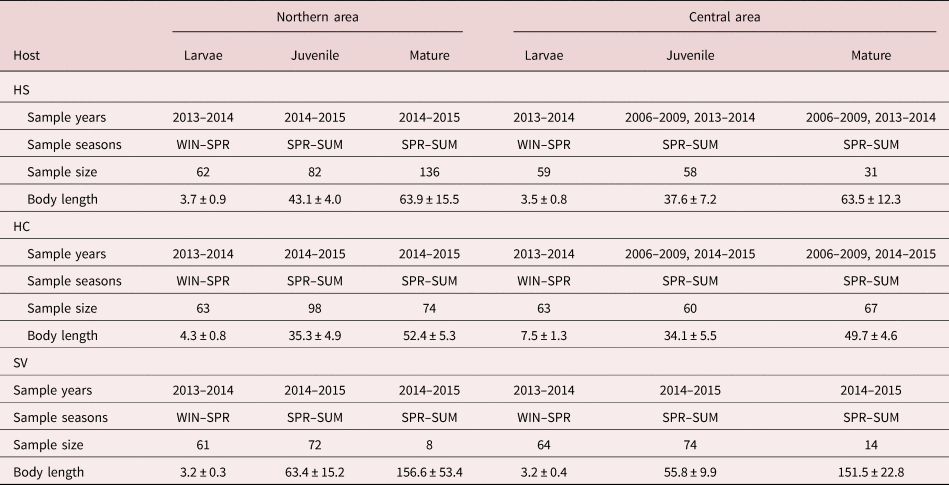
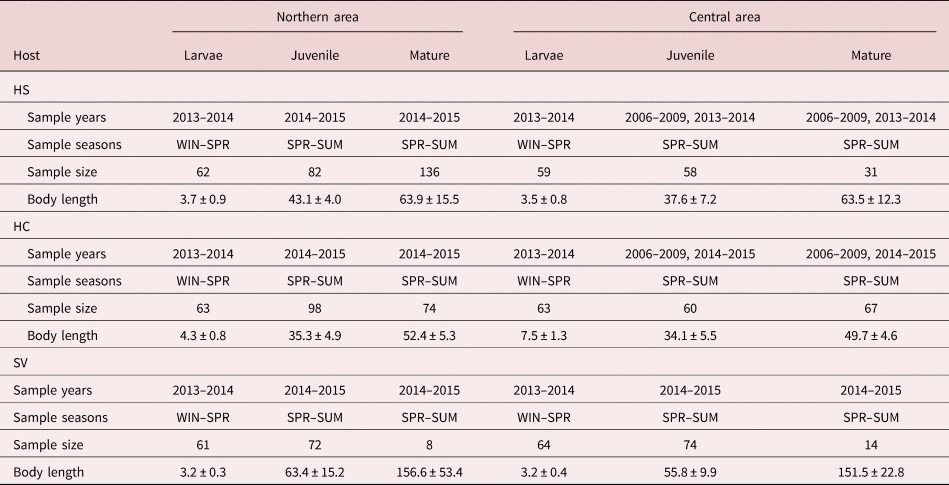
Fish were collected from two localities on the northern Chilean coast: Isla Santa Maria (23°26′S) and Coloso (23°45′S), Antofagasta; and at two localities on the central Chilean coast: Las Cruces (LC) (33°30′S) and Isla Negra (IN) (33°25′S), Valparaíso. Samplings took place during the years 2006–2009 and 2013–2015 in Valparaíso, and 2014–2015 in Antofagasta, and the larval fish were collected during 2013–2014 (see more details in table 1). Juvenile and mature fish were captured from rocky intertidal pools with anaesthetic solution (0.1%, AQUI-S®, Bayer S.A., Santiago, Chile) and hand-nets. The fish were placed in plastic bags and transported to the laboratory. Larval sampling was conducted from an artisanal fishing vessel in the nearshore region (<500 m offshore), by oblique hauls of a Bongo net (with two conical nets of 60 cm diameter with a 300 µm mesh size) at 20 m depth for 10–15 min. The samples of one net were initially fixed with 5% formalin, buffered with sodium borate and preserved in 96% ethanol after 12 h.
Sample periods (years and seasons), number of examined specimens (sample size) and mean body length ± standard deviation (mm), according to host stage, of Hypsoblennius sordidus (HS), Helcogrammoides cunninghami (HC) and Scartichthys viridis (SV), from the northern (23°S) and central Chilean coast (33°S).
WIN, winter; SPR, spring; SUM, summer.
Fish were examined either fresh or frozen (−10°C). A ruler was used to measure (in mm) the body length (BL) of each fish, and the stage of sexual maturity was determined by external observation of the gonads. For each fish species, individual fish were sorted by ontogenetic stage: larvae, juvenile (with small and translucent gonads) and mature (white colour in males, and pink/orange in females). The fishes were identified in the field using the descriptions of Medina et al. (Reference Medina, Vega and Araya2004) and Balbontín & Pérez (Reference Balbontín and Pérez1979). The identified larvae were measured in BL (in mm) using a 5.0 MPx Moticam 2500 (Motic Instrument, Richmond, Canada) connected to an Olympus SZ-61 stereomicroscope (Olympus Corporation, Tokyo, Japan), and Motic Images Plus 2.0 software (Motic China Group, Xiamen, China).
The skin, fins, gills (in all three life stages) and opercular cavity (except for the larval stage) were examined to record the presence of ectoparasites using a stereomicroscope Leica M80 (Leica Microsystems, Wetzlar, Germany). The digestive tracts were removed to collect the endoparasites. All organs of juvenile and mature fish were washed with running water and filtered through a 175 mm filter. The retained material was inspected under a stereomicroscope. The collected parasites were fixed in alcohol–formalin–acetic acid solution or preserved in absolute ethanol in individual tubes for subsequent molecular analyses. Ecto- and endoparasites were identified to the lowest taxonomic level possible based on their morphology, following Cribb (Reference Cribb, Jones, Bray and Gibson2005), Moravec (Reference Moravec1998), Jones & Bray (Reference Jones and Bray1994) and Petrochenko (Reference Petrochenko1958). Then, the digenean species identifications were supported using the v4 region of the 18S gene (unpublished data). The sequences of each collected species were compared among them and with sequences obtained from GenBank, and the genetic distance was used to discriminate among different species.
For each fish species, population descriptors (prevalence and intensity) and species richness per ontogenetic stage (larval, juvenile and mature) were calculated following Bush et al. (Reference Bush, Lafferty, Lotz and Shostak1997), and generalized linear models were used to evaluate the effect of host ontogenetic stage (juveniles and mature fish) and geographic area on parasite species richness, with BL as a co-variable. A Poisson distribution was used for the response variable and a log link function (Venables & Ripley, Reference Venables and Ripley2002). These statistical analyses were performed using R-Studio v1.1.383 software (RStudio IDE, Boston, USA).
Results and discussion
A total of 1146 fish belonging to H. sordidus, H. cunninghami and S. viridis were examined; 656 from the northern area and 490 from the central area. The BLs per development stage and geographical area for each host species are given in table 1.
In the northern area, a total of six, seven and ten parasite species were recorded in H. sordidus, H. cunninghami and S. viridis, respectively: four ectoparasites (three Copepoda and one Monogenea) and 17 endoparasites (one Acanthocephala, 14 Trematoda and two Nematoda) (supplementary tables S1–S3). In the central area, a total of four, five and 15 parasite species were recorded in H. sordidus, H. cunninghami and S. viridis, respectively: eight ectoparasites (four Copepoda, three Monogenea and one Hirudinea) and 13 endoparasites (two Acanthocephala, eight Trematoda, two Nematoda and one Cestoda) (supplementary tables S1–S3).
For H. sordidus, the parasite richness per mature fish was significantly affected by geographic area and BL, but not ontogenetic stage (table 2). For H. cunninghami, the parasite richness was significantly affected only by geographic area (table 2). For S. viridis, parasite richness was significantly affected by fish ontogenetic stage and BL, but not geographical area (table 2).
Results of generalized linear models for parasite richness of Hypsoblennius sordidus, Helcogrammoides cunninghami and Scartichthys viridis in the different geographic areas and ontogenetic stages.

Statistically significant relationships (p ≤ 0.05) are indicated in bold.
Higher levels of parasite intensity and prevalence were found in mature fish. Trematodes were the most common endoparasites in juveniles and mature stages, but were absent in fish larvae. In H. sordidus and H. cunninghami, opecoelid species were only present in fish from the northern area where no ectoparasites were recorded for these fish species (supplementary tables S1 and S2). The copepod Trifur sp. (in the larval stage) was only recorded in larval fish of H. cunninghami. In S. viridis, Neobenedenia melleni, Hemipera cribbi, Lecithaster cf. macrocotyle, Monorchimacradena viridis, Lepeoptheirus zbigniewi, Microcotyle sp. and Pseudophillydea gen. sp. were most prevalent in the central area (supplementary table S3).
This study evidenced the importance of geographic area in parasite composition of the intertidal fish. Several studies examining parasites of intertidal fish (juvenile and adults) species from the central south coast of Chile (Muñoz & Delorme, Reference Muñoz and Delorme2011; Muñoz & Randhawa, Reference Muñoz and Randhawa2011; Leiva et al., Reference Leiva, López, González and Muñoz2017) have not reported the digenean species (opecoelid spp.) present in this study in northern Chile. Additionally, as this is one of the first studies about intertidal fish species from northern Chile, several digenean species reported here could correspond to new undescribed parasite species.
Along the Chilean coast, the three fish species showed differences in parasite community composition between geographic areas (24°S and 33°S). Previous studies (González & Moreno, Reference González and Moreno2005; González et al., Reference González, Barrientos and Moreno2006) have shown that only endoparasite species exhibit a biogeographic pattern concordant with known biogeographical areas. In this study, although the host geographical range analysed was more limited (24–33°S), both endo- and ectoparasite species were relatively different between biogeographic areas. For example, digeneans such as opecoelid species were only registered in fish collected in the northern area, whereas ectoparasites such as Piscicolidae gen. sp., Holobomolochus chilensis and N. melleni were only registered in specimens from the central area.
The life cycles for most of the trematode species recovered are unknown. However, it is possible that the presence of opecoelid and other endoparasite species in the localities of the northern area, and their low prevalence in the localities of the central area (only in S. viridis), is a result of geographical variations in prey items or in the availability of infected prey (i.e. the intermediate host). In this context, the discontinuities in hydrography (e.g. oxygen-minimum area) registered at 30°S on the Chilean coast (Camus, Reference Camus2001; Guiñez et al., Reference Guiñez, Valdés and Sifeddine2010) may affect the distribution or availability of intermediate hosts involved in the life cycle for opecoelid species (González et al., Reference González, Barrientos and Moreno2006). It is known that the species composition of invertebrates and vertebrates tends to vary along the Chilean coast (Ojeda et al., Reference Ojeda, Labra and Muñoz2000; Valdovinos et al., Reference Valdovinos, Navarrete and Marquet2003). On the other hand, ectoparasites have direct life cycles and their distribution is determined mainly by environmental factors and behaviour of their hosts (González & Oliva, Reference González and Oliva2009). Therefore, the different environmental conditions between the northern and central areas may influence the composition of ectoparasites present in each of the fish species. The existence of a surface water layer known as the oxygen-minimum zone in the northern area (Escribano et al., Reference Escribano, Marín and Irribarren2000) could inhibit the survival of some ectoparasite species. This hypoxia may prevent them from infecting intertidal fish such as H. sordidus, but not fish in the subtidal and demersal habitat where several ectoparasite species have been recorded in the northern latitudes of the Chilean coast (Oliva & González, Reference Oliva and González2005; González & Oliva, Reference González and Oliva2009).
The higher parasitic richness in mature fish can be explained by a higher exposure time to parasite infection of fish as well as by fish-ontogenetic dietary changes (Muñoz et al., Reference Muñoz, Valdebenito and George-Nascimento2002; Muñoz & Zamora, Reference Muñoz and Zamora2011). Fish larvae of H. sordidus and S. viridis were not infested by ecto- or endoparasites, whereas three larvae of H. cunninghami were parasitized by pennellid copepods. Infestation may have been limited to H. cunninghami due to differences in larvae; most of the larvae of H. sordidus and S. viridis were found to be in the small preflexion stage (3.2 ± 0.3 and 3.7 ± 0.9 mm, respectively), whereas larvae of triplefin H. cunninghami were rather larger and at the postflexion stage (4.3 ± 0.8 mm). Landaeta et al. (Reference Landaeta, Contreras, Bustos and Muñoz2015) determined that larvae of small size and/or early development, as well as reduced abundance in nearshore waters, may preclude copepod infestation in these fish species. Additionally, the absence of endoparasites in fish larvae could be attributed to these larvae inhabiting the plankton for a short period (three months planktonic duration on average; Mansur et al., Reference Mansur, Plaza, Landaeta and Ojeda2014) and/or feeding of small prey (mostly crustaceans eggs and phytoplankton) that may not harbour parasites. Juveniles and adult fish inhabiting the intertidal zone have a broader trophic spectrum and feed on larger organisms including sessile and/or slow-moving (e.g. molluscs) and active animals (e.g. crustaceans) (Muñoz & Ojeda, Reference Muñoz and Ojeda1997). Most endoparasitic species use intertidal organisms such as molluscs and crustaceans as their intermediate hosts (Muñoz & Zamora, Reference Muñoz and Zamora2011; Leiva et al., Reference Leiva, George-Nascimento and Muñoz2015). The increased consumption of crustaceans and molluscs by juvenile and mature fish, therefore, increases the possibility of acquiring a higher number and diversity of parasites.
In conclusion, our results suggest that geographical area is the main factor influencing the parasite composition of intertidal fish. The differences in the parasite composition could be associated with geographical changes in the diet of the fish, or with the availability of infected prey due to hydrographic barriers affecting prey distribution. This hypothesis could be tested by future studies that focus on the intermediate hosts of the recorded parasite species to advance knowledge of their life cycles.
Supplementary material
To view supplementary material for this article, please visit https://doi.org/10.1017/S0022149X20000061
Acknowledgements
We thank Lissette Paredes for his help in fish sample capture in Antofagasta and Dr Mauricio Landaeta for letting us use her laboratory during the course of this investigation.
Financial support
This study was partially funded by the project Semillero, Dirección de Gestión de la Investigación, Universidad de Antofagasta (M.T.G., grant number 5303); and projects FONDECYT (G.M., grant number 1120868; M.G.N., grant number 1130304).
Conflicts of interest
None.
Ethical standards
All fish were killed following the strict codes of practice according to CONICYT, Chile.