Die Meistersinger von Nürnberg begins with a scene evoking a formative period in the development of German national identity – a Protestant church service in Nuremberg's Church of St Catherine ‘circa 1550’.Footnote 1 The curtain opens to historicising stage music: the concluding chorale for the feast of St John's Eve, which paraphrases Luther's hymn for this day and gestures towards Bach and beyond.Footnote 2 At the same time, there is also something quite ahistorical about this scene, or rather, its sound: each line of the chorale is interrupted by a wordless exchange between the hero and heroine, Walther von Stolzing and Eva Pogner, who attempt to communicate with each other through passionate gestures accompanied by a more chromatic nineteenth-century idiom, one that first alternates with the measured course of the church service, then almost threatens to engulf it.
Some years ago, I suggested that Wagner's opening chorale, with its typological invocation of John the Baptist at the Jordan as a predecessor of Christ, also establishes a typology between the first and last scenes of the opera.Footnote 3 That is to say, the introductory sixteenth-century Protestant church service foreshadows the concluding celebration along the banks of the Pegnitz outside Nuremberg, with its obvious representation of nineteenth-century festival culture. The congregation in Act I thus anticipates and is fulfilled by the crowds in Act III, which are consistently designated as das Volk, a secularised society with a consciousness of itself as an entity with a historical destiny – a consciousness fundamental to the development of German identity in the nineteenth century. This sweeping historical shift reflects Wagner's sophisticated use of cultural history in anticipation of German unification in 1871.Footnote 4
At the same time, however, there is also an individual component to this opening chorus, which is the topic of the following discussion: the congregation's celebration of John the Baptist's baptism of Christ also prefigures ‘John’ Sachs's baptism of Walther's dream song in Act III, and perhaps of Walther himself as the – pardon the expression – ‘composer of the future’.Footnote 5 Somewhat surprisingly, Wagner's young hero has not attracted much critical scrutiny, in part because scholarship gravitates to the monologues of Hans Sachs, with their apparently more futuristic musical and philosophical agendas, and in part because of the deceptive appearance of Walther's numbers as straightforward diegetic music or stage songs.Footnote 6 Indeed, a recent article concludes that Walther's songs are consonant with nineteenth-century harmonic conventions, which by itself makes it difficult to explain the songs in the context of Die Meistersinger as a music-drama – for example, why he fails the Trial Song or how he develops across the course of the action.Footnote 7 The following observations will suggest that Walther's songs need to be analysed as texted music with a historicising agenda. As with the chorale, Wagner inflects his hero's career with nineteenth-century concerns, juxtaposing the Meistersingers' pre-modern rule-driven poetics of imitation with a Romantic aesthetics of inspiration.Footnote 8 Secondarily, Walther's songs also engage fundamental issues about the nature of musical creativity and the composer's role in the emerging German nation-state – the obvious beneficiary of which is a composer whose initials are R.W.
I
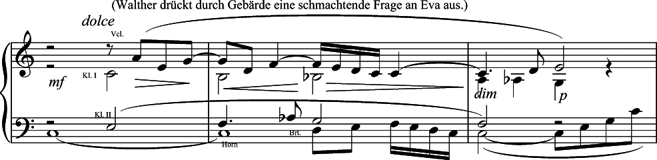
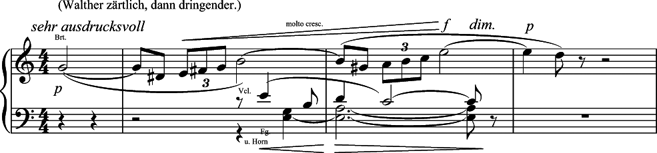
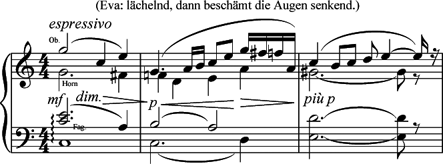
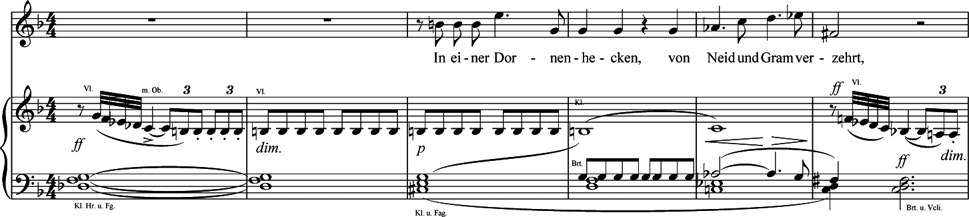
Walther von Stolzing's mute appearance in the opening scene seems rather inauspicious, and – given our modern aversion to highly gestural acting – rather comic. While the Protestant congregation begins the chorale (‘Da zu dir der Heiland kam’) in a measured four-bar C major phrase with organ accompaniment, Walther silently ‘expresses through gestures a languishing question to Eva’ (drückt durch Gebärde eine schmachtende Frage an Eva aus), his desire underpinned at first by a solo cello in falling fourths and restless motion often designated as the ‘love motif’ (Ex. 1a).Footnote 9 After Eva responds in kind, Walther gestures again, ‘tenderly, then more imploringly’ (zärtlich, dann dringender), to another version of the ‘love motif’, characterised again by a falling interval and by rising triplets, this time with a solo viola (Ex. 1b). The process is repeated again, with a third variant of the ‘love motif’ appearing at the conclusion of Walther's and Eva's third attempt at silent communication, a variant that anticipates the resolution of their mutual longing in the Prize Song (Ex. 1c). These inarticulate expressions are crucial to the ensuing music drama. Inasmuch as Walther's actions are driven by desire, it's not surprising to find that these ‘love-motifs’ and their elaboration – rather than melodic invention – dominate his musical trajectory. The hero has one theme, and he belabours it with intense determination.

Die Meistersinger, Act I, scene 1: The so-called ‘love-motif’.
Immediately after the church service, however, we learn how problematic Walther's ardour might be in sixteenth-century Nuremberg when Eva finally answers his attempts to ask if she is already betrothed by repeating his question, ‘er fragt – ob ich schon Braut?’ (he asks: if I'm already betrothed?) The question is punctuated by a half-diminished seventh chord, spelled with the same pitches (f, b, d♯, g♯) and with the same orchestration (minus the cor anglais) as its first occurrence in the Prelude to Tristan und Isolde. The citation of the Tristan chord, a signifier of passionate longing – indeed, adulterous desire – to underpin a question about marriage draws attention to a radical disjuncture between the lovers' sudden and intense affinity, on the one hand, and their conservative bourgeois surroundings, on the other. Even talking to Eva in private after church is a breach of etiquette, ‘der Sitte Bruch’, and this desire will have to be tamed, both socially and musically.Footnote 10
Walther's development across the opera is instantiated primarily through a series of stage songs and the events surrounding them: the Trial Song in Act I and the Prize Song in Act III, which actually consists of two versions, the Dream Song presented for Sachs's commentary at the beginning of Act III and then its revision in the Prize Song during the public singing contest. In addition to these explicit performances, though, there's an earlier moment that seems to straddle the boundaries between normal operatic discourse and diegetic performance, and we should begin with it as the beginning of Walther's compositional career. That moment, significantly, involves the hero's responses to three questions about his qualifications to be a Meistersinger: 1) his teacher, 2) his school and 3) whether he is prepared to demonstrate his proficiency with a new text and melody. Walther responds, not in the opera's normal discourse of rhymed couplets, but in three carefully composed stanzas, which comprise two Stollen and an Abgesang.
The Interview
As the list of rhymes in the margin indicates, the first two answers form two Stollen of a Barform in what Walther knows from his ancestral manuscript as Minnesang: each has the identical initial pattern (aabbb), followed by three final lines in which a third rhyme brackets an unrhymed penultimate line (marked x in the list), known in Meistersinger terminology as a Weise or orphan. These unrhymed lines also rhyme homophonically with each other: a proper name in the first stanza – Vogelweid (Walther von der Vogelweide) – and a noun in the second – Vogelweid (bird meadow), a virtuosic feat called Korn.Footnote 11 Since Meistergesang was conceived ideologically as an urban renovation of Minnesang (and for the first half of the nineteenth century was also largely considered identical to itFootnote 12), it's not surprising that one of Walther's interviewers – ironically, his name is Veit Vogelgesang [Birdsong] – explicitly notes that the young man's responses have provided a frame for two charming Stollen: ‘Zwei art'ge Stollen faßt er da ein.’ Not for nothing does our hero have the same first name as the teacher from whose songbook he has learned.Footnote 13
At the same time, Walther von Stolzing's responses differ formally in one obvious way from Minnesang, which traditionally uses a Natureingang or invocation of the natural world at the beginning of the song as a mirror of human social concerns. In contrast, each of Walther's two Stollen begins with a Natureingang, and together they set up an antithesis, juxtaposing winter (Winterszeit) and summer (Sommerzeit) in lines 1–2 of each stanza respectively, refer to each other in lines 3–4 (Lenz, Wintersnacht), and reveal an underlying thesis and antithesis in line five – learning from books versus learning from nature, from art song versus bird song.
Moreover, as the beginning of the third stanza or Abgesang teasingly suggests, Walther might even be a Minne-singing proto-Hegelian, striving for a sublation of opposites – winter (Winternacht) and spring (Waldespracht), book (Buch) and grove (Hain), culture and nature. But Walther never reaches any such synthesis. Instead, the opening opposition quickly devolves into a laundry list of life experiences, each beginning with ‘was’ (what), before pausing at the challenge of transforming the flood of events into song. And while the penultimate line even raises the question whether he can write Meistergesang: ‘ob ich den weiß’ (if I know how), the word that Walther chooses as his last word to characterise his performance, the infinitive ergießen (to pour out), suggests that his effusions lack formal restraints.Footnote 14
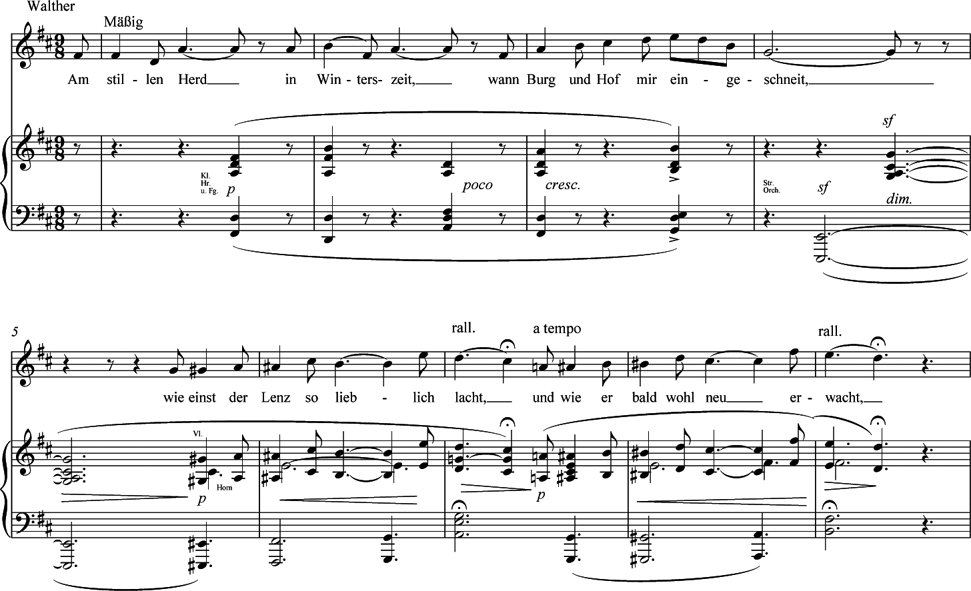
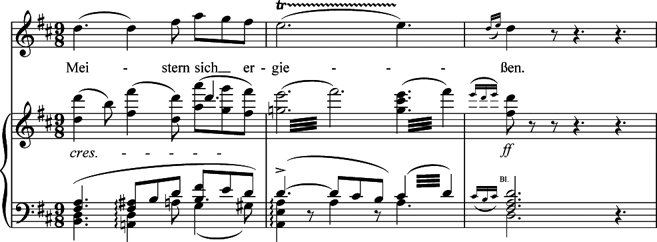
Walther's three responses here are clearly intended as diegetic poetry, distinct from the surrounding dialogue in rhymed couplets – indeed, as we just noted, the first two responses are identified as Stollen by Vogelgesang. But are they also, as most interpretations tacitly assume, also diegetic song, that is, is Walther responding to the questions by ‘singing’ – something not suggested by the prose drafts of the libretto? The evidence at the beginning of the scene is not clear-cut. There is no formal command to begin (‘Fanget an!’), used elsewhere in the opera to draw attention to formal Meistersinger performance; nor does the orchestral introduction provide the usual arpeggiated gesture suggesting a singer accompanying himself on a stringed instrument before an audience.Footnote 15 Rather, a knowing and narrating orchestra presents the motif of his longing from the opening scene in the horns, then in the bassoons and oboes and a solo viola, filling all its registers with his desire and revealing the motivation behind the attempt to become a Meistersinger (Ex. 2a). Not surprisingly, the vocal line of this inexperienced composer has an aura of clumsiness – the first quatrain, for example, consumes nine bars, with the first phrase ending awkwardly on an unstable scale degree 4 (‘geschneit’) with no orchestral support; there follow some lurching sforzando chords and then a sequence of two shorter phrases that end prematurely and elide into fermatas (on ‘lacht’/‘wacht’). Nonetheless, Walther eventually cadences on the tonic of D with a spectacular one-bar trill, which implies singing, not to mention the kind of outpouring appropriate to his concluding word ergießen (Ex. 2b).
Die Meistersinger, Act I, scene 3: Walther's first answer in his ‘Interview’.
Die Meistersinger, Act I, scene 3: conclusion of Walther's ‘Interview’.
Wagner's principal source on the Meistersinger, Johann Christoph Wagenseil's Buch der Meister-Singer Holdseligen Kunst (1697), seems to provide an explanation for this quasi-performative response.Footnote 16 In Wagenseil's description, the interview questions and answers determining whether a candidate be admitted to the guild are sung to different Meistersinger melodies (apparently without instrumental accompaniment). The interviewer introduces the candidate ‘mit Gesang … in der Strohalm Weis’ and asks about the origins of Meistergesang, which the candidate answers ‘In der grünen Liljen-weis’, and so on through five questions and responses.Footnote 17 Walther's Barform thus corresponds instinctively to traditional Minnesinger and Meistersinger practice, even following Wagenseil in having the last line of each of his three responses paraphrase the question it has answered.
II
Before Walther is allowed to proceed to the Trial Song there is a mandatory recitation from the Leges Tabulaturae, intended as a guide for composition. Wagner's suggestive designation of the rules with the nonce phrase ‘Richt und Schnur’ (guide and line) draws attention to the Masters' understanding of music as one of the mechanical arts,Footnote 18 based by analogy on the artisanal production of medieval guilds. Not surprisingly, Die Meistersinger abounds in jokes relating the cobbling of rhymes and melodies to the cobbling of shoes, something most obviously exemplified by Hans Sach's working song in Act II, ‘Jerum, Jerum’, his only diegetic piece in the opera. Such highly regulated procedures presuppose that a candidate will appear at a trial not only having been certified as a poet and singer, but also having finished a ‘Meisterlied’, a master-song that extrapolates from an inventory of topics, has been composed in accordance with the rules, is memorised and ready to be performed as written.
Unfortunately, that is not the case here, since Walther's desire to become a Meistersinger coincides with his falling in love with Eva the day before. This obvious discrepancy caused Wagner considerable difficulty across the genesis of the opera. In initial prose drafts, where Walther's only qualification consisted in having written imitation medieval poetry, the Masters assigned him a less stringent task: composing a new text to a pre-existing melody selected from a list of Meisterlied titles. But he begins to perform ‘im Ton der alten Minnesänger’, and then, seeing he is lost, sings about his beloved with mounting enthusiasm.Footnote 19 This still violated the rule requiring a new text and new melody for entrance to the guild, and Wagner therefore decided in the 1862 verse draft to represent Walther's attempt at spontaneous songwriting.Footnote 20 The lover of medieval poetry thus became a lover trying to compose.
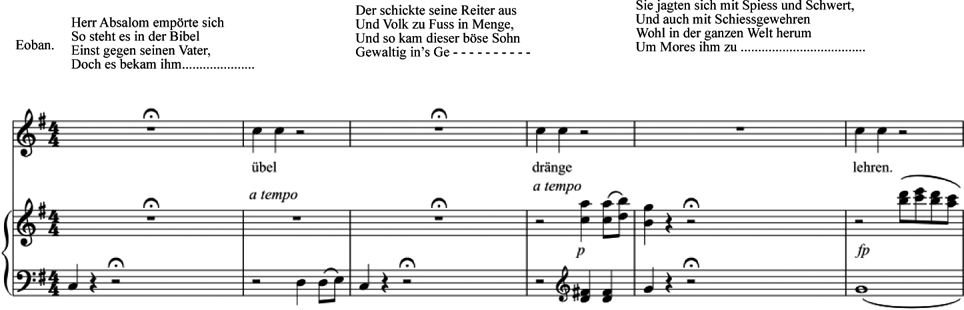
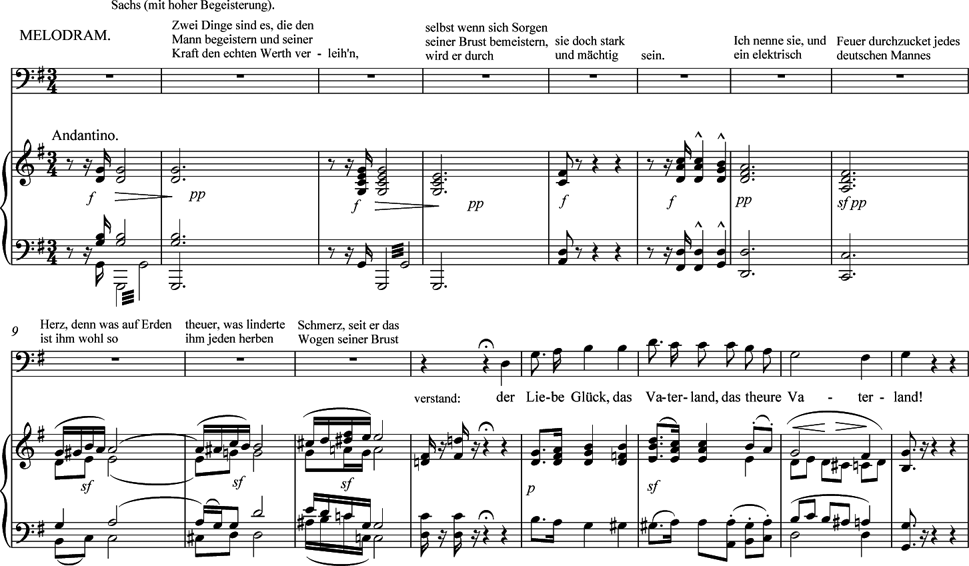
There may well be another reason for this decision: the desire to outdo a similar trial scene in Lortzing's opera Hans Sachs (1840), in which the eponymous young hero must compete with a Beckmesser-like rival for the hand of the heroine. Lortzing cleverly opens his second act with the song contest already finished: the Meistersingers, bribed in advance, have voted for the pedant Eoban Hesse, while the people of Nuremberg noisily acclaim Sachs as the true victor. To avert a riot, a further contest is proposed – improvisation. The contrasts in this melodram are instructive. Whereas Eoban takes refuge in the biblical story of Absalom, and has difficulty finding rhymes, let alone inventing any musical accompaniment beyond arpeggiation (Ex. 3a), Sachs chooses the ‘electric’ topic that moves every German heart, happiness in love and the beloved fatherland (‘der Liebe Glück, das liebe Vaterland’), underpinning his conviction with a gesture towards a well-known national anthem (Ex. 3b).
Lortzing, Hans Sachs, Act II: beginning of Eoban Hesse's ‘Prize Song’.
Lortzing, Hans Sachs, Act II: beginning of Hans Sach's ‘Prize Song’.
Not bad for c.1520, or even 1840, for that matter! Eoban's pre-modern religious theme is typical of sixteenth-century Meistersinger practice, which actually forbade love songs,Footnote 21 while Sachs's secular theme is proleptically modern, preoccupied with two forms of individual desire, love in the private realm and patriotic fervour in the public sphere. Wagner obviously learned much from this scene for his treatment of Beckmesser and Walther.
Of course, after the revolution of 1848 the ‘electric’ topic of patriotism was considerably less attractive, and Walther's Trial Song understandably focuses only on love. Inasmuch as the hero has no experience in Meistergesang, he also has no collection of topoi to work with, and is forced instead to improvise on his own uncontrolled subjectivity. The result is predictable: unlike the medieval Minnesang that he presumably knows, which usually has Stollen of from two to four lines, Walther's first Stollen is huge, sprawling across some twenty-nine lines.Footnote 22 This distended structure prevents most of his examiners from noticing its Barform, but should not prevent us from being very suspicious, as we will see in a moment. The entire text, printed in Appendix I in such a way as to emphasise that form, will help suggest why.
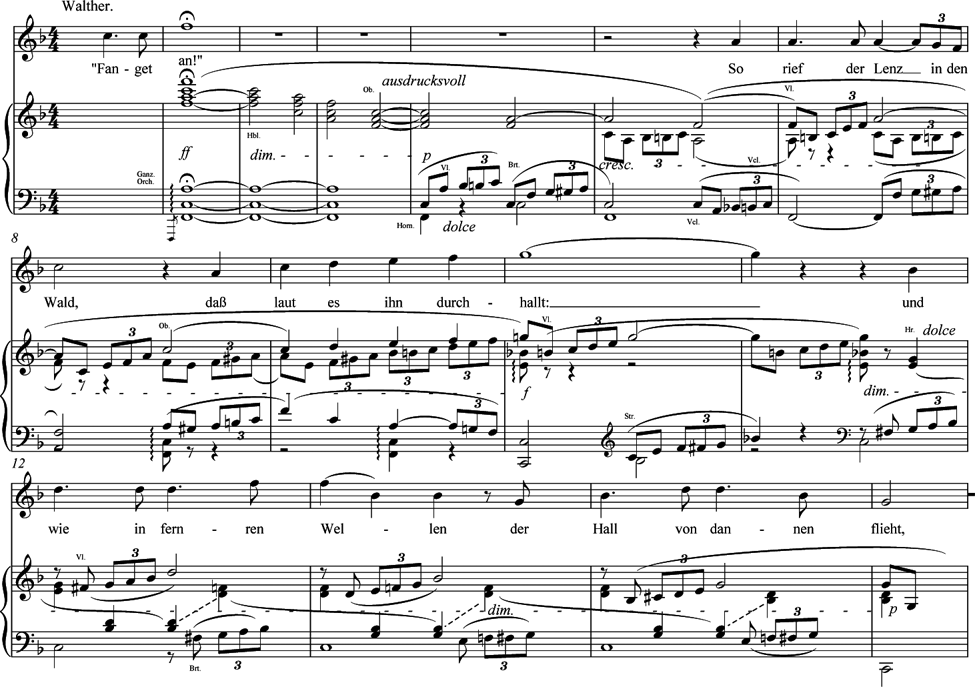
Beckmesser initiates the performance with the command to begin (‘Fanget an!’), which is followed by a bar of silence, a V7 chord, and an anxious flurry of rising semiquaver (sixteenth) notes in the orchestra.Footnote 23 Walther begins ‘nach einiger Sammlung’ (after some reflection) as he responds improvisationally to the Marker's command by incorporating it into his performance, immediately rising a fourth to the tonic, a long (semibreve/whole note) high F held as a fermata, which the orchestra underpins with a full fortissimo chord, followed by a slow temporising descent of F major chords. In this interval the hero devises his compositional strategy. His vocal line is still awkward, the first phrase rising resolutely to a high G (at ‘durch-hallt’), held over into a fifth bar, while a V7 accompaniment and then a C pedal tread water furiously as he tries to imagine the reverberations of his/spring's exuberant outburst (Ex. 4a). But clever lad and desperate lover that he is, Walther does not actually create this song from scratch; in fact, its locale is the very same bird-infested forest in which he learned to sing, and the music to which he sets his text, first in the accompaniment and then in the melody at ‘Es schwillt und schallt’ (line 8), is built on the so-called ‘love motifs’ that underpinned his inarticulate gestures in church that morning. Walther's desire now finds words and music, projecting his longing throughout the entire throbbing realm of nature.
Die Meistersinger, Act I, scene 3: beginning of Walther's ‘Trial Song’.
Die Meistersinger, Act I, scene 3: Walther's ‘Trial Song’ ‘digresses’.
In spite of its improvisational beginning, the text reveals careful long-range planning: Walther's citation of the command ‘Fanget an’ eventually culminates in the rhyme ‘stimmte an’ nineteen lines away in the penultimate verse, a connection emphasised musically by the prominent leaps of a fourth and a fifth to a high F and then a high A, respectively. In turn, this long-distance connection culminates in an unrhymed Waise in the last line, Lenzeslied (spring song), which will eventually find its counterpart – twenty-nine lines later in the second Stollen in the unrhymed word Liebeslied (love song), producing – you guessed it: Korn – a rhyme across the conclusions of both Stollen, which terminate, not surprisingly, on the all-important word Lied, the production of which is precisely what this performance is all about. It seems as if the hero has progressed from his brief interview responses to large-scale forms, even creating internal refrains in lines 16–21 and 45–50.
The teleology of rhyme across the first Stollen has a counterpart in the text's evocation of an extraordinary acoustical space, in which the call of spring in the forest resounds across vast distances, then returns through the forest, growing in volume and intensity through the response of a massed avian chorus, a motion propelled by contrapuntal motion and constantly shifting dynamics. In spite of the brief gesture towards arpeggiation in the introduction, this is not a text for lute accompaniment like Beckmesser's songs. Walther's three-dimensional, sonically active forest requires a full Wagnerian orchestra, with its chromatic passing tones and restlessly surging motion. In fact, the second Stollen, although obviously a counterpart to the first, requires even more. Juxtaposing the world outside with the world inside, Walther proceeds from the call of spring in the forest to the call of love within his own heart. The interior space it invokes is even vaster than the forest, filled with pulsing beats, throbbing emotions, rapidly coursing blood on a warm night, swelling to a vast ocean of sighs and wild tumults of ecstasy – for the expression of which the hitherto absent harps are added.Footnote 24
It looks, then, as if Walther is again attempting to present an opposition in Barform, which will be resolved in the Abgesang or final section of his song. Of course, the actual performance of the Trial Song does not run its course in the way that Walther anticipates, since his cadence at the end of line 21 is followed by Beckmesser's disruptive sighs and a flurry of loud chalk marks registering errors. Only briefly unsettled, the hero incorporates the disturbance into his song (Ex. 4b).
The aside on Beckmesser's slating of his performances remains within the conceptual framework of his song, imagining the sounds as coming from a thorn hedge, whence Winter (aka old Beckmesser) enviously tries to disturb the happy forest song. Unsettled by anger, Walther's music explores the boundaries of his original key of F,Footnote 25 a staccato – and alienated – reminiscence of the Merker's markings barely underpinned by the orchestra, before recovering his bearings. What appears to be a deviation is being recuperated as a second theme within the first Stollen.
Walther then begins his second Stollen with an allusion to his improvisational beginning of the first: ‘Doch fanget an!’, continuing then – as I just suggested – to explore the counterpart to the vast forest in the vast interior space in his own heart, an exploration that again concludes in a cadence (line 50), at which point Beckmesser tears open the curtain of the Marker's box and brings the performance to an apparent conclusion with the nasty tritone question: ‘Seid Ihr nun fertig?’ (Are you finished?) Analyses of the Trial Song at this point necessarily diverge into two subgroups, based either on the song ended by this interruption or on the song that Walther eventually finishes at the end of Act I amid the cacophony of the Meistersingers' discontent.
The foreshortened song has drawn the most attention, and for compelling reasons. For one thing, as Carl Dahlhaus observed, there is a wonderful historical irony in Beckmesser's (and the Masters') condemning while perceiving as finished Walther's first and second Stollen with the intervening commentary on Beckmesser: the three sections comprise a Bogenform, an ABA or – as Dahlhaus suggests – a da capo-like structure, which will subsequently become so important in the development of opera. If we pick up on the cue and designate Walther's fragment as ‘music of the future’, a further irony unfolds, namely that the Masters' rejection anticipates by three centuries the criticisms levelled against Wagner's music by his contemporaries, as Thomas Grey has most recently suggested.Footnote 26 These consist especially in the emphasis on continuous music over discrete numbers, and motivic organisation over melody and vocal display: ‘zu kurz, zu lang – wer ein End da fänd?’ (too short, to long – who could find an end?);Footnote 27 ‘Kein Absatz wo, keine Koloratur, / von Melodei auch nicht eine Spur!’ (No break anywhere, no coloratura, not even a trace of melody).
The ironies deepen if we, in contrast to the Meistersingers, accede to Hans Sachs's plea to let Walther finish his song. Sachs's reasons are sensible on the surface, namely that Walther's song is something new and not confused. Not surprisingly, Wagner's ventriloquistic suggestions for listening to this ‘new’ way of composing are not derived from the rule-driven neo-Aristotelianism characteristic of Renaissance poetics, but from a post-Enlightenment aesthetic based on inspiration, to which general rules do not apply, but from which rules for understanding individual genius can be discerned:
Moreover, there's a further surprise waiting for us if we piece together the song that Walther eventually finishes amidst the clamour of the Meistersingers' dissention. The entire composition, unusual in that it contains Stollen with a theme and counter theme each (the latter containing the Beckmesser digressions), is still an old-fashioned Barform: A[a1b1] A′[a2b2] B. When Walther continues, he begins with a second subsection to the second Stollen, in character with the first digression, imagining a nasty chorus of owls, ravens, magpies, crows and jackdaws to the pizzicato Beckmesser rhythm, again teetering in F, this time as a long dominant harmony. More important: it concludes with an Abgesang that imagines a marvellous golden bird rising majestically above the fowl air of the city and flying back to the origins described in his introductory interview, the bird-meadow or Vogelweide where Meister Walther (von der Vogelweide) first drew his interest. Here he will sing regardless of the Master-crows' opinion – a pointed rejection of the Meistersinger aesthetic.
III
Act I's pattern of preliminary interview, public performance and rejection of the Meistersinger seems to be repeated in Act III in the discussion of Walther's dream in Sachs's study and the ensuing Prize Song contest on the Festival Meadow, which themselves also involve repetition – a process that has raised at least one discerning post-Adornian eyebrow.Footnote 28 But in addition to my observation at the outset of this article that the lovesick Walther endlessly elaborates on his one great theme (after all, what is love but thematische Arbeit?), I would like to suggest that such repetition also invites us to consider the changes in his songs across the course of Die Meistersinger. In much the same way as Wagner's shift from the church service in Act I to a public festival in Act III enables us to see the sixteenth-century congregation as anticipating a unified Volk, the introduction of Walther at a pre-modern stage of creativity, involving the study of ancient masters and imitation of nature,Footnote 29 begins a progression to a desire-driven interiority in the Trial Song, which continues in Act III to an even more modern psychological working out of the dream-materials produced by his own subconscious. And along the way he also learns to ‘compose’ as an activity that mediates between static rules and rampant desire.
Act III opens with Hans Sachs ruminating in his sunlit study, surrounded by folio volumes – a scene that pointedly recalls the opening of Goethe's ‘Hans Sachsens poetische Sendung’,Footnote 30 an occasional poem written on the 200th anniversary of the poet-cobbler's death (1776), which subsequently begat the dramatisation by Ludwig Deinhardstein (1820),Footnote 31 which begat the libretto for Lortzing's Hans Sachs, and now casts its matutinal intertextual shadow on Wagner's Schopenhauerian puppeteer of human delusion. Although it is not mentioned explicitly, Sachs is reading the Nuremberg Chronicle (1492), which provides his ‘Wahn-monologue’ with the reference to Nuremberg as the symbolic middle of Germany (‘in Deutschlands Mitten’).Footnote 32 Not just historicising precision, this geographical detail has far-reaching consequences, implicitly imbuing the Dream Song and the Prize Song with national-allegorical resonances, since the reward for which Wagner's young stalking horse strives is not just the hand of Eva in Paradise (aka Nuremberg), but the acclaim of Germany as well, which – as the response of das Volk on the festival meadow suggests – will not be far behind.
Surprisingly, the idea of portraying Walther as a developing composer by presenting the Dream Song as a rough draft and the Prize Song as its revision was almost an afterthought.Footnote 33 In the first prose sketch, Walther wrote a Minnesang text after the riot, and then went prosaically to bed. For the first printed libretto of 1862, he composed a dream song rather different from the one we know, and repeated it verbatim in the song contest.Footnote 34 Only in the finished opera does he spontaneously revise and recompose the Dream Song after beginning to repeat it in the prize contest. In part this has to do with providing a pointed contrast with Beckmesser, who fails because he has not managed to memorise the same text, purloined that morning, and cannot improvise. The paradigm shift from rote fabrication to a psychologically based, ongoing process of creation could hardly be more vivid. But Wagner has more on his agenda, and in order to suggest what it is, I need briefly to compare the two songs.
First the Dream Song (full text in the Appendix). At first glance, the dream that Walther narrates to Hans Sachs seems to repeat his penchant for thinking in Barforms. The text is highly convoluted, indeed opaque, even by Wagnerian standards, since it must be abstruse enough to be garbled convincingly by Beckmesser in the Song Contest. But by this point even Walther's subconscious already dreams in Barforms, and driven by desire – the ‘Verlangen einz'ger Macht’ (stanza II.6) – he constructs binarisms across the first two stanzas, vaguely juxtaposing a vision of an enclosed garden, containing the Tree of Life and what appears to be a beautiful bride in the first (stanza I.19), with an unnamed mountain and a well-spring and laurel tree in the second (stanza II.15/25). In the third stanza's conclusion, he begins to parallel the two,Footnote 35 but arrives at a general understanding of the vision only in the last line: it is a ‘Liebestraum’, a dream of love. At the same time, however, Walther's rough draft also begins to represent something new: rather than simply opposing or juxtaposing the two topographies, he now perceives them as part of a process, proceeding chronologically from morning (‘Morgenlich leuchtend’, I.1) in the first stanza, to evening (‘Abendlich glühend’, II.1) and night (‘Nächtlich umdämmert’, II.8) in the second, and then to a new day in the third stanza (III.9).
Fortunately, we have Hans Sachs on hand as therapist to comment on Walther's dream and allegorise his development in terms of larger social concerns. Sachs begins with the Trial Song in Act I, ignoring transgressions of the rules cited by the masters and focusing instead on the excess of desire we noted in the textual exuberance and musical gestures of longing:
Desire needs a controlling framework, and he therefore channels Walther's instinctive Barform proclivities in the Dream Song, reorienting the process not in terms of indeterminate longing but rather its goal, namely, marriage and procreation: the second Stollen must be like the first in order to demonstrate, ‘Ihr wähltet Euch gleich ein Weib zur Eh'’ (You choose a wife like you in marriage); while the Abgesang demonstrates whether the composer succeeded in finding the right couple, which is apparent in their children:
This strange equation of poetic and social norms, which symbolically accommodates artistic forms to those of bourgeois social life, explains in part why Die Meistersinger so quickly became the German ‘national opera’Footnote 36 – a hetero-normative aesthetic for the nation-building middle class, in whose honour Eva's father has instituted the song contest in the first place. This reactionary nexus should not prevent us from noticing that Walther's dream reveals the hero well on the way to achieving Sachs's norm, for the dream location of the first Stollen is no longer the endless, wild and throbbing forest of the Trial Song, but an enclosed garden, containing what appears to be a bride (I.6/19).
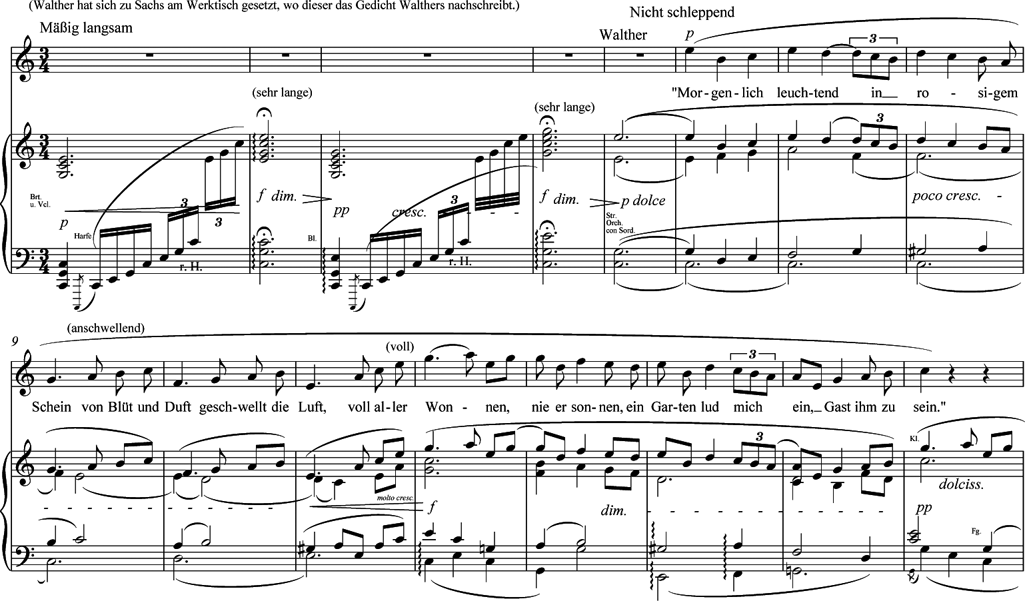
Walther's compositional practice in the Dream Song has also changed. No longer totally improvisatory, it begins with a formally restrained introduction (‘Mäßig langsam’), two bars of C major chords and their arpeggiation, repeated with slight variations, followed by a ‘regular’ four-bar unison setting of the first line of text in a diatonic C major,Footnote 37 far less inflected by chromaticism than Walther's Trial Song, hovering over a tonic pedal with minimal chromaticism in the violas and ending on the dominant (See Ex. 5a).
Die Meistersinger, Act III, scene 2: beginning of Walther's ‘Dream Song’.
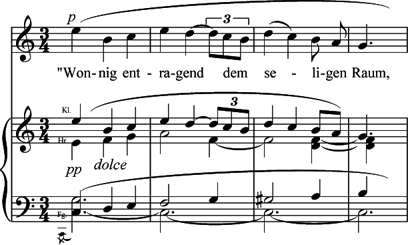
Die Meistersinger, Act III, scene 2: Walther's ‘Dream Song’, beginning of Abgesang.
The ensuing lines swell to a crescendo (‘anschwellend’) to express the text's atmosphere swollen (‘geschwellt’) with the scent of blossoms before descending to the entrance to a garden and the tonic at the end of the Stollen, artfully extended from eight bars to eleven. The second Stollen underscores the process implied in the text by not cadencing on the tonic but modulating instead to the dominant at the end of the Aufgesang. The fact that Sachs explicitly comments on this modulation, his only observation on tonal rules in the entire opera, gives it special prominence:
By observing that modulation would upset the Masters, but that he will make a note of the innovation, Sachs also draws attention to the historicising context of the opera and especially Walther's latest intuitive move towards a music of the future, with its basis in thematic development and harmonic progression, in which form follows content, not procrustean rules. Finally (Ex. 5b), there is another surprise in the Abgesang, that legitimate child of our happily married but modulating Stollen:
It should come as no surprise that this more ‘regular’ melody incorporates the third and last of the ‘love’-motifs for Walther's desire in the opening chorale, the last one before the service ends and he dares ask Eva whether she is already bethrothed.
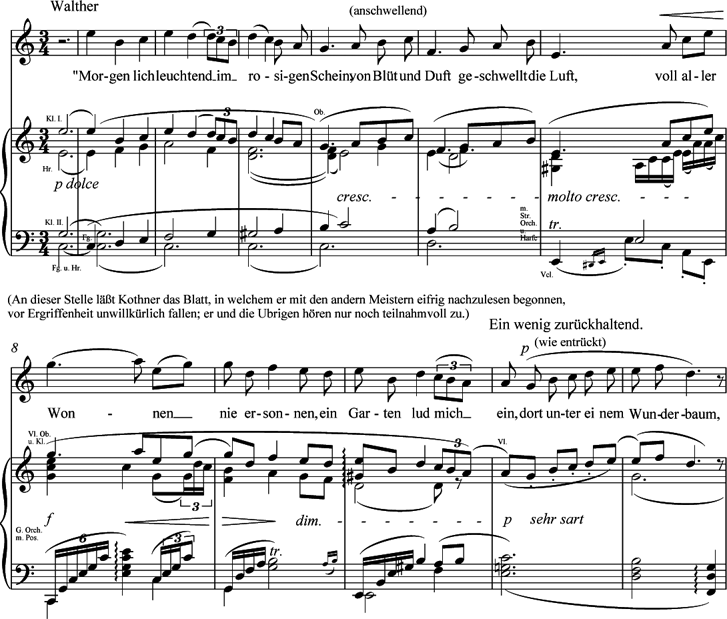
The Prize Song that Walther sings shortly thereafter on the festival meadow marks the culmination of his development. It demonstrates the extent to which composition has become both improvisation and process: the text is identical to the Dream Song through the first six lines (nine bars), though Walther begins to re-orchestrate it in line 3 at ‘Luft’, at which point Kothner, deeply moved, unconsciously lets fall the written text that he and the other Meistersingers have been examining.Footnote 38 More important, this is the point at which Walther also ‘gets it’, and then proceeds ‘wie verzückt’ (as if transported) to rewrite as well as recompose the Dream Song, not only condensing the three stanzas of the dream into a single stanza, but also articulating its significance (see Ex. 6).
Die Meistersinger, Act III, scene 5: Walther's ‘Prize Song’, beginning.
The rewritten Prize Song (see Appendix) retains the dream's opening references to the sequence of time from morning to evening at the beginning of each Stollen (‘Morgendlich leuchtend’, ‘Abendlich dämmernd’), but now rearranges its components to make the two sections rigorously parallel. In contrast to the Dream Song's general intimation of a Liebestraum, Walther now separates its contrasting parts into a ‘Liebestraum’ (dream of love) and a ‘Dichtertraum’ (poet's dream), respectively, rearranging and clarifying the events by describing his arrival at each imagined space and a prominent natural feature, a ‘Wunderbaum’ (marvellous tree) and a ‘Lorbeerbaum’ (laurel tree). Moreover, the process does not end here, but culminates in the identification of two objects of desire: in the first, the woman who resembled a bride in his dream can now be identified as ‘das schönste Weib, Eva im Paradies’ (the most beautiful woman, Eva in Paradise); in the second, there is now another woman – ‘das hehrste Weib, die Muse des Parnaß’ (the most majestic woman, the Muse of Parnassus). As Sachs has led us to expect, the first Stollen cadences on the tonic and the second on the dominant. But a further modulation within the second Stollen, to B major no less (with arpeggiations, dolce in the harp, then ausdrucksvoll in the oboes), suggests the excitement of ascending Parnassus and discovering the Muse in residence. The Abgesang achieves, for the first time in Walther's œuvre, a progression beyond the oppositions in the preceding Stollen: the morning and evening dreams yield to the metaphor of awakening the next day (‘Huldreichster Tag’) with a full consciousness of their significance, concluding (at the end of an extended sentence that renders the path of discovery verbally, underpinned with a dominant pedal) that the two visions are identical, his beloved is also his muse, enabling him to attain both the singer's Parnassus and the lover's Paradise.
Walther's prize for this insight, obviously, is the fair Eva, who crowns him with a wreath of laurel and myrtle, symbolising – appropriately enough – poetic achievement and marriage, respectively. Unexpectedly, however, in the concluding chorus Eva takes the crown from Walther's head and puts it on Hans Sachs, while Pogner kneels down in front of the cobbler, as if in homage (‘wie huldigend’), while the Volk acclaims him as their leader. Although it was no longer possible in the 1860s to conclude, as Lortzing's Hans Sachs did a quarter century earlier, with an acclamation of the emperor (Maximilian I), the substitution of the political head of state by an artist capable of manipulating human delusion could give one pause. But that's another, very long topic indeed.
Appendix: Walther's songs in Die Meistersinger
I. The Trial Song
II. The Dream Song
III. The Prize Song
(Stollen 1. ‘Shining in the rosy light of morning, the air filled with blossoms and scents, full of every unthought-of joy, a garden invited me’ – (as if transported) There, under a marvellous tree, richly hung with fruit, to behold in a blessed dream of love, what boldly promised fulfilment of the supreme desire of bliss, the most beautiful woman: Eva in Paradise.
Stollen 2. In the evening twilight, night enfolded me; on a steep path I had approached a spring of pure water, which laughed invitingly to me: there under a laurel tree, stars shining through its leaves, I beheld in a poet's waking dream, holy and fair of countenance, sprinkling me with the precious water, the most wondrous woman: the Muse of Parnassus!
Abgesang. Most gracious day, to which I awake from a poet's dream! What I had dreamed of, Paradise, lay bright before me in heavenly, new transfigured splendour, to which the spring laughingly showed me the path; she, born there, chosen by my heart, earth's fairest image, consecrated as my muse, as holy and solemn as mild, was boldly wooed by me; in the sun's bright day, through victory in song I had won: Parnassus and Paradise!)