1. Myrvold's No-Go Theorem
There are three main types of modal interpretations: the Schmidt-decomposition, the spectral-resolution and the preferred-observables modal interpretations. In the Schmidt-decomposition modal interpretations, the properties that a system may have and their probabilities are given by the unique biorthogonal decomposition of their pure (non-degenerate) quantum-mechanical state. (Here and henceforth, unless mentioned otherwise by ‘probabilities’ we shall mean ‘single-time’ probabilities, i.e., the probabilities that systems have certain properties at a time or on a spacelike hypersurface.) In the spectral-decomposition modal interpretations, which are generalizations of the Schmidt-decomposition interpretations to mixed states, the properties that a system may have and their probabilities are given by the non-zero on-diagonal elements of the spectral resolution of the system's reduced state (obtained by partial tracing). Finally, in the preferred-observables modal interpretations the definite properties of a system are given by some preferred (time-independent) observables.
Myrvold (Reference Myrvold2002) argues that all the above property assignments are incompatible with special relativity. He presupposes that any relativistic modal interpretation will have to satisfy the following condition (p. 1783):
Relativistic Born Rule. Let q and r be any possible values of the observables (i.e., quantities) Q 1 and R 2, respectively. For any spacelike hypersurface σ, if the quantum-mechanical state of the composite system
 $S_{1}+S_{2}$ on σ is ψ(σ), and if
 $Q_{1}=q$ and
 $R_{2}=r$ are local definite properties of S 1 and S 2, respectively, then the probability of
 $Q_{1}=q$ and
 $R_{2}=r$ on σ is equal to
 $\mathrm{Tr}\,[ P_{Q1}(q) \,P_{R2}(r) \,\psi (\sigma) ] $, where
 $P_{Q1}(q) $ and
 $P_{R2}(r) $ are the projections onto the eigenspaces
 $Q_{1}=q$ and
 $R_{2}=r$, respectively.
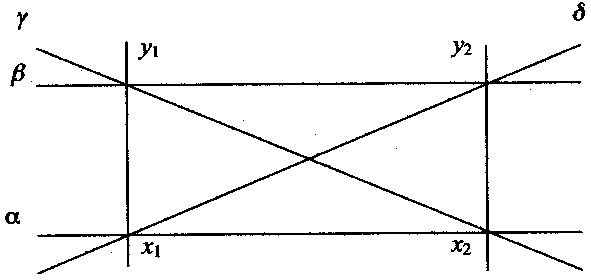
But, he argues, the Relativistic Born Rule is incompatible with the above property assignments. The reasoning is as follows. Let α and β be two hyperplanes of simultaneity in some reference frame (see Figure 1). Let x i and y i be small regions on α and β, respectively, in which the system S i is located. Suppose that x 1 is spacelike separated from y 2 and x 2 is spacelike separated from y 1. Let γ be a spacelike hypersurface containing y 1 and x 2 and let δ be a spacelike hypersurface containing x 1 and y 2. Let R 1 and R 2 be observables associated with the systems S 1 and S 2 respectively, and let A 1 and A 2 be measurement apparatuses that record the values of R 1 and R 2. Suppose that the states of
 $S_{1}+S_{2}+A_{1}+A_{2}$ on α, β, γ, and δ are the following:


where
 $\vert r_{i}+\rangle $ and
 $\vert r_{i}{\mbox{$-$}} \rangle $ are the eigenstates of R 1 and R 2 and
 $\vert p_{i}+\rangle $ and
 $\vert p_{i}{\mbox{$-$}} \rangle $ are the eigenstates of pointer observables P 1 and P 2, associated with the measuring devices A 1 and A 2 respectively. The states
 $\vert \varphi (\beta) \rangle $,
 $\vert \varphi (\gamma) \rangle $, and
 $\vert \varphi (\delta) \rangle $ are obtained from
 $\vert \varphi (\alpha) \rangle $ by applying the following Hadamard transformation to the eigenstates of
 $R_{i}\otimes P_{i}$:

That is,
 $\varphi (\beta) =U_{1}\otimes U_{2}\vert \varphi (\alpha) \rangle $,
 $\varphi (\gamma) =U_{1}\otimes I_{2}\vert \varphi (\alpha) \rangle $, and
 $\varphi (\delta) =I_{1}\otimes U_{2}\vert \varphi (\alpha) \rangle $, where I is the identity transformation.
The spacelike hypersurfaces used in Myrvold's theorem.

In the spectral-resolution and the Schmidt-decomposition modal interpretations, the values of R 1 and R 2 are definite in the states (1)–(4). Suppose that the values of these observables are also definite in the preferred-observables modal interpretations. Suppose further that the value of R i corresponds to a local property of the system S i, so that R i has the same value on any two spacelike hypersurfaces that intersect the spacetime region in which S i is located. Then, if the probabilities of the values of R i were to satisfy the Relativistic Born Rule on the hypersurfaces α, β, γ, and δ, there would have to be a joint probability distribution over these values that yields as marginals their Born probabilities on all the four hypersurfaces. But, such joint probability distribution would satisfy certain Bell-like inequalities, which are violated in the states (1)–(4) (see Myrvold Reference Myrvold2002 and Berkovitz and Hemmo Reference Berkovitz and Hemmo2005). This means that the probabilities of local properties like R i cannot be given by the Born probabilities along every foliation of spacetime for arbitrary initial quantum states, and accordingly the Relativistic Born Rule fails in all the current modal interpretations that admit the existence of such properties in their ontology.
For example, suppose that on α, R 1 and R 2 have the valuesFootnote 1 r 1+ and r 2+. By assumption, R 1 and R 2 are local properties of S 1 and S 2, respectively. Thus, the value of R 1 must be r 1+ on δ, and by the Relativistic Born Rule the probability that R 2 has the value r 2− on δ must be one. Since R 2 is a local property of S 2, it must have the same value on β. Accordingly, the probability that R 2 has the value r 2− on β is one. A parallel argument leads to the conclusion that if R 2 has the value r 2+ on α, the probability that R 1 has the value r 1− on β is one. Thus, if R 1 and R 2 have the values r 1+ and r 2+ on α, the probability that these observables have the values r 1− and r 2− on β is one. But, by the Relativistic Born Rule,
 $\vert \varphi (\beta) \rangle $ assigns zero probability to these values, and so it is impossible to obtain the Born probabilities for the values of R 1 and R 2 on all the four hypersurfaces α–δ.
2. On the Interpretation of Properties
In response to Myrvold's theorem, one may object to the presupposition that the Relativistic Born Rule is a necessary condition for relativistic modal interpretations. This presupposition seems to rely on the natural assumption that the probabilities of possessed properties should invariably be equal to the Born probabilities. But one may reject this assumption and insist that only the probabilities of observable, possessed properties should be equal to the Born probabilities. In what follows, we shall assume the Relativistic Born Rule and suggest different strategies for circumventing Myrvold's theorem.
Myrvold's theorem presupposes the existence of local properties and their joint probabilities:
Local Properties. The value of R i is the same on any two spacelike hypersurfaces that intersect the region in which S i is located.Footnote 2
Joint Probabilities. The values of R 1 and R 2 have definite joint probabilities in the states
 $\vert \varphi (\alpha) \rangle $,
 $\vert \varphi (\beta) \rangle $,
 $\vert \varphi (\gamma) \rangle $, and
 $\vert \varphi (\delta) \rangle $.
We shall propose below modal interpretations that violate these assumptions, and thus circumvent Myrvold's theorem without violating the Relativistic Born Rule. To remain general and simplify things, we shall work with schematic modal interpretations in which the possible properties of a given system and their probabilities are given by the nonzero on-diagonal elements of the system's reduced state in the spectral resolution, i.e., in the Schmidt bases. Further, as a working hypothesis we shall assume that this property assignment is consistent with the Kochen and Specker-type theorems, and moreover that it can be developed so as to provide a solution to the measurement problem. (In Berkovitz and Hemmo Reference Berkovitz and Hemmo2005 and Reference Berkovitz, Hemmo, Demopoulos and Pitowsky2006, we propose a modal interpretation in which the possible properties of a given system and their probabilities are given by the on-diagonal elements of its reduced state in any orthonormal resolution, i.e., in any orthonormal basis, and argue that this interpretation meets this working hypothesis.)
Finally, similarly to the mainstream modal interpretations, our proposed interpretations violate the so-called ‘property composition’ and ‘property decomposition’ conditions. Let H 1 and H 2 be the Hilbert spaces of the systems S 1 and S 2, respectively. Let Q 1 be an H 1 observable and q be one of its eigenvalues, let
 $P_{Q1}(q) $ be a projection onto the eigenspace
 $Q_{1}=q$, and let I 2 be the identity operator for H 2. Then:
Property Composition. If S 1 has the property (associated with)
 $P_{Q1}(q) $, then the composite system
 $S_{1}+S_{2}$ has the property (associated with)
 $P_{Q1}(q) \otimes I_{2}$.
Property Decomposition. If
 $S_{1}+S_{2}$ has the property (associated with)
 $P_{Q1}(q) \otimes I_{2}$, then S 1 has the property (associated with)
 $P_{Q1}(q) $.
The violation of these conditions implies that the properties of composite systems neither determine nor are determined by the properties of their subsystems. In particular, the value of
 $R_{1}\otimes R_{2}$ does not determine the values of R 1 and R 2, and vice versa. Moreover, in general the range of the possible values of
 $R_{1}\otimes R_{2}$ (given by the reduced state of
 $S_{1}+S_{2}$) will be different from the range of the possible values of R 1 and R 2 (given by the reduced states of S 1 and S 2, respectively). This means that to circumvent Myrvold's theorem, it is necessary to show that the theorem is inapplicable not only to the values of R 1 and R 2 but also to the values of
 $R_{1}\otimes R_{2}$. Note also that the violation of Property Composition and Property Decomposition naturally suggests that in transformations of the eigenstates of R 2 (R 1) the value of
 $R_{1}\otimes R_{2}$ may change as a whole, even when the reduced state of S 1 (S 2) does not change.
2.1. The Holistic Interpretation
In the modal interpretations we discuss below, the range of the possible properties of a system is given by the system's reduced state in the spectral resolution. Thus, if the values of R 1 and R 2 on α are r 1+ and r 2+, the value of at least one of these observables has to be different on δ (γ). Myrvold assumes that the values of R 1 and R 2 are local properties of S 1 and S 2 respectively, and accordingly he concludes that the values of R 1 and R 2 on δ (γ) have to be r 1+ and r 2− (r 1− and r 2+), respectively. But, this conclusion is not valid for the value of
 $R_{1}\otimes R_{2}$, interpreted as a holistic property of
 $S_{1}+S_{2}$ that is not decomposable into the properties of S 1 and S 2. On this interpretation, the value of
 $R_{1}\otimes R_{2}$ is a non-local property, which is independent of the local values of R 1 and R 2. Accordingly, this value may not be the same on α and δ, and thus Myrvold's theorem is inapplicable to it.
If the values of R 1 and R 2 are unrelated to the value of
 $R_{1}\otimes R_{2}$, we can also motivate the violation of Joint Probabilities—i.e., the assumption that R 1 and R 2 have joint probabilities. The probabilities of the possible values of R 1 are given by the reduced state of S 1, the probabilities of the possible values of R 2 are given by the reduced state of S 2, and the probabilities of the possible values of
 $R_{1}\otimes R_{2}$ are given by the reduced state of
 $S_{1}+S_{2}$. Since the nonlocal value of
 $R_{1}\otimes R_{2}$ is unrelated to the local values of R 1 and R 2 and the probabilities of the possible values of
 $R_{1}\otimes R_{2}$ do not correspond to the joint probabilities of the possible values of R 1 and R 2, the reduced state of
 $S_{1}+S_{2}$ cannot be used to assign joint probabilities for the possible values of R 1 and R 2. Thus, on the holistic interpretation of the value of
 $R_{1}\otimes R_{2}$ there are no means for assigning joint probabilities to the values of R 1 and R 2. But if the values of R 1 and R 2 have no joint probabilities, Myrvold's theorem is inapplicable to them; for the Relativistic Born Rule presupposes Joint Probabilities.
Based on the above reasoning, it is not difficult to show that Myrvold's theorem is also inapplicable to any other properties assigned by the holistic interpretation.
Finally, we have two remarks. (i) The question whether the holistic interpretation reproduces the Born probabilities along every foliation of spacetime for arbitrary initial quantum states depends on the dynamics of properties. The simplest dynamics that accomplishes this objective is one in which transition probabilities are equal to the corresponding single-time probabilities. In Section 3, we shall propose a more sophisticated dynamics. (ii) The construal of the values of
 $R_{1}\otimes R_{2}$ as holistic non-decomposable properties explains the failure of Property Composition and Property Decomposition. But, the challenge is to explicate the exact nature of these properties. In current modal interpretations, the failure of Property Composition and Property Decomposition is largely unexplained. Further, given that properties of systems are uncorrelated with the properties of their subsystems, there is also the challenge of explaining how such uncorrelated properties are related to our experience.Footnote 3
2.2. The Relational Interpretation
Another way to explain the failure of Property Composition and Property Decomposition is to interpret the properties assigned by modal interpretations as relational (i.e., properties that systems have relative to other systems) rather than intrinsic properties (i.e., properties that the systems have in and for themselves, independently of any other system). The main idea is that reduced states prescribe relational properties, and properties that a system has relative to different systems are given by different reduced states and may be different. Furthermore, in general properties that are related to different systems are unrelated to each other. For example, the value that R 1 (R 2) may have, as a property of S 1 (S 2) relative to
 $S_{2}+A_{1}+A_{2}$ (
 $S_{1}+A_{1}+A_{2}$) is given by the reduced state of S 1 (S 2), and the value that R 1 (R 2) may have, as a property of
 $S_{1}+S_{2}$, relative to
 $A_{1}+A_{2}$ is given by the reduced state of
 $S_{1}+S_{2}$. These different relational values of R 1 (R 2) may be different from each other and, moreover, the values that R 1 has relative to
 $S_{2}+A_{1}+A_{2}$ and R 2 has relative to
 $S_{1}+A_{1}+A_{2}$ do not constrain the values that R 1 and R 2 each has relative to
 $A_{1}+A_{2}$, and vice versa. By contrast, properties that a system S I has relative to another system S II may be decomposable into the properties that S I's subsystems have relative to S II, and accordingly are related to each other. For example, the properties that
 $S_{1}+S_{2}$ has relative to
 $A_{1}+A_{2}$ are decomposable into the properties that S 1 and S 2 each has (as a property of
 $S_{1}+S_{2}$) relative to
 $A_{1}+A_{2}$: If
 $R_{1}\otimes R_{2}$ has the value (r 1+, r 2+) relative to
 $A_{1}+A_{2}$, then R 1 and R 2 have respectively the values r 1+ and r 2+ relative to
 $A_{1}+A_{2}$.
Since properties that are related to different systems are unrelated, they have no joint probabilities and accordingly Joint Probabilities fails. But, similarly to the holistic interpretation, this failure can be motivated on technical grounds. The probabilities of the values that R 1 may have, as properties of S 1, relative to
 $S_{2}+A_{1}+A_{2}$ are given by the reduced state of S 1 and the probabilities of the values that R 2 may have, as properties of S 2, relative to
 $S_{1}+A_{1}+A_{2}$ are given by the reduced state of S 2. But the joint probabilities of these properties are not given by the reduced state of
 $S_{1}+S_{2}$, or any other reduced state. The reduced state of
 $S_{1}+S_{2}$ only prescribes the joint probabilities of the values that R 1 and R 2 each may have (as a property of
 $S_{1}+S_{2}$) relative to
 $A_{1}+A_{2}$, but these probabilities are unrelated to the joint probability of the values that R 1 may have relative to
 $S_{2}+A_{1}+A_{2}$ and R 2 may have relative to
 $S_{1}+A_{1}+A_{2}$.
This failure of Joint Probabilities means that Myrvold's theorem does not apply to the values of R 1 relative to
 $S_{2}+A_{1}+A_{2}$ and R 2 relative to
 $S_{1}+A_{1}+A_{2}$. Myrvold's theorem would also fail to apply to the value that R 1 (R 2) has relative to
 $A_{1}+A_{2}$ if the relational modal interpretation violated Local Properties—i.e., the assumption that the value of R 1 (R 2) is the same on any two spacelike hypersurfaces that intersect the spacetime region in which S 1 (S 2) is located. In the relational interpretation, properties of systems are neither intrinsic nor local—they are always relations between distant systems. Yet, this nonlocal nature of properties does not imply the violation of Local Properties. Whether or not this condition is violated depends on the dynamics of properties. The simplest way to violate Local Properties is to equip the relational interpretation with a dynamics in which transition probabilities are equal to the corresponding single-time probabilities. But, as we shall see in the next section, a more sophisticated dynamics could also be reconciled with the Relativistic Born Rule.
Based on the above reasoning, it is not difficult to show that given a dynamics that violates Local Properties, Myrvold's theorem will also be inapplicable to any other properties assigned by the relational interpretation.
3. The Dynamics
In the previous section, we remarked that both the holistic and the relational interpretations may be equipped with a trivial dynamics in which the transition probabilities are equal to the corresponding single-time Born probabilities. In this section, we outline a dynamics in which transition probabilities depend on the degree of entanglement between the relevant systems (a measure that we define below). To simplify matters, we focus on the relational interpretation, though the same dynamics applies to the holistic interpretation. Also, we first present the outline of this dynamics in two extreme cases: (i) of no entanglement and (ii) of maximal entanglement. We then propose a generalized dynamics that entails these special cases.
Consider, first, the case of no entanglement. Let S I and S II be a partition of the universe into two systems. Let U be a unitary transformation of the state of
 $S_{\mathrm{I}\,}+S_{\mathrm{II}\,}$. If the reduced state of S I does not change under U, the range of the possible properties that S I may have relative to S II and their probabilities as well as the actual properties that S I has relative to S II do not change. If the reduced state of S I changes, the transition probabilities of the properties that S I may have relative to S II depend on the properties that S I has relative to S II and the transformation U. The properties of S I associated with projectors that commute with U evolve deterministically, so as to return the single-time Born probabilities; and the properties of S I associated with projectors that do not commute with U evolve indeterministically, so as to return the single-time Born probabilities.
While the above transition probabilities resemble the probabilities obtained by a sequential application of the Born rule in a collapse theory, the transition probabilities in case of maximal entanglement resemble the transition probabilities obtained by the trivial dynamics in which transition probabilities are equal to the corresponding single-time Born probabilities. That is, let ψ(α) and ψ(β) be the states of
 $S_{\mathrm{I}\,}+S_{\mathrm{II}\,}$ on the spacelike hypersurfaces α and β respectively, U be the unitary transformation between these hypersurfaces, Q be any observable of S I and q be one of its eigenvalues. Then, if the reduced state of S I changes in the transformation U, the transition probability of S I having the property
 $Q=q$ on β given its properties on α is equal to the single-time probability of
 $Q=q$ on β, as calculated from S I's reduced state on β. Otherwise, S I's properties remain the same.
When entanglement is less than maximal, the dynamics is a weighted average of the two extreme cases according to the degree of entanglement (see (6) below). There are various measures of entanglement. As an example, we shall use Shimony's (Reference Shimony1995) measure, where the degree of entanglement between systems S i and S j is defined in terms of the minimal (normalized) distance, in Hilbert space norm, of the state ψ of the composite
 $S_{i}+S_{j}$ from the set of all product states in the Hilbert space of
 $S_{i}+S_{j}$. In mixed states, the degree of entanglement is defined in terms of distance in the space of self adjoint operators. The degree of entanglement between S i and S j is the minimal distance between the (normalized) mixed state of
 $S_{i}+S_{j}$ and the convex set C of all the (mixed) product states of
 $S_{i}+S_{j}$, where the distance between a mixed state B of
 $S_{i}+S_{j}$ and any mixed product state A in C is
 $\mathrm{Tr}\,(B\otimes A) $.
The relevant systems for measuring the degree of entanglement are determined by the properties under consideration. Let |ψ〉 be the state of the universe, S I and S II be any partition of the universe,
 $S^{*}_{\mathrm{I}\,}$ and
 $S^{**}_{\mathrm{I}\,}$ be any partition of S I, and
 $S^{*}_{\mathrm{II}\,}$ be any subsystem of S II, where
 $S^{*}_{\mathrm{I}\,}$ and
 $S^{**}_{\mathrm{I}\,}$ are proper subsystems of S I, and
 $S^{*}_{\mathrm{II}\,}$ is a proper subsystem of S II. Let U be a (non-identity) unitary transformation of the state of
 $S^{*}_{\mathrm{I}\,}+S^{*}_{\mathrm{II}\,}$ and the identity transformation of the state of all the other subsystems of
 $S_{\mathrm{I}\,}+S_{\mathrm{II}\,}$. The effect of U on the properties of S I depends on the degree of entanglement between
 $S^{*}_{\mathrm{I}\,}+S^{*}_{\mathrm{II}\,}$ and
 $S^{**}_{\mathrm{I}\,}$ in ψ. When
 $S^{*}_{\mathrm{I}\,}$ or
 $S^{*}_{\mathrm{II}\,}$ is the ‘null’ system, the degree of entanglement is postulated to be zero. Intuitively, this measure is intended to reflect the extent to which the properties that S I has relative to S II should be redistributed by unitary transformations, so as to reproduce the Born probabilities for arbitrary quantum states along every foliation of spacetime without selecting any foliation as preferred.
We can now turn to present the universal dynamics. Let |ψ〉 be the state of
 $S_{\mathrm{I}\,}+S_{\mathrm{II}\,}$, d(e) be the degree of entanglement between
 $S^{*}_{\mathrm{I}\,}+S^{*}_{\mathrm{II}\,}$ and
 $S^{**}_{\mathrm{I}\,}$ in |ψ〉, and U be as characterized above. Let
 $P(Q=q/ R=r) $ be the probability that S I has the property
 $Q=q$ relative to S II in the state U|ψ〉 given that it has the property
 $R=r$ relative to S II in the state |ψ〉, and let
 $P_{\mathrm{ME}\,}(Q=q/ R=r) $,
 $P_{\mathrm{NE}\,}(Q=q/ R=r) $, and
 $P_{\mathrm{UNIV}\,}(Q=q/ R=r) $ denote respectively the value of
 $P(Q=q/ R=r) $ according to the dynamics in case of maximal entanglement, the dynamics in case of no entanglement and the universal dynamics. ThenFootnote 4

We have two remarks. (i) If the distribution of properties is given by the single-time Born probabilities on any spacelike hypersurface, then (by construction) the dynamics in cases of no entanglement and maximal entanglement will both reproduce the single time Born probabilities on every spacelike hypersurface. Accordingly, the universal dynamics will also reproduce the single-time Born probabilities. (ii) As is easily seen, the universal dynamics does not pick out any preferred foliation of spacetime.
4. Myrvold's Theorem Revisited
Let us apply the universal dynamics to Myrvold's set-up. Consider the properties of
 $S_{1}+S_{2}$. In the Hadamard transformation on the eigenstates of
 $R_{2}\otimes P_{2}$ between the hypersurfaces α and δ,
 $S^{**}_{\mathrm{I}\,}$ is S 1,
 $S^{*}_{\mathrm{I}\,}$ is S 2,
 $S^{*}_{\mathrm{II}\,}$ is A 2, and the relevant degree of entanglement is the one between S 1 and
 $S_{2}+A_{2}$ in the reduced state of
 $S_{1}+S_{2}+A_{2}$, obtained by partial tracing from |ϕ(α)〉. Thus, in the relational interpretation the universal dynamics entails that the chance that the value of R 1 relative to
 $A_{1}+A_{2}$ on α will be different from its value on δ depends on the degree of entanglement between
 $S_{2}+A_{2}$ and S 1 on α. Similarly, in the holistic interpretation the universal dynamics entails that the chance that the value of the holistic property
 $R_{1}\otimes R_{2}$ is (r 1−, r 2+) or (r 1−, r 2−) on δ given that it is (r 1+, r 2+) on α depends on the degree of entanglement between
 $S_{2}+A_{2}$ and S 1 on α. In the state ϕ(α) this degree of entanglement is substantial. Accordingly, Myrvold's theorem is inapplicable to the values of
 $R_{1}\otimes R_{2}$ in the holistic interpretation and the values of R 1 and R 2 relative to
 $A_{1}+A_{2}$ in the relational interpretation.
This dependence of the universal dynamics on the degree of entanglement is desirable. It circumvents Myrvold's theorem by yielding non-locality in the evolution of the values of R 1 and R 2 relative to
 $A_{1}+A_{2}$ (in the relational interpretation) and the value of
 $R_{1}\otimes R_{2}$ (in the holistic interpretation) in the non-experimental circumstances of Myrvold's theorem, where
 $S_{1}+S_{2}+A_{1}+A_{2}$ is isolated from the environment and accordingly the (relevant) degree of entanglement is significant. Yet, this non-locality is extremely unlikely in experimental circumstances, where
 $S_{1}+S_{2}+A_{1}+A_{2}$ interacts with the environment and accordingly the (relevant) degree of entanglement is virtually zero. (For more details, see Berkovitz and Hemmo Reference Berkovitz and Hemmo2005 and Reference Berkovitz, Hemmo, Demopoulos and Pitowsky2006.)
Consider now the (non-relational) value of R 1 and R 2 in the holistic interpretation, the value of R 1 (as a property of S 1) relative to
 $S_{2}+A_{1}+A_{2}$ and the value of R 2 (as a property of S 2) relative to
 $S_{1}+A_{1}+A_{2}$ in the relational interpretation. In the transformation from α to δ (γ), the degree of entanglement relevant for these values of R 1 (R 2) is (by definition) zero; for in this case
 $S^{*}_{\mathrm{I}\,}$ is the ‘null’ system. Thus, these values of R 1 and R 2 evolve according to the dynamics in case of no-entanglement, and accordingly they do not change. Yet, since they have no joint probabilities, Myrvold's theorem is inapplicable to them.
Based on the considerations above, it is not difficult to show that Myrvold's theorem will also be inapplicable to any other properties assigned by the holistic and the relational modal interpretations.
5. On the Prospects of Relativistic Holistic and Relational Modal Interpretations
The holistic and relational interpretations of properties provide explanations for the violation of Property Composition and Property Decomposition. Given these interpretations and the dynamics of properties outlined in Section 3, the resulting relational and holistic modal interpretations circumvent Myrvold's no-go theorem. Moreover, as we argue in Berkovitz and Hemmo Reference Berkovitz, Hemmo, Demopoulos and Pitowsky2006, these interpretations also evade the other no-go theorems. The question arises then: Are these interpretations compatible with special relativity?
Compatibility with relativity requires that the dynamics of properties and their probabilities do not select any preferred inertial reference frame, and that inertial reference frames ‘agree’ with each other about objective properties and probabilities. This agreement means that such properties and their probabilities are Lorentz covariant: Their transformations between inertial frames obey the Lorentz transformations.
In the relational and holistic interpretations, the dynamics of properties and their probabilities does not select any preferred foliation of spacetime. Thus, the compatibility of these interpretations with relativity turns on whether the properties and probabilities they assign are Lorentz covariant. The single-time and transition probabilities are Lorentz covariant. Furthermore, when the (relevant) degree of entanglement (as defined in Section 4) is zero, the assigned properties are Lorentz covariant. But when the degree of entanglement is not zero, some of the assigned properties are not Lorentz covariant. For example, in the set up of Myrvold's theorem the values that R 1 has (as a property of
 $S_{1}+S_{2}$) relative to
 $A_{1}+A_{2}$ on α and on δ need not be related to each other by the Lorentz transformations; and similarly, mutatis mutandis, for the values of
 $R_{1}\otimes R_{2}$ in the holistic interpretation. Thus, the above holistic and relational modal interpretations are not relativistic. It is noteworthy, however, that when the degree of entanglement is virtually zero, as in typical experimental circumstances where environmentally-induced Decoherence suppresses entanglement, these interpretations assign properties that are effectively Lorentz covariant.
A way to reconcile the holistic and relational modal interpretations with relativity is to postulate that in addition to being holistic or relational the assigned properties are hypersurface dependent. On this interpretation, properties of systems are always Lorentz invariant: Systems have the same properties relative to a given hypersurface in all inertial reference frames. Furthermore, this hypersurface dependence does not show up in experimental circumstances; for it follows from the dynamics that in such circumstances, the probability that the properties that a system has on any two spacelike hypersurfaces that intersect the region in which the system is located are the same, is virtually one.
Finally, although our focus in this paper has been on modal interpretations, Myrvold's theorem also poses challenge for other no-collapse hidden-variable interpretations of quantum mechanics. For this theorem exploits the fact that in a dynamics that picks out no preferred foliation of spacetime, it is impossible to reproduce the Born probabilities of local properties along every spacelike hypersurface for an arbitrary initial quantum state.