Introduction
For organizational development to occur, it is necessary to motivate employees in serving to enable organizational construction (e.g., Argote & Ingram, Reference Argote and Ingram2000; Eisenberger, Armeli, Rexwinkel, Lynch, & Rhoades, Reference Eisenberger, Armeli, Rexwinkel, Lynch and Rhoades2001; Zhou & George, Reference Zhou and George2001). Employees’ desire for organizational construction in this study denotes employees’ willingness to care about the organizational development and to help the organization to reach its goals, and this definition is originally from felt obligation in Eisenberger’s et al. (Reference Eisenberger, Armeli, Rexwinkel, Lynch and Rhoades2001) study. However, desire for organizational construction focuses on employees’ subjective intentions, and it is different from felt obligation that focuses on social norms (Eisenberger et al., Reference Eisenberger, Armeli, Rexwinkel, Lynch and Rhoades2001). Exploring the factors predicting desire for organizational construction is important for organization to increase employees’ constructive work behavior such as organizational citizenship behavior (Van Dyne, Graham, & Dienesch, Reference Van Dyne, Graham and Dienesch1994), prosocial behavior (O’Reilly & Chatman, Reference O’Reilly and Chatman1986) and change-oriented behavior (Parker, Williams, & Turner, Reference Parker, Williams and Turner2006) that are of benefit to the organization. Many studies have tried to find the antecedent variables of employees’ desire for organizational construction (e.g., Den Hartog & Belschak, Reference Den Hartog and Belschak2012; Zhang, LePine, Buckman, & Wei, Reference Zhang, LePine, Buckman and Wei2014; Lam, Liang, Ashford, & Lee, Reference Lam, Liang, Ashford and Lee2015). For example, Eisenberger et al. (Reference Eisenberger, Armeli, Rexwinkel, Lynch and Rhoades2001) showed that when an organization provides support for its employees, they may tend to repay their organization and strive for organizational construction.
However, there are two reasons why more investigations need to be done in this field. First, there exist two competing theoretical perspectives to explain the desire for organizational construction in situations in which employees face negative treatment, and we have not yet found the boundary between these theories. In the perspective of social exchange theory, when employees feel positively about their work environment, they tend to do benefits for organization as a norm of reciprocity (Cropanzano & Mitchell, 2005). Negative treatment from the organization, however, may undermine this norm of reciprocity. For example, Ng and Feldman’s (Reference Ng and Feldman2012) meta-analytic study showed that employee dissatisfied with work conditions tended to thwart their motivations to do benefit for their organizations, thus decreasing voice behavior (i.e., a change-oriented behavior that is beneficial to organizations). The second perspective comes from uncertainty management theory (Lind & van den Bos, Reference Lind and van den Bos2002), which proposes that feelings of discomfort tend to motivate employees to change the environment around them. Thus, if employees are dissatisfied with their organizations, they may initially increase the desire to adopt change-oriented behaviors, which have important implication for organizational development. This perspective was supported by Anseel and Lievens (Reference Anseel and Lievens2007), who found that employees who perceived high uncertainty tended to seek positive feedback from their supervisors. As challenge stressors can lead to job satisfaction and perceived organizational justice, and as hindrance stressors tend to cause job dissatisfaction and perceived unfairness (Cavanaugh, Boswell, Roehling, & Boudreau, Reference Cavanaugh, Boswell, Roehling and Boudreau2000; Zhang et al., Reference Zhang, LePine, Buckman and Wei2014), we suggest that challenge stressors and hindrance stressors are experienced as positive and negative treatment, respectively. This study constructs the relationship between challenge–hindrance stressors and employees’ desire for organizational construction. In doing so, the study helps us to understand the scope of application for both social exchange and uncertainty management theory.
The second reason for further exploration in this field is that some paradoxical results motivate us to find moderating variables. For example, Zhou and Long (Reference Zhou and Long2013) have suggested that employees’ voice behavior was most evident in conditions of moderate job insecurity, which is a kind of hindrance stressor (Cavanaugh et al., Reference Cavanaugh, Boswell, Roehling and Boudreau2000). As voice behavior is a change-oriented behavior, which is constructive for organization, we infer that the relationship between job insecurity and desire for organizational construction is inverted U-shape. In contrast, Lam et al. (Reference Lam, Liang, Ashford and Lee2015) has showed that the relationship between job insecurity and organizational citizenship behavior, which is also a constructive behavior for organizations (Warren, Reference Warren2003), was U-shaped and moderated by psychological capital. Considering the hindrance characteristic of job insecurity, the relationship between hindrance stressor and desire for organizational construction may be moderated by some variables. In addition, evidence has shown that the effect of work stressor on work-related outcomes may be moderated by organizational contextual variables (e.g., Janssen, Reference Janssen2001; Anseel & Lievens, Reference Anseel and Lievens2007; Leung, Huang, Su, & Lu, Reference Leung, Huang, Su and Lu2011; Wang, Lu, & Siu, Reference Wang, Law, Hackett, Wang and Chen2015). For example, Leung et al. (Reference Leung, Huang, Su and Lu2011) have showed that the U-shaped relationship between role conflict and innovative performance was only emerged at low levels of perceived support for innovation.
Therefore, this study suggests that the relationship between work stressor and desire for organizational construction is regulated by some moderators. This study considers that the availability of cognitive resources can influence employees’ degrees of reflection on their exchange relationship with the organization (Hixon & Swann, Reference Hixon and Swann1993), and employees enjoying high cognitive resources tend to regard organizational constructive behavior as a tool to satisfy their prosocial motivation. Therefore, cognitive resources may amplify the effect of negative or positive treatment on desire for organizational construction. We suggest that the moderating factor in these responses is the perceived leader–member exchange, because this relationship involves the feature of social support, which can enhance employees’ cognitive resources (Restubog, Bordia, Tang, & Krebs, 2010). Moreover, evidence has shown that leader–member exchange can moderate the effect of work stressor on work-related outcomes (e.g., Graen & Uhl-Bien, Reference Graen and Uhl-Bien1995).
This study has two main purposes. The first purpose is to construct and examine the relationship between challenge–hindrance stressors and the desire for organizational construction, and to do so through an integration of social exchange and uncertainty management theory. This integration may help us to understand the application boundaries for these two theories. Through clarifying the effect of challenge–hindrance stressors on desire for organizational construction, this study may contribute to describe employees’ organizational constructive work behavior such as voice, prosocial behavior and organizational citizenship behavior under the condition of work stressor. Moreover, employees’ motivation to engage in constructive work behavior involves prosocial and self-interest motivation (Morrison, Reference Morrison2014; Mowbray, Wilkinson, & Tse, Reference Mowbray, Wilkinson and Tse2015). However, previous studies mainly focus on the single motivation perspective (e.g., Stamper, Masterson, & Knapp, Reference Stamper, Masterson and Knapp2009; Ng & Feldman, Reference Ng and Feldman2012) and it is unclear that employees’ desire for organizational construction is driven by which kind of motivation when they are faced with negative treatment (i.e., hindrance stressor in this study). As social exchange theory pertains to reciprocity, and it is generally used to explain the mechanism of employees’ prosocial work behavior (e.g., Wang, Law, Hackett, Wang, & Chen, Reference Wang, Lu and Siu2005; Stamper, Masterson, & Knapp, Reference Stamper, Masterson and Knapp2009), such theory is related to prosocial motivation and also other-directed motivation (see it in Ng & Feldman, Reference Ng and Feldman2012). In contrast, uncertain management theory is related to self-interest motivation because this theory explains individuals being motivated to reduce employees’ own perception of discomfort through constructive work behavior (Lind & van den Bos, Reference Lind and van den Bos2002). Employees’ prosocial motivation tends to be hindered and the discomfort reduction motivation tends to be activated due to the increase of hindrance stressors. Therefore, present study can help to describe employees’ attitude for constructive work behavior when these two motivations are in the competing position by integrating social exchange theory and uncertainty management theory, which has little been done in the previous study.
The second purpose is to examine the moderating role of leader–member exchange and to show how this factor can explain the inconsistent results of previous studies. By doing so, this study specifies more clearly on how the relationship with immediate supervisor influences the reciprocity relationship between employees and their organizations. Indeed, scholars have provided evidence that the relationship between supervisor and subordinate is essential to the development of positive attitude regarding how the subordinates experience the organization (e.g., Gerstner & Day, Reference Gerstner and Day1997; Sluss & Thompson, Reference Sluss and Thompson2012). Extant literature suggested that the high-quality relationship between supervisor and subordinate might help to reduce the negative effect of the unmet expectation such as work stressors in the organizations (e.g., Graen & Uhl-Bien, Reference Graen and Uhl-Bien1995), which indicates that the leader–member exchange can buffer the subordinates’ negative attitude for the organization. However, some other scholars argued that the high-quality leader–member exchange may deteriorate subordinates’ attitude for the organization when they suffer from negative treatment (e.g., Restubog et al., Reference Restubog, Bordia, Tang and Krebs2010). This study may help ameliorate this problem by constructing the moderating role of leader–member exchange on the nonlinear relationship between hindrance stressor and desire for organizational construction. As such, we suggest that employees’ motivation for organizational construction tend to alter between prosocial and uncertainty reduction motivation due to the variance of work stressor, and that leader–member exchange may act opposite roles when employees experience different motivations for organizational construction. In addition, as Dutton and Ragins lament that ‘in spite of the centrality of relationships to our life experience, relationships traditionally are placed in the background of organizational life’ (Reference Dutton and Ragins2007: 5), this study contributes to the problem that the supervisor–subordinate relationship can ‘do the most to make our life sweet or sour’ (Hughes, Reference Hughes1950: 321) by drawing out how leader–member exchange influences the employees’ perception of the stressors and the ways of coping with the stressors through constructive work behavior within the organizational context.
Theory and Hypothesis
Social exchange theory
Social exchange theory suggests that the way relationships between parties evolve depends on the rules of their exchange (Blau, Reference Blau1964). The exchange rule of reciprocity suggests that people who feel sponsored tend to reciprocate with the same degree of sponsorship in turn (Cropanzano & Mitchell, 2005). The norm of reciprocity bridges the social exchange, enabling trust and emotional engagement (Ng & Feldman, Reference Ng and Feldman2012). According to the norm of reciprocity, employees who enjoy high job satisfaction or organizational commitment tend to do more for organizational construction (Burris, Detert, & Chiaburu, Reference Burris, Detert and Chiaburu2008; Ng & Feldman, Reference Ng and Feldman2012).
Challenge stressors that involve work overload, time pressures and additional responsibilities may bring potential gains for employees (Cavanaugh et al., Reference Cavanaugh, Boswell, Roehling and Boudreau2000). Thus, employees who face challenge stressors tend to have positive emotions that promote job satisfaction and organizational commitment (Cavanaugh et al., Reference Cavanaugh, Boswell, Roehling and Boudreau2000; Podsakoff, LePine, & LePine, Reference Podsakoff, LePine and LePine2007; Liu, Shi, Wang, & Gong, Reference Liu, Shi, Wang and Gong2011). According to social exchange theory, employees who experience job satisfaction and organizational commitment tend to feel an obligation to their organizations (Burris, Detert, & Chiaburu, Reference Burris, Detert and Chiaburu2008; Ng & Feldman, Reference Ng and Feldman2012). Therefore, we suggest that challenge stressors are catalysts of desire for organizational construction. As Ng and Feldman (Reference Ng and Feldman2012) conducted a meta-analysis and found that a perceived lack of job challenge could reduce employees’ voice behavior, which is a kind of behavior that facilitates organizational development (Van Dyne & LePine, Reference Van Dyne and LePine1998).
In contrast, hindrance stressors, such as job insecurity, limited career prospects or excessive red tape, tend to thwart potential growth for employees (Cavanaugh et al., Reference Cavanaugh, Boswell, Roehling and Boudreau2000). In the process of coping with hindrance stressors, employees may experience decreased job satisfaction and reduced organizational commitment (Cavanaugh et al., Reference Cavanaugh, Boswell, Roehling and Boudreau2000; Podsakoff, LePine, & LePine, Reference Podsakoff, LePine and LePine2007; Liu et al., Reference Liu, Shi, Wang and Gong2011). According to the norm of social exchange, this effect of hindrance stressors leads to low desire for organizational construction (Choi, Reference Choi2007). Thus, the relationship between hindrance stressors and desire for organizational construction is negative according to social exchange theory.
Uncertainty management theory
Different from social exchange theory which focuses on the relationship between individual with the others (Blau, Reference Blau1964), uncertainty management theory pertains to individual self-interest (Lind & van den Bos, Reference Lind and van den Bos2002). Specifically, uncertainty management theory suggests that people have aversion tendency to the feeling of uncertainty and that they have a need to keep their surrounding environments predictable (Wanberg & Kammeyer-Mueller, Reference Wanberg and Kammeyer-Mueller2000; Lind & van den Bos, Reference Lind and van den Bos2002). When people have a sense of insecurity and uncertainty, they may feel threatened and concerned over their ability to control changes in their environment. Therefore, they tend to work harder to establish their worth and their future prospects in the organization (Tangirala & Alge, Reference Tangirala and Alge2006; Rosen, Harris, & Kacmar, Reference Rosen, Harris and Kacmar2011).
Many empirical studies have shown that uncertainty management theory can explain employees’ reactions to stressors (Tangirala & Alge, Reference Tangirala and Alge2006; Anseel & Lievens, Reference Anseel and Lievens2007). For example, Anseel and Lievens (Reference Anseel and Lievens2007) demonstrated that individuals tended to be more motivated to improve their situation when they perceived high uncertainty. Both challenge stressors and hindrance stressors can elicit psychological strains (LePine, Podsakoff, & LePine, Reference LePine, Podsakoff and LePine2005). These feelings of discomfort may stimulate the motivation to reduce such strains. Engagement in organizational construction is a way for employees to confirm their value. Such efforts may increase their sense of control in the organization, as is suggested by the dissatisfaction-based perspective of Tangirala and Ramanujam (Reference Tangirala and Ramanujam2008). Therefore, employees’ desire to engage in organizational construction may be enhanced in the face of stressors. Sverke and Hellgren (Reference Sverke and Hellgren2001) showed that job insecurity can lead employees to speak out concerning their ideas for the organization. Thus, it may be reasonable to propose that challenge–hindrance stressors are positively related to desire for organizational construction according to uncertainty management theory.
Both social exchange theory and uncertainty management theory predict that the relationship between challenge stressors and the desire for organizational construction is positive. Hence, we propose the following hypothesis:
Hypothesis 1: Challenge stressors are positively related to desire for organizational construction.
Concerning the relationship between hindrance stressors and desire for organizational construction, we propose to integrate the two competing theories and to explain the U-shaped relationship between these factors through the perspective of motivation. Social exchange theory can explain the motivation for reciprocity (Blau, Reference Blau1964). For example, when employees perceive organizational support, they feel an obligation (Eisenberger et al., Reference Eisenberger, Armeli, Rexwinkel, Lynch and Rhoades2001) to return that support by achieving organizational goals. In contrast, uncertainty management theory explains that such motivation arises from a need for the reduction of uncertainty (Anseel & Lievens, Reference Anseel and Lievens2007).
We propose that the motivation for reciprocity is primary in the condition of low hindrance stressors, and the motivation for uncertainty reduction is primary in the condition of high hindrance stressors. According to social exchange theory, people need to calculate the cost–benefit balance among parties or concerns that claim the same cognitive resources (Blau, Reference Blau1964). When employees face low hindrance stressors, they may have unused cognitive resources for considering their relationship with the organization. Moreover, the motivation for reducing uncertainty is low in situations with low hindrance stressors (e.g., Anseel & Lievens, Reference Anseel and Lievens2007). In the case of facing high hindrance stressors, employees may allocate their cognitive resources to cope with those stressors, as is predicted by uncertainty management theory. These employees may have little or no resources available for calculating the cost–benefit balance between themselves and their organization. Thus, their motivation for reciprocity is lower than their motivation for uncertainty reduction.
Hindrance stressors may thwart employees’ growth opportunities (Cavanaugh et al., Reference Cavanaugh, Boswell, Roehling and Boudreau2000) and decrease their job satisfaction (Liu et al., Reference Liu, Shi, Wang and Gong2011), and in turn influence employees’ desire for organizational construction. However, it should have a premise that employees should have resource to consider the cost–benefit of the relationship. As discussed above, the motivation for reciprocity is primary when hindrance stressors are low. Thus, we suppose that employees have high desire for organizational construction when employees come across low-level hindrance stressors because of the high reciprocity motivation due to the low hindrance stressors, which may elicit negative attitude (Liu et al., Reference Liu, Shi, Wang and Gong2011). However, employees may suffer from high psychological strain when employees confront high-level hindrance stressors, and to reduce the feelings of discomfort they desire to engage in organizational constructive behavior.
When employees are faced with moderate hindrance stressors, employees’ prosocial reciprocity motivation is destroyed and the uncertainty reduction motivation is not activated. Therefore, employees’ desire for organizational construction is the lowest than the low and high points of hindrance stressors. The other point we should address is that people can satisfy two opposite motivations at the same time (e.g., Anseel & Lievens, Reference Anseel and Lievens2007; Tangirala & Ramanujam, Reference Tangirala and Ramanujam2008). For example, Anseel and Lievens (Reference Anseel and Lievens2007) showed that people can satisfy their motivations for self-verification and for uncertainty reduction during the process of coping with feelings of uncertainty. This complex response can explain the U-shaped relationship between feelings of uncertainty and desire for positive feedback. Thus, we make the following hypothesis:
Hypothesis 2: The relationship between hindrance stressors and desire for organizational construction is U-shaped.
Moderating role of leader–member exchange
We consider that leader–member exchange can be a moderator between challenge–hindrance stressors and desire for organizational construction. Leader–member exchange theory explains the interpersonal relationship between an employee and his or her supervisor (Graen & Uhl-Bien, Reference Graen and Uhl-Bien1995). In general, such relationships are constrained by time and energy, and it is impossible for supervisors to develop close relationships with every subordinate (Graen, Dansereau, Minami, & Cashman, Reference Graen, Dansereau, Minami and Cashman1973). This constraint tends to divide employees into ‘in-groups’ and ‘out-groups.’ Employees who are ‘in-groups’ are respected and trusted by their supervisors, and these employees tend to work harder. Moreover, these employees have more opportunity to access support from their organization. The leader–member exchange can be considered a source of social support (Restubog et al., 2010) that may buffer the negative effects of stressors (Cohen & Wills, Reference Cohen and Wills1985). Thus, strong leader–member exchange should weaken the negative effects of work stressors and enhance the positive effects of work stressors (e.g., Harris & Kacmar, Reference Harris and Kacmar2005).
The factor of social support, however, cannot totally explain the moderating role of leader–member exchange. Employees who enjoy high-quality leader–member exchange tend to have low performance evaluations if they suffer a psychological contract breach (i.e., failure to fulfill organization’s promised obligations) with their supervisors (Restubog et al., 2010). The positive relationship between procedural justice and task performance is also weakened as the influence of leader–member exchange grows stronger (Rosen, Harris, & Kacmar, Reference Rosen, Harris and Kacmar2011).
We suggest that it is better to involve the effects of leader–member exchange on the motivations when employees are in the face of work stressor. As Marr and Thau (Reference Marr and Thau2014) indicated, high status may bring people more psychological resources, but such status can also cause them to experience increased motivation for self-protection when they face a loss of status. Therefore, we propose that the social support properties of the leader–member exchange tend to enhance employees’ motivations for both reciprocity and uncertainty reduction. As employees who enjoy a high-quality leader–member exchange have more cognitive resources (Restubog et al., 2010), they are better able to think about the cost–benefit balance in their relationship with the organization. This mixture of support and reflection induces them to respond more intensely to the treatment they receive from their organization. Challenge stressors are related to potential gains and hindrance stressors are related to potential blocks to growth (Cavanaugh et al., Reference Cavanaugh, Boswell, Roehling and Boudreau2000). These two kinds of stressors therefore represent positive and negative treatment, respectively. We suggest that when employees’ main motivation is reciprocity, the positive effects of challenge stressors on desire for organizational construction are enhanced, and also the negative effects of hindrance stressors on such desire are enhanced.
Concerning situations in which the main motivation is uncertainty reduction, the leader–member exchange can be a catalyst for efforts to realize that aim. According to uncertainty management theory, employees engage in proactive behavior to reduce the feelings of uncertainty caused by stressors (Wanberg & Kammeyer-Mueller, Reference Wanberg and Kammeyer-Mueller2000). Leader–member exchange may provide additional resources for employees, which can help them to feel more confident about dealing with any negative consequences from using their initiative (Parker, Williams, & Turner, Reference Parker, Williams and Turner2006). Tangirala and Ramanujam (Reference Tangirala and Ramanujam2008) found that when employees perceived high levels of control over their work environment, they tended to speak out more about the possibilities for organizational construction (i.e., voice).
This study explains the moderating role of leader–member exchange on the relationship between challenge stressors and desire for organizational construction from both of reciprocity and uncertainty reduction motivation. As discussed above, employees who experience high levels of leader–member exchange tend to have higher motivation for reciprocity than average, and they are more sensitive to the factors, which can influence the reciprocity relationship. In the case of challenge stressors, it can bring potential growth for employees (Cavanaugh et al., Reference Cavanaugh, Boswell, Roehling and Boudreau2000) and triggers positive attitude for organization (Liu et al., Reference Liu, Shi, Wang and Gong2011). Thus, employees enjoying high leader–member exchange may respond more strongly to challenge stressors. When employees’ desire for organizational construction is activated by the strains due to the challenge stressors, leader–member exchange can act as additional support, which can help them participant in organizational constructive behavior better. In summary, the positive relationship between challenge stressors and desire for organizational construction is strengthened by the leader–member exchange no matter what motivation the employees are activated by. We therefore suggest the following hypotheses:
Hypothesis 3: The positive relationship between challenge stressors and desire for organizational construction is strengthened due to an increase in leader–member exchange.
Hindrance stressors such as red tape and hassles in the organization can cause damage for employees, and make employees feel little hope to acquire additional benefits from coping with these stressors. Therefore, hindrance stressors create a situation in which norms of reciprocity are violated (Zhang et al., Reference Zhang, LePine, Buckman and Wei2014: 678). As employees who keep high-quality relationship with their supervisors expect more positive treatment from the organization, when they confront hindrance stressor they may respond more negatively because of the damaged norms of reciprocity. Hence, the decrease of employees’ desire for organizational construction is steeper when hindrance stressors are in the range of low and moderate hindrance stressors for employees with high-quality leader–member exchange because employees’ reciprocity motivation is primary in such range as is discussed above. When hindrance stressors are in the range of moderate and high hindrance stressor, employees may not have enough cognitive resources to think about the costs and benefits between them and their organizations, which is the main constituent of reciprocity motivation, and they only focus on their own interest. Consequently, the self-interest motivation such as uncertainty reduction motivation is activated. To reduce the discomfort eliciting from hindrance stressor, employees engage in organizational constructive behavior to make the environment predictable. However, for the employees who enjoy high-quality leader–member exchange have more additional resources to help them cope with the negative situation (Parker, Williams, & Turner, Reference Parker, Williams and Turner2006). In summary, leader–member exchange strengthens employees’ uncertainty reduction motivation and makes the positive relationship between hindrance stressors and desire for organizational construction (i.e., the right side of the U-shaped curve) steeper. Therefore, we suggest the following hypotheses:
Hypothesis 4: Leader–member exchange moderates a U-shaped relationship between hindrance stressors and desire for organizational construction. The U-shaped effects of hindrance stressors on desire for organizational construction are strengthened due to an increase in leader–member exchange.
Study 1
Method
Participants
We administered a questionnaire to test our hypotheses in study 1. The data were collected from manufacturing, pharmaceutical and educational institutions in eastern China. To protect confidentiality, we entered the questionnaires into a website named ‘Questionnaire Star’ and mailed the website address to the participants, who could omit their employee identification numbers from the questionnaire. We set the items as necessary to complete the survey, so that if the participants omitted any of the items they could not submit the questionnaire. We received 204 valid questionnaires from 214 questionnaires submitted, for an efficiency of 95%. Overall, 58.3% of the respondents were male and 68.6% were unmarried. Most of the respondents were young, with an average age of 27.39 (SD=3.33). In terms of education, 55.4% of the respondents had bachelor’s degrees, 24.0% of them had master’s degrees and the others had lower levels of schooling. The average job tenure of the respondents was 3.33 years (SD=4.24) and their average total job experience was 5.17 years (SD=6.69).
Measures
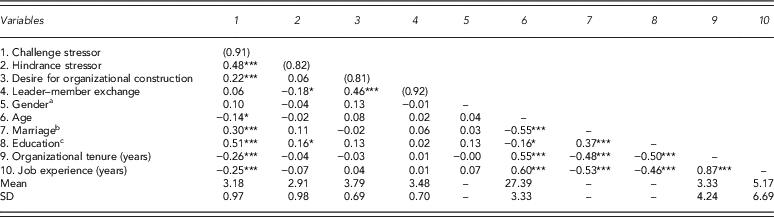
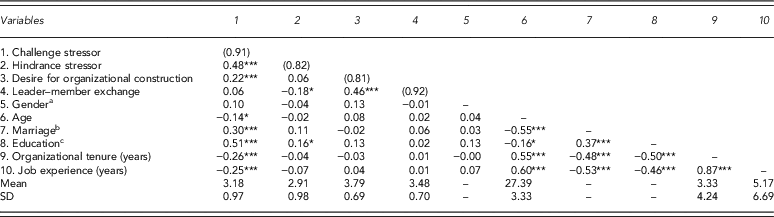
Unless noted, all of the scales were translated from English to Chinese according to the standards of translation and back-translation. First, the original version of the scale was translated into Chinese by a bilingual professor. Second, another professor and two PhD students (all bilingual) translated the Chinese versions into English, respectively. Finally, they compared the translated versions and resolved the minor translation issues among the four translators. Five-point Likert-type scales ranging from 1=‘strongly disagree,’ to 5=‘strongly agree’ were used, and all of the scales had adequate reliability, as is shown in Table 1.
The correlations between the variables in this study
Note. N=204. The values in the parentheses represent Cronbach’s α reliability coefficient.
a Gender (1=‘male,’ 2=‘female’).
b Marriage (1=‘married,’ 2=‘unmarried,’ 3=‘others’).
c Education (1=‘high school and below,’ 2=‘college,’ 3=‘bachelor,’ 4=‘master and above’).
*p<.05; ***p<.001.
Challenge–hindrance stressors
A total of 11 items from Cavanaugh et al. (Reference Cavanaugh, Boswell, Roehling and Boudreau2000) were used to measure challenge stressors (six items) and hindrance stressors (five items). Sample items from the challenge stressor scale were ‘The number of projects and or assignments I have’ and ‘The amount of time I spend at work.’ In contrast, sample items from hindrance stressor scale were ‘The inability to clearly understand what is expected of me on the job’ and ‘The lack of job security I have.’ Participants were asked to respond to how much stress each of the 11 stressor items was causing them. The scale of challenge stressors yielded a reliability of α=0.91 and the scale of hindrance stressors yielded a reliability of 0.82.
Desire for organizational construction
Five items adapted from Eisenberger et al. (Reference Eisenberger, Armeli, Rexwinkel, Lynch and Rhoades2001) were used to measure desire for organizational construction. The original scale included seven items, which is used to measure felt obligation. We deleted two items because of the low factor loadings or heavy cross-loadings with items of other scales. To highlight the subjective intention of employees’ desire for organizational construction, we used the phrase ‘I am willing to’ to replace the word ‘obligation.’ The five items were ‘I am willing to do whatever I can to help the organization achieve its goals,’ ‘I am willing to ensure that I produce high-quality work,’ ‘I am willing to do what I can to ensure that customers are well-served and satisfied,’ ‘I am willing to take time from my personal schedule to help the organization if it needed my help,’ ‘I would feel guilty if I did not meet the organization’s performance standards.’ This scale yielded a reliability of 0.81.
Leader–member exchange
A total of 11 items from the scale developed by Liden and Maslyn (Reference Liden and Maslyn1998) were used to measure leader–member exchange. This scale had four subscales, namely affect, loyalty, contribution and professional respect. Three items were used to measure affect, and sample items were ‘I like my supervisor very much as a person’ and ‘My supervisor is the kind of person one would like to have as a friend.’ Three items were used to measure loyalty, and sample items were ‘My supervisor defends my work actions to a superior, even without complete knowledge of the issue in question’ and ‘My supervisor would come to my defense if I were “attacked” by others.’ Two items were used to measure contribution, and sample items were ‘I do work for my supervisor that goes beyond what is specified in my job description’ and ‘I am willing to apply extra efforts, beyond those normally required, to further the interests of my work group.’ Three items were used to measure professional respect, and sample items were ‘I am impressed with my supervisor’s knowledge of his/her job’ and ‘I respect my supervisor’s knowledge of and competence on the job.’ As we focused on the broader variable of leader–member exchange, we conducted a higher order confirmatory factor analysis. In the measurement model, the 11 items were loaded onto their respective first-order factors, and the four second-order factors were loaded onto a second-order factor. The results indicated that this model fit the data well (χ2=91.43, df=40, TLI=0.96, CFI=0.97, RMSEA=0.08). The overall scale yielded a reliability of 0.92.
Control variables
The demographic variables such as gender, age, marriage, education, job experience and organizational tenure were measured as control variables.
Confirmatory factor analysis
We conducted a confirmatory factor analysis on the above four measures to examine the construct validity. As our study involved cross-sectional data, which is vulnerable to common method variance (Podsakoff, Mackenzie, Lee, & Podsakoff, Reference Podsakoff and Organ2003), confirmatory factor analysis can help to assess the severity of method variance (Podsakoff & Organ, Reference Podsakoff, MacKenzie, Lee and Podsakoff1986). If the method variance is a significant problem, a single-factor model is as well as the full-factor measurement model. For leader–member exchange we used the scale scores of the dimensions to represent the broad factors. The result of confirmatory factor analysis shows that the hypothesized four-factor measurement model (including challenge stressor, hindrance stressor, desire for organizational construction and leader–member exchange) fits the data better than the other measurement model (χ2=386.82, df=164, TLI=0.87, CFI=0.89, RMSEA=0.08).
Results
The means, standard deviations and correlation coefficients of the variables are shown in Table 1. As the table shows, challenge stressors is moderately related to hindrance stressors (r=0.48, p<.001) as in the results of previous studies (e.g., Cavanaugh et al., Reference Cavanaugh, Boswell, Roehling and Boudreau2000; LePine, Podsakoff, & LePine, Reference LePine, Podsakoff and LePine2005). The relationship between challenge stressors and desire for organizational construction is positive (r=0.22, p<.001). The relationship between hindrance stressors and desire for organizational construction is not significant at the 95% confidence interval (r=0.06, p>.05). As is shown in Table 1, job experience and organizational tenure are highly related (r=0.87, p<.001). To avoid multicollinearity, we selected organizational tenure as one of the control variables in this study, as in the study by Eisenberger et al. (2001). Job experience was excluded from the regression equations.
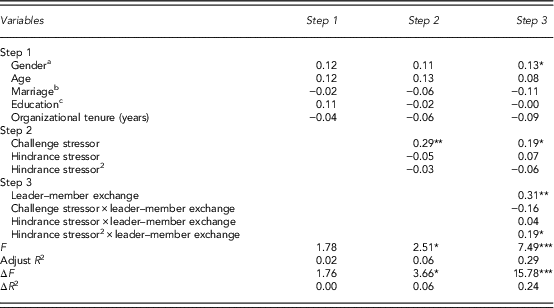
This study computed the squared item of hindrance stressors, the interaction item of hindrance stressors and leader–member exchange, and the interaction item of hindrance stressors squared and leader–member exchange (after centralizing hindrance stressors and leader–member exchange). The result of the hierarchical regression is shown in Table 2. Step 2 in Table 2 shows that challenge stressors is positively related to desire for organizational construction (β=0.29, p<.001), and therefore Hypothesis 1 is supported. However, the U-shaped relationship between hindrance stressors and desire for organizational construction is not supported by the regression coefficient of hindrance stressors squared (β=−0.03, p>.05). Thus, Hypothesis 2 is not supported. However, this result may have been caused by the moderating role of leader–member exchange. As is shown in step 3 of Table 2, leader–member exchange cannot moderate the relationship between challenge stressors and desire for organizational construction (β=−0.16, p>.05). However, leader–member exchange can moderate the relationship between hindrance stressors and desire for organizational construction (β=0.19, p<.05). Thus, Hypothesis 3 is not supported, but Hypothesis 4 is supported.
The results of hierarchical regression
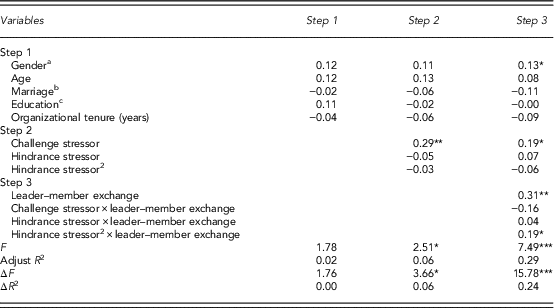
Note. N=204. The values in the parentheses represent Cronbach’s α reliability coefficient.
a Gender (1=‘male,’ 2=‘female’).
b Marriage (1=‘married,’ 2=‘unmarried,’ 3=‘others’).
c Education (1=‘high school and below,’ 2=‘college,’ 3=‘bachelor,’ 4=‘master and above’).
*p<.05; **p<.01; ***p<.001.
To further explain the moderating role of leader–member exchange, we have drawn Figure 1 according to the method used by Aiken and West (Reference Aguinis, Beaty, Boik and Pierce1991). We divided high, moderate and low leader–member exchange based on the mean of leader–member exchange plus the standard deviation, mean and mean minus standard deviation. We can conclude that the relationship between hindrance stressors and desire for organizational construction tend to be U-shaped under the condition of high leader–member exchange, and that this U-shaped relationship is weakened with a decrease in leader–member exchange, as is assumed in Hypothesis 4. The interesting result is that this relationship shows an inverted U-shape under the condition of low leader–member exchange. This finding indicates that employees who experience low leader–member exchange commonly do not have enough cognitive resources to consider the cost–benefit balance in their relationships with the organization when they are faced with hindrance stressors that elevate their motivations for reducing uncertainty. However, as in the case of increased hindrance stressors, these employees may experience failure to control their environment and may then feel less desire for change-oriented behavior, which is a typical organizational constructive work behavior (Parker, Williams, & Turner, Reference Parker, Williams and Turner2006).
The moderating effect of leader–member exchange

Study 2
The results of the above-described quadratic relationship may be difficult to duplicate (Aguinis, Beaty, Boik, & Pierce, Reference Aiken and West2005). Therefore, to confirm the robustness of the quadratic relationship between hindrance stressors and desire for organizational construction, we conducted study 2. In this second study, we designed five scenarios and investigated the feelings of the participants. A total of 44 graduate and undergraduate students participated in the study. Their ages ranged from 21 to 25, with an average age of 22.25. Most of the participants (56.80%) were male. To test the hypothesis, we designed two scenarios concerning leader–member exchange (low and high), and three scenarios concerning hindrance stressors (low, moderate and high). Our design was a between-subjects experimental condition. Every participant was randomly allocated to a condition and there were six groups in total, as shown in Table 3.
The groups in this study

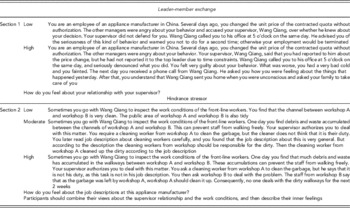
The participants in each group read two scenarios about a work situation and a relationship with a supervisor. After reading each scenario as given in Table 4, they appraised the situation. First, the participants read the scenario about leader–member exchange and appraised their relationship with the supervisor. Second, they read the scenario about hindrance stressors, and then appraised their work stressors and their feelings about organizational construction by combining the scenarios concerning leader–member exchange. The participants received RMB10 as a reward for their participation.
The process of the study 2 experiment

Unless noted, the scales used in this study were all 7-point Likert-type scales, ranging from 1=‘strongly disagree,’ to 5=‘strongly agree.’
The manipulation of the leader–member exchange was based on the items from Liden and Maslyn (Reference Liden and Maslyn1998), and the story was adapted from an article in Business Review Net (i.e., http://www.ebusinessreview.cn). We used one question (i.e., ‘How do you feel about your relationship with your supervisor?’) to confirm whether the manipulation was a success. The score in the ‘high leader–member exchange’ group is more than that in the ‘low leader–member exchange’ group (mean=4.95 vs. mean=3.86, F(1, 42)=14.64, p<.01). The hindrance stressors were based on an item from Cavanaugh et al. (Reference Cavanaugh, Boswell, Roehling and Boudreau2000). The story was adapted from a case of management. We also used one question to confirm whether this manipulation was a success. The means of the three groups (low, moderate and high) are different (mean=2.86 vs. mean=4.00 vs. mean=5.20, F(2, 41)=10.72, p<.001), and the result of the post hoc test shows that the means of the three groups differ.
Five items adapted from Eisenberger et al. (Reference Eisenberger, Armeli, Rexwinkel, Lynch and Rhoades2001) were used to measure desire for organizational construction, and the scale was the same to that was used in study 1. This scale yielded a reliability of 0.94.
The results of an analysis of variance with ‘hindrance stressors’ as a factor shows that the means of desire for organizational construction are different (F(2, 41)=3.66, p<.05). We conducted a post hoc test to confirm whether the U-shaped relationship existed. The results show that the differences between the low hindrance stressor group and the high hindrance stressor group is significant at the level of the 95% confidence interval (Meanlow=5.15, Meanhigh=3.95, p<.05). However, the difference between the low hindrance stressor group and the moderate hindrance stressor group is not significant (Meanlow=5.15, Meanmoderate=4.63, p=.14), and it is the same as the difference between the moderate hindrance stressor group and the high hindrance stressor group (Meanmoderate=4.63, Meanhigh=3.93, p<.26). As in study 1, these results do not support the U-shaped relationship.
To examine the moderating role of leader–member exchange, we conducted a two-factor variance analysis. The results show that the values of the interaction of the two factors (including the leader–member exchange factor and the hindrance stressor factor) are significant (F(2, 38)=18.45, p<.001) in the full factorial model (including the leader–member exchange factor, the hindrance stressor factor and the interaction). Using the drawing function of SPSS, we obtained Figure 2. From the findings shown in Figure 2, we conclude that the employees’ desire for organizational construction is highest in the moderate hindrance stressor group and in the low leader–member exchange group. In contrast, the employees’ desire for organizational construction is lowest in the moderate hindrance stressor group and in the high leader–member exchange group. This finding provides further evidence that leader–member exchange can moderate the quadratic relationship between hindrance stressors and desire for organizational construction.
The results of two-factor variance analysis

Discussion
This study constructs the relationship between challenge–hindrance stressors and desire for organizational construction through the perspectives of both social exchange and uncertainty management theory. We propose that leader–member exchange can be a moderator in this relationship. The results of this study show that challenge stressors are positively related to desire for organizational construction and that leader–member exchange can moderate the quadratic relationship between hindrance stressors and desire for organizational construction. These findings offer important theoretical implications for distinguishing the scope of application for social exchange and uncertainty management theory in dealing with situations in which employees are facing of negative treatment.
Theoretical implications
This study extends our knowledge of the motivations involved in desire for organizational construction in the face of work stressors. The study shows that challenge stressors tend to motivate employees to engage in organizational construction. This finding corresponds to the predictions made by both social exchange and uncertainty management theory. Social exchange theory proposes that as challenge stressors can bring potential gains for employees (Cavanaugh et al., Reference Cavanaugh, Boswell, Roehling and Boudreau2000), the employees may perceive such stressors as positive treatment from their organizations, and such perceptions of positive treatment can stimulate the employees’ motivation for positive reciprocity. However, challenge stressors can also lead to negative effects (LePine, Podsakoff, & LePine, Reference LePine, Podsakoff and LePine2005; Widmer, Semmer, Kälin, Jacobshagen, & Meier, Reference Widmer, Semmer, Kälin, Jacobshagen and Meier2012). According to uncertainty management theory, employees may increase the desire for organizational construction to reduce their uncomfortable feelings caused by challenge stressors. In summary, challenge stressors can simultaneously cause motivation for positive reciprocity and for uncertainty reduction, and these two motivations are both positive in promoting desire for organizational construction. However, this positive relationship between challenge stressors and desire for organizational construction does not help to explain the scopes of application for these two theories from the perspective of employee motivations.
We can understand the above-described findings through constructing the relationship between hindrance stressors and desire for organizational construction. Hindrance stressors tend to thwart personal growth and may thus harm an employee’s motivation for organizational construction. However, according to uncertainty management theory, hindrance stressors can motivate employees to change their environments proactively because of the need for reducing uncertainty. Thus, there are two competing motivations that can explain the relationship between hindrance stressors and desire for organizational construction. This study proposes a U-shaped relationship for integrating these two competing motivations. The results of study 1 and study 2, however, do not support this hypothesis.
Our study shows that the insignificance of the U-shaped relationship occurs due to the moderating effects of leader–member exchange. According to social exchange theory, employees need psychological resources to calculate the benefits and costs of their relationships with their organizations (Blau, Reference Blau1964). Unlike employees who experience low leader–member exchange, employees who experience high leader–member exchange have sufficient cognitive resources to consider the benefits and costs of enhancing this exchange. These employees are sensitive to negative forms of treatment such as hindrance stressors. With the increase of hindrance stressors, the employees’ motivation for reciprocity is weakened, because the employees reduce the resources spent on considering the benefits and costs involved. However, the motivation for reducing uncertainty is enhanced under conditions of high hindrance stressors. Therefore, when these employees confront low-level hindrance stressors, they perceive little loss from coping with them and feel high positive attitude for their organizations. Consequently, their prosocial reciprocity motivation is activated and the desire for organizational construction is high. In contrast, when the hindrance stressors are high, employees experience intensely strain, which motivate them to reduce the discomfort. Then employees’ desire for organizational construction is at high level due to the high hindrance stressors. When the hindrance stressors are at moderate level, employees’ motivation to reduce uncertainty is not activated and the norm of reciprocity is damaged by the hindrance stressor. Therefore, desire for organizational construction is the lowest. In summary, the relationship between hindrance stressors and desire for organizational construction is U-shaped in the condition of high leader–member exchange, as is shown in the solid line in Figures 1 and 2. We can infer that employees’ motivation for reciprocity requires cognitive resources to be applied for reflecting on their relationship with their organization. In contrast, it requires no extra resources to activate the motivation to reduce uncertainty.
The interesting result we have found in this study is that the relationship between hindrance stressors and desire for organizational construction has an inverted U-shape under the condition of low leader–member exchange (see the dashed line in Figures 1 and 2). Employees who experience low leader–member exchange obtain fewer resources from their direct leaders, and therefore they need to use their own cognitive resources to cope with hindrance stressors. Thus, they may not have enough resources to activate a motivation for reciprocity. Consequently, uncertainty reduction becomes the primary motivation that leads to a positive relationship between hindrance stressors and desire for organizational construction. This finding that the initial positive relationship between hindrance stressor and desire for organizational construction indicates that employees enjoying low leader–member exchange expect little positive treatment from the organizations, which is corresponding to the suggestion of Rosen, Harris, and Kacmar’s (Reference Rosen, Harris and Kacmar2011: 823) study. These employees place more emphasis on their own interest and coping with stressors depending on their own resources. As is shown in the dashed line of Figures 1 and 2, when hindrance stressors are within the scope between moderate and high level the relationship tend to be negative. This findings show that when the hindrance stressors seem to be beyond the employees’ ability to control, their desire for organizational construction tends to decrease, as is predicted by action theory (Hacker, Reference Hacker1985). According to action theory, individuals are motivated to conduct change-oriented behavior if they perceive that they have control in a situation and if they can change their negative work environment through proactive behavior.
In a word, this study shows that employees who enjoy high-quality leader–member exchange focus more on the norm of reciprocity and the others focus more on self-interest under the condition of low-level hindrance stressors when they consider whether to engage in organizational construction. We contribute to clarify the various motivations when employees conduct organizational constructive behavior by examining the moderating role of leader–member exchange. This finding is in general agreement with the broader research on the important effect of the supervisor–subordinate relationship on employees’ attitude toward organization (Sluss & Thompson, Reference Sluss and Thompson2012).
We can explain the moderating role of leader–member exchange on the relationship between challenge stressors and desire for organizational construction through the perspective of expectation theory (Vroom, Reference Vroom1964). High-quality leader–member exchange may prompt employees to impose greater expectations on their leaders (Restubog et al., 2010). The employees expect their leaders to do more for them and to give them positive treatment such as challenge stressors. In contrast, employees who experience low leader–member exchange may feel surprised when they obtain challenge stressors that can bring them potential benefits. As low leader–member exchange leads employees to have low expectations from their leaders, their enthusiasm may be greatly enhanced when they do obtain positive treatment (Vroom, Reference Vroom1964). Thus, when the motivation for leader–member exchange is predominant, the positive relationship between challenge stressors and desire for organizational construction is weakened due to the increased importance of leader–member exchange. As is discussed above, when the motivation for reducing uncertainty is predominant, the leader–member exchange may act as a kind of support resource that tends to enhance the positive relationship between challenge stressors and desire for organizational construction. However, the competing roles of leader–member exchange on this relationship can make the moderating effect fail to produce positive motivation.
From the perspective of coping with hindrance stressors, the findings of this study may support Selye’s (Reference Selye1950) triphasic model of stress. The triphasic model of stress suggests that there are three phase containing alarm, reactance and exhaustion phase when coping with stress. As individual invests little resources to eliminate the strain eliciting from low-level stress in the alarm phase, the low-level stress tend to decrease individuals’ work behavior, which is similarity to the relationship when employees with high leader–member exchange confront hindrance stressors range from low to moderate level. During the phase of reactance, individual is aware of the stress and engage more resources in coping with stress, which is corresponding with the relationship when employees with high leader–member exchange confront high-level hindrance stressors. For the exhaustion phase of stress triphasic model, previous study suggests that it is relatively uncommon in the organizational context (Leung et al., Reference Leung, Huang, Su and Lu2011). However, this study shows that leader–member exchange may be an important contextual variable to alter the phase of stress coping. For the employees who obtain little attention from their supervisors they should cope with stressors depending on their own resources. Thus, high-level hindrance stressors make them face the exhaustion phase which indicates that the coping responses become invalidity. Moreover, low leader–member exchange vanishes the alarm phase and give prominence to the reactance and exhaustion phase. Therefore, this study may contribute to the triphasic model of stress by finding an important boundary condition.
Finally, although the theoretical construction of this study is mainly from the perspective of desire for change-oriented behavior and organizational citizenship behavior, which are not included in the regular performance evaluation criteria (Van Dyne, Graham, & Dienesch, Reference Van Dyne, Graham and Dienesch1994), the results of this study can also be extended to the in-role work behavior and job crafting. First, for the in-role work behavior engaging in the behavior, which is required in the job duties, can help to achieve organizational goal, and this can reflect employees’ caring about organizational development. Hence, in-role work behavior is a part of constructive behavior. Second, evidence has shown that increasing in-role work behavior is an appealing strategy for employees with high work stressor, and increasing in-role work behavior can help employees to reduce the negative effect of work stressor (Gilboa, Shirom, Fried, & Cooper, Reference Gilboa, Shirom, Fried and Cooper2008; Selenko, Mäkikangas, Mauno, & Kinnunen, Reference Selenko, Mäkikangas, Mauno and Kinnunen2013), which is corresponding to the prediction of uncertainty management theory.
Job crafting denotes employees’ physical and cognitive effort to change the task or relational boundaries of their work (Wrzesniewski & Dutton, 2001). Through job crafting employees can acquire control over the work environment and create a positive self-image for the job (Baumeister & Leary, Reference Baumeister and Leary1995). Similar, desire for organizational construction in this study denotes that employees’ willingness to engage in organizational development proactively. Through such behavior can also help the employees change the work environment around them and satisfy their self-interest. The difference between job crafting and desire for organizational construction is that job crafting is only activated by self-direct motivation and it not necessarily to bring potential benefits for the organization (Wrzesniewski & Dutton, 2001) like organizational constructive behavior. Therefore, the findings about the increasing desire for organizational construction due to self-interest motivation can be extended to job crafting.
Limitations and future study
This study has some limitations that can be overcome in the future. First, the data used in study 1 are cross-sectional and are not conducive to inferring causal relationships. However, we designed a scenario experiment in study 2 that may make up for the inadequacy of study 1. Second, the variables in study 1 are all evaluated by employees, which may lead to common source bias (Podsakoff et al., Reference Podsakoff and Organ2003). We add one inverse item in the questionnaires to help to control for common source bias (Podsakoff et al., Reference Podsakoff and Organ2003). Third, the result of the quadratic relationship is hard to duplicate (Aguinis et al., Reference Aiken and West2005). Although study 2 helps to enhance the robustness of the evidence concerning the moderating role of leader–member exchange on the relationship between hindrance stressors and desire for organizational construction, the number of participants in the sample is limited. Moreover, although the tendency of Figures 1 and 2 is similar and the figures support the hypothesis of present study, the solid line in Figures 1 and 2 is slightly different. For example, Figure 1 shows that the U-shaped relationship between hindrance stressors and desire for organizational construction for high leader–member exchange is not prominent than that in Figure 2. In addition, the lines in Figure 1 have cross-connection and the lines in Figure 2 are not. Specifically, the point with high leader–member exchange and moderated hindrance stressors in Figure 1 is larger than that with low leader–member exchange and moderated hindrance stressors. In contrast, the point with high leader–member exchange and moderate hindrance stressors in Figure 2 is smaller than that with low leader–member exchange and moderate hindrance stressors. However, present study cannot give a reasonable explanation, which needs furthermore research. A potential explanation is that the direct effect of leader–member exchange on desire for organizational construction is different in study 1 and study 2 as the value of leader–member exchange can influence the intercept of the equation. In addition, this study only controlled the demographic variables such as gender, age, marriage, education and organizational tenure, and this may have alternative explanations to our proposed model. For example, social identity theory may also help to explain the relationship between work stressor and desire for organizational construction. According to social identity theory, when employees confront challenge stressors that can bring potential benefits for them, they may produce high sense of organizational identity (Ashforth & Mael, Reference Ashforth and Mael1989). Employees with high organizational identity tend to bridge organizational goal with personal benefits, and then they may increase their desire for organizational construction (Ashforth & Mael, Reference Ashforth and Mael1989). Therefore, it is necessary for us to do more work on this issue and add more control variables such as organizational identity. Finally, this study is conducted in China, which may constrain the generality of the results.
Practical implications
Our study suggests that challenge stressors can lead to employee desire for organizational construction. Employees who enjoy high-quality leader–member exchange tend to be motivated in serving their organization when they are facing of low or high hindrance stressors. In contrast, employees who experience low-quality leader–member exchange are better motivated to serve their organization when faced with moderate hindrance stressors. Thus, management practitioners should impose more challenge stressors on employees, or adopt different hindrance stressor management strategies, according to the variance of leader–member exchange. For employees who develop a high exchange relationship with leaders, eliminating hindrance stressors is an effective way to improve the employees’ motivation for serving their organization. For employees who experience low leader–member exchange, leaving them in a moderate hindrance stressor environment may be a good method for promoting their motivation for serving the organization.
Conclusion
The findings reported here suggest that challenge stressor can increase employees’ desire for organizational construction and hindrance stressor can also activate employees to serve for organization in specific condition (i.e., condition 1: high levels of leader–member exchange with high levels of hindrance stressor; condition 2: low levels of leader–member exchange with low levels of hindrance stressor). This study has important implications to explain employees various organizational constructive behaviors such as change-oriented behavior, organizational citizenship behavior and in-role work behavior when facing work stressors by describing the variation of employees’ desire for organizational construction. Finally, managers can motivate employees to serve for organization by increasing challenge stressor and regulating appropriate levels of hindrance stressor according to the levels of leader–member exchange.
Acknowledgement
The authors wish to thank the anonymous reviewers and the editor for their constructive comments. In addition, the authors are grateful for the financial support of the National Natural Science Foundation of China (71472054).