Introduction
Rates of lifetime exposure to a natural disaster in the US population are estimated to be around 19% for men and 15% for women.Reference Kessler, Sonnega, Bromet, Hughes and Nelson 1 Natural disasters are known to lead to depression and posttraumatic stress disorder (PTSD) in exposed populations, possibly due to the fact that they involve human casualties and massive destruction.Reference Fullerton, Ursano and Wang 2 Firefighters are often called to the scene of these disasters to serve as rescue workers. This line of work places high demands on firefighters and puts firefighters at risk for problems such as depression and PTSD.Reference Fullerton, Ursano and Wang 2 , Reference Berger, Coutinho and Figueira 3 It is important to understand what risk factors may exist that make firefighters susceptible to these challenges. One risk factor may be pre-existing exposure to disasters, the effects of which may make firefighters vulnerable to the stressors of fire service and lead to an escalation of mental health problems over time. To date, there is little research on the impact of natural disasters on firefighter mental health, thus the topic of the current study.Reference Neria, Nandi and Galea 4
Trauma, Depression, and PTSD
A number of studies have examined the psychological effects of natural disasters in adult victims.Reference Acierno, Ruggiero and Galea 5 – Reference Tracy, Norris and Galea 15 Of these psychological effects, depression and PTSD are among the most commonly reported mental health issues following a disaster. Major depressive disorder (MDD) is characterized by depressed mood or loss of pleasure that lasts for at least two weeks; PTSD is characterized by the development of symptoms of intrusions, avoidance, negative alteration in cognition and mood, and alterations in arousal and reactivity following exposure to a traumatic event. 16 Studies have found depression rates of 5.0%-20.0% and PTSD rates of 4.0%-14.0% in adults after hurricanes.Reference Acierno, Ruggiero and Galea 5 , Reference Kohn, Levav, Garcia, Machuca and Tamashiro 10 , Reference Pietrzak, Southwick, Tracy, Galea and Norris 11 , Reference Tracy, Norris and Galea 15 By comparison, the 12-month prevalence of depression and PTSD in the general population is estimated to be 9.0% and 4.0%, respectively.Reference Gadermann, Alonso, Vilagut, Zaslavsky and Kessler 8 In addition, Shore and colleagues observed higher onset of depression and PTSD in subjects with high exposure to a volcanic eruption compared to those with low or no exposure.Reference Shore, Tatum and Vollmer 13
A number of studies have focused specifically on the depressogenic effects of disaster exposure. Ginexi and colleagues found that the 1993 Midwest Floods led to increases in depressive symptoms and diagnoses in exposed individuals,Reference Ginexi, Weihs, Simmens and Hoyt 9 whereas Toukmanian et al found that survivors of the 1988 Armenia earthquake reported higher levels of depression than non-exposed individuals.Reference Toukmanian, Jadaa and Lawless 14 Individuals who were exposed to the 1985 floods in Puerto Rico endorsed more depression symptoms than unexposed persons.Reference Canino, Bravo, Rubio-Stipec and Woodbury 7 Thus, exposure to disasters appears to place individuals at risk for depression and depressive symptoms.
There are many similar findings specific to PTSD. After Hurricane Katrina (2005), Rhodes et al found probable PTSD in 48.0% of exposed respondents approximately 18 months post-hurricane.Reference Rhodes, Chan, Paxson, Rouse, Waters and Fussel 12 Similarly, Bei and colleagues found 15.0% of respondents exposed to floods in Australia reported clinically elevated PTSD symptoms, while another 15.0% reported mildly elevated symptoms.Reference Bei, Bryant and Gilson 6 A study of a separate group of flood-exposed individuals revealed that exposed subjects were more likely than non-exposed to be diagnosed with PTSD.Reference Canino, Bravo, Rubio-Stipec and Woodbury 7
Disaster Exposure in First Responders
Given the nature of fire service work, first responders (eg, police, firefighters, and emergency medical personnel who provide life-saving services) are especially vulnerable to the challenges associated with disaster exposure. After the 2005 hurricanes in the United States, there were many reports of psychological and physical illness among New Orleans (Louisiana, USA) firefighters and police officers, prompting investigation. 17 According to Tak, Driscoll, Bernard, and West, 27.0% of New Orleans firefighters reported major depressive symptoms after the hurricanes, with only two percent having previous clinician diagnosed depression before the natural disasters.Reference Tak, Driscoll, Bernard and West 18 Additionally, 22.0% of firefighters in the study reported symptoms consistent with PTSD, 17 which is consistent with the 24.0% and 25.0% of rescue workers who were diagnosed with PTSD following separate earthquakes.Reference Armagan, Engindeniz, Devay, Erdur and Ozcakir 19 , Reference Ozen and Sir 20 Similarly, after an Australian bushfire disaster, McFarlane and Papay found that 13.0% of the firefighters were diagnosed with definite PTSD and nine percent with definite depression 42 months after working the disaster.Reference McFarlane and Papay 21 Thus, the nature of fire service work makes firefighters more vulnerable than the general population for trauma- and stress-related challenges.
Present Research
As much as research has explored the impact of on-the-job disaster exposure, research has yet to explore whether pre-existing disaster exposure may be a risk factor for firefighters and first responders. This research group was interested in the effects of pre-fire academy natural disaster exposure on depression and PTSD symptoms in the first three years of fire service. In this study, exposure to natural disaster was defined as exposure to a tornado, hurricane, flood, major earthquake, or other event as interpreted by the respondent, where the participant felt they or their loved ones were in danger of death or injury. The current study compared a sample of firefighter recruits exposed to natural disasters prior to fire academy with an age-, education-, and region-matched sample of recruits without disaster exposure to determine if pre-academy trauma exposure contributes to vulnerability in the first three years of service. The researchers hypothesized that: (1) disaster-exposed firefighters would have greater depression and PTSD symptoms than non-exposed overall; and (2) depression and PTSD symptoms would worsen over years in fire service in exposed firefighters, but not in their unexposed counterparts.
Methods
Design
The study was a longitudinal analysis examining the effect of pre-academy disaster exposure (yes / no) across 10 time points (baseline, 4-month, 8-month, 1-year, 16-month, 20-month, 2-year, 28-month, 32-month, and 3-year). Disaster exposure was a between-subjects independent variable, whereas time was a within-subjects independent variable. Depression symptoms and PTSD symptoms were assessed as dependent variables.
Procedure
As part of a large National Institutes of Health-funded study (Bethesda, Maryland USA; R01-MH-73808), 322 firefighter cadets were recruited from seven urban fire departments across the United States and followed through their first three years of fire service. In-person clinical assessments were conducted by doctoral-level clinical psychologists at four time points: before graduating from fire training academy (baseline) and at the end of each of their first three years of fire service (annual one, two, and three). Phone assessments were conducted by trained research assistants at four-month intervals between the baseline and annual assessments (4-month, 8-month, 16-month, 20-month, 28-month, and 32-month). The Texas A&M University (Temple, Texas USA) Institutional Review Board and Baylor Scott & White (Temple, Texas USA) Institutional Review Board approved all procedures.
Participants
At baseline, 35 male firefighter recruits reported lifetime exposure to at least one natural disaster. Female firefighters were excluded due to a low percentage of females in the overall study sample leading to few females in the disaster-exposed sample, and because gender differences have been observed in post-disaster depression.Reference Toukmanian, Jadaa and Lawless 14 These disaster-exposed recruits were matched on age, city, and education to 35 non-exposed cadets (total n=70). All recruits were free of Axis I diagnoses at the time of consent, as determined by a structured clinical interview which included the Mini International Neuropsychiatric Interview,Reference Sheehan, Lecrubier and Harnett-Sheehan 22 the Clinician Administered PTSD Scale,Reference Blake, Weathers and Nagy 23 , Reference Weathers and Litz 24 and portions of the Structured Clinical Interview for Diagnostic and Statistical Manual of Mental Disorders, 4th Edition (DSM-IV) Disorders.Reference Spitzer, Williams, Gibbon and First 25
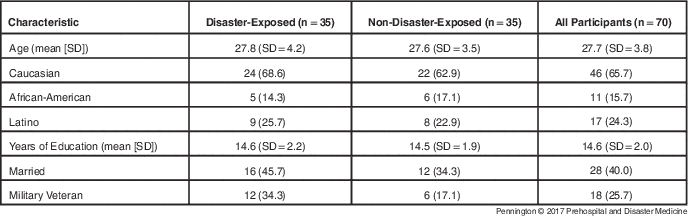
As described in Table 1, the sample had a mean age of 27.7 years (SD=3.8). Participant ethnicity was somewhat diverse, as follows: 16.0% African American, 24.0% Hispanic, and 66.0% Caucasian (categories not mutually exclusive). All participants completed high school (mean education: 14.6 years), 26.0% were military veterans, and 40.0% were married.
Demographic Characteristics

Note: Data presented as n (%), except where otherwise noted.
Most disaster-exposed firefighter recruits experienced one natural disaster (80.0%); however, five firefighters experienced two natural disasters (14.0%), one experienced six disasters (3.0%), and one experienced 21 disasters (3.0%). At the time of disaster exposure, firefighters ranged in age from three to 34 years old (M=15.18; SD=7.73), and time since exposure ranged from one to 22 years (M=12.48; SD=7.18). Disaster-exposed recruits experienced hurricanes (31.0%), earthquakes (23.0%), tornados (23.0%), floods (3.0%), and heat waves (3.0%). In addition, three firefighters experienced more than one type of natural disaster (9.0%) and three did not specify the type of natural disaster experienced (9.0%).
Measures
Disaster Exposure and Trauma
Pre-academy disaster exposure was assessed using the Trauma History Questionnaire – Revised (THQ-R), a 24-item clinician-administered measure designed to assess exposure to potentially traumatic experiences that could qualify as PTSD Criterion A1 events.Reference Green 26 A yes/no question was used to identify the disaster-exposed recruits, asking “Have you ever experienced a natural disaster such as a tornado, hurricane, flood, major earthquake, etc, where you felt you or your loved ones were in danger of death or injury?” Disaster-exposed participants were also asked to specify the type of natural disaster, the frequency of exposure, and age at the time of the disaster.
Depression Symptoms
Depressive symptoms were assessed with the Beck Depression Inventory for Primary Care (BDI-PC), a 7-item self-report measure designed to screen for MDDs according to the DSM-IV criteria.Reference Beck, Guth, Steer and Ball 27 The BDI-PC assesses the cognitive and affective symptoms, and questions are asked in the context of the “past two weeks, including today.”
PTSD Symptoms
Posttraumatic stress disorder symptoms were assessed using the Post-Traumatic Stress Disorder Checklist – Civilian (PCL-C), a 17-item self-report questionnaire designed to screen for PTSD symptoms over the previous month.Reference Weathers, Litz, Herman, Huska and Keane 28 , Reference Ruggiero, Ben, Scotti and Rabalais 29 The PCL-C is adapted from the DSM-IV PTSD Criteria B-D. Internal consistency at baseline for the current study was .89.
Work Trauma
The Firefighter Work Experience (FFWE; unpublished measure) is an 11-item clinician-administered measure designed to assess potentially traumatic experiences that may have occurred while working as a firefighter. Sample items include: “witnessed or learned about a line of duty death” and “worked on a scene with multiple casualties.”
Social Support
Social support was assessed using the Family Social Support Scale (SSS-F) and the Firefighter Social Support Scale (SSS-FF), adapted from King, King, and Vogt’s Post Deployment Social Support Scale.Reference King, King and Vogt 30 The SSS-F and SSS-FF are each 9-item self-report measures that include only items that are relevant to firefighters and their families. In the current study, internal consistency was .82 for the SSS-F at baseline and .85 for the SSS-FF at the 4-month time point (first time point collected). To facilitate interpretation, these variables were z-scored prior to analysis.
Data Analytic Strategy
Because the data consisted of observations nested within persons over time, they were analyzed with multi-level growth models.Reference Hox 31 , Reference Raudenbush and Bryk 32 Data were analyzed using R (v 3.2.2), the lme4 (v. 1.1-10),Reference Bates, Mächler, Bolker and Walker 33 and lmerTest (v. 2.0-29) 34 packages for multi-level modeling. Because the dependent variables scores were count data (ie, count of symptoms endorsed), the researchers used multi-level count models to account for non-normality. Specifically, the researchers used over-dispersed poisson models,Reference Atkins, Baldwin, Zheng, Gallop and Neighbors 35 which are multi-level regression models that accounts for the non-normality in the dependent variable using a log-link function.Reference Raudenbush and Bryk 32 Coefficients are interpreted using the exponential function (e coefficient); the resulting value is the magnitude of change in depression given a one-unit increase in the predictor.Reference Atkins, Baldwin, Zheng, Gallop and Neighbors 35
Time was operationalized as the number of months from baseline. Pre-existing disaster exposure was entered as a between-subjects variable, and time was entered as a within-subjects variable. Both main effects and the exposure×time interaction were considered:
 $${\rm Level}\,1\,\colon\,\,{\rm Log}\left( {{\rm E}\left[ \it{DV_{{ti}} } \right]} \right){\equals}\pi _{{0i}} {\plus}\pi _{{1i}} \left( \it{Time} \right){\plus}e_{{ti}} $$
 $${\rm Level}\,2\,\colon\,\pi _{{0i}} {\equals}\beta _{{00}} {\plus}\beta _{{11}} \left( \it{Exposure} \right){\plus}u_{{0i}} ; \ \pi _{{1i}} \,{\equals}\,\beta _{{10}} {\plus}\beta _{{11}} \left( \it{Exposure} \right).$$
In the model, Level 1 represents the effect of time (π 1i =linear effect of time). Level 2 includes an intercept (β 00), the effect of disaster at baseline (ie, when time=0, β 11), the main effect of time (β 10), and trauma×time interaction (β 11).
Results
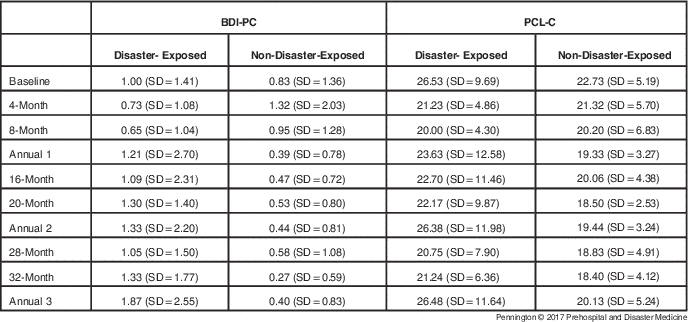
Means and standard deviations for dependent variable scores by disaster-exposure group can be found in Table 2.
Depression and PTSD Scores

Note: Data presented mean (SD).
Abbreviations: BDI-PC, Beck Depression Inventory for Primary Care; PCL-C, Post-Traumatic Stress Disorder Checklist – Civilian; PTSD, posttraumatic stress disorder.
Depression
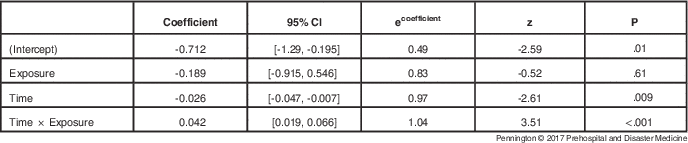
Model results for predicting depression symptoms are shown in Table 3 and plotted visually in Figure 1. There was no significant effect of disaster exposure at baseline (coefficient=-0.19; e coefficient=0.83; P=.61). Overall, there was a slight downward trend in depression symptoms over time (coefficient=-0.03; e coefficient=0.97; P=.009). In other words, depression symptoms changed within persons by a factor of .97 (ie, loss of three percent) per month in the sample as a whole. However, this was qualified by a significant exposure×time interaction (coefficient=0.04; e coefficient=1.04; P<.001). A comparison of models with and without the interaction further confirmed that including the interaction considerably improved fit (∆BIC=-6.38; ∆AIC=-10.43; χ2(1)=12.43; P<.001). Thus, the pattern of the interaction was the focus of interpretationReference Hox 31 and is depicted visually in Figure 1. Among non-exposed participants, depression trajectories trended downward over time; among disaster-exposed participants, depression symptoms trajectories trended upward. Models ran separately on both groups confirmed that the upward trend among exposed participants was significant (coefficient=0.02; e coefficient=1.02; P=.01), as was the downward trend among non-exposed participants (coefficient=-0.03; e coefficient=.97; P=.009).
Predicted BDI Score as a Function of Disaster Exposure and Time in Fire Service. Note: The grey line represents a significant increase in depression scores among disaster-exposed participants; the black line represents a decrease among non-exposed participants. Abbreviation: BDI, Beck Depression Inventory for Primary Care.

Fixed Multi-Level Coefficients for Predicting Depression

Note: All confidence intervals were conducted using parametric bootstrapping in R. Time was months since baseline (0 to 32). Exposure was dummy-coded (0 = no exposure, 1 = disaster-exposed) and represented effect of exposure on depression at baseline. e coefficient = magnitude change in depression per month (1.00 = no change).
Adjusting for Time-Varying Controls
Because time in fire service may lead to trauma exposure and social support, the researchers re-ran the model above controlling for these variables. Controlling for overall exposure to potentially traumatic experiences (THQ-R) during the three-year period did not substantively impact results for time (coefficient=-0.03; e coefficient=0.97; P=.008), pre-academy exposure (coefficient=-0.54; e coefficient=0.58; P=.21), or the exposure×time interaction (coefficient=0.06; e coefficient=1.11; P<.001). Similarly, controlling for service-related trauma (FFWE) also had little impact on coefficients for time (coefficient=-0.03; e coefficient=0.97; P=.01), pre-academy exposure (coefficient=-0.59; e coefficient=0.55; P=.17), or the exposure×time interaction (coefficient=0.06; e coefficient=1.06; P<.001). The same was observed when controlling for social support. The pattern of results remained unchanged when controlling for support from families for time (coefficient=-0.02; e coefficient=0.98; P=.02), pre-academy exposure (coefficient=-0.24; e coefficient=0.79; P=.49), and the exposure×time interaction (coefficient=0.04; e coefficient=1.04; P=.001). Controlling for support from firefighters also had no substantive effect on results for time (coefficient=-0.03; e coefficient=0.97; P=.01), pre-academy exposure (coefficient=-0.46; e coefficient=0.63; P=.28), or the exposure×time interaction (coefficient=0.05; e coefficient=1.05; P<.001). Thus, the depressive trajectories associated with pre-academy exposure persisted when controlling for trauma exposure during fire service or social support in fire service.
PTSD Symptoms
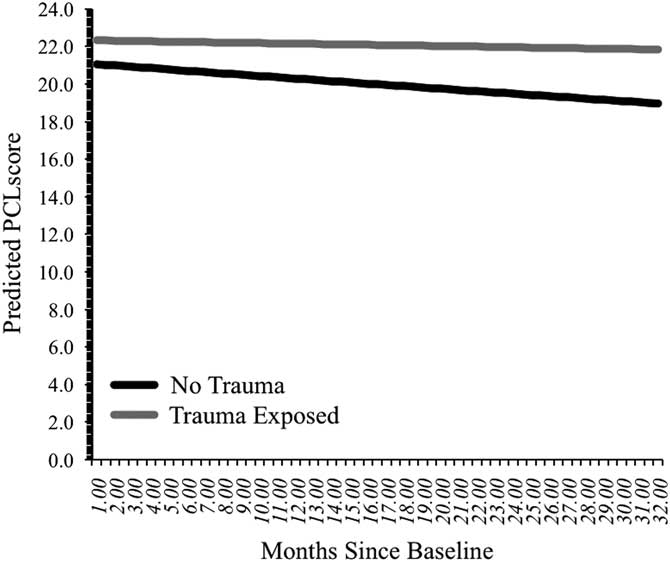
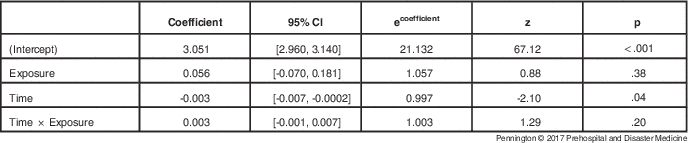
Model results for predicting PTSD symptoms are shown in Table 4 and plotted visually in Figure 2. There was no significant effect of disaster exposure at baseline (coefficient=0.06; e coefficient=1.06; P=.38), and the exposure×time interaction was not significant (coefficient=0.003; e coefficient=1.003; P=.20). Overall, there was a small downward trend in PTSD symptoms over time, however (coefficient=-0.003; e coefficient=0.997; P=.04). In other words, PTSD symptoms changed by a factor of .997 (loss of 0.3% per month).
Predicted PTSD Symptoms as a Function of Disaster Exposure and Time in Fire Service. Note: The grey line represents scores among disaster-exposed participants; the black line represents non-exposed participants. Abbreviations: PCL, Post-Traumatic Stress Disorder Checklist – Civilian; PTSD, posttraumatic stress disorder.

Fixed Multi-Level Coefficients for Predicting PTSD Symptoms

Note: All confidence intervals were conducted using parametric bootstrapping in R. Time was months since baseline (0 to 32). Exposure was dummy-coded (0 = no exposure, 1 = disaster-exposed) and represented effect of exposure on PTSD symptoms at baseline. e coefficient = magnitude change in depression per month (1.00 = no change).
Abbreviation: PTSD, posttraumatic stress disorder.
Discussion
To the knowledge of the researchers, this is the first study to examine the effects of disaster exposure in firefighters that occurred prior to entry into fire service. The hypotheses were partially supported. Disaster-exposed firefighter recruits and non-exposed recruits did not differ on depressive or PTSD symptoms at baseline. However, depression symptoms worsened over the first three years of fire service for disaster-exposed recruits compared to non-exposed recruits. The pattern of results suggests this trend was a function of exposure that pre-dates entry into fire service and was not reduced when controlling for other traumatic exposure or social support during fire service. This finding was not observed with respect to PTSD symptoms between groups.
Although this sample of firefighter recruits did not meet criteria for depression at baseline (participants were excluded from the study if they met criteria for an Axis I diagnosis at baseline), individuals who were previously disaster-exposed entering fire service showed increasing depression scores over time compared to their non-exposed counterparts, indicative of possible synergistic effects of the initial disaster exposure and on-the-job traumas. In fact, research suggests that prior disaster exposure is a risk factor for developing depressive symptoms after a newly experienced disaster.Reference Pietrzak, Southwick, Tracy, Galea and Norris 11 This may account for increasing depression symptoms as new firefighter recruits are called to respond to disasters. These findings highlight the importance of identifying firefighters who are at a greater risk for developing depression during the course of their careers, to ensure that they are provided with preventative interventions and adequate mental health support in fire service. As this was only a three-year study, the increasing effects could lead to more serious psychological problems later in a firefighter’s career if the trajectories are maintained.
Although there was a slight downward trend in PTSD symptoms over the first three years of fire service, no significant differences were found between disaster exposure groups in regards to PTSD symptoms. Though this is inconsistent with previous findings,Reference Fullerton, Ursano and Wang 2 , Reference Canino, Bravo, Rubio-Stipec and Woodbury 7 it may be due to the extended amount of time since the disaster exposure. In this sample, the time since exposure ranged from one to 22 years, with a mean of 12.48 years. To the researchers’ knowledge, in previous studies, the longest post-disaster exposure assessment of PTSD symptoms was 42 months post-disaster.Reference McFarlane and Papay 21
Limitations
A limitation of the current project is the small sample size, as the larger research study from which these data were drawn was not specifically designed for this purpose. These findings are preliminary and indicate a need for more research in this area. Future longitudinal research with a larger population of disaster-exposed firefighters is needed to replicate and extend these findings. Additional research should also focus on the possible synergistic effects of additional on-the-job exposure in recruits pre-exposed to disasters.
Conclusion
The results indicate that natural disasters do have an effect on firefighter recruits’ mental well-being, which could potentially impact the caliber at which they perform their job now and in the future. Exposure to further traumatic events could in turn increase the risk of developing further mental health problems. Efforts should be made to provide disaster-exposed populations, including firefighters, with comprehensive medical care addressing any mental changes post-disaster.