I. INTRODUCTION
Ceramic particle reinforced iron matrix composites (PRIMCs) offer many opportunities for developing new materials by combining physical and mechanical properties, which is not achievable with monolithic ferrous materials. These materials have been actively researched because they offer high strength, high wear resistance, and good performance at elevated temperatures. Reference Mei, Yan and Cui1–Reference Pagounis and Lindroos5 Considering that the PRIMCs will potentially be used as wear-resistant materials such as roll dies for construction steel bars and car brakes, it is preferred to maximize the content of ceramic particles to satisfy wear-resistant requirement without compromising their mechanical properties. From the Refs. Reference Prabhu, Varma and Vedantam6 and Reference Prabhu, Varma and Vedantam7, it was found that when the volume fraction of reinforcements was around 20% in minimum for the excellent wear resistant ability. Therefore, 20% volume fraction was selected in this study to find out possible design and processing to further improve the mechanical properties of the composites.
Manufacturing technology has a substantial effect on the mechanical property of PRIMC. Various processing methods have been utilized to manufacture iron matrix composites, Reference Pagounis and Lindroos5,Reference Cen, Jiang, Zhou, Xu and Wang8–Reference Weber and Theisen10 particularly the dynamic temperature resistant hot press (DTRHP) technology is used to fabricate composites with superior mechanical properties. Reference Li, Zong, Wang and Zhuang11,Reference Zhuang, Zong, Wang and Yang12 The tensile strength of a SiCp/Fe composite manufactured using this technology is 1000 MPa, the highest value reported so far. Reference Song, Dong, Coddeta, Zhou, Sheng, Liao and Coddeta13–Reference Aigbodion and Hassan15 Further research may lead to improvements in mechanical properties by adjusting the microstructure and processing details, such as particle surface treatment and green compact preparation as per the DTRHP technology.
The matrix–reinforcements interface is a key factor influencing the mechanical properties of PRIMCs. Reference Pagounis, Talvitieb and Lindroosa16–Reference Chawla and Chawla19 The effect of nickel coating on particle reinforcement was found to benefit interfacial bonding, which results in a higher mechanical response of metal matrix composites. Reference Kretz, Gacsi, Kovacs and Pieczonka20,Reference Yi, Yu, Hu, Liu, Wang and Jiang21 Few studies have reported the effect of copper coating on the mechanical properties of iron matrix composites, and electroless copper coating on ceramic particles has been proven to be a low-cost and easy-controlled technology compared with nickel coating. Reference Zhang, Zong, Jin and Cao22
Ceramic particles such as SiC, TiC, and TiN are commonly used as reinforcements in metal matrix composites owing to their good physical and chemical properties. Reference Hao and Xie23–Reference Zhou, Qiu and Jiang25 Variations in the reinforcement volume fraction, size, type, and sintering process substantially affect the mechanical properties of PRIMCs. Reference Prabhu, Varma and Vedantam6,Reference Wang, Song, Sun and He26–Reference Rahimian, Ehsani, Parvin and Baharvandi28 Because the effect of different individual types of reinforcing particles on the mechanical properties of PRIMCs has been reported Reference Zhong, Xu, Hojamberdiev, Wang and Wang3,Reference Petersen, Pedersen, Pryds, Thorsen and List27,Reference Das and Bandyopadhyay29 using various processing technologies, we cannot conclusively determine the best material. A comparison of different reinforcement types on the mechanical properties of PRIMCs using a single processing technique is required.
Only a few studies have considered hybrid ceramic particles of different types for metal matrix composites. Reference Ahmadi, Toroghinejad and Najafizadeh30–Reference Zhao, Liu, Pan, Bian and Liu32 An aluminum matrix composite reinforced by TiB2 and Al2O3 particles mixture was reported to have better tensile strength than the corresponding composites with monolithic types of reinforcement. Reference Chen, Yang, Guan and Yan31 However, the hybrid particulate reinforcement strengthening mechanism of iron matrix composites has yet to be explored.
The mechanical properties of iron matrix composites individually reinforced by three types of ceramic particles (SiC, TiC, and TiN) and their hybrid mixtures (SiC + TiC, SiC + TiN, and TiC + TiN) with and without copper coating are examined. DTRHP technology was used to manufacture all the samples. This study evaluates different types of reinforcing particles, hybrid particles mixture, and processing techniques to improve the performance of these materials. Microstructure observations were conducted to provide an explanation of the hybrid particulate reinforcement strengthening effect.
II. MATERIALS AND EXPERIMENTAL PROCEDURE
Three types of ceramic particles, i.e., α-SiC, TiC, and TiN, were used as reinforcements in this study. They were all commercial powder of 99.8, 99.0, 99.9 wt% purity, respectively (Qinhuangdao Yinuo Inc., China). The average particle size for all particles was 10 μm, which is an appropriate size with a good mechanical response. Reference Zhuang, Zong, Wang and Yang12 The iron powder (Beipiao Shenglong, China) used as the matrix material was commercial deoxidized powder of 99.2 wt% purity with an average particle size of 51 μm. 1.0 wt% zinc stearate was added as a caking agent and lubricant.
Electroless copper plating was conducted in a thermostatic water bath with mechanical stirring. Before copper coating, ceramic particles were pretreated as follows: (i) the particles were immersed into an aqueous solution of hydrofluoric acid (25 mL/L) for 20 min to increase the surface roughness after cleaning with alcohol; (ii) the etched particles were sensitized in a solution of stannous chloride (10 g/L) and hydrochloric acid (HCl, 40 mL/L) for 30 min; (iii) the particles were immersed in an activation solution consisting of palladium chloride (0.25 g/L), HCl (0.5 mL/L), and boric acid (H3BO3, 20 g/L) for 30 min. The plating process was performed after this treatment. The main compositions in the plating bath included copper sulfate (CuSO4·5H2O, 15.6 g/L), sodium hypophosphite (NaH2PO2·H2O, 21.5 g/L), H3BO3 (17.7 g/L), nickel sulfate (NiSO4·6H2O, 3.0 g/L), and sodium citrate (C6H5Na3O7·2H2O, 12.0 g/L) at temperature of 65 °C and a pH value of 9–11. After coating for 40 min, the particles were filtered from the plating bath and washed thrice with distilled water. Next, the copper-coated ceramic particles in powder were dried in an oven at 80 °C. Further details of the electroless copper plating process can be found in Ref. Reference Zhang, Zong, Jin and Cao22. The thickness of copper coating on the particle surface was 0.35 μm. After electroless plating process, a uniform, compact, and good-coverage copper layer were shown on the particle surface. Reference Zhang, Zong, Jin and Cao22
The ceramic particles and iron powders were mixed and milled in a planetary ball milling machine at 225 rpm for 2 h to achieve a fine dispersion of particles. Reference Zhuang, Zong, Zhang and Cao33 Then the mixed powders were compressed at 240 MPa into a compact block of 60 mm3 × 30 mm3 × 10 mm3. The green compacts were sintered for a few minutes by the DTRHP technology Reference Zhuang, Zong, Wang and Yang12 in two stages: heating and holding. For the heating stage, the block was held at about 1200 °C for 120 s. For the holding stage, the sintering current was switched on and off every 1 s for 200 s. The applied pressure during the sintering process was 40 MPa. Afterward the sample was cooled down, demoulded, and ready for tests (60 mm3 × 10 mm3 × 10 mm3). Other details of processing can be found in Ref. Reference Zhuang, Zong, Wang and Yang12. According to the ASTM E8/E8M-08 standard, tensile tests were performed at room temperature with an electronic universal testing machine (CMT5105, Shenzhen SANS Inc., China) at a strain rate of 3.0 × 10⁻⁴ s−1 to obtain tensile strength and total elongation, where the test sample had a 28 mm gage length and 5 mm diameter. For each composite type, three samples were measured and the results averaged. The microstructure of the PRIMCs was imaged by a scanning electron microscope (SEM, JSM-6510A, JEOL, Japan) and the components were analyzed by an energy dispersive spectrometer (EDS).
III. RESULTS AND DISCUSSIONS
A. Mechanical properties of composites reinforced by different individual types of particles with and without copper coating
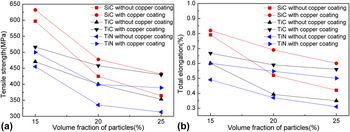
Tensile testing of composites reinforced by monolithic SiC, TiC, and TiN particles with and without copper coating was conducted. Figure 1 shows the results with the volume fractions of 15, 20, and 25%. The tensile strength of the SiCp/Fe composite is always the highest among the three composites, regardless of volume fraction or whether the particles were copper coated in Fig. 1(a), whereas the tensile strength of the TiNp/Fe composite is the lowest. The composites' tensile strength decreases with increasing volume fraction of reinforcements. Moreover, the tensile strength of the uncoated SiCp/Fe composite decreased by 39% as the volume fraction increased from 15 to 25%, in contrast to the uncoated TiNp/Fe and TiCp/Fe composites, which showed 31.2 and 24.8% decreases, respectively. It is easier to compare mechanical properties of the composites in Fig. 1 to find that volume fraction 20% is the right selection to keep wear resistant ability for further strengthening study because the 20% composite has a reasonable strength and further increase of ceramic particle fraction will result in an unacceptable severe drop in strength though the wear resistance may be better. Copper coating of the reinforcing particles significantly improves the tensile strength of all three types of composites present in Fig. 1(a) and similarly also improves the total elongation of the composites in Fig. 1(b). The larger the volume fraction of the reinforcing particles in the composite is, the higher an increase in tensile strength and total elongation of the composites after the copper coating treatment.
Comparison of (a) tensile strength and (b) total elongation of composites reinforced by monolithic SiC, TiC, and TiN particles with and without copper coating with volume fractions of 15, 20, and 25%.

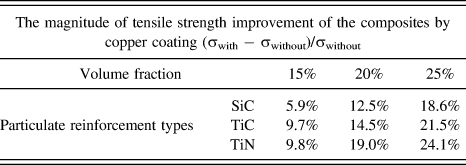
As the tensile strength improvement of the three types of composites after copper coating was apparently different, the magnitude of tensile strength improvement (σwith − σwithout)/σwithout was calculated and presented in Table I, where σwith and σwithout are the tensile strength of the particle-reinforced composites with and without copper coating, respectively. The table shows that the tensile strength of the TiNp/Fe composite consistently had the highest improvement, whereas that of the SiCp/Fe composite had the lowest. When the volume fraction of the particles was 20%, the tensile strength of the composite reinforced by copper-coated TiN particles increased by 19.0% over that of the composite reinforced by uncoated TiN, as compared with the SiCp/Fe composite, where the relative improvement was 12.5%. This suggests that the interfacial bonding mechanism of SiC–Fe and TiN–Fe is different and the improvement of TiN–Fe bonding strength by copper coating is greater than that of SiC–Fe, as will be discussed in Sec. III. D.
Magnitude of tensile strength improvement (σwith − σwithout)/σwithout, where σwith and σwithout are, respectively, the tensile strength of the particle-reinforced composites with and without copper coating from Fig. 1, associated with different types and volume fractions of particulate reinforcements.

B. Mechanical properties of composites reinforced in hybrid way by different particles mixture without copper coating
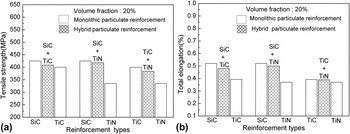
In Fig. 2, the tensile strength and total elongation of the composites reinforced by 20 vol% monolithic particles and hybrid particles mixture without copper coating, where the hybrid mixture is 50/50 by volume, are shown.
Comparison of (a) tensile strength and (b) total elongation of the composites reinforced by 20 vol% monolithic particles and hybrid particles mixture without copper coating, where hybrid particles mixture was a mixture of two types of individual particles with each half of the total volume fraction.

Results show that for a 20% volume fraction, the highest tensile strength of a hybrid was for (SiC + TiN)p/Fe, which was 418 MPa, followed by (SiC + TiC)p/Fe at 409 MPa, whereas (TiC + TiN)p/Fe was the lowest at 384 MPa, as shown in Fig. 2(a). Meanwhile, the highest total elongation of a hybrid was for (SiC + TiN)p/Fe, followed by (SiC + TiC)p/Fe and (TiC + TiN)p/Fe, as shown in Fig. 2(b). The tensile strength and total elongation of the hybrid composites had values between those of the corresponding monolithic composites. This indicates that using hybrid particles mixture without copper coating has no significant effect on the mechanical properties of iron matrix composites. However, the tensile strength of the hybrid (SiC + TiN)p/Fe composite was 24.6% higher than that of the monolithic TiNp/Fe composite, but only 1.6% lower than that of the monolithic SiCp/Fe composite. In other words, the mechanical properties of the hybrid composite were more likely to be closer to those of the corresponding monolithic composite with the better mechanical improvement.
C. Mechanical properties of composites reinforced in hybrid way by different particles mixture with copper coating
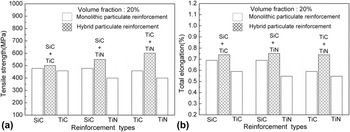
The tensile strength and total elongation of composites reinforced in hybrid way by different particles mixture with copper coating were measured and compared with those of composites reinforced by the monolithic particles with copper coating, as shown in Fig. 3.
Comparison of (a) tensile strength and (b) total elongation of the composites reinforced by 20 vol% monolithic particles and hybrid particles mixture with copper coating, where hybrid particles mixture was a mixture of two types of individual particles with each half of the total volume fraction.

Evidently, the tensile strength of the hybrid composites in Fig. 3(a) was surprisingly higher than that of either of the corresponding monolithic composites. When the volume fraction of particles was 20%, the tensile strength of the copper-coated (TiC + TiN)p/Fe composite was the highest (601 MPa) among the three hybrid composites. Meanwhile, the tensile strength of this hybrid composite increased by 31.2% over that of the copper-coated TiCp/Fe composite and by 50.5% over that of the copper-coated TiNp/Fe one. The tensile strength of the (SiC + TiN)p/Fe composite was 550 MPa, whereas that of the (SiC + TiC)p/Fe composite was the lowest at 501 MPa. The relative improvement of tensile strength of the hybrid composites containing copper-coated (TiN + TiC)p/Fe, (TiN + SiC)p/Fe, and (TiC + SiC)p/Fe composites over the uncoated particles was 56.5, 31.6, and 22.6% in Figs. 2(a) and 3(a), respectively, in comparison with monolithic composite improvements of 19.0, 14.5, and 12.5% for TiNp/Fe, TiCp/Fe, and SiCp/Fe, respectively (Table I). Therefore, copper coating improves the tensile strength of both hybrid and monolithic composites; however, the strength improvement in the hybrid composites is much larger relative to the monolithic composites. TiN reinforcement has the largest effect on hybrid particles mixture strengthening after copper coating. The reason for this will be discussed in the next section. Furthermore, the total elongation of the hybrid composites in Fig. 3(b) is higher than that of the monolithic composites after copper coating. Therefore, hybrid particles mixture with copper coating has a significant effect on the mechanical properties of PRIMCs.
D. Strengthening mechanisms
As shown in Fig. 1, SiCp/Fe composites have significantly higher tensile strength than those reinforced by TiC or TiN particles, which can be explained by a thermodynamics analysis. The Gibbs free energies are taken from the thermodynamic database. Reference Ye and Hu34 In the SiC/Fe interfacial reaction,
 $$\eqalign{ & {\rm{SiC}} + {\rm{Fe}} \to {\rm{FeSi}} + {\rm{C}}\quad , \cr & \Delta G = - 0.02{T^2} - 255T + 30T\ln T - 2386150{T^{ - 1}} \cr &+ 22825 \lt 0,\;T \lt 1200\,^\circ {\rm{C}}\quad , \cr}$$
in the TiC/Fe interfacial reaction,
 $$\eqalign{ & {\rm{TiC}} + 2{\rm{Fe}} \to {\rm{F}}{{\rm{e}}_2}{\rm{Ti}} + {\rm{C}}\quad , \cr & \Delta G = - 0.022{T^2} + 839.66T + 16.87T\ln T - 5650{T^{ - 1}} \cr &+ 3417 > 0,\;T \lt 1200\,^\circ {\rm{C}}\quad , \cr}$$
and in the TiN/Fe interfacial reaction,
 $$\eqalign{ & {\rm{TiN}} + 2{\rm{Fe}} \to {\rm{F}}{{\rm{e}}_2}{\rm{Ti}} + {\rm{N}}\quad , <$$><$$>\cr & \Delta G = 0.0034{T^2} + 2307.89T - 3.93T\ln T \cr &<$$><$$>+ 39750{T^{ - 1}} - 412 > 0,\;T \lt 1200\,^\circ {\rm{C}}\quad . \cr}$$
The free energy calculations indicate that the reaction between Fe and SiC is only thermodynamically feasible at a sintering temperature of 1200 °C with a negative ΔG, whereas no interfacial reaction occurs between Fe and TiC or Fe and TiN. In our previous work, Reference Li, Zong, Wang and Zhuang11 an amount of pearlite in the SiCp/Fe composite has been observed. This suggests that the pearlite may be attributed from the reaction of Fe and SiC during sintering process. At the matrix–reinforcements interface, there is a discontinuity in the thermodynamic properties, elastic modulus, and coefficient of thermal expansion, all of which have a large influence on the composite properties. Reference Chawla and Chawla19 The ceramic particles do not wet well with the iron matrix during sintering. When the interfacial reaction between the reinforcements and matrix occurs, it changes the interface bonding features and strongly affects the interfacial strength. It can also promote the wettability between reinforcements and matrix. A limited interfacial reaction may improve mechanical properties of the corresponding composite. Reference Ibrahim, Mohamed and Lavernia9,Reference Chakthin, Poolthong and Tongsri14 Among the three reinforcements, SiC appears to have the maximum effect on strengthening the PRIMCs.
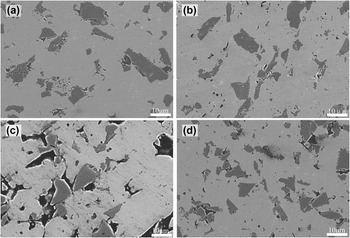
Figures 1 and 3 show that copper coating on the surfaces of SiC, TiC, and TiN particles remarkably improves the mechanical properties of the composites. The microstructure of the composites reinforced by uncoated and copper-coated TiC particles with volume fractions of 10 and 20% is shown in Fig. 4. It can be seen that copper coating does not change the dispersion state of particulate reinforcements in the composites. Copper coating may enable better to accommodate the brittle particle into iron powder matrix during sintering, so the interface will be generally less defective. When the volume fraction of particles is 20%, more interfacial defects can be seen in Fig. 4(c) than those seen when the volume fraction is 10%, as shown in Fig. 4(a). However in Figs. 4(b) and 4(d), the interfacial defects have been nearly eliminated by copper coating. A high particle fraction produces many interfacial defects that deteriorate the composite strength, but the copper coverage around the particles could effectively avoid the direct contact of the particles and eliminate the interfacial defects no matter how many. Therefore, it follows that copper coating improves tensile strength more significantly for high-volume-fraction composites than those with low volume fractions (Table I).
Microstructure of TiCp/Fe composites of different particle volume fraction with or without copper coating (a) and (b) 10%, (c) and (d) 20%; (a) and (c) without coating, and (b) and (d) with coating.

The hybrid particles mixture strengthening effect is not well understood, although it is a good and inexpensive way to improve composite strength. There are two theories in the strengthening mechanism of the particle reinforced metal matrix composite: micromechanisms (i.e., dislocation density strengthening, dispersion strengthening, and grain boundary strengthening acting on the matrix) wherein the particles make the matrix stronger and micromechanics (i.e., load transfer acting on the particles), Reference Chawla and Chawla19,Reference Zong, Zhang, Wang and Zuo35 wherein the particles share much a higher load than the matrix. Because when using the very large 10 μm particles as reinforcement, it was reported that micromechanics were the major strengthening mechanism Reference Zhuang, Zong, Wang and Yang12,Reference Zong, Zhang, Wang and Zuo35 compared with the micromechanisms. Hybrid particulate reinforcement without copper coating had little effect on tensile strength improvement of the composites over those reinforced with monolithic particles, whereas hybrid reinforcement with copper coating showed a more significant improvement due to the better load transfer ability through the interface continuity provided by the copper layer. This suggests that the hybrid particles mixture strengthening effect operates via a load transfer mechanism.
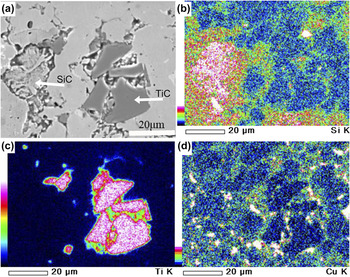
As shown in Fig. 5, a copper layer reposes at the particle–particle or particle–matrix interface in the composite reinforced by the copper-coated hybrid particles mixture of SiC and TiC, as indicated by the EDS analysis of Si, Ti, and Cu elements. There are many voids around the hybrid reinforcement without copper coating, and voids prevent load transfer from the matrix to reinforcing particles. Thus, the hybrid is strengthened if copper coating produces a continuous interface between the particles and matrix.
(a) The SEM image of microstructure of the composites reinforced by copper-coated SiC and TiC hybrid particles mixture and the EDS analysis of different elements: (b) Si, (c) Ti, and (d) Cu.

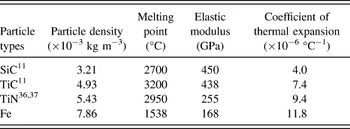
The load transferring capacity strongly depends on mismatch strain, which is produced during straining of the composite owing to a large difference in the elastic modulus between the reinforcement and matrix. Reference Chawla and Chawla19,Reference Zong, Zhang, Wang and Zuo35 Table II shows that relative to the matrix, the three ceramic reinforcements have large differences in elastic modulus. Nevertheless, the difference in elastic modulus between the reinforcements is also very large. For example, the difference between SiC and TiN is 76.5%. The stress field around a ceramic particle during far-field straining will produce a larger disturbance strain in the matrix if the neighboring particles differ because of elastic modulus mismatch, as in the case of hybrid strengthening, than by neighboring uniform particles, as in case of monolithic strengthening, since this causes a severe stress gradient in the matrix. Reference Zong, Zhang, Wang and Zuo35 The hybrid particulate reinforcement creates a larger stress gradient in the matrix because of their large localized elastic modulus mismatch, which helps the load transferring capacity Reference Zong, Zhang, Wang and Zuo35 from the matrix to particles such that the composite strength increases. One study suggested a similar argument for stress gradient strengthening a composite reinforced by in situ hybrid particulate reinforcement fabricated during reaction sintering, although they believed that the gradient increased the matrix strength Reference Chen, Yang, Guan and Yan31 rather than improving load transfer, as we suggest herein.
Characteristics of various ceramic particulate reinforcements related to the iron matrix. Reference Li, Zong, Wang and Zhuang11,Reference Rajabi, Ghazali and Daud36,Reference Huang, Lee, Lu and Lii37

As shown in Fig. 3, any hybrid composite containing TiN reinforcement always has a higher strength increment over the corresponding monolithic particle strengthening composites than any other hybrid composite combination. From Table II, TiN reinforcement has the lowest elastic modulus among the three reinforcements and therefore, has the largest difference in elastic modulus when hybrid particles mixtures are used, which creates the highest stress gradient. The table also shows that TiN has the largest coefficient of thermal expansion among the three reinforcements so that it will produce high thermal stress in the matrix, and residual stress will also increase the overall stress gradient between particulate reinforcements. Also, the thermal residual stress in the matrix may affect constraint of the surrounding matrix on the particle and deterioration of the particles dispersion effect. In addition, the copper coating layer could act as interlayer accommodating (relaxing) local (residual) stress (concentration) which further affects the damage development. Therefore, the fact that TiN reinforcement has the largest effect on the hybrid strengthening among the three reinforcement types supports our explanation that a severe stress gradient in the matrix improves load transfer.
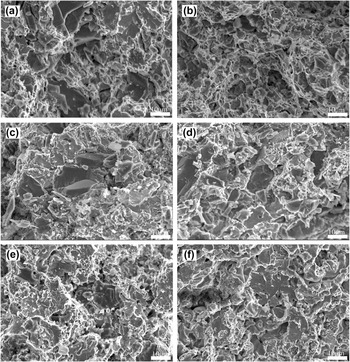
The fracture surfaces of composites reinforced by copper-coated monolithic and hybrid particles mixture are shown in Fig. 6. It can be seen that the fracture surfaces of the hybrid composites in Figs. 6(a)–6(c) have a much rougher morphology than those of the monolithic composites in Figs. 6(d)–6(f), which implies that hybrid particles mixtures result in tough composites. Nonetheless, the fracture surface of the TiN + TiC hybrid composite in Fig. 6(a) exhibits well-developed voids even with secondary microcracks. This observation provides evidence that the TiN + TiC hybrid composite has the best ability to transfer load between the matrix and reinforcements, which results in higher strength.
Fracture surface of the composites reinforced by copper-coated hybrid particles mixture of (a) TiC and TiN, (b) SiC and TiN, (c) SiC and TiC, and monolithic particle of (d) TiC, (e) TiN, (f) SiC, respectively.

IV. CONCLUSIONS
-
(1) Copper coating the surfaces of SiC, TiC, and TiN particles can improve the mechanical properties of their respective composites. When the volume fraction is 20%, the tensile strength of the TiNp/Fe composite increases by 19.0% after copper coating, which is the highest relative improvement among the three composites. Microstructure observations indicate that copper coating eliminates interfacial defects to improve tensile strength.
-
(2) SiCp/Fe has the highest strength among the SiCp/Fe, TiCp/Fe, and TiNp/Fe composites because an interfacial reaction only occurs at the SiCp/Fe composite and the limited reaction can improve mechanical properties of the composite.
-
(3) A hybrid particulate reinforcement strengthening effect was found where the strength of a composite reinforced by a mixture of different particles is stronger that either composite containing only one of those particles. For example, a particulate TiC + TiN mixture is higher by 50.5% than that of TiNp/Fe and higher by 31.2% than that of TiCp/Fe.
-
(4) The hybrid particulate reinforcement strengthening effect occurs through load transfer mechanism and hybrid particle mixture attributes an extra extensive stress gradient in the matrix by local severer elastic modulus mismatch, which improves the load transferring capacity from the matrix to particles, which in turn increases the composite strength.
ACKNOWLEDGMENT
This work was financially supported by Northeastern University Young Talent Start-up Funding (No. 01270021814101/024), National Natural Science Foundation of China (Grant Nos. 51171040, U1302272, and 51301035) and the National High Technology Research and Development Program of China (Grant No. 2013AA031601).