Introduction
Regardless of which causes are involved in the aetiopathogenesis of psychoses, antipsychotic drugs are effective, to some extent, in alleviating the symptoms of these severe and incapacitating disorders (Seeman, Reference Seeman2005).
Antipsychotic drugs mostly target the dopamine D2 receptors, and specific pharmacodynamic interactions depend on drug class (Seeman, Reference Seeman2002). Typical ‘haloperidol-like’ molecules act as dopamine D2 receptor antagonists in the mesolimbic and mesostriatal regions. Atypical ‘clozapine-like’ compounds reduce dopaminergic activity in the mesolimbic system, by blocking D1 and D2 receptors, and have higher affinity for serotonin 5-hydroxytryptamine type 2 receptors than for D2 receptors. Despite clinical evidence of different side-effects profiles of atypical compared to typical antipsychotics, their mechanisms of action are not fully understood.
Studies on animals, mostly rodents, suggest that antipsychotics can affect neuronal structure and function through neuroplasticity, neurotoxicity, gene expression and apoptosis (Dean, Reference Dean2006). Conventional antipsychotics may be neurotoxic and induce neuronal loss and gliosis in the striatum, hypothalamus, brainstem, limbic system and cortex. Moreover, apoptosis has been documented with in vivo administration of haloperidol in the substantia nigra, caudate and putamen (Dean, Reference Dean2006). A study of non-human primates showed that chronic therapeutic-like daily exposure to either the typical antipsychotic haloperidol or the atypical olanzapine is associated with reductions in both grey and white matter (Dorph-Petersen et al. Reference Dorph-Petersen, Pierri, Perel, Sun, Sampson and Lewis2005).
Morphological changes in brain structures, such as lateral and third ventricle enlargement and temporal regions reductions, have been reported in patients with chronic schizophrenia (Lawrie & Abukmeil, Reference Lawrie and Abukmeil1998; McCarley et al. Reference McCarley, Wible, Frumin, Hirayasu, Levitt, Fischer and Shenton1999; Shenton et al. Reference Shenton, Dickey, Frumin and McCarley2001). Less frequently, volume reductions of frontal and parietal cortices and of subcortical structures have also been reported. There is also evidence that some of these brain changes may progress over time (Ho et al. Reference Ho, Andreasen, Nopoulos, Arndt, Magnotta and Flaum2003; Pantelis et al. Reference Pantelis, Velakoulis, McGorry, Wood, Suckling, Phillips, Yung, Bullmore, Brewer, Soulsby, Desmond and McGuire2003; Thompson et al. Reference Thompson, Vidal, Giedd, Gochman, Blumenthal, Nicolson, Toga and Rapoport2001); this may occur as part of the disease and its progression or because of treatment exposure. For example, the seminal study by Chakos et al. (Reference Chakos, Lieberman, Alvir, Bilder and Ashtari1995) showed that when individuals were switched from a typical antipsychotic to clozapine, the basal ganglia volume decreased. This suggests that typical antipsychotics have an effect on the basal ganglia volume that is specific and also potentially reversible. These findings renewed interest in the question of whether antipsychotics affect brain structure, with an increasing number of reports documenting structural brain changes in association with use of antipsychotics. However, it has remained unclear to what extent current and previous antipsychotic drug use has influenced imaging findings.
This review addresses the following two questions: (1) is there sufficient evidence that antipsychotic medications induce changes in total or regional human brain volumes, and if so, (2) do such effects depend on antipsychotic type?
Method
Data sources
We searched Medline and EMBASE databases using the medical subject heading (MeSH) terms: ‘antipsychotics’ AND ‘brain’ AND (MRI NOT functional). The electronic search was not restricted to English language papers and included studies published up to 31 January 2007. We also searched published research with the Science Citation Index.
Studies selection
Articles were selected by the first author (S.N.) and checked by the last author (P.D.). We included studies directly reporting structural brain magnetic resonance imaging (MRI) measures in association with antipsychotic treatment, or studies that evaluated these in patients who had received at least some treatment with antipsychotics and compared them with drug-naive patients or controls.
Data extraction
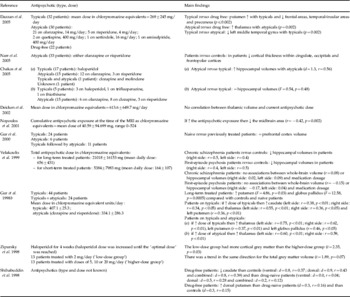
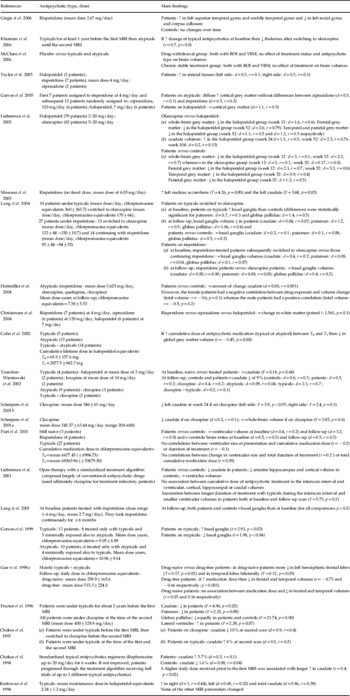
Data were extracted from the studies and, when records were missing or incomplete, authors were contacted directly for clarification. For each study (Tables 1 and 2; see also expanded online versions) we recorded information on: (a) year of publication; (b) study design; (c) sample characteristics; (d) duration of treatment with antipsychotic drugs before the first MRI and time to follow-up MRI [data on length of treatment before the first MRI scan were not available for one study (Corson et al. Reference Corson, Nopoulos, Miller, Arndt and Andreasen1999b), for which plausible estimates based on length of illness were imputed]; (e) type and dose of antipsychotic drug; (f) brain region/s evaluated; (g) methods for estimating brain volumes and slice thickness; and (h) any reported association or lack of association between brain volume and antipsychotic treatment. If information on the strength of the association (either Pearson's r, or Cohen's d, correlation coefficient) was reported, this was included in the tables. When this was not the case but the data were available in the original paper, we calculated the effect size (d) (Cohen, Reference Cohen1992). When data were not sufficient to calculate the effect size, we reported the statistical test with the p value quoted in the original study.
Cross-sectional studies presented in chronological orderFootnote a

a An expanded version of this table is available at the Journal's website (http://journals.cambridge.org/psm).
Follow-up studies presented in chronological orderFootnote a

a An expanded version of this table is available at the Journal's website (http://journals.cambridge.org/psm).
As length of exposure to antipsychotic treatment can be associated with different brain changes, we classified studies first according to design (cross-sectional versus longitudinal). Then, within each study design, studies were classified according to duration of treatment prior to first MRI scan: (1) studies conducted in drug-naive (never-treated) and drug-free (not treated for the previous 3 weeks) subjects. These two groups were considered together according to the existing literature on antipsychotic washout (Farde et al. Reference Farde, Hall, Ehrin and Sedvall1986; Miller et al. Reference Miller, Andreasen, O'Leary, Rezai, Watkins, Ponto and Hichwa1997a, Reference Miller, Rezai, Alliger and Andreasenb, Reference Puri, Hutton, Saeed, Oatridge, Hajnal, Duncan, Chapman, Barnes, Bydder and Joyce2001); (2) studies conducted in subjects receiving short-term treatment (⩽12 weeks); and (3) studies conducted in subjects receiving long-term treatment (>12 weeks). This makes it easier to discriminate between brain changes that are potentially due to a specific treatment effect and those that are related to the illness itself and its progression (Dazzan & Murray, Reference Dazzan and Murray1999).
Method of analysis
Published reports did not provide sufficient information across studies to allow a meta-analytical quantitative summary; therefore, data were used for a systematic review and critical literature analysis.
Results
We identified 33 papers investigating the association between antipsychotic drug treatment and brain structure: 10 cross-sectional and 23 longitudinal studies. We report on the effects on any regional or global brain volume. For studies with the same design, we first present findings at a regional level, following brain anatomy from cortical to subcortical structures (basal ganglia and thalamus). We then present findings on global volumes (grey and white matter, whole brain, ventricles).
Cross-sectional studies
Cross-sectional studies evaluated brain structure and its association with concomitant antipsychotic treatment in terms of dosage and type of antipsychotic used at a single time-point (Table 1).
Studies conducted in drug-naive and drug-free subjects
Such studies are extremely valuable in understanding brain changes at illness onset and also the possible effect of previous medication on brain structure. Only three studies were available on patients either drug-naive or drug-free at MRI.
A single report compared cortical volumes in drug-naive patients, long-term treated patients, and controls (Gur et al. Reference Gur, Cowell, Latshaw, Turetsky, Grossman, Arnold, Bilker and Gur2000). Both patient groups showed reduced prefrontal cortex volume, particularly in the dorsolateral sector. The authors concluded that reduced prefrontal volume is not a by-product of treatment and might represent a neuroanatomical abnormality already present at illness onset.
Nopoulos et al. (Reference Nopoulos, Ceilley, Gailis and Andreasen2001) studied a sample of male patients at their first episode of psychosis; all 45 drug-free patients had previous exposure to typicals and four of these had been additionally exposed to atypicals. The cumulative dose of antipsychotic medication was negatively correlated with the size of the midbrain, indicating that the greater the antipsychotic exposure, the smaller the midbrain area. When the authors compared subjects naive (n=5) and with minimal antipsychotic exposure (n=9) to those medicated, they found that the medicated group had a smaller midbrain area. Treatment with typicals seemed to induce a reduction in the midbrain area that was still present 3 weeks after withdrawal.
Shihabuddin et al. (Reference Shihabuddin, Buchsbaum, Hazlett, Haznedar, Harvey, Newman, Schnur, Spiegel-Cohen, Wei, Machac, Knesaurek, Vallabhajosula, Biren, Ciaravolo and Luu-Hsia1998) looked at volume of striatum in a small sample of naive and drug-free schizophrenia patients in comparison to healthy individuals. They found a significant group (drug-naive versus drug-free versus controls) by level (ventral versus dorsal side) by structure (putamen versus caudate) interaction. The largest difference was a larger dorsal putamen volume in drug-free patients versus controls and, to a minor extent, versus drug-naive patients. Findings on the caudate size were in the opposite direction, with drug-free patients showing a smaller caudate volume than both drug-naive patients and controls. The authors suggested that the post-treatment enlargement might last longer after treatment discontinuation for the putamen than for the caudate, possibly because of a higher density of D2 receptors in the putamen. The difference between the drug-naive and drug-free subjects in putamen and caudate volumes might be more likely to reflect the effect of never-medicated versus previously medicated status than that of age or illness severity.
More investigations on drug-naive and drug-free patients are required to clarify the timing of brain changes and the possible relationship between causality and antipsychotic treatment.
Studies conducted in subjects receiving short-term treatment (⩽12 weeks)
Studies on patients at the initial stages of psychosis, when treatment would have occurred only for a short time, can provide information on the occurrence and timing of structural brain changes; such studies can help to disentangle changes caused by a specific class of antipsychotics from those due to the illness and its progression.
Our group (Dazzan et al. Reference Dazzan, Morgan, Orr, Hutchinson, Chitnis, Suckling, Fearon, McGuire, Mallett, Jones, Leff and Murray2005) has evaluated a sample of first-episode psychosis patients treated with typical or atypical antipsychotics for a relatively short period of time (mean 8.5 weeks). Patients who received typicals, but not those on atypicals, compared to drug-free patients showed cortical grey matter reduction in frontal areas, temporal-insular areas and precuneus. As there were no clinical differences between the groups that could explain the brain morphological differences, these results support the hypothesis that these brain changes could be at least in part explained by the different treatment received. A potential effect of haloperidol on cortical volume has also been suggested by another study (Zipursky et al. Reference Zipursky, Zhang-Wong, Lambe, Bean and Beiser1998). Here, first-episode psychosis patients treated with higher doses of haloperidol had significantly smaller total cortical grey matter volumes than subjects on lower doses. Therefore, more marked brain structural changes may represent a dose-dependent effect of haloperidol on cortical grey matter. Alternatively, individuals with more marked structural abnormalities may also be those less responsive to treatment, and hence receiving higher antipsychotic doses.
Narr et al. (Reference Narr, Toga, Szeszko, Thompson, Woods, Robinson, Sevy, Wang, Schrock and Bilder2005) reported that both patients receiving short-term treatment (mean length 8 days) with atypical antipsychotics and drug-naive patients, when compared to controls, had significant cortical thinning of cingulate, occipitals and frontopolar cortices, suggesting that brain changes at this level predate illness onset. This is an important issue to consider when evaluating potential medication effects, and it may be at least partially addressed by comparing patients on treatment with those who are drug free, the approach used by our group (Dazzan et al. Reference Dazzan, Morgan, Orr, Hutchinson, Chitnis, Suckling, Fearon, McGuire, Mallett, Jones, Leff and Murray2005). Most of the differences found in our study were between the group on typicals and the drug-free group. This suggests a different effect of antipsychotic type, which could not be estimated in the report by Narr et al. (Reference Narr, Toga, Szeszko, Thompson, Woods, Robinson, Sevy, Wang, Schrock and Bilder2005), where all patients were taking atypicals. It remains unclear whether medications act on cortical volume or on cortical thickness. Changes in cortical thickness may reflect cytoarchitectural abnormalities more closely related to illness onset than volumetric abnormalities (Thompson et al. Reference Thompson, Hayashi, de Zubicaray, Janke, Rose, Semple, Herman, Hong, Dittmer, Doddrell and Toga2003).
Data on the basal ganglia in patients on short-term treatment are limited to a single report from our group (Dazzan et al. Reference Dazzan, Morgan, Orr, Hutchinson, Chitnis, Suckling, Fearon, McGuire, Mallett, Jones, Leff and Murray2005). Typical antipsychotics were found to be specifically associated with increased putamen volume in comparison to drug-free status. Of note, we found no differences in basal ganglia volumes when patients on typicals and atypicals were compared directly. This suggests that atypicals also act on these structures, although to a lesser extent. This finding may also reflect a lack of statistical power, and a larger sample size could have clarified if indeed basal ganglia enlargement is an effect specific to typical antipsychotics. Our study is also the only report on thalamus volume in patients on short-term treatment (Dazzan et al. Reference Dazzan, Morgan, Orr, Hutchinson, Chitnis, Suckling, Fearon, McGuire, Mallett, Jones, Leff and Murray2005). We found that only patients treated with atypicals showed an enlargement of the thalami in comparison with drug-free patients.
Finally, one study (Velakoulis et al. Reference Velakoulis, Pantelis, McGorry, Dudgeon, Brewer, Cook, Desmond, Bridle, Tierney, Murrie, Singh and Copolov1999) specifically evaluated the relationship between hippocampal volume and antipsychotics, albeit indirectly. Here, the smaller hippocampal volume identified in patients at their first episode of psychosis in comparison to controls was not related to the cumulative dose of antipsychotics received prior to MRI.
Studies conducted in subjects receiving long-term treatment (>12 weeks)
Findings from these studies are difficult to interpret because subjects may have been treated with different antipsychotics at different doses for many years. Therefore, brain modifications due to medication are difficult to distinguish from those due to illness progression.
We identified four studies that included patients treated for >12 weeks, and most have evaluated the effect of antipsychotics on the basal ganglia and thalamus. Data from a sample of males with schizophrenia found no differences in thalamic volumes between patients and controls and no association between thalamic volume and antipsychotic dose at time of MRI (Deicken et al. Reference Deicken, Eliaz, Chosiad, Feiwell and Rogers2002). By contrast, Gur et al. (Reference Gur, Maany, Mozley, Swanson, Bilker and Gur1998b) found that a total higher lifetime dose of typicals was associated with larger caudate, putamen and thalamus volumes whereas a higher dose of atypicals was associated only with larger thalamic volume. These data on chronic patients are consistent with the findings from Dazzan et al. (Reference Dazzan, Morgan, Orr, Hutchinson, Chitnis, Suckling, Fearon, McGuire, Mallett, Jones, Leff and Murray2005), who described thalami enlargement following short-term treatment with atypicals, and enlargement of the putamen in relation to use of typicals.
In the study by Velakoulis et al. (Reference Velakoulis, Pantelis, McGorry, Dudgeon, Brewer, Cook, Desmond, Bridle, Tierney, Murrie, Singh and Copolov1999) on long-term patients with schizophrenia, hippocampal volume was found to be significantly smaller than in controls. Similar to their findings in subjects on short-term treatment, they found no correlation between hippocampal volume and cumulative antipsychotic dose. Only one study evaluated hippocampal volume in relation to type of antipsychotic used, with negative findings (Chakos et al. Reference Chakos, Schobel, Gu, Gerig, Bradford, Charles and Lieberman2005). However, patients had received long-term treatment with both typical and atypical antipsychotics, and it could have been difficult to distinguish specific effects of drug type. To better investigate the effects of different antipsychotics on hippocampal volume, Chakos et al. (Reference Chakos, Schobel, Gu, Gerig, Bradford, Charles and Lieberman2005) randomly assigned male patients to treatment with either an atypical (olanzapine or risperidone) or a typical (haloperidol) antipsychotic. They found a larger hippocampal volume in patients treated with atypicals than in those taking haloperidol, suggesting that male patients, treated early in the course of illness with atypicals rather than typicals, might be protected against hippocampal volume reduction. Despite the randomized design, the sample evaluated was relatively small.
The cross-sectional studies reviewed used different designs to test the relationship between antipsychotics and brain structure (Table 1): three are drug-type (typicals and/or atypicals); five are dose-correlation (chlorpromazine equivalents range: from 40.59±94.96 mg for drug-naive and drug-free patients to 21018±16153 mg for long-term treated patients); and one is dose-correlation for drug-type (chlorpromazine equivalents for typicals: 407.1±25.3 mg and for atypicals: 334.1±286.3 mg). Finally, two are comparisons between drug-free and drug-naive patients versus controls (for one of them neither the type nor the dose of antipsychotic used was reported, and for the other one only the number of patients taking which type of antipsychotic was reported). Indeed, as cross-sectional studies evaluate brain structure at a single time-point, it is difficult to understand the role of antipsychotics in determining brain changes if type and dose used are not reported systematically, as either could be responsible for any effect observed. Even taking into account these limitations, the cross-sectional studies reviewed suggest that antipsychotics, typicals in particular, affect the basal ganglia even after short-term treatment. They also provide preliminary evidence of an early action at cortical level that may be drug specific.
Longitudinal studies
A longitudinal design allows a better understanding of the timing and progression of changes in brain structures and of the effects of antipsychotics on these changes, making it possible to speculate on causality.
Studies conducted in drug-naive and drug-free patients
We identified eight longitudinal studies on drug-naive and drug-free patients. Keshavan et al. (Reference Keshavan, Bagwell, Haas, Sweeney, Schooler and Pettegrew1994), in naive first-episode psychosis patients, found that the prefrontal cortex did not change significantly over 1 year of treatment with typicals. By contrast, Gur et al. (Reference Gur, Cowell, Turetsky, Gallacher, Cannon, Bilker and Gur1998a, Reference Gur, Maany, Mozley, Swanson, Bilker and Gurb) found, over approximately 2 years, a more pronounced reduction in frontal and temporal lobes in drug-naive patients at their first psychotic episode than in drug-free patients treated previously for more than 12 weeks (mainly with typicals). The differences between these studies might be related to the slightly different brain areas investigated, and to the subjects receiving different antipsychotics at different doses. Indeed, Garver et al. (Reference Garver, Holcomb and Christensen2005) found that, even after a short period (28 days) of antipsychotic use, patients treated with haloperidol did not show any change in cortical grey matter volume whereas patients treated with atypicals showed an increase in cortical grey matter volume. These data support a different effect of typical versus atypical antipsychotics, even after a short period of treatment.
Regarding the basal ganglia, Heitmiller et al. (Reference Heitmiller, Nopoulos and Andreasen2004) followed up naive patients treated with different atypical antipsychotics for 2 years. They found that patients had a very small increase in caudate volume, almost identical to that of the controls. This replicates findings from cross-sectional studies suggesting that exposure to atypicals affects the caudate volume less than exposure to typicals. By contrast, a study by Massana et al. (Reference Massana, Salgado-Pineda, Dunque, Perez, Baeza, Pons, Massana, Navarro, Blanch, Morer, Mercader and Bernardo2005) on naive schizophrenia patients treated with risperidone reported an increase in left caudate and left accumbens volumes, with a positive correlation between dose and volume. Considering the large body of evidence of an increase in caudate volumes after treatment with typicals (Chakos et al. Reference Chakos, Lieberman, Bilder, Borenstein, Lerner, Bogerts, Wu, Kinon and Ashtari1994, Reference Chakos, Lieberman, Alvir, Bilder and Ashtari1995; Keshavan et al. Reference Keshavan, Bagwell, Haas, Sweeney, Schooler and Pettegrew1994; Corson et al. Reference Corson, Nopoulos, Andreasen, Heckel and Arndt1999a, Reference Corson, Nopoulos, Miller, Arndt and Andreasenb; Lang et al. Reference Lang, Kopala, Vandorpe, Rui, Smith, Goghari and Honer2001; Scheepers et al. Reference Scheepers, de Wied, Hulshoff Pol, van de Flier, van der Linden and Kahn2001a, Reference Scheepers, Gispen de Wied, Hulshoff Pol and Kahnb), it is possible that the increase in caudate volume seen at higher doses of risperidone reflects an action more like that of a typical antipsychotic (Nyberg et al. Reference Nyberg, Eriksson, Oxenstierna, Halldin and Farde1999). Finally, Taylor et al. (Reference Taylor, Christensen, Holcomb and Garver2005) found an increase of striatal volumes following 4 weeks of treatment with either atypicals or typicals in schizophrenia patients but not in healthy controls. The small sample size did not allow an evaluation of antipsychotic-type differences on striatal volume.
In the study by Christensen et al. (Reference Christensen, Holcomb and Garver2004), white matter did not change significantly following 4 weeks of treatment (typicals or atypicals) in schizophrenia subjects. Indeed, Keshavan et al. (Reference Keshavan, Bagwell, Haas, Sweeney, Schooler and Pettegrew1994) reported no change in brain volume even after 1 year of treatment with typicals in drug-naive patients at their first psychotic episode. By contrast, Girgis et al. (Reference Girgis, Diwadkar, Nutche, Sweeney, Keshavan and Hardan2006) found, in naive first-episode psychosis patients, a decrease in white matter and an increase in grey matter volumes after 6 weeks of treatment with the atypical risperidone. Differences between studies might be related to the characteristics of the subjects and to the different treatment received (type and dose of antipsychotics).
In conclusion, studies on drug-naive and drug-free subjects have been mostly conducted on small samples (between 11 and 19), and this may have affected the power of such studies to identify significant differences. Studies on larger samples would allow testing the hypothesis of an antipsychotic-type effect not only on basal ganglia but also on cortical grey and white matter.
Studies conducted in subjects receiving short-term treatment (⩽12 weeks)
These studies take into account the treatment received prior to, and in between, MRI scans. Chakos et al. (Reference Chakos, Lieberman, Bilder, Borenstein, Lerner, Bogerts, Wu, Kinon and Ashtari1994) studied drug-naive and short-term treated patients with first-episode schizophrenia and did not find any cortical volume change following treatment with typical antipsychotics. These findings are consistent with two other studies that also found no longitudinal changes in total cortical and prefrontal cortex volumes over a period of 2.5 years (Lieberman et al. Reference Lieberman, Chakos, Wu, Alvir, Hoffman, Robinson and Bilder2001) and 1 year (Keshavan et al. Reference Keshavan, Bagwell, Haas, Sweeney, Schooler and Pettegrew1994) respectively. It is possible that treatment may prevent the volume loss potentially associated with disease progression. However, a later study with a randomized design (Lieberman et al. Reference Lieberman, Tollefson, Charles, Zipursky, Sharma, Kahn, Keefe, Green, Gur, McEvoy, Perkins, Hamer, Gu and Tohen2005) reported a drug-type effect of antipsychotics on cortical grey matter over 2 years. Subjects treated with haloperidol, but not with olanzapine, lost frontal grey matter between weeks 12 and 24, suggesting that typical and atypical antipsychotics have differential effects also at the cortical level.
As far as the basal ganglia are concerned, two studies have found increased basal ganglia volumes following short-term treatment with typicals (Chakos et al. Reference Chakos, Lieberman, Bilder, Borenstein, Lerner, Bogerts, Wu, Kinon and Ashtari1994; Lieberman et al. Reference Lieberman, Chakos, Wu, Alvir, Hoffman, Robinson and Bilder2001). By contrast, Tauscher-Wisniewski et al. (Reference Tauscher-Wisniewski, Tauscher, Logan, Christensen, Mikulis and Zipursky2002) reported a 9% reduction in caudate volumes over 5 years in first-episode schizophrenia patients mostly treated with atypicals and low-dose typicals (about one-tenth of the doses received in the study by Chakos et al. Reference Chakos, Lieberman, Bilder, Borenstein, Lerner, Bogerts, Wu, Kinon and Ashtari1994). This would suggest an effect related to both dose and type of antipsychotic. A drug-type effect of antipsychotics on basal ganglia was also reported by Lieberman et al. (Reference Lieberman, Tollefson, Charles, Zipursky, Sharma, Kahn, Keefe, Green, Gur, McEvoy, Perkins, Hamer, Gu and Tohen2005), who found a caudate volume increase in haloperidol-treated but not in olanzapine-treated subjects. Similarly, Corson et al. (Reference Corson, Nopoulos, Miller, Arndt and Andreasen1999b) found an increase in basal ganglia volumes in patients receiving mostly typicals, whereas the opposite was observed in patients receiving mostly atypicals. Of interest, the use of the atypical risperidone at low doses has been associated with no basal ganglia volume change over time (Lang et al. Reference Lang, Kopala, Vandorpe, Rui, Smith, Goghari and Honer2001), in contrast with the volume increase observed when risperidone is administered at higher doses (Massana et al. Reference Massana, Salgado-Pineda, Dunque, Perez, Baeza, Pons, Massana, Navarro, Blanch, Morer, Mercader and Bernardo2005), when is thought to have a more typical-like action.
Only one study specifically examined hippocampal volume, in patients mostly treated with typicals (Lieberman et al. Reference Lieberman, Chakos, Wu, Alvir, Hoffman, Robinson and Bilder2001). Anterior hippocampal volume remained unchanged in patients, independently from cumulative antipsychotic dose, whereas it decreased over time in controls.
Regarding total grey matter, Cahn et al. (Reference Cahn, Hulshoff Pol, Lems, van Haren, Schnack, van der Linden, Schothorst, van Engeland and Kahn2002) found a 3% volume decrease over 1 year, positively correlated with cumulative antipsychotic dose. These authors did not find any association between grey matter decrease and antipsychotic type. The small size of the typical antipsychotic group could limit this conclusion, which contrasts with evidence from Lieberman et al. (Reference Lieberman, Tollefson, Charles, Zipursky, Sharma, Kahn, Keefe, Green, Gur, McEvoy, Perkins, Hamer, Gu and Tohen2005) that subjects treated with haloperidol, but not with olanzapine, lose grey matter over 2 years.
As far as ventricular volumes are concerned, Puri et al. (Reference Puri, Hutton, Saeed, Oatridge, Hajnal, Duncan, Chapman, Barnes, Bydder and Joyce2001) found that patients on antipsychotic treatment (mostly with typicals) did not show any significant change in ventricular volume over time in comparison with controls. These results are consistent with data from short- and long-term treated patients showing no significant changes in lateral and third ventricular volume over time (Frazier et al. Reference Frazier, Giedd, Kaysen, Albus, Hamburger, Alaghband-Rad, Lenane, McKenna, Breier and Rapoport1996; Lieberman et al. Reference Lieberman, Chakos, Wu, Alvir, Hoffman, Robinson and Bilder2001).
This evidence is in accordance with data from studies on drug-free and drug-naive patients, suggesting that even after short-term treatment, typical and atypical antipsychotics differentially affect brain structure not only at the subcortical but also at the cortical level.
Studies conducted in subjects receiving long-term treatment (>12 weeks)
The existing literature on chronically treated patients mostly evaluated basal ganglia volume and the reversibility of volume changes in these structures.
Most studies consistently suggest that switching from long-term treatment with typical antipsychotics to clozapine results in a significant decrease in basal ganglia volume (Chakos et al. Reference Chakos, Lieberman, Alvir, Bilder and Ashtari1995; Frazier et al. Reference Frazier, Giedd, Kaysen, Albus, Hamburger, Alaghband-Rad, Lenane, McKenna, Breier and Rapoport1996; Scheepers et al. Reference Scheepers, de Wied, Hulshoff Pol, van de Flier, van der Linden and Kahn2001a). This has been most often shown for the caudate (Chakos et al. Reference Chakos, Lieberman, Alvir, Bilder and Ashtari1995; Frazier et al. Reference Frazier, Giedd, Kaysen, Albus, Hamburger, Alaghband-Rad, Lenane, McKenna, Breier and Rapoport1996; Scheepers et al. Reference Scheepers, de Wied, Hulshoff Pol, van de Flier, van der Linden and Kahn2001a), and to a lesser extent for the putamen (Frazier et al. Reference Frazier, Giedd, Kaysen, Albus, Hamburger, Alaghband-Rad, Lenane, McKenna, Breier and Rapoport1996). The volume of the globus pallidus has also been reported as decreasing over time both in patients switching from typicals to atypicals and in healthy individuals (Frazier et al. Reference Frazier, Giedd, Kaysen, Albus, Hamburger, Alaghband-Rad, Lenane, McKenna, Breier and Rapoport1996). Switching from haloperidol to olanzapine is also reported to be associated with putamen and globus pallidus volume reduction (Lang et al. Reference Lang, Kopala, Vandorpe, Rui, Smith, Goghari, Lapointe and Honer2004). By contrast, switching from risperidone to olanzapine (pharmacologically more similar to clozapine than risperidone) is not associated with a decrease in basal ganglia volume (Lang et al. Reference Lang, Kopala, Vandorpe, Rui, Smith, Goghari, Lapointe and Honer2004). This suggests that atypical antipsychotics could induce basal ganglia volume normalization, rather than reduction, in patients previously treated with typicals, and supports the notion that atypical antipsychotics also act on basal ganglia, albeit differently from typicals (Heitmiller et al. Reference Heitmiller, Nopoulos and Andreasen2004). Indeed, Khorram et al. (Reference Khorram, Lang, Kopala, Vandorpe, Rui, Goghari, Smith and Honer2006) found that switching from typicals to olanzapine also resulted in a reduction in thalamic volumes, with higher baseline dosage being associated with a greater reduction over time. These changes would therefore represent a normalization of previously larger volumes associated with the dosage of typicals administered. These findings are in contrast to data from cross-sectional studies suggesting an association between increased thalamic volume and atypical antipsychotic treatment (Gur et al. Reference Gur, Maany, Mozley, Swanson, Bilker and Gur1998b; Dazzan et al. Reference Dazzan, Morgan, Orr, Hutchinson, Chitnis, Suckling, Fearon, McGuire, Mallett, Jones, Leff and Murray2005). These inconsistencies could be due to methodological issues and differences in sample characteristics.
McClure et al. (Reference McClure, Phillips, Jazayerli, Barnett, Coppola and Weinberger2006) explored whole-brain volume changes with both region of interest (ROI) and voxel-based morphometry (VBM) methods in subjects scanned before and after antipsychotic withdrawal, and in subjects scanned at two time-points during stable antipsychotic treatment. Both methods found no volume changes in either group. The authors concluded that these findings may be explained by the small sample size, the low statistical power, and the brief follow-up period.
Finally, only one study looked at lateral ventricular volume changes, following switch to clozapine (Frazier et al. Reference Frazier, Giedd, Kaysen, Albus, Hamburger, Alaghband-Rad, Lenane, McKenna, Breier and Rapoport1996), and found a trend for an increase in lateral ventricle volume compared to controls.
In conclusion, findings from studies on long-term treated patients, already exposed to different antipsychotics at baseline, are limited by the implicit difficulties in interpreting the nature of the relationship between brain structure and antipsychotic treatment.
Conclusions
The studies reviewed suggest that antipsychotic drugs act regionally rather than globally on the brain, with different effects on different brain structures. An estimate of the effect sizes of these volumetric changes suggests that they are of a greater magnitude in association with typical than with atypical antipsychotics.
The studies reviewed also suggest an early action of antipsychotics on the basal ganglia, and possibly on the thalamus, with typicals specifically increasing the volume of the basal ganglia and atypicals increasing the volume of the thalamus. Moreover, they suggest that antipsychotics also affect cortical grey matter, with typicals reducing global grey matter volume, possibly with a dose-dependent effect, and atypicals potentially retaining/increasing cortical grey matter over time.
Whether there are progressive brain changes after the onset of schizophrenia remains debatable (Mathalon et al. Reference Mathalon, Sullivan, Lim and Pfefferbaum2001; Ho et al. Reference Ho, Andreasen, Nopoulos, Arndt, Magnotta and Flaum2003). Some changes could precede illness onset and may progress in the course of the disease. Should this be the case, we might expect these changes to be associated with measures of illness severity but this association remains controversial (Hulshoff Pol & Kahn, Reference Corson, Nopoulos, Andreasen, Heckel and Arndt2008). It is also possible that antipsychotic treatment interacts with the underlying pathophysiology of the illness, co-determining structural brain changes or playing a protective role against the progression of the illness itself (Ho et al. Reference Ho, Andreasen, Nopoulos, Arndt, Magnotta and Flaum2003). Indeed, in this perspective, the potential reversibility of antipsychotic effects has to be considered, as observed, for example, for the caudate enlargement induced by typicals and reversed by clozapine (Chakos et al. Reference Chakos, Lieberman, Alvir, Bilder and Ashtari1995; Frazier et al. Reference Frazier, Giedd, Kaysen, Albus, Hamburger, Alaghband-Rad, Lenane, McKenna, Breier and Rapoport1996).
The potentially different effects of typical and atypical antipsychotics on brain structures could be due to different mechanisms of action (Lieberman et al. Reference Lieberman, Tollefson, Charles, Zipursky, Sharma, Kahn, Keefe, Green, Gur, McEvoy, Perkins, Hamer, Gu and Tohen2005; Scherk & Falkai, Reference Scherk and Falkai2006). Atypical drugs, such as clozapine and olanzapine, could increase cellular resilience and therefore act on the pathophysiology of psychosis through an agonistic effect on N-methyl-d-aspartate (NMDA) receptors (Duncan et al. Reference Duncan, Zorn and Lieberman1999; Millan, Reference Millan2005), increasing the expression of trophic factors (Fumagalli et al. Reference Fumagalli, Molteni, Bedogni, Pennarelli, Perez, Racagni and Riva2004; Angelucci et al. Reference Angelucci, Aloe, Iannitelli, Gruber and Mathe2005) and stimulating neurogenesis (Halim et al. Reference Halim, Weickert, McClintock, Weinberger and Lipska2004; Wang et al. Reference Wang, Dunnavant, Jarman and Deutch2004). Moreover, typical antipsychotics such as haloperidol may have a potentially toxic effect, and induce oxidative stress and excitatory neurotoxicity (Post et al. Reference Post, Holsboer and Behl1998; Wright et al. Reference Wright, Bempong, Kirby, Barlow and Bloomquist1998). The potential confounding effect of dose also has to be considered. For example, low doses of typicals may produce effects similar to those of atypicals (Oosthuizen et al. Reference Oosthuizen, Emsley, Jadri Turner and Keyter2004), although the data reviewed did not support such effects.
Changes in MRI volume measurements can also be produced by alterations in neuronal and non-neuronal tissue compartments, in addition to physiological alterations in brain tissue (e.g. changes in tissue perfusion, fat and water content) and in body weight, alcohol intake, steroid administration and hormonal status (Weinberger & McClure, Reference Weinberger and McClure2002). An additional issue, implicit to all MRI studies, is that measurements can be affected by differences in image acquisition and analysis techniques. The studies reviewed certainly used several different parameters, which made comparability of findings difficult.
The interpretation of findings can be difficult when these are negative, and when the raw data are not presented. The significance of the p value is often overestimated, and a critical interpretation of the data in terms of effect size would be more informative and improve comparability. Indeed, it would be useful if authors systematically reported the median of the dose of antipsychotic used, and also the type of antipsychotic, to allow more meaningful comparisons on the association between typical and atypical antipsychotics and changes in brain structures. These issues make it difficult to discern to what extent findings are comparable, and to interpret the meaning of volume changes at a neuroanatomical, clinical and prognostic level.
Implications for future research
This is, to our knowledge, the first systematic review on the effects of past and current antipsychotic drug use on brain structure. The evidence reviewed supports the notion that treatment represents one of the factors among those potentially contributing to the wide range of brain structural modifications in psychosis, and it should be considered in the interpretation of neuroimaging findings.
Studies accounting for structural brain changes over time, in first-episode psychotic patients, possibly drug-naive or short-term treated, with randomized assignment of medications and dose, would be desirable. Finally, evaluating measures such as the shape of brain structures could provide a complementary approach to volumetric methods. In fact, volume changes may not be uniform over a specific structure but rather localized to specific parts.
Declaration of Interest
None.
Note
Supplementary material accompanies this paper on the Journal's website (http://journals.cambridge.org/psm).