1. Introduction
With the finances of Social Security and Medicare under pressure from an aging population and health care cost growth, the ability of these programs to provide retirement security has become an important policy concern. Fiscal pressures on these programs come in part from the fact that life expectancy has increased dramatically over the past several decades but working lives have not kept pace. Thus, in addition to shoring up the finances of entitlement programs for retirees, policy makers have also expressed interest in facilitating longer working lives. Longer careers can improve retirement security by reducing the amount of private saving needed to achieve a given standard of living in retirement, as well as by reducing financial pressure on government programs.Footnote 1
Evaluating proposals to extend working lives requires an understanding of employment and income dynamics at older ages. Numerous studies have documented that retirement often does not involve an abrupt stopping of work. Many workers take ‘bridge jobs’ (whether self-employment or part-time wage jobs) that enable them to slowly reduce hours or return to the labor force after a period of retirement (e.g., Ruhm, Reference Ruhm1990; Maestas, Reference Maestas2010; Cahill et al., Reference Cahill, Giandrea and Quinn2011; Kerr and Armstrong-Stassen, Reference Kerr and Armstrong-Stassen2011). We contribute to the understanding of employment and income dynamics at older ages by examining the role that self-employment plays in the transition to retirement. Specifically, we investigate the extent to which transitions to self-employment increase at popular retirement ages associated with Social Security eligibility, as well as the extent to which self-employment income replaces income from wage-employment. Studying the role of flexible self-employment in transitions to retirement is particularly important considering its increasing availability through ‘gig economy’ jobs, such as ride sharing (see, e.g., Jackson et al., Reference Jackson, Looney and Ramnath2017).
Previous research shows that self-employment is an important part of labor force dynamics at older ages because wage earners become more likely to switch to self-employment as they age (Fuchs, Reference Fuchs1982; Zissimopoulos et al., Reference Zissimopoulos, Maestas and Karoly2007; Giandrea et al., Reference Giandrea, Cahill and Quinn2008; Cahill et al., Reference Cahill, Giandrea and Quinn2013). Wealth, liquidity, and access to credit appear to be important determinants of these self-employment transitions for older workers (Bruce et al., Reference Bruce, Holtz-Eakin and Quinn2000; Zissimopoulos and Karoly, Reference Zissimopoulos and Karoly2009; Zissimopoulos et al., Reference Zissimopoulos, Karoly and Gu2009). Being unemployed increases the probability of becoming self-employed (Biehl et al., Reference Biehl, Gurley-Calvez and Hill2014). Job characteristics and personality traits play a role too (Zissimopoulos and Karoly, Reference Zissimopoulos and Karoly2009; Kerr and Armstrong-Stassen, Reference Kerr and Armstrong-Stassen2011; Angrisani et al., Reference Angrisani, Hurd, Meijer, Parker and Rohwedder2013). The evidence on the role of health status (Fuchs, Reference Fuchs1982; Zissimopoulos and Karoly, Reference Zissimopoulos and Karoly2007; Giandrea et al., Reference Giandrea, Cahill and Quinn2008; Cahill et al., Reference Cahill, Giandrea and Quinn2013) and portable health insurance (Bruce et al., Reference Bruce, Holtz-Eakin and Quinn2000; Zissimopoulos and Karoly, Reference Zissimopoulos and Karoly2007; Boyle and Lahey, Reference Boyle and Lahey2010; Fairlie et al., Reference Fairlie, Kapur and Gates2011; Heim, Reference Heim2015) is more mixed. Several studies have also documented gender and other demographic differences both in the probability of transitioning to self-employment and in the determinants of self-employment (Bruce et al., Reference Bruce, Holtz-Eakin and Quinn2000; Zissimopoulos and Karoly, Reference Zissimopoulos and Karoly2007; Kerr and Armstrong-Stassen, Reference Kerr and Armstrong-Stassen2011; Lusardi et al., Reference Lusardi, Christelis and Carlos de Bassa2016).
We add to this literature by using a rich dataset based on tax returns to examine the role that self-employment plays along the pathway to retirement. We begin by examining the impact of Social Security and private pension receipt on self-employment transitions utilizing both administrative tax return data and the Health and Retirement Study (HRS), a panel survey of the U.S. population over the age of 50. Because Social Security and pension receipt may be determined endogenously with labor-force transitions, we instrument for them using age-based eligibility thresholds. Social Security or pension receipt may increase the hazard of self-employment by providing the liquidity needed to start a business or the financial security needed to induce risk-taking. For example, Coile et al. (Reference Coile, Duggan and Guo2016) show that the increase in income from the receipt of military disability benefits causes veterans to switch from wage employment to self-employment. Zissimopoulos and Karoly (Reference Zissimopoulos and Karoly2009) show that pension cash-outs and other shocks to liquid wealth are associated with switches to self-employment. Alternatively, a switch to self-employment may be part of the retirement process, and Social Security or pension receipt (triggered by reaching eligibility thresholds) may signal the start of that process. For example, Kerr and Armstrong-Stassen (Reference Kerr and Armstrong-Stassen2011) examine the role of both self-employment and part time wage employment as bridge jobs that allow workers to reduce hours and effort gradually. Zissimopoulos and Karoly (Reference Zissimopoulos and Karoly2007) have argued that self-employed older workers are more likely to transition to part-time work, possibly because of the flexibility that self-employment provides. Fuchs (Reference Fuchs1982) and Quinn (Reference Quinn1980) show that self-employed older workers tend to work longer than wage and salary workers in part because they reduce their working hours rather than stopping work. Finally, eligibility for Social Security and pensions often coincides with Medicare eligibility, and health insurance considerations may drive transitions to self-employment. Fairlie et al. (Reference Fairlie, Kapur and Gates2011), who find an increase in business ownership in the few months after turning 65 relative to the few months before turning 65.
In both of our datasets, we find that Social Security receipt, instrumented by reaching early or full retirement age, increases the probability of transitioning from wage-employment to self-employment. This effect is after controlling for a nonlinear trend in age to account for continuous changes in the hazard of self-employment as individuals age. It is equally present for those with employment-dependent health insurance and those without, suggesting that Medicare eligibility is less likely to be an explanation.Footnote 2 The reverse, however, is not true: Social Security receipt does not increase the probability of transitioning from self-employment to wage employment. Transitions to self-employment are particularly responsive to Social Security claiming at full retirement age. Social Security-induced transitions to self-employment are associated with a switch in occupation, suggesting that those who transition to self-employment are not simply going back to work in their former occupations as consultants. We also find that Social Security-driven transitions to retirement are more common among those with higher retirement wealth, suggesting that these transitions are not driven by the availability of liquidity. On the other hand, private pension receipt does not have a statistically significant impact on transitions between wage employment and self-employment.
To further explore the mechanisms behind this relationship, we use the tax return data to examine the impact of switching to self-employment on the income paths of older workers relative to younger ones. To our knowledge, no other studies have examined this relationship.Footnote 3 We find that late-career transitions from wage employment to self-employment are associated with a substantially larger drop in income than mid-career transitions from wage employment to self-employment. For younger wage earners who become self-employed, income increases with the duration of self-employment; however, it continues to fall for older wage earners. This result is consistent with the role of self-employment as a flexible bridge job or a form of partial retirement. It suggests that Social Security induces transitions to self-employment because it signals the start of the retirement process.
The remainder of the paper is organized as follows. Section 2 describes our data and methods. Section 3 presents our results. Section 4 concludes.
2. Data and methods
2.1 Data
We use administrative tax return data for the 1940, 1945, and 1965 cohorts from 1999 to 2013. We observe the 1940 birth cohort from ages 59 through 73 and the 1945 birth cohort from ages 54 through 68. The 1965 birth cohort, which we use as a younger comparison group, is observed from ages 34 through 48. We select a 10% sample of tax returns from each cohort. We drop individuals who died prior to our sample period, who never report having self-employment income, or who were never issued a Form W-2. We obtain information about wage income from form W-2; since this form is an information return, we can include nonfilers in our sample. We obtain information about net self-employment income from Schedule SE. Since Schedule SE is filed by self-employed individuals with their tax returns, it is not available for nonfilers. However, this is unlikely to result in substantial selection bias because self-employment income is subject to a much lower filing threshold than wage income.Footnote 4 We can determine whether an individual has claimed Social Security based on the presence of a 1099-SSA, an information return that reports Social Security income. We define an individual's Social Security claiming age to be the year in which they first begin to receive income reported on a 1099-SSA, excluding income paid from the disability trust fund. We obtain Individual Retirement Account (IRA) balances from form 5498.Footnote 5 All monetary amounts are adjusted for inflation and expressed in 2010 dollars.
In the tax return data, we define an individual as a wage earner if wages make up 50% or more of total earnings (wages plus self-employment income), and if total earnings are greater than $3,000 in 2010 dollars. We define an individual as self-employed if self-employment income makes up more than 50% of total earnings, and if total earnings are greater than $3,000 in 2010 dollars. Finally, we define an individual as not working if total earnings are less than $3,000 in 2010 dollars.Footnote 6 One shortcoming of using Schedule SE income is that it reports taxable, net self-employment income; thus, our definition of self-employed would exclude self-employed individuals who made profits less than the $3,000 threshold (or losses) despite having significant revenue.
We supplement our analysis using data from the HRS, a panel survey intended to track the U.S. population over age 50. The survey began in 1992 with a cohort of individuals born between 1931 and 1941, and several new cohorts have been added periodically to keep the sample representative of the target population. Interviews take place every 2 years. We use data through the 2014 wave. We define an individual's baseline year as the year in which their cohort first entered the survey.Footnote 7
The HRS includes an indicator for whether an individual is doing any work for pay. It also includes an indicator for whether an individual's main job is self-employment. We classify individuals as either employees (working for pay and not self-employed), self-employed (working for pay and self-employed), or not working based on these self-reports. For individuals who are currently working, the HRS includes information about the usual number of hours worked per week and the usual number of weeks worked per year at both their main job and second job (if any).Footnote 8 It also includes an hourly wage, which is calculated based on these variables and self-reported earnings on all jobs. Self-reported earnings include both wages and net earnings from self-employment. We assume the hourly wage is zero for individuals currently not working.Footnote 9 We calculate annual earnings as hourly wage multiplied by usual hours worked per week at all jobs multiplied by usual weeks worked per year at all jobs. Note that, consistent with the tax data, our HRS earnings measure includes any earnings from self-employment for people who are wage earners at their main job and any earnings from wage employment for people who are self-employed at their main job. Net earnings from self-employment in the HRS also do not appear to be negative, suggesting that losses are not included. In contrast to the tax data, however, individuals in the HRS are classified as self-employed not based on the fraction of their income from self-employment but based on whether they report that their main job is self-employment. We construct retirement wealth for each individual as the sum of household IRA balances and the individual's defined contribution balances from the current job.Footnote 10 Just as in the tax return data, all monetary amounts are adjusted for inflation and expressed in 2010 dollars.
In their baseline wave, individuals report information on up to three or four (depending on the wave) pension plans sponsored by their current employer. For defined benefit plans, individuals report early and full eligibility ages.Footnote 11 We create early and full retirement eligibility indicators for whether an individual has a defined benefit plan and has reached the early and full retirement ages, respectively, for any of the defined benefit plans they reported. We also create an indicator for whether an individual had a defined contribution plan or IRAFootnote 12 in their baseline wave and has reached age 59.5, the age at which penalty-free withdrawals may be made from these accounts. In each interview, individuals report whether they are currently receiving any income from employer-sponsored pensions. We use this information to create an indicator for private pension claiming in each wave. For individuals who have claimed Social Security in the past, the HRS includes information about their Social Security claiming age.
We begin with 29,048 individuals in the cohorts used in the study. After dropping individuals who are not present in their baseline wave, we are left with 25,714 individuals. These 25,714 individuals correspond to 171,805 person-wave observations. We drop individuals with missing Social Security claiming status (leaving 161,759 observations and 24,421 individuals), individuals with missing pension claiming statusFootnote 13 (leaving 147,614 observations and 23,651 individuals), individuals whose employment status in their baseline wave is unknown (leaving 147,122 observations and 23,481 individuals), observations with a currently missing employment status (leaving 146,893 observations and 23,480 individuals), observations with missing age (leaving 146,892 observations and 23,479 individuals), and observations with zero sampling weight (leaving 134,684 observations and 22,067 individuals). Only a subset of these observations is used in the regressions due to missing values for the dependent variables or individuals present in only one wave (in the fixed effects regressions).
2.2 Transitions
In both the HRS and tax data, we estimate regressions examining the association between Social Security and private pension claiming and transitioning from being a wage earner to being self-employed (and vice versa). We also estimate the association between Social Security or pension claiming and stopping work. The dependent variable in our working-to-not-working transition model takes on a value of 1 for individuals who were working (either self-employed or wage earner) in the previous period and are currently not working. It takes on a value of zero for individuals who were working (either self-employed or wage earner) in the previous period and continue to be employed in the current period (again either self-employed or wage earner). It is missing for all other individuals. Similarly, the dependent variable in our self-employment transition model takes on a value of 1 for individuals who were wage earners in the previous period and are self-employed in the current period. It takes on a value of zero for individuals who were wage earners in the previous period and continue to be wage earners in the current period. It is missing for all other individuals. That is, we model the hazard of stopping work for working individuals, as well as the hazard of self-employment for wage earners.
In the HRS, we also observe individuals’ occupation in each wave.Footnote 14 Thus, in addition to examining overall transitions to self-employment, we can further examine whether becoming self-employed is associated with a switch in occupation. To that end, we break down our self-employment transition indicator into two sub-indicators. The first takes on the value of 1 if a wage earner in the previous wave switches to self-employment in a new occupation; it takes on a value of zero if a wage-earner in the previous wave either continues as a wage-earner or switches to self-employment in the same occupation. The second takes on the value of 1 if a wage earner in the previous wave switches to self-employment in the same occupation; it takes on a value of zero if a wage-earner in the previous wave either continues as a wage-earner or switches to self-employment in a different occupation. Both indicators are missing in all other cases.
Social Security and private pension claiming are likely jointly determined with retirement. Thus, we instrument for these variables using age-based eligibility thresholds. Since the tax return data have limited information on private pensions, we restrict attention to Social Security claiming. We also restrict attention to the 1940 and 1945 birth cohorts, as the 1965 birth cohort is not eligible for Social Security retirement benefits during the sample period. We instrument for Social Security claiming using indicators for whether an individual has crossed the eligibility thresholds of age 62 (at which point a reduced retirement benefit can be claimed) and full retirement age (65.5 for the 1940 cohort and 66 for the 1945 cohort), both of which are popular claiming ages. Because the probability of switching to self-employment or retiring may vary with age, we control for a quadratic age trend. The coefficient on Social Security claiming then measures any discontinuous change in the hazard of self-employment or retirement that occurs upon claiming Social Security at the key eligibility ages. In all regressions, standard errors are clustered by individual to account for possible correlations in individual error terms across years.
In the HRS, we include both Social Security and private pension claiming as independent variables. We instrument for them using eligibility indicators for defined benefit and defined contribution pensions reported in the baseline wave, and indicators for reaching Social Security early or full retirement age.Footnote 15 We also include a quadratic age trend and wave dummies.Footnote 16 Standard errors are clustered by individual.
2.3 Earnings
There are several reasons why claiming Social Security might induce switches to self-employment. Social Security receipt might provide the liquidity needed to finance a new business or an outside income source that induces risk-taking. Alternatively, self-employment may be part of the path to retirement, allowing individuals to reduce hours and effort slowly, pursue hobbies, or move. Claiming Social Security may indicate the start of that path to retirement. To distinguish between these two explanations, we examine how earnings and hours worked change upon transitioning to self-employment.
The dependent variable in the earnings regressions is total earnings, whether from a job or from self-employment. In the HRS data, we can use weekly hours as a dependent variable as well. The key independent variables are indicators for being self-employed or not working in the current year or wave. In the tax data, we utilize the 1945 and 1965 birth cohorts. The tax data regressions also include year dummies, a dummy for the 1945 birth cohort, interactions between the 1945 birth cohort dummy and the work status indicators, interactions between the 1945 birth cohort dummy and the year dummies, and individual fixed effects. In the HRS data, we include wave dummies, age dummies, and individual fixed effects. We cluster standard errors at the individual level. We estimate these regressions for the full sample, as well as for the subset of individuals who start out as wage earners (i.e., in 1999 in the tax data and the baseline wave in the HRS). The latter set of regressions allows us to examine the impact of switching to self-employment for individuals who begin as wage earners. This is more relevant to the question of the role that self-employment may play as career employees transition to self-employment at older ages. In these regressions, we exclude 1999 (in the tax data) or the baseline wave (in the HRS data). The use of fixed effects means that we are estimating within-person changes from switches between wage-employment and self-employment. In the tax data, the year-by-cohort fixed interactions absorb the impact of aging on earnings for the 1945 birth cohort. That is, they allow for the fact that earnings may fall over time for the older group due to aging, regardless of employment type.
The goal of this exercise is to examine the impact of late-career transitions to self-employment on earnings and hours. However, it is possible that the self-employed differ from wage earners at any age in terms of their reported hours or earnings. For example, income underreporting is more common for self-employment income than for wage and salary income (see e.g., Feldman and Slemrod, Reference Feldman and Slemrod2007). Thus, a drop in reported income upon switching to self-employment may simply reflect underreporting. Alternatively, self-employed individuals may take a few years to become established in their business, suggesting that a drop in income during the first period of self-employment is to be expected regardless of age. Finally, macroeconomic factors may affect the relative earnings of the self-employed versus wage employees. In the tax data, the younger cohort can help us to control unobservable factors that affect the income of the self-employed versus wage employees at all ages. If both age groups face similar incentives to underreport, have similar experiences with becoming established in business, and are affected similarly by macroeconomic factors, we can examine the impact of switching to self-employment on income for the older versus the younger group. That is, the coefficient on the interaction term between the 1945 cohort dummy and the self-employment dummy tells us the additional change in income that results from a late-career (versus a mid-career) switch to self-employment. In both the tax data and the HRS data, we also estimate regressions in which we allow the income changes resulting from self-employment to vary depending on the number of consecutive years of self-employment. This allows us to determine how income evolves after a switch to self-employment.
3. Results
3.1 Transitions
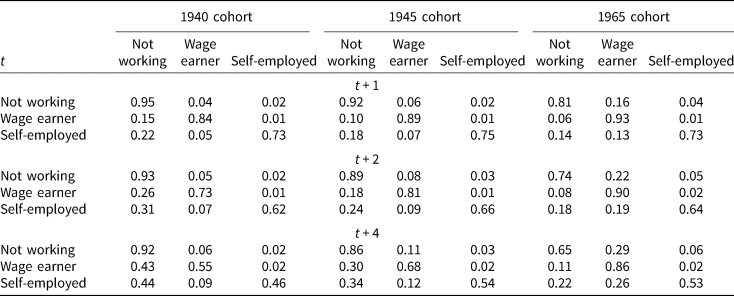
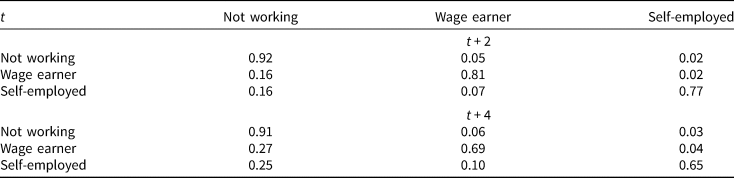
Table 1 uses tax return data to show the 1-year, 2-year, and 4-year transition probabilities between self-employment, wage-employment, and non-work for the 1940, 1945, and 1965 cohorts over the entire 1999–2013 period. They suggest that around 1% of wage earners in each age group become self-employed each year. The fraction rises to around 2% over 4 years. Table 2 does the same for the HRS data. Since interviews are conducted every other year, we only show the 2-year and 4-transition probabilities. These figures suggest that around 2% of wage earners transition to self-employment over 2 years, with that fraction rising to around 4% over 4 years. Most of the transition probabilities are similar for the older tax data cohorts and the HRS sample. The main difference is that self-employed people are more likely to transition to not working in the tax data relative to the HRS data. That difference likely arises from the $3,000 minimum income threshold we require to be defined as working in the tax data. If income fluctuates from year-to-year for the self-employed, individuals who temporarily fall below the threshold in the tax data may be classified as not working. But individuals in this situation may still identify their main job as self-employment in the HRS.
Transition probabilities (Tax return data)

Source: Authors' calculations from tax return data.
Transition probabilities (HRS data)

Notes: Transition probabilities use respondent-level weights.
Source: Authors’ calculations from Health and Retirement Study.
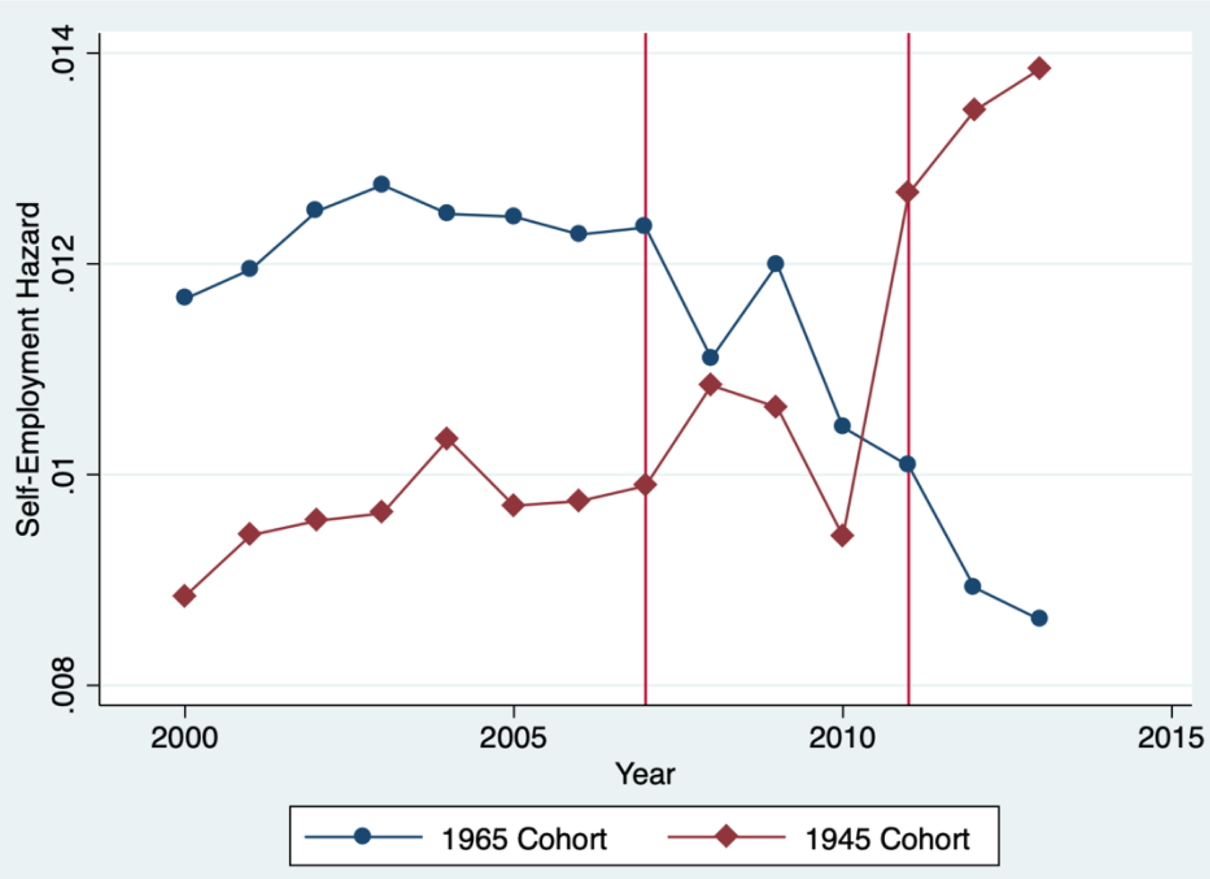
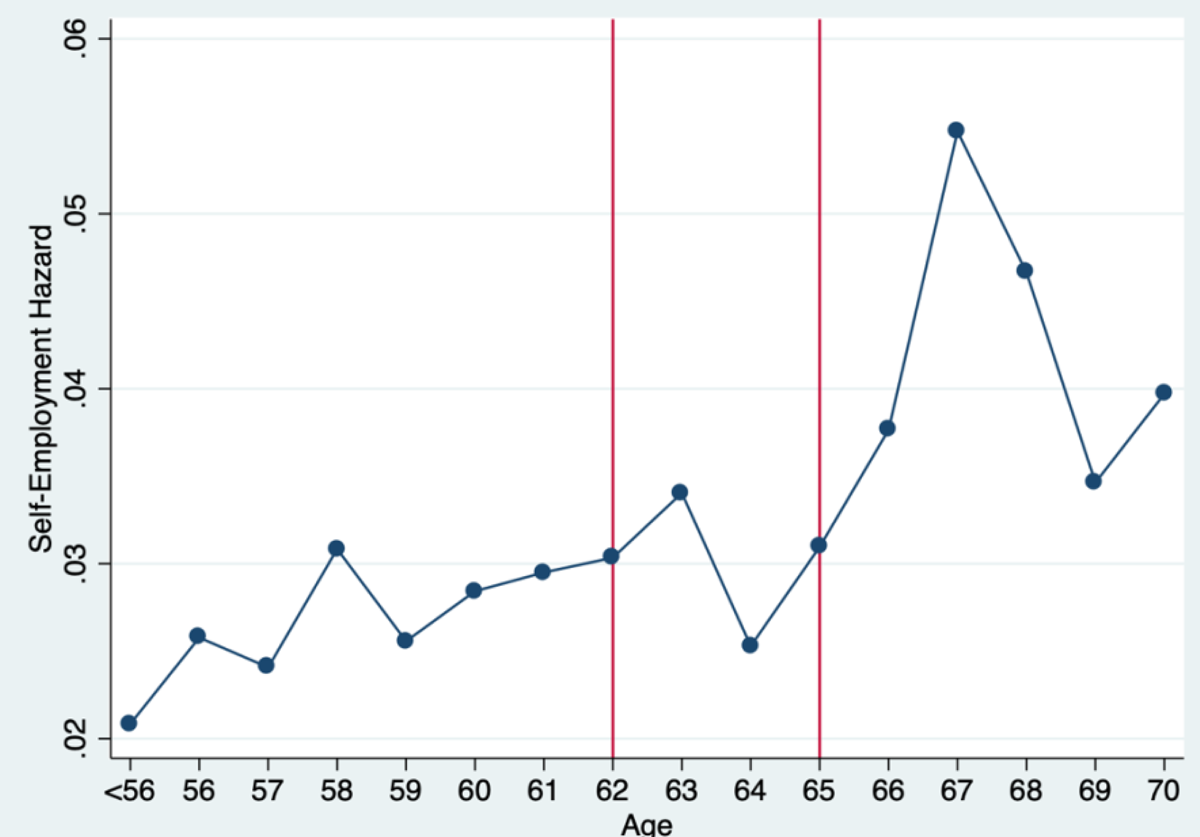
Figure 1 uses the tax data to show the hazards of self-employment each year for individuals who were wage earners in the previous year. These hazards are conditional on not stopping work. The two horizontal lines indicate the years that the older cohort turned 62 and 66 (the Social Security full retirement age). Figure 2 provides 2-year self-employment hazard rates by age using the HRS data. The horizontal lines here indicate ages 62 and 65 (the Social Security full retirement age for almost half of the HRS sample). Both graphs show that the probability of switching from wage-employment to self-employment increases around the Social Security full retirement age. The tax data additionally show a spike in the hazard of self-employment soon after age 62. In the tax data, the increases in the hazard of self-employment at key Social Security ages are more pronounced when viewed relative to the younger cohort, whose hazard of self-employment has declined relatively steadily since 2007. These spikes suggest the possibility that Social Security receipt may induce self-employment by providing outside income, or that individuals may use self-employment as a bridge job as they transition to retirement at key Social Security eligibility ages.
Hazard of self-employment (tax return data).
Source: Authors’ calculations from tax return data

2-year hazard of self-employment (HRS).
Source: Authors’ calculations from Health and Retirement Study

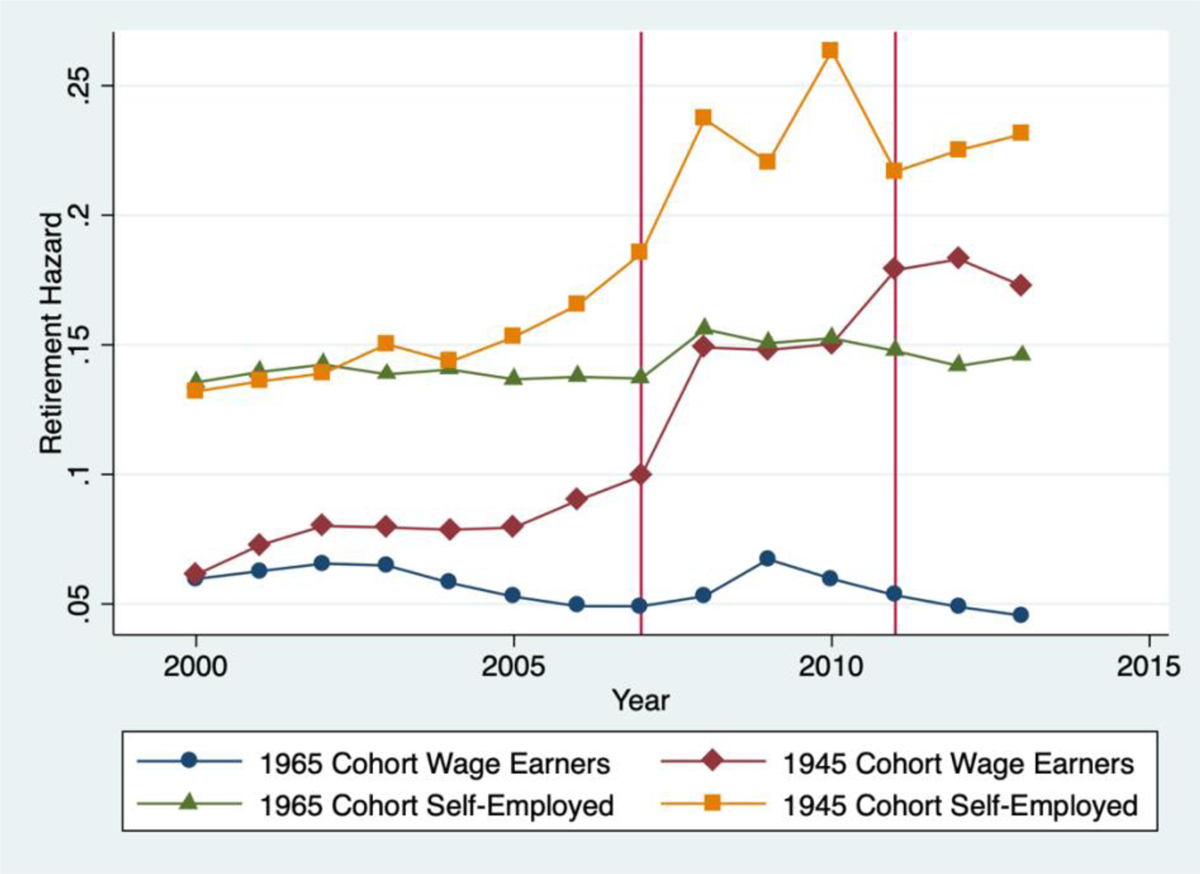
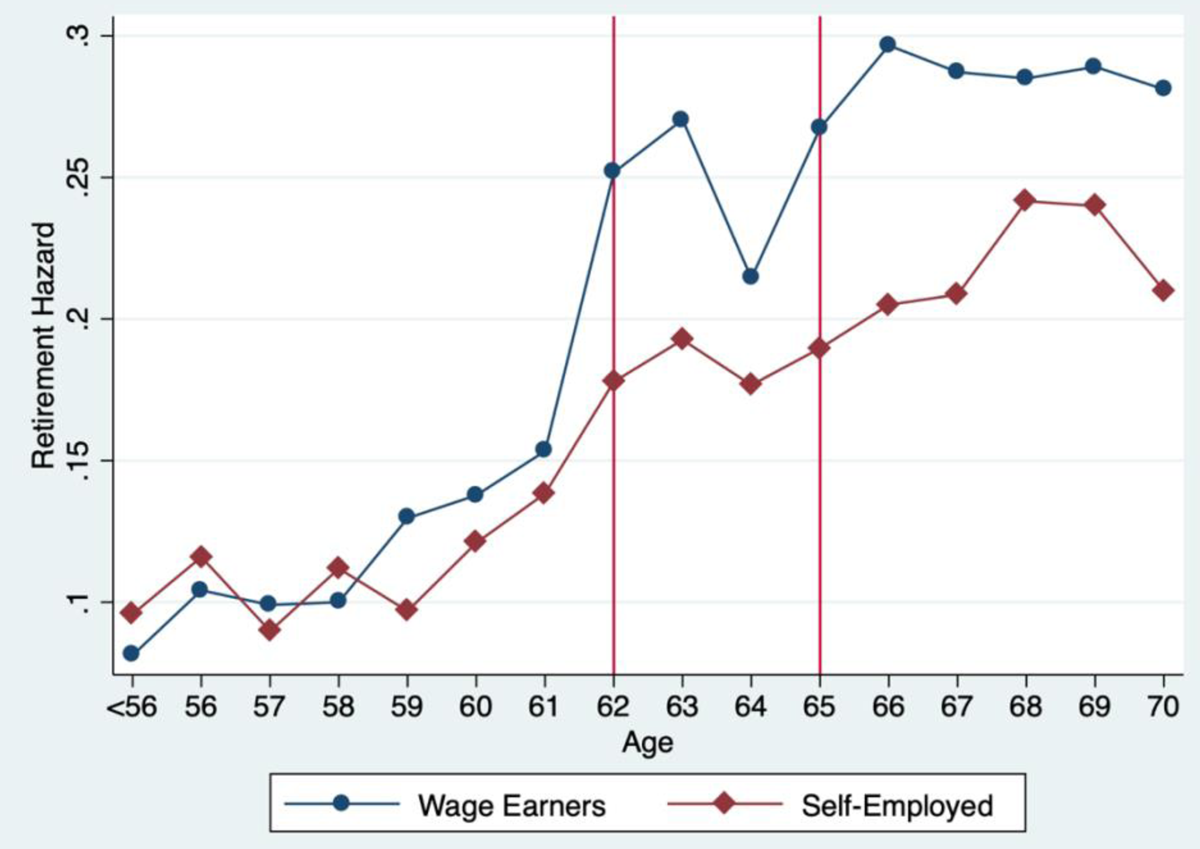
Figure 3 shows the hazard of stopping work each year for individuals who were wage earners and self-employed, respectively, in the previous year. Figure 4 does the same, by age, for the HRS data. Figure 3 suggests that retirement hazards for the older group (measured relative to the younger cohort's hazard of stopping work) are higher for wage earners before age 62. Both figures show that retirement hazards increase at ages 62 and normal retirement age, for both self-employed individuals and wage earners. In the HRS data, self-employed individuals appear to have a lower hazard of stopping work than wage earners, while the reverse is true in the tax data. One explanation for this finding might be our definition of not working. In the HRS data, an individual is not working if he or she reports not doing any work for pay. In the tax data, we use a threshold of $3,000 of earnings. It is possible that the net earnings of self-employed people are more volatile than those of wage earners, causing them to fall below $3,000 in net earnings in some years (and be classified as not working) even though they continue to work in self-employment.
Hazard of retirement (tax data).
Source: Authors’ calculations from tax return data

2-year hazard of retirement (HRS).
Source: Authors’ calculations from Health and Retirement Study

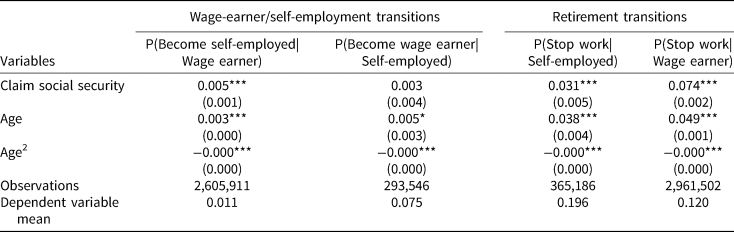
Table 3 shows the impact of claiming Social Security on the probabilities of different labor market transitions. In all models, Social Security claiming is instrumented using indicators for reaching early and full eligibility ages. The first two columns show the impact of Social Security claiming on transitions between being a wage earner and being self-employed. The first column shows that claiming Social Security is associated with a 0.5 percentage point increase in the hazard of switching from wage employment to self-employment, a 45% increase relative to the dependent variable mean of 1.1% (the fraction of wage-earners who switch to self-employment each year). The second column shows that the reverse is not true. Claiming Social Security is not associated with a change in the probability of switching from self-employment to wage employment. The last two columns examine retirement transitions and show that claiming Social Security at the two threshold ages is associated with an increase in the probability of stopping work for both wage earners and the self-employed. However, the association is stronger for wage-earners. The coefficients on the age trend show that the probability of switching to self-employment, as well as the probability of stopping work, increases at a decreasing rate with age. The age trend for switching from self-employment to wage employment is weaker (the coefficient on age is only significant at the 10% level) but follows a similar pattern.
Impact of Social Security Claiming on work transitions (tax return data)

Notes: Standard errors clustered by individual in parentheses. In the first two columns, the dependent variable is conditioned on continuing to work. Instruments for Social Security claiming include reaching age 62 and reaching full retirement age.
Source: Authors’ calculations from tax return data.
***p < 0.01, **p < 0.05, *p < 0.1.
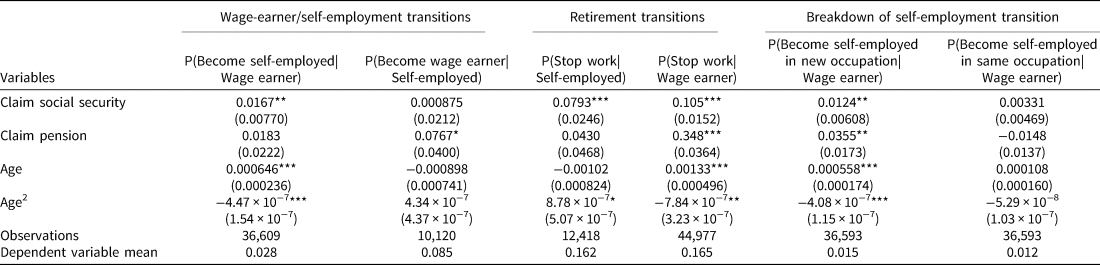
The first four columns of Table 4 present similar results for the HRS data. Again, the first two columns show the impact of claiming Social Security on transitions between being self-employed and being a wage earner. The first column shows that claiming Social Security is associated with a 1.67 percentage point increase in the hazard of self-employment over 2 years, a 60% increase relative to the dependent variable mean of 2.8%. However, claiming a private pension is not associated with a statistically significantly higher probability of switching to self-employment. The second column shows no statistically significant relationship (at the 5% level) between claiming Social Security or pensions and switching from self-employment to wage employment. The next two columns show that Social Security and pension claiming are associated with stopping work, with a stronger impact for wage earners than self-employed. Just as in the tax data, the nonlinear age trend suggests that the probability of switching to self-employment and the probability of retiring increase at a decreasing rate with age.
Impact of Social Security and pension claiming on work transitions (HRS data)

Notes: Standard errors clustered by individual in parentheses. Regressions utilize respondent-level weights and also include wave dummies. In the first four columns, the dependent variable is conditioned on continuing to work. Instruments for Social Security and pension claiming include reaching age 62, reaching Social Security full retirement age; reaching pension early and full retirement ages (for individuals with DB pensions); and reaching age 59.5 (for individuals with DC pensions).
Source: Authors’ calculations from Health and Retirement Study.
***p < 0.01, **p < 0.05, *p < 0.1.
Because the HRS includes data on occupation for both wage earners and self-employed individuals, we can further break our self-employment indicator down into two sub-indicators. These sub-indicators, described earlier, show whether self-employment transitions are associated with a switch in occupation. Regressions using these sub-indicators are shown in the last two columns of Table 4. They show that claiming Social Security is associated with switching to self-employment and switching occupation, rather than switching to self-employment within the same occupation. Private pension receipt also appears to be associated with becoming self-employed in a new occupation. These results suggest that Social Security-driven switches to self-employment are not likely to be individuals who return to work for former employers as consultants.Footnote 17
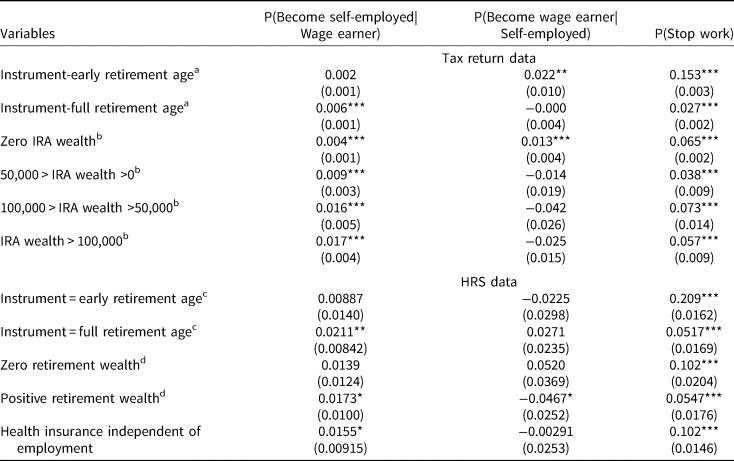
To further explore the results in Tables 3 and 4, we re-run the transition regressions separately with each of the Social Security eligibility instruments.Footnote 18 We also re-run the transition regressions for individuals in different retirement wealth categories. In the tax return data, these categories are zero IRA wealth, IRA wealth between $0 and $50,000, IRA wealth between $50,000 and $100,000, and IRA wealth about $100,000. In the HRS data, due to the smaller sample size, we break the sample into individuals with zero retirement wealth and individuals with positive retirement wealth. Retirement wealth is always measured in the current year or wave. Finally, since Social Security full retirement age is close to Medicare eligibility age, the increase in self-employment hazard around that age may also indicate the role that health insurance availability plays in transitions to self-employment.Footnote 19 To examine the role that Medicare eligibility may play in our results, we re-estimate the regressions in Table 4 for individuals who, in the baseline wave, either do not have employer-sponsored health insurance or have employer-sponsored health insurance that also covers retirees. The labor market decisions of this group should not be sensitive to the availability of Medicare, as they do not have health insurance that is tied to their employment.
Table 5 reports the results from these alternative specifications. The table reports only the coefficient on Social Security claiming, but all regressions still include controls for age and age squared, and for wave (in the HRS data). In the HRS regressions, private pension claiming (and the associated eligibility instruments) is included in the regressions that are broken down by wealth and health insurance status. The first two lines of the top (tax data) and bottom (HRS data) panels of the table show that when we use only the early eligibility age instrument, there is no statistically significant relationship between claiming Social Security and self-employment hazards. However, when we use only the full retirement age instrument, there is a statistically significant relationship. These results suggest that self-employment transitions are driven more by reaching full retirement age than early retirement age. In contrast, retirement transitions appear to be more strongly driven by the early eligibility age. There also appears to be a positive relationship between the early eligibility age and switching from self-employment to wage employment. The next four lines of the top panel and the next two lines of the bottom panel suggest that the impact of Social Security claiming on the hazard of self-employment increases with wealth. Finally, the last line of the bottom panel suggests that the coefficients on Social Security claiming are similar in magnitude for individuals whose health insurance status does not depend on employment. However, they lose some significance due to the smaller sample size.
Impact of social security claiming on work transitions (breakdown by instruments and subgroups)

Notes: Coefficients are IV estimates of the impact of Social Security receipt on the transition probability given in the column heading. Standard errors clustered by individual in parentheses. In the first two columns, the dependent variable is conditioned on continuing to work. All regressions include controls for age and age squared. HRS regressions also include wave dummies.
Source: Authors’ calculations from Health and Retirement Study.
a Instruments for Social Security claiming are as indicated.
b Instruments for Social Security claiming include reaching age 62 and reaching Social Security full retirement age.
c Regressions do not include indicators for private pension claiming or instruments indicating private pension eligibility. Instruments for Social Security claiming are as indicated.
d Regressions also include private pension claiming. Instruments for private pension and Social Security claiming include reaching age 62; reaching Social Security full retirement age; reaching pension early and full retirement ages (for individuals with DB pensions); and reaching age 59.5 (for individuals with DC pensions).
***p < 0.01, **p < 0.05, *p < 0.1.
Our results regarding Medicare eligibility contrast with Fairlie et al. (Reference Fairlie, Kapur and Gates2011), who find an increase in business ownership in the few months after turning 65 relative to the few months before turning 65. They attribute this change to the availability of Medicare. Our findings may differ for a few reasons. First, Fairlie, Kapur, and Gates focus on business ownership, which may be significantly narrower than our definition of self-employment. In the tax data, we define self-employment as the presence of a Schedule SE with sufficient net income. Many individuals who report Schedule SE income may be consultants or other independent contractors who do not consider themselves business owners. In the HRS as well, the question we use to classify individuals’ work status refer to self-employment rather than business ownership. Second, Fairlie, Kapur, and Gates restrict attention to individuals working at least 15 hours per week for at least 20 weeks per year, defining all other individuals as not working. Our sample contains many individuals who work considerably less than 15 hours per week and have quite low earnings. Thus, their sample selection likely excludes many individuals who are using self-employment as a transition to retirement while ours does not. Third, Fairlie, Kapur, and Gates focus on transitions that occur immediately after turning 65. The transitions we study occur over a longer period – 1 year in the tax data and 2 years in the HRS data. Thus, it is possible that the transitions Fairlie, Kapur, and Gates study – the ones that occur immediately upon turning 65 among those continue to work at least 15 hours per week, and could be described as business ownership – are Medicare driven, while the transitions we study are associated with the retirement process. Indeed, the point estimate of the impact of Social Security claiming is slightly smaller for those without employment-based health insurance, leaving open the possibility that some self-employment transitions are Medicare driven. Finally, Medicare may provide better coverage than the typical employer-sponsored retiree health insurance plan. Thus, even those with access to employer-sponsored retiree health insurance may respond to Medicare eligibility. We interpret our evidence as suggestive of an independent role for Social Security eligibility, although we cannot conclusively rule out Medicare eligibility as an explanation.
3.2 Earnings
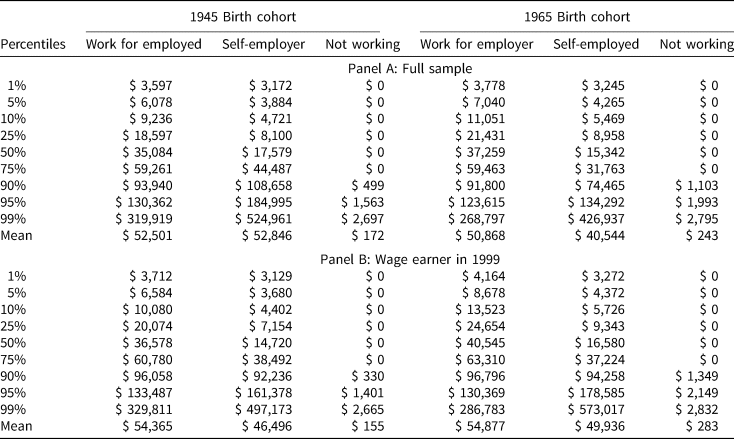
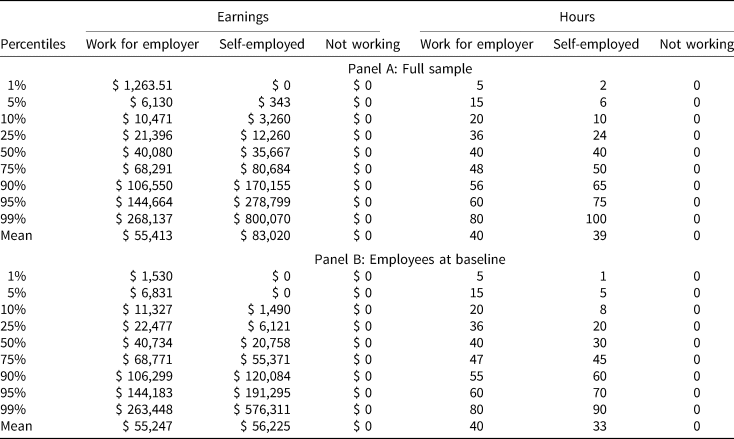
Tables 6 (for the tax data) and 7 (for the HRS data) show the percentiles of the earnings distribution broken down by current work status. Table 7 additionally shows the percentiles of the weekly hour distribution for the HRS data. In both tables, the top panel represents the full sample, while the bottom panel represents individuals who were wage earners in 1999 (for the tax data) or the baseline wave (for the HRS data). In the bottom panel, observations from 1999 or the baseline wave are excluded. Table 7 suggests that in the full sample, self-employed individuals earn more on average than wage earners. However, self-employed earnings are lower at the 50th percentile and below, suggesting that the difference in means is driven by outliers at the top. Indeed, the 99th percentile of earnings for the self-employed is substantially larger than the 99th percentile of earnings for wage-earners. The earnings of the self-employed are higher in the HRS than in the tax data, possibly due to underreporting on tax returns or due to individuals underestimating costs when reporting net earnings in the HRS.
Income summary statistics (Tax Data)

Notes: Panel B includes only observations after 1999.
Source: Authors’ calculations from tax return data.
Income, hours, and wages summary statistics (HRS data)

Notes: Summary statistics use respondent-level weights. Panel B utilizes only observations after the baseline wave.
Source: Authors’ calculations from Health and Retirement Study.
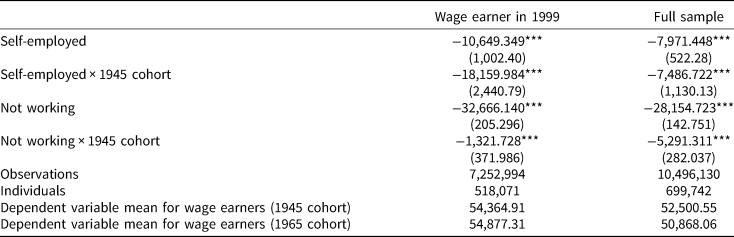
The regression in the first column of Table 8 shows that, in the tax data, individuals in the younger cohort who start out as wage earners experience a drop of around $10,649 upon switching to self-employment. This drop could merely reflect underreporting, or the fact that small businesses take a few years to become established. However, the interaction between the indicator for self-employed and the 1945 cohort dummy suggests that the older cohort experiences an additional $18,160 drop in earnings upon switching to self-employment. This effect is not simply due to aging (i.e., that individuals who start out as workers are older when they switch to self-employment, and earnings decline with age) because we have included interactions between the year dummies and the 1945 cohort dummy. These interactions should pick up the fact that the 1945 cohort's earnings are likely to decline over time relative to the younger cohort's earnings regardless of employment type. Our result therefore suggests that self-employment could be a form of partial retirement for older people. When the full sample is used (in the second column of the table), the impact of self-employment for older workers is smaller. That is, the drop in income is more pronounced for individuals who start out as wage earners and switch to self-employment late in life.
Impact of self-employment on earnings (tax data)

Notes: Standard errors clustered by individual in parentheses. All regressions also include year dummies, interactions between year dummies and the 1945 cohort dummy, and individual fixed effects. Regression for wage earners in 1999 utilizes only post 1999 observations.
Source: Authors’ calculations from tax return data.
***p < 0.01, **p < 0.05, *p < 0.1.
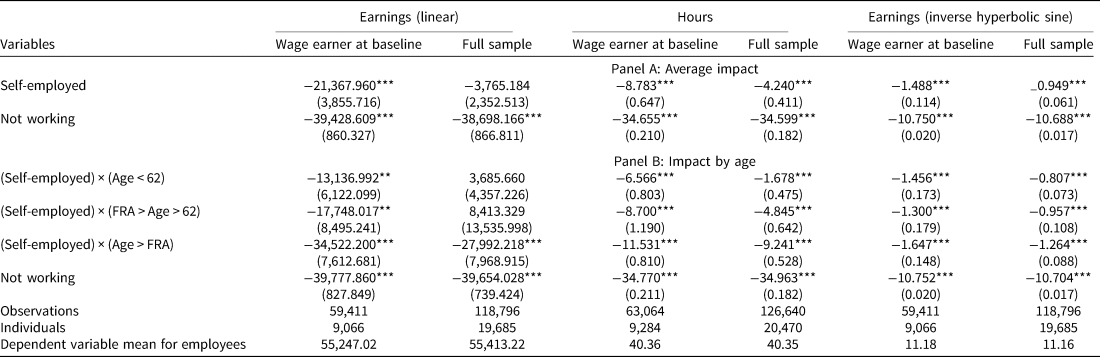
The first four columns of Table 9 present similar results for the HRS data. In the first two columns, the dependent variable is earnings. In the second two, the dependent variable is hours worked. The top panel of Table 9 suggests that income and hours drop upon transition to self-employment, and that the drop is more pronounced for wage-earners who later become self-employed. The HRS data do not include a younger comparison group. However, the bottom panel of Table 9 interacts the self-employment indicator with a set of age dummies indicating whether the individual has reached Social Security early or full eligibility ages. These results suggest that the drop in income and hours following self-employment is concentrated among those who transition to self-employment after reaching Social Security full retirement age.
Impact of Self-Employment on Earnings and Hours

Notes: Standard errors clustered by individual in parentheses. Regressions utilize respondent-level weights and also include age dummies, wave dummies, and individual fixed effects. Regressions for wage earners and self-employed at baseline utilize only post-baseline observations.
Source: Authors’ calculations from Health and Retirement Study.
***p < 0.01, **p < 0.05, *p < 0.1.
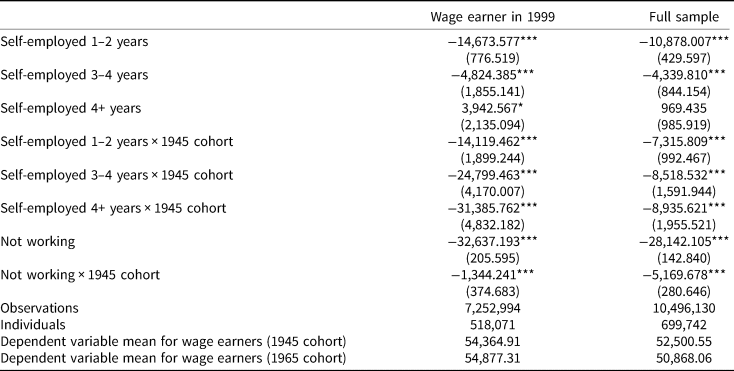
Table 10 shows the impact of the duration of self-employment on total earnings. The first column suggests that when a wage earner in the younger cohort becomes self-employed, earnings initially drop by $14,674. However, once an individual has been self-employed for more than 4 years, expected earnings increase slightly relative to what the same individual earned in wages. On the other hand, not only is the initial drop more pronounced for the older cohort, but earnings continue to decline with the duration of self-employment. Again, this effect is not simply because earnings decline with age for older workers. The regression includes year dummies interacted with the older cohort dummy, which should control for any decline in income over time due to aging. Therefore, our result is again consistent with the story that older workers who transition to self-employment are in the process of retirement, gradually reducing their effort and earnings as they continue in self-employment. The second column of the table shows that these effects are present even when people who start out self-employed (or not working) are included in the sample; however, they are smaller in magnitude.
Impact of self-employment on earnings by duration of self-employment (tax data)

Notes: Standard errors clustered by individual in parentheses. All regressions also include year dummies, interactions between year dummies and the 1945 cohort dummy, and individual fixed effects. Regression for wage earners in 1999 utilizes only post 1999 observations.
Source: Authors’ calculations from tax return data.
***p < 0.01, **p < 0.05, *p < 0.1.
One possible concern about the earnings regressions is that the earnings distribution is highly skewed. The last two columns of Table 9 check the robustness of our results to transforming the dependent variable to adjust for this skewness. Since a log transformation would result in dropping zeros, we instead use the inverse hyperbolic sine transformation. The coefficients in the last two columns have the same signs and significance as the coefficients in the first two. Following Bellemare and Wichman (Reference Bellemare and Wichman2020) discussion of the interpretation the inverse hyperbolic sine transformation, we estimate that the approximate percentage decrease in earnings upon a switch to self-employment, for individuals who begin as wage earners, is 77.5%.Footnote 20 In comparison, the linear model in the first column suggests that earnings for this group decrease by 21,367.96/55,247.02 = 39% upon switching to self-employment.
4. Conclusions
We have shown that the flow of individuals transitioning between working for an employer to self-employment is rather modest: ~1% per year. This is true of members of the 1945 birth cohort who range from 54 to 68 during our period of observation, members of the 1940 birth cohort who range from 59 to 73 during our period of observation, and members of the 1965 birth cohort who range from 34 to 48 during our period of observation. Second, we find that the flow into self-employment increases substantially upon claiming Social Security, and this effect is more pronounced among those with greater retirement wealth. Finally, we show that individuals who transition to self-employment in their 60s experience a much larger drop in earnings relative to prime age individuals, and the relative decline continues as they gain experience in self-employment. All of this suggests that the transition from wage employment to self-employment for workers in their 60s is likely to represent a transition from full-time work to part-time work. That is, self-employment appears to play the role of a bridge job in the transition to retirement, allowing workers to slowly reduce hours. This pathway to retirement appears to be most common among those with greater retirement wealth. The earnings of the self-employed are sufficiently low that the contribution to retirement security is quite modest. However, self-employed people do tend to retire at a later age.
The overall conclusions are that the work to self-employment to retirement pathway is less common than one might expect given the flexibility of self-employment, and that the number of people in their 60s who are self-employed would be even lower if reported in terms of ‘full time equivalent’ workers. This finding could reflect fixed costs of switching to self-employment. However, if the ‘gig economy,’ which makes self-employment more accessible, continues to grow, self-employment may play an increasing role in the transition to retirement. To the extent that policy makers would like to encourage people to work longer to enhance retirement security, a year of self-employment is much less productive than an extra year of work for an employer. On the other hand, self-employment may increase career lengths by allowing workers to retire gradually.
Acknowledgement
John B. Shoven and Sita Nataraj Slavov were supported by Sloan Foundation grant number 2015-14152. We thank Kyung Min Lee and Chanup Jeung for excellent research assistance. We thank Gila Bronshtein, Arcenis Rojas, Natalya Shelkova, seminar participants at Brookings Institution, participants at the 2016 Southern Economic Association Annual Meeting, participants at the 2016 Working Longer conference at the Stanford Institute for Economic Policy Research, and participants at George Mason's Schar School brown bag series for helpful comments. The findings and conclusions expressed are solely those of the author(s) and do not represent the views of the U.S. Department of the Treasury, the Sloan Foundation, or the NBER.