Over the past several decades, social movement theorists have challenged the classical political process definition of social movements, which is centered around excluded groups using noninstitutionalized means and systematically embracing a confrontational stance toward the state. Many social movements born with an anti-institutional stance have moved toward a more accommodationist position: social movement actors have adopted more conventional means of action and accepted the idea of cooperating with, rather than systematically opposing, the state (Costain and McFarland Reference Costain and McFarland1998; Giugni and Passy Reference Giugni, Passy, Giugni, McAdam and Tilly1998; McAdam, Tarrow, and Tilly Reference McAdam, Tarrow and Tilly2001; Meyer and Tarrow Reference Meyer and Tarrow1998; Soule and Earl Reference Soule and Earl2005). At the same time—and the two paths are, of course, closely linked—states have become more open to social movements’ ideas and actors (Banaszak, Beckwith, and Rucht Reference Banaszak, Beckwith and Rucht2003). Against this backdrop, some social movement scholars have envisioned the movement-state interaction as “conflictual cooperation” (Giugni and Passy Reference Giugni, Passy, Giugni, McAdam and Tilly1998), while others have asserted the idea of a “social movement society” (Meyer and Tarrow Reference Meyer and Tarrow1998) in which social movement protest is a full dimension of routinized politics.
This renewed theoretical view on movement-state interaction, however, has only partially challenged the “great divide” between social movements and the state. While it has become more and more difficult to associate social movements with specific discourses, strategies, or targets (Fillieule Reference Fillieule2009), social movements have been increasingly equated with a specific set of actors, namely, “social movement organizations.” These have often been defined negatively: located outside the state and distinct from other organized actors, such as parties, unions, lobbies, foundations, religious institutions, corporations, etc. In this perspective, the integration of social movement ideas and actors into state institutions has remained overwhelmingly seen as a process of co-optation, deradicalization, and depoliticization (Thörn and Svenberg Reference Thörn and Svenberg2016), which ultimately equates with the end of protest politics (see Sawer Reference Sawer2010, Reference Sawer, Sawer and Maddison2013 for a critique of this perspective).
Research on women's movements, feminism, and the state has played a crucial role in challenging the dominant vision of the relationship between protest politics and mainstream institutions (Andrew Reference Andrew, Sawer and Maddison2013; Banaszak Reference Banaszak2010; Bereni and Revillard Reference Bereni and Revillard2012; Chappell Reference Chappell2010; Clemens Reference Clemens1993; Eisenstein Reference Eisenstein, Ferree and Martin1995; Franzway, Court, and Connell Reference Franzway, Court and Connell1989; Gelb and Hart Reference Gelb, Hart, Giugni, McAdam and Tilly1999; Katzenstein Reference Katzenstein1998a; Mackay Reference Mackay2014; McBride, Mazur, and Lovenduski Reference McBride, Mazur and Lovenduski2010; Sawer Reference Sawer1990, Reference Sawer2010, Reference Sawer, Sawer and Maddison2013; Stetson and Mazur Reference Stetson and Mazur1995; Watson Reference Watson1990).Footnote 1 On the one hand, women's movements have followed a path of institutionalization since the 1980s and 1990s through the formalization, professionalization, and routinization of their forms of action. On the other hand, states have responded to women's movement protest by setting up positions and instances specifically devoted to the promotion of women's rights at different levels of government and by carrying out public policies that have followed feminist demands (McBride, Mazur and Lovenduski Reference McBride, Mazur and Lovenduski2010). Such bodies, positions, and policies have proliferated in a variety of national contexts, in the North and in the South, and with the strong support of international organizations, most notably, the United Nations (Lépinard Reference Lépinard2007; Stetson and Mazur Reference Stetson and Mazur1995).
Feminist scholars have drawn on this empirical path to map out new theoretical views on the relationship between feminist protest and the state. The concept of state feminism was introduced as early as the 1980s to subsume the idea that feminist ideas and actors could develop within mainstream institutions, primarily inside the state. This research has focused on gender equality policies and ideas carried out by the state, on individual actors pursuing gender equality goals within the state (usually referred as “femocrats”), or on bureaucratic bodies formally devoted to the advancement of women's status (women's policy agencies). The literature on state feminism has thus contributed to blur the boundaries between civil society and the state, social movements and institutions, disruptive action and conventional politics.
However, since most of these works pertain to public policy and institutional analysis rather than to social movement theory, they have not drawn the full conclusions of their critique of the traditional model of protest. With some notable exceptions (Andrew Reference Andrew2010, Reference Andrew, Sawer and Maddison2013; Banaszak Reference Banaszak, Meyer, Jenness and Hingram2005, Reference Banaszak2010; Katzenstein Reference Katzenstein1998a, Reference Katzenstein, Meyer and Tarrow1998b; Sawer Reference Sawer2010, Reference Sawer, Sawer and Maddison2013; Valiente Reference Valiente2007), most of them rest more or less explicitly on the idea of a social movement-state dichotomy and conceptualize the movement-state interaction in terms of alliance rather than in terms of intersection.
Building on a series of works that have challenged the common definition of social movements as being irreducibly located outside institutions, this article makes the case for fully recognizing the existence of a possible intersection between movements and dominant institutions, including the state. Drawing on the French case, we argue that women's policy agencies (WPAs) can operate, under some circumstances, as movement institutions: they can be institutionally engrained with a protest dimension, rather than being only a shelter for a network of insider activists; they can be sources of feminist protest, rather than only importing ideas from the “outside” movement. In other words, they can act in conjunction with—rather than only in response to—other women's movement actors located outside the state. We envision these hybrid institutional settings as potentially being a full part of both the state apparatus and the women's movement, which we broadly define as a configuration of mobilizing structures dedicated to improving women's status and/or challenging the gender orderFootnote 2 in a multiplicity of social fields, inside and outside institutions—what Laure Bereni (Reference Bereni2015) calls the “field of women's cause.”Footnote 3
In the first section of the article, we detail how the rich scholarship on women's movements, feminism, and the state has contributed, over the past 25 years, to blur the boundary between protest and institutions. We distinguish four approaches to state feminism, each of them questioning the classical divide between protest and institutions in a specific way: the femocratic, institutional relay, coalition, and intersection approaches. We also point out the limitations of these perspectives with respect to our case for considering state bodies devoted to promoting women's status as possible movement institutions. On the one hand, many studies of WPAs, inspired by policy analysis, tend to overlook the protest dimension engrained in these institutions, which are thought of strictly as policy-making actors. On the other hand, most studies of the “state-movement intersection” (Banaszak Reference Banaszak2010), inspired by a social movement approach, tend to focus on individual actors and informal networks to the detriment of institutions.
The second part of the article details the theoretical implications of the concept of movement institutions in terms of the profile of individual WPA members, political agendas, and modes of action, building on our respective studies on women's mobilization inside and outside the state in France since the 1960s (Bereni Reference Bereni2015; Revillard Reference Revillard2016).
WOMEN'S MOVEMENTS, FEMINISM, AND THE STATE
In the course of the 1980s, as “autonomous” new women's movements were declining and states were displaying increased openness to women's movements’ ideas and actors, a new vision of the relationship between women's movements, feminism, and the state started to proliferate. Feminist scholars increasingly viewed the state as a possible arena for feminist action, against the dominant viewpoint that feminism and bureaucracy are irreducible enemies (Ferguson Reference Ferguson1984). The term “state feminism” symbolized this new vision (Hernes Reference Hernes1987) and gave birth to a great deal of research in the following decades (McBride, Mazur, and Lovenduski Reference McBride, Mazur and Lovenduski2010).
The body of research commonly subsumed under the heading of “state feminism” is not a unified field. This scholarship has developed since the 1980s in a variety of national contexts, disciplinary settings, and research fields—from policy analysis to social movement theory. Among the resulting diversity of this body of literature, four approaches can be distinguished, each questioning the classical divide between protest and institutions in a specific way.
The Femocratic Approach: A Focus on Individual Feminists
The first approach to state feminism, which we label “femocratic,” focuses on the action of individual advocates for women's rights working within the bureaucracy. Australian feminist scholars pioneered this body of research on these individuals, whom they called “femocrats” (a contraction of feminist bureaucrats) (Eisenstein Reference Eisenstein, Ferree and Martin1995; Franzway, Court, and Connell Reference Franzway, Court and Connell1989; Sawer Reference Sawer1990; Watson Reference Watson1990). Initially used only to refer to women working in positions specifically devoted to a women's rights agenda, the term rapidly broadened to designate all feminist actors working within the state, regardless of whether they were located in women's policy positions or structures.
Such theoretical innovations were closely linked to the specific national context in which they developed. In Australia, actors from the women's movement, some of them identifying as radical feminists, had entered into the state as early as the beginning of the 1970s, in the heyday of the new feminist movement.
Against this backdrop, Australian scholars argued that the state was not, by definition, entirely patriarchal and hostile to women's interests: rather, it needed to be seen as an heterogeneous body, composed of conflicting interests, ideologies, and bodies,Footnote 4 that could be taken advantage of by feminist bureaucrats seeking to promote a feminist agenda.
Focusing on individual actors provided a fruitful way to theorize the continuity between the women's movement and the state. Several scholars associated with the femocratic approach used the notion of accountability to grasp the multiple (conflicting) identities of individual feminists working inside the state (Banaszak Reference Banaszak2010; Eisenstein Reference Eisenstein, Ferree and Martin1995; Katzenstein Reference Katzenstein1998a). Working within state institutions imposes a set of constraints (Chappell Reference Chappell2010; Mackay Reference Mackay2014). Femocrats cannot ignore the dominant bureaucratic norms and values if they want to achieve feminist goals and maintain their position within the state. In other words, they are, in the first place, accountable to government and bureaucracy. But they have proved to be accountable to the women's movement as well, although there was no formal, legal basis for such accountability. Most of the early femocrats came from the women's movement and individually maintained their links to it over time (Eisenstein Reference Eisenstein, Ferree and Martin1995). This double accountability to the women's movement and to the government does not work without tensions. As Eisenstein points out, Australian femocrats have recurrently been suspected by women's movement actors of placing bureaucratic interests ahead of women's concerns.Footnote 5
In the course of the 1990s and 2000s, the femocratic approach to state feminism was fruitfully applied to other national cases and enriched with new conceptual insights. Among others, Outshoorn (Reference Outshoorn1994) used the term “femocrat” to refer to those individual actors working specifically in official women's policy agencies and divided them into two subcategories: professionals, who are “career oriented” and primarily devoted to bureaucratic norms and values, and “allies,” who are “movement oriented,” embracing some of the women's movements’ ideas and concerns.
The Institutional Relay Approach: A Focus on Women's Policy Agencies
By the mid-1990s, another approach to state feminism began to develop in feminist theory, shifting the focus from individual actors (femocrats) to institutional bodies, and more specifically, women's policy agencies, the government agencies officially in charge of furthering women's rights and gender equality. This new perspective was introduced by Dorothy McBride Stetson and Amy Mazur in their landmark book on Comparative State Feminism (Reference Stetson and Mazur1995), and further developed conceptually and empirically within the Research Network on Gender Politics and the State (RNGS) (McBride, Mazur, and Lovenduski Reference McBride, Mazur and Lovenduski2010). Public policy analysts, rather than social movement scholars, were the driving force of this new theoretical approach to state feminism. The central research question was no longer the transformations of social movements and protest politics. Rather, the main issue was whether public policies could integrate feminist perspectives and to what extent women's policy bodies were instrumental to this process.
First, RNGS researchers sought to establish whether feminist movement goals and actors were included by women's policy agencies. Second, they sought to assess the extent to which WPAs’ presence and action within the state could account for bringing feminist movements’ demands (substantive representation) and actors (descriptive representation) into the broader policy-making process. Carried out in a range of 13 countries and focusing on five gender policy issues (abortion, job training, political representation, prostitution, and one “hot” issue specific to each country), the RNGS project created a four-term typology of state feminism: “Insider where agencies’ goals reflect movement goals and the agency genders the issue frame of the debate; Marginal agencies that promote movement goals but are not able to change the issue frame; Nonfeminist category where the agency genders the debate but with ideas and goals that do not reflect women's movement ideas; and Symbolic where the agency takes no position and does not gender the debate” (Mazur and McBride Reference Mazur and McBride2007, 507–8). In the end, the RNGS comparative study provided empirical evidence of a significant role for WPAs in increasing both the substantive and descriptive representation of women.
Expanding on the RNGS project, theorists of feminist institutionalism can also be associated with this institutional relay approach, as they are interested in the gendered nature of institutions and the conditions under which women's interests may be represented through a variety of institutional settings (see Chappell Reference Chappell2010; Krook and MacKay Reference Krook and Mackay2010; Mackay Reference Mackay2014; Weldon Reference Weldon2002).
In this theoretical perspective, the focus is placed on the extent to which WPAs reflect feminist movement demands and achieve their integration into public policy. This formulation does not question the state-movement dichotomy, in the sense that, although WPAs can be feminist (i.e., embracing a feminist discourse), they are not, by definition, a component of the women's movement. They are considered allies of women's movement actors, as well as the relays of their ideas within the state. This clear separation derives from the idea that feminist protest originally and primarily comes from the discursively and organizationally “autonomous” women's movement, composed of a range of groups and organizations that are located outside the state (as well as other organizational settings, such as parties, lobbies, universities, corporations, etc.).
The Coalition Approach: Cross-Sectional Alliances of Women Advocates
Along with research focusing on feminist individuals and institutions within the state bureaucracy, the literature on feminist policy coalitions has contributed to an analysis of the interactions between feminist protest and dominant institutions, including the state bureaucracy (Holli Reference Holli2008; Mazur Reference Mazur2002).
Feminist theory has developed several concepts to refer to “women's co-operation constellations,” which Holli defines broadly as “any kind of actual co-operation initiated or accomplished by one or several groups of women in a policy process to further their aims or achieve goals perceived as important to them” (Reference Holli2008, 169). Among these, the metaphor of the “triangle” has been particularly successful, to a large extent because it refers to the concept of the “iron triangle,” which has been a landmark of policy analysis since the 1960s. An early conceptualization of a feminist triangle was Haalsa's (Reference Haalsa1991) “strategic partnership,” mapped out in the beginning of the 1990s in the Norwegian case. Haalsa argued that women's achievements in Norwegian public policies could be partly accounted for by the emergence of alliances between women politicians, women bureaucrats, and women activists from women's organizations on “pragmatic, specific issues” (Haalsa Reference Haalsa1991, cited by Holli Reference Holli2008).
Haalsa's conceptualizations have subsequently been used and reworked by other feminist political scholars (Mazur Reference Mazur2002; Vargas and Wieringa Reference Vargas, Wieringa, Nijeholt, Vargas and Wieringa1998; Woodward Reference Woodward, Christiansen and Piattoni2003). In these conceptualizations, the nature of the participants in the triangle varies slightly. For Mazur, only femocrats working in WPAs are part of the “state” corner of the triangle, whereas Haalsa refers to the broad category of “women bureaucrats,” and Vargas and Wieringa refer to feminist bureaucrats working within the state, not specifically in WPAs. Addressing the network of women advocates at the level of European institutions, Woodward conflates party women, public office women, and women bureaucrats in the same corner of the triangle. She introduces academics/experts on women and gender as a new category of strategic participants in a second corner, the last one relating to civil society organizations.
As in the RNGS approach, most of the coalition approach concepts have been driven by a policy analysis framework rather than by social movement theory. There is generally little sociological input on how these coalitions emerge, who (which women) gets involved in them, and why they last (or do not last). These coalitions are often less analyzed for themselves than for their impact on policy making. Moreover, the women's movement's definition remains unchanged. It is still limited to a set of organizations located “outside” dominant institutions (the state, political parties, academia, etc.).
The Intersection Approach: Theorizing the Overlap between Movement Politics and Institutions
The fourth approach to women's movements, feminism, and the state is what we call the intersection approach, echoing Banaszak's (Reference Banaszak2010) concept of “movement-state intersection.” Along with Banaszak's (Reference Banaszak, Meyer, Jenness and Hingram2005, Reference Banaszak2010) study of “movement insiders” in the American bureaucracy, we include in this category Katzenstein's work on feminist “unobtrusive mobilization” within the American Catholic Church and military (Katzenstein Reference Katzenstein1998a, Reference Katzenstein, Meyer and Tarrow1998b). Other works that we have identified as pertaining to the femocratic perspective (notably, Andrew Reference Andrew, Sawer and Maddison2013; Sawer Reference Sawer1990, Reference Sawer2010, Reference Sawer, Sawer and Maddison2013) can also be associated with this intersection approach, as they have explicitly challenged the divide between women's movements and institutions, which remains untouched in many policy analysis works on state feminism, as well as in most social movement studies.
In her study of women's claim making within the U.S. church and military, Katzenstein argues that feminist protest moved from the streets to mainstream institutions after its heyday in the 1960s and 1970s. As she points out, social movement scholars have usually overlooked the social movement voices incorporated within institutional settings: “Institutional actors (lawyers, judges, politicians, employers, journalists) are by definition precluded from being social movement activists—except after hours” (Katzenstein Reference Katzenstein, Meyer and Tarrow1998b, 195). This common view derives from a conflation of the location, form, and content of protest: “When social movement actors doing street politics (location) opt for or ally themselves with those who use conventional modes (forms) of political activism such as lobbying or voting, a social movement is generally deemed to have crossed the threshold separating protest politics from institutional politics, and the result is presumed to be de-radicalizing (content)” (Katzenstein Reference Katzenstein, Meyer and Tarrow1998b, 195–96). According to Katzenstein, the definition of social movements and protest politics can no longer rely first and foremost on the location of action. “Movement politics”—or “institutional protest”—can develop within institutions, and even possibly pursue radical goals. While feminists within the military took a “moderate” stance, focusing on bringing the legal equal opportunity framework into their institution, feminists within the Catholic Church engaged in a more “radical” discursive politics.
One of the assets of Katzenstein's approach is to combine individual and organizational dimensions to study protest within institutions. In line with the femocratic approach, she stresses the multiple accountabilities (discursive, financial, and organizational) of social movement actors within dominant institutions. But she also pays attention to the organizational dimension of protest: within a hostile institutional environment, “organizational habitats” can shelter the development of unobtrusive mobilization. Defined as “spaces where women advocates of equality can assemble, where discussion can occur, and where the organizing for institutional change can originate” (Katzenstein Reference Katzenstein, Meyer and Tarrow1998b, 197), organizational habitats echo the concept of “free space” in which members of dominated groups find themselves relatively protected from elite control and where a form of politicization of identity may develop (Evans and Boyte Reference Evans and Boyte1986).
Banaszak's work on feminist protest inside and outside the state also helps us think of feminist protest within the state as a full part of the women's movement. She studies the mobilizing of American feminist bureaucrats inside the state over the past 50 years and their relationships with other components of the women's movement outside the state. She argues that while feminist activists within the state have often worked discretely, “under the radar” (echoing Katzenstein's description of feminists’ “unobtrusive mobilization” within institutions), they have had a central role in the emergence, the forms, and the successes of the American new women's movement since the 1960s. A small group of feminist bureaucrats in the 1960s used their informational, material, and network resources as state insiders to foster the first organizations of the “new” women's movement outside the state. In the following decades, they continuously mobilized the resources attached to their insider position to advance women's movement goals, and they did so even when women's movement activities outside the state were declining and the political environment was explicitly hostile to feminist ideas (e.g., during Ronald Reagan's presidency).
Banaszak's approach pertains, to some extent, to the femocratic approach, since she focuses on individuals rather than institutions. She envisions the network of feminist activists within the federal bureaucracy at large (not only in WPAs) as full women's movement actors. Unlike other conceptualizations of femocrats (most notably, Outshoorn Reference Outshoorn1994), however, she argues that bureaucrats pursuing feminist goals in any subdivision of the state (not only in women's “policy-ghettos”) are full part of the women's movement. The network of feminist activists working inside the state makes up what she calls the “movement-state intersection.”
In a series of studies on the transformations of the Australian women's movement since the rise of the second wave, Sawer, Andrew, and their colleagues have participated in challenging the divide commonly drawn between social movements and male-dominated—including state—institutions. In particular, Sawer (Reference Sawer, Sawer and Maddison2013) stresses the need to take into account the meaning that participants give to their action. This interpretive focus sheds light on how institutionalized modes of action can be endowed with an activist meaning. The (public) use of disruptive action, she argues, should not be a defining characteristic of collective protest. In the same line, studying the case of contemporary women's movement activism against male violence in Australia, Andrew and McLaren argue that institutions can be a site for “radical activism,” as soon as our account of “what makes activism radical … does not rely exclusively on organisational forms and repertoires of contention” (Reference Andrew and McLaren2014, 4). While showing that institutionalization can sometimes lead to a routinization and de-politicization of action, the authors argue that it is not systematically the case, and they present “an alternative picture of institutions as sometimes radical spaces where discursive work challenging current social and political structures may continue” (21).
Our approach builds on this movement-state intersection perspective. While this body of research focuses on the activism of a network of individuals within (often hostile) institutional environments, we make the case for fully recognizing the institutional dimension of the movement-state intersection, considering bureaucratic bodies devoted to women's rights as potential movement institutions.
WOMEN'S POLICY AGENCIES AS MOVEMENT INSTITUTIONS: LESSONS FROM THE FRENCH CASE
Drawing from our studies of feminist mobilization inside and outside the state in France since the 1960s (Bereni Reference Bereni2015; Revillard Reference Revillard2016), we argue that French women's policy agencies can operate, under certain historical circumstances, as movement institutions—that is, as institutional settings engrained with a protest dimension—which are thus part of the women's movement as much as they belong to the state bureaucracy.
Women's Policy Agencies in France (1960s–2010s)
In France, the first women's policy agency was the Women's Labor Committee (Comité du travail féminin), an advisory board with a dual mission of research and advice regarding women's employment. It was created in 1965 within the Department of Labor under conservative president Charles de Gaulle, before the rise of the second wave of feminism. Nine years later, another conservative president appointed former journalist Françoise Giroud to the first government-level position devoted to women's status, the state secretary for women's condition (secrétariat d'Etat à la condition féminine). Subsequent right-wing governments made similar appointments. At the time, the second-wave “autonomous” women's movement, which had flourished in the aftermath of May 1968 uprising, was dominated by leftist, anti-institutional stances. The most visible women's movement actors refused to cooperate with the right-leaning state structures dedicated to improving women's “condition.”
The boundary between the “movement” and WPAs became fuzzier during the 1980s, as women's protest in the streets lost its momentum and political centrality, and as WPAs increasingly endorsed an explicit feminist identity and gained an unprecedented governmental recognition. The appointment of self-identified feminist Yvette Roudy as a full minister of women's rights (ministre des droits de la femme) by Socialist president François Mitterrand in 1981 was a turning point (Jenson and Sineau Reference Jenson and Sineau1995; Mazur Reference Mazur1995). Roudy and her administration engaged in a series of ideological conflicts with other parts of the state bureaucracy. This was the case, for instance, when she initiated a bill ensuring the reimbursement of abortions by public health insurance and launched the first public information campaign on birth control. She faced considerable opposition on the part of the traditionalist family movement, which lobbied Georgina Dufoix, the family secretary of state, to adopt more conservative measures. Stable administrative services devoted to women's rights—such as the Women's Rights and Equality Service (Service des droits des femmes et de l’égalité)—were also set up under Roudy's tenure in the 1980s, whereas previous appointees could only rely on cabinets. The creation of this administrative body ensured, from then on, a form of stability for the representation of women's rights issues within the state apparatus, with the allocation of office space, a small budget, and personnel.
In subsequent decades, in spite of variations in ideological stances, as well as in titles and governmental ranks, the WPAs’ identification with feminism generally remained strong. Along with these executive structures, new bureaucratic advisory boards were put in place at the national level: an Equal Employment Council (Conseil supérieur de l’égalité professionnelle) was set up in 1983, following a landmark equal employment law; a Parity Observatory (Observatoire de la parité) was established in 1995 against the backdrop of the campaign for gender parity in political representation. The structure was replaced in 2013 by a higher-level Higher Council for Equality between Women and Men (Haut conseil à l’égalité entre les femmes et les hommes). A Delegation for Women's Rights (Délégation aux droits des femmes) was created in each house of Parliament in 1999.
Movement Institutions
Over the past 40 years, French WPAs have not been the passive receptacles of feminist protest coming from an “outside” women's movement. We found that they have operated as sources of feminist protest from within the state. Two structural factors account for this role of WPAs in France as critical actors of feminist protest. First, bureaucratic bodies devoted to women's rights have remained closely tied to other actors of the women's movement: not only because of the activist background of many of their members but also because of the institutional links that tie them with “autonomous” women's organizations through public funding and collaboration in the definition and implementation of feminist policy. These structural ties help us understand that they maintain a strong movement dimension and a clear accountability to feminism although they are caught in bureaucratic constraints. Second, the activist dimension of WPAs has been rendered possible by their relative organizational and discursive autonomy within the state bureaucracy: as such, they have been able to operate as “organizational habitats,” to take Katzenstein's words (Reference Katzenstein, Meyer and Tarrow1998b, 197). This relative autonomy has partly derived from their marginal and exceptional status within the state bureaucracy: as institutions run by women and for women, with few resources and power, they have been durably perceived as second-class bodies within the bureaucratic hierarchy and thus relatively protected from bureaucratic control.
The notion of movement institutions describes how, under certain historical circumstances, feminist protest can be engrained at the core of women's rights institutions, within their culture and everyday routines, beyond individual members importing their activist identity from the outside. To be sure, women's policy agencies are bureaucratic institutions: their structuring and missions are defined by legal provisions, they are run by civil servants on a public budget, and their possibilities of action are constrained by the public administration's “logic of appropriateness” (Chappell Reference Chappell2006; March and Olsen Reference March and Olsen1989). Many of them are explicitly endowed with a policy-making role. Yet, at the same time, we argue that they can purvey feminist protest to the same extent as other actors of the women's movement. Rather than only operating as constraints, bureaucratic norms can operate as resources and opportunities for protest.
Existing works on feminism and state institutions have not fully captured this institutional dimension of protest. While the gendered nature of institutions has been explored (Chappell Reference Chappell2010; Mackay Reference Mackay2014), the institutional dimension of feminist activism has not been fully conceptualized in a social movement perspective. On the other hand, women's movement scholars have stressed the existence of possible forms of unobtrusive protest within institutions, but they have tended to focus on individual activists or informal networks within institutions, sometimes within the confines of “organizational habitats” (Katzenstein Reference Katzenstein, Meyer and Tarrow1998b, 197; see also Banaszak Reference Banaszak2010). Institutions, in this perspective, have been viewed as the inhospitable backdrop against which mobilization nevertheless occurs. They have been thought of as what constrains mobilization, not as what enables and sustains it. Drawing on the case of French WPAs, we suggest thinking of institutional protest as being deploying not in the interstices of or against institutional norms and routines, but as part of them.
What does it concretely mean, for institutions, to be part of the women's movement? What does it mean for movement activism to deploy within the state and under bureaucratic forms? In the following sections, the institutional dimension of the state-movement intersection will be analyzed based on the French case, on three levels: WPA members’ individual profiles, WPAs’ political agendas, and WPAs’ modes of action.
WPAs’ Bureaucrats, between Feminist Background and Feminist Conversion
Many works on state feminism have put the emphasis on the feminist background of the founders and members of WPAs. France is no exception: women's rights activists were at the origin of several of the structures, under both right-wing and left-wing governments. Women's movement activists made up the large majority of the members of these instances at their beginning. For example, the Women's Labor Committee, which was created in 1965 under de Gaulle, was mostly composed of the heads of French women's organizations that had been founded during the suffrage era. In 1981, when Yvette Roudy was appointed minister of women's rights in the new Socialist government, second-wave feminist activists formed most of the ranks of the new Women's Rights and Equality Service:
Everybody had been in the feminist movement. I mean almost everybody. Feminist movement and/or trade unions, etc. It was a very activist recruitment, which is far from being the case nowadays. (Interview with a former member of the Women's Rights and Equality Service, November 2004)
As the end of this quote suggests, by the 1990s, French women's policy agencies had gone through a process of bureaucratic normalization and professionalization of their staff (Dauphin Reference Dauphin2010). They increasingly hired people with a “classical,” generalist administrative profile and no activist background, and the share of permanent civil servants rose at the expense of temporary private contracts. Significantly, this tendency translated, for some time, into the appointment of a man at the head of the Women's Rights and Equality Service.
This normalization process, however, did not put an end to the presence within these agencies of people involved in various forms of feminist activism. Because they remained associated with activism and were seen as offering few career opportunities, these agencies kept on attracting (yet not solely) women involved in various forms of feminist activism besides their “classical” administrative profile. A many interviewees put it, you needed to have some form of “other” motivation in order to go and work there. The presence of individuals from civil society organizations also remained important at the political level of ministerial cabinets, as well as at the local bureaucratic level. Finally, the various advisory boards also included many feminist organization representatives as part of their official composition.
Moreover, and more importantly for our argument, beyond this continuing tendency to attract people with a previous feminist socialization, WPAs also provided their own form of feminist socialization to their members. Indeed, several of the staff members of the Women's Rights and Equality Service who were recruited as part of the “normalization” strategy from the 1990s onward had their first in-depth exposure to feminism when they started to work within this institution. To be sure, the feminism they “learned” there was of a particular kind, infused with expertise and technocratic discourse. Yet, more often than not, this contact with the service's “critical expertise” (Revillard Reference Revillard2009) gave rise to a feminist consciousness as much as it favored the development of specialized bureaucratic skills. Of course, some staff members resisted this particular form of professional socialization; this mismatch, however, generally translated in their leaving the Women's Rights and Equality Service and transferring to other administrative divisions. This socialization effect was not restricted to those with no prior involvement in women's civil society organizations. The feminist identity of those recruited with an activist background also changed as a result of this institutional socialization, often with a shift away from explicitly ideological stances to more expertise-based visions of the cause. For all of those who “converted” to feminism in these institutions, or whose feminist convictions were transformed as a result of this professional experience, the long-lasting impact of this socialization is attested by the fact that these women still endorsed feminist beliefs after they left WPAs to work for other administrations.
In sum, WPAs have been more than a shelter for insider activists. The bureaucratic socialization experienced by their members of these women's policy structures has proved to be inseparable from a process of feminist socialization, converting some of them to feminism while inflecting the feminist identity of others.
WPAs between Relays and Purveyors of Feminist Protest
Existing research on state feminism, especially the institutional relay approach, usually considers WPAs as institutional conveyers of external women's movements demands into the policy-making process. Of course, echoing and institutionally translating demands stemming from women's movement actors outside the state is a large part of what WPAs have been doing from their inception. For example, in France, policy initiatives regarding women's reproductive rights as well as gender violence since the early 1980s have imported and reframed political demands initially voiced by second-wave women's groups and organizations outside the state (Delage Reference Delage2017; Pavard Reference Pavard2012). Yet what WPAs do does not boil down to a translation of outside feminist claims into public policy.
First, state feminism institutions can operate as abeyance structures of the women's movement, by which “movements sustain themselves in nonreceptive political environments and provide continuity from one stage of mobilization to another” (Taylor Reference Taylor1989, 761). In France, they played this role during the 1980s, while the second-wave women's movement lost its momentum and became politically and publicly less visible. WPAs, which developed and were increasingly integrated in the state bureaucratic landscape during this decade, became the main venue in which feminist activism was deployed. The Ministry of Women's Rights, headed by self-identified feminist socialist Yvette Roudy, launched many policy actions thought of and explicitly labeled as feminist, which she designed in cooperation with feminist activists of the second-wave women's movement, some of whom had integrated her cabinet and administrations, others being at the head of a feminist autonomous organization. Beyond its own feminist initiatives, the Ministry of Women's Rights sustained the activities of the women's movement outside the state, despite their shrinking activist ranks. The ministry started to provide regular funding to many feminist associations and to gather their representatives several times a year, be it for the March 8 day or for preparing international conferences on women's rights (e.g., United Nations conferences of Nairobi in 1985 and Beijing in 1995). It thus contributed to sustaining a feminist impetus outside the state at a time when the “women's movement” inheriting from the second wave encountered difficult times. Hence, WPAs were one of the major drivers of feminist protest in France from the end of the second-wave heyday in the early 1980s up to the remobilization of feminist groups in the course of the 1990s.
Second, beyond this role of feeding the women's movement when other sources of feminist protest were in decline, WPAs in France have proven to be the main source of feminist efforts on a series of issues that were not necessarily prominent among social movement organizations at a given moment. For example, French state feminism has always put a strong focus on equal employment, job training, and the opening of career options for young girls, when these issues were never at the forefront of the activism of autonomous women's organizations (Revillard Reference Revillard2016). In other instances, French WPAs paid early attention to some issues that later became major focuses of mobilization of nongovernmental feminist organizations: this was the case of the political representation of women, and particularly the demand for gender quotas on electoral lists, which was on the agenda of WPAs by the mid-1970s, at a time when it was as a very marginal concern among—mostly radical—women's groups of the second wave, and long before it became a major theme of mobilization for the feminist movement at large in the 1990s (Bereni Reference Bereni2007, Reference Bereni2015; Bereni and Revillard Reference Bereni and Revillard2007). At the end of the 1990s, members of autonomous women's organizations, women's political party sections, feminist academic networks, and WPAs joined their efforts around the goal of gender parity reform. Yet after the first “gender parity laws” were passed in 1999 and 2000, solemnly affirming the principle of parity and implementing gender quotas on electoral lists, “autonomous” women's organizations stepped back from the battle around parity. WPAs then regained a central role in advocating for parity reform and secured a series of laws extending and reinforcing the effects of the parity principle in political bodies.
In sum, the French case shows that WPAs have been doing more than translating feminist demands stemming from an “outside movement.” In certain periods of time, and on certain issues, they have stood as a critical actor of the women's movement, fueling feminist protest rather than relaying it.
WPAs’ Modes of Action: Between Movement and Bureaucratic Repertoires
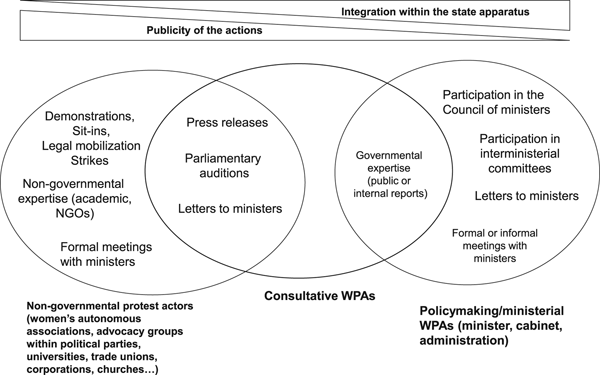
Finally, state bodies devoted to women's rights can be characterized as movement institutions if we consider their means of action, which can be seen as institutionalized forms of protest and thus as a specific repertoire of contention (Tilly Reference Tilly1986)—or rather, as two repertoires, depending on WPAs’ level of integration in the state apparatus (see Figure 1).
The repertoires of contention of women's policy agencies (WPAs).

If we look at the modes of action and, more importantly, at the meaning they are endowed with, part of what WPAs do bears a striking resemblance to the repertoires of contention adopted by social movement organizations, especially in the context of their increased use of “insider's tactics” (Soule and Earl Reference Soule and Earl2005). This is particularly the case of consultative WPAs, which can make their criticisms public: in France, institutions such as the Women's Labor Committee and the Parity Observatory have publicly mobilized critical expertise (publishing reports, issuing press releases) in order to promote egalitarian reforms in the fields of employment and political participation (Bereni and Revillard Reference Bereni and Revillard2007; Revillard Reference Revillard2009).
To be sure, some of the modes of action of WPAs are more specific to state actors. These are more frequent among policy-making/ministerial WPAs. They include negotiating at the level of higher administrations or taking part in the council of ministers. These modes of action, however, can also be endowed with an activist meaning. The structural ties that connect these institutions to outside activism are key here: while using what might appear to be classical bureaucratic modes of action, many femocrats maintain a sense of accountability to the feminist movement (Eisenstein Reference Eisenstein, Ferree and Martin1995; Mansbridge Reference Mansbridge and Ferree1995). Their marginal position within the state apparatus, their lack of resources and their resulting need to fight in order to involve other departments in their feminist policy making increases their sense of an activist mission.
As shown in Figure 1, the repertoires of contention of women's policy structures combine modes of action that these bodies have in common with outside organized groups with more classic bureaucratic modes of action. The generally polished form of both ensembles should not let us underestimate the disruptive potential of their use.
We argue that these repertoires crystallize the specific constraints and resources that derive from these institutions’ position at the interface between the state apparatus and outside activism: their bureaucratic status prevents them from adopting confrontational tactics such as street demonstrations, but it also provides them with venues of protest that are inaccessible or much less accessible to outside actors, such as direct connections to higher civil servants and cabinets in various departments. Moreover, these forms of action are routinized and endowed with the kind of stability that characterizes repertoires of contention. In the case of WPAs, this stability is directly connected to a mechanism of institutionalization: these modes of action pertain to the daily routines of these institutions; they are both described in formal procedures and systematically learned on the job by the agents of these administrations.
CONCLUSION
Research on women's movements, feminism, and the state has made major contributions to the study of the interactions between social movements and institutions over the past several decades. However, these theoretical contributions pertain to a diversity of disciplines and subfields, from policy analysis to social movement theory, and have rarely been brought together. This article has clarified the different perspectives opened up by this body of literature, distinguishing four main approaches: femocratic, coalition, institutional relay, and intersection. Moreover, we have argued that the theoretical conclusions that can be drawn from this body of works, from a social movement perspective, have only been partially explored.
As shown by the French case (as well as empirical results from several other postindustrialized countries), administrative bodies devoted to the promotion of women's status can, under specific circumstances, operate as movement institutions—that is, as bureaucratic sources of feminist protest that are as much a part of the women's movement as they belong to the state apparatus. Their structural connections with outside feminist activism as well as their relative autonomy within the bureaucracy can favor this institutionally engrained protest dimension, beyond the activism of individuals or informal networks within institutions. As we have shown in the French case, movement institutions have offered their members a specific form of feminist socialization; they have been critical in fueling feminist protest during certain periods of time and on certain issues; and their means of action can be envisioned as specific, institutionalized forms of protest.
To be sure, not all WPAs can be characterized as such. The diversity of roles played by these structures in relation to women's movement goals has been abundantly documented by studies of state feminism (McBride, Mazur, and Lovenduski Reference McBride, Mazur and Lovenduski2010). Bureaucratic institutions do not necessarily render possible the development of women's protest: the longitudinal analysis of the women's movement in Australia, characterized by a high level of institutionalization of feminist ideas and actors since the 1970s and followed by a period of retrenchment by the mid-2000s, provides a good illustration of the vulnerability of intra-institutional protest over time (Andrew and Maddison Reference Andrew and Maddison2010). Moreover, WPAs may in some instances act against movement goals, especially if the diversity of normative orientations within the women's movement is taken into account. They may even impede the very participation they would be expected to favor on the part of women (Hern Reference Hern2017). The conditions under which WPAs may act as movement institutions remain to be specified by further research. Our aim in this article was (1) to make the case for the possibility for state institutions to be considered part of the women's movement, (2) to show how taking these movement institutions into account can enrich our understanding of feminist protest, and (3) to specify the theoretical and empirical implications of the notion of movement institution in terms of feminist socialization, agenda setting, and repertoires of contention.
Finally, considering women's policy agencies as movement institutions has important consequences for the ways in which we conceptualize the women's movement. Our analysis leads us to challenge the traditional definition of women's movement as being located “outside” dominant institutions, especially the state. In order to fully capture the contemporary dynamics of women's protest, we need to broaden the definition of the women's movement and consider it as a configuration of sites of women's protest that are potentially located both inside and outside dominant institutions, including within the state (Bereni Reference Bereni2015).