1. Introduction
The Outer Hebrides Fault Zone (White & Glasser, Reference White, Glasser, Park and Tarney1987) is one of the largest tectonic features of the British Isles (Sibson, Reference Sibson1977). This regional-scale, reactivated structure cuts Archaean–Palaeoproterozoic-aged gneisses of the Lewisian complex (Dearnley, Reference Dearnley1962; Park et al. Reference Park, Cliff, Fettes, Stewart, Gibbons and Harris1994), is parallel to major Caledonian structures of the mainland, and can be traced for 170 km along the eastern seaboard of the Western Isles (e.g. Jehu & Craig, Reference Jehu and Craig1923; Sibson, Reference Sibson1977; Lailey, Stein & Reston, Reference Lailey, Stein and Reston1989; Butler, Holdsworth & Strachan, Reference Butler, Holdsworth and Strachan1995; Imber et al. Reference Imber, Holdsworth, Butler and Lloyd1997) (Fig. 1a, b). In addition, seismic studies have revealed that the Outer Hebrides Fault Zone dips consistently 20–25° ESE down to the base of the continental crust (Brewer et al. Reference Brewer, Matthews, Warner, Hall, Smythe and Whittington1983; Cheadle et al. Reference Cheadle, McGeary, Warner, Matthews, Coward, Dewey and Hancock1987).
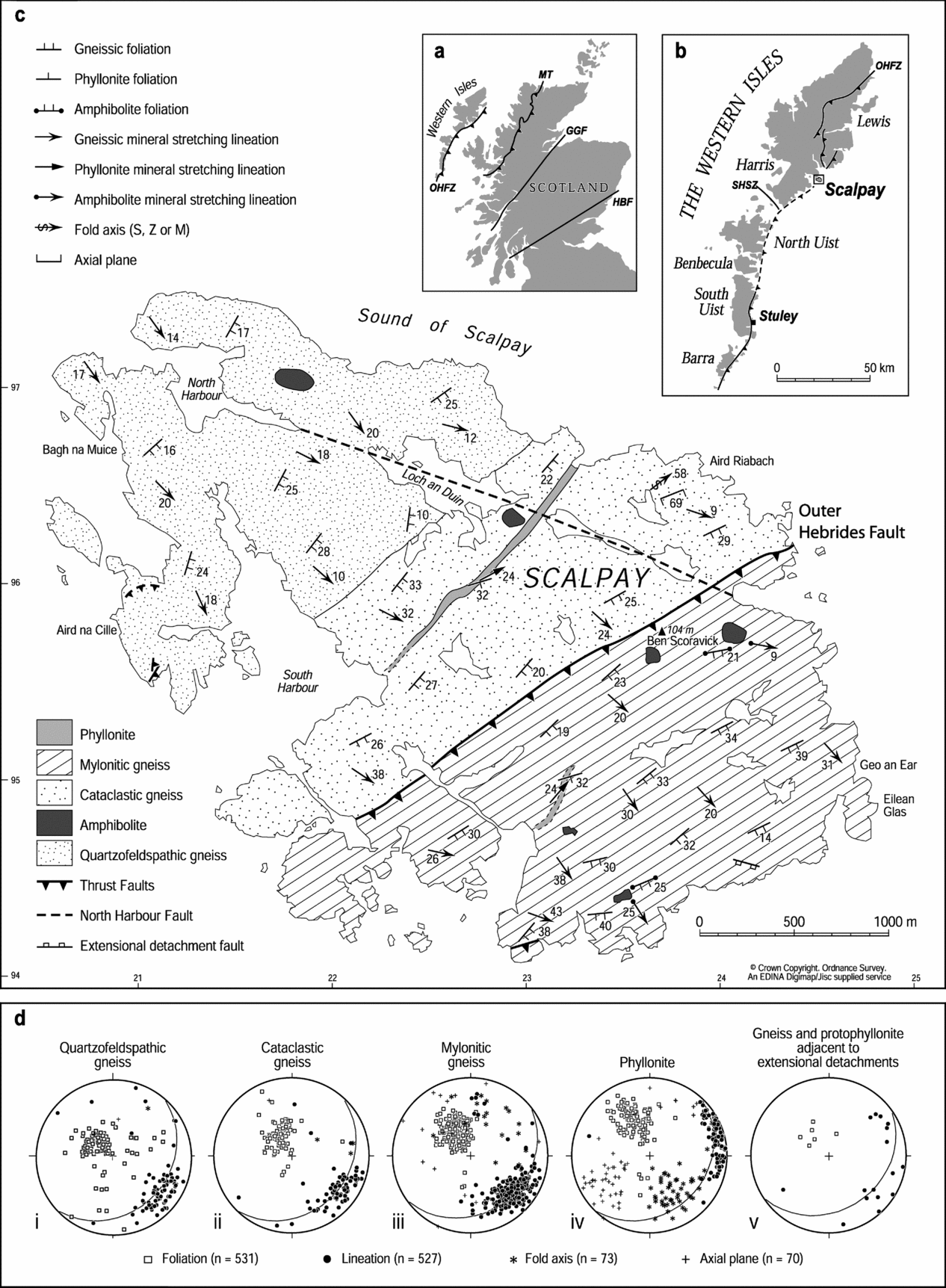
(a) Simplified map of Scotland and the Western Isles showing the location of major Caledonian structures. HBF – Highland Boundary Fault, GGF – Great Glen Fault, MT – Moine Thrust, OHFZ – Outer Hebrides Fault Zone. (b) Details of the Western Isles showing the location of principal islands (including Stuley) together with the Outer Hebrides Fault Zone (OHFZ), South Harris Shear Zone (SHSZ), and the study area on Scalpay. (c) Detailed geological map of Scalpay based on 1:10 000 mapping showing the major geological units and structural data. UK National Grid (prefix NG) is shown. Refer to (b) for location. (d) Equal area lower hemisphere projections (i–v) of structural data (poles to planes) and great circles representing the average of foliation measurements collected from the study area on Scalpay.

Despite the Outer Hebrides Fault Zone being one of the best-studied exhumed fault zones in the world, resulting in seminal publications on fault rocks and mechanisms (e.g. Sibson, Reference Sibson1977), together with detailed field descriptions on the kinematics and products of reactivation (e.g. Imber et al. Reference Imber, Holdsworth, Butler and Strachan2001), there has been little detailed analysis of the conditions and temperatures associated with fault movement. Phyllosilicate-rich fault rocks or phyllonites are recognized along the Outer Hebrides Fault Zone, and are typically considered to develop in faults formed at the brittle–ductile transition at depths of 5–15 km (see Imber et al. Reference Imber, Holdsworth, Butler and Lloyd1997, Reference Imber, Holdsworth, Butler and Strachan2001; Jefferies et al. Reference Jefferies, Holdsworth, Wibberley, Shimamoto, Spiers, Niemeijer and Lloyd2006). Studies of such phyllonites, and the temperatures and pressures at which they form, are critical to understanding the response of the crust to deformation as they provide potential weak zones in the main load-bearing region of the crust (see Jefferies et al. Reference Jefferies, Holdsworth, Wibberley, Shimamoto, Spiers, Niemeijer and Lloyd2006 for discussion). It is well established that fluids perform a crucial role in the development of phyllonite (e.g. see Butler, Holdsworth & Strachan, Reference Butler, Holdsworth and Strachan1995; Imber et al. Reference Imber, Holdsworth, Butler and Lloyd1997, Reference Imber, Holdsworth, Butler and Strachan2001, Reference Imber, Strachan, Holdsworth and Butler2002), and our study aims to constrain further the temperatures at which such fluids operate within phyllonites via the detailed analysis of fluid inclusions trapped within syn-tectonic quartz veins along the Outer Hebrides Fault Zone.
2. Regional geological background to the Outer Hebrides Fault Zone
As noted above, the Outer Hebrides Fault Zone is a regional-scale, reactivated structure which cuts Archaean–Palaeoproterozoic-aged gneisses of the Lewisian complex (Park et al. Reference Park, Cliff, Fettes, Stewart, Gibbons and Harris1994). Deformation and fault rock distribution is variable along the length of the Outer Hebrides Fault Zone, and previous studies have therefore separated the fault zone into northern and southern segments across the South Harris Shear Zone (Fig. 1b) (e.g. Butler, Holdsworth & Strachan, Reference Butler, Holdsworth and Strachan1995; Imber et al. Reference Imber, Holdsworth, Butler and Strachan2001, Reference Imber, Strachan, Holdsworth and Butler2002; MacInnes, Alsop & Oliver, Reference MacInnes, Alsop and Oliver2000; Osinski, Alsop & Oliver, Reference Osinski, Alsop and Oliver2001). The islands of North and South Uist, Benbecula, Barra and Stuley form the southern segment of the fault zone, which is characterized by the absence of pervasive mylonites and large amounts of pseudotachylyte and phyllonite (Butler, Holdsworth & Strachan, Reference Butler, Holdsworth and Strachan1995; MacInnes, Alsop & Oliver, Reference MacInnes, Alsop and Oliver2000; Osinski, Alsop & Oliver, Reference Osinski, Alsop and Oliver2001; Imber et al. Reference Imber, Holdsworth, Butler and Strachan2001) (Fig. 1b). The islands of Lewis, Harris and Scalpay comprise the northern segment, where the fault is associated with a thick sequence of quartzofeldspathic mylonites and phyllonites (Butler, Holdsworth & Strachan, Reference Butler, Holdsworth and Strachan1995; Imber et al. Reference Imber, Holdsworth, Butler and Strachan2001, Reference Imber, Strachan, Holdsworth and Butler2002) (Fig. 1b). As well as displaying different fault rocks, the northern and southern segments of the Outer Hebrides Fault Zone are also considered to display different kinematic histories, with pervasive mylonites associated with early top-to-the-NW ductile thrusting observed in the northern segment being largely absent from the southern segment (Imber et al. Reference Imber, Strachan, Holdsworth and Butler2002; but see also MacInnes, Alsop & Oliver, Reference MacInnes, Alsop and Oliver2000; Osinski, Alsop & Oliver, Reference Osinski, Alsop and Oliver2001). The subsequent tectonic history comprising top-to-the-W brittle thrusting associated with cataclasis, followed by sinistral strike-slip faulting concentrated into phyllonite bands, which are themselves reactivated during late-stage top-to-the-E extension, is observed along the entire strike length of the Outer Hebrides Fault Zone (see Osinski, Alsop & Oliver, Reference Osinski, Alsop and Oliver2001; Imber et al. Reference Imber, Strachan, Holdsworth and Butler2002 for further details). It is clear from the description above that a number of fault rocks and fault strands collectively form the Outer Hebrides Fault Zone. Following previous workers (e.g. Osinski, Alsop & Oliver, Reference Osinski, Alsop and Oliver2001), we refer to the westernmost discrete fault within that overall zone as the Outer Hebrides Fault.
This contribution presents critical field evidence and the first fluid inclusion findings from the northern segment of the Outer Hebrides Fault Zone on the island of Scalpay which provides the best exposed section (~ 1000 m thick) through the NE–SW-trending upper greenschist-facies mylonite belt (Fig. 1b, c). Existing published geothermometric constraints (based on the composition of syn-tectonic minerals on Lewis) suggest temperatures of ~ 520 ± 60°C for early ductile top-to-the-NW thrusting (White, Reference White1996), while subsequent reactivation and phyllonitization is broadly within prehenite–pumpellyite- to greenschist-facies conditions, that is, between 250°C and 400°C (see Imber et al. Reference Imber, Holdsworth, Butler and Strachan2001). Our observations provide new rigorous constraints on the temperatures and conditions of mylonitization and phyllonitization, together with insights into the subsequent reactivation and kinematic evolution of the Outer Hebrides Fault Zone.
3. Lithologies and fault rocks of the Outer Hebrides Fault Zone on Scalpay
Scalpay is composed of a hornblendic acid gneiss assemblage (2590–2830 Ma) (Whitehouse, Reference Whitehouse1990) which becomes increasingly foliated and strained towards the southeast of the island (Butler, Holdsworth & Strachan, Reference Butler, Holdsworth and Strachan1995; Imber et al. Reference Imber, Holdsworth, Butler and Strachan2001, Reference Imber, Strachan, Holdsworth and Butler2002) (Fig. 2a, b). Although the Outer Hebrides Fault Zone runs through the southern part of Scalpay, it is considered that most of the thrust zone is actually located just offshore (Francis & Sibson, Reference Francis, Sibson, Park and Tarney1973). The dominant mineralogy consists of quartz, hornblende, plagioclase, orthoclase and biotite with accessory apatite, zircon, sphene, opaques and rutile. Within the quartzofeldspathic gneiss, evidence of upper greenschist retrogression includes chlorite and microcline, and is assumed to be an effect of fault zone inception (Imber et al. Reference Imber, Holdsworth, Butler and Strachan2001; see below).
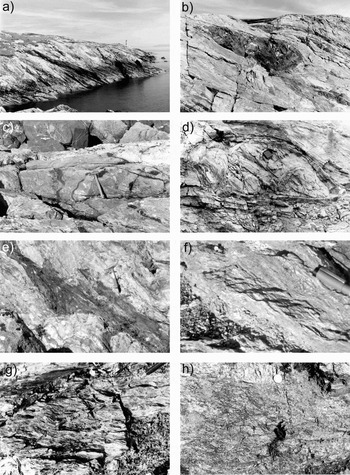
(a) Photograph looking east along the south coast of Scalpay towards the lighthouse at Eilean Glas. The photo shows the gently SE-dipping mylonitic foliation and sheared amphibolite (dark) pods associated with top-to-the-NW ductile thrusting (NG 23859450). Cliffs are ~ 50 m in height. (b) Detail of a large (~ 10 m long) amphibolite pod which is sheared within the intense mylonitic gneisses shown in (a). (c) Amphibolite sheets (upon which the 0.4 m long hammer is resting) together with pegmatites (lighter unit behind) both contain the regional mylonitic fabric and therefore must be older than the fault zone. See text for discussion. View looking southeast at (NG 23209427). (d) Amphibolite pod with an actinolite reaction rim. The pod is clearly sheared and the surrounding mylonite flows around it in a top-to-the-NW sense (sectional view looking NE) (NG 22609509). Compass-clinometer (10 cm long) for scale. (e) Looking east at top-to-the-NE sinistral strike-slip concentrated in a dark green phyllonite band which transects the cataclastic gneiss (see Fig. 1c). Hammer (0.4 m long) for scale. Map view of shear bands and quartz bands illustrating sinistral strike-slip deformation within phyllonites at (f) (NG 22459562). Pen (4 cm long) for scale. (g, h) (NG 24209450) with pencil (4 cm long) and coin (25 mm diameter) for scale respectively.

Quartzofeldspathic hornblende gneiss passes gradually towards the SE into broken or cataclastic gneiss, which forms the footwall of the Outer Hebrides Fault Zone on Scalpay (Fig. 1c). These brittle fault rocks are much less well developed than elsewhere in the northern segment of the Outer Hebrides Fault Zone (e.g. Imber et al. Reference Imber, Strachan, Holdsworth and Butler2002), and the exact location of the contact between quartzofeldspathic and cataclastic gneiss (displaying fracturing of constituent quartz and feldspar grains) is therefore somewhat arbitrary (Fig. 1c). The Outer Hebrides Fault juxtaposes cataclastic gneiss in the footwall with mylonites in the hangingwall (Fig. 1c).
Within the mylonite, porphyroclasts of antiperthitic orthoclase and quartz are common and indicate an acid gneiss protolith (Lailey, Stein & Reston, Reference Lailey, Stein and Reston1989). Gneissose banding is highly attenuated within the mylonite but still visible, while foliation is defined by an interconnected network of polycrystalline quartz ribbons which anastomose around isolated feldspar and hornblende grains. The gneissose foliation typically displays a NE strike and a gentle to moderate SE dip, and is associated with top-to-the-NW ductile shearing (see Section 5.a) (Fig. 1c, d). Upper greenschist-facies retrogression involved the sericitization of feldspar and partial alteration of hornblende to chlorite, epidote and actinolite (Fettes et al. Reference Fettes, Mendum, Smith and Watson1992; Butler, Holdsworth & Strachan, Reference Butler, Holdsworth and Strachan1995; Imber et al. Reference Imber, Holdsworth, Butler and Strachan2001, Reference Imber, Strachan, Holdsworth and Butler2002). The mylonite has thus locally been phyllonitized, resulting in thin (< 30 cm) bands of phyllonite (e.g. NG 24219450). Phyllonite (sericite, chlorite, epidote, albite, muscovite, quartz, calcite, feldspar and oqaques) is a product of late reactivation and although playing a minor role in terms of abundance, is an integral part of Scalpay's structural evolution (see Butler, Holdsworth & Strachan, Reference Butler, Holdsworth and Strachan1995; Imber et al. Reference Imber, Holdsworth, Butler and Strachan2001, Reference Imber, Strachan, Holdsworth and Butler2002). Phyllonite occurs as two discrete units (and several thin bands) within the Outer Hebrides Fault Zone of Scalpay, and is normally surrounded by protophyllonite which displays similar characteristics to phyllonite, but with a smaller percentage of phyllosilicate minerals.
4. Age of the Outer Hebrides Fault Zone on Scalpay
The current debate concerning the age of inception of the Outer Hebrides Fault Zone centres on either a Palaeoproterozoic ‘Inverian’ age of c. 2500 Ma (e.g. Lailey, Stein & Reston, Reference Lailey, Stein and Reston1989) or a post-Laxfordian age (c. 1700 Ma) and possibly Grenvillian age (c. 1100 Ma) proposed by Imber et al. (Reference Imber, Strachan, Holdsworth and Butler2002).
In order to evaluate this problem, detailed mapping within the mylonite zone on Scalpay was undertaken. This revealed only one phase of mylonite formation, as opposed to the separate S1 and S2 mylonites of Lailey, Stein & Reston (Reference Lailey, Stein and Reston1989). Lailey, Stein & Reston (Reference Lailey, Stein and Reston1989) also reported that the amphibolite sheets and pegmatite of Meall Challibost (NG 23209427) display a cross-cutting relationship with respect to the mylonite. Our study shows that the amphibolite sheets are in fact folded and the mylonitic foliation forms an axial planar fabric that quite clearly passes through the sheets (Fig. 2c). At (NG 23039412) a sectional view reveals the mylonite flowing around amphibolite pods while adjacent pegmatites are also sheared. In thin-section, porphyroclasts and minor folding also indicate ductile shear. Elsewhere, pegmatite is intensely deformed with the development locally of quartz-rods (e.g. Ramerigeo, NG 24569530).
The amphibolites have been correlated with the 2.4–2.0 Ga metadolerite Scourie Dyke swarm or ‘Younger Basics’ (Lambert, Myers & Watson, Reference Lambert, Myers and Watson1970; Fettes & Mendum, Reference Fettes, Mendum, Park and Tarney1987; Heaman & Tarney, Reference Heaman and Tarney1989) of mainland Scotland. The majority of pegmatites are related to the late-Laxfordian granite sheets (about 1.7 Ga: Fettes & Mendum, Reference Fettes, Mendum, Park and Tarney1987; Park et al. Reference Park, Cliff, Fettes, Stewart, Gibbons and Harris1994) and which have been precisely dated (SHRIMP(tm)) on Lewis at 1674 ± 3 and 1683 ± 9 Ma (Friend & Kinney, Reference Friend and Kinney2001). As the mylonite overprints the amphibolite and pegmatite intrusions, deformation must be younger. We therefore concur with the studies of Imber et al. (Reference Imber, Strachan, Holdsworth and Butler2002) that deformation post-dates intrusion of the sheets, and that the fault zone is therefore younger than the c. 1.7 Ga Laxfordian tectonics.
Phyllonite, which cross-cuts the mylonitic and cataclastic fabrics and thus post-dates the main phase of deformation, is typically considered a late-stage fault rock of Caledonian age (e.g. Butler, Holdsworth & Strachan, Reference Butler, Holdsworth and Strachan1995; Imber et al. Reference Imber, Holdsworth, Butler and Lloyd1997). Indeed, whole-rock K–Ar dates of c. 397 Ma were obtained for phyllonite from Uist and Scalpay (R. H. Sibson, unpub. Ph.D. thesis, Univ. London, Reference Sibson1977), suggesting late Caledonian phyllonitization. In addition, 40Ar–39Ar dating of pseudotachylite from the Outer Hebrides Fault Zone by Kelley, Reddy & Maddock (Reference Kelley, Reddy and Maddock1994) produced an age of 430 ± 6 Ma and is also interpreted to reflect Caledonian movement across the fault zone. Thus, the fault rocks and tectonics of the Outer Hebrides Fault Zone may be broadly divided into ‘early’ (post-Laxfordian) ductile mylonites overprinted by bands of ‘late’ (Caledonian) retrogressive phyllonite.
5. Structural history of the Outer Hebrides Fault Zone on Scalpay
The general level of exposure and location of Scalpay in the Outer Hebrides Fault Zone has resulted in several detailed structural studies being recently undertaken (e.g. Butler, Holdsworth & Strachan, Reference Butler, Holdsworth and Strachan1995; Imber et al. Reference Imber, Holdsworth, Butler and Strachan2001, Reference Imber, Strachan, Holdsworth and Butler2002). Our fieldwork on Scalpay highlights a similar chronology of events to these authors (summarized below), and provides the crucial kinematic framework for fluid inclusion studies of syn-tectonic quartz veins.
5.a. Early top-to-the-NW ductile thrusting
The gneissose fabric on Scalpay displays a general increase in intensity southeastwards towards the Outer Hebrides Fault Zone, where mylonitic gneiss is ultimately developed (Fig. 1c, d). This strain gradient can be seen within the gently SE-dipping foliation and SE-plunging mineral lineations, with planar and linear fabrics rotating into parallelism with the fault zone towards the south (Fig. 1c, d). The base of the mylonitic gneiss is separated from the cataclastic gneiss by a narrow breccia zone orientated 056/30SE which marks the Outer Hebrides Fault (NG 24209610) (Fig. 1c).
The mylonitic gneiss in the hangingwall of the Outer Hebrides Fault displays an average foliation of 056/28 SE, a lineation of 27/135, and contains abundant σ- and δ-type porphyroclasts indicating ductile top-to-the-NW thrusting (e.g. Geo nan Calaman, NG 24509540) (Fig. 1c, d). In addition, close folds of mafic layers are also consistent with a ductile top-to-the-NW shear sense (NG 24509450). Folded amphibolite sheets display NW-directed vergence together with top-to-the-NW shear of cataclastic gneiss around amphibolite pods (NG 22609509) (Fig. 2d). NW-directed transport is also indicated by sheared amphibolite pods (e.g. NG 22609509), which are superbly exposed along the south coast where the typically large pods (up to 10 m long) both taper and rotate in a northwesterly direction (NG 23859450) (Fig. 2a, b). This reflects greater competency compared to the gneiss, and also indicates that they pre-date the inception of the Outer Hebrides Fault Zone as discussed above (Section 4). Boudinaged pegmatite (e.g. NG 23129422), sheared pegmatite pods (e.g. NG 24439577) and porphyroclasts within the pegmatite also indicate ductile top-to-the-NW thrusting.
5.b. Late top-to-the-NE sinistral strike-slip
Top-to-the-NE sinistral strike-slip on Scalpay is largely confined to two main phyllonite bands (e.g. NG 22459562). The pyllonitic foliation is more steeply dipping (mean 067/47SE), and overprints the mylonitic thrust fabric, while the mean lineation is 15/063 (Fig. 1c, d). Mineral stretching lineations display typical pitches between 0° and 10°, indicative of strike-slip deformation which may have been focused into the mechanically weak phyllonite (e.g. Butler, Holdsworth & Strachan, Reference Butler, Holdsworth and Strachan1995). However, small areas of phyllonite (e.g. NG 23089466) preserve down-dip mineral lineations similar to those associated with NW-directed ductile thrusting. This suggests that the formation of the phyllonite may have been initiated during thrusting (see Imber et al. Reference Imber, Holdsworth, Butler and Strachan2001).
Shear criteria are abundant with many σ- and δ-type porphyroclasts, together with shear bands and localized development of S–C fabric (Fig. 2e–h). All shear criteria indicate top-to-the-NE movement. Asymmetric, close to tight, S and Z folds display variable hinge orientations ranging from sub-parallel to the strike-slip mineral lineation, to transport-normal attitudes (Fig. 1d). These folds may deform the mineral lineation around their hinges and are associated with progressive tightening as hinges become transport-parallel. The S and Z folds also display variably oriented axial planes, which in some cases fan around the mineral lineation. These relationships indicate that the folds formed during phyllonitization and have undergone sequential rotations during intense shear to generate the range of observed geometries (see Alsop & Holdsworth, Reference Alsop and Holdsworth2004a,Reference Alsop, Holdsworth, Alsop, Holdsworth, McCaffrey and Handb). Fold asymmetry therefore also supports a top-to-the-NE motion associated with sinistral strike-slip deformation.
5.c. Late top-to-the-NE/SE extensional detachments
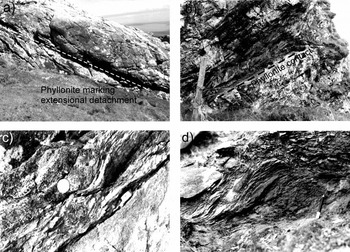
Two major (and one minor) extensional detachments have been identified on Scalpay, although observations inland are hindered due to recessive weathering of these features and limited exposure. Extensional detachments are concentrated along pre-existing phyllonite bands and produce fault gouge and obvious dislocation surfaces associated with shear bands and S–C fabrics indicative of top-to-the-NE and SE extension (e.g. NG 24209450) (Fig. 3a–d). Gouge is green and malleable in outcrop, and contains principal minerals of sericite, chlorite and epidote. Extension on Scalpay is discrete and does not overprint the phyllonite completely, as observed along the southern sector of the Outer Hebrides Fault Zone in Stuley (e.g. Osinski, Alsop & Oliver, Reference Osinski, Alsop and Oliver2001).
(a) A thin band of phyllonite (forming the overhang by the 0.4 m long hammer) marks an extensional detachment cutting through the mylonitic gneiss with an amphibolite sheet above (looking north at NG 24209450). (b) Phyllonite cutting through the gneiss associated with top-to-the-E extensional reactivation (NG 23109470). Fence post (1.2 m) for scale. (c) Quartz veins deformed by top-down-to-the-NE extension within the phyllonite (NG 24209450) Coin (25 mm diameter) for scale. (d) Top-down-to-the-NE extension within the phyllonite band shown in (a) (looking north at NG 24209450). Pencil (15 cm long) for scale.

5.d. Late (Mesozoic?) faulting
The North Harbour Fault is marked by a breccia zone (e.g. NG 24089592) which extends from the Scoravick inlet and continues through the North Harbour and eventually through Tarbert (Fettes et al. Reference Fettes, Mendum, Smith and Watson1992) (Fig. 1c). No displacement of earlier contacts is visible, although a series of lochans follows the NW–SE-trending fault. This fault probably relates to the development of the adjacent Mesozoic Minches Basin (Roberts & Holdsworth, Reference Roberts and Holdsworth1999) and is not considered further here.
6. Fluid inclusion studies
Fluid inclusions are samples of fluid trapped inside crystal imperfections during crystal growth (primary inclusions) or at some later stage during sealing of post-crystallization microcracks (secondary inclusions) (Shepherd, Rankin & Alderton, Reference Shepherd, Rankin and Alderton1985). Primary inclusions therefore reflect the character of fluids present during crystal growth, whereas secondary inclusions represent later fluids, possibly related to further tectonism in a shear zone (Shepherd, Rankin & Alderton, Reference Shepherd, Rankin and Alderton1985). Fluid inclusion studies were undertaken on vein quartz from the mylonitic gneiss, strike-slip phyllonite, and extensional phyllonite described above, in order to constrain further the temperatures and conditions of reactivation along the Outer Hebrides Fault Zone.
6.a. Fluid inclusion experimental procedure
The majority (95 %) of inclusions in the mylonite and phyllonite samples are liquid-rich, two-phase liquid and vapour (L + V) inclusions. This includes both primary and secondary types. The vapour bubble is a result of thermal contraction of the fluid during cooling. There are rare occurrences of multiphase solid inclusions which contain liquid, vapour and a solid (L + V + S) or daughter mineral. Most inclusions are small (< 50 μm in diameter), which can complicate thermometric analysis. Primary and secondary inclusions generally have good crystal form. Primary inclusions were chosen for analysis where the inclusions are isolated, and display a random distribution which does not form part of an inclusion array. Secondary inclusions are easier to locate because they usually form planar arrays when the microscope stage is zoomed in or out. All inclusions contain over 90 % liquid.
Non-destructive heating and freezing experiments were performed on polished quartz wafers using a Leitz Wetzler microscope and Linkam TH 600 thermocell. Liquid nitrogen was used for the freezing experiments. The temperature of homogenization (Th) is recorded on the disappearance of the vapour bubble, or of the vapour bubble and daughter mineral in the case of multiphase solid inclusions. Homogenization occurs into the liquid state for all the Scalpay inclusions. It should be noted that Th represents the minimum trapping temperature, so the actual temperature of retrogression may have been slightly higher, depending on the lithostatic pressure (Shepherd, Rankin & Alderton, Reference Shepherd, Rankin and Alderton1985). The standard error for heating studies is in the range of ± 10°C (Shepherd, Rankin & Alderton, Reference Shepherd, Rankin and Alderton1985).
Freezing studies are used to measure the salinity of the inclusions by measuring the final ice melting temperature (Tm) on re-heating the frozen inclusion. The depression of the freezing point of pure water is directly proportional to the amount of salt in solution. Tm is conventionally reported as wt % NaCl equivalent (Shepherd, Rankin & Alderton, Reference Shepherd, Rankin and Alderton1985). For mixed Na–K–Ca–Mg chloride solutions it is generally assumed that the error in estimating salinities using the above method is < 5 % (Clynne & Potter, Reference Clynne and Potter1977; Roedder, Reference Roedder1984). The first appearance of liquid after complete freezing is known as the temperature of first melting (Tfm) and is recorded where possible. Tfm corresponds to the eutectic temperature and is determined solely by the composition of the end-member components (Shepherd, Rankin & Alderton, Reference Shepherd, Rankin and Alderton1985).
6.b. Fluid inclusion results
6.b.1. Fluid inclusions from top-to-the-NW ductile thrust mylonites
Quartz for analysis was obtained from veins which have suffered thrusting and are stretched out into sequences of σ-type porphyroclasts at Eilean Glas (NG 24709480). Recrystallization of quartz during thrusting will result in inclusions reflecting the final stages of thrust movement, regardless of whether the quartz is syn- or pre-tectonic.
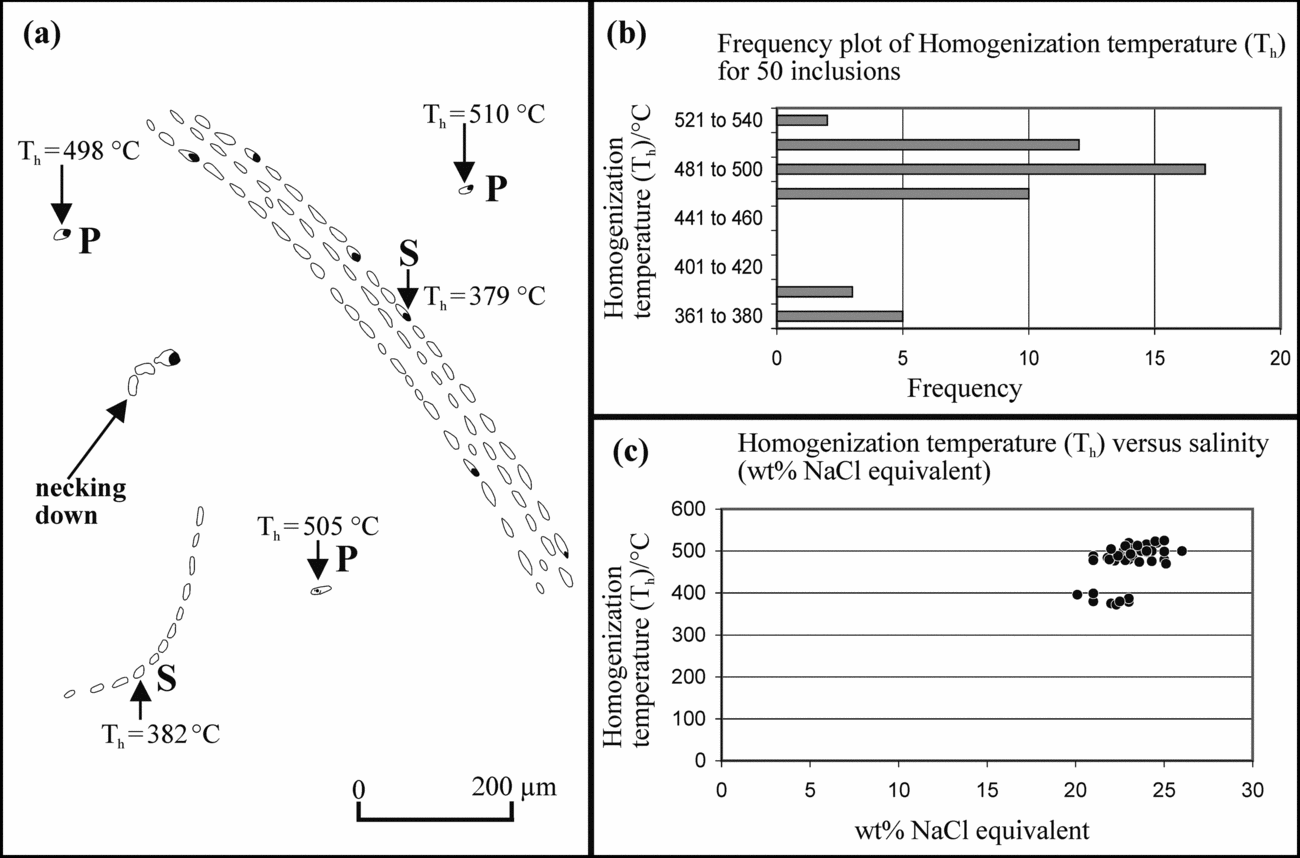
The combination of heating, freezing and optical studies on 50 inclusions reveals that there are two distinct fluid inclusion groups. The first group relates to primary inclusions with Th from 470°C to 530°C and very high salinities in the range 21 to 27 wt % NaCl equivalent (Fig. 4a–c). This equates with an inclusion density of 0.9 g cm−3 (Brown, Reference Brown1989). The other grouping relates to secondary inclusions with Th from 360°C to 400°C and high salinities in the range 20 to 24 wt % NaCl equivalent (Fig. 4a–c). This equates with an inclusion density of 0.92 g cm−3 (Brown, Reference Brown1989).
Fluid inclusion analysis from quartz in thrust-related mylonites at Eilean Glas (NG 24709480). (a) Field of view map showing the morphological difference between primary (P) and secondary (S) inclusions. Homogenization temperatures (Th) are shown next to selected fluid inclusions. (b) Frequency plot of homogenization temperature (Th) for all fluid inclusions (N = 50). (c) Graph of homogenization temperature (Th) versus salinity expressed as wt % NaCl equivalent.

Heating experiments reveal the average temperature of homogenization (Th) of primary (L + V) inclusions is 500 ± 30°C (Fig. 4b, c). This is interpreted to represent the conditions of crystallization for the initial ductile top-to-the-NW thrusting (a in Table 1). Ductile thrusting produced a syntectonic mineral assemblage of sericite, albite, actinolite and epidote which represents the Upper Greenschist Facies group of Miyashiro (Reference Miyashiro1994). This relates to an estimated temperature of ~ 400–500°C (Yardley, Reference Yardley1989), therefore the fluid inclusion experiments support and further constrain estimated conditions of Upper Greenschist-facies mylonitization in the literature. The other set of (secondary) inclusions with lower abundance have an average temperature of homogenization (Th) of 380 ± 20°C (Fig. 4b, c). These are assumed to reflect continued movement and may relate to initial stages of phyllonitization during thrusting (e.g. Imber et al. Reference Imber, Holdsworth, Butler and Strachan2001, p. 617) (a in Table 1). It is emphasized that results for the mylonite inclusions display some variability due to the small size of inclusions, which also means that Tfm cannot be calculated in this case.
Parameters recorded from fluid inclusions developed during different deformation conditions (P – primary fluid inclusion; S – secondary fluid inclusion); the kinematics of the fault zone are divided into (1) thrust tectonics, (2) strike-slip tectonics and (3) extensional tectonics

(a) Fluid inclusion analysis (n = 50 inclusions) from quartz in thrust-related mylonites at Eilean Glas (NG 24709480). (b) Fluid inclusion analysis (n = 122 inclusions) from quartz in strike-slip-related phyllonites at South Harbour (NG 22459562). (c) Fluid inclusion analysis (n = 100 inclusions) from quartz in extension-related phyllonites near the south coast of Scalpay at (NG 24209450).
6.b.2. Fluid inclusions from sinistral strike-slip phyllonites
Quartz for analysis was taken from quartz porphyroclasts indicating sinistral strike-slip deformation within the phyllonite (NG 22459562). Quartz collected from the strike-slip phyllonite contained the most abundant and well-preserved inclusions with a large amount of primary inclusions.
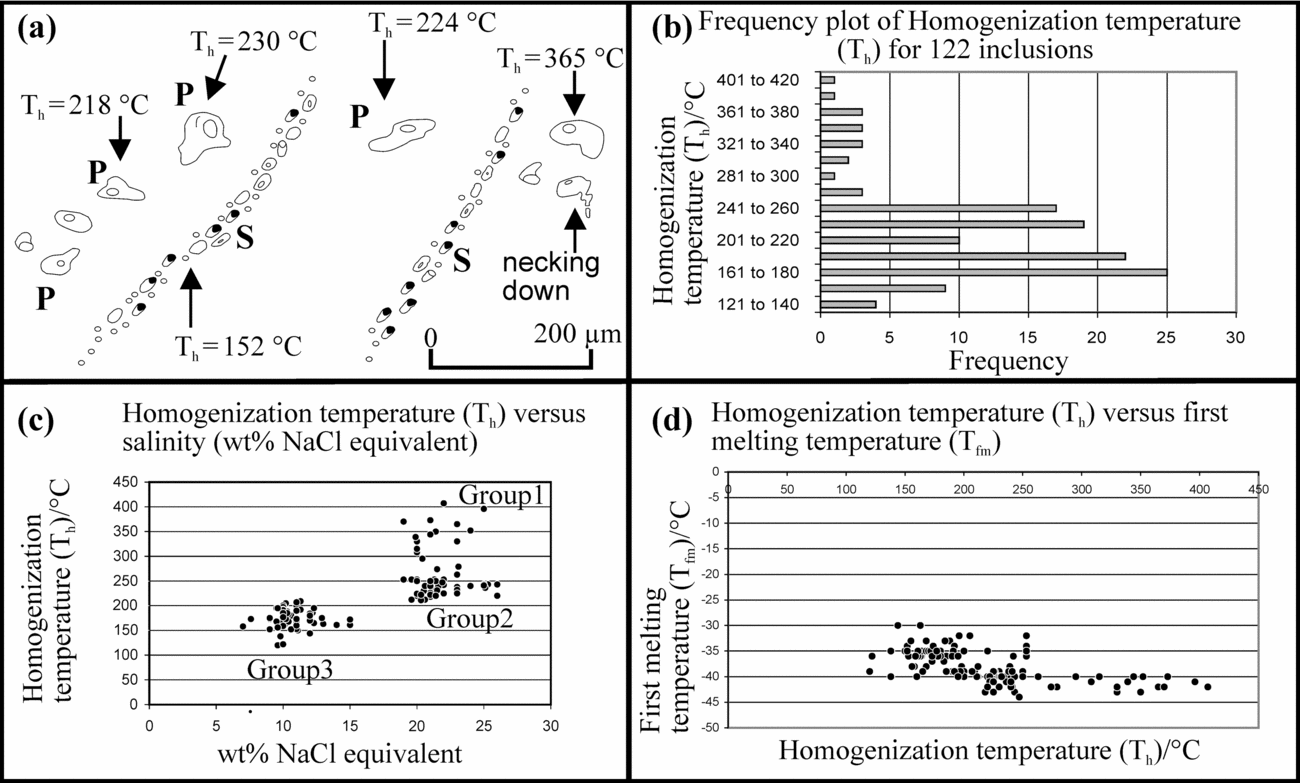
The combination of heating, freezing and optical studies on 122 inclusions indicates that there are three distinct fluid inclusion groups. Group 1 are primary inclusions, with Th from 330°C to 370°C and very high salinities in the range 20 to 25 wt % NaCl equivalent (Fig. 5a–d). This equates with an inclusion density of 0.9 g cm−3 from the program and methodology of Brown (Reference Brown1989). Group 2 are also primary inclusions, with Th from 210°C to 250°C and very high salinities in the range 20 to 25 wt % NaCl equivalent (Fig. 5a–d). This equates with an inclusion density of 1 g cm−3 (Brown, Reference Brown1989). Group 3 are secondary inclusions, with Th from 150°C to 190°C and medium salinities in the range 9 to 14 wt % NaCl equivalent (Fig. 5a–d). This equates with an inclusion density of 0.95 g cm−3 (Brown, Reference Brown1989).
Fluid inclusion analysis from quartz in strike-slip-related phyllonites at South Harbour (NG 22459562) (see Fig. 2f). (a) Field of view map showing the morphological difference between primary (P) and secondary (S) inclusions. Homogenization temperatures (Th) are shown next to selected fluid inclusions. (b) Frequency plot of homogenization temperature (Th) for all fluid inclusions (N = 122). (c) Graph of homogenization temperature (Th) versus salinity expressed as wt % NaCl equivalent. (d) Graph of first melting temperature (Tfm) versus homogenization temperature (Th) for all inclusions.

Measured values of Tfm range from −30°C to −45°C for all three inclusion groups (Fig. 5d). Using the phase data of Borisenko (Reference Borisenko1977), this suggests that inclusions contain divalent cations such as Ca2+, Fe2+ and Mg2+ in addition to Na+ and K+ (Osinski, Alsop & Oliver, Reference Osinski, Alsop and Oliver2001). The presence of Fe and Mg coincides with the abundance of ferromagnesium minerals (actinolite, chlorite, biotite) in the phyllonite (Roedder, Reference Roedder, Hollister and Crawford1981).
Heating experiments reveal that the average temperature of homogenization (Th) of primary (L + V) inclusions is 230 ± 20°C for the strike-slip related phyllonite (Fig. 5a–d). It is proposed that this reflects quartz growth during strike-slip movements (b in Table 1). There is also, however, another set of primaries (Group 1) which have an average temperature of homogenization (Th) of 350 ± 20°C (Fig. 5c). It is proposed that these represent either the initial stages of strike-slip movements where conditions were hotter, or the initial formation of phyllonite during ductile thrusting noted above (b in Table 1). Either way, these inclusions are low in abundance and have been largely overprinted by the strike-slip primary inclusions. The group 3 inclusion set (secondary) have an average temperature of homogenization (Th) of 170 ± 20°C (Fig. 5c). It is proposed that these refer to a second major period of fault activity and fluid influx during development of the extensional detachments which are now described below. Because this is the last major kinematic event to have affected the phyllonite, it is represented by the most abundant fluid inclusions.
6.b.3. Fluid inclusions from extensional top-to-the-east phyllonites
Quartz for analysis was taken from syn-tectonic veins within an extensional phyllonite (NG 24209450) (Fig. 1c) and which grew during this phase of phyllonitization. The veins are thin (< 2 cm) and are deformed in a similar way to that of the surrounding phyllonite. Quartz from the extensional phyllonite contained fewer primary inclusions than that related to strike-slip, but a large number of secondary inclusions. This indicates a more pronounced fluid influx after initial crystallization, which destroyed many of the remaining primary inclusions. As the extensional phyllonite is thought to be a product of post-strike-slip reactivation, a larger secondary inclusion assemblage is to be expected.
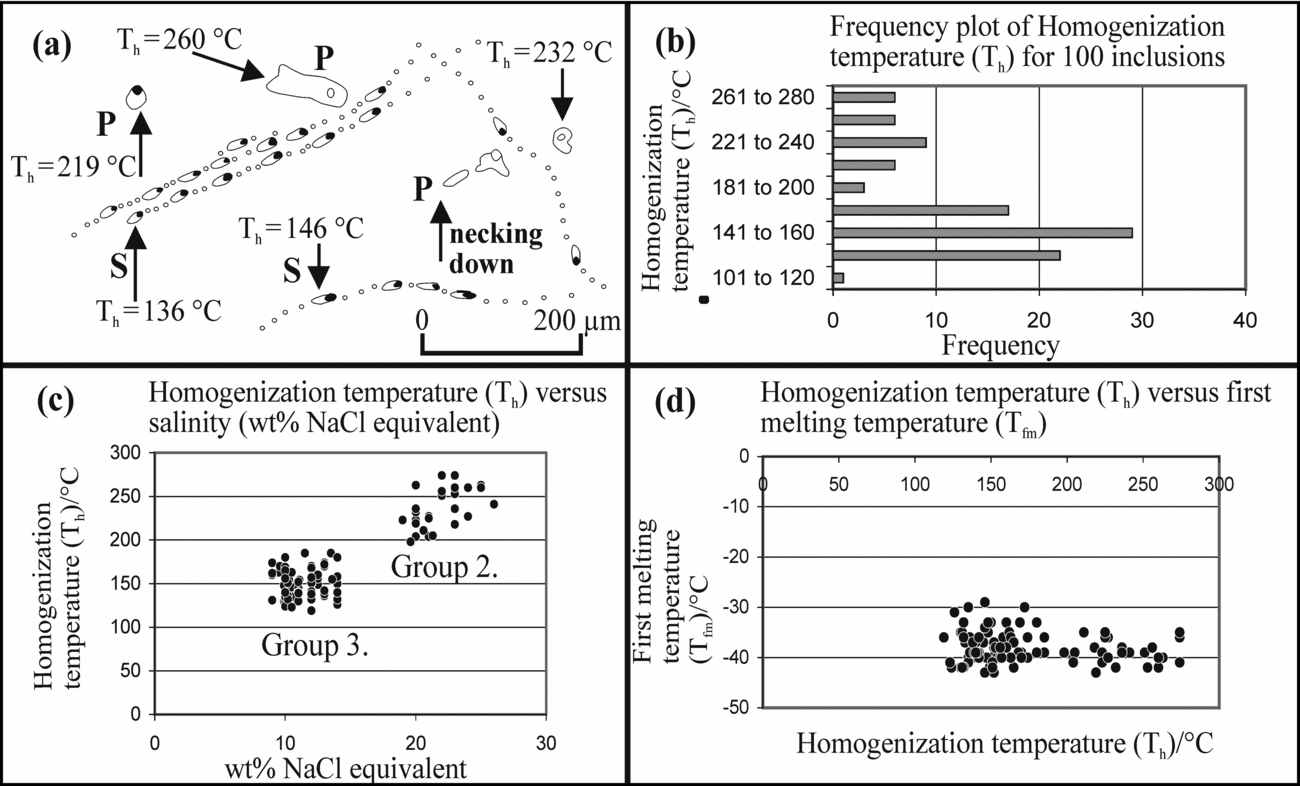
The combination of heating, freezing and optical studies on 100 inclusions indicates that there are two distinct inclusion groups which also relate to groups 2 and 3 of the strike-slip phyllonite (Fig. 6a–d). Group 2 are primary inclusions, with Th from 210°C to 250°C and very high salinities in the range 20 to 25 wt % NaCl equivalent (Fig. 6b, c). This equates with an inclusion density of 0.9 g cm−3 (Brown, Reference Brown1989). Group 3 are secondary inclusions, with Th from 130°C to 170°C and medium salinities in the range 9 to 14 wt % NaCl equivalent (Fig. 6b, c). This equates with an inclusion density of 0.95 g cm−3 (Brown, Reference Brown1989). Measured values of Tfm range from −30°C to −43°C for both inclusion groups (Fig. 6d). This mirrors that of the strike-slip phyllonite inclusions, and thus similar conclusions can be drawn concerning the presence of ferromagnesium minerals in the phyllonite.
Fluid inclusion analysis from quartz in extension-related phyllonites near the south coast of Scalpay at (NG 24209450) (see Fig. 3c). (a) Field of view map showing the morphological difference between primary (P) and secondary (S) inclusions. Homogenization temperatures (Th) are shown next to selected fluid inclusions. (b) Frequency plot of homogenization temperature (Th) for all fluid inclusions (N = 100). (c) Graph of homogenization temperature (Th) versus salinity expressed as wt % NaCl equivalent. (d) Graph of first melting temperature (Tfm) versus homogenization temperature (Th) for all inclusions.

Heating experiments reveal that the average temperature of homogenization (Th) of primary (L + V) inclusions is 230 ± 20°C for the extensional phyllonite (Fig. 6). It is proposed that this reflects relicts of growth during strike-slip movements (c in Table 1). A second set of (group 3) inclusions (secondary) have an average temperature of homogenization (Th) of 150 ± 20°C (Fig. 6b, c). It is proposed that these relate to a second major period of fault activity and fluid influx during development of the extensional detachments (c in Table 1). These secondary inclusions are far more abundant than the primary inclusions in the extensional detachment phyllonite.
7. Discussion
7.a. Significance of fluid inclusion temperatures during early top-to-the-NW ductile thrusting
Existing geothermometric constraints on conditions of mylonitization and subsequent reactivation of the Outer Hebrides Fault Zone are limited. The co-existence of hornblende and biotite, coupled with core-and-mantle structures in quartz led Imber et al. (Reference Imber, Strachan, Holdsworth and Butler2002) to suggest that mylonitization associated with top-to-the-NW ductile thrusting occurred at upper greenschist to lower amphibolite-facies (temperatures > 500°C). This is in broad agreement with Fettes & Mendum (Reference Fettes, Mendum, Park and Tarney1987), who use a garnet–biotite assemblage to suggest temperatures of 535 ± 50°C, while White (Reference White1996) used plagioclase and amphibole compositions to suggest temperatures of 520 ± 60°C for this event. The fluid inclusion data presented here further constrain the temperature of mylonitization associated with this top-to-the-NW thrusting to 500 ± 30°C (a in Table 1). Importantly, these temperatures appear to support the suggestion of Imber et al. (Reference Imber, Holdsworth, Butler and Strachan2001) that conditions during mylonitization were insufficient to reset 39Ar–40Ar hornblende ‘ages’ which would require temperatures of 530 ± 40°C (Ghent, Stout & Parrish, Reference Ghent, Stout, Parrish, Nisbet and Fowler1988). Gneisses in Lewis and Harris therefore preserve Laxfordian (1600–1700 Ma)39 Ar–40 Ar hornblende ‘ages’ (Cliff, Rex & Guise, Reference Cliff, Rex and Guise1998), despite tectonism associated with the initiation of the Outer Hebrides Fault Zone possibly being significantly younger and cutting Laxfordian intrusions on Scalpay (see Imber et al. Reference Imber, Strachan, Holdsworth and Butler2002, this study).
7.b. Significance of fluid inclusion temperatures during late-stage phyllonitization
Existing constraints on temperatures associated with the reactivation of the Outer Hebrides Fault Zone and generation of Caledonian phyllonites are limited. On the southern segment of the fault zone at North Uist (Fig. 1b), calcite displays undulose extinction and deformation twins, suggesting that phyllonitization occurred at > 200°C, with a probable temperature in the broad range of 250–400°C (Imber et al. Reference Imber, Holdsworth, Butler and Strachan2001). Osinski, Alsop & Oliver (Reference Osinski, Alsop and Oliver2001) performed fluid inclusion analysis on quartz veins developed within extension-related phyllonites on Stuley (Fig. 1b). This analysis revealed temperatures of homogenization (Th) of 370 ± 20°C, suggesting that reworking of phyllonites occurred at lower greenschist-facies conditions in the southern segment of the Outer Hebrides Fault Zone. Analysis of mineral assemblages in phyllonite on Scalpay has previously led to suggestions of prehenite–pumpellyite- to greenschist-facies metamorphism associated with the strike-slip event (e.g. Imber et al. Reference Imber, Holdsworth, Butler and Strachan2001). Our work provides the first detailed estimates of temperature via fluid inclusion of syn-tectonic quartz veins which indicate temperatures of 230 ± 20°C during strike-slip-related phyllonitization, with subsequent top-to-the-NE extensional detachments operating at 150 ± 20°C (Table 1). The conditions of this late-stage extension are similar to the 150–210°C temperatures recorded from secondary inclusions along extensional detachments in the southern segment of the Outer Hebrides Fault Zone (Osinski, Alsop & Oliver, Reference Osinski, Alsop and Oliver2001). Importantly, the wt % NaCl salinities also display similar ranges for this extension-related event in both the northern (Scalpay) and southern (Stuley) segments. In both cases, fluids are more dilute than those trapped during earlier phyllonitization, suggesting a similar kinematic and fluid-related history during the latest phases of movement, and enabling some confidence to be placed in kinematic correlations.
The youngest Rb–Sr and K–Ar biotite ages from the footwall gneisses of the Outer Hebrides Fault Zone are all older than 1100 Ma (Cliff & Rex, Reference Cliff and Rex1989), suggesting that these rocks have subsequently remained below the ~ 250–300°C blocking temperature (Imber et al. Reference Imber, Holdsworth, Butler and Strachan2001). While our new fluid inclusion temperatures of 230 ± 20°C from the strike-slip-related phyllonites confirm this view, they also reveal a disparity with the 370 ± 20°C temperatures recorded in the extension-related phyllonites of Stuley (Osinski, Alsop & Oliver, Reference Osinski, Alsop and Oliver2001). Although temperatures recorded in fluid inclusions are different, the wt % NaCl salinities display similar ranges, suggesting a broadly similar fluid phase. As the temperatures recorded on Stuley during presumed Caledonian extension have not led to wholesale re-setting of the Rb–Sr and K–Ar biotite ages noted above, it could be suggested that these higher temperatures were only attained within the actively deforming fault zone during local fluid flow and phyllonitization (Imber et al. Reference Imber, Holdsworth, Butler and Strachan2001). The sets of ‘remnant’ secondary fluid inclusions within mylonitic gneiss at 380 ± 20°C, and primary inclusions in strike-slip phyllonite at 350 ± 20°C, may best be related to the onset of phyllonitization during ductile thrusting (Table 1), and once again support localization of fluids and deformation. It should also be noted that kinematic studies of the South Harris Shear Zone (Graham, Reference Graham1980; Coward & Park, Reference Coward, Park, Park and Tarney1987; see Imber et al. Reference Imber, Strachan, Holdsworth and Butler2002) (Fig. 1b) have recognized ‘late’ dextral shearing associated with greenschist-facies metamorphism. This may further segment the Outer Hebrides Fault Zone, resulting in disparate temperatures of early phyllonitization being exposed.
8. Conclusions
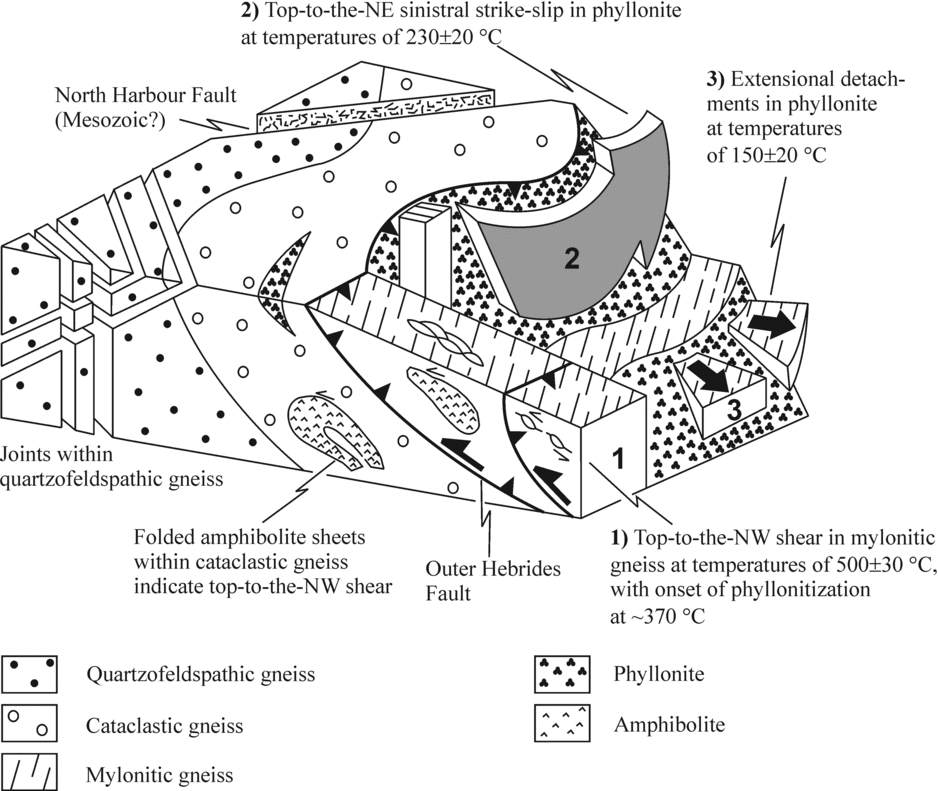
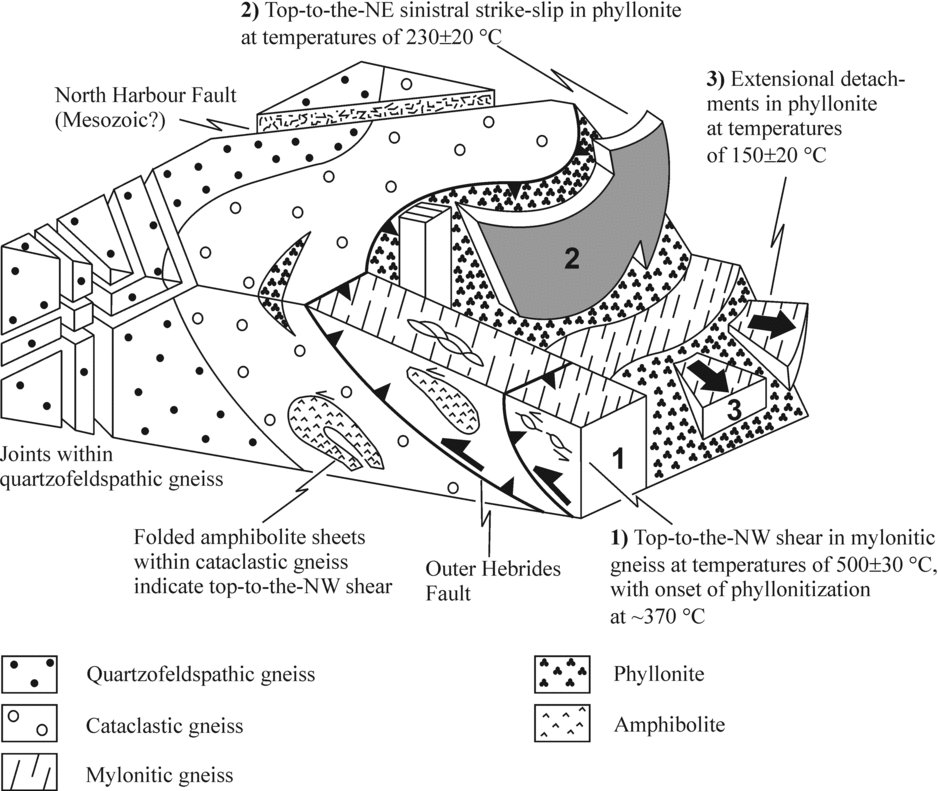
Our field studies lead us to concur with Imber et al. (Reference Imber, Strachan, Holdsworth and Butler2002) that top-to-the-NW ductile thrusting on the Outer Hebrides Fault Zone in Scalpay overprints intrusions correlated with the c. 1685 Ma Laxfordian, and that deformation must therefore be (significantly?) younger than this. Subsequent reactivation was principally associated with the spatial distribution of phyllonite, and is considered to be Caledonian in age. The kinematic and thermal evolution of the Outer Hebrides Fault Zone as exposed on Scalpay (Fig. 7, Table 1) is constrained by fluid inclusion analysis (N = 272) and comprises:
(1) Top-to-the-NW ductile thrusting associated with the development of mylonitic gneiss occurs at temperatures of 500 ± 30°C. Early phyllonitization associated with this thrusting may have initiated at temperatures of ~ 370°C.
(2) Oblique top-to-the-NE sinistral strike-slip accompanied by phyllonitization at temperatures of 230 ± 20°C.
(3) Top-to-the-NE and SE extensional detachments along pre-existing phyllonite bands at temperatures of 150 ± 20°C.
Schematic 3-D block diagram (looking North) illustrating the reactivation history and overall geometry of the Outer Hebrides Fault Zone on Scalpay. Initial ductile top-to-the-NW-directed thrusting (1) at temperatures of 500 ± 30°C was followed by initiation of phyllonitization at ~ 370°C. Subsequent top-to-the-NE sinistral strike-slip (2) occurred at temperatures of 230 ± 20°C, and this was succeeded by top-to-the-E extension developed within discrete phyllonite bands (3) at temperatures of 150 ± 20°C. The late-stage (Mesozoic?) North Harbour Fault and joint system are also shown.
The precise temperatures derived from kinematically constrained fluid inclusion studies may be correlated along strike with the southern segment of the Outer Hebrides Fault Zone. This permits a greater understanding of the thermal history of the fault zone and also allows greater confidence to be placed in dating systems, with only very limited re-setting of isotopic ‘ages’.
Acknowledgements
We wish to thank the Edinburgh Geological Society and the Welch Fund of the School of Geography & Geosciences at the University of St Andrews for supporting aspects of this work. We also wish to thank Jonny Imber and an anonymous referee for careful and constructive reviewing.