Introduction
Our work as teacher educators of music to pre-service primary or elementary school generalist teachers is as important as it is challenging. Faced with large cohorts and limited time, many of our students describe themselves as ‘unmusical’ or ‘untalented’, confessing limited musical skills or knowledge to draw upon in their preparation to teach music. This self-appraisal is typically coupled with fears and misconceptions about teaching music in their future classrooms. Our experience is not isolated. Research outlines that limited prior music learning opportunities (Hallam et al., Reference HALLAM, BURNARD, ROBERTSON, SALEH, DAVIES, ROJERS and KOKATSAKI2009), the demise of hours in tertiary teacher training (Hocking, Reference HOCKING2009), and the presence of specialists in schools contribute to generalists’ limiting their potential future contribution to effective classroom music instruction (Garvis et al., Reference GARVIS, TWIGG and PENDERGAST2011). Yet research has also provided a strong and enduring case for equitable access to Arts instruction including Music within school education, which is often the sole responsibility of generalists to provide (WIGGINS & WIGGINS, Reference WIGGINS and WIGGINS2008; Ewing, Reference EWING2010). Despite the diminished place of Music within primary school education in Australia and elsewhere (Pascoe et al., Reference PASCOE, LEONG, MACCALLUM, MACKINLAY, MARSH, SMITH, CHURCH and WINTERTON2005), case study examples of quality teaching exist, when a range of tools and learning approaches including technology are utilised by generalists in line with their interests, skills and existing competencies (de Vries, Reference DE VRIES2015). This suggests a critical re-examination of teacher training programmes is overdue.
Situated at an Australian university, this research sought to evaluate the effectiveness of our teacher training practice and its impact on the formation of self-efficacy beliefs of pre-service teachers with regard to their future contribution as facilitators of classroom music instruction. Our reading of the literature and shared appraisal of the problem led us to employ Bandura’s (Reference BANDURA1997; Reference BANDURA, Urdan and Pajares2006) self-efficacy concepts and Legitimation Code Theory (LCT) from the sociology of education (Maton, Reference MATON2014) in the design, analysis and theorisation of research. The combination of these tools provided a new way to examine an old problem, enabling the appraisal of data relevant to the immediate case, but with explanatory potential to the field of music education more broadly situated (Carroll, 2019; Reference CARROLL, Wright, Johansen, Kanellopoulos and Schmidt2021). An action-research project consisting of a peer-directed collaborative web-based digital music-making project (Somekh, Reference SOMEKH2011) was planned to culminate the music education module attended by 136 second-year Bachelor of Education students enrolled in a core Creative Arts Education unit. Modules of equal length were also planned and attended in Drama, Dance and Visual Arts concurrently. The music component included four weeks (total 8 hours) of sequential music-making activities using voice, body and both un-tuned and tuned percussion, followed by the two-week (4 hours) peer-directed digital music-making project (described hence). Five additional lectures provided further grounding in curriculum, assessment and pedagogical theory for primary-level music education. The study utilised a pre- and post-survey according to a mixed-methods design (Cresswell, Reference CRESSWELL2015) along with our shared reflective accounts of practice to holistically appraise the results (Somekh, Reference SOMEKH2011). All activities were designed to address K-6 Creative Arts national and state curricular objectives (Board of Studies, 2006; Australian Curriculum, 2021). In preparation for the module, we undertook a critical appraisal of the literature relevant to generalists’ pre-service teacher training for music in Australia and elsewhere, which is outlined hence.
Background
Self-efficacy refers to an individual’s ‘perceptions of their capability to execute the actions necessary to achieve a desired goal’ (Gallagher, Reference GALLAGHER and Ramachandran2012, p. 314). An individual’s self-efficacy beliefs help determine how much effort s/he will expend and how long effort will be sustained in the face of obstacles (Pajares, Reference PAJARES1996). These self-perceptions of capability – or ‘self-efficacy beliefs’ – are recognised as a critical force shaping a person’s choices in activity and their effort and persistence toward the achievement of desired goals (Bandura & Cervone, Reference BANDURA and CERVONE1983). As Bandura states, ‘if people believe they have no power to produce results, they will not attempt to make things happen’ (Reference BANDURA1977, p. 3).
Garvis et al. (Reference GARVIS, TWIGG and PENDERGAST2011) outline the mechanisms perpetuating a poor ‘self-efficacy cycle’ for pre-service generalist primary teachers and music instruction. Utilising Bandura’s (Reference BANDURA1997) four-fold self-efficacy framework, limited mastery experiences (direct experience of teaching music) affected pre-service teacher’s capacity to develop confidence and competence in teaching music. Vicarious experiences (learning through modelling or demonstration) then often followed, if their supervising generalist teachers, or teachers like them, did not demonstrate quality music instruction. As a consequence, limited verbal persuasion (positive feedback) resulted in insufficient emotional or psychological arousal (identification or ownership) for their personal development to teach music. This negative self-efficacy cycle has been the inspiration for much of the research outlined in the literature, with limited prior music learning, insufficient hours in pre-service teacher training and the presence of specialists in schools listed as contributing factors to this seemingly intractable problem for teacher educators.
Hallam, et al. (Reference HALLAM, BURNARD, ROBERTSON, SALEH, DAVIES, ROJERS and KOKATSAKI2009), Lowe et al. (Reference LOWE, LUMMIS and MORRIS2017) and Henley (Reference HENLEY2017) note that limited and/or negative prior experience of school music strongly affects the formation of positive self-efficacy beliefs of pre-service teachers. Despite valuing the music instruction offered in their pre-service training and appreciating self-directed musical experiences in their everyday lives, prior competence in singing, instrumental music and proficiency in reading music notation was seen by pre-service teachers as common impediments to the development of positive self-efficacy in teaching music in each study.
Hocking’s (Reference HOCKING2009) national report of Australian teacher training institutions reveals why the negative self-efficacy cycle has yet to be been broken at the tertiary level, with allocation for K-6 curricular Music constituting an average of only 1.51% of an entire bachelor’s degree, transpiring to a total of between 4 and 17 hours of training. A synthesis of handbook content and Hocking’s survey data reveal several commonalities in approach across institutions, with singing, playing classroom instruments and creating or composing common to the majority of programmes which feature Kodaly, Orff and Dalcroze pedagogies. Frequently, this training for Music is delivered in conjunction with Dance, Drama, and Visual Arts instruction in integrated formats. Although the use of music technology is mentioned in Hocking’s report, the orientation of its use is not defined, with an average of only 0.8% (therefore 48 minutes) of time allocated. Admittedly, Hocking’s work is not situated to appraise content changes which may have occurred over the past decade; however, any such change should be weighed against the further demise of face-to-face hours in many tertiary institutions.
Acknowledging these ongoing limitations, it is understandable that the solution adopted by many primary schools in Australia is toward the appointment of specialist teachers for music, who take on a subject-specific role due to their specialised experience and training. However, according to Ardzejewska et al. (Reference ARDZEJEWSKA, MCMAUGH and COUTTS2010), the orientation of specialists’ contribution varies greatly, as the possession of subject-specific qualifications may not be required by many schools. Although many schools, particularly in the independent sector employ ‘relief from face to face’ specialists to teach classroom (curricular) music, music ‘programmes’ in many government schools, have become synonymous with co-curricular (user pays) ensembles only, with curricular music instruction remaining in the hands of generalist teachers. With this being the case, there has been a movement toward increasing access to post-university mentoring and/or in-service music programmes for generalists in order to close this gap (Collins, Reference COLLINS2016). These mentoring programmes are relatively new, however, with their reach dependent upon the interests and resources available to individual schools. In the majority of cases, schools continue to outsource instruction to music specialists, or, offer limited to no instruction at all if a sufficient case for their employment cannot be made (Ardzejewska et al., Reference ARDZEJEWSKA, MCMAUGH and COUTTS2010; Power & Klopper, Reference POWER and KLOPPER2011; Wiggins & Wiggins, Reference WIGGINS and WIGGINS2008).
The work of de Vries (Reference DE VRIES2015, Reference DE VRIES2017) however makes a strong case for the value of generalists’ delivery of music instruction – albeit in localised Australian contexts. Through narrative inquiry, de Vries describes a spectrum of activity: from generalists who serve somewhat as specialists to those who do not teach music at all. Of those that do teach music, their pedagogy aligns with their existing skills and interests including singing, moving, playing simple classroom instruments, integrating the arts with other subject learning areas, and using music technology such as Garageband to instigate creative projects with children. Importantly, such individual classroom initiatives require the support of school leadership and a pragmatic combination of both formal and less formal modes of music facilitation in order to meet the individual needs of teachers and children. These findings suggest that a generalist/specialist dichotomy, although presented in much of the literature, may in reality constitute a spectrum of positions and practices in schools worthy of consideration at the teacher training level.
Regardless of the spectrum of activity which characterises primary school music instruction, the orientation of teacher training programmes for generalists has tended to reflect a narrower range of offerings in Australian tertiary institutions. Steven-Ballenger et al. (Reference STEVENS–BALLENGER, JEANNERET and FORREST2010) believe this may contribute towards the development of poor self-efficacy for many generalists. The authors note that despite the limited number of contact hours to prepare teachers to teach music and the other arts disciplines, there are only scant recommendations for tertiary providers as to what constitutes effective training. Like Hocking’s (Reference HOCKING2009) study, Steven-Ballenger et al. (Reference STEVENS–BALLENGER, JEANNERET and FORREST2010) list live music-making pedagogies (Orff, Dalcroze, Kodaly) as central to most pre-service training programmes, despite these requiring more established musical skills such as singing in tune, playing in time, basic ensemble work, improvisation, conducting and so on to initiate. In summary, they note that aside from breadth and depth of expertise, and the ability to run co-curricular ensembles, the course expectations in many tertiary training programmes align more closely to those required by music specialists than generalists.
These findings instigated for us a process of critical evaluation exposing over time some of the underlying assumptions we had held as teacher educators. Despite our offering a range of participatory modes of performance emulating children’s classroom singing and playing abilities, and a range of listening and creative work supported by graphic and traditional notation, we had little understanding of how to connect this learning with our students’ existent knowledge and experience of music. We considered their varied accounts of music learning during secondary school and the frequency of statements describing their ‘lack of talent’ when encouraged to participate in music-making activities during workshops. To what extent might we be perpetuating the ‘self-efficacy’ problem through the orientation of our teacher training? A critical appraisal of our training programme was required in order to make room for the possibility that alternate tools and modes of learning could be encouraged.
Research design and context
A mixed-method study was undertaken with pre- and post-survey data collected from 136 second-year Bachelor of Education students situated at two campuses of a major Australian university (Creswell, Reference CRESSWELL2015). The 12-hour practical Music module and an additional 5 lectures were delivered over a 6-week period by the authors who participated as teacher/researchers. Ethical consent was obtained before the study began from the university, with students invited to participate in the surveys via the learning management system. The unit of learning modelled a range of practical stage-appropriate activities we had often employed in class-sized groups of around 26 pre-service teachers. Here, we initiated activities in chanting, singing, movement, body percussion and both un-tuned and tuned percussion for both large and small groups that were later supported by the use of both graphic and traditional forms of music notation. Creative activities such as soundscapes and basic forms of rhythmic and pitched improvisation were included in all sessions. To broaden offerings, the module included a peer-directed web-based digital music-making project that will be outlined in detail hence. The six lectures provided more focused examination of the national and state syllabus documents, assessment practices, means of integrating the various art forms, as well as an outline of the literature and theoretical underpinnings of the key pedagogical approaches employed in the module. An overview and basic instruction and demonstration using the web-based tools featured in the module were also provided.
The module culminated in an action-research project (Somekh, Reference SOMEKH2011), where the students collaborated over the final 2 weeks of the unit with peers of their choosing on a music-making task using a choice of freely accessible web-based tools: Chrome Music Lab Song Maker (2016, https://musiclab.chromeexperiments.com/Song-Maker/), or Bandlab (2015, https://www.bandlab.com). These tools had been trialled in our practice during an earlier pilot study with students at the same university and were so chosen due to their accessibility, functionality, alignment with national and state curricular outcomes and the presence of free online instruction videos allowing flipped learning strategies (Board of Studies, 2006; Australian Curriculum, 2021). Our use of digital technologies in pre-service teacher training acknowledges and builds upon findings by Heyworth (Reference HEYWORTH2011, Reference HEYWORTH2018) and utilises aspects of project-based learning as defined by Kokotsaki et al. (Reference KOKOTSAKI, MENZIES and WIGGINS2016).
The digital music-making project encouraged the students to use the concepts and skills taught in the initial weeks of live music-making to realise a creative project of their own design appropriate for a Stage 3 or upper primary school class (children aged 10–12 years). In groups of three, the pre-service teachers were asked to create a piece of music of around 60 seconds duration consisting of three layers of sound including pitched and rhythmic digital sounds and an acoustic vocal or instrumental layer. The Song Maker platform provided a way for students to visualise pitch and rhythm through the use of colour-coded tiles supported by a basic drum machine. This enabled the integration of live sound using mallet percussion or boomwhackers which used the same colour coding system. Many students chose to arrange music they had accessed online for boomwhackers in a range of musical styles, creating simple melodic lines and ostinato accompaniments. The Bandlab platform facilitated group composition with pre-set midi instruments and loop packs including instrumental riffs in a range of popular music genres. Bandlab also provided the opportunity to record live performance elements and combine these with pre-set materials or create backing tracks from a combination of these elements to be used in conjunction with live material presented in class. Both platforms allowed students to save and share their work online which facilitated communication and project completion in remote locations.
The pre-survey was designed to gauge base level data of prior and current learning experiences in music, their school music experiences, their self-concept or self-perception of musicality and their self-appraisal of capability to initiate a range of different classroom music activities. The two university campuses – henceforth named ‘North’, (N=42), and ‘West’, (N=94) – are located in geographically distinct regions of a major city and typically attract students with markedly different ethnic and socio-economic backgrounds. A cross-campus comparison of data therefore added to the richness of our findings, with LCT from the sociology of education providing the overarching theoretical lens for the meta-analysis of data. An outline of the theory with reference to this study is provided hence.
LCT
LCT from the sociology of education is a multi-dimensional tool kit (Maton, Reference MATON2014), with its use in music education providing valuable insights on an array of issues from curriculum design, to classroom pedagogy, to studio and assessment practices, across a broad range of contexts and levels of education (Lamont & Maton, Reference LAMONT and MATON2008, Reference LAMONT, MATON and Wright2010; Carroll, Reference CARROLL2019, Reference CARROLL2020, Reference CARROLL, Wright, Johansen, Kanellopoulos and Schmidt2021; Richardson, Reference RICHARDSON2019; Carver, Reference CARVER2020; McPhail & McNiell, Reference MCPHAIL and MCNEILL2019, Reference MCNEILL and MCPHAIL2020; Walton, Reference WALTON2020). Although LCT comprises five dimensions each with distinct application, the Specialisation dimension proved apposite for this research investigation as it can reveal how actors become legitimate players within a field of practice according to hidden codes of legitimation. Unveiling the codes that determine legitimate participation provides clues as to why some succeed and others do not, allowing insights as to how the game is played, or can be changed, over time. Specialisation codes are determined by two key concepts: Epistemic Relations (ERs) and Social Relations (or SR). ERs qualify an actor’s relationship to legitimate knowledge and skills on a continuum of strengths and weaknesses (either more +, or less –) according to ‘what they know’ and ‘what they can do’. SRs qualify an actor’s relationship to personal dispositions, qualities or beliefs again on a continuum of strengths and weaknesses (either more +, or less –), not according to ‘what they know or can do’, but rather, according to ‘who they are’, and ‘how they see themselves’.
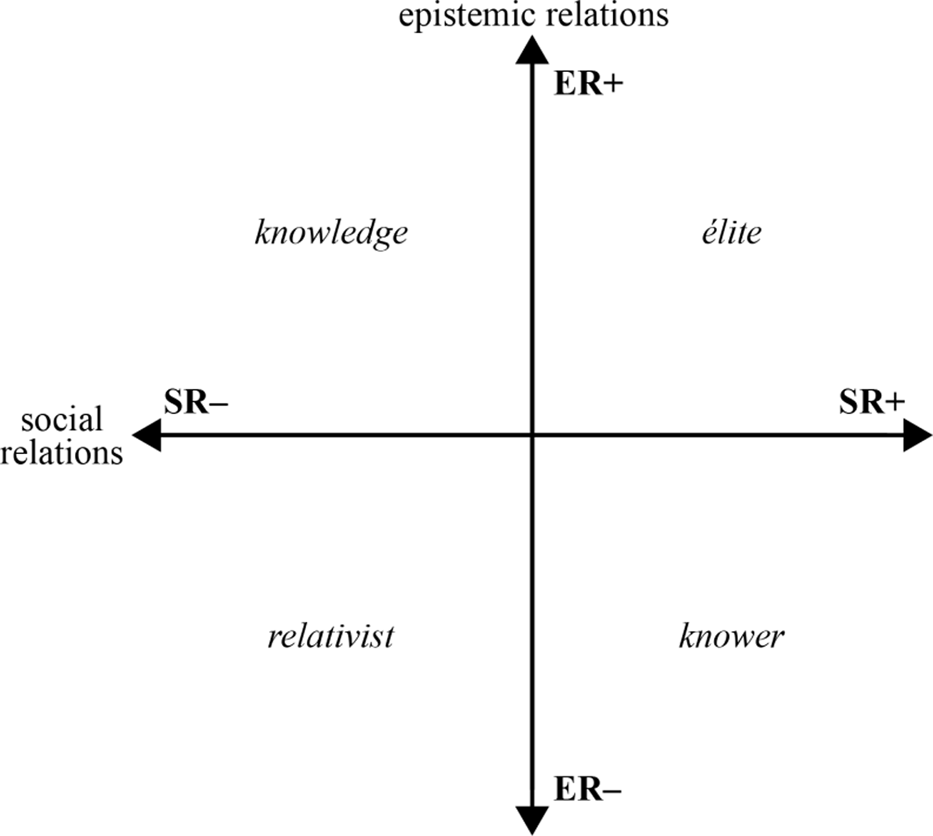
With reference to this study, these concepts played out both according to pre-service teachers’ (or actor’s) possession of legitimate musical knowledge and skills (or ERs either ER+, ER–) and their existent self-concept of ‘musicality’ (or SRs either SR+, SR–). As these concepts are frequently linked, simultaneous strengths and weaknesses generate four specialisation codes: a knowledge code (ER+, SR–) when actor’s possess musical knowledge or skills but see themselves as remaining somewhat ‘unmusical’; a knower code (ER–, SR+), where their ‘musical’ self-concept may be stronger, but their possession of knowledge more limited; an élite code (ER+, SR+), where actors possess both knowledge and skills, and a self-concept of ‘musicality’ and a relativist code (ER–, SR–), where they describe themselves as being neither knowledgeable nor ‘musical’. Used in this way, the LCT specialisation codes enabled the teasing out of a spectrum of orientations and positions held by the pre-service teachers involved in the study and a way to appraise how these positions might relate to the activities included in the learning module. Rather than being viewed in dichotomous categories such as future ‘generalists’ or ‘specialists’, ‘experts’ or ‘novices’, a fuller picture could emerge concerning their pre-existing and emerging self-concept as teachers of music. Represented using a Cartesian plane, the four specialisation codes are depicted in Figure 1.
As stated, the pre-survey was structured to first ascertain participants’ current and prior engagement in music, their self-efficacy with regard to content and pedagogical knowledge (ER) and their self-concept or identity with regard to musicality (SR). This generated initial data aligning each of our participants to one of the four LCT Specialisation codes (Maton, Reference MATON2014). We also asked a series of questions to explore their perception of capability with regard to a range of musical activities for primary students, through a set of ‘can-do’ statements (Bandura, Reference BANDURA, Urdan and Pajares2006). Responses required a rating on a five-point Likert scale, from ‘cannot do at all’ through ‘can do moderately well’ to ‘can do exceptionally well’. This provided a snapshot of our participant’s pre-existing musical identities and perceived ability against which any shifts in post-survey results could be appraised. The post-survey reiterated the ‘can-do’ statements in order to track the extent to which the module had shifted individual perceptions of self-efficacy within each specialisation code group. Open-ended responses then provided the opportunity to appraise responses using the approach developed by Corbin and Strauss (Reference CORBIN and STRAUSS2008), generating qualitative findings through open, axial and then thematic coding. The principles of ethical research were upheld with students providing a chosen pseudonym and number, with no identifying information required. Although participation in the learning activities was a requirement of study, participation in research via the provision of survey responses remained optional.
Results and discussion: Pre-survey
The pre-survey [N=136] generated responses which each aligned each participant to one of the four specialisation codes, with additional questions used to qualify the nature of musical engagement within each of the four code groups. Using our existing knowledge of pre-service teachers as they tended to describe themselves, these were worded as follows: ‘I am quite knowledgeable about music, but I’m not very musical’ (a knowledge code: ER+, SR–), ‘I sing or play an instrument, but don’t read music or know much music theory’ (a knower code: ER–, SR+), ‘I sing or play an instrument, and can read music’ (an élite code: ER+, SR+), and ‘I don’t know very much about music, and I’m not very musical’ (a relativist code: ER–, SR–). It should be mentioned that some variation in response could be observed within each code group, but for the purposes of reporting, each shall be treated as a distinct entity. Drawing on our years of experience teaching the course, we were not surprised to find that 47% of participants identified with the relativist code and only 14% with an élite code. However, results for the remaining code groups revealed more nuanced findings between these polar responses, with 17% identifying with the knowledge code statement and 23% with the knower code statement.
A series of exploratory questions then allowed us to gauge the current musical interests, practices and beliefs of each code group, and, their prior access to music learning both in and outside of school. As our search of the literature had revealed that self-perception, current interests as well as pre-existing knowledge and skills were chief factors effecting self-efficacy formation, we believed this important foundational analysis to undertake, allowing us to contribute to the findings by Hallam et al. (Reference HALLAM, BURNARD, ROBERTSON, SALEH, DAVIES, ROJERS and KOKATSAKI2009), Lowe et al. (Reference LOWE, LUMMIS and MORRIS2017) and others. The questions in the pre-survey enabled the construction of both a musical profile and a learning profile for each code group as outlined hence.
The relativist code group
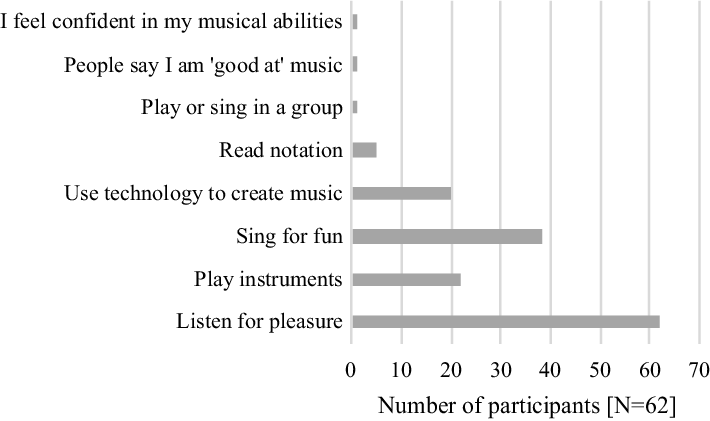
For those identifying with the relativist code statement [N=62], their self-perception of ‘musicality’ was low; however, engagement in activities such as listening, singing for pleasure, playing instruments, and making music with technology were listed as ways they engaged with music in their everyday lives as depicted in Figure 2.
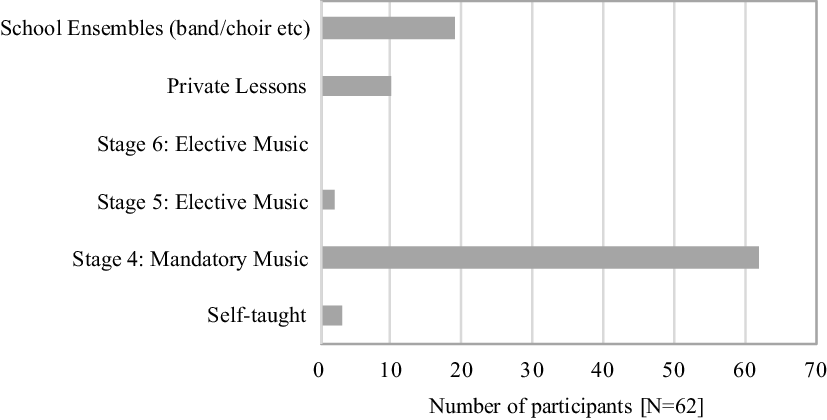
A learning profile was also generated from their survey data. Although a small proportion mentioned participating in instrumental lessons or an ensemble early on in their schooling, in almost all cases, high school music engagement consisted of mandatory music classes only (undertaken during Stage 4 at ages 12–14 years), rather than elective study options at either Stage 5 (15–16 years), or Stage 6 (17–18 years) as is depicted in Figure 3.
Both musical and learning profiles corresponded with their projected pedagogical ability, with the majority [N=51] identifying with either ‘cannot’ or ‘can a little’ statements relating to singing, playing instruments, creating music, using notation, using technology and leading others in classroom music activities. The only exception was teaching involving listening, where participants [N=11] identified with the ‘moderately’, and ‘moderately well’ statement. This highlighted a tension between their engagement and value for music in everyday life particularly as listeners and their understanding of school music as requiring more specialised skills and knowledge.
The knowledge code group
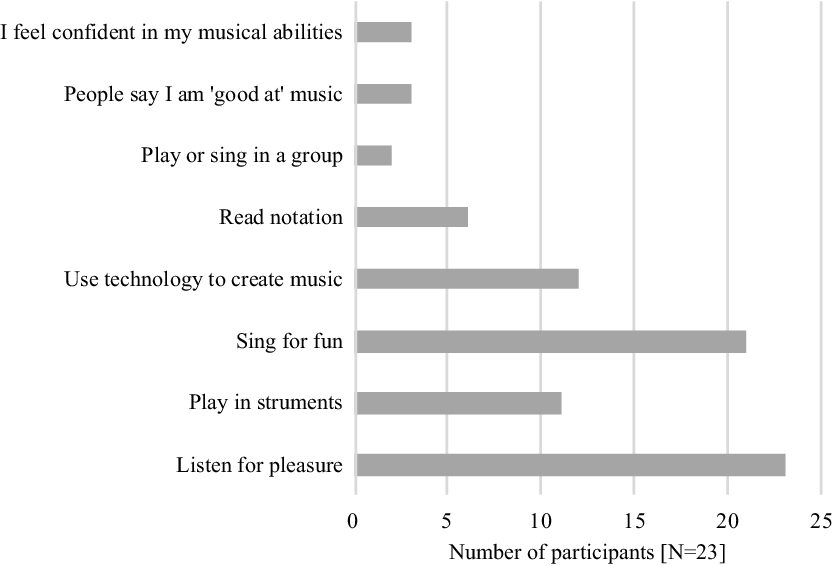
For the students identifying with the knowledge code statement [N=23], many similarities could be noted to the relativist code group, with the exception that personal interest in music and engagement in everyday music-making activities were proportionally higher, especially for singing (N=21) as is outlined in Figure 4.
LCT specialisation codes.
Note. This figure was reproduced from Maton (Reference MATON2014, p. 30).

Musical profile relativist code group [N=62]: ‘I don’t know very much about music, and I’m not very musical’ (ER–, SR–).

Learning profile relativist code (ER–, SR–) [N=62]. ‘I don’t know very much about music, and I’m not very musical’ (ER–, SR–).

Musical profile knowledge code [N=23]: ‘I am quite knowledgeable about music, but I’m not very musical’ (ER+, SR–).

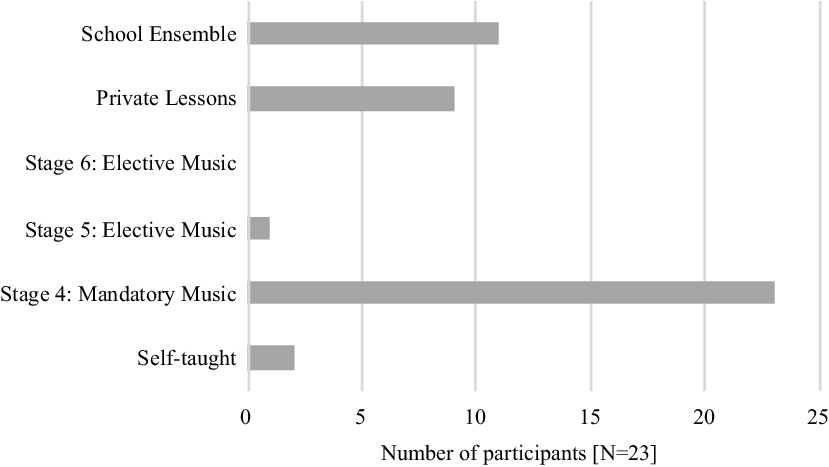
A higher rate of prior engagement with music learning was also noted for this group, although again, high school study was mainly limited to the mandatory Stage 4 course as is outlined in Figure 5.
Learning profile knowledge code [N=23]: ‘I am quite knowledgeable about music, but I’m not very musical’ (ER+, SR–).

Increased interest in, and value for music, as well as confidence in singing also affected their projected confidence to teach music, with most participants in the knowledge code group aligning their ability to ‘moderately’ or ‘somewhat confident’ statements, with listening listed as an area in which they felt moderate to high levels of confidence [N=15]. Like those in the relativist code group who described music at primary school as ‘fun and engaging’, the knowledge code group equally described high school music as either ‘too theoretical’, ‘not relevant’ or ‘just for talented people’. This sat in stark contrast with further analysis of qualitative responses showing the majority believed music to be ‘very valuable’ to student learning.
The knower code group
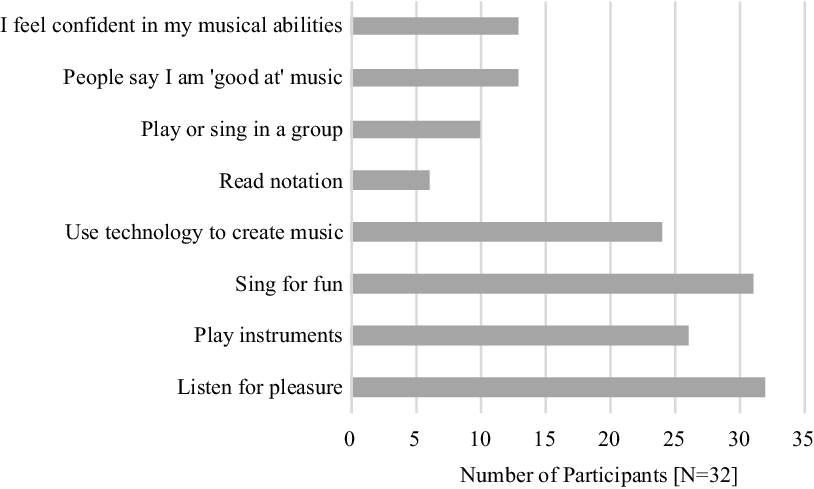
For those that aligned with the knower code statement [N=32], the pre-survey data revealed markedly higher rates of engagement in music-making activities including playing instruments [N=14], singing [N=26] and using technology [N=15], but a lower proportion of participants with formal training and music literacy skills as is outlined in Figure 6.
Musical profile knower code [N=32]: ‘I sing or play an instrument, but don’t read music or know much music theory’ (ER–, SR+).

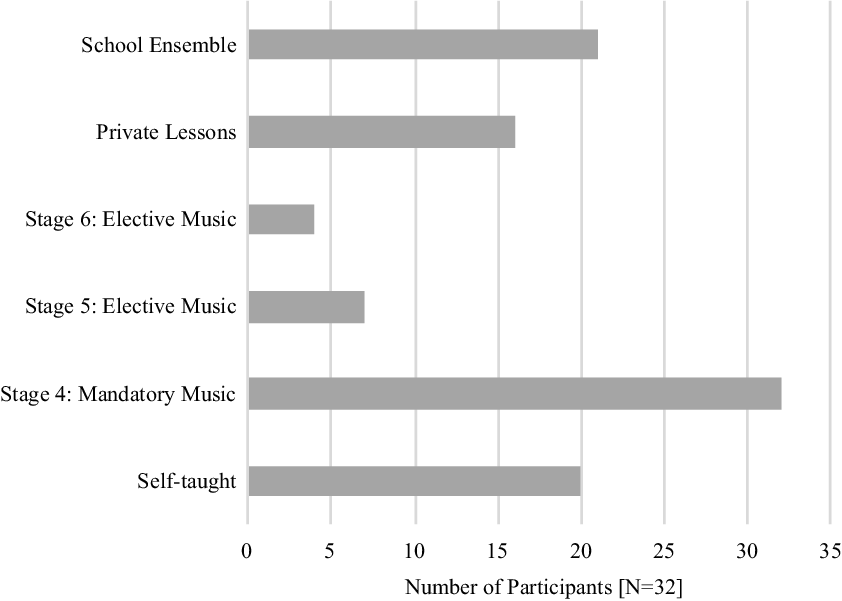
Increased self-confidence and active participation in self-directed or informal music-making was more frequent for knower code participants, with 20 of the 32 participants listing ‘self-teaching’, along with private tuition, and participation in school music ensembles in their learning profile as is depicted in Figure 7.
A heightened self-perception of ‘musicality’ corresponded with their increased self-efficacy towards teaching music, with mean responses aligning to ‘can a little’ statements for singing, playing and using technology.
The Élite code group
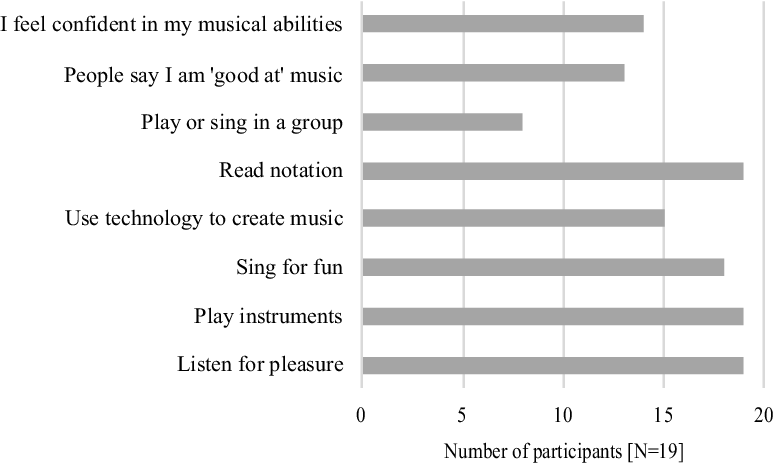
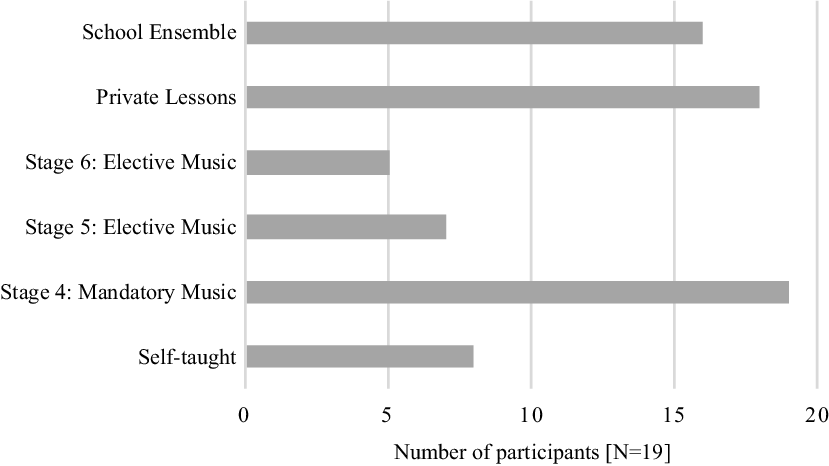
The final group of participants aligned with the élite code statement [N=19], with high levels of prior engagement in both formal and informal music-making corresponding with a stronger foundational knowledge set and a salient self-concept of musicality as is depicted in Figure 8.
Élite code participants also reported the highest levels of engagement in school music programmes, although surprisingly less than half had studied elective music subjects throughout high school as is captured in Figure 9.
Learning profile knower code [N=32]: ‘I sing or play an instrument, but don’t read music or know much music theory’ (ER–, SR+).

Musical profile élite code (ER+, SR+) [N=19]: ‘I sing or play an instrument, and can read music’.

Learning profile élite code (ER+, SR+) [N=19]: ‘I sing or play an instrument, and can read music’.

Although those in the élite code group reported significantly higher mean scores for projected pedagogical self-efficacy, with mean ‘can-do’ scores of ‘moderately well’, for singing, playing instruments and using notation (performance-centric musicianship) [N=17], comparatively lower mean scores for self-efficacy were reported by them for tasks involving leading class ensembles and creating music.
Cross-campus comparison
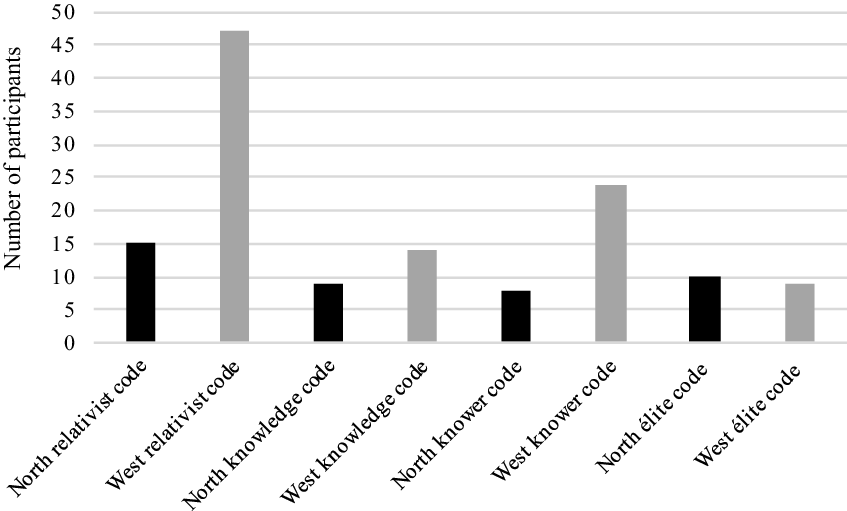
When data from campus North [N=42] and campus West [N=94] were compared, a much bigger picture emerged with regard to the relationship between prior learning, pre-existing self-efficacy towards teaching music, and rates of socio-economic advantage. Students enrolled in campus North – a region typically representing a higher socio-economic status – showed a fairly even spread across each of the four code groups and hence a proportionally higher rate [23%] in the élite code category. This contrasted starkly with those enrolled at campus West – a lower socio-economic region – where only 9% aligned to an élite code. At campus West, a much higher number of participants identified with the relativist and knower code statements, as can be seen in Figure 10.
Comparison by code orientation at campus ‘North’ (N=42: higher SES) and campus ‘West’ (N=96: lower SES).

While the relativist code group remained by far the largest number of candidates at both campuses (47%), rates of those identifying with knower code and hence self-teaching or active participation in music through informal learning represented not only the second largest group over all (23%) but also an even larger proportion (25%) at campus West. From this, we deduced that pre-service teachers who train and then seek work in more socio-economically disadvantaged and ethnically diverse settings might benefit from activities aligned to their prior and existing musical interests and skills and pedagogies which utilise aural-based or informal rather than traditional notation-based modes of music-making. With this in mind, the findings from the post-survey will be reported next.
Results and discuss: Post-survey
The post-survey [N=126] was designed to gauge both potential shifts in the self-efficacy of pre-service teachers and to ascertain the success of the module activities which had included the peer-directed project using web-based digital tools. Again, participants were asked which activities they were most ‘likely to try’ in their future classrooms. By pairing their pseudonyms between pre- and post-surveys, we were able to examine shifts in projected self-efficacy, as well as examining qualitative responses or ‘reasons why’ these changes may have occurred. Overall, the cohort reported a significant strengthening in ER+: ‘I improved my knowledge and skills’: 51%; and in SR+: ‘I am more musical than I first thought’ (41%), which we viewed as a positive finding.
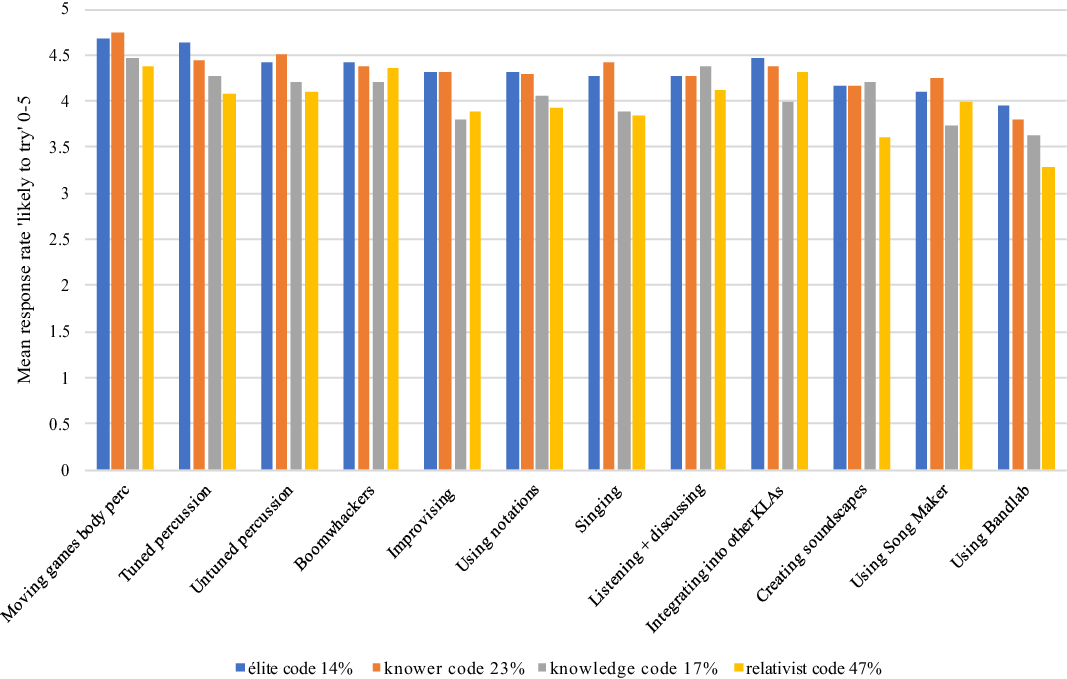
We then asked the cohort to rate the activities they were ‘likely to try’ in their future teaching on a Likert scale of 1 – 5, with a score of 1 indicating they ‘definitely will not try’ through to 5 indicating they ‘definitely will try’. The activities included moving games and body percussion, tuned percussion, un-tuned percussion, boomwhackers, improvising, using different kinds of notation (both graphic and basic traditional forms), singing, listening and discussing, integrating music with other key learning areas (KLAs), creating soundscapes and using the digital music-making platforms Song Maker and Bandlab. This provided a way of appraising student experience during the unit and potential measures of transfer and application into classrooms. In line with findings by Garvis et al. (Reference GARVIS, TWIGG and PENDERGAST2011), these activities were hence those most likely to promote mastery experiences while on practicum or at a later date and hence potentially affect the formation of positive self-efficacy beliefs. The results as aligned to each code group are provided in Figure 11.
Module activities pre-service teachers were ‘likely to try’ in their future teaching.

Consistently, high mean scores of 4-4.5 were recorded for both élite and knower code groups (those with a stronger self-perception of ‘musicality’ or SR+), with more variation in mean scores noted for those in the larger knowledge and relativist code groups (conversely those with a weaker self-perception of ‘musicality’ or SR–). This highlighted that self-perceptions of ‘musicality’ remained the chief factor determining choice in future classroom activities, with corresponding lower mean scores noted for more traditional performance-based tasks including tuned percussion, improvising and singing for the knowledge and relativist code groups. Conversely, activities using movement and body percussion, boomwhackers, listening and discussion, and integrating music with other KLA’s were those that recorded more consistent mean scores across the cohort. Results from the choice of digital tasks require explanation, as there was considerable variation across the cohort and between campuses in the number of students choosing between the two web-based platforms. Overall, more students chose to use Song Maker, with a positive mean score of 3.98 for ‘likely to try’ for students in the relativist code group viewed as a very positive finding.
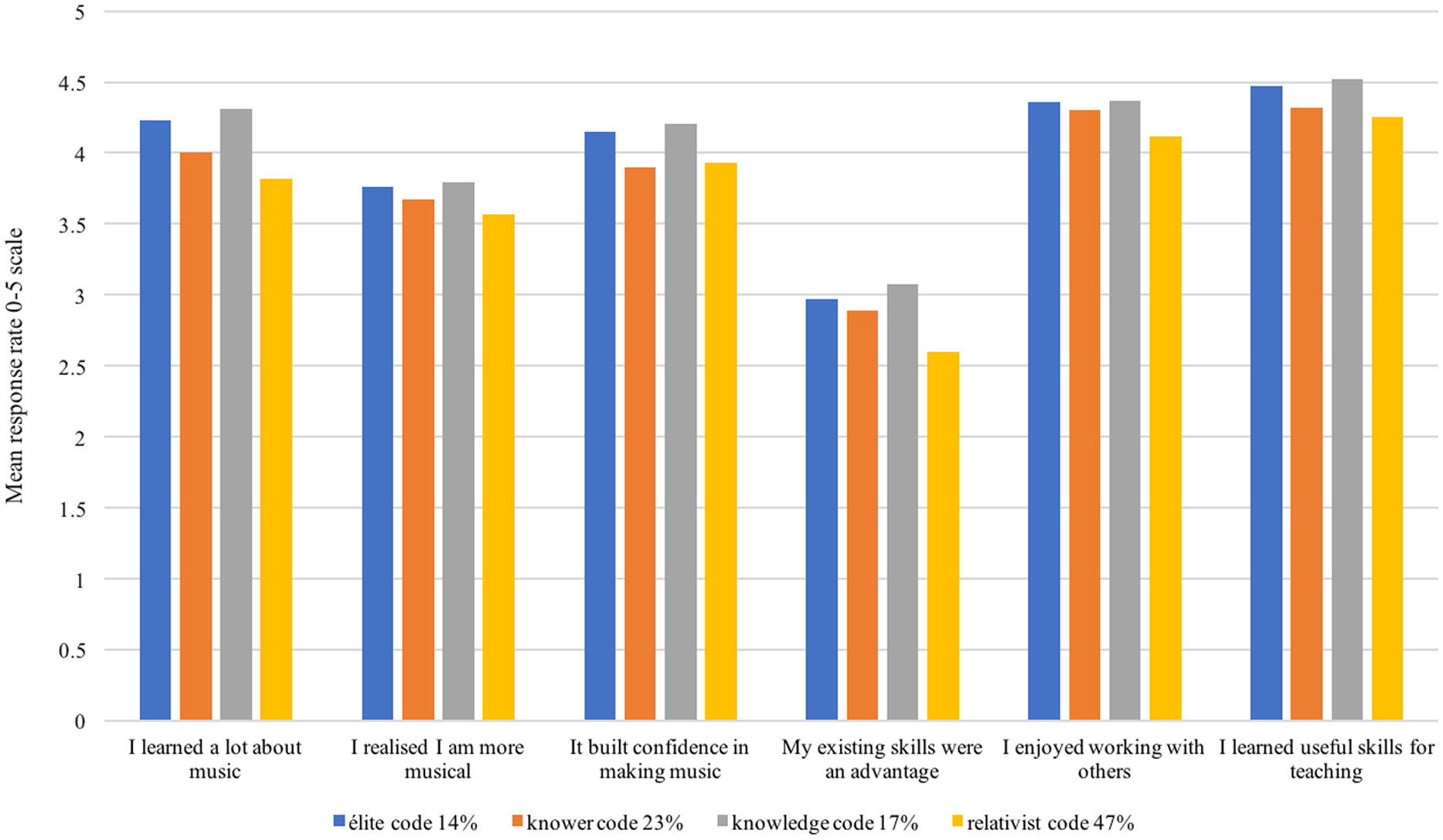
As results from the collaborative digital music-making project were of particular interest to us, the post-survey included specific questions to allow us to critically evaluate the future application of these tools in our teacher training programme with regard to self-efficacy formation. Results showed that the use of technology had provided an inclusive platform for learning in pre-service teaching. Figure 12 reveals the mean scores relating to the use of these digital tools and peer-directed learning.
Evaluation of web-based digital music-making project by Specialisation code.

As captured in Figure 12, results related to the use of the digital tools revealed positive shifts in self-efficacy in terms of learning (ER), musicality (SR) and confidence (ER and SR combined) across all code groups, with the majority of students finding the activity enjoyable and beneficial to their future teaching. We viewed the lower scores for pre-existing skills positively, as the creative task had attempted to build new skills and therefore did not advantage the élite or knower code groups with more established musical skills and self-perceptions of ‘musicality’. The analysis of qualitative data confirmed these findings with the most numerous responses reporting the project had been ‘fun’ and ‘engaging’. The appraisal of peer-directed learning is captured in the following student statement:
I felt that this unit showed me that music in the classroom can be explored in a variety of ways. In particular, the more ‘informal’ activities I felt had the most potential when implemented in the classroom. Removing formal processes made the activities fun and enjoyable.
The shift in pedagogical focus allowing peer learning, experimentation and risk-taking particularly during the web-based digital music weeks highlighted that student access to mastery experiences had positively affected self-efficacy formation as follows: ‘This was a good assessment as it allowed us to make music in another way. I feel like it allowed us to take risks as we could use computerised instruments and loops. It was also more collaborative. However, if it would have been terrifying if it was an individual performance task’.
We were able to appraise the future value of peer learning and collaboration as the students presented their projects for assessment in the final tutorial, with some mentioning that the pedagogical shift from ‘director’ to ‘facilitator’ of music-making was achievable for teachers who still saw themselves as ‘unmusical’ or ‘untalented’. One participant responded: ‘I would use technology because it was helpful and easier as a non-talented musician’ – a self-assessment we continued to challenge, but remained regardless of the quality of many of the creative projects which emerged at the conclusion of the study. These comments resonated for us with a statement by Tobias (Reference TOBIAS, Ruthmann and Mantie2017) about the power of technology to provide more inclusive access to music education. He states: ‘Music education’s tendency toward cultural reproduction of existing paradigms of music and musical engagement often limits the potential of technology to support and mediate a broad range of ways people can be musical’ (p. 292).
Conclusion
This case study has examined pedagogical practice for music education within a single teacher training programme for pre-service generalist primary teachers. The results from the pre-survey highlight how access to both musical content and skills (ER) and possession of an existent self-concept of musicality (SR) are key in determining the projected future self-efficacy of pre-service teachers. Prior and current engagement with music is closely linked to self-efficacy formation, and that once formed, a pre-existent self-concept of one’s ‘musicality’ (SR) is the strongest determinant as to which activities teachers are likely to engage within their future classrooms. Those with a lower self-concept of ‘musicality’ (SR) were those least likely to engage in traditional performance-centric tasks in their future classrooms – and hence had the most to gain from activities aligned to alternate constructs of ‘musicality’ utilising technology and peer-directed learning.
Further research which focuses on the transfer of these skills into generalists’ classroom practice is needed to ascertain if these findings have made an enduring impact on the music education opportunities offered to children. It is unfortunate that further funding and time were not available to us to undertake this research ourselves; however, the results did provide us with insights valuable to our training programme. Particularly, the post-survey showed which activities could instigate uptake in later classroom practice and by whom in terms of LCT code orientation. This was significant considering the contrasting socio-economic backgrounds of students at the different campuses and their varying alignment to the contrasting LCT codes. Although we chose to maintain the use of live music-making activities in later iterations in order to provide a breadth of experience, the pre-service teachers with more limited prior music learning opportunities and/or a developed self-concept of musicality were those who could benefit most from training facilitating active music participation and creation with technology. This was taken into consideration in planning for future cohorts, including those at a further five campuses situated nationally.
The power for technology to facilitate creative music-making activities integrating listening, composing and both live and digital performance skills offers a practical solution to enduring problems of inequity of access in school music education. Although by no means a ‘fix all’ nor a complete package, the use of technology should be considered in teacher training as having the power to impact children particularly in schools where limited resources for music exist and where teachers with specialist training in music are absent. The use of technology has the potential to improve the capacity of generalists to offer quality music education experiences in classrooms, potentially enabling a broader spectrum of music learning activities for primary school children in the future.
Acknowledgements
The authors would like to thank Australian Catholic University for the award of a Teaching Development Grant that helped to fund this study.