I. INTRODUCTION
I believe that the history of economic thought (HET) should maintain a strong connection, both theoretically and academically, with economics. I argue this along two dimensions. The first one can be labeled as disciplinary and regards what I call the “HET-as-science-studies program,” which has become quite influential in our sub-discipline during the last few years. I deem that this program is not a winning strategy for our field, and in Section II I criticize it from several angles. Among other things, I provide data about the academic affiliation of young HET scholars that support my case. My second argument is pedagogical: I think that future HET scholars should have a good background in mainstream economics, and I explain why in Section III.
II. A CRITIQUE OF THE HET-AS-SCIENCE-STUDIES PROGRAM
The disciplinary flexibility of HET has allowed for its literature to participate in several methodological genres. The most traditional one is probably the history-of-analysis approach, which focuses on the internal developments of economic science without necessarily framing them as narratives of progress. A second genre of HET is intellectual history, which studies economic ideas as a part of the cultural landscape of a given historical period, mainly in relationship with contemporary political and philosophical ideas. A third, more recent genre is HET-as-science studies. Like intellectual history, science studies situates HET in broader historical, social, political, economic contexts. Yet, science-studies narratives focus mainly on the sociological processes through which economic theories have been produced, accepted, and transmitted within the scientific community of economists. Many other approaches to HET are possible and have been practiced.
During the last ten to fifteen years a number of important HET science studies have appeared. Among others, I recall here Philip Mirowski's Machine Dreams (2002a) and Roy Weintraub's How Economics Became a Mathematical Science (2002).Footnote 1 This flourishing of research has been accompanied by what can be labeled as the “HET-as-science-studies program,” originally proposed by Margaret Schabas (Reference Schabas1992), keenly supported by Weintraub (Reference Weintraub1996; Reference Weintraub1999; Reference Weintraub2002, pp. 256-72; 2007) and Mirowski (Reference Mirowski and Roy Weintraub2002b, Reference Mirowski2004), and backed by other leading scholars such as Wade Hands (Reference Hands2001). Two main tenets characterize the HET-as-science-studies program. The first is a tendency to identify proper HET with science-studies narratives, and to marginalize other approaches (especially the history-of-analysis approach) as non-legitimate contributions to the field. The second is the belief that, by writing science-studies narratives, historians of economics could break away from economists and economic departments, and be welcomed by different scholarly communities such as those of historians, philosophers, political scientists, or sociologists.
Both tenets of the HET-as-science-studies program appear to me too limiting. As regards the first one, I find it is imperialistic and restrictive to think that HET-as-science-studies is the only legitimate form of HET. I share the need expressed, for example, by Weintraub (Reference Weintraub1996), to raise the historiographical standards of HET contributions, and I also believe that papers claiming that some past economist got it right should be submitted to a theoretical journal rather than to an historical one. However, insightful and well-researched “thin” histories of analysis written à la George Stigler, John Chipman, or, for Italian readers, à la Claudio Napoleoni, often are more interesting and instructive than, for instance, conspiracy “thick” tales à la Mirowski (Reference Mirowski2002a), and should not be dismissed from HET's top journals.
In effect, by focusing on the cultural, academic, or political contexts related to the texts produced by economists, science studies often tends to pay little attention to what is actually written in these texts, that is, to disregard what are the basic facts on the ground for HET. Indeed, the history of economic science is not like the history of, say, the French Revolution. In economics the main action does not take place in streets and assemblies, but on paper, in economists’ articles and books. A HET narrative that disregards or dismisses what happens in these articles and books is incomplete and hence, in spite of its alleged thickness, too thin.
The previous point is related to a broader philosophical issue. Economics is surely a human enterprise, carried out by concrete actors who are situated in specific historical environments, embedded in certain academic networks, paid by particular institutions, etc. However, science-studies scholars tend to consider the material contexts where economics takes place as the only “real thing.” Accordingly, economic theories and ideas are viewed and rationalized as products of the material contexts of economics. This standpoint relies on an unspoken materialistic ontology that also explains why science-studies scholars do not consider internal histories of analysis as “real history.” From a philosophical viewpoint, however, this materialistic ontology is highly questionable.
Finally, the identification of proper HET with science-studies narratives does not seem to me beneficial to historians’ attempts to let HET journals be included in the Social Science Citations Index (SSCI) and the Social Sciences Edition of the Journal Citation Reports (JCR), both produced by Thomson ISI.Footnote 2 At the time I write (October 2007) the situation is the following. Among the main HET journals, only History of Political Economy and The European Journal of the History of Economic Thought are listed in the SSCI, whereas no HET journal is included in the JCR for the years 2004, 2005, and 2006. To be sure, the poor presence of HET journals in the Thomson ISI indexes largely depends on the self-referential way they are constructed: since a journal is mostly cited by journals of the same disciplinary cluster, if few or no HET journals are included in the indexes, HET journals get very few citations and tend to be removed from the indexes.Footnote 3 However, HET journals should try to be cited also by non-HET journals.
In particular, let us consider the JCR index which is the basis for the notorious Impact Factor. According to the Thomson ISI classification, the 2006 JCR database includes twenty-eight journals of history and philosophy of science, sixteen journals of history of social sciences, and 175 economics journals (as just mentioned, no HET journal is listed in the 2006 JCR). Prognosticating the future is probably not our strength as historians, but I expect that the HET-as-science-studies strategy will increase the citations from the forty-four journals of the first two groups, but will decrease the citations from the much more numerous group of 175 economics journals. If this belief is correct, the net effect of the HET-as-science-studies strategy on the HET journals citations is negative, so that such strategy decreases the chances of HET journals of being included in the JCR and having an Impact Factor higher than zero.
An alternative strategy for increasing HET journals’ citations may be for HET journals to publish more internal reconstructions and review essays on the developments in economic theory that occurred in the last forty to fifty years, possibly written by economists. Such papers on “recent” developments in economics are rare in HET journals, and tend rather to appear in the Journal of Economic Literature, the Journal of Economic Perspectives, sometimes in the Economic Journal, and also in the handbooks on economic theory published by Elsevier.Footnote 4
If we historians were capable of writing solid internal histories of recent economic analysis and convincing economists to publish some of their review essays in HET journals, economists might become accustomed to looking for surveys, say, on the recent developments in contract theory also in HET journals. In this case, citations of HET journals would probably go up. To be clear: I advocate that HET journals publish more internal reconstructions and review essays on recent economics, not only this kind of work.
To this proposal one may object that economists would not trust internal reconstructions of recent economic analysis written by historians, on the basis that “historians have not played the game they talk about.” I am not so skeptical about the economists’ attitude. Internal reconstructions of recent economics that are insightful with respect to the theoretical questions at issue, thorough about the authors and the literature under consideration, as well as attentive in illustrating differences and relationships between the ideas examined, would be read and cited by economists, and this independently of the disciplinary specialization of their author. In the terms of the game metaphor, historians who have not played the game but understand it well, can tell an excellent story of the game that is appreciated also by economists. Furthermore, the historians’ story would probably be more complete and balanced than the economists’ story: players have no interest or time to write about the game, and even at the end of it they generally are not detached enough to assess the match fairly. Yet, historians need to understand the game well, that is, they need to have a good background in economic theory to narrate its recent developments competently. I return to this in Section III below.
The second tenet of the HET-as-science-studies program, namely the idea that historians of economics turned science-studies scholars could break away from economics departments and join different and more sympathetic scholarly communities, appears to me highly implausible.
In fact, in Europe, North America, and other parts of the world, historians of economics work primarily in economics departments, business schools, or other institutions involved in economic research. This is the case for 165 of the 189 participants in the ESHET 2006 conference (that is, eighty-seven percent of the participants), and for 105 of the 132 participants in the HES 2006 meeting (eighty percent).Footnote 5 All these people could not find room in history, philosophy, political science, or sociology departments, which generally are more overcrowded and less well funded than economics and business departments. Therefore, even only from a purely academic viewpoint, the break-away move is an option practicable only for a minority of HET scholars, whereas for the large majority of them it would mean self-destruction.
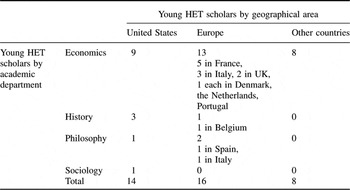
Advocates of the break-away move may argue that the data above largely reflect the presence at HET conferences of scholars who got into academia during less gloomy times. Therefore, those data would be uninformative about the future prospects for young HET scholars. In order to address this issue, I constructed a different database. I recorded for the period from 2000 to 2006 the participants in the special Ph.D. student sessions at the ESHET conferences, the participants in the Young Scholar Sessions at the HES meetings, and the winners of the Dorfman Award for the best dissertation in the history of economics.Footnote 6 After cleaning out some double presences, I obtained a list including 101 scholars who can be considered “young.” By using Google, I then found that thirty-eight of these scholars are now working as lecturers, assistant professors or associate professors. More exactly, sixteen entered academia in Europe (five in France; four in Italy; two in the UK; one each in Belgium, Denmark, the Netherlands, Portugal, and Spain); fourteen got into academia in the United States, and eight in other countries (three in Colombia; two in Japan; and one each in Argentina, South Korea, and Turkey). Of these thirty-eight scholars, thirty—that is, seventy-nine percent—work in economics departments or other institutions involved in economic research.Footnote 7 A more precise analysis of the findings is displayed in Table 1.
Young HET scholars by geographical area and academic department

I submit that these data strongly suggest that even for young HET scholars, or at least for the large majority of them, the break-away move is a self-defeating one. This is particularly true for Europe and the “other countries,” but for the U.S., too.
III. FUTURE HISTORIANS SHOULD HAVE A GOOD BACKGROUND IN MAINSTREAM ECONOMICS
My second argument concerning the future of HET is pedagogical: future scholars in HET should be well trained in mainstream economics.Footnote 8 More exactly, they should be at ease with advanced micro- and macroeconomics, as well as with the underlying mathematics. A good knowledge of some more specific area of research, like econometrics, game theory, public finance, experimental or behavioral economics would also be useful. The straightest way to acquire such background is through a Ph.D. in economics, but a rigorous master's program in economics, in conjunction with a different doctoral degree, could lead to the same result.
The first reason for HET scholars to have a good background in mainstream economics is for research purposes. During the last century, and especially after World War II, economic science has been dominated by the mainstream approach, such that its developments in the second half of the twentieth century should be an important topic of research for historians. However, as also documented by Nuno Palma (Reference Palma2008), historiographical interest in post-WWII mainstream economics has so far not corresponded to its actual relevance.
In a certain sense this is good news for future HET scholars because it means that they have plenty of unexplored terrain to investigate. However, post-WWII mainstream theory employs sophisticated mathematical tools, and in order to understand its problems and developments one must be familiar with these tools. Without a good background in mathematics and advanced economic theory it will be difficult for future historians to go beyond John Maynard Keynes and Piero Sraffa and beyond Kenneth Arrow and Gerard Debreu, to write an insightful history of game theory from John Harsanyi to Robert Aumann, to describe competently the developments of decision theory from Leonard Jimmie Savage to David Schmeidler, or to narrate, as experts of the game, what has happened in macroeconomics with and after Robert Lucas. Moreover, if future historians lack the technical skills to understand what was going on in post-WWII economic theory, they will inevitably focus on the contexts of post-WWII economic theory and produce almost exclusively science-studies narratives. For the reasons illustrated in the previous section, the identification of HET with science-studies does not seem to me the best long-term equilibrium for our field.
Second, a good knowledge of mainstream economics is important not only for research purposes, but also for didactic ones. As I showed in Section II, the large majority of HET scholars work in economics departments, and they often teach HET to undergraduates in economics. I see two main reasons for teaching HET to these kind of students: HET can offer them a panoramic and perspective view of the discipline they are taught (let us call this the “compass function” of HET),Footnote 9 and, by making the students aware of non-mainstream ideas, HET may stimulate them to a critical study of economics (the “critical function” of HET).
My perception is that most courses in HET in European and American universities currently emphasize the critical function of HET. They are less effective in advising undergraduates on what has been done in choice and decision theory, general equilibrium theory, game theory, welfare economics and social choice theory, experimental and behavioral economics, growth and business-cycle theory, the political economy of macroeconomics, and so on in the last sixty years. Yet, in order to be able to offer the students a panoramic and orienting view of the recent developments of mainstream economics, future historians of economics should add to their traditional background in classical, heterodox, and pre-WWII neoclassical thought a solid training in recent and current mainstream economics.
Finally, there is a pragmatic reason for future HET scholars to have a good background in mainstream economics. As far as economics departments will remain the institutional home for most of them, future HET scholars need good economic backgrounds first to enter these departments, and then to teach economics courses, actively participate in departmental seminars, and have fruitful intellectual interactions with their economist colleagues.