



1 Introduction
In this paper, we deal with reversibility and transitivity properties of semigroup actions on topological spaces with emphasis on homogeneous spaces.
The concept of reversibility is well known in semigroup theory. It was first introduced by Ruppert [Reference Ruppert9] in relation to the problem of embedding semigroups into groups (see Lawson [Reference Lawson, Hofmann, Lawson and Lawson5] and Ruppert [Reference Ruppert9]). By Ore’s condition, a semigroup can be embedded into a group if it is cancellative and left or right reversible. So many questions on the reversibility of subsemigroups of topological groups are posed in the literature. For instance, Ruppert [Reference Ruppert9] has presented several reversibility properties for open subsemigroups of Lie groups (e.g., open semigroups are reversible in nilpotent Lie groups) and San Martin and Tonelli [Reference San Martin and Tonelli18] have shown that in semi-simple Lie groups there are no proper open reversible subsemigroups. Other topological and algebraic properties of semigroups were obtained as consequences of their reversibility properties (for instance, see [Reference San Martin10, Reference San Martin and Tonelli18]).
The theory of semigroups in Lie groups or topological groups has shown to be useful for understanding that reversibility entails topological (apart from algebraic) properties of the semigroups. A variant of the concept of reversibility was considered in [Reference Ruppert9], namely, the concept of mid-reversibility. There it was shown that mid-reversibility is related to connectivity properties of open subsemigroups. Other results that relate mid-reversibility and connected components of open subsemigroups were presented in [Reference Rocio and San Martin8]. Moreover, other results about mid-reversibility of semigroup actions on homogeneous spaces were presented in [Reference Reis, San Martin and Rocha7].
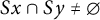
We consider in this paper another variant of the concept of reversibility, namely, the concept of reversible actions of semigroups on topological spaces. In [Reference Reis and San Martin6], Reis and San Martin studied the reversibility of subsemigroup actions on homogeneous spaces, with emphasis on flag manifolds. Let S be a subsemigroup of a topological group G acting on a topological space X. We say that S is reversible in X if
 $Sx\cap Sy\neq \emptyset $
for all
 $x,y\in X,$
that is, if any two S-orbits in X have nonempty intersection. This condition is equivalent to
 $S^{-1}Sx=X$
for all
 $x\in X.$
Clearly this condition is reduced to right (respectively left) reversibility if one considers the action of G on itself by left (right) translations. In [Reference Reis and San Martin6], it was shown that reversibility is related to the existence of a dense orbit in certain flag manifolds. There it was also shown that the concept of reversibility is related to the concept the transitivity. In [Reference San Martin14, Reference San Martin and Tonelli18, Reference San Martin and Tonelli19], it was studied the transitivity of subsemigroup actions on flag manifolds.
In this paper, we follow this line of investigation. We relate reversibility and the existence of a dense orbit in the setting of homogeneous spaces. We relate the concept of reversibility with minimal actions of subgroups on connected homogeneous spaces. We also present results on the behavior of the dynamical objects related to reversibility under equivariant fibrations between homogeneous spaces. The results presented here generalize the ones from [Reference Reis and San Martin6] on reversible actions of subsemigroups of Lie groups and give us further contributions to the theory of reversibility for semigroup actions.
In Section 2, we recall the basic concepts and results from the theories of reversibility and transitivity for semigroup actions that are used throughout this paper. The reversor set of a subsemigroup was defined in [Reference Reis and San Martin6]. There it was described in terms of the invariant control sets for semigroups acting on certain homogeneous spaces. Here we describe the reversor set of invariant control sets for S and present some properties of this set. We also prove results about the connectedness of the reversor set. In Section 3, we give necessary and sufficient conditions for a semigroup S in G to be reversible in a homogeneous space
 $G/L$
. Here S has nonempty interior in G and L is a closed subgroup of G. The conditions are given in terms of the actions of L and S on a given compact homogeneous space
 $G/H$
, e.g., see Theorem 3.4. This way Theorem 3.4 says that S is reversible in
 $G/L$
if and only if the L-action on
 $G/H$
has a dense orbit. We introduce the notion of transitivity modulo L and relate it with the concepts of reversibility. Also for this kind of semigroup, we show that the concepts of transitivity modulo L and transitivity of S in
 $G/L$
are equivalent. As an application of the results, we show that S is right reversible in G if S is reversible in
 $G/L$
. In Section 4, we relate the reversibility of S with the minimality of the action of L on homogeneous spaces of G (see Theorem 4.2), in the sense that every orbit is dense. This result allows us to relate the transitivity and the reversibility of S in terms of the action of L.
In Section 5, we study the behavior of the dynamical objects related to reversibility under equivariant fibrations. We start with some results on the reversibility of S in the total and base spaces of a general fibration. Afterward, we focus on equivariant fibrations
 $\pi :G/H_{1}\rightarrow G/H_{2}$
between homogeneous spaces. In this section, the main result is Theorem 5.8. It gives necessary and sufficient conditions for a semigroup S in G to be reversible in a homogeneous space
 $G/L$
. It characterizes the reversibility of S in
 $G/L$
in terms of a dense L-orbit in the base space
 $G/H_{2}$
. Thus, we characterize the reversibility of S in terms of a minimal action of L on
 $G/H_2$
(Theorem 5.10).
2 Reversibility of semigroup actions
In this section, we recall the standard notations and concepts of the theories of control sets and reversibility for semigroup actions on topological spaces and present some results that will be used afterwards in this paper. The reversor set of a subsemigroup was defined in [Reference Reis and San Martin6]. There it was described in terms of the invariant control sets for semigroups acting on certain homogeneous spaces. Here we show that the reversor set of a certain class of subsets coincides with the reversor set of the semigroup. We present some properties of the reversor set in terms of these subsets. Such results generalize the ones from [Reference Reis and San Martin6, Section 2]. We also prove a result about the connectedness of the reversor set in topological spaces. We refer to [Reference Reis and San Martin6, Reference Ruppert9, Reference San Martin and Tonelli18, Reference San Martin and Tonelli19] for the theories of reversilibity and control sets (see also [Reference Arnold, Kliemann, Oeljeklaus, Arnold and Wihstutz1, Reference Rocio and San Martin8, Reference San Martin10, Reference San Martin11, Reference San Martin13, Reference San Martin14, Reference San Martin16]).
Let G be a topological group acting continuously (on the left) on a topological space X. This action is denoted by
 $gx$
with
 $g\in G$
and
 $x\in X.$
Let
 $S\subset G$
be a subsemigroup acting on X by the restriction of the action of G. The semigroup S acts on X as a semigroup of homeomorphisms. Analogously, the semigroup
 $S^{-1}$
acts on X as a semigroup of homeomorphisms.
A useful fact about subsemigroups is that S is contained in
 $S^{-1}S$
if S is a subsemigroup of a group G. In fact, for a given
 $s\in S$
, we have that
 $s=(s^{-1}s)s=s^{-1}(ss)$
. Since
 $SS$
is contained in S, it follows that s belongs to
 $S^{-1}S$
and the inclusion is proved.
The orbit of an element
 $x\in X$
under S is the set
 $Sx=\{gx:g\in S\}.$
For a subset
 $A\subset X$
, the union of all orbits
 $Sx$
, with
 $x\in A$
, is denoted by
 $SA$
. We say that a subset A is S-invariant (or invariant for S) if
 $SA\subset A$
. Moreover, we say that S is transitive on X (or that S acts transitively on X) if
 $Sx=X$
for all
 $x\in X$
.
A control set for S on X is a subset
 $D\subset X$
such that
 $D\subset \mathrm {cl}(Sx)$
, for all
 $x\in D,$
and D is maximal (by inclusion) with this property. An invariant control set for S (or an S-invariant control set) is a control set C whose closure is an S-invariant subset of X. A control set is said to be minimal if its closure is an
 $S^{-1}$
-invariant set.
Throughout this paper, we assume that
 $\mathrm {int}S\neq \emptyset $
. We consider here only control sets with nonempty interior.
Let D be a control set for S in X. The set of transitivity of D is defined as the set
 $D^{0}=\{x\in D:x\in \mathrm {int}Sx\}.$
An effective control set is a control set whose set of transitivity is nonempty. We have that both invariant and minimal control sets are effective, an invariant control set is closed and a minimal control set is open. Moreover, invariant control sets and minimal control sets always exist if X is compact. The set
 $D^{0}$
satisfies the following properties:
 $1)$
 $D^{0}$
is open;
 $2)$
 $D^{0}$
is S-invariant if D is an invariant control set;
 $3)$
 $D\subset (\mathrm {int}S)^{-1}x$
for every
 $x\in D^{0};$
 $4)$
 $D^{0}$
is dense in
 $D;$
 $5)$
 $D^{0}$
 $=$
D for a minimal control set;
 $6)$
for all
 $x,y\in D^{0}$
, there exists
 $g\in \mathrm {int}S$
such that
 $gx=y$
. These properties can be proved by arguing as in [Reference San Martin and Tonelli18, Proposition 2.2].
Throughout this paper we use the letter C to denote invariant control sets for the semigroup S in X. When we consider invariant control sets for the semigroup
 $S^{-1}$
, we use the notation
 $C^*$
. The superscript “
 $*$
” just indicates that the set
 $C^*$
is an invariant control set for the semigroup
 $S^{-1}$
. We adopt the same notation for other sets. If A is a subset of X that satisfies some property related to the semigroup S, we indicate by
 $A^*$
a subset of X that satisfies the analogous property for the semigroup
 $S^{-1}$
.
The following proposition, which can be proved by arguing as in [Reference Reis and San Martin6, Proposition 2.4], gives a further property ensuring that the minimal control sets for S are the sets of transitivity of the
 $S^{-1}$
-invariant control sets.
Proposition 2.1 Let X be a compact space. Suppose that G acts transitively on X. Then D
 $\subset X$
is a minimal control set for S if and only if
 $C^{\ast }=\mathrm {cl}(D)$
is an
 $S^{-1}$
-invariant control set. In this case
 $D=(C^{\ast })^{0}$
.
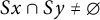
As defined in the introduction, we say that the semigroup S is reversible in X if any two S-orbits in X have nonempty intersection, that is,
 $Sx\cap Sy\neq \emptyset $
, for all
 $x,y\in X$
. In this case, S is reversible in X if and only if for all
 $x,y\in X$
, there exists
 $g\in S^{-1}S$
such that
 $gx=y$
, or equivalently,
 $S^{-1}Sx=X$
, for all
 $x\in X$
. Clearly this fact implies that G acts transitively on X if S is reversible in X.
A concept related to reversibility which was considered in [Reference Reis and San Martin6] is the reversor set of a nonempty subset A of
 $X.$
The reversor set of a nonempty subset A of X is defined by
 $\mathcal {R}(A)=\left \{ g\in G:gA\cap A\neq \emptyset \right \} .$
If A is a subset of G, the reversor set of A is denoted by
 $\mathcal {R}_{G}(A).$
We note that the concept of reversor set does not depend on the semigroup S. However, Reis and San Martin [Reference Reis and San Martin6] have presented sufficient conditions for the reversor set of a minimal control set to be equal to the reversor set of
 $S^{-1}.$
We recall the following property of the reversor set of a subset A of X proved in [Reference Reis and San Martin6, Proposition 2.1].
Proposition 2.2 Let G be a topological group acting in a topological space X and A a nonempty subset of
 $X.$
Then
-
(1)
 $\mathcal {R}(A)$
is open in G if A is an open in X and the map
$g\in G \longmapsto gx\in X$
is continuous for every
$x \in X$
.
-
(2)
$\mathcal {R}(A)$
is closed in G if A is compact and X is a Hausdorff space and G acts continuously on X.




We now recall the following proposition proved in [Reference Reis and San Martin6, Proposition 2.2].
Proposition 2.3 Let
 $L_{1}$
and
 $L_{2}$
be subgroups of G such that
 $L_{1}\subset L_{2}.$
Consider the canonical fibration
 $\pi :G/L_{1}\rightarrow G/L_{2}$
and take
 $A\subset G/L_{2}$
. Then
 $\mathcal {R}(\pi ^{-1}(A))=\mathcal {R}(A)$
.
Below to look at subsets having the same reversor set as a semigroup, we recall the following lemma proved in [Reference Reis and San Martin6, Lemma 2.3].
Lemma 2.4 Let X be a compact topological space and
 $A\subset X$
an invariant set for S. Then
 $\mathcal {R}_{G}(S)$
is contained in
 $\mathcal {R}(A).$
In particular, if D is a control set for S in X then
 $\mathcal {R}_{G}(S)$
is contained in
 $\mathcal {R}(D^{0}).$
As it is known from [Reference Reis and San Martin6], it may happen that the reversor set of S is different from the reversor set of A. We prove below that invariant sets in which the semigroup acts transitively have the same reversor set of the semigroup.
Theorem 2.5 Let X be a compact topological space and
 $A\subset X$
an invariant set for S. Suppose that S is transitive on A and
 $S\cap G_{x}=\left \{ g\in S:gx=x\right \} $
is left reversible in the isotropy subgroup
 $G_{x}$
for all
 $x\in A.$
Then
 $\mathcal {R}(A)=\mathcal {R}_{G}(S).$
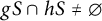
Consequently, for all
 $g,h\in G$
,
 $gS\cap hS\neq \emptyset $
if and only if
 $gA\cap hA\neq \emptyset .$
Moreover
 $\mathcal {R}_{G}(S)$
is an open set in G if A is an open subset of
 $\ X$
.
Proof By Lemma 2.4 it follows that
 $\mathcal {R}_G(S)$
is contained in
 $\mathcal {R}(A).$
Take now
 $g\in \mathcal {R}(A).$
Then
 $gA\cap A\neq \emptyset $
which implies that there exist
 $x,y\in A$
such that
 $x=gy.$
By the transitivity of S on A, there exists
 $h\in S$
such that
 $y=hx$
, that is,
 $x=ghx,$
which means that
 $gh$
 $\in G_{x}$
. From the assumption, we have that
 $gh\left ( S\cap G_{x}\right ) \cap \left ( S\cap G_{x}\right ) \neq \emptyset .$
Since
 $gh\in gS,$
we have
 $gS\cap S\neq \emptyset ,$
and therefore,
 $\mathcal {R}_{G}(S)$
contains
 $\mathcal {R}(A).$
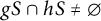
Finally, given
 $g,h\in G,$
we have that
 $gS\cap hS\neq \emptyset $
is equivalent to
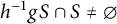 $h^{-1}gS\cap S\neq \emptyset $
, that is,
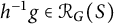 $h^{-1}g\in \mathcal {R}_{G}(S)$
or, equivalently,
 $h^{-1}gA\cap A\neq \emptyset $
and, by Proposition 2.2,
 $\mathcal {R}_{G}(S)$
is an open set in G, concluding the proof.
The class of subsets of X satisfying Theorem 2.5 includes the sets of transitivity of invariant control sets for S. Consequently, Theorem 2.5 holds for the set of transitivity
 $C^{0}$
of an invariant control set C for S in X (see, e.g., [Reference Reis and San Martin6, Proposition 2.5]).
As a consequence of the previous result we have
Corollary 2.6 Let X be a compact topological space and
 $A^{\ast }\subset X$
an invariant set for
 $S^{-1}$
. Suppose that
 $S^{-1}$
is a transitive in
 $A^{\ast }.$
Suppose that
 $S\cap G_{x}$
is right reversible in the isotropy subgroup
 $G_{x}$
for all
 $x\in A^{\ast }.$
Then
 $\mathcal {R}(A^{\ast })=\mathcal {R}_{G}(S^{-1}).$
Consequently, for all
 $g,h\in G$
,
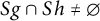 $Sg\cap Sh\neq \emptyset $
if and only if
 $g^{-1}A^{\ast }\cap h^{-1}A^{\ast } \neq \emptyset .$
Moreover,
 $\mathcal {R}_{G}(S^{-1})$
is an open set in G if
 $A^{\ast }$
is an open subset of X.
Proof The right reversibility of
 $S\cap G_{x}$
is equivalent to left reversibility of
 $S^{-1}\cap \, G_{x}.$
By applying Theorem 2.5 to the semigroup
 $S^{-1}$
the result follows.
The class of the subsets
 $A^{\ast }$
includes sets of transitivity of invariant control sets for
 $S^{-1}$
. We now observe that by Proposition 2.1, we have that every minimal control set for S is the transitivity set of some invariant control set for
 $S^{-1}$
. Consequently the previous corollary holds with a minimal control set D for S in X in place of
 $A^{\ast }$
(see [Reference Reis and San Martin6, Corollary 2.6]).
The hypotheses used in Theorem 2.5 and Corollary 2.6 are satisfied for semigroups acting on certain homogeneous spaces of noncompact semi-simple Lie groups. In fact, let G be a noncompact semi-simple Lie group with finite center and S a subsemigroup of G with nonempty interior. In the context of [Reference Reis and San Martin6, Section 3], let
 $C^{0}$
be the set of transitivity of the (unique) invariant control set C for S in the maximal flag manifold
 $\mathbb {F}=G/P$
, where P is the isotropy (minimal parabolic) subgroup at a given element
 $x\in C^{0}$
and let
 $P^{0}$
be identity component of P. Then
 $S\cap P^{0}$
is left reversible in
 $P^{0}$
. Moreover, if x belongs to a minimal control set, then
 $S\cap P^{0}$
is right reversible (that is,
 $S^{-1}\cap P^{0}$
is left reversible) in
 $P^{0}$
(see [Reference Reis and San Martin6, Proposition 3.4] and [Reference Rocio and San Martin8, Lemma 3.4]). This fact is fundamental in the study of reversibility in flag manifolds presented in [Reference Reis and San Martin6]. The hypotheses were also used in the study of mid-reversibility for semigroup actions on homogeneous spaces and flag manifolds (see [Reference Reis, San Martin and Rocha7, Proposition 2.4 and Sections 3 and 4]) and in the study of controllability of invariant control systems on Lie groups ([Reference Ayala and San Martin2, Proposition 33 and Theorem 34]).
We now consider the following proposition which can be proved by arguing as in [Reference San Martin and Tonelli18, Proposition 2.3].
Proposition 2.7 Suppose that X is a compact Hausdorff topological space. Assume that the set
 $C=\bigcap _{x\in X}\mathrm {cl}(Sx)$
is nonempty. Then C is the only invariant control set for S in X.
The following proposition can be proved by using the properties of control sets and arguing as in [Reference San Martin and Tonelli18, Corollary 2.4].
Proposition 2.8 Suppose that
 $C=\bigcap _{x\in X}\mathrm {cl} (Sx)\neq \emptyset $
is the only S-invariant control set in X and that there exists an
 $S^{-1}$
-invariant control set, say
 $C^{\ast }$
, such that
 $(\mathrm {int} C)\cap (\mathrm {int}C^{\ast })\neq \emptyset .$
Then S is transitive on X.
In Section 3, we apply the previous proposition to characterize reversibility in terms of transitivity in homogeneous spaces (see Theorem 3.10). By applying Proposition 2.7 and arguing as in [Reference Reis and San Martin6, Proposition 2.8] we have a characterization of reversibility in topological spaces in terms of the uniqueness of an invariant control set as follows.
Theorem 2.9 Suppose that X is a compact Hausdorff topological space. Then S has a unique invariant control set in X if and only if S is reversible in
 $X.$
We note that when X is a homogeneous space of a noncompact semi-simple Lie group G by a parabolic subgroup L, that is,
 $X=G/L$
is a flag manifold of G, the uniqueness of an invariant control set always holds (see [Reference San Martin11, Theorem 3.1]). This property does not hold in general, for instance, in coverings of flag manifolds (for example, for the action of
 $\mathrm {Sl} (n,\mathbb {R})$
on the unit sphere
 $\mathbb {S}^{n-1}$
which is a double covering of the real projective space
 $\mathbb {P}^{n-1}$
as we can see in [Reference Reis and San Martin6]). We refer to [Reference San Martin11, Reference San Martin and Tonelli18] for results on semi-simple Lie group and their flag manifolds.
The following proposition relates reversor sets and isotropy subgroups.
Proposition 2.10 Let G be a topological group. Assume that G acts on the topological space X and let A be a nonempty S-invariant subset of
 $X.$
Suppose that the semigroup S acts transitively on A. Then there exist
 $x,y\in A$
such that
 $\mathcal {R}(A)=SG_{x} =G_{y}S^{-1}$
.
Proof Take
 $g\in \mathcal {R}(A)$
. Then there exist
 $x,y\in A$
such that
 $gx=y$
. Since S is transitive in A, there exists
 $h\in S$
such that
 $y=hx$
. Thus
 $gx=hx$
and
 $h^{-1}g\in G_{x}$
. Hence,
 $g\in hG_{x}\subset SG_{x}$
. Conversely, pick
 $g\in SG_{x}$
. There exist
 $s_{1}\in S$
and
 $g_{1}\in G_{x}$
such that
 $g=s_{1}g_{1}$
. Then
 $gx=s_{1}g_{1}x=s_{1}x\in A$
with
 $x\in A$
. Therefore
 $g\in \mathcal {R}(A)$
. Similarly, one shows that
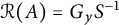 $\mathcal {R}(A)=G_{y}S^{-1}$
.
In the next result, we present sufficient conditions for S to be reversible in a subset
 $A\subset X$
.
Theorem 2.11 Suppose that X is a compact space. Assume that
 $A\subset X$
is an invariant set for S and S is transitive on
 $A.$
Suppose that
 $S\cap G_{x}$
is left reversible in the isotropy subgroup
 $G_{x}$
for all
 $x\in A.$
Then
 $S^{-1}$
is reversible in
 $A,$
that is,
 $SS^{-1}x=A$
for all
 $x\in A.$
Consequently, if C is an invariant control set for S in X and
 $S\cap G_{x}$
is left reversible in
 $G_{x}$
for all
 $x\in C^{0}$
then
 $S^{-1}$
is reversible in
 $C^{0},$
that is,
 $SS^{-1}x=C^{0}$
for all
 $x\in C^{0}.$
Proof Let
 $x\in A$
. It follows from Theorem 2.5 and Proposition 2.10 that
 $\mathcal {R}_{G}(S)$
is equal to
 $SG_{y},$
for some
 $y\in A$
, that is, the set
 $S^{-1}S$
is equal to
 $SG_{y}.$
Then by the isotropy property at y and the transitivity of S in A it follows that
 $SS^{-1}y=A.$
Again, from the transitivity of S in A, we have that
 $SS^{-1}x=A.$
The second assertion follows once that the set of transitivity
 $C^{0}$
of the invariant control set C satisfies the hypotheses for the set A.
As a consequence of Propositions 2.1 and 2.10 and Theorem 2.11 we have the following corollary for the semigroup
 $S^{-1}$
.
Corollary 2.12 Suppose that X is a compact space. Assume that
 $A^{\ast }\subset X$
is an invariant set for
 $S^{-1}$
. Suppose that
 $S^{-1}$
is transitive on
 $A^{\ast }$
. Then there exist elements
 $x,y\in A$
such that
 $\mathcal {R}(A^{\ast })=S^{-1}G_{x}=G_{y}S$
. Moreover, assume that
 $S\cap G_{x}$
is right reversible in the isotropy subgroup
 $G_{x}$
for all
 $x\in A^{\ast }.$
Then S is reversible in
 $A^{\ast },$
that is,
 $S^{-1}Sx=A^{\ast }$
for all
 $x\in A^{\ast }$
. Consequently, S is reversible in a minimal control set D for
 $S,$
that is,
 $S^{-1}Sx=D$
for all
 $x\in D$
if
 $S\cap G_{x}$
is right reversible in
 $G_{x}$
for all x in
 $D.$
As an application of Theorems 2.5 and 2.11 we now present the following result about the connectedness of the reversor set of a connected subset in X.
Theorem 2.13 Suppose that X is a compact space. Let
 $A\subset X$
be an invariant set for S. Suppose that S is transitive on A and
 $S\cap G_{x}$
is left reversible in the isotropy subgroup
 $G_{x}$
for all
 $x\in A.$
Assume that the map
 $g\in G\rightarrow gx\in X$
is open for every
 $x\in X$
. Then
 $\mathcal {R}(A)$
is a connected subset of G if and only if A is connected in X. It follows that
 $\mathcal {R}_{G}(S)$
is connected in G if A is a connected subset of X.
Proof To prove the first statement, assume that A is connected. Let U and V be open sets in G such that
 $\mathcal {R}(A)=U\cup V.$
Let
 $x\in A.$
By applying Theorem 2.5, we have that
 $\mathcal {R}(A)$
is equal to
 $SS^{-1}$
and hence by Theorem 2.11 it follows that
 $\mathcal {R}(A)x$
is equal to
 $SS^{-1}x=A.$
Therefore,
 $A=Ux\cup Vx$
with
 $Ux$
and
 $Vx$
open sets in A once that the map
 $g\in G\rightarrow gx\in X$
is open
 $.$
By the connectedness of the set A it follows that
 $Ux$
or
 $Vx$
are empty sets. This implies that
 $U=\emptyset $
or
 $V=\emptyset $
, and therefore,
 $\mathcal {R}(A)$
is connected. Conversely, assume that
 $\mathcal {R}(A)$
is connected subset of G. Let now
 $x\in A.$
Then by the continuity of action, we have that
 $\mathcal {R}(A)x$
is a connected subset of X. Then again applying Theorems 2.5 and 2.11, it follows that
 $\mathcal {R}(A)x$
is equal to
 $SS^{-1}x=A.$
Hence we can conclude that A is a connected subset of X. The other statement follows once that by Theorem 2.5
 $\mathcal {R} (A)$
is equal to
 $\mathcal {R}_{G}(S).$
We consider now an
 $S^{-1}$
-invariant subset
 $A^{\ast }$
of X on which
 $S^{-1}$
acts transitively. Thus applying Theorem 2.13 to the semigroup
 $S^{-1}$
we have the following corollary.
Corollary 2.14 Suppose that X is a compact space and
 $A^{\ast }\subset X$
is an invariant set for
 $S^{-1}$
. Assume that S is transitive on
 $A^{\ast }$
and
 $S\cap G_{x}$
is right reversible in the isotropy subgroup
 $G_{x}$
for all
 $x\in A^{\ast }.$
Then
 $\mathcal {R}(A^{\ast })$
is a connected subset of G if and only if
 $A^{\ast }$
is a connected set in X. It follows that
 $\mathcal {R}_{G}(S^{-1})$
is connected in G if
 $A^{\ast }$
is a connected subset of X.
We now recall the following result proved in [Reference San Martin and Tonelli18, Theorem 6.2] (see also [Reference San Martin11, Reference Warner20]) which ensures that if G is a connected noncompact semi-simple Lie group G with finite center, then G is the only of its semigroups with nonempty interior acting transitively on its flag manifolds, that is, homogeneous spaces
 $G/Q$
, where Q is a parabolic subgroup of G. Let now
 $S\subset G$
be a subsemigroup with nonempty interior acting on the flag manifold
 $G/Q$
.
Proposition 2.15 Let G be a connected noncompact semi-simple Lie group with finite center and suppose that S is a subsemigroup of G with nonempty interior. Then
 $S=G$
if S is transitive on
 $G/Q$
.
We conclude this section with an application of Corollary 2.6 showing that a certain semigroup is not reversible. We also give an application of the Corollary 2.14 showing that the reversor set of its minimal control sets are connected.
Example 2.16 Let G be the semi-simple Lie group
 $Sl(2,\mathbb {R})$
and consider the semigroup
 $S=Sl^{+}(2,\mathbb {R})$
of all matrices in G whose entries are nonnegative which has nonvoid interior in G (see, e.g., [Reference San Martin11]). We consider the subgroup P of G which is formed by the upper triangular
 $2\times 2$
real matrices in
 $G.$
We have that the identity connected component
 $P^{0}$
consists of the matrices in P with strictly positive diagonal elements. We know that the homogeneous space
 $G/P$
can be identified with the projective space
 $\mathbb {P}^{1}$
and its covering
 $G/P^{0}$
with the unity sphere
 $\mathbb {S}^{1}$
(see, e.g., [Reference San Martin15, Example 6.3.1]). Consider the canonical action of S on the unity sphere
 $\mathbb {S}^{1},$
regarded as the set of rays on
 $\mathbb {R}^{2}$
starting at the origin. Let
 $W=\left \{ (x,y)\in \mathbb {R}^{2}:x\geq 0,y\geq 0\right \} $
and take the sets
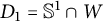 $D_{1}=\mathbb {S}^{1}\cap W$
and
 $D_{2}=\mathbb {S}^{1}\cap (-W)$
the part of
 $\mathbb {S}^{1}$
contained in the first and third quadrant respectively. One can see that the sets
 $D_{1}$
and
 $D_{2}$
are the invariant control sets for S in
 $\mathbb {S}^{1}$
(see [Reference San Martin11, Reference San Martin12]). The sets of transitivity of
 $D_1$
and
 $D_2$
are their respective interiors. We have that
 $\mathcal {R}(S) = \mathcal {R}((D_1)^0)$
(see also [Reference Reis and San Martin6, Section 2]). Also by Corollary 2.12 we have that for all
 $x\in (D_1)^0$
,
 $S^{-1}Sx=(D_1)^0$
, that is, S is reversible in
 $(D_1)^0.$
Applying now Proposition 2.2, we have that
 $\mathcal {R}((D_{1})^0)$
is open in
 $G.$
Moreover since
 $(D_1)^0$
is a connected subset of
 $\mathbb {S}^{1}$
then applying Corollary 2.14 it follows that
 $\mathcal {R}((D_1)^0)$
is a connected in
 $G.$
Similarly, the same holds for
 $(D_2)^0.$
Furthermore, since S admits two invariant control sets in
 $\mathbb {S}^1$
then by Theorem 2.9, we have that S is not reversible in
 $\mathbb {S}^1$
.
3 Reversibility and transitivity
Let G be a topological group and S a subsemigroup of G such that
 $\mathrm {int}S\neq \emptyset $
. Let L be a closed subgroup of
 $G.$
In this section, we present some results on the reversibility of semigroup actions on homogeneous spaces. We characterize the reversibility of S in
 $G/L$
in terms of the L-action on a given compact homogeneous space
 $G/H$
. We show that the reversibility in
 $G/L$
is equivalent to the existence of a dense L-orbit in
 $G/H$
and its consequences. As an application of the results we show that S is right reversible in G if S is reversible in
 $G/L$
. In addition, we show that the reversibility of S in
 $G/L$
is equivalent to the reversibility of
 $S^{-1}$
in
 $G/H.$
Such results generalize the ones from [Reference Reis and San Martin6, Section 4]. Finally, we introduce the concept of transitivity modulo L and relate it with the concepts of reversibility, e.g., we show that the concepts of reversibility in
 $G/L$
and transitivity in
 $G/H$
are equivalent.
As defined in [Reference Reis and San Martin6], we say that S is reversible modulo the subgroup L if
 $G=S^{-1}SL$
or, equivalently, S is reversible modulo L if and only if
 $S^{-1}Sx_{0}=X$
where
 $x_{0}=1\cdot L$
is the origin of the coset space
 $X=G/L.$
We start by recalling the following lemma proved in [Reference Reis and San Martin6, Lemma 2.7].
Lemma 3.1 The following statements are equivalent:
-
(1) S is reversible in
$G/L.$
-
(2) S is reversible modulo
$gLg^{-1},$
for all
$g\in G.$
-
(3) For all
$g,h\in G$
,
$SgL\cap ShL\neq \emptyset .$
-
(4) For all
$g,h\in G,$
there exist
$l_{1},l_{2}\in L$
such that
$Sgl_{1}\cap Shl_{2}\neq \emptyset $
. -
(5) For all
$g,h\in G,$
there exists
$l\in L$
such that
$Sgl\cap Sh\neq \emptyset .$









Next we present a characterization of the reversibility of S in
 $G/L$
in terms of the minimal control sets in a compact topological space X. This result gives the basic topological statement that yields the density condition of Theorem 3.4 and the main results of the next section. Its assumptions are the same of Theorem 2.5 and Corollary 2.6 and appear in the context of semigroup actions on flag manifolds.
By arguing as in [Reference Reis and San Martin6, Proposition 2.9] we have the following result.
Proposition 3.2 Let X be a compact topological space. Let L be a closed subgroup of G and S a subsemigroup of G with
 $\mathrm {int}S\neq \emptyset $
. Let D be a minimal control set for S in X. Suppose that
 $S\cap G_{x}$
is right reversible in the isotropy subgroup
 $G_{x}$
for
 $x\in D.$
Then the following statements are equivalent:
-
(1) S is reversible in
$G/L$
. -
(2) For all
$g,h\in G$
, there exists
$l\in L$
such that
$lg^{-1}D\cap h^{-1}D\neq \emptyset .$
-
(3) For all
$g,h\in G$
, there exists an L-orbit in X which intersects both
$g^{-1}D$
and
$h^{-1}D$
.





Proof By Lemma 3.1, we have that S is reversible in
 $G/L$
if and only if for all
 $g,h\in G,$
there exists
 $l_{1}\in L$
such that
 $Sgl_{1}h^{-1}\cap S\neq \emptyset .$
On the other hand, we observe that by Proposition 2.1, we have that every minimal control set for S is the transitivity set of some invariant control set for
 $S^{-1}$
. Hence, we can apply Corollary 2.6 for D in place of
 $A^*$
to conclude that S is reversible in
 $G/L$
if and only if
 $l_{1}^{-1}g^{-1}D\cap h^{-1}D\neq \emptyset .$
Then by taking
 $l=l_{1}^{-1}$
it follows that the first and second statements are equivalent. The equivalence between the second and the third statements is immediate.
Next we show that the reversibility of S in
 $G/L$
is equivalent to the existence of a dense L-orbit on X. From now on we assume that G acts continuously and transitively on a compact topological space X. We also assume the existence of a minimal control set D for S in
 $G/L$
such that for every open set U in
 $G/L$
there exists g such that
 $gD\subset U,$
that is, the open sets
 $gD$
with
 $g\in G$
determine a basis for the topology on
 $G/L$
. This assumption is satisfied for minimal control sets of semigroups acting on flag manifolds (see [Reference San Martin15, Proposition 3.13]).
In order to establish the next theorem, we need the following result from topological dynamics (see [Reference Reis and San Martin6, Lemma 4.7]).
Lemma 3.3 Let X be a separable Baire topological space on which a topological group T acts continuously. Then T has a dense orbit in X if and only if
 $TU\cap V\neq \emptyset $
for any nonempty open sets
 $U,V\subset X.$
We now characterize the reversibility in
 $G/L$
in terms of the action of L on a compact homogeneous space.
Theorem 3.4 Let
 $X=G/H$
be a compact and separable Baire homogeneous space. Let L be a closed subgroup of G and S a subsemigroup of G with
 $\mathrm {int}S\neq \emptyset .$
Let D be a minimal control set for S in
 $G/H$
. Assume that for all
 $x\in D$
the semigroup
 $S\cap H_{x}$
is right reversible in the isotropy subgroup
 $H_{x}$
which is conjugate to H. Then the following statements are equivalent:
-
(1) S is reversible in
$G/L.$
-
(2) For any nonempty open sets
$U,V$
in
$G/H$
, we have that
$LU\cap V\neq \emptyset .$
-
(3) L has a dense orbit in
$G/H.$




Proof Suppose that S is reversible in
 $G/L.$
By Proposition 3.2 this is equivalent to for all
 $g,h\in G$
, there exists an L-orbit in
 $G/H$
that intersects both
 $g^{-1}D$
and
 $h^{-1}D$
. Since the sets
 $gD$
determine a basis for the topology of
 $G/H$
, given open sets U and V in
 $G/H$
, there exist
 $g,h\in G$
such that
 $g^{-1}D\subset U$
and
 $h^{-1}D\subset V$
. This implies that
 $LU$
intersects
 $V,$
and therefore, the second statement holds. Conversely, take
 $g,h\in G.$
Since
 $g^{-1}D$
and
 $h^{-1}D$
are open sets in
 $G/H$
there exists an L-orbit in
 $G/H$
meeting both
 $g^{-1}D$
and
 $h^{-1}D.$
Then again applying Proposition 3.2, we have that S is reversible in
 $G/L$
. The second and the third statements are equivalent by Lemma 3.3.
We observe that applying Theorem 3.4, we have that S is reversible in
 $G/L$
if L has a dense orbit in
 $G/H$
. Hence by the definition of reversibility it follows that S is reversible modulo L. Therefore, if L has a dense orbit in
 $G/H$
then S is reversible modulo L. Conversely, suppose that S is reversible modulo L. This means that for all
 $h\in G$
, there exists an L-orbit in
 $G/H$
which meets both D and
 $h^{-1}D$
, that is,
 $LD\cap h^{-1}D\neq \emptyset .$
Then there exists
 $g\in L$
such that
 $hgD\cap D\neq \emptyset $
. Then applying Corollary 2.6 it follows that
 $hgS^{-1}\cap S^{-1} \neq \emptyset $
, that is, there exists
 $g\in L$
such that
 $hg$
belongs to
 $S^{-1}S.$
Take now
 $x_{0}\in D.$
Since from Corollary 2.12, we have that
 $S^{-1}Sx_{0}=D$
, we conclude that
 $hgx_{0}$
belongs to D. Hence
 $Lx_{0}$
intersects
 $h^{-1}D$
for every
 $h\in G.$
Let V be nonempty open set in
 $G/H.$
Since the sets
 $gD$
determine a basis for the topology on
 $G/H$
then there exists
 $h\in G$
such that
 $h^{-1}D\subset V$
. Thus
 $Lx_{0}$
intersects V, which means that L has a dense orbit in
 $G/H$
. We have proven the following corollary of Theorem 3.4.
Corollary 3.5 Let the notations and assumptions be as in Theorem 3.4. Then L has a dense orbit in
 $G/H$
if and only if
 $\ S$
is reversible modulo L.
Combining Theorem 3.4 with Corollary 3.5 we have
Corollary 3.6 Let the notations and assumptions be as in Theorem 3.4. Then S is reversible modulo L if and only if S is reversible in
 $G/L$
.
As an application of the results presented in this paper, we show in the next theorem that the reversibility of S in
 $G/L$
implies the right reversibility of S in G.
Theorem 3.7 With the previous notations, let
 $G/H$
be a compact and separable Baire homogeneous space and S a subsemigroup of G with
 $\mathrm {int}S\neq \emptyset .$
Let D be a minimal control set for S in X. Assume that for all
 $x\in D$
the semigroup
 $S\cap H_{x}$
is right reversible in the isotropy subgroup
 $H_{x}$
which is conjugate to H. Suppose that S is reversible modulo
 $L.$
If
 $S\cap L$
is right reversible in L then
 $G=S^{-1}S,$
that is, S is right reversible in G. The same holds if
 $S\cap L$
is left reversible in
 $L.$
Proof Firstly, assume that
 $S\cap L$
is right reversible in L. Since S is reversible modulo L then by Corollary 3.6 we have that S is reversible in
 $G/L$
. By applying Theorem 3.4 we have there exists an L-orbit in
 $G/H$
that intersects both D and
 $h^{-1}D,$
for all
 $h\in G,$
that is,
 $LD\cap h^{-1}D\neq \emptyset .$
Since L is contained in
 $S^{-1}S$
then by Corollary 2.12 it follows that
 $D\cap h^{-1} D\neq \emptyset ,$
that is,
 $h\in \mathcal {R}(D).$
By Corollary 2.6 it follows that h belongs to the reversor set of
 $S^{-1},$
that is,
 $h\in S^{-1}S,$
concluding the proof of the first statement. The other case is analogous.
As another application of the previous results we now prove that the reversibility of S in
 $G/L$
is equivalent to the reversibility of
 $S^{-1}$
in
 $G/H$
.
Theorem 3.8 Let
 $G/H$
be a compact and separable Baire homogeneous space. Let L be a closed subgroup of G and S a subsemigroup of G with
 $\mathrm {int} S\neq \emptyset .$
Let D be a minimal control set for S in
 $G/H$
. Assume that for all
 $x\in D$
the semigroup
 $S\cap H_{x}$
is right reversible in the isotropy subgroup
 $H_{x}$
which is conjugate to H. Suppose that the sets
 $gD$
with
 $g\in G$
determine a basis for the topology on
 $G/H.$
Assume that
 $S\cap L$
is right reversible in
 $L.$
Then S is reversible in
 $G/L$
if and only if
 $S^{-1}$
is reversible in
 $G/H.$
Furthermore S has a unique invariant control set in
 $G/L$
if and only if
 $S^{-1}$
has a unique invariant control set in
 $G/H.$
Proof Suppose that S is reversible in
 $G/L.$
Let
 $C^{\ast }$
be an invariant control set for
 $S^{-1}$
in
 $G/H$
such that
 $(C^{\ast })^{0}=D.$
We show that it is unique. In fact, let
 $C_{1}^{\ast }$
be an invariant control set for
 $S^{-1}$
in
 $G/H$
. Since D and
 $(C_{1}^{\ast })^{0}$
are open sets in
 $G/H$
by Theorem 3.4 it follows that there exists an L-orbit in
 $G/H$
that intersects both D and
 $(C_{1}^{\ast })^{0}$
. Since
 $S\cap L$
is right reversible in L then L is contained in
 $S^{-1}S$
. Hence from Corollary 2.12, we have that
 $LD$
is contained in D, so that the
 $S^{-1} $
- invariant control sets
 $C^{\ast }$
and
 $C_{1}^{\ast }$
have nonempty intersection, and therefore they coincide. This shows the uniqueness of
 $C^{\ast }.$
By Theorem 2.9 it follows that
 $S^{-1}$
is reversible in
 $G/H.$
Conversely, suppose that
 $S^{-1}$
is reversible in
 $G/H$
. Then from the definition of reversibility we have that
 $S^{-1}$
is reversible modulo H which means that for all
 $g\in G$
there exist
 $h\in H$
and
 $s,t\in S$
such that
 $s^{-1}g=t^{-1}h$
. Take now
 $x\in D.$
We can assume that H is the isotropy subgroup at
 $x.$
Then we have
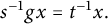 $s^{-1}gx=t^{-1}x.$
Let
 $y=t^{-1}x.$
Since
 $y\in D$
and
 $S^{-1}S$
contains S then again applying Corollary 2.12 it follows that
 $gx=sy$
belongs to
 $S^{-1}Sy=D$
. Then we have that
 $gx\in D,$
that is,
 $x\in g^{-1}D$
for all
 $g\in G.$
Since
 $x\in Lx$
it follows that
 $Lx$
intersects
 $g^{-1}D$
for all
 $g\in G$
. Hence, for all
 $g,h\in G$
, there exists an L-orbit in
 $G/H$
which intersects both
 $g^{-1}D$
and
 $h^{-1}D$
. Therefore, by Proposition 3.2, we have that S is reversible in
 $G/L$
. Finally, the last statement follows from Theorem 2.9.
We have the following corollary of Theorem 3.8.
Corollary 3.9 Let the notations and assumptions be as in the previous theorem. Suppose that
 $G/L$
is a compact and separable Baire homogeneous space. Then S is reversible in
 $G/L$
if and only if
 $S^{-1}$
is reversible in
 $G/L$
. Furthermore S has a unique invariant control set in
 $G/L$
if and only if
 $S^{-1}$
has a unique invariant control set in
 $G/L.$
We now relate the concepts of reversibility to the concepts of transitivity. We recall that a semigroup S is transitive in
 $G/L$
if
 $Sx=G/L$
for every
 $x\in G/L$
or equivalently,
 $SgL\cap hL\neq \emptyset $
for all
 $g,h\in G$
. Moreover, we say that S is transitive modulo L if
 $SL=G$
or equivalently,
 $Sx_{0}=G/L$
where
 $x_{0}=1\cdot L$
is the origin of the coset space
 $G/L$
. Notice that S is transitive in
 $G/L$
if and only if S is transitive modulo
 $gLg^{-1}$
for all
 $g\in G$
. We have that S is transitive in
 $G/L$
if and only if for all
 $g,h\in G$
there exists
 $l\in L$
such that
 $hl\in Sg$
. We also have that S is transitive modulo L if and only if
 $gS\cap L\neq \emptyset $
for all
 $g\in G$
.
In the context of Theorem 3.8 we prove in the next theorem that the reversibility of S in
 $G/L$
is equivalent to the transitivity of S in
 $G/H$
.
Theorem 3.10 Let
 $G/H$
be a compact and separable Baire homogeneous space. Let L be a closed subgroup of G and S a subsemigroup of G with
 $\mathrm {int}S\neq \emptyset .$
Let D be a minimal control set for S in
 $G/H$
. Assume that for all
 $x\in D$
the semigroup
 $S\cap H_{x}$
is right reversible in the isotropy subgroup
 $H_{x}$
which is conjugate to H. Suppose that the sets
 $gD$
with
 $g\in G$
determine a basis for the topology on
 $G/H.$
Assume that
 $S\cap L$
is right reversible in
 $L.$
Then S is reversible in
 $G/L$
if and only if S is transitive in
 $G/H.$
It follows that S is reversible in
 $G/L$
if and only if S is transitive in
 $G/L$
.
Proof Suppose that S is reversible in
 $G/L.$
Let
 $C^{\ast }$
be the unique invariant control set for
 $S^{-1}$
in
 $G/H$
such that
 $(C^{\ast })^{0}=D$
as in the proof of Theorem 3.8. Let C be an invariant control set for S in
 $G/H$
. By the same procedure as above, since D and
 $C^{0}$
are open sets in
 $G/H$
then applying Theorem 3.4 and Corollary 2.12 it follows that D and
 $C^{0}$
have nonempty intersection. By Proposition 2.8 it follows that
 $S^{-1}$
is transitive in
 $G/H$
, that is, S is transitive in
 $G/H$
. Conversely, if S is transitive in
 $G/H$
it follows immediately that S is reversible in
 $G/H.$
The result follows from Theorem 3.8.
As in the previous theorem, we now observe that the transitivity in
 $G/L$
implies reversibility in
 $G/L$
once
 $S^{-1}S$
contains S. Hence by applying Corollary 3.5, we have that L has a dense orbit in
 $G/H$
. Therefore, if S is transitive in
 $G/H$
then, we have that L has a dense orbit in
 $G/H$
. The converse follows by combining Theorems 3.4 and 3.10. Thus we have proven the following proposition.
Proposition 3.11 Let the notations and assumptions be as in Theorem 3.10. Suppose that
 $G/H$
is a compact and separable Baire homogeneous space. Then S is transitive in
 $G/H$
if and only if L has a dense orbit in
 $G/H$
.
From the definition of transitivity, we have that transitivity in
 $G/L$
implies transitivity modulo L. In order to prove the converse, we observe that transitivity modulo L implies reversibility modulo L because S is contained in
 $S^{-1}S$
. Hence by combining Corollary 3.6 and Proposition 3.11 it follows that S is transitive in
 $G/H$
. We have the following corollary.
Corollary 3.12 Let the notations and assumptions be as in Theorem 3.10. Suppose that
 $G/H$
is a compact and separable Baire homogeneous space. Then S is transitive in
 $G/H$
if and only if S is transitive modulo L. It follows that S is transitive in
 $G/L$
if and only if S is transitive modulo L.
We now present an example of a subsemigroup which is reversible but not transitive.
Example 3.13 We consider the semisimple Lie group
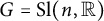 $G=\mathrm {Sl}(n,\mathbb {R})$
and the semigroup
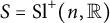 $S=\mathrm {Sl}^{+}(n,\mathbb {R})$
which is the subsemigroup of G of all matrices with nonnegative entries. Consider now the canonical action of S on the real projective space
 $\mathbb {P}^{n-1}$
given by
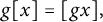 $g[x]=[gx],$
where
 $[x]$
is the equivalence class in
 $\mathbb {P}^{n-1}$
of the element x in
 $\mathbb {R}^{n}$
with
 $x\neq (0,...,0).$
Let
 $C=\{[x_{1} ,...,x_{n}]:x_{i}\geq $
 $0\}$
be the subset of
 $\mathbb {P}^{n-1}$
corresponding to the positive orthant in
 $\mathbb {R}^{n}$
. This set is the only invariant control set for S in
 $\mathbb {P}^{n-1}$
. Then by Theorem 2.9, we have that S is reversible in
 $\mathbb {P} ^{n-1}.$
By applying Proposition 2.15, we have that S is not transitive in
 $\mathbb {P}^{n-1}$
because S is a proper subsemigroup of
 $\ \mathrm {Sl}(n,\mathbb {R}).$
4 Reversibility and minimality
Let G be a topological group and S a subsemigroup of G with nonempty interior. Let L be a closed subgroup of
 $G.$
We recall that the action of L on a topological space X is minimal if every orbit of L in X is dense. In this case, we simply say that L is minimal in X. In this section we relate the reversibility of S with the minimality of the action of L on connected homogeneous spaces of G. The results obtained from this relation allow us to analyse the transitivity of S and the reversibility in terms of the action of L on homogeneous spaces of G.
We start with the following result.
Proposition 4.1 Let L be a closed subgroup of G and let S be a subsemigroup of G with
 $\mathrm {int}S\neq \emptyset $
. Let D be a minimal control set for S in
 $G/H$
and let
 $C^{\ast }$
be its closure. Assume that
 $S\cap H_{x}$
is right reversible in the isotropy subgroup
 $H_{x}$
which is conjugate to H for all
 $x\in D$
. Assume also that S is reversible in
 $G/L$
. Then
 $C^{\ast }$
is contained in the closure of
 $Ly$
for every
 $y\in C^{\ast }$
.
Proof Take
 $x\in D$
and let U be an open neighborhood of x in
 $G/H$
. Since the sets
 $gD$
determine a basis for the topology on
 $G/H$
there exists
 $h\in G$
such that
 $h^{-1}D\subset U.$
Since S is reversible in
 $G/L$
then it follows that there exists
 $g\in L$
such that
 $hg\in S^{-1}S$
. By applying Corollary 2.12 we have that
 $hgD$
is contained in D, which implies that
 $gD$
is contained in
 $h^{-1}D$
. Hence we have
 $gD\subset U$
with
 $g\in L.$
This fact shows that x belongs to the closure of
 $Ly$
for every
 $y\in C^{\ast }$
because U was arbitrarily choosen. Since
 $x\in D$
the statement follows from the density of D in
 $C^{*}$
.
We now show that in case
 $G/H$
is connected the reversibility of S in
 $G/L$
implies that all the L-orbits on
 $G/H$
are dense, that is, that the action of L on
 $G/H$
is minimal. This result will be proved applying the previous proposition several times. As before let D be a minimal control set for S in
 $G/H$
and let
 $C^{\ast }$
be its closure. We have that the invariant control set
 $C^{\ast }$
for
 $S^{-1}$
satisfies the assumptions of Proposition 4.1. We now observe that reversibility of the semigroup S in
 $G/L$
is equivalent to reversibility of the semigroup
 $gSg^{-1}$
in
 $G/L$
with
 $g\in G.$
We have that
 $gD$
is a minimal control set for the semigroup
 $gSg^{-1}$
and its closure
 $gC^{\ast }$
is an invariant control set for
 $gS^{-1}g^{-1}$
for every
 $g\in G.$
Then Proposition 4.1 also holds for
 $gC^{\ast }$
in place of
 $C^{\ast } $
, that is,
 $gC^{\ast }$
is contained in the closure of
 $Ly$
for every
 $y\in gC^{\ast }$
. Hence, the same holds for the minimal control set
 $gD$
for
 $gSg^{-1}$
which is the interior of
 $gC^{\ast }.$
Therefore, we have the following result.
Theorem 4.2 Let
 $G/H$
be a connected compact homogeneous space. Let L be a closed subgroup of G and S a subsemigroup of G such that
 $\mathrm {int}S\neq \emptyset $
. Let D be a minimal control set for S in
 $G/H$
. Suppose that
 $S\cap H_{x}$
is right reversible in the isotropy subgroup
 $H_{x}$
which is conjugate to H for all
 $x\in D$
. Then the action of L on
 $G/H$
is minimal if S is reversible in
 $G/L$
.
Proof As in the assumption let D be a minimal control set for S in
 $G/H$
and let
 $C^{\ast }$
be the closure of D in
 $G/H$
. Given
 $g\in G,$
we have that
 $gC^{\ast }$
is an invariant control set for
 $gS^{-1}g^{-1}$
for every
 $g\in G$
. We consider the interior
 $\mathrm {int}(gC^{\ast })$
of
 $gC^{\ast },$
which is the set
 $gD,$
as mentioned above. Since these sets form a covering of
 $G/H,$
from the compactness of
 $G/H$
it follows that there exists a finite number of elements
 $g_{1},...,g_{n}\in G$
such that
 $G/H$
is contained in the finite union of the open sets
 $g_{r}D$
in
 $G/H$
with
 $r=1,...,n.$
Now, take x and y in
 $G/H$
and let V be an open in
 $G/H$
containing x. We prove that
 $Ly$
intersects V. Put
 $W_{r}=g_{r}D.$
From the connectedness of
 $G/H$
, we can consider open sets
 $W_{1},...,W_{r}$
such that
 $y\in W_{1}$
,
 $W_{n}$
meets V and
 $W_{r}$
meets
 $W_{r+1}$
for
 $r=1,...,n-1$
. Take
 $u_{r}\in W_{r}\cap W_{r+1}$
for
 $r=1,...,n-1.$
Since
 $u_{1}$
belongs to
 $W_{1}$
then by Proposition 4.1, we have that
 $u_{1}\in \mathrm {cl} (Ly),$
which implies that
 $Ly$
intersects
 $W_{1}\cap W_{2}$
. Thus there exists
 $h_{1}\in L$
such that
 $h_{1}y\in W_{1}\cap W_{2}.$
By taking
 $y_{1}=h_{1}y\in W_{2}$
and again applying Proposition 4.1, we have that
 $u_{2}\in \mathrm {cl}(Ly_{1})$
. Then we have that
 $Lh_{1}y$
intersects
 $W_{2}\cap W_{3}$
implying that there exists
 $y_{2}\in W_{2}\cap W_{3}$
such that
 $y_{2}=h_{2}h_{1}y$
for some
 $h_{2}\in L.$
By proceeding in this way, since
 $u_{r}$
belongs to
 $W_{r}$
then
 $u_{r}\in \mathrm {cl}(Ly_{r-1})$
and we can get
 $y_{r}\in W_{r}\cap W_{r+1}$
with
 $y_{r}=\ h_{r}y_{r-1}$
for some
 $h_{r}\in L.$
Since
 $u_{n}\in W_{n}$
by the same proposition, we have that
 $u_{n}\in \mathrm {cl}(Ly_{n-1})$
and
 $Ly_{n-1}$
intersects
 $W_{n}\cap V,$
that is, there exists
 $h_{n}\in L$
such that
 $y_{n}=h_{n}y_{n-1}.$
Hence by taking
 $h=h_{n}h_{n-1}\cdots h_{2}h_{1}\in L$
, we have that
 $hy$
belongs to
 $V,$
that is,
 $Ly\cap V\neq \emptyset $
. Since V and y were arbitrarily choosen, we conclude the statement.
By combining Proposition 3.2 with Theorem 4.2, we have the following corollary.
Corollary 4.3 With the notations and assumptions of Theorem 4.2, let
 $G/H$
be a connected and compact homogeneous space. Let L be a closed subgroup of G and S a subsemigroup of G such that
 $\mathrm {int}S\neq \emptyset $
.
-
(1) Then S is reversible in
$G/L$
if and only if the L-action on
$G/H$
is minimal. -
(2) Suppose that
$G/H$
is a compact and separable Baire homogeneous space. Then L has a dense orbit in
$G/H$
if and only if L is minimal in
$G/H$
.


Proof Suppose that L is minimal in
 $G/H$
. Then we have that there exists a dense L-orbit in
 $G/H.$
Hence, for all
 $g,h\in G$
, there exists an L-orbit in
 $G/H$
which intersects both
 $g^{-1}D$
and
 $h^{-1}D$
. By Proposition 3.2 it follows that S is reversible in
 $G/L$
. The converse follows from Theorem 4.2. The second claim follows from Theorem 3.4.
Applying Theorem 3.10 and Corollary 4.3 we have
Corollary 4.4 Let the notations and assumptions be as in Theorem 4.2. Suppose that
 $G/H$
is a compact and separable Baire homogeneous space. Suppose also that
 $G/H$
is connected. Let D be a minimal control set for S in
 $G/H$
and assume that
 $S\cap H_{x}$
is right reversible in the isotropy subgroup
 $H_{x}$
conjugate to H for all
 $x\in D$
. Assume that
 $S\cap L$
is right reversible in
 $L.$
Then S is transitive in
 $G/H$
if and only if the action of L on
 $G/H$
is minimal.
The following result concerns the existence of a compact orbit for the action of L in the context of Theorem 4.2.
Proposition 4.5 With the previous notations, let
 $G/H$
be a connected and compact homogeneous space. Let L be a closed subgroup of G and S a subsemigroup of G such that
 $\mathrm {int}S\neq \emptyset $
. Let D be a minimal control set for S in
 $G/H$
. Assume that
 $S\cap H_{x}$
is right reversible in the isotropy subgroup
 $H_{x}$
for all
 $x\in D$
, and that L has a compact orbit in
 $G/H$
.
-
(1) Then S is reversible in
$G/L$
if and only if L is transitive in
$G/H$
. -
(2) Suppose that
$G/H$
is a compact and separable Baire homogeneous space. Then L is minimal in
$G/H$
if and only if L is transitive in
$G/H$
.


Proof Suppose that S is reversible in
 $G/L.$
By Theorem 4.2 we have L is minimal in
 $G/H$
. Now, let
 $x\in G/H$
such that
 $Lx$
is compact. Since
 $Lx$
is a compact orbit in
 $G/H$
we have
 $Lx$
is closed in
 $G/H$
. Therefore,
 $Lx=G/H$
which means that L is transitive in
 $G/H$
. The converse also follows by applying Theorem 4.2 because the assumption that L is transitive in
 $G/H$
implies that L is minimal in
 $G/H$
. The last assertion follows from Corollary 4.3.
Now in case
 $G/H$
is compact and Baire separable then by combining Corollary 4.4 and item 2 of Proposition 4.5 we have that the transitivity of S in
 $G/H$
is equivalent to the transitivity of L in
 $G/H$
. Hence by combining Proposition 4.5 and Corollary 4.3 this is equivalent to L to have a dense orbit in
 $G/H$
. Thus, we have the following corollary.
Corollary 4.6 As in Proposition 4.5, suppose that
 $G/H$
is a compact and separable Baire homogeneous space. Suppose also that
 $G/H$
is connected. Assume that L has a compact orbit in
 $G/H$
. Then the following statements are equivalent:
-
(1) S is transitive in
$G/H$
. -
(2) L is transitive in
$G/H$
. -
(3) L has a dense orbit in
$G/H$
.


5 Reversibility and equivariant fibrations
In this section, we state and prove our main results on reversibility under equivariant fibrations. Firstly, we present some basic general results in this direction. After, we focus on the particular case of equivariant fibrations
 $\pi :G/H_{1}$
 $\rightarrow G/H_{2}$
between homogeneous spaces. Our main result here is Theorem 5.8. It gives necessary and sufficient conditions for a semigroup S in G to be reversible in a homogeneous space
 $G/L$
. It characterizes the reversibility of S in
 $G/L$
in terms of a dense L-orbit in the base space
 $G/H_2$
. This result allows us to relate the reversibility of S in
 $G/L$
in terms of a minimal action of L on
 $G/H_2$
(Theorem 5.10) and also in terms of a transitive action of L on
 $G/H_2$
(Corollary 5.11). We refer to [Reference Husemoller4] for the theory of fibrations.
Let G be a topological group acting on topological spaces X and Y and S a subsemigroup of G with int
 $S\neq \emptyset $
. A (surjective) fibration
 $\pi :X\rightarrow Y$
is equivariant with respect to the action of G if
 $\pi (gx)=g\pi (x)$
for all
 $x\in X$
and
 $g\in G$
.
In the following, we show that S is reversible in the base space if it is reversible in the total space of a fibration.
Proposition 5.1 Suppose that
 $\pi :X\rightarrow Y$
is an equivariant fibration. Then S is reversible in Y if S is reversible in X.
Proof Take
 $y_{1},y_{2}\in Y$
. We have that there exist
 $x_{1},x_{2}\in X$
such that
 $\pi (x_{1})=y_{1}$
and
 $\pi (x_{2})=y_{2}$
. Since S is reversible in X, it follows that
 $Sx_{1}\cap Sx_{2}\neq \emptyset .$
The result follows from the equivariance of
 $\pi $
.
We now present sufficient conditions for the reversibility in the total space.
Proposition 5.2 Suppose that
 $\pi :X\rightarrow Y$
is an equivariant fibration. Assume that S is reversible in the fiber
 $\pi ^{-1}\{y\}$
, for all
 $y\in Y$
. Then S is reversible in X if S is reversible in Y.
Proof Take
 $x_{1},x_{2}\in X.$
Since S is reversible in Y, it follows that
 $S\pi (x_{1})$
intersects
 $S\pi (x_{2})$
. Then there exist
 $s_{1},s_{2}\in S$
such that
 $s_{1}\pi (x_{1})=s_{2}\pi (x_{2})$
. By the equivariance of
 $\pi $
we have that
 $\pi (s_{1}x_{1})=\pi (s_{2}x_{2})$
. Since S is reversible in the fibers then there exist
 $s_{3},s_{4}\in S$
such that
 $s_{3}s_{1}x_{1} =s_{4}s_{2}x_{2}$
. Therefore,
 $Sx_{1}\cap Sx_{2}\neq \emptyset $
and S is reversible in X.
By Propositions 5.1 and 5.2 we have that S is reversible in X if and only if S is reversibile in Y. Hence, combining this result with Theorem 2.9, we have the following proposition.
Proposition 5.3 Suppose that
 $\pi :X\rightarrow Y$
is an equivariant fibration and assume that X is a compact Hausdorff space. Assume also that S is reversible in
 $\pi ^{-1}\{y\}$
, for all
 $y\in Y$
. Then S has a unique invariant control set in X if and only if S has a unique invariant control set in Y.
From now on we are focused on equivariant fibrations between homogeneous spaces (for instance, see [Reference San Martin and Tonelli18]). Let
 $H_{1}\subset H_{2}$
be closed subgroups of G and consider the homogeneous spaces
 $G/H_{1}$
and
 $G/H_{2}$
. We consider the standard left actions of G on both
 $G/H_{1}$
and
 $G/H_{2}$
and the canonical equivariant fibration
 $\pi :G/H_{1}$
 $\rightarrow G/H_{2}$
defined by
 $\pi (gH_{1})=gH_{2}$
. We prove below our main results about reversibility in the homogeneous space
 $G/L$
. Our conditions for reversibility of S in
 $G/L$
are given in terms of the action of L on the base space
 $G/H_2$
. We now note that by Proposition 5.1 it is immediate that if S is reversible in
 $G/H_{1}$
then S is reversible in
 $G/H_{2}$
. As a reciprocal of this fact, we have the following result.
Proposition 5.4 As above, let
 $H_{1}$
 $\subset H_{2}$
be closed subgroups. Suppose that S is reversible in
 $H_{2}/H_{1}$
. Then S is reversible in
 $G/H_{1}$
if and only if S is reversible in
 $G/H_{2}.$
Proof Suppose that S is reversible in
 $G/H_{2}.$
Consider the canonical equivariant fibration
 $\pi :$
 $G/H_{1}\rightarrow G/H_{2}$
with fiber
 $\pi ^{-1}\{y\}$
which identifies with
 $H_{2}/H_{1}$
. Since S is reversible in
 $H_{2}/H_{1}$
by appyling Proposition 5.2 it follows that S is also reversible in
 $G/H_{1}$
. The converse is immediate by Proposition 5.1.
Combining Propositions 5.3 and 5.4 we have
Corollary 5.5 With the notations and assumptions of the previous proposition, suppose that
 $G/H_{1}$
is compact Hausdorff. Assume that S is reversible in
 $H_{2} /H_{1}.$
Then S has a unique invariant control set in
 $G/H_{1}$
if and only if S has a unique invariant control set in
 $G/H_{2}.$
Now let L be a closed subgroup of G. With the above assumptions we consider below the homogeneous space
 $G/L$
to relate the reversibility of S in
 $G/H_{1}$
and
 $G/H_{2}$
. The conditions are given in terms of the actions of L and S on the homogeneous spaces
 $G/H_{1}$
and
 $G/H_{2}$
.
Let
 $\pi :G/H_{1}$
 $\rightarrow G/H_{2}$
be the canonical fibration and assume that
 $G/H_{1}$
is compact. Let
 $C_{1}$
be an invariant control set for S in
 $G/H_{1}$
. We say that the invariant control set
 $C_{1}$
satisfies hypothesis
 $\mathcal {H}$
if there exists an invariant control set
 $C_{2}$
for S in
 $G/H_{2}$
such that
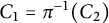 $C_{1}=\pi ^{-1}(C_{2})$
, with
 $C_{2}=\pi \left ( C_{1}\right ) $
and
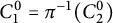 $C_{1}^{0}=\pi ^{-1}(C_{2}^{0})$
. We observe that hypothesis
 $\mathcal {H}$
is satisfied, for instance, in case of natural fibrations between covering spaces of flag manifolds of G, where G is a connected noncompact semi-simple Lie group with finite center, S is a subsemigroup of G with nonempty interior and with parabolic type given by
 $\Theta (S)=\Theta $
(see [Reference Reis and San Martin6, Lemma 4.2]). Other contexts in which hypothesis
 $\mathcal {H}$
is satisfied can be found in [Reference Barros and San Martin3, Lemma 2.1] and [Reference San Martin and Tonelli18, Proposition 2.7] (see also [Reference Rocio and San Martin8, Reference San Martin and Santana17]).
Let
 $D_{1}$
be a minimal control set for S in
 $G/H_{1}$
. Since
 $G/H_{1}$
is compact, it follows from Proposition 2.1 that there exists an invariant control set
 $C_{1}^{*}$
for
 $S^{-1}$
in
 $G/H_{1}$
such that
 $D_{1}=(C_{1}^{*})^{0}$
. If
 $C_{1}^{*}$
satisfies hypothesis
 $\mathcal {H}$
, it is immediate from Proposition 2.1 that there exists a minimal control set
 $D_{2}$
for S in
 $G/H_{2}$
such that
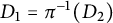 $D_{1}=\pi ^{-1}(D_{2})$
, where
 $D_{2}=\pi \left ( D_{1}\right ) .$
From now on in this section we assume that the invariant control sets that we consider satisfy hypothesis
 $\mathcal {H}$
. Consequently, the minimal control sets that we consider in the next results satisfy the properties mentioned above. For this class of control sets, we have that the reversor set of an invariant control set for S in
 $G/H_{1}$
is the reversor set of some invariant control set for S in
 $G/H_{2}$
, as we see in the next result.
Proposition 5.6 With the above notations and assumptions, let S be a subsemigroup of G with
 $\mathrm {int}S\neq \emptyset $
and
 $C_{1}\subset G/H_{1}$
an invariant control set for S satisfying hypothesis
 $\mathcal {H}$
. Then
 $\mathcal {R}(C_{1})=\mathcal {R}(C_{2})$
for some invariant control set
 $C_{2}$
for S in
 $G/H_{2}.$
Furthermore, we have that
 $\mathcal {R}((C_{1})^{0})=\mathcal {R}((C_{2})^{0}).$
Proof As mentioned above, there exists an S-invariant control set
 $C_{2}\subset G/H_{2}$
such that
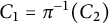 $C_{1}=\pi ^{-1}(C_{2})$
, where
 $\pi : G/H_1 \rightarrow G/H_2$
is the canonical fibration. Then applying Proposition 2.3 to the projection
 $\pi $
it follows that
 $\mathcal {R} (C_{1})=\mathcal {R}(C_{2}).$
Since
 $(C_{1})^{0}=\pi ^{-1}((C_{2})^{0})$
, the statement for the sets of transitivity also follows by applying Proposition 2.3.
In the following, we characterize the reversibility in
 $G/L$
in terms of minimal control sets on the homogeneous space
 $G/H_{2}.$
This result yields the density condition of Theorem 5.8.
Theorem 5.7 Let L and
 $H_1\subset H_2$
be closed subgroups of G and S a subsemigroup of G with
 $\mathrm {int}S\neq \emptyset $
and assume that
 $G/H_{1}$
is compact. Let
 $D_{1}$
be a minimal control set for S in
 $G/H_{1}$
satisfying hypothesis
 $\mathcal {H}$
. Assume that for all
 $x\in D_{1}$
the semigroup
 $S\cap (H_{1})_{x}$
is right reversible in the isotropy subgroup
 $(H_{1})_{x}$
which is conjugate to
 $H_{1}$
. Then the following statements are equivalent:
-
(1) S is reversible in
$G/L$
. -
(2) Let
$D_{2}\subset G/H_{2}$
be a minimal control set for S as above. Then for all
$g,h\in G$
, there exists an L-orbit in
$G/H_{2}$
that intersects both
$g^{-1}D_{2}$
and
$h^{-1}D_{2}.$


Proof By Proposition 2.1, we have that the minimal control set
 $D_{2}$
for S is the set of transitivity of an
 $S^{-1}$
-invariant control set
 $C_{2}^{\ast }\subset $
 $G/H_{2}$
. Similarly we also have that
 $D_1$
is the set of transitivity of an
 $S^{-1}$
-invariant control set
 $C_{1}^{\ast } \subset G/H_1$
and
 $D_1=(C_{1}^{\ast })^0$
as mentioned above. By applying hypothesis
 $\mathcal {H}$
and Proposition 5.6 to the semigroup
 $S^{-1}$
with the projection
 $\pi :G/H_1\rightarrow G/H_2$
, it follows that
 $\mathcal {R}(D_{1})=\mathcal {R}(D_{2}).$
By Proposition 3.2, we have that S is reversible in
 $G/L$
if and only if for all
 $g,h\in G$
, there exists
 $l\in L$
such that
 $\ lg^{-1}D_{1}\cap h^{-1}D_{1}\neq \emptyset ,$
that is,
 $hlg^{-1}D_{1}\cap D_{1}\neq \emptyset $
which is equivalent to
 $hlg^{-1}\in R(D_{1})=R(D_{2})$
. Hence the semigroup S is reversible in
 $G/L$
if and only if there exists
 $l\in L$
such that
 $hlg^{-1}D_{2}\cap D_{2}\neq \emptyset $
. This is equivalent to
 $lg^{-1}D_{2}\cap h^{-1}D_{2}\neq \emptyset $
which means that there exists an L-orbit in
 $G/H_{2}$
intersecting both
 $g^{-1}D_{2}$
and
 $h^{-1}D_{2}$
.
Let
 $D_{2}=\pi (D_{1})$
be the minimal control set for S in
 $G/H_{2}$
such that
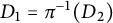 $D_{1}=\pi ^{-1}(D_{2})$
. In the following, we assume that the sets
 $gD_{1}$
with
 $g\in G$
determine a basis for the topology on
 $G/H_{1}$
and that the sets
 $gD_{2}$
with
 $g\in G$
determine a basis for the topology on
 $G/H_{2}$
. In the next result, we characterize the reversibility of S in
 $G/L$
in terms of a dense L-orbit in the homogeneous space
 $G/H_{2}$
.
Theorem 5.8 With the previous notations, let L and
 $H_1\subset H_2$
be closed subgroups of G and S a subsemigroup of G with
 $\mathrm {int}S\neq \emptyset $
and assume that
 $G/H_{1}$
is compact. Let
 $D_{1}$
be a minimal control set for S in
 $G/H_{1}$
satisfying hypothesis
 $\mathcal {H}$
. Assume that for all
 $x\in D_{1}$
the semigroup
 $S\cap (H_{1})_{x}$
is right reversible in the isotropy subgroup
 $(H_{1})_{x}$
which is conjugate to
 $H_{1}$
. Assume that
 $G/H_{2}$
is a separable Baire space. Then the following statements are equivalent:
-
(1) S is reversible in
$G/L$
. -
(2) For any nonempty open sets
$U,V$
in
$G/H_{2}$
there exists
$l\in L$
such that
$lU\cap V\neq \emptyset $
. -
(3) L has a dense orbit in
$G/H_{2}.$


Proof Let
 $D_{2}$
be the minimal control set for S in
 $G/H_{2}$
as mentioned above. Suppose that S is reversible in
 $G/L$
and let U and V be nonempty open sets in
 $G/H_{2}.$
Since the sets
 $gD_{2}$
with
 $g\in G$
determine a basis for the topology on
 $G/H_{2}$
there exist
 $g,h\in G$
such that
 $g^{-1}D_{2}\subset U$
and
 $h^{-1}D_{2}\subset V$
. By Theorem 5.7 there exists an L-orbit in
 $G/H_{2}$
that intersects both
 $g^{-1}D_{2}$
and
 $h^{-1}D_{2}.$
Therefore,
 $LU$
intersects V, showing the second statement. Conversely, take
 $g,h\in G$
. Since
 $g^{-1}D_{2}$
and
 $h^{-1}D_{2}$
are open sets in
 $G/H_{2}$
then by assumption there exists an L-orbit in
 $G/H_{2}$
which intersects both
 $g^{-1}D_{2}$
and
 $h^{-1}D_{2}.$
Then by Theorem 5.7 it follows that S is reversible in
 $G/L$
. The second and third statements are equivalent by Lemma 3.3.
As in Theorem 5.8, we observe that applying Theorem 3.4, we have that S is reversible in
 $G/L$
if and only if L has a dense orbit in
 $G/H_1$
. Morever, since
 $\pi :G/H_{1}\rightarrow G/H_{2}$
is a continuous and surjective map, a dense L-orbit on
 $G/H_{1}$
is projected onto a dense L-orbit of
 $G/H_{2}$
. Therefore, if L has a dense orbit in
 $G/H_1$
then L has a dense orbit in
 $G/H_2$
. The converse follows by Theorem 5.8. Therefore, L has a dense orbit in
 $G/H_1$
if and only if L has a dense orbit in
 $G/H_2$
. Thus we have
Corollary 5.9 Let the notations and assumptions be as in the previous theorem. Assume that
 $G/H_{1}$
is a compact and separable Baire homogeneous space. Then S is reversible in
 $G/L$
if and only if L has a dense orbit in
 $G/H_{1}$
if and only if L has a dense orbit in
 $G/H_{2}.$
With the notations and assumptions of Theorem 5.8 and the additional assumption that
 $G/H_1$
is connected, we now characterize the reversibility of S in
 $G/L$
in terms of a minimal action of L on
 $G/H_2$
.
Theorem 5.10 With the notations and assumptions of Theorem 5.8, let L be a closed subgroup of G and S a subsemigroup of G with
 $\mathrm {S}\neq \emptyset $
. Let
 $D_1$
be a minimal control set for S in
 $G/H_1$
satisfying hypothesis
 $\mathcal {H}$
. Assume that
 $G/H1$
is a compact and separable Baire homogeneous space. Suppose also that
 $G/H_{1}$
is connected. Then the following statements are equivalent:
-
(1) S is reversible in
$G/L$
. -
(2) L is minimal in
$G/H_{1}$
. -
(3) L is minimal in
$G/H_{2}$
.


Proof Firstly, we observe that
 $G/H_2$
is also a separable Baire space because the projection
 $\pi :G/H_1\rightarrow G/H_2$
is a continuous, surjective and open map. Now, the equivalence between the first and second statements follows by Corollary 4.3. Suppose now that L is minimal in
 $G/H_1$
. Then since the projection
 $\pi $
is continuous and surjective it follows that L is minimal in
 $G/H_2$
. Conversely, suppose that L is minimal in
 $G/H_2$
. Then by the definition of minimal action it follows that L has a dense orbit in
 $G/H_2$
which by Corollary 5.9 implies that L has a dense orbit in
 $G/H_1$
. Then again applying Corollary 4.3 it follows that L is minimal in
 $G/H_1$
.
Now combining Theorem 5.10 with Proposition 4.5, we have that the reversibility of S in
 $G/L$
is equivalent to the transitivity of L in
 $G/H_1$
. Moreover clearly we have that the transitivity of L in
 $G/H_1$
implies the transitiviy of L in
 $G/H_2$
. For the converse suppose that L is transitive in
 $G/H_2$
. This implies that L is minimal in
 $G/H_2$
. Hence, by Theorem 5.10 it follows that L is minimal in
 $G/H_1$
. Thus we have the following corollary.
Corollary 5.11 With the notations and assumptions as in Theorem 5.10, suppose that
 $G/H_{1}$
is connected. Suppose that L has a compact orbit in
 $G/H_{1}.$
Then the following statements are equivalent:
-
(1) S is reversible in
$G/L$
. -
(2) L is transitive in
$G/H_{1}$
. -
(3) L is transitive in
$G/H_{2}$
.


We now present an example of a subsemigroup S which is not reversible in
 $G/L$
, but L admits a dense orbit. We also observe the fact that the subgroup L having a dense orbit in the base space of a fiber bundle
 $p_E : E \rightarrow X$
does not imply that L has a dense orbit in the total space E. Moreover we observe the fact that the minimality of L in X does not imply that L is minimal in E, and also, the transitivity of L in X does not imply that L is transitive in E, although the converse of each of these statements is true.
Example 5.12 Let
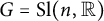 $G=\mathrm {Sl}(n,\mathbb {R})$
be the noncompact semisimple Lie group and take the semigroup
 $S=(\mathrm {Sl}^{+}(n,\mathbb {R} ))^{-1}$
where
 $\mathrm {Sl}^{+}(n,\mathbb {R})$
is the subsemigroup of G of all matrices with nonnegative entries. Let
 $L\subset G$
be the subgroup of the upper triangular matrices with ones on the diagonal. We consider the subgroup P of G which is formed by the upper triangular
 $n\times n$
real matrices in
 $G.$
We have that the connected component
 $P^{0}$
consists of the matrices in P with strictly positive diagonal elements. We know that the homogeneous space
 $G/P$
is the real projective space
 $\mathbb {P}^{n-1}$
(see, e.g., [Reference San Martin15, Example 6.3.1]). Also the homogeneous space (its covering)
 $G/P^{0}$
can be identified with the unity sphere
 $\mathbb {S}^{n-1}.$
Consider now the canonical action of S on the space
 $\mathbb {P}^{n-1}$
and let
 $C=\{[x_{1},...,x_{n}]:x_{i}\geq 0\}$
be the subset of
 $\mathbb {P}^{n-1}$
corresponding to the positive orthant in
 $\mathbb {R}^{n}$
. This set is the only invariant control set for
 $S^{-1}$
in
 $\mathbb {P}^{n-1}.$
Let
 $\pi :\mathbb {S}^{n-1}\rightarrow \mathbb {P}^{n-1}$
be the map which identifies antipodals. Consider now the canonical action of S on the unity sphere
 $\mathbb {S}^{n-1},$
regarded as the set of rays on
 $\mathbb {R}^{n-1}$
starting at the origin. We have that
 $C^{+}=\mathbb {S}^{n-1}\cap W$
the part of
 $\mathbb {S}^{n-1}$
contained in the positive orthant
 $W=\{x_{i}:x_{i}\geq 0\}$
and
 $C^{-}=\mathbb {S}^{n-1}\cap (-W)$
the part of
 $\mathbb {S}^{n-1}$
contained in the negative orthant
 $-W$
are the only invariant control set for
 $S^{-1}$
in
 $\mathbb {S}^{n-1}$
. We have that
 $\pi $
projects both
 $C^{+}$
and
 $C^{-}$
onto
 $C,$
whose set of transitivity
 $C^{0}$
is the interior of
 $C.$
The open sets
 $U=\left \{ (x_{1},..,x_{n})\in \mathbb {S}^{n}:x_{1}>0\right \} $
and
 $V=\left \{ (x_{1},..,x_{n})\in \mathbb {S}^{n}:x_{1}<0\right \} $
are orbits of L-action on
 $\mathbb {S}^{n-1},$
and therefore,
 $LU\cap V=\emptyset .$
Then by Theorem 5.8 it follows that S is not reversible in
 $G/L,$
or equivalently, L does not have dense orbit in
 $\mathbb {S}^{n-1}.$
However, we have that the orbit
 $L[e_{1}]$
is dense in the projective space
 $\mathbb {P}^{n-1}$
, where
 $[e_{1}]$
is the equivalence class in
 $\mathbb {P} ^{n-1}$
of the element
 $e_{1}=(1,0,...,0)$
in
 $\mathbb {S}^{n-1}.$
Also since S is not reversible in
 $G/L$
then by Corollary 4.3 we have that L is not minimal in
 $\mathbb {S}^{n-1}$
which implies that L is not transitive in
 $\mathbb {S} ^{n-1},$
but we have that L is transitive in
 $\mathbb {P}^{n-1},$
hence, L is minimal in
 $\mathbb {P}^{n-1}.$


