Mise-en-ScèneFootnote 1
It is 7 November 1904, 7:55 p.m. New York City theatregoers anxiously await the opening of George M. Cohan's newest production, Little Johnny Jones. Footnote 2 The house is just about filled, but the well-dressed ushers hustle a few stragglers to their seats. Some of the theatre's usual patrons have been held up late at work, while others are too consumed by Clifford Berryman'sFootnote 3 political cartoons in the Washington Star to attend the performance. This particular Monday evening marks an important moment for America: polls for the thirtieth presidential election will be opening in fewer than twelve hours. Theodore Roosevelt represents the Republican Party, and Alton B. Parker heads the Democratic ticket. Although results will not be known for sure until the close of the 8 November election, Roosevelt's recent success in office upon the assassination of William McKinley gives him a political boost. New York City's predominantly Republican values leave little doubt about which name a majority of tonight's audience will be checking off on the ballot come morning; Roosevelt has carried every region but the South in his campaigning efforts thus far. Nonetheless, Broadway occasionally attracts a few guests from the slightly less liberal states of Maryland and Pennsylvania, and this evening's house is no different; the Liberty Theatre is filled with men of opposing political views. A nervous excitement fills the room; a combination of political gossip, predictions about how Cohan's first Broadway musical will compare to his earlier comedic works and vaudeville skits, and occasional gasps and awestruck sighs from spectators who are seeing the inside of the Liberty Theatre for the first time since its very recent grand opening at 234 West 42nd Street. The twenty-thousand-square-foot theatre, with its dramatic stage, extensive balconies, and striking cathedrallike ceilings is the perfect home for the unfolding of Broadway, a theatrical form and style that America will come to call its own. As the house lights dim and the violins hum a piercing A note, other members of the orchestra slowly begin tuning their individual instruments. As the oboists finish adjusting their pitch, the conductor taps his music stand: musicians tilt their gaze to the front of the pit, audience members sink into the velvet of their plush seats and begin to quiet their chatter. Blackout.
A Changing Aesthetic
Little Johnny Jones was not Cohan's first Broadway show, but it materialized the writer-composer-performer-director's first attempt at “modern” musical theatre. This highly patriotic show won over the hearts of millions with its catchy tunes, captivating dance sequences, and the appeal it garnered from a politically divided white audience.Footnote 4 While Roosevelt and Parker's differing views manifested most clearly in their opposing outlooks on labor and economy (e.g., corporate monopolies and the gold standard), the public would likely interpret a win for Roosevelt as a victory for the North, and the northern–southern divide still boiled down to discrepant views on racial equality. Yet despite these political differences, the songs introduced by Cohan in Little Johnny Jones proved successful at bonding white Americans from a range of class, ethnic, and religious backgrounds. More than a hundred years later, public schools in America still teach young children hits from Cohan's songbook, like “The Yankee Doodle Boy,” alongside the country's national anthem.
Up until Johnny, the popular theatre housed a mélange of specialty acts—burlesque dancers, musicians, heavyweight champions, obese women, racial grotesquerie—packaged as a single spectacle known as vaudeville. Abandoning many of vaudeville's signature qualities, including that of blackface minstrelsy, Cohan set a new precedent for the American stage without the use of burnt cork. Yet his use of Africanisms pervaded the show's libretto and score, and caricature remained integral to the show's success. By Africanisms, I am referring here to a canon of five distinct Africanist aesthetic traits established by Robert Farris Thompson and further theorized within a performance context by Brenda Dixon Gottschild.Footnote 5 These traits are: ephebism, polyrhythm/polycentrism, contrariety, high affect juxtaposition, and the aesthetic of the cool. Scholar Jacqui MaloneFootnote 6 has added improvisation and call-and-response to this canon, and as such, this analysis understands the Africanist presence as signaled by any one of these seven traits. In substituting the “yellow” body for that of the black, pairing visible acts of yellowface caricature with “ethnic” leitmotifs, and lacing an otherwise syncopated production with ambiguous musical phrases, Cohan disguised an inherently Africanist performance by accentuating America's simultaneous attraction to an exotic Other and its apparent Sinophobia.
This essay examines some of the more invisible forms of minstrelsy at play in Cohan's original production of Little Johnny Jones. Using a selection of newspaper reviews from states where Johnny either previewed or ran during the years 1904–8, programs containing cast lists and musical numbers from Cohan's New York and Connecticut productions, as well as original sheet music written by Cohan himself and F. A. Mills's subsequent published versions of these scores for piano, I have tried to uncover and recover both an Africanist aesthetic and a pervasive use of yellowface caricature through song and script—elements of the show that were not necessarily seen as problematic during Johnny's successful run. Despite Cohan's highly visible departure from the vaudeville stage and the material of his black contemporaries, Cohan's patriotic show restaged a long-standing relationship in American entertainment between the “Chinese and the Coon,”Footnote 7 a pairing that would endure with great success well into 1920. Thus, I explore two layers of masking: on the surface, this essay posits the existence of yellowface in Johnny and its broader ramifications. Underneath the yellowface lies yet another layer of disguise; I argue that yellowface in Johnny stands in for blackface by disguising the Africanist aesthetic. That is, using the Chinaman stereotype in place of Zip Coon, Cohan presents the Africanist aesthetic as distinct from the black body. This separation helps to write certain Africanist traits into Broadway's aesthetic while writing the existence of blackness out of the national narrative. Furthermore, because Cohan's use of the Africanist aesthetic is primarily sonic, and thus experienced by the audience aurally, his visible displays of yellowface caricature further conceal the show's black presence.
Throughout the text, in passages indented at the left (only), I include detailed descriptions of the show's plot, music, costume, and dance numbers in what I am calling the essay's “mise-en-scène,” historical reconstructions of the show based on my research. Though a few liberties have been taken with regards to audience response, the majority of this material is the result of my findings in the archive. The historical and landmark descriptions are based on real events and structures, the music analysis results from reading several versions of Cohan's scores, and the plot comes directly out of the 1904 script as it exists in the Museum of the City of New York's Edward B. Marks Music Co. Collection on George M. Cohan.
Johnny premiered at a moment of great national expansion for America. Geographical borders expanded, and the bodies held within the nation's margins not only increased but also diversified. Diversity contributed to the success of theatrical forms that mirrored such cultural diversity while at the same time exaggerating racial and ethnic differences through gross caricature and “comedic” buffoonery. Show business during this time of transition included everything from traveling medicine shows—small “hit-and-run affair[s]” consisting of a doctor and two or three assistants who would travel by wagon across the country making sales pitches to try and sell their “medicine”Footnote 8—to gillies, “specially equipped trucks … sometimes festooned with decorations and plastered with advertisements.”Footnote 9 These traveling shows took a cue from the minstrel stage, utilizing many of the same instruments (e.g., tambourines or banjos) and styles of dancing (i.e., a blend of popular vernacular steps including shuffles, struts, and the flat-footed buck)Footnote 10 that performers had historically employed in blackface as Jim Crows or Zip Coons.Footnote 11 One difference between these traveling tent shows and the minstrel shows that preceded them could be seen in the function of the black performer: the tent shows still required black dancers to black up, but black performers were generally hired for their dancing and musical capabilities rather than for their ability to comply with various Negro archetypes. That is, their purpose on the minstrel stage was solely to fulfill certain stereotypes, whereas their value on the gilly circuit was often based on artistic merit. Marshall Stearns recalls, “Negro dancers performed in blackface before Negro audiences and continued to play the role of knockabout comedians, but now they were frequently hired on their own merits as entertainers and given the freedom to create anything that might attract an audience.”Footnote 12 While these transient tent shows were a popular form of entertainment for southern audiences, vaudeville was a more common platform for those living in the North. Vaudeville, like most things at this time, was segregated, and so the color of one's skin determined on which circuit you toured. More seasoned black performers gained exposure on the TOBA circuit,Footnote 13 while more veteran white performers could make a decent living on the white vaudeville circuit. There were, however, some exceptional black performers who managed to work around some of the strict segregation rules and achieve national fame among white and black audiences alike.
Bert Williams, the famous vaudevillian—who performed with his partner, George Walker, and the latter's wife, Ada Overton Walker—was one of these black performers at the peak of his performance career when Johnny debuted. In addition to popularizing the cakewalk, Williams and Walker became known for their vocal rags. These vocal rags, known more commonly as “coon songs,” were short pieces of ragtime that had accompanying derogatory lyrics about African American life and people. Although the word “coon” dated back to the 1830s—Americans often referred to the Whig Party as “coons” because of the raccoon they had claimed as their emblem—by the late 1880s the word referred only to the caricatured person of color.Footnote 14 Through comedy, song, and dance, Williams and Walker made a name for themselves as the “two real coons.” They would black up with burnt cork or shoe polish, put crass and demeaning lyrics about the black body to syncopated ditties, and reinforce many of the stereotypes blackface minstrels had been creating since the 1830s. Audiences were most likely as interested in Williams and Walker's “authenticity” and their condoning of black buffoonery as they were in their talents.
Until Cohan introduced his unique formula for the stage, vaudeville, including that of Williams and Walker, reigned as America's most popular live attraction. Its disparate skits and one-actsFootnote 15 modeled the exciting yet highly fragmented makeup of the United States at the turn of the century and allowed for the rapid, successive, and fairly inexpensive presentation of eclectic entertainment. The white vaudeville circuit, in its motley of interacting genres and types, was one way America gave the illusion of an integrated whole at a time when this energetic “new world” seemed to lack a single, unified, national identity. At the time of Johnny’s debut, the United States was at the peak of its immigration boom, known as “the Great Wave,” where immigration averaged six hundred thousand annually. Everything from animal acts to blackface minstrelsy thrived under this model, thereby sending the message that this was in fact the melting pot American Dream the nation claimed to be. As a result, the types of performance presented on the vaudeville stage became indelibly tied to the country's narrative and nearly impossible to separate from its own internal sense of pride. Johnny, however, offered a new kind of patriotism.
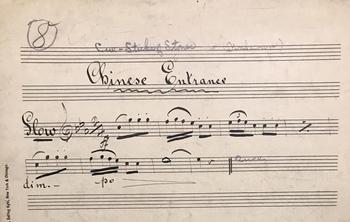
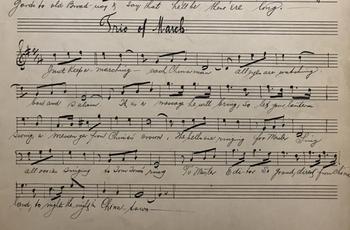
The lights come up on the stage, outside of the Cecil Hotel in London, England. Little Johnny Jones (the show's lead character, played by George M. Cohan and based loosely on the life and career of the famous jockey Tod Sloan) has traveled to England to participate in the English Derby. Johnny loves the heiress Goldie Gates (played by Cohan's wife of nearly five years and famous performer, Ethel Levey), but unbeknownst to the jockey, Goldie's aunt, Mrs. Kentworth (played by Cohan's own mother, Helen Cohan) has already arranged for her niece to marry the Earl of Bloomsbury (also played by Ethel Levey). Goldie, however, has beaten both Johnny and her aunt to the punch: she has already arrived in England disguised as a French mademoiselle, Rosario Fauchette, and will later pose as the British Earl. Amid all this, the head of San Francisco's Chinese Lottery, the nefarious Anthony Anstey (played by Cohan's own father, Jerry Cohan) has asked to marry Mrs. Kentworth in order that he may inherit her riches and destroy all of her female reform efforts.Footnote 16 The audience giggles whenever Mr. Anstey makes an entrance with his partner in crime, Sing Song (editor of the Pekin Gazette). The characters Chung Fow and Hung Chung evoke a similar response in the audience. Perhaps the catchy audible eight-bar phrase (Fig. 1) that accompanies the entrances and exits of these three Chinese characters invites the audience in on a little national joke; the gong and tom-tom drum leitmotif that comes to represent “Chineseness” in Johnny unifies the politically divided audience that fills the seats that evening.
“Chinese Entrance,” orchestration from Little Johnny Jones, score for leader, ca. 1904. George M. Cohan Collection, courtesy of the Museum of the City of New York. Gift of the Edward B. Marks Music Co., 1968 [68.123.200A].

I pause in the middle of act 1 to discuss the part these Chinese characters—Sing Song, Chung Fow, and Hung Chung—played in shaping Cohan's flag-waving aesthetic, one that continuously drew ties between Uncle Sam and the American people, while establishing Sam's whiteness as emblematic of the nation through the covert exclusion of nonwhite bodies. A review from the San Francisco Chronicle Footnote 17 confirms that the plot has as much to do with “Frisco's” Chinatown and the Chinese who inhabit it as it does a jockey or villainy. Of the three, Sing Song was the only one with a legitimate speaking part. Chung Fow and Hung Chung were mostly muted characters, generally communicating with small gestures, bows, or laughter. Several critical race theorists have taken up the denial of voice as a colonial tactic for mapping meaning onto racialized bodies.Footnote 18 Sean Metzger extends this analysis into a consideration of how such denial manifests in the “text of muteness” within yellowface performance. According to Metzger, muteness, accompanied by various material signifiers and their repetitive use on the stage, creates a fetishistic logic wherein the white audience can simultaneously acknowledge the phoniness of the Chinaman onstage and “invest” enough belief in the caricature in order temporarily to take pleasure in it.Footnote 19 In other words, the repetition of the Chinaman's farce onstage procures its alleged authenticity. Though the Chinamen in Johnny do speak on occasion, their speech is contrived:
Wilson: (Looks about, and whistles up to balcony left.)
(Chinaman appears on balcony and leans over to see who it is.)
Wilson: Are you Chung Fow?
Chinaman: Yes, all right.
Wilson: Tell Anstey I am here.
Chinaman: Wilson. Yes, Wilson.
(Chinaman disappears into den.) Footnote 20
Cohan assigns the Chinese women of the play even less speech, rendering them silent objects of purely sexual appeal:
Sing: Come, my little ones, it's time to chop suey.
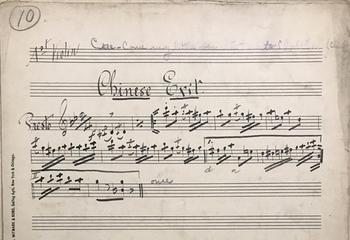
(Sing and girls go up stage with music and off door left.) [Fig. 2]
Wilson: (Wilson and McGee go over to R. table and sit down.)
They run like a lot of ducks.Footnote 21
“Chinese Exit,” orchestration from Little Johnny Jones, score for first violin, ca. 1904. George M. Cohan Collection, courtesy of the Museum of the City of New York. Gift of the Edward B. Marks Music Co., 1968 [68.123.200A].

The “girls” (defined a couple of times in the script as the Chinese emperor's wards) are never named, but they play a big enough role in the show to be the subjects of at least two big musical numbers. “Foong Toong Fee,” for example, a song to which I will soon return, treats these girls as Sing Song's concubines, or “Chink maid[s].” These voiceless, nameless wards are meant merely for the men's enjoyment:
Starter … Four of the emperor's wards are with him, sir.
Henry: Emperor's wards!
Starter: Sure. Chinese women my word, they are a sight.Footnote 22
The musical as a whole thus presents Chinese women as exotic, sexual, and submissive. It constructs the Chinaman as falling into one of two categories: either he is naïve, subservient, mute, and lacking women (e.g., Chung Fow and Hung Chung), or he is clever, possesses a penchant for “dirty” business, and owns several Chinese female concubines. Upon Sing Song's initial entrance, Mrs. Kentworth shrieks with fear, claiming Sing Song is after her:
Mrs. Kentworth: (Screams when she sees Chinamen.)
Look, look, save me, save me, Anthony. (Gets behind McGee)
Anstey: Why, what's the matter my dear? (Crosses over to her.)
Mrs. Kentworth: (Crosses McGee to Anstey.)
Anthony the HighbindersFootnote 23 are after me.
(Laughter from all.) Footnote 24
Cohan piles stereotypes such as these one on top of the other, creating an invisible yet audible tautology, which constructs the Chinaman stereotype without having visibly to show it.
Cohan's script further complicates these caricatured characters by assigning white actors to play the parts of the Chinese. Moreover, in 1905, less than a year after Johnny debuted, though the original cast remained intact, the Chinamen characters’ actors had been replaced. By 1907, all of the programs gave no names for the actors playing these roles, insinuating that these three roles were somehow interchangeable in a way that the rest of the cast was not. Here, the Chinaman is seen less as an individual subject and more as a replaceable object. Representing Chinese characters as mute and interchangeable reduced, albeit indirectly, the economic threat that so many non-Chinese Americans believed Chinese immigrants posed. That is, rather than changing the economy per se, Cohan's production contributed to a larger process of abjectifying the Chinese body. Cohan's characters in turn helped to defend some of the nation's contemporaneous legal measures, by both dehumanizing the Chinese laborer and invisibilizing his labor-laden contributions to the American economy. Johnny’s debut coincided with the government's making permanent the Chinese Exclusion Act, a law banning Chinese laborers from entering the country. Hence, in addition to the stage acting as a mediator of identity, that is, as a locus of differentiation between “us and them,” such ostracism invisibilized the Other's labor so that “they” became completely useless. By limiting the audience's perception of Chinese immigrants’ labor through a theatrical invisibilization, Johnny could at once mitigate the “threat” and justify the means. In a manner akin to the dehumanizing process of the blackface minstrel stage, which helped to justify the institution of slavery, Cohan's use of yellowface assisted in taking the need for labor out of the master–slave dialectic. In order to see the ways in which the institution of blackface overlaps with Cohan's use of yellowface, it is necessary to establish blackface as an older theatrical instrument used for the purpose of producing both a desired social politics and humor; the fact that these two outcomes work in tandem increases the efficacy of the first.
Blackface Minstrelsy
The origins of blackface minstrelsy predate the Cohan years by at least a half century. Beginning with T. D. Rice's embodiment of the Jim Crow figure (ca. 1830), white actors—and black actors by the 1840s—began using blackface makeup in order to enhance the believability of various “negro types” they presented on the minstrel stage. While these caricatures incorporated an array of performance media, including a dialect of broken English, a mélange of instruments such as the banjo, tambourine, and fiddle, and finally a comedic dance consisting usually of early tap and Irish step dancing, it was the makeup that generally guaranteed a full house of laughs and a performer's continued success on the circuit.
Black-on-white and black-on-black minstrelsy were woven into the United States’ entertainment values at a pivotal point in the country's formation of a national aesthetic. It was at these minstrel performances that white men from different classes and backgrounds (e.g., Irish, Jewish, German) could unite on account of their whiteness in an encounter with the spectacle of “blackness.” As Eric Lott posits, minstrelsy reproduced working-class relationships between the bodies who performed and those who spectated, thereby acting as a mediator among various class, racial, and ethnic groups. The show itself created a racial economy whereby those in power reinforced a set of stereotypes by producing theatrical material that not only defined “blackness” for the nation but also sold it as commodity. Lott writes:
[B] lackface performance reproduced or instantiated a structured relationship between the races—racial difference itself as much as black cultural forms. This relationship included its share of interest and fascination. … Its circulation of black cultural practices—more accurately the racially mixed forms that both did and did not read as “black”—operated through burlesque or humiliation.Footnote 25
Thus, “blackness” for many American theatregoers was based more in racial fantasy than in reality, often blending ambiguous “primitive” tropes marking difference as a means to create the hallmarks of “authentic” black identity. Furthermore, “blackness” as commodity became a critical part of the nation's process of identity formation. Minstrelsy highlighted difference within America's complex makeup, and wrote the practice of “othering” into citizens’ sense of self-worth.
As more and more white immigrants entered America—the greatest influx of European immigrants arrived in the 1880s and 1890s—the government banned the immigration of other groups of people (e.g., “aliens” carrying dangerous diseases, criminals, polygamists, and those coming for the sole purpose of finding labor), hoping to limit both the economic competition arising as a result of a rapidly growing population, as well as the spread of certain physical and moral diseases. The Chinese Exclusion Act of 1882 and the ensuing Geary Act,Footnote 26 for example, excluded “laboring” bodies of Chinese descent from even entering the United States. The Supreme Court argued that Chinese immigrants held an unfair labor advantage because they took away jobs and did not spend enough money to justify their income:
Chinese immigrants gained an (unfair) advantage in competition for labor opportunities because “they were generally industrious and frugal,” and “they remained strangers in the land, residing apart by themselves and adhering to the customs and usages of their own country. It seemed impossible for them to assimilate with our people or to make any change in their habits or modes of being.”Footnote 27
Thus, the United States had to limit the number of Chinese bodies that entered not only because American citizens believed they were bad for the economy, but because they threatened the notion of a collective national identity.
Before the 1880s unwritten social hierarchies simply placed white bodies above black; but with the arrival of so many new “foreigners” came the belief that the nation needed to delineate more clearly everyone's “place” on the social ladder. Both skin color and economic threat played into the formation of this social structure. This placed the Irish in more powerful positions than Jewish immigrants, and both visibly white groups (Irish and Jewish) significantly above Chinese immigrants, Native Americans, and African Americans, respectively.Footnote 28 Such a pecking order unequally distributed work to the nation's citizens, placing restrictions on who could be hired and where, while establishing the breeding ground for the American Dream as one that was highly segregated. The vaudeville stage, however, was one way many white immigrants could ensure a steady income.
From Blackface Minstrelsy to Vaudeville and Yellowface
Much like the minstrel stage, vaudeville was an economy built upon social and economic disparities among various immigrant bodies, where sometimes a performer's only means of survival was to subject him- or herself to the ridicule of others. Blackface minstrelsy offered comic relief that at the same time elevated the social status of the white bodies it engaged. For example, blacking up allowed white immigrants an opportunity to erase their own immigrant status by forgoing ethnic labels in favor of a common racial bond. In donning burnt cork, white performers of Irish or Jewish descent could identify as not-black (evidenced by their ability to black up over white skin) and thus represent themselves as white. Simultaneously, white spectators could identify with performers’ perceptibly white identity (evidenced by their ability to black up on a white stage) and unite on the basis of skin color. Vaudeville allowed for the same processes of identification, yet in a somewhat more dignified fashion. Vaudeville was a slightly more inclusive form that more accurately mirrored the nation's increasingly complex makeup during the last two decades of the nineteenth century. Not only did the range of acts expand, but the types of Other its actors mocked diversified as well. Moreover, unlike blackface minstrelsy, which surfaced during the height of slavery, vaudeville developed in a post–Civil War, post-Reconstructionist era, where presenting the black body as uncouthly as performers had on the stage of T. D. Rice would have likely not been so well-received. Still most performers on the vaudeville circuit were raised in a culture that valued the blackface component of the minstrel stage, and although the quotidian usage of derogatory “Negro” slurs tapered by the turn of the century, and the types of language used in conjunction with coon music was seen as less offensive by many, the vaudeville stage was replete with performers who blacked up; black-on-white as well as black-on-black minstrelsy still saturated the American stage.
Chinese impersonators also inhabited both the black and white vaudeville circuits. Just as Irish, German, and Jewish immigrants tended to participate in blackface as a way of drawing attention to their whiteness, African American performers could similarly turn to masking as a method of identifying with America. Because Chinese laborers dominated the railroad industry, African Americans seeking work in that field saw them as much of a threat as did white working- class men. Krystyn Moon posits that many African Americans also saw the Chinese as a threat to religion and education. She cites two reports from 1867 claiming that many African American parents refused to let their children go to school with Chinese immigrants and Native Americans because they did not want to mix with “idolatrous heathens” or the “scum of the community.”Footnote 29 Even though African Americans tended to exist on a lower social rung than any of America's immigrants from Asia, African Americans could lay claim to a role in American entertainment—namely, music and dance—in a way that no other racial or ethnic group could in the States. Many black performers between the 1860s and 1920s incorporated Chinese caricatures into their one-acts. Knowing firsthand the effectiveness of blackface caricatures, black performers could mock the Chinese as a means of harnessing a stronger sense of national identity. Pairing these two groups of Others was thus a long-standing American tradition, and Cohan's Little Johnny Jones would not deviate; yellowface was as much as part of Johnny as blackface was a part of vaudeville, and as I show below, these two conventions often overlapped.
Applying Yellowface to Johnny
The three actors who played the parts of Sing Song, Chung Fow, and Hung Chung were white and relied on costume and makeup to make them more “Chinese.” Just as a set of unwritten rules demarcated a series of types for black performers (e.g., Jim Crow, Zip Coon, Long Tail Blue) during this period, society established a class of “Oriental” types, a common one of which collapsed anyone male from Asia into the role of the “Chinaman.” Like the figure of Jim Crow, this caricature could be performed either by someone white or by someone of color. In yellowface, a non-Chinese person plays to the American stereotype of the Chinaman archetype by imagining and exaggerating Chineseness, just as in black-on-white minstrelsy a nonblack performer plays to the archetype of the coon, which itself is an imagination and exaggeration of blackness. The Chinaman, as Sean Metzger contends, “both depends on and informs hegemonic constructions of Chineseness,”Footnote 30 such that the very idea of Chineseness in America emerges from the caricature rather than the human. As yellowface caricatures became more pervasive onstage, they blurred the distinction between “real” and “fake” to the general public. This influenced audience perception of the Chinese body onstage and prejudiced many in daily (offstage) life. In a manner similar to a rise in the colloquial usage of the term “coon” after Bert Williams and George Walker labeled themselves “two real coons,” a surge in the word “chine” onstage—after the Middle English for “crack,” here alluding to eye shape—gave rise to the increasing popularity of “chine” and “chink” in everyday speech. Furthermore, because most Chinese immigrants settled in California and other big cities west of the Rockies,Footnote 31 by the time Congress passed the Chinese Exclusion Act, many Americans, including those present on the evening Johnny debuted in New York, still had never met anyone from China. Consequently, the majority of spectators and reviewers in central states and smaller towns witnessed these caricatures without any experience or understanding to counter the authenticity of vaudeville's “reality.”Footnote 32 These early nineteenth-century distortions of the Chinese body set a standard for the treatment of Asian bodies for years to come and would surface on the stage of Johnny in lyric and song.
The travesties of Chung Fow and Hung Chung needed very few visual signifiers in order to make the decades-old Chinaman stereotype available to the audience. As Karen Shimakawa puts it, “Asian American performers never walk onto an empty stage; … that space is always already densely populated with phantasms of orientalness through and against which an Asian American performer must struggle to be seen.”Footnote 33 Whether or not the characters of Fow and Chung yellowed up makes little difference in the way of audience perception. Everything from the libretto to the musical score spoke for the invisible characters. Their stereotypes, whether visible or not, depended upon “phantasms of orientalness” and also did their part to subvert further the image of the real Chinese body and Chinese American identity in the twentieth century.
The question remains: if Bert Williams and George Walker were leading a lucrative career as coons on a nearby Broadway stage, why would Cohan opt for a less-exposed stereotype? I posit many reasons for Cohan's decision to expose the Chinaman in lieu of the Zip Coon archetype that Williams and Walker were promoting on a neighboring New York stage. Born in 1878, Cohan spent his formative years surrounded by a culture of Sinophobia, some of which I have outlined in the preceding pages, and he also grew up in a culture of blackface minstrels “playing” Chinese; replacing the black body with the “yellow” might have allayed some of the fears associated with incorporation and minimized the nation's visible reminder of slavery; moreover, using Chinese characters in place of Jim Crows might have allowed Cohan to cover up his pervasive use of Africanisms in this patriotically American show. The choice may or may not have been intentional, but from an economic standpoint, it behooved Cohan to abandon blackface, as Williams and Walker were, contemporaneously, finding great success as “two real coons” on a Broadway stage just down the street. I explore some of these possibilities.
Cohan inserts the generic “Oriental” and specifically “Chinese” body onstage in place of what would have previously been a role for the primitively figured black man. Deflection of this nature took power away from the economic threat of the real Chinese body at the same time it removed the corporeal threat of the visible black body. Substituting the visible Chinaman body for the black on the Broadway stage of Cohan's era not only made a statement about Chineseness, but also helped Cohan to distinguish new entertainment from the minstrel stage and vaudeville.
Whereas blackface utilized face paint as its primary medium, yellowface relied on the accentuation of facial features, hairstyle, and costume to highlight the yellow. Little evidence of the three Chinamen costumes in Little Johnny Jones has survived; these three characters seem to have gone missing from the only two archival photographs taken of the “whole” cast in 1904. I did find, however, a pencil sketch of one of the Chinamen on the back of the final version of the original first cellist's musical score. According to this sketch, each of the Chinamen in Johnny wore a baggy tunic, pointed shoes, and skullcap, all of which were standard costume choices in the portrayal of Chinamen. Metzger and others have written about the importance of the queue,Footnote 34 a long ponytail or braid often worn by Chinese men; this sketch shows each wearing a long braid down his back.Footnote 35 But the most telling element of these characters’ costumes is the fact that all three of the men who dressed as Chinamen donned very exaggerated makeup resembling what might have been outlined in nineteenth-century texts on makeup application for “Orientals.”Footnote 36 Moon describes this routine:
Because performers and theatrical goods manufacturers believed that the Chinese had large noses and lacked facial hair, actors were prescribed to paint around their nostrils in a darker color and add a dark shadow or an eyebrow below the nose to create a wispy mustache for the male characters. The most important aspect were the eyes, the defining factor in making up a Chinese face. Eyes were to be outlined in Indian ink, with the bottom line extending out beyond the eye to create a slanting effect.Footnote 37
The Chinese caricature could be achieved without the use of paint, as Moon outlines here, but by the early twentieth century, the use of greasepaint had become much more common in order to create a more “authentic” Chinese look.Footnote 38 While we have no way of knowing exactly what makeup Cohan required of his cast, we can assume his Chinamen at least slanted their eyes, and wore a queue, as confirmed by the cellist's sketch. But whether or not Sing Song, Chung Fow, and Hung Chung donned visible yellowface is actually less important than the leitmotifs that played during all of their entrances and exits, in addition to the four big Chinese numbers. In other words, here sound rather than the image organizes audience responses and self-constructions in relation to the Other; in the case of Johnny, leitmotifs work just as effectively as more visible markers of such racial stereotypes.
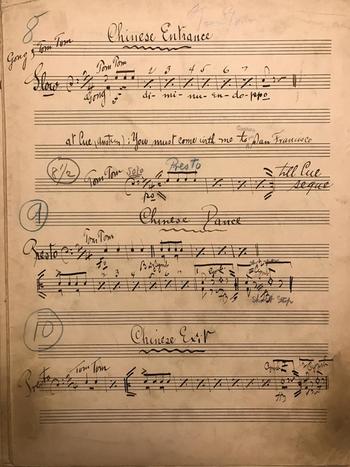
London. Anthony Anstey explains to Sing Song why he has made the meeting place London instead of San Francisco (Frisco). Anstey claims that the Chinese Lottery game is not safe in America with Mrs. Kentworth there, and that he and Sing must therefore attend to business overseas. Sing agrees that the Chinese Lottery in America has made a fortune for both him and Anstey, but he is reluctant to participate in Anstey's scheme in case the emperor finds out. Anstey persuades Sing to join him in Frisco: “The game is at a standstill. The Chinamen are afraid to operate. All I've said and done is of no avail. A word from you and the game goes on.”Footnote 39 While Sing expresses concern that Mrs. Kentworth and her band of reformers will destroy his and Anstey's plot, Anstey reassures him that he will take care of the resistance: “I'll guarantee her band will be no more. music cue—chinese music”Footnote 40 (Fig. 3), and the wards enter from stage left to provide entertainment in the form of a dance.
Percussion orchestration from Little Johnny Jones, ca. 1904. George M. Cohan Collection, courtesy of the Museum of the City of New York. Gift of the Edward B. Marks Music Co., 1968 [68.123.200A, 68.123.200M].

The tom-tom beats steadily throughout this song in 2/4, and the audience likely recognizes the song as “Oriental” because of the chromaticism found throughout. The music stops, and Anstey walks to stage left, making room for the four Chinese girls who enter from a door on the left. They make their way to center stage and sit on brightly colored “Oriental” pillows. Sing Song walks up to the wards and mumbles a kind of gibberish: “Ahmila, Amoy, Agoy, Ahfung … Hila Muck a Ting. …”Footnote 41 Some introductions take place, and before long George M. Cohan makes his big entrance. He soon realizes just how many Americans have come to see him win the derby, and thus decides to let his spectators in on a little tip in the form of a song: “The Yankee Doodle Boy” presents the musical climax of act 1 and showcases Cohan's most signature dance moves, including a strut and Virginia essence (a syncopated, back flap ball change). The conductor taps his music stand three times, and a large orchestra begins an upbeat tune in 2/4—a marchlike intro—eight for nothing. The stage is filled with dozens of women in voluminous Lord & Taylor hats and satin gloves, a handful of men exchanging dollar bills and bets, as well as a horse in post position, all against the painted backdrop of a filled grandstand and dirt track. By this point, all the Chinese characters have cleared the stage.
The absence of Chinese bodies during the musical's major (patriotic) numbers—e.g., songs like “The Yankee Doodle Boy,” which Cohan wrote to increase national pride—is a recurring theme throughout Johnny, and possibly no accident. The “foreigners” clear the stage in time for Cohan's salutes to America, but their presence flanks his overall attempt to unify the nation. Numbers such as the “Chinese Dance” might exist as an aural form of othering, not only setting messages like the chorus's interjected “So's Uncle Sam” apart from unscrupulous business, but also contrasting it to criminality. The Chinese numbers act as asides and contribute nothing to the plot itself, other than to function as a foil by which to glorify the good in America.
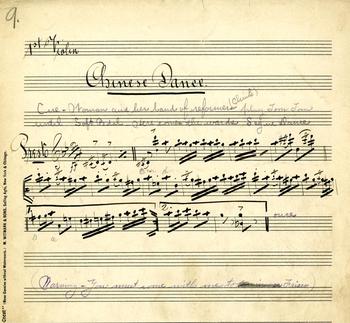
Most of the Chinese music stands alone, without lyrics, which means that something about the music would itself have to be perceptibly “Chinese” in order to be effective. In the case of “Chinese Dance,” this discernibly Chinese feeling is likely due to the use of grace notes (the smaller noteheads with a dash through the tail; Fig. 4) that act as a kind of chromatic embellishment, as well as to the use of certain instruments. Cohan almost certainly meant to convey some sort of “Oriental” affect by using such noticeable chromaticism and foregrounding instruments as the violin and tom-tom.Footnote 42 Blackface minstrels almost always used what they called a “Chinese fiddle,” which, according to Moon, was “some kind of huqin, a family of instruments commonly described by Americans and Europeans as a violin or fiddle and criticized for the high-pitched sounds it generated.” Entertainers had been using these musical instruments as “curiosities” since the 1820s in order to establish Chinese music as noise.Footnote 43 Likewise, the tom-tom had come to represent the ethnic Other in America by way of association. It had come to signify a group of Others, including American Indians, Orientals, and people of African descent. Thus the beat of the tom-tom in “Chinese Dance” (see middle of Fig. 3) and other Oriental-themed numbers represented the trope of difference. Use of “sticks and stones”Footnote 44 also emphasized the foreigners’ alleged primitivity in contrast to the modernity of Western music. Thus, rather than rendering Johnny’s Chinamen completely mute, Cohan created musical material upon which otherwise silent figures could build a persuasive image of “Chinese” otherness.
“Chinese Dance,” orchestration from Little Johnny Jones, ca. 1904. George M. Cohan Collection, courtesy of the Museum of the City of New York. Gift of the Edward B. Marks Music Co., 1968 [68.123.200A, 68.123.200M].

The ensemble clears the stage so that the slight Little Johnny Jones may be seen upstage alongside his horse. “I'm the kid that's all the candy, / I'm a Yankee Doodle Dandy, / I'm glad I am,” belts Cohan's character in a half spoken, half sung cadence. The chorus then responds to Johnny's call: “So's Uncle Sam.” The audience breathes a collective sigh as if, though engulfed in Cohan's production, tomorrow's election is ever present on their minds. Johnny continues his Sprechgesang, Footnote 45 and the chorus responds with familiar American phrases: “Oh, say can you see.” The choreography is minimal: a flick of the umbrella from the women in the ensemble or a tilt of the head from the men. Cohan continues to sing but begins to strut across the stage, occasionally acknowledging the derby props held by other jockeys stage left. He picks up a jockey's whip, or “bat,” and begins to strut, using it as a conductor's baton. He tosses the whip off stage left and announces: “I'm gonna give America the English Darby cup!” Johnny then abandons the recitative style and belts, “I'm a Yankee Doodle Dandy, / A Yankee Doodle do or die; / A real live nephew of my Uncle Sam, / Born on the Fourth of July” in a fully sung manner. A few members of the audience versed in Cohan's biographical details laugh when they realize Cohan's lyrics not only construct this musical's plot, but tell America a little bit about Mr. George M. Cohan, who claims also to have been born on the Fourth and believes it his moral obligation to construct America's national identity through song and dance. Cohan continues to sing and, as the instrumentation picks up, he begins to pulse evenly on the beat of the music as a chorus of women sway on the horizontal. The chorus then breaks into song as Johnny begins performing a strut across the stage with a syncopated triplet step on every eighth count. He continues to strut in a manner that was most often associated with eccentric dancing,Footnote 46 a forte of Cohan's, with an occasional soutenu turn or waltz clog on the syncopated sixth or eighth note. The dance continues to evolve, and the audience roars with laughter. Cohan begins a combination that loosely resembles an Irish jig, cakewalk, and the kind of hoofing one might see in the streets. The chorus stops singing, but Cohan continues to fill the orchestral break with crowd-pleasing steps—perhaps a bell kick or what appears to be an excerpt out of a Russian Troika—and then, all of the sudden, the orchestra ceases to play and the room becomes silent, with all audience members perched on the edges of their seats. Cohan begins a syncopated tap dance, which upon first listen seems to break the 2/4 rhythm presented thus far. After one bar of tapping, the orchestra joins Johnny, and the lead's feet engage with the skilled orchestra in a bout of perfectly synched stop-time,Footnote 47 a call-and-response of sorts between feet and winds, brass, strings, and horns. As the volume of the orchestra escalates so does the fury of sounds emanating from Cohan's feet. His movements become bigger, and finally he breaks away from the standard proscenium planes and begins walking and dancing up and down the walls that divide the apron from the stage, interrupting the distance that typically divides the performers from the spectators: Cohan struts across the stage for counts 1, 2, 3, then does a small syncopated switch leap on “and a 4 e and a”—changing planes, so that by the fourth beat Cohan's strut takes place on the proscenium stage's left wall. He uses an “over the top” (hopping over his own other leg) and gravity to assist his return to the floor by count 5. While Cohan never breaks the fourth wall, he treads new ground for the Broadway stage: his dance up the wall destabilizes a Western dance tradition, offering American musical theatre a new way of using space and the body. More important, Cohan has danced a tap routine in 6/8 to a song in 2/4.Footnote 48
Applying Blackface to Cohan
Cohan's previous success with blackface set the stage for a new type of makeup. Reviews from the last decade of the nineteenth century confirm that Cohan and his family (headlined as The Four Cohans) experienced capital gain (i.e., this act paid their bills and then some) and visibility (i.e., they achieved national fame) on the vaudeville stage, in part as a result of their “appropriation” of skin color by means of blackface makeup. As was so typical of the period, the Cohans might have relied on blacking up as a means of drawing audience attention away from their Irishness and toward their whiteness.Footnote 49 During this time, Cohan began writing his own music, composing coon songs that other vaudeville performers could use in conjunction with their blackface skits. I should note that Cohan rarely, if ever, performed these songs with his own family act, but he received national recognition for his popular piano rags and household coon songs, which circulated widely. Consequently, The Four Cohans (Five Cohans when wife Ethel joined them) became a well-respected name on the white vaudeville stage, their white identity ineffaceably tied to the blackface mask. George M. Cohan's identity, on the other hand, while associated with the mask worn by his family act, was also seen by many as linked to ragtime music, specifically of the “coon” type.
Cohan continued to change the aesthetics of his compositions in order to better reflect the popular musical style of the times, but the coon song subgenre of ragtime music offered him prolonged success from 1895 to 1903. During these years Cohan made a prolific contribution to the ragtime genre and to American entertainment.Footnote 50 Like other rags of the era, coon songs, or “Ethiopian songs,” were written in the 2/4 time signature and highly syncopated. Where coon songs differed from pieces of classic ragtime, however, was in their “Negro dialect.”Footnote 51 The songs’ highly offensive language, coupled with the callous imagery that permeated the covers of their published iterations, bolstered their economy while blackface was still very much en vogue, but it also led to their demise as blackface began to wane in popularity.
Ironically the coon song and ragtime music more generally find their roots in an Africanist musical tradition. Even though ragtime was the most popular musical form in the United States from the late nineteenth to the early twentieth century, white consumers still often referred to it as “whorehouse music,”Footnote 52 seeing its syncopations and polyrhythms as sinful and crude. The public could not argue with the reality, however, that the form's complex rhythmic structure was both catchy and conducive to dancing. Thus, if there were a way for Cohan to keep the rhythms intact but disguise the tunes’ Africanist presence, he might be able to win over the audience.
Establishing a national identity is a process that involves the shaping of public perception, and therefore some consideration of the ways in which Cohan's white audience received him over time will be helpful.Footnote 53 Regardless of a performer's “real” skin color, both the mask and coon music carried certain stigmas related to blackness around the turn of the century. On the one hand, these two relics of the minstrel stage served as constant reminders of America's slaveowning past. On the other, these performances often evoked in their spectators a deep-seated fear of incorporation—a corporeal enmeshment, so to speak.Footnote 54 Though the blackface mask assisted in The Four Cohans’ rise to fame during the 1890s, and Cohan's sheet music afforded him public visibility at the fin de siècle, the popularity of these forms began to decline around 1903. This is neither to say that the use of blackface on the vaudeville stage vanished, nor to claim that composers stopped publishing coon music altogether; both of these practices persisted up through the 1920s. The popularity of these forms declined, however, when more and more consumers sided with Reconstructionist views and recognized such entertainment as shameful; doing away with the makeup and retaining Africanist aesthetics, however, were not mutually exclusive. By reshaping his experiences with The Four Cohans on the white vaudeville circuit, George M. Cohan could simultaneously distinguish himself from his family act and cater to a changing political and social climate.
Part of what makes a show like Johnny significant is its predominantly Africanist aesthetic, which a set of simultaneous masks seems to invisibilize. Various substitutions made by Cohan, including his heavy reliance on Chinese caricatures, likely distracted his audience from perceiving anything Africanist about the work. Musically and choreographically Cohan could engage with Africanist elements such as syncopation and improvisation without using slurs or makeup. Because these compositional elements had long been paired with the black body onstage, audiences accustomed to such pairings likely did not notice Cohan's disjointing of the black body from the Africanist aesthetic. Historically blackface performers paired certain stylistic choices, like burnt cork and insensitive language, with the black body; but Johnny confronted audiences with the Africanist aesthetic alongside the white body, cloaked in spirited language and a collective hatred toward the Chinese.
A key way that Cohan covered up his persistent use of the Africanist music aesthetic throughout Johnny was by substituting the derogatory lyrics he frequently used in his coon songs with more patriotic verbiage. The show's most famous song, “The Yankee Doodle Boy,” for example, is a piece of ragtime beaming with national pride. Note that a song like “The Warmest Baby in the Bunch,” which Cohan published in 1897, is also a piece of ragtime, but its lyrics work to establish difference rather than unity. The latter song boasts, “The coons they all acknowledge she's a wizard, / You'll cremate if around this gal you fool,” and, “You'll think that you've been drinking nigger punch,”Footnote 55 whereas “The Yankee Doodle Boy” speaks of “A real live nephew of my Uncle Sam, / Born on the Fourth of July.”Footnote 56 By replacing the lyrics that white Americans often considered corrupt and vulgar by 1904 with patriotic language, Cohan could appropriate the Africanist aesthetic, mask his engagement with qualities such as syncopation and polyrhythm, win over a public that had already taken a liking to such music, and corral his public into national identification by invoking Uncle Sam through song and dance. Accordingly, Cohan could separate America from the minstrel stage by making small sonic substitutions that unified his audience by association—a simultaneous association with Uncle Sam and such Africanist contributions as syncopation.
Cohan also covered up his use of an Africanist aesthetic in dance. The kind of dancing he executed in “The Yankee Doodle Boy”—the strut and Virginia essence, long associated with the vaudeville stage—stood in contrast to the risqué hoochie-coochie dance performed by the Chinese maids in the next act. In performing these two dances within the already established “American versus Chinese” narrative, Cohan draws a clear distinction between tap dancing and the hoochie-coochie; tap dance is all American, and the latter is of a different world (often, in fact, as I shall suggest, associated with Chinese figures). Implicit messages such as these further delineate the old from the new, marking the raunchy “old” and tap dance new and patriotic. Performing tap dance without the blackface mask, however, helps to transition this old form from its ties to slavery and the minstrel context to its new home on the Great White Way.
An ensemble of male jockeys begins to dance, allowing Johnny enough time to do a quick costume change and reenter mounting a horse. The tone shifts as Johnny begins riding and the ensemble breaks into Sprechgesang again, relaying the results of the race in real time: “That's Yankee Doodle on the end, a wonderful position / Come on Yankee Doodle, we have bet the whole caboodle on you / Come, hurry up, hurry up!” The tone then shifts from excitement to melancholy as the race is called off; Little Johnny Jones, it seems, has thrown the race. The audience, paying no attention to the melancholic turn the plot has just taken, rises to their feet to applaud the fine work of art they have just witnessed. The curtain closes on act 1 as well as on Johnny's shot at Goldie and honor in the eyes of the American public.
Although Cohan labeled “The Yankee Doodle Boy” a “march,” the Broadway hit was in fact a piece of ragtime, complete with a syncopated chorus.Footnote 57 This and other similarly syncopated songs in the show stand in stark contrast to the very “straight” or “even” Chinese songs scattered throughout Johnny. This marks yet another way in which Cohan's score differentiates by way of juxtaposition. By interspersing an otherwise syncopated score with “Chinese music” that resists the Africanist aesthetic in this way, Cohan makes a statement about the Americanness of the ragtime style (and more generally, Africanist aesthetics), and further excludes the Chinese body. The Chinese music stands out as different, it lacks meaning in service of the plot, and it reinforces a long list of stereotypes about the yellow body. Whether intentional or not, Johnny staged the Chinese Exclusion Law of 1904Footnote 58 and sang a presage of United States v. Ju Toy (1905), a case that concluded that a “citizen of Chinese parentage seeking admission to the United States”—as after a visit to China—could be excluded by immigration authorities and be deported back to China even before having a hearing before the judicial body.Footnote 59
Act 2: “Southampton Dock with the steamer, St. Hurrah, ready to sail away.”
This act is song-heavy and full of character development. Wilson is a comedian, evoking laughter with every line he utters. The women, both the American reformers and the Chinese wards, are flirtatious, soft-spoken, and have no identity of their own; they exist for the men on the ship. The sentimental croon with a swinging chorus, “Good Bye Flo,” sung by Goldie gets a raucous round of applause. This ovation was a harbinger of the great success this song would have exactly one year later when Billy Murray and the Haydn Quartet recorded the song for the Victrola;Footnote 60 “Good Bye Flo” would become a household staple, along with so many of the songs from Johnny. Shortly after the excitement of this number dies down, the whole ensemble sings, “So Long, Sing Song,” a “march” in 6/8. Some dialogue ensues and before long, Sing Song enters with the four wards along with “Tommy Atkins Soldiers.”Footnote 61 The five Chinese characters do a big number and dance, “Foong Toong Fee,” which soon has the audience both uncomfortable and in hysterics: “My little Chinee, tootsies tiny; / Every night I sing my serenade, / Here to my Chink maid,” sings Sing as the four wards do what is likely a seductive hoochie-coochie. The lyrics and movements border on the too risqué for turn-of-the-century Broadway, but then again this makes the number all the more enticing, especially because it confirms that Chinese women in America are all the same.
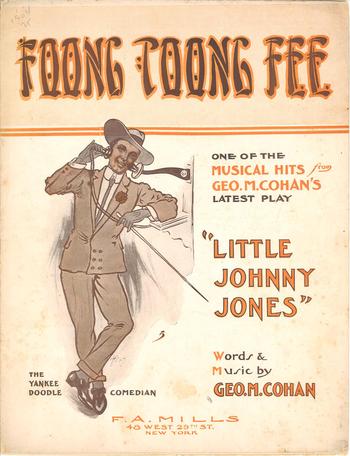
Newspaper reviews from the era confirm that “Foong Toong Fee”Footnote 62 was not only a hit on the 1904 stage, but would also be a success for years to come.Footnote 63 But unless people read the reviews, they would have had no way of knowing that this song was part of Cohan's show at all. Although a partialFootnote 64 version of the published score from 1904 survives (Fig. 5),Footnote 65 all proof of its existence after 1904 remains absent from the archive. Furthermore, Cohan omitted this major number from all published song lists. Whether Cohan later omitted it from the show remains unclear, but no trace of the song exists after 1905. The question remains: Why would a marketable number like “Foong Toong Fee” simply vanish from the public record despite being an integral part of Johnny’s anti-Chinese sentiment? I suggest a few reasons for the song's absence:
“Foong Toong Fee,” Little Johnny Jones, piano score cover, ca. 1904. Lester S. Levy Collection of Sheet Music, courtesy of the Sheridan Libraries, Johns Hopkins University.

As I referenced in the above mise-en-scène, audiences might have used a number like “Foong Toong Fee” to support a set of stereotypes about women emigrating from China: one common belief was that Chinese women came to America for the sole purpose of prostitution. According to Judy Yung, women who traveled to the United States during this period were either the wives of merchants or prostitutes.Footnote 66 By 1870 the ratio of Chinese women who were prostitutes in California was so disproportionate to other women immigrants from the Far East that prostitution itself became a compelling argument for Congress in the passing of certain Chinese immigration laws. Lee writes, “Their mere presence made possible the crossing of racial and class lines and renewed fears of ‘moral and racial pollution.’”Footnote 67 Combined with the belief that Chinese women carried “more virulent strains of venereal disease that had the power to ‘poison Anglo-Saxon blood,’”Footnote 68 this laid the groundwork for the notion that Chinese immigrants threatened the goodness and cleanliness of America; Chinese exclusion was seen as necessary for the nation's survival. The Page Act of 1875Footnote 69 is a perfect example of this and demonstrates how vilifying Chinese labor through the oversexualized female body led to greater restrictions and the ultimate removal of a strong Chinese presence in the United States. As I show, Johnny enacted in miniature—and mainly on an aural level—what legislation enacted in the political sphere.
Another common misconception in circulation at this time was that all Orientals were versed in the hoochie-coochie. The hoochie-coochie was still a relatively new phenomenon in 1904, after its introduction at the 1893 Chicago World's Fair, or Columbian Exposition. Many saw the dance as scandalous, but it still attracted gawkers from all over the country well past 1904. The fair advertised the hoochie-coochie as an “original” treat from the Far East. Most of the hired dancers, however, came from New York City. A. W. Stencell, writing of this “evil” dance, quoted several newspapers, started with the New York Journal: “the hoochie-coochie was, ‘neither dancing of the head or the feet.’ The San Francisco Chronicle screamed, ‘Mudway Plaisance!’ To the showmen's glee, men in barber shops, saloons, and hotel lobbies talked about nothing else.”Footnote 70 Most of these dancers went by names that were Middle Eastern in nature—the most notable being “Little Egypt,”Footnote 71 one of the Fair's most iconic hoochie-coochie dancers—but the span of titles for these shows suggests that producers wished to represent the dance as encompassing the whole Orient. Stencell writes, “In an era where most ladies wore corsets, the loose-fitting clothes of these dancers and their body gyrations caused a major stir. Oriental dancing, muscle-control dancing, dance du ventre, and hoochie-coochie became beacons drawing men to circus and carnival lots.”Footnote 72 This style of dancing slowly crept into vaudeville and burlesque shows, and likely made an impact on Cohan. Including such a dance in Johnny increased the “Orientalness” of the wards, substantiated stereotypes surrounding Chinese women and prostitution—that the only female Chinese characters in this play are concubines is significant—and also might have helped to acclimate viewers from a vaudeville aesthetic to a more “refined” Broadway style.
Given the anti-Chinese sentiment prevalent throughout the United States at this time and the overall lack of censorship surrounding issues of race, yellowface could not have been responsible for the removal of “Foong Toong Fee” from the record. More likely than its removal as a service to the Chinese population, I posit that the song was considered obscene for sexual reasons, and that its association with prostitution led to its excision from the show and thus from the record. One of the twentieth-century's most significant censorship battles occurred in 1905 over Bernard Shaw's Man and Superman, which was thought to extol the economic advantages of prostitution. The man behind the opposition to Shaw's morals was Anthony Comstock, the same man who railed against the 1893 World's Fair for its hoochie-coochie dancers.Footnote 73 However, that this song was the first of several Chinese numbers to disappear mirrors the role the Page Act played in American history. By targeting a single song for its sexual, dirty content, censorship laws validated a general confiscation of Johnny’s Chinese presence. “Foong Toong Fee” was the first to be removed from the written repertoire. Whether by intentional disposal or not, nothing but a small trace of this song exists today. While other hits from Johnny (e.g., “Give My Regards to Broadway”; “The Yankee Doodle Boy”) have sold millions of copies and continue to circulate more than a hundred years later, the leitmotifs, parades, and dances that at one point marked Chinese bodies have since disappeared as well. Just as successive laws banned Chinese immigration in various forms over time, is it possible that the people in charge of Cohan's legacy have regulated the visibility of this history?
“Give My Regards to Broadway” marks the culmination of act 2, wherein Johnny is forced to stay in England to defend his reputation while all of his friends sail back to America. He will not have the public see him as a cheat. The routine opens with an ensemble of women dancing a cancanlike sequence downstage. The men, dressed as sailors, dance an athletic routine that signifies the work they do on the ship. After this clear delineation of the two sexes, the ensemble clears the stage for Cohan. The Americans board the ship upstage while Cohan recites a now-familiar Sprechgesang downstage: waving goodbye to his friends and blowing a kiss to his fictional wife (who just happens to be his wife in real life as well), Johnny begins to reference famous New York City landmarks, simultaneously inviting his New York audience into the performance and tying his name to the entertainment capital for years to come: “Remember me to Herald Square. / Tell all the gang at Forty-Second Street / That I will soon be there.” The orchestra plays a break for another one of Cohan's famous tap solos. Following this climactic song in act 2, the undercover investigator, Whitney Wilson (played by Tom Lewis) makes it known that Anstey has framed Jones. Johnny returns to America with his name cleared and ready to marry Goldie, who, unbeknown to him, has been kidnapped by Anstey. After a long trip from overseas, the boat docks in San Francisco The curtain opens on Chinatown, the center of laundering—money and cotton. Act 3 ties up all of the plot's loose ends while clearly establishing San Francisco's immigrant population as a problem. The audience laughs at a series of laundry jokes while also becoming caught up in the intricacies of Anstey and Sing Song's scheme. Most of the music in this act contains the “Oriental sound”—parade music, leitmotifs, and the show-stopping “March of the Frisco Chinks,” which have the whole audience roaring with jingoism and laughter (Fig. 6). Wilson continues to take down the whole Chinese Lottery, and the two men find Goldie in San Francisco's Chinatown; Johnny and Goldie reunite, and America the beautiful lives happily ever after—confident, strong, and in control of foreign invaders. Thus, if in act 1 Cohan draws a connection between his roots and Uncle Sam, in act 2 he brings in New York City—and specifically the parts of it associated with entertainment and Broadway—to represent all of America. Act 3 seals the deal for Cohan: reviews in the morning paper highlight the success of Johnny and articulate the newness of Cohan's formula.Footnote 74
“March of the Frisco Chinks,” orchestration from Little Johnny Jones, leader score, ca. 1904. George M. Cohan Collection, courtesy of the Museum of the City of New York. Gift of the Edward B. Marks Music Co., 1968 [68.123.202].

Little does the United States know that this piece will set a precedent for all forthcoming Broadway shows. While the significance of this show was likely unclear to the audience of 7 November 1904, Cohan's musical identified New York City as the nation's entertainment capital, highlighted the “Chinese problem” by constructing San Francisco as the city of highbinders and brothels, and, most important, wrote a new trajectory for American theatre.Footnote 75
Substituting Yellow for Black
Though not completely mute, the character Sing and his gang of Chinamen are silenced through music. Recall the fetishistic leitmotif that accompanies each of their entrances and exists, as well as the “(anti)climactic song in act 3, ‘March of the Frisco Chinks.’” These numbers, with their persistent use of various Oriental tropes, including chromaticism and pentatonicism, evoke a long history of Asian music as filtered by Western ears. Whether conscious on his part or not, Cohan's use of yellowface, combined with a set of sonic substitutions within Johnny, demonstrates the efficacy of plural masking, especially when the masquerade itself becomes invisibilized by the sheer synchronicity of several masks in play at once. In replacing blackface by yellowface, Cohan avoided visibly “coloring” his American stage with the black body that had become so stigmatized by 1904 and transitioned this Africanist aesthetic into the fabric of American identity. Interspersing tom-toms and other “primitive” instruments like sticks and stones alongside a canon of Africanist principles, allowed Cohan to project a new sound altogether: he wove a sense of American identity—achieved through patriotic lyrics, the othering of Chinese bodies, and a distinct sound—into Broadway. In the same way that older forms of entertainment (e.g., minstrelsy, vaudeville) conditioned Americans to associate black bodies with the coon song, Cohan trained the audience of this new era to associate yellow bodies with this “exotic” sounding tom-tom and high-pitched violin; at the same time he reinforced stereotypical Oriental occupations such as the laundry industry, underground lottery (men), and prostitution (women) while conditioning the theatregoing public to associate a syncopated score with American, not black, entertainment. That is, in replacing a Negro dialect with that of a patriotic discourse, Cohan effectively distracted his audience from perceiving anything remotely Africanist. He replaced the need for an Other with the Chinaman, offering his spectators the pleasures of abjection: figures they could see as at once attractive and repellent. Cohan could draw his audience in with Africanist elements like syncopation and polyrhythm without referencing slavery, and at the same time stimulate a collective American spirit, even among citizens from different classes and political leanings. In doing so he could separate various Africanist elements from the black or blackfaced body, assign certain sounds and aesthetic values to the nation, all the while using Sinophobia as the basis of unity. Yellowface thus bonded the Liberty Theatre's politically divided audience on the night before one of the nation's biggest presidential elections. In a manner akin to the nineteenth-century minstrel stage, Little Johnny Jones inaugurated its own racial economy, bringing Republicans and Democrats together on the basis of race and national pride. In unifying an American aesthetic, the Broadway stage (as popularized by Cohan) allowed white patrons—including immigrants—to bond over a disguised Africanist aesthetic, masked by the shared enjoyment in denigrating the (Chinese) Other, thus constructing the national stage as a divided space: the U.S. versus Them.
My findings in the archive lead me to believe that successive productions of Johnny saw a diminished use of Chinese caricature through music such that by mid-1942, when Warner Bros. released the George M. Cohan biopic Yankee Doodle Dandy, not a hint of yellowface remained in any of the scenes relating to Little Johnny Jones. These thirty-eight years span the full run of the permanently extended Chinese Exclusion Act, which Congress made permanent in 1904 and repealed some eighteen months after the Cohan film premiered. By 1942, Cohan's name was so tied to a sense of nationalism and a distinctly white American Broadway aesthetic that yellowface caricature was no longer needed as an oppositional force to define America, as it was when Cohan originally wrote Johnny. As fewer and fewer Chinese immigrated to America (as a direct result of the Chinese Exclusion Act), Cohan's need actively to denigrate the Asian body diminished as well; as the threat of the Chinese body became less of an issue he slowly removed elements of yellowface. Furthermore, yellowface was no longer needed to mask an Africanist presence in Cohan's work. As the Africanist presence became less and less tied to the black body and more in congruence with the national aesthetic, Cohan had to work less to cover up certain Africanist qualities; both his name and his aesthetic became the “American” way.
The abridged version of Johnny that circulates in both the archive and the repertoire today tells a very one-sided story of “Uncle Sam.” For a more complete history, we must look to Cohan's 1904 nationalism, unabridged.
Wilson It means that you and me are going to take a long trip to China together. …
Sing: (Wild with rage.) Ling, Kow, Fring to long, China tok ki Ling ki la and so on.
(Denouncing Wilson. McGee and Wilson go to extreme left and look on.)
…
Wilson Come on! (Starts to exit R.1.E. and turns in time to see Sing turn to strike officer) Here! Come on—be careful.
(Wilson, Sing, and Officer exit L.E.R. McGee leaves Jones and follows them off on run.) (Lights up. Chorus enter singing. …)
CURTAIN. Footnote 76