INTRODUCTION
A large body of social science literature analyzes how citizens view women who participate either as candidates or political representatives. We extend this work by presenting an experimental study of the impact of candidate sex on voter evaluations in Turkey. Despite a significant increase in the application of experimental methods in political science (Druckman et al. Reference Druckman, Green, Kuklinski and Lupia2006), comparative politics, in general, and comparative studies of women and politics in particular, rarely employs experiments. We contribute to the scholarly understanding of women's access to political power and show the viability of experiments as a tool to study such questions in comparative politics.
Public opinion surveys reveal fundamental differences between Western and Muslim societies in their treatment of women (Fish Reference Fish2011). Muslim majority countries score at the bottom of the Gender Equality Scale developed from the World Values Survey (Inglehart and Norris Reference Inglehart and Norris2003, 33). Furthermore, ethnographic studies of women in political life in Turkey describe a patriarchal polity (e.g., Arat Reference Arat2005). These findings lead to an assumption that Islamic faith is important as an explanation for the low levels of women's political participation in many countries. Yet virtually no work has studied systematically how citizens in Muslim majority countries view female political figures.
Turkey provides a rare opportunity for studying gender effects, democracy, and Islam simultaneously. It is one of the few democracies with a Muslim majority population.Footnote 1 Among these countries, Turkey has the longest experience with democracy. As such, Turkey is one of the few Muslim countries where we can appropriately run democratic election experiments.
At the same time, Turkish public opinion exhibits traditional value orientations. Responses from the Turkish public to questions on the World Values Surveys (WVS) indicate a strongly held set of patriarchal values. In the fourth wave of the WVS (2005), members of the Turkish public were asked whether they agreed with the statement that “On the whole, men make better political leaders than women.” Sixty-one percent of Turks agreed or strongly agreed. Comparatively speaking, this places Turkey below 75% of the participating countries in the WVS in terms of support for political equality. It suggests a skepticism that may make it difficult for women to win political office. On the other hand, while Turkey is patriarchal, it may be less so than other majority Muslim countries.Footnote 2 Democratic transitions are expected to improve conditions for women, and so Turkey's relatively long history of democracy should mitigate some patriarchal trends. Finally, voting in democratic systems varies in the extent to which it revolves around characteristics of the individual candidates. Therefore, the question of whether Turkish voters view female candidates in the same manner as they are viewed in Western democracies is an open one. We present experimental evidence showing how the sex of a politician affects Turkish university students' perceptions of those politicians. While using students has a cost in terms of external validity, the strengths of experiments in terms of internal validity are considerable, especially in an area such as this, which is virtually uncharted. This experiment is a first empirical test of how Turkish women are viewed as candidates.
WOMEN AS CANDIDATES: ELECTORAL AND EXPERIMENTAL EVIDENCE
Loewenberg and Patterson (Reference Loewenberg and Patterson1979) depict legislative recruitment as a funnel that winnows a large pool of eligibles to a small set of elected representatives. An extensive international literature on women's access to political power, drawing primarily from work on Western democracies (Darcy, Welch, and Clark Reference Darcy, Welch and Clark1994; Matland Reference Matland1998, Reference Matland, Karam and Ballington2005; Matland and Montgomery Reference Matland and Montgomery2003; Norris Reference Norris1985; Rule Reference Rule1987), suggests a variety of conditions that lead to the disproportionate “winnowing out” of women at the various stages: as eligibles become aspirants, as parties select candidates among the aspirants, and as voters chose representatives among the candidates.
Our research focuses on the final stage of the legislative recruitment process, where candidates face voters. One might expect sexism by voters to serve as a brick wall, making it difficult for women to penetrate the halls of power. The evidence for this is quite limited, however. In industrialized democracies, voters vote primarily for parties and leaders, rather than for individual candidates (LeDuc, Niemi, and Norris Reference LeDuc, Niemi and Norris2010). Even in countries where the personal vote is important, for example those with majoritarian electoral systems, mounting evidence suggests that when female candidates face voters, they do as well as their male counterparts (Black and Erickson Reference Black and Erickson2003; Darcy and Schramm Reference Darcy and Schramm1977; Darcy, Welch, and Clark Reference Darcy, Welch and Clark1994; Rekkas Reference Rekkas2008; Seltzer, Newman, and Voorhees Leighton Reference Seltzer, Newman and Leighton1997; Welch and Studlar Reference Welch and Studlar1986). In the Irish context, where voters vote for individuals, rather than parties under the single transferable vote (STV) electoral system, McElroy and Marsh (Reference McElroy and Marsh2010) find that women also do as well as men. Note, however, that in testing the effect of gender under STV systems in Australia, Malta, and Ireland, Schwindt-Bayer, Malecki, and Crisp (Reference Schwindt-Bayer, Malecki and Crisp2010) find no effect in Australia and Malta, but do find a bias against women in Ireland. In an extensive meta-analysis across a series of Western democracies, Banducci, Everitt, and Gidengil (Reference Banducci, Everitt and Gidengil2002) find very little evidence that voters are less likely to support women candidates.
Beyond Western democracies, however, there is limited evidence of the impact of gender-neutral election outcomes. A few studies of Eastern Europe find women do as well as men at the polls and that voters express no bias in polling data (Birch Reference Birch, Matland and Montgomery2003; Moser Reference Moser, Matland and Montgomery2003; Sieminenska Reference Sieminenska, Matland and Montgomery2003). But Turkey is a very different context, one in which we have little beyond speculation to guide our predictions. We take an initial step to a firmer empirical grounding with this experiment.
In actual elections, many factors plausibly affect the evaluation of voters. Thus, it is exceedingly difficult to determine whether being a woman has a direct effect on people's evaluations. Experiments, because they control for all other factors, allow for precise estimates of how candidate sex affects evaluations. In such experiments, a candidate is described—or a speech is read—and respondents rate the candidate on issue dimensions and candidate traits, and report whether they would vote for the candidate. While everyone reads the same description or speech, half the sample, chosen at random, is led to believe the candidate is a woman, while the other half is led to believe the candidate is a man. Since all other stimuli are exactly the same, and given that respondents are placed randomly into treatment and control groups, any statistically significant differences in candidate assessment between the two subsamples can be attributed to candidate sex.
Experiments are common in the American subfield but are rare outside of the United States. In a review of 14 U.S.-based experiments, Matland and King (Reference Matland, King and Rosenthal2002) found that gender differences rarely affected the vote-getting abilities of male and female candidates. Yet voters consistently view male and female candidates differently. Women candidates are seen as superior in dealing with issues with a nurturing emphasis: education, health, helping the poor. Male candidates have been seen as superior in dealing with military issues and foreign affairs.
Furthermore, voters impute female stereotypical traits onto female political candidates. Gender schemata are used to help process information, and at least portions of a general gender schema are consistently transferred to female politicians. For example, one of the most consistent findings in the U.S. data is that women are deemed more honest and compassionate (Huddy and Terkildsen Reference Huddy and Terkildsen1993; Kahn Reference Kahn1992; Leeper Reference Leeper1991; Sapiro Reference Sapiro1981/1982). These traits are remarkably resilient; Huddy and Terkildsen (Reference Huddy and Terkildsen1993) find that even when both female and male candidates are described exclusively with male characteristics (tough, articulate, and ambitious), or when both are described exclusively with female characteristics (compassionate, trustworthy, and family oriented), women are still seen as more compassionate than similarly described male candidates. On the other hand, the transference of general male traits to male candidates occurs less often. While being rational and knowledgeable are identified in social psychology studies as male traits, no study gives male candidates an advantage on these characteristics.
Three experimental articles evaluate women candidates outside the United States. Matland (Reference Matland1994) found that in Norway, despite a reputation for a progressive political culture, there was substantial projection of sex stereotypes onto candidates. There were no differences in willingness to support a candidate, but there were differences in perceived policy competencies, with stereotypes varying across political parties. Herrick and Sapieva (Reference Herrick and Sapieva1997) found male candidates to be perceived as more competent on a large number of policy areas in Kazakhstan. Finally, a study in rural India found that citizens consistently showed greater skepticism about policy proposals made by hypothetical local council leaders when these leaders were described as female (Beaman et al. Reference Beaman, Chattopadhyay, Duflo, Pande and Topalova2009). It is interesting to note this skepticism diminished dramatically in districts where citizens had experience with local council leaders who were female.
THE CURRENT TURKISH POLITICAL SYSTEM AND WOMEN'S REPRESENTATION
Turkey's history of free multiparty electoral competition stretches back to 1950. The current electoral system has its origins in the 1980 military intervention that restructured the Turkish political scene. Religiosity became the major source of party identification from the late 1980s into the 1990s and has remained a central cleavage (Kalaycıoğlu Reference Kalaycıoğlu1994; Sayarı and Esmer Reference Sayarı and Esmer2002). A recent analysis of public opinion reveals that two ideological dimensions dominate Turkish politics; a pro-Islamist versus secularist dimension is the primary cleavage, and a Kurdish versus Turkish nationalist dimension is also a significant cleavage line (Çarkoğlu and Hinich Reference Carkoğlu and Hinich2006).
The economic crisis in 2001 resulted in the discrediting of existing parties. The Justice and Development Party (AKP, Adalet ve Kalkınma Partisi), established by politicians who originated from Islamist parties previously dissolved by the Constitutional Court (Koğacıoğlu Reference Koğacıoğlu2004), emerged as the leading political force in the 2002 parliamentary elections. They captured 34% of the vote and formed a majority government (Tezcür Reference Tezcür2010). The AKP maintained power and increased its vote share to 47% in 2007 and 50% in 2011. Since 2002, the secularist and former ruling Republican People's Party (CHP, Cumhuriyet Halk Partisi), has become the main opposition party. These two parties received 54% of the vote and 99% of the seats in the 2002 election; in 2007 they received 68% of the votes and more than 80% of the seats; in 2011 they received 76% of the votes and 84% of the seats.Footnote 3 Two other parties, the Nationalist Action Party (MHP, Milliyetçi Hareket Partisi) and the Kurdish nationalist Democratic Society Party (DTP, Demokratik Toplum Partisi), formed parliamentary groups after the 2007 elections.Footnote 4
The Turkish modernization project entails, among other things, women's “emancipation” and active participation in public life (Berkes Reference Berkes2002; Kili Reference Kili1981). Women were granted suffrage in 1934, earlier than in many Western European nations. The policy has met only modest success. Although state feminism has expanded social opportunities available to urbanized and well-educated women, these policies have had little impact on the lives of the majority of Turkish women in rural areas and small towns (Arat Reference Arat, Bozdoğan and Kasaba1997; Duben and Behar Reference Duben and Behar1991; White Reference White2003a). While women were 4.5% of the members of parliament in 1935, representation was lower at 4.4% in 2003. After the 2011 elections, representation stood at 14.3%. Turkey did have a female prime minister in the 1990s, but the Turkish government had only two female ministers (responsible for education and women's affairs) in 2010. Among the 81 Turkish provincial capitals, only two elected female mayors in the 2009 elections.
At the national level, Turkey has a proportional representation electoral system, with closed lists across 85 electoral districts. Individuals vote for a party list in their province. Electoral campaigns revolve around national party platforms and party leaders. Therefore, it would not seem that a candidate characteristic would be decisive in voting behavior. If party leaders perceive voters as prejudiced against female candidates, however, they may be hesitant to nominate women. Studies of candidate selection committees (Bochel and Denver Reference Bochel and Denver1983) show that nominating committees are convinced their selection decision can have dramatic effects on the likelihood the party will win an election, even though political scientists argue that they have limited effect. Descriptions of the candidate selection process, even in countries with closed lists, find selection committees choosing slates with an eye to the voters; they expect specific candidates to attract or repel groups of voters (Gallagher Reference Gallagher, Gallagher and March1988; Hazan and Rahat Reference Hazan and Rahat2010; Valen Reference Valen, Gallagher and March1988). As a result, widespread voter biases against female candidates may indirectly and negatively affect women's representation by making party leaders less likely to increase the number of women running under the party ticket. Furthermore, in elections for mayors, voters do vote directly for individual candidates, and candidate sex can directly affect voting behavior. Just how negative voters actually are toward female candidates, however, is simply not known.
HYPOTHESES
Hypothesis I:
Candidate sex will affect voters' estimates of areas of policy competency and perspectives on a candidate's characteristics.
The experimental research assessing voters' reactions to candidate sex consistently finds an impact on perceived issue competencies. We expect that men will be seen as better at handling defense, foreign policy, and the economy. Women will be perceived as better able to handle women's issues, children's issues, and possibly health issues. In Western countries, women's expertise in private-sphere activities, such as child rearing and caring for the elderly or sick, are transferred to policy areas that have to do with these traditional roles. We test whether a more conservative culture may be less willing to see women as superior in dealing with these issues when they are in the public sphere.
We also compare the effect of discussed versus nondiscussed policy areas on perceived competency. In experiments conducted in the United States, gendered expertise is imputed only when there is no discussion of a policy area in the speeches evaluated by respondents (Chang and Hitchon Reference Chang and Hitchon2004; Kahn Reference Kahn1992; Matland and King Reference Matland, King and Rosenthal2002). Gender schemata are invoked to fill in information when there is no individuated information on a candidate. When information is available, however, the gender schemata are not used to estimate competencies. There is no gender related competency effects for issues discussed in the experimental speeches. We test whether skepticism toward women as political representatives in Turkey is sufficiently strong such that gender schemata effects remain salient even in the face of relevant policy information.
We also test whether candidate traits are imputed on the basis of sex stereotypes. Williams and Best (Reference Williams and Best1990) find that trait stereotypes are pervasive and remarkably uniform across countries. As such, we test whether effects for this Turkish sample, in terms of male and female characteristics of the candidates, parallel those found in Western studies.
Hypothesis II:
Candidate sex will not affect voter's willingness to vote for a candidate.
We believe issue based-differences and, most importantly, party differences will be more important than the effects of candidate sex in voter evaluations in Turkey. Candidates positions on salient issues and the party label associated with a candidate, as opposed to candidate sex, should be decisive in affecting voter perceptions.
EXPERIMENTAL DESIGN
We created three versions of a survey; each includes two speeches where the names attached to the speeches vary. The baseline case is Ali Arısoy (male AKP candidate) and Mustafa Özsoy (male CHP candidate). The other two survey versions identify the speech givers as Ayşe Arısoy (female AKP candidate) and Mustafa Özsoy (male CHP candidate), or Ali Arısoy (male AKP candidate) and Belgin Özsoy (female CHP candidate). These candidate names are gender specific, and references to the candidates as he or she appear in the survey. Otherwise, the text is precisely the same across versions. To ensure that the speeches are accurate representations of the parties' policies, we use edited versions of speeches given by party leaders (Prime Minister Recep Tayyip Erdoğan of AKP and the former foreign minister, Mr. Deniz Baykal of CHP) during the 2007 elections. The candidate names, however, are fictitious (see the Appendix for copies of the speeches). By making the distinction between candidates as discrete as a few words, it is possible to process relatively large groups of people simultaneously, as participants are unaware that the pages they are reading vary slightly from others in the same room.Footnote 5 This ensures that testing conditions are equivalent across treatment groups.
We ran sessions in Istanbul and Ankara in the summer and fall of 2008. Participants were students from 12 classes at five different universities: Bilgi, Bilkent, Boğaziçi, Koç, and Yeditepe. Obviously, university students are not equivalent to the population as a whole.Footnote 6 Nevertheless, experiments using college students have been the backbone of social psychology and provide substantial information on cognitive processes. As we are testing for the elements of and the impact of gender schemata, this sample can provide a window into these processes and provide guideposts for future work. In addition, although the sample respondents are all young and educated, there is considerable variation in terms of political affiliation, religiosity, and socioeconomic background. But true to the experimental paradigm in terms of external validity, we do not see our experiment as the final test of these findings, only the first. As McDermott (Reference McDermott2002) notes, “External validity [in experiments] occurs through replication.” Generating definitive information on causal relations is the forte of experiments; the causal results can then be examined more broadly in future research.Footnote 7
We randomly distributed the three versions of the questionnaire in each class, and we received a total of 303 surveys.Footnote 8 The students were overwhelmingly social science (e.g., political science, sociology, economy) and humanities (e.g., history) majors. The sample is 57% female. Respondents came from a range of social and geographical backgrounds, 52% were born outside Istanbul and Ankara, and 40% had parents with less than four years of college education. In comparing their responses to the World Values Survey, our sample is more liberal than the Turkish public on gender issues. While the median respondent in the WVS in Turkey agreed that when jobs are scarce, men should have priority, our median student respondent strongly disagreed. On whether a university education is more important for a boy, the median respondent in the WVS disagreed; our median respondent strongly disagreed. On issues of religiosity, however, the student sample is quite religious (only 8.5% define themselves as atheist). Nevertheless, it is clear that we cannot easily extrapolate to the nation at large.
We used a cover story noting that in many democracies, representatives are elected to represent a specific constituency (single-member districts), whereas Turkey uses a party-list system at the national level. We told respondents that we were studying the impact of a change in the electoral system, how such a change might affect the way that people vote, and which system people prefer. Respondents were asked to consider a situation in which Turkey adopted a system similar to that of many European Union countries, including the United Kingdom, where there is only one candidate per party in each district. As Turkey directly elects mayors, this is a fairly realistic electoral option. Respondents were to read two speeches given by candidates running for parliament, evaluate the candidates, vote, and fill out a survey discussing what factors affected their vote. While there were only two speeches, the hypothetical ballot included several additional parties,Footnote 9 a generic “other” party, and a “would not vote” option. Respondents were asked to evaluate the candidates' competencies in a variety of policy fields and to evaluate the candidates' individual characteristics. Additional questions supported the cover story by asking for preferences on electoral systems. By providing a scenario to engage respondents, we sought to ensure that they were entirely unaware that our primary interest was the effect of candidate sex on voter evaluations.
EXPERIMENTAL RESULTS
Candidate Characteristics
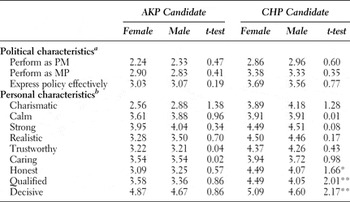
Table 1 compares the mean scores of the male and female candidates for a set of political and personal characteristics.Footnote 10 The traits are ordered from greatest male advantage to greatest female advantage for the CHP. The second and third columns show the evaluation of the female and male AKP candidate. The fourth column presents the result for a difference of means t-test. The fifth through seventh columns show the results for the CHP candidate.
Difference of means tests for candidate characteristics, by candidate sex

Note: The N on which the t-tests are based varies from a minimum of 163 to a maximum of 185.
aThe scale for political characteristics runs from 1–6 with higher numbers being more favorable.
bThe scale for personal characteristics runs from 1–7 with higher numbers being more favorable.
* Difference is statistically significant at p < .10 for a two-tailed test.
** Difference is statistically significant at p < .05 for a two-tailed test.
The results reveal no statistically significant differences between the male and female AKP candidate in terms of political or personal characteristics. One possible explanation for these noneffects is that the speeches have little impact and the stimuli are too weak to produce differentiation. Undercutting this suggestion, however, are the large differences across the two parties. On 11 of the 12 characteristics in Table 1 (being decisive is the one outlier), and on all nine policy areas in Table 2, the difference in scores between the AKP and CHP candidates (ignoring candidate sex) is statistically significant and in the CHP candidate's favor. This is not surprising, as these respondents are more supportive of the CHP. When considering AKP candidate characteristics for this sample, the party and policy signals are powerful and the gender signal quite weak.
Difference of means test for policy expertise, by candidate sex

Notes: The N on which the t-tests are based varies from a minimum of 130 to a maximum of 167. Policy area expertise was measured with a five-point scale, from not competent (1) to very competent (5).
* Significant at p < .10 for a two-tailed test.
** Significant at p < .05 for a two-tailed test.
*** Significant at p < .01 for a two-tailed test.
Turning to the evaluation of the two different guises of the CHP candidate in columns five through seven of Table 1, we find greater distinctions made on the basis of candidate sex. With respect to their ability to be an effective member of parliament or prime minister, the gender differences are small. With respect to personal characteristics, however, we see noticeable divergences. The female candidate is viewed as significantly more honest, qualified, and decisive. Honesty is a standard finding, as women are often seen as less prone to corruption and less part of the insider clique that may be prone to corruption. Qualified and decisive, on the other hand, were somewhat unexpected strengths for the female candidate.
Candidate Policy Expertise
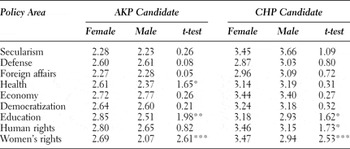
Respondents were asked to evaluate the candidates' abilities to deal with nine different policy subfields.Footnote 11Table 2 presents these results, ordered from the policy on which the male CHP candidate has the greatest advantage to the policy on which the female CHP candidate has the greatest advantage. The pattern that emerges shows a female advantage on issues strongly tied to women's private roles and no statistically significant advantages for men. Even on such quintessentially male issues as the economy and defense, no significant differences emerge, although this may be because these issues are explicitly discussed so respondents have individuated information and do not use gender schemata. For both AKP and CHP, the female candidate is evaluated as better able to deal with education and women's rights issues. The female AKP candidate is stronger than the male AKP candidate on health issues, while the female CHP candidate is stronger on human rights. For the remaining policies, differences fail to reach statistical significance.
For those issues exhibiting a statistically significant difference, the norm was that the speech did not mention the policy area. The CHP speech did not refer to education, human rights, or women's rights. The AKP speech mentioned women's rights and health policy only very obliquely. A stronger case can be made that the education effect for the AKP candidates shows up even though there is individuating information. The speech includes two lines regarding education, although they are not central to the speech. For those policies to which the speeches refer more extensively, especially the economy, defense, and, for CHP, health issues, there are no significant differences. Consistent with findings in other countries, gender schemata are used, but largely to fill in blanks when respondents have no other information. The results for both candidate characteristics and policy competencies mirror results from Western experiments.
Voting Behavior
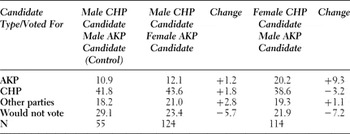
Table 3 compares the vote share for the two major parties when both run male candidates, with vote shares when one party runs a female candidate. In comparing the second and third columns, we see no difference in how well AKP does when it runs a female versus a male candidate. While there is a slight increase in the AKP vote, there is also a slight increase in the CHP vote, so the gap between the two is virtually unchanged. The chi-squared statistic shows no relationship between candidate sex and the party's vote-winning ability for the AKP case.
Effect of candidate sex on party (in percentage)

Notes: CHP male/AKP male vs. CHP male/AKP female: columns 2 and 3: Chi-squared: .71 PR = 0.87.
AKP male/CHP male vs. AKP male/CHP female; columns 2 and 4: Chi-squared: 2.76 PR = 0.43.
The second and fifth columns compare voting behavior when the CHP candidate is male versus female, while the AKP candidate is always male. When the CHP candidate changes from male to female, there is a small drop in the CHP vote. More noticeable, however, is the increased support for the male AKP candidate. This is due not to defections from CHP to AKP but primarily to the 7.2% drop in abstentions. Although these results suggest that candidate sex may have an impact, the chi-squared statistic shows the relationship is not significant.
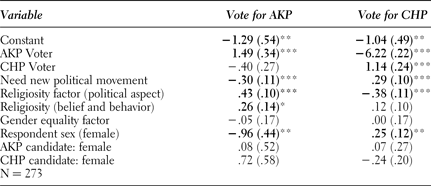
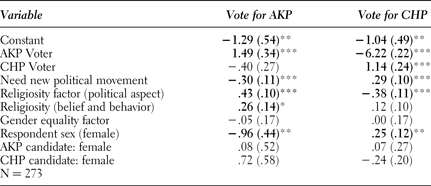
To delve more deeply into the effect of candidate sex on the vote-winning ability of a candidate, we turn to multivariate analyses. Our dependent variables are based on responses to the question “What candidate would you vote for if the election were held today?” We coded the answers into four nominal categories: AKP, CHP, other parties, and “would not vote.” Because the proportions for all of the outcomes are constrained to sum to one, if we run separate estimates for AKP and CHP, the error terms will be correlated. To deal with this dilemma, we ran seemingly unrelated probits.Footnote 12 Thus, for the AKP probit, a vote for AKP is coded 1, while votes for CHP, other parties, or not voting are coded 0. For the CHP probit, a vote for CHP is coded 1 and all other cases are coded 0.
We use three sets of control variables. First is previous party support. We asked which party the respondent voted for in the previous national election (held July, 2007, approximately one year before our experiments) and created two separate dummies, AKPvoter and CHPvoter. Second are four issue concerns/voter characteristics, starting with the level of agreement with the statement “There is a need for a new political movement in Turkey.” Among our sample, respondents who are relatively young (median age is 22) and have lived with an AKP government for six years, this can be seen as a retrospective evaluation on the present government. As such, we expect those who strongly agree to be unlikely to vote for AKP and likely to vote for CHP, and vice versa.
An important voter characteristic is the respondent's religiosity. As noted previously, religiosity is one of the major cleavages in the Turkish electorate. We distinguish piety as measured through beliefs and behavior from a more consciously political perspective on religion. To create a scale of religiosity based on beliefs and behaviors, we use five separate questions.Footnote 13 To measure how religiosity informs political perceptions, we use a single question asking whether the respondent agrees that “Muslims are under pressure in Turkey.”Footnote 14 A highly salient issue in Turkish politics is the scope of restrictions on public expressions of religion. While AKP aim to minimize these restrictions, CHP defend them as essential for the vitality of Turkish secularism. We expect the political measure of religiosity to be particularly salient in making a vote choice, but also expect to see the belief and behavior measures exerting an independent impact.
The final voter characteristic is a gender equality measure, similar to the scale developed by Inglehart and Norris using World Values Survey questions. Our measure is built on the results from a confirmatory factor analysis of five measures that ask questions concerning gender equality.Footnote 15 We expect this to have a positive effect on support for CHP, as CHP sees itself as the protector of the secular and modernizing movement in Turkey, and to have a negative effect on the likelihood of voting for AKP. We also include the sex of the respondent. Finally, the two experimental dummies, whether the AKP or CHP candidate is female, are included. The seemingly unrelated probit results are presented in Table 4.Footnote 16
Estimated effect on vote for AKP/vote for CHP (seemingly unrelated probit regression coefficients and standard errors)
* Significant at p < .10 for a two-tailed test.
** Significant at p < .05 for a two-tailed test.
*** Significant at p < .01 for a two-tailed test.
The previous vote variables work as expected; having voted AKP has a strong positive effect on voting AKP in our election, and having voted CHP in the previous election has a strong positive effect on voting CHP. For the policy measures, those who see a need for a new political movement are less likely to vote AKP and more likely to vote CHP. The religiosity variables show expected effects as well. The politicized perspective measure reveals that those who agree that Muslims are under pressure are more likely to vote AKP and less likely to vote CHP. The more general measure of religiosity relates positively with voting for the AKP, but shows no impact for the CHP. The gender equality factor has no impact on the vote. We do find, however, that women in our sample are substantially less likely to vote for AKP and more likely to vote for CHP.
Finally, the variables manipulated in our experimental design show no significant effects. Looking at the probabilities and the coefficients, we find changing the sex of the AKP candidate not only is not statistically significant but is also quite far from statistical significance. The coefficients for the female AKP candidate are tiny at .08 and .07 and have a significance level (p) of .88 and .79. It simply does not matter whether the AKP runs a woman or a man. For the CHP, on the other hand, the coefficients are larger at –.24 and .72. The effects are still nonsignificant (p = .24 and .21), but there is a suggestion that varying the CHP candidate sex may have an effect, especially by providing voters from other parties and nonvoters an incentive to vote AKP.
To get a better handle on the effect of changing the candidate's sex on votes, we performed additional analyses. First, we generated a set of point estimates using the equations from the seemingly unrelated probits (all tables available upon request from authors). These results show that the impact of changing the sex of the AKP candidate is miniscule. For no group is there more than a 3% change in the probability of voting for the AKP candidate.
When CHP nominates a woman, the effects also are small, with a couple of exceptions. The largest direct impact on the CHP vote occurs among male voters who voted CHP in the previous election. When both candidates are male, there is a 72% likelihood of these voters maintaining support for CHP; if, instead, CHP nominates a woman, then the likelihood of supporting the candidate drops to 63%. The largest indirect effect is among previous female AKP voters. For this group, there is a 49% chance of voting AKP again if the CHP nominee is male, but this jumps to 75% when the nominee is female. It should be noted, however, that this is a very small group who were always highly unlikely to vote CHP.
The second set of analyses tests interactions between candidate sex and six separate variables that identify individuals who would be especially sensitive to a female candidate.Footnote 17 The additional probits (not shown) find that for none of the interactions is there a statistically significant direct impact of nominating a female candidate. We do find, however, that the CHP's nomination of a woman has an indirect impact, by increasing AKP vote. The crosstabs and point estimates suggested the AKP might get a positive bump from the CHP's nomination of a woman; the interaction tests show this to be true specifically for the politically knowledgeable, the politically interested, and for those who score higher on (nonpolitical) religiosity. A female AKP candidate did not scare off conservative voters. In effect, the party label provided her with legitimacy. But for non-AKP religious voters, a woman with the CHP label is worthy of special skepticism and leads them to switch their allegiance from other parties, or not voting, to the AKP. Furthermore, we find that the impact of nominating a woman is sensitive to the political knowledge and interest of the citizenry. Those with high levels of political interest and knowledge are more likely to react negatively to the CHP's nomination of a woman. This is probably due to politically sophisticated conservatives drawing a series of policy implications from CHP nominating a woman.
DISCUSSION: OBSTACLES TO WOMEN'S REPRESENTATION IN TURKEY
The implications of this experiment need to be approached cautiously and confirmed through further research. We have presented the results of a single study on a population not representative of the nation as a whole. Nevertheless, the results show no strong and immediate negative reaction to women running as candidates for office. Furthermore, our findings are consistent with findings of a recent public opinion survey showing an overwhelming majority of the Turkish public supporting greater female participation in politics.Footnote 18 Our findings suggest that the explanation for the low levels of women's representation in Turkish politics likely lies elsewhere than in the public's attitudes.
Legislative recruitment models identify a number of crucial steps before becoming an elected representative. In the legislative recruitment process, the move from eligible to aspirant significantly affects the pool of possible candidates. Much of the problem is likely to lie here at the step where women might consider being active in politics. Prevailing cultural expectations discourage female participation in politics and create barriers to women's political aspirations. Additionally, women's relative lack of human capital and relevant experience using skills honed in public forums skews the aspirant pool and puts women at a disadvantage when they compete for power within the parties.Footnote 19
A large number of studies find that the step moving from aspirant to candidate, focusing on the internal party nomination processes, is crucial to representation. Major Turkish parties are dominated by leaders or a small leadership circle with strong control over appointment procedures. Among parties with mass support, only the Kurdish nationalist BDP has a comprehensive gender quota and a relatively high number of women in powerful positions.Footnote 20 Women are voters, supporters, and members of parties, and they play an important role in popular mobilization (for Islamist parties, see Arat Reference Arat2005; White Reference White2003b). But they have yet to convince the party leadership for parliamentary nominations. Further complicating the matter, women are underrepresented in party hierarchies and often lack an independent power base, having to depend on personal support from party leaders.Footnote 21 If supported by the leader, a female candidate is unlikely to alienate the grass roots, but this access line leads to very few women.Footnote 22 In the two major parties, women comprise only 12% of individuals who formally applied to be considered candidates to run on the AKP and CHP tickets in the 2007 elections. Ultimately, 11% of the AKP parliamentary candidates and 9% of the CHP candidates were women (KA-DER 2007, 82–84). In the 2009 local elections, women were less than 1% of the AKP candidates and less than 2% of CHP candidates. In the run up to the 2011 elections party leaders were more receptive to women candidates. As a result, 79 women were elected to the parliament and women's representation in the parliament increased from 8.8 percent to 14.3 percent. In short, recruitment and party openness are likely to be the most serious barriers to increasing women's representation in Turkey.
CONCLUSION
This study provides a first analysis of the impact on candidate evaluations of a nominee being female in the Muslim Middle East. Although the experiment deals with a hypothetical situation, the respondents were engaged and the experimental design allows us to isolate the effects of the impact of candidate sex. The most important limitation concerns the generalizability of its findings. University students fall within a narrow band with respect to age and education, and they are privileged. Nevertheless, they come from varied backgrounds and will take influential positions as opinion leaders in society. This work provides evidence that women have little to fear from these respondents as voters and opinion leaders. In evaluating competence and character, they did not penalize female candidates. Furthermore, they show little reluctance to vote for women. Of course, the findings of this research should be corroborated by studies based on more representative samples in Turkey. Similar studies should be undertaken in other Muslim majority countries as well. Only then can we determine whether the same effects appear in majority Muslim countries with less of a historical legacy of democracy and secularism.
We found patterns that, at times, were similar to results found in Western countries. In terms of candidate characteristics, we uncovered an interaction between party and sex. The female AKP politician was not advantaged vis-à-vis the male AKP politician on any characteristic. The female CHP politician, on the other hand, was described as more qualified, honest, and decisive than her male counterpart. When it came to policy expertise, the female candidates for both parties were seen as superior on education and women's rights. For CHP, the female candidate was superior on human rights, and for AKP, the woman was stronger on health policy.
Concerning voting, however, we find considerable support for the proposition that voters' support is affected only marginally by candidate sex. None of the measures of candidate sex were statistically significant. We do not find this particularly surprising. When voters are confronted with candidates with party labels and extensive policy platforms that diverge, the demographic characteristics of the candidates recede into the background. It has been suggested that AKP leadership may have incentives to nominate female candidates in order to convince voters concerned about gender issues that the party is indeed committed to gender equality. Yet a female AKP candidate did not reassure these voters. The party's overall message seems to overwhelm a female candidate's symbolic value. When we tested for interaction effects, to see if there were niches of voters hesitant to support a female candidate, we found no identifiable groups that would desert a party if they nominated a woman.
Overall, this experiment lends little support to the suggestion there is a necessary and inevitable tie between religiously observant Muslims and low levels of female representation. Rather, our preliminary evidence indicates that the major obstacles seem more likely to be found in the earlier stages of legislative recruitment.
APPENDIX: CANDIDATE SPEECHES
Justice and Development Party (AKP) Candidate
Following is a speech (original in Turkish) delivered at a party rally by Ayşe/Ali Arısoy, parliamentary candidate of the Justice and Development Party (AK Parti). Ayşe/Ali Arısoy is a 40-year-old businessperson who has been active in AKP since its inception. S/he is married with two children. S/he has served on the party provincial board and is running for a seat in parliament.
Dear citizens, our party has been in power since 2002 and the results are clear. Our national income increased from 180 billion USD to 400 billion USD. The national debt is 183 billion USD by the end of 2006. It had been 181 billion USD when we came to power. Now, the national income is 400 billion USD. This means the national debt decreased from 79% of the national income to 44.8% under our rule. We decreased inflation levels from 30% to 8.5%. Our exports rose from 36 billion USD to 95 billion USD. We no longer have those types who loot our national wealth. From whom did we take over the government? From DSP-MHP-ANAP. Now I tell you, they transferred 22 banks to state control because of embezzlements. The cost was 40 billion USD. Who paid the cost? The people paid it and penalized these parties in the 2002 elections. We do not want Turkey to return to the 1970s, 1980s, and 1990s. Turkey is no longer a country ruled with incoherent coalition governments.
We took control of a Turkey on the brink of disaster. We have opened new horizons for Turkey. We have a very successful record in education, public health, security, transportation, energy, public housing, agriculture, and women's rights. Our youth now look to the future with confidence. Why was knowledge technology not installed in schools in the past? Now our schools have fast internet connection and our students have access to all sorts of knowledge. All of these were achieved under our rule. Then, who are the progressives? Are those who criticize us progressive? They are not progressive; they are a hundred percent reactionary. CHP, why do you exploit the legacy of Atatürk? He established CHP as a gift to the democratic life of our nation. Yet CHP does not live up to his standards.
Turkey is a democratic, secular, and social state where the rule of law prevails. Our party follows the principles of justice. We waged the war on terror with utmost efficiency. There is a significant drop in the number of martyrs. We do not exchange the blood of a single martyr for 550 parliamentary seats. The politicians who cannot even travel to the East cannot criticize us. When they go there, people boo them. We draw support from all regions of the country. There are some people who are trying to sow seeds of separation among us. Our people would like to live in a country with welfare and justice. Yet they struggle to make us hate each other. We will not permit this. They cannot divide us. We are united. We have a single nation, a single flag, a single homeland, and a single state.
Do you support the ones who stand for liberties? Or do you support the ones who are against liberties? Do you support the ones who espouse freedom of association? Or do you support the ones who block freedom of association? Do you support the ones who advocate freedom of religion and conscience? Or do you support the ones who do not tolerate freedom of religion and conscience? AK Parti is the party of liberties and leads Turkey into a brand new era.
Republican People's Party (CHP) Candidate
Following is a speech (original in Turkish) delivered at a party rally by Mustafa/Belgin Özsoy, parliamentary candidate of the Republican People's Party (CHP). Mustafa/Belgin Özsoy is a 42-year-old lawyer who has been active in CHP since his/her student days. S/he is married with two children. S/he has served on the lawyer's association and is running for a seat in parliament.
Dear citizens, they say Turkey's income has increased sixfold. Has your income increased? They say the stock exchange pays very well. Don't you have stocks? Is it true that 70% of those who have stocks are foreigners? Is it the foreigners who become rich in Turkey? They say Turkey is the land of opportunities. They are content with their lives.
In the last period, Turkey's debt skyrocketed. Turkey had 220 billion USD in debt for 80 years, until 2004. Since this government has taken over in 2002, they have doubled the country's debt. It is now 408 billion USD. This is national debt. Has the increased debt contributed to your welfare? The government is selling everything the state possesses. They are selling the factories built when CHP was in power. Who owned these factories? Do you gain anything from the selling of the factories? Japan is seven times richer than Turkey. Yet Turkey has more dollar billionaires than Japan. What does it show? It shows how skewed and unfair the income distribution is in Turkey.
The Turkish economy is working for those who benefit from interest. It is not oriented toward production, increased employment, fair distribution of income, and empowering local traders and industrialists. Money makes money; the high interest rates promote imports and higher debts. We need a different economic policy. We have to establish a system that generates production, employment for youth, and protects agriculture and facilitates development.
It is one of our priorities to develop a new agriculture policy. The state says I prefer Greek cotton, as it is cheaper. It refuses to purchase the cotton of Antalya. Greece exports cotton to Turkey. Why? This is because Greek farmers have access to diesel at subsidized prices. Our farmers of Antalya have to pay twice for diesel and are forced to compete against the Greeks. This is unfair. We will provide our farmers cheap diesel. We are well prepared to govern Turkey and come up with serious policies. We will also end the green card practice. What is a green card? It is supposed to be a public health service for poor citizens. Yet the system does not work properly. A guy with a Mercedes is given a green card while a poor peasant with two cows is denied. We will get rid of this corrupt practice.
There are now 266 cases regarding corruption allegations against parliamentarians. These involve the minister of finance, other ministers, and members of the ruling party. A parliamentarian slaps a woman flight attendant and gets away with that. He slaps a police officer; still nothing is done. They enjoy a culture of impunity. What other country has such a distorted system of immunities? None other than Turkey. The prime minister is against revoking these immunities. He fears we will revoke these immunities. Under CHP rule, rentier economy will be abolished and secularism will not be tarnished.