INTRODUCTION
The heterogeneity and asymmetry of inter-species interactions are important properties of ecological networks, mainly through the promotion of community coexistence, with a reduction in competitive interactions between species and an increase in resistance to stochastic extinction (Bascompte et al. Reference Bascompte, Jordano and Olesen2006; Bastolla et al. Reference Bastolla, Fortuna, Pascual-García, Ferrera, Luque and Bascompte2009). Two patterns stand out in this context: (i) nestedness, in which a group of generalist species (i.e. with many interactions) interact with each other and specialist species (i.e. with few interactions) preferentially interact with generalist species and rarely with each other (Bascompte et al. Reference Bascompte, Jordano, Melian and Olesen2003); and (ii) modularity, in which the networks exhibit subsets of species interacting more with one another within a larger group of species (Lewinsohn et al. Reference Lewinsohn, Loyola and Prado2006a).
These two patterns are not mutually exclusive. There are nested networks with modular networks (Olesen et al. Reference Olesen, Bascompte, Dupont and Jordano2007; Fortuna et al. Reference Fortuna, Popa-Lisseanu, Ibanez and Bascompte2009, Reference Fortuna, Stouffer, Olesen, Jordano, Mouillot, Krasnov, Poulin and Bascompte2010) and modular networks may have nested structures within the modules (Lewinsohn et al. Reference Lewinsohn, Loyola and Prado2006a). In modular networks, it is possible to determine the functional role of each species based on its pattern of intra-module and inter-module connections, which assists in understanding how species are connected (Guimerà and Amaral, Reference Guimerà and Amaral2005a,Reference Guimerà and Amaralb; Olesen et al. Reference Olesen, Bascompte, Dupont and Jordano2007). The connectance (i.e. proportion of the number of actual interactions divided by the number of possible interactions) of a network has been identified as one of the factors that determine the degree of nestedness and modularity, as the most highly connected networks tend to exhibit only one or neither of these two properties (Fortuna et al. Reference Fortuna, Stouffer, Olesen, Jordano, Mouillot, Krasnov, Poulin and Bascompte2010).
The evaluation of the properties of a host-parasite network and the characterization of the functional roles of species demonstrate the importance of parasite specificity to the network topology. This specificity is evidenced by a high number of species that perform few links with other species of the network. Host-parasite networks are a good model for understanding the interaction structure of organisms and its effects on natural communities (Gotelli and Rohde, Reference Gotelli and Rohde2002; Vázquez et al. Reference Vázquez, Poulin, Krasnov and Shenbrot2005, Reference Vázquez, Melián, Williams, Blüthgen, Krasnov and Poulin2007; Tello et al. Reference Tello, Stevens and Dick2008). However, the interaction between hosts and parasites in a host-parasite network does not directly reveal the interaction pattern between parasite species, as the networks seem to link hosts with parasites regardless of whether they co-occur in the community within an individual host (i.e. infracommunity; Bush et al. Reference Bush, Lafferty, Lotz and Shostak1997) Thus, parasites of a host species and within the same subgroup or module do not always coexist in all individual hosts. Therefore, the analysis of possible co-occurrence patterns among parasite species allows the recognition of patterns in structuring modules and component community (i.e. all parasite species exploiting the same host population; Bush et al. Reference Bush, Lafferty, Lotz and Shostak1997).
A number of studies report that the absence of competition between parasites in certain species of hosts is a reflection of an unsaturated community (Rohde et al. Reference Rohde, Hayward and Heap1995; Rohde, Reference Rohde1998; Morand et al. Reference Morand, Poulin, Rohde and Hayward1999). Furthermore, null model analysis of species co-occurrence patterns has revealed scant evidence of non-randomization in the structuring of communities (Gotelli and Rohde, Reference Gotelli and Rohde2002; Mouillot et al. Reference Mouillot, George-Nascimento and Poulin2005). However, it is understood that the different degrees of interaction among the parasites of a host species require these communities to be in a continuum of interactionist to isolationist communities (Holmes and Price, Reference Holmes, Price, Kikkawa and Anderson1986). Thus, modules could either be sets of species that have minimized the effects of competitive exclusion through the differentiation of some components of their niches or random sets of species, which is less likely.
The aim of the present study was to determine characteristics of the community structure of gastrointestinal helminths of an assemblage of 39 species of marine fish collected in the state of Rio de Janeiro, Brazil, revealing the network patterns as well as the real interaction patterns of species in the community. For such, the following questions are addressed. (i) Is the ecological network nested, modular or both? (ii) What is the degree of network connectance? (iii) What is the functional role of network species with respect to their position among and within modules? (iv) What are the parasite species co-occurrence patterns?
MATERIALS AND METHODS
A total of 2493 infracommunities of gastrointestinal parasites of 39 species of marine fish representing 10 orders and 21 families were collected and analysed. All fish were caught by local fishermen in coastal waters off the state of Rio de Janeiro, Brazil (latitude 21 to 23°S) between 1991 and 2006. Fish identification was based on the protocols of Figueiredo and Menezes (Reference Figueiredo and Menezes1978, Reference Figueiredo and Menezes1980, Reference Figueiredo and Menezes2000) and Menezes and Figueiredo (Reference Figueiredo and Menezes1980, Reference Menezes and Figueiredo1985). The valid names for each species were based on those reported by Froese and Pauly (Reference Froese and Pauly2010). All dissections and the collection of the parasites were performed using the same methods. Parasite identification was either performed or confirmed by the same researcher (J. L. L.). Thus, the data do not suffer from problems associated with datasets compiled from different sources and/or based on different methods. The parasites belonged to 170 taxa of trematodes, cestodes, nematodes or acanthocephalans. The presence-absence matrix was used for analysis, with ‘1’ denoting that a species was found in a particular host and ‘0’ denoting its absence.
The degree of nestedness of the network was evaluated using the NODF metric (Almeida-Neto et al. Reference Almeida-Neto, Guimarães and Lewinsohn2007, Reference Almeida-Neto, Guimarães, Guimarães, Loyola and Ulrich2008). The randomness of matrix nestedness was assessed by the analysis of null models. The hypothesis of randomness of matrix nestedness was tested by calculating the proportion (P) of NODF values obtained from null matrices equal to or greater than that observed among a total of 999 random matrices. The calculation of the NODF metric (‘nestednodf’) (Oksanen et al. Reference Oksanen, Blanchet, Kindt, Legendre, O'Hara, Simpson, Solymos, Stevens and Wagner2010) and the simulation of the null model were conducted using the R program (version 2.11) with the ‘oecosimu’ function of the Vegan package (Oksanen et al. Reference Oksanen, Blanchet, Kindt, Legendre, O'Hara, Simpson, Solymos, Stevens and Wagner2010) and the swap algorithm (‘SIM9’ and ‘Fixed-Fixed’) (Gotelli, Reference Gotelli2000; Joppa et al. 2010). There is intense debate in the literature regarding which null model should be used to test for the significance of nestedness (Ulrich and Gotelli, Reference Ulrich and Gotelli2007; Ulrich et al. Reference Ulrich, Almeida-Neto and Gotelli2009; Fortuna et al. Reference Fortuna, Stouffer, Olesen, Jordano, Mouillot, Krasnov, Poulin and Bascompte2010; Joppa et al. Reference Joppa, Montoya, Solé, Sanderson and Pimm2010). In the present study, the decision was made to use the swap null model, as studies have demonstrated that this model is more conservative and realistic and offers a lesser probability of type I statistical errors (Joppa et al. 2010).
The investigation of the existence of modules in network interactions and the functional role of species was conducted with an optimization routine of the Netcarto program (Guimerà and Amaral, Reference Guimerà and Amaral2005a, Reference Guimerà and Amaralb). This procedure generates a value of modularity (M) for the interaction matrix. The hypothesis of M randomness was calculated by generating 99 null matrices which, together with the M value of the real matrix, totals 100 values for the construction of the null distribution of the statistical test (Manly, Reference Manly2004).
To determine the functional role of the species, the classification described by Olesen et al. (Reference Olesen, Bascompte, Dupont and Jordano2007) was employed, which considers the degree z of the species within a module and the connectivity c between modules (Guimerà and Amaral, Reference Guimerà and Amaral2005a, Reference Guimerà and Amaralb). Based on cz scores, species are considered peripheral (z⩽2 5 and c⩽0 62) (i.e. with few links to other species), connectors (z⩽2 5 and c>0 62) (i.e. linking several modules), module hubs (z>2 5 and c⩽0 62) (i.e. highly connected and linked to many species within their own module) or network hubs (z>2 5 and c>0 62) (i.e. both connectors and module hubs). Connectance (C) was measured for entire networks as well as for each module.
To determine the influence of evolutionary relationships among fish in host-parasite interactions, the association between the host taxonomic distance matrix and parasitic fauna dissimilarity matrix (generated by the ‘vegdist’ function of the Vegan package with a Mantel test (Legendre and Legendre, Reference Legendre and Legendre1998; Manly, Reference Manly2004)) was determined by the R program, using the correlation coefficient r as a test statistic (Manly, Reference Manly2004).
Organization patterns of the infracommunities of gastrointestinal parasites were analysed using the checkerboard score (C-score) co-occurrence index (Stone and Roberts, Reference Stone and Roberts1990) and the swap algorithm (‘SIM9’) (Gotelli, Reference Gotelli2000). Co-occurrence analyses were carried out with all infracommunities of all host species together, as well as within each module, and on the component community, totaling 52 matrices. For each matrix analysed, 30 000 randomizations were performed using the Ecosim 7 program (Gotelli and Entsminger, Reference Gotelli and Entsminger2001). These analyses were conducted for each component community to determine whether these were intrinsic characteristics determining co-occurrence patterns within the modules.
RESULTS
Among the 170 parasite species analysed in the present study, only 51 were associated with more than 1 host and, among these parasites, only 3 were found to occur in more than 10 host species. Fish species had between 5 and 22 parasite species in their component communities, but only 6 fish species had more than 10 parasite species. The most generalist parasite was Lecithochirium microstomum (degree=21) and the fish with the most interactions was Pseudopercis numida (degree=22). Scolex polymorphus have a high degree (24) but it is a cestode larval stage species complex.
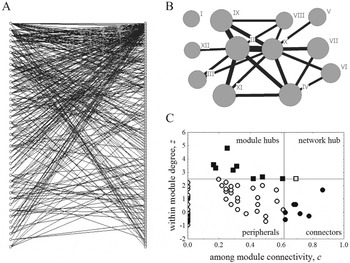
A nested pattern was found in the host-parasite network (NODF=5 491, P<0 001) (Fig. 1A) and modules were found in the network interaction (M=0 680, P< 0 001). Twelve modules with 5–31 species were identified (see Supplement material, Online version only). Fig. 1B displays the interaction patterns among the modules.
(A) Bipartite graph (left edges are host species and right edges are parasite species, the species are ordered from top to bottom in order of decreasing interactions). (B) Graph of modules (line thickness corresponds to the number of links between the modules, and the circle diameter corresponds to the number of species in module). (C) Species roles according to a cz-plot for host-endoparasite matrix.

Most species were peripheral (N=92 820%, Fig. 1C). Only 7 species were connectors and, among these, 5 were parasite species (Bucephalus margaritae, Hysterothylacium sp. 1, Lobatostoma ringens, Procamallanus macaensis and Scolex polymorphus) and 2 were host species (Paralonchurus brasiliensis and Menticirrhus americanus). Connector parasite species were from modules II and X, except Lobatostoma ringens, which was from module XI. Seven species were module hubs and, among these, only 1 was a parasite species (Parahemiurus merus; module II) and all others were host species (Balistes capriscus, Dactylopterus volitans, Lophius gastrophysus, Merluccius hubbsi, Mugil platanus and Pseudopercis numida). Only the digenean Lecithochirium microstomum from module II was a network hub (see Supplement material, Online version only, for identification of the functional role of all species). Overall network connectance (C) was 4 796% and mean module C±s.d. was 61 050%±31 680%. Host-parasite interactions were influenced by the taxonomic distance of the host (Mantel r=0 404; P<0 001); in other words, phylogenetically close hosts tended to share parasite species.
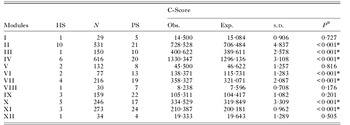
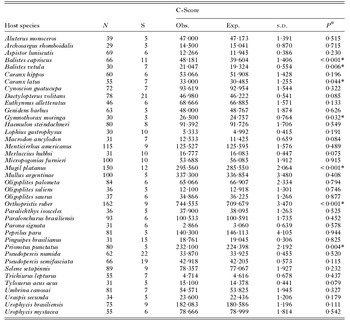
The observed C-score for the matrix with all infracommunities was higher than the expected value (C-scoreobserved: 711 551; C-scoreexpected: 703 668; P<0 001), revealing a negative co-occurrence pattern and demonstrating the segregation of parasite species. Table 1 displays the observed values and mean values expected at random of the C-score index applied to each module. Among modules with more than one host species, only modules V and IX displayed random co-occurrence patterns, which was similar to the modules with a single host species, except module III. Negative co-occurrence patterns were observed in the other modules. Considering the 39 matrices analysed for infracommmunities of each fish species, only 7 had non-random patterns and these were negative (Pobserved⩾Pexpected) (Table 2).
Observed values and mean of the values expected at random of the index C-Score applied for parasite species in each network module of the coastal area of Rio de Janeiro, Brazil

# Probability that the observed number of pairs of species that do not co-occur⩾simulated number of pairs of species that do not co-occur, inside the null hypothesis of random structure of parasite species in each module.
Observed values and mean of the values expected at random of the index C-Score applied for infracommunities of gastrointestinal parasites of 39 species of marine fish collected in the coastal area of Rio de Janeiro, Brazil

# Probability that the observed number of pairs of species that do not co-occur⩾simulated number of pairs of species that do not co-occur, inside the null hypothesis of random structure of infracommunities.
DISCUSSION
Host-parasite networks have a nested structure similar to mutualistic networks (Poulin, Reference Poulin2010). However, antagonistic predator-prey or, in the present case, host-parasite co-evolution leads to differences in network structures in comparison with the majority of mutualistic networks, thereby producing modules with greater frequency that depend on more specialized network interactions, mainly governed by co-evolutionary processes (Lewinsohn et al. Reference Lewinsohn, Prado, Jordano, Bascompte and Olesen2006b; Thompson, Reference Thompson2005, Reference Thompson2006; Olesen et al. Reference Olesen, Bascompte, Dupont and Jordano2007; Fortuna et al. Reference Fortuna, Stouffer, Olesen, Jordano, Mouillot, Krasnov, Poulin and Bascompte2010; Thébault and Fontaine, Reference Thébault and Fontaine2010; Stouffer and Bascompte, Reference Stouffer and Bascompte2011). The data of the present study corroborate these notions.
A large number of generalist species tends to increase network connectance, reduce nestedness and modularity (Fortuna et al. Reference Fortuna, Stouffer, Olesen, Jordano, Mouillot, Krasnov, Poulin and Bascompte2010) and promote homogenization (Borrett and Salas, Reference Borrett and Salas2010), which makes the network more susceptible to disturbances (Olesen et al. Reference Olesen, Bascompte, Dupont and Jordano2007). Generalist parasite species tend to reduce biodiversity through competition, unlike specialist species (Hudson et al. Reference Hudson, Dobson and Lafferty2006), which are frequent in communities with a low degree of connectance. In contrast, low connectance in networks promotes nestedness and modularity patterns simultaneously, as observed in the present study, although these patterns may have some dependence on the null model and the measure employed (see Fortuna et al. Reference Fortuna, Stouffer, Olesen, Jordano, Mouillot, Krasnov, Poulin and Bascompte2010). In the present study, the large number of peripheral species and low degree of network connectance reflected the high degree of specialization of the host-parasite interactions.
Determining factors that lead to parasite specialization requires the combination of phylogenetic and ecological approaches (Poulin, Reference Poulin2005). The variation of the parasite species richness of network host species and its functional role might be a reflection of ancient associations between fish and parasite species, and not only a consequence of the ecological traits, e.g. diet or host habitat (Luque and Poulin, Reference Luque and Poulin2004). Scolex polymorphus was the parasite with the largest number of interactions; however, this is a larval stage and possibly a complex of species (Chandler, Reference Chandler1935; Chambers et al. Reference Chambers, Cribb and Malcolm2000; Braicovich and Timi, Reference Braicovich and Timi2008) and thus is not possible to verify the host specificity. Lecithochirium microstomum (Hemiuridae) was the parasite adult species with the highest number of interactions and occurred in fishes with a high range of parasite species richness, such as Pseudopercis numida (Perciformes), Gymnothorax moringa (Anguilliformes), Oligoplites saliens (Perciformes) and Paralichthys isosceles (Pleuronectiformes) (see Supplementary material, Online version only). Lecithochirium microstomum, was the only network hub species observed and was parasitizing unrelated fishes. The other non-peripherical parasite species has a low specificity tendency (see Bush et al. Reference Bush, Fernández, Esch and Seed2001; Cribb et al. Reference Cribb, Bray, Wright and Pichelin2002; Torres and Soto, Reference Torres and Soto2004; Marchiori et al. Reference Marchiori, da, Magalhães and Pereira2010).
Factors such as habitat heterogeneity, divergent selection regimes and phylogenetic groups of related species could promote modularity, contributing to complexity in ecological networks (Pimm and Lawton, Reference Pimm and Lawton1980; Lewinsohn et al. Reference Lewinsohn, Prado, Jordano, Bascompte and Olesen2006b; Olesen et al. Reference Olesen, Bascompte, Dupont and Jordano2007). In mutualistic networks, the presence of species from different families in the same module may be indicative of convergence between non-related species (Thompson, Reference Thompson1994, Reference Thompson2005). In contrast, in host-parasite networks like the one analysed here, the acquisition of parasites is linked to the food chain (ingestion of intermediate hosts), in which the presence of phylogenetically distant hosts in the same module may indicate a reduction in competitive pressure or adaptation to an abundant resource (Rezende et al. Reference Rezende, Albert, Fortuna and Bascompte2009), whereas the presence of related host species in different modules may avoid niche overlap. The highest similarity of the parasite fauna of related host species in the network and the presence of congeneric hosts in the same module are an indicator of the conservation of phylogenetic niches by the hosts, through feeding of the same preys (intermediate hosts of parasites). Nevertheless, the presence of fish species from different taxonomic orders in the network modules could suggest that in some cases the host ecology could be more important than host phylogeny to determine the similarity of their parasite faunas (Chávez et al. Reference Chávez, González, Oliva and Valdivia2011) and in the formation of modules.
Interactions among modules typically occur with generalist species (Olesen et al. Reference Olesen, Bascompte, Dupont and Jordano2007), and these species when removed from the system could exhibit the fragility of the network structure forming several isolate modules (Solé and Montoya, Reference Solé and Montoya2001). For instance, the non-peripheral hosts overfishing could result in a decrease in parasite diversity affecting the stability of the network and the functionality of the ecosystem (Scheffer et al. Reference Scheffer, Carpenter and Young2005; Wood et al. Reference Wood, Lafferty and Micheli2010). In the present study, modules II and X were fundamental to the topology of the network as these modules contained the majority of non-peripheral generalist parasite species. Additional studies about the other hosts of the life cycle of these parasite species might give important information about diet overlapping in the network fish species. Moreover, the presence of few generalist parasites in a few modules enables greater complexity in the network and could indicate a low degree of competition for resources. This low degree of competition is also suggested by the few component communities that exhibited non-random patterns of co-occurrence.
Gotelli and Rohde (Reference Gotelli and Rohde2002) stressed that metazoan ectoparasites of marine fish exhibit little evidence of non-randomization in the interactions of their component communities, as demonstrated for the endoparasites in the present study. Non-randomization may occur due to intrinsic characteristics of the component communities, indicating hosts from different demographic groups with some particular sex or age classes (Fellis et al. Reference Fellis, Negovetich, Esch, Horak and Boomker2003) or hosts from different locations (Krasnov et al. Reference Krasnov, Matthee, Lareschi, Korallo-Vinarskaya and Vinarski2010). In the present study, a negative pattern of co-occurrence was found when all component communities were analysed together, grouping different species of fish.
A host individual is a habitat for its parasites and, although there are genetic and physiological differences between populations of the species of this host, the individuals are basically homogeneous (Rossin et al. Reference Rossin, Poulin, Timi and Malizia2005). This may have benefitted the predominant random distribution pattern in modules with one host species and those with hosts belonging to the same family (module V – Ariidae; and module IX – Pinguipedidae) as well as in the component communities analysed. Moreover, the low number of parasite species with prevalence equal to or greater than 60% reported by Poulin and Luque (Reference Poulin and Luque2003) for 30 of the host species examined in the present study may explain the random distribution pattern observed, as parasites of low prevalence are less likely to co-exist in their hosts. According to the same authors, the CC50 interactivity index revealed that the 7 component communities with a negative co-occurrence pattern are in an isolationist-interactive continuum, thereby supporting the notion that competition or some other type of interaction is not deterministic in the component communities. Thus, these characteristics may indicate that even host-parasite interactions with a high degree of specialization in the network may be governed by randomness within the component communities.
Host-parasite interactions in ecological networks or component communities allow the understanding of factors related to host biology and ecology. Moreover, endoparasites could be an indicator of the organization of trophic networks in terms of host diversity (intermediate or definitive) involved in their life cycles. With detailed knowledge on ecological networks, it is possible to detect key species for the maintenance of biodiversity and carry out future studies on the stability of networks in the face of frequent environmental changes as well as the effect of overfishing.
ACKNOWLEDGEMENTS
Thanks are due to Robert Poulin for reading the earlier version of the manuscript and making helpful comments. All authors were supported by a research fellowship of the CNPq (Conselho Nacional de Desenvolvimento Científico e Tecnológico of Brazil).