Introduction
Older persons undergoing intimate partner violence (IPV) form a shadowy group falling between the categories of wife abuse and elder abuse (Straka and Montminy, Reference Straka and Montminy2006). In wife abuse, older victims are thought to comprise a minority. In elder abuse, violence within the context of intimate relationships is seldom recognized. Furthermore, although men also fall victim to IPV, this is typically overlooked (Dutton and Nicholls, Reference Dutton and Nicholls2005). The present study is an attempt to address this existing research gap and to establish the prevalence and risk factors for IPV in older Chinese men and women in Hong Kong.
IPV in younger and older adults
In contrast to the general perception that IPV diminishes as relationship partners grow old, Wilke and Vinton (Reference Wilke and Vinton2005) found that older women experience more IPV than younger women. Specifically, 41% of the women aged 45 years and older versus 36% of those aged 30–44 and 26% of those aged 18–29 reported being in a violent relationship. The duration of abuse was also found to be much longer for older women, lasting an average of 14.5, 5.5, and 2.6 years in three separate cohorts of women, respectively. This indicates that there is not a falling-off in abuse because of the frailty and dependence which come with aging, and it is speculated that older women who have survived IPV may have been involved in a long-standing violent relationship.
Risk factors for IPV in older adults
Drawing upon the National Violence against Women Survey, Jasinski and Dietz (Reference Jasinski and Dietz2003) examined the physical violence perpetrated by partners reportedly experienced by respondents over 55 years of age. They found that women were three times more likely to report the experience of physical assault by their current partner than men, with individuals who were married, whose partner was in poorer health, and/or who reported that their partner drank alcohol having greater odds of being a victim of IPV.
Given the limited empirical evidence regarding the risk factors specific for IPV in older adults, it is helpful to review the literature on elder abuse and IPV in general. The existing literature suggests that various situational and demographic variables are related to the occurrence of elder abuse. In terms of the situational variables, both social isolation and a shared living environment are major factors related to elder abuse (Shugarman et al., Reference Shugarman, Fries, Wolf and Morris2003). The empirically based demographic characteristics of older adults are mixed in terms of the impact of gender. Some studies have actually reported that there are more males than females who are abused (Pillemer and Finkelhor, Reference Pillemer and Finkelhor1988), whereas others suggest that the majority of victims are female (Barnett et al., Reference Barnett, Miller-Perrin and Perrin1997). In either case, older adults with cognitive or physical impairments are more likely to be abused by their caregivers (Choi and Mayer, Reference Choi and Mayer2000).
For risk factors specific to IPV, it has been found that abusive partners tend to be unemployed or of a low socioeconomic status (Parish et al., Reference Parish, Wang, Laumann, Pan and Luo2004; Xu et al., Reference Xu2005), abuse alcohol and drugs (Parish et al., Reference Parish, Wang, Laumann, Pan and Luo2004; Xu et al., Reference Xu2005), and have poor anger management (Chan, Reference Chan2004) or suffer sexual jealousy (Parish et al., Reference Parish, Wang, Laumann, Pan and Luo2004). Male domination has also been identified as an important risk factor for violence against women (Xu et al., Reference Xu2005) and so has conflict with the perpetrator's mother-in-law (Chan et al., Reference Chan, Brownridge, Tiwari, Fong and Leung2008).
The aim of the present study was to study the prevalence and risk factors for IPV in older Chinese couples in Hong Kong using a representative population sample.
Methods
This study was approved by the ethics committee of the University of Hong Kong.
Study design and sample
The data employed in this analysis were a subsample from a representative population study on IPV using a household survey which was carried out in 2004. A complete description of the research design and sampling is available (Chan et al., Reference Chan, Brownridge, Tiwari, Fong and Leung2008). Cantonese, Putonghua, or English speaking individuals aged 16 years or above at the time of the study, who were either married or cohabiting, or were single or divorced but with children, were eligible to participate. All subjects participated voluntarily without monetary reward. After explanation of the study and confidentiality issues, written informed consent was obtained from all of the participants. They were then individually interviewed face-to-face by trained research assistants. With a response rate of 71%, this survey was a representative sample of 5,049 adult respondents.
The data employed in this analysis included only those participants who were aged 60 years or above and who were married or cohabiting at the time of the interview. A total of 937 cases (397 women and 540 men) were extracted and included in this analysis.
Measures
Dependent variables
Intimate partner violence. The Revised Conflict Tactics Scale (CTS2) was employed to measure partner violence in terms of lifetime and preceding-year prevalence. The CTS2 covers five aspects of spousal conflicts – negotiation, physical assault, psychological aggression, physical injury, and sexual coercion. It has been demonstrated to have satisfactory psychometric characteristics (Straus, Reference Straus, Straus and Gelles1990) and high cross-cultural reliability (Straus, Reference Straus2004). The internal consistency reliability of the CTS2 scales is generally high, with an α coefficient ranging from 0.79 to 0.95 (Straus et al., Reference Straus, Hamby, Boney-McCoy and Sugarman1996). The CTS2 has been translated into Chinese and validated using Hong Kong data (Chan, Reference Chan2004). In this study, the observed α reliability ranged from 0.88 to 0.96.
Independent variables
Demographic characteristics. Participants provided information on their age, gender, education level, marital status, disability and chronic illness, living arrangements, work status and income, whether they were receiving social security, whether they were in debt, and whether they were new immigrants to Hong Kong.
Childhood witness of parental violence. Participants were asked to recall if they had witnessed parental use of physical violence and injury in childhood, as described by the physical assault and injury scales of the CTS2.
In-law conflicts. In-law conflict was measured by a single item. Participants were asked to report the number of incidents of conflict with children-in-law in the previous 12 months. The responses included never, once, twice, 3–5 times, 6–10 times, 11–20 times, 20 times or more, and none in the past 12 months but it has happened before.
Risk factors for intimate partner violence. Risk factors for IPV were measured using the Family Needs Screener (FNS; Kantor and Straus, Reference Kantor and Straus1999). The FNS is a short version of the Personal and Relationships Profile (PRP) which is a multiscale instrument that profiles various empirically demonstrated variables related to physical violence against a spouse in a marital, cohabiting, or dating relationship, with reportedly satisfactory internal reliability (Straus and Mouradian, Reference Straus and Mouradian1999). The PRP items are arranged in 21 subscales which are theoretically related to the etiology of IPV and measure both individual and relationship factors. For the present study, six subscales were selected from the PRP to estimate their correlation with partner violence. These were criminal history, domination, jealousy, anger management, substance abuse (including alcohol and/or drug abuse), and stressful conditions. Respondents were asked to indicate the extent to which each statement adequately described themselves on a 4-point scale, with a higher score indicating a higher risk for IPV.
Social support. Social support was measured by the social support scale from the FNS (Kantor et al., 1999). The items of the social support scale include the following items: only have a few friends/family to help with a child/children; feel very isolated; there is someone who makes me feel confident; there is someone with whom I can talk openly; there is someone with whom I can talk about my relationship problems; there is someone from whom I can borrow money in an emergency; I have someone to take care of my children in an emergency; someone who helps me around the house; I have someone I can count on in times of need; there is enough money for my daily needs.
For the present study, the PRP subscales and the social support scale were translated into Chinese by the second author. A back translation was conducted to ensure compatibility with the original scale. The Chinese version was further checked by two clinical psychologists and three experienced social workers with experience working with family violence. The reliability α of the anger management subscale was 0.52. The reliability α of the subscales including domination, jealousy, anger management, substance abuse, and stressful conditions ranged from 0.78 to 0.97. The α coefficient of the social support scale was 0.71.
Results
Participants
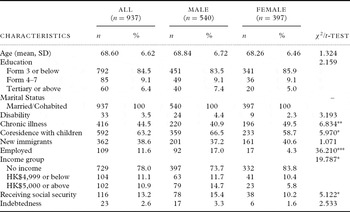
The participants’ age ranged from 60 to 100 years with a mean of 68.6. Approximately 15.5% had attended high school (equivalent to grade 10 or above in the USA) or tertiary education. Approximately 3.5% identified themselves as physically or mentally challenged. Nearly half of the participants reported a chronic illness that required medical treatment, a condition slightly more common in females (49.5%) than in males (40.9%). Approximately 64% of the subjects were living with their children and 38.6% were new immigrants from Mainland China. Seventy-eight percent had no income and approximately 13.2% were dependent on social security. More men than women were dependent on social security (χ2 = 5.122, p < 0.05) or were still employed (χ2 = 36.210, p < 0.001) at the time of the interview
The demographic characteristics of the present sample are summarized in Table 1.
Demographic characteristics of the respondents

* p < 0.05; ** p < 0.01; *** p < 0.001.
Prevalence
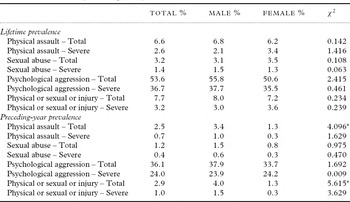
The lifetime prevalence of various forms of aggression ranged from 1.4% to 53.6% in this sample. Psychological aggression and sexual abuse, respectively, were the most and the least prevalent forms of abuse reported in this sample. No significant gender difference was observed in terms of the lifetime prevalence of the various forms of IPV.
The past-year prevalence of IPV ranged from 0.4% to 36.1%. Psychological aggression was the most common form of IPV reported by respondents in this sample, with 36.1% of the respondents reporting their partners had used some form of psychological aggression on them in the surveyed year. Physical assault and sexual abuse were reported by 2.5% and 1.2% of the respondents, respectively. With the exception of total physical assault (χ2 = 4.096, p < 0.05), and total physical or sexual injury (χ2 = 5.615, p < 0.05), both of which were more common in males than in females, no significant gender difference was observed in terms of the lifetime prevalence of the various forms of IPV.
Lifetime and past-year prevalence rates of the forms of IPV broken down by gender are summarized in Table 2.
Lifetime and preceding-year prevalence of IPV victimization and in-law conflict

*p < 0.05.
Risk factors for IPV
A series of binary logistic regression analyses were conducted to unearth associations between IPV and the participants’ demographic, psychosocial, and relationship characteristics.
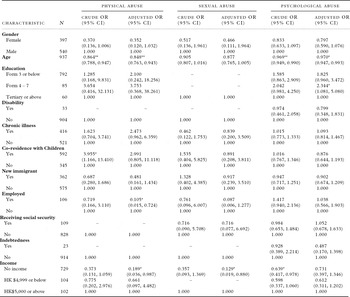
The demographic variables of interest included gender, age, education level, disability, chronic illness, coresidence with adult child(ren), whether the participant was a new immigrant, employment status, social security, indebtedness, and income. An examination of the adjusted odds ratio showed that different demographic characteristics were independently associated with various forms of IPV. The perpetration of physical abuse was associated with a younger age of the victim (OR = 0.848, p < 0.001), not being employed (OR = 0.105, p < 0.05), and having an income (OR = 0.189, p < 0.05); psychological abuse was associated with a younger age of the victim (OR = 0.970, p < 0.05); sexual abuse was associated with having an income (OR = 0.129, p < 0.05).
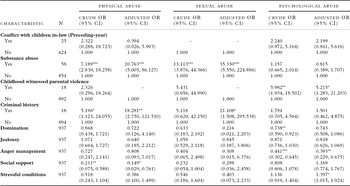
The psychosocial and relationship variables of interest included conflict with children-in-law, substance abuse, witnessing parental violence in childhood, criminal history, domination, jealousy, anger management, social support, and stressful conditions. The results showed that while substance abuse increased the risk for physical and sexual abuse 20- and 35-fold, respectively (OR = 20.763 and 35.330, p < 0.001), criminal history also increased the risk for physical and sexual abuse by 18 and 21 times, respectively (OR = 18.281 and 21.108, p < 0.001). A low level of social support also increased the odds of physical abuse (OR = 0.149, p < 0.05). A low level of anger management and a high number of stressful conditions were both independently associated with higher levels of psychological aggression (OR = 0.393 and 1.397, p < 0.01 and 0.05).
Tables 3 and 4 present the results of the logistic regression analyses.
Demographic correlates associated with preceding-year IPV victimization as shown by regression analyses

OR = odds ratio; Adjusted OR = odds ratio controlling for all variables: CI = confidence interval.
*p < 0.05; ** p < 0.01; *** p < 0.001.
Psychological and behavioral correlates associated with preceding-year IPV victimization as shown by regression analyses

OR = odds ratio; Adjusted OR = odds ratio controlling for all variables: CI = confidence interval.
*p < 0.05; ** p < 0.01; *** p < 0.001.
Discussion
The present study used a representative sample to determine the prevalence of IPV in older Chinese couples in Hong Kong. In doing so, our team sought to identify the significantly related demographic, psychosocial, and relational risk factors.
Previous local studies on IPV in the comparatively younger population using representative samples have typically reported a past-year prevalence of 16%–26% (Leung et al., Reference Leung, Leung, Lam and Ho1999; Xu et al., Reference Xu2005). Compared to these reported rates, the prevalence of IPV in older adults was found to be quite high in the present study, with a lifetime prevalence ranging from 1.4% to 53.6% and a past-year prevalence ranging from 0.4% to 36.1% for various forms of aggression.
It is unclear whether IPV in older adults bears a closer resemblance to IPV or elder abuse. On one hand, it is possible that these IPV cases in older adults are a form of spousal abuse in a couple that is growing old, meaning that the IPV victims in the present study may have been survivors of a long-standing violent relationship. On the other hand, it is also possible that these cases are better understood as elder abuse, wherein a person falls victim to abuse because of his or her frailty and decreased capacity for self-care due to advanced age. While it is too early to draw a conclusion, an investigation into the factors associated with IPV in older couples may begin to throw some urgently needed light on this special group.
Our study found that older men, not women, were more likely to become victims of physical abuse by an intimate partner in the surveyed year. This finding contrasts with previous research which showed physical abuse more commonly occurring in women. A previous incidence study showed that two-thirds of the victims of physical abuse were older females (National Center on Elder Abuse, 1998). Another study examining older victims in the domestic violence service system also showed an overwhelming majority of the victims (90.1%) to be female (Lundy and Grossman, Reference Lundy and Grossman2004). While both studies used data from adult protective services, referrals, and service systems, the results may not be closely comparable to the present findings due to various methodological or sampling differences. In fact, however, a previous study using random samples also found that more males than females were abused (Pillemer and Finkelhor, Reference Pillemer and Finkelhor1988). It is possible that while older persons of both genders are victims of IPV, older females may be more inclined to seek help from service agencies or were in some similar sense more easily identified, and have thus been better represented in certain previous studies.
An examination of the demographic correlates of IPV among older couples showed that while it resembles both elder abuse and IPV in younger couples, there is also a considerable difference between them: For instance, this study found that among the older victims of IPV, those who were relatively younger among them were at elevated risk for IPV. This finding contradicts the general perception that advanced age per se is associated with increased risk of elder abuse. However, this is less of a surprise when taking into account the fact that only a fraction of elderly adult abuse cases are actually reported. The results from the national elderly adult abuse incidence study showed that the oldest old are overrepresented among the cases reported to adult protective services but nevertheless still underrepresented in that they make up the highest number of non-reported cases. Specifically, among the elder abuse cases reported to adult protective services, approximately half of the victims were 80 years of age or above. The opposite is observed in non-reported cases, however, with 60–70-year olds comprising almost 70% of the cases of physical abuse (National Center on Elder Abuse, 1998). It is also noteworthy that much of the elder abuse literature focuses on victims’ adult children as the abusers (National Center on Elder Abuse, 1998). It is possible that a victim's age may have different implications for IPV in older couples.
Previous reports on the association between substance abuse, criminal history, and domestic violence have largely focused on the perpetrators. In the elder abuse literature, abusers are reported to engage in both drinking and getting drunk (Anetzberger et al., Reference Anetzberger, Korbin and Austin1994), and most had consumed alcohol before perpetrating acts of violence (Eckley and Vilakazi, Reference Eckley, Vilakazi, Kosberg and Garcia1995). In the field of IPV research, abusive partners tend to use or abuse alcohol and drugs (Parish et al., Reference Parish, Wang, Laumann, Pan and Luo2004; Xu et al., Reference Xu2005). Findings from the present study showed that older respondents with substance abuse and/or a criminal history were in fact more likely to become victims of IPV. It is possible that older IPV victims in the present study may have used drugs and/or alcohol as a means to “self-medicate.” Exposure to repeated interpersonal traumatic events has been associated with alcohol use (Nelson et al., Reference Nelson2002). Female IPV victims, in particular, reportedly use alcohol to cope with the trauma arising from domestic violence (Kaysen et al., Reference Kaysen2007). IPV in older couples is thus intertwined in a network of social issues and problems, and any effort to understand domestic violence must take a variety of factors into consideration.
This study also found that witnessing parental violence in childhood was associated with the present experience of psychological abuse. This is consistent with the hypothesis of a pattern of intergenerational transmission of violence and re-victimization. Indeed, a reported meta-analysis showed previous experience of witnessing/experiencing family-of-origin violence to be a risk factor for subsequent victimization (Riggs et al., Reference Riggs, Caulfield and Street2000).
Consistent with previous IPV studies in the Chinese population (e.g. Chan, Reference Chan2004; Xu et al., Reference Xu2005), we found domination and anger management to be associated with psychological abuse in older couples. While previous studies examined perpetrators’ high level of domination and low levels of anger management predictive of domestic violence (e.g. Vives-Cases et al., Reference Vives-Cases, Gil-González and Carrasco-Portiño2009), our study shows the lack of assertiveness and anger management on the part of the victim to be predictive of a high level of psychological aggression on the part of the perpetrator.
We also found a low level of social support to be predictive of physical assault. This is consistent with the elder abuse literature, which shows social isolation and a lack of social support to be important factors contributing to a mistreatment by caregivers (Lachs et al., Reference Lachs, Berkman, Fulmer and Horwitz1994; Compton et al., Reference Compton, Flanagan and Gregg1997). Having limited social support, older IPV victims may find themselves dependent on the abuser, making it difficult or essentially impossible for them to leave the abusive relationship. Previous studies on elder abuse also found that victims perceive themselves as being emotionally dependent on their relationship with the abuser (Yan and Tang, Reference Yan and Tang2004).
Several limitations of the present study warrant consideration. Since this study was based on cross-sectional data, no conclusion about the causal relationship between the risk factors and IPV can be drawn. For the same methodological reason, the changes in IPV perpetration and victimization could not be captured over time. The data relied on the respondent self-reports and no external validation of these reports could be conducted in this study. Furthermore, although the present analysis is based on a subset of a representative population sample, the sample does not adequately reflect the demographics of the older population in Hong Kong. While previous studies showed that older persons with dementia were at elevated risks of family violence, no attempt has been made to identify the participants with dementia or cognitive impairment in this study. These are important factors which need to be examined in future studies.
However, despite these limitations, this study did employ both a representative sample and validated measures. The results suggest that IPV among older Chinese couples resembles both elder abuse and IPV as reported in the literature. However, given the complexity of the phenomenon, further studies should be conducted to investigate this preliminary finding and to better understand the driving mechanisms of IPV in older couples. IPV in older couples is a highly complicated phenomenon that is heavily intertwined with other forms of domestic violence and abuse, including spousal violence, child abuse, in-law conflicts, and elder abuse. Until we have a more definitive analysis and clear evidence as to whether IPV in older couples should come under the category of spousal abuse or elder abuse, it is advisable to treat it as a separate category of family violence related to both.
Conflict of interest
None.
Description of the authors' roles
E. Yan formulated the research questions and wrote the paper. E. Chan formulated the research questions, designed the study, and supervised data collection and analysis.
Acknowledgments
This study was commissioned by the Social Welfare Department and the Government of Hong Kong and funded by the Lotteries Fund.