
Introduction
During the First World War (1914–1918), the landscape along the European Western Front was devastated by warfare and military operations. By the end of 1914, a stalemate was reached and both sides dug in. Improvised trenches soon formed a continuous line running from the Belgian coast, through France, to the Swiss border (Keegan Reference Keegan2000) (Figure 1). After four years of warfare, intense artillery bombardment had rendered large sections of the approximately 700km-long front virtually unrecognisable (e.g. Clout Reference Clout1996; Amat Reference Amat1999; Stichelbaut & Chielens Reference Stichelbaut and Chielens2014; Stichelbaut et al. Reference Stichelbaut, Gheyle, Eetvelde, Meirvenne, Saey and Note2017).
Find locations of the wooden remains from the First World War. The red line demarcates the front line in early 1918, the green line the farthest advance of German troops. Thin lines demarcate the front zone (dotted and solid lines for the Allied and German armies, respectively) after the First (grey lines, October to November 1914), Second (green lines, May 1915), Third (light blue lines, June to November 1917) and Fourth (dark blue lines, April 1918) Battle of Ypres.

In the Belgian province of West Flanders, a sector of the front line was held by Belgian forces. This was situated adjacent to the flooded area between the River Yser and its tributary canals. Farther to the east and south—along low ridges around the town of Ypres—Allied and German troops were entrenched for most of the war. During several military operations, this sector of the front—better known as the Ypres Salient—moved only a few kilometres in both directions (Barton & Doyle Reference Barton and Doyle2005). Today, material evidence from the First World War can still be found, above and below ground. Ploughing and infrastructural works in the area of the former front line frequently reveal trenches, (underground) shelters, ammunition, personal belongings and even human remains (Dewilde et al. Reference Dewilde, Pype, de Meyer, Demeyere, Lammens, Degryse, Wyffels and Saunders2004, Reference Dewilde, de Meyer and Saunders2007; Robertshaw & Kenyon Reference Robertshaw and Kenyon2008; Saunders Reference Saunders2010; Van Hollebeeke et al. Reference Van Hollebeeke, Stichelbaut and Bourgeois2014).
When First World War structures are encountered during archaeological fieldwork in this area, wood is by far the most common category of find. This is unsurprising, as wood was used in huge quantities for the construction of footpaths to facilitate access across muddy and cratered battlefields, for reinforcing trenches and creating (underground) shelters, and for the thousands of poles required to support communication lines (The War Office 1922; Vancoillie & Blieck Reference Vancoillie and Blieck2016). Furthermore, wood and charcoal were also essential for heating and cooking (MacLean Reference MacLean2004). The military operations between 1914 and 1918 thereby fuelled a constant and significant demand for timber—both for maintaining and repairing existing infrastructure and for the building of new defensive structures on conquered terrain. To reduce the potential strain of transporting this timber on the logistical supply lines needed for more essential provisions—overseas transport routes for the Allies, and congested railways for the Germans—woodlands and forests in France, England and Germany took on strategic importance (e.g. MacLean Reference MacLean2004).
This article presents the results of the analysis of wood samples from a series of First World War sites located along the Western Front, with the intention of determining the range of wood species used and to assess their potential for tree-ring analyses, and thus the identification of provenance. In turn, the latter allows for the reconstruction of former timber supply routes. The study aims to evaluate how wood research can contribute to a better understanding of the significance, transportation and use of timber during the First World War.
Timber supply during the First World War
At the beginning of the war, the UK War Office relied on large quantities of timber from Sweden and Russia, as well as Canada and the USA, a tradition going back to Napoleonic times (Tozer & Strickland Reference Tozer and Strickland1980). By late 1915, the Royal Engineers had formed a forestry branch for coordinating the exploitation of home-grown timber (The War Office 1922). Shortly after, access to forests in France was provided by the French authorities. Forests of beech (Forêt d'Eu) and Scots pine forests near Brotonne and in Rouvray (near Rouen) were the first to be exploited by the British in France (MacLean Reference MacLean2004).
When the armies on the Western Front dug in the demand for timber soared and local forests and woodlands were soon depleted. Furthermore, as the war progressed, demand for timber grew—over time, trenches evolved from simple ditches with little or no side reinforcement, to trenches with duckboards or planks, to trenches reinforced with A-frames and duckboards and sides supported by wooden frames and planks (Figure 2a). This type of reinforced construction was soon adopted by German troops, although wattlework was often used in their trenches to support the trench sides.
Images taken during the First World War in a French forest and in the trenches: a) British troops carrying timber for a trench support at Ploegsteert, 1917 (© IWM; Q 5092); b) prisoners stacking felled trees in Brotonne Forest, 1918 (© IWM; Q 10242); c) saw mills in the Brotonne Forest, 1918 (© IWM; Q 8504); d) German prisoners of the 52nd POW Company stacking pickets (for charcoal production) in the Basse Foret d'Eu, 1918 (© IWM; Q 10207); e) a German trench with walls reinforced by wattlework; f) the 2nd Australian Tunnelling Company at work underground in Nieuport Bains, Belgium, 1917 (© IWM; (E AUS) 4621).

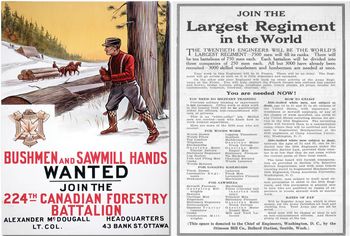
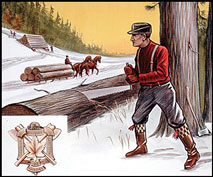
To meet the ever rising demand for construction materials, in 1916, the British were forced to request Canadian assistance, in the form of experienced lumberjacks and sawmill operators, for the exploitation of British and French forests (Figure 3). Within the year, a total of 2406 Canadian Foresters were working in the UK, and 623 more were active in the forests of northern France. The import of timber from Scandinavia and Canada became a risky operation due to unrestricted submarine warfare in the North Sea (Bird & Davies Reference Bird and Davies1919), which increased the strategic importance of forests along the Western Front even more. Early in 1917, The War Office requested further support from the Canadian government, as more skilled foresters and lumberjacks were urgently needed (Figure 2b). At its peak, the Directorate of Timber Supplies employed 41 forestry companies in England and 60 in France (Bird & Davies Reference Bird and Davies1919). The workers of the Directorate comprised British and Canadian soldiers, Newfoundlanders, German prisoners of war, Portuguese, Finns and—reported as a separate category—“woman cutters and measurers” (The War Office 1922: 717). According to the Statistics of the Military effort of the British Empire during the Great War (The War Office 1922), 24 901 workers were employed by the Directorate by November 1918. Furthermore, the deployment of the Chinese Labour Corps in France—especially in sawmills—should not be underestimated. When workers transporting the timber are included, up to 33 000 individuals were working in the forestry sector under British-Canadian supervision.
Recruitment posters for skilled lumberjacks and sawmill workers in Canada (left) and the USA (right).

The USA also assisted in ensuring a large and continuous supply of timber to the front. The American army began, in cooperation with the US Forest Service, to recruit experienced lumberjacks, foresters and sawmill operators. This led to the establishment of two regiments of foresters (Greely Reference Greely1919; Davies Reference Davies1920): the 10th and 20th Engineers (Forestry). From October 1917 onwards, these regiments were active in the north and south of France (Figure 4) (Moore Reference Moore1919). By October 1918, up to 18 543 men were active in forestry under American command (American Forestry 1919), working in 81 sawmills in France (Figure 2c) to ensure a stable supply of beams and planks to the front.
Maps showing the locations where the Canadian forestry corps (Bird & Davies Reference Bird and Davies1919: 37) and the American 10th and 20th Engineers Forestry were active in France (Davies Reference Davies1920: 32).

The French themselves concentrated on harvesting timber for trench construction in four centres: Besançon, Bordeaux, Orléans and Rouen (Puyo Reference Puyo2004), employing approximately 43 500 workers in 1917 and 1918 (Chevalier 1928, quoted in Puyo Reference Puyo2004). These combined Allied efforts in France to increase local timber supply reduced the quantity of timber that needed to be transported from overseas (MacLean Reference MacLean2004) (Figure 5). In addition to timber for construction, wood was equally important as fuel. Charcoal production was re-introduced in France and England in order to supply the front with a light fuel that produced little smoke and was easy to ration and apportion (Figure 2d).
Trends in the amount of timber transported to the Western Front to supply British troops (from MacLean Reference MacLean2004: 98).

Timber supply on the German side relied both on the exploitation of local forests in occupied areas and the transport of timber from German forests to the front. In Belgium, for instance, it was estimated that from 1914–1918, at least 22 000ha of forest was cleared or devastated in occupied territory and along the front line in western Flanders (Tallier Reference Tallier2004). Trees in parks and along avenues were also an important source of timber. German soldiers were rarely involved in forestry (Bader Reference Bader2011); instead, in Belgium, 130 000 local forced labourers were put to work (Dassen Reference Dassen2014). In occupied territories, local timber production facilities were seized in order to ease pressure on the German rail network (Vancoillie & Blieck Reference Vancoillie and Blieck2016), although huge quantities of timber were also brought to the front from the German hinterland.
At the outbreak of war, Germany relied heavily upon the import of timber from abroad, with Russia and Austria-Hungary accounting for 52 and 30 per cent of the exports, respectively. Import from countries that were neutral at the start of the war accounted for only a small portion of the imports: Sweden (seven per cent), Norway (one per cent) and the USA (six per cent)—trade that practically ceased in 1914 (Bader Reference Bader2011). In the years prior, forestry policies and a decline in the importance of timber had resulted in extensive domestic forests that were sufficient to offset the loss of these imports. Despite this, however, domestic felling decreased during the war as labour and equipment were redirected towards the front.
The overall demand for timber can be divided into two distinct phases. First, by early 1915, the front line became more or less fixed and trenches permanent. An estimated 539 000m3 of timber was needed for initial construction of the 700km-long defensive line. Barracks alone accounted for approximately 10 per cent (approximately 50 000m3 per month, from December 1914 to April 1915) of the required timber (Bader Reference Bader2011). After these works were completed, the need for timber decreased. The second distinct phase of demand for timber coincided with the start, in 1916, of attritional warfare, as exemplified by the Battle of Verdun. Heavy artillery barrages by one side would obliterate the enemy's forward trenches, which were then quickly occupied and repaired by advancing forces. The process would then be reversed, as the trenches were shelled, recaptured and rebuilt. This required a continuous supply of building timber, and demand remained steady for the rest of the war.
The remains of some of the immense volume of timber that was brought to the front during these years are still to be found in the ground, and they are frequently unearthed during archaeological investigations and development works. Waterlogged conditions, in particular, often ensure the excellent preservation of wooden structures and objects. The scientific analysis of these timbers offers the opportunity to verify and complement the evidence provided by the historical sources discussed above.
Research material and methods
Find locations along the Western Front in Belgium
Wood from 24 contexts at 22 locations with First World War archaeological features and finds were sampled for species identification (Figures 1 & 6). These sites are all located close to the city of Ypres. Both research-driven and development-led archaeological projects have revealed a wide variety of structures and finds from varied First World War contexts (Table 1).
Overview of the find locations where wooden structures and finds from the First World War were sampled and examined. The site IDs refer to Figure 1.

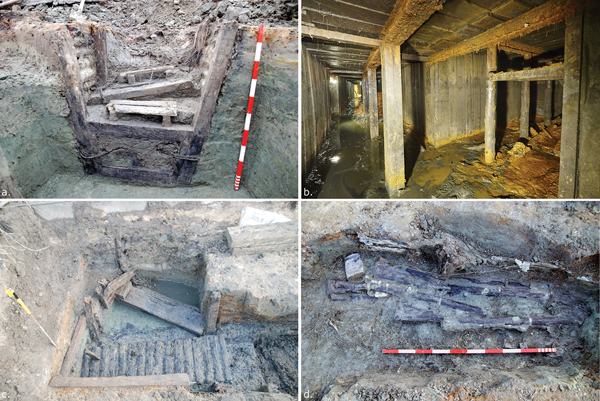
The most prominent features encountered during the fieldwork discussed here are trenches constructed by British, French, Belgian and German troops. Wooden elements from these trenches sampled for analysis include planks, duckboards and A-frames (Figure 6a). For instance, trenches were excavated at Sint-Elooi (site 3), where personal belongings from both German and British soldiers were found, suggesting that control of this particular location shifted between combatants. In a German encampment located in Langemark-Poelkapelle, a pit filled with the remains of a (bon)fire was located and sampled, containing both charred and fresh wood fragments, mixed with corks, bottles, tools and pieces of bread (Bracke et al. Reference Bracke, Ervynck, Lentacker, Bastiaens, Deforce, Haneca, Moens and Verdegem2016). Furthermore, an underground deep dugout next to the (post-war) church at Zonnebeke was drained in 2017, allowing the collection of samples for species identification and wood-technological research (Deseyne Reference Deseyne1990; Van Acker et al. Reference Van Acker, Windt, Haneca, Beeckman, Claeys, Vandenbussche, Vandewalle, Robeyst and Willems2017) (Figure 6b). In Ypres, the heavily fought-over Wieltje site, provided an opportunity to sample the well-preserved trenches, as well as access to the Hades deep dugout (Finlayson Reference Finlayson2008), which were discovered immediately below the modern pavement (Figure 6c). Finally, in Heuvelland, along the Galgestraat, the remains of German soldiers were found during development work; samples of nine wooden coffins were taken for analysis.
a) A-frames at Kleine Poezelstraat; b) the Zonnebeke Church deep dugout; c) entrance to the Hades deep dugout at Ieper-Wieltje; d) Lee Enfield rifles at Ieper-Wieltje (all images courtesy of the Flanders Heritage Agency).

Wood-species identification
A total of 381 pieces of wood from 24 First World War contexts were collected by taking cross-sections of the timbers with the largest dimensions, or bulk samples from refuse deposits. Small subsamples of less than 1cm3 were taken from particular objects, such as gunstocks (Figure 6d) or ammunition holders. Thin sections were prepared, and anatomical characteristics of the wood were described and compared to identification keys for taxonomic identification (see the online supplementary material (OSM) for more detail). To determine the provenance of the wood samples, timbers were selected for tree-ring analysis. When at least 70 annual rings could be observed on the transverse surface of a wood sample, its ring-width pattern was recorded to the nearest 0.01mm, after preparing a radial strip approximately 10mm wide on a transverse section.
Results
From wood anatomy to species identification
Initial observations revealed that the 381 samples included fragments of cork (n = 40), bark (n = 25) and bamboo (n = 3), the latter originating from a set of signal flags that were used for transmitting messages. These 68 samples came from the remains of a fire at Wolvengrachtstraat (site 20). Taxonomic identification was focused on the remaining 313 wooden fragments, objects and timbers. At least 16 different species are represented. The range is dominated by wood from coniferous trees (79.6 per cent), with pine (Pinus sylvestris), spruce (Picea abies) and silver fir (Abies alba) representing the most abundant species (Figure 7).
Abundance of the identified wood species (n = 313). Green = coniferous wood (softwood); blue = broadleaved wood (hardwood) (figure by authors).

The anatomical characteristics of 16 individual timbers (Figure 8) allow us to exclude coniferous species that are native to Europe (see the OSM for more detail). Four beams from the Zonnebeke Church dugout (site 22) and one plank from Ooststraat in Ypres (site 10) are identified as pine wood (subgenus Pinus, section Trifoliata) from the subsection contorta; this botanical subsection includes species native to North America, such as P. banksiana (Jack pine) and P. contorta (lodgepole pine). One plank from Ooststraat (site 10) and one from Sint-Elooi 3 (site 5) belong to the group of Southern Yellow Pines, native to the south-eastern USA; this group of pines include P. taeda (loblolly pine), P. palustris (longleaf pine), P. elliottii (slash pine) and P. echinata (shortleaf pine). A plank of similar anatomy came from Sint-Elooi 3 (site 5), and probably originates from a pine tree of the subsection Australes; it may represent one of the Southern Yellow Pines, but probably of a different species to those described above. Finally, microscopic analysis of eight planks from the trenches at Ieper-Wieltje (site 8) identifies the species as Pseudotsuga menziesii (Douglas fir or Oregon pine).
Microscopic images of two similar samples of wood from the First World War trenches (FLAZ33 nr.140 sp.214 and STE3 spoor (feature) 2004), with anatomical features corresponding to the genus Pinus, subsection Australes (figure by authors).

Hardwoods are relatively rare in the collection (Figure 7), the most frequent being willow/poplar (n = 17) and elm (n = 16). Other broadleaved species—alder (n = 8), beech (n = 5), walnut (n = 5), maple (n = 4), oak (n = 4), hornbeam (n = 2), ash (n = 2) and birch (n = 1)—were found in low numbers.
Selection and technology
Restricting discussion to the larger construction timbers (n = 210), coniferous species dominate (83.2 per cent), with the same three European species (pine, spruce and fir) being the most abundant (Figure 9). To establish whether there was a difference in the wood species used by the German and Allied troops, all taxonomic identifications were classified according to the location of findspots to the front line, and to the contexts of the objects at the time of archaeological investigation. The results demonstrate strong similarity in the range of wood species found in the structures built by Allied or German troops (Figure 9). Both sides predominantly used coniferous species to meet their construction needs. The American pine timbers were all found in trenches originally built by British soldiers, except two pieces from Sint-Elooi 3; this was originally a German position, but was captured and recaptured several times, and it is possible that the American pine timbers were brought to the site by Allied forces and do not belong to the original German construction.
Abundance of the identified wood species in a sample restricted to the larger construction timbers (n = 210) (figure by authors).

Elm (Ulmus sp.) represents the most abundant broadleaved species found in trenches built by British, French and Belgian troops. This species is native to south-western regions of Belgium, and presumably the elm timber used for construction during the First World War had a local origin. At the beginning of the twentieth century, elm was a common species in the local landscape of south-western Flanders, where fields, roads and pastures were bordered by earthern banks covered with hedges or rows of trees (Heyde Reference Heyde2014). Dutch elm disease devastated the native populations of elms in Europe and led to a dramatic reduction of the elm population in Flanders shortly after the end of the First World War.
Wooden utensils and smaller objects are often made from broadleaved wood species. The small blocks that were used to adjust the level of duckboards, for example, were often made of poplar or willow (Populus/Salix). Although most coffins found in Heuvelland (site 2) were made with spruce, or a mixture of pine, spruce and/or fir, two coffins were made predominantly of Populus/Salix planks. Handles from unidentified tools were made of ash (Fraxinus sp.)—an elastic wood species that was preferred for ladders and handles throughout Western Europe at the time. Four rifle stocks from both German and Allied trenches were examined; all are made of walnut (Juglans regia) (Figure 6d). In the sample, beech (Fagus sylvatica) was used only for small utensils, such as brushes. Oak (Quercus robur and Q. petraea), the most abundant and preferred species for construction timber for many centuries in Western Europe (Haneca et al. Reference Haneca, Cufar and Beeckman2009)—and in Flanders in particular (Haneca Reference Haneca2016)—is conspicuously absent from the sample.
Identifying timber provenance
Only 19 timber samples had sufficient numbers of tree rings for dendrochronological analysis. Comparison of the tree-ring series reveals significant internal correlation between the samples from Ooststraat/FLAZ-33 (site 10). Two samples (FLAZ-33_a and c) originate from the same tree. The mean curve for these two measurements, along with the individual series, were compared to reference chronologies from forests in southern Germany, France and Scandinavia, covering the period c. AD 1750–1914. Only four series display a good correlation with the available chronologies (Table 2). A single fir tree-ring series can be dated with chronologies from the Black Forest and Vosges region in south-west Germany and north-east France. Three series that originate from a trench constructed by French and Belgian forces (site 10) display a high correlation with a chronology composed of tree-ring series from spruce timbers imported from central Sweden that were found and analysed in the Netherlands (NLPCAB01).
Overview of all measured (and dated) tree-ring series (t BP = t-value according to Baillie and Pilcher (Reference Baillie and Pilcher1973), %PV = percentage of parallel variation according to Eckstein and Bauch (Reference Eckstein and Bauch1969)).

Discussion
Due to the high water table and waterlogged conditions, wood recovered from First World War sites is generally well preserved, with little evidence of advanced fungal decay. Cell-wall erosion due to bacterial decay usually advances into the interior of waterlogged wood less than 1mm per year from the exterior (Klaassen Reference Klaassen2008), and is therefore insignificant in the degradation of the relatively recently buried timbers studied here. As a result, the anatomical features and tree-ring patterns of the analysed wood samples can be studied in detail. The structural integrity and mechanical strength of the preserved timbers from the Zonnebeke Church dugout clearly show that, in waterlogged conditions, wood outperforms steel when used, for example, as supporting beams (Figure 6b).
The similarity in the use of wood between the German and Allied trenches is striking (Figure 9). Construction timbers are dominated by the three most widespread European conifer species: pine, spruce and fir. While these may have been sourced in forests near the front lines, in Flanders they probably represent timber transported over longer distances. The two most frequently encountered broadleaved wood species—elm and poplar/willow—are also found on both sides of the Western Front and represent forests in closer proximity to the front line.
While there is a clear tendency towards the use of coniferous timber in the trenches, the opportunistic use of different timber species is also noted. Availability was probably the main factor when selecting timber for construction purposes. At Ieper-Wieltje (site 8), composite A-frames were found, combining spruce, pine and/or fir—including small blocks of poplar/willow to adjust the level of the duckboards. Several coffins for the deceased German soldiers at Heuvelland were also made with the same mixture of tree species. Consequently, no deliberate choice or preference for any particular softwood can be observed. An opportunistic use of the available timber—both local and non-local—was common.
In addition to construction timbers, twigs (usually of willow or hazel) were used for wattlework to reinforce trench walls—a technique predominantly used by the German army (Figure 2e). Archival sources, such as text posters, provide examples of bundles of long twigs of coppice or pollards being demanded from the local inhabitants in occupied territory. The abandoned fire found at Houthulst contained numerous twigs. This could have been material for, or leftovers of, wattlework. Most of the small twigs found in the fire, however, were of pine and spruce, with much smaller quantities of alder and poplar/willow.
Detailed observations of wood anatomy reveal that not all of the construction timbers originated from France, England or the German hinterland. The entrance of the Hades deep dugout at Ieper-Wieltje (Figure 6c) was constructed with beams of Douglas fir (Pseudotsuga menziesii). This species was first introduced into Europe in 1826 and was initially limited to arboreta and parks. The first Douglas fir plantations were established in France and Germany (among other countries) in the late nineteenth century, and, although the species was present in Europe at the outbreak of war, it is very unlikely that a substantial quantity of mature trees would have been available (Da Ronch et al. Reference Da Ronch, Caudullo, de Rigo, San-Miguel-Ayanz, de Rigo, Caudullo, Durrant and Mauri2016). This suggests that the timbers from Ieper-Wieltje were imported from North America. If so, this is remarkable, as this species is native to the west coast of the USA and Canada, and would have required transportation across or around the North American continent and then across the Atlantic Ocean.
Timbers of other North American species have been identified at the Zonnebeke Church dugout (site 22) and on site Sint-Elooi 3 (site 5). These species were introduced into Europe in the first half of the eighteenth century, but were never grown or used commercially (Buis Reference Buis1985). The timbers identified here were therefore certainly shipped from North America. This supply source is remarkable considering that German submarines attacked both military and merchant vessels. It is also notable that at two sites where North American pine timbers were found, these were associated with underground shelters—deep dugouts, sometimes more than 10m below the ground surface, for shelter and accommodation. These underground structures were often built by British, Canadian or Australian tunnelling companies (Figure 2f) specialised in mining (Barton et al. Reference Barton, Doyle and Vandewalle2004). Our results may suggest that these companies relied on trans-Atlantic resources for timber supply.
Oak and beech are notably absent from the range of identified wood species from these First World War contexts. These hardwood species were reserved for specific heavy construction purposes (e.g. carts and railway sleepers), and were not used for building trenches. Instead, elm, another locally available tree species, is the most frequent hardwood. As elm was used as a pre-war construction timber in, for example, houses and stables, the elm beams found in the trenches and shelters were probably either recovered from demolished houses, or represent the last remnants of the local elm population.
Most of the construction timbers examined here are characterised by wide tree rings. Such fast-growing timber is characteristic of trees that have been grown on lowland plantations or managed conifer forests. Combined with the relatively small size of the timber cross-sections, the material examined here has low potential for tree-ring analysis, which requires longer tree-ring series for correlation with reference chronologies. This contrasts with evidence from the other end of the Western Front, at the Kilianstollen trenches and underground gallery of Carspach (Alsace, France) (Landolt Reference Landolt2012; Tegel & Hakelberg Reference Tegel, Hakelberg, Schnitzler and Landholt2013) where the construction timbers (pine, fir and spruce) had up to 213 rings on their cross-sections, and originated from locally harvested silver firs up to 300 years old.
Only a few timbers in the current dataset can be dendrochronologically dated against available reference chronologies. These series also allow identification of timber provenance. The dated fir tree-ring series (HEGA15.03) is probably from the Black Forest in southern Germany, or the Vosges mountains in north-east France (Table 2), although correlation values are low. If correct, it would mean that this timber was transported along the length of the Western Front to supply the front line in Flanders and to serve as planks for the coffins of German soldiers. Three other series (all spruce) were found in trenches manned by French and Belgian soldiers. Surprisingly, these timbers could only be dated against reference chronologies from central Sweden. Indeed, Sweden was a traditional timber supplier for the UK, especially at the start of the First World War, although the amount of timber shipped across the North Sea diminished as the war progressed with the increased submarine threat.
Conclusions
Analysis of a large sample of timbers and wooden objects from multiple sites around Ypres has identified, for the first time, the range of wood species, and their provenance, used in First World War trenches. Although documentary sources record the production targets of sawmills and provide estimates of timber needs along the front line, there is no mention of required or preferred timber species. Similarly, although production figures recorded by forestry battalions demonstrate the scale of timber production and forestry-related activities, the organisation of timber transport from forested areas towards the front is poorly documented. Combining wood-species identification, tree-ring analysis and archival sources addresses these gaps in our knowledge. The results clearly identify the dominance of European softwoods, with supplementary use of European hardwoods and North American softwood species. As the latter were not yet generally established in Europe, it is possible to identify some trans-Atlantic supply alongside the timber sourced from Europe, both local to the front and from farther afield, including Sweden. The combination of documentary sources, research on wood anatomy and tree-ring analysis contributes to a more detailed understanding of how the timber supply was organised during the First World War and the identification of the forest resources that were exploited in order to meet the Western Front's immense demand for wood and timber.
Acknowledgements
We would like to thank Burkhard Neuwirth, Thomas Frank, Flurin Babst, Cyrille Rathgeber and Willy Tegel for generously sharing data and comparing our measurements with chronologies and tree-ring data from their own databases. Marc Dewilde, Franky Wyffels and Maarten Bracke are acknowledged for taking samples and providing the necessary archaeological background information. Kris Vandevorst and Franky Wyffels provided us with excellent photographs of the finds and the archaeological fieldwork. Finally, we would like to thank Kévin Lievens who prepared high-quality thin sections for wood-species identification.
Supplementary material
To view supplementary material for this article, please visit https://doi.org/10.15184/aqy.2018.172