There is no political danger discoverable to Great Britain in American Imperialism. … But to British trade American Imperialism cannot be anything but a menace. The American Empire is a Protectionist Empire. The “open door” in the Philippines was never anything but a myth, in which only those who did not know America could believe.
—Sydney Brooks, 1901Footnote 1The United States adopted a much more activist foreign policy in the twenty-five years before World War I. The nation acquired colonies in the Philippines, Guam, and Puerto Rico as a result of the Spanish-American War. American presidents broadened their interpretation of the Monroe Doctrine's injunction against European expansion in the Americas while taking diplomatic and military actions beyond their borders increasingly often. In Asia, they involved themselves in the ongoing controversy over the future of China, intervening alongside other major powers to suppress the Boxer Rebellion in 1900. The fact that things had changed was obvious to Americans at the time, prompting much public debate about whether this new departure was wise and what it might mean for the country's future.
The common practice of characterizing American foreign policy in terms of the level of international activism—contrasting isolationism with internationalism—makes it tempting to see this nascent global activism as foreshadowing the role the United States has played since 1945. The titles of some histories of this period—America's First Steps to Superpower and First Great Triumph—imply this interpretation.Footnote 2 Many more with less suggestive titles explicitly advance the same argument, finding continuities linking the two historical periods. For example, William Appleman Williams argues that demand for overseas markets shaped an open door policy during this period that “became the strategy of American foreign policy for the next half century.”Footnote 3 Other scholars have stressed the continuing importance of ideological imperatives, particularly the promotion of liberal ideals.Footnote 4 Still others have noted similarities in the methods for dealing with resistance to American policy goals in less developed areas of the world.Footnote 5
Parallel developments in American domestic politics add credence to the possibility that this period launched the nation down the path toward its eventual superpower status. A substantial body of scholarship finds that the capacity of the American state in the domestic realm grew enormously during this period.Footnote 6 As Stephen Skowronek put it, “the great departure in American national government came between 1877 and 1920, when the new administrative institutions first emerged free from party domination, direct court supervision, and localistic orientations.”Footnote 7 The president's greater constitutional authority over foreign policy suggests a correspondingly greater potential for growing state capacity and autonomy in this area.Footnote 8 Fareed Zakaria's book on the rise of the United States as a world power follows this line of argument, attributing increasing foreign policy activism to the growing capacity of the American state.Footnote 9
On closer examination, the apparent similarity between American foreign policy before World War I and after World War II turns out to be far less than meets the eye. American policy was activist during both periods, but both the goals of this activism and the identity of its domestic supporters differed greatly. These differences are critical for explaining the American refusal to assume the mantle of world leadership after World War I. Since 1945, the United States has sought to establish and maintain multilateral institutions that promote international economic integration, especially among developed countries.Footnote 10 Those who stand to benefit from relatively liberal trade policies have been among its most important supporters.Footnote 11 By contrast, the policymakers who devised and supported American foreign policy activism before 1914 were protectionists. The tariff was critically important to the dominant Republican Party. Under its leadership, the United States consistently refused to lower its barriers to manufactured imports, even when doing so held out the promise of access to wealthy markets in developed states. Policymakers instead sought exclusive trading arrangements with less developed countries, especially in Latin America, that would exclude their European competitors. Not surprisingly, given their uncooperative economic premises, they expected hostile relations with most other developed states. The American empire of this period was indeed a protectionist empire.Footnote 12 The logical successor to this foreign policy is not the internationalism of the postwar era but rather the isolationism of the interwar years, particularly in its rejection of multilateral political and economic ties with European powers. If the United States has also pursued an imperial foreign policy since 1945, it has aimed at a different kind of empire.
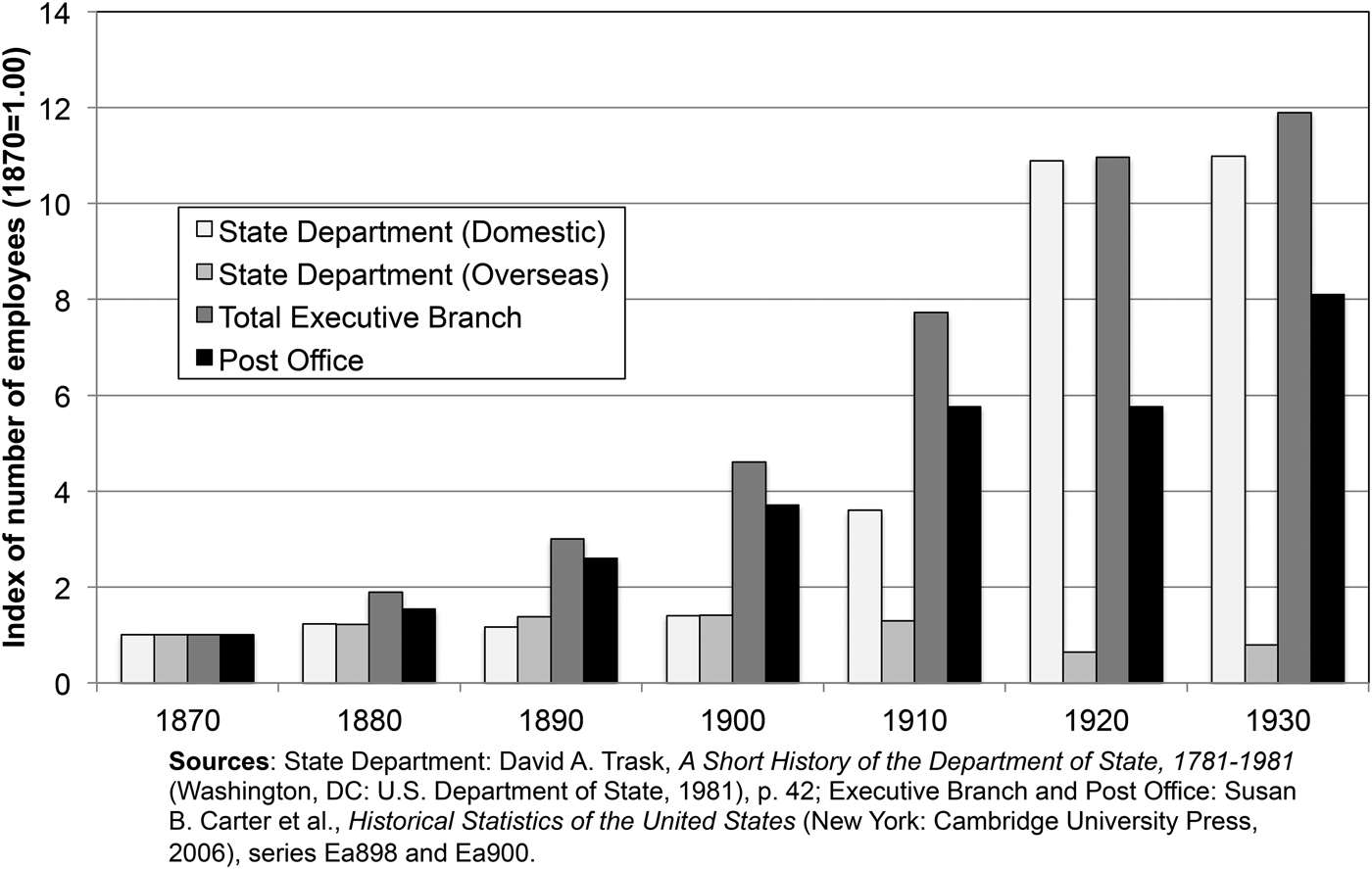
The potential parallel to the growth of state capacity in other areas is also illusory. In spite of the president's constitutional authority over foreign policy, the arm of the state responsible for it remained relatively weak. Political appointees dominated the American diplomatic and consular services well after other parts of the executive branch had been professionalized.Footnote 13 A professional foreign service recruited through an examination process was not fully established until 1924. The State Department also remained relatively small and short of resources.Footnote 14 As Figure 1 suggests, the American state expanded less in the realm of foreign policy than it did in the domestic arena. The State Department was a very small organization in 1870, with sixty-five domestic and 805 overseas employees. In the same year, 36,696 people worked for the Post Office. Despite beginning from a smaller base, the State Department expanded substantially more slowly than did the Post Office until World War I. It lagged even further behind the executive branch as a whole. Even after World War I, the overseas component of the State Department actually shrank. The domestic portion of the State Department did not exceed 1,000 employees until the eve of World War II. By contrast, the State Department has always maintained more than 7,000 domestic employees since World War II and nearly an equal number overseas. It has also been joined by a range of even larger military, intelligence, and other foreign policy agencies that did not exist before the war. The American national security state was a product of World War II and the Cold War.Footnote 15 Nothing remotely like it emerged before World War I.
Federal Government Employment, 1870–1930.

The dominant party's commitment to protectionism, coupled with the weakness of the foreign policy arm of the state, helps explain the different character of American foreign policy before 1914. Previous research about the role of trade in American foreign policy during this period has emphasized the search for overseas markets, according trade protection only a subsidiary role. The evidence reviewed here suggests that protectionism was more important than the previous research suggests, shaping the search for export markets, as well as the broader foreign policies that went along with it, in critical ways. Without considering the implications of the tariff, one cannot explain American policymakers’ decision to target relatively poor, less developed regions; their unwillingness to seek multilateral arrangements to promote a more liberal commercial order, as they would after 1945; and their hostile posture toward other major powers. An exclusive analytical emphasis on exports obscures the differences in the goals and the politics of American foreign policy before World War I.
These differences are important for theoretical as well as historical reasons. From the perspective of international relations theory, it is not growing American activism that is puzzling but rather the fact that American policymakers did not exploit the country's growing material power sooner and more completely. The United States was the largest economy in the world by 1900, yet its leaders resisted intervention in World War I until 1917 and rejected a political or economic leadership role after that war ended.Footnote 16 This American reticence had enormous historical consequences, arguably contributing to the onset of the Great Depression and World War II. Probably because of its substantive importance, candidate solutions to the puzzle of American foreign policy before World War II have been used to illustrate many different theoretical arguments about foreign policy.Footnote 17 It may be that no single case, however historically important, should feature so prominently in theoretical debates about the determinants of foreign policy. Nevertheless, it has. Conclusions about it matter because they are bound to influence how scholars think about foreign policy choices.
This article will examine the impact of protectionism on American foreign policy. Its effects begin with foreign economic policy but extend to security issues as well. Commentary in major periodicals is especially useful for understanding how American policymakers viewed the world before 1914, and it forms an important part of the evidence reviewed here. In contrast to more recent times, the small size of the foreign policy bureaucracy limited policy deliberation inside the state. There is no 1900 counterpart to NSC 68, the document that famously set out American Cold War strategy in 1950, because the American state of that era lacked both the capacity and the inclination to produce such a comprehensive policy statement. There was also far less official secrecy before World War I. In 1914, reporters were still able to wander freely through the State Department's offices, reading more or less whatever they chose.Footnote 18 Even if they kept their correspondence away from prying journalists, policymakers could not feel confident that it would remain secret. The Foreign Relations of the United States series, a standard reference for American diplomatic historians, began in 1861 as a set of documents furnished to Congress each December and promptly published. The published documents date from the current calendar year until 1906, when the demands of assembling an increasingly large set of records delayed its publication by three years. The documents often reveal sources of intelligence and sensitive policy deliberations that would now routinely be classified. The attenuation of secret policymaking processes within the state increased role of periodicals, like the North American Review, Atlantic, and Forum, that circulated among influential Americans. Indeed, high-ranking military officers and State Department officials often published articles setting out their own positions in these journals. The Literary Digest, a publication that summarized key articles from these journals, provides a sense of what contemporary observers thought important.
The remainder of this article has three parts. The first focuses on the role of trade in American politics before World War I, including the widely shared beliefs in the importance of foreign markets and the deep partisan divisions over the tariff. The second explains how the Republican Party's commitment to trade protection complicated the policies needed to gain access to foreign markets, pushing them toward an activism quite different from the sort that prevailed after 1945. The last part summarizes the implications of this evidence for our understanding of American foreign policy.
INTERNATIONAL TRADE, PROTECTIONISM, AND AMERICAN FOREIGN POLICY
Any account of the role of international trade in American foreign policy in the years before 1914 must confront two major facts, one pertaining to exports and the other to imports. First, there was a widespread belief among American elites that foreign markets were very important for national prosperity. Second, the tariff was among the most important and divisive political issues of the day. Republicans favored a protective tariff, especially for manufactured products, while Democrats preferred lower barriers to imports. Previous research on American foreign policy has extensively examined the search for overseas markets for American exports before World War I, but has not fully considered the foreign policy implications of American protectionism.
The Search for Export Markets
Concerns about market access and commercial advantage pervaded public discussion of American foreign policy before 1914. There were no global ideological conflicts comparable to those against fascism and communism to overshadow these economic interests. The debate over annexing the Philippines illustrates their prominence. Whitelaw Reid, a prominent Republican who had helped negotiate the peace treaty that ended the Spanish-American War, gave a series of speeches around the United States to build support for retaining control of the islands. Naturally, he took pains to explain that it was legally and morally permissible to do so, but he focused on their commercial value when explaining the benefits of this course of action. He emphasized both their intrinsic economic potential and their usefulness as an “unapproachable foothold” on even more valuable markets in China. Surprisingly to a present-day reader, Reid had almost nothing to say about their value for American national security.Footnote 19 Those who objected to the emerging emphasis on China in American foreign policy also focused on debunking its prospects as a market for American goods rather than asserting its irrelevance to American security.Footnote 20
Even later observers who thought other concerns were actually more important noted the prevalence of economic considerations before World War I. Writing in 1951, George Kennan pointed with exasperation to the practice of framing the costs and benefits of foreign policy in primarily economic terms. Brooks Adams, whom he viewed as one of the most prescient writers of the period, had his thinking “distorted by the materialism of the time.” Writers like Adams did not simply downplay security concerns in favor of economic interests. Instead, they argued that economic concerns defined security threats and interests. International political conflicts were fundamentally quarrels over economic stakes, especially access to markets. Kennan disagreed, suggesting that “fear, ambition, insecurity, jealousy, and perhaps even boredom” were just as important.Footnote 21 Of course, Adams and Kennan wrote in very different times. While Kennan spent much of his career focused on the rivalry with the Soviet Union, Adams and his contemporaries lived in an era of economic change and uncertainty at home. Writers in the Wisconsin School have extensively documented elite discourse about the role of foreign markets in ensuring internal social stability in the face of “overproduction” and falling prices.Footnote 22
Trade's potential to stave off economic crises was not the only reason so many influential Americans were interested in it. Indeed, the Wisconsin School's link between the search for overseas markets and anxiety about the nation's future may be overstated. For instance, William Becker has shown that distressed elements of the business community did not always see foreign markets as a solution, and that the large businesses most interested in foreign markets tended to optimistic about the future. They were seeking and expecting economic gain rather than attempting to avoid losses.Footnote 23 Many commentators also argued that control of international commerce was vital for American survival in international anarchy. They worried that the United States would be severely disadvantaged without access to the regions that were then being divided up into European colonial empires. For example, the leading military theorist of the day, Alfred Thayer Mahan, argued that control of maritime trade had always offered a decisive advantage in world politics, something he hoped would not be denied to the United States.Footnote 24 Brooks Adams was more specific, writing about need for the United States and Britain to gain commercial control over the Pacific and East Asia in order to compete with the coalition of Eurasian powers he expected to emerge in opposition to them.Footnote 25 Whether based on concern about domestic political and social stability, the pursuit of economic opportunity, or the demands of international security competition, the bottom line was that most observers agreed that the United States needed access to foreign markets.
Achieving this access required the help of the American state. The state's explicit trade promotion efforts could be awkward and ineffective.Footnote 26 Nevertheless, traders and investors confronted a variety of political problems that could only be overcome through diplomatic or military action. Latin American tariffs had long been high, and European tariffs rose steadily after the 1870s.Footnote 27 Internal political conflicts such as the Boxer Rebellion in China disrupted trade and sometimes prompted American military intervention. These interventions were far more frequent in the Caribbean Basin, where American policymakers acted not only to protect American economic interests but also to preclude similar moves by European powers. The empire-building efforts of these powers also threatened American trade. The recent division of Africa into European colonies was an ominous precedent. Preventing a comparable colonization process in Latin America was a long-standing priority enshrined in the Monroe Doctrine and enforced more aggressively after 1895. Following the acquisition of the Philippines, American policymakers also sought to prevent the partition of China, most notably through the Open Door Notes of 1899–1900, an attempt to get all the major powers to agree to allow equal economic access to the country. John Gallagher and Ronald Robinson called this style of commercially motivated intervention and diplomacy “the imperialism of free trade” in the context of mid-Victorian British foreign policy.Footnote 28 Scholars who emphasize the economic sources of American foreign policy have frequently applied this idea to the United States, noting that the promotion of American exports led political and military intervention overseas even though American policymakers had only a limited interest in acquiring colonies.Footnote 29
The Political Importance of the Tariff
Demands for foreign markets were not the only way that international trade entered American politics. The highly partisan conflict over the protective tariff was another. There may have been a consensus about obtaining access to overseas markets, but there was certainly no broad agreement about trade protection during the late nineteenth and early twentieth centuries. The tariff was among the most important issues dividing the two parties. The Republican Party was strongly committed to trade protection, especially after 1887.Footnote 30 This was as apparent to political actors at the time as it has been to subsequent scholars. Republican presidents could not easily abandon this commitment. As Richard Bensel explains in some detail, tariffs provided a vital incentive for key constituencies to support other aspects of the Republican Party's program. More than 99 percent of Republicans in Congress voted for trade protection between 1888 and 1897. Less than 4 percent of Democrats took this position.Footnote 31
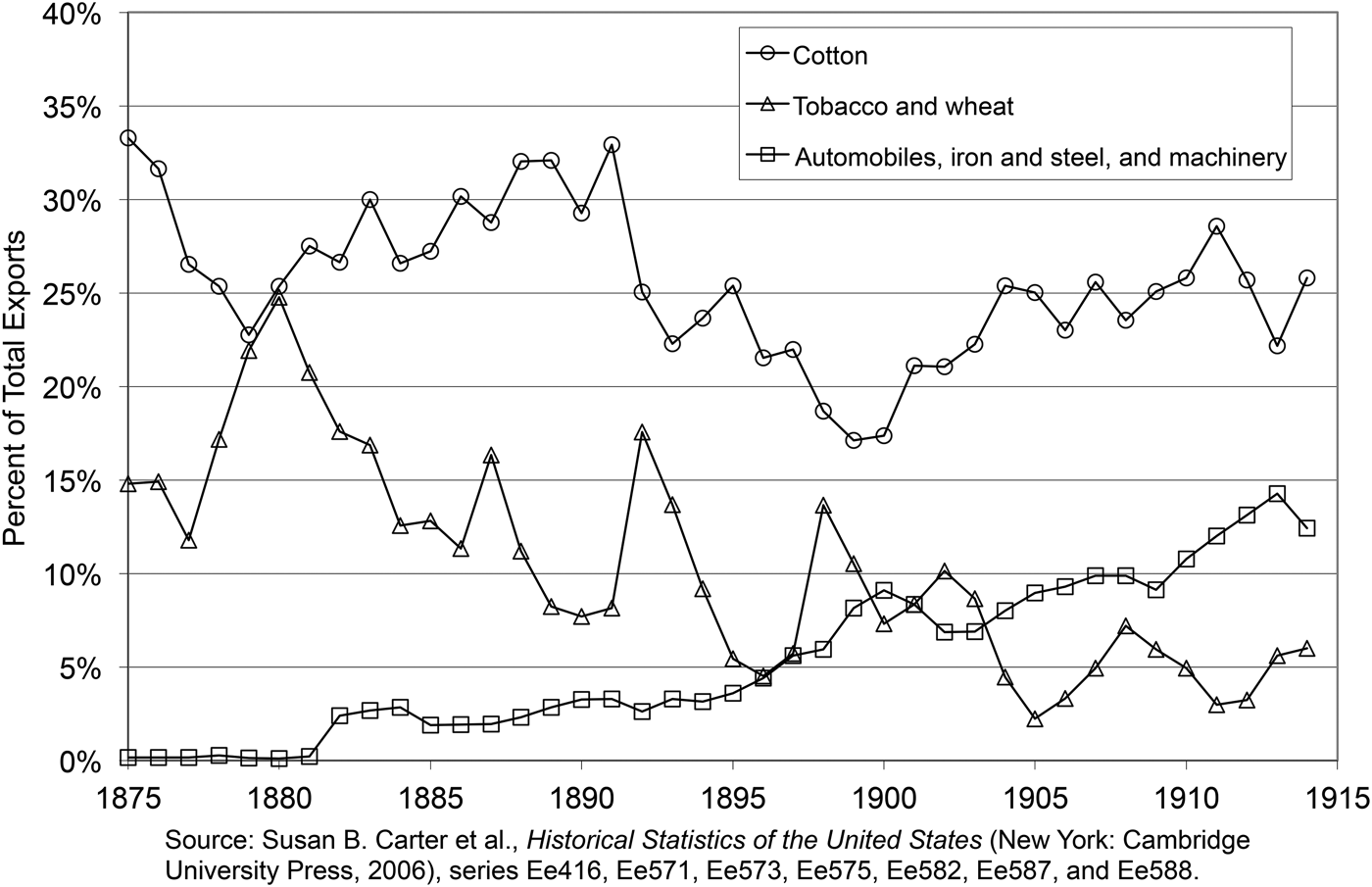
Demands for protection came mainly from manufacturers, though producers of wool and sugar also played a role. By contrast, many American agricultural commodities were highly competitive and constituted the bulk of American exports before World War I. As Figure 2 indicates, cotton was by far the largest American export through the entire period, composing roughly one quarter of all exports from the end of Reconstruction through 1914. Tobacco and wheat were also quite important. Exports of iron and steel, machinery, and automobiles—a much broader category than the other two depicted in Figure 2—were still relatively unimportant at the time the United States began its career as a colonial power in 1898. Though manufactured exports increased steadily, they remained less important than agriculture through 1914.
U.S. Exports by Selected Commodities.

Under these circumstances, the tariff transferred wealth to manufacturers, whose products received protection against foreign competition, from farmers, who paid the resulting higher prices for these manufactured products. As one scholar explained in the North American Review, “our farmer sells on the basis of Liverpool prices in the market of the world. He buys home productions at a protected price, and thus he is hit both ways.”Footnote 32 Foreign observers frequently noted this redistributive feature of the tariff in the United States.Footnote 33
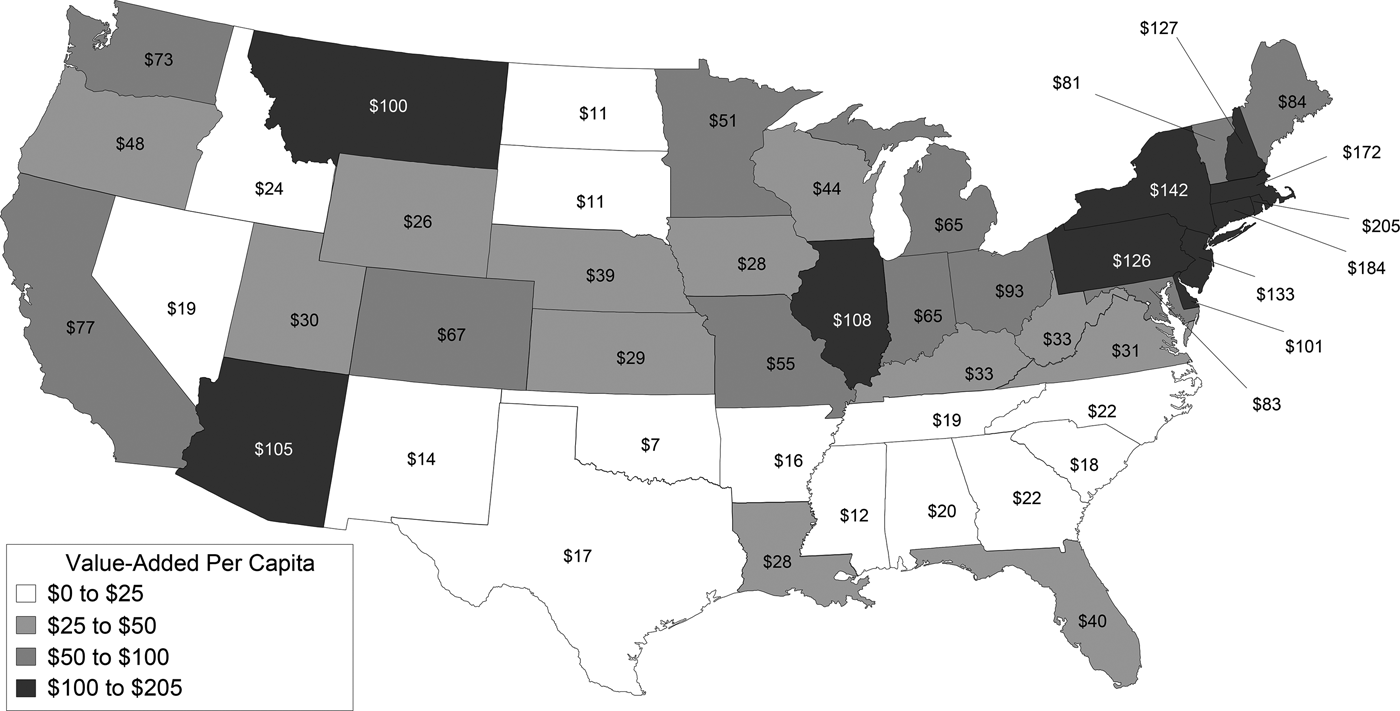
Because manufacturing was concentrated in the Northeast, this transfer of wealth had a regional as well as sectoral dimension. Figure 3 depicts the extent of this regional concentration in 1900. Aside from Montana and Arizona, where small populations and large copper-smelting industries created the misleading appearance of a large manufacturing sector, income from manufacturing was heavily concentrated in the Northeast. The fifteen states between New England and the Great Lakes accounted for 77 percent of employment and output in manufacturing, and 79 percent of capital invested in the sector in 1900.Footnote 34 By increasing income from manufacturing at the expense of other economic activities, trade protection redistributed income from the rest of the country to the Northeast. The fact that the revenue from the tariff helped fund pensions for Union veterans of the Civil War further reinforced its regional redistributive effects.
Manufacturing Activity by State, 1900.

Advocates of trade protection maintained that manufacturing was simply more important than agriculture for the future of the country. For example, Worthington C. Ford, a trade specialist with the State and Treasury Departments, welcomed the growing share of manufactures among American exports, noting that agricultural commodities were subject to dangerous price fluctuations.Footnote 35 The manufacturer Charles R. Flint offered a series of reasons for focusing on finding foreign markets for manufactured exports rather than agricultural raw materials, including their higher profit margins and increasing importance in the American economy. He saw Latin American markets as especially promising, provided they could be weaned away from their preference for European products.Footnote 36
Not surprisingly, these arguments did not persuade those representing agricultural parts of the country that the tariff was fair or beneficial. Senator George Vest of Missouri summarized their position in North American Review prior to the 1892 election.
The existing tariff is an obstruction to healthy and legitimate commerce. It narrows and restricts the markets for American products, and especially those of agriculture. It is based upon the idea that the American farmer must look to the home market alone, and if that does not give remunerative prices for his surplus, the loss must be borne patiently and patriotically for the general welfare.Footnote 37
Other members of Congress representing similar interests made much the same point during elections and tariff debates.Footnote 38 They hoped to reduce reliance on the tariff for revenue and replace it with an income tax that would fall more heavily on manufacturers. Representative Roger Mills of Texas, one of the principal Democratic advocates of tariff reduction, defended the income tax provision of the 1894 tariff bill by noting that “we produce over eight billions of manufactured products protected against competition: it would not be unjust to call on it for a contribution.”Footnote 39 As congressional voting on the issue suggests, these views were common among those representing agricultural areas.Footnote 40
Although tariff reformers had a few successes along the way, advocates of trade protection retained the upper hand. The nation's population, like its manufacturing industries, was concentrated in the Northeast. The fifteen manufacturing states in the Northeast and Great Lakes region held 214 of the 224 electoral votes needed to win the presidency in the 1900 election and were similarly critical in all the other elections during the 1890–1914 period.Footnote 41 Democratic candidates, who typically endorsed “tariff reform,” needed to win at least a few of these manufacturing states in order to gain the White House. They accomplished this difficult task only twice in the seven elections between 1888 and 1912. By contrast, advocates of trade protection could assemble a successful electoral coalition by gaining only a few agricultural states, something they sought to do by protecting domestic producers of wool and sugar in addition to manufacturers.
The importance of the tariff in late nineteenth-century American politics is widely acknowledged, but previous research has accorded it a relatively minor role in shaping foreign policy. For the Wisconsin School, the pursuit of overseas markets was the most important driving force. The tariff mattered only insofar as it became a tool for commercial expansion. Walter LaFeber's The New Empire is perhaps the best developed general presentation of this position. He refers to the tariff at many points in his narrative. However, because the drive for exports provides a sufficient explanation for growing American foreign policy activism, the analytical role of the tariff is limited. LaFeber discusses the reciprocity measures included in the 1890 McKinley Tariff and especially the 1897 Dingley Tariff at some length, because these provisions were expressly designed to help secure overseas markets.Footnote 42 For him, they underscore the consensus behind the need for new markets by showing that even an outspoken protectionist like McKinley was willing to make selective tariff reductions in pursuit of this goal.Footnote 43 LaFeber is certainly correct that that American policymakers sought to use reciprocity provisions to gain access to overseas markets, but the main purpose of the tariff was to protect the home market against foreign competition. As we shall see, maintaining this tariff wall turned out to have more profound foreign policy implications than did the reciprocity measures that LaFeber emphasizes.
Other major works in the Wisconsin School treat the tariff in much the same way, stressing its potential usefulness for opening foreign markets rather than its broader effects on American foreign policy. William Appleman Williams mentions the tariff only briefly, noting that “even the traditional policy of tariff protection was questioned and modified by Americans who saw reciprocity treaties as a way of penetrating foreign markets.”Footnote 44 Thomas McCormick stresses the reciprocity provisions of the 1897 Dingley Tariff—the law's “primary emphasis” in his account—suggesting that these were precursors to more liberal trade policies that came about later in the twentieth century.Footnote 45 He characterizes debates pitting broad tariff reductions against narrower reciprocity measures as disagreements “largely over tactics” in the pursuit of overseas markets.Footnote 46 The tariff is the primary focus on Tom Terrill's 1973 book. Yet even in this work, the demand for export markets plays a more important role in the story. Those who favored lower tariffs, mainly Democrats, argued that they would help expand export markets. Those who preferred trade protection, mainly Republicans, made the same case for reciprocity provisions within the protectionist trade bills they supported. As they are for LaFeber and McCormick, the tariff debates are tactical disagreements in Terrill's account. “The hyperactivity about the tariff was anticlimactic in that both Republican and Democratic leaders agreed by 1890 that expansion of American exports was necessary and could be achieved by manipulating the tariff.”Footnote 47
Subsequent historical work on the economic sources of American foreign policy during this period has gone in many different directions, but has not challenged the relatively minor role that the Wisconsin School accorded the tariff in shaping broader American foreign policy. Emily Rosenberg's book on American economic and cultural expansion focuses on the ideology of “liberal-developmentalism” as it emerged from the 1890s through World War II, including “support for free or open access for trade and investment.”Footnote 48 She acknowledges that the high U.S. tariff contradicts this ideology.Footnote 49 However, protectionism remains “an important qualification” within the broader liberal ideology she stresses.Footnote 50 Like earlier writers, her discussion of the tariff stresses the adoption of reciprocity provisions “aimed at converting tariff policies into instruments of commercial expansion.”Footnote 51 Her later work on dollar diplomacy after 1900 focuses on banking and has little additional discussion of tariffs or trade.Footnote 52
Other writing on the economic side of American foreign policy produced since the 1970s offers illuminating discussions of the difficulties that tariffs posed for American commercial expansion, but does not link these problems to the broader structure of American foreign policy, as Rosenberg and LaFeber do. Some writers have been reluctant to make these connections precisely because of their discomfort with the Wisconsin School's broad generalizations. For instance, William Becker (1974, 468) argues that the Wisconsin School had “oversimplified the behavior of the business community” in its emphasis on export promotion as a reaction to economic distress.Footnote 53 He avoids any parallel overgeneralizations in his book on business-government relations in American foreign policy. He offers a detailed account of how the tariff posed a greater barrier to trade promotion than LaFeber and others argue, but does not pursue the implications of these problems for the broader outlines of American foreign policy.Footnote 54 Other recent works also focus on the tariff's effects on U.S. relations with particular states rather than the broad issues that LaFeber and Rosenberg address. For instance, Cyrus Veeser's work provides an excellent account of the difficulties that American demands for privileged economic access posed for the Dominican Republic when European states objected to discriminatory treatment, but his focus remains on U.S.-Dominican relations.Footnote 55 Steven Topik's book offers a similar account of U.S. pressure for trade privileges in Brazil.Footnote 56
Recent works in political science about the political economy of American foreign policy before World War I have also generally followed the lead of the Wisconsin School, stressing the demand for export markets over the implications of trade protection. Peter Trubowitz's account of the politics of foreign policy focuses on the value of export markets to different regions of the United States, with only a secondary role for trade protection. As in earlier historical works, the reciprocity provisions of the tariff produce the legislation's most important effects on American foreign policy.Footnote 57 Kevin Narizny has less to say about the tariff than Trubowitz does, but he also explains the American turn to the periphery in terms of export interests, stressing European tariffs rather than American protectionism as the reason less developed markets looked so attractive.Footnote 58
To be clear, the point here is not that these accounts of the role of trade in American foreign policy before World War I are wrong, but rather that they are incomplete. Protectionism turns out to have foreign policy consequences that they do not discuss. Nevertheless, the argument about the role of trade protection presented here builds on these earlier works about export promotion. The Republican commitment to trade protection helps explain some of the more puzzling features of the pre-1914 search for overseas markets that all these authors stress, as well as some key differences from what came later. Of course, there are also many accounts of American foreign policy during this era that move away from economic considerations entirely. For instance, some stress ideological and cultural notions of race, gender, and American identity.Footnote 59 This article's focus on the relationship between American foreign policy and international commerce is not meant to suggest that these other considerations do not matter. Assessing the causal impact of noneconomic concerns, as well as their relationship to trade and trade protection, is obviously an important task, but it lies beyond the scope of this work.
THE FOREIGN POLICY IMPLICATIONS OF PROTECTIONISM
Most scholars’ focus on demands for access to potential export markets highlights the similarities between American “Open Door imperialism” after 1890 and the British “imperialism of free trade.” Yet American imperialism during this period was not associated with free trade. Its most vociferous advocates came from the party most strongly committed to protecting the domestic market. Republicans occupied the White House for nineteen of the twenty-five years between 1890 and 1914, and they held both houses of Congress for nearly that long. No Democratic president won reelection between the Civil War and World War I, so their ability to reshape American foreign policy was limited. Predictably, American protectionists denied that their preferred commercial policy posed any problems for American foreign policy. However, a closer examination of the foreign policy debates of the time suggests that these difficulties were quite real and that they became increasingly clear to both American and foreign observers over time.
Republican presidents’ need to respond to demands for both increased access to foreign markets and continuing trade protection, especially against manufactured imports, influenced their foreign policy choices in three major ways. First, it led them to focus on markets in less developed areas even though these were poorer and less promising than those in wealthier parts of the world. Second, it limited the means through which they could promote American exports, leading them to seek special bilateral arrangements or unilateral trade concessions. Third, protectionism limited prospects for international cooperation and gave American foreign policy an aggressive and unilateralist tone when it came to dealing with other major powers. Together, these elements added up to an American foreign policy that was unsuitable for the leading role in world politics that the country would assume after 1945. Foreign policy officials took note of these constraints, but were not able to overcome them.
The Emphasis on Less Developed Markets
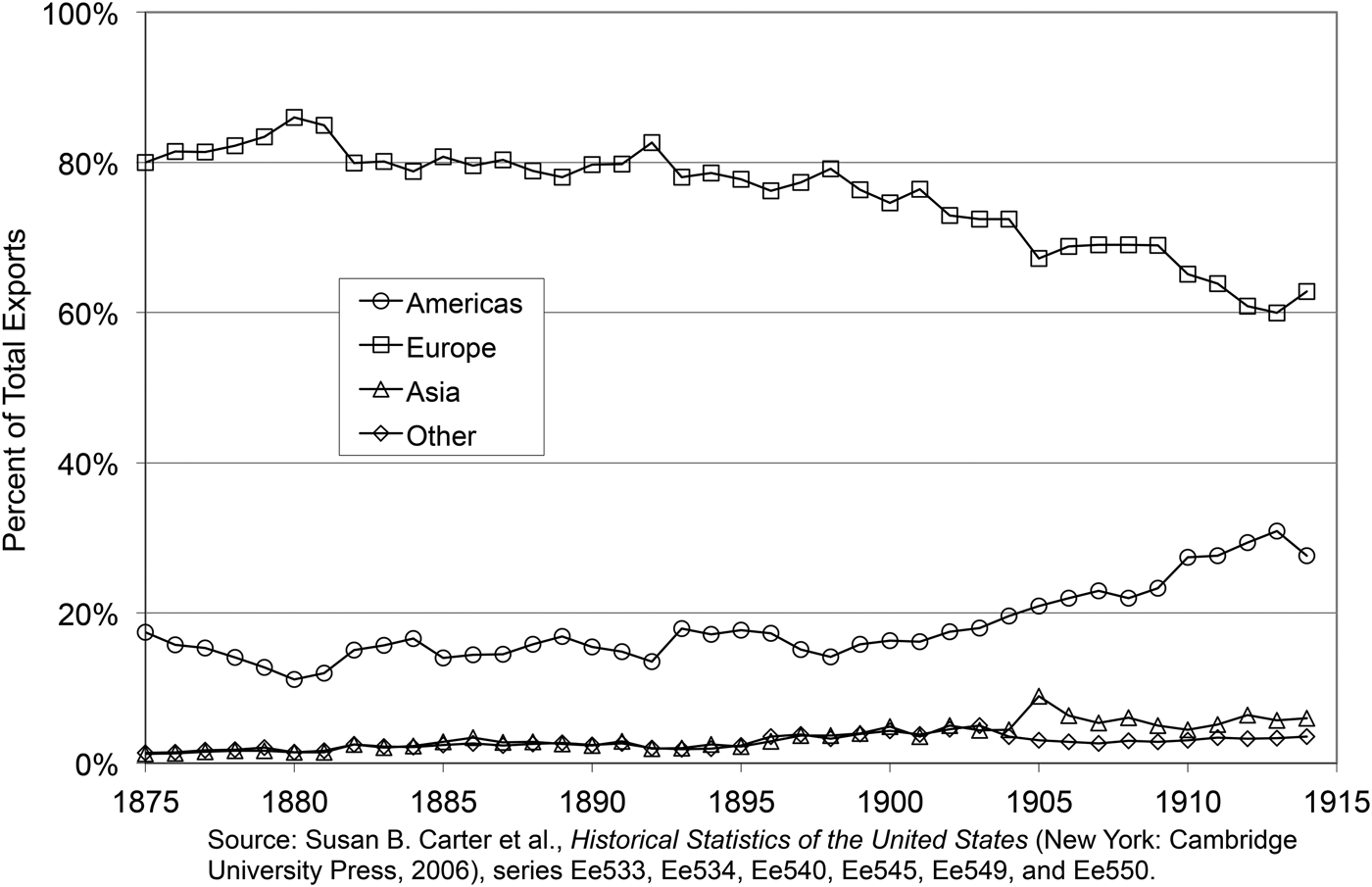
One of the most obvious difficulties with the claim that concern about export markets drove American foreign policy during the 1890–1914 period is that policymakers focused on relatively poor markets, slighting the wealthier parts of the world that actually imported more American products. As Figure 4 indicates, Europe had long been the recipient of roughly 80 percent of U.S. exports at the time the United States began acquiring overseas colonies in 1898. Latin America and Asia gradually increased their shares during the remaining decade and a half before World War I, but Europe remained the United States’ best export market by wide margin. (The graph actually overstates the importance of less developed markets to some extent because it includes Canada with the Americas and Japan with Asia.) Nevertheless, as LaFeber, McCormick, and others have documented, Americans concerned about overseas markets wrote mostly about Latin America and East Asia. The relative importance of manufactured exports in less developed markets does not explain this emphasis, as some have suggested.Footnote 60 While less developed markets certainly took more manufactures than agricultural products, wealthier developed countries still imported far more American manufactures. In 1900, in spite of rising European tariffs, developed countries, including Canada and Japan, received 78 percent of American manufactured exports.Footnote 61 Exports to less developed markets were indeed growing, but it was far from obvious that they would ever be as valuable as those of wealthier states.
U.S. Exports by Region of Destination, 1875–1914.

The puzzle deepens when one considers that access to developed markets before 1914 entailed many fewer of the dangerous and costly foreign policy problems that plagued market access in less developed areas. It required neither battleships nor colonies. These regional priorities make more sense when one considers the implications of trade protection in the United States. High American tariffs, especially on manufactured goods, provoked European retaliation that threatened continuing American access to their markets. Less developed trading partners were poorer, but they had fewer reasons to object to American protectionism.
Advocates of free trade always argued that protectionism would interfere with American exports. Roger Mills made this point repeatedly during the debate on the protectionist McKinley Tariff of 1890. “When protection puts taxes on the goods of the foreigner that prohibit them from coming here, he is rendered less able to take in exchange the surplus which we are ready and anxious to give.”Footnote 62 Like other protectionists, William McKinley bluntly denied that there was any connection between exports and the tariff. “[Tariffs] put no restraint upon foreign trade.”Footnote 63 The protectionists were correct in a narrow sense. In a multilateral trading system, bilateral exports and imports do not have to balance.Footnote 64 Moreover, flows of European investment into the United States also helped reduce potential balance-of-payments problems during this period. Nevertheless, as the size of the American economy and the volume of American trade steadily increased during the late nineteenth century, continuing American protectionism posed growing difficulties for the international trading system.
The prospect of European tariff retaliation was a more immediate threat to American exports than long-term problems with the balance of payments were. American products were frequently sold overseas for less than their price in the protected home market. “Dumping,” the term used to describe this practice then and now, was a common result of tariff protection. The purpose of protection, after all, was to raise domestic prices above those prevailing on the world market. Dumping outraged both foreign competitors and American advocates of free trade.Footnote 65 The Belgian economist Gustave de Molinari summed up the European reaction to the 1890 McKinley Tariff for an American audience in the North American Review, pointing out that the bill strengthened the hand of protectionists there and had even led to talk of a customs union directed against the United States.Footnote 66 The Literary Digest summarized Molinari's comments for its readers and reported other European views of the McKinley Tariff, which were uniformly negative and included various plans for retaliation against American exporters.Footnote 67 Subsequent protectionist tariff bills elicited a similar European response that was duly reported in the American press. For example, the economist and diplomat Jacob Schoenhof warned readers of Forum that “the new [Dingley] tariff exercises the severest pressures against those countries which have become our best customers in manufactured goods.” Retaliation was the likely result.Footnote 68 James Howard Gore offered a more specific account of the German efforts to reduce its food imports from the United States in response to the burden the Dingley Tariff imposed on its manufactured exports.Footnote 69
The prospect of European retaliation did not deter American protectionists. Because Britain was both the largest European importer of American products and the only country not to retaliate in kind against American tariffs, plans for an imperial preference system that would discriminate against American imports were especially ominous. The Literary Digest found that newspaper editorialists generally expected the scheme to harm the United States if it were implemented. Even in the face of this threat, some protectionist papers redoubled their support for the tariff. As one editor put it “all this country needs to do is to keep on the way it has been going. Build up its industries by protection, seek markets in South America, China, and other such countries, and nothing that European nations can do in the way of tariff barriers will check or stop our growth.”Footnote 70
As this quotation suggests, protectionists interested in foreign markets saw a brighter future in Latin America and Asia than in Europe, even though the value of exports to these areas remained relatively small. There was little local competition for American manufactures in these parts of the world, so concerns about the inequities of American tariffs did not arise there. Whitelaw Reid summarized this line of argument as part of his case for annexing the Philippines.
That way lies now the best hope of American commerce. There you may command a natural rather than an artificial trade—a trade which pushes itself instead of needing to be pushed; a trade with people who can send you things you want and cannot produce, and take from you in return things they want and cannot produce; in other words, a trade largely between different zones, and largely with less advanced peoples, comprising one fourth the population of the globe, whose wants promise to be speedily and enormously developed. The Atlantic Ocean carries mainly a different trade, with people as advanced as ourselves, who could produce or procure elsewhere much of what they buy from us, while we could produce, if driven to it, most of what we buy from them. It is more or less, therefore, an artificial trade as well as a trade in which we have lost the first place and will find it difficult to regain.Footnote 71
The idea that trade with less developed areas would not create pressure to reduce domestic tariffs on manufactured products prompted James Blaine, Secretary of State during the Harrison administration, to include a plan for reciprocity agreements to promote trade with Latin America in the 1890 McKinley Tariff. Not coincidentally, Blaine was among the most prominent Republican advocates of trade protection.Footnote 72 His plan for reciprocity agreements with Latin American states followed in the wake of the Pan-American conference over which he had presided a few months earlier, a meeting that was also directed at increasing United States trade with its southern neighbors.Footnote 73 The reciprocity measure used the threat of punitive duties on sugar and a few other products to secure American access to markets in countries that would have little cause to complain about high American tariffs on manufactured products.Footnote 74 Opponents of the McKinley Tariff argued that focusing on less developed trading partners who would export agricultural products to the United States would further disadvantage American agriculture, already harmed by higher prices for protected manufactured goods.Footnote 75
The political forces backing the tariff kept Republican presidents focused on less developed markets even when they and officials in the State Department would have preferred a broader approach. Europe remained a richer market than either Latin America or East Asia, even for manufacturers. For this reason, some Republicans hoped to use reciprocity agreements to lower European tariff barriers as well. Democrats had managed to repeal the reciprocity provisions of the McKinley Tariff in 1894, but the Dingley Tariff, adopted after the sweeping Republican electoral victories of 1896, revived them. President McKinley appointed John Kasson, a veteran diplomat and former Republican member of Congress, to negotiate reciprocity treaties under the new law. Interpreting his mandate broadly, Kasson concluded agreements with European as well as Latin American states.
Kasson's treaty with France was especially controversial, prompting the National Association of Manufacturers (NAM) to call a special National Reciprocity Convention so that its members could debate the treaties publicly. Some participants in the convention, most notably agricultural implements manufacturers, spoke out in favor of concessions to the French in exchange for lower tariffs on American exports. Many others were strongly opposed, however. Some pointed out that the reciprocity plank of the 1900 Republican Party platform had called only for trade with states that would export nothing produced in the United States, a condition that might hold in Latin America but certainly not in Europe. Particularly canny opponents of the treaties worried about the integrity of the protectionist coalition. They pointed out that allowing some manufacturers to be harmed so that others could benefit set a dangerous precedent. It would be better if the “forces of protection” that the convention embodied remained united. “The country is looking at you. If you make a blunder, and allow individual interests to lead you too far, you may lead us between the conflicting forces of fair trade and free trade, and we may be shot to pieces.” In the end, the convention endorsed reciprocity “only where it can be done without injury to any of our home interests of manufacturing, commerce or farming.”Footnote 76 This verdict carried substantial political weight. President Theodore Roosevelt tempered his support for the treaties, which had been negotiated under his predecessor, and the Senate refused to ratify any of them.Footnote 77 Writing after the convention in Forum, editorialist E. J. Gibson summed up the outcome. “When we go outside the lines laid down in the last Republican National platform favoring treaties that ‘open our markets on favorable terms for what we do not ourselves produce,’ it is very difficult to make a reciprocity treaty not in conflict with the protective tariff.”Footnote 78
Some policymakers had recognized the constraints that protectionism imposed even before the failure of the Kasson treaties. Many preferred a more moderate approach than the politics of the Republican Party would permit, but their personal opinions did not alter the political reality.Footnote 79 Addressing a convention on international trade in 1899, James C. Monaghan, then a U.S. consul in Germany and later head of the division of consular reports, noted with some frustration both foreign complaints about the tariff and the defiant attitude of American protectionists. “The fact that almost if not quite every foreign country or foreign delegate has entered a protest against the tariff conditions existing in this country will be to the larger part of this people a splendid argument in favor of the continuation of the tariff.” The topic of Monaghan's address was trade with Northern Europe. He noted that Europe was indeed a richer market, but he also pointed out that “just as soon as any manufactured article or product of the machines of this country begins to be imported in any large quantities into the countries of Europe, the statesmen of those countries will enact protective and sometimes prohibitory duties on those articles.” He concluded that “it may be wiser and better to pay even more attention to the East and to Russia than to Europe, but I certainly say this, let us neglect neither.”Footnote 80
The contrast with American foreign policy after 1945 could hardly be sharper, both in the central role of trade with developed states and in the ability of the foreign policy state to overcome congressional resistance. The United States vigorously promoted more liberal trade policies in its developed allies after World War II, reducing American tariffs in the bargain. Postwar foreign policymakers linked this effort to Cold War security concerns, further strengthening their hand against congressional opponents.Footnote 81 The United States by no means adopted a policy of universal free trade after 1945. However, its overall thrust was decidedly toward greater liberalization. Indeed, some prominent discussions of American hegemony focus primarily on the country's role in promoting a more liberal international economic order.Footnote 82
The Need for Exclusive Bilateral Arrangements and Unilateral Privileges
The nature of American efforts to secure overseas markets presents another sharp contrast with postwar foreign policy. The reciprocity agreements that Republican administrations negotiated under the McKinley and Dingley Tariffs were not steps toward broader free trade. They were limited exceptions within a protectionist commercial policy framework. They were negotiated on a few goods—ideally those not produced in the United States—and were strictly bilateral. Until 1923, the United States did not recognize unconditional most favored nation (MFN) status in international trade. This rule automatically extends tariff reductions granted to any state to all MFNs. After 1945, unconditional MFN would form the basis for the multilateral trading system. The rule generalized bilateral tariff reductions negotiated under the General Agreement on Tariffs and Trade and the World Trade Organization to the other parties to these agreements. Under the pre-1923 “American interpretation” of MFN, trade concessions granted in exchange for some special consideration were not automatically extended. Instead, the benefits of MFN status applied only to concessions granted without receiving a reciprocal favor in return.Footnote 83
Because nearly all other states had accepted the unconditional interpretation of MFN status by the 1890s, the anomalous American position caused frequent disputes with its trading partners. The United States did grant unconditional MFN status in a few unusual instances, but it generally avoided this step even when it was costly to do so. In 1898, the Swiss minister in Washington managed to convince the State Department that his country's 1850 trade agreement with the United States entitled Switzerland to the same duties accorded the French under a newly negotiated reciprocity agreement. To stave off similar claims from other states, the United States abrogated the commercial treaty with Switzerland after the required one-year notification period.Footnote 84
The conditional interpretation of MFN and provisions for bilateral reciprocity agreements made discrimination against some trading partners and in favor of others a matter of policy. This fact rests uneasily with historical accounts that treat the Open Door Notes as the basis for American policy from 1900 through the postwar era.Footnote 85 After 1899, the American diplomats indeed promoted an open door principle that traders from all nations should have equal access to markets in all parts of China, regardless of any special political influence particular powers enjoyed there. This policy must be viewed in light of the fact that the other powers had already carved out spheres of influence in China by 1899, when American bases in the Philippines made the United States a player in the politics of the region. American observers thought a partition of China among these powers was likely.Footnote 86 The Open Door Notes were an effort to secure the greatest possible economic access for the United States in one particular country, not a general principle. The policy of nondiscrimination in China did not slow American efforts to set up exclusive bilateral arrangements in Latin America. Moreover, Sydney Brooks's prediction, quoted at the beginning of this article, that the United States would not adhere to the open door policy in the Philippines turned out to be correct. The United States had promised that it would not discriminate in favor its exports to the Philippines for ten years after annexing the islands in 1899. This promise lapsed in 1909, when new legislation promptly eliminated duties on trade between the United States and the Philippines while imposing a tariff on other states’ exports to the islands.Footnote 87 Some advocates of tariff reform indeed argued that the principle of equal treatment implied in the Open Door Notes should be universal.Footnote 88 Their position had little policy impact before World War I.
The commitment to both trade protection and finding foreign markets would have made acceptance of unconditional MFN difficult even if American leaders had been inclined to do so. The system of strictly bilateral reciprocity allowed them to select the most promising potential markets without making politically sensitive changes in the tariff. Extending the same concessions they made under these agreements to all states that could claim MFN status would have been nearly equivalent to reducing the tariff overall. The prospect that other states might extend the concessions they granted to the United States to their other trading partners was less threatening, but diminished the competitive advantage that a special tariff rate gave American exporters. Perhaps because they were accustomed to seeking these advantages through the tariff anyway, politically active business leaders were not afraid to suggest that the government should seek out exclusive privileges when negotiating reciprocity agreements. As Henry Dalley of the New York Board of Trade and Transportation put it during the 1901 National Reciprocity Convention, “We can certainly justify it to ourselves if we (following the examples of other nations) secure such advantages as we are entitled to through our commanding position in the world of commerce.”Footnote 89 Others were more specific about the advantages they had in mind. William Bass of the South Brooklyn Board of Trade argued that a workable reciprocity arrangement had to “exclude European productions from our Latin neighbors.”Footnote 90 Such exclusive privileges were not easy to obtain because they served only to provide a rent to the American exporter. As F. W. Taussig put it, “concessions of this sort, however, which do not redound to the ultimate advantage of the communities giving them, are not likely long to remain preferential.”Footnote 91
Reciprocity agreements were not the only means through which American policymakers sought to secure privileged market access for American exports. In any event, these agreements were generally unsuccessful. Those negotiated under the 1890 McKinley Tariff were repealed in 1894, when the Democrats gained control of Congress. The resurgent Republicans reintroduced the idea in the 1897 Dingley Tariff, but the Senate refused to ratify the treaties the McKinley administration negotiated. American policymakers turned instead to other means of obtaining privileged market access. Colonies were one option. In the Insular Cases of 1901, the Supreme Court upheld the constitutionality of setting separate tariffs for American overseas possessions.Footnote 92 The United States could thus impose its preferred trade policy on U.S. colonies rather than treating them like U.S. states. In the case of the Philippines, the military occupation authorities in the War Department accepted suggestions from American business when setting tariff rates, finding ways of favoring American products even before the repeal of the open door policy there. Meanwhile, Philippine products exported to the United States paid the full rates set out in the Dingley Tariff until the law was revised in 1909.Footnote 93 Cuba was not formally a colony but remained an American protectorate. It had to accept a reciprocity treaty that fell far short of the free trade agreement that Cuban leaders had wanted.Footnote 94 The American colonies acquired in 1898 were not large or important markets, but it was not clear at the time that they would be the last. Some observers argued that the prospect of further colonial expansion and the unilateral privileges it would bring American exporters weakened support for reciprocity treaties that required American tariff concessions, like those John Kasson had negotiated.Footnote 95
The 1909 Payne-Aldrich Tariff moved away from reciprocity treaties, adopting an alternative approach copied from French practice. It set out both a general minimum tariff and a maximum schedule to be paid by states that unreasonably discriminated against American exporters in the president's judgment. President Taft was then able to negotiate twenty-three agreements using the threat provided in the new law, ultimately declining to impose the maximum schedule on any state.Footnote 96 While it punished discrimination against American exports, the Payne-Aldrich Tariff neither endorsed the unconditional interpretation of MFN nor ruled out obtaining special privileges for American exports. Indeed, the Taft administration went on to negotiate a trade agreement that would have given the United States privileged access to the Canadian market, though the Canadians ultimately declined to ratify it.
Both American officials and American businesses also sought access to foreign markets in less formal ways. Promoting American exports was a central preoccupation of American diplomats before World War I. As the U.S. minister to Brazil noted in 1899, “it is no violation of proper diplomatic reserve to say that paramount in South America missions and consulates are the desire and effort to extend our commerce.”Footnote 97 The failure of the Kasson treaties in 1901 put a premium on other means of gaining market access. Robert Hannigan points out that informal diplomatic pressure, as well as better marketing by American firms, became an increasingly important part of American plans to increase exports to Latin America during the Roosevelt administration.Footnote 98 Congress also encouraged this approach, creating a Bureau of Foreign Commerce within the State Department in 1903 and increasing the Department's total staff by more than ten percent in the process.Footnote 99 In 1909, the Department reported that diplomatic intervention on behalf of American exporters “has increased at least 50 percent in the last few years.”Footnote 100
For their part, American businesses engaged in international commerce sought market access independently. Large firms accounted for as much as 90 percent of overseas trade in manufactures. Becker's research reveals that, among other things, these powerful firms lobbied foreign governments and local chambers of commerce about commercial regulations and patent issues. The firms supplemented their individual efforts with collective action through the NAM and, after 1909, the American Manufacturers’ Export Association (AMEA). Of course, they also enlisted the help of the American state when they found it necessary.Footnote 101 The shadow of American intervention during a time when it took place frequently no doubt also helped American businesses get their voices heard.
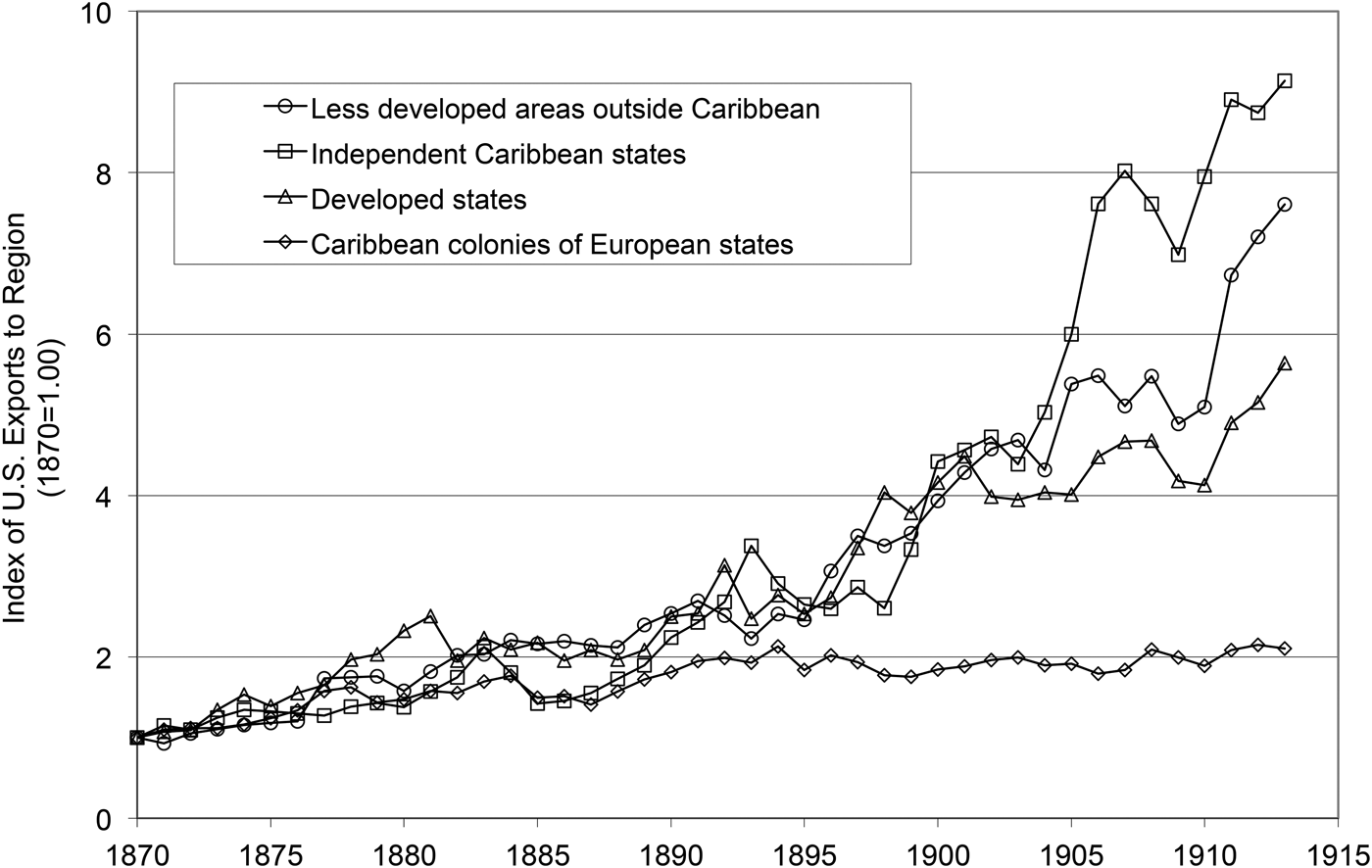
Did American power really facilitate the export-promotion efforts of American diplomats and businesses? The fact that the United States held greater sway over the small states of the Caribbean Basin permits a statistical test of its effectiveness. The United States intervened in the Caribbean after 1898 far more often than in any other part of the world, occupying some countries for years at a time. Diplomats and the representatives of large firms could use the specter of military intervention to pressure local authorities with whom they disagreed. Moreover, the American prohibition on external intervention in the region effectively ruled out appeals to any other power. The United States also took control of customs revenue collection in some Caribbean states, including the Dominican Republic in 1904 and Nicaragua in 1912.Footnote 102 These receiverships were established to secure the repayment of foreign loans, but they also provided opportunities for adjusting local tariff rates on American exports, as had been done in the Philippines. Writing in 1929, Benjamin Williams noted that “obtaining over certain countries a system of financial control backed by strong protection methods” had entirely supplanted any interest in further colonies because “such controls do not require annexation and do not affect trade through the manipulation of the tariffs.”Footnote 103 If American power really made a difference, then American exports to states in this region after the Spanish-American War should have grown more rapidly than did American exports elsewhere and at other times. Though they were similar in most other respects, European colonies in the Caribbean were immune to this form of political pressure. The threat of intervention was far less credible in the large states of Colombia and Venezuela, where its costs would have been much greater. The competitiveness of American products certainly played a role, but this consideration applies to all markets, not just independent Caribbean states after 1898.
Figure 5 depicts the growth of American exports to independent states bordering on the Caribbean (excluding Venezuela and Colombia), as well as several comparison groups. The pattern of export growth is consistent with effective intervention to promote it after the Spanish-American War. Exports to these states did not grow more rapidly than did exports to other markets before 1898. The United States was far less active in the region before the Spanish-American War and had fewer political and military resources at its disposal. Things changed after 1898, and especially after the 1903 announcement of the Roosevelt Corollary to the Monroe Doctrine, which codified the United States’ more interventionist posture toward the region. During the latter part of the period depicted in Figure 5, American exports to the independent Caribbean states grew more rapidly than did exports to any of the comparison groups.
Growth in U.S. Exports by Destination.

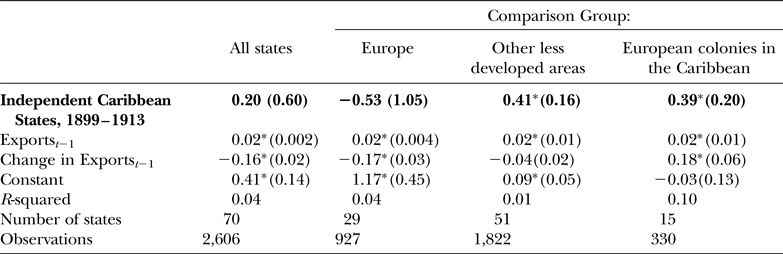
Table 1 presents the results of a more formal statistical test of the hypothesis that American exports toward independent Caribbean states grew more rapidly. The dependent variable in these regression models is the annual change in American exports to the countries and colonies for which the Commerce Department reported trade data. The most important independent variable is a dummy indicating the independent Caribbean states after 1898. It tests whether exports to this this region really grew more rapidly during the period of greatest American political influence. The value of the coefficient indicates the difference between the growth in exports to the independent Caribbean states after 1898 and the growth in exports to the states in the comparison group, in millions of 1900 dollars. The other independent variables—the lagged value of exports and the lagged change in exports—capture time dependence in each export series. The four models in the table use different comparison groups: all states, Europe, other less developed areas, and European colonies in the Caribbean.
Models of Annual Change in American Exports to Selected Areas of the World, 1870–1913

Note: The table shows ordinary least squares (OLS) coefficients with standard errors reported in parentheses. Asterisks indicate statistical significance at the p < 0.05 level. The dependent variable is the annual change in American exports to each state or colony, in millions of 1900 dollars, for which data were reported by the Census Bureau in various volumes of the Statistical Abstract of the United States, https://www.census.gov/library/publications/time-series/statistical_abstracts.html.
The results suggest some qualifications to the patterns that are apparent in Figure 5 but support the principal hypothesis that American power made a difference. Exports to independent Caribbean states indeed increased more rapidly after 1898 when compared to other less developed areas of the world, including other parts of the Caribbean. The positive and significant coefficients in the last two models indicate that annual growth in American exports to an average Caribbean state was about $410,000 greater than the growth in exports to other less developed markets and about $390,000 greater than the growth in American exports to European colonies in the Caribbean. However, American exports to this part of the world did not increase more rapidly than did exports to Europe or, as a result, to the rest of the world as a whole. (European states made up a much larger share of the total number of independent states during this period than they do today, so they strongly influence the results for the world as a whole.) In spite of retaliation against American protectionism, Europe remained just as much a growing market for American exports after 1898 as the region where the United States exercised the greatest imperial power. If American policymakers had wanted only to find growing export markets, this costly and controversial activity would have made little sense. Continuing demand for trade protection as well as foreign markets helps explain the policy choice.
Relations with Other Major Powers
Even if American policymakers had been able to overcome the commitment to trade protection, the search for export markets would still have had important foreign policy implications. For example, ensuring access to the China market might still have required an American naval presence. Moreover, American policymakers would probably still have seen the Russians and later the Japanese as potential rivals in East Asia. Both these powers sought to set up their own exclusive economic and political spheres of influence in the region. The British, who actually were committed to free trade during this period, generally perceived the same threats, and for much the same reason. The patterns of greatest interest here are those that would not have existed without the commitment to trade protection. The central role of markets in less developed areas and the search for privileged access to these markets are immediate practical implications of responding to demands for overseas markets while protecting the domestic market. These uncooperative premises led the United States to adopt an aggressive and opportunistic posture toward other major powers, most of which were pursuing a similar and competing foreign policy. Those who rejected protectionism tended to see more opportunities for cooperation. These are precisely the dynamics Patrick McDonald suggests in his book linking protectionism to an aggressive foreign policy, which includes an excellent discussion of the American conflict with Britain over the Venezuelan border in 1895–96.Footnote 104 The documentary evidence reviewed here provides further support for this interpretation.
Many observers at the time linked protectionism to a foreign policy that aggressively sought unilateral advantage at the expense of international cooperation for mutual gain. David Wells, a prominent advocate of free trade, argued that because tariffs harmed people in other states, they were essentially hostile acts. “Restrictions on the commercial intercourse of nations differ in form only from acts of war; and such acts inevitably tend to develop ill-feeling and acts of retaliation.”Footnote 105 The writer William D. McCrackan made a similar argument. “Under the plea of helping native industries, protection merely perpetuates bogus international hatreds. It destroys the brotherhood of nations. It brings estrangements, jealousies, imputations of evil motives, and misunderstandings without end.”Footnote 106 This line of argument was also common among scholars of international relations. For example, Paul Reinsch argued in his 1900 textbook that “a growth of protectionist feeling and policy is going hand in hand with the growth of imperialism.” He feared that protectionism would lead to “cutting the world up into mutually exclusive spheres, making trade national, and accentuating still further the excessive antagonisms between countries.”Footnote 107
Among observers who favored trade protection or took its presence for granted, commentary about the inevitability of political and military conflict among the major powers for control of markets was common. Brooks Adams and Alfred Thayer Mahan are perhaps the best remembered of those writing in this vein, but they were not alone.Footnote 108 For example, Charles Conant argued in a series of articles written soon after the Spanish-American War that the United States would inevitably be drawn into a political-military contest for market access.Footnote 109 He noted that these means would not be necessary “if commercial freedom were the rule among nations,” but argued that this had never really been the case.Footnote 110 Economic competition was commonly discussed using military metaphors such as “peaceful combat,” “conquer[ing] by commerce,” “peaceful conquest,” and the like.Footnote 111 Then as now, advocates of free trade objected to these terms, arguing that trade was not a zero-sum endeavor. For example, Edward Atkinson wrote during the dispute with Britain over the Venezuelan border with British Guiana that “the mediaeval error that in all commerce what one nation gains another must lose, is one of the most potent causes of the animosity against England which now depraves the minds of many people in this country.”Footnote 112 Protectionist Republican policymakers preferred the militarized language, which sometimes threatened to become more than a metaphor. As one harsh but not entirely inaccurate Democratic critic summarized their perspective, “its spirit is that of conquest; its first reason, as well as its last, is force.”Footnote 113
The influence of protectionism on American posture toward other major powers was apparent in the application of the Monroe Doctrine. Over the course of the 1890–1914 period, advocates of American empire reinterpreted this long-standing policy in ways that complemented both the regional priorities and the emphasis on unilateral privilege associated with trade protection.Footnote 114 The doctrine's prohibition on further European colonization in the Western Hemisphere undeniably involved a noneconomic security interest. A colony in the Caribbean Basin might have been used as a base from which to threaten the United States, or at least the proposed canal linking the Pacific Ocean and the Caribbean Sea. However, debate over whether potentially costly actions to enforce the Monroe Doctrine against European powers were worth the risk tended to divide protectionists, who were usually Republicans, from free traders, who were usually Democrats. For protectionists, Latin America was the most important potential target for the exclusive trading arrangements they hoped to construct. This effort would necessarily harm European commercial interests, perhaps leading to retaliation against American trade. Such conflict appeared less costly to protectionists because they were seeking to limit trade with Europe anyway. Free traders saw fewer benefits from trade with Latin America and much greater costs from conflict with European powers. Because the noneconomic security implications of the Monroe Doctrine affected all Americans in roughly the same way, they cannot account for the strong divisions over what it meant and how it should be enforced.
The relationship between the tariff and conflicting views of the Monroe Doctrine was clearly apparent during dispute over the Venezuelan boundary with British Guiana in 1895–96. This was an old dispute, but the Venezuelan government hired an American publicist who substantially increased U.S. awareness of the controversy by 1895. Though the crisis was ultimately resolved peacefully, it provoked an extensive debate about whether the United States should enforce the Monroe Doctrine militarily. Because the United States had no immediate stake in the boundary itself, the real question was whether British territorial claims violated the doctrine's prohibition on European territorial expansion in the Americas.Footnote 115 Those who argued that it did frequently cited the importance of Latin America for the future of American commerce and thus the need to prevent Europeans from gaining or expanding their foothold in the hemisphere. For example, two members of the House of Representatives, Joseph Wheeler (D-MS) and Charles Grosvenor (R-OH), writing in the North American Review, cited the region's commercial importance as the main reason for taking action against Britain.Footnote 116
Henry Cabot Lodge was among those offering the strongest interpretation of the Monroe Doctrine in this case.Footnote 117 He asserted that the doctrine gave the United States special prerogatives in the region, an area in which it held “rightful supremacy.” The United States should be willing to fight to prevent any European power from seizing additional territory in the Americas. “The supremacy of the Monroe Doctrine should be established and at once—peaceably if we can, forcibly if we must.”Footnote 118 Lodge presented the Venezuela boundary dispute as a key example of the Cleveland administration's broader policy of “retreat and surrender,” an approach he linked to the Democratic Party's support for lower tariffs. He charged that Democrats had consistently failed to drive a sufficiently hard bargain in tariff negotiations with Canada and Germany, and that they had thrown away the advantages gained through Blaine's reciprocity treaties by abrogating them under the 1894 Wilson Tariff. Among those favoring free trade, he contended, “everywhere there is opposition and abuse for the navy and sneers at any attempt to uphold the rights of the United States against any other nation.” He also attacked free traders for their concerns about the costs of military conflict with Britain. “We have had something too much of these disciples of the Manchester School, who think the price of calico more important than a nation's honor, the duties on pig iron of more moment than the advance of the race.”Footnote 119
Advocates of free trade viewed this dispute and broader prospects for cooperation with Britain very differently. Edward Atkinson, a New England businessman and widely published supporter of free trade, responded to Lodge. Ridiculing the senator's assertion that financial considerations could not be weighed against national honor, Atkinson wrote that “when it is proposed to dishonor the country by an aggressive and violent jingo policy without warrant of any kind, it becomes fit to count the cost of possible war in dollars and cents in order to bring the malignant influence of the jingo faction into most conspicuous notice.”Footnote 120 He argued that the United States gained far more from its close relationship with Britain than it could from increasing its trade with Latin America or other less developed areas of the world. Risking war with such a valuable trading partner was foolish. “The prosperity of the grain grower of the West, of the dairyman of the Middle States, and of the cotton grower in the South demands alike that every effort shall be asserted to overcome the prejudice and animosity which find their expression in jingoism.”Footnote 121 (Atkinson notably omitted “the manufacturer of the Northeast” from his catalog of economic interests harmed by an aggressive foreign policy.) Just as Lodge had tied the opposition to a hardline position on Venezuela to support for free trade, Atkinson tied advocacy of war to protectionism:
It is perfectly logical for the advocates of a prohibitory tariff to take the position long since taken by Henry C. Carey, who said that “he would regard a ten years’ war with England as the greatest material benefit that could happen to this country.” People are wiser now than they were when they listened to such a false prophet, and yet there are to-day a sufficient number of ignorant persons to whom a similar appeal is made.Footnote 122
The regional priorities of the protectionists and free traders were also reflected to a lesser extent in their attitude toward what most viewed as the Monroe Doctrine's natural correlate: nonentanglement in European political affairs. Because nearly all Americans, including those who advocated free trade, took it for granted that no such intervention would ever make sense, there was little debate on the issue.Footnote 123 As George Kennan noted, the dependence of American security on British sea power, and thus on the security of Britain, was not widely accepted at the time.Footnote 124 Alfred Thayer Mahan worried about European colonial expansion in the Western Hemisphere, but he discounted the importance of Europe itself, “whence, if disturbances arise, the effect upon us may be but partial and indirect.”Footnote 125 Lodge also ruled out American involvement in European conflicts in his discussion of the Monroe Doctrine during the Venezuelan boundary dispute. “The proposition laid down by Mr. Monroe, however, is not complicated. It is merely the corollary of Washington's neutrality policy, which declared that the United States would not meddle with or take part in the affairs of Europe.”Footnote 126 The position Mahan and Lodge took on this issue certainly cannot be attributed to any general aversion to foreign policy activism. Instead, it reflects a strategic vision focused on less developed regions and concerned mainly about European competition for exclusive access to these areas.
Contrary views about the possibility of American involvement in a European war were rare. There was occasional discussion of an alliance with Britain, but it is not clear whether those advocating this course anticipated involvement in a European war as a result. Not surprisingly, arguments for such an alliance were typically coupled with advocacy of free trade. Sidney Sherwood, a professor of economics at Johns Hopkins University, argued in the aftermath of the Venezuelan boundary dispute that the Monroe Doctrine no longer served American interests in an increasingly interdependent world where American manufactures required export markets.Footnote 127 Rather than seek colonies, he advocated a formal alliance with Britain coupled with a policy that would encourage British colonization in the Western Hemisphere in cases where it was required to preserve order.Footnote 128 Writing two years later, John Procter, who would later serve as head of the Civil Service Commission under Theodore Roosevelt, similarly advocated setting aside the Monroe Doctrine in favor of an alliance with Britain. He also advocated a concomitant end to the protective tariff, “which is but one of the evils resulting from our policy of isolation.”Footnote 129 Whenever the topic arose, British observers tended to point to American protectionism as the main barrier to such an alliance.Footnote 130
Overall, the policy of seeking special advantages for American exporters while closing the U.S. market to manufactured imports implied an aggressive posture toward other developed states. This was particularly true in Latin America, which protectionists hoped to develop into an exclusive American sphere of economic influence. Doing so would inflict material harm on other states trading with the region, so coercive measures to overcome their resistance were probably necessary for it to succeed. If one accepts his protectionist premise, Lodge's emphasis on the need for an assertive foreign policy was no mistake. Those who rejected protectionism saw more promising avenues for international cooperation, especially with Britain, and objected to the stress on relatively poor and unpromising markets. Abandoning protectionism, as writers like Atkinson urged, might really have created opportunities for close collaboration with Britain and perhaps other major powers on the basis of joint gains, as it did after World War II. The policies that Lodge and Atkinson advocated both make sense in light of their respective economic underpinnings. The policy debate reflected more than just differences in individual opinions. The association between free trade and cooperation—like that between protectionism and aggressive unilateralism—arose from the practical demands of the economic policies.
Here again the contrast with post-1945 American foreign policy is telling. After 1945, the United States pursued multilateral alliances and liberal trade agreements with nearly all the states it had viewed as competitors before World War I. To be sure, Cold War competition with the Soviet Union had much to do with the new policy. However, the changes in American commercial policy made the country a far more attractive hegemonic leader than it would have been under the protectionism that had prevailed a few decades earlier. This change in policy was intimately tied to changes in American domestic politics, particularly the political dominance of the Democratic Party after the Great Depression and the Republican Party's gradual move away from protectionism.Footnote 131 It is impossible to say whether American multilateralism could have succeeded without these domestic political changes, but the task facing American policymakers would certainly have been more difficult.
CONCLUSION: TRADE, CONTINUITY, AND CHANGE IN AMERICAN FOREIGN POLICY
The refusal of the United States to grasp the reins of world leadership after World War I is one of the enduring puzzles in both international relations theory and American political history. In his account of the Great Depression, Charles Kindleberger aptly quoted E. H. Carr's summary of this outcome from The Twenty Years’ Crisis: “In 1918 world leadership was offered, by almost universal consent, to the United States [and] was declined.”Footnote 132 By themselves, changed international conditions were not enough to alter American foreign policy. After the 1918 and 1920 elections, which returned Republicans to power, American tariffs reverted to the high levels the party preferred. As they had before World War I, Republican presidents in the 1920s sought to minimize American entanglement in European economic and security affairs, even as they continued to intervene in Latin America and East Asia. These decisions had enormous consequences for the shape of world politics in the interwar period. As Adam Tooze put it in his history of this period, “what was exposed at this moment of disaster [1919] was not only the central role of the United States in world politics, but also the frailty of the American state as the pivot of this new order.”Footnote 133
As consequential as the “return to normalcy” in American foreign policy turned out to be, it is not surprising in light of the foreign policy that had emerged during the twenty-five years before World War I. The protectionism, prioritization of American interests in less developed areas, and reluctance to cooperate with other major powers that had characterized American foreign policy during this era proved difficult to shed. As I have argued in this article, the major elements of this policy were interconnected and commanded the support of powerful interests that were central to Republican Party. The high tariffs intended to protect domestic manufactures against foreign competition made less developed markets more attractive. These trading partners would not object to American commercial policy because they exported few manufactured goods. In order to avoid reducing tariffs across the board, the United States sought exclusive bilateral arrangements or unilateral privileges in these markets. This policy brought the United States into direct competition with other major powers, most of which were seeking to establish similar spheres of influence in the less developed world. American policy contained little basis for cooperation with these states, lending itself instead to an aggressive and unilateralist posture.
In Tooze's terms, this durable configuration of policies was among the principal frailties of the American state that made rejection of a world leadership role highly likely in 1919. The pursuit of “protectionist empire” implied a great deal of foreign policy activism compared to what had gone before and yet was inconsistent with most later “internationalist” principles. Even before World War I, some Republican policymakers could see the advantages of moderating their party's protectionist trade policy.Footnote 134 However, as the defeat of the Kasson treaties demonstrates, they were not able to overcome the resistance of their party's key supporters on this question. These interests remained after 1918, though they now had to compete with others who sought a very different world role of the United States.Footnote 135 Given these policies’ demonstrated political appeal, it is hardly surprising that many Republicans wanted to return to them after World War I. The dire implications of their refusal to play the role of hegemon in Kindleberger's or Stephen Krasner's sense of the term are far clearer to us now than they were to most contemporary observers.Footnote 136
The patterns surveyed here reveal a striking discontinuity between the foreign policy activism of the pre-1914 period and the superficially similar activism prevailing after 1945. Policymakers during both periods built up American military power and sought a larger role for the country in world politics. They also intervened in many less developed countries and fought counter-insurgency wars there. This activism served different visions of world order and of the American role within it during these two periods, though. Considering the role of trade protection helps reveal the extent of these differences. While protectionists were the main supporters of the foreign policy activism of the 1890–1914 period, those with an interest in a relatively liberal trade policy have been the principal backers of American internationalism in the postwar era.Footnote 137 Given the content of the policy, this reversal in its source of political support makes sense. After World War II, the United States worked to promote more liberal trade policies worldwide and helped establish a multilateral trading system based on the unconditional interpretation of MFN status. Indeed, the nation's commitment to these and other multilateral institutions is arguably the distinctive feature of American hegemony since 1945.Footnote 138 The fact that the goals of American activism have changed so much over time suggests that thinking about the politics of foreign policy as a contest over the level of activism or “extroversion” may be misleading.Footnote 139 The policymakers of the 1890–1914 period were by no means isolationists, but neither were they “internationalists” in the post-1945 sense of the term.
Beyond its historical importance, the discontinuity between the foreign policy activism of the period before 1914 and the activism of the years since 1945 reveals important weaknesses in some accounts of American foreign policy. Arguments about broad continuities are common in the historiography of American foreign relations. That the Wisconsin School's overemphasized the consensus about the need for foreign markets is an important critique of this perspective.Footnote 140 The contrast between the foreign policy of the post–World War II and pre–World War I eras suggest that this criticism is well taken. Agreement on the desirability of foreign markets was only the beginning of the story, and “open door imperialism” is probably a better description of American foreign policy after 1945 than before 1914. The Wisconsin School used this continuity to support a left critique of American foreign policy, what James Field aptly called an “inverted Whig interpretation of history, differing from its predecessor in that now the children of darkness triumph over the children of light.”Footnote 141 Appealing to false continuities in American foreign policy knows no ideological bounds, however. In recent years, many popular histories have found echoes of some features of current American foreign policy, such as the promotion of democracy or the country's periodic involvement in small wars, in earlier periods of American history.Footnote 142 These accounts support dubious efforts to give interventionism after 9/11 the luster and legitimacy of long-standing tradition. Regardless of their ideological bent, claims that American foreign policy is rooted in some set of ideas or interests that have remained consistent over time are likely to obscure both the substance and the politics of American foreign policy. If this supposed continuity, whatever its roots, can produce policies that differ as radically as that of 1890–1914 differed from what came after 1945, then it probably does not explain much.