INTRODUCTION
While at work, employees have the opportunity to exhibit a full spectrum of behavior. Employers expect that this behavior will benefit the firm and will involve the meticulous fulfillment of duties and undertaking various other activities to foster the success of the organization. Employees, however, also harbor the potential for behavior that is inappropriate and harmful to the firm and their coworkers. The causes and types of such behavior have long been a subject of interest in organizational psychology. Collectively, such actions are known as Counterproductive Work Behavior (CWB; Spector, Bauer, & Fox, Reference Spector, Bauer and Fox2010).
The aim of the present study was to explore if CWB could be accompanied with relatively high work satisfaction. This seems to be a paradox, because CWB is commonly treated as a response to unpleasant incidents or situations (Spector & Fox, Reference Spector and Fox2002). For some workers, however, the possibility to unburden the stress of negative emotions by CWB – especially with no adverse consequences – could be a basis for a positive attitude toward the organization and for satisfaction. To identify these workers, a cluster analysis was conducted.
The nature of CWB
Research on CWB to date has focused primarily on behavior directed against the organization and on interpersonal aggression (e.g., Spector, Reference Spector1975). Robinson and Bennett (Reference Robinson and Bennett1995) classified several such behaviors under the term ‘deviant behavior.’ The widely accepted and frequently quoted typology developed in that study proposed two dimensions of deviant behavior: against whom it is directed (organizational/interpersonal), and gravity of the offense (minor/serious). Further research by theese authors (Bennett & Robinson, Reference Bennett and Robinson2000) empirically confirmed the existence of such a delineation. Minor organizational offenses include extending breaks, leaving early, intentionally working slowly, wasting supplies and gossiping about the organization with outsiders. Serious organizational offenses usually cause measurable damage (e.g., sabotage, theft, embezzlement). Minor interpersonal offenses can broadly be understood as a lack of fair play (e.g., favoritism, gossiping, unfair competition, blame laying and causing disruptions at work). Serious interpersonal offenses are actions explicitly forbidden at work (e.g., molestation, insults, theft, harassment).
Sources of CWB
The most relevant question in terms of maintaining the functional efficiency of the organization and in fostering productive relations between coworkers is determining the causes and sources of counterproductive behavior. Researchers look for them within both dispositional and situational factors and in the interaction of the two realms.
Dispositional traits studied include age and education. Meta-analyses confirm that age consistently correlates negatively with CWB, regardless of category. Older workers are less likely to indulge in aggression, absenteeism or negligence than are younger workers (Ng & Feldman, Reference Ng and Feldman2008). Education levels do not correlate with CWB as clearly. In fact, negative coefficients of the relationship have been found, indicating that higher education levels are linked to lower CWB for the general index. Partial indexes like aggression and absenteeism, however, show consistently negative results (Ng & Feldman, Reference Ng and Feldman2009).
The Big Five is a useful starting point for an overview of the personality traits that can induce counterproductive behavior. Meta-analyses carried out by Salgado (Reference Salgado2002) and Berry, Ones, and Sackett (Reference Berry, Ones and Sackett2007), indicate that neuroticism, agreeableness and conscientiousness are the personality traits most closely linked to counterproductive behavior. Berry, Ones, and Sackett distinguished interpersonal and organizational offenses in order to demonstrate that conscientiousness shows a markedly stronger correlation (negative, of course) with organizational than interpersonal offenses, while agreeableness has the opposite results. Neuroticism, in turn, relates positively to both types of CWB to a similar degree.
The study by Berry, Ones, and Sackett (Reference Berry, Ones and Sackett2007) also identifies fairness perception as a situational variable. Although weaker than the two aforementioned personality traits, its relationship with CWB is nevertheless noteworthy. Perceptions of organizational justice turn out to be particularly relevant both at the interpersonal (e.g., respect from supervisors) and the procedural levels (e.g., influence on the decision-making process). The study also confirmed that the link between work experience and counterproductive behavior is stronger for organizational than interpersonal offenses. The interactive effects of the work environment and personality were addressed by Colbert, Mount, Harter, Witt, and Barrick (Reference Colbert, Mount, Harter, Witt and Barrick2004). This study showed that conscientiousness, agreeableness and neuroticism either weaken or strengthen the relationship between an unfavorably perceived work environment and counterproductive behavior.
Bowling and Eschleman (Reference Bowling and Eschleman2010) also attribute counterproductive behavior to a negatively perceived work environment, but more so to stress. The authors demonstrated that CWB is closely tied to feelings of repression at work, to an inability to carry out the job, and to a rise in interpersonal conflicts. The personality traits of conscientiousness and negative affectivity have a significant moderating effect: individuals with high conscientiousness and low negative affectivity are much less likely to respond to work stressors with CWB.
Fine, Horowitz, Weigler, and Basis (Reference Fine, Horowitz, Weigler and Basis2010) explored the extent to which integrity lies at the root of CWB, demonstrating that high integrity is tied to low proclivity for counterproductive behavior. The study also examined the interaction of integrity with other situational variables, including the degree of involvement in work and perceived levels of job security. Results confirmed the interaction between situational variables and integrity: employees with high integrity exhibited less counterproductive behavior even when not deeply engaged in or secure about their positions. Among employees with low integrity, however, an inclination to CWB related clearly to situational variables: the less involvement in work and job security, the more CWB.
Many researchers have sought to associate counterproductive behavior with negative reactions, namely anger and aggression, brought on by stress and negative work situations. (Bruk-Lee & Spector, Reference Bruk-Lee and Spector2006; Gilboa, Shirom, Fried, & Cooper, Reference Gilboa, Shirom, Fried and Cooper2008; Reisel, Probst, Swee-Lim, Maloles, & König, Reference Reisel, Probst, Swee-Lim, Maloles and König2010). Aquino, Galperin, and Bennett (Reference Aquino, Galperin and Bennett2004) found trait aggressiveness to be an important predictor of workplace-deviant behavior. In recent years, however, attention has increasingly been paid to other possible causes for CWB: boredom and inadequate stimulation at work. Initial empirical data supporting this school of thought can be found in Salgado’s (Reference Salgado2002) meta-analysis, which, in corroborating the relationship between Big Five traits and various types of counterproductive behavior, verified that openness to experience correlates positively to accident proneness and inappropriate behavior such as consuming alcohol on the job. Rodel and Judge (Reference Rodell and Judge2009), studying the roles various stressors play, confirmed that jobs requiring less attention or involvement have higher rates of counterproductive behavior.
Bruursema, Kessler, and Spector (Reference Bruursema, Kessler and Spector2011) took the unique angle of combining the dispositional and situational traits associated with a need for stimulation. This study attributed counterproductive behavior to boredom, treating CWB as an additional source of stimulation or as a potentially functional means of adding variety to a dull job. The authors determined, however, that boredom stems not only from the nature of responsibilities, but that it can also be fueled by individual predispositions that they termed ‘propensity for boredom.’ The authors employed a survey that distinguished an internal propensity for boredom (e.g., inability to independently find cognitive stimulation) from an external propensity (e.g., expecting strong stimulation from surroundings). The survey also determined how respondents viewed their jobs in terms of routine and boredom. Results showed that external propensity for boredom moderated the link between counterproductive behavior and boredom: at low levels of external propensity for boredom (in other words weak need for external stimuli), boredom at work does not link to CWB. However, at high external propensity for boredom, counterproductive behavior increased with boredom.
This brief perusal of existing research suggests that counterproductive behavior can be fueled by unmet expectations (stress, boredom) of individuals who lack the necessary tools (high neuroticism, low conscientiousness, high need for stimulation) to cope with them. This particular configuration triggers not necessarily conscious revenge mechanisms that fuel behavior that is harmful to the organization and to coworkers (Bordia, Restubog, & Tang, Reference Bordia, Restubog and Tang2008). Studies examining revenge as a direct source of counterproductive behavior (Hung, Chi, & Lu, Reference Hung, Chi and Lu2009; Jones, Reference Jones2009), confirm that it is inexorably linked with the intensification of CWB.
CWB and satisfaction
The problems of definitions, measures and origins of work satisfaction have been studied by psychologists for almost a century (e.g., see a review by Hoppock, Reference Hoppock1935). Work satisfaction as stated by Staw (Reference Staw1984) is the most commonly investigated dependent variable in industrial–organizational psychology. It can be treated as a derivative both of permanent personality traits (e.g., the negative association of satisfaction with neuroticism and positive with extraversion: Judge, Heller, & Mount, Reference Judge, Heller and Mount2002), and of the work situation (e.g., types of duties, behavior of management, degree of involvement: Kinicki, McKee-Ryan, Schriesheim, & Carson, Reference Kinicki, McKee-Ryan, Schriesheim and Carson2002).
The relationship between work satisfaction and counterproductive behavior, it seems, should consistently be negative. Meta-analyses (e.g., Dalal, Reference Dalal2005) confirm this result, although the coefficients reported are not very high. Detailed studies substantiate the interactive influence of various kinds of traits on this relationship. The moderating effect of conscientiousness was demonstrated by Bowling (Reference Bowling2010): for respondents with low conscientiousness the relationship between job satisfaction and CWB was negative (the less satisfaction, the more counterproductive behavior), while for those with high conscientiousness, this relationship was marginally positive (the more job satisfaction, the more counterproductive behavior). The interactive influence of conscientiousness, agreeableness and extraversion and job satisfaction on counterproductive behavior was shown by Mount, Ilies, and Johnson (Reference Mount, Ilies and Johnson2006). Other works confirm the combined influence on CWB of satisfaction and commitment (Harrison, Newman, & Roth, Reference Harrison, Newman and Roth2006) or satisfaction and perceptions of interpersonal justice (Judge, Scott, & Ilies, Reference Judge, Scott and Ilies2006).
Research questions
The basic purpose of this study was to determine whether it is possible to identify a group of individuals in whom high job satisfaction can be accompanied by relatively high proclivity for counterproductive behavior. This expectation seems reasonable given that CWB can occur in reaction to unpleasant incidents (Venkataramani & Dalal, Reference Venkataramani and Dalal2007) or in pursuit of stimulation during moments of passing boredom (Rodel & Judge, Reference Rodell and Judge2009). It is possible to hypothesize that high work satisfaction in these individuals can stem precisely from the fact that certain types of inappropriate behavior are socially acceptable in their circles, enabling them to maintain a high comfort zone. In subsequent steps, it would be worthwhile to ascertain whether differences exist between dispositional traits and attitudes toward work and toward the organization among individuals with varying levels of satisfaction and counterproductive behavior. To these ends and in light of the preliminary, exploratory, nature of the presentresearch, stress at work and organizational justice were selected for the study from variables related to work while propensity for aggression was selected for study from dispositional variables. The work pressure (stress) and perceived unfairness of organizational rules (organizational justice) were chosen from variables mentioned in research exploring the revenge hypothesis (Bordia, Restubog, & Tang, Reference Bordia, Restubog and Tang2008; Hung, Chi, & Lu, Reference Hung, Chi and Lu2009; Jones, Reference Jones2009). The propensity for aggression was selected because of its close relationship to low agreeableness and anger, mentioned as antecedents of CWB (Aquino, Galperin, & Bennett, Reference Aquino, Galperin and Bennett2004; Bruk-Lee & Spector, Reference Bruk-Lee and Spector2006; Gilboa et al., Reference Gilboa, Shirom, Fried and Cooper2008; Reisel et al., Reference Reisel, Probst, Swee-Lim, Maloles and König2010).
Method
Sample
There were 212 respondents, 149 (75.65%) women, all of whom were administrative/office workers, aged 23 to 65 years, with an average age of 43 years. They were employed by a local government institution, located in Warsaw, Poland.
Procedure
The survey was fully anonymous. The respondents were handed the survey in an envelope and asked to drop off the sealed responses in a designated container. This step was taken in order to assure the respondents of there being no possibility of identifying their answers. Only index data concerning gender, age and years worked at the present position were collected.
Measures
Propensity for aggressive behavior
A scale comprising 21 questions concerning reactions to ones’ own or others’ anger, irritation or vexation directly related to manifestations of aggression and openly referring to such behavior, was employed (Janiak, Reference Janiak2003). Sample items include: ‘In a fierce debate I happen to lose control of myself,’ ‘When I’m angry, slap the door’ or ‘I fall in anger easily.’ Respondents rated each question on a 4-point scale from 1=‘I definitely agree’ 4=‘I definitely disagree.’ The psychometric properties of this scale were verified in earlier studies (e.g., among professional drivers: Janiak, Reference Janiak2003), which confirmed that scores relate to accident proneness. The Cronbach’s α was 0.91 in the validation study and 0.89 in the present study.
Stress at work
The scale was constructed based on the Polish adaptation of the Occupational Stress Indicator – OSI-2 (Widerszal-Bazyl, Reference Widerszal-Bazyl2001). The resulting questionnaire comprised 41 descriptions of situations or factors that could be potential sources of stress at work. Respondents were asked to consider each question on a 6-point scale (0=‘this does not occur at my work’, 1=‘this occurs at my work but is decidedly not a source of tension for me’ to 5=‘this occurs at my work and is decidedly a source of tension for me’). Questions concerned managing others, physical working conditions, opportunities for advancement, support from supervisors and coworkers, and work-life balance. Answers marked 0 – this does not occur at my work, were discarded and the average value was calculated from the remaining ratings. The higher the score, the higher the levels of perceptible tension at work. The Cronbach’s α in the present study was 0.92.
Organizational justice
On the basis of tools measuring organizational justice proposed by Colquitt (Reference Colquitt2001), we created an abridged, Polish version comprising eight questions relating to four aspects of organizational justice: procedural (e.g., ‘Were procedures consistent with earlier agreements?’); distributional (e.g., ‘Does your salary reflect your contribution to the organization?’), interpersonal (e.g., ‘Was your supervisor candid in discussing your salary?’) and informational (e.g., ‘Did your supervisor explicitly explain the terms governing salary?’). Respondents were asked to select one out of five answers, from 1=‘decidedly no,’ to 5=‘decidedly yes.’ The score for perceived organizational justice was the average of eight questions included in the scale. The higher the score, the higher the perception of organizational justice at the organization. The Cronbach’s α in the present study was 0.83.
Work satisfaction
The same scale was used as in earlier studies (Czarnota-Bojarska, Reference Czarnota-Bojarska2010). This scale contains seven items that pertain to the following aspects of work: earnings, opportunities for advancement, independence at work, opportunities for learning, relations with supervisors, relations with coworkers, feelings of job security. Respondents were asked to answer on a scale from 1=‘I am very unsatisfied’ to 7=‘I am very satisfied’. The overall result was the average from all the questions on the scale. The higher the result the higher the level of job satisfaction. The Cronbach’s α in the present study was 0.77.
Counterproductive behavior
A preliminary list of questions was formulated based on examples cited by Robinson and Bennett (Reference Robinson and Bennett1995). It consisted exclusively of descriptions of behaviors that break some rule or regulation (e.g., I arrive at work late). Questions that show refraining from optional behavior (e.g., I don’t help my coworkers with their duties) were not employed. We were guided by comments formulated by Spector, Bauer, and Fox (Reference Spector, Bauer and Fox2010). Care was taken that the descriptions pertained to concrete behavior, as opposed to personal views or positions.
A total of 33 descriptions of counterproductive behavior involving serious or minor organizational or interpersonal offenses was formulated. Examples from each category are:
∙ Minor organizational offenses: ‘Making personal use of company property’ (12 items total).
∙ Serious organizational offenses: ‘Dishonest billing and expense reporting and other financial questions’ (10 items).
∙ Minor interpersonal offenses: ‘Gossiping about coworkers/supervisors’ (five items total).
∙ Serious interpersonal offenses: ‘Harassing a coworker for no reason’ (six items total).
The categories were intermixed. Responses were provided on a 5-point scale, where 1=‘I never did this,’ 2=‘I did this once,’ 3=‘I did this a few times,’ 4=‘I did this occasionally,’ 5=‘I did this frequently.’
Results
A preliminary perusal of responses showed that a significant majority of respondents usually answered 1 – I never did this to the counterproductive behavior items. This is understandable given the lack of social acceptance for CWB, although it could be expected that anonymity would encourage truthfulness. Moreover, it seems reasonable that the type of behavior in which the decided majority of respondents denied participating, actually occurs very rarely. For example, questions to which over 95% of those surveyed answered ‘1=never’ include:
∙ harassing a coworker for no reason;
∙ impeding a coworker on purpose;
∙ sabotaging the employers organizational work;
∙ spreading rumors/false information about the organization.
Factor analysis did not confirm the existence of the four forecasted behavior groups (minor organizational, serious organizational, minor interpersonal, serious interpersonal). Given such a clearly skewed distribution of variables, exploratory analysis predictably presented a multifactorial, uninterpretable solution. The basic descriptive statistics for the indicator of CWB counted as the mean of all items show the distribution is skewed to the right. The value of the mean is 1.60, standard deviation 0.38, skewness 1.01 with standard error 0.17. Because of the skewed distribution any further parametric analysis was unreasonable. It was therefore decided to limit analyses to those items to which ‘never’ responses did not exceed 55%. This condition was applied exclusively based on the analysis of the frequency of answers to specific items. Therefore, an average result was calculated based on questions selected in this way and this became the indicator for CWB. Ultimately, the indicator of proclivity for counterproductive behavior comprised the following questions (parentheses show the aggregate percentage of positive – i.e., not ‘never’ – responses):
∙ negatively speaking about my firm to third parties (44.6%);
∙ spending time loafing instead of carrying out my assigned tasks (48.8%);
∙ taking care of private matters during work hours (50.2%);
∙ extending breaks (55.9%);
∙ talking about my company’s problems with outsiders (62.4%);
∙ complaining during crisis moments at work (76.5%);
∙ arriving late to work (78.9%);
∙ using company equipment for private use (79.3%);
∙ gossiping about coworkers and/or management (81.2%).
The basic descriptive statistics for the indicator of CWB counted as the mean of items listed above show the distribution is close to normal. The value of the mean is 2.46, the standard deviation 0.74, skewness 0.18 with standard error 0.16.
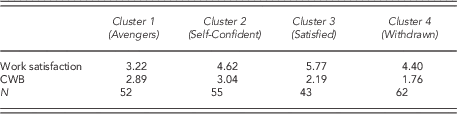
The Pearson correlation of work satisfaction and CWB was −0.220, which is statistically significant (p<.001) but weak. A search for groups of different configurations of the both variables seemeds reasonable. The indicator of counterproductive behavior was included, together with a general index of work satisfaction, in a cluster analysis. Four clusters were identified by k-means clustering, forming clusters that were similar in size, but had differing levels of the analyzed variables. The final centroids are shown in the table below.
Cluster 1 (Avengers): displayed relatively low levels of work satisfaction and high levels of counterproductive behavior. It can be said that these are individuals who, predictably, ‘get back’ at the organization and coworkers because they perceive their work as unsatisfactory.
Cluster 2 (Self-Confident): is the group predicted to stand out: individuals whose high levels of job satisfaction are nevertheless accompanied by inclinations toward counterproductive behavior.
Cluster 3 (Satisfied): is, in turn, a reversal of the first cluster: higher job satisfaction is accompanied by low proclivity for counterproductive behavior. These individuals give no reason to suspect that they present a threat to their organization or coworkers.
Cluster 4 (Withdrawn): is characterized by the lowest level of job satisfaction, but this is not accompanied by a proclivity for counterproductive behavior; in fact, this group exhibited the lowest amount of such behavior (Table 1).
Results of the cluster analysis
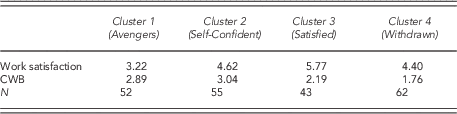
In subsequent analyses of the differing levels of dispositional and situational variables in specific clusters, it is the potential differences between the Avengers and the Withdrawn as well as the Satisfied and the Self-Confident that seem most interesting. The first pair both exhibit relatively low levels of job satisfaction but have different levels of proclivity for CWB. The second pair, in turn, are satisfied employees, some of whom are nevertheless prone to behave in a way that is harmful to the organization and to coworkers.
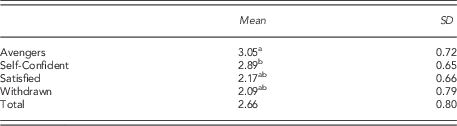
With regard to levels of perceived tension at work, both a notable primary effect in the one-way variance analysis, as well as interesting differences between clusters (see Table 2) were noted. The Avenger and Self-Confident clusters had the highest and nearly identical levels of tension, while the Satisfied and Withdrawn clusters had significantly lower, though also very similar, levels of tension. These results indicate that higher levels of tension at work correlate with increased proclivity for counterproductive behavior regardless of perceived job satisfaction.
Means and standard deviations for stress in clusters
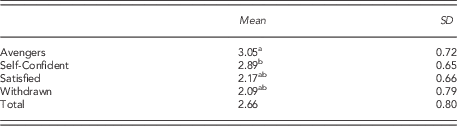
Note: F=12.21, p<.000.
Means with the same superscripts differ on p<.05 level.
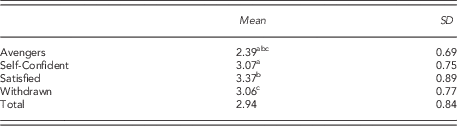
The Avengers also turned out to harbor the lowest perceptions of organizational justice. Analysis of this variable also resulted in a notable primary effect of one-way variance analysis (see Table 3). The highest average appraisal of organizational justice was seen in the Satisfied cluster, followed by marginally lower results in the Self-Confident and Withdrawn clusters. The Avengers showed substantively lower scores, confirming the hypothesis that ‘getting back’ is a mechanism of proclivity for counterproductive behavior in this group.
Means and standard deviations for organizational justice in clusters
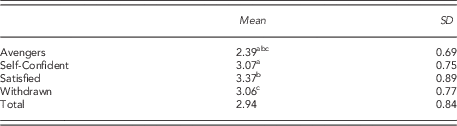
Note: F=8.05, p<.000.
Means with the same superscripts differ on p<.05 level.
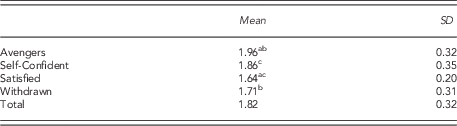
Analysis of the inclination toward aggression showed a very different pattern of results. The main effect of one-way variance analysis proved significant (see Table 4). The Avengers and Self-Confident clusters were most inclined to indulge in aggressive behavior. In the pairs of interest to this study, two significant differences were noted: the Withdrawn were less likely to be aggressive than the Avengers and the Satisfied were more likely to be aggressive than the Self-Confident. This demonstrates that inclinations toward aggression can lead to counterproductive behavior regardless of their potential objective causes or levels of work satisfaction.
Means and standard deviations for aggression in clusters
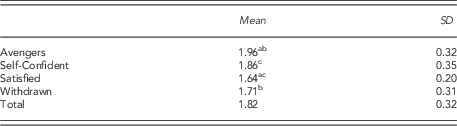
Note: F=6.09, p<.001.
Means with the same superscripts differ on p<.05 level.
Discussion
The purpose of this research was twofold: to ascertain whether the fundamental cause for counterproductive behavior is work dissatisfaction and – once established that it is not – to determine whether there are other factors linked to this behavior. Both goals were accomplished, despite certain difficulties stemming from the overall low frequency of CWB as a result of which only those examples of counterproductive behavior that appear relatively frequently were ultimately included in the analysis.
The groups created in the cluster analysis differ both in terms of satisfaction and CWB in such a way as to represent every expected combination of variables. The Self-Confident group, which shows both substantial proclivity toward counterproductive behavior and relatively high job satisfaction, is of greatest interest to this study. In terms of perceptions of organizational fairness, this group had similar results as the Satisfied group (high satisfaction+low CWB). However, in terms of perceived tension at work and inclination toward aggressive behavior, their scores aligned more closely with the Avengers group (low satisfaction+high CWB).
This particular configuration of results suggests that the Self-Confident group resorts to counterproductive behavior because of an inability to balance difficulties at work with personal inclinations. Moreover, this group may resort to CWB without any deeper awareness that such actions are potentially harmful to the organization and/or to coworkers whom they clearly hold in high regard. These motives are fundamentally unique and require a different correctional approach than those which drive the Avengers, who are not only inclined toward CWB but also have low job satisfaction, low perceptions of organizational fairness, high perceptions of tension at work and substantial inclinations toward aggression. It can be surmised that the Avengers consciously undertake actions against surroundings that they perceive as unsatisfactory (Brees, Mackey, & Martinko, Reference Brees, Mackey and Martinko2013).
The difference between the two groups is particularly relevant in terms of planning countermeasures at the organizational level. For the Self-Confident group, this includes increasing awareness of the harm caused by this type of behavior, changing the scope of responsibilities or how they are carried out in order to reduce stress levels, and introducing less destructive ways of managing aggression. The Avengers, in turn, require a more fundamental reaction whose objective is increasing levels of work satisfaction and garnering greater respect for the organization and coworkers. Only once the fundamental source of CWB is removed is it possible to expect a reduction of these behaviors in this group (Howard & Wech, Reference Howard and Wech2012).
The Withdrawn group (low satisfaction+low CWB) is also interesting. Compared with the other groups, these respondents perceive low stress at work and have low inclinations toward aggressive behavior. Although this group has low work satisfaction, there are no triggers of counterproductive behavior in the guise of stress and aggression. In fact, the relatively low work satisfaction among the Withdrawn can often pass unnoticed by management precisely because it is not signaled in any way that is overtly harmful or threatening to the organization (Sommers, Schell, & Vodanovich, Reference Sommers, Schell and Vodanovich2002). This, however, in no way indicates, that the problem does not exist. Future studies should examine whether employees from this group exhibit other tendencies and behaviors (e.g., desire to change jobs, low involvement) that are not beneficial in the long run. Presumably, such tendencies or behaviors will be revealed at the least expected moments, and will therefore be perceived as unreasonable and incomprehensible. Preventative measures to increase job satisfaction in this group should successfully ward off such superficially unexpected situations.
This explorative study sought to assess whether expectations formulated on the basis of the analysis of significantly divergent research results is meaningful. Subsequent steps should test these results on a wider group of respondents, including non-office workers. Other factors, both situational and dispositional, should also be considered. A limitation of the research is the self-descriptive nature of all the measures. It would be worthwhile to explore the problem using external, observational measure of CWB. Initial conclusions that can be drawn already, but still warrant further precision, are extremely relevant for management. A better understanding of the mechanisms and sources fueling undesirable behavior will allow for planning and carrying out more effective measures to prevent it.