Introduction
Studying the trophic ecology of wild populations is relevant given that feeding habits determine trophic web connections, and therefore such trophic ecology could affect community structure to a significant extent (Araújo et al. Reference Araújo, Bolnick and Layman2011, Dall et al. Reference Dall, Bell, Bolnick and Ratnieks2012). In this sense, a generalist population may be composed of generalist individuals who use all of the resources consumed by the population, or it may be the sum of groups of individuals with specialized trophic strategies (Bolnick et al. Reference Bolnick, Yang, Fordyce, Davis and Svanbäck2002, Reference Bolnick, Svanbäck, Araújo and Persson2007, Dall et al. Reference Dall, Bell, Bolnick and Ratnieks2012). The latter is called individual trophic specialization (ITS). ITS refers to intra-population variation in the use of resources not attributable to sex, age or discrete morphs of individuals (Bolnick et al. Reference Bolnick, Svanbäck, Fordyce, Yang, Davis, Hulsey and Forister2003, Araújo et al. Reference Araújo, Bolnick and Layman2011). One proposed ecological cause for ITS is intraspecific competition: if individuals share a preferred (set of) resource(s), increased competition can lead them to diversify their trophic habits by consuming different secondary prey (Bolnick et al. Reference Bolnick, Svanbäck, Fordyce, Yang, Davis, Hulsey and Forister2003, Reference Bolnick, Svanbäck, Araújo and Persson2007, Araújo et al. Reference Araújo, Bolnick and Layman2011, Dall et al. Reference Dall, Bell, Bolnick and Ratnieks2012). ITS can have important ecological and evolutionary consequences by affecting population and community dynamics (Araújo et al. Reference Araújo, Bolnick and Layman2011, Dall et al. Reference Dall, Bell, Bolnick and Ratnieks2012). In addition, the degree of individual specialization can affect the strength of competitive interactions between sympatric species and, consequently, the probability of persistence of a species in a given environment (e.g. Costa-Pereira et al. Reference Costa-Pereira, Rudolf, Souza and Araújo2018).
The degree of ITS in a population can be estimated as the proportion of the population niche that is explained by the inter-individual variance component (Roughgarden Reference Roughgarden1974, Bolnick et al. Reference Bolnick, Yang, Fordyce, Davis and Svanbäck2002, Reference Bolnick, Svanbäck, Araújo and Persson2007). The total niche width (TNW) of a population can be divided into two components: the within-individual variance component (WIC), which reflects the average diversity of resources used by each individual; and the between-individual variance component (BIC), which reflects the average variation in resource use amongst individuals in the population (TNW = WIC + BIC; Roughgarden Reference Roughgarden1972). Accordingly, the ITS index (BIC/TNW) ranges from 0, when the population is composed of generalist individuals, to 1, when all of the individuals are specialists (Bolnick et al. Reference Bolnick, Yang, Fordyce, Davis and Svanbäck2002).
The ITS in a population is determined by studying the temporal consistency in the trophic habits of its individuals (Costa-Pereira & Araújo Reference Costa-Pereira and Araújo2022). In recent times, one of the main methodologies used to study this consistency is stable isotope analysis (SIA) of δ15N and δ13C. δ15N mainly allows us to infer the trophic position of an individual (Post Reference Post2002) and, secondarily, to discriminate between feeding zones (McMahon et al. Reference McMahon, Hamady and Thorrold2013, Brault et al. Reference Brault, Koch, McMahon, Broach, Rosenfield and Sauthoff2018). δ13C provides information on the origin of primary productivity, enabling the foraging habitat to be inferred (France Reference France1995). For instance, in the marine environment, δ13C distinguishes between the use of benthic vs pelagic prey (France Reference France1995).
Individual specialization could be assessed using SIA in three different ways: 1) sequential sampling of the same tissue in the same individuals, 2) simultaneous sampling of different tissues (i.e. a multi-tissue approach) and 3) sampling of different portions of a metabolically inert tissue that undergoes continuous growth (Naya & Franco-Trecu Reference Naya and Franco-Trecu2019 and references therein). Continuous growing metabolically inert tissues (e.g. vibrissae, nails, feathers) maintain an unchanged isotopic signal once synthesized, and hence repeated measurements of the trophic habits of an individual can be obtained over periods of months and even years (i.e. Silva et al. Reference Silva, Siles, Cardona, Tavares, Crespo and Gandini2015). SIA of these tissues allows researchers to evaluate the variation in the trophic habits of the individuals relative to the total population variation and therefore the degree of ITS (Newsome et al. Reference Newsome, Tinker, Monson, Oftedal, Ralls and Staedler2009, Vander Zanden et al. Reference Vander Zanden, Bjorndal, Reich and Bolten2010). Whilst these tissues have been used to study trophic habits (not necessarily ITS), they are often sampled invasively as they involve the manipulation of living individuals (e.g. use of vibrissae from sea lions and sea otters (Newsome et al. Reference Newsome, Tinker, Monson, Oftedal, Ralls and Staedler2009, de Lima et al. Reference DE Lima, Franco-Trecu, Carrasco, Inchausti, Secchi and Botta2022) and feathers in birds (Jaeger et al. Reference Jaeger, Blanchard, Richard and Cherel2009)). Moreover, the tips of nails are cut off when using the nails in living animals, and this only allows us to obtain isotopic data from a short and sometimes unknown period of time (Cherel et al. Reference Cherel, Hobson, Guinet and Vanpe2007). Therefore, the use of metabolically inert tissues obtained from dead individuals is a good alternative to avoid sampling living animals, thereby constituting a valuable non-invasive methodology (Ainley et al. Reference Ainley, Ballard, Barton, Karl, Rau, Ribic and Wilson2003, Vasil et al. Reference Vasil, Polito, Patterson and Emslie2012). Moreover, in the case of nails, using dead animals allows us to sample the entire nail and thus to obtain the isotopic data regarding the whole of the period of time it integrates.
The gentoo penguin (Pygoscelis papua) is a mesopredator species with a circumpolar distribution (Clucas et al. Reference Clucas, Dunn, Dyke, Emslie, Naveen and Polito2014), and it is considered a generalist species with a diverse and flexible diet at the population level (Polito et al. Reference Polito, Trivelpiece, Patterson, Karnovsky, Reiss and Emslie2015, Negrete et al. Reference Negrete, Sallaberry, Barceló, Maldonado, Perona and McGill2016). Although some populations consume fish and squid in addition to Antarctic krill (Euphausia superba; Karnovsky Reference Karnovsky1997, Polito et al. Reference Polito, Lynch, Naveen and Emslie2011, Gorman Reference Gorman2015), in others Antarctic krill remains their main prey, constituting more than 90% of the diet (Pickett et al. Reference Pickett, Fraser, Patterson-Fraser, Cimino, Torres and Friedlaender2018).
Although several studies have assessed intra-individual differences in the trophic ecology of other Pygoscelis species regarding environmental variability and population density (e.g. see Lescroël et al. Reference Lescroël, Dugger, Ballard and Ainley2009, Reference Lescroël, Ballard, Grémillet, Authier and Ainley2014, Reference Lescroël, Lyver, Jongsomjit, Veloz, Dugger and Kappes2020, Massaro et al. Reference Massaro, Ainley, Santora, Quillfeldt, Lescroël and Whitehead2020 for studies in Pygoscelis adeliae), little is known about intra-population variation in P. papua. Until now, only two studies have explored the degree of ITS at the population level of this species (Herman Reference Herman2016, Handley et al. Reference Handley, Connan, Baylis, Brickle and Pistorius2017), without assessing potential differences between sexes. Given that ITS is affected by the diversity and abundance of local resources as well as by colony size, the degree of ITS in gentoo penguins varies not only between different islands (Herman Reference Herman2016) but also between colonies of the same population (Handley et al. Reference Handley, Connan, Baylis, Brickle and Pistorius2017). Moreover, the methodologies previously used have been invasive (i.e. stomach contents and SIA of feathers), involving the capture of individuals within the colony. Here, we aimed to assess a non-invasive methodology of using SIA of the nails of dead P. papua adults to estimate the degree of ITS in one of its main reproductive colonies: Ardley Island, South Shetland Islands. In addition, we tested differences in ITS between sexes. Considering the sustained growth in the population abundance of P. papua on Ardley Island (Roberts et al. Reference Roberts, Monien, Foster, Loftfield, Hocking and Schnetger2017, Firla et al. Reference Firla, Mustafa, Pfeifer, Senf and Hese2019; see also ‘Discussion’ section below), which implies a decrease in the per capita abundance of local resources, we predicted that this population would have a high degree of ITS as a mechanism to decrease competition at the intra-population level (Araújo et al. Reference Araújo, Bolnick and Layman2011).
Materials and methods
Study area and sample collection
Ardley Island (62°13′S, 58°56′W) is located to the south-west of King George Island, which is part of the South Shetland Islands, Antarctica. It is considered a Site of Special Scientific Interest (SSSI No. 33) and is part of the Antarctic Specially Protected Areas (ASPA No. 150; ASPA 2009) given its relevance as a breeding and moulting site for various species of seabirds, such as P. papua (ASPA 2009). Ardley Island contains one of the largest reproductive colonies of P. papua, with more than 6000 breeding pairs (Roberts et al. Reference Roberts, Monien, Foster, Loftfield, Hocking and Schnetger2017, Firla et al. Reference Firla, Mustafa, Pfeifer, Senf and Hese2019). There, P. papua inhabits in sympatry with chinstrap penguin (Pygoscelis antarctica) and Adélie penguin (P. adeliae), whose breeding colonies have ~50 and 300 breeding pairs, respectively (Roberts et al. Reference Roberts, Monien, Foster, Loftfield, Hocking and Schnetger2017, Firla et al. Reference Firla, Mustafa, Pfeifer, Senf and Hese2019).
During January 2019, we made two visits to Ardley Island, in which feet from 19 carcasses belonging to adult individuals of the genus Pygoscelis were collected. The carcasses corresponded to recently predated individuals, so the feet were fresh. Both feet were collected from each carcass to ensure that the same individual was not sampled twice during different sampling events. In the laboratory, the external portion of the central and longest nail was extracted. As nails are inert tissues, it is possible to obtain samples from recently dead individuals, constituting a non-invasive methodology (see Vasil et al. Reference Vasil, Polito, Patterson and Emslie2012). In addition, a skin sample was obtained from each foot and stored in Eppendorf tubes with 95% alcohol.
Sample analysis
DNA was isolated from tissue samples, following the procedure of González et al. (Reference González, Cosse, Del Rosario Franco, Emmons, Vynne and Duarte2015). The taxonomic identity of the samples was established by 500 bp amplification of the COI gene (mtDNA) using AWCF1 and AWCintR4 primers (Patel et al. Reference Patel, Waugh, Millar and Lambert2010). Polymerase chain reactions (PCRs) were conducted in a final volume of 25 μl with 0.08 U Invitrogen™ Platinum™ Taq DNA Polymerase (Invitrogen Life Technologies, Carlsbad, CA, USA), 1X buffer, 2.5 mM, 1.25 μl bovine serum albumin (BSA), 0.75 μl of each primer and 100 ng of genomic DNA template. For the PCRs, an initial denaturing step at 94°C for 3 min was followed by 35 cycles of denaturation at 94°C for 45 s, annealing (55°C for 30 s) and extension at 72°C for 1 min, and this ended with a final extension of 72°C for 10 min. All PCR products were confirmed on 1% agarose gel and purified with Exonuclease I (Exo I) and FastAp following Werle et al. (Reference Werle, Schneider, Renner, Volker and Fiehn1994). The purified products were sequenced on Macrogen Korea. Species was confirmed by a BLAST search against the GenBank nr database (http://blast.ncbi.nlm.nih.gov/Blast.cgi).
Sex determination was performed using molecular methods. PCR amplification of the CHD1 gene, located on birds' sex chromosomes, with P2 and P8 primers (Griffiths et al. Reference Griffiths, Double, Orr and Dawson1998) produced fragments (CHD1W and CHD1Z) that differ in 18 bp length amongst the sex chromosomes of P. papua (Valenzuela-Guerra et al. Reference Valenzuela-Guerra, Morales-Moraga, González-Acuña and Vianna2013). Chromosome Z occurs in both sexes, whereas chromosome W is unique to females. Therefore, a single fragment size is amplified in males (ZZ) and two fragments of different sizes are amplified in females (ZW). PCR was carried out in a final volume of 20 μl with 1x of Platinum Multiplex Master Mix (Invitrogen Life Technologies, Carlsbad, CA, USA), 0.5 μl of each primer and 50 ng of genomic DNA template. We incorporated a fluorescent dye (FAM) on the P2 primer to analyse fragment sizes using capillary electrophoresis. The PCR profile consisted of an initial denaturing step at 94°C for 10 min, followed by 35 cycles of 94°C for 30 s, 47°C for 1 min and 72°C for 1 min, and then a final extension of 72°C for 10 min. Positive and negative controls were included in each PCR. Positive controls consisted of samples of Ara chloroptera of known sex. PCR amplification was confirmed by electrophoresis on 1% agarose gel, and the products were sent to the Institut Pasteur de Montevideo, Uruguay, for fragment analysis. Genotype assignment was carried out using GeneMarker 2.4.0 (Softgenetics LLC, State College, PA, USA). Males were homozygotes (370/370 pb) and females were heterozygotes (370/388 pb).
The collected nails were washed with distilled water to remove residues and contaminants and subsequently dried in an oven at 60°C for 24 h. Silva et al. (Reference Silva, Siles, Cardona, Tavares, Crespo and Gandini2015) estimated the nail growth rate of the Patagonian penguin (Spheniscus magellanicus) at 3.4 mm per month (assuming linear and constant growth). Since this is the closest phylogenetically available information, we used this growth rate to estimate the period that each portion of each nail integrated. The nail of each individual was measured and cut from the basal end in sections of ~3.5 mm (each portion integrated the trophic habits of ~1 month), allowing us to obtain five or six portions per individual. Each portion was washed and oven-dried again. Finally, each nail portion was cut into smaller fragments that were used for the SIA of δ15N and δ13C. Samples were sent to the Center for Stable Isotopes, University of New Mexico (http://csi.unm.edu/) for analysis.
Each sample was analysed in a continuous-flow mass spectrometer to determine the abundance of N and C isotopes with analytical precisions of ±0.2‰ for δ15N and ±0.04‰ for δ13C. Isotopic values are expressed in delta notation (d) in parts per thousand (‰) according to the equation: dX = [(R sample/R standard) - 1] × 1000, where X corresponds to 13C or 15N, R sample is the ratio between the heavy and light isotope of the sample (15N/14N or 13C/12C) and R standard is the ratio between the heavy and light isotope of the reference standards. Standard values for 13C are determined with Pee Dee Belemnite (PDB), and for 15N atmospheric nitrogen (air) is used.
Given that five or six portions were obtained from each nail analysed and that their isotopic signatures ranged from August/September 2018 to January 2019, the information on the trophic habits of each individual reflected the end of the non-reproductive period and most of the reproductive period (Hinke et al. Reference Hinke, Polito, Reiss, Trivelpiece and Trivelpiece2012).
Data analysis
Differences between sexes in the mean value of each isotope were evaluated using repeated-measures analysis of variance (ANOVA). The values of each isotope were modelled, including sex as a fixed effect and the identity of the individual (intercepts) and the portion of the nail (slopes) as random effects, using the nlme package (Pinheiro et al. Reference Pinheiro, Bates, DebRoy and Sarkar2021) of R (R Core Team 2020).
We estimated Layman metrics that allow for quantifying various aspects of the trophic habits of a population based on the distribution of the isotopic signatures of the individuals in the isotopic space (biplot δ15N-δ13C; see Layman et al. Reference Layman, Arrington, Montaña and Post2007). The δ15N range (NR) and the δ13C range (CR) are the distances between the highest and the lowest values of δ15N and δ13C, respectively. Whilst the NR reflects the diversity of trophic levels exploited/used, the CR reflects the diversity of basal resources. The mean nearest neighbour distance (NND) is the average of the Euclidean distances of each individual to its nearest neighbour (individual) in the biplot δ15N-δ13C; the lower the values of NND, the greater the degree of trophic packing of the individuals. The standard deviation of the nearest neighbour distance (SDNND) indicates how uniform the distribution of the trophic niches of individuals is, being less influenced by sample size than NND. Whilst NR and CR are population metrics, NND and SDNND provide information about the relative position of the individuals in the population with respect to each other within the isotopic space (Layman et al. Reference Layman, Arrington, Montaña and Post2007). We calculated the Layman metrics at the population level and also separately for each sex.
Stable Isotope Bayesian Ellipses in R (SIBER; Jackson et al. Reference Jackson, Inger, Parnell and Bearhop2011) were used to define the isotopic niche space at the population, sex and individual levels. This method is a Bayesian version of Layman metrics (Layman et al. Reference Layman, Arrington, Montaña and Post2007) that can incorporate uncertainties such as sampling biases and small sample sizes into niche metrics (Jackson et al. Reference Jackson, Inger, Parnell and Bearhop2011). Based on Markov chain Monte Carlo (MCMC) simulation, this approach assigns measures of uncertainty to calculate parameters of ellipses in a way that is similar to a bootstrap procedure. Standard ellipse areas, corrected for small sample sizes (SEAC), were used to estimate the width of the isotopic niche using Bayesian standard ellipse areas (SEAB). We calculated the SEAB using three percentages of the data (25%, 40% and 99%) and 1000 replicates, from which we obtained the mean value and the 95% confidence interval (CI). The SEAB calculated with: 1) 99% of the data represents the total area of the isotopic niche used, 2) 40% of the data represents the core of the isotopic niche and 3) 25% of the data represents the area of the isotopic niche that is most frequently used by the population, by individuals of the same sex or by each individual. We estimated the degree of SEAC overlap between sexes. In addition, we estimated the mean and standard deviation (SD) of the SEAC for all individuals and for the individuals of each sex using two percentages of the data: 25% and 99% (Jackson et al. Reference Jackson, Inger, Parnell and Bearhop2011). In all of the cases, we used the mean value of the five or six nail portions of each individual to avoid redundancy of information associated with each individual.
We estimated the degree of ITS at the population level and for each sex using both a multidimensional approach (which incorporates the information of both isotopes, each constituting a niche axis; Ingram et al. Reference Ingram, Costa-Pereira and Araújo2018) and a one-dimensional approach (obtaining the degree of ITS for each isotope separately; Bolnick et al. Reference Bolnick, Svanbäck, Araújo and Persson2007). For the multidimensional approach, we used a multiple-response generalized linear mixed model (MGLMM) to estimate intra- and inter-individual variance components, modelling the identity of the individual as a random effect (Ingram et al. Reference Ingram, Costa-Pereira and Araújo2018). We used the MCMCglmm package (Hadfield Reference Hadfield2010), which employs a Bayesian MCMC approach, to estimate the variance components (WIC and BIC), TNW (as BIC + WIC) and ITS (as BIC/TNW) with a 95% CI. For the one-dimensional analysis, we used the RInSp package (Zaccarelli et al. Reference Zaccarelli, Bolnick and Mancinelli2013) to estimate the variance components (WIC and BIC), TNW and ITS, for both δ13C and δ15N, and also to evaluate the statistical significance of the ITS index against the null hypothesis that the population is composed of generalist individuals (see Zaccarelli et al. Reference Zaccarelli, Bolnick and Mancinelli2013). Finally, as an ITS proxy, we estimated the proportion of the population isotopic niche (SEAC) represented by each single individual and by the individuals of each sex altogether, using 99% of the data. All of these analyses were performed in the free software R (R Core Team 2020), and the statistical significance was established at the 0.05 level.
Results
From 19 penguin samples, 17 were determined as P. papua, one corresponded to P. adeliae and other to P. antarctica. In our sample of 17 gentoo penguins, we identified eight females and eight males. Only in one case was it not possible to determine the sex, which was probably related to the low DNA quantity for amplifying nuclear markers.
The average length of the 17 nails analysed was 19.62 mm (SD = 1.55), allowing us to obtain five and six nail portions from 12 and five individuals, respectively. The average δ15N and δ13C values at the population level were 7.30‰ (0.52) and -24.24‰ (0.37), respectively. We did not find differences between sexes in either the δ15N values (females = 7.21 ± 0.57‰, males = 7.42 ± 0.49‰, P = 0.26) or in the δ13C values (females = -24.32 ± 0.39‰, males = -24.20 ± 0.36‰, P = 0.39).
Regarding isotopic niche metrics, both at the population level and for each sex, the range of δ15N (NR) was greater than the range of δ13C (CR). Females showed higher values than males for all Layman metrics. For example, the value of SDNND (uniformity in the distribution of the trophic niches of the individuals) was 0.21 for females and 0.09 for males (Table I).
Values of Layman metrics at the population level and for each sex. Isotopic values were obtained from the nails of 17 adult individuals of the population of Pygoscelis papua (8 females, 8 males, 1 could not be determined) from Ardley Island, South Shetland Islands.

NND = mean nearest neighbour distance; SDNND = standard deviation of the nearest neighbour distance.
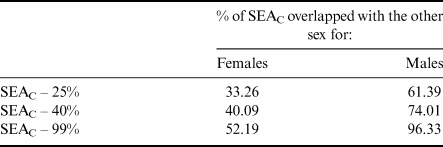
Similarly, the mean SEAB values (using 25%, 40% and 99% of the data) of females were always higher than those of males (Fig. 1 & Table II). In addition, the degree of overlap between the ellipses (SEAC) of females and males showed that females have a greater exclusive area in all of the cases (Table III): whilst the exclusive area for males did not exceed 40%, the exclusive area for females exceeded 65%.
Isotopic niche areas of males and females from the population of Pygoscelis papua from Ardley Island, South Shetland Islands. Standard ellipse areas were generated from the isotopic values (δ15N and δ13C) of nails from eight adult females (circles, red) and eight adult males (triangles, blue) using three percentages of the data (Stable Isotope Bayesian Ellipses in R): 25% (solid lines), 40% (dashed lines) and 99% (dotted lines).

Bayesian standard ellipse areas (SEAB; number of replicates = 1000) at the population level and for each sex. Isotopic values were obtained from the nails of 17 adult individuals of the population of Pygoscelis papua (8 females, 8 males, 1 could not be determined), from Ardley Island, South Shetland Islands. SEAB was calculated using three percentages of the data: 25%, 40% and 99% (Stable Isotope Bayesian Ellipses in R). The means are given, and 95% confidence intervals are shown in parentheses.

Percentage of the corrected standard ellipse area (SEAC) that each sex overlaps with the other. Isotopic values of δ15N and δ13C were obtained from the nails of eight adult females and eight adult males of the population of Pygoscelis papua from Ardley Island, South Shetland Islands. The area of overlap is shown using three percentages of the data: 25%, 40% and 99% (Stable Isotope Bayesian Ellipses in R).

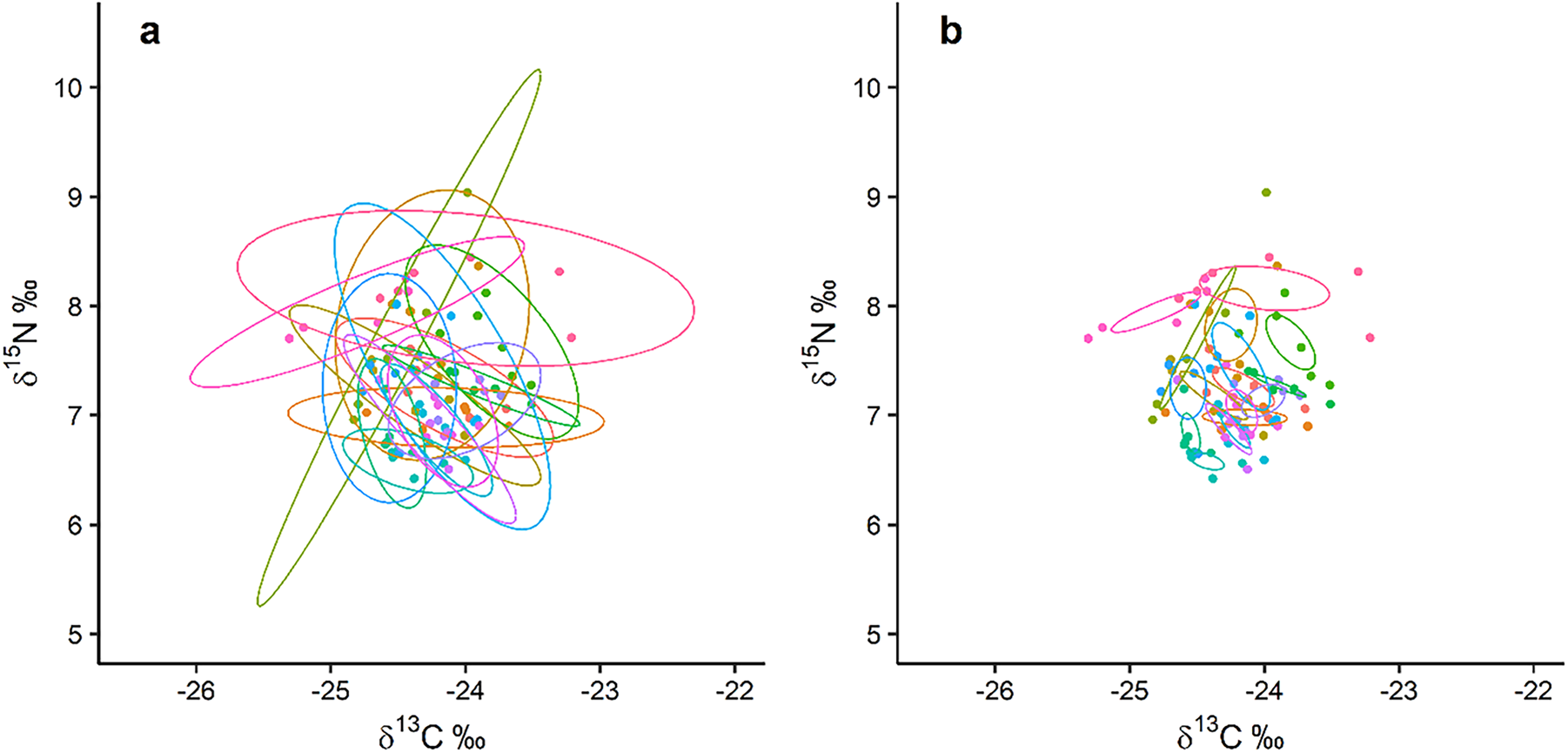
The individual mean (SD) of the SEAC using 99% of the data was 1.87 (1.37), and there was high overlap between them (Fig. 2a). However, when we used 25% of the data, the ellipse area reduced to 0.12 (0.09), and some individuals overlapped little or not at all with others (Fig. 2b). The mean SEAC values of male individuals were higher than those observed for female individuals, both for 99% (males = 2.44 ± 1.79, females = 1.36 ± 0.61) and for 25% of the data (males = 0.15 ± 0.11, females = 0.08 ± 0.04).
Isotopic niche areas of individuals of Pygoscelis papua from the population of Ardley Island, South Shetland Islands. Individual standard ellipse areas were generated from the isotopic values (δ15N and δ13C) of nails from 17 adult individuals using a. 99% and b. 25% of the data.

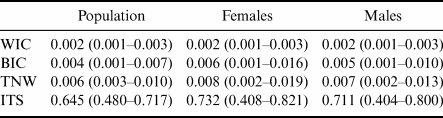
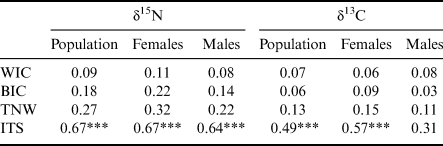
The multidimensional ITS (95% CI) was 0.65 (0.48–0.72) at the population level, 0.73 (0.41–0.82) for females and 0.71 (0.40–0.80) for males (Table IV). The one-dimensional ITS at the population level was higher for δ15N (0.67) than for δ13C (0.49; Table V). At the sex level, the one-dimensional ITS for δ15N was similar between sexes (females = 0.67, males = 0.64). However, for δ13C, the ITS of females was higher (0.57) than that of males (0.31). In all of the cases, the ITS index was significant (P < 0.001) with respect to the null model, except for the δ13C index for males (P = 0.079; Table V).
Degree of multidimensional individual trophic specialization (ITS) for the population of Pygoscelis papua from Ardley Island, South Shetland Islands. Values of the within-individual variance component (WIC), between-individual variance component (BIC), total niche width (TNW) and multidimensional individual trophic specialization value (ITS = BIC/TNW) for the isotopic values (δ15N and δ13C) of the population of P. papua (n = 17 adults) from Ardley Island and of each sex (8 females, 8 males, 1 could not be determined) are calculated using 95% confidence intervals (MCMCglmm package in R). Isotopic values were obtained from the nails. Mean (minimum–maximum) values are shown.

Degree of individual trophic specialization (ITS) in δ15N and δ13C for the population of Pygoscelis papua from Ardley Island, South Shetland Islands. Values of the within-individual variance component (WIC), between-individual variance component (BIC), total niche width (TNW) and one-dimensional ITS value (ITS = BIC/TNW) are shown for the isotopic values (δ15N and δ13C) of 17 adult individuals at the population level and for each sex (8 females, 8 males, 1 could not be determined). Isotopic values were obtained from the nails. Statistical significance is shown regarding the ITS index against the null hypothesis that the population is made up of generalist individuals (RInSp package in R): ***P ≤ 0.001.

The mean (SD) percentage of the population niche used by each individual (SEAC - 99%) was 35.32% (19.49). Female individuals used 26.68% (8.69) of the total population niche and male individuals used 44.00% (24.92).
Discussion
In the present study, we estimated using a non-invasive methodology a moderate ITS for the gentoo penguin in Ardley Island, South Shetland Islands, and we also found some sexual differentiation. The degree of ITS found at the population level suggests that it could function as a mechanism to reduce potential intraspecific competition arising due to the sustained increase in population abundance (see below). As for the differences between sexes, the greater energy investment that females make at the beginning of the reproductive period could lead them to further minimize the number of conspecifics with which they must compete.
Isotopic niche metrics
The greater range reported for δ15N in relation to δ13C suggests that this population of P. papua shows a greater feeding diversity associated with the trophic position of the prey consumed rather than with the habitat used. In this sense, it should be noted that although differences in δ15N could be related to differences in feeding zones, its variation in the West Antarctic Peninsula (i.e. the location of this study) occurs at a larger scale than that used by the P. papua individuals of this colony (Kokubun et al. Reference Kokubun, Takahashi, Mori, Watanabe and Shin2010, McMahon et al. Reference McMahon, Hamady and Thorrold2013, Brault et al. Reference Brault, Koch, McMahon, Broach, Rosenfield and Sauthoff2018). The values of NND and SDNND indicate that the individuals of the population are unevenly distributed in the isotopic space, so that groups of some individuals are closer to each other. The variation in the size of the individual isotopic niche as well as its distribution in the isotopic space support the notion that this population includes both specialist and generalist individuals.
In addition, both sexes showed the same pattern as the overall population concerning the range of δ15N and δ13C. Therefore, females and males show greater diversification regarding the trophic level of the prey consumed than regarding trophic habitat. A greater range of δ15N and δ13C and a greater area of the ellipse (percentage of data: 25%, 40% and 99%) in females suggest that they use a greater area of the isotopic space and therefore have greater diversity in their foraging habits than males. A higher NND, SDNND and exclusive isotopic niche area of females compared to males indicate that they have a lower degree of trophic redundancy (i.e. the relative position of females to each other within the δ15N-δ13C biplot differs more than that of males; Layman et al. Reference Layman, Arrington, Montaña and Post2007) and that their distribution in the isotopic space is considerably less uniform. Similarly, this suggests that females use trophic resources and foraging areas that males do not. Since female individuals have on average smaller isotopic niche areas than male individuals, their trophic habits would be more limited to certain resources or foraging areas. The aforementioned result could be associated with the investment that this sex makes during the beginning of the reproductive period. Unlike males, females of P. papua fast for ~1 week during courtship, and a decrease in mass during the days before the first egg lay has been reported on King George Island (Trivelpiece & Trivelpiece Reference Trivelpiece, Trivelpiece, Davis and Darby1990). In addition, females carry out the first incubation period (Black Reference Black2016). Each female individual could modify her foraging habits with respect to the other individuals in the population (of both sexes) and reduce their overlap, thus mitigating potential intraspecific competition for access to resources. Similarly, a greater isotopic niche area of females compared to males suggests that they are the sex that contributes to a greater extent to the diversification of the population isotopic niche.
Individual trophic specialization
At the population level, the estimation of ITS via the multidimensional and one-dimensional approaches indicated that the population of P. papua from Ardley Island presents a moderate to high degree of specialization, being composed mainly of specialist individuals. The one-dimensional analysis indicated that this population shows a higher degree of ITS associated more with the trophic position of the consumed resources (δ15N) than with the foraging habitat (benthic/pelagic, δ13C). Although the population degree of specialization in δ15N is not affected by the foraging habits of individuals of a particular sex, at the level of δ13C the degree of population ITS is influenced more by the habits of females (see below). Studies on Livingston Island (near Ardley Island) reported a higher degree of ITS in δ15N (0.53) than in δ13C (0.44) during winter (e.g. Herman Reference Herman2016). In this same population, greater inter-individual variation in δ15N than in δ13C was reported during the reproductive period (Polito et al. Reference Polito, Trivelpiece, Patterson, Karnovsky, Reiss and Emslie2015). The greater specialization at δ15N, as found in this study and in Herman (Reference Herman2016), could be related to the fact that P. papua generally forages near the coast/benthic zones (Kokubun et al. Reference Kokubun, Takahashi, Mori, Watanabe and Shin2010, Polito et al. Reference Polito, Lynch, Naveen and Emslie2011), so the degree of differentiation in the isotopic values that individuals can achieve in the foraging habitat is less than the trophic segregation that can be achieved regarding the consumed prey. A degree of ITS close to 0.70 in δ15N indicates that there is significant differentiation between individuals in the consumption of secondary resources, such as fish and squid. These results are supported by the ellipses analysis, given that on average each individual uses less than half of the total population niche, indicating that they are specialized in certain resources and/or foraging areas.
At the sex level, the multidimensional estimation of ITS indicated a moderate to high degree of specialization for both females and males. The degree of ITS of females was higher with respect to the trophic position of the consumed resources (δ15N) than to the foraging habitat (δ13C). Males were specialized in the trophic position of the prey that they consume but without any degree of diversification in foraging habitat. The differences in the degree of specialization between females and males are consistent with the fact that female individuals use, on average, a lower percentage of the population niche compared to male individuals and show less variation between them. The fact that a moderate to high degree of multidimensional ITS was found in males whilst in the one-dimensional analysis this was reported for δ15N, but not for δ13C, may be due to the fact that the multidimensional analysis considers how the paired values of δ15N and δ13C of each individual are distributed in the isotopic space.
Given the sustained population increase of P. papua in Ardley Island (Roberts et al. Reference Roberts, Monien, Foster, Loftfield, Hocking and Schnetger2017, Firla et al. Reference Firla, Mustafa, Pfeifer, Senf and Hese2019), the degree of ITS found in this study could constitute one of the mechanisms adopted by individuals to deal with intraspecific competition for trophic resources. In recent decades, gentoo penguins have increased their trophic level by consuming more fish and squid (McMahon et al. Reference McMahon, Michelson, Hart, McCarthy, Patterson and Polito2019). Although the percentage of consumption of these items can be highly variable amongst populations (e.g. Polito et al. Reference Polito, Lynch, Naveen and Emslie2011, Pickett et al. Reference Pickett, Fraser, Patterson-Fraser, Cimino, Torres and Friedlaender2018), the dietary diversification found in this study may occur through differentiation in the proportion of krill vs higher-trophic-level species in the diet. The increase in fish consumption could be favoured by both the recovery of marine mammal predators that also consume krill (McMahon et al. Reference McMahon, Michelson, Hart, McCarthy, Patterson and Polito2019) and the recovery of some fish species in King George Island (see Marschoff et al. Reference Marschoff, Barrera-Oro, Alescio and Ainley2012). Thus, the degree of specialization reported in this study could be due to multiple, non-mutually exclusive factors.
Furthermore, unlike other studies, we did not find differences between sexes in the trophic level of the prey consumed (Karnovsky Reference Karnovsky1997, Gorman Reference Gorman2015), but we did find a moderate to high degree of ITS in δ15N for both sexes. This could also be explained by fluctuations in prey availability and interspecific competition. On the other hand, the differentiation between sexes regarding the degree of ITS in the foraging habitat suggests that the cost associated with the reproductive period could influence females to differentiate themselves even more than males from the rest of the individuals.
To our knowledge, this work is the first to estimate the degree of ITS of P. papua on Ardley Island at the population level, and it is also the first to assess ITS separately for each sex. We also highlight the non-invasive methodology used, which allows for the study of trophic habits in wild populations without manipulating individuals. Future research could incorporate the use of isotopic mixing models to address the specific contribution of each prey species to the diet of individuals. In this way, we could gain even more insights into the ways by which this population is dealing with intraspecific competition.
Acknowledgements
We thank the Ministry of Education and Culture of Uruguay (N° I/FVF/2017/076) for financing the stable isotope analysis and the Uruguayan Antarctic Institute for financing the trip and the logistical support in Antarctica. We thank David Ainley and an anonymous reviewer for their valuable comments on the manuscript. The present article is a contribution to Lucía Rabinovich-Larrechea's. graduate thesis, tutored by Valentina Franco-Trecu.
Author contributions
LR-L and VF-T conceived and designed the study; DEN and VF-T conducted the fieldwork; LR-L, MC, NB and VF-T conducted the laboratory work; LR-L and VF-T analysed the data; LR-L and VF-T wrote the manuscript; VF-T obtained the funding. All authors contributed to editing the manuscript and approved the final version.
Financial support
This work was supported by the Vaz Ferreira Funds - Ministry of Education and Culture, Uruguay (grant number I/FVF/2017/076).
Competing interests
The authors declare none.
Data availability
To access the database that supports the findings of this study, please contact the corresponding author, LR-L.