Introduction
Social cognition refers to the processes that allow individuals to interact in complex social groups, make inferences about mental states (i.e., beliefs, intentions, feelings), and understand other people's behavior (Brüne & Brüne-Cohrs, Reference Brüne and Brüne-Cohrs2006; Premack & Woodruff, Reference Premack and Woodruff1978). Among these abilities, Theory of Mind (ToM), or the ability to make inferences, is a core component of social functioning. Most aspects of social interaction are made up of implicit meanings that encode numerous inferences and hypotheses about another's intentions, thoughts, and feelings (Adolphs, Reference Adolphs2001). ToM was first studied in children and in developmental pathology, most prominently in autism and in adults with Asperger's syndrome (Baron-Cohen, Leslie, & Frith, Reference Baron-Cohen, Leslie and Frith1985; Baron-Cohen, Reference Baron-Cohen2001), and it is considered an important contributing factor to behavioral symptoms in these patients (Baron-Cohen, Tager-Flusberg, & Cohen, Reference Baron-Cohen, Tager-Flusberg and Cohen1993). More recently, research has focused on neurological populations, including those with neurodegenerative diseases such as Parkinson's disease (PD), Huntington disease (HD), fronto-temporal dementia (FTD), and Alzheimer's disease (AD), as well traumatic brain injury (Gregory et al., Reference Gregory, Sinclair, Stone, Erzinclioglu, Martin, Baron-Cohen and Hodges2002; Lough et al., Reference Lough, Kipps, Treise, Watson, Blair and Hodges2006; Mengelberg & Siegert, Reference Mengelberg and Siegert2003; Rowe, Bullock, Polkey, & Morris, Reference Rowe, Bullock, Polkey and Morris2001; Saltzman, Strauss, Hunter, & Archibald, Reference Saltzman, Strauss, Hunter and Archibald2000; Snowden et al., Reference Snowden, Gibbons, Blackshaw, Doubleday, Thompson, Craufurd and Neary2003; Stuss, Gallop, & Alexander, Reference Stuss, Gallup and Alexander2001). The research suggests that those patients with behavioral disturbances also show ToM impairment, which could contribute to the emergence of the behavioral problems. Lesion and functional magnetic resonance imaging studies have delineated a widespread cerebral network involved in social cognition, including the amygdala, ventromedial prefrontal cortex, cingulate cortex, and somatosensory-related cortices in the right hemisphere (Adolphs, Reference Adolphs2001, Reference Adolphs2003, Reference Adolphs2009; Bird, Castelli, Malik, Frith, & Husain, Reference Bird, Castelli, Malik, Frith and Husain2004; Brunet, Sarfati, Hardy-Baylé, & Decety, Reference Brunet, Sarfati, Hardy-Baylé and Decety2000; Gallagher & Frith, Reference Gallagher and Frith2003; Rowe et al., Reference Rowe, Bullock, Polkey and Morris2001; Shaw, Lawrence, Bramham, Brierley, & Radbourne, Reference Shaw, Lawrence, Bramham, Brierley and Radbourne2007; Stuss et al., Reference Stuss, Gallup and Alexander2001), with white matter integrity also identified as an associated factor (Ruffman, Henry, Livingstone, & Phillips, Reference Ruffman, Henry, Livingstone and Phillips2008).
Multiple sclerosis (MS) is a chronic, inflammatory disease of the central nervous system that is associated with a diffuse demyelination of white matter. The disease has early onset (typically between 20 and 40 years old) and a variable and unpredictable course. In addition to neurological deficits, cognitive impairments and psychological and psychiatric disorders are common features in MS. Cognitive deficits occur even in the early stages of MS, with prevalence rates ranging from 43% to 70%; cognitive domains most typically affected include the executive functions, memory, information processing speed, and attention (Chiaravalloti & DeLuca, Reference Chiaravalloti and DeLuca2008; Heesen et al., Reference Heesen, Schulz, Fiehler, Von der Mark, Otte, Jung and Gold2010; Langdon, Reference Langdon2011; Rogers & Panegyres, Reference Rogers and Panegyres2007). In addition, relative to individuals with similar degrees of disability, patients with MS have an elevated incidence and prevalence of psychological and psychiatric symptoms (Beiske et al., Reference Beiske, Svensson, Sandanger, Czujko, Pedersen, Aarseth and Myhr2008; Chwastiak & Ehde, Reference Chwastiak and Ehde2007; José Sá, Reference José Sá2008; Kalb, Reference Kalb2007; Kinsinger, Lattie, & Mohr, Reference Kinsinger, Lattie and Mohr2010). MS also involves psychosocial consequences such as disruptions to life goals, employment, relationships, and daily living activities (Feinstein, Reference Feinstein2006; Morrow et al., Reference Morrow, Drake, Zivadinov, Munschauer, Weinstock-Guttman and Benedict2010; Smith & Arnett, Reference Smith and Arnett2005). Furthermore, and in similarity with other neurodegenerative diseases (Adolphs, Tranel, Damasio, & Damasio, Reference Adolphs, Tranel, Damasio and Damasio1994; Clark, Neargarder, & Cronin-Golomb, Reference Clark, Neargarder and Cronin-Golomb2008; Hanks, Temkin, Machamer, & Dikmen, Reference Hanks, Temkin, Machamer and Dikmen1999; Lough, Gregory, & Hodges, Reference Lough, Gregory and Hodges2001), patients with MS are prone to personality changes (Gainotti, Reference Gainotti2006). These changes are typically attributed to psychological reactions to neurological deficits, fatigue, or social consequences of the disease. However, given that they may even be observed during the first MS event, when patients are not yet experiencing any significant limitation, a direct link to demyelinating lesion load in critical brain regions is likely (José Sá, Reference José Sá2008). Therefore, the high incidence of behavioral disturbances and white matter lesions in MS patients could be linked. In support of this, studies of other neurological diseases that produce behavioral changes also show deficits in social cognition (Gregory et al., Reference Gregory, Sinclair, Stone, Erzinclioglu, Martin, Baron-Cohen and Hodges2002; Mengelberg & Siegert, Reference Mengelberg and Siegert2003; Snowden et al., Reference Snowden, Bathgate, Varma, Blackshaw, Gibbons and Neary2001, Reference Snowden, Gibbons, Blackshaw, Doubleday, Thompson, Craufurd and Neary2003). There has been little investigation of social cognition abilities in MS patients (Banati et al., Reference Banati, Sandor, Mike, Illes, Bors, Feldmann and Illes2009; Henry et al., Reference Henry, Phillips, Beatty, McDonald, Longley, Joscelyne and Rendell2009; Krause et al., Reference Krause, Wendt, Dressel, Berneiser, Kessler, Hamm and Lotze2009; Ouellet et al., Reference Ouellet, Scherzer, Rouleau, Métras, Bertrand-Gauvin, Djerroud and Duquette2010; Phillips et al., Reference Phillips, Henry, Scott, Summers, Whyte and Cook2011), although existing studies have demonstrated that MS patients perform significantly worse compared to healthy participants on advanced ToM tasks: the eyes’ test and the faux pas task (Banati et al., Reference Banati, Sandor, Mike, Illes, Bors, Feldmann and Illes2009; Henry et al., Reference Henry, Phillips, Beatty, McDonald, Longley, Joscelyne and Rendell2009). Henry et al. (Reference Henry, Phillips, Beatty, McDonald, Longley, Joscelyne and Rendell2009) also showed that MS patients were significantly impaired in the ability to recognize facial expressions of anger and fear. Phillips et al. (Reference Phillips, Henry, Scott, Summers, Whyte and Cook2011) found a specific deficit in decoding both static and dynamic information about emotion in MS, as compared with non-emotional information. They also observed a relationship between emotion perception problems and poor social and psychological quality of life. When comparing two small subgroups of MS patients, with or without cognitive impairment, Ouellet et al. (Reference Ouellet, Scherzer, Rouleau, Métras, Bertrand-Gauvin, Djerroud and Duquette2010) found that the former group had more difficulties attributing mental states to others. Banati et al. (Reference Banati, Sandor, Mike, Illes, Bors, Feldmann and Illes2009) showed that MS patients with faster progressing disease were the most impaired in social cognition tasks.
Advanced ToM tasks (e.g., the eyes’ test and the faux pas task) are able to detect subtle differences in mental state. However, within developmental theory, three levels of ToM have been described: between 3 and 4 years old, children develop the ability to understand first-order false belief (“A thinks X”); between 6 and 7 years old, children begin to be able to understand second-order false belief (“A thinks that B thinks X”); and between 9 and 11 years old, children develop the ability to detect and understand a faux pas (Baron-Cohen, O'Riordan, Stone, Jones, & Plaisted, Reference Baron-Cohen, O'Riordan, Stone, Jones and Plaisted1999; Baron-Cohen, Reference Baron-Cohen2001; Perner & Wimmer, Reference Perner and Wimmer1985; Wimmer & Perner, Reference Wimmer and Perner1983). Thus, it is possible that the ToM impairments observed in the studies of MS patients described above may be due to deficits in simpler levels of ToM, which could be detected by more basic ToM tasks.
The aim of our study is to assess whether MS patients correctly perform first- and second-order mental state attribution ToM tasks, and to replicate the results of Henry et al. (Reference Henry, Phillips, Beatty, McDonald, Longley, Joscelyne and Rendell2009) and Banati et al. (Reference Banati, Sandor, Mike, Illes, Bors, Feldmann and Illes2009) in facial emotion recognition and faux pas tasks.
Method
Participants and Procedure
Sixty-four Relapsing-Remitting MS (RRMS) patients were recruited from two regional MS clinics in France, and underwent neuropsychological evaluation for the present study. Inclusion criteria were a definite diagnosis of RRMS according to the criteria defined by McDonald et al. (Reference McDonald, Compston, Edan, Goodkin, Hartung, Lublin and Wolinsky2001), and an Expanded Disability Status Scale (EDSS; Kurtzke, Reference Kurtzke1983) score ≤ 5.5. Patients were excluded if they showed any of the following characteristics: psychiatric disorder, nervous system disorder other than MS, substance abuse, severe motor or visual impairment that may interfere with psychometric testing, or MS relapse or corticosteroid pulse within the past 6 weeks. The performance of patients was compared to a control group comprising 30 healthy participants matched for age, gender, and education level. The controls had no history of neurological or psychiatric illnesses or of drug or alcohol abuse.
An ad hoc ethical review committee approved this study and all participants gave informed consent as required by the institutional review board.
Measures
Neuropsychological measures
MS patients underwent neuropsychological tests that were selected to evaluate global functioning and show sensitivity to the impairment of executive functions. The Ward seven-subtest short form of the revised Wechsler Adult Intelligence Scale (WAIS-R/7 SF) was used to estimate current intellectual functioning (Ward, Reference Ward1990). This abbreviated version provides an efficient and accurate assessment of intellectual functioning (IQ) in a clinical population (Callahan, Schopp, & Johnstone, Reference Callahan, Schopp and Johnstone1997; Ryan, Abraham, Axelrod, & Paolo, Reference Ryan, Abraham, Axelrod and Paolo1996; Ward, Reference Ward1990). Weighted algorithms were used to estimate the verbal and performance raw scores, as suggested by Ward (Reference Ward1990). Verbal, performance, and full scale IQs were then calculated in the usual manner from Table 20 of the WAIS-R manual (Wechsler, Reference Wechsler1981) using the estimated sums of scaled scores. Age-corrected scores for the seven subtests were obtained from Table 21 in the manual. Given the good standardization of the WAIS-R, it was administered to MS patients only. A score below the 5th percentile was considered as an impaired performance, as suggested by Lezak, Howieson, and Loring (Reference Lezak, Howieson and Loring2004).
Executive functions were assessed using the Brixton Spatial Anticipation Test developed by Burgess and Shallice (Reference Burgess and Shallice1997) and the similarities subtest from the WAIS-R (Wechsler, Reference Wechsler1981). The Brixton Spatial Anticipation Test primarily measures a person's ability to detect a rule, follow it, and switch to a new rule. The total number of errors across 55 trials was used as an outcome measure, with higher scores thus reflecting worse performance. The WAIS-R similarities subtest was used to assess verbal abstract thinking.
Self-report Measures
MS subjects were asked to complete the French version of the Modified Fatigue Impact Scale (MFIS; Debouverie, Pittion, Guillemin, & Vespignani, Reference Debouverie, Pittion, Guillemin and Vespignani2002). The MFIS is a 40-item self-report measure of fatigue that is commonly used in MS. It comprises three subscales measuring physical, social, and cognitive fatigue on a 0 (no problem) to 4 (extreme problem) Likert scale. Total MFIS scores were standardized from 0 (“no fatigue”) to 100 (“high degree of fatigue”). All subjects were also screened for depression using the Beck Depression Inventory (BDI; Beck, Steer, and Brown, Reference Beck, Steer and Brown1996). Each item is scored on a four-point Likert scale ranging from 0 to 3. French cutoff values are the following: 0–3 = no depressive symptoms, 4–7 = low depressive symptoms, 8–15 = moderate depressive symptoms, 16–39 = severe depressive symptoms.
Specific ToM Measures
ToM tasks
To test ToM, a total of six stories were used: two for the first-order false belief task, two for the second-order false belief task, and two for the faux pas task. The stories were based on those used by Rowe et al. (Reference Rowe, Bullock, Polkey and Morris2001) and Baron-Cohen et al. (Reference Baron-Cohen, Leslie and Frith1985) and were adapted for a French population. To reduce the demand on verbal working memory and comprehension during the test, each ToM task was presented as a short scenario illustrated by several pictures accompanied by a written text. To ensure a triple encoding (visual, oral, and written), participants were requested to examine each picture and read the text, which was also read aloud by the examiner. All participants underwent the same procedure.
First- and second-order false belief tasks
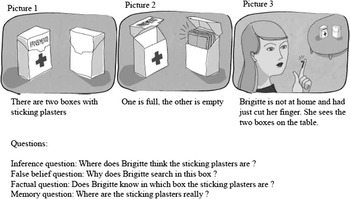
The first-order false belief tasks were designed to test subjects’ ability to infer that someone can have a mistaken belief that is different from their own true belief (of the form “A thinks X”). The second-order false belief tasks were used to test the ability to understand what someone else thinks about what another person thinks (of the form “A thinks B thinks X”). After reading (and hearing) the story, participants were asked to respond to the following four types of question (see Figure 1):
Example of first-order theory of mind story and questions.

False belief questions addressed the ability to make an inference about another individual's mental state, namely, that a protagonist of the scenario is holding a false belief, and to justify this inference.
Inference questions evaluated the ability of the participant to draw inferences that do not involve reasoning about another individual's mental state.
Fact questions determined whether the participant comprehended relevant elements from the scenario that explain the false belief of the protagonist.
Memory questions assessed whether the participant was able to hold memory for scenario details.
One question of each type was asked per story, with the exception of the first story in the first-order false belief task where two false belief, inference, and fact questions (and one memory question), were posed. Questions were asked in an order from least to most explicit, to prevent cueing. Each answer was scored as either 0 (incorrect or absent) or 1 (correct), except for the false belief question for which participants received a score of 1 for a full answer which correctly made an inference about the main character's false belief, 0.5 for a partial answer, and 0 for an incorrect answer. Global scores were calculated as the sum of the first three question scores (false belief, inference, and fact).
Faux pas tasks
Faux pas tasks were designed to assess participants’ ability to detect when a person unintentionally says something that would hurt another person. After each story, the participant was asked the following questions:
Faux pas detection question: “Did anyone say something he/she shouldn't have said? Did anyone say something awkward?” If the participant answered “Yes,” the second question was, “Who said something he/she should not have said?” After a correct answer, the following question was asked, “What shouldn't he/she have said?” If the participant identified the correct person, the faux pas was considered to have been correctly identified. Thereafter, three additional questions were asked (as follows).
False belief question checked if the participants understood that the faux pas was the consequence of the speaker's false belief rather than due to a malicious intent.
Unintentional question assessed understanding that the faux pas was unintentional.
Comprehension question assessed attention, memory, and comprehension.
Each question was scored as either 0 (incorrect or absent) or 1 (correct), except for the faux pas detection question, which was scored from 0 to 2 (2 for full explanation, 1 for partial). Global scores were calculated as the sum of the first three question scores (faux pas detection, false belief, unintentional).
Facial emotions recognition task
This task was derived from the Facial Expressions of Emotion: Stimuli and Tests (FEEST; Young, Perrett, Calder, Sprengelmeyer, & Ekman, Reference Young, Perrett, Calder, Sprengelmeyer and Ekman2002). The stimuli consisted of a series of 60 black and white photographs of the same female face, which showed the six primary emotions (anger, disgust, fear, surprise, sadness, and happiness) as described by Ekman and Friesen (Reference Ekman and Friesen1976). For each emotion, 10 levels of emotional intensity were displayed, ranging from minimal to full expression. The pictures were presented on a computer screen using a 4 × 3-inch format. Each face was presented once, for 5 s, and was followed by a screen showing six boxes bearing the name of the six basic emotions. Participants were asked to point to the label that best described the facial expression shown on the screen. The testing phase was preceded by a short training phase. During the testing phase, the 60 faces were presented in a pseudo-random order, avoiding more than two consecutive presentations of the same emotion. Participants were allowed to take as much time as they needed to make their decision, but they received no feedback. One point was attributed for each correct answer. The maximum score was 10 for each emotion, and 60 for the whole task.
Statistical Analyses
All statistical analyses were performed using StatView for Windows (SAS Institute Inc. Copyright© 1992–1998, Version 5.0). Non-parametric statistical tests were used due to non-homogeneity of variances and non-normality of the distributions. An alpha-level of .05 was selected for the comparisons. A Mann-Whitney U test was performed to compare the two groups in terms of demographics, cognitive measures, and social cognition tests. The χ2 test was used for categorical variables. The relationship between age, sex, years of education, disease duration, EDSS, executive function, and social cognition was determined using Spearman correlations.
Results
Demographic data
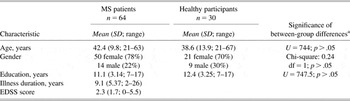
No significant difference emerged between controls and MS patients with regard to age, years of education and sex ratio (see Table 1).
Summary of demographic characteristics

aMann-Whitney U-test (unless otherwise indicated).
Data for the neuropsychological assessments and ToM tasks were available for all study participants, although only 50/64 MS patients correctly completed the two self-report questionnaires (all healthy controls completed the BDI correctly). The 14 subjects with missing data did not differ from others with respect to main demographic characteristics or cognitive performance.
Neuropsychological data
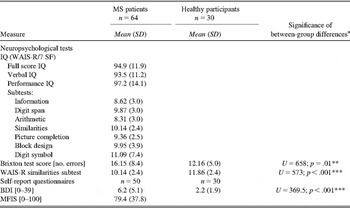
As shown in Table 2, mean IQ scores fell within the average range for MS patients (standard score = 90–109; 25–75th percentile), as defined by Wechsler (Reference Wechsler1981). No patient had an impaired performance level (<5th percentile) on the full scale IQ estimate. Only one patient had an impaired performance on both the verbal and performance IQ estimates (but not the full scale). Mean subtest scores were also all within the average range for MS patients (standard score = 8–12; 25–75th percentile). A few patients performed at below the 5th percentile for the information (n = 7), digit span (n = 2), and arithmetic (n = 9) subtests. Of interest, although processing speed is often impaired in MS, no patients had an impaired performance in the digit symbol subtest.
Neuropsychological assessments and self-report questionnaires (fatigue, depression)

aMann-Whitney U-test.
**p < .01.
***p < .001.
On the measures of executive functioning, MS patients performed significantly worse than healthy participants on the Brixton test and the WAIS-R similarities subtest (Table 2), although the similarities subtest means were within the average range for MS patients.
Fatigue and Depression Self-Report Data
MS patients reported elevated fatigue on the MFIS, as indicated by mean scores per item of above 3. In addition, the MS group scored significantly higher on the BDI as compared with controls (Table 2). However, the MS patient scores were low (6.2 ± 5.1), suggesting that no patient suffered from ongoing depression.
ToM Data
First-order false belief task
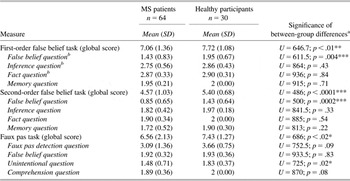
MS patients had a significantly lower global score as compared to controls (7.06 vs. 7.72; p < .01) on the first-order false belief task, as shown in Table 3. Regarding the four individual questions, the MS group achieved significantly lower scores than the control group on the false belief question only. The absence of a significant difference on the memory question suggests that difficulties encountered by MS patients in first-order false belief tasks are not related to language or working memory difficulties.
Performance of MS patients and healthy participants on theory of mind tasks

aMann-Whitney U-test.
bIn this first-order false belief task, two questions of this type were asked in the first story, one in the second, giving a maximum score of 3 points.
*p < .05.
**p < .01.
***p < .001.
Second-order false belief task
The MS group had a significantly lower global score as compared with controls on the second-order false belief task. In similarity with the first-order task results, the MS group performed significantly worse on the false belief question only.
Faux pas task
The global score for the faux pas task was significantly lower in the MS group compared to controls, but for the individual questions the two groups differed significantly for the unintentional question only. No significant difference was observed for the faux pas detection question, or the false belief question. This suggests that, when MS patients know that a faux pas has occurred, they seem less able, as compared to controls, to understand that it was not intentional.
In addition to group data, confidence intervals were calculated for each ToM level. The percentages of patients below the lower limit of these confidence intervals were 30% (n = 21), 50% (n = 35), and 20% (n = 14) for the first- and second-order false belief tasks and the faux pas task, respectively.
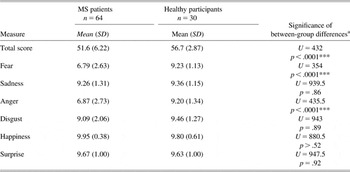
Facial emotions recognition task
The mean values for overall decoding accuracy of facial emotions, and the decoding accuracy for each emotion are presented in Table 4. The total score was significantly lower in the MS group when compared to healthy controls (p < .0001). In MS patients, Mann-Whitney tests revealed impaired recognition of anger (p < .0001) and fear (p < .0001), but no other emotions (all p > .50). Within the MS group, performance in recognizing anger and fear was significantly correlated (corrected Spearman rho: 0.42; p < .0001). However, no significant correlation was demonstrated between the total recognition score and demographic characteristics (age, sex, education level, EDSS, disease duration, MFIS, or BDI), or with any cognitive assessment (full score IQ, verbal IQ, performance IQ, Brixton test, or WAIS-R similarities subtest) in the MS group. There was also no correlation between the total recognition score and demographic characteristics (age, sex, and education level), or with any cognitive assessment, in the control group.
Performance of MS patients and healthy participants on facial emotions recognition task

aMann-Whitney U-test.
**p < .01.
***p < .001.
In order to consider individual, we compared the performance of each MS patient with the 95% confidence interval of the mean result for the healthy participants group. The percentage of patients scoring below the lower limit of the confidence interval was 66% (n = 42) for the global score, 67% (n = 43) for anger and fear, 17% for disgust, surprise, and sadness (n = 10, 12, and 12, respectively), and 1.6% (n = 1) for happiness.
Relationship Between ToM Tasks and Other Variables
In the MS group, we found no correlations that were significant (or that accounted for more than 10% of the variance) between the three ToM task global scores and demographic characteristics (age, disease duration, EDSS, MFIS, or BDI), or with any cognitive assessment. We specifically assessed the effect of cognitive impairment, as Ouellet et al. (Reference Ouellet, Scherzer, Rouleau, Métras, Bertrand-Gauvin, Djerroud and Duquette2010) found that this may contribute to some of the difficulties shown by MS patients in attributing mental state to others. The analysis of correlations between full score IQ (or any subtest of the WAIS-R) and each of the three ToM tasks showed only a borderline result for first-order task (the full score IQ accounting for approximately 7.5% of the variance). When the MS population was split into two groups based on the level of full score IQ – high (>90; n = 37; mean IQ: 103) or low (≤90; n = 27; mean IQ: 83.9) – we found that patients with higher IQ performed better than patients with lower IQ on the three ToM tasks, but the differences were small (less than 10%) and none reached statistical significance. There was no significant correlation between performances in the facial emotions recognition task and the various ToM tasks, suggesting that they could be considered as two independent sources of social difficulties.
Discussion
The present study compared the performance of patients with RRMS with matched healthy participants on tasks relating to three levels of ToM (first- and second-order mental state attribution and faux pas) and facial emotion recognition. Results demonstrate that MS patients obtained significantly lower scores, as compared to healthy participants, on all ToM task global scores, indicating a disruption in social reasoning ability. This deficit was not accounted for by demographic or other clinical characteristics (including duration or severity of disease, intensity of fatigue, or depression), or by any specific cognitive deficit (including, most notably, executive functions). These results differ from previous studies (Banati et al., Reference Banati, Sandor, Mike, Illes, Bors, Feldmann and Illes2009; Henry et al., Reference Henry, Phillips, Beatty, McDonald, Longley, Joscelyne and Rendell2009; Ouellet et al., Reference Ouellet, Scherzer, Rouleau, Métras, Bertrand-Gauvin, Djerroud and Duquette2010), possibly because we used different tasks or because our patients were less severely cognitively impaired.
MS patients showed particular difficulty in responding to first- and second-order false belief questions; in contrast, they demonstrated no difficulty in understanding the specific portions of stories that were necessary for the identification of a false belief or the inferences to be drawn from them. This suggests that ToM impairment in MS patients is due to a specific failure to accurately attribute the mental states of others, rather than a deficit of comprehension, memory or pragmatics. In addition, while MS patients were usually able to identify a social faux pas, to correctly point to the person responsible for it, and to explain what should not have been said, they showed less ability to understand that the faux pas was unintentional. These results again demonstrate the difficulty that MS patients have with correctly attributing a mental state to another person.
As noted above, MS patients seemed to correctly detect and understand the faux pas but were misattributing it as an intentional insult. A possible explanation for this very specific deficit is that the first- and second-order false belief tasks require epistemic mental state inferences such as knowing or expecting (that something will occur), whereas faux pas tasks require intentional inferences and affective mental state inferences such as feeling happy. Therefore, MS patients may encounter difficulty while attempting to infer intentionality and epistemic mental states, but may be more effective when inferring affective mental states. Several studies have emphasized the role of the amygdala in epistemic, intentional and affective mental state inferences (Fine, Lumsden, & Blair, Reference Fine, Lumsden and Blair2001; Stone, Baron-Cohen, Calder, Keane, & Young, Reference Stone, Baron-Cohen, Calder, Keane and Young2003).
Thus, errors on the ToM tasks revealed difficulty with several aspects of mental state attribution. The present study extends the results from Banati et al. (Reference Banati, Sandor, Mike, Illes, Bors, Feldmann and Illes2009), which showed that people with MS were impaired on faux pas tasks compared to matched healthy participants, by demonstrating that social cognition (ToM) is disrupted even at less complex levels of the ability to make mental state attributions.
As the independence of ToM and executive skills is still widely debated, we examined whether performance of MS patients on ToM tasks was correlated with tests of executive function. Although MS patients displayed poorer performances on executive tasks as compared to healthy subjects, no correlation was found between ToM tasks and executive function scores. To increase feasibility, we used relatively simple tasks (Brixton test, similarities subtest of the WAIS-R 7SF) which show high correlation with more complex tests of executive functions (such as the Wisconsin Card Sorting Test, WSCT, or the Trail-Making Test, TMT). Our results are consistent with other studies which suggest that ToM may be an independent module (Gregory et al., Reference Gregory, Sinclair, Stone, Erzinclioglu, Martin, Baron-Cohen and Hodges2002; Lough et al., Reference Lough, Gregory and Hodges2001; Rowe et al., Reference Rowe, Bullock, Polkey and Morris2001).
The second major finding was that MS patients were less accurate than healthy participants in decoding the emotions of anger and fear in facial expressions. These data were consistent with other studies (Henry et al., Reference Henry, Phillips, Beatty, McDonald, Longley, Joscelyne and Rendell2009; Phillips et al., Reference Phillips, Henry, Scott, Summers, Whyte and Cook2011) who also found a selective impairment in the perception of anger and fear. At first glance, the selective nature of this impairment appears counterintuitive, given the diffuse distribution of plaques within the brain. The result could be artifactual due to the small sample size (i.e., our random selection of patients may have had lesions concentrated within networks involved in the recognition of anger and fear, such as the amygdala, frontal orbital cortex, and their connections; Adolphs, Reference Adolphs2002; Calder, Keane, Lawrence, & Manes, Reference Calder, Keane, Lawrence and Manes2004). If the finding is unrelated to a selection bias, this pattern could instead indicate that these networks are at greatest risk of damage by MS lesions due to, for instance, their localization in the brain or their large size. Unfortunately, we were unable to test these hypotheses because available neuroimaging data were obtained at variable intervals relative to the ToM evaluation, without standardized imaging techniques, which precluded quantitative analysis. Regardless of the precise etiology, impairment of the recognition of anger and fear in facial expressions in MS patients may contribute to disruption in adaptive behavior, as has been observed in other pathologies (Clark et al., Reference Clark, Neargarder and Cronin-Golomb2008). A specific impairment in anger or fear recognition could have particularly negative repercussions in situations involving high levels of tension and interpersonal conflict.
Deficits both in anger and fear recognition, and in mental state attribution, are consistent with previous studies which highlighted the role of the ventromedial prefrontal cortex and the amygdala in these abilities. Most of these studies focused on brain activity during the attribution of mental states to others, and have delineated a cerebral network involving structures in the limbic-paralimbic system, including the amygdala, orbito-frontal cortex, ventromedial prefrontal cortex, and anterior cingulated cortex (Abu-Akel, Reference Abu-Akel2003). A large number of functional imaging and lesion studies have also demonstrated the key role of the amygdala and orbito-frontal cortex in the recognition of negative emotions and, in particular, anger and fear (Adolphs, Reference Adolphs2002). In MS, a subcortical disruption in the limbic-paralimbic system is more likely to explain the observed specific deficits, rather than a volumetric loss of grey matter.
The current study has potential limitations beyond the lack of neuroimaging data, including the absence of information regarding the timeline of social cognitive disturbance, and whether these problems occur in other types of MS (e.g., primary or secondary progressive forms). Further research is in progress to examine these issues. Nevertheless, we believe the current study shows that social cognition abilities may be significantly disturbed even in the early or moderate stages of relapsing remitting forms of MS. We have also confirmed previous work showing that both the response to faux pas tasks, and the recognition of anger and fear in facial expressions, are defective in patients with MS. In addition, the current study demonstrates impairments in the attribution of mental states, even for very simple inferences such as false beliefs. From a clinical perspective, further studies will be needed to evaluate the exact consequences of impaired social cognition abilities in MS patients. We hypothesize that even a mild impairment in processing of the facial emotions of anger and fear, and in ToM abilities could alter the fine tuning necessary to properly adjust behavior and social interactions, as already demonstrated with more crude deficits in other pathologies such FTD (Gregory et al., Reference Gregory, Sinclair, Stone, Erzinclioglu, Martin, Baron-Cohen and Hodges2002; Lough et al., Reference Lough, Kipps, Treise, Watson, Blair and Hodges2006). Thus, measuring deficits in social cognition could be important for MS patients. Such evaluation should be performed with psychometrically sound tools that have been validated for measuring ToM functions independent of other cognitive domains. The current study demonstrates that a series of easily administered, time-efficient tasks can demonstrate subtle disturbances of high clinical relevance. This work underscores the importance of the clinical assessment of social cognition abilities in MS, as it may improve the overall management of this complex disease.
Acknowledgments
We thank the study subjects for their kind participation and Mélanie Hisland, Marie-Cécile Huck, and Mathilde Robert for their help with testing. We also thank Nathalie Ehrlé for the conceptual framework of this study. Mary Beth Spitznagel (PhD) and Juliet George provided invaluable help with the English manuscript preparation and for their very helpful comments. This work has been presented in part as an oral communication at the World Congress on Treatment and Research in Multiple Sclerosis (ACTRIMS, ECTRIMS, and LACTRIMS Joint meeting), Montreal, September 2008. The authors received no financial support for this work and have no conflicts of interest.