

Introduction
Archaeoentomology has become an important discipline for the detailed interpretation of archaeological contexts (Elias Reference Elias2009). It can be defined as the study of insect remains recovered from archaeological contexts that are associated with past human activities. The high level of ecological specialisation among arthropods allows these entomological remains to be used not only for palaeoenvironmental reconstructions (e.g. Buckland Reference Buckland1979; Andrieu-Ponel et al. Reference Andrieu-Ponel2000; Ponel et al. Reference Ponel2005) but also for interpreting the specific use of space in ancient structures (e.g. Kenward & Carrott Reference Kenward and Carrott2006; Panagiotakopulu et al. Reference Panagiotakopulu2010; Forbes & Milek Reference Forbes and Milek2014). Insect remains have also facilitated the identification of storage practices and pest activity in the past (e.g. Kislev Reference Kislev and Renfrew1991; Panagiotakopulu et al. Reference Panagiotakopulu2013; Antolín & Schäfer Reference Antolín and Schäfer2024).
This discipline has also gained significance in funerary contexts, providing valuable insights into mortuary practices at archaeological sites (Huchet Reference Huchet1996, Reference Huchet, Charabidze and Gosselin2014). Originating from forensic entomology, funerary archaeoentomology contributes to identifying the season of death, distinguishing between subterranean burial and surface exposure, detecting post-mortem movements of the body and revealing the presence of toxic substances (Huchet & Greenberg Reference Huchet and Greenberg2010; Vanin & Huchet Reference Vanin, Huchet and Schotsmans2017; Giordani et al. Reference Giordani2020; Vanin et al. Reference Vanin2021; Tuccia et al. Reference Tuccia2025).
Despite its recognised interpretative potential, the systematic recovery of entomological samples from archaeological sites remains uncommon. This is particularly evident in North Africa, excluding Egypt, where favourable conditions (a dry environment that promotes the preservation of entomological remains and a strong archaeological interest in the site) have allowed insect studies since the nineteenth century (e.g. Panagiotakopulu Reference Panagiotakopulu2001). The Canary Islands also follow this pattern, as several archaeoentomological studies have been conducted there recently (e.g. Henríquez-Valido et al. Reference Henríquez-Valido2020, Reference Henríquez-Valido2025).
One of the most debated issues in Canarian archaeology concerns funerary practices in caves. While the deposition of wrapped bodies in such settings is well documented (Alberto-Barroso et al. Reference Alberto-Barroso2019), recent studies have questioned how soon after death these burials took place. Working from historical accounts and decontextualised insect remains preserved in museum collections, some researchers have hypothesised that corpses were left exposed to sunlight prior to burial (Velasco-Vázquez Reference Velasco-Vázquez and Rodríguez-Rodríguez2025). Entomological evidence recovered directly from archaeological contexts now provides stronger and more reliable data for reconstructing funerary practices and depositional histories.
This study analyses insect remains from the Cruz de la Esquina funerary cave (Acusa Seca, Gran Canaria, c. seventh–ninth centuries AD). The analysis aimed to: 1) identify insect taxa associated with cadaveric decomposition; 2) reconstruct funerary practices; and 3) investigate whether the cave was also used for purposes other than burial. The method applied demonstrates the potential of entomological evidence to shed light on the reuse of archaeological structures, not only at this site but also for comparable funerary contexts worldwide.
The archaeological context of Cruz de la Esquina
Cruz de la Esquina is located at 990m above sea level on the south-eastern ridge of the Acusa plateau, in the Tejeda Basin, Artenara, on the island of Gran Canaria (Figure 1). The plateau is characterised by steep escarpments on all sides, except at its northernmost end, and has an abundance of artificial caves used by the Indigenous population for domestic, storage and funerary purposes. Evidence from the site indicates continuous occupation since at least the fifth century AD (Velasco-Vázquez et al. Reference Velasco-Vázquez2020). Geologically, the site consists of accumulated pyroclastic deposits from the Roque Nublo magmatic cycle of Gran Canaria, between five and three million years ago (Barrera-Morate & García-Moral Reference Barrera-Morate and García-Moral2011). The climate in this area is predominantly dry, except during winter, when sea-air flows bring occasional moisture. The average annual temperature ranges between 13 and 16°C, and the annual rainfall is among the highest on the island, between 600 and 900mm.
Location of Cruz de la Esquina: A) location on the island of Gran Canaria, within the Canary archipelago and the African continent; B) Mesa de Acusa in a 3D digital elevation model (source: IDECanarias), the red arrow marks the location of the site; C) photograph of the Cruz de la Esquina complex (courtesy of Ernesto Martín), the red arrow marks the location of the burial cave (figure by authors).

The Cruz de la Esquina archaeological complex consists of approximately twenty artificial caves in the south-eastern corner of the plateau, distributed across multiple levels with distinct functions. Domestic spaces are located at the base of the path surrounding the plateau, while storage caves are situated at a higher level. The cave under study contains the only documented instance of funerary use within the complex. It marks the south-eastern limit of the complex and opens approximately 6m above the path, excavated into a steep volcanic rock wall. The cave has a heart-shaped structure composed of two chambers (Figure 2). The main chamber opens to the north-east and has maximum dimensions of 3.37m in length, 1.88m in width and 1.33m in height. The second chamber, located in the south-west wall of the first, is 3.18m long, 1.67m wide and 1.24m high.
Planimetry of the burial cave based on the photogrammetric survey: A) Plan of the cave from a zenith viewpoint; B) side view of the cave; C) photogrammetry of the plan, showing the remains before archaeological intervention; D) distribution of samples taken from the different stratigraphic units excavated. The red dots show survey 1 and the green dots show survey 2 for each unit (figure by authors).

The funerary cave, now known as Cruz de la Esquina, was discovered during survey work in 2001. When first visited, most of the skeletal remains were exposed on the ground, with no apparent anatomical connections or relationships, except for a few vertebrae and ribs from one individual, which remained associated due to pathological fusion (see online supplementary material (OSM)). In the main chamber, a series of wooden planks arranged like a platform served as a base for the deposition of the corpses. In addition to the wood, other plant materials were preserved in desiccated conditions, including fragments of rope, rush fabrics and leather, indicating excellent preservation for organic remains within the cave.
Methods
Excavation of the funerary deposit followed an archaeothanatology methodological framework (sensu Duday Reference Duday2009), focusing on stratigraphic control, anatomical connections and the analysis of taphonomic processes. The excavation beneath the wooden platform revealed three stratigraphic layers. The uppermost layer (UE1), composed of aeolian sediment mixed with disintegrated tuff from the cave itself, contained some residual bones from the burial deposit. The intermediate layer (UE2) featured an alignment of rocks that supported the platform boards, some of which were knapped. The deepest layer (UE3), directly upon the bedrock, contained evidence of a small combustion feature, with abundant scattered ash and some remains of domestic fauna and lithic debris.
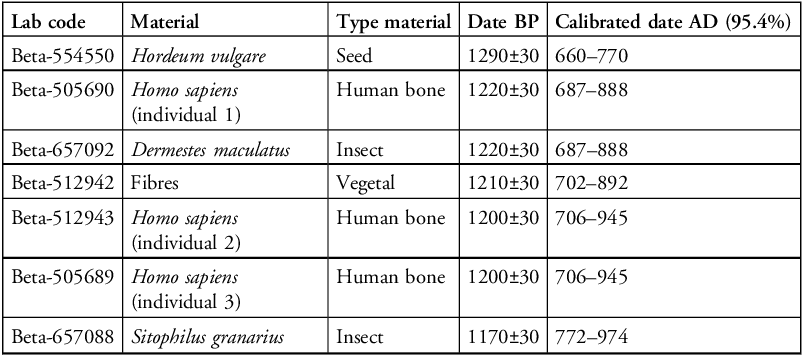
To establish the chronological framework of the site, seven radiocarbon dates were obtained. The sampled materials included human bone, insect remains (cadaveric species and storage pests), a plant fibre sample and a barley seed. The results indicate that the site was in use between the seventh and ninth centuries AD (Table 1, Figure 3). The radiocarbon dates were calibrated in OxCal v.4.4 using the IntCal20 calibration curve (Bronk-Ramsey Reference Bronk-Ramsey2010; Reimer et al. Reference Reimer2020). Throughout the text, calibrated dates are expressed to 95.4% confidence.
Dates of samples of materials identified in the Cruz de la Esquina burial cave.

Table 1 Long description
The table presents radiocarbon dates of various materials from the Cruz de la Esquina burial cave. It has seven rows and five columns. The columns are labeled Lab code, Material, Type material, Date BP, and Calibrated date AD (95.4%). The rows list different samples with their corresponding lab codes, materials, types, dates before present (BP), and calibrated dates AD. Row 1: Beta-554550, Hordeum vulgare, Seed, 1290 ±30, 660–770. Row 2: Beta-505690, Homo sapiens (individual 1), Human bone, 1220 ±30, 687–888. Row 3: Beta-657092, Dermestes maculatus, Insect, 1220 ±30, 687–888. Row 4: Beta-512942, Fibres, Vegetal, 1210 ±30, 702–892. Row 5: Beta-512943, Homo sapiens (individual 2), Human bone, 1200 ±30, 706–945. Row 6: Beta-505689, Homo sapiens (individual 3), Human bone, 1200 ±30, 706–945. Row 7: Beta-657088, Sitophilus granarius, Insect, 1170 ±30, 772–974.
Bayesian sequence: chronological ranges for the estimated start and end of each phase and the modelled ranges of each radiocarbon date. Dates modelled in OxCal v.4.4.4 (Bronk Ramsey Reference Bronk Ramsey2021; r:5; atmospheric data from Reimer et al. Reference Reimer2020) (figure by authors).

Insect remains were recovered through a structured sampling strategy designed to capture both stratigraphic (UE-based) and spatial variability across the cave. Samples were collected from the funerary deposit and the underlying storage layer, including areas beneath the wooden platform, adjacent to cave margins and to the centre of the deposit (Figure 2D).
A total of 43 sediment samples of 1L were collected from UE1 and UE3. The sediment was passed through a column of sieves with mesh sizes from 0.25–10mm. Fractions larger than 2mm were analysed visually using a lighted magnifying glass, and identifiable remains were separated using entomological soft steel tweezers. Fractions smaller than 1mm were examined under a Nikon SMZ-2T stereomicroscope (8–80×), and the arthropod remains were recovered manually. Taxonomic identification of entomological remains was performed through direct comparison with specimens from the reference collection housed in the PACEA Laboratory at the Université de Bordeaux.
Results and discussion
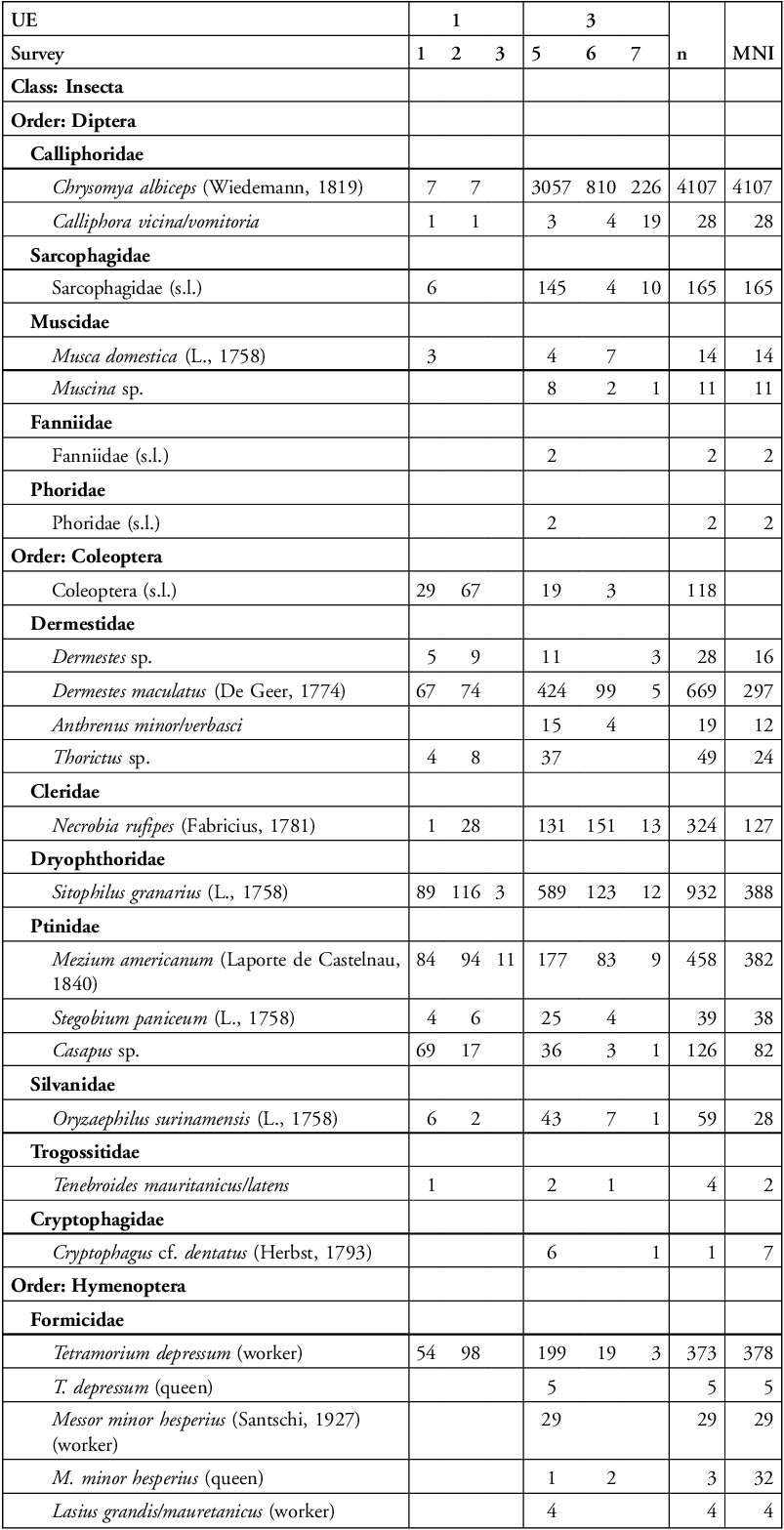
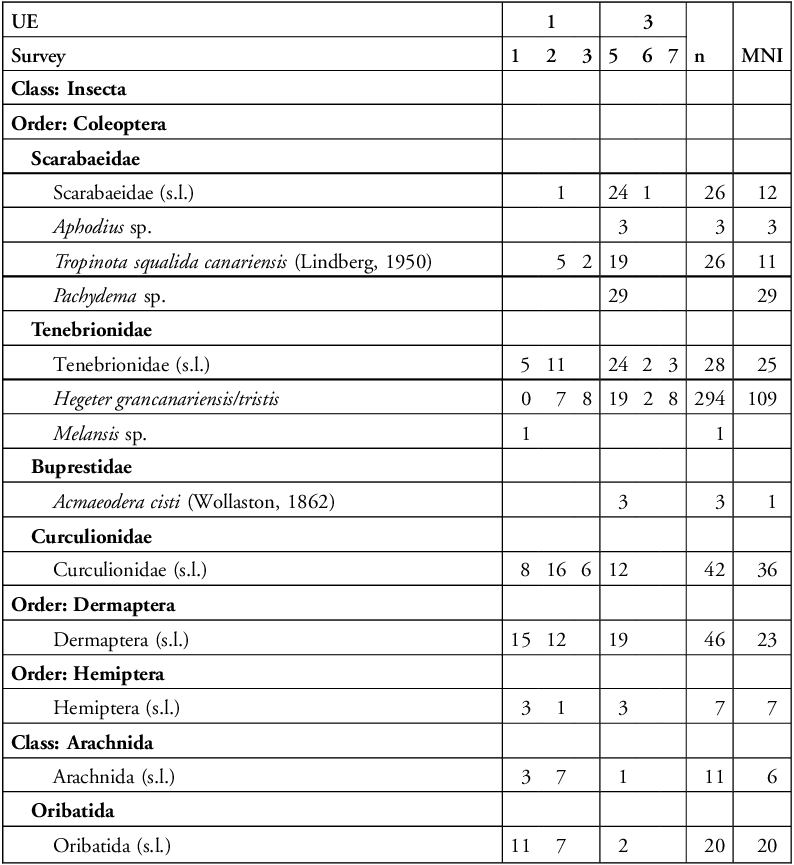
The archaeoentomological analysis of the funerary cave yielded 8173 arthropod remains preserved by desiccation, of which 8082 could be taxonomically identified (minimum number of individuals (MNI) = 5792). Most remains (83%) were recovered from beneath the wooden floorboards and span two classes (Insecta and Arachnida), seven orders, 18 families and 35 morphospecies (Tables 2 & 3, Figure 4). These data allowed us to identify two types of insect activities that reflect the different uses of Cruz de la Esquina cave.
Insect remains identified and mentioned in the text.

Table 2 Long description
The table presents data on insect remains identified in a survey, organized by class, order, family, and species. It includes columns for survey numbers, counts, and minimum number of individuals (MNI). The table has 5 columns labeled UE, Survey, and MNI, with row labels indicating class, order, family, and species. Each row lists specific insect species and their respective counts across different surveys. Notable entries include high counts for species like Chrysomya albiceps and Sitophilus granarius. The table provides a detailed breakdown of the distribution and abundance of various insect species identified in the survey.
Other insect remains identified but not mentioned in the text.

Table 3 Long description
The table presents data on the identification of various insect and arachnid species from surveys. It includes columns for survey numbers 1, 2, 3, 5, 6, 7, the total number (n), and the minimum number of individuals (MNI). The table is organized by class, order, and family, with specific species listed under each category. Row 1: Class: Insecta. Row 2: Order: Coleoptera. Row 3: Scarabaeidae. Row 4: Scarabaeidae (s.l.), Survey 1: 1, Survey 2: 24, Survey 3: 1, n: 26, MNI: 12. Row 5: Aphodius sp., Survey 1: 3, Survey 3: 3, n: 3, MNI: 3. Row 6: Tropinota squalida canariensis (Lindberg, 1950), Survey 1: 5, Survey 2: 2, Survey 3: 19, n: 26, MNI: 11. Row 7: Pachydema sp., Survey 3: 29, n: 29, MNI: 29. Row 8: Tenebrionidae. Row 9: Tenebrionidae (s.l.), Survey 1: 5, Survey 2: 11, Survey 3: 24, Survey 5: 2, Survey 6: 3, n: 28, MNI: 25. Row 10: Hegeter grancanariensis/tristis, Survey 2: 7, Survey 3: 8, Survey 5: 19, Survey 6: 2, Survey 7: 8, n: 294, MNI: 109. Row 11: Melanosis sp., Survey 3: 1, n: 1, MNI: 1. Row 12: Buprestidae. Row 13: Acmaeodera cisti (Wollaston, 1862), Survey 3: 3, n: 3, MNI: 1. Row 14: Curculionidae. Row 15: Curculionidae (s.l.), Survey 1: 8, Survey 2: 16, Survey 3: 6, Survey 5: 12, n: 42, MNI: 36. Row 16: Order: Dermaptera. Row 17: Dermaptera (s.l.), Survey 1: 15, Survey 2: 12, Survey 3: 19, n: 46, MNI: 23. Row 18: Order: Hemiptera. Row 19: Hemiptera (s.l.), Survey 1: 3, Survey 2: 1, Survey 3: 3, n: 7, MNI: 7. Row 20: Class: Arachnida. Row 21: Arachnida (s.l.), Survey 1: 3, Survey 2: 7, Survey 3: 1, n: 11, MNI: 6. Row 22: Oribatida. Row 23: Oribatida (s.l.), Survey 1: 11, Survey 2: 7, Survey 3: 2, n: 20, MNI: 20.
Insect remains identified in Cruz de la Esquina burial cave: a) Chrysomya albiceps, puparia; b) Calliphora vicina/vomitoria, puparia; c) Sarcophagidae, puparia; d) Phoridae, puparia; e) Fanniidae, puparia; f) Dermestes sp., elytra; g) Dermestes maculatus, elytra; h) Thorictus sp., pair of elytra; i) Necrobia rufipes, elytra; j) Sitophilus granarius; k) Mezium americanum; l) Stegobium paniceum; m) Casapus sp., pair of elytra; n) Oryzaephilus surinamensis, pronota; o) Tenebroides mauritanicus/latens, head; p) Cryptophagus sp., pronota; q) Aphodius sp., elytra; r) Tropinota squalida canariensis, pronota; s) Hegeter grancanariensis/tristis, pronota; t) Melansis sp., pronota; u) Acmaeodera cisti, pair of elyta; v) Tetramorium depressum, worker head; w) Messor minor hesperius, worker head; x) Lasius grandis/mauretanicus worker head; y) Dermaptera, cerci; z) Hemiptera, pronota (figure by authors).

Cadaveric entomofauna
The composition of species found on a corpse, as well as their succession, depends on multiple factors, including decomposition conditions, climate, geography, seasonality and the degree of concealment of the body (Lefebvre & Gaudry Reference Lefebvre and Gaudry2009; Vanin & Huchet Reference Vanin, Huchet and Schotsmans2017). Typically, flies (Diptera) are the first to colonise a corpse after death, and they are also the most abundant order found at Cruz de la Esquina. Experimental data on cadaveric decomposition in the volcanic caves of the Canary Islands are provided in the OSM. Among Diptera, the families of Calliphoridae and Sarcophagidae (the most numerous in this study) are known for colonising corpses in the initial stages of decomposition (Greenberg & Kunich Reference Greenberg and Kunich2002; Byrd & Tomberlin Reference Byrd and Tomberlin2020). Chrysomya albiceps (Wiedemann, classified in 1819) (Calliphoridae) tends to dominate in the earliest stages from spring onward, but it is absent in cold temperatures (Martín-Vega & Baz Reference Martín-Vega and Baz2013). In contrast, Calliphora vicina (Robineau-Desvoidy, 1830) and C. vomitoria (L., classified in 1758) are thermophobic species that also appear in the earliest stage, though they are more common in colder seasons and typically absent in summer (Martín-Vega & Baz Reference Martín-Vega and Baz2013; Fremdt & Amendt Reference Fremdt and Amendt2014). Sarcophagidae species also colonise corpses in the initial stages during warmer seasons, mirroring the behaviour of C. albiceps (Fremdt & Amendt Reference Fremdt and Amendt2014). While some specimens were documented on the funerary planks, most were recovered from beneath them. Phoridae, identified in UE3, can reach corpses in the early stages of decomposition but typically only when the corpses are indoors or underground (Gaudry Reference Gaudry and Amendt2010). The Muscidae identified in this funerary cave, Musca domestica (L., classified in 1758) and Muscina sp., are known for their coprophagous-necrophagous behaviour. They typically appear on corpses during warm seasons. This family arrives at the body once active decomposition begins, approximately two to three days post-mortem, primarily attracted by faeces (Lefebvre & Gaudry Reference Lefebvre and Gaudry2009; Farag et al. Reference Farag2021). Fanniidae and Phoridae usually arrive in the later stages of decomposition, and they are present throughout the year, particularly in enclosed or buried environments where other Diptera have already developed (Prado-e-Castro et al. Reference Prado-e-Castro2012; Grzywacz et al. Reference Grzywacz2017).
Beetles (Coleoptera) of forensic significance were more numerous than Diptera on the wooden platform but were equally abundant beneath it. This pattern is consistent with their known biology: these insects, as other in the Diptera family, do not migrate to pupate and likely remained on the body for a longer period, for as long as prey insects or human-derived organic matter were available. Under the wooden platform, Dermestidae (Dermestes maculatus De Geer, 1774 and Dermestes sp.) were predominant. This family is associated with the active stages of decay (Charabidze et al. Reference Charabidze2014). The distribution of Dermestidae species is influenced by both geographic location and environmental conditions. In this funerary cave, D. maculatus was the most abundant species. In addition to consuming desiccated muscle tissue, it can prey on fly larvae and other dead insects (Braak Reference Braak1987). Remains of this species returned a radiocarbon date of cal AD 687–974 (Beta-657092), in association with human remains. Another Dermestidae species identified at the site, Anthrenus minor/verbasci, primarily targets dried meat and is commonly documented in carrion on the African continent (Villet Reference Villet2011). Other forensic-relevant Coleoptera identified in the cave include Cleridae, represented by Necrobia rufipes (Fabricius, 1781). This species is linked to the dry and skeletonisation phases of cadaveric decomposition (Farag et al. Reference Farag2021). Like Dermestidae, N. rufipes accesses decomposing bodies to consume both dry tissue and insect remains, particularly Diptera (Grassberger & Frank Reference Grassberger and Frank2004). The timing of its arrival on a corpse depends on climatic conditions, with higher abundance during warmer seasons (Hu et al. Reference Hu2020).
Funerary practices
A key factor in determining the manner and timing of corpse deposition within the cave is the arrangement of the skeletal remains. This can indicate whether they were primary deposits or if significant movements occurred after decomposition had begun (Duday Reference Duday2009). At this site, the skeletal remains were found in a disordered state, lacking any apparent arrangement. The presence of textile fragments made of plant fibres and hides, along with burial patterns consistent with those documented at other sites on the island displaying better preservation, suggest that the bodies were originally wrapped in bundles. Despite this, their condition at the time of excavation complicated the interpretation of the original deposition process. In this context, archaeoentomology has proven to be a crucial tool, offering new insights into the nature and dynamics of the funerary event and complementing anthropological studies, which are still underway.
The presence of entomological remains associated with the early stages of decomposition (particularly Calliphoridae and Sarcophagidae) and the identification of over 1000 individuals (puparia) from these families (47% of all specimens identified) indicates that the bodies were placed in the cave shortly after death and decomposition proceeded in situ. This high percentage is also indicative that the presence of these insects within the cave is related to the cadaveric decomposition process itself, rather than to a possible phase as an area for meat storage prior to its use as a funerary deposit. In other granaries, where no burial processes were documented, the percentage of this ecological group does not exceed 1% (e.g. Henríquez-Valido et al. Reference Henríquez-Valido2020). In addition, the remains of Phoridae, which typically arrive early on indoor deposits, supports this interpretation. The identification of Dermestidae and Cleridae remains further confirms that the full decomposition process occurred in situ, on the surface. The entomological succession documented in an experimental study within another cave (Henríquez-Valido et al. Reference Henríquez-Valido2026) also showed a marked dominance of taxa associated with the early stages of decomposition (particularly Diptera) despite the absence of any prolonged open-air exposure prior to deposition.
Other uses of the cave
Archaeoentomology can also help document changes in the use of space over time, based on the ecological characteristics of each species. Of the insects identified in the Cruz de la Esquina funerary cave, 21% are classified as storage pests. These insects have been previously documented in other archaeological contexts on the island, particularly in cave-granaries used by the Indigenous population for storing plant products (Henríquez-Valido et al. Reference Henríquez-Valido2020). In some archaeological contexts, such pests have been linked to funerary offerings of stored plant materials (e.g. Evans & Weinstein Reference Evans and Weinstein2021), but the substantial diversity of species associated with storage spaces at Cruz de la Esquina makes this less likely here. Pest remains were found in 76% of the sediment samples, suggesting an alternative interpretation: the cave was originally a storage space that was later repurposed as a funerary site. The lack of direct archaeological evidence for the inclusion of cereal offerings within the funerary deposit (e.g. concentrations of grains or storage containers) supports this interpretation.
The most abundant storage pest in Cruz de la Esquina is Sitophilus granarius (L., 1758) (Dryophthoridae), commonly known as the granary weevil. This is one of the most destructive species in stored grains and thrives in temperate climates (Haines Reference Haines1991; King et al. Reference King2014). During its larval stage, it feeds on the endosperm of cereal grains. Due to its fused elytra, S. granarius is flightless, and its spread depends entirely on human transport. As a result, it is considered a synanthropic species specialised in storage environments (Buckland Reference Buckland, Fournier and Sigaut1990; Huchet Reference Huchet and Dietsch-Sellami2017). It is also the most abundant pest in other cave granaries used by the Indigenous society of Gran Canaria (Henríquez-Valido et al. Reference Henríquez-Valido2020). This species has been recorded in other burial sites across Africa and Europe, where it is suggested to have been introduced on grave goods accompanying corpses, from Egyptian to medieval contexts (e.g. Levinson & Levinson Reference Levinson and Levinson1985; Loni et al. Reference Loni2022).
Bayesian modelling of the radiocarbon dates from Cruz de la Esquina (Figure 3) supports a stratigraphic sequence in which a storage phase pre-dates the funerary phase; however, the posterior distributions indicate that the transition between phases was most likely rapid, with substantial chronological overlap within the calibrated ranges. This pattern is consistent with short-lived reuse of the space rather than a long hiatus between occupations. These results suggest that storage pest activity continued after the corpses were deposited, very likely due to inadequate sanitation of the cave. The radiocarbon date obtained from a sample of Sitophilus granarius on the planks (AD 772–974; Beta-657088) further supports the hypothesis that the reuse of the space occurred within a relatively short time span, during which storage pests remained active and continued to reproduce inside the cave. The burial space appears to have been prepared by constructing a wooden platform over the remains of previously stored cereals, which could have continued to be affected by pests.
The second most common storage pest at the site is Mezium americanum (Laporte, 1840) (Ptinidae). This cosmopolitan species is a secondary pest (Haines Reference Haines1991) commonly found in storage spaces, where it feeds on vegetal and dried animal materials (Hagstrum & Subramanyam Reference Hagstrum and Subramanyam2017). Additional Ptinidae associated with plant storage were found in smaller quantities. Stegobium paniceum (L., 1758) is a well-known secondary pest that feeds on processed cereals and legumes or on grains already damaged by primary pests (Delobel & Tran Reference Delobel and Tran1993).
The remains of Oryzaephilus surinamensis (L., 1758) (Silvanidae), one of the most destructive cereal pests worldwide (Haines Reference Haines1991), were also documented. This secondary pest consumes grains already damaged by other insects (Hagstrum & Subramanyam Reference Hagstrum and Subramanyam2017). Along similar lines, Tenebroides mauritanicus/latens (Trogossitidae) is also considered a secondary pest and feeds on already damaged grains and other storage pests (Delobel & Tran Reference Delobel and Tran1993). In addition, Cryptophagus cf. dentatus (Herbst, 1793) (Cryptophagidae) is a fungivorous species common in granaries and decaying vegetation (Hagstrum & Subramanyam Reference Hagstrum and Subramanyam2017). Its presence in the funerary cave may relate to the wooden burial platform or to prior storage activities, as seen in indigenous cave granaries on Gran Canaria.
The presence of storage pests in a cave used as a funerary site raises several hypotheses regarding its prior function. By the eighth–ninth centuries AD, the transition from isolated silos to larger and more complex troglodytic storage structures had become increasingly common, reflecting population growth and the need for organised grain storage. This shift is marked by the transition from simple, isolated granaries to interconnected and multilevel storage structures. The morphology of the Cruz de la Esquina cave aligns with the simple granaries used by the Indigenous population between the sixth and eighth centuries AD, a period that also coincides with the cave’s reuse as a funerary deposit and the foundation of a new interconnected granary just 20m away. An alternative hypothesis is that the storage pests were introduced as part of plant-based funerary offerings. These offerings may have consisted primarily of cereals, potentially carrying ritual significance, though no similar evidence has been documented in other funerary contexts on the island. Another possible explanation is that cereal straw was used in wrapping the corpses or in preparing the burial platform. However, on Gran Canaria, funerary bundles were typically made of plant fibres such as rush and covered with leather, with no documented association with cereal straw.
Conclusion
The exceptional preservation of insect remains at Cruz de la Esquina, due to the cave’s stable climatic conditions, has allowed for detailed interpretation of funerary practices. The abundance of early-stage Diptera puparia (Calliphoridae & Sarcophagidae) suggests that the bodies were placed in the cave immediately after death, offering an archaeological example in which pre-burial desiccation did not occur. Other Diptera families (Muscidae, Fanniidae and Phoridae) indicate subsequent stages of decomposition. Remains from Coleoptera families, Dermestidae (D. maculatus, Dermestes sp. and Anthrenus minor/verbasci) and Cleridae (N. rufipes), support the interpretation of a primary burial where decomposition occurred entirely inside the cave despite later skeletal disturbance. These data confirm that the bodies were deposited shortly after death, without any evidence of external desiccation.
This study also provides archaeoentomological evidence for the reuse of the cave; a transition from storage to funerary purposes that is rarely documented. The high number of storage pests, especially S. granarius, O. surinamensis and T. mauritanicus/latens, suggests that Cruz de la Esquina originally served as a granary before being reused for burials. Radiocarbon dating of S. granarius remains confirms pest activity contemporaneous with the human remains, most likely due to residual cereals on the cave floor. Other species such as Cryptophagus cf. dentatus, may be linked to fungal activity from decomposing plant materials, including burial wrappings or wooden supports.
Beyond funerary archaeology, this study contributes to our understanding of biodiversity in the western Palaearctic geographic region. The direct radiocarbon dating of D. maculatus to the pre-modern period establishes its presence in North Africa prior to European colonial-era species dispersals, aligning with its documentation in Egyptian and South American burial contexts. The use of archaeoentomology in this study highlights the potential interpretative value in applying these methods within funerary contexts in caves worldwide.
Acknowledgements
We sincerely thank the COMOS and EVODIBIO teams (PACEA laboratory, University of Bordeaux) for their contribution. We are also grateful to Cabildo de Gran Canaria and Dirección General de Patrimonio Cultural of Gobierno de Canarias for permission to sample. We further thank Xavier Espadaler (Autonomous University of Barcelona), Mark Maraun (University of Göttingen) and Pedro Oromí (University of La Laguna) for their generous help in species identification. We are also indebted to Francisco Martínez-Sevilla for his selfless review of the text.
Funding statement
This research was funded by the Spanish Ministry of Science and Innovation (grant CNS2022-136039), as well as Project PID2023-151226NB-I00 funded by Ministry of Science, Innovation and Universities (MICIU)/State Investigative Agency (AEI)/10.13039/501100011033 and by European Regional Development Fund (ERDF), European Union. Pedro Henríquez-Valido is the beneficiary of Juan-de-la-Cierva grant funding by the Spanish Ministry of Universities (JDC2023-051629-I).
Online supplementary material (OSM)
To view supplementary material for this article, please visit https://doi.org/10.15184/aqy.2026.10407 and select the supplementary materials tab.
Author contributions: CRediT categories
Pedro Henríquez-Valido: Conceptualization-Equal, Data curation-Lead, Formal analysis-Lead, Investigation-Equal, Methodology-Equal, Visualization-Equal, Writing - original draft-Equal, Writing - review & editing-Equal. Jean-Bernard Huchet: Conceptualization-Equal, Formal analysis-Equal, Methodology-Equal, Resources-Equal, Supervision-Equal, Validation-Lead, Visualization-Equal, Writing - review & editing-Equal. Jacob Morales: Conceptualization-Equal, Funding acquisition-Lead, Project administration-Lead, Resources-Supporting, Supervision-Equal, Visualization-Equal, Writing - review & editing-Equal. Amelia Rodríguez-Rodríguez: Conceptualization-Equal, Funding acquisition-Lead, Methodology-Equal, Project administration-Lead, Resources-Equal, Supervision-Equal, Visualization-Equal, Writing - review & editing-Equal.





 Open access

