I. Introduction
In her groundbreaking studies on the so-called paths to justice, Hazel Genn (Reference Genn1999; Genn and Paterson, Reference Genn and Paterson2001) presented a thorough description of the potential legal problems that citizens in England, Wales and Scotland face, how they deal with these problems, the outcomes they obtain, and the way in which they experience and perceive the legal system. Explaining why citizens ran different risks of encountering potential legal problems or why they chose different ways to deal with these problems was not a major part of either of her studies. In their appendices, however, multivariate analysis was used to identify the factors that influenced:
• the likelihood that the citizen would obtain advice while dealing with his or her problem;
• the likelihood that the dispute was (partly or completely) resolved;
• the likelihood that the citizen achieved his or her main objective; and
• the likelihood that the citizen perceived the final outcome of the problem as fair.
Genn used several kinds of factors to explain these different likelihoods. Basically, they can be grouped into four clusters:
• background characteristics of the respondents: age, sex, income, employment status, social class and highest educational qualification;
• the attitude to law of the respondent: whether he or she is confident of a fair hearing;
• characteristics of the problem: problem type, whether plaintiff or defendant; and
• characteristics of the chosen path to justice: the type of advice sought, the type of remedy sought, and whether negative effects were experienced while sorting out the problem.
Although the results of her analyses are interesting, Genn's approach is a bit opaque and, because of this, raises several questions. First, it is not clear why she researched the likelihoods mentioned above and ignored the more fundamental issue: the likelihood that citizens encounter any potential legal problems at all. Second, her operationalisations raise some queries. It is, for instance, not always clear how she operationalised several of her independent variables. This is true for the age groups she used, as well as for social class, educational qualification and the type of advice citizens sought. Nor is it always clear why she decided to choose a specific way of operationalisation. Why, for instance, did she merge the answer categories ‘no’ and ‘no answer’, regarding the question whether people experienced negative situations and/or emotions as a result of trying to sort out their problem? Perhaps she had a good reason to do so, but she does not tell the reader about it.
The third point is the most important one. Genn did not research whether all of the independent variables mentioned above influence the likelihoods we have also mentioned. It remains unclear why, but prior to her analyses, she decided to limit further the number of explanatory variables she was going to use. Since she did not make use of any theory to help her decide which variables to include in her models and which to exclude, she needed an alternative method. Her approach consisted of two stages. First, she hand-picked the variables she was going to use (Reference Genn1999, p. 278; Reference Genn and Paterson2001, p. 285). In this way, social class was, after all, not included in the model she used to explain the likelihood that disputes were resolved either partly or completely. Why Genn made this choice remains unknown. She did not present any theoretical reason for doing so. Furthermore, she did not present any statistical evidence that social class did not influence the likelihood that disputes were resolved partly or completely either. She could have researched this, which is underlined by the fact that she did research the effect of social class on the likelihood that the main objective was achieved, but apparently she did not do so. The same is true for the educational level. Without explaining why, Genn excluded educational level from the model she used to explain the perception of her respondents of the outcome they obtained in dealing with their problem. There are no apparent theoretical or statistical reasons to do so.
The second stage of Genn's selection procedure consisted of employing the forward stepwise selection method that SPSS offers as part of the logistic regression routine. One can question whether this was wise: the forward stepwise selection method enters the variables one by one in the order of the significance of the score statistic. When the addition of the variable to the model significantly increases the fit of the model to the data, the variable is retained. Furthermore, it is tested at every step whether, based on the Wald statistic, the effect of the variable has a significance level above the cut-off value (usually 0.1). If this is the case, the variable will be removed from the model. It ought to be stressed that this way of working has a serious drawback: it ignores potential suppressor effects. Suppressor effects are the effects of variables that only show up as statistically significant when other variables are included in the model as well. In order not to ignore these effects, it is generally advised to use the backward stepwise selection method. Backward stepwise selection uses the same criteria, but starts with a model that contains all the variables and then removes them, one by one, when the criteria are not met. In this way, the variables that only have statistically significant effects in the presence of other variables are not removed from the model as they would have been when forward stepwise selection was used (Field, Reference Field2009, p. 272).
In a more general sense, one may wonder whether the use of an automated selection method as such is wise. Genn was interested in finding the variables that have statistically significant effects on the four previously mentioned likelihoods. To find them, she could simply have entered all the variables that appeared likely to do so. Stepwise selection was therefore not necessary. Actually, it was even less suitable: in Genn's case, it was not only important to know which variables have statistically significant effects, but also which ones do not. Stepwise selection is meant for occasions where one wants to find the model that best fits the data, not where one is testing variables for effects.
Several of the somewhat unfortunate decisions that Genn took appear to have been the consequence of the fact that she did not use an explicit theoretical framework. Had she done so, the operationalisation of the factors and the selection of the variables to include in the models would have been guided by what the theory states. We will come back to that point later on.Footnote 2 First, we will pay attention to the paths to justice studies that were published after Genn's groundbreaking work, and especially to the way in which these studies deal with the previously mentioned likelihoods.
Follow-up studies
During the decade that followed the publication of Genn's studies, the paths to justice became a topic of international interest. Studies were completed on the paths to justice in Australia (Coumarelos, Wei and Zhou, Reference Coumarelos, Wei and Zhou2006), Bulgaria (Gramatikov, Reference Gramatikov2008), Canada (Currie, Reference Currie2006; Reference Currie2007; Reference Currie, Buck, Pleasance and Balmer2009; McEown, Reference Mceown2009), England (Pleasance, Buck, Balmer, O'Grady, Genn and Smith, Reference Pleasance, Buck, Balmer, O'grady, Genn and Smith2004; Pleasance, Balmer and Buck, Reference Pleasance, Balmer and Buck2006; Pleasance, Balmer and Tam, Reference Pleasance, Balmer and Tam2007; Pleasance, Balmer, Tam, Buck, Smith and Patel, Reference Pleasance, Balmer, Tam, Buck, Smith and Patel2008), Hong Kong (Asia Consulting Group Limited, 2008), Japan (Muruyama, Reference Muruyama2007), the Netherlands (Van Velthoven and Ter Voert, Reference Van Velthoven and Ter voert2004; Van Velthoven and Klein Haarhuis, Reference Van Velthoven and Klein haarhuis2010), New Zealand (Legal Services Agency, 2007; Nicholas, Reference Nicholas2007) and Northern Ireland (Dignan, Reference Dignan2006). Genn was, however, not the first to research the paths to justice. In the US, the tradition to research the access to justice preceded Genn's work. An important study was the 1994 survey of the American Bar Association on legal needs and civil justice. Until now, it has been followed by access to justice studies in the following states of the US: Columbia, Connecticut, Florida, Georgia, Hawaii, Illinois, Maryland, Massachusetts, Montana, Nebraska, Nevada, New Jersey, North Carolina, Ohio, Oregon, Tennessee, Utah, Vermont, West Virginia, Washington and Wisconsin.Footnote 3
A good example of one of these follow-up studies is the Geschilbeslechtingsdelta 2003 (Van Velthoven and Ter Voert, Reference Van Velthoven and Ter voert2004). The Geschilbeslechtingsdelta 2003 followed Genn's studies to a high degree. It examined the potential legal problems that Dutch citizens encountered in 2003, how they dealt with these problems, the outcomes they obtained, and the way in which they experienced and perceived the legal system. As was the case with Genn's studies, the multivariate analyses that aimed to explain some of the risks run and choices made by citizens were consigned to the appendix. In the case of Van Velthoven and Ter Voert, these chances and choices pertained to the risk of encountering potential legal problems; the choice to remain passive or to become active in the face of the problem; the choice to do-it-yourself or to engage legal assistance in dealing with the problem; the choice to accept the problem or to try to solve it; and the chances of solving the problem with either an agreement or a verdict. The explanatory variables that Van Velthoven and Ter Voert used were sex, age, marital status, degree of urbanisation, highest achieved education, income and social group. One may wonder what kind of mechanism they expected behind these characteristics, and what the rationale was for including them. However, since the analyses of Van Velthoven and Ter Voert were, like Genn's, not theory-driven, it remains unclear why they used these variables. The same is true for the characteristics they refrained from using. One might hypothesise, for instance, that the level of trust of citizens in the fairness of the judicial system plays a role in their decision on whether or not to take the risk that their potential legal problems will evolve into court cases. Testing for this would mean that one would have to add (a proxy for) the level of trust to the model (see Croes and Van Gammeren-Zoeteweij, Reference Croes and van Gammeren-Zoeteweij2007), but Van Velthoven and Ter Voert chose not to do so.
In a step forward from Genn's approach, Van Velthoven and Ter Voert (Reference Van Velthoven and Ter voert2004) identified some variables that relate to cost-benefit assessments and, assuming that citizens are rational, self-interested and goal-oriented, they decided to include these variables in some of their models. The factors involved were: the expected length of time to solve the problem, the expected financial interest involved, whether people had legal expenses insurance, and the kind of opponent they faced (a one-shotter or a repeat player).
In another step forward from Genn's approach, Van Velthoven and Ter Voert (Reference Van Velthoven and Ter voert2004, pp. 215, 227) identified several factors that could be held responsible for baseline effects or, in other words, unequal chances to experience potential legal problems. These factors were: employment status, the possession of real estate, the rental of housing, and children below the age of eighteen. These variables were added to the models.
Although Van Velthoven and Ter Voert (Reference Van Velthoven and Ter voert2004, p. 154) presented their multivariate analysis at times as a way to determine whether the bivariate correlations they had found earlier were still statistically significant when controlling for the effects of other variables, their main interest appears to have been something else. Like Genn, they wanted to explain the chances and choices of their respondents. Since they followed Genn in her lack of interest in theory, they met the same problem she had faced previously. Apart from the baseline effects and the variables relating to cost-benefit assessment, for which there was a rationale, which variables should be included in the models? To determine this, Van Velthoven and Ter Voert used the backward stepwise selection method that SPSS offers as part of the logistic regression routine. Compared to the forward stepwise technique employed by Genn, this is an improvement, but the central problem remains the same: stepwise techniques are useful when one wants to find a model that efficiently explains the variation. When one wants to learn which factors under what circumstances play what kind of role in the chances and choices Genn as well as Van Velthoven and Ter Voert sought to explain, it is better not to use it.
In a sequel to the study of Van Velthoven and Ter Voert (Reference Van Velthoven and Ter voert2004), Van Velthoven and Klein Haarhuis (Reference Van Velthoven and Klein haarhuis2010) again researched the paths to justice of Dutch citizens. The approach of this second Dutch study is basically the same as the first one. This means that the multivariate analyses regarding the chances and choices citizens face are relegated to the appendix, while the analyses here are not theory-driven. The variables for the models are selected by making use of the backward stepwise technique (where Poisson regression was used, the selection procedure was comparable). While the effort appears to have been aimed at finding a model that efficiently explains the chances and choices of citizens with potential legal problems, the effects are interpreted as if the researchers where testing variables for statistically significant effects.
With regard to the reason why some explanatory variables were tested for effects and others were not, this 2010 study is actually less clear than the 2004 study. It might perhaps be argued that the 2010 study builds on the 2004 study and therefore copies its approach, making any additional explanation redundant. However, the 2010 study used explanatory variables that the 2004 study did not, such as whether the respondent was a member of a trade union; whether the respondent was a plaintiff or a defendant; whether the respondent rented out housing; the severity of the problem; and the complexity of the problem (Van Velthoven and Klein Haarhuis Reference Van Velthoven and Klein haarhuis2010, p. 86). One cannot help but wonder why, since it was decided not to use those variables for the 2004 analyses. Another question pertains to omitted variables. It has been argued before that levels of trust in the judiciary, legal system and legal aid play a role in the behavioural choices of citizens faced with potential legal problems (Croes and Van Gammeren-Zoeteweij, Reference Croes and van Gammeren-Zoeteweij2007).Footnote 4 Van Velthoven and Klein Haarhuis appear not to have considered using these variables. One wonders why: it is not unlikely that including them in their models would have resulted in statistically significant effects, which happened to be what they were looking for (Van Velthoven and Klein Haarhuis, Reference Van Velthoven and Klein haarhuis2010, pp. 261–262).
To put the critique above in perspective: it should be stressed that what has been said here about Genn (1999; Genn and Paterson, 2001), Van Velthoven and Ter Voert (Reference Van Velthoven and Ter voert2004) and Van Velthoven and Klein Haarhuis (Reference Van Velthoven and Klein haarhuis2010) could also have been said about the other paths to justice studies. When it comes to explaining the chances that citizens have and the choices they make regarding the potential legal problems they face, none of these studies uses a theory-driven approach. This means that the critique that ad hoc models (if any) are fitted, of which it remains unclear why the included explanatory variables were chosen and why others were not, applies to all of them.
II. Problem, theories, hypotheses
If creating ad hoc models is not the way, then how should we proceed? According to the Dutch sociologists Ultee, Arts and Flap (Reference Ultee, Arts and Flap1996, p. 15), sociology of law should, like sociology in general, be problem-oriented, theoretical and empirical. ‘Theoretical’ means here that all occurrences should be explained and predicted by making use of general statements, formulated in hypotheses. ‘Empirical’ means here that these hypotheses ought to be tested by making use of observations that result in a corroboration or a rejection. ‘Problem-oriented’ means here that the decision to formulate a hypothesis that will be tested is taken after the sociological problem or research question has been stated. The right order therefore is to pose this question, to derive and formulate a hypothesis that tentatively answers this question, and then to do research in order to test this hypothesis. More often than not, doing research in this way leads to new, better-phrased questions, after which the sequence starts all over again, systematically refining and deepening understanding along the way.
To start the research sequence that Ultee et al. (Reference Ultee, Arts and Flap1996) advocate, a problem should be identified. Obviously, several kinds of questions may be posed that all deserve being researched. In this artcile, I will focus on the following two issues:
• how to explain differences in the chance of encountering potential legal problems that managers of SMEs experience;
• how to explain the choice of managers of SMEs to mobilise lawyers and/or legal advisors or not when dealing with potential legal problems.
The next step is to derive testable hypotheses that explain the variation in chances and choices that interest us here. The first step is the selection of the theories from which to derive these hypotheses. This is, however, already an audacious task. Explaining the chances and choices of managers of SMEs escapes the delimitation of individual scientific disciplines such as psychology and sociology. Furthermore, both these disciplines already have several sets of theories to account for the variation in chances and in choice behaviour of people in circumstances like those faced by managers of SMEs. To help ease the choice among the different theories, the meta-theory of Poiesz (Reference Poiesz1999) was used.Footnote 5 Poiesz chooses the individual as his unit of analysis and postulates that his intentional behaviour is determined by three variables: the degree to which the individual wants to perform the intended behaviour; the degree to which the individual has the capacity to perform the intended behaviour; and the degree to which the individual has the opportunity to perform the intended behaviour.Footnote 6
The will, capacity and opportunity are to a large extent determined by the characteristics of the individual (intrinsic determinants) and the goals he chooses to strive for. However, his social environment (the extrinsic determinant) plays an important role as well, in two ways. First, it can stimulate the will, capacity and opportunity that the individual has or creates; and second, this individual can derive will, capacity and opportunity from his social environment by employing the people around him.
The intrinsic will of the individual is his motivation to perform the intended behaviour, based on his interests, wishes, desires, needs and goals. This motivation is shown by the degree to which individuals mobilise the means (capacities) available to them and create opportunities to perform the intended behaviour. The extrinsic will of the individual is his motivation as a result of an impetus from his social environment, whether a bonus (the carrot), a penalty (the stick) or a pep talk (the sermon).
The intrinsic capacity of an individual consists of his knowledge, his skills and his ability to focus. These capacities enable him to perform the intended behaviour. His extrinsic capacity consists of the knowledge, skills and focus of others, which can be called upon by the individual to realise his aims.
The intrinsic opportunity of the individual is the amount of time and money that he makes (can make) available, given his other aims, for the intended behaviour. The extrinsic opportunity refers to the degree to which the circumstances limit the freedom of choice of the individual in striving for his aims.
After defining the intrinsic and extrinsic aspects of the will, capacity and opportunity of the individual, it is easier to select the theories from which to derive the testable hypotheses that explain chances and choices of the managers of SMEs on their paths to justice. Below, these theories will be introduced and the hypotheses will be derived.
Intrinsic motivation
Regarding the intrinsic motivation, we make use of the social production function (SPF) theory of Lindenberg (Reference Lindenberg and Turner2001). The SPF theory is about goals, about what human beings strive for and how they make some of their trade-offs. According to Lindenberg, individuals order their goals in a hierarchical way: at the top of the hierarchy resides subjective wellbeing, which can be subdivided into physical wellbeing and social wellbeing.
Physical wellbeing consists of physiological needs (food, water, rest) and the absence of fear. Consuming water and foodstuffs, and the avoidance of physical effort and dangerous situations, can fulfil this need. However, individuals also need some physical and mental exercise, which can be attained by exercise or leisure activities (watching a movie, reading a book).
Social wellbeing can be subdivided into status, behavioural confirmation and affection. According to Lindenberg (Reference Lindenberg and Turner2001), status is more than relative social standing: it also refers to the influence on the distribution of scarce means. Behavioural confirmation denotes the perception of the individual that he shows the ‘right’ kind of behaviour, both in his own eyes and those of relevant others. Affection encompasses the feelings of love and care in a close relationship and the perception of the individual to be accepted unconditionally. Individuals produce their physical and social wellbeing themselves, within the limits of the opportunities they have. These kinds of wellbeing can (momentarily) be generated by accomplishing instrumental goals. Thirst, for instance, can temporarily be overcome by consuming an amount of water.
When it comes to satisfying instrumental goals, individuals are resourceful; they look for new possibilities to be successful and they are able to learn from their own and others' experiences. This is also true for managers of SMEs. The survival and success of the company they lead should be seen as their instrumental goal, with which they strive to accomplish the more general goals (physical wellbeing and social approval). The ways in which managers of SMEs endeavour to realise their aims are not identical. An important factor is the degree to which managers are able to choose the ways they see fit in dealing with potential legal problems. Three factors are likely to influence the freedom of choice of the manager: the legal status of the company, whether or not the company is a family company, and the size of the company.
Regarding the legal status of the company, the manager has more freedom to choose his policies when he leads an independent company and not a franchise, agency or branch. Managers of companies that are not fully independent have less freedom of action than their counterparts of companies that are fully independent. The decision on how to deal with a potential legal problem they are facing is bound by company regulations, or is taken by other, higher-ranking managers. As a result of this, they are less able to influence their chance of meeting potential legal problems and they are less flexible in dealing with the problems that have arisen. Whether this increases or decreases this chance is unknown: there are too many unknowns involved for a clear expectation. Phrased in a hypothesis, this means:
H1: Managers of not fully independent SMEs will have a chance of encountering potential legal problems that differs from the chance that managers have whose SMEs are fully independent.
Apart from this, it appears likely that the reduced flexibility in dealing with problems that arise increases the chance that these problems will escalate and lawyers and/or legal advisors will be called upon.
H2: Managers of not fully independent SMEs will have a higher chance of mobilising lawyers and/or legal advisors in cases of potential legal problems than managers of fully independent SMEs.
Furthermore, managers of family SMEs have more to lose than just their breadwinning when their decisions result in adverse consequences: it appears likely that their family will suffer as well, and to a higher degree than the family of a manager of a non-family SME. They will, therefore, take fewer risks while doing business. This will, ceteris paribus, result in fewer potential legal problems.
H3: Managers of family SMEs will have a lower chance of encountering potential legal problems than managers of non-family SMEs.
Regarding company size, generally speaking it has been noted that managers of larger companies are more guided by their self-interest than their counterparts in smaller companies are (Gibcus, Vermeulen and de Jong, Reference Gibcus, Vermeulen and De jong2004; Gibcus and Kemp, Reference Gibcus and Kemp2003). Managers of larger companies perceive their company to a relatively high degree as an instrument for realising their own aims. Their relationship with the company is less personal. As a result of this, it appears likely that they will take more risks. Consequently, they will be confronted with more potential legal problems than managers of smaller companies will be.
H4: Managers of larger SMEs will have a higher chance of encountering potential legal problems than managers of smaller SMEs.
Since having a less personal relationship with the company results in more bureaucratisation (Agell, Reference Agell2003), it appears likely that managers of larger companies are more inclined to mobilise lawyers and/or legal advisors in cases of potential legal problems.
H5: Managers of larger SMEs will have a higher chance of mobilising lawyers and/or legal advisors in cases of potential legal problems than managers of smaller SMEs.
Extrinsic motivation
With regard to extrinsic motivation, we use the network theory of Aviram (Reference Aviram2003). This network theory is centred around the influence that social networks, such as networks of SMEs, have on the behaviour of its members. This influence is generated by (the threat of) three sanction mechanisms that can be employed when a member SME does not abide by the norms of the network. The first sanction mechanism refers to the access to centralised transaction facilities (roads, eBay, etc.) that the members of the network use. This access can be taken away when members offend against the rules of the network. The second sanction mechanism refers to reputation effects. Whenever a member breaks the rules of the social network he is part of, information about his behaviour and/or unreliability can be spread among the members of the network (which may result in a change in the way this member is treated by his fellow members). However, information can also be spread outside this network: the reaction to a member's behaviour can therefore have consequences that reach further than the network where this reaction originated. The third sanction mechanism is based on the temporary or permanent, limited or complete expulsion of the offending member from the social network. This means that some or all of the advantages that being a member of this network entails are no longer his. Subsequently, the value of his previous investments in this social network decreases or is completely lost. Furthermore, the expulsion can result in a reputation effect that has consequences even outside the original network.
The previously mentioned sanction mechanisms can be called upon in response to the behaviour of managers of SMEs dealing with potential legal problems. In anticipation, managers of SMEs may try to defuse potential discordant situations. One would expect that managers of SMEs who rely on the use of transaction facilities, or managers who fear the consequences of reputation effects to a comparatively high degree, will try harder to do so. Eventually, it can be expected that, ceteris paribus, managers who work harder to avoid problems will also have fewer problems. Phrased in hypotheses, this means:
H6: Managers of SMEs that depend on the use of transaction facilities will have a lower chance of encountering potential legal problems.
H7: Managers of SMEs who fear the consequences of reputation effects to a comparatively high degree will have a lower chance of encountering potential legal problems.
Intrinsic capacity
With regard to the intrinsic capacities of the managers of SMEs, we use human capital theory. Human capital theory focuses on specific work-related skills that have been obtained either by education or experience. In the case of the manager of an SME, the skills that enable him to recognise and defuse potential legal problems before they occur are particularly important. Given that these skills concern the ability of the manager to acquire and process information, we are basically concerned with his intelligence. It can be expected that more intelligent managers are more able to recognise potentially discordant situations and, therefore, to avoid potential legal problems. Ceteris paribus, this will result in fewer potential legal problems to deal with. At the same time it can be expected that, even if potential legal problems do arise, more intelligent managers are more capable of resolving these without employing lawyers and/or legal advisors. Phrased in hypotheses, this means:
H8: More intelligent managers of SMEs will have a lower chance of encountering potential legal problems.
H9: More intelligent managers of SMEs will have a lower chance of mobilising lawyers and/or legal advisors in cases of potential legal problems.
Extrinsic capacity
With regard to the extrinsic capacities that managers of SMEs can call upon, we use social capital theory. ‘Social capital’ refers to the collection of resources owned by members of an individual's personal social network, which this individual may draw upon to realise his aims (Van der Gaag and Snijders, Reference Van der Gaag, Snijders, Flap and Völker2004). The resources are usually thought to be prestige, information, skills and support. In the case of managers of SMEs on their paths to justice, skills and information appear to be especially important. Here, we think of their co-workers as their primary social network, upon whom they call when the company meets (potential) problematic situations. It can be expected that managers who can draw upon more social capital (more or better information and skills from their co-workers) are more capable of recognising and avoiding the escalation of potential discordant situations. Ceteris paribus, this will result in fewer potential legal problems to deal with. At the same time, it may be expected that when potential legal problems arise, managers who can draw upon more social capital (more or better information and skills from their co-workers) are more capable of resolving these problems without employing lawyers and/or legal advisors. Therefore, they will employ them less frequently. Phrased in hypotheses, this means:
H10: Managers of SMEs with more social capital will have a lower chance of encountering potential legal problems.
H11: Managers of SMEs with more social capital will have a lower chance of mobilising lawyers and/or legal advisors in cases of potential legal problems.
Intrinsic opportunity
With regard to the intrinsic opportunity of managers of SMEs, we make use of opportunity structure theory. At the micro-level, opportunity structure theory focuses on the time and money that individuals (can) budget to deal with choices. In the case of managers of SMEs, this refers in the first place to the time and money they make available to prevent potential legal problems from occurring (for instance by making contracts).Footnote 7 The amount of time a manager can spend on the prevention of potential legal problems is, however, limited. This is also true for the amount of money he can spend in order to make his co-workers work on the prevention of these problems. Two propositions arise from this. The first is that managers of SMEs below the age of forty-five, who have on average less time available due to other time-consuming responsibilities such as raising children, will have fewer opportunities to prevent potential legal problems. Ceteris paribus, this will result in more potential legal problems. The second proposition is that managers of SMEs that have a higher net result can spend more money on the prevention of potential legal problems by their co-workers. Eventually, this will result in fewer potential legal problems.
H12: Managers of SMEs who are younger than forty-five will have a higher chance of encountering potential legal problems.
H13: Managers of SMEs with a higher net result will have a lower chance of encountering potential legal problems.
Budgets of time and money will not only influence the chance to run into potential legal problems. One can expect an influence on the likelihood that lawyers and/or legal advisors will be employed as well. Managers of SMEs who are aged below forty-five often have time-consuming responsibilities besides their work, as stated above. As a result, they will have less time available to deal with potential legal problems that have occurred. Ceteris paribus, they will employ lawyers and/or legal advisors more frequently than older managers. Managers of SMEs that have a higher net result can budget more money to employ lawyers and/or legal advisors when potential legal problems have arisen. Eventually, they will call upon lawyers and/or legal advisors more often when confronted with potential legal problems.
H14: Managers of SMEs who are younger than forty-five will have a higher chance of mobilising lawyers and/or legal advisors in cases of potential legal problems.
H15: Managers of SMEs with a higher net result will have a higher chance of mobilising lawyers and/or legal advisors in cases of potential legal problems.
Extrinsic opportunity
With regard to the extrinsic opportunity of managers of SMEs, we again use opportunity structure theory. At the macro-level, opportunity structure theory focuses on the institutional environment of the individual and the extent to which this environment creates opportunities for and restrictions of choice. An important element of this institutional environment, especially for managers of SMEs, is the legal infrastructure. The law states the conditions under which companies can be built, capital can be raised, and co-workers can be employed. It also defines and limits the role of the different actors (owners, capital providers, workers, management) within the company. The law furthermore prescribes what standards have to be met by the goods and services produced by companies and which conditions delivery and payment have to fulfil. Last but not least, the law provides managers of SMEs with the means to protect the interests of the company, and with an arena in which they can settle disputes with opposing parties or get a judge's decision.
The availability (and costs) of alternative procedures for dispute resolution, next to procedures involving a judge, is an important aspect of the legal infrastructure that shapes the extrinsic opportunities of managers of SMEs on their paths to justice. More procedures to choose from means that managers have more (and often cheaper) options than just court cases when dealing with potential legal problems. More choice may have the effect that managers are less deterred by potential legal problems, since the range of means to come to a solution of these problems is higher (and the price is lower). In that case, it may therefore be assumed that managers of SMEs will be less inclined to prevent risks and will, ceteris paribus, run into more potential legal problems. We can also assume that a more extensive choice of procedures lowers the chance that lawyers and/or legal advisors will be mobilised during the conflict, since alternative dispute resolution procedures do not require representation by lawyers. As a result of this, lawyers and/or legal advisors will eventually be called upon less frequently. Phrased in hypotheses, this means:
H16: Managers of SMEs who have more options for dispute resolution will have a higher chance of encountering potential legal problems.
H17: Managers of SMEs who have more options for dispute resolution will have a lower chance of mobilising lawyers and/or legal advisors in cases of potential legal problems.
A second important aspect of the institutional environment of managers of SMEs is the stability of their sector of the economy. This is the case, for instance, in the building sector. In this sector, there is no steady stream of orders and the weather dependency is high, while the life cycle of contractor companies is often short. Under these circumstances, it is more difficult to build up stable business relationships. Conflicts of interest escalate quicker and potential legal problems are rife. Phrased in a hypothesis, this means:
H18: When their sector of the economy is less stable, managers of SMEs will have a higher chance of encountering potential legal problems.
This situation is nevertheless mitigated when potential trading partners, whether producers or consumers, are few. This is, for instance, the case for building companies that deal with a limited number of manufacturers of building materials. It is also true for the producers of expensive consumer goods (yachts, etc.) who produce for a small market. Whenever there are fewer alternative suppliers or fewer alternative customers in the economic sector in which the company operates, the balance of power between the producer and the consumer becomes more unequal. With fewer customers in the business sector (or when the rights of consumers are strongly protected), the power of the customer increases. When the number of producers in the business sector decreases (or when the rights of producers are strongly protected), the power of the producer increases.Footnote 8 From the perspective of the producing company, powerful customers will increase the chance of running into potential legal problems, while powerful producers will decrease this chance. Phrased in hypotheses, this means:
H19: Managers of SMEs that are active in a business sector where customers have a relatively strong position of power will have a higher chance of encountering potential legal problems.
H20: Managers of SMEs that are active in a business sector where producers have a relatively strong position of power will have a lower chance of encountering potential legal problems.
Above, hypotheses were derived that explain the chance of potential legal problems for SMEs. Before we graphically present the models below, we will add one more factor to explain the chance of encountering potential legal problems for managers of SMEs. This factor is the number of transactions. It appears rather obvious that the more business deals a manager concludes, the higher the chance will be that he will meet potential legal problems. In our analyses, we will therefore control for the number of transactions. Phrased in a hypothesis, this means:
H21: Managers of SMEs who conclude more business deals will have a higher chance of encountering potential legal problems.
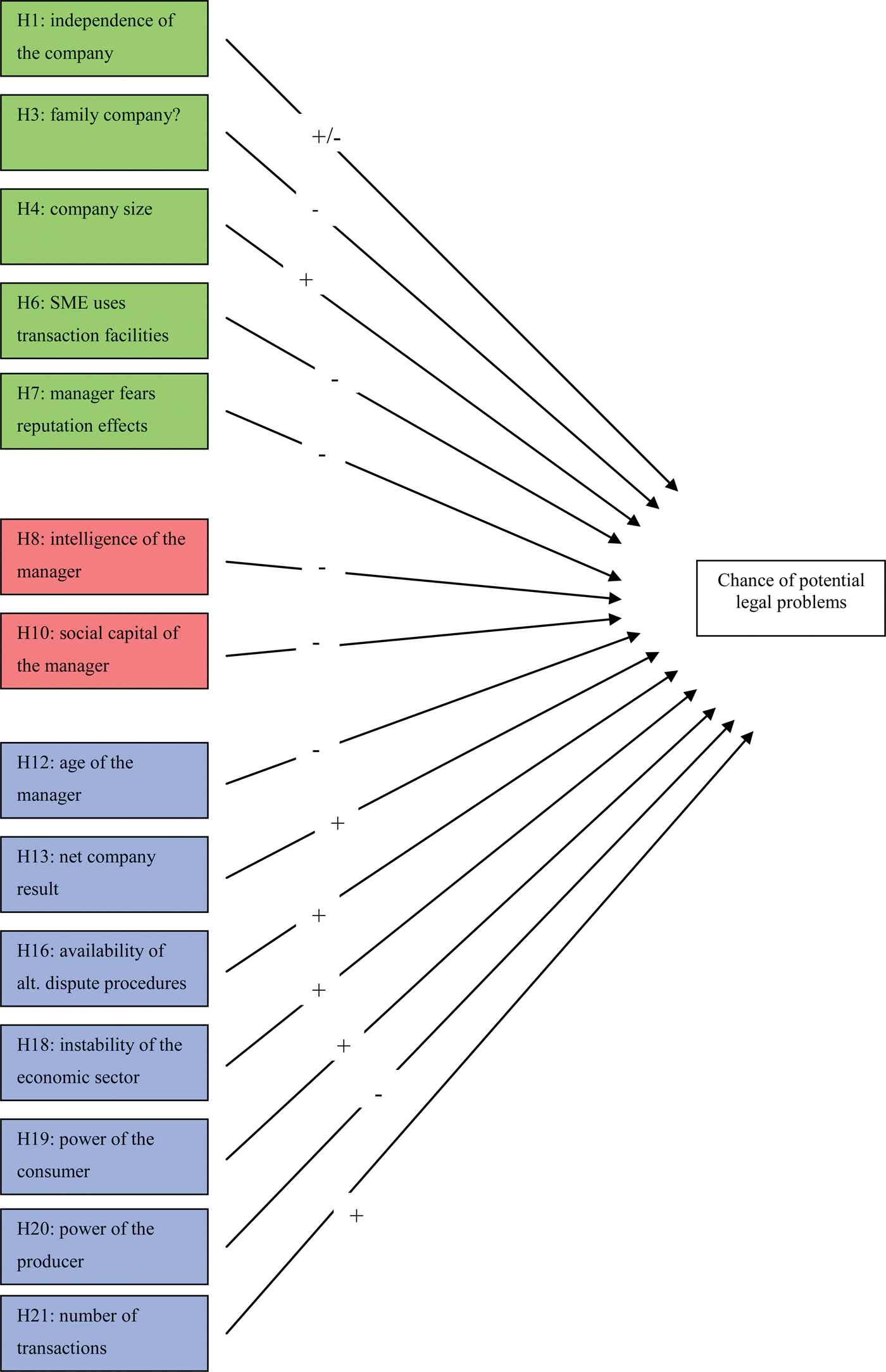
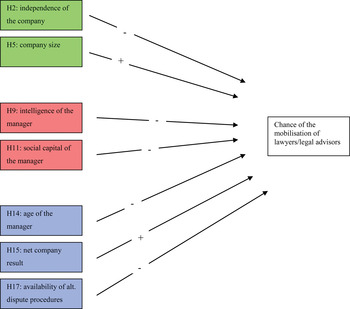
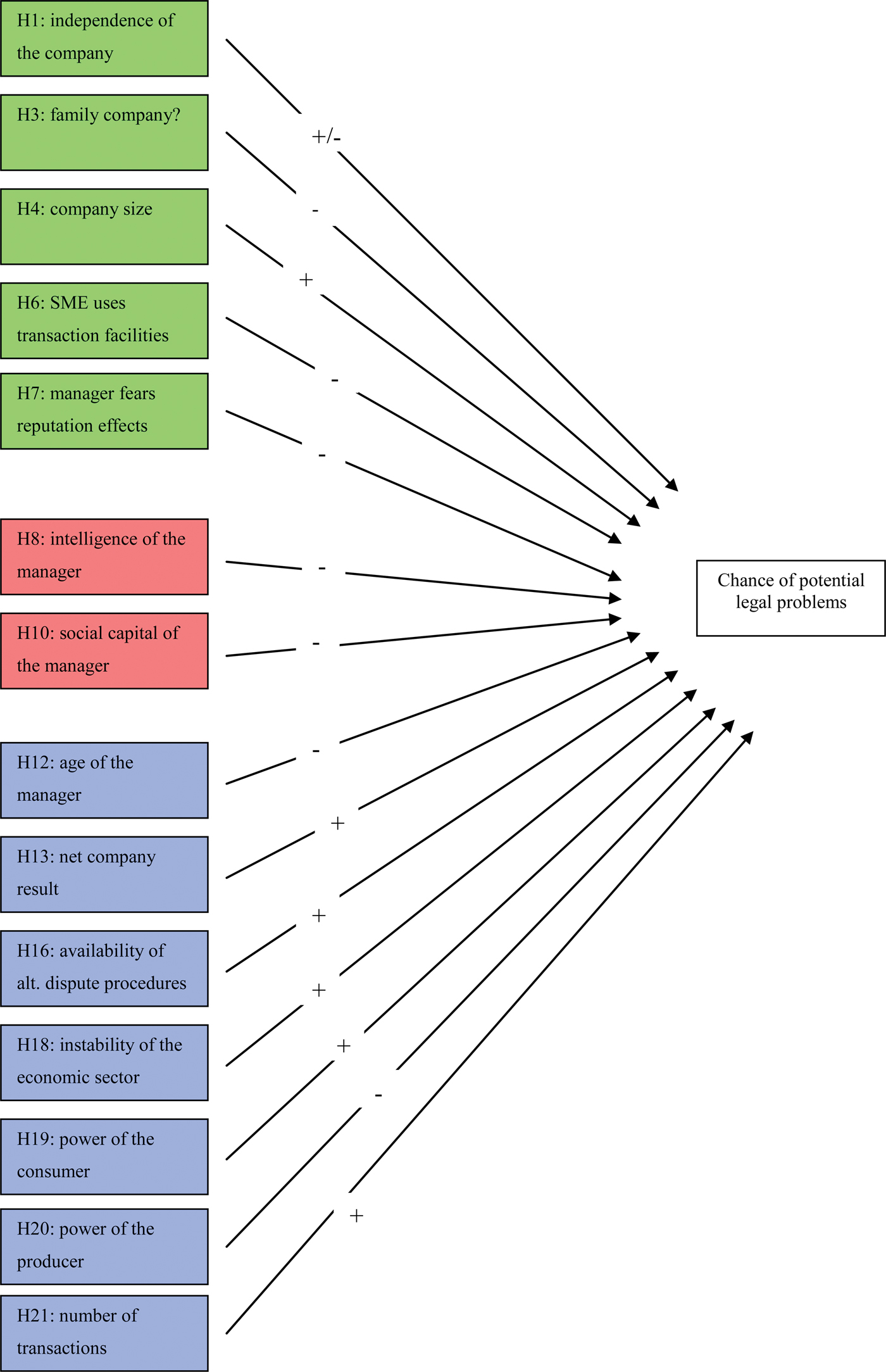
Models 1 and 2 explain the chance of running into potential legal problems and the choice of mobilising lawyers and/or legal advisors. On the left-hand side, the explanatory variables are shown.
The chance of encountering potential legal problems
The chance of lawyers/legal advisors getting mobilised

For purposes of clarity, the factors are grouped: the green factors (Model 1: H1 − H7; Model 2: H2 − H5) relate to the will of the manager; the red factors (Model 1: H8 − H10; Model 2: H9 − H11) to his capacities, and the blue factors (Model 1: H12 − H21; Model 2: H14 − H17) to his opportunities. On the right-hand side, each of the dependent variables is shown. In the arrow, the expected direction of the effect of an increase in the independent variable on the dependent variable is denoted by a ‘ + ’ or a ‘ − ’.
III. Data and operationalisation
The data used here to operationalise the factors and test the hypotheses were collected for a study on the potential legal problems that SMEs in the Netherlands experienced in 2006 and the ways in which their managers chose to deal with them (Croes and Maas, Reference Croes and Maas2009). The data were collected by means of a telephone survey among 1,784 managers of SMEs, who were members of the SME panel of the Economisch Instituut voor het Midden en Kleinbedrijf (EIM). It should be stated beforehand that these data were not collected with the explicit aim to test the hypotheses presented here. This means that the operationalisation below makes frequent use of proxies, variables that do not fit the concept that they measure as effectively as they might have, had the questionnaire been tailored to meet the demands of an optimal test of the hypotheses involved.
The hypotheses are tested with the incidence as well as the frequency of the dependent variables. The incidence denotes whether or not a potential legal problem occurred, or whether or not lawyers and/or legal advisors were mobilised in cases of potential legal problems. In the case of the potential legal problems, the frequency indicates the number of these problems. In the case of the lawyers and/or legal advisors, the frequency indicates a relative number: the quantity of problems that resulted in the mobilisation of lawyers and/or legal advisors, divided by the number of potential legal problems that the manager experienced.Footnote 9 Below, the independent variables will be dealt with.
The will of the manager
There are five factors that relate to the will of the manager:
• the degree of independence of the SME;
• whether or not the SME was a family company;
• the size of the SME;
• whether or not the SME made use of transaction facilities; and
• the manager's fear of reputation effects.
For the variable that denotes the degree of independence of the SME, we used the answers to the question whether the company was 100 percent independent (96%) or not (4%). For the variable that denotes whether or not the company was a family company, we used the answers to the question whether the SME, according to its manager, should be characterised as a family company (49%) or not (51%). For the size of the SME, we used the number of co-workers the SME employed. For the variable that denotes whether or not the SME used transaction facilities, we deduced from the known economic activity of the company whether (10%) or not (90%) it was likely to use central markets, auctions and the like. For the manager's fear of reputation effects, we used two kinds of operationalisation. One was aimed at the infrastructure that makes reputation effects more effective: the business association. Business associations can be instrumental in spreading information about members who do not abide by their standards; they can deny companies membership because of their reputation. It therefore appears likely that managers of SMEs would be more careful regarding their reputation when their company was a member of such a business association. Which business associations the companies in the SME panel were a member of had been researched previously by EIM. We used those data to create a variable that denoted whether (53%) or not (47%) the SME was a member of any of them. The second operationalisation was more straightforward. We used the answers to the questions whether (74%) or not (26%) the managers would feel they were put under pressure if their adversary was to make their potential legal problem public knowledge, and whether (57%) or not (43%) they would hasten to find a solution to the problem if this happened.
The capacities of the manager
There are two factors that relate to the capacities of the manager:
• the intelligence of the manager; and
• the social capital of the manager.
For the variable that denotes the intelligence of the manager of the SME, we used his highest achieved educational level to create a variable with four categories: primary school and lower professional school; mid-level secondary school and mid-level professional school; higher-level secondary school; and high-level professional school and university.
For the variable that denotes the social capital of the manager, we focused on the skills and intelligence of the co-workers of the manager. We used the manager's estimate of the proportion of higher educated co-workers his company employed times the number of total co-workers as a proxy.
The opportunities of the manager
There are five factors that relate to the opportunities of the manager:
• the age of the manager;
• the net company result;
• the number of procedures;
• the instability of the economic sector; and
• the dependency between trading partners (power of the consumer and power of the producer).
For the age of the manager, we used his known year of birth and created a variable with three categories: younger than forty-five years of age (38%); between the ages of forty-five and fifty-five (38%), and older than fifty-five (24%). For the net company result, we used the manager's estimate of the net result of the company in 2006 and created a categorical variable with six categories. For the availability of alternative procedures to deal with potential legal problems, two measures were used. The first one is based on the work of Van Erp and Klein Haarhuis (Reference Van Erp and Klein haarhuis2006) and denotes whether (39%) or not (61%) the business sector of the SMEs has extrajudicial procedures at its disposal to solve potential legal problems. The second measure denotes whether (13%) or not (87%) the business sector of the SMEs has a complaints board, based on the information of the Geschillencommissie (the Arbitration Board).Footnote 10 For the instability of the business sector, another survey of the SME panel of EIM was used. In this survey, in 2005, the respondents were asked whether or not they planned to undertake risky projects in 2006. EIM has made these data publicly available at the level of the business sector.Footnote 11 For the trading partner dependency, two measures were used: the average perceived level of power of the customer in the business sector and the averaged perceived level of power of the producer in the business sector. In both cases, the level of power is expressed as a percentage. EIM collected these data previously among the members of its SME panel and has made them publicly available.Footnote 12
The number of transactions
To control in the analysis for the number of transactions, we needed a measure that approximates this number, since the quantity of transactions is unknown. We used the turnover of the company as a proxy.
IV. Analysis
Below, we will test the hypotheses that were derived previously. The models will be built up step by step. First, the factors that relate to the will of the manager will be entered, followed by the addition of the factors that relate to the capacities of the manager, and finally by the addition of the factors that relate to his opportunities (including the control variable). Some factors will be added later, however. Since the measures for social capital and the reputation effects have many missing values, they were added as an extension to this complete model. The variables that measure the availability of alternative dispute resolution procedures were also added later because the relevance of these procedures often depends on the kind of opposing party the companies were confronted with. Since in the analyses no distinction was made regarding the kinds of opposing parties, the effect of this variable is diluted. The variables that measure the independence of the company were also added later, since we had very few companies that were not independent (which decreases the power of the test). In the analyses below, we used weights to make the results more representative regarding company size and the economic sector of the company.
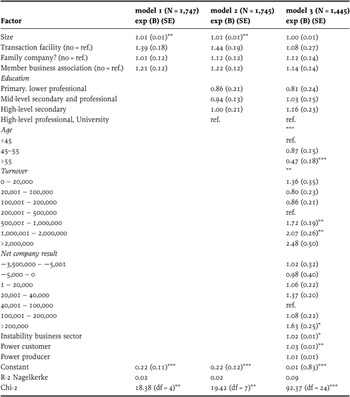
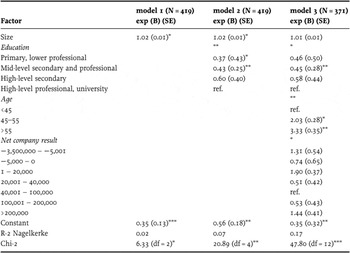
In Table 1, the chance of potential legal problems (incidence) is modelled. Since the dependent variable is dichotomous, we use logistic regression to analyse the data. The results are presented as odds ratios. The interpretation of odds ratios is straightforward: an effect larger than one means a positive effect, resulting in a higher chance than the reference category, while an effect lower than one means a negative effect, resulting in a lower chance than the reference category.
The chance of encountering potential legal problems (incidence): odds ratios (weighed)

* = significant at the 0.05 level.
** = significant at the 0.01 level.
*** = significant at the 0.001 level.
In Models 1 and 2 in Table 1, we see that the size of the SME has a statistically significant positive effect on the chance of meeting potential legal problems. However, in Model 3, the effect is not statistically significant any more. In that model, we see a statistically significant effect of the highest age group. Corroborating Hypothesis 12, a lower age goes together with a higher chance of potential legal problems. Two higher categories of the turnover show a statistically significant positive effect on the chance of potential legal problems, which supports Hypothesis 21. Furthermore, we see a statistically significant positive effect of the highest net company result category, in accordance with Hypothesis 13. The overall test of the effect of the net company result is, however, statistically not significant, which indicates that we should not read too much into this result. The instability of the business sector has a statistically significant positive effect, in accordance with Hypothesis 18. The power of the customer has a statistically significant positive on the chance of potential legal problems, which corroborates Hypothesis 19. The extensions of Model 3 (Models 3a and 3b in Table 2) did not result in statistically significant effects.
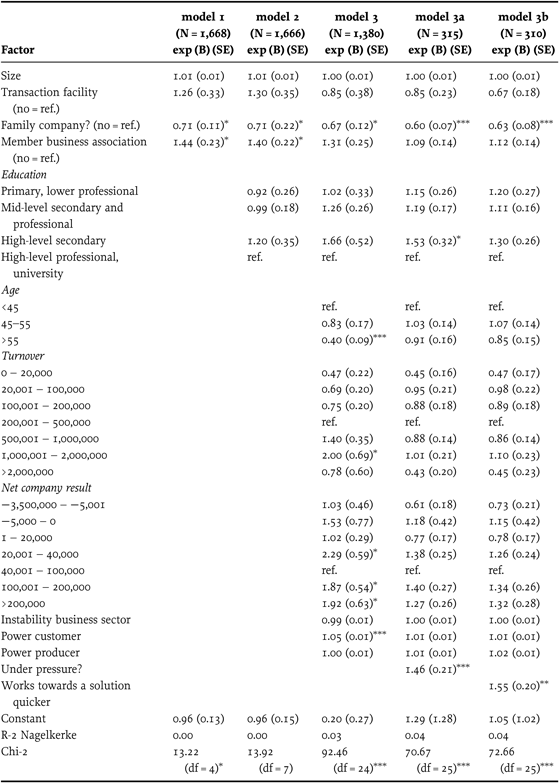
The chance of more potential legal problems (frequency): odds ratios (weighed)
* = significant at the 0.05 level.
** = significant at the 0.01 level.
*** = significant at the 0.001 level.
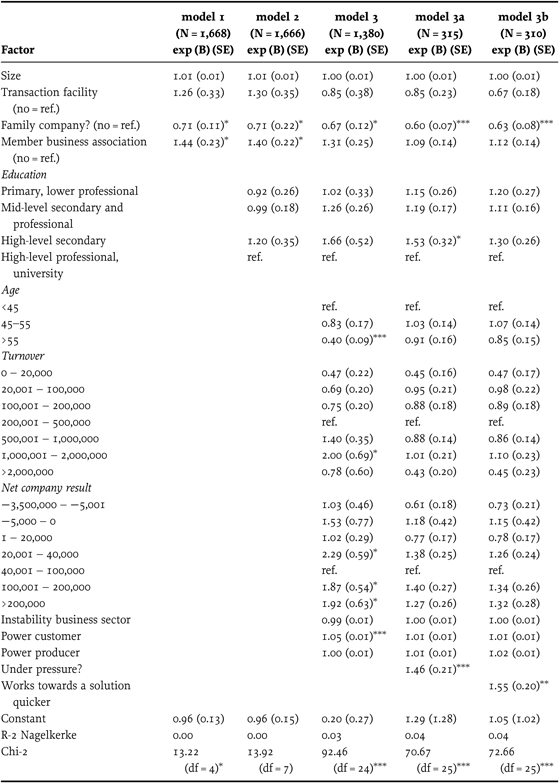
In Table 2, the chance of more potential legal problems has been modelled. Since the dependent variable is a frequency and the rate of overdispersion was too high to use Poisson regression, we used negative binomial regression to analyse the data. The interpretation of the effects is comparable to the effects in Table 1, since we again use odds ratios. Compared to the results shown in Table 1, there are only a few differences. The first is that, in Model 3, the family company has a statistically significant negative effect on the chance of meeting more potential legal problems, corroborating Hypothesis 3. Furthermore, some other categories of the turnover and the net result show statistically significant effects, but this does not alter the interpretation of the results much: it still corroborates Hypotheses 21 and 13 (with the addition that, apparently, the relation of the net company result with the problem frequency is not linear). The instability of the business sector, however, does not play a statistically significant role any more.
In Models 3a and 3b, the two extensions of the Model 3 are shown that resulted in statistically significant effects. We see that both measures of the fear of reputation effects have a positive effect on the chance of encountering more potential legal problems. This is contrary to Hypothesis 7.
In Table 3, the choice has been modelled whether or not to mobilise lawyers and/or legal advisors in cases of potential legal problems. Since the dependent variable is dichotomous, we use logistic regression to analyse the data. Just as above, the results are presented as odds ratios. Table 3 shows that education plays a role: in Model 3, the effects are statistically significant. The direction of the effect is positive: higher-educated managers employ lawyers and/or legal advisors more frequently. This is contrary to Hypothesis 9. The effect of age is also statistically significant, but contrary to Hypothesis 14, the direction is positive. The net company result has an overall statistically significant effect, but none of the categories differ significantly from the reference category. Of the variations on Model 3, none resulted in statistically significant effects.
The choice to mobilise lawyers and/or legal advisors (incidence): odds ratios (weighed)

* = significant at the 0.05 level.
** = significant at the 0.01 level.
*** = significant at the 0.001 level.
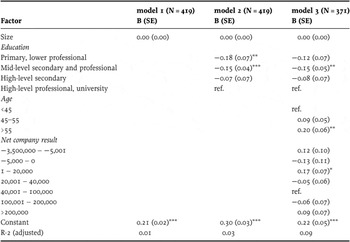
In Table 4, the relative frequency of the choice to mobilise lawyers and/or legal advisors is modelled. Since the dependent variable is continuous, we use OLS-regression analysis to analyse the data. The interpretation of the effects (B) is straightforward: a negative effect denotes a less frequent choice to mobilise lawyers and/or legal advisors, a positive effect a more frequent choice to mobilise lawyers and/or legal advisors.
The choice to mobilise lawyers and/or legal advisors (relative frequency): OLS regression coefficients (weighed)

* = significant at the 0.05 level.
** = significant at the 0.01 level.
*** = significant at the 0.001 level.
Note: In sixteen cases, the dependent variable had a value higher than 1 because lawyers and/or legal advisors can be mobilised several times. Since this resulted in outliers, the value of the dependent variable was limited to 1.
In Table 4, we see that, compared to Table 3, the differences are few. Education and age still play the same role, as does the net company result. Of the variations on Model 3, none resulted in statistically significant effects.
V. Discussion
The analysis above has made a few things clear. First, there are several statistically significant effects on the chance of encountering potential legal problems. Positive effects were generated by the instability of the business sector, the power of the customer and the turnover. These results corroborate Hypotheses 18, 19 and 21. The highest net company result category showed a positive effect, in accordance with Hypothesis 13. The overall test of the effect of the net company result was, however, statistically not significant, which indicates that we should not read too much into this result. There was one factor that had a statistically significant negative effect on the chance of potential legal problems: the age of the manager. This effect corroborated Hypothesis 12: younger managers have more potential legal problems than older managers.
Regarding the chance of being confronted with more potential legal problems, the results were basically the same. The differences were that, in this case, family companies had a statistically significant lower chance of encountering more problems. This corroborates Hypothesis 3. Apparently, family companies did not have a smaller chance of meeting potential legal problems (incidence) as such, but they do have fewer of these problems (frequency) when they occur. Furthermore, in two models, two reputation effects showed a positive effect: whether the respondent would feel under pressure when his opponent sought publicity, and whether the respondent would work towards a solution quicker when his opponent sought publicity. In both cases, a ‘yes’ corresponded with a higher chance of more potential legal problems. Since it was assumed that the fear of reputation effects would result in avoidance behaviour and, therefore, in fewer potential legal problems, these effects contradict Hypothesis 7. Perhaps the assumption that the balance of behaviour would tip towards the direction of precautionary action goes too far, in this case. It is possible that the fear of reputation effects are the result of more potential legal problems, making this fear more ‘real’ when the company is confronted with several potential legal problems. Finally, more net company result categories show statistically significant positive effects compared to the reference category, which provides more evidence for the relevance of this factor in cases of more potential legal problems. Since one of these categories is lower than the reference category, this indicates that the effect of the net company result is not linear.
Regarding the (incidence of the) choice to mobilise lawyers and/or legal advisors, there was a statistically negative effect of the age of the manager: older managers chose to engage lawyers and/or legal advisors less often than younger managers. This corroborates Hypothesis 14. Statistically positive effects were shown by the attained educational level of the manager: higher-educated managers employ lawyers and/or legal advisors more frequently. This means that the expectation expressed in Hypothesis 9 was not borne out. It does not necessarily mean, however, that higher-educated managers employ lawyers and/or legal advisors comparatively more often: if higher-educated managers are less passive when confronted with potential legal problems than lower-educated managers, one could get the same result. One last effect still needs to be mentioned: the net company result. With the fifth category as the reference category, none of the other categories show a statistically significant difference. The overall test shows, however, that with another reference category some differences would be statistically significant. It ought to be stressed that the effect of the variable is not linear. Not only do higher levels of the net company result go together with the mobilisation of lawyers and/or legal advisors; this is also the case with strong negative net results and small positive net results. Since these levels of company results could be indicative of financial problems, this is perhaps not very surprising. The results should therefore be seen as only a partial corroboration of Hypothesis 15.
Regarding the relative frequency of the choice to mobilise lawyers and/or legal advisors, the results basically did not differ from the incidence: in cases of potential legal problems, higher-educated managers seek the help of lawyers and/or legal advisors more frequently than mid-level educated managers do. This contradicts Hypothesis 9. The oldest group of managers employs lawyers and/or legal advisors more frequently than the youngest group, which contradicts Hypothesis 14. And managers whose company fits the net company result category of 1 to 20,000 euros seek the help of lawyers and/or legal advisors more frequently than the reference category. This contradicts Hypothesis 15, but as we stated before, the effect of the net company result appears to be non-linear.
Summing up, we have seen that some of the results corroborated hypotheses, while other results contradicted them. Does this mean that we can already start accepting or rejecting hypotheses? First, several of the factors in the hypotheses were operationalised with proxies, variables that do not optimally fit the concept that they are supposed to measure. This is the result of the fact that the theoretical approach presented here was basically developed after the questionnaire was completed. More research with more suitable operationalisations will result in stronger tests and stronger conclusions. Second, the testing of some hypotheses can be improved to include controls, enabling us to rule out potential alternative explanations of the effects found.
What has the theory-driven, hypotheses-testing approach brought us here? Not yet the answers to the hypotheses that we posed, perhaps, but at least a demonstration of the method that gets us closer to answers, and to indications regarding where to go next in this search for answers. Although this article has shown that a theory-driven approach can be fruitfully applied to the paths of justice, the attempt also shows that to get clearer results, the research sequence should be systematically followed through. This means that the problems should be posed first, after which the hypotheses should be derived, after which these hypotheses should be operationalised. Finally, this operationalisation should be the foundation for the questionnaire. In this way, the answers to the questions posed to the respondents will fit the theoretical concepts better, which will produce more valid and reliable results. This critique is, however, true not only for this article, but pertains even more so to the existing paths to justice literature: in this field, there is still a world to win.