

Introduction
Amongst the archaeological area of the ancient city of Cyrene (Shahat), there are various sites that contain mosaic floors. Most were uncovered more than half a century ago by the foreign missions, but the majority of these sites were neglected and left without any protection, preservation or regular maintenance and restoration. The condition of these mosaic floors has deteriorated over time and the exposure to humans, animals and the environment contributed to this. The Department of Antiquities (DoA) lacked funds, consideration and support from the consecutive governments after the uprising of February 2011. Since the spring of 2012 the restoration team within the DoA of Cyrene commenced work of maintenance and restorations on some sites that contain vital and beautiful mosaic floors. Such works were developing slowly due to the lack of capabilities in both materials and tools, but despite the difficulties, the restoration team managed to carry out some undertakings in 2012, 2016, 2017 and 2019. In 2020 the restoration team managed to conduct some maintenance and restoration works on four sites in different locations in the archaeological area of the city that we list in this brief article:
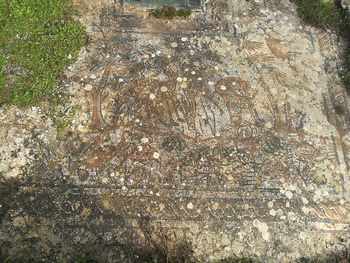
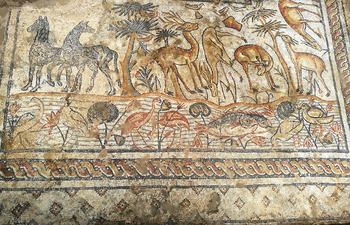
First site: Restoration work on the mosaic floor of the Central Church in the Roman Quarter in the central zone (al-Mantiqa al-Wusta) (carried out from 2 February to 15 March 2020). (Figure 1 and Figure 2).
The Central Church in the Roman Quarter, before restoration works.
Source: Adel El Mayer.

The Central Church in the Roman Quarter, after restoration works.
Source: Adel El Mayer.

Many of the Roman buildings and Byzantine churches within the Roman quarter in the central archaeological area are adorned and decorated with beautiful mosaic floors, but most are neglected, damaged and have been in poor condition since the excavations and discoveries by the foreign missions. Many of them may be completely lost due to the lack of attention, cleaning and regular maintenance. The last restoration works on the mosaic floor of the Central Church were conducted in 1957 as stated at the site. This mosaic floor is rectangular in shape and measures 7.30 metres in length and 4.25 metres in width. Its mosaic cubes are in various colours and measure 1 cm on each side. In the middle of the floor mosaic, there is a marble rectangle in the form of a base on which other architectural elements were placed. It is 1.85 metres in length and 95 cm in width. In one part of the floor many sections and the associated tesserae cubes have been lost. These were previously and wrongly restored by being filled with dark cement. This black cement was carefully removed and replaced with new mortar consisting of hydraulic lime, salt-free sand, mosaic gravel or stones and a small amount of white cement liquid. The rest of the floor and the tesserae in this section are in bad condition and cannot even undergo cleaning. The second part of the floor contains most of the cubes on which a natural scene is drawn. The iconography consists of a water lake that has two fish, two ducks, two swans, two pelicans swimming and many flowers. The lake is surrounded by several trees, a group of gazelles, two horses, a peacock, a partridge, a pigeon, birds, plants and flowers. There is also a plant that resembles the ‘Silphium’ and this is the first time the Silphium plant appears painted on a mosaic floor. The edges of the floor are framed by black lines that contain decorative female hair braids. After cleaning, restoring, rectifying and replacing many of the cubes, the paintings and scene was much clearer. This part of the mosaic floor embodies a unique artistic natural scene and we strongly recommend a hanging cover so that it can be preserved and protected from natural factors for many years to come.
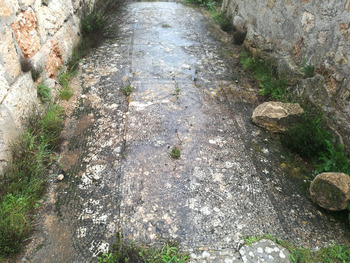
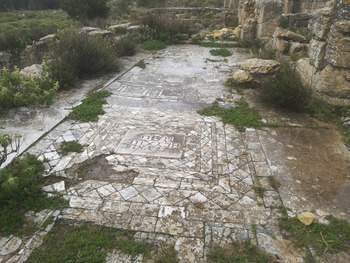
Second site: Restoration of work on the mosaic and marble floors of the Hesychius House in the Agora area (carried out from 16 March to 10 April 2020). (Figure 3, Figure 4 and Figure 5).
The Hesychius House in the Agora area before restoration works. Source: Adel El Mayer.

The Hesychius House in the Agora area after restoration works. Source: Adel El Mayer.

The Hesychius House in the Agora area after restoration works. Source: Adel El Mayer.

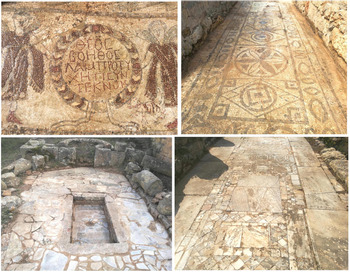
The Hesychius House is located on the ruins close to the Odeon theatre. It dates back to the fifth century AD and contains many and varied mosaic floors. At the entrance of the Eastern corridor there is a mosaic floor of human figures with wings surrounding five circles and Roman text. One circle is surrounded by plant leaves that contain a Roman inscription. The tesserae measure 1–2 cm each side and are in multiple colours including white, red, black and silver. It is 14.60 metres in length and 2.5 metres in width. In one part of the Western hall entrance there is a mosaic floor that measures 14.70 metres in length and 2.5 metres in width. It shows geometric structures and is white, black and silver. In the second part of the same floor, there are writings in geometric formats with different shapes on the way to the angle of the next entrance. Outside and behind the mosaic floors, there is the external patio and house garden with a marble fountain in a rectangular shape and 73 cm in length and 1.40 cm in width. This fountain is surrounded by a white marble surface measuring 6.20 metres long and 2.63 metres wide. It has small stoned columns around the edges and the walls of the garden are surrounded by a water passage made of stone. At the edges of the southern area of the house there is a large marble floor that is 8.70 metres long and 3.90 metres wide. It contains multiple colours including white, pink, silver and black. It has rectangular geometric shapes and at its front there is a small square with a specific script. It is worth noting that the last work performed on this site was in 1961 by the former controller of antiquities, Richard Goodchild. During this undertaking, the restoration team managed to clean all the floors of grass, weed, algae and lichen. Moreover, the mosaic and marble cubes were carefully replaced on both the floors and the fountain. The restoration team strongly recommend installing a hanging cover so that the site can be protected and preserved from the effects of natural factors.
Third site: Restoration work on the mosaic floor of the Baths of Trajan in the Apollo Sanctuary area (carried out from 11 to 18 April 2020). (Figure 6, Figure 7 and Figure 8).
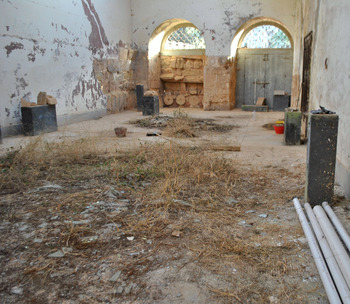
The mosaic floor of the Baths of Trajan before restoration. Source: Adel El Mayer.

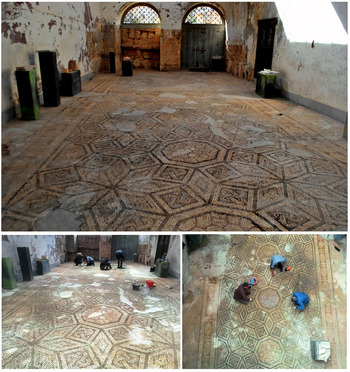
Restoration work on the mosaic floor of the Baths of Trajan. Source: Adel El Mayer.

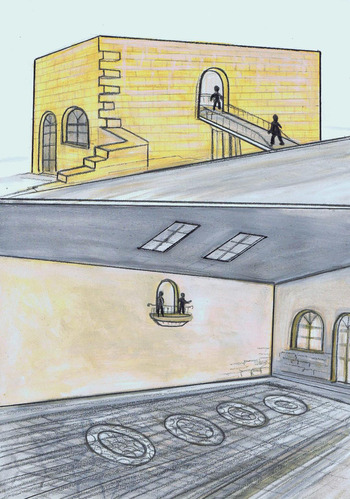
An artist's impression of how a hanging balcony might look. Source: Adel El Mayer.

The Baths of Trajan, which date back to the Roman era, are located in the Apollo Sanctuary and were used into the Byzantine era. They date back to the time of Emperor Trajan in AD 98 and were rebuilt during the reign of Hadrian in AD 119. The baths were first discovered in 1913 and continued to be uncovered until 1929. Among the rooms there exists a long hall with a mosaic floor that has different geometric decorations, multiple colours and covers an area of 19.20 metres by 7.5 metres. In October 2016, Adel El Mayer and Abdulsalam Sa'adoon from the restoration team conducted some cleaning, maintenance and restoration on this floor. In April 2020 the team conducted a regular and maintenance review and repeated the same process as in 2016. Unfortunately the hall that contains the mosaic floor has been used by the Cyrene Museum to display sculptures since 1947 up to the late 1980s, as documented at the site. As a result of visitors walking on the floor during that period, some damages and subsidence has occurred. For the aforementioned reasons, we strongly recommend installing a hanging balcony to allow visitors to view the area from above instead of walking on the mosaic floor and causing more damage. There are also some cracks on the wall and ceiling and some water leakage and humidity in the hall due to a water canal that passes underneath the building and the hall. The team recommends an urgent and proper maintenance of the wall and roof.
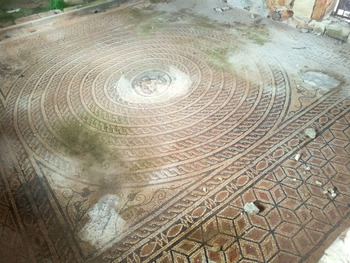
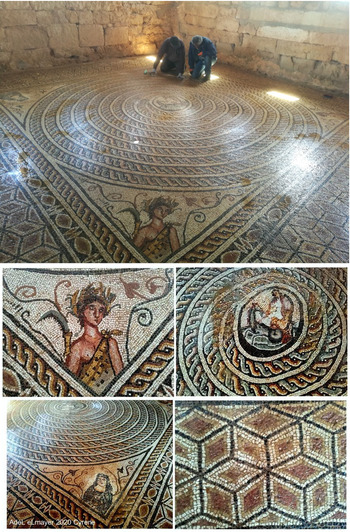
Fourth Site: Regular maintenance and restoration works on the floor of the Four Seasons mosaic in the house of Jason Magnus (carried out from 19 to 28 April 2020). (Figure 9 and Figure 10).
The poor state of the Four Season's mosaic in the House of Jason Magnus before restoration. Source: Adel El Mayer.

The restored floors of the Four Season's mosaic in the House of Jason Magnus. Source: Adel El Mayer.

During the summer of 2017, the team managed to restore the floor of the Four Seasons mosaic for the first time after the damage and vandalism it sustained in 2011. Cubes of shapes and symbols of the seasons of winter and spring were verified and firmly installed. Periodical maintenance and restoration works were conducted for a second time from 19 to 28 April 2020. In general the site of the house of Jason Magnus is exposed to too many human and natural risks and hazards, mainly due to a lack of maintenance and security. The last proper maintenance and protection took place in 1946. Another detrimental factor was the inaccurate manner of placing tin covers by the DoA in 2018, which resulted in some damage to the floors and walls of the site. Other damage on the floor of the Four Seasons mosaic, marbles and other mosaic floors at the site were a result of rainwater penetration. The maintenance and restoration works conducted in 2017 and 2020 were only on the floor of the Four Seasons mosaic. The rest of mosaic and marble floors of Jason Magnus's house remain in a very poor condition and are in urgent need of maintenance, restoration, care and attention.
Conclusion
Despite the lack of funds, equipment and materials, which is very challenging, the restoration team of Cyrene are making significant efforts and various fieldwork has been carried out including the maintenance and restoration of walls, columns, water canals, cemeteries, temples, buildings and mosaic floors in all the archaeological areas of the ancient city of Cyrene and in some archaeological areas in Cyrenaica. The restoration team request the guidance of the DoA, foreign missions and international organisations to draw attention and support to the field of restoration by providing essential materials and equipment and by establishing a restoration laboratory. As you all know, we lack the necessary training and development of human resources without which we cannot continue our work professionally and pass it down to future generations. This is essential to enable us to restore, protect, preserve and maintain the antiquities and cultural heritage of not only the ancient city of Cyrene, but Cyrenaica in general.
Acknowledgements
This article was written in Arabic by Adel El Mayer and translated into English by Salem El-Maiar. The concept of restoration for the 2020 fieldwork was initiated and led by Adel El Mayer. The team consisted of Abdelkarim Boghazalah, Salah Bobaker and Hussein Saleh. Adel El Mayer works for the restoration department at Cyrene and studied restoration, archaeology and arts in Italy and has worked in Italy, Cyrene and Apollonia. He worked with the French mission in the restorations of mosaic floors in Apollonia in 2012 and the restoration of the Temple of Zeus, and the Apollo and Dimitrios sanctuaries. He attended the ICCM Foundation in Venice (January 2016) and Barcelona (October 2017) as a representative of the state Libya and presented the mosaic floor restorations in Cyrene. He recommended restoring the four sites and is responsible for preparing, training and supervising the mosaic floor restoration in Cyrene. Abdelkarim Boghazalah is a researcher in archaeology within the department in Cyrene and manages some of the local sites. He has a special interet in the field of submerged (underwater) archaeology. He trained in the restoration of mosaic floors with the French mission in 2012 and has worked with many foreign missions in Cyrene,Apollonia and Cyrenaica. Salah Bobaker works for the DoA in Cyrene and was trained by the University of Rome in Leptis Magna. He specializes in archaeological drawing and survey. He has worked with many foreign missions in Cyrene, Apollonia and Cyrenaica. Hussein Saleh works for the DoA in Cyrene and has a special interest in cleaning and preparing the prime materials involved in the restoration process. He has worked with many foreign missions in Cyrene, Apollonia and Cyrenaica.