Introduction
The rapid spread of coronavirus disease 2019 (COVID-19) created significant challenges in healthcare, specifically around cancer treatment. The first positive COVID-19 tests in Washington, DC were reported in early March 2020, shortly followed by the Mayoral declaration of a public emergency and Washington DC’s first documented COVID-19-related death. 1 By late March 2020, the mayor announced that Washington, DC received a federal disaster declaration for COVID-19. 1 At this point, approximately 13% of the over 4,300 COVID-19 screening tests administered to symptomatic patients in Washington, DC were positive. 2
By April 2020, the American Society of Radiation Oncology issued disease site-specific clinical guidance on the departure of guideline-recommended radiation therapy (RT), the postponement and interruption of RT and factors for patient triage due to COVID-19. 3 The RADS (remote visits, avoidance, deferment, and shortening of radiation therapy) framework was also released by Zaorsky et al. in early April 2020 to inform the care of patients undergoing RT during the pandemic. Reference Zaorsky, Yu and McBride4 Yet, there was still little to no guidance on COVID-19 testing for asymptomatic patients. While symptomatic cases and death rates increased in Washington, DC and nationwide, limited guidelines were available for testing asymptomatic patients with COVID-19. Early reporting indicated that patients with active or personal history of cancer may be at an increased risk of developing severe complications associated with COVID-19. Reference Liang, Guan and Chen5 Moreover, it was reported that immunocompromised patients, including those with cancer, have specific risk factors increasing vulnerability to COVID-19. Reference Kuderer, Choueiri and Shah6 These patients may be immunocompromised due to antineoplastic therapy, steroids or the effects of cancer itself; they may also be older, with one or more medical comorbidities.
With health equity on the forefront of public health policy in the USA, the early stages of the pandemic magnified social and racial injustice across the country. Reference Killerby, Link-Gelles and Haight7 The Centers for Disease Control (CDC) issued warnings that COVID-19 unequally affected racial and ethnic minority groups, increasing their risk of severe illness or hospitalisation. Reference Killerby, Link-Gelles and Haight7 Limited guidance was available to avoid poor outcomes for these groups during this unprecedented time. The COVID-19 pandemic represented another barrier to optimal high quality cancer care across different racial and ethnic communities and stood to possibly exacerbate disparities in cancer care and outcomes. Reference Siegel, Miller and Jemal8
Especially during the global pandemic, timely care remains critical for individuals diagnosed with cancer, as delays adversely affect cancer outcomes. Reference Hanna, King and Thibodeau9 Given these concerns, this study sought to understand factors contributing to these delays in cancer care and how such delays affected outcomes. Patients presenting for RT at a single institution who underwent COVID-19 screening procedures prior to RT and throughout their cancer care were analysed regarding COVID-19 testing trends, treatment delays and disparities. This study evaluated the utility of asymptomatic pre-RT COVID-19 testing, assessed the degree of COVID-19 testing faced by patients being treated for cancer, examined the COVID-19 status of these patients throughout cancer treatment and analysed the outcomes driven by cancer treatment delays and disparities present in the healthcare system.
Materials and Methods
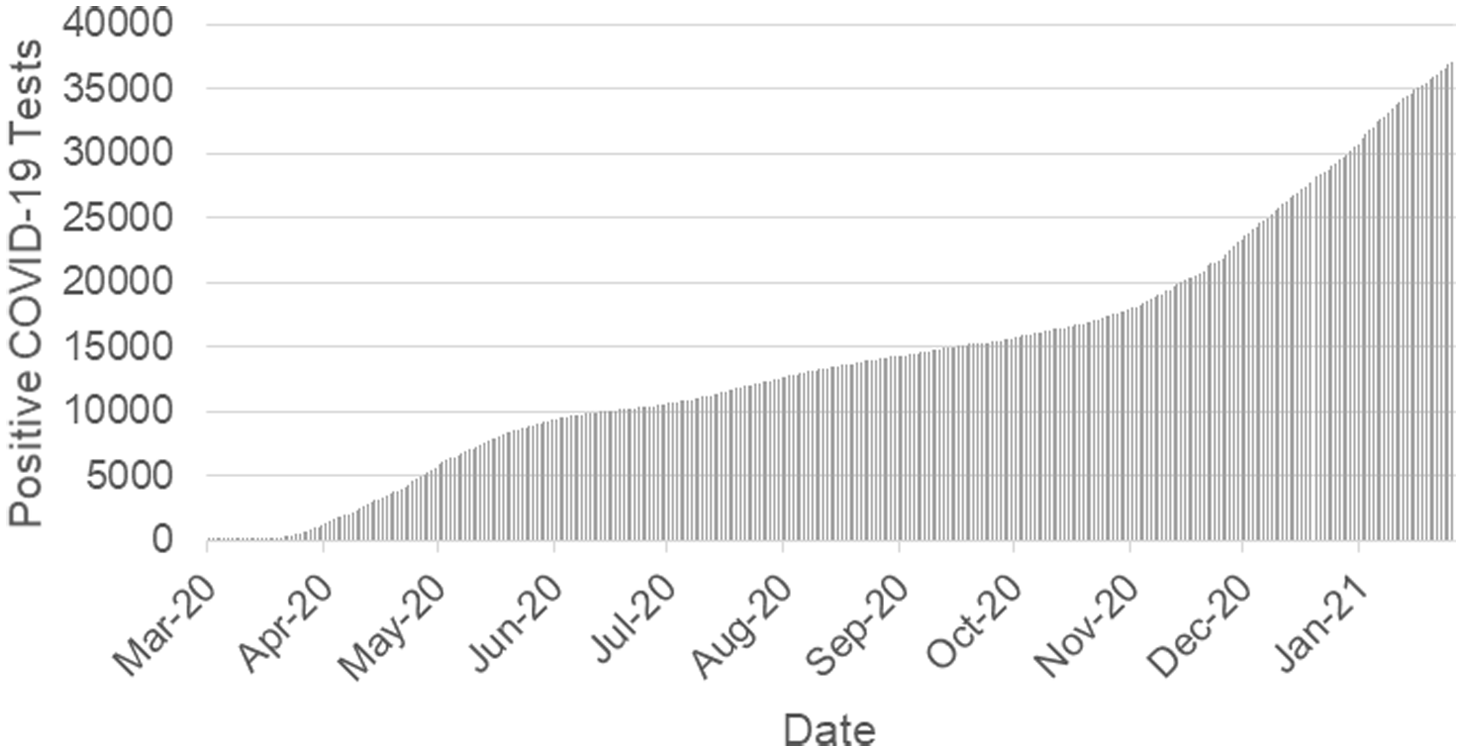
The study was conducted at an urban multidisciplinary cancer centre associated with a large academic physician practice and hospital. As local cases of COVID-19 in Washington, DC began to increase in March 2020 (Figure 1), the institution’s radiation oncology department developed and implemented universal COVID-19 screening protocols prior to RT initiation (with possible patient opt-out) to ensure patient and staff safety. 10 At this time, the CDC discouraged testing of asymptomatic individuals. 11 However, given the increased vulnerability of cancer patients to COVID-19 and potential for severe sequelae, interest grew in testing asymptomatic cancer patients prior to RT. Reference Huang, Hu and Ran12 Thus, in April 2020, in addition to following CDC guidelines involving screening questionnaires regarding COVID-19-like symptoms, maintaining social distancing, frequent hand washing and using appropriate personal protective equipment, the institution implemented pre-RT COVID-19 testing.
Washington, DC positive COVID-19 tests.

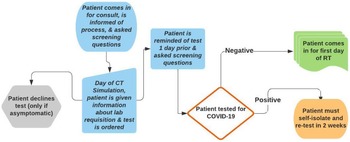
Patients were first seen via an in-person or tele-visit consultation and subsequently presented to clinic for CT simulation. It was then requested that patients undergo pre-RT COVID-19 testing. This was not mandatory for asymptomatic patients, but highly encouraged. COVID-19 test orders were submitted when patients agreed to undergo testing. Once resulted, patients who tested negative for COVID-19 started RT. Patients who tested positive were instructed to self-quarantine and retest in 2 weeks (Figure 2). Pre-RT COVID-19 testing of asymptomatic patients continued through January 2021.
Pre-radiation therapy asymptomatic COVID-19 testing flowchart.

Asymptomatic patients with cancer who were tested for COVID-19 pre-RT were retrospectively reviewed. Information about additional COVID-19 tests administered to these patients throughout their cancer care was also acquired. Patient demographics and comprehensive COVID-19 testing information on patients with cancer planned for RT from April 2020 through January 2021 was collected. Trends of patients’ lifetime COVID-19 testing to evaluate overall RT delays, poor outcomes and disparities were then studied using this information.
The data collection for this study involved a chart review to acquire de-identified information. A REDCap (Research Electronic Data Capture, Nashville, TN) registry was created with this information where summary statistics were calculated under approved IRB protocol (#NCR213608). Reference Harris, Taylor, Thielke, Payne, Gonzalez and Conde13 Demographic and clinical variables included age, race, sex, insurance type, primary disease site, stage, role of RT, type of RT, COVID-19 test dates and results, and treatment delays.
De-identified data were exported and statistical analysis was performed using IBM SPSS Statistics (version 20, Armonk, NY). For age, patients were binned into three variables: age less than 45, age 45–65 and age greater than 65. For insurance type, patients were collapsed into three variables: Medicare, Medicaid and private insurance. For primary disease category, patients were binned into eight variables: breast, thoracic, genitourinary, head and neck, gastrointestinal, gynaecological, central nervous system and other. For number of COVID-19 tests, patients were collapsed into four variables: 1–5 tests, 6–10 tests, 11–15 tests and 16–20 tests. Univariable logistic regression was used to identify variables associated with testing positive for COVID-19 and RT delays. A two-tailed p-value <0·05 was considered to be statistically significant.
Results
During a 10-month period (April 2020 to January 2021), a total of 296 consecutive patients were scheduled to begin RT. Twenty-four (8·1%) patients declined pre-RT COVID-19 testing and proceeded to RT, 11 patients who underwent pre-RT COVID-19 testing never received RT and 7 patients without cancer received a pre-RT COVID-19 test. These 42 total patients were excluded from the analysis.
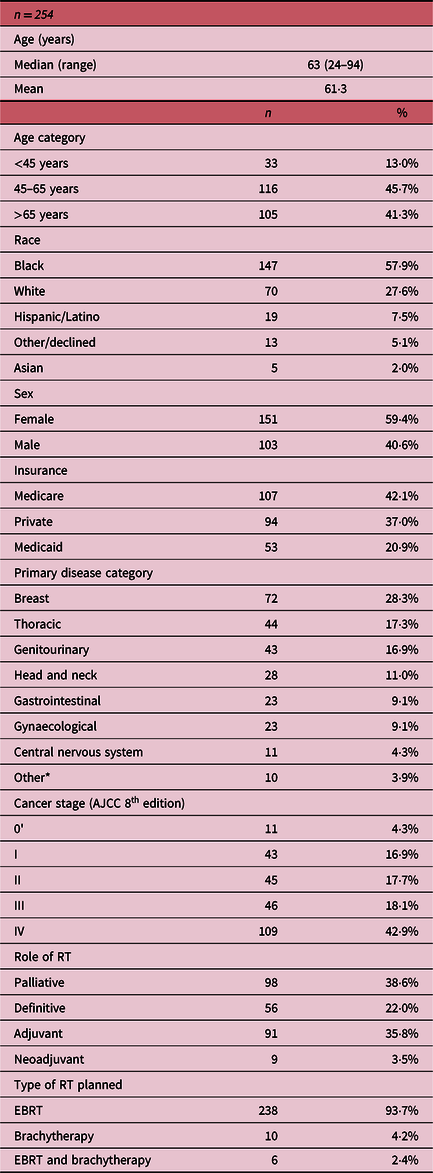
The demographics of the 254 patients with cancer who consented to pre-RT testing and proceeded to RT are presented in Table 1. Median age was 63 years (range 24–94 years). Most patients identified as Black (n = 147, 57·9%), followed by White (n = 70, 27·6%) and Hispanic/Latino (n = 19, 7·5%). 59·4% (n = 151) of patients were female. Most (n = 107, 42·1%) patients were insured through Medicare, followed by private insurance (n = 94, 37·0%) and Medicaid (n = 53, 20·9%). Common primary disease categories for patients undergoing RT included breast (n = 72, 28·3%), thoracic (n = 44, 17·3%) and genitourinary (n = 43, 16·9%). Most patients presented with American Joint Committee on Cancer 8th edition stage IV disease (n = 109, 42·9%) and received palliative RT (n = 98, 38·6%).
Patient demographics

* Other = Mantle cell lymphoma, melanoma, fibrosarcoma, mycosis fungoides, multiple myeloma, squamous cell carcinoma, diffuse large B-cell lymphoma, Merkel cell carcinoma.
'Stage 0 = breast ductal carcinoma in situ.
EBRT = external beam radiation therapy.
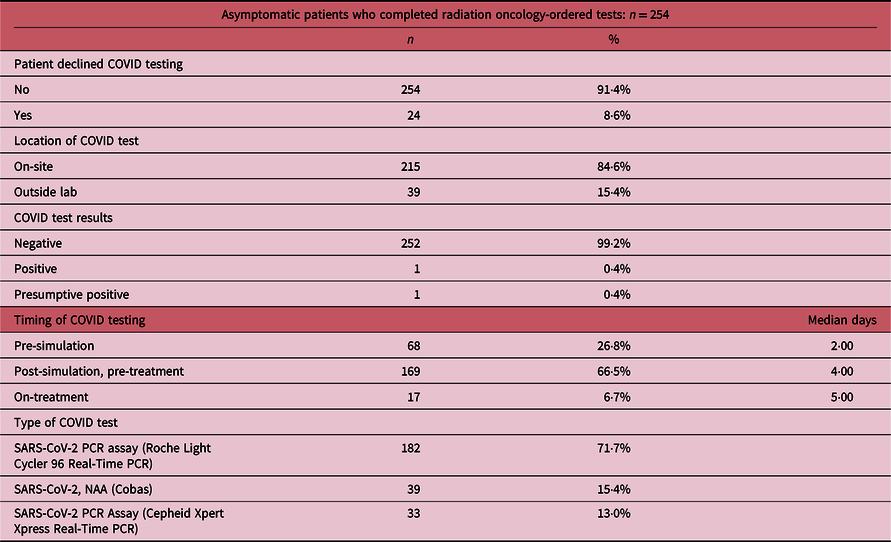
The testing information for the patients who completed the pre-RT COVID-19 test is presented in Table 2. Most patients were tested within the institution (n = 215, 84·6%), while 15·4% (n = 39) of patients were tested at an outside lab. One (0·4%) asymptomatic patient tested positive for COVID-19 pre-RT. The patient tested negative for COVID-19 1 week later and proceeded to RT. One (0·4%) asymptomatic patient tested presumed positive for COVID-19 pre-RT. The patient immediately tested negative for COVID-19 on two consecutive tests and proceeded to RT without delay. The remaining 252 (99·2%) asymptomatic patients tested negative for COVID-19 and proceeded to RT without delay. Most pre-RT COVID-19 tests (n = 169, 66·5%) were completed after radiation simulation but before the initiation of RT (n = 169, 66·5%, median 4 days) or before radiation simulation (n = 68, 26·8%, median 2 days). However, 17 (6·7%) of the COVID-19 tests were completed after the patients had started RT (median 5 days). Notably, the positive and presumed positive pre-RT COVID-19 tests resulted after CT simulation but before the initiation of RT.
COVID testing details for radiation oncology screening

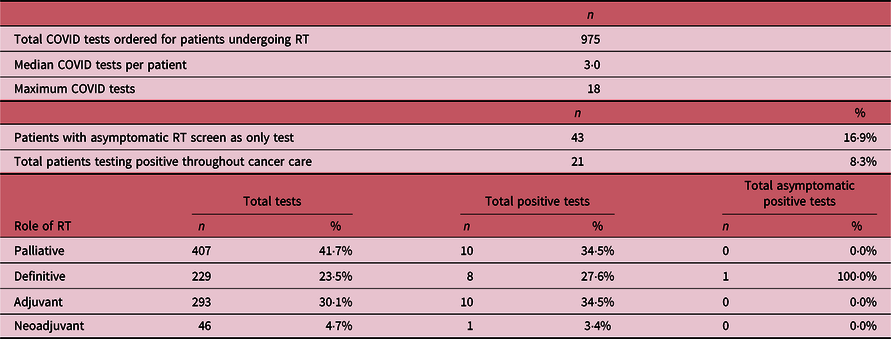
The 254 patients who consented to pre-RT COVID-19 testing received 975 total lifetime COVID-19 tests (Table 3). The median number of tests per patient was 3 throughout their cancer care (range 1–18). Forty-three (16·9%) patients received the department’s pre-RT COVID-19 test as the solitary test during their care. Overall, these 975 pre-RT COVID-19 tests resulted in 29 positive test results across 21 patients undergoing cancer treatment; 6 of these 21 patients had one or more positive tests. These lifetime COVID-19 tests were done for pre-procedural screening (i.e., prior to chemotherapy port placement) or other required cancer treatments.
COVID testing details throughout cancer care

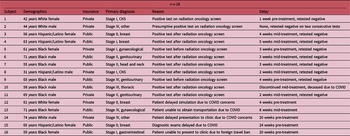
A summary of the 16 patients with RT delays is presented in Table 4. The two asymptomatic patients who tested positive and presumed positive and had subsequent negative tests are also included. Nine patients had at least one positive COVID-19 test during their RT course. Median age of these nine patients was 61 years (range 31–71 years). These patients identified as Black (n = 6, 66·6%) and Hispanic (n = 3, 33·3%), and six (66·6%) were male. Six patients (66·6%) were insured through either Medicare or Medicaid. These nine patients were instructed to quarantine for 2 weeks and resumed RT once they tested negative for COVID-19. RT was discontinued for one patient who died from cancer complications and superimposed COVID-19 pneumonia. The remaining eight patients experienced a median RT delay of 3·0 weeks (range 2–5 weeks). Two patients self-delayed initiating treatment (mean 12 weeks) due to COVID-19 fears. One patient experienced an 8-week delay mid-RT due to lack of available transportation during COVID-19. One patient experienced a 24-week pre-RT delay due to COVID-19-related diagnostic imaging limitations. Lastly, one patient experienced a 20-week delay in treatment initiation due to international government travel restrictions. Of patients experiencing RT delays, most (n = 12, 75%) were either Black or Hispanic. Additionally, most 12 (75%) were insured through either Medicare or Medicaid.
Details of patients with RT delays

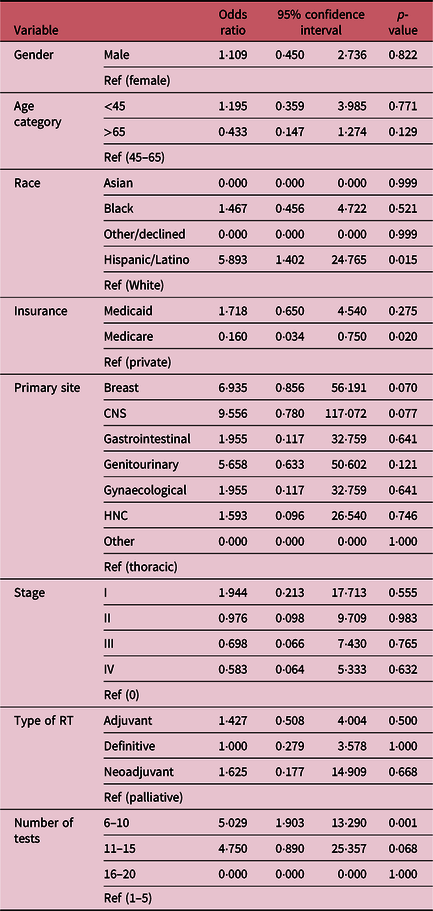
Variables associated with testing positive for COVID-19 are shown in Table 5. Univariable analysis for the entire cohort showed that being tested for COVID-19 6–10 times (OR 5·029, 95% CI 1·903–13·290) and identifying as Hispanic/Latino (OR 5·893, 95% CI 1·402–24·765) were associated with testing positive for COVID-19. Having Medicare insurance was associated with being less likely to test positive for COVID-19 (OR 0·160, 95% CI 0·035–0·750). No other clinical or demographic variables were associated with a patient testing positive for COVID-19.
Univariable analysis of association with testing positive for COVID-19

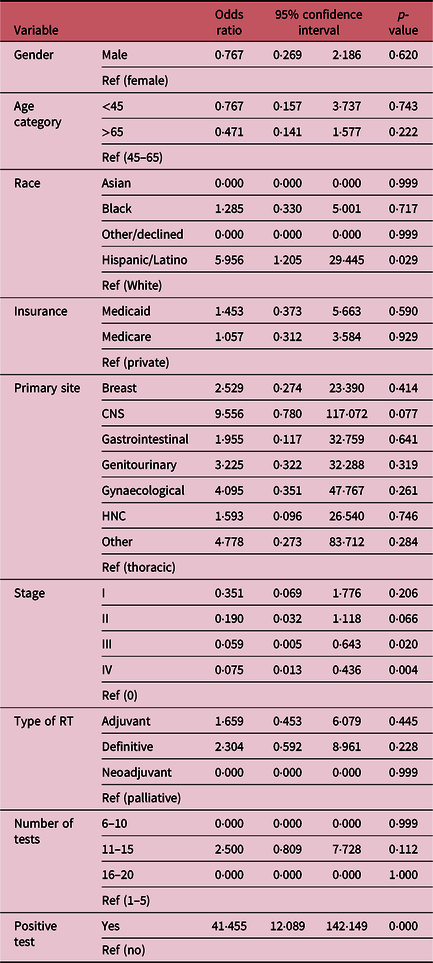
Finally, univariable analysis for the entire cohort showed that testing positive for COVID-19 (OR 41·455, 95% CI 12·089–142·149) and identifying as Hispanic/Latino (OR 5·956, 95% CI 1·205–29·445) were associated with RT delays (Table 6). Patients with Stage III (OR 0·059, 95% CI 0·005–0·643) or IV (OR 0·075, 95% CI 0·013–0·436) disease were less likely to have RT delays. There were no other variables found to be associated with RT delays.
Univariable analysis of association with RT delays

Discussion
The COVID-19 pandemic presented a major challenge for patients with cancer, as patients experienced delays throughout the entire spectrum of cancer care. This study found that asymptomatic patients presenting for COVID-19 screening prior to RT in an urban clinical setting had a very low prevalence (0·4%) of positive tests. In this cohort, patients received several COVID tests throughout their cancer care, possibly representing additional burden for the patients. To the authors’ knowledge, this is the first analysis of total number of COVID-19 tests received by patients with cancer. This study also found that some patients who tested positive for COVID-19 experienced substantial treatment delays, and that identifying as Hispanic/Latino was associated with both testing positive for COVID-19 and having an RT delay.
Asymptomatic COVID-19 infections posed a significant threat early in the pandemic, prompting the institution to implement COVID-19 testing protocol to ensure patient and staff safety. In September 2020, the CDC estimated that 40% of all infections were asymptomatic and the infectivity of asymptomatic individuals relative to symptomatic ones was 75%. 14 Similarly, He et al. estimate that 44% of secondary cases were infected during others’ asymptomatic stages. Reference He, Lau and Wu15 Population studies from Europe indicated that asymptomatic rates could range from 20 to 75%, demonstrating that symptomatic isolation alone would fail to control the virus. Reference Yanes-Lane, Winters and Fregonese16 While the implementation of social distancing and mask compliance limited viral transmission, demand for more stringent testing protocols increased as asymptomatic individuals continued to spread COVID-19. Reference Cheng, Jian and Liu17 However, this study found that only a very small proportion of asymptomatic patients with cancer actually tested positive for COVID-19. The rate of positive COVID-19 tests (<1%) found in this study is comparable to that reported by others, though one group from the USA reported a 5·8% positive rate when looking at all comers, including patients with COVID-19 symptoms. Reference Ning, McAleer and Jeter18–Reference Modi, Dragun and Henson20 Overall, testing patients for COVID-19 prior to RT may have limited utility, particularly as the patients in this study received many COVID-19 tests throughout their cancer care course. This investigation examined RT treatment delays in conjunction with COVID-19 testing results. Patients from this cohort were delayed both pre- and mid-RT. Some patients were delayed up to 20–24 weeks before starting RT, but some were delayed for weeks mid-RT. This has implications for overall cancer outcomes as it is well known that delays in adjuvant RT initiation are associated with increased recurrence risks and worsened survival in many cancer types. Reference Huang, Barbera and Brouwers21–Reference Ohri, Rapkin, Guha, Kalnicki and Garg23 Beyond RT, Hanna et al. determined that a 4-week treatment delay is associated with an increase in mortality across all common forms of cancer treatment, with longer delays being increasingly detrimental. Reference Hanna, King and Thibodeau24
Cancer has proven to be a negative risk factor for those affected by COVID-19. Early data from China analysing 2,007 cases of COVID-19 demonstrated that patients with cancer had poorer outcomes and increased severe events, including intensive care unit (ICU) admission, invasive ventilation requirements and death. 2 An Italian study indicated that 20·3% of patients who died from complications of COVID-19 had active cancer. Reference Onder, Rezza and Brusaferro25 Lastly, a study from Dubai examining asymptomatic patients undergoing cancer treatment showed that patients with cancer had a higher rate of infection (29·4%) and hospitalisation (28·1%). Reference Al-Shamsi, Coomes, Aldhaheri and Alrawi26 This study’s data show that patients with cancer requiring treatment during the COVID-19 pandemic experienced substantial delays in care, which may affect their overall cancer outcomes. The authors acknowledge that the disruption in the healthcare system due to the pandemic was one that few could have anticipated. Yet, given that fear and anxiety are already well-documented limitations to RT compliance, Reference Teckie, Andrews and Chen27 it was encouraging that only 16 out of 254 patients experienced some type of delay. It was expected that most treatment delays would be due to testing positive for COVID-19—this was evidenced by a significant association on univariable analysis. It was also hypothesised that many treatment delays would be attributed to fear of nosocomial infection at this facility, given the paucity of data at that time regarding the impact of COVID-19 on patients with cancer. Unanticipated delays in this cohort occurred secondary to diagnostic examinations and changes to domestic and international travel policies.
Nonetheless, given the institution’s location in a diverse metropolitan area, patients at this institution are affected by factors that may increase their risk of COVID-19 and potentially adverse outcomes. The collected data show that identifying as Hispanic/Latino is associated with both testing positive for COVID-19 and having RT treatment delays. Additionally, the one patient in this cohort who died from cancer complications and superimposed COVID-19 pneumonia identified as Black. The CDC has shown that minority populations have been disproportionately affected by the pandemic with higher rates of cases, hospitalisations and deaths. 28 A study of 2,595 patients in a large Midwestern academic health system revealed that Black race, age greater than 60 and male sex were associated with COVID-19 positivity. Reference Muñoz-Price, Nattinger and Rivera29 According to Gu et al., when adjusting for age, sex, socioeconomic status and comorbidity score, Black patients were more likely to be hospitalised due to COVID-19 compared with White patients. Reference Gu, Mack and Salvatore30 Finally, a systematic review of the literature indicated that Black, Asian and other minority ethnic individuals had an increased risk of infection with COVID-19 and worse clinical outcomes, including increased admission to the ICU and mortality. Reference Pan, Sze and Minhas31 The authors were alarmed by the significant portion of RT delays (75%) due to testing positive for COVID-19 in individuals of racial and ethnic minority groups. Care must be taken to prevent worsening of health disparities in American cancer care during the COVID-19 pandemic.
This single-institution retrospective study does have some limitations. The study only sampled patients with cancer who were treated with RT and did not evaluate patients with benign conditions or patients with cancer who did not require RT. Moreover, asymptomatic patients who declined pre-RT COVID-19 testing were also excluded. Additionally, the analysis was limited to information available in this institution’s electronic medical records. Any information on COVID-19 testing and treatment that patients may have received from outside institutions was not included in the analysis. Lastly, the analysis is unable to evaluate the effects that RT delays have on cancer survival outcomes due to the short follow-up period and relatively small sample size. However, this study remains the first reported analysis of total COVID-19 testing throughout cancer care and the associated delays in RT.
Conclusion
Asymptomatic COVID-19 testing of patients presenting for RT may provide limited utility. While most patients proceeded to RT without delay, some patients experienced cancellations or delays in treatment. Identifying as Hispanic/Latino was associated with both testing positive for COVID-19 and having an RT delay, which may widen the existing disparities in cancer treatment and outcomes seen in minority populations. Overall, increased testing burden, delays due to diagnostic workup and cancer treatment and testing positive for COVID-19 could intensify disparities affecting this urban patient population.
Acknowledgements
We thank the support staff at our university for ensuring the safety of our patients and clinical teams during the COVID-19 pandemic.
Funding
None.
Conflict of Interest
None.