1. Introduction
According to several researchers (e.g. Clahsen, Reference Clahsen, Flynn and O'Neil1988; Bley-Vroman, Reference Bley-Vroman1990; Meisel, Reference Meisel1997), there are fundamental differences between first and second language acquisition. Meisel (Reference Meisel and Eubank1991) gives the following general characteristics which differentiate L2 from L1: limited ultimate attainment, slower rate of acquisition, strong individual differences, discontinuity of acquisition patterns and no parameter setting (see also Meisel, Reference Meisel, Fletcher and MacWhinney1995; Reference Meisel2007, p. 11).
Studies on bilingual first language acquisition from birth have revealed that the children basically acquire two L1s (see de Houwer, Reference De Houwer1990; Meisel, Reference Meisel and Meisel1990, Reference Meisel and Meisel1994; Parodi, Reference Parodi and Meisel1990; Meisel and Müller, Reference Meisel, Müller and Meisel1992; Genesee, Nicoladis and Paradis, Reference Genesee, Nicoladis and Paradis1995; Lanza, Reference Lanza1997, among others). However, in certain cases, one of the two languages is, at least temporarily, clearly less developed than the other. Schlyter (Reference Schlyter and Meisel1990a, Reference Schlyter and Meiselb, Reference Schlyter, Hyltenstam and Vilberg1993) and others call this “underdeveloped” language the “weaker” language. The other language is often consequently referred to as the “stronger” language (Leopold, Reference Leopold1939–1949; Döpke, Reference Döpke1992; Schlyter, Reference Schlyter, Hyltenstam and Vilberg1993). Some authors also use the term “dominant language” in this context (see Arias, Kintana, Rakow and Rieckborn, Reference Arias, Kintana, Rakow and Rieckborn2005; Müller, Kupisch, Schmitz and Cantone, Reference Müller, Kupisch, Schmitz and Cantone2006, for a discussion on language dominance).
A major criterion for differentiating between balanced and unbalanced bilingualism is the MLU (Mean Length of Utterance). Other criteria are the verb lexicon (e.g. Genesee et al., Reference Genesee, Nicoladis and Paradis1995; Müller and Kupisch, Reference Müller and Kupisch2003; Rieckborn, Reference Rieckborn2006) and the noun lexicon (Cantone, Kupisch, Müller and Schmitz, Reference Cantone, Kupisch, Müller and Schmitz2008). However, it is not always clear which criteria can be considered as qualitative and which as quantitative. According to Bernardini and Schlyter (Reference Bernardini and Schlyter2004), the MLU is a quantitative criterion, while Müller and Kupisch (Reference Müller and Kupisch2003) consider it to be qualitative. In this paper, I will not go into the discussion on how to determine language dominance, but rather will refer to studies such as those from Nicoladis (Reference Nicoladis1998), Paradis and Navarro (Reference Paradis and Navarro2003), Arias et al. (Reference Arias, Kintana, Rakow and Rieckborn2005) and Müller et al. (Reference Müller, Kupisch, Schmitz and Cantone2006). I will use the broad criteria of MLU and verb lexicon to demonstrate that the two children examined in this study are unbalanced bilinguals from the age of 2;05 and 2;07 respectively.Footnote 1
According to some authors (e.g. de Houwer, Reference De Houwer1990; Parodi, Reference Parodi and Meisel1990; Müller and Kupisch, Reference Müller and Kupisch2003; Müller, Reference Müller, Prévost and Paradis2004; Meisel, Reference Meisel2007), the “weaker” language only appears to develop in a delayed manner, but actually follows the same developmental pattern as the “stronger” language or, more generally speaking, as an L1. Studies such as Kupisch (Reference Kupisch2001) (determiners); Müller and Kupisch (Reference Müller and Kupisch2003), Meisel (Reference Meisel2007) and Cantone et al. (Reference Cantone, Kupisch, Müller and Schmitz2008) (a number of grammatical phenomena); Cantone (Reference Cantone2004) (code-switching); and Schmitz (Reference Schmitz, Hole, Meinunger and Abraham2006) (dative) have demonstrated that the weak language exhibits exactly the same qualitative development and cross-linguistic influence phenomena as the languages in balanced bilingual acquisition. Thus, according to these studies, the differences between the stronger or balanced language(s) and the “weaker” language are only quantitative in nature and hence not qualitative.
In contrast to the studies mentioned above, Schlyter (Reference Schlyter, Hyltenstam and Vilberg1993, Reference Schlyter1994) argues that the “weaker” language in the Swedish/French bilingual children she studied is not only delayed, but additionally shows various characteristics associated with an L2. As far as French is concerned, she notes that the children who acquire French as the “weaker” language use some constructions in which subject clitics are combined with non-finite verbs (Schlyter, Reference Schlyter and Meisel1990b, p. 113; Schlyter, Reference Schlyter, Hyltenstam and Vilberg1993, p. 297), a type of error which is attested in L2 but hardly ever in L1 acquisition of French.
Further evidence for the “weaker” language possibly like an L2 can be seen in the children's difficulties in acquiring finiteness (Schlyter, Reference Schlyter, Hyltenstam and Vilberg1993). The children often use incorrect verb forms and omit the subject in the “weaker” language at an age when this kind of error hardly occurs in the “stronger” language. Hence, there is a stage of several months during the acquisition of the “weaker” language when the children sometimes use correct finite verbs with subjects, but also omit the subject and use incorrect verb inflections; i.e. in contrast to what is usually observed in L1 acquisition, there is neither a rapid decrease of agreement errors nor does the frequency of subjects rise rapidly after the acquisition of finiteness. However, it is questionable whether this type of evidence is sufficient to assign the “weaker” language the characteristics of an L2.
Although the authors mentioned above clearly demonstrate several differences between the acquisition of an L1 and an L2, it should be noted that these differences are not discrete. Not only do L1 and L2 acquisition share similarities but additionally may form a continuum in those areas in which they differ. According to many researchers, the differences between L1 and L2 can be accounted for by the Critical Period Hypothesis (Penfield and Roberts, Reference Penfield and Roberts1959), according to which the acquisition of an L1 must be completed by a certain age. According to Meisel, however, the Critical Period “is understood as comprising a set of sensitive periods affecting various grammatical phenomena at different points in development” (Meisel, to appear).
Furthermore, and as a consequence, the Critical Period does not end abruptly, but is instead “followed by a gradual offset” (Meisel, to appear). The acquisition of a (second) language at the age of this “gradual offset” must consequently be interpreted as a case of acquisition that stands between L1 and L2.
As both languages are acquired from birth in bilingual first language acquisition, both languages are by definition L1s. If there is the possibility that one of the languages shares characteristics with an L2, the only feasible explanation would be that the input does not suffice to acquire certain domains within the Critical Period. Within the framework of the Principles and Parameters Theory (Chomsky, Reference Chomsky, Hornstein and Lightfoot1981), this means that certain parameters cannot be set due to either a shortage or complete lack of input. In the case of unbalanced bilingualism, the “weaker” language may be characterized by a mixture of both L1 and L2 attributes in certain domains, despite the fact that this language has been acquired since birth. Randall (Reference Randall, Weissenborn, Goodluck and Roeper1992, p. 100) argues that a certain threshold level is needed in order to set the parameters correctly. It is far from clear, however, how a threshold input can be defined (cf. Meisel, Reference Meisel, Fletcher and MacWhinney1995). Meisel (Reference Meisel2007) argues that input reduced to a certain degree compared to balanced bilingualism and monolingualism still suffices for the acquisition of a language as an L1, although the language might be “weaker”. It should be clear that at a certain level, however, the level of input becomes too low and no longer allows for L1-type complete acquisition.
In this paper, I will investigate the status of French as the “weaker” language in French/German bilingual language acquisition using the data from two children from the DuFDE corpus, Christophe and François.Footnote 2 The main question I seek to answer is in what respects the “weaker” language develops as the L1 of monolinguals or as the L2 of adults. To this end, the next section sets out some differences between the acquisition of French as an L1 and as an L2.
2. Differences between French L1 and L2 acquisition
Granfeldt and Schlyter (Reference Granfeldt, Schlyter, Cantone and Hinzelin2001, Reference Granfeldt, Schlyter, Prévost and Paradis2004) investigate the differences between L1 and L2 French. Their analysis is based on the data from three bilingual French/Swedish children and seven adult learners of French in the early stages (after 5–16 months exposure to French) in both formal and informal (i.e. natural) settings. They predominantly analyze the use of subject clitics and observe several differences between the two groups. As noted by various other authors (e.g. Meisel, Reference Meisel and Meisel1990; Pierce, Reference Pierce1992; Kaiser, Reference Kaiser and Meisel1994; Ferdinand, Reference Ferdinand1996), DP-subjects are nearly always doubled by a clitic pronoun in L1 as soon as the children begin using finite verbs such as Jean il part “Jean he leaves/Jean he is leaving”. In contrast, the adult learners in the study by Granfeldt and Schlyter hardly ever use such constructions, but mainly use DP+V such as Jean part “Jean leaves/Jean is leaving”.
A further difference between L1 and adult L2 acquisition is that the children often produce DP right-dislocations of the subject such as il part Jean “he leaves, Jean/he is leaving, Jean”, whereas these constructions do not occur at all in the data from the adult learners. Granfeldt and Schlyter conclude that the children analyze the subject clitics from the beginning as clitic elements or even affixes, a finding which is also supported by the fact that the clitic is never separated from the finite verb (see also Kaiser, Reference Kaiser and Meisel1994). Further evidence that the children analyze subject clitics appropriately as soon as they begin using them can be drawn from the observation that they reduce je to j before a vowel.
In contrast, the adult L2 learners treat the clitics as DP-subjects, since a DP-subject is hardly ever used with a coreferent clitic. With respect to phonetics, the clitic pronoun je is not elided preceding a vowel, as shown in the examples in (1).
(1)


Furthermore, as in the examples (1c, d), the clitics are used in connection with non-finite verbs, another feature which is rarely attested in L1. This observation concurs with that of Prévost and White (Reference Prévost, White, Friedemann and Rizzi2000), among others, who report an error rate of 50% for clitic subjects occurring with infinitives or participles in L2. Considering clitic subjects as elements of subject–verb agreement and finiteness (Roberge, Reference Roberge1986; Kaiser and Meisel, Reference Kaiser, Meisel, Fanselow and Olsen1991; Kaiser, Reference Kaiser and Meisel1994; Bonnesen and Meisel, Reference Bonnesen, Meisel and Kaiser2005, among others), these results are in agreement with studies such as Clahsen (Reference Clahsen, Flynn and O'Neil1988), Paradis (Reference Paradis1998) and Herschensohn (Reference Herschensohn2001), according to which non-finite verbs appear quite frequently in structurally higher, finite positions in L2, but hardly ever in L1.
In addition, Granfeldt and Schlyter note that the adults incorrectly separate the clitics from the verb, a phenomenon which does not occur in first language acquisition and which provides further evidence that the adults analyze these pronouns as DP-subjects:
(2)
Similar observation are made in child L2 (with L1 English) in the study of Grondin and White (Reference Grondin and White1996) with respect to the negator, which is occasionally placed between the clitic and the verb (e.g. *i[l] pas vient “he not come”).
In contrast to the children, the adults also accentuate and contrast the clitics, a fact constituting a further argument in favor of the DP status of the clitic pronouns in the grammar of the adults.
In addition to the differences in the use of subject clitics by L1 and L2 learners, Granfeldt and Schlyter observe that the children produce a rather high rate of null subjects in the early stages of acquisition (two of the three children over 50%). This finding is also documented in other studies, such as Rizzi (Reference Rizzi1993/1994) and Pierce (Reference Pierce1992). In contrast, referring to the study of Josefsson (Reference Josefsson1997), in which five L2 learners of French are analyzed after 5–14 months of exposure to French, Granfeldt and Schlyter (Reference Granfeldt, Schlyter, Cantone and Hinzelin2001, p. 96) remark that the L2 learners already show a very low rate of subject omissions in the early acquisitional stages (<10%).
Besides the differences in the use of subject clitics and subjects in general, L1 and L2 learners also differ in the acquisition of negation. Meisel (Reference Meisel1997) observes a large variation in the placement of the negation marker in L2 acquisition of French (L1 Spanish) and German (L1 Italian, Spanish or Portuguese). In both languages, some learners prefer to place it consistently in the preverbal position, whereas others tend to use them in the postverbal position. This high level of variation among learners is not attested in L1 acquisition. Therefore, the acquisition of negation is obviously less problematic for L1 learners, who usually place the negation marker in the correct position as soon as they begin using negation.
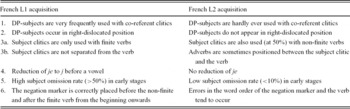
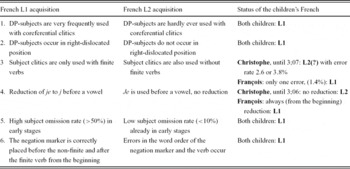
The differences between the acquisition of French as an L1 and as an L2 focused on in this article are summarised in Table 1. In the following section I briefly present some background information on the data used in this study.
Differences between French L1 and L2 acquisition.

3. The children
The data were collected by the DuFDE research group, which carried out a longitudinal study on the simultaneous first language acquisition (2L1) of German and French by preschool children living in Hamburg, Germany.Footnote 3 The children were videotaped twice a month from the age of about one-and-a-half years through the age of five and up. The recordings were transcribed and then stored electronically. French is the native language of the mothers, while the fathers' native language is German. The parents usually use their native language when talking to their children.
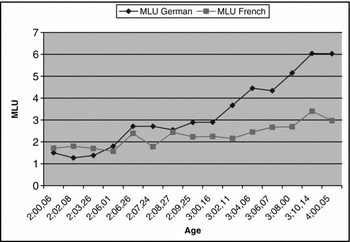
In this investigation, I use the data from François and Christophe. According to Schlyter (Reference Schlyter and Meisel1990a), French is the “weaker” language for these children, as is evidenced by the infrequent use of the language, the lower MLU value compared to German and the occurrence of at least several errors not usually seen in the L1 acquisition of French (see Schlyter, Reference Schlyter and Meisel1990b, and below in this article). François' mean MLU value at the age of 2;09–4;0 is 4.22 in German and 2.58 in French, and Christophe's mean MLU value at the age of 3;0–3;06 is 4.62 in German and 3.45 in French (see Figures 1 and 3 for the single MLU values). However, it should be noted that there is no evidence in the corpus that the children's comprehension of French is “weaker” than that of German. After the acquisition of finiteness, they understand even complex constructions. Hence, the term “weaker” language, if appropriate, can only be applied when referring to their speech production, but not to their comprehension of the respective languages.
François' MLU values in both languages.

It should be mentioned that both children often refused to speak French for several months, François at the age of 2;09–4;03 and Christophe at the age of 3;0–3;03. This is not unusual in bilingual language acquisition and can also be observed in some balanced bilingual children in the DuFDE project. However, in contrast to the balanced bilinguals, the mothers of François and Christophe often gave up speaking French with them, resulting in little French input during that period. This may account for French being the “weaker” language.
3.1 François
François has an older sister with whom he usually speaks German, but occasionally also French. According to Schlyter (Reference Schlyter and Meisel1990b, pp. 105, 119), François begins to produce auxiliaries and modals at the age of 2;07, providing evidence for the acquisition of the IP (Inflectional Phrase of the verb). He speaks very little French between the ages of 2;09 and 4;03 and his mother gradually stops speaking French with him. During this period, the MLU value is always lower than 3.0, while it increases regularly in German and reaches 6.0 at the age of 3;10 (see Figure 1). At the age of 4;0 François starts going to a German kindergarten and is now unwilling to speak any French at all. After a stay in France at the age of 4;03, he begins speaking French again and his linguistic level increases until the end of the recordings at 5;03 (Schlyter, Reference Schlyter and Meisel1990a, p. 83). In Figure 1, I display François' MLU values in order to demonstrate the rate of his language development.Footnote 4
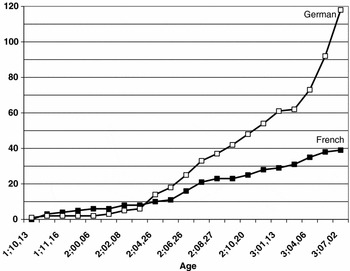
Another possibility for measuring his language development is to count the number of different verbs which are documented in the corpus. Since verbs represent one of the central units of my analysis, the verb is an appropriate category for assessing the rate of acquisition. Furthermore, verbs are usually used at a stage of language development when the children combine words. To illustrate the development of François' verb lexicon, I present Figure 2, taken from Rieckborn (Reference Rieckborn2006, p. 9).
Number of different verb types used by François (Rieckborn Reference Rieckborn2006).

Figure 2 illustrates that François uses approximately the same number of verb types in both languages in the early stages of his linguistic development. Starting at the age of 2;05, he produces a significantly larger number of verb types in German than in French. Hence, the number of different verbs produced in the recordings confirms the results of the MLU values, according to which François' language development progresses more slowly in French than in German. The development of his German is comparable to that of the balanced bilinguals or monolinguals (see Schlyter, Reference Schlyter and Meisel1990a, p. 83; Bonnesen Reference Bonnesen2005).
3.2 Christophe
Christophe is also a second child. He usually speaks German with his older brother. Christophe speaks French with his mother up until the age of 2;06 and his MLU value in French corresponds to that for his German. According to Schlyter (Reference Schlyter and Meisel1990a, p. 82; Reference Schlyter and Meisel1990b, p. 113), French becomes his “weaker” language starting at the age of 2;06. His use of French decreases gradually until the age of 3;0 and his mother often gives up trying to speak French with him. From the age of 3;03, after the family visited relatives in France, Christophe begins to speak French again. Up until the age of 3;09, Christophe is willing to speak French. His French gradually decreases again, starting at the age of 3;10, at which point the recordings were made only every three months (see Schlyter, Reference Schlyter and Meisel1990a).
At the age of 2;10, just before the point at which Christophe almost totally refuses to speak French, there is evidence that he has acquired finiteness (see Bonnesen, Reference Bonnesen2006, Reference Bonnesen2007). According to Parodi (Reference Parodi and Meisel1990, p. 186), Christophe produces subject clitics frequently from the age of 3;04, which, according to Kaiser and Meisel (Reference Kaiser, Meisel, Fanselow and Olsen1991), among others, can be interpreted as evidence for the acquisition of the IP.
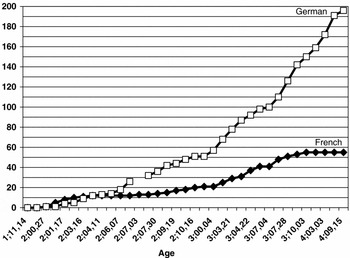
The MLU value of 3.15 derived from the recording at the age of 3;03 indicates that his French had in fact progressed throughout the period in which he spoke hardly any French at all. However, this MLU value is remarkably low compared to that for his German. Figure 3 displays his MLU values. Figure 4, taken from Rieckborn (Reference Rieckborn2006, p. 8), presents the different verbs as a further aspect of his language development.
Christophe's MLU values in both languages.

Number of different verb types used by Christophe (Rieckborn Reference Rieckborn2006).

In contrast to his French, Christophe's German progresses regularly and is comparable to that of the balanced bilingual children from the DuFDE-Project or to monolingual children (cf. Bonnesen Reference Bonnesen2005; Schlyter, Reference Schlyter and Meisel1990a, p. 82).
In the following section, I analyze the “weaker” language of the two unbalanced children in order to determine whether the language is more comparable to an L1 or an L2.
4. Results
4.1 The “weaker” language in François' corpus
François produces his first finite utterances at the age of 2;06,26, as seen in Bonnesen (Reference Bonnesen2006), where I argue that he has acquired finiteness at around the age of 2;08. The examples in (3) present those first finite utterances.
- (3)
a.
“Can one put one more?”
b.
c.
Flo it has broken
“Flo broke it.”
d.
“It is finished.”
e.
f.
“She is there.”
g.
“It is gone.”
François produces five finite utterances with subjects and four without subjects at the age of 2;06,26. His subject omission rate is actually always situated around 50% up until the age of 3;06. Some examples of subject omissions are presented in (4).
- (4)
a.
goes not
“It does not work.”
b.
has eaten
“He has eaten.”
c.
“It is also gone.”
d.
has everything broken
“He has broken everything.”
e.
pricks not
“It does not prick.”
f.
want to-have more
“I want to have more.”
g.
go it find
“He will find it.”
h.
“This is a hat for him.”
i.
“I'm not doing it.”
j.
“He has eaten well.”
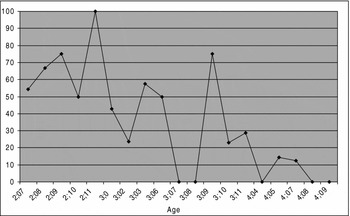
François shows a high subject omission rate when producing his first finite verbs, a behavior also typical of L1 learners in this respect. However, it is striking that this high omission rate is stable for about one year, whereas the subject omission rate in L1 usually approaches zero percent soon after the acquisition of finiteness (see Roeper and Rohrbacher, Reference Roeper and Rohrbacher1994; Granfeldt and Schlyter, Reference Granfeldt, Schlyter, Cantone and Hinzelin2001, Reference Granfeldt, Schlyter, Prévost and Paradis2004, among others). This observation can be interpreted as evidence that his acquisition is indeed delayed. Figure 5 illustrates his use of subject omissions.
François' subject omission rate in percent in French.

I now turn to François' use of subject clitics. There are 71 utterances in the corpus in which he produces subject clitics. He places the clitics appropriately in preverbal position in 70 cases. In only one utterance does he produce a subject clitic without a finite verb:
(5)
“Yes, me afterwards, that's all.”
Thus, his error rate of 1.4%, based on only one mistake, is negligible.
Apart from the utterance displayed in (5), François always uses strong pronouns in non-finite constructions, as in (6).
- (6)
a.
“Me too, I want a car.”
b.
“I want to do it there.”
c.
“He is also eating.”
d.
“I don't want any more.”
e.
“Not me.”
One can conclude, then, that François analyzes strong and clitic pronouns differently, as required by the target language. Clitic pronouns are bound to the finite verb, whereas strong pronouns can occur independently of other elements as DPs.
François uses the strong pronouns toi and moi both with and without co-referent clitic subjects throughout the entire recording period, even though the use of these pronouns without co-referent clitics is not grammatically correct.Footnote 5 This type of syntactic restriction of strong pronouns may be accounted for by an additional C(omplementizer) P(hrase) layer as proposed by Cardinaletti and Starke (Reference Cardinaletti, Starke and van Riemsdijk1999), which may contain semantic or pragmatic features (see also Rizzi, Reference Rizzi and Haegeman1997, for a discussion on the CP layer of the verbal domain and Bonnesen, Reference Bonnesen2005, for a more detailed analysis of the acquisition of strong pronouns). Some examples are listed in (7).
- (7)
a.
you do
“You do it.”
b.
“I am also sleeping.”
c.
“I am doing this.”
d.
“I don't want a bed.”
e. moi viens tout
a.moment
“I'm coming in a moment.”
f.
“Do you also do it like this?!”
g.
“I'm going down now.”
h.
“I'm not telling you.”
Though the use of these strong pronouns without clitics is ungrammatical, it is a typical developmental stage found in L1 (Heinen and Kadow, Reference Heinen, Kadow and Meisel1990; Ferdinand, Reference Ferdinand1996; de Cat, Reference De Cat2000) and in 2L1 (Bonnesen, Reference Bonnesen2005). However, it is rather unusual in François' data that he has not yet moved beyond this stage at the end of the recordings, i.e. a stage which usually lasts for only a few moths in L1 and 2L1 lasts for years in his case. This could be interpreted as evidence of delayed acquisition.
François correctly uses the phonetic reduction of je before a vowel from the beginning without exception, as shown in the following examples:Footnote 6
- (8)
a.
“I have finished it.”
c.
“I was ill.”
d.
“I stayed asleep.”
e.
“I have one more plane.”
Thus, the use of the subject clitic je provides further evidence that he analyzes the subject clitics correctly from the beginning.
There are 12 utterances in which a preverbal non-pronominal DP-subject is produced. A subject clitic co-occurs in seven of these. Some examples with DP-subjects are presented in (9).
- (9)
a.
“The ship is moving.”
b.
“The train is there.”
c.
“The car is bigger.”
d.
“Fabrice has some of this and some of that.”
e.
“And the blood goes . . .”
f.
“Yes, Monique stayed at work.”
g.
“And Monique came.”
Although the total number of preverbal non-pronominal subjects is too small to warrant a general conclusion, I wish to point out that the clitic doubling rate is 58%. This percentage is not as high as that given by Kaiser (Reference Kaiser and Meisel1994), but it is certainly compatible with the assumption that François analyzes the clitics appropriately as elements of finiteness.
Furthermore, four right-dislocations of the subject are found in the corpus:
- (10)
a.
“There goes a clown.”
b.
“I have finished it.”
c.
“Where is the piece of . . .?”
d.
needle
“Monique, where is the needle?”
The total number of clitic right-dislocations is rather low. They occur at a rate of 25%, however, when considering the small number (16) of non-pronominal subjects.
To summarize, the use of subject clitics in François' recordings corresponds with that of an L1 acquisition. With one exception (5), the clitic subject is always located before the finite verb. François uses dislocated DP-subjects and his clitic doubling rate is rather high. Furthermore, he always elides je to j' before a vowel. There is no evidence that his French should be interpreted as having the features of an L2.
I now turn to the use of negated constructions. The negation marker pas is always placed correctly after the finite verb and before the non-finite verb, from the beginning, as the following examples illustrate:
- (11)
a.
“It isn't raining.”
b.
“I haven't finished it.”
c.
“It doesn't prick.”
d.
“She cannot burn it.”
e.
“No, I don't know her.”
f.
“You should not do this.”
g.
“He is not sleeping there.”
h.
“Do not light.”
i.
“We don't play.”
j.
“I don't want a bed.”
François' use of negation, therefore, provides clear evidence that his French can be analyzed as similar to an L1 in balanced bilingualism or in monolingualism.
To summarize, the characteristics found exclusively in L2 grammars are not attested in François' corpus. His data provide clear evidence against the assumption that the “weaker” language in bilingual first language acquisition develops in the manner of an L2.
4.2 The “weaker” language in Christophe's corpus
First and foremost, it is important to note that Christophe produces very few verbs in French in the entire corpus. His subject omission rate up to the age of 2;10,16 is 38%. Apart from utterances probably representing unanalyzed chunks, such as c'est “this is”, and imitated utterances, up until the age of 2;10,16 the utterances in (12) are the only ones that contain verbs.Footnote 7
- (12)
a.
“Don't I have rice?”
b.
“Shall we go upstairs?”
c.
d.
e.
“repair it”
f.
“We sing baya.”
g.
h.
Since Christophe produces different clitics and finite verb forms, the utterances in (12) provide evidence that he has already acquired finiteness (see Bonnesen, Reference Bonnesen2006, for a detailed report on Christophe's acquisition of finiteness). However, after the age of 2;10,16 Christophe does not use finite verbs again until the age of 3;03. Actually, he produces hardly any verbs at all during this stage. At the age of 3;03 he begins to produce verbs again, but subject clitics do not occur:
- (13)
a.
“This is broken.”
b.
“No, you take this.”
c.
“I take this.”
d.
“This is green.”
e.
“I want to make a bed.”
f.
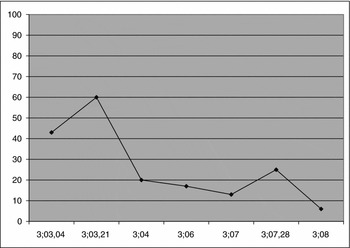
The subject omission rate at this age is 43%. Starting at the age of 3;04, Christophe begins to use subject clitics again. The subject omission rate initially decreases rather rapidly before slowing down and then decreasing more gradually.
Figure 6 displays the development of subject omissions. It shows that Christophe's subject omission rate is comparable to the rates reported in L1 acquisition (see Pierce, Reference Pierce1992; Rizzi, Reference Rizzi1993/1994; Roeper and Rohrbacher, Reference Roeper and Rohrbacher1994, among others). Christophe begins with a rather high rate of subject omissions, which decreases rather rapidly to below 20%.
Christophe's subject omission rate in percent in French.

Having presented the subject omission rate, I now turn to the use of subject clitics. There are four utterances in the whole corpus in which Christophe produces subject clitics without finite verbs:
- (14)
a.
“He left with the car.”
b.
“What kind of work do we do?”
c.
“I swim.”
d.
“The motor is broken here.”
Christophe produces 152 subject clitics in the whole corpus. Apart from the utterances presented in (14), the subject clitic is always used appropriately in the adjacent preverbal position. The error rate of subject clitics is therefore 2.6%. If one counts only the utterances until the age of 3;07,14, as clitics are always placed in front of the finite verb after this age, 105 utterances occur with subject clitics, yielding an error rate of 3.8%, which is still rather low. This is an error type which usually occurs in L2 but hardly ever in L1 acquisition of French. But the error rate is so low that it is questionable whether this value suffices as evidence for the “weaker” language to be analyzed as an L2. Constructions in which an adverb is placed between the verb and the subject clitic, as documented for the L2 acquisition of French in Granfeldt and Schlyter (Reference Granfeldt, Schlyter, Cantone and Hinzelin2001), do not occur in the corpus examined here.
I now turn to the phonetic reduction of je. Some examples of the use of the clitic pronoun je are given in (15).
- (15)
a.
b.
“I have eaten strawberries.”
c.
“I swam in the sea.”
d.
“I already have a car.”
e.
“I don't have any more.”
Before the age of 3;07, Christophe fails to reduce je to j before a vowel in three utterances, (15aI), (15b) and (15c). There is only one construction in which he follows the phonetic reduction rule, as shown in (15aIII). However, since the interviewer uses the same construction immediately before, it is doubtful that this is a productive utterance. Hence, one can assume that Christophe generally does not reduce je to j before a vowel prior to the age of 3;07. Starting at this age, however, he always uses the correct form j before a vowel. Thus, there is a stage in his grammatical development in which he behaves like an L2 learner in terms of the use of the clitic je, as such stages are usually only attested in L2 acquisition, but not in L1 acquisition of French. One could assume that Christophe has not acquired the general rule of phonetic reduction in French before the age of 3;07. However, this hypothesis is problematic because of the scarcity of the data: the only constructions in which he does not follow the reduction rule of je to j before a vowel are the three utterances displayed in (15a–c).
There are a few other examples at this stage in which he succeeds in using the target phonetic reduction of an article, shown in (16).
(16)
However, the examples in (16) are ambiguous. Children in the early stages of grammatical development sometimes misinterpret the definite article as part of the noun, e.g. they analyze l'autre “the other” as *lautre “other” and therefore produce utterances such as le *lautre instead of l'autre. These constructions are not found in the data, however. Furthermore, Christophe appropriately uses the preposition dans “in” with an article at this age:
(17)
Thus, one can conclude that he consistently uses the article with the preposition dans, which means that the phonetic reduction is used correctly in (16c) and (16d). Otherwise, one would expect to find constructions such as dans mer “in see” and dans piscine “in swimming pool”. Therefore, the question arises as to why Christophe fails to reduce je to j before a vowel in (15a–c). In (15a), there is a pause between the subject pronoun and the verb, which explains why je does not cliticize on the verb. Although this pause does not conform to the target norm, it may be due to Christophe's needing time to find the verb. This example, therefore, remains rather ambiguous. In contrast, he clearly violates the phonetic rule in (15b), as seen again in (15c), where the pronoun does not cliticize to the verb. Since Christophe obeys the phonetic reduction in (16) but not in (15a–c), it is possible that the reduction is optional in his grammar at an early stage. Another possibility is that he only violates the rule with the clitic je, indicating that the phonetic rule might be sensitive to syntactic categories. There are too few examples to propose a definitive explanation for this phenomenon. Regardless, and returning to the main goal of this paper, Christophe's French develops rather as an L1, but a few errors occur in his data which are also attested in L2 acquisition. To focus on this question, I take a closer look at the subject pronouns.
The fact that temporarily Christophe does not use the phonetic reduction/clitization of je combined with the fact that he produces a few clitics without finite verbs could be taken as evidence supporting the assumption that he analyzes the subject clitics as DPs. However, the data do not allow for a clear verdict in this matter. Apart from the four utterances in (14), Christophe always uses strong pronouns in non-finite constructions, as shown in the examples in (18).
- (18)
a.
“I'm all alone.”
b.
c.
“I'm a horse.”
d.
“I'm a baby.”
e.
“You shall do it.”
f.
g.
“And not me.”
Up until the age of 3;07,14, when the last utterance occurs in which a clitic is used without a finite verb, 29 non-finite constructions are found in which the strong pronouns are produced, i.e. a subject clitic is produced in only four out of 33 non-finite contexts with subject pronouns.Footnote 8 Thus, clitics occur in only 12.1% of the non-finite constructions with subject pronouns, while 87.9% of the subject pronouns are strong pronouns. By contrast, Christophe produces more than three times as many clitic subject pronouns (105) than non-clitic subject pronouns (33) when counting all contexts, finite and non-finite. Therefore, the frequency of the pronouns cannot account for the fact the he uses a far larger number of strong pronouns in non-finite constructions than clitics, i.e. if the clitic and the strong pronouns were analyzed in the same way, one would expect to find more clitics in both contexts, finite and non-finite. Hence, one can conclude that Christophe does not analyze the clitic pronouns as elements equivalent to the strong pronouns. Rather, he realizes from the beginning that strong pronouns must be used instead of subject clitics in non-finite constructions. The clitic subject rate of 12.1% in non-finite contexts with subjects is comparable to that given in Rasetti (Reference Rasetti, Friedemann and Rizzi2000), who analyzed the use of subjects in infinitives in L1 French of six learners. In his data, 85 subjects are produced in infinitives. In 10 of these or 11.8%, the subject is a clitic.
Christophe uses the strong pronouns toi and moi with and without coreferent clitic subjects until the end of the recordings. As in François' corpus, this variation could be interpreted as evidence of delayed acquisition.
I have argued above that Christophe has indeed recognized that the clitic subjects are markers of finiteness. He actually behaves just like L1 learners with respect to the use of non-pronominal DP-subjects. He generally produces a coreferent clitic subject when using a DP-subject. There are seven utterances in the corpus in which a DP-subject occurs. In five of them, (19a, b, d, f, g), he also produces a subject clitic:
- (19)
a.
“My puppet is inside there.”
b.
“The wheelbarrow goes ‘brrrrrr’.”
c.
“The restaurant is here.”
d.
“The motor is broken here.”
e.
“The little piglets stay at home.”
f.
“They all sleep.”
g.
“Caroline doesn't run.”
The clitic doubling rate is 71.4%, which is nearly identical to the rate of 74% given by Kaiser (Reference Kaiser and Meisel1994) for the balanced 2L1 acquisition of French and German. Additionally, several subject right-dislocations can also be found in the corpus:
- (20)
a.
“Where is mama?”
b.
“Where is the other violin?”
c.
“Where is the sea?”
d.
“Where is the car?”
e.
he sleeps the dog
“The dog is sleeping.”
To summarize Christophe's use of subject clitics, one can say that the examples given provide evidence that he analyzes the clitic subjects as clitic elements from the beginning. In non-finite constructions, he mainly uses strong pronouns instead of clitics. The clitics usually double DP-subjects and subject right-dislocations occur. However, he does not use the phonetic reduction of je to j before vowels at a certain age (see examples in (15)) and, although the error rate is rather low, there are some utterances in which clitics are used in non-finite contexts. However, his use of subject clitics provides overall evidence suggesting that his French develops in the manner of an L1 in balanced bilingualism or monolingualism.
In order to gain a clearer view of Christophe's “weaker” language, I now turn to the use of negation. There are 20 negated constructions in Christophe's corpus. Some examples are listed in (21).
- (21)
a.
“I am not playing with you.”
b.
“No, he doesn't slap.”
c.
“You don't cut.”
d.
“No, I'm not ringing you.”
e.
“I cannot tidy up.”
f.
“He doesn't go to the swimming pool.”
g.
“This is not for sleeping.”
Christophe nearly always places the negation marker in the correct position from the beginning: in 19 out of 20 constructions, pas is correctly placed after the finite verb. There is only one error in the whole corpus, (21f), where he places pas after the object. However, the negative marker is not placed in preverbal position as in L2. Therefore, his use of negation can be taken as clear evidence that his French has the status of an L1.
To summarize, Christophe's subject omission rate, his rate of clitic doubling and the use of negation provide clear evidence that his French has the features of L1 acquisition. Furthermore, he obviously analyzes subject clitics as bound to finiteness. However, he produces a few constructions in which clitics occur without finite verbs and passes through a stage in which he does not reduce je before a vowel. Tus, his use of language does not correspond to L1 monolingual acquisition in every respect.
5. Summary
Table 2 summarizes the results of the investigation.Footnote 9 The results for both children show that the “weaker” language does not exhibit the characteristics typically found in L2. Both children exhibit a high DP-subject clitic doubling rate and some DP-subject right-dislocations also occur. When the children produce the first verbs, they often omit the subjects, as seen in L1 acquisition. There are hardly any errors in the placement of the negation marker. Therefore, on the whole, the data provide clear evidence that the “weaker” language is acquired in the manner of an L1. However, Christophe's use of subject clitics could be interpreted as evidence of his French being similar to an L2. He produces four constructions in which a clitic subject occurs without a finite verb and goes through a stage in which he does not reduce the clitic pronoun je to j' before a vowel.
The results.

The question may arise as to whether Christophe misanalyzes the clitic subjects as strong pronouns at a certain stage, as is the case with L2 learners. However, considering that his DP-subject clitic doubling rate is rather high (58%) and that he usually uses the strong pronoun in non-finite contexts, one can draw the conclusion that he appropriately analyzes the subject clitics as bound elements from the beginning. Since his error rate of clitics in non-finite contexts is only 2.6% when taking the whole corpus into consideration, or 3.8% if only the recordings until the age of 3;07,14 are considered (this error type does not occur after this age), I assume that these errors are negligible and do not define the child's process of acquisition. In contrast, he hardly ever reduces je to j' in the early stages of development. A plausible assumption would be that he analyzes the clitic subject pronouns as syntactically bound elements, but that he has not yet acquired the phonetic rule of vowel reduction in French. But since the phonetic rule is correctly applied with respect to the article and the noun, I can only conclude that the data are insufficient to support a definite conclusion with respect to phonetic errors. It is important to remember that there are only three examples in which je is not reduced to j before a vowel, all three in only two recordings between the ages of 3;04 and 3;06. After 3;06 this error no longer occurs.
In François' corpus, there is no evidence that his French has the features of L2 acquisition, i.e. characteristics exclusive to an L2 are not found. Therefore, my conclusion is that the “weaker” language and the stronger language develop as L1s. However, since there are different degrees of “weakness” of a language in bilingual acquisition, there might be cases in which one finds more evidence for a “weaker language” to evidence the features of an L2 (see the discussion on the Critical Period Hypothesis (CPH) in section 1), as the data examined in Schlyter (Reference Schlyter, Hyltenstam and Vilberg1993, Reference Schlyter1994) indicate. In this respect, it may be helpful for future research to focus on the age at which a language becomes “weaker”. Weakness at the age of three years old, when usually most parts of the core grammar have already been acquired, is perhaps less problematic than weakness at the age of two. The age factor may indeed account for the differing results found in the Schlyter study and the present study. Thus, the present research is related to the CPH, according to which some parameters can only be set before a certain age. Likewise, I propose that when a certain level of weakness is reached, a parameter can no longer be set. Therefore, an important research question is whether the percentage of L2-specific errors increases in inverse proportion to the age at which one of the languages of the bilingual becomes “weaker”.
Another important issue which could hardly be addressed in the present study is the amount of input resulting in a “weaker” language. It should be clear that a reduced input must, to a certain degree, result in language weakness. This is also indicated in the data examined in the present study, as both mothers often gave up speaking French with their children at a certain age. Future data collections and research on bilingualism should therefore also focus on the precise way in which and the extent to which the children receive input. This kind of information should be documented throughout the entire recording period.