Introduction
One's ability to competently participate in social interaction is ordinarily taken for granted: we treat others as capable of understanding and producing meaningful social actions. However, this assumption of competency may be suspended in interactions with categories of people who might not be seen as “bona fide members” (Garfinkel Reference Garfinkel1967) of a speech community, such as, young children and other novices (including “foreigners” and “nonnative” language speakers). While one's identity as a novice speaker of a language, for example, may appear to be relatively stable across social occasions, it is enacted in interactions with others through a range of communicative practices that expose one's relative incompetence. For Garfinkel (Reference Garfinkel1967), competence refers to a member's entitlement to manage “everyday affairs without interference” (57). This article analyzes one form such “interference” can take and describes how it makes salient participants' divergent language competencies. Specifically, the focus is on a conversational practice of repair resolution that consists of one interlocutor brokering (or mediating) understanding problems that are—demonstrably—rooted in participants' divergent linguistic (and sometimes more broadly conceived cultural)Footnote 1 expertise. Using the methodology of conversation analysis to investigate mundane conversations in Russian-American immigrant families, this study aims to further our understanding of the interactional construction of linguistic and cultural competence in bilingual/immigrant communities, on the one hand, and the organization of repair, on the other.
In recent years, the notion of competence—including language expertise—as a cognitive attribute of an individual has been challenged on a variety of grounds (e.g. Firth & Wagner Reference Firth and Wagner1997). It has been argued, for example, that language expertise needs to be seen not as an essentialist and omnirelvant property of an individual—an exogenous category that has a universally explicatory value—but as a constructed and negotiated feature of social interaction (Seedhouse Reference Seedhouse1998; Hosoda Reference Hosoda2003; Mori Reference Mori2003; Egbert Reference Egbert2004; Mondada Reference Mondada, Gardner and Wagner2004). Research into interactions with nonnative speakers (e.g. Hosoda Reference Hosoda2003; Mori Reference Mori2003; Egbert Reference Egbert2004; Mondada Reference Mondada, Gardner and Wagner2004; Kurhila Reference Kurhila2006; Seo & Koshik Reference Seo and Koshik2010) has shown that just because interlocutors can be characterized as language novices, their relatively low linguistic expertise is not necessarily—or at all times—relevant to or consequential for how an interaction unfolds. This suggests that the “relevance” and the “procedural consequentiality” (Schegloff Reference Schegloff, Boden and Zimmerman1991) of low language expertise needs to be demonstrated in the details of participants' own conduct rather than presupposed by the analyst (cf. Sacks Reference Sacks and Sudnow1972; Wong & Olsher Reference Wong and Olsher2000). Studies that have examined language expertise (and the associated identities of a “novice” and “expert” language speaker) from this emic (i.e. participant-centered) perspective have found that participants' orientations to language (in)competencies may become evident when mutual understanding is threatened, especially when interlocutors deal with problems of hearing, speaking, or understanding by engaging in conversational repair. (This literature is reviewed in a later section.) This article furthers this line of research by describing additional ways in which repair activity can expose participants' orientations to their divergent linguistic and cultural expertise.
While the vast majority of research on novice language speakers is conducted in pedagogical settings, the findings presented here are based on a close analysis of everyday face-to-face conversations between Russian-American immigrant family members and friends (see Data and Method for more information). Consistent with the intergenerational language shift documented in many immigrant communities in the US (e.g. Fishman Reference Fishman1978; Veltman Reference Veltman1983; Zemskaia, Glovinskaia, & Bobrik Reference Zemskaia, Glovinskaia and Bobrik2001; Alba, Logan, Lutz, & Stults Reference Alba, Logan, Lutz and Stults2002), the older family members in my data are dominant in the language of their native country (i.e. Russian) while the younger members are stronger in the language of the immigrant country (i.e. English). In many immigrant communities, the levels of competency in the immigrant and heritage languages are seen as central to one's cultural identity (e.g. Fishman Reference Fishman1978; Zentella Reference Zentella, Hoyle and Adger1998; Broeder & Extra Reference Broeder and Guus1999). Both the maintenance of the heritage language(s) and the learning of the immigrant language(s) are intimately linked to processes of acculturation and cultural assimilation (Schumann Reference Schumann1986; Remennick Reference Remennick2003). In immigrant communities, heritage language maintenance may be driven by and seen as an intrinsic part of the preservation of the heritage culture, while language loss might be equated with the loss of culture. The symbolic connection between language competence and cultural membership may manifest itself in everyday interactions in a variety of ways. For instance, as Nishizaka (Reference Nishizaka1995) shows, assessing your interlocutors' language proficiency is one practice for invoking the addressee's identity as a “foreigner” and one's own identity as a “native.” Relatedly, Kitzinger & Mandelbaum (Reference Kitzinger and Mandelbaum2008) demonstrate that to display knowledge of a specialized vocabulary (e.g. a professional jargon or slang) is to make a claim about your own and your interlocutors' sociocultural identities (cf. sociolinguistic research into specialized languages of subcultural groups, such as Widdicombe & Wooffitt (Reference Widdicombe and Wooffitt1995), Russell & Murray (Reference Russell and Murray2004), Bucholtz (Reference Bucholtz, Monaghan and Goodman2007)). Additionally, participants may explicitly ascribe gaps in language competence to a cultural group membership (Egbert Reference Egbert2004). We will see here that asymmetries in both language and cultural expertise can become exposed when one interlocutor takes on (or is enlisted into) the role of a language broker to translate, paraphrase, or explain problematic talk of another party.
This article advances our understandi of how conversational repair is organized and, especially, how it is organized in a relatively unexamined domain: interactions that involve more than two interlocutors. The availability of more than two “ratified participants” expands opportunities for their participation in conversational activities (e.g. Goffman Reference Goffman1981; Goodwin Reference Goodwin, Atkinson and Heritage1984; Lerner Reference Lerner1992, Reference Lerner1993; Schegloff Reference Schegloff, Have and Psathas1995), including their participation in conversational repair (Egbert Reference Egbert1997; Bolden Reference Bolden2011). Repair is ordinarily a dyadic exchange organized by reference to two local identities: the speaker of the problematic talk and the (typically, addressed) recipient (Schegloff, Jefferson, & Sacks Reference Schegloff, Jefferson and Sacks1977). I show that, in interactions involving more than two participants who may be seen as having asymmetrical linguistic and cultural competencies, a person who is neither the speaker of the problematic talk nor the addressed recipient has a systematic opportunity to participate in the repair sequence as a “broker.” To broker a (potential) problem of understanding is to act as an intermediary between the other participants (i.e. between the speaker of the problematic talk and his/her addressed recipient) and to attempt to resolve the problem in a way that would expose and bridge participants' divergent linguistic and/or cultural expertise—for instance, by providing a translation or a simplified paraphrase of the problematic talk.Footnote 2 Unlike some institutional contexts (such as medical offices or courtrooms), where the role of a language broker may be assigned to and occupied by a particular individual (e.g. a language interpreter), in ordinary conversation one or another participant can momentarily inhabit this role. The findings presented here will bring to light the role of socially distributed rights to knowledge—or social epistemics (e.g. Raymond & Heritage Reference Raymond and Heritage2006)—in the organization of repair.
In what follows, I briefly discuss the data and methodology used in the study and review prior research on how conversational repair can make salient language asymmetries among interlocutors. Then, I analyze how third persons can be (a) enlisted into and (b) volunteer to enact the role of language brokers for the purposes of resolving (actual or potential) understanding problems and how such brokering displays participants' orientations to their divergent language/cultural competencies.
Data and method
The data for this article come from a corpus of everyday, unscripted video-recorded face-to-face interactions between family members and friends who are immigrants from the former Soviet Union currently living in the United States. Recordings come from several families (a total of approximately forty hours). The participants in the study fall into the following three generations (marked on the transcripts with subscript numerals 1, 2, and 3): (i) Children1 (college age) came to the United States when they were between 1–4 years of age; based on the collected recordings,Footnote 3 their primary language is English, but they have proficiency in spoken Russian as well; (ii) Parents2 (and others of the same generation) immigrated to the United States as adults and have lived in the US for fifteen to twenty-five years; their primary language is Russian but they have a very good command of English; (iii) Grandparents3 (and others of the same generation) have also lived in the US for fifteen to twenty-five years; their primary language is Russian, and they have a somewhat limited proficiency in English. In some recordings, friends' and children's romantic partners (some of whom are monolingual English speakers) are also present. For this article, interactions that include at least three participants were selected (the maximum number of participants in recorded interactions is eight).
All data were transcribed and analyzed using the methodology of Conversation Analysis (Heritage Reference Heritage1984). In line with this methodology, sequences of talk in which interlocutors orient to linguistic and cultural asymmetries among them were collected and analyzed. A subcollection of (approximately forty) instances whereby more than two interlocutors engage in resolving problems of understanding was analyzed.
Overview of the research on repair and the procedural consequentiality of language competencies
Conversational repair refers to a set of practices for dealing with problems of hearing, speaking, and understanding talk (Schegloff et al. Reference Schegloff, Jefferson and Sacks1977). In describing the repair machinery, Schegloff and colleagues (1977) distinguish between “repair initiation” and “repair solution” and between “self” (the speaker of the problematic talk) and “other” (the recipient). The initiation of repair (by either self or other) suspends the ongoing course of action until the problem (“the trouble source” or “the repairable”) is dealt with. Once the repair solution is provided (by either self or other), the interrupted course of action is resumed. Based on who initiates repair and who provides the repair solution, distinctions are made between self-initiated self-repair (the speaker initiates and resolves the repair, typically in the same turn, e.g. when one word is replaced with another), self-initiated other-repair (the speaker initiates repair, but a recipient provides a solution, e.g. when a searched-for word is provided by another participant), other-initiated self-repair (a recipient initiates repair, e.g. with What?, and the trouble-source turn speaker resolves it), and other-initiated other-repair (a recipient initiates and resolves the repair, e.g. by correcting something in the other person's talk).
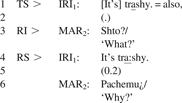
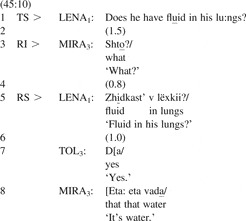
Conversational repair thus addresses problems of intersubjectivity, including those that may be rooted in cultural and linguistic differences between the participants. Prior research has shown that the organization of repair sequences may expose participants' orientations to their divergent linguistic expertise. For instance, speakers' orientations to their interlocutor's identity as a language novice can be displayed in how they respond to other-initiated repair: for example, trouble-source turn speakers may translate the problematic talk into another language (Egbert Reference Egbert2004). This repair operation is illustrated in Excerpt (1), taken from a conversation between Lena and her grandparents, Mira and Tolik. Mira has been telling Lena about Tolik's (referred to as “he” at line 1) upcoming appointment with a cardiologist. (TS stands for trouble source, RI for repair initiator, and RS for repair solution. Transcription conventions can be found in the appendix.)
Lung fluid (I5a)

Mira initiates repair on Lena's question (produced in English) with a Russian “open class” (Drew Reference Drew1997) repair initiator Shto? ‘What?’ (line 3). Open class repair initiators (such as What?, Huh?) are not specific about the kind of trouble their speaker experiences and are commonly responded to with (modified) repeats of the trouble-source turn (Schegloff et al. Reference Schegloff, Jefferson and Sacks1977; Drew Reference Drew1997; Schegloff Reference Schegloff2004; Robinson Reference Robinson2006). Here, Lena produces a close translation of her English-language trouble-source turn into Russian as a repair solution, which indicates her orientation to Mira's repair initiator as indexing a problem of understanding the language of her turn (i.e. English).Footnote 4 Note that Lena translates not the entire trouble-source turn but only its key component (‘fluid in his lungs’), thus suggesting that the recipient's problem is limited to understanding this rather technical English term (Kitzinger & Mandelbaum Reference Kitzinger and Mandelbaum2008). Thus, the way in which Lena responds to the repair initiation displays the procedural relevance of interlocutors' linguistic expertise and, specifically, Mira's culturally bound identity as a nonproficient English language speaker.
Researchers have identified a number of other repair-related practices that expose linguistic differences among interlocutors, including the following: Language novices may produce ordinary lexical items with rising intonation in order to elicit confirmation or correction from a more proficient speaker (Hosoda Reference Hosoda2003); Pronunciation, grammar, and lexical choices of language novices may, on occasion, be corrected by other (more expert) interlocutors (Norrick Reference Norrick1991; Kurhila Reference Kurhila2006); Cultural and linguistic differences among interlocutors may be topicalized after repair is resolved (Egbert Reference Egbert2004).
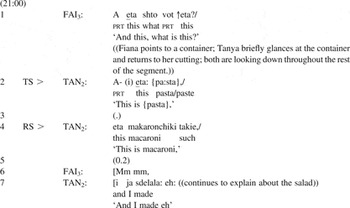
Participants' monitoring of their own talk for potential sources of mis- or nonunderstanding may also reveal their orientation to differences in their linguistic expertise (Ikeda Reference Ikeda2007; Greer Reference Greer2008; Kitzinger & Mandelbaum Reference Kitzinger and Mandelbaum2008). For example, in Excerpt (2), Tanya treats a momentary silence (line 3) as indexing her addressee's problem in understanding an English word (‘pasta’ in line 2). Tanya and her mother-in-law Faina are in the kitchen, preparing a holiday meal. Tanya is cutting up some ingredients. Faina is asking about a salad that Tanya is making. (Curley brackets mark a borrowing from another language.)
Pasta (O16)

In response to Faina's question, Tanya uses the word ‘pasta’ (line 2). In Russian, this word means paste, but Russian immigrants in the US often use it as an English borrowing to refer to pasta products. When Faina does not acknowledge Tanya's response in any way (see the micropause at line 3), Tanya goes on to reformulate her answer, using a Russian word for a kind of pastaFootnote 5 (makaronchiki ‘macaroni,’ line 4). Tanya's self-initiated self-repair (via translation from English to Russian) indicates that she monitors her speech for potential understanding problems, and specifically for potential problems having to do with her interlocutor's limited expertise in English. The way Tanya repairs her talk displays procedural consequentiality of divergent linguistic expertise of the two interlocutors.
It might be tempting to believe that in a conversation that involves interlocutors with divergent levels of linguistic expertise, a low proficiency in the language is an omnirelevant concern. Research shows, however, that this is not the case (Hosoda Reference Hosoda2003; Mori Reference Mori2003; Seo & Koshik Reference Seo and Koshik2010). In fact, participants may (and overwhelmingly in my data do) deal with threats to intersubjectivity as if they are not related to language differences. Space considerations prevent a discussion of repair sequences where linguistic differences do not surface (see extract (A) in note 4 for an example). However, we will see (e.g. excerpt (7)) that even when one participant is oriented to an interlocutor's low linguistic expertise, another may not be, which argues for viewing language (in)competence as an interactional accomplishment rather than an inevitable byproduct of participants' linguistic characteristics.
The existing research has, thus, identified and described a number of important ways in which participants orient to linguistic differences among them when it comes to solving problems of understanding talk. However, the vast majority of this research has been conducted on dyadic interactions, which is a limitation given that the presence of additional participants may have a profound effect on how understanding problems are resolved (relevant literature is reviewed in the analytic sections below). In interactions with three or more interlocutors, participants may act in coalition with others during repair sequences (cf. Lerner Reference Lerner1993). For example, they may enlist others—either their compatriots or more linguistically proficient speakers—in resolving speaking and understanding problems (Mori Reference Mori2003). Additionally, interlocutors may form momentary alliances along cultural lines by launching successive repair initiators on the same trouble-source turn (Egbert Reference Egbert2004).
This study advances this line of research by examining another role third persons can enact in conversational repair: a language (or culture) broker. The possibility of language brokering in the service of repair has been noted but not systematically investigated. For instance, Del Torto (Reference Del Torto2008) observed that in trigenerational interactions in immigrant families, second-generation speakers may participate in repair as translators between interlocutors belonging to the younger and the older generations.Footnote 6 Furthermore, Ikeda (Reference Ikeda2007) documented one aspect of language brokering (referred to as “teaching”) whereby a “native speaker” steps in to translate, explain, or paraphrase a potentially problematic utterance by one speaker for the benefit of another. The following analysis expands our understanding of language (and culture) brokering as a method for achieving intersubjectivity. Specifically, I demonstrate that when a recipient of some problematic talk initiates repair on it, she may enlist a third person into the role of a broker by addressing the repair initiation to them (excerpts (3) and (4)); alternatively, a third person may volunteer (or self-select; Sacks, Schegloff, & Jefferson Reference Sacks, Emanuel A. and Jefferson1974) to provide a repair solution (excerpts (5) and (6)). Moreover, third persons may repair problems in the talk of the current speaker for the benefit of the addressed recipient, thus taking on the role of a broker (excerpt (7)). The analysis demonstrates that interlocutors may deploy their divergent language and cultural expertise as a resource for expanding legitimate opportunities for participation in conversational repair.
Enlisting language brokers
One way in which participants may orient to differences in their language/culture competencies is when they enlist third persons into the role of a language broker so that they may assist in resolving an understanding problem. In this section I discuss one practice for doing so: addressing repair initiation to somebody other than the speaker of the trouble-source turn.
Ordinarily, the person who produces a problematic utterance (i.e. the trouble-source turn) is the one who is (tacitly or explicitly) selected to repair it (Sacks et al. Reference Sacks, Emanuel A. and Jefferson1974; Lerner Reference Lerner2003; Bolden Reference Bolden2011). This norm may be attributed to the conversational maxim to “speak for yourself” (Lerner Reference Lerner1996), which describes people's special right (and responsibility) to speak on their own behalf (cf. Labov & Fanshel Reference Labov and Fanshel1977; Sacks Reference Sacks, Atkinson and Heritage1984); it is also consistent with the structural preference for self-correction (over other-correction) in allowing the speaker of the trouble source to repair their own talk (Schegloff et al. Reference Schegloff, Jefferson and Sacks1977). In another study (Bolden Reference Bolden2011), I have shown that the selection of somebody other than the speaker of the trouble-source turn to provide a repair solution is motivated by two broad considerations: implementing locally distributed rights to knowledge (i.e. social epistemics) and maintaining progressivity of a course of action. Here, I examine how these considerations play out in contexts of language brokering.
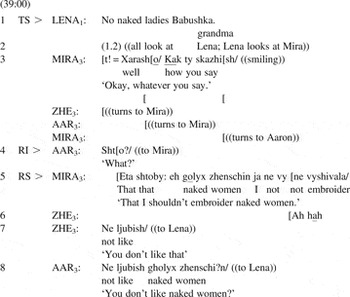
Excerpt (3) is taken from a conversation between Lena, her grandmother Mira, Aaron (Mira's brother-in-law), and his wife Zhenya. Just prior to this excerpt, Mira says that she wants to go back to doing needlework. In line 1, Lena jokingly requests that Mira not embroider any “naked ladies” (presumably, to give to Lena and her parents). This turn, which Lena produces in English, becomes the trouble source when Aaron initiates repair on it (in line 4).
Naked ladies (I7a)

Lena's turn in line 1 is a sequence-initiating action (a humorous request) that selects Mira as the next speaker (Sacks et al. Reference Sacks, Emanuel A. and Jefferson1974; Lerner Reference Lerner2003).Footnote 7 Following a gap in line 2 (which indicates some problem with this request), Mira finally responds with compliance (in Russian, line 3), thus displaying her understanding of what Lena has said. Towards to end of her response (line 3), Mira turns to Aaron (who is now looking at her), and Aaron immediately initiates repair with an open-class repair initiator Shto? ‘What?’ line 4). Via accompanying gaze (Lerner Reference Lerner2003), the repair initiation selects as the next speaker not the speaker of the trouble source (Lena), but Mira. Mira then immediately (line 5) provides a repair solution in the form of a Russian-language translation of Lena's trouble-source turn. Note that Aaron's selection of Mira to deal with the trouble source takes place after Mira's displayed understanding of Lena's words (in line 3). By selecting Mira (rather than Lena) to provide a repair solution, Aaron (i) displays his treatment of Lena as potentially being unable to provide an acceptable repair solution (thus, orienting to her low proficiency in RussianFootnote 8), (ii) casts himself as potentially lacking linguistic expertise to understand Lena's repair solution (if it were provided via an English language paraphrase, for example), and (iii) casts Mira into the role of a language broker capable of acting as an intermediary between the two languages. Thus, by addressing his repair initiation to a third person, Aaron makes the participants' divergent linguistic expertise procedurally relevant to this moment in interaction. This analysis is supported by Mira's choice to provide a Russian-language translation of Lena's problematic talk in response to Aaron's initiation of repair and not, for instance, to repair her own immediately preceding turn (as is ordinarily done in response to open class repair initiators). This demonstrates Mira's understanding that the trouble Aaron experiences has to do with his limited understanding of English (as in (1)). Following Mira's repair solution (line 5), Aaron goes on to question (and thereby challenge) Lena's grounds for her initial request (line 8).
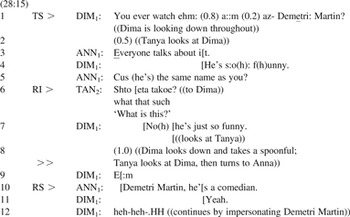
In excerpt (4), a third person is also selected as a language/culture broker after the speaker of the trouble source turn fails to respond to the repair initiation. In line 1, Dima starts a new topic by asking his sister Anna a question about an American comedian, using a recognitional person reference form “Demetri Martin” (Sacks & Schegloff Reference Sacks, Emanuel A. and Psathas1979; Schegloff Reference Schegloff and Fox1996). Their mother Tanya is also present.
Demetri Martin (O10)

Several seconds into the discussion of Demetri Martin, Tanya initiates repairFootnote 9 and addresses it (via gaze) to Dima, thus selecting him as the next speaker (cf. Lerner Reference Lerner2003). The repair initiator Shto eta takoe? ‘What is this?’ or ‘What does that mean?’ (line 6) is designed to index a general problem of understanding, leaving it up to the recipient to figure out what sort of repair solution will adequately resolve the problem. Given its placement, the repair initiation appears to target the recognitional reference Demitri Martin (or perhaps the entire preceding stretch of talk) as the source of nonunderstanding. The repair initiation gets almost entirely overlapped by Dima's response to Anna's preceding question (lines 5 and 7), which raises the possibility that Dima may not have heard what Tanya said to him (though his brief gaze at Tanya in line 7 suggests that he heard her speaking). Having responded to Anna (line 7), Dima puts a spoonful of food in his mouth (line 8). Seeing this as a sign that Dima will not respond to the repair initiation, Tanya turns her gaze to Anna (line 8), thereby now selecting her as the next speaker tasked with providing a repair solution. By choosing to select another interlocutor when the initial repair initiation has failed, Tanya displays an orientation to the progressivity of the repair activity (Stivers & Robinson Reference Stivers and Robinson2006; Schegloff Reference Schegloff2007; Bolden Reference Bolden2011). At the same time, the selection of Anna as the next speaker treats her as capable of providing an adequate repair solution (observe that Anna has shown her understanding of Dima's trouble-source turn by responding to him in line 3). In other words, Tanya selects Anna to speak on Dima's behalf as his repair consociate (cf. Lerner Reference Lerner1992), putting her in a position to mediate the problem.
As a repair solution (line 10), Anna first repeats the name Demetri Martin and, then, immediately explains who the person is by providing a categorical identifier (‘comedian’). The repeat treats Tanya's repair initiation as indexing a failure to hear or to “register” the name, and the categorical identifier ‘comedian’ treats the provided name as a nonrecognitional for Tanya and thereby attributes Tanya's nonunderstanding to her lack of relevant pop-cultural knowledge. In this way, Anna enacts the role of a (pop)culture broker for Dima and Tanya. Dima accepts the first part of Anna's repair with ‘Yeah’ (line 11) and then, without any further uptake of Anna's repair solution, goes on to impersonate one of the comedian's jokes (line 12). Note that both in this excerpt and in the previous one (excerpt (3)), the speakers of the trouble-source turns (Lena and Dima respectively) tacitly consent to others doing repair “for them” by letting the repair solutions stand uncontested.Footnote 10
In this section, we examined cases in which one interlocutor selects a particular other to broker an understanding problem. While ordinarily, the speaker of a problematic utterance has the right (and the obligation) to repair his or her own talk, the examples above demonstrate that other interlocutors can be recruited into the role of language (or culture) brokers. By enlisting a third person into the role of a broker, the repair initiator shows that the selected person has relevant linguistic (or cultural) expertise to provide a repair solution—expertise that had been locally demonstrated by their engagement with the trouble-source turn. The foregoing analyses of excerpts (3) and (4) point to the possibility that intersubjectivity problems that are rooted in interlocutors' linguistic (or cultural) (in)competencies might be collectively resolved by individuals acting in concert as a single “party of experts” (Lerner Reference Lerner1993; Schegloff Reference Schegloff, Have and Psathas1995).Footnote 11 Thus, when a repair initiator selects somebody other than the trouble-source turn speaker to provide a repair solution, she treats that third person as a spokesperson for the trouble-source turn speaker (capable of brokering the problem), and when this third person provides a repair solution, she complies with this role. Furthermore, when the trouble-source turn speaker concedes her rights to repair her own talk, she sanctions the other person as her repair consociate (see also Bolden Reference Bolden2011).
Stepping in as a language broker
In the previous section's examples, a third person was selected to resolve a problem of understanding by other participants in a conversation. This section shows that an unselected third person may also step in to mediate an actual or a potential understanding problem. Two contexts are examined. First, in other-initiated repair sequences, somebody other than the trouble-source turn speaker may self-select to respond to a repair initiation (excerpts (5) and (6)). Second, an unaddressed recipient of some potentially problematic talk may step in to preemptively resolve the problem for the addressed recipient (excerpt (7)).
Resolving understanding problems following an other initiation of repair
As discussed in the previous section, ordinarily, by initiating repair on another's talk, the repair initiator (tacitly) selects the trouble-source turn speaker as the next speaker (Sacks et al. Reference Sacks, Emanuel A. and Jefferson1974; Lerner Reference Lerner2003). Discussing next-speaker selection, Lerner (Reference Lerner2003) writes: “In locating a trouble source in the prior turn, next-turn repair initiators are directed to matters of that turn's production, and therein (when not addressed elsewhere) directed to that turn's producer as the one participant ordinarily entitled to complete the repair (though not necessarily the only participant capable of doing so)” (195). In fact, Egbert (Reference Egbert1997) demonstrated that when somebody other than the speaker of the trouble-source turn responds to the repair initiation (first), other interlocutors act in ways that display their orientation to the trouble-source turn speaker as the proper respondent (e.g. the trouble-source turn speaker will provide another repair solution). However, my data (illustrated below) suggest that when repair initiation exposes a linguistic problem, interlocutors might not orient to this next-speaker selection rule (unless an explicit addressing technique, such as gaze, is used). Instead, the repair initiation might be understood as having been directed to any incumbent in the “party of language experts” (cf. Sacks et al. Reference Sacks, Emanuel A. and Jefferson1974:718; Lerner Reference Lerner1993). By offering a repair solution, a third person (who is not the speaker of the trouble source) enacts the role of a language broker between the initiator of the repair and the trouble-source turn speaker.
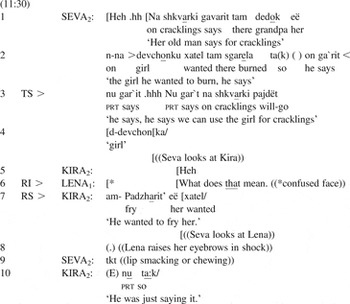
Excerpt (5) is taken from a conversation between Lena and her parents, Kira (mom) and Seva (dad). On Kira's request, Seva has been retelling events of a Russian TV drama series (about World War II) that he watches and Kira doesn't.
Cracklings (I6a)

In line 1, Seva sets up to report a phrase from the show that he finds humorous. After a parenthetical explanation (line 2), Seva returns to the report of the humorous phrase, ‘We can use the girl for cracklings’ (meaning, apparently, that they can cook and eat the girl; lines 3–4). This telling is addressed to both Kira and Lena, as Seva moves his gaze between the two as he speaks. In response, Kira briefly laughs (line 5), claiming her understanding. Lena, however, fails to understand what Seva has said, as evident by her embodied show of confusion (eyebrows drawn together), followed by an initiation of repair (in English), ‘What does that mean.’ (line 6). When producing her repair initiator, Lena's body and face are oriented towards the space between Seva and Lena, so that both of them can be seen as having been addressed. However, the general rule of repair initiation (discussed above) is that it tacitly selects the speaker of the trouble-source turn (i.e. Seva) as the next speaker (unless something is done to override this tacit selection).
In line 7, immediately following Lena's repair initiation (i.e. with no gap), Kira produces a repair solution by paraphrasing (in a very simple Russian) Seva's immediately preceding unit of talk, thereby treating it as the trouble source (cf. Kitzinger & Mandelbaum Reference Kitzinger and Mandelbaum2008).Footnote 12 Observe that neither Kira nor Seva orient to Seva having been selected as the next speaker: Kira immediately intervenes with a conditionally relevant response (cf. Lerner Reference Lerner2002), and Seva does not go on to provide his own response to contest Kira's (see lines 8–9), as has been found in such situations (Egbert Reference Egbert1997). Moreover, Seva, who turned his gaze to Kira towards the end of his turn in line 4, continues to look at her while she produces a repair solution (line 7) rather than immediately shifting his gaze to Lena, as a selected speaker would. This lack of the participants' orientation to the applicability of the general next-speaker selection rule suggests the possibility that some problems of understanding—such as those rooted in participants' divergent linguistic expertise—are treated as “collective” problems that can be solved by any interlocutor capable of doing so. In this segment, Kira takes on the role of a language broker by providing a simple paraphrase of a Russian idiom used by Seva that had not been understood by Lena, and Seva (tacitly) concedes her that role by allowing her repair solution to stand uncontested. This is particularly striking given that Kira has no independent knowledge of (and thus no entitlement to) the narrated events (having asked Seva to tell about the show she does not watch).
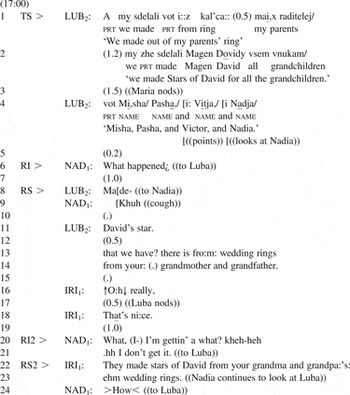
In excerpt (6), a third person takes on the role of a language broker by stepping in to provide a repair solution after the speaker of the trouble-source turn has failed in her attempts to do so. The excerpt is taken from a conversation between six people, three of whom take part in the segment: Luba, her daughter Nadia (sitting right next to her), and her niece Irina (sitting on the other side of Nadia). Across the table are Irina's mother (Maria), Luba's husband, and Luba's son (Victor). In line 1, Luba starts a new topic by telling Maria (her primary addressed recipient) about some jewelry they had made (lines 1–4 are in Russian).
Jewelry (M3-2)

While, in lines 1 through 4, Luba has been directing her talk to Maria (who is sitting across the table from her), when Luba lists her daughter Nadia as one of the recipients of the Stars of David, she looks at Nadia (the end of line 4) and holds her gaze through the gap in line 5. Nadia, having been addressed via gaze, is now put on the spot to provide a response (e.g. to assess the telling). Instead, Nadia initiates repair (in English) with ‘What happened¿” a form of repair initiation that displays little grasp of the prior talk. The repair initiator is addressed to Luba (through gaze) and selects her as the next speaker. Luba treats the repair initiator as indexing Nadia's problem in understanding Russian and haltingly translates her prior turn into English (lines 8 and 11–14). This sort of repair solution displays Luba's orientation to Nadia's relatively low Russian language proficiency.
Following Luba's repair solution, Nadia remains silent (see line 15), suggesting that she may still have failed to understand Luba's words. Irina then takes up Luba's informing as news and positively assesses it (lines 16–18). During the silence at line 19, Nadia and Luba continue to look at each other, and in line 20, Nadia initiates another repair. The new form of repair initiator (“I'm getting a what?”) is “stronger” (Schegloff et al. Reference Schegloff, Jefferson and Sacks1977) in that it displays a better grasp of the trouble source turn. Nadia then laughs (end of line 20), perhaps in embarrassment that she has not understood what is being said while others (e.g. Irina) apparently have, and then asserts her lack of understanding (‘I don't get it’ in line 21). Throughout her turn (lines 20–21), Nadia continues to look at Luba, thus apparently selecting her as the next speaker. However, it is Irina who steps in to provide a repair solutionFootnote 13 (lines 22–23) in the form of a paraphrase of Luba's trouble-source turn in more fluent (or “correct”) English. Irina's response to the second repair initiation displays her orientation to the trouble source having to do with Luba's English language expertise. By stepping in to “translate,” Irina takes on the role of the language broker between Nadia (who has displayed a procedurally relevant low proficiency in Russian with her first repair initiator) and Luba (who has displayed a procedurally relevant low proficiency in English in her repair solution). Similarly to excerpt (5), Irina's language-broker role is tacitly accepted as the conversation moves forward (see line 24) without any further attempt on Luba's part to fix the problem.Footnote 14
The two segments examined here suggest that, when a repair initiation indexes a problem of understanding rooted in participants' divergent language competencies, the speaker of the trouble-source turn may not be the only interlocutor having the right to provide a repair solution. Other participants capable of doing so (due to their linguistic expertise) might self-select to respond to the repair initiation and, thereby, enact the role of a language broker. Two pieces of evidence suggest that this mode of participation in the repair sequence is not seen as an encroachment onto the other's interactional territory (or a violation of the turn-taking system; Sacks et al. Reference Sacks, Emanuel A. and Jefferson1974): First, such responses by third persons may be offered immediately following the repair initiation in an unmitigated fashion (as in excerpt (5)), and, second, unlike parallel situations in which third persons intervene but not for the purposes of language brokering (Egbert Reference Egbert1997), other participants do not contest these responses in any way and the conversation moves forward (see excerpts (5) and (6)). This suggests that the role of a language broker may be a legitimate mode of participation in repair sequences that address intersubjectivity problems rooted in participants' divergent linguistic expertise. Trouble-source turn speakers appear to orient to the person doing the brokering as their repair consociate, tacitly sanctioning their responses (as argued in the previous section as well).
Monitoring for and repairing potential understanding problems
We have seen that a third person may step in to provide a repair solution when one of the interlocutors displays a lack of understanding by initiating repair on some bit of talk. An example presented in this section shows that unaddressed recipients monitor talk of others for potential language-based understanding problems and can step in to attempt to solve them. This monitoring is evident when a third person repairs somebody else's talk for the benefit of another participant (a form of other-initiated other-repair).
Consistent with the conversational maxim to “speak for yourself,” other-initiated other-repair (such as other-correction)—whereby a recipient repairs or corrects the speaker's utterance—is a structurally dispreferred form of repair that is quite rare in conversation (when compared to self-repair) (Schegloff et al. Reference Schegloff, Jefferson and Sacks1977). One possible exception to the dispreferred status of other-repair may be story-telling sequences during which “an ‘as-of-some-point-non-teller’ of a story … may use other-correction of the teller as a bid, or subsequently as a vehicle, for being a co-teller of the story—making, with the initial teller, a ‘team’” (Schegloff et al. Reference Schegloff, Jefferson and Sacks1977:380). In these contexts, a co-teller is a “story consociate” who has experiential access to the events being told that is equal to (or greater than) the other teller (Lerner Reference Lerner1992, Reference Lerner1993). Unlike the context of co-telling, in my data (exemplified by excerpt (7) below), the person doing repair on another person's talk has no epistemic claim to what is being said; instead, she takes on the role of a language broker to “translate” or explain what is being said to another party (the addressed recipient of the talk that is deemed problematic). In other words, a third person may license her entry into a particular action sequence by enacting relevant linguistic or cultural expertise (cf. Ikeda Reference Ikeda2007).
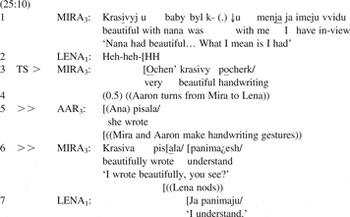
Excerpt (7) is from a conversation between Mira, Aaron (her brother-in-law), and Zhenya (Aaron's wife). Lena, Mira's granddaughter, rejoins the conversation just prior to line 1. Mira had just said to others that she used to have beautiful handwriting.
Handwriting (I7a)

When Lena returns to the table, Mira recaps for her (in Russian) what she has been talking about (lines 1, 3): her (Mira's) beautiful handwriting. A response from Lena (e.g. an acknowledgement or an assessment) is due following this announcement, but Lena remains silent (see the gap in line 4). During this gap, Aaron turns from Mira to Lena and then explains to Lena—verbally and through gesture—what Mira meant by the word ‘handwriting’Footnote 15 (line 5). Simultaneously, Mira makes a handwriting gesture and then (in line 5) incorporates Aaron's clarification into her own talk (thus tacitly accepting his repair solution; line 6). Subsequently, Lena claims understanding by nodding and saying ‘I understand’ (lines 6–7).
By stepping in to do a repair operation on Mira's turn and by choosing to paraphrase and gesturally illustrate the word “handwriting,” Aaron displays his orientation to Lena's lack of relevant linguistic knowledge and acts as a language broker. Rather than allowing Mira an opportunity to repair her own talk (according to the preference for self-repair) or for Lena to initiate repair on her own behalf, Aaron steps in and thus claims some level of entitlement to what Mira has said. Aaron's intervention suggests that interlocutors may claim rights to aspects of others' talk on the basis of their linguistic expertise. Unlike situations in which thirds persons act as co-tellers with the main teller by virtue of their shared access to the events being told (Lerner Reference Lerner1992), in examples like excerpt (7), third persons claim rights to the domain of general linguistic knowledge (rather than the particularized knowledge of the events spoken about) by providing clarifications or translations of the words used.
In this section, we examined cases where a third person (e.g. an unaddressed recipient) takes on the role of language broker either in response to a repair-initiation or as a result of his or her own monitoring of others' talk. First, other initiation of repair may be treated as directed to any of the language “experts” (rather than only selecting the speaker of the trouble-source turn; see excerpts (5) and (6)). Second, participants may use their linguistic knowledge to repair the talk of another speaker for the benefit of that speaker's addressed recipient(s) and, thus, claim some level of entitlement to the trouble-source talk (excerpt (7)). All of this suggests that participants can deploy their language expertise as a license to broker (potential) understanding problems for others. Interlocutors seem to orient to the person inhabiting the broker role as a repair consociate who can, uncontestedly, act in alliance with (or in place of) the trouble-source turn speaker.
Conclusions
This article examines mundane interactions between family and friends in Russian-American immigrant families. The focus has been on how participants resolve problems of understanding that are demonstrably rooted in their divergent linguistic (and cultural) expertise. Contributing to the extant research on the interactional construction of language (in)competence, on the one hand, and on the organization of repair, on the other, the article has described a previously unanalyzed communicative practice for solving understanding problems: by one participant enacting the role of a language (or culture) broker in a repair sequence. Several ways in which brokering can emerge have been examined. An interlocutor can be recruited into the role of a language broker by a repair initiation addressed to him or her (excerpts (3) and (4)) or he or she may step in (by self-selecting) to respond to a repair initiation addressed to the speaker of the problematic turn (excerpts (5) and (6)). Furthermore, an interlocutor may repair the talk of another speaker for the benefit of the addressed recipient (as a form of other-correction; excerpt (7)). As we have seen, all of these situations display, in various ways, participants' orientations to differences in their language (and cultural) expertise.
Prior research on the organization of repair in conversations with nonnative speakers has examined repair operations that display speakers' orientations to their addressee's relatively low language expertise (such as translations from one language to another and simplification of the trouble source). The findings presented here show that ways of participating in the repair activity are also methods for enacting linguistic and cultural asymmetries (see also Mori Reference Mori2003; Egbert Reference Egbert2004; Egbert, Niebecker, & Rezzara Reference Egbert, Niebecker, Rezzara, Gardner and Wagner2004). Even though the speaker of the problematic talk is ordinarily entitled to and responsible for carrying out repair operations on it, language brokering opens up opportunities for legitimate participation in repair sequences. The data suggest that participants may deal with understanding problems that are rooted in language asymmetries among them as “collective” problems, with the broker acting as a “repair consociate” (Lerner Reference Lerner1992, Reference Lerner1993) of the trouble-source turn speaker. More generally, the presented findings expand our—currently limited—understanding of how repair is accomplished in multiparty interaction (Egbert Reference Egbert1997; Bolden Reference Bolden2011).
In this study, brokering is examined as a role an interlocutor can enact during the repair activity for the purposes of resolving (or averting) an understanding problem. Prior research on communication in immigrant communities has identified language brokering as a role typically taken up by bilingual children to mediate between monolingual family members and outside institutions as a form of community interpreting (Morales & Hanson Reference Morales and Hanson2005) and, occasionally, as an activity one bilingual family member takes on to facilitate interactions between older and younger generations (Ng, He, & Loong Reference Ng, He and Loong2004; Del Torto Reference Del Torto2008). The findings presented here detail conversational mechanisms through which the brokering activity can be accomplished, thus contributing to an understanding of interactional processes involved in doing brokering. In my data, brokering is not restricted to particular family members, nor is it restricted to translations from one language to another. Rather, brokering emerges as a local solution to a particular interactional problem; its form (who brokers, on whose initiative, and in what way) reflects contingencies of the local sequential context.
The findings presented here have implications for our understanding of social epistemics (e.g. Raymond & Heritage Reference Raymond and Heritage2006), that is, how participants in interaction manage socially distributed rights to knowledge. While, ordinarily, conversationalists have a privileged access to their own experiences and, thereby, a right and a responsibility to speak on their own behalf (Labov & Fanshel Reference Labov and Fanshel1977; Sacks Reference Sacks, Atkinson and Heritage1984; Lerner Reference Lerner1996), this study suggests that participants can use asymmetries in their language (and cultural) competencies to gain (and/or be granted) the right to speak on behalf of others (see also Bolden Reference Bolden2011). We have seen that language brokering is an endogenous method for solving understanding problems and thereby promoting intersubjectivity. However, in some circumstances this same communicative practice may have an effect of marginalizing or even excluding language (and culture) novices from social interaction (e.g. when language interpreters speak in place of, rather than for, their clients; see Bolden Reference Bolden2000). Further research into how participants negotiate their entry into others' interactional territories for the purposes of achieving intersubjective understanding would shed additional light on interactions across language and cultural boundaries.
Appendix: Transcription conventions
The transcripts are based on conversation-analytic transcription conventions developed by Jefferson for English (Sacks et al. Reference Sacks, Emanuel A. and Jefferson1974).
Transcription conventions used for both Russian and English
- [ ]
simultaneous or overlapping speech or nonvocal conduct
- =
no interval between utterances
- (0.2)
timed silences in seconds
- (.)
micropause
- word
stressed sound
- wo:rd
prolonged sound
- wo-
cut-off sound
- ºwordº
quieter than surrounding talk
- ↑ ↓
markedly higher/lower pitch
- > word <
quicker speech
- < word >
slowed speech
- .hh
hearable inhalation
- hh
hearable exhalation
- wo(h)rd
interspersed laugh tokens
- (word)
uncertain hearing
- ( )
undistinguishable hearting
- ((looks at Ann))
transcriber's comments and descriptions of nonvocal conduct
Transcription conventions for English
- word.
falling intonation
- word,
continuing intonation
- word?
rising intonation
- word¿
somewhat rising intonation
Transcription conventions for Russian
The first line of the transcript represents Russian speech (see Bolden (Reference Bolden2008) for an explication of the transliteration system). The second line is a word-for-word translation into English. The third line is idiomatic translation with minimal prosodic information.
Unit boundary intonation
- , ? ¿
placed after the syllable carrying the distinct intonation contour (comma or questioning intonation) that will be actualized at the unit boundary
- /
unit boundary; if no intonation symbol is placed in the preceding unit, it marks default, somewhat falling pitch contour
- ./
marks final pitch drop that is larger that the default, unmarked pitch drop
Other marks
- {word}
English borrowing
Abbreviations
- TS
trouble source
- RI
repair initiation
- RS
repair solution
- prt
particle