1. Introduction
The one-dimensional dynamics of a premixed flame propagating in a closed channel is useful in enlightening the physical mechanisms responsible for knocking that occurs in internal combustion engines (Kagan & Sivashinsky Reference Kagan and Sivashinsky2013; Wang, Hu & Reitz Reference Wang, Hu and Reitz2017). The markedly subsonic propagation of a planar flame in a closed channel with a quasi-uniform pressure growth is known as a layered combustion process investigated theoretically by Zeldovich et al. (Reference Zeldovich, Barenblatt, Librovich and Makhviladze1985). The numerical simulations of planar flames propagating in a stoichiometric hydrogen–air mixture at elevated temperature and pressure performed by Yu & Chen (Reference Yu and Chen2015) have shown that, when the initial temperature and pressure reach 1100 K and 10 atm, respectively, a deflagration-to-detonation transition (DDT) occurs before autoignition of the unburned gas (end-gas). These numerical results are important from both fundamental and applied points of view since they point out an unexplained DDT that could be responsible for the important damage of knocking since the overpressure by reflection of the leading shock on the wall is larger than that by autoignition. Using a thin-flame model associated with a one-step chemical kinetics scheme and considering the low-Mach-number regime from which nonlinear compression waves are excluded, Kagan & Sivashinsky (Reference Kagan and Sivashinsky2013) conducted numerical analysis of one-dimensional flames propagating in a closed channel up to autoignition of the end-gas. The numerical study was recently extended to non-uniform initial conditions by Li et al. (Reference Li, Oton-Martinez, Velasco, Sánchez and Williams2025) (but without autoignition to the best of our understanding).
There are many numerical studies on DDT in closed or open channels/tubes (Ciccarellia & Dorofeev Reference Ciccarellia and Dorofeev2008; Liberman et al. Reference Liberman, Ivanov, Kiverin, Kuznetsov, Chukalovsky and Rakhimova2010). However, these studies are not in the context of knocking studied here. Only a few studies have reported multi-dimensional simulations of DDT in a closed tube under knocking-relevant conditions (Wei et al. Reference Wei, Zhang, Zeng, Deiterding, Pan and Zhou2019; Morii et al. Reference Morii, Dubey, Nakamura and Maruta2021; Yang et al. Reference Yang, Wang, Dai and Chen2024). Similar to the one-dimensional simulation by Yu & Chen (Reference Yu and Chen2015), end-gas autoignition and detonation development were also observed at elevated temperatures and pressures in these multi-dimensional simulations.
The objective of the present note is to decipher the mechanism of DDT observed in the simulations of Yu & Chen (Reference Yu and Chen2015). Following an analytical solution of the low-Mach-number flow associated with a planar flame propagating in a closed vessel (useful for the following), a theoretical analysis is presented showing that the very small energy released in the end-gas during the induction period is responsible for the breakdown of the low-Mach-number approximation leading to the transition to detonation as soon as the induction delay is more sensitive to the temperature than the laminar flame velocity. To illustrate how the highly sensitive rate of small heat release in the end-gas during the induction period influences drastically the DDT onset, the previous numerical simulations (Yu & Chen Reference Yu and Chen2015) are reconsidered by introducing artificially small modifications into the full kinetic scheme. These modifications concern the induction period without modifying either the laminar flame velocity or the inner structure of the laminar flame. Thus, the decisive role played by the chemical kinetics controlling the induction delay in the DDT onset is confirmed by the numerical results.
2. Simplified model of combustion in a closed channel
For later purposes, it is worth beginning to recall briefly the low-Mach-number limit leading to the dynamics of a thin flame front propagating slowly in a closed vessel and associated with a quasi-homogeneous pressure growth. The asymptotic equations in a multi-dimensional geometry have been derived in the pioneering analyses of Sivashinsky (Reference Sivashinsky1974, Reference Sivashinsky1979) who gave also an analytical expression in spherical geometry for the pressure growth in a spherical bomb. The markedly subsonic planar flame propagating in a closed tube is extensively analysed in Zeldovich et al. (Reference Zeldovich, Barenblatt, Librovich and Makhviladze1985) by a theoretical study based on physical insights. The basic assumptions are the following.
-
(i) The combustion is initiated by a thin laminar flame starting at
 $t=0$
from the closed end of the channel at
$x=0$
and the inner structure of the flame is assumed to be in a stable quasi-steady state. The first assumption is that the flame thickness (
$ d_L$
) is negligible compared with the tube length (
$ L$
), i.e.
$ d_L/L\ll 1$
. This is equivalent to assuming that the transit time of a fluid particle across the inner structure of the flame (
$\tau _L\equiv d_L/U_L$
) is much smaller than the transit time for the flame to cross the whole length of the channel (
$\tau _f\equiv L/U_{\!f}$
in the absence of DDT), i.e.
$\tau _L\equiv d_L/U_L\ll \tau _f\equiv L/U_{\!f}$
, where
$U_L$
and
$U_{\!f}\equiv \text d X_{\!f}/\text d t$
denote, respectively, the laminar flame velocity and the flame propagation speed in the channel,
$x=X_{\!f}(t)$
being the flame position. Assuming
$U_{\!f}/U_L=O(1)$
, the time scale
$\tau _f \equiv L/U_{\!f}$
is of same order of magnitude as
$\tau _e\equiv L/U_L$
$\approx \tau _f \equiv L/U_{\!f}$
so that a quasi-steady-state assumption of the inner structure of the flame during its propagation across the tube
$\tau _L\ll \tau _e$
is equivalent to a thin flame front:(2.1)The laminar flame velocity
\begin{eqnarray} d_L\ll L \quad \Leftrightarrow \quad \tau _L\ll \tau _e. \end{eqnarray}
$U_L(T_{\textit{uf}})$
is an increasing function of the temperature of the unburned gas
$T_{\textit{uf}}$
just ahead of the flame with a thermal sensitivity that is larger than unity:
$ (T_{\textit{uf}}/U_L)\text{d}U_L/\text{d}T_{\textit{uf}}\gt 1$
. An eventual pressure dependence of the laminar flame velocity can be easily included in the function
$U_L(T_{\textit{uf}})$
, especially if the unburned gas flow is isentropic. Another basic assumption of the low-Mach-number model is that the Mach number of the laminar flame velocity is a small number:(2.2)and stays small during the combustion process,
\begin{eqnarray} \varepsilon \equiv U_{L0}/a_{u0}\ll 1, \end{eqnarray}
$U_L/a_u=O(\varepsilon )$
,
$ u/a_u=O(\varepsilon )$
,
$a_u$
and u denoting, respectively, the sound speed in the unburned gas and the flow speed. The subscript
$0$
denotes the initial state. In the laminar flame theory, the Mach number
$\varepsilon$
is a transcendentally small parameter in the limit of large activation energy
$E$
,
$\text b\equiv E/k_BT_b$
,
$\lim _{\text b \to \infty }\varepsilon \propto \text e^{-\text b/2}$
,
$T_b$
being the flame temperature. In a stoichiometric hydrogen–air mixture at ordinary conditions the reduced activation energy
$\text b$
is about 8 and smaller in a stoichiometric hydrogen–oxygen mixture. According to (2.2), the transit time of the acoustic wave across the tube
$\tau _a\equiv L/a_{u0}$
is shorter than the time scale of the flow
$\tau _e\equiv L/U_{L0}$
. The small parameter (2.2) is precisely the ratio of these two time scales,
$\varepsilon =\tau _a/\tau _e$
. Consider a flame disturbed by compression waves whose length scale is of the same order as the tube length (not much smaller)
$\tau _a\approx L/a$
, so that
$\tau _a/\tau _L =\varepsilon L/d_L$
. Then the flame inner structure is in a quasi-steady state (
$\tau _L\ll \tau _a$
) if(2.3)that is a more restrictive condition than (2.1).
\begin{eqnarray} d_L/U_L \ll L/a\quad \Leftrightarrow \quad L/d_L\gg 1/\varepsilon \end{eqnarray}
-
(ii) Before an eventual sharp transition, attention is focused on the long time scale
$\tau _e\equiv L/U_{L0}$
of the flame motion so that the small effects of fast acoustic waves, such as the vibratory instability of planar flames analysed by Clavin, Pelcé & He (Reference Clavin, Pelcé and He1990), are ignored in the following. Neglecting acoustics, the pressure
$p(t)$
is uniform in the channel. This approximation is accurate to leading order in the limit
$\varepsilon \to 0$
as long as two conditions are satisfied before the DDT onset: firstly, the flow stays of the same order as the initial laminar flame velocity
$ u/a=O(\varepsilon )$
; and, secondly, the flame acceleration does not involve time scales shorter than
$\tau _e$
. More details are given in § 3.2. -
(iii) In the initial formulation, exothermic reactions were neglected in the end-gas. This occurs if the induction delay is long enough compared with the time taken by the combustion front to reach the closed end, as for example in runs 1 (neither detonation nor autoignition) and 5 (detonation onset) of Yu & Chen (Reference Yu and Chen2015) while autoignition develops ahead of the flame front in case 4. The assumption of an inert end-gas was relaxed by Kagan & Sivashinsky (Reference Kagan and Sivashinsky2013), still using the low-Mach-number approximation and a one-step chemical reaction controlled by an Arrhenius law that are not suitable approximations for the detonation onset near autoignition.


3. Combustion in a closed channel for inert end-gas
Before addressing the drastic effect of chemical kinetics in the induction period, it is instructive to revisit the case of flames propagating in inert end-gas, essentially to present an analytical solution that will be useful in the following.
3.1. One-dimensional non-dissipative flows
Equations of mass, momentum and energy in inert and non-dissipative planar flows yield
 \begin{align} \frac {1}{\rho }\frac {\text D \rho }{\text D t}=-\frac {\partial \, u}{\partial x}, \!\quad \frac {\text D u}{\text D t}=-\frac {1}{\rho }\frac {\partial p}{\partial x},\!\quad \rho c_{\!p}\frac {\text D T}{\text Dt}=\frac {\text D p}{\text Dt}, \!\quad \text{where} \!\quad \frac {\text D }{\text D t}\equiv \frac {\partial }{\partial t}+ u \frac {\partial }{\partial x}. \end{align}
For a perfect gas
 $p=(c_{\!p}-c_v)\rho T$
,
 $(1/\rho )\text D \rho /\text Dt=(1/p)\text D p/\text Dt-(1/T)\text D T/\text Dt$
, the energy equation in (3.1) takes the form of the entropy equation
 $s(p,T)$
:
 \begin{align} \text{entropy wave:}\quad\frac {\text Ds}{\text Dt}=0 \Leftrightarrow \frac {1}{T}\frac {\text D T}{\text D t}=\frac {\gamma -1}{\gamma }\frac {1}{p}\frac {\text D p}{\text D t} \Leftrightarrow \frac {1}{\rho }\frac {\text D \rho }{\text D t}=\frac {1}{\gamma }\frac {1}{p}\frac {\text D p}{\text D t}, \quad\!\! \text{where} \,\,\, \gamma \equiv \frac {c_{\!p}}{c_v}. \end{align}
Equations (3.1) can also be put in conservative form for the total energy
 $ e_{\textit{tot}}$
:
 \begin{align} \frac {\partial \,(\rho e_{\textit{tot}})}{\partial t}=-\frac {\partial \, \text J}{\partial x}, \quad \text{where} \,\, e_{\textit{tot}}\equiv c_vT+ u^2/2 +Q\psi \,\,\text{and}\,\, \text J\equiv \rho u\left(c_{\!p}T+ u^2/2+Q\psi \right) \end{align}
with
 $\psi = 1$
and
 $\psi =0$
in the unburned and burned gas, respectively,
 $Q$
being the chemical energy liberated per unit mass by combustion.
3.2. One-dimensional subsonic flows evolving slowly: low-Mach-number approximation
In a one-dimensional flow associated with a planar and markedly subsonic flame propagating in a closed tube, the momentum equation in (3.1) becomes non-useful as soon as the flame acceleration is small enough for making unimportant the drastic effect of the nonlinear compression waves pointed out long ago by the outstanding analysis of Riemann (Reference Riemann1860), namely the formation of shock waves. This is not so obvious a mechanism that can be understood as a two-time-scale problem. The one-dimensional compressibility-induced disturbances (labelled by the subscript
 $a$
) are of the order of the Mach number (2.2)
 $\delta u_a/\overline { u}=O(\varepsilon )$
,
 $\delta p_a/p \approx \delta u_a/a$
and oscillate on the short time scale of longitudinal acoustics in the tube,
 $\tau _a\equiv L/a$
. The same effect is produced by weak shock waves bouncing back and forth by reflection on the walls delimiting the length of the closed tube. Focusing attention on a much longer time scale than
 $\tau _a$
, the effect of these small oscillations vanishes by time averaging. Considering the mean flow (
 $\overline { u}$
,
 $\overline p$
) evolving on the long time scale of the flame dynamics in a closed tube
 $\tau _e/\tau _a=1/\varepsilon$
, the relative difference along the tube of the time-averaged velocity and pressure is, respectively, of order unity and of second order
 $\varepsilon ^2$
(like across the flame), while the time evolution of both velocity and pressure is of order unity on the long time scale. For reasons that will become clear later, it is worth introducing a notation
 $\dot \tau _e\equiv \overline { u}/(\partial \overline { u}/ \partial t)$
different from the time scale of the flame propagation in the tube (
 $\dot \tau _e\leqslant \tau _e\approx L/U_L$
):
 \begin{align} \frac {\tau _a}{\dot \tau _e}=O( \varepsilon ), \quad \frac {\dot \tau _e}{\overline { u}}\frac {\partial \overline { u}}{\partial t}=O(1)\quad \Rightarrow \quad \frac {L}{\overline p}\frac {\partial \overline p}{\partial x}=O\bigl(\varepsilon ^2\bigr), \quad\frac {L}{\overline { u}}\frac {\partial \overline { u}}{\partial x}=O(1), \quad\frac {\dot \tau _e}{\overline p}\frac {\partial \overline p}{\partial t}=O(1). \end{align}
Because of the nonlinear term
 $u_a\partial u_a/\partial x$
(Reynolds stress), essential in the Riemann analysis, the time-averaging process is not straightforward. The assumption of a small flow acceleration
 $1/\dot \tau _e\equiv (1/ u)(\partial u/\partial t)\ll 1/\tau _a$
is a crucial issue for the validity of the low-Mach-number approximation (3.4) that can be broken down during the induction period of autoignition in the end-gas leading to the detonation onset studied in §§ 4 and 5. A rough dimensional analysis leading to (3.4) is worth recalling briefly, suppressing the overline and the subscript
 $a$
for brevity of notation. According to the perfect gas law
 $a^2/\gamma = p/\rho$
, the pressure gradient
 $(1/\rho )(\partial p/\partial x)$
and the unsteady term
 $\partial u/\partial t$
can be written, respectively, as
 $(a^2/L) \delta p/p= (a/\tau _a)\delta p/p$
and
 $\partial u/\partial t\approx u/\dot \tau _e=(a/\dot \tau _e)(u/a)$
. The balance of these two terms yields
 $\delta p/p \approx (\tau _a/\dot \tau _e) \,u/a$
recovering the relation of acoustic flows
 $\dot \tau _e\approx \tau _a \Rightarrow \delta p/p \approx u/a$
. If the mean flow varies on the long time scale
 $\dot \tau _e\approx \tau _e\equiv (\tau _a/\varepsilon )$
and on the length scale
 $L$
, the above balance shows that the relative variation of pressure along the tube is of order
 $\varepsilon ^2$
if the Mach number of the flow is small,
 $ u/a=O(\varepsilon ) \Rightarrow \delta p/p=O(\varepsilon ^2)$
. The same order of magnitude is obtained using the comparison with
 $ u\partial u/\partial x=O(\varepsilon ^2 a^2/L)$
.
Before coming back to the one-dimensional case, it is worth recalling that the multi-dimensional problem is more involved because an additional length scale is introduced by the Darrieus–Landau instability, namely the intrinsic size of the cellular structure involving the laminar flame thickness to stabilise the short wavelength; see Clavin & Searby (Reference Clavin and Searby2016) for an extensive presentation of the problem in free space.
To summarise, in a one-dimensional geometry and under the conditions (2.1)–(2.2), the flame can be treated as a discontinuity whose inner structure is in steady state. Under the additional condition (3.4) the pressure
 $p(t)$
can be considered as uniform and the constitutive equations for the flow on both sides of the flame front reduce to the first and third equations in (3.1). These two equations for the temperature and the flow on each side of the flame front (
 $T_u(x,t)$
,
 $ u_u(x,t)$
) and (
 $T_b(x,t)$
,
 $ u_b(x,t)$
), the subscripts u and b denoting the unburned and burned gas, respectively, have to be solved with four boundary conditions, one at each tube end plus two others on the thin flame front involving the laminar flame velocity
 $U_L$
(see (3.11) below). Knowing the function ‘laminar flame velocity versus the temperature just ahead of the flame front’
 $U_L(T_{\textit{uf}})$
, the solution for the flow leads to the time-dependent pressure
 $p(t)$
and flame position
 $ X_{\!f}(t)$
. The problem is usually solved numerically. An analytical solution useful for the following is presented below.
3.3. Analytical solution of the simplified model presented in § 2
Introducing the unknown pressure growth rate
 $1/\tau _p(t)$
and using the isentropic condition, the mass conservation reads
 \begin{eqnarray} \frac {\partial \, u}{\partial x}=-\frac {1}{\tau _p(t)} \lt 0, \quad \text{where}\quad \frac {1}{\tau _p(t)}\equiv \frac {1}{\gamma }\frac {1}{p}\frac {\text d p}{\text d t}\gt 0. \end{eqnarray}
The boundary conditions on the tube ends,
 $ u=0$
for
 $x=0$
and
 $x=L$
, yield
 \begin{align} X_{\!f}(t)\leqslant x \leqslant L: u_u(x,t)=-\frac {(x-L)}{\tau _p(t)}\gt 0,\quad 0\leqslant x \leqslant X_{\!f}(t): u_b(x,t)=-\frac {x}{\tau _p(t)}\lt 0, \end{align}
leading to the flow adjacent to the flame on both sides of the front in the form
 \begin{align} \text{unburned gas side:} \quad u_{\textit{uf}}(t)\equiv u_u\left (x=X_{\!f}(t),\,t\right )&=-\frac {[X_{\!f}(t)-L]}{\tau _p(t)}\gt 0, \end{align}
 \begin{align} \text{burned gas side:} \quad u_{\textit{bf}}(t)\equiv u_b\left (x=X_{\!f}(t),\,t\right )&=-\frac {X_{\!f}(t)}{\tau _p(t)}\lt 0. \end{align}
The linear distribution of flow speed in (3.6) was confirmed by the numerical simulations of Yang, Wang & Chen (Reference Yang, Wang and Chen2023) and Li et al. (Reference Li, Oton-Martinez, Velasco, Sánchez and Williams2025).
In the absence of an entropy source in the end-gas, (3.2) shows that, the pressure being uniform, the thermodynamic state of the end-gas is also uniform,
 $\rho _u(t)$
,
 $T_u(t)$
:
 \begin{eqnarray} \text{end-gas:}\qquad \frac {p(t)}{p_0}= \left (\frac {\rho _u}{\rho _0}\right )^\gamma =\left (\frac {T_u}{T_0}\right )^{\gamma /(\gamma -1)}, \end{eqnarray}
where the subscript 0 denotes the initial state of the unburned gas. Therefore, we have
 $T_{\textit{uf}}=T_{u}$
. In contrast, the thermodynamic state of the burned gas is not uniform because the burned gas side of the flame acts as an entropy source and the flame temperature increases with the flame position
 $x=X_{\!f}(t)$
. This unsteady entropy is propagated by the flow towards the adiabatic wall at
 $x=0$
since
 $ u_{b}\lt 0$
, producing a gradient of temperature and density in the burned gas. This phenomenon, called ‘layered combustion’, was well explained by Zeldovich et al. (Reference Zeldovich, Barenblatt, Librovich and Makhviladze1985). It was observed a long ago in 1906 and described some time later. This question will not be addressed here. The flame dynamics
 $X_{\!f}(t)$
is obtained from the solution of the end-gas flow, independently of the burnt-gas flow.
On the one hand, the flame position
 $X_{\!f}(t)$
can be eliminated by subtracting (3.7) from (3.8):
 \begin{eqnarray} u_{\textit{uf}}- u_{\textit{bf}}=\frac {L}{\tau _p(t)}=L\frac {1}{\gamma }\frac {1}{p}\frac {\text d p}{\text d t}. \end{eqnarray}
On the other hand, the pressure drop across the flame being negligible (of order
 $\varepsilon ^2$
), the jump
 $ u_{\textit{uf}}- u_{\textit{bf}}$
can be expressed in terms of the laminar flame velocity
 $U_L$
and the chemical heat release per unit mass of unburned gas
 $Q$
,
 $T_{\textit{bf}}-T_u=Q/c_{\!p}$
, using the quasi-isobaric conservation of mass and energy across the flame structure in quasi-steady state:
 \begin{align} U_{\!f}- u_{\textit{uf}}=U_L,\quad U_{\!f}- u_{\textit{bf}}=U_b=\frac {T_{\textit{bf}}}{T_u}U_L \Rightarrow u_{\textit{uf}} - u_{\textit{bf}}=\left [\frac {T_{\textit{bf}}}{T_u} - 1\right ]U_L=\frac {Q}{c_{\!P}T_u}U_L, \end{align}
where
 $U_{\!f}(t)\equiv \text d X_{\!f}/\text d t$
denotes the propagation speed of the flame front in the reference frame of the tube,
 $U_b=(T_{\textit{bf}}/T_u) U_L$
being the laminar flame velocity relative to the burned gas. Putting together (3.10) and (3.11) yields the rate of pressure rise in terms of the laminar flame velocity:
 \begin{eqnarray} \frac {L}{\tau _p(t)} = \frac {1}{\gamma }\frac {1}{p}\frac {\text d p}{\text d t}L=\frac {Q}{c_{\!P}T_u}U_L(T_u). \end{eqnarray}
Then, the isentropic condition (3.9) in the end-gas leads to a closed equation for
 $T_u(t)$
:
 \begin{eqnarray} \frac {\text d T_u}{\text d t}= (\gamma -1)\frac {Q}{c_{\!p}}\frac {U_L(T_u)}{L}. \end{eqnarray}
Introducing the initial temperature
 $T_0$
, the solution of (3.13) can be written
 \begin{align} \int _1^{T_u/T_{0}}\frac {\text d \,(T_u'/T_{0})}{U_L(T_u')/U_{L0}}=(\gamma -1)\frac {Q}{c_{\!p} T_{0}}\frac {t}{\tau _e}, \quad \text{where} \quad \tau _e\equiv \frac {L}{U_{L0}} \,\, \text{and}\,\, U_{L0}\equiv U_L(T_{0}). \end{align}
The reduced temperature
 $T_u/T_0$
of the end-gas versus the reduced time
 $t/\tau _e$
is obtained by inversion of (3.14). The integrant being positive, the solution can be obtained for any law
 $U_L(T_u)$
, at least numerically. Once the function
 $T_u(t)/T_0$
is known from (3.13)–(3.14), the pressure
 $p(t)/p_0$
and the density of end-gas
 $\rho _u(t)/\rho _0$
are given by the isentropic condition (3.9). The geometry occurring only through the divergence of the flow in (3.5), the solution is extended in a straightforward manner to cylindrical and spherical geometry.
The flame dynamics
 $x=X_{\!f}(t)$
is directly obtained from
 $p(t)$
and
 $\rho _u(t)$
by the conservation of total energy (3.3) (see (3.17) below). In the limit of small Mach number, the term
 $ u^2/2$
introduces a negligible correction of order
 $\varepsilon ^2$
in the total energy
 $e_{\textit{tot}}\approx c_vT+Q\psi$
and in the flux
 $\text J\approx [(\gamma -1)/ \gamma ] u p+\rho u Q\psi$
. Integration of (3.3) for adiabatic walls,
 $\text J_b\vert _{x=0}=J_u\vert _{x=L}=0$
, yields in the burned and unburned gas, respectively,
 \begin{align} \psi &=0, \int _0^{X_{\!f}(t)}c_v\frac {\partial (\rho T)}{\partial t}\text dx=-\text J_b\vert _{x=X_{\!f}(t)}=- u_{\textit{bf}}(t)\frac {\gamma }{\gamma -1}p(t), \end{align}
 \begin{align} \psi &=1, \int _{X_{\!f}(t)}^L \left [c_v\frac {\partial (\rho T)}{\partial t}+Q\frac {\partial \rho _u}{\partial t}\right ]\text dx=\text J_u\vert _{x=X_{\!f}(t)},\nonumber \\ \text{where}\quad & \text J_u\vert _{x=X_{\!f}(t)}= u_{\textit{uf}}(t)\left [\frac {\gamma }{\gamma -1}p(t)+Q \,\rho _{\textit{uf}}(t)\right ]\!. \end{align}
Using the perfect gas law
 $p\propto \rho T$
with the approximation of
 $p(t)$
uniform in the tube, the continuity equation (3.1) written in conservative form
 $\partial \rho _u/\partial t=-\partial (\rho _u u_u)/\partial x$
and the impermeable condition at the wall
 $x=L: u_u=0$
, (3.15) and (3.16) read
 $X_{\!f} {\text d p}/{\text dt}=-\gamma u_{\textit{bf}}p$
and
 $(L-X_{\!f}) {\text d p}/{\text dt}=\gamma u_{\textit{uf}}p$
that are the same as (3.7)–(3.8) leading to (3.10). The global form of the conservation of total energy was used by Zeldovich et al. (Reference Zeldovich, Barenblatt, Librovich and Makhviladze1985) to show that the pressure increases linearly with the mass fraction of burned gas (see (3.19) below). This is obtained in a straightforward manner by commuting the derivative with respect to the time and the integral in (3.15)–(3.16) that introduces the shift
 $\text d X_{\!f}/\text dt$
in the flux. The inner structure of the flame being assumed in steady state, the fluxes relative to the flame front
 $\rho [ u-\text dX_{\!f}/\text dt]$
and
 $[ u-\text dX_{\!f}/\text dt][\gamma p/(\gamma -1)+\rho Q\psi ]$
are the same on both sides of the moving flame. Therefore, the time derivative of the total energy flux obtained by adding these two equations is zero. Then, a uniform pressure
 $p(t)$
in the channel and a uniform density in the end-gas
 $\rho _u(t)$
yield
 \begin{align} & \frac {\text d }{\text dt}\left [\int _0^{X_{\!f}(t)}c_v\rho _b T_b\text dx +\int _{X_{\!f}(t)}^L(c_v\rho _u T_u+Q\rho _u)\text dx\right ]=0 \,\, \Rightarrow \,\,p+(\gamma -1)Q\left ( 1-\frac {X_{\!f}}{L}\right )\nonumber \\ & \rho _u=\text{const.},\quad (\gamma -1)Q\rho _u(t){X_{\!f}(t)}/{L}= p(t)-p_0+(\gamma -1)Q[\rho _u(t)-\rho _0], \end{align}
 \begin{align} & \qquad\quad t=0:\,\, X_{\!f}=0, \,\, p=p_0; \quad X_{\!f}=L: \,\, p=p_e \equiv p_0+(\gamma -1)Q\rho _0 \end{align}
leading to
 \begin{eqnarray} \frac {p-p_0}{p_e-p_0}=1-\frac {\rho _u(t)[L-X_{\!f}(t)]}{\rho _0L}. \end{eqnarray}
This is the result of Zeldovich et al. (Reference Zeldovich, Barenblatt, Librovich and Makhviladze1985) indicating that the relative pressure rise is equal to the mass fraction of burned gas. When all the mixture is burned, i.e.
 $ X_{\!f}=L$
, the pressure is equal to the equilibrium pressure,
 $p=p_e$
. Note that the end-gas is assumed to be frozen since the exothermic reactions are neglected.
3.4. Finite-time singularity
Coming back to the closed equation for the temperature of the unburned gas in (3.14), the laminar flame velocity being a nonlinear function increasing with the unburned gas temperature
 $T_u$
, the solution
 $T_u(t)$
of (3.13)–(3.14) is singular after a finite time as soon as the thermal sensitivity of the laminar flame velocity
 $U_L(T_u)$
is large enough. This can be illustrated by a power law
 $U_L/U_{L0} =\theta ^{\,n}$
, where
 $\theta \equiv T_u/T_0$
, the general property of the solution depending on the sign of
 $n-1$
. Introducing the notation
 $\tau \equiv (\gamma -1)(Q/c_{\!p}T_0)\,(t/\tau _e)$
for the reduced time, the solution of (3.14) is
 \begin{eqnarray} n\gt 1: &&\theta =\frac {1}{\left [ 1-(n-1)\tau \right ]^{1/(n-1)}}; \quad n\lt 1: \theta = \left [ 1+(1-n)\tau \right ]^{1/(1-n)}; \nonumber \\ &&n=1:\theta =\exp \tau , \end{eqnarray}
showing a finite-time singularity for
 $n\gt 1$
. The larger is
 $n-1\gt 0$
, the stronger is the singularity and the smaller the critical time
 $t_c$
:
 \begin{eqnarray} \tau _c =\frac {1}{n-1}\quad \Leftrightarrow \quad t_c =\frac {\tau _e}{(n-1)(\gamma -1)Q/c_{\!p}T_0}, \quad \tau _e \equiv L/U_{L0} \equiv L/U_L(T_0). \end{eqnarray}
A similar result is obtained with the exponential expression of the laminar flame velocity by the asymptotic theory of Zeldovich & Frank-Kamenetskii (Reference Zeldovich and Frank-Kameznetskii1938) in the limit of large activation energy (the pre-factor being neglected):
 $U_L(T_u)/U_L(T_0)=\exp [-(E/2k_B)(1/T_{\textit{bf}}-1/T_{b0})]$
with
 $T_{b0}=T_0+Q/c_{\!p}$
and
 $T_{\textit{bf}}=T_u+Q/c_{\!p}$
. Approximating
 $\theta \equiv T_u/T_0\approx 1$
in front of
 $(Q/c_{\!p}T_0)$
for simplicity, we have
 \begin{align} \frac {U_L(T_{u})}{U_L(T_0)}= \exp [b(\theta -1)], \qquad b&\equiv \frac {1}{2}\frac {E}{k_BT_{b0}}\frac {1}{(\theta +Q/c_{\!p}T_0)} \nonumber \\ b&\approx \frac {1}{2}\frac {E}{k_BT_{b0}}\frac {1}{(1+Q/c_{\!p}T_0)}\gt 0, \end{align}
in which
 $b$
is approximated by a positive parameter of order unity. Substituting (3.22) into the integral on the left-hand side of (3.14) yields
 \begin{eqnarray} \theta =1-\frac {\ln (1-b\tau )}{b}, \quad \tau \equiv (\gamma -1)(Q/c_{\!p}T_0)\,(t/\tau _e), \end{eqnarray}
which shows a logarithmic singularity for the temperature of the end-gas at the critical time
 $t_c$
:
 \begin{eqnarray} \tau _c =\frac {1}{b}\quad \Leftrightarrow \quad t_c =\frac {\tau _e}{b(\gamma -1)Q/c_{\!p}T_0}, \quad \tau _e \equiv L/U_{L0} \equiv L/U_L(T_0). \end{eqnarray}
This singularity is physically relevant if and only if the critical time (3.21) or (3.24) is smaller than the transit time of the flame in the tube
 $t_c\lt t_{end}$
,
 $\int _0^{t_{end}}U_{\!f}(t) \text d t=L$
. This cannot be the case with an inert end-gas since, according to (3.9) and (3.19),
 $p$
and
 $\rho _u$
are necessarily bounded for
 $X_{\!f}/L \leqslant 1$
under the low-Mach-number approximation characterised by a uniform pressure
 $p(t)\leqslant p_e$
(see (3.18)). The relation
 $t_{end}\lt t_c$
is checked directly on the preceding example (3.22) from
 $U_{\!f}\gt U_L$
 $\Rightarrow$
 $X_{\!f}/L\gt \int _0^t (U_L/L) \text dt'$
 $\Rightarrow$
 $1\gt \int _0^{t_{end}} \exp [b(\theta -1)] \text d t/\tau _e$
to give
 $(\gamma -1)(Q/c_{\!p}T_0)\gt \int _0^{\tau _{end}}\text d \tau /[1-b\tau ]$
, in which (3.23) for the reduced variable
 $\tau$
is used. Using
 $\tau _c\equiv 1/b$
, we have
 $b(\gamma -1)(Q/c_{\!p}T_0)\gt \int _0^{\tau _{end}/\tau _c}\text d (\tau /\tau _c)/[1-(\tau /\tau _c)]$
 $\Rightarrow$
 $\tau _{end}/\tau _c\lt 1$
. To conclude, the singularity is not relevant for an inert end-gas. What about the end-gas during the induction period delay preceding autoignition? This problem is the topic of § 4.
4. Transition to detonation just before autoignition of the end-gas
The purpose of this section is to explore the role of autoignition and more specially the key effect of the large thermal sensitivity of the induction period, a phenomenon that cannot be captured by a one-step kinetic model of combustion. This is enlightened by comparison with the one-step model investigated numerically by Kagan & Sivashinsky (Reference Kagan and Sivashinsky2013) and revisited briefly now.
4.1. Autoignition of the end-gas in the low-Mach-number regime
Still using the low-Mach-number formalism, Kagan & Sivashinsky (Reference Kagan and Sivashinsky2013) added a uniform heat release rate to the energy equation (3.1) in the end-gas, controlled by the same one-step reaction scheme governing the flame, denoting
 $\psi _u$
as the mass fraction of the limiting species,
 \begin{align} \rho _u c_{\!p}\frac {\text d T_u}{\text dt}=\frac {\text d p}{\text dt}+\rho _u Q\frac {\psi _u}{\tau _{r}(T_u)}, \!\quad \frac {\text d\psi _u}{\text d t}=-\frac {\psi _u}{\tau _{r}(T_u)},\! \quad t=0:\,\,\psi _u =1,\,\,X_{\!f}=0, \end{align}
using the same mass and momentum equations as in (3.1).
From a mathematical point of view, particular attention should be paid to keep meaningful the inner structure of the flame treated as a peculiar kind of reaction–diffusion wave (see §§ 8.3–8.4 in Clavin & Searby (Reference Clavin and Searby2016) for an extensive discussion of this question). The reaction rate in the unburned gas should be fully negligible compared with the reaction rate at the flame temperature
 $1/\tau _{ru} \ll 1/\tau _{rb}$
, with
 $\tau _{ru}\equiv \tau _r(T_u)$
and
 $\tau _{rb}\equiv \tau _r(T_{\textit{bf}})\approx d_L/U_L$
denoting, respectively, the reaction time scales at the unburned gas temperature
 $T_u$
and at the flame temperature
 $T_{\textit{bf}}=T_u+Q/c_{\!p}$
. It turns out that an extremely large difference of combustion time scales
 $\tau _{ru}\gg \tau _{rb}$
can be handled for describing autoignition of the end-gas before the flame reaches the end of the channel at a time of the order
 $\tau _{e}= L/U_L\approx (L/d_L)\tau _{rb}$
, using
 $\tau _{rb}\approx d_L/U_L$
. It is sufficient to consider tubes long enough. A rough estimation involves considering
 $\tau _{ru}$
as the induction time assumed constant for simplicity to give
 $\tau _{e}/\tau _{ru} =O(1)$
yielding
 $(L/d_L)(\tau _{rb}/\tau _{ru})=O(1)$
. This leads to a realistic tube length for ordinary combustible mixtures governed by an Arrhenius law:
 \begin{eqnarray} \frac {L}{d_L}\approx \exp \left [\frac {E}{k_BT_b}\frac {Q}{c_{\!P}T_{u}}\right ]\approx 10^3, \end{eqnarray}
the numerical value
 $10^3$
corresponding to
 $E/k_BT_b\approx 3.5$
at
 $T_u=1000$
K and
 $T_b=3000$
, leading to
 $L\approx 10$
cm. Introducing the solution of (4.1)
 $\psi _u(t)$
, the conservation of total energy takes a similar form as before:
 \begin{eqnarray} \frac {\text d }{\text dt}\left [\int _0^{X_{\!f}(t)}c_v\rho _b T_b\text dx +\int _{X_{\!f}(t)}^L(c_v\rho _u T_u+Q\rho _u)\psi _u\text dx\right ]=0 \nonumber \\ \,\, \Rightarrow p(t)+(\gamma -1)Q\left ( 1-\frac {X_{\!f}(t)}{L}\right )\psi _u(t) \rho _u(t)=\text{const.},\qquad \nonumber \\ \frac {p(t)-p_0}{p_e-p_0}=1-\frac {\rho _u(t)\psi _u(t)[L-X_{\!f}(t)]}{\rho _0L}. \end{eqnarray}
Unfortunately, because of the heat release in the end-gas in (4.1), the isentropic condition is no longer valid and there is no analytical solution valid up to the end. However, the temperature of the end-gas can be computed analytically during a large part of the combustion process in the tube. More precisely, during most of the induction period, the mass fraction of reactants remains close to its initial value,
 $\psi _u \approx 1$
. Then, (4.1) associated with (3.12) leads to a closed equation for
 $T_u(t)$
:
 \begin{eqnarray} \frac {\text d T_u}{\text d t}=\frac {Q}{c_{\!p}}\left [ (\gamma -1)\frac {U_L(T_u)}{L}+\frac {1}{\tau _r(T_u)}\right ]\!, \end{eqnarray}
which can be solved by quadrature in the same way as in (3.14) showing a singularity in finite time. But, as before, the runaway of temperature obtained from (4.4) cannot be observed before the end of the combustion process because the upper bound of pressure
 $p_e$
is still imposed by the low-Mach-number approximation.
The problem (4.1) has been addressed numerically by Kagan & Sivashinsky (Reference Kagan and Sivashinsky2013). When the combustion ends before the flame reaches the closed end of the channel on the unburned side, their numerical results show an abrupt homogeneous (volumetric) autoignition of the whole end-gas ahead of the flame. A sudden inversion of the flow
 $ u_u$
is shown by the numerics during the final sharp rise of pressure and temperature of the end-gas. In the words of the authors, this phenomenon is well beyond the range of the model’s validity. As explained in the next subsection, the small-Mach-number approximation is no longer valid as soon as the flame acceleration becomes large enough under the joint effect of the small heat release at low temperature in the end-gas and the thermal sensitivity of the laminar flame velocity.
4.2. Deflagration-to-detonation transition in the numerical simulations
The combustion dynamics reported in the preceding section, obtained with a one-step chemistry and a low-Mach-number approximation, has nothing to do with case 5 of the simulation results of Yu & Chen (Reference Yu and Chen2015) concerning flame propagation and DDT in a 2 cm channel filled with a hydrogen–air mixture at 10 atm and 1100 K. The temperature of the end-gas stays close to 1100 K (never larger than 1200 K) up to the end of the combustion process and the flame velocity stays about
 $U_{\!f}\approx 70\,{\rm cm\,s}^{-1}$
before a sharp transition in flame acceleration leading to the DDT occurring at about
 $X_{\!f}\approx$
0.6–0.8 cm, the rest of the end-gas being burnt in a few microseconds by the propagation of the detonation before volumetric explosion by autoignition. The objective of this section is to explain the DDT mechanism for such an initial condition of a planar flame starting near an endwall with a low-Mach-number mode in a closed channel of relatively small length. The chemical kinetics controlling the induction delay below the ‘crossover temperature’ (as it is called in chemical kinetics of hydrogen–oxygen combustion) play an important role.
4.3. Induction delay below the crossover temperature
The complex chemical kinetics of hydrogen–oxygen mixtures is well understood as a result of the theoretical analyses of Sánchez & Williams (Reference Sánchez and Williams2014), Sánchez et al. (Reference Sánchez and Williams2014) and Boivin et al. (Reference Boivin, Sánchez and Williams2012). A detailed presentation of the systematically reduced kinetic scheme derived by those authors is beyond the scope of this article. The essential results for the conditions in the end-gas studied here (about 1150 K and 10 atm) are summarised as follows. The crossover temperature (1500 K at 10 atm) corresponds to a balance between the rate of production and consumption of hydrogen atoms by, respectively, the shuffle reactions (chain-branching) and the recombination of H with O
 $_2$
(chain-breaking) producing HO
 $_2$
(hydroperoxyl) that is recycled to produce H
 $_2$
O
 $_2$
(hydrogen peroxide). The thermal sensitivity
 $\text b$
of the flame propagation is governed by the shuffle reactions at the flame temperature (
 $T_b\approx 3000$
K) to give a moderate flame sensitivity
 $\text b$
between 2 and 3. The induction period of the homogeneous end-gas for temperature
 $T_u$
between 1100 and 1200 K (well below crossover) is governed by a thermal explosion in which, the hydrogen atoms being maintained in extremely small concentration and the consumption of reactants negligible, the rate of heat release is governed by the hydrogen peroxide dissociation whose activation energy is very large (about 25 700 K) compared with that of the shuffle reactions (about 8590 K). The overall thermal sensitivity
 $\beta _i$
of the resulting induction time at 1250 K is about 13, about 5 times larger than
 $\text b$
. A key point of the DDT phenomenon is the time scale of this precursor phenomenon which is highly sensitive to temperature
 $T_u$
, as illustrated by the variation of the induction delay
 $\tau _{\textit{ind}}$
with the temperature. In a stoichiometric hydrogen–air mixture at p = 10 atm,
 $\tau _{\textit{ind}}$
decreases by a factor of about
 $10^{-3}$
–
 $10^{-4}$
when
 $T_u$
increases by a few hundred kelvins around 1000 K (see Sánchez & Williams Reference Sánchez and Williams2014). To be more precise concerning case 5 investigated by Yu & Chen (Reference Yu and Chen2015), starting with an initial temperature
 $T_u=1100$
K for which the induction delay is about
 $\tau _{\textit{ind}}\approx 5\times 10^{-4}$
s, the transition to detonation occurs at
 $T_u\approx 1200$
K for which the induction delay is 50 times smaller,
 $\tau _{\textit{ind}}\approx 10^{-5}$
s. The numerical results presented in § 5 are based on the full chemical scheme controlling the
 $\text{H}_2/\text{O}_2$
combustion. The drastic effect of the chemical kinetics below crossover is not easily assessed with a one-step kinetics scheme governed by a single Arrhenius law. Moreover, the use of detailed chemical kinetics in an analytical description of the detonation onset is beyond the scope of the present article.
4.4. Ultra-simplified kinetic model
In this section, we develop a theoretical analysis based on a model considering a law of reaction rate of heat release different at the low temperature
 $T_u\approx 1100{-}1200$
K of the end-gas from that at the high temperature
 $T_b=T_u+Q/c_{\!p}\approx 2500{-}3000$
K controlling the flame propagation. Three assumptions are made: firstly, the reaction rate is much more sensitive to temperature at low temperature (
 $T\approx T_u$
) than at high temperature
 $T_b$
; secondly, the heat release per unit mass
 $q$
during the induction process (
 $T\approx T_u$
) is much smaller than
 $Q$
liberated by the full combustion; and thirdly, the consumption of reactants is negligible at low temperature (
 $T\approx T_u$
) during the induction period. In case 5 of the numerical simulation by Yu & Chen (Reference Yu and Chen2015), the chemical heat release per unit mass of reactive mixture
 $q$
during the induction period (in the end-gas) is typically 10
 $^{2}$
to 10
 $^{3}$
times smaller than the total heat release by the complete combustion
 $q/Q\approx 10^{-2}$
. Introducing the rate of heat release
 $1/\tau _{\textit{ri}}(T_u)$
during the induction period, whose thermal sensitivity
 $\beta _i\equiv -(T_u/\tau _{\textit{ri}})\partial \tau _{\textit{ri}}/\partial T_u$
is as large as that of the induction delay
 $\tau _{\textit{ind}}$
,
 $\beta _i\tau _{\textit{ind}}/(-T_u\partial \tau _{\textit{ind}}/\partial T_u)=O(1)$
, and recalling that the consumption of reactants is negligible during the induction period, (4.1) in the end-gas is replaced by
 \begin{align} \rho _u c_{\!p}\frac {\text d T_u}{\text dt}\approx \frac {\text d p}{\text dt}+\rho _u q\frac {1}{\tau _{\textit{ri}}(T_u)} \Leftrightarrow \frac {1}{T_u}\frac {\text d T_u}{\text dt}\approx \frac {\gamma -1}{\gamma }\frac {1}{p}\frac {\text d p}{\text dt}+\frac {q/(c_{\!p} T_u)}{\tau _{\textit{ri}}(T_u)} , \,\,\, \psi _u \approx 1, \end{align}
to give, using (3.12), a closed equation for the temperature of the end-gas:
 \begin{align} \frac {\text d T_u}{\text dt} \approx ({\gamma -1})\frac {Q/c_{\!p}}{\tau _e(T_u)}+\frac {q/c_{\!p}}{\tau _{\textit{ri}}(T_u)} , \,\,\, \tau _e(T_u) \equiv \frac {L}{U_L(T_u)}\approx \,300 \,{\unicode{x03BC}}{\rm s}, \,\,\, \tau _{\textit{ind}}(T_u)\approx 100 \,{\unicode{x03BC}}{\rm s}, \end{align}
characterising the low-Mach-number regime of flame propagation during the induction period. The first and second terms on the right-hand side of (4.6),
 $ ({\gamma -1})(Q/c_{\!p})/\tau _e$
and
 $(q/c_{\!p})/\tau _{\textit{ri}}$
, describe, respectively, the small temperature rise by low-Mach-number compression and induction kinetics below crossover.
The time scale
 $\tau _e(T_0)=L/U_L(T_0)$
is a measure of the initial transit time of the flame across the channel in the absence of DDT or autoignition. It is much larger than the acoustic time
 $\tau _e \gg \tau _a=L/a$
,
 $\tau _e/\tau _a=1/\varepsilon$
. For
 $T_0\approx$
1100 K and
 $p_0\approx 10$
atm, both time scales
 $\tau _e$
and
 $\tau _{\textit{ind}}$
are initially of the same order of magnitude, but
 $\tau _{\textit{ind}}(T_u)$
decreases with the temperature
 $T_u$
faster than
 $\tau _e(T_u)$
and becomes quickly smaller than
 $\tau _e$
. Autoignition develops immediately after the induction delay
 $\tau _{\textit{ind}}$
, while the flame has propagated on a distance typically larger than one third of the channel length
 $\tau _{\textit{ind}}\gtrsim \tau _e/3$
.
The full dynamics is characterised by four time scales:
 $\tau _L\approx \tau _{rb}\equiv \tau _r(T_b)$
,
 $\tau _a=L/a$
,
 $\tau _e\equiv L/U_L$
and
 $\tau _{\textit{ri}}(T_u)$
with
 $\tau _{\textit{ri}}/\tau _{\textit{ind}}=O(1)$
. The transit time of a fluid particle across the quasi-isobaric flame
 $\tau _L\equiv d_L/U_L \lesssim 5 \,{\unicode{x03BC}}{\rm s}$
is not much larger than the reaction time at the flame temperature
 $\tau _{rb}\approx 1\,{\unicode{x03BC}}{\rm s}$
, but
 $\tau _L$
is markedly smaller than the acoustic time
 $\tau _a=L/a\approx 20 \,{\unicode{x03BC}}{\rm s}$
that is itself smaller than the transit time of the flame across the channel (in the absence of autoignition)
 $\tau _e\equiv L/U_L\approx \,300 \,{\unicode{x03BC}}{\rm s}$
(
 $U_{\!f}\approx U_L$
). In terms of the Mach number
 $\varepsilon \equiv U_L/a$
, one has the relations
 $\tau _L/\tau _a\approx (d_L/L)/\varepsilon \approx 10^{-1}$
and
 $\tau _a/\tau _e=\varepsilon$
. To summarise, the following relations between the time scales hold during all the combustion process:
 $\tau _{rb} \lesssim \tau _L\ll \tau _a\ll \tau _e$
. Moreover, at the initial condition one has
 $\tau _{\textit{ind}}/\tau _e=O(1)$
:
 \begin{align} \text{initial condition, }t=0,\ T=T_0{:}\qquad \tau _L\ll \tau _a\ll \tau _e \approx \tau _{\textit{ind}}, \quad \tau _{\textit{ri}}/\tau _{\textit{ind}}=O(1). \end{align}
During most of the induction period, as long as the time scale characterising the induction-induced heating of the end-gas is larger than the time scale controlling the inner flame structure
 $\tau _L\ll \tau _{\textit{ind}}$
, the flame structure is described by the Zeldovich–Frank-Kamenetskii analysis (Zeldovich & Frank-Kamenetskii Reference Zeldovich and Frank-Kameznetskii1938) and is still controlled by the rate of heat release at high temperature
 $1/\tau _{rb}$
. Introducing the combustion time scale at high temperature
 $\tau _{rb}\equiv \tau _r(T_b)\approx d_L/U_L(T_u)$
into the the first term on the right-hand side of (4.6) and using
 $\tau _e\equiv L/U_L$
, we get
 \begin{eqnarray} \frac {\text d T_u}{\text dt} \approx ({\gamma -1})\frac {d_L}{L}\frac {Q/c_{\!p}}{\tau _r(T_b)}+\frac {q/c_{\!p}}{\tau _{\textit{ri}}(T_u)}, \end{eqnarray}
illustrating how small is the initial heating rate of the end-gas by both adiabatic compression and induction reactions compared with the exothermic reaction rate at high temperature inside the flame structure
 $(Q/c_{\!p}T_u)/\tau _r(T_b)$
. The very small factor
 $d_L/L$
in front of
 $(Q/c_{\!p}T_u)/\tau _r(T_b)$
makes the heating rate by adiabatic compression sufficiently small to keep meaningful the inner structure of the flame evolving in a quasi-steady-state approximation. A very small increase in temperature makes the reaction rate
 $1/\tau _{\textit{ri}}$
increase considerably so that
 $\tau _{\textit{ri}}$
becomes quickly of same order of magnitude as the acoustic time. However, the end-gas is warmed up at a rate still smaller than at high temperature inside the flame structure
 $(Q/c_{\!p}T_b)/\tau _{rb}$
. But
 $(q/c_{\!p})/\tau _{\textit{ri}}$
becomes quickly larger than the heating rate by the low-Mach-number compression, namely the first term on the right-hand side (4.8) proportional to
 $d_L/L\ll 1$
. After the delay
 $t_I$
making the second term on the right-hand side of (4.8) larger than the first term, (4.8) reduces to
 \begin{eqnarray} t\gt t_I:\qquad \frac {\text d T_u}{\text dt}\approx \frac {q/ c_{\!p}}{\tau _{\textit{ri}}(T_u)}. \end{eqnarray}
This delay
 $t_I$
corresponds roughly to the time at which the heating rate of the end-gas by the reactions controlling the induction delay below the crossover temperature becomes of the same order of magnitude as the adiabatic compression during the small-Mach-number propagation of the flame. According to (4.6), this occurs at a temperature
 $T_{\textit{ui}}$
defined by
 \begin{align} t=t_I:\quad T_u=T_{\textit{ui}}, \quad \frac {q/c_{\!p}}{\tau _{\textit{ri}}(T_{\textit{ui}})}= ({\gamma }-1)\frac {Q/c_{\!p}}{\tau _e(T_{\textit{ui}})}, \quad \text{where} \quad \frac {1}{\tau _e(T_{\textit{ui}})}\equiv \frac {U_L(T_{\textit{ui}})}{L}. \end{align}
The reaction time
 $\tau _{\textit{ri}}(T_u)$
decreasing quickly when the temperature
 $T_u$
increases, the reaction rate
 $1/\tau _{\textit{ri}}$
is a strongly increasing function of
 $T_u$
so that, as explained in § 3.4, (4.9) exhibits a finite-time runaway of the end-gas temperature
 $T_u(t)$
denoting a transition in the rate of heat release by the volumetric autoignition of the end-gas, as explained below (4.12). To show that the temperature runaway given by (4.9) occurs inside the channel as soon as the thermal sensitivity
 $\beta _i$
of the reaction rate
 $1/\tau _{\textit{ri}}(T_u)$
is large enough, consider for simplicity a reaction rate
 $1/\tau _{\textit{ri}}(T_u)$
governed by an Arrhenius law
 $1/\tau _{\textit{ri}}(T_u)\approx \exp [\beta _i(\theta _i-1)]/\tau _{\textit{ri}}(T_{\textit{ui}})$
, the reduced temperature
 $\theta _i\equiv T_u/T_{\textit{ui}}$
being scaled by the temperature
 $T_{\textit{ui}}$
in (4.10),
 $t=t_I: \theta _i=1$
. The solution of (4.9) reads
 \begin{align} 1-\text e^{-\beta _i(\theta _i-1)}=\frac {t-t_I}{\Delta t_{c}}\quad & \Leftrightarrow \quad \beta _i(\theta _i-1)=-\ln \left [1-\frac {(t-t_I)}{\Delta t_c}\right ]\!,\quad \frac {(t-t_I)}{\Delta t_c}\leqslant 1, \end{align}
 \begin{align} \text{where}\quad \frac {1}{\Delta t_{c}}& \equiv \beta _i\frac {q}{c_{\!p} T_{\textit{ui}}}\frac {1}{\tau _{\textit{ri}}(T_{\textit{ui}})}= \beta _i(\gamma -1)\frac {Q}{c_{\!p} T_{\textit{ui}}}\frac {U_L(T_{\textit{ui}})}{L}. \end{align}
According to (4.11),
 $\lim _{\beta _i(\theta _i-1)\to \infty } (t-t_I)/\Delta t_c=1 \Leftrightarrow$
 $\lim _{t\to t_I+\Delta t_{c}} \beta _i(\theta _i-1)=\infty$
so that, in the limit
 $\beta _i\gg 1$
, the singularity concerns a small reduced temperature
 $(T_u-T_{\textit{ui}})/T_{\textit{ui}}=O(1/\beta _i)$
. According to (4.12), the delay
 $\Delta t_c$
is of the same order of magnitude as the reaction rate
 $\tau _{\textit{ri}}(T_{\textit{ui}})$
if
 $\beta _i q/c_{\!p}T_{\textit{ui}}=O(1)$
in the double limit
 $\beta _i\gg 1$
and
 $q/(c_{\!p}T_{\textit{ui}})\ll 1$
. The distance travelled by the flame between
 $t=t_I$
and the critical time
 $t_I+\Delta t_{c}$
is obtained by integration on the time
 $\Delta X_{\!f} \approx \int _{t_I}^{t_I+\Delta t_{c}}U_L(T_u) \text d t =U_L(T_{\textit{ui}}) \int _{t_I}^{t_I+\Delta t_{c}} \exp [b(\theta _i-1)]\text d t$
with (4.11)–(4.12):
 \begin{align}& \qquad \frac {U_L(T_u)}{U_L(T_{\textit{ui}})}=\text e^{b(\theta _i-1)}=\frac {1}{[1-(t-t_I)/\Delta t_c]^{b/\beta _i}} \end{align}
 \begin{align} & \Rightarrow\Delta X_{\!f}= \frac {U_L(T_{\textit{ui}})\Delta t_c}{1-b/\beta _i}\approx U_L(T_{\textit{ui}})\Delta t_c=\frac {L/[\beta _i(\gamma -1)]}{ Q/(c_{\!p}T_{\textit{ui}})}. \end{align}
The ratio
 $b/\beta _i\ll 1$
been neglected in (4.14). Neglecting the rate of chemical heat release before
 $t_I$
, the solution is the same as in § 3.3, with a rate of temperature increase (3.13) proportional to
 $1/\tau _e(T_u)$
times a factor of order unity
 $(\gamma -1)(Q/c_{\!p}T_u)\approx 2$
so that the temperature
 $T_{\textit{ui}}$
can easily be reached after a distance travelled by the flame of a fraction of
 $L$
. Therefore, because of the kinetics-induced temperature runaway (4.11)–(4.14), the total distance travelled by the flame during the induction delay
 $\tau _{\textit{ind}}(T_0)\equiv t_I+\Delta t_c$
can easily be smaller than the tube length
 $L$
. The larger the thermal sensitivity of the chemical kinetic scheme controlling the chain-branching reactions
 $\beta _i(\gamma -1) Q/c_{\!p}T_{\textit{ui}}\gg 1$
, the closer to
 $t_I$
is the singularity of
 $\beta _i(\theta _i-1)$
in (4.11).
According to (4.13), the flame acceleration increases when approaching the induction delay:
 \begin{eqnarray} \frac {1}{U_L(T_{u})}\frac {\partial U_L}{\partial t}=\frac {b}{\beta _i}\frac {1}{\Delta t_c}\frac {1}{[1-(t-t_I)/\Delta t_c]^{1+b/\beta _i}}\approx \frac {b}{\beta _i}\frac {1}{t_I+\Delta t_c-t}, \end{eqnarray}
the last approximation being valid in the limit
 $b/\beta _i \ll 1$
. The inner structure of the laminar flame is in quasi-steady state and is close to the solution of Zeldovich & Frank-Kamenetskii (Reference Zeldovich and Frank-Kameznetskii1938) as long as the acceleration time scale
 $\dot \tau _e$
is larger than the transit time across the flame structure
 $\tau _L$
:
 \begin{eqnarray} \tau _L \lt \dot \tau _e\equiv \frac {U_L}{\partial U_L/\partial t}=\frac {\beta _i}{b}(t_I+\Delta t_c-t)\,\,\Leftrightarrow \,\, (t_I+\Delta t_c-t)\gt \frac {b}{\beta _i}\tau _L. \quad \end{eqnarray}
The flame acting as a self-accelerating semi-transparent piston, the low-Mach-number approximation of the end-gas flow breaks down when
 $\dot \tau _e$
becomes smaller than
 $\tau _a/\varepsilon$
, according to § 3.2. Equation (4.15) then puts the condition of breakdown of the low-Mach-number approximation in the form
 \begin{eqnarray} (t_I+\Delta t_c-t)\lt \frac {b}{\beta _i}\frac {\tau _a}{\varepsilon }, \qquad b/\beta _i=O(\varepsilon ) \,\,\Rightarrow \,\, (t_I+\Delta t_c-t)\lt \tau _a. \end{eqnarray}
Therefore, according to (4.16) and (4.17), assuming
 $\tau _L\lt \tau _a/\varepsilon$
, the low-Mach-number approximation breaks down when the structure of the inner flame is in quasi-steady state:
 \begin{align} \frac {b}{\beta _i}\tau _L\lt (t_I+\Delta t_c-t)\lt \frac {b}{\beta _i}\frac {\tau _a}{\varepsilon }\approx \tau _a. \end{align}
4.5. The DDT mechanism
The flame acceleration and the flow acceleration run away simultaneously in a finite time. Acceleration-induced compression waves propagating downstream (towards the closed end on the unburned gas side at
 $x=L$
) are launched from the maximum of flow velocity, namely from the leading edge of the flame. The compression waves become stronger and stronger as the flame acceleration increases, namely as the critical time
 $ t_I+\Delta t_c$
is approached. According to the nonlinear Riemann mechanism (Riemann Reference Riemann1860), shock waves are formed just ahead of the flame front. Then, in a way similar to the previous theoretical analyses of DDT (Clavin Reference Clavin2022, Reference Clavin2023, Reference Clavin2025) (but in a context different from the knocking studied here), the flame structure is blown off just before
 $t\approx t_I+\Delta t_c$
by a thermal feedback loop between the shock and the flame, leading to a quasi-spontaneous formation of a detonation. According to the numerical simulation, the transition takes about 1
 $\,{\unicode{x03BC}}{\rm s}$
. Propagating at about 2000 m s−1, the detonation burns the last 1.2 cm of end-gas in less than 6
 ${\unicode{x03BC}}{\rm s}$
, namely faster than the induction time
 $\approx 100 \,{\unicode{x03BC}}{\rm s}$
at
 $T_u=$
1150 K and
 $p=$
10 atm. A key point is that, according to (4.16)–(4.18), the reaction–diffusion nature of the inner structure of the flame remains valid during the induction up to the transition, viewed as a catastrophic event for the inner structure of the laminar flame. A detailed analytical study of the short transient phenomena during which the inner structure of the flame is blown off is beyond the scope of the present article.
A problem worth investigating in the future is to decipher the DDT mechanism developing in some particular conditions on the closed end opposite to the flame ignition. It could be related to a thermal gradient built by cumulative nonlinear effects associated with the longitudinal acoustic waves in a closed channel since the pressure and temperature fluctuations are maximum on the closed ends.
5. Numerical simulation with a modified induction mechanism
To assess the effects of the chemical kinetics controlling the end-gas autoignition on the transition to detonation below the crossover temperature, the numerical simulations of case 5 conducted previously by Yu & Chen (Reference Yu and Chen2015) are reconsidered by modifying the reaction scheme that controls the induction period without influencing the inner structure of the laminar flame. The flame propagation and its transition to detonation are simulated using the same in-house code A-SURF as in Yu & Chen (Reference Yu and Chen2015). The numerical methods and settings are the same as those in Yu & Chen (Reference Yu and Chen2015) and thereby are not repeated here.
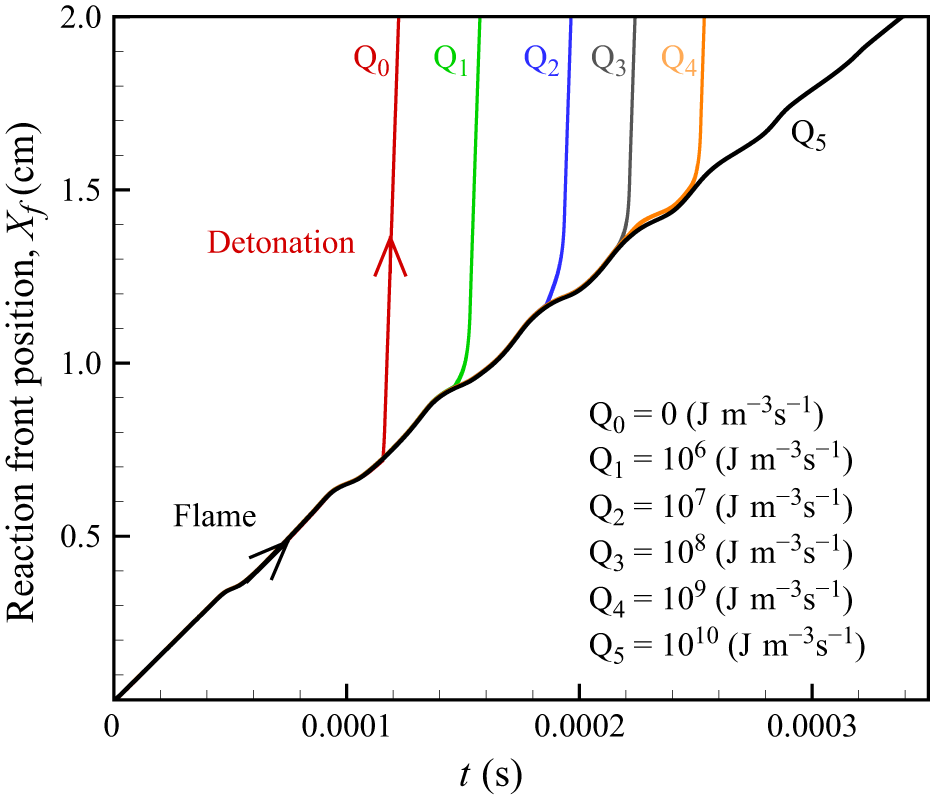
Figure 1 shows the reaction front position as a function of time for different modifications of the reaction rates in the end-gas. The local flow is assumed to be frozen (i.e. to neglect all the elementary chemical reactions in the simulation) when the local heat release rate is below a threshold value
 $Q_i$
 $(i=0,1,2,3,4,5)$
; otherwise the mixture is reactive and all chemical reactions are considered in the simulation. The thresholds
 $Q_i$
are systematically much smaller than the maximum of heat release rate inside the inner structure of the laminar flame,
 $Q_{max}\approx 10^{13}$
 ${\rm J\,m}^{-3}\,{\rm s}^{-1}$
. Before the sharp transition to detonation, the inner flame structure (and in particular the laminar flame velocity
 $U_L$
) is found to be insensitive to such small modifications that concern the heat release rate in a small range of end-gas temperature,
 $\delta T_u/T_u$
, of a few per cent. For
 $Q_0=0$
, all chemical reactions in the end-gas are considered as in Yu & Chen (Reference Yu and Chen2015) showing a transition to detonation 0.12 ms after flame ignition near the closed wall. When the threshold value increases to
 $Q_1=10^6$
 ${\rm J\,m}^{-3}\,{\rm s}^{-1}\approx 10^{-7}Q_{max}$
, the transition to detonation is still observed but is delayed to 0.15 ms. For the largest value
 $Q_5=10^{10}$
 ${\rm J\,m}^{-3}\,{\rm s}^{-1} \approx 10^{-3}Q_{max}$
that corresponds to the rate of heat release in the end-gas just before the transition to detonation when no modification of the chemical network is introduced, the end-gas is burned by the rightward-propagating flame and there is no transition to detonation. This confirms that the detonation mechanism is associated with the highly thermally sensitive rate of the small heat release during the induction period of the end-gas, as discussed in § 4.
Evolution of the reaction front position.

6. Concluding remarks
The DDT mechanism of a one-dimensional flame initiated by a hot slide (planar hot pocket of burned gas) near the wall of a closed channel filled with a stoichiometric hydrogen–air mixture at
 $p=10$
atm and
 $T= 1100$
K is different from that of the transition at the tip of an elongated flame initiated by a spark at the centre of a closed wall and propagating into a mixture at normal conditions of temperature and pressure. In the latter case, the transition to detonation occurs in a cold mixture (no autoignition) after a few milliseconds and the tube is long enough (about 2 m) for the compression waves generated by the self-accelerating flame and reflected by the opposite closed end to have not enough time to be back to the flame front before the detonation transition. The case considered here is different. It concerns an initial mixture close to autoignition in a short tube (2 cm) and prompt to detonate. The initial condition is also quite different; the pressure is quasi-uniform in the closed vessel during the early stage of the flame propagation, the acoustic time being much shorter than the evolution time scale of the thermodynamic state of the unburned gas. The difference in the nature of the initial state is also worth stressing: stable initial composition at normal temperature (
 $T= 300$
K) in the case of an elongated flame in a long tube while the initial state of the end-gas considered here to represent the knocking in internal combustion engines is close to autoignition with an induction delay decreasing quickly with a small increase in temperature during the induction process. In both cases, the transition to detonation is of a one-dimensional nature and is due to the ultimate compression waves generated during the last stage of strong flame acceleration. But, the origin of this ultimate acceleration is quite different: the back flow impinging on an elongated flame while it is the transient state of induction in the end-gas considered here. The key mechanism is here the large thermal sensitivity of the reactions controlling the induction delay below the crossover temperature, coupled with the increase in temperature associated with the flame propagation in a closed tube (before the detonation onset or the quasi-homogeneous autoignition of the end-gas). The rapid decrease of the time scale
 $\tau _{\textit{ri}}$
controlling the small heat release during the induction delay is essential for the DDT onset before the end of the induction period of the end-gas. During the short-lived transient stage (4.18) when the time scale
 $\tau _{\textit{ri}}$
becomes smaller than the acoustic time but larger than the transit time of a fluid particle across the flame structure, the reaction–diffusion nature of the flame remains meaningful. This short transient period of a strongly self-accelerated flame (acting as a semi-transparent piston) ends up with a catastrophic event blowing up the flame structure and leading to a spontaneous transition to detonation for no more than a microsecond. As on the tip of an elongated flame, it is the nonlinear thermal feedback loop (of thermal origin) between the laminar flame velocity and the acceleration-induced compression waves that is responsible for this catastrophic event. After the detonation onset, the rest of the end-gas is burned up faster by the detonation than it would be by the flame and/or the quasi-homogeneous autoignition of the end-gas.
Acknowledgements
Fruitful discussions with Dr Y. Morii at Manchester and Beijing are gratefully acknowledged. One of us (P.C.) thanks Professor C.K. Law for giving him the opportunity to interact with a very motivated audience and also with excellent groups of scientists during the summer schools of Princeton and Tsinghua.
Funding
The work at Peking University was supported by the National Natural Science Foundation of China (no. 52425604).
Declaration of interests
The authors declare that they have no known competing financial interests or personal relationships that could have appeared to influence the work reported in this paper.