The prevailing perception within the academy, policy circles, and the media inside and outside Iran has been that the members of bazaars are a unified social class engaged in a symbiotic relationship with the political elite of the Islamic republic and the conservative faction in particular.Footnote 1 This approach is largely built on the perspective that there is a historic predilection for bāzārīs and clerics to cooperate (“mosque–bazaar alliance”Footnote 2), and thus ideological compatibility and familial ties between the clergy and bāzārīs have continued and developed into an alliance under the current regime headed by segments of the clergy. For instance, one of the leading experts on 20th-century Iran, Nikki Keddie, comments that, despite Mohammad Khatami's reformist agenda, “the ruling elite, who represent an alliance between the commercial bazaar bourgeoisie and conservative clerics, resist giving up their economic privileges as they do their political ones.”Footnote 3
At the same time, a number of studies have challenged the notion that bāzārīs are homogeneous and intrinsically wedded to the clergy and that their relationship with the Islamic republic's establishment is necessarily mutually supportive.Footnote 4 Benjamin Smith, for example, documents how bāzārī mobilization prior to the revolution emerged independently of the clerical establishment and for reasons quite distinct from Khomeini's. He also argues that postrevolutionary state–bazaar relations have been fraught with conflicts over policies with implications for capital accumulation, just as they were under the Pahlavi monarchy.Footnote 5
This debate has revolved around discussions of the bāzārīs' capacity to engage in collective action in noninstitutionalized settings. In doing so, both the prevailing and revisionist analyses develop their arguments by scrutinizing the socioeconomic structure of the bazaar. Instead, in this article, I focus on state institutions and political organizations in order to redirect the discussion of the bazaar under the Islamic republic toward a topic that is alluded to, but not fully elaborated upon, in recent writings. To be specific, I evaluate the contention that the bazaar's political position under the current regime is enhanced by institutionalized politics and parties associated with the prerevolutionary Khomeinist coalition.Footnote 6
The Society of Islamic Coalition (SIC, Jamʿiyyat-i Muʾtalifih-i Islami)Footnote 7 and its sister organization, the Society of Islamic Associations of Guilds and Bazaars of Tehran (SIAGBT, Jamiʿih-yi Anjumanha-yi Islami-yi Asnaf va Bazar-i Tihran), to which I refer jointly as SIC-SIAGBT, are considered to represent the interests and embody the will of the trading class.Footnote 8 Wilfred Buchta, for instance, writes that SIC “functions as an indispensable link between the traditionalist ruling clerics and a substantial portion of the group of bazaar traders, who from time immemorial have been linked to the clergy.”Footnote 9 Mehdi Moslem goes so far as to state that the “position [of clergy–bazaar alliance] after the revolution remained largely intact. This alliance eventually manifested itself as the traditional right faction [including SIC] after the 1979 revolution.”Footnote 10 Thus, this article is less concerned with the bazaar as an urban space and socioeconomic group with a potentially powerful capacity for mobilization than with the performance and ability of SIC-SIAGBT to both represent the bazaar and be a political broker in institutionalized politics.Footnote 11
By tracing and analyzing the composition and actions of SIC-SIAGBT, I argue that its organization and behavior is profoundly influenced by the experience of the revolution and the institutions of the Islamic republic—in ways that have mediated and problematized relations between bāzārīs and this allegedly “bāzārī party.” For their part, bāzārīs, as a corporate entity, have been increasingly detached and alienated from the party leadership and unable to make inroads into institutional politics to represent their group interests.Footnote 12 Meanwhile, SIC-SIAGBT, which enjoyed a privileged position at the political table immediately after the revolution, has performed unremarkably in elections and has been increasingly sidelined by new conservative trends and associations.
In other words, the prevailing wisdom overstates the collective coherence of bāzārīs, the persistence of SIC-SIAGBT as representing the bazaar, and the influence of SIC-SIAGBT in institutionalized politics. In accordance, we need to depart from the overly static view of both the bazaar's relationship with SIC-SIAGBT and the political strength of this association. Instead, we have to consider both the bazaar and SIC-SIAGBT, which are regarded as representing and embodying bāzārī power, as part of the shifting political landscape that is shaped by the regime's institutions and the fragmented nature of elites. Hence, the narrative presented draws particular attention to the strategic decisions and bargains in changing contexts that were never fully determined by any single actor, let alone SIC-SIAGBT.
The article proceeds as follows. First, I situate the analytical approach in relation to the recent literature on authoritarian endurance. Second, I describe SIC-SIAGBT, focusing on its origins and position within Iran's postrevolutionary political economy, which has destabilized the organization's relations with bāzārīs. I then show that the initial bargain between SIC-SIAGBT and leadership of the Islamic republic aligned the regime and SIC-SIAGBT's bāzārīs—but not the bāzārīs as a collective social body. In the next two sections I describe the electoral system and the predicaments facing SIC-SIAGBT during the 1990s, when electoral competition became regularized. I focus on the electoral strategies of SIC and how they were conditioned by its prerevolutionary experiences as an underground organization and the current challenge of being a loyal party under electoral authoritarianism. This perspective enables us to make sense of the poor performance of SIC-SIAGBT in elections, its tactical coalition building, and how these actions and results further alienated many bāzārīs.
Finally, I draw out the implications for the study of Iranian politics more generally by advising against an ideological view of Iranian politics, especially one that frames it as a conflict between conservatives and reformists, hardliners and pragmatists, or modernizers and traditionalists. First, the Manichaean view obfuscates the complexities and differentiations of Iranian politics, making it difficult to analyze and predict electoral outcomes, coalitions, and conflicts. Second, this perspective has rendered Iranian politicians and activists incapable of imagining and developing new forms of politics, specifically a vision that engages with bāzārīs as an independent and internally differentiated social group.
INSTITUTIONS AND EXPERIENCES IN REVOLUTIONARY TIMES
This article engages with the recent literature on authoritarianism. In order to better understand the emergence of democracy and the breakdown of authoritarianism, the literature on democratization has recently redirected its analyses toward the various means by which authoritarian regimes reproduce and transform themselves.Footnote 13 Authoritarian survival and breakdown thus are conceived of as endogenous to the structure of the state and institutions of the regime, rather than as attributes of social and economic conditions or ideological and value orientations. This recent institutionalist analysis is in part a response to the growing number of “hybrid regimes” that combine elements associated with both dictatorship and democracy.Footnote 14 A hallmark of this approach is the focus on the specific institutional arrangements (such as electoral rules,Footnote 15 legislatures,Footnote 16 and the structure of the ruling partyFootnote 17 and party systemFootnote 18) in order to foreground the predicaments of elites and strategic interactions between rulers and opposition parties.Footnote 19
My analysis of the Islamic Republic of Iran adopts the basic premise of this literature, namely, that institutions matter even in the context of authoritarianism because they enable and restrict the behavior of political actors and organizations. The discussion of hybrid regimes—yielding such concepts as “competitive authoritarian” regimes that combine the participation and contestation of democracy with authoritarian practices and institutions—allows us to read the constellation of republican, authoritarian, and “Islamic” institutions that constitute the Islamic republic in less esoteric light. In addition, this approach invites us to interpret SIC-SIAGBT's actions as responding to the institutions of the regime (e.g., the electoral rules and economic organizations), which have affected the distribution of power in ways that have drawn the party away from its would-be constituents. Rather than casting SIC-SIAGBT as an articulation of personal backgrounds of members or a particular bāzārī ideology, the evidence presented in this article demonstrates that the political decisions of party leaders, the political plight of the bāzārī associations, and the ability of SIC-SIAGBT to be a conduit between the bazaar and the stateFootnote 20 are deeply conditioned by the institutional setting of the Islamic republic. Meanwhile, these state institutions, which emerged in the process of postrevolutionary regime consolidation, were themselves by-products of bargains and negotiations between state elites and SIC-SIABGT leadership. Therefore, the political power of this coalition rests in its relationship with state elites rather than with the bāzārī backgrounds and relations of members.
The article modifies the institutionalist approach in at least three ways, however. First, the article examines the case of a proregime party instead of legal or illegal opposition parties that are more often the focus of recent scholarship interested in the prospects for political liberalization. The article evaluates the political efficacy of SIC, a legal, loyal supporter of the authoritarian status quo.
Second, if current institutions matter in shaping the behavior of parties by providing incentives, prior institutions matter as well because they shaped parties at their genesis. Institutions have legacies: political actors experience them and develop organizations and practices in response to these past conditions. Once organizational structures are created, they tend to lock in certain outlooks and sets of relationships. The experience of state repression under the Pahlavi regime is important because it taught SIC's leadership to create underground, cell-like organizations instead of broad-based parties aimed at aggregating interests. This legacy, in addition to the policies and institutions of the Islamic republic, deepened the gulf between the bāzārīs as a large social stratum and SIC-SIAGBT as an exclusive political association.
Third, unlike institutionalist analyses, which tend to take as given the relationship between parties and their social constituencies, I trace the experiences of an important social class, namely, the merchants of bazaars (bāzārīs), and its changing relationship with SIC-SIAGBT. Here the recent analytical literature and the existing body of knowledge on politics in Iran are each other's foils. Unlike the recent political science literature on parties and democratization that privileges elite calculations and interactions and tends to diminish the power of sociological mechanisms that integrate (or separate) constituencies and political associations, the prevailing discussion of parties in Iran often takes a purely ideological and sociological turn, the case of bāzārīs' involvement in postrevolutionary politics being exemplary in this regard.Footnote 21 A comprehensive analysis of political parties in competitive authoritarian regimes, however, must pay attention to both the bargaining that takes place among elites and the socioeconomic context in which parties operate to win votes and mobilize resources in order to remain efficacious and politically relevant. This is particularly important in the socially dynamic context of revolutionary Iran.
By bāzārīs I am referring to import–exporters, wholesalers, retailers, brokers, and middlemen who make up the historic commercial class situated in urban centers and involved in diffuse, complex, and long-term exchange relations with the city, the nation, and international markets. On the face of it, the spatial concentration, the kinship ties that weave much of the bazaar together, and many of the customs and practices of the bazaar have forged a collective identity and periods of cooperation and collective action. Yet, the heterogeneity among bāzārīs is an essential characteristic of the bazaar. The bazaar's stratification and heterogeneity are produced by specialization in different commodity types (e.g., import, export, domestically produced, consumer, and agricultural goods), the prevalence of vertical hierarchies and differentiated economic roles (e.g., importers, exporters, wholesalers, retailers, apprentices, and brokers), and diversity in religion, ethnicity, regional background, and degree and conception of religiosity. In the prerevolutionary era, institutions and practices bridged these divides and fashioned something that could be described as a collective identity and sense of solidarity.Footnote 22 Over the last quarter century, however, as stable and long-term distribution chains, wide use of promissory notes, and the Tehran-centered nature of trade were dislocated intentionally and unintentionally by the state and social forces, it has become more difficult to think of the bazaar as a “class in and of itself,” let alone a “class for itself.”Footnote 23 Hence, this characteristic of the bazaar poses particular problems for political actors seeking to mobilize and lead it.
Compounding the problem of the bazaars' heterogeneity is a second complicating matter—the bāzārīs' interests have often dovetailed with those of the rest of society. Given that bāzārīs have famously participated in several 20th-century multiclass movements and shared the aspirations of many Iranians for more accountable and internationally independent government, we should question to what extent the bazaar is a distinct political constituency and can be conceptualized as such. Bāzārīs supported the reformist trends of the late 1990s (see below); it is clear that many of the issues that concern merchants and shopkeepers are not specific to them, and many of the issues that have rallied broad public support at various historical moments resonated with bāzārīs too. Complaining about corruption, nepotism, and lack of transparency is not a class-specific grievance in modern Iran. Thus, bāzārīs share some broad grievances overlapping with those of many other segments of society, and it is erroneous to think of them as a coherent group.Footnote 24
REWARDING SIC-SIAGBT, DIFFERENTIATING AMONG BĀ ZĀRĪS
SIC was established in the early 1960s, when three independent hayʾats (informal religious associations) centered in a number of mosques in the Tehran bazaar area pledged loyalty to Khomeini and were brought under the direct tutelage of his inner circle of students, such as Muhammad-Husayn Bihishti and Murtida Mutahhari.Footnote 25 A largely secretive and cell-like organization prior to the revolution, SIC included members of the Tehran bazaar and the fruit and vegetable markets (maydan) loosely linked to one another by young seminarians and preachers who had studied with Khomeini in the 1950s.Footnote 26 Soon after its formation, SIC was forced underground because alongside its religious and political activism, it had created a military branch. Although not as active as some other urban armed groups in Iran, SIC was behind the assassination of Prime Minister Hasan ʿAli Mansur in 1965, which resulted in many of its members being imprisoned or living in safe houses. SIC's exclusionary and fragmented structure became necessary attributes for its survival in the 1960s and 1970s. Nevertheless, SIC was important for Khomeini's cause, for it provided a tie to segments of the urban commercial class, which in earlier decades had been more closely affiliated with the liberal nationalists and their Islamist offshoot, the religious nationalists led by Mehdi Bazargan's Liberation Movement.Footnote 27
After the Islamic Revolution, this group exhibited loyalty to Khomeini and followed his request to disband and join the Islamic Republican Party (IRP). SIC leadership was heavily involved in creating and administering the coercive and intelligence organs, including the Islamic Revolutionary Guard Corps and the Revolutionary Prosecutor's Office, which were involved in violently confronting armed leftist and antiregime Islamist organizations. In 1987, once the IRP was dissolved, SIC reestablished independent activities; two years later it registered as an official political party.Footnote 28 Over the past two decades, it has published its views in an official weekly newspaper, Shuma (Shuhada-yi Muʾtalifi-i Islami, Martyrs of the Islamic Coalition), as well as Risalat, a daily newspaper owned by the Risalat Foundation. This organization in the 1980s was linked to Ayatollah Ahmad Azari-Qumi-Bigdili and the anti-Bahai Hujjatiyyih Society,Footnote 29 which initially challenged Khomeini's religio-political doctrine on theological grounds.
SIAGBT, being very much a subsidiary of SIC, shares many members, and together they organize regular joint events, such as lectures in the Tehran bazaar area. SIAGBT, established with the direct blessing of Bihishti in 1980, surfaced as an umbrella organization bringing together various Islamic associations that emerged during the revolutionary turmoil. As the state shut down and “cleansed” trade syndicates and associations, these Islamic associations, as the sole legitimate representative of the state's will in the bazaar, had the explicit mandate to “destroy the idol worshippers in the Muslim bazaar” and to prevent “intellectual deviation,”Footnote 30 which in the initial years after the establishment of the Islamic republic included intimidating bāzārīs who had more nationalist leanings or affiliated with Bazargan's Liberation Movement. For instance, at a speech given at the monthly meeting held by SIAGBT, Habiballah ʿAsgarawladi-Musalman declared, “If the Islamic bazaar is unified, the Islamic republic opens the path for the Islamic bazaar to be at the service of the revolution of the people and reaching its [the bazaar's] own rights.”Footnote 31 He added that each guild needed to have an Islamic association to preserve Islam.
In the early years, these associations also took on the mantle of ensuring that the practices in the bazaar were in line with the regime's desire to “Command the Right and Forbid the Wrong”—and more specifically, limited “hoarding” and “profiteering,” which, as under the Shah's regime, were often identified as the source of economic ills.Footnote 32 In addition, the Islamic associations were important during the Iran–Iraq War, for they mobilized “behind the war front” by collecting and coordinating donations for military and civilian victims.Footnote 33 For instance, in the early stages of the war, the fabric sellers in the Tehran bazaar promised to donate a billion rials for the war wounded.Footnote 34 Yet, it is interesting to note that in order to ensure that goods went to the needy, some bāzārīs preferred to give in-kind rather than cash donations.Footnote 35 Until 2001 the SIAGBT was headed by Hajj Saʿid Amani, who was a member of SIC and the first two parliaments after the revolution. It is now headed by Ahmad Karimi-Isfahani.
Anecdotal evidence gathered from biographiesFootnote 36 and my interviews suggests that many SIC-SIAGBT members had relatively low standing in the bazaar's hierarchy (e.g., as retailers, middlemen, brokers, and apprentices), worked in the produce markets, and were quite young. However, more research is needed to clarify if, how, and why class standing in the bazaar is correlated and causally related to pro-Khomeini and proconservative politics, attitudes, and behavior.
Did this longstanding connection among SIC-SIAGBT, the Khomeinist elite, and the bāzārī class translate into structural links between state and bazaar? To answer this question we must briefly discuss how the commercial class was situated in the postrevolutionary political economy. Its position was dictated by a contradiction in the objectives of the regime at the founding moment of the Islamic republic. On the one hand, many among the political elite that came to dominate the republic, including Khomeini, recognized that a large portion of the bazaar community had supported the overthrow of the ancien régime by organizing closures and financing political activism. On the other hand, the bāzārīs were a powerful constituency capable of influencing the ongoing battles among the disparate parties vying for political power in the immediate aftermath of the revolution.Footnote 37
Some new high-ranking state officials (such as Ayatollah Bihishti—the influential head of the Judiciary, Revolutionary Council, and Islamic Revolutionary Party—and Mehdi Bazargan, the first postrevolutionary prime minister) pushed for a more liberal economic approach in part as a way to mollify the private sector and those who were involved in national and international commerce. It is not surprising that SIC was closely allied with this policy position. However, others argued the state should take a more direct and comprehensive role in production and accumulation of capital in order to “annihilate dependent capitalism.” Three factors supported this argument. First, an important contingent of state officials (especially after the fall of the provisional government) had populist orientations or, to be more precise, believed in the central role of the state in economic development and ensuring a more egalitarian redistribution of wealth and opportunities. Second, these new elites understood that controlling the economy was an important means to co-opt social groups and entrench a new order. Finally, with the Iraqi invasion in 1980, it became incumbent upon the state to mobilize resources for the war effort.Footnote 38 Within this approach, it was unclear how the state would represent and protect the basic interests of the bāzārī class, that is to say, their access to markets, hard currency, and a liberal trade regime. The solution to this predicament was state incorporation based on personalism rather than corporatist arrangements found in other parts of the Middle East (e.g., Egypt) and in Latin America.Footnote 39
In summer 1984, a debate over the nationalization of international trade, which was implied by unimplemented Article 44 of the constitution, came to the fore, with supporters of a more free-market-oriented system challenging the governing populist–statist coalition headed by Prime Minister Mir Husayn Musavi. The parliament, in which a majority was allied with Musavi, drafted a bill placing all international trade under public management. However, Islamic jurisprudence and Articles 46 and 47 explicitly sanction private property, something that was not lost on SIC-SIABGT and non-bāzārī supporters of liberal economics, who had successfully stymied earlier attempts for wholesale state management of the economy.
To resolve this heated and critical policy debate, the issue was eventually brought before Khomeini, who crafted a pragmatic and judicious framework aimed at maintaining the support of his followers in the bazaars and retaining the state's role as economic mediator. He said,
[I]t was the people who established this government and this republic. [But] not all the people, only the barefooted [i.e., the destitute and oppressed] masses. The burden has been on the shoulders of the bāzārīs, the middle class, and the oppressed. That is, the deprived [mahrumin] have shouldered the burden of the revolution. .–.–. Therefore, your government is a government of the deprived and it should work for the deprived.Footnote 40
However, Khomeini paused to remind the government of the bāzārīs' specific role in the economy:
You should not discard the bazaar. That is, if the bazaar is incapable of doing something, then the government should do that job. But if the bazaar is quite capable of doing something, do not stop it; this is not legally accepted by Islamic law. The people should not be deprived of their freedom. The government should supervise [niẓārat]. Take, for example, importing goods from abroad. The people should be left free to import as far as possible. Such goods should be imported by both the people and by the government. But the government should supervise and make sure that goods which are against the interests of the Islamic republic and Islamic law are not imported. This is called supervision, meaning that you should not leave them free to saturate the bazaar with luxuries and other such goods, which were common in the past. But, if you were to refuse to allow the people to share with you in trade, industry, and similar things, you would not succeed.Footnote 41
Khomeini's statement has been interpreted as an example of the Islamic republic's probazaar stance because it ultimately helped impede the nationalization of trade and development of a planned economy.Footnote 42 However, he made a critical, although subtle, modification. “Obviously, there are some corrupt individuals in the bazaar; there are some self-seeking individuals there,” declared Khomeini. “However, there are many correct, religious, and skilled people in the bazaar, too.”Footnote 43 Unlike many political observers, the theologian-cum-political leader was emphasizing that policymakers should not view or treat bāzārīs as a homogeneous class or corporate entity.Footnote 44 Instead, state officials, as part of their role as “supervisors,” should be aware of differences and select their partners and relationships accordingly. Therefore, the Islamic republic's approach to the bazaar was not one that implemented policies to incorporate the bazaar as a corporate entity through uniform laws or opportunities as suggested by the discussion of “the bazaar.” Rather it was one that was based on personal ties between members of the regime and individual bāzārīs, or those with bāzārī roots, who were “correct, religious, and skilled” and hence merited government portfolios, protection from property seizures, and ultimately political and economic power.Footnote 45
Who were these bāzārīs who benefited from a political economy that facilitated this form of clientelism? In the early 1980s, merchants who were able to demonstrate their commitment to the regime were the beneficiaries, specifically those bāzārī members of SIC and the related SIAGBT.
The leading figures in these organizations were handsomely rewarded for their loyalty to the Khomeini political agenda. Habiballah ʿAsgarawladi-Musalman, one of the founding members of SIC and the public face of the organization, has held a number of high-level government posts, including minister of commerce (1981–83), representative of the supreme leader at the Imam Relief Fund Committee, and member of the central council of the 15th of Khordad Foundation. His brother, Asadollah ʿAsgarawladi-Musalman, a more active trader in the Tehran bazaar prior to the revolution, has been a long-standing member of Iran's Chamber of Commerce, Industry, and Mines. ʿAli Naqi Khamushi, an SIC member from a bāzārī family and an engineer by training, was initially a director of the Foundation of the Oppressed and Disabled, as well as Khomeini's representative to Iran's Chamber of Commerce, Industry, and Mines. Although a member of the fourth parliament and working for the Ministry of Commerce, he is best known for having been the chairman of Iran's Chamber of Commerce for twenty-seven years until his ouster in spring 2007. Taqi Khamushi, ʿAli Naqi's brother, was a member of the board of directors of the Islamic Propaganda Organization and the Islamic Economy Organization.
Another prominent figure in this circle was Muhsin Rafiqdust, who worked in the vegetable market (maydan).Footnote 46 In his official memoirs he claims to have joined SIC as a teenager and engaged in political activism under supervision of the future SIC ideologue Asadollah Badamchian.Footnote 47 After the revolution, he headed arguably the two most powerful institutions in Iran, first as commander in chief of the Islamic Revolutionary Guard Corps and later as head of the most powerful economic foundation (bonyad), the Foundation for the Oppressed and Disabled. Asadallah Lajvardi, who was assassinated in the Tehran bazaar in 1998, was the former chief prosecutor overseeing the summary executions of political prisoners in 1988. Meanwhile, Kazim Hajj-Tarkhani, a member of the Revolutionary Council with close ties to the ruling clergy and actors mentioned previously, avoided full-scale expropriation of his assets in cement and carton production and distribution and sugar processing. However, probably because of personal disputes with prominent members of the revolution, ʿAli Hajj-Tarkhani, Kazim's younger brother and Shahd Sugar Company shareholder, was among an initial set of industrialists who had their assets appropriated after the revolution because of their alleged ties to the Pahlavi family.Footnote 49 This latter example indicates that personal relations and political ideology, rather than bāzārī affiliations, cemented the close connection between SIC members and the new regime.
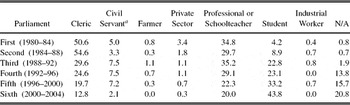
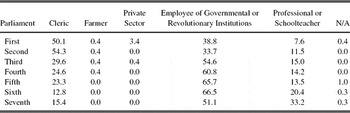
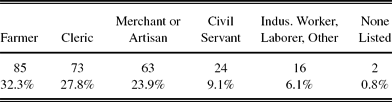
The point that class background was insufficient to attain political power in state institutions is also corroborated by evidence on the composition of parliament. Although we lack a detailed and comprehensive study of regime elites and the members of various branches of the Islamic republic, information on parliamentary members suggests that we should reevaluate the notion that the regime is dominated by bāzārīs. Tables 1 to 3 provide data on the professional backgrounds of MPs in the seven postrevolutionary parliaments and of fathers of MPs in the first parliament. These tables show that bāzārīs comprised a very small percentage of the parliament even from the outset of the Islamic republic. In comparison to clerics, professionals, and government employees, bāzārīs (here categorized broadly as members of the private sector) constituted a small and diminishing percentage of parliamentarians. Even when we consider their family backgrounds, we notice that although almost a quarter of the fathers of the members of the first parliament (the only parliament where this information is available) were artisans and merchants, the vast majority of MPs had fathers who were clerics, farmers, and civil servants (total 69.2%). Given that the service and petty bourgeois sectors have been the largest workforce sectors and have grown in the postrevolutionary era,Footnote 50 these figures are noteworthy for their small, rather than large, magnitude.
Members of parliament (1979–2004): Occupations prior to the Islamic Revolution (percentages)Footnote 48

aIncludes military personnel.
Members of parliament (1979–current parliament): Occupations after the Islamic Revolution (percentages)Footnote 51
Members of parliament in the first parliament (1979–83): Occupations of fathersFootnote 52
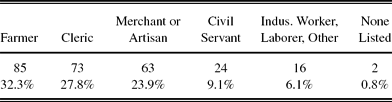
Thus, only bāzārīs who were members of SIC-SIAGBT were included and co-opted by the governing structure of the Islamic republic. They gained oligarchic positions in economic and noneconomic related institutions, which increasingly controlled the production and distribution of resources via the Foreign Exchange Allocation Commission, procurement boards, state-initiated and staffed cooperatives, and economic foundations.Footnote 53 These elites gained direct supervision over state assets and government-owned firms, and as a consequence their individual interest became aligned with that of the regime and its goal to maintain the political order. The very fact that individual “members of the bazaar” have so readily broken ranks with their fellow bāzārīs and pursued personal advantage in the context of nationalization and state regulation demonstrates the precarious and nonessential nature of the bazaar's solidarity and corporate logic. SIC-SIAGBT merchants were willing to trade their shops in the bazaars for offices in the state apparatus. “This is the story of the few who found the golden goose in the turmoil of the revolution,” note Nomani and Behdad.Footnote 54
Meanwhile, those politicized bāzārīs who were allied with more liberal-nationalist trends were ostracized and even executed. From the perspective of the state, this mode of patronage and blurring of state–society boundaries was a method of rule through the distribution of exclusive resources and information to produce rents for regime loyalists and simultaneously reproduce state authority. Although the bazaar and its relationship with the state changed over the last quarter century through other modes as well, this patronage-based cleavage in the bazaar is essential to understanding the discrepancy between SIC-SIAGBT and the bazaar's position in the evolving political landscape.
CONTRADICTIONS OF STATE PATRONAGE AND BĀZĀRĪ REPRESENTATION
What have been the consequences of this personalistic alignment between the regime and SIC for both the political association's decision making and the representation of the bazaar constituency? In terms of collective representation and party development, the outcomes have been largely negative both from the perspective of SIC leadership and the bāzārīs as a collectivity. The crux of the contradiction facing SIC-SIAGBT was that the very catalysts empowering its members were the forces that limited its ability to remain a meaningful and responsive representative of the bāzārīs.
Preexisting factors undermined the capacity for parties to represent “bāzārī interests” and even to form in Iran. As in other authoritarian contexts, lack of a transparent and politically neutral electoral system and of protection for political and civil rights, as well as a constitutionally weak legislature both before and after the revolution, acted as an important disincentive for potential political entrepreneurs to invest resources and develop institutionalized parties with organized and elaborate elite-grassroots linkages. For instance, in the early 1960s, some businessmen, including leading members of the Chamber of Commerce (Abolhusayn Nikpur and Qasim Lajvardi), sought to establish the Economic Party, but the state quickly stepped in and ended these ambitions.Footnote 55
However, one would expect that the current regime's generally positive outlook toward the bazaar and the existence of SIC would provide a space for the emergence of a coherent and powerful party to represent the bāzārīs as a collective. In addition, given that bāzārīs have a long history of collective political action and participation over the last century, the idea and practice of coordination and united action are quite familiar to them. However, the nature of the relationship between SIC and the bazaar as refracted by the state was such that it resulted in deep cleavages between the would-be bāzārī party and its constituency.
To begin with, SIC had difficulty and little interest in restructuring itself into a broad party engaging with the bazaar as a whole. Its experience under the oppressive contexts of the Pahlavi monarchy and the limited pluralism of the Islamic republic encouraged SIC-SIAGBT to be both elitist and exclusionary. Under the Pahlavi monarchy, SIC responded to the state's regular surveillance by operating in a clandestine manner via ten-person cells.Footnote 56 Family relations and intermarriage not only enhanced the close bonds of members—but also enhanced the insular nature of SIC. To give one example beyond those mentioned previously, Saʿid Amani, the head of SIAGBT, was the maternal uncle of Asadallah Badamchian, one of the leading members of SIC and its spokesperson, who in the 1990s was also the head of the Ministry of Interior's commission in charge of licensing political parties.Footnote 57 Thus, in the 1960s and 1970s, SIC was fundamentally an underground, secretive association quite consciously developed around discreet and personalistic relationships in order to prevent infiltration.
Even though the establishment of the Islamic republic allowed SIC to operate openly, this came with a trade-off. Scott Mainwaring describes parties under authoritarian regimes as operating in a dual game.Footnote 58 On the one hand, when elections exist, they compete in imperfect games between rival groups or ideologies. On the other hand, parties are also involved in a second metalevel struggle, or “regime game,” in which they seek to reform, delegitimize, or preserve the regime. In the context of Latin America, Mainwairing shows that the two levels of these games interact with one another, with parties often privileging one game over the other and their strategies in one shaping their behavior in the other.
As described previously, SIC members were direct beneficiaries of the new political system, and hence the party in the 1980s very much privileged the “regime game” by seeking to preserve the regime, or what they have called “the Islamic Revolution and the system of Guardianship of the Jurist.” This decision, exemplified by merging the party into the IRP, affected SIC's behavior because it retained political influence in the regime without having to adjust views to either the public at large or the bazaar in order to succeed in the “electoral game.” Hence, even today SIC often speaks of all ballots as being “votes for the regime,” rather than discussing factional and party victories. Thus, by the late 1980s, when it registered as an independent party, SIC remained an elitist organization dominated by a select group of increasingly elderly figures.
Rather than cultivating, incorporating, and addressing the demands of social groups, SIC has depended on direct relations with regime officials for political power. They have had very little use for party institutionalization and grassroots development. Like political parties in other parts of the Middle East discussed by Ellen Lust-Okar, SIC has been a “vessel . . . for powerful actors not [a] mechanism . . . for elite recruitment or enforcement.”Footnote 59 The narrowness of SIC's base and its exclusiveness have been exacerbated by the largely closed economy, which members publicly criticize but from which they have privately benefited. Because the economy has been largely dominated by the state, SIC leaders have enjoyed ideal positions for immediate access to rents via exclusive importing licenses, tax exemptions, subsidized hard currency, and control over procurement boards and industrial establishments. The bāzārīs who have established patronage channels have used them for personal and exclusive ends—not as a tool for distributing benefits to the entire bāzārī class.
This process has had ramifications for how members of the Tehran bazaar have experienced the postrevolutionary era and come to identify, talk about, and conceive of SIC-SIAGBT members, whom they view as “officials of the government” rather than bāzārīs.Footnote 60 Meanwhile, the bureaucratization of bazaar-based religious organizations and their charity activities, which originally were grassroots initiatives based on mosque and religious circles, kinship ties, and neighborhood relations, has undermined their efficacy and their ability to create shared beliefs through dialogue and interplay among bāzārīs, as the heads of these Islamic associations readily admitted to me.Footnote 61 Over the last two decades the tendency to incorporate the bāzārīs' self-help associations into the regime has impoverished the ability of SIC-SIAGBT to retain these social avenues for partisan mobilization.
As a consequence, SIAGBT, which in 2000 had only 2,500 members out of a Tehran bazaar that comprises roughly 40,000 individuals,Footnote 62 does not reflect the bāzārīs' sentiments through aggregating interests and building consensus. Instead it claims to present the views of the bazaar from a position of state-sanctioned authority. Another indication that the so-called bāzārī associations have a diminishing reach and support in the bazaar is their inability to mobilize support for conservative causes. For instance, in 1999 and 2003, SIC and the Tehran bazaar's Islamic associations' call for bazaar closures, part of a time-honored repertoire of political dissent, had very little bāzārī support. As it has become apparent that SIC-SIAGBT cannot mobilize support for the regime and the conservative camp, these associations have lost clout with the supreme leader and opened the door to other conservative forces to play a leading role.
Western journalistic accounts complement my field research findings that the bazaar is far less uniform in its political opinions and orientations. For instance, the notion that bāzārīs are invariable supporters of “traditional conservatives” is challenged by one journalist who interviewed bāzārīs during the 2001 presidential elections and found much support for Mohammad Khatami and reformist candidates in the parliamentary elections in 2000.Footnote 63 A longtime jeweler in the Tehran bazaar told another journalist,
Sixty percent of the bazaar is behind Khatami. . . . The conservatives here have blocked Khatami from acting. But he's in touch with the realities of the modern world. We want to do business with everybody—Europeans, Americans, [and] Arabs. Khatami supports us. Why have the others refused to open up to the world?
Prior to the 2005 presidential elections, Robert Tait in The Guardian quoted several bāzārīs who were critical of all the political elite (including Akbar Hashemi-Rafsanjani) and claimed that they would not vote for anyone.Footnote 64 My own observations during the last two presidential elections suggest that bāzārīs' political attitudes vary considerably, with a significant number matter-of-factly criticizing SIC-SIAGBT's support for conservative candidates and placing posters to publicly display their support for other candidates, including Khatami in 2001.
CHALLENGES AND ALLIANCES UNDER ELECTORAL COMPETITION
Accordingly, SIC-SIAGBT has increasingly struggled to maintain a prominent position in electoral and institutional politics. With the end of the Iran–Iraq war and the transition from Khomeini to Khamenei as the supreme leader, the Islamic republic's elite and factions entered a new era where they competed with one another to control state power and to propose a new social contract with citizens. The defunct law that outlined how parties received permits from the Ministry of Interior was revived in 1988, and there was a flurry of permits issued to organizations that operated within the parameters of the constitution and spirit of the Islamic Revolution as interpreted by the state commission.Footnote 65 In this circumscribed context, a new “electoral game” became the format of conflict and representation in which SIC-SIAGBT participated.
These elections revealed the limited support for SIC-SIAGBT. For much of the 1990s its candidates were soundly defeated by presidential candidates advocating economic liberalization and technocratic reforms (Hashemi-Rafsanjani in 1989 and 1993) and championing a political and social reform agenda (Khatami 1997 and 2001). For instance, SIC-affiliated candidates in the 1993, 1997, 2001, and 2005 presidential elections were all routed at the polling booth (e.g., ʿAbdallah Jasbi in 1993 and 2001, ʿAli Akbar Natiq-Nuri in 1997, and ʿAli Larijani in 2005).
In response to these electoral setbacks, SIC-SIAGBT has been unable to restructure its organization into something resembling less a secretive, exclusionary clique and more an institutionalized party with the ability to produce new elites and mobilize social support. The old guard remains in charge with few prospects for new, younger members to emerge to reformulate the platform, internal party relations, or ties with social groupings. Yet, elections, even under authoritarian conditions, are opportunities for learning. The lessons taken away by SIC-SIAGBT were that legal and illegal means must be used to stem the power of the reformists and that it needs to develop more robust alliances with pro status quo parties. As Penner Angrist has argued, the weakness of status quo parties induces political elites to defect from democratic norms and institutions.Footnote 66 Toward the end of Khatami's first term, the poor election results were part of the reason that SIC leadership quickly sided with the authoritarian backlash against journalists, students, women activists, and close allies of Khatami. One can speculate that if SIC-SIAGBT had performed better in the elections of the 1990s, it would have been more willing to abide by the democratic rules of the game.
SIC-SIAGBT also learned that if it was unable to compete on its own, it needed to forge alliances with other parties and organizations opposed to and threatened by the reformist agenda associated with Mohammad Khatami and the Participation Front of Islamic Iran (Jibhih-yi Musharikat-i Iran-i Islami). Before the seventh parliament, the conservatives created a loose umbrella organization that, in addition to the clerical and lay groups of the revolutionary epoch, included socially conservative groups that emerged in the postrevolutionary era within the Islamic Revolutionary Guard Corps, the intelligence apparatus, and other “revolutionary institutions.” It is notable that these individuals did not emerge within the bazaars and business community, which were dominated by the state and the state-affiliated oligarchy.Footnote 67 The coalition was originally titled the Front of the Followers of the Path of the Imam and Leader (Jibhih-yi Payruvan-i Khatt-e Imam va Rahbari), but in 2002 the front was reorganized and named the Coordination Council of the Islamic Revolutionary Forces (Shawra-yi Hamahangi-yi Niruha-yi Inqilab-i Islami). In making this alliance with figures previously unknown to the majority of the electorate, this broader set of conservative forces was victorious in elections for the municipal councils (2003), the legislature (2004), and the executive (2005)—all of which had been dominated by reformists in the previous election cycles. These electoral victories were achieved in part by the interference of the Guardian Council and other electoral irregularities.
This alliance between “old” and “new” conservatives has not been without a cost for SIC-SIAGBT. Beginning with the 2003 municipal elections, which saw the success of the “new right,” specifically Mahmoud Ahmadinejad and the Developers' Coalition of Islamic Iran (Iʾtilaf-i Abadgaran-i Iran-i Islami) and the Devotees' Society of the Islamic Revolution (Jamʿiyyat-i Isargaran-i Inqilab-i Islami), the “old right” exemplified by SIC has been forced to play a less public and more limited role as the conservative mantle was seized by these younger figures socialized in the postrevolutionary security–military infrastructure who have espoused a populist and anti-free-market rhetoric and policy agenda.Footnote 68 Their agenda advocates the “logic of distribution” rather than the “logic of accumulation.”Footnote 69 This general shift over the last three decades is captured in Tables 1 and 2, which show that in the last three parliaments the members, a greater percentage of whom were students at the time of the revolution, are increasingly employees of state institutions, have professional backgrounds (e.g., engineers), and are members of the laity, not the clergy. In the run-up to the 2004 parliamentary elections, the Guardian Council vetoed most of the reformist candidates, who were the conservative forces' most formidable opponents. Yet SIC's ʿAsgarawladi, Badamchian, and Al-i Ishaq all withdrew their names from the election ballot. As figures from SIC have readily admitted since Ahmadinejad's presidential victory, they struck a bargain with the younger conservatives ensuring that the Developers' Coalition and Devotees' Society would remain in the umbrella organization, and in return the elder statesmen of SIC-SIAGBT would take a more peripheral role, allowing their lesser known (but more competitive) candidates to dominate the conservative list of candidates.Footnote 70
Meanwhile, as “the new right” has enjoyed electoral success and political power, it has become emboldened and sought greater independence from SIC and power in agenda setting.Footnote 71 For instance, a member of the Developers' Coalition of Islamic Iran, whose candidates were victorious in the 2003 municipal elections, claimed that SIC's support did not win them more than 1,000 votes, and therefore the coalition owed nothing to SIC.Footnote 72 In fact, after the 2004 parliamentary election, Ghulam-ʿAli Haddad-ʿAdil, a member of the Developers' Coalition, secured the important position of speaker of the house at the expense of the better known Muhamad-Riza Bahunar, who was an advocate of economic liberalization, the most notable figure in the Islamic Society of Engineers, and very closely allied with SIC.
The tensions within the conservative alliance became more public during the 2005 presidential elections. The Coordination Council of the Islamic Revolutionary Forces failed to arrive at a consensus, with many of its leading figures supporting different candidates and Ahmadinejad and the Devotees' Society and Developers' Coalition distancing themselves completely from the council. The preelection conflict between SIC and Ahmadinejad was expressed when Hamid-Riza Taraqqi, the managing editor of Shuma and member of SIC's political council, described Ahmadinejad as “a political midget,” which he denied was a reference to Ahmadinejad's height, maintaining that it was an allusion to his lack of experience.Footnote 73 SIC-SIAGBT, which remained in the Coordination Council, eventually endorsed ʿAli Larijani in the first round,Footnote 74 but he finished with only five percent of the vote and in sixth place in a field of seven candidates. In the second round, the Coordination Council did not publicly endorse either Hashemi-Rafsanjani or Ahmadinejad and stated that it considered both candidates as “principlist” (usulgara).Footnote 75 In the case of ʿAsgarawladi, this position was particularly inconsistent because prior to the first round he explained that he could not endorse Hashemi-Rafsanjani because he never consulted SIC,Footnote 76 yet on the eve of the second round SIC's elder statesman cautiously described both candidates as “principlist reformists,” (islahtalab-i usulgara) and thus equally satisfactory.Footnote 77 Finally, in this presidential election ʿAli Naqi Khamushi, who had been the president of the Chamber of Commerce since the revolution and is from a politically active bāzārī family allied with SIC, split with SIC: instead of supporting ʿAli Larijani, he endorsed Hashemi-Rafsanjani in both the first and second rounds.Footnote 78
Despite the schism between SIC and Ahmadinejad's brand of political authoritarianism, religious conservatism, and economic populism,Footnote 79 SIC-allied individuals did receive important government portfolios. Manuchihr Mottaki became minister of Foreign Affairs and ʿAli Larijani secretary general of the Supreme National Security Council and Iran's official representative in the nuclear negotiations with the permanent members of the U.N. Security Council and Germany. Larijani's powerful position, however, probably owes more to his family's stature and his close ties to the supreme leader than to his association with SIC leadership. In publications and public statements, SIC has combined general and vague praise for Ahmadinejad's government (especially for “revitalizing the values of the revolution”Footnote 80) with pointed criticisms of his bloated government budgets and noninclusive political style. Sensing that they had limited influence over policymaking, shortly after the election, members of SIC-SIAGBT repeatedly complained that they had not been consulted by the incoming president and reminded him that he needed to include a wider spectrum of conservatives in his government.Footnote 81 The general secretary of SIAGBT claimed that Ahmadinejad did not invite the group to work with him or even send the form that his advisers were distributing for suggestions for cabinet members.Footnote 82
Badamchian called for friendship (rifāqat) instead of competition (riqābat) and for Ahmadinejad to engage all those within the conservative camp.Footnote 83 In a similar tone, SIC's general secretary, Muhammad Nabi Habibi, commented that “being a principlist is a necessary condition for being in the cabinet, although it is not a sufficient condition.” He added that cabinet members must also have “exceptional managerial ability [and experience]” or else “the principles of the principlist movement will be hurt.”Footnote 84 Taking the argument further and responding to the administration's hostility toward party organizations in general, ʿAsgarawladi borrowed the reformists' rhetoric and even warned that Ahmadinejad's lack of a sense of “indebtedness to other parties .–.–. will take the country towards dictatorship.”Footnote 85 A final example of the decline of SIC-SIAGBT's political power in the context of the rise of new conservative forces is ʿAli-Naqi Khamushi's failure to be reelected chairman of the Iran Chamber of Commerce in June 2007. He was defeated by Muhammad Nahavandian, who is considered more closely aligned with Ahmadinejad and the younger conservatives and has no specific connection to the bazaar.Footnote 86
Within this context of growing tensions between old and new conservative factions, SIC has held a series of meetings and exchanges over the last couple of years with the leadership of the reformist movement, the Participation Front of Islamic Iran.Footnote 87 These talks, which were played down by SIC leaders and were ostensibly about the growing regional tensions and conflict between the United States and Iran, nonetheless reflect SIC's desire to identify potential allies other than Ahmadinejad. This strategic shift was exemplified in December 2006, when the deputy general secretary of the party, Badamchian, who in 2004 had stepped aside in favor of the younger members of the conservative coalition, decided to run in the midterm elections for two open seats to represent Tehran. He finished a distant third in the polls, however.Footnote 88
CONCLUSIONS
Scholars working on contemporary Iran have documented the endemic factionalism in Iran's political system,Footnote 89 some arguing that “.–.–. the evolution of the Iranian system toward a fuller version of democracy will depend on the establishment of fully functioning political parties, which would institutionalize political pluralism.”Footnote 90 Given that Iran's political parties are typically coded in ideological terms (e.g., reformist versus conservative), however, there has been little analysis of the extent to which the existing parties engage constituencies and may become vehicles for social representation and negotiation. This article has aspired to initiate such a discussion by analyzing the dynamic relationship between bāzārīs and SIC-SIAGBT and how it was conditioned by state policies and the nature of electoral competition. The narrative, however, is not of a single, continuous process in which socioeconomic developments elide into political ideologies and fronts. It is a story of a series of strategic reorientations, tenuous alliances, and Faustian bargains.
Originally SIC-SIAGBT enjoyed significant political favor and was able to access state resources and shape policymaking (although was never able to dictate it). I have interpreted this political capacity as stemming from the close political relationship and ideological affinity with the regime leadership (in particular Khomeini and Bihishti) rather than from a metaphysical or structural nature associated with many of the figures in these organizations being “bāzārī” in some broad sense. Given the party's close relationship with the founders of the regime, its members' position in the new state structure, and its underground nature in earlier decades, the primary objective of SIC-SIAGBT was for the regime to be consolidated rather than to develop an independent social base of support for the association and strong bāzārī attachment. Thus, these organizations tied political relevance to the very survival of the regime and political status quo instead of developing a broad and deep institutionalized party structure that might have allowed SIC-SIAGBT to represent the bazaar community.
Once the regime was consolidated and the ideological and social differences among the regime's elite came to the fore, SIC-SIAGBT faced new challenges and moved from simply being a regime loyalist to a participant in the electoral game. The party's influence faced the real constraint of electoral competition and more institutionalized politics. Lacking clear mechanisms to recruit new, young members and being unable to gain broad support inside or outside the bazaars, SIC-SIAGBT had to fashion an elite-level alliance with younger conservatives from a military-security background, who brought with them not only the mobilizing power of the paramilitary forces (the Islamic Revolutionary Guard Corps and basij [volunteer forces]) but also an agenda to marshal the state to redistribute resources to new clients, although not necessarily to the urban poor they have claimed to champion.Footnote 91 This has further distanced SIC-SIAGBT from the bazaar, the original social strata from which the bulk of its leadership was drawn. Meanwhile, many bāzārīs have felt threatened by Ahmadinejad's redistributive policies and confrontational foreign policy, which has dampened consumer spending and investments.Footnote 92 Like many others in Iranian society, these bāzārīs have been left without an independent and consistent associational voice.Footnote 93
Some other bāzārīs, whose profits depended on shortages and the black-market economy of the 1980s, may have been attracted to Ahmadinejad's populist slogans and the potential for a return to the political economy of the first postrevolutionary decade.Footnote 94 As a result, SIC-SIAGBT is increasingly isolated from other political trends, which its leaders have resorted to describing as “extremist.”Footnote 95 Inability to compete in elections has only exacerbated the organization's irrelevance to the bazaar community and lack of utility to the regime leadership and conservative forces that depend on popular participation as well as coercion and patrimonialism to remain in power. As several studies on elections under authoritarianism have illustrated, elections are means for rulers to gather information.Footnote 96 As the Iranian case demonstrates, autocratic leaders may be particularly interested in gathering information about the strength of the opposition, but elections are also a useful means to evaluate the popularity and viability of allies.
During the post-Khomeini era, elections have become more meaningful and party distinctions more profound. Despite continuing to be elitist in makeup (although not in message) and undermined by the political ineffectiveness of representative institutions, political parties have had to respond to political allies and rivals as well as to the electorate. Much of the literature and analysis over the last two decades has sought to illustrate and categorize the elite fragmentation and competition that have epitomized politics in the Islamic republic despite authoritarian exclusion of opposition groups and secular voices. It is necessary to move beyond the state dichotomization between terms like “conservatives” and “reformists” (or hardliners and pragmatists). This dichotomy operates mostly at an elite level, and as the vicissitudes of electoral outcomes and public attitudes have made clear, this cleavage is not replicated at the societal level.
Yet even at the elite level, social, economic, military, and ideological attitudes, in addition to generational fissures, have generated a kaleidoscope of cross-cutting and cumulative cleavages that refract politics in complex and dynamic ways. Distinctions between reformers and hardliners mask internal distinctions within these political trends. Given that factionalism and elite conflict are rooted in the era of the revolutionary movement and regime consolidation (1978–83), it is too simple to say that elections have caused factionalism, but the electoral calculus has both enabled and undermined alliances by rejuvenating some and weakening other political trends. Alliances are more contingent and partial than a purely ideological reading of factionalism implies but more burdened by social realities than imagined by a strictly strategic and institutionalist understanding.