




No CrossRef data available.
Article contents
Knowledge of context sensitive spellings as a component of spelling competence: Evidence from Danish
Published online by Cambridge University Press: 03 May 2005
Abstract
Spelling performances in 104 Danish children from Grades 4 to 6 were compared across three levels of orthographic transparency. At the first level all spellings that were plausible at the level of the single phoneme were accepted. At the second level spellings were accepted only if they were plausible when the phonological context was considered (context sensitive spellings). At the third level word-specific spelling accuracy was required. There were 16 word items per level, matched for structure and frequency. Scores for context sensitive spellings were intermediate between scores at the phonemic level and the word-specific level, both for vowel and consonant spellings. Scores for context sensitive vowels and consonants were significantly interrelated even when performances at the phonemic and word-specific levels were controlled. The results demonstrate that Danish spellers beyond the initial phases of literacy development rely on phonological entities larger than the single phoneme. They extend similar findings from English in suggesting that knowledge of context sensitive spellings is a separate component of spelling competence.
Information
- Type
- Articles
- Information
- Copyright
- © 2005 Cambridge University Press
It is a well-known fact that some spellings are easier to learn than others. Some spellings are quite predictable from the sounds they represent, whereas others are ambiguous (e.g., the vowel spellings of sail and sale) or even quite exceptional (e.g., the o of women). It has been shown that even adults misspell words with inconsistently spelled phonemes more often than words with predictable spellings (Fischer, Shankweiler, & Liberman, 1985; Kreiner & Gough, 1990).
Some inconsistent spellings are more consistent than others, however. Thus, although the consonant doublet of a word like cancelled is not predictable from the /l/ phoneme as such, it is nevertheless predictable from the information that the /l/ is preceded by a single vowel and followed by a vowel initial suffix. By contrast, the fact that a doublet is used in a word like hemorrhage is not predictable from the context and has to be memorized as a fact about that specific word (Fischer et al., 1985).
Fischer et al. (1985) found that words like cancelled were spelled correctly more often than words like hemorrhage, but less often than “predictable” words like vibrated, even though word types were equated for frequency and number of syllables. To characterize the spellings of words such as vibrated only versus canceled versus hemorrhage, Fischer et al. (1985) made a distinction between three levels of “orthographic transparency.” Their results suggest that orthographic transparency is an important parameter in assessments of spelling competence.
It is a common procedure, of course, to use words with predictable spellings to assess phonological spelling knowledge, and words with ambiguous or exceptional spellings to assess lexical (word-specific) spelling knowledge. Although it is a matter of debate whether phonological spelling knowledge and lexical spelling knowledge are integrated as in connectionist models of spelling production (Brown & Loosemore, 1994) or distinct as in dual route models (Barry, 1994), it is widely accepted that measures of both types of knowledge contribute important information to assessments of spelling competence. The importance of spelling knowledge at the intermediate level of transparency, where contextual constraints are taken into account, is not as generally recognized, however, and proficiency at this level is not often assessed. This paper reports a study that attempted to clarify the status of this intermediate level of orthographic transparency in spelling acquisition. The study was based on Danish orthography which like English orthography is often characterized as “deep” or “inconsistent.” Danish spellings are very often inconsistent at the level of the single phoneme but, as in English, they are often, although not always, much more consistent when contextual constraints are taken into account.
“Contextual constraint” is a very broad term, of course, as it covers any type of context that increases the consistency of a spelling. Reference may be made, for instance, to “suffixes with an initial vowel” (cf. above) and other categories of some linguistic sophistication. The present study deals with a less sophisticated kind of context, namely, the phonological context of phonemes to be spelled.
The relevance of the phonological context to spelling was demonstrated by Kessler and Treiman (2001), who showed that the overall consistency of sound–spelling correspondences in an American vocabulary was improved considerably when context sensitive consistency measures were employed. This held true both for an adult vocabulary and for a child vocabulary. Context effects were strongest for phonemes within the rime unit. For instance, the igh spelling of /aI/ applies more often than otherwise when the following coda consonant is /t/, as in right and night. Conversely, the use of doublets for certain coda consonants is more predictable when the preceding vowel is taken into account (e.g., doublets are common after /I/, as in Jill, but not after /e/, as in jail). Similar context effects are also found in the direction from spelling to sound (Kessler & Treiman, 2001; Treiman, Kessler, & Bick, 2003).
It has been pointed out before that English (and American) orthography is better than its reputation (e.g., Aronoff & Koch, 1996; Carney, 1994; Sampson, 1985; Venezky, 1970), but Kessler and Treiman make the point very convincingly as they support their claim with computations of conditional sound–spelling consistencies. Of particular interest in the present context is their suggestion that paying attention to context sensitive spellings is helpful to children learning to spell.
If this is correct, it is clearly important to take account of the phenomenon of context sensitivity in assessments of spelling development. One question that needs to be addressed in this connection is how the concept of phonological plausibility should be defined. If phonemes are considered in isolation, then the misspelling educat for educate, for instance, is phonologically plausible, because it is possible to represent the vowel /e/ by a simple a-spelling (as in alien and Cambridge). If the phonological context is considered, however, the spelling educat may be classified as phonologically implausible, because the simple a-spelling for /e/ is not appropriate before a word final consonant. In this context, e-marking or a vowel digraph (as in late and wait) is required. Some researchers have adopted a narrow definition of phonological plausibility that requires spellings to be plausible even when the context is taken into account (Bruck & Waters, 1988; Caravolas, Bruck, & Genesee, 2003; Lennox & Siegel, 1996). This has the undesirable consequence, however, that misspellings which are plausible at the level of the single phoneme (e.g., educat) and misspellings that are not plausible at this level (e.g., ebucate) are categorized together as phonologically implausible.
An alternative approach to context sensitivity is to devise distinct measures of performances on context sensitive spellings. Such an approach was used by Varnhagen, Boechler and Steffler (1999) who assessed (presumably) Canadian children's use of o-spellings and a-spellings for the vowel phoneme /

/. According to these authors, the o-spelling is the default spelling, as in cost, but in certain contexts the a-spelling is the more frequent spelling, for example, before /l/ as in salt. Using pseudowords such as /n
st/ and /n
lt/, Varnhagen et al. (1999) found that first graders used the o-spelling regardless of the context, whereas third graders used both o- and a-spellings in words like /n
lt/; in words like /n
st/ they used the o-spelling. Thus, knowledge of the default /
/-spelling clearly preceded knowledge of the context sensitive spelling. This points to the importance of distinguishing between basic phoneme level spelling knowledge and knowledge of context sensitive spellings.
The fact that the third graders in the study by Varnhagen et al. (1999) used the a-spelling in pseudowords when /
/ preceded /l/, but not otherwise, suggests that they did take account of the phonological context. Otherwise, they would have used the a- and o-spellings with the same frequency in all contexts. Apparently, they were able to generalize their spelling knowledge of real words where /
/ precedes /l/ (e.g., salt) to pseudowords. Possibly, these children knew that the spelling of particular phonemes can be subject to contextual constraints. An alternative possibility is that they spelled the pseudowords in analogy to specific real words (Campbell, 1983; Goswami, 1988; Goswami & East, 2000; Marsh, Friedman, Welch, & Desberg, 1980; Nation, 1997). The focus in the present study is on Danish children's spelling of particular phonemes, and for this reason it is convenient to talk about phoneme level spelling knowledge and knowledge of contextual constraints. However, this is not to deny the possible role of word analogies in children's spelling production.
Adults also appear to be sensitive to the phonological context when they spell pseudowords. For instance, Treiman, Kessler, and Bick (2002) found that college students only used the igh spelling for the vowel phoneme /aI/ if it was followed by /t/. Before other coda consonants (where igh never spells /aI/ in real words) they never used the igh spelling. However, although in real words ight is the most frequent spelling for the rime unit /aIt/, the most frequent pseudoword spelling was not ight, but ite.
An almost identical observation was made by Perry, Ziegler, and Coltheart (2002), who found that college students preferred to spell the pseudoword /jaIt/ jite rather than jight. Based on such findings, Perry et al. suggested that spellers predominantly prefer to base their pseudoword spellings on phoneme sized units rather than larger units such as rimes. This argument appears to be flawed, however, as there is no strong reason why spellers should avoid the jite spelling for pseudo- words like /jaIt/. A word final /t/ does not exclude the split i_e spelling for /aI/ (cf. bite, site, kite). In fact, the i_e spelling is attractive because silent e is a common marker of vowel length. Thus, the predominance of the ite spelling cannot be used as evidence that college students are not sensitive to the phonological context of phonemes (or units larger than single phonemes). On the contrary, the fact that 19% of the participants in the Perry et al. (2002) study did use the jight spelling strongly suggests that they did not always consider the spelling of /aI/ in isolation from the following /t/.
Although spellers are able to generalize knowledge of contextual constraints to pseudoword spelling, it does not follow that this knowledge plays any important role when spellers spell real words. If knowledge of context sensitive spellings is derived entirely from word-specific spelling knowledge, it may not be necessary to make a distinction between context sensitive and word-specific spelling knowledge. To test the relevance of such a distinction one can compare the accuracy with which context sensitive and word-specific spellings are used. If knowledge of contextual constraints is indeed applied, one might expect spelling accuracy to be higher for context sensitive spellings.
Similarly, one can test the relevance of the distinction between phoneme level spelling knowledge and context sensitive spelling knowledge by comparing the frequency with which phonemically plausible spellings are used to the frequency with which context sensitive spellings are used. Thus, a design like the one used by Fischer et al. (1985), where spelling performances were compared across three levels of orthographic transparency, can be used to clarify whether it is important to distinguish knowledge of context sensitive spellings from other aspects of spelling knowledge.
A similar design was employed by Zinna, Liberman, and Shankweiler (1986) to study the importance of contextual constraints in word decoding. These authors compared three types of vowel digraphs in monosyllabic words: digraphs with predictable pronunciations, for example, ee as in green; ambiguous digraphs that occurred in a context where their pronunciation was in fact consistent, for example, ea before the coda consonant n, as in clean; and digraphs with ambiguous pronunciations even when the context was considered, for example, ea before k (cf. speak vs. steak). They found that in third and fifth graders, but not in first graders, naming accuracy rates were higher for words with context sensitive digraph pronunciations than for words with word-specific digraph pronunciations. Thus, as in the spelling study by Varnhagen et al. (1999), it was found that children beyond the initial phase of literacy acquisition begin to pick up knowledge of contextual constraints on the correspondences between sounds and spellings.
A particular strength of the study by Zinna et al. (1986) was that the differences between items were confined to a particular kind of segment, namely, vowel digraphs, which occurred in otherwise similar words. In the study by Fischer et al. (1985) orthographic transparency was defined at the word level, rather than at the level of the phoneme. Items at the lowest level of orthographic transparency often had several ambiguously spelled phonemes (e.g., hemorrhage and hieroglyphic), whereas items at the intermediate level usually had just one “problem segment.” This means that the difference found in spelling accuracy across the two levels may have been due to differences in the number of problem segments, rather than to intrinsic differences in the transparency of sound–spelling correspondences.
The present study employed a design much like that used for decoding by Zinna et al. (1986). It was hypothesized that spelling performances in Danish children beyond the earliest phases of spelling development (children from Grades 4 to 6) would reflect the level of orthographic transparency of spellings. Performances were expected to be best when only plausibility at the level of the single phoneme was required, and poorest when spellings were word specific, that is, when they were inconsistent even when the phonological context was considered. Performances for context sensitive spellings, that is, spellings that are inconsistent at the level of the single phoneme, but consistent if the phonological context is considered, were expected to fall somewhere in between performances at the phonemic level and the word-specific level. Comparisons between the three levels were based on phonemes occurring in the same position in words matched for structure and frequency.
Table 1 provides examples of Danish sound–spelling correspondences addressed in the study (word examples illustrating the correspondences can be found in Appendix A and in the Method section below). One focus was the spelling of intervocalic consonant phonemes. As shown in the first section of Table 1, intervocalic consonants can be represented in writing either by a singleton consonant or by a consonant doublet. As indicated by the frequency counts (based on the official Danish spelling dictionary) the default spelling is a singleton consonant. Overall, the odds that an intervocalic consonant is spelled with a doublet are around 1:3 for /s/ and around 1:2 for /m/. However, for some consonant phonemes, including /s/ and /m/, one can be next to certain that the correct spelling is a doublet if the preceding vowel is stressed and short (a context sensitive doublet). By contrast, if the preceding vowel is stressed and long, the default singleton spelling applies with few exceptions (cf. the doubling rule in English; e.g., Cassar & Treiman, 1997). After unstressed vowels, both doublet and singleton consonant spellings occur. Doublets in this position (word-specific doublets) occur mainly in words of foreign origin with an unstressed first syllable. However, many such words are very common, so it is doubtful whether speakers of Danish perceive them as foreign. To illustrate, the following Danish words, well known to any child, are all stressed on the final syllable: appelsin (orange), ballon (balloon), dessert (dessert), banan (banana), tomat (tomato).

The expectation for intervocalic consonants, then, was that errors on context sensitive doublets would be less frequent than errors on word-specific doublets, but more frequent than phonemically implausible errors.
A second focus of the study was the accuracy with which stressed short vowels were spelled. Although the spellings of long vowels are fairly consistent in Danish, the consistency of short vowels differs. This is illustrated by the three bottom sections of Table 1. Some short vowels, such as /i/ and /y/, are almost invariably spelled in the same way. By contrast, vowels such as /e/, /

/, /ε/, and /ø/ (the last two sections of Table 1) can be represented by two or even three different vowel letters. Among these vowel phonemes /e/ and /
/ stand out in two important ways.
First, one of the possible spellings of these phonemes is more frequent than the alternatives, i being the more common spelling of /e/, and u being the more common spelling of /
/, whereas the relative frequencies of the /ε/ and /ø/ spellings are closer to 50/50. The frequency counts provided for vowel spellings in Table 1 are very approximate, however. They are derived from information on spelling–sound correspondences reported in Becker–Christensen (1988). A concise qualitative description of sound–spelling correspondences in Danish can be found in Basbøll and Wagner (1985).
Second, the i and u spellings of /e/ and /
/ are used consistently in certain contexts, the constraining factor being the quality of the following consonant phoneme, whereas the spellings of /ε/ and /ø/ are inconsistent, regardless of the context. The study compared children's use of the context sensitive /e/ and /
/ spellings to their use of the phonemically straightforward /i/ and /y/ spellings on the one hand and their use of the word-specific /ε/ and /ø/ spellings on the other hand. Performances for /e/ and /
/ were expected to be intermediate between performances on the other two pairs of vowel phonemes, both because the phoneme level consistency of /e/ and /
/ spellings was intermediate and because the correct spellings were context sensitive.
A difference between the consonant and vowel items used was that there were no phonemically plausible spelling alternatives for the /i/ and /y/ vowel phonemes, whereas there were always two phonemically plausible spellings for the intervocalic consonants (either a doublet or a singleton consonant; cf. Table 2). To assess performance with relatively transparent consonant spellings, items were chosen where the default singleton spelling applied.

Another difference was that the context sensitive vowels and consonant items differed with respect to the constraining context. The critical vowel spellings were constrained by the following consonant phonemes, whereas the critical consonant spellings were constrained by the quantity of the preceding vowel phoneme. However, if sensitivity to contextual constraints is a general component of spelling competence, one might expect measures of context sensitive spelling knowledge to be strongly interrelated across types of constraints and across types of phonetic segments (consonants vs. vowels). Indeed, Treiman et al. (2002) found that adult spellers who were sensitive to constraints on vowel spellings from the syllable coda tended to be sensitive to constraints from the syllable onset as well. Thus, in the present study it was hypothesized that a strong relation would be found between performances on the context sensitive consonant and vowel items.
Studies of spelling in English-speaking adults have suggested that proficiency at the intermediate level of transparency is a distinguishing feature of good spellers (Fischer et al., 1985; Treiman et al., 2002). Therefore, it was also hypothesized that good spellers would show greater sensitivity to contextual constraints on spellings than poor spellers.
Spelling knowledge that goes beyond knowledge of predictable sound–spelling correspondences is often referred to as “orthographic” (e.g., Notenboom & Reitsma, in press; Steffler, 2001; Varnhagen et al., 1999). Apart from the specific purposes stated above, it was a more general purpose of the present study to open up this orthographic dimension of spelling competence and to focus on a more specific type of orthographic knowledge, namely, knowledge of context sensitive spellings.
METHOD
Participants
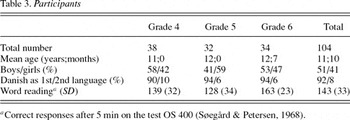
A total of 104 children from Grades 4, 5, and 6 participated in the study (cf. Table 3). Two classrooms per grade level were tested. All participants came from the same school in a socially mixed suburban neighborhood in Copenhagen. Testing was done in the first part of the second half of the school year. It should be noted that, contrary to expectation, the fourth graders obtained higher scores on a test of word reading than the fifth graders. The difference was not significant, however.

Measures
The study was based on 48 words spelled to dictation. Half of the items assessed spelling performances for stressed vowels, and the other half assessed spelling performances for consonants in intervocalic position. Within each phonetic category there were three levels of orthographic transparency: phonemically plausible spellings, context sensitive spellings, and word-specific spellings (cf. Table 2). There were 8 items per level. Appendix A provides a list of all items used. The phonemic structures of words as well as word frequencies were similar across phonetic types and transparency levels. Frequency counts were based on a text corpus of approximately 36.6 million Danish words (Den Danske Ordbogs Korpus, DSL-Test, version 1.0, www.dsl.dk). This corpus comprises a variety of text types, including some not often read by schoolchildren. Frequency counts restricted to texts from children's books and the like would have been preferable, but were not available.
Spelling performances were assessed only for the critical phonemes in order to observe the effects of orthographic transparency specifically. Errors on other parts of the items are not reported. At the phonemic level there was only one phonemically plausible vowel spelling. For instance, the letter i is the only possible representation of the phoneme /i/ in Danish orthography, as in the item gnisten (the spark; Table 2). Plausible consonant spellings at the phonemic level, however, comprised singleton spellings as well as doublet spellings, as explained in the Introduction. In the item knase (crunch), for instance, a singleton s is correct; but if the medial /s/ phoneme is considered in isolation, a doublet ss is also a plausible spelling.
For the context sensitive items there were two or more phonemically plausible spellings of the critical phonemes, but these phonemes occurred in contexts where one of these possible spellings is used almost exclusively. As explained in the Introduction, the constraining contexts for vowels were the following consonant phonemes. For instance, the phoneme /e/ can in principle be represented either by i or e, but when the vowel is followed by /s/ within the same morpheme, as in the item kvisten (the twig), the correct spelling is very consistently the letter i. This contextual constraint is also found in the uninflected monosyllabic word kvist (twig); the bisyllabic inflected form was used to keep the phonemic structure of items similar for vowel and consonant items, as items with intervocalic consonants could not be monosyllabic, of course. For the consonant items the constraining context was the quantity of a preceding stressed vowel, doublets being correct after stressed short vowels. In the item basse (big lump), for instance, a doublet ss is required because the preceding phoneme is a stressed short /a/.
For the word-specific items, there were also two phonemically plausible spellings. Neither of these could be excluded from considerations of the phonological context, as is the case for the vowel spellings of English sale versus sail. For instance, the Danish vowel phoneme /ε/ is represented by æ in the item blæsten (the wind), but the spelling e is also frequent and occurs in similar phonological contexts, for example, in the word hesten (the horse), a perfect rhyme to blæsten. The consonants at the word-specific level followed unstressed short vowels, in which position both single and doubled consonants occur. For instance, a doublet is correct for the intervocalic /s/ in the item bassist (bass player; pronounced with stress on the final syllable), whereas a singleton s is correct in the word fasan (pheasant; pronounced also with stress on the final syllable).
Participants were also asked to spell 10 structurally complex pseudowords, such as /sgvald/ and /sgr
mf

/. All phonemically plausible spellings were accepted, for example, skvalt or sgvald for /sgvald/. A maximum of three errors per word were scored. The purpose of this measure was to assess basic phoneme–grapheme encoding skills.
Procedure
Participants were asked to supply the spellings of words to dictation. Words were presented in sentence contexts that were printed on the test sheets. The sentence contexts were designed to facilitate word identification. More items than the 48 relevant to this study were included. The sixth graders spelled a total of 116 words, whereas the fourth and fifth graders were given a more limited version of the test comprising a total of 69 words. The words were presented in a random order that was fixed for each version of the test. The pseudoword items were always presented last. Tests were administered class by class in the participants' own classrooms.
RESULTS
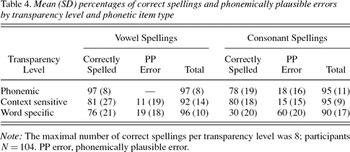
Table 4 presents the mean scores for vowel and consonant spellings at the three levels of orthographic transparency. As expected, it was found that context sensitive spellings were used correctly more often than word-specific spellings, for both vowels and for consonants. The spelling accuracy for the vowels was even better at the phonemic level, where there were no plausible alternatives to the correct spellings. For the consonants, however, the spelling accuracy observed was no better at the phonemic level, where the default singleton spellings were correct, than at the context sensitive level, where doublets were correct. This was because the participants tended to overgeneralize the use of doublets to the items where singleton consonants were correct (on average, 18% of their responses to these items were overgeneralizations). If the total number of phonemically plausible spellings produced is considered, however, it is evident that the children in the study mastered the use of phonemically plausible spellings earlier than the use of context sensitive and word-specific spellings, when they spelled both vowel and consonant items.

When only correct responses were considered (i.e., when phonemically plausible errors were not accepted at the phonemic level), a significant overall effect of the level of transparency (phonemic vs. context sensitive vs. word specific) was found (general linear model), F (2, 206) = 238,906; p < .001. The differences between the individual levels were significant, too (p < .001). There was also a significant effect of phonetic type (i.e., vowels vs. consonants), F (1, 103) = 396,295; p < .001. Furthermore, the interaction between transparency level and phonetic type was also significant, F (1, 103) = 474,682; p < .001. This interaction was due to the fact that word-specific spellings were particularly difficult for consonant spellings, an observation that is in line with the fact that word-specific consonant doublets are considered particularly difficult even by proficient Danish adult spellers. Furthermore, correct responses were relatively less frequent for consonant items than for vowel items at the phonemic level, because of the overgeneralizations of doublet spellings mentioned above.
When the total number of plausible spellings at the phonemic level was compared to the number of correct spellings produced for items at the context sensitive and word-specific levels, the same effects were found, and the differences between the individual levels were still significant.
When the results were analyzed by items (correct responses at all levels), there was, again, a significant overall effect of transparency level, F (2, 42) = 22,003; p < .001, but the difference between items at the phonemic and the context sensitive levels was not significant. There was, again, a significant effect of phonetic type, F (1, 42) = 25,645; p < .001, and a significant interaction between transparency level and phonetic type, F (2, 42) = 8,813; p = .001.
As before, the results were much the same when all phonemically plausible responses at the phonemic level were considered. On this analysis, even the difference between scores at the phonemic and context sensitive levels was significant (p < .05). Item reliability coefficients (alpha) were .79 for all items, .76 for vowel items, and .58 for consonant items.
These results suggest that Danish children beyond the earliest phase of literacy acquisition do rely on the phonological context when spelling. Otherwise, scores on context sensitive items would not have differed from scores on word-specific items. However, the use of context sensitive spellings continued to be more difficult for these children than the use of phonemically plausible spellings.
Next, it was hypothesized that there would be a strong relation between the use of context sensitive vowel and consonant spellings. If performances on the two types of context sensitive spellings reflect a separate “context sensitive” component of spelling competence, then performances at the other levels (phonemically plausible and word-specific spellings) should not account for the correlation between the two. To test this possibility the correlation between scores (correct responses) on context sensitive vowels and consonants was computed, controlling for scores on phonemically plausible as well as word-specific spellings. The control measures used were the means of the normalized scores on consonant and vowel items at the phonemic and word-specific levels, respectively. This partial correlation was clearly significant (r = .32, df=100, p = .001).
Finally, it was a question whether the phonological context was exploited mainly by the most proficient spellers. To answer this question, the total set of participants was divided into three percentile groups based on the scores on the pseudoword spelling task. Presumably, scores on this task reflected basic phoneme–grapheme encoding skills. On average, the first percentile group (good encoders) made 1 error on the 10 pseudowords, the second group (medium encoders) made 6 errors, and the third percentile group (poor encoders) made 18 errors. (Recall that up to 3 errors could be scored per pseudoword.)
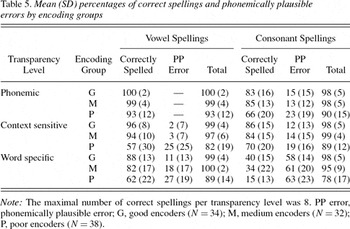
Table 5 is an elaboration of Table 4, reporting the mean scores by encoding group. A significant overall effect of encoding group was found, F (2, 101) = 49.437; p < .001. However, post hoc tests (Scheffé) revealed that only the differences between the poor encoders and the other two groups were significant (p < .001). Thus, as one would expect, performances were generally poorest in the poor encoders. These analyses are based on phonemically plausible responses at the phonemic level (the “total” columns) and on correct responses at the other two levels of transparency. The pattern of results was the same when correct spellings were compared at all three levels of transparency.

Generally, there were significant differences between performances at the level of context sensitive spellings and performances at the phonemic and word-specific levels within all three encoding groups (paired samples t tests; p < .05). However, there were no significant differences between the phonemic level and the context sensitive level when only correct spellings were considered, as all three groups showed the tendency to overgeneralize the use of doublets to the items at the phonemic level. Furthermore, the poor encoders did not spell context sensitive vowels better than word-specific vowels. This result suggests that the poor encoders exploited the context when spelling consonants, but not when spelling vowels.
DISCUSSION
Danish children take account of the phonological context when spelling ambiguous phonemes. This conclusion is suggested by the fact that the children in the present study spelled phonemes with context sensitive spellings more accurately than phonemes with word-specific spellings. However, the use of context sensitive spellings was clearly more difficult than the use of phonemically plausible spellings, suggesting that context sensitive spelling knowledge is acquired later than spelling knowledge at the phonemic level. Thus, spelling accuracy appears to be a function of orthographic transparency. Phonemes with context sensitive spellings are misspelled more often than phonemes with entirely consistent spellings, but not as often as phonemes with word-specific spellings. It must be noted, however, that in the present study errors on intervocalic consonant phonemes were as common when the correct spelling was a singleton consonant (the default spelling) as when the correct spelling was a context sensitive doublet.
The results are in line with findings from English that have also indicated that spellers are sensitive to the phonological context (Treiman et al., 2002; Varnhagen et al., 1999). Furthermore, the results of the present study suggest that knowledge of context sensitive spellings is a separate component of spelling competence because a significant relation was found between the use of vowel spellings constrained by the following consonant and the use of consonant spellings constrained by the preceding vowel, even when the use of phonemically plausible and word-specific spellings was controlled.
In the case of context sensitive spellings, spellers will benefit if units larger than single phonemes are available as input to the spelling process because of the increased consistency of sound–spelling correspondences. Thus, the results suggest that Danish spellers are able to process more than one phoneme at a time, either in parallel or as larger complex units. Clearly, models of spelling production must be able to account for this aspect of spelling competence.
For the context sensitive vowel items in the present study an alternative interpretation of the results is possible, however. These items differed from the word-specific items because they had vowels that could only be spelled in one way in the given phonological context. However, they also differed in terms of their phoneme level consistency, so that the chances of guessing the correct spelling would be better for the context sensitive vowels, even if the phonological context was ignored (cf. Table 1). From the present results it is difficult to say whether context sensitivity or phoneme level consistency was the more important factor. The relation found between context sensitive vowel and consonant spellings does point to the relevance of context sensitivity, but clearly phoneme level consistency is a factor that needs to be controlled. Unfortunately, comprehensive quantitative analyses of sound–spelling correspondences in Danish are not available.
Assuming that context sensitivity is relevant, this raises the question of whether children are sensitive to all sorts of phonological contexts or whether context sensitivity is confined to certain types of large units. The rime unit has often been a focus of attention in discussions of the role of larger units in reading and spelling (Carlisle, 1991; Goswami, 1988; Goswami & East, 2000; Nation, 1997; Treiman, Mullennix, Bijeljac–Babic, & Richmond–Welty, 1995; Treiman & Zukowski, 1988). This makes sense, at least in English where the consistency of sound–spelling correspondences is improved most markedly when neighboring segments within the rime unit are taken into account (Kessler & Treiman, 2001). More recently it has been suggested that contextual effects are confined to the syllable (Treiman et al., 2002).
The results on context sensitive spellings from the present study are of some relevance to this issue. Whereas the context sensitive vowel spellings were constrained by the syllable coda, the consonant spellings were constrained by a vowel belonging to the preceding syllable. Recall from Table 2 that a consonant doublet is used for the /s/ in the two-syllable word basse /'bas
/ (big lump) because it follows a short stressed vowel. Thus, it appears that Danish children learn a contextual constraint that applies across a syllable boundary. However, although Danish children would typically divide words such as basse into two consonant–vowel syllables, /'ba+/s
/, some phonologists argue that the syllable structure of such Danish words should be described with the boundary placed after the /s/, /'bas/+/
/. In such an analysis the contextual constraints studied here are internal to the syllable and rime units, even for the consonant spellings. Thus, the conclusion with respect to the role of rimes and syllables is not quite clear.
Although the Danish results presented here are in accordance with research on spelling in English, it is an open question whether they hold for other orthographies, too. Recent research has indicated that the size of the units employed in reading depends on the specific demands posed by orthographies (Goswami, Ziegler, Dalton, & Schneider, 2003; Martensen, Maris, & Dijkstra, 2000). It seems likely that the same will hold for spelling. What the present results do suggest is that flexibility with respect to unit size is not an idiosyncratic characteristic of English orthography users. Thus, the findings support the view that the strategies used in reading and spelling vary both within and across orthographies as a function of orthographic transparency. Data from more orthographies are needed, however.
Another question about spelling production concerns the relation between lexical and phonological spelling knowledge. The phonological (nonlexical) route in dual route models of spelling may allow for context sensitivity or larger units and thus explain the data (Treiman et al., 2002). However, it may not be desirable to pose a sharp distinction between lexical and nonlexical spelling processes (Campbell, 1983). Such a distinction does not accord well with the lack of a sharp distinction between consistent and inconsistent spellings. Orthographic transparency appears to be a continuum rather than a dichotomy: Many spellings that are usually regarded as phonemically straightforward in English and Danish do have exceptions, and for this reason word-specific spelling knowledge is rarely completely irrelevant. Furthermore, all knowledge of sound–spelling correspondences derives ultimately from real words, and the relevance of this knowledge rests on the fact that it can be applied to real words. Thus, it may be equally misleading to characterize knowledge of phonemically plausible spellings as nonlexical and to characterize knowledge of word-specific spellings as nonphonological. Rather, what matters is the extent to which the use of particular spellings can be generalized from one word to another, and the extent to which spellers actually make such generalizations. The interplay in spelling production between knowledge of spellings at various levels of orthographic transparency certainly calls for further study. Interesting new evidence may come from brain activity studies of subjects making decisions about spelling (Varnhagen, 2003).
It has been suggested that good spellers are more sensitive to contextual constraints than poor spellers (Fischer et al., 1985; Treiman et al., 2002). The present study seemed to confirm this, as good spellers (defined by scores on a pseudoword spelling task) performed better on context sensitive vowels than on word-specific vowels, whereas poor spellers did not. However, for the consonant spellings even the poor spellers showed a clear difference between context sensitive and word-specific spellings. Possibly, this difference reflects the fact that the use of consonant doublets in the context after stressed short vowels is usually pointed out explicitly in Danish spelling instruction, whereas context sensitive vowel spellings are traditionally not paid much attention. Thus, explicit attention to context sensitive spellings in spelling instruction may be a great help for poor spellers. In contrast, it seems likely that spellers with a good mastery of default phoneme level spellings will have more resources to learn spellings with a more restricted scope of application (Caravolas, Hulme, & Snowling, 2001; Gough, Juel, & Griffith, 1992). Good spellers may be sensitive to contextual constraints because they were good spellers in the first place! In that case spelling instruction should focus first of all on poor spellers' performances at the phonemic level.
Longitudinal studies are called for to reveal how children's use of context sensitive spellings develops and to shed light on the factors that determine this development. Both good and medium encoders in the present study performed near ceiling on context sensitive spellings. Thus, it appears that the ability to exploit contextual constraints in spelling develops well before Grade 4 (the youngest grade level in the present study). For models of spelling development it is of great interest to discover how early this ability emerges (Goswami, 1988; Varnhagen et al., 1999; Varnhagen, McCallum, & Burstow, 1997).
Measures of context sensitive spelling knowledge seem important, then, for practical as well as theoretical reasons. Broad spelling error categories such as vowel errors, consonant errors or doubling errors tend not to be very informative about context sensitive spelling knowledge. A vowel error, for instance, may reflect a problem with the use of phonemically plausible, context sensitive, or word-specific spellings alike. In order to identify specific spelling problems, a finer subcategorization of errors is necessary. At the same time, some distinctions between spelling errors seem somewhat arbitrary. Traditionally, a distinction is made between vowel and consonant errors, whereas other phonetic distinctions (e.g., the distinction between front and back vowels) are ignored, although they could, in principle, be just as relevant, or irrelevant, as the vowel–consonant distinction. Perhaps assessments of spelling competence should focus less on children's ability to spell particular types of phonetic segments and more on their mastery of spellings at particular levels of orthographic transparency.
APPENDIX A
Items used in the study are listed in the table below. The table lists correct spellings (with the critical spellings in bold), critical phonemes (in the International Phonetic Alphabet as conventionally modified for Danish), and English translations. Mean item frequencies (with SDs) are added in the final line of each section of the table. The frequency measure is the logarithm to the summed frequency of the three most frequently occurring inflectional forms of each item (counts based on Den Danske Ordbogs Korpus, www.dsl.dk).
For the critical vowel phonemes of the context sensitive and word-specific items there were phonemically plausible alternative spellings: /e/: e; /
/: å and o; /ε/: e; /ø/ and /œ/: y. For the critical consonants phonemes both singleton and doublet spellings were phonemically plausible (cf. Table 2).

ACKNOWLEDGMENTS
I thank Maja Dyrby and Tinne Ferslev for assistance with data collection and Dorthe Klint Petersen, Carsten Elbro, Brett Kessler, Usha Goswami, and three anonymous reviewers for helpful comments. Special thanks to teachers and pupils at Rødovre Skole.
References
Aronoff M., &
Koch E.
1996.
Context-sensitive regularities in English vowel spelling.
Reading and Writing: An Interdisciplinary Journal,
8,
251–
265.Google Scholar
Barry C.
1994.
Spelling routes (or roots of rutes).
In G. D. A. Brown &
N. C. Ellis (Eds.),
Handbook of spelling: Theory, process and intervention
(pp. 27–
49).
Chichester:
Wiley.
Basbøll H., &
Wagner J.
1985.
Kontrastive phonologie des Deutschen und Dänischen.
Tübingen:
Max Niemeyer Verlag.
Becker–Christensen C.
1988.
Bogstav og lyd. Dansk retskrivning og rigsmålsudtale [Letter and sound. Danish orthography and standard pronunciation].
Copenhagen:
Gyldendal.
Brown G. D. A., &
Loosemore R. P. W.
1994.
Computational approaches to normal and impaired spelling.
In G. D. A. Brown &
N. C. Ellis (Eds.),
Handbook of spelling: Theory, process and intervention
(pp. 319–
335).
Chichester:
Wiley.
Bruck M., &
Waters G.
1988.
An analysis of the spelling errors of children who differ in their reading and spelling skills.
Applied Psycholinguistics,
9,
77–
92.Google Scholar
Caravolas M.,
Bruck M., &
Genesee F.
2003.
Similarities and differences between English- and French-speaking poor spellers.
In N. Goulandris (Ed.),
Dyslexia in different languages.
London:
Whurr.
Caravolas M.,
Hulme C., &
Snowling M. J.
2001.
The foundations of spelling ability: Evidence from a 3-year longitudinal study.
Journal of Memory and Language,
45,
751–
774.Google Scholar
Carlisle J. F.
1991.
Questioning the psychological reality of onset-rime as a level of phonological awareness.
In S. A. Brady &
D. Shankweiler (Eds.),
Phonological processes in literacy.
Hillsdale, NJ:
Erlbaum.
Carney E.
1994.
A survey of English spelling.
London:
Routledge.
Cassar M., &
Treiman R.
1997.
The beginnings of orthographic knowledge: Children's knowledge of double letters in words.
Journal of Educational Psychology,
89,
631–
644.Google Scholar
Fischer F. W.,
Shankweiler D., &
Liberman I. Y.
1985.
Spelling proficiency and sensitivity to word structure.
Journal of Memory and Language,
24,
423–
441.Google Scholar
Goswami U.
1988.
Children's use of analogy in learning to spell.
British Journal of Developmental Psychology,
6,
21–
33.Google Scholar
Goswami U., &
East M.
2000.
Rhyme and analogy in beginning reading: Conceptual and methodological issues.
Applied Psycholinguistics,
21,
63–
93.Google Scholar
Goswami U.,
Ziegler J. C.,
Dalton L., &
Schneider W.
2003.
Nonword reading across orthographies: How flexible is the choice of reading units?
Applied Psycholinguistics,
24,
235–
247.Google Scholar
Gough P. B.,
Juel C., &
Griffith P. L.
1992.
Reading, spelling and the orthographic cipher.
In P. B. Gough,
L. C. Ehri, &
R. Treiman (Eds.),
Reading acquisition
(pp. 35–
48).
Hillsdale, NJ:
Erlbaum.
Kessler B., &
Treiman R.
2001.
Relationships between sounds and letters in English monosyllables.
Journal of Memory and Language,
44,
592–
617.Google Scholar
Kreiner D. S., &
Gough P. B.
1990.
Two ideas about spelling: Rules and word-specific memory.
Journal of Memory and Language,
29,
103–
118.Google Scholar
Lennox C., &
Siegel L. S.
1996.
The development of phonological rules and visual strategies in average and poor spellers.
Journal of Experimental Child Psychology,
62,
60–
83.Google Scholar
Marsh G.,
Friedman M.,
Welch V., &
Desberg P.
1980.
The development of strategies in spelling.
In U. Frith (Ed.),
Cognitive processes in spelling
(pp. 339–
353).
London:
Academic Press.
Martensen H.,
Maris E., &
Dijkstra T.
2000.
When does inconsistency hurt? On the relation between phonological consistency effects and the reliability of sublexical units.
Memory & Cognition,
28,
648–
656.Google Scholar
Nation K.
1997.
Children's sensitivity to rime unit frequency when spelling words and nonwords.
Reading and Writing: An Interdisciplinary Journal,
9,
321–
338.Google Scholar
Notenboom A., &
Reitsma P.
(in press).
Investigating the dimensions of spelling ability.
Educational and Psychological Measurements.
Perry C.,
Ziegler J. C., &
Coltheart M.
2002.
A dissociation between orthographic awareness and spelling production.
Applied Psycholinguistics,
23,
43–
73.Google Scholar
Sampson G.
1985.
Writing systems.
London:
Hutchinson.
Steffler D. J.
2001.
Implicit cognition and spelling development.
Developmental Review,
21,
168–
204.Google Scholar
Søegård A., &
Petersen P. B.
1968.
OS 400 Ordstillelæsningssprøve.
Copenhagen:
Dansk Psykologisk Forlag.
Treiman R.,
Kessler B., &
Bick S.
2002.
Context sensitivity in the spelling of English vowels.
Journal of Memory and Language,
47,
448–
468.Google Scholar
Treiman R.,
Kessler B., &
Bick S.
2003.
Influence of consonantal context on the pronunciation of vowels: A comparison of human readers and computational models.
Cognition,
88,
49–
78.Google Scholar
Treiman R.,
Mullennix J.,
Bijeljac–Babic R., &
Richmond–Welty E. D.
1995.
The special role of rimes in the description, use, and acquisition of English orthography.
Journal of Experimental Psychology: General,
124,
107–
136.Google Scholar
Treiman R., &
Zukowski A.
1988.
Units in reading and spelling.
Journal of Memory and Language,
27,
466–
477.Google Scholar
Varnhagen C. K.
2003, June.
Brain activation during spelling.
Paper presented at the SSSR Conference, Boulder, CO.
Varnhagen C. K.,
Boechler P. M., &
Steffler D. J.
1999.
Phonological and orthographic influences on children's vowel spelling.
Scientific Studies of Reading,
3,
363–
379.Google Scholar
Varnhagen C. K.,
McCallum M., &
Burstow M.
1997.
Is children's spelling naturally stage-like?
Reading and Writing: An Interdisciplinary Journal,
9,
451–
481.Google Scholar
Venezky R. L.
1970.
The structure of English orthography.
The Hague:
Mouton.
Zinna D. R.,
Liberman I. Y., &
Shankweiler D.
1986.
Children's sensitivity to factors influencing vowel reading.
Reading Research Quarterly,
21,
465–
480.Google Scholar
Participants
Mean (SD) percentages of correct spellings and phonemically plausible errors by transparency level and phonetic item type
Mean (SD) percentages of correct spellings and phonemically plausible errors by encoding groups

 You have
Access
- 13
- Cited by