Introduction
Mild cognitive impairment (MCI) is conceptualized as an aging condition that is situated on the continuum from normal cognitive aging to dementia (Petersen, Reference Petersen2004). While it differs from normal aging by the presence of an objective impairment in at least one cognitive domain, and from dementia by the fact that functional impairment is minimal, there are overlaps at both ends of the spectrum, and differential diagnosis between normal aging, MCI and dementia is complex (Petersen, Reference Petersen2004). Various sets of diagnostic criteria for MCI have been delineated, principally from the Mayo Clinic (Petersen, Reference Petersen2004; Petersen et al., Reference Petersen, Smith, Waring, Ivnik, Tangalos and Kokmen1999; Reference Petersen2001). A consensus report by the International Workgroup on MCI has stressed the need to sub-typify the MCI concept into several subgroups based on the nature of cognitive impairment observed in the individuals. Older adults with amnestic MCI (aMCI) present with either an isolated (single-domain: sd-aMCI), or a non-isolated (multiple-domain: md-aMCI), memory impairment. On the other hand, individuals with nonamnestic MCI (naMCI) show no memory deficit but impairment in one (single-domain: sd-naMCI) or many (multiple-domain: md-naMCI) other cognitive domains (Petersen, Reference Petersen2004; Winblad et al., Reference Winblad2004).
Besides cognitive impairment, several older adults with MCI also show non-cognitive features. According to a systematic review of 21 studies, 35–75% of patients with MCI presented at least one neuropsychiatric symptom; the most commonly reported were depression, apathy and anxiety, followed by irritability and agitation (Apostolova and Cummings, Reference Apostolova and Cummings2008). Sleep/night-time disturbances have been understudied relative to depression, apathy or anxiety in elders with MCI. To our knowledge, no work has yet investigated thoroughly and systematically the sleep of these persons. Moreover, they were not addressed in a recent review on neuropsychiatric symptoms (Apostolova and Cummings, Reference Apostolova and Cummings2008), as the vast majority of the selected studies utilized the 10-item version of the Neuropsychiatric Inventory (NPI-10) instead of the 12-item version (NPI-12). Since the NPI-10 does not include a subscale for sleep/night-time disturbances, little is known about the prevalence and manifestations of this type of neuropsychiatric symptoms in the context of preclinical dementia. (Note: Sleep disturbances have been documented as neuropsychiatric symptoms in the context of aging and dementia and these manifestations are assessed by the NPI-12.)
Sleep is well characterized in the two extremities of the continuum from healthy aging to dementia. On the one hand, advancing age is accompanied by changes in the continuity (e.g. reduced total sleep time, more fragmented sleep) and architecture (e.g. increased light sleep, reduced deep or slow-wave sleep, changes in electrophysiological features) of sleep, as well as in the circadian sleep-wake timing (Ohayon et al., Reference Ohayon, Carskadon, Guilleminault and Vitiello2004; Espiritu, Reference Espiritu2008). While several sleep disorders are more prevalent in the elderly, they are typically comorbid to specific psychiatric, medical or neurologic conditions and are therefore not related to the process of aging per se (Ohayon et al., Reference Ohayon, Carskadon, Guilleminault and Vitiello2004). On the other hand, dementia can be one of these conditions emerging in older age that is frequently characterized by sleep alterations and disorders. Disturbed sleep is even proposed as one of four neuropsychiatric syndromes in dementia to be included in the DSM-V, along with psychosis, depression and agitation (Jeste et al., Reference Jeste, Meeks, Kim and Zubenko2006). Some sleep changes are seen in all forms of dementia (e.g. increased number of awakenings, decreased deep or slow-wave sleep), whereas other features or disorders are more typical to specific pathologies – for example, disruption of the sleep-wake cycle in Alzheimer's disease (Yesavage et al., Reference Yesavage2003) and REM sleep behavior disorder (RBD) in dementia with Lewy bodies and Parkinson's disease (Boeve et al., Reference Boeve, Silber and Ferman2004).
Several lines of evidence suggest the need to better characterize sleep disturbances in older adults with MCI. First, it has been proposed that disturbed night-time sleep and excessive daytime sleepiness could worsen cognitive symptoms (e.g. attention and memory deficits, slowed reaction time) in older people (Cole and Richards, Reference Cole and Richards2005; Martin and Ancoli-Israel, Reference Martin and Ancoli-Israel2008). Thus, given that the diagnosis of MCI relies on neuropsychological assessment, one must verify to what extent sleep disturbances modulate the cognitive impairment of these persons. Second, some authors have suggested that when combined with other neuropsychiatric symptoms (e.g. anxiety, depression, apathy), sleep disturbances could represent a potential marker for the deterioration of the cognitive and functional status from MCI to specific subtypes of dementia (Geda et al., Reference Geda2004; Rozzini et al., Reference Rozzini2008a). In other words, improved knowledge about the manifestations of sleep disturbances in MCI could lead to the identification of subgroups of patients at risk of developing a degenerative disorder. Third, given the fact that sleep disturbances are commonly associated with both depressive syndromes and preclinical phases of dementia, the characterization of the similarities and discrepancies as regards the nature of sleep in depression and MCI could refine the differential diagnosis between these clinical conditions, which has been identified as a major focus of research by the National Institute of Mental Health (Steffens et al., Reference Steffens2006). Finally, a group of experts has recently included in its recommendations the need for detection and treatment of sleep problems in the context of dementia (Hogan et al., Reference Hogan2007). By extension, this recommendation could well be applied to elders with MCI.
To sum up, there are indications that the study of sleep in MCI could help to characterize the preclinical phase of dementia. The aim of this unsystematic review is to summarize the current literature on the prevalence and severity of sleep disturbances in the context of MCI. As part of this objective, results of the reviewed studies will be discussed in relation to the progression from MCI to dementia, and recommendations will be made regarding future research on sleep disturbances in persons with MCI.
Methods
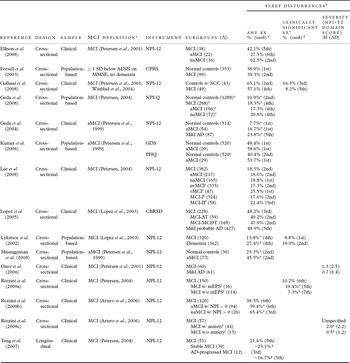
An unsystematic review of the literature was conducted in order to document sleep in the context of MCI. Included studies were published in English prior to February 2009 and had to report empirical data on sleep disturbances in MCI individuals. Publications using the concept of “cognitive impairment no dementia” (CIND) were excluded to ensure more homogeneity and therefore maximize the internal validity of the review. Several papers could not be considered because the NPI-10 was used by many authors. As mentioned earlier, the NPI-10 does not assess night-time disturbances. A total of 18 empirical studies reporting data on sleep-related disturbances among MCI individuals were identified via the PubMed and PsychINFO databases (keywords used: [“sleep” or “nighttime disturbances” or “neuropsychiatric symptoms” or “non-cognitive symptoms”] AND [“mild cognitive impairment” or “mci” or “dementia”]) and reference lists of the examined papers. The characteristics of 15 studies from which quantitative data on the prevalence, clinical significance or severity of sleep disturbances could be obtained are summarized in Table 1. The remaining three studies were not included in the table nor in the description of methodological characteristics because they did not report data on prevalence, clinical significance or severity (Feldman et al., Reference Feldman2004; Gabryelewicz et al., Reference Gabryelewicz2004; Lobo et al., Reference Lobo, Lopez-Anton, Camara, Quintanilla, Campayo and Saz2008). Their results will nonetheless be referred to in the text because they included other relevant sleep-related information.
Summary of studies assessing prevalence, clinical significance, and severity of sleep disturbances in mild cognitive impairment

* Significant between-group differences for prevalence rates (p < 0.05).
a Except for the study by Forsell and colleagues (Reference Forsell, Palmer and Fratiglioni2003), see reference in parentheses for description of diagnostic criteria used by the authors.
b When more than one MCI subgroup was included in a study, a global prevalence rate/clinical significance rate/severity for all MCI participants was computed.
c Clinically significant symptoms are defined as a NPI-12 domain score (symptom frequency (0–4) × symptom severity(0–5)) equal or superior to 4 (Lyketsos et al., Reference Lyketsos, Lopez, Jones, Fitzpatrick, Breitner and DeKosky2002).
d Rank of sleep disturbances among the most prevalent neuropsychiatric symptoms in the sample.
e Number of participants for each subgroup is lower for sleep disturbances than for other neuropsychiatric symptoms because of missing data for a total of 353 participants; these numbers were derived from Table 2 in the paper.
f See reference of the paper (first column) for a description of the criteria used to define these specific subgroups of MCI.
g Prevalence rates of sleep disturbances were not reported in the text of the paper but were approximated from Figure 1b.
Abbreviations: AD = Alzheimer's disease; AESN = age- and education-specific norms; aMCI = amnestic MCI; CPRS = Comprehensive Psychopathological Rating Scale; GDS = Goldberg Depression Scale; M = mean; MCI = mild cognitive impairment; MCI-AT = MCI-amnestic type (Lopez et al., Reference Lopez2003); MCI-I = MCI with activities of daily living essentially preserved (Petersen et al., Reference Petersen, Smith, Waring, Ivnik, Tangalos and Kokmen1999); MCI-II = MCI with complex instrumental function minimally impaired (Winblad et al., Reference Winblad2004); MCI-MCDT = MCI-multiple cognitive domain type (Lopez et al., Reference Lopez2003); mEPS = mild extrapyramidal signs; MMSE = Mini-mental State Examination; naMCI = nonamnestic MCI; NPI-12 = Neuropsychiatric Inventory, 12-item version; NPI-Q = Neuropsychiatric Inventory Questionnaire; nvMCI = nonvascular MCI; PHQ = Patient Health Questionnaire; SCC = subjective cognitive complaints; SD = standard deviation; vMCI = vascular MCI; w/ = with; w/o = without.
Results
Methodological characteristics of the studies reporting prevalence, clinical significance or severity data
Study design and setting
Among the 15 papers reporting the prevalence, clinical significance or severity of sleep disturbances in MCI, 14 reported cross-sectional data while the study by Teng and colleagues (Reference Teng, Lu and Cummings2007) used a longitudinal design. With regard to the recruitment setting, ten studies were conducted with clinical samples (Geda et al., Reference Geda2004; Lopez et al., Reference Lopez, Becker and Sweet2005; Onor et al., Reference Onor, Trevisiol, Negro and Aguglia2006; Teng et al., Reference Teng, Lu and Cummings2007; Ellison et al., Reference Ellison, Harper, Berlow and Zeranski2008; Gallassi et al., Reference Gallassi, Bisulli, Oppi, Poda and Di Felice2008; Lee et al., Reference Lee, Cho, Hong, Kim and Oh2008; Rozzini et al., Reference Rozzini2008a; Reference Rozzini2008b; Reference Rozzini2008c), for the most part by including consecutive patients from tertiary memory or dementia clinics, while the five remaining studies used population-based samples (Lyketsos et al., Reference Lyketsos, Lopez, Jones, Fitzpatrick, Breitner and DeKosky2002; Forsell et al., Reference Forsell, Palmer and Fratiglioni2003; Kumar et al., Reference Kumar, Jorm, Parslow and Sachdev2006; Geda et al., Reference Geda2008; Muangpaisan et al., Reference Muangpaisan, Intalapaporn and Assantachai2008).
MCI criteria
The selected studies utilized different criteria to include participants with MCI. Three studies (Geda et al., Reference Geda2004; Kumar et al., Reference Kumar, Jorm, Parslow and Sachdev2006; Muangpaisan et al., Reference Muangpaisan, Intalapaporn and Assantachai2008) used the initial MCI diagnostic criteria of the Mayo Clinic (Petersen et al., Reference Petersen, Smith, Waring, Ivnik, Tangalos and Kokmen1999), which corresponds to amnestic MCI (aMCI). Subsequent MCI criteria were used in nine studies (Onor et al., Reference Onor, Trevisiol, Negro and Aguglia2006; Teng et al., Reference Teng, Lu and Cummings2007; Ellison et al., Reference Ellison, Harper, Berlow and Zeranski2008; Gallassi et al., Reference Gallassi, Bisulli, Oppi, Poda and Di Felice2008; Geda et al., Reference Geda2008; Lee et al., Reference Lee, Cho, Hong, Kim and Oh2008; Rozzini et al., Reference Rozzini2008a; Reference Rozzini2008b; Reference Rozzini2008c). Although they referred to different papers when describing their diagnostic criteria (i.e. Petersen et al., Reference Petersen2001; Petersen, Reference Petersen2004; Winblad et al., Reference Winblad2004; Artero et al., Reference Artero, Petersen, Touchon and Ritchie2006), the inclusion criteria of these nine research papers were in fact fairly similar. Two other studies (Lyketsos et al., Reference Lyketsos, Lopez, Jones, Fitzpatrick, Breitner and DeKosky2002; Lopez et al., Reference Lopez, Becker and Sweet2005) relied on MCI criteria from the Cardiovascular Health Study Cognition Study (Lopez et al., Reference Lopez2003). Finally, in one investigation (Forsell et al., Reference Forsell, Palmer and Fratiglioni2003), MCI was defined on the basis of the absence of dementia and a Mini-mental State Examination (MMSE; Folstein et al., Reference Folstein, Folstein and McHugh1975) score at least 1 SD below age- and education-specific norms.
Exclusion criteria
In terms of exclusion criteria, significant systemic illnesses, unstable medical conditions, as well as a history of schizophrenia, schizo-affective and bipolar disorders were generally excluded across the 15 studies included in Table 1. Four studies had exclusion criteria for a history and/or current diagnosis of depression (Teng et al., Reference Teng, Lu and Cummings2007; Gallassi et al., Reference Gallassi, Bisulli, Oppi, Poda and Di Felice2008; Muangpaisan et al., Reference Muangpaisan, Intalapaporn and Assantachai2008; Rozzini et al., Reference Rozzini2008c). Two of these studies applied the same criteria to all Axis I disorders (Teng et al., Reference Teng, Lu and Cummings2007; Muangpaisan et al., Reference Muangpaisan, Intalapaporn and Assantachai2008). Participants with alcohol or substance abuse were excluded from two studies (Lopez et al., Reference Lopez, Becker and Sweet2005; Gallassi et al., Reference Gallassi, Bisulli, Oppi, Poda and Di Felice2008), while two others applied exclusion criteria regarding the use of psychiatric medication (Gallassi et al., Reference Gallassi, Bisulli, Oppi, Poda and Di Felice2008; Muangpaisan et al., Reference Muangpaisan, Intalapaporn and Assantachai2008). Finally, the longitudinal study by Teng and colleagues (Reference Teng, Lu and Cummings2007) excluded those individuals who progressed from MCI at baseline to non-AD dementia at follow-up.
Assessment methods
All studies except one (Kumar et al., Reference Kumar, Jorm, Parslow and Sachdev2006) used a semi-structured interview, usually conducted with the primary caregiver, to document night-time disturbances and other neuropsychiatric symptoms. The NPI-12 (Cummings, Reference Cummings1997) was used by most studies (n = 11), whereas one study (Geda et al., Reference Geda2008) used the Neuropsychiatric Inventory Questionnaire (NPI-Q, a shorter version of the NPI-12; Kaufer et al., Reference Kaufer2000), one study (Forsell et al., Reference Forsell, Palmer and Fratiglioni2003) used the Comprehensive Psychopathological Rating Scale (CPRS), and another (Lopez et al., Reference Lopez, Becker and Sweet2005) used the Consortium to Establish a Registry for Alzheimer's Disease Behavioral Rating Scale for Dementia (CBRSD; Tariot et al. Reference Tariot1995). The study by Kumar and colleagues (Reference Kumar, Jorm, Parslow and Sachdev2006) utilized two self-reported instruments completed by patients that are primarily designed to evaluate depressive symptoms: the Goldberg Depression Scale (GDS; Goldberg et al., Reference Goldberg, Bridges, Duncan-Jones and Grayson1988) and the Patient Health Questionnaire (PHQ). The presence/absence of sleep disturbances was assessed by one item of the GDS (“waking up too early”) and one item of the PHQ (“trouble sleeping, staying asleep or sleeping too much”).
Prevalence of sleep disturbances in MCI
Twelve studies documented the prevalence of sleep/night-time disturbances in MCI individuals. Overall, results indicated that sleep/night-time disturbances are present in 14–59% of MCI cases. (Note: When more than one MCI subgroup was included in a study, a global prevalence rate for all MCI participants was computed and included in Table 1.)
Prevalence in relation to study setting
Similar prevalence results were obtained whether data were collected from tertiary clinical samples (prevalence of 17–57%) (Geda et al., Reference Geda2004; Lopez et al., Reference Lopez, Becker and Sweet2005; Teng et al., Reference Teng, Lu and Cummings2007; Ellison et al., Reference Ellison, Harper, Berlow and Zeranski2008; Gallassi et al., Reference Gallassi, Bisulli, Oppi, Poda and Di Felice2008; Lee et al., Reference Lee, Cho, Hong, Kim and Oh2008; Rozzini et al., Reference Rozzini2008b) or population-based samples (prevalence of 14–59%) (Lyketsos et al., Reference Lyketsos, Lopez, Jones, Fitzpatrick, Breitner and DeKosky2002; Forsell et al., Reference Forsell, Palmer and Fratiglioni2003; Kumar et al., Reference Kumar, Jorm, Parslow and Sachdev2006; Geda et al., Reference Geda2008; Muangpaisan et al., Reference Muangpaisan, Intalapaporn and Assantachai2008).
Prevalence in relation to MCI criteria and exclusion criteria
Prevalence of night-time disturbances was also similar across the different definitions of MCI. For instance, it varied between 17% and 59% in studies using the aMCI criteria of Petersen and colleagues (Reference Petersen, Smith, Waring, Ivnik, Tangalos and Kokmen1999) (Geda et al., Reference Geda2004; Kumar et al., Reference Kumar, Jorm, Parslow and Sachdev2006; Muangpaisan et al., Reference Muangpaisan, Intalapaporn and Assantachai2008), and between 18% and 57% in those using subsequent MCI criteria (Teng et al., Reference Teng, Lu and Cummings2007; Ellison et al., Reference Ellison, Harper, Berlow and Zeranski2008; Gallassi et al., Reference Gallassi, Bisulli, Oppi, Poda and Di Felice2008; Geda et al., Reference Geda2008; Lee et al., Reference Lee, Cho, Hong, Kim and Oh2008; Rozzini et al., Reference Rozzini2008b). Regarding studies that used the Cardiovascular Health Study Cognition Study criteria for MCI (Lopez et al., Reference Lopez2003), the prevalence of sleep disturbances was 14% in a population-based sample (Lyketsos et al., Reference Lyketsos, Lopez, Jones, Fitzpatrick, Breitner and DeKosky2002), compared to 48% in a clinical sample (Lopez et al., Reference Lopez, Becker and Sweet2005). The prevalence was 39% when definition of MCI was based on the MMSE (Forsell et al., Reference Forsell, Palmer and Fratiglioni2003). Finally, the exclusion of individuals with a history and/or current diagnosis of major depression did not modify drastically the prevalence range of sleep disturbances (22–57%) (Teng et al., Reference Teng, Lu and Cummings2007; Gallassi et al., Reference Gallassi, Bisulli, Oppi, Poda and Di Felice2008; Muangpaisan et al., Reference Muangpaisan, Intalapaporn and Assantachai2008).
Prevalence in relation to assessment method
When the NPI-12 or NPI-Q was employed, the prevalence of sleep disturbances varied from 14 to 57% (Lyketsos et al., Reference Lyketsos, Lopez, Jones, Fitzpatrick, Breitner and DeKosky2002; Geda et al., Reference Geda2004; Reference Geda2008; Teng et al., Reference Teng, Lu and Cummings2007; Ellison et al., Reference Ellison, Harper, Berlow and Zeranski2008; Gallassi et al., Reference Gallassi, Bisulli, Oppi, Poda and Di Felice2008; Lee et al., Reference Lee, Cho, Hong, Kim and Oh2008; Muangpaisan et al., Reference Muangpaisan, Intalapaporn and Assantachai2008; Rozzini et al., Reference Rozzini2008b). The two other studies using clinical interviews to document sleep in MCI obtained prevalence rates of 39% with the CPRS (Forsell et al., Reference Forsell, Palmer and Fratiglioni2003) and 48% with the CBRSD (Lopez et al., Reference Lopez, Becker and Sweet2005). In the investigation by Kumar and colleagues (Reference Kumar, Jorm, Parslow and Sachdev2006), 59% of patients with MCI reported waking up too early on the GDS, while 52% reported having trouble sleeping, staying asleep or sleeping too much on the PHQ.
Relative importance of sleep disturbances in MCI
In the eight studies using the NPI-12 (Lyketsos et al., Reference Lyketsos, Lopez, Jones, Fitzpatrick, Breitner and DeKosky2002; Geda et al., Reference Geda2004; Teng et al., Reference Teng, Lu and Cummings2007; Ellison et al., Reference Ellison, Harper, Berlow and Zeranski2008; Gallassi et al., Reference Gallassi, Bisulli, Oppi, Poda and Di Felice2008; Lee et al., Reference Lee, Cho, Hong, Kim and Oh2008; Muangpaisan et al., Reference Muangpaisan, Intalapaporn and Assantachai2008; Rozzini et al., Reference Rozzini2008b), as well as in the study using the NPI-Q (Geda et al., Reference Geda2008), night-time disturbances were among the six most frequently reported neuropsychiatric symptoms. It was even among the two most common symptoms on three occasions (Geda et al., Reference Geda2004; Lee et al., Reference Lee, Cho, Hong, Kim and Oh2008; Muangpaisan et al., Reference Muangpaisan, Intalapaporn and Assantachai2008). In the study using the CPRS to document psychiatric symptoms (Forsell et al., Reference Forsell, Palmer and Fratiglioni2003), sleep disturbances were the second most prevalent symptom, which was also the case in the study using the CBRSD to measure behavioral symptoms (Lopez et al., Reference Lopez, Becker and Sweet2005). In the investigation by Kumar and colleagues (Reference Kumar, Jorm, Parslow and Sachdev2006), “waking up too early” and “trouble sleeping, staying asleep or sleeping too much” were the most commonly reported symptoms on the GDS and the PHQ, respectively. Similar results were presented in one paper that was not entered in Table 1. In fact, the insomnia item of the Beck Depression Inventory (Beck et al., Reference Beck, Ward, Mendelson, Mock and Erbaugh1961) had the third highest mean score after reduced libido and fatigue in a subsample of 593 older adults classified sd-aMCI and displaying a total NPI-10 score greater than 0 (Feldman et al., Reference Feldman2004). In this study, MCI was defined on the basis of the Clinical Dementia Rating Scale (Morris, Reference Morris1993; stage 0.5) and the New York University Delayed Paragraph Recall Test (Kluger et al., Reference Kluger, Ferris, Golomb, Mittelman and Reisberg1999; cutoff inclusion score of < 9).
Using a different method, Geda and colleagues (Reference Geda2008) evaluated the importance of each neuropsychiatric symptom by computing a population-attributable risk, which considers both the frequency of the symptom in individuals with normal cognition and the odds ratio (OR) measuring the magnitude of the association between MCI and the specific neuropsychiatric symptom. Night-time behavior had the fifth highest population-attributable risk among NPI-Q symptoms (8.1%) based on the frequency of the symptom in participants with normal cognition (10.9%) and the OR (1.80; 95% confidence interval = 1.25–2.60).
Prevalence of clinically significant sleep disturbances in MCI
Aside from reporting the frequency of night-time disturbances and other neuropsychiatric symptoms, three studies reported rates of clinically significant symptoms, defined as a NPI-12 domain score of 4 and higher. In the ground-breaking population-based study by Lyketsos and colleagues (Reference Lyketsos, Lopez, Jones, Fitzpatrick, Breitner and DeKosky2002), while night-time disturbances were the fourth most prevalent neuropsychiatric manifestation, they were in fact the most clinically significant symptom, as reported by 8.8% of the 320 MCI participants. Similar results were obtained by two subsequent investigations from clinical samples, with rates of clinically significant sleep disturbances of 8.2% (Gallassi et al., Reference Gallassi, Bisulli, Oppi, Poda and Di Felice2008), and 10.2% (Rozzini et al., Reference Rozzini2008a).
Severity of sleep disturbances in MCI
Two studies reported the mean domain scores of NPI-12 symptoms as a measure of severity. In a sample of 60 MCI individuals recruited from a clinical setting, the mean domain score for night-time disturbances was 1.3 (SD = 2.5) (Onor et al., Reference Onor, Trevisiol, Negro and Aguglia2006). Rozzini and colleagues (Reference Rozzini2008c) reported a mean domain score of 2.0 (SD = 2.2) in 44 MCI patients with high anxiety, which was significantly higher than for 13 low-anxiety MCI patients (M = 0.5; SD = 1.2).
Comparisons of MCI subtypes
Comparison of amnestic and nonamnestic MCI
Some of the previous studies compared the prevalence of sleep disturbances between different MCI subtypes. Using the CBRSD, Lopez and colleagues (Reference Lopez, Becker and Sweet2005) found equivalent prevalence rates of sleep disturbances between MCI-amnestic type participants (MCI-AT; 49%) and those with MCI-multiple cognitive domain type (MCI-MCDT, requiring either deterioration in at least one cognitive domain not including memory or two abnormal tests in two different domains including memory; 48%). Amnestic and nonamnestic MCI individuals were contrasted in four studies, with mixed findings. Two of those studies, conducted in clinical settings using the NPI-12, reported a significantly higher prevalence of night-time disturbances in naMCI compared to aMCI patients – 62.5% vs. 27.3%, respectively (Ellison et al., Reference Ellison, Harper, Berlow and Zeranski2008) and 65.4% vs. 39.4%, respectively (Rozzini et al., Reference Rozzini2008b). Another clinical study failed to replicate these results, finding comparable rates of night-time disturbances, as assessed with the NPI-Q, between aMCI (18.0%) and naMCI (18.8%) (Lee et al., Reference Lee, Cho, Hong, Kim and Oh2008). Findings from a population-based investigation were comparable as 17.3% of aMCI patients and 20.8% of naMCI patients reported sleep disturbances (Geda et al., Reference Geda2008).
Comparisons based on vascular status, functional level and presence of extrapyramidal signs
In addition to comparing aMCI and naMCI, Lee and colleagues (Reference Lee, Cho, Hong, Kim and Oh2008) classified and compared their participants according to their vascular status (vascular MCI, n = 47, vs. nonvascular MCI, n = 335) and their functional level (MCI-I, activities of daily living essentially preserved, n = 324, vs. MCI-II, complex instrumental function minimally impaired, n = 58). Results indicated that patients with vascular MCI were no more likely to experience sleep/night-time disturbances than nonvascular MCI (25.5% vs. 17.3%, respectively, p = .17). Similarly, there was no significant difference between the prevalence of sleep disturbances of MCI-I and MCI-II patients (17.6% vs. 22.4%, respectively, p = .38). But one should note that the subgroups were of unequal sizes in these comparisons and this may have contributed to the lack of power to detect significant differences. In a study conducted within a clinical setting, Rozzini and colleagues (Reference Rozzini2008a) classified their MCI participants as presenting mild extrapyramidal signs (EPS; n = 36) or not (n = 114) to examine the relationships between parkinsonian signs, cognitive functioning, and neuropsychiatric features. The authors found that the prevalence of clinically significant sleep disturbances (NPI-12 domain score ≥ 4) was significantly higher in the subgroup with mild EPS (19.4% vs. 7.3%).
Prevalence of sleep disturbances in MCI compared to normal aging and dementia
If MCI represents a transitory stage from normal aging to dementia, the prevalence and severity of neuropsychiatric symptoms, including sleep disturbances, should be intermediate between the two ends of the continuum (Lyketsos et al., Reference Lyketsos, Lopez, Jones, Fitzpatrick, Breitner and DeKosky2002). Six research papers compared MCI participants with healthy older adults, three of them finding a significant between-group difference in the prevalence of sleep disturbances. More precisely, in a sample recruited through tertiary clinics, 16.7% of MCI participants had sleep disturbances and this was significantly higher than the prevalence in the control group (7.7%) (Geda et al., Reference Geda2004). Significant differences were also found in a population-based study from the same research team, with 18.3% of MCI participants and 10.9% of controls presenting night-time disturbances (Geda et al., Reference Geda2008). Another population-based study found a significantly higher prevalence of night-time disturbances in aMCI participants (45.5%) compared to normal controls (23.3%) (Muangpaisan et al., Reference Muangpaisan, Intalapaporn and Assantachai2008). Among the studies that reported no significant differences between MCI and control participants, it is noteworthy that two had distinctive methodological characteristics compared to the other reviewed papers: Forsell and colleagues (Reference Forsell, Palmer and Fratiglioni2003) defined MCI solely on the basis of the MMSE score while the study by Kumar and colleagues (Reference Kumar, Jorm, Parslow and Sachdev2006) was the only one to use self-reported questionnaires for depressive symptoms instead of a clinical interview to document sleep problems. The other study without significant results included control participants with subjective cognitive complaints (SCC) (Gallassi et al., Reference Gallassi, Bisulli, Oppi, Poda and Di Felice2008). This may have confounded the results as the participants with SCC may have corresponded to the concept of subjective cognitive impairment (Reisberg and Gauthier, Reference Reisberg and Gauthier2008), which is hypothesized to represent a pre-MCI stage.
The prevalence of sleep disturbances was contrasted between MCI and dementia subgroups in three studies (Lyketsos et al., Reference Lyketsos, Lopez, Jones, Fitzpatrick, Breitner and DeKosky2002; Geda et al., Reference Geda2004; Lopez et al., Reference Lopez, Becker and Sweet2005), two of them reporting significant differences. That is, in a population-based study, the prevalence of sleep disturbances was significantly higher in dementia (27.4%) compared to MCI patients (13.8%) (Lyketsos et al., Reference Lyketsos, Lopez, Jones, Fitzpatrick, Breitner and DeKosky2002). In a clinic-based investigation, 16.7% of MCI participants displayed sleep disturbances, compared to 23.8% for participants with mild AD (Geda et al., Reference Geda2004). The study without significant results used the CBRSD instead of the NPI-12 (Lopez et al., Reference Lopez, Becker and Sweet2005). Regarding the severity of sleep problems, Lyketsos and colleagues (Reference Lyketsos, Lopez, Jones, Fitzpatrick, Breitner and DeKosky2002) reported that clinically significant sleep impairment was more common in dementia compared to MCI (19.9% vs. 8.8%). Finally, a study conducted in a clinical setting reported a higher severity of sleep disturbances based on the mean NPI-12 domain score for participants with MCI (M = 1.3; SD = 2.5) compared to those with mild AD (M = 0.7; SD = 1.4) (Onor et al., Reference Onor, Trevisiol, Negro and Aguglia2006). However, this difference was not statistically significant.
Sleep disturbances and the development of MCI or dementia
Among the 18 reviewed articles, two reported longitudinal data on the development of MCI or dementia, one of which included results on prevalence of sleep disturbances and was presented in Table 1. In this study, the main conclusion was that the presence of neuropsychiatric symptoms in MCI patients at baseline was associated with progression to AD after two years (Teng et al., Reference Teng, Lu and Cummings2007). Regarding sleep disturbances, no significant difference was found for the baseline prevalence between MCI individuals whose cognitive status remained stable (~23.1%) and those who progressed to AD (~16.7%). However, one should note that participants who developed non-AD dementia at follow-up were excluded from the analyses. Moreover, it is possible that more incident cases of dementia in elders with MCI would have been identified with a longer duration of follow-up, which was of 25 months on average. These factors could have contributed to the absence of a significant difference for sleep disturbances between MCI decliners and those who remained stable.
The other longitudinal study used a different approach. This innovative study from the ZARADEMP Project, an extensive longitudinal research project on the incidence of dementia, aimed at investigating whether non-cognitive symptoms are associated with the incidence of MCI and dementia (Lobo et al., Reference Lobo, Lopez-Anton, Camara, Quintanilla, Campayo and Saz2008). The authors performed two stepwise logistic regressions to determine which non-cognitive symptoms assessed at baseline in non-cognitively impaired individuals were associated with incident MCI and incident AD, respectively. The follow-up assessment in this study took place approximately two years after baseline. At follow-up, 208 cases of MCI and 47 cases of AD were identified, and 1645 participants were classified as non-incident cases. The presence or absence of 23 non-cognitive symptoms, including sleep problems, was evaluated using the Geriatric Mental State schedule (Copeland et al., Reference Copeland1976), which is a semi-structured interview. The initial aMCI criteria (Petersen et al., Reference Petersen, Smith, Waring, Ivnik, Tangalos and Kokmen1999) were used for the diagnosis of MCI at follow-up. Six non-cognitive symptoms documented at baseline were included in the regression model associated with incident MCI at follow-up: irritability, neurovegetative symptoms, sleep problems, concentration difficulties, loneliness and subjective slowing. Among those, “sleep problems” was the one with the highest odds ratio (OR = 2.67, 95% confidence interval = 1.92–3.70), meaning that individuals with sleep problems at baseline were 2.67 times more likely than those without to have a diagnosis of MCI at follow-up. For incident AD, a different profile was obtained. Namely, tension, sleep problems, observed slowing and subjective restriction of activities were associated with incident AD cases. Having sleep problems was the second symptom in terms of odds ratio (OR = 2.81, 95% confidence interval = 1.30–6.08).
Sleep disturbances in relation to other neuropsychiatric symptoms or syndromes
Comorbidity between sleep problems and mood or anxiety symptoms is common. Yet, the latter symptoms are often associated with MCI as well. Understanding the interplay between sleep disturbances and mood/anxiety symptoms in MCI could be particularly relevant for diagnostic and therapeutic purposes. Rozzini and colleagues (Reference Rozzini2008c) studied the association between anxiety and other neuropsychiatric symptoms. They found a higher severity of night-time disturbances in MCI participants with high anxiety (mean domain score = 2.0; SD = 2.2) compared to those with low anxiety (mean domain score = 0.5; SD = 1.2). The classification of participants regarding their anxiety status was made using the Geriatric Anxiety Inventory (Pachana et al., Reference Pachana, Byrne, Siddle, Koloski, Harley and Arnold2007).
Another research paper analyzed combinations of non-cognitive symptoms of MCI (Gabryelewicz et al., Reference Gabryelewicz2004). The authors carried out a factor analysis on depressive symptoms, measured with the Montgomery-Åsberg Depression Rating Scale (MADRS) (Montgomery and Åsberg, Reference Montgomery and Åsberg1979), in a sample of 102 consecutive clinical patients with clinically defined MCI based on the initial criteria by Petersen and colleagues (Reference Petersen, Smith, Waring, Ivnik, Tangalos and Kokmen1999). The varimax rotation method yielded three distinct factors labeled anhedonia-pessimism, anxiety-vegetative and cognitive-inhibition. These factors explained 30%, 17%, and 11% of the variance, respectively. Of note, the MADRS item assessing reduced sleep loaded on the anxiety-vegetative factor, along with inner tension, reduced appetite, and suicidal thoughts.
Discussion
The present review reveals that no systematic study on the nature of sleep in MCI has been carried out to date. Previous authors have documented the prevalence, clinical significance and severity of sleep disturbances among other neuropsychiatric symptoms. Results of the reviewed studies were manifold. First, it was made clear that sleep disturbances are prevalent in MCI, occurring in 14–59% of patients. Second, in many of the selected studies sleep problems have been classified as one of the four most common neuropsychiatric symptoms of MCI and they were considered clinically significant in some instances (Lyketsos et al., Reference Lyketsos, Lopez, Jones, Fitzpatrick, Breitner and DeKosky2002; Geda et al., Reference Geda2008). Third, the prevalence of sleep disturbances in MCI is intermediate between that of normal aging and dementia (Lyketsos et al., Reference Lyketsos, Lopez, Jones, Fitzpatrick, Breitner and DeKosky2002; Geda et al., Reference Geda2004; Reference Geda2008; Muangpaisan et al., Reference Muangpaisan, Intalapaporn and Assantachai2008). Fourth, sleep problems appeared to be more common in some specific MCI subtypes, such as in MCI with EPS compared to MCI without EPS (Rozzini et al., Reference Rozzini2008a), and in naMCI compared to aMCI (Ellison et al., Reference Ellison, Harper, Berlow and Zeranski2008; Rozzini et al., Reference Rozzini2008b), even though other studies failed to replicate the latter finding (Geda et al., Reference Geda2008; Lee et al., Reference Lee, Cho, Hong, Kim and Oh2008). Fifth, longitudinal data revealed that the presence of sleep problems in healthy older adults was associated with the incidence of MCI and AD approximately two years later (Lobo et al., Reference Lobo, Lopez-Anton, Camara, Quintanilla, Campayo and Saz2008). But in another study, although the presence of neuropsychiatric symptoms was associated with progression from MCI to dementia, the prevalence of sleep disturbances alone was not significantly different between MCI patients who remained stable and those who progressed to AD after 25 months on average (Teng et al., Reference Teng, Lu and Cummings2007). Sixth and finally, regarding the relations among neuropsychiatric symptoms, sleep disturbances have been documented to be more frequent in MCI individuals with high anxiety (Rozzini et al., Reference Rozzini2008c), and an attempt at regrouping the non-cognitive symptoms of MCI has found that sleep problems loaded in a mood factor with inner tension, reduced appetite, and suicidal thoughts (Gabryelewicz et al., Reference Gabryelewicz2004).
Taken together, these findings from the literature suggest that sleep disturbances are part of the core non-cognitive symptoms of MCI. This interpretation is also supported by studies in individuals with “cognitive impairment no dementia” (CIND). The concept of CIND is defined as the presence of memory and/or other cognitive problems that are not sufficient to meet the diagnostic criteria for dementia (Ebly et al., Reference Ebly, Hogan and Parhad1995). While there are some conceptual differences between CIND and MCI, both constructs account for cognitive decline in the elderly. Essentially, results from studies using the CIND definition revealed that between 24% and 59% of participants had night-time disturbances (Peters et al., Reference Peters2006; Tatsch et al., Reference Tatsch2006; Chiu et al., Reference Chiu, Liu and Tsai2007; Edwards et al., Reference Edwards, Spira, Barnes and Yaffe2009). Sleep problems were consistently classified as one of the four most prevalent neuropsychiatric symptoms in CIND individuals. Moreover, some data showed that sleep disturbances were clinically significant (Chiu et al., Reference Chiu, Liu and Tsai2007) and of intermediate prevalence between normal aging and dementia (Tatsch et al., Reference Tatsch2006).
Longitudinal data suggest that sleep problems are among the non-cognitive symptoms associated with the incidence of either MCI or AD (Lobo et al., Reference Lobo, Lopez-Anton, Camara, Quintanilla, Campayo and Saz2008). Although these results must be replicated in further studies to confirm the observed associations, they bring up the assumption that disturbed sleep could be a risk factor or early marker of the progression from healthy aging to MCI or from MCI to dementia. A similar hypothesis has already been proposed (Geda et al., Reference Geda2004; Rozzini et al., Reference Rozzini2008a), and there is some supporting evidence from large community-based samples that identified retrospectively a subgroup of persons who were cognitively intact at baseline but who showed cognitive decline at follow-up. Namely, data from one study revealed that daytime sleepiness was associated with higher risk of cognitive decline and dementia diagnosis within a three-year period (Foley et al., Reference Foley2001). Another investigation reported an association between subjective complaints of insomnia and cognitive decline three years later (Cricco et al., Reference Cricco, Simonsick and Foley2001). However, it is important to emphasize that current knowledge is far from sufficient to understand the role of sleep disturbances in the nosology and semiology of MCI (i.e. symptom vs. risk factor vs. early marker). To clarify this issue, systematic cross-sectional and longitudinal studies with MCI participants should be carried out in order to characterize the nature, severity and course of sleep disturbances in these persons.
Specific combinations of sleep disturbances/ disorders and neuropsychiatric symptoms could also help to identify which form of dementia a person with MCI could develop in the future. For instance, there is increasing evidence that a specific sleep disorder, RBD, is an early manifestation of synucleinopathies (Gagnon et al., Reference Gagnon, Postuma, Mazza, Doyon and Montplaisir2006). Furthermore, sleep problems, hallucinations, and extrapyramidal signs have been found to be more prevalent in naMCI than in aMCI in one study (Rozzini et al., Reference Rozzini2008b), and naMCI is more likely to progress to non-AD dementia (Petersen et al., Reference Petersen2001). Accordingly, early detection of clusters of symptoms in different MCI subtypes could potentially improve diagnostic accuracy and management strategies in the early stages of cognitive and functional decline from MCI to dementia. Additional research is warranted to test this hypothesis.
When depressive symptoms are comorbid to sleep disturbances, differential diagnosis is a complex issue, as are, by extension, management and treatment. Depression has been proposed as either a prodrome or independent risk factor for AD and VaD (Steffens et al., Reference Steffens2006). A few studies have assessed the prevalence of symptoms included in the diagnostic criteria of depression (e.g. appetite or weight disturbances, sleep disturbances, concentration problems, thoughts of death or suicide) in patients with MCI. They found that sleep disturbances were among the most prevalent depressive symptoms (Feldman et al., Reference Feldman2004; Kumar et al., Reference Kumar, Jorm, Parslow and Sachdev2006). But it is important to emphasize that the mechanisms of the interaction between depression and sleep problems are still unclear; these two syndromes are increasingly considered as comorbid conditions rather than one being secondary to the other (National Institutes of Health, 2005). In sum, cross-sectional studies comparing depressed and non-depressed MCI patients on several characteristics, including night-time disturbances and daytime sleepiness, could clarify the associations between depression, sleep disturbances and cognitive decline in older adults. This in turn could improve diagnostic sensitivity and specificity of MCI and depression and, ultimately, tailor therapeutic alternatives (Steffens et al., Reference Steffens2006).
Potential causes of impaired sleep in MCI should be carefully investigated. Examples of factors contributing to sleep disturbances could include environmental and lifestyle factors, inadequate sleep hygiene, neuropathological processes related to dementia, genetic factors, specific sleep pathophysiology, pharmacological treatment, and psychiatric conditions (Yesavage et al., Reference Yesavage2003; Cole and Richards, Reference Cole and Richards2005; Dauvilliers, Reference Dauvilliers2007; Martin and Ancoli-Israel, Reference Martin and Ancoli-Israel2008). Unfortunately, some of these causes, such as neuropathological and genetic factors, cannot be modified at this point. However, several other contributing factors can be effectively reduced or eliminated using appropriate pharmacological or nonpharmacological treatment. Given the potential interaction between sleep disturbances and other cognitive and non-cognitive symptoms of MCI, efforts for improved detection and management of sleep problems in individuals with MCI are needed and could be highly beneficial, as suggested by the experts who participated in the Third Canadian Consensus Conference on Diagnostic and Treatment of Dementia (Hogan et al., Reference Hogan2007).
The currently available literature has several limitations that preclude drawing firm conclusions on the significance of sleep disturbances in MCI. To sum up: (a) all selected studies targeted neuropsychiatric symptoms in general, and sleep was not the primary focus; (b) the nature of sleep or night-time disturbances was not assessed and only frequency and severity data were available; (c) data were mostly derived from self- or caregiver-reported interviews or questionnaires documenting neuropsychiatric or depressive symptoms in general, and no specific objective or subjective sleep measures were used; and (d) the methodological characteristics differed widely between studies (e.g. different populations, MCI classifications, recruitment settings), at least partly accounting for the wide range of prevalence results obtained and limiting the validity of comparisons across studies. Despite these shortcomings, the present review highlighted that sleep disturbances are a prevalent and clinically significant feature of MCI. At this point, many uncertainties remain concerning the nature of sleep disturbances and their significance for the nosology of preclinical dementia. There is thus a crucial need to conduct more thorough studies on sleep in MCI. This need is supported by the following previous findings: (a) the prevalence of sleep disturbances in MCI was found to be intermediate between normal aging and dementia (Lyketsos et al., Reference Lyketsos, Lopez, Jones, Fitzpatrick, Breitner and DeKosky2002; Geda et al., Reference Geda2004; Reference Geda2008; Muangpaisan et al., Reference Muangpaisan, Intalapaporn and Assantachai2008); (b) a longitudinal study observed an association between sleep problems and other non-cognitive symptoms in healthy older adults, and the incidence of MCI and dementia two years later (Lobo et al., Reference Lobo, Lopez-Anton, Camara, Quintanilla, Campayo and Saz2008); (c) investigations from community-based cohorts have found an association between specific sleep problems (i.e. daytime sleepiness, insomnia) and cognitive decline or dementia onset (Cricco et al., Reference Cricco, Simonsick and Foley2001; Foley et al., Reference Foley2001); and (d) sleep disorders can be a marker of an underlying neuropathology, as illustrated by the well-documented association between RBD and synucleinopathies such as DLB and Parkinson's disease dementia (Gagnon et al., Reference Gagnon, Postuma, Mazza, Doyon and Montplaisir2006).
In conclusion, several recommendations can be made regarding future research in the field of sleep in persons with MCI. More systematic studies are needed to document the prevalence of various types of sleep disturbances in MCI. Furthermore, the nature, severity and frequency of sleep disturbances have to be thoroughly assessed, both with standard objective measures (i.e. nocturnal and diurnal polysomnography, actigraphy) and subjective measures (e.g. daily sleep logs, validated questionnaires on sleep and sleep disorders). More consistency for MCI diagnostic criteria should also ensure maximal specificity and sensibility. Additionally, various subtypes of MCI should be compared on sleep parameters, as well as on the frequency and nature of sleep disturbances and disorders. As mentioned previously, in the longitudinal study on the predictors of incident MCI and dementia, the presence of sleep problems at baseline was significantly associated with the incidence of MCI at follow-up, along with the presence of these other non-cognitive symptoms: irritability, neurovegetative symptoms, concentration difficulties, loneliness and subjective slowing (Lobo et al., Reference Lobo, Lopez-Anton, Camara, Quintanilla, Campayo and Saz2008). Additional research is needed to determine whether these predictors of MCI development are inter-related. For instance, detailed assessment of depressive symptoms is recommended to refine knowledge on the association between mood, sleep, and cognitive disturbances. Finally, large prospective longitudinal studies are warranted to document the evolution of sleep problems and their predictive value for cognitive decline along the spectrum from normal aging to dementia. Results from such studies could potentially have significant implications for prevention and early diagnosis of dementia in the elderly.
Conflict of interest
None.
Description of authors' roles
S. Beaulieu-Bonneau performed the literature review and wrote the paper. C. Hudon supervised this work and provided assistance in writing the paper.
Acknowledgments
S. Beaulieu-Bonneau is supported by a Fellowship Award from the Canadian Institutes of Health Research (CIHR). Dr. C. Hudon is supported by research grants from the CIHR (IAO-77374) and the Fonds de la recherche en santé du Québec (FRSQ; 5699), as well as by a Chercheur-boursier Junior 1 Award from the FRSQ.