Introduction
The stinging catfish (Heteropneustes fossilis) is a commercially important freshwater catfish distributed in the tropical waters of the Indian sub-continent. In H. fossilis there is considerable studies on the reproductive biology (Manjula & Malancha, 1999; Saxena & Sandhu, 2005), breeding (Tripathi, 1996) and cryopreservation of sperm (Lal et al., Reference Lal, Barman, Punia, Khare, Mohindra, Lal, Gopalakrishnan, Sah and Lakra2009), but there are only a very few studies on gamete management. Especially there is no study on optimum requirement of sperm-to-egg ratio. The optimum sperm requirement for fertilization success was studied in rainbow trout and brown trout (Billard, Reference Billard, Ritcher and Goos1982), pike (Erdal & Graham, Reference Erdal and Graham1987), guppy (Billard & Cosson, Reference Billard and Cosson1992), halibut (quoted in Suquet et al., Reference Suquet, Billard, Cosson, Normant and Fauvel1995), European catfish (Linhart et al., Reference Linhart, Billard, Kouril and Hamackovas1997) sturgeon (Persov, Reference Persov1953), Atlantic croaker (Gwo et al., Reference Gwo, Strawn, Longnecker and Amold1991), turbot (Suquet et al., Reference Suquet, Billard, Cosson, Normant and Fauvel1995) and sea-bass (Fauvel et al., Reference Fauvel, Savoye, Dreanno, Cosson and Suquet1999). The standardization of the sperm-to-egg ratio is a prerequisite for improving sperm diluents and thereby minimizing the wastage of sperm, especially where the male brooders have to be sacrificed for their sperm. Thus, the objective of this study is to standardize a technique for quick assessment of sperm number spectrometrically and to determine the optimum sperm-to-egg ratio, to improve fertilization efficiency and reduce wastage of sperm in artificial breeding.
Materials and Methods
Brood stock collection
The experimental fish H. fossilis (males, 35–50 g body weight (BW) and females, 80–120 g BW) were collected during the month of June (early spawning phase) from the ponds in and around Alwarkurichi (8°48′00″N; 77°27′30″E). On arrival to the laboratory, fish were disinfected with formalin (50 ppm) for 2 h to remove external parasites and pathogens. Matured female brood fish were primarily selected on the basis of soft and bulging belly, which yielded continuous ova of uniform size on gentle stripping. Then these eggs were examined under a stereozoom microscope for checking its maturity. Ovaries that contained fully mature preovulatory follicles are spherical, translucent, green to brown in colour with centrally located germinal vesicle and lacking previtelline space, such brooders alone were selected. These selected fish were stocked to the polyvinylchloride (PVC) tank (3 × 2 × 1 m) with continuous aeration, normal photoperiod (13.5 h light (L):10.5 h dark (D)) and an ambient water temperature (26 ± 1°C) for inducing final ovulation.
Induction of ovulation
The induction of final maturation and ovulation was stimulated, using a single intramuscular injection of ovaprim, at the rate of 0.3 and 0.5 mg.kg−1 body weight for males and females.
Collection of gametes
The eggs were collected after 10 h of hormonal injection at an ambient water temperature of 26 ± 1°C (determined by pilot studies), by gently pressing the abdomen towards the anus, which yields a copious stream of transparent greenish brown eggs and were collected in a glass bowl previously rinsed with Hanks Balanced Salt Solution (HBSS) [Hi-media].
The males were anesthetized and sacrificed for the collection of milt. The testes were surgically removed and were cut into small bits, then gently squeezed in a glass tissue homogenizer with a few drops of HBSS. The left out tissue particles were removed and the milt was diluted to 1:10 with HBSS. The sperm motility was checked for each sample, by taking an aliquot of 10 μl in a microslide and activated by 3 μl of tap water, then viewed under microscope at ×400. Samples with high motility alone were used for the experiment.
Assessment of sperm concentration
Sperm numbers were assessed by spectrophotometry (Spectronic Genesys) and haemocytometer (Marks) (Suquet et al., Reference Suquet, Omens, Normant and Fauvel1992). The sperm suspension was diluted with HBSS in the ration of 1:500, which brought spermatozoa to counting concentration. The absorption spectrum of the diluted sperm was measured at 420 nm followed by haemocytometer counting by two observers. The correlation between absorbance and sperm concentration was analysed. There was no significant difference between observers’ counts. These values were analyzed for correlation coefficient.
Determination of sperm-to-egg ratio and gametes contact time
Constant volume of fresh sperm suspension was prepared with desired concentration ranging from 2.4 × 10² to 2.4 × 10⁷ per 0.5 ml was prepared. The sperm suspension was deposited over 300 ± 25 eggs. The sperm suspension was gently mixed for uniform distribution. Then 0.2 ml of tap water was added for sperm activation. Activated sperms were allowed to fertilize the eggs for three different durations such as 3, 5 and 7 minutes, all in separate batches. Then the excess sperm were washed out repeatedly with fresh water and the fertilized eggs were transferred to plastic trays for incubation. The resulting fertilization rate was assessed under the stereozoom microscope (Nikon SZU) for a 50 randomly chosen eggs. Eggs were assumed to be fertilized when they exhibited the 8-cell stage (after 45 min). The successes in the form of fertilization percentage were recorded. This experiment was repeated four times in each sperm concentration.
Results
Spectrophotometric evaluation
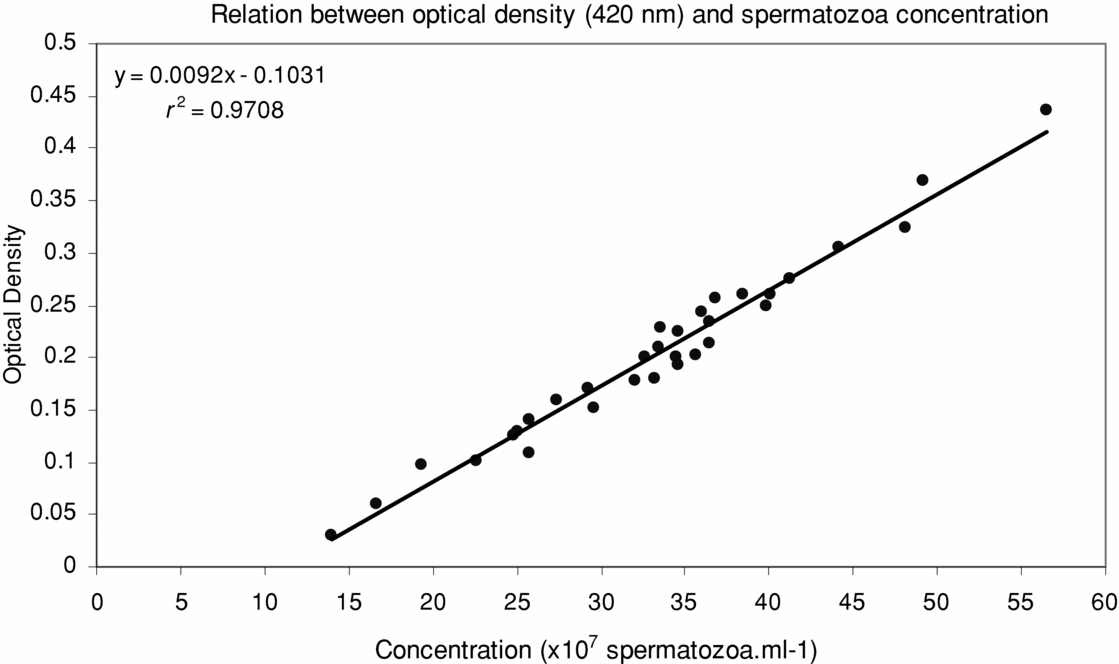
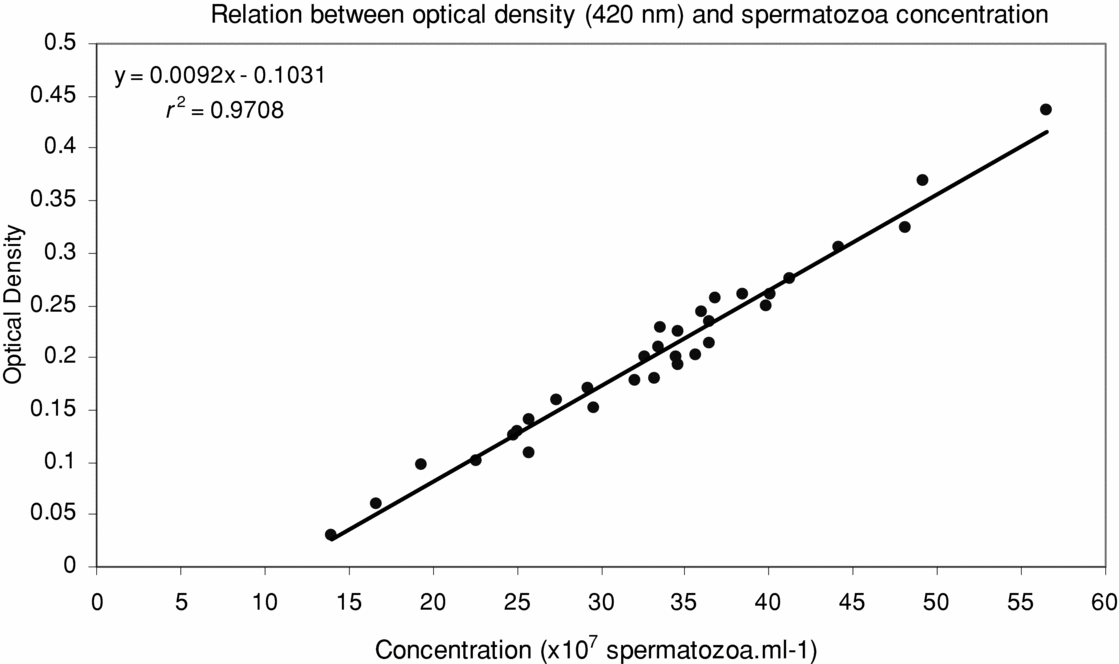
Quantification of spermatozoa using a haemocytometer needs a counting concentration, which was brought by diluting the sperm suspension with HBSS for different ratios (1:100, 1:200, 1:300, 1:400, 1:500 and 1:600). The best countable dilution for assessing sperm concentration was 1:500. A linear relationship with highly significant correlation was found between sperm number assessed by haemocytometer counting and its optical density using simple linear regression (Fig. 1). Best correlation was recorded (r 2 = 0.97).
Sperm number assessed by haemocytometer counting and its optical density using linear regression.
Sperm-to-egg ratio and contact time
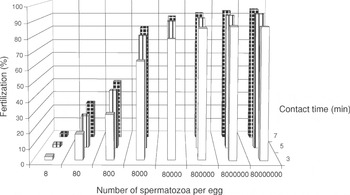
The number of sperm per egg is plotted against percentage of fertilization in Fig. 2. It is observed that the increase in sperm availability from 8 to 8 × 10⁷ sperm per egg resulted in a progressive increase in fertilization rate. It is observed that the fertilization rate was low (8, 21 and 39%) in 8, 80 and 800 spermatozoa/egg respectively. Then there was a progressive increase (78 to 93%) in fertilization rate from 8000 to 80,000,000 spermatozoa.egg−1. The highest fertilization success of 98.18% was also recorded at 8 × 10⁷ spermatozoa.egg−1. There is no significant difference (p > 0.1) between 8000 to 80,000,000 spermatozoa.egg−1. From this result it is clear that 8000 spermatozoa.egg−1 is required for optimum fertilization success. As for the gametes contact time, 5 minutes was found to be the most optimum duration (Fig. 2). When the contact time was reduced to 3 minutes, fertilization percentage decreased.
Mean fertilization percentage with increasing number of sperm-to-egg ratio and their contact time.

Discussion
This is the first study in H. fossilis to assess the sperm concentration and determine optimal sperm requirement for egg fertilization. Milt concentration has been assessed by three techniques, counting in a haemocytometer chamber (Buyukhatipoglu & Holtz, Reference Buyukhatipogly and Holtz1984; Leung-Trujillo & Lawrence, Reference Leung-Trujillo and Lawrence1987), spermatocrit (Munkittrick & Moccia, Reference Munkittric and Moccia1987) and spectrophotometric evaluation (Suquet et al., Reference Suquet, Omens, Normant and Fauvel1992). Among the three techniques, spectrophotometry is simple and faster. Spectrophotometry was more reliably used for the assessment of sperm concentration in different species, viz., rainbow trout and common carp (Billard et al., Reference Billard, Breton and Jalabert1971), turbot (Suquet et al., Reference Suquet, Omens, Normant and Fauvel1992), seabass (Fauvel et al., Reference Fauvel, Savoye, Dreanno, Cosson and Suquet1999) white and yellow perch (Ciereszko & Dabrowski, Reference Ciereszko and Dabrowzki1993). The observation maximum (420 nm) was chosen for the best correlation between absorbance and sperm concentration evaluated by haemocytometer with minimal interference (Suquet et al., Reference Suquet, Omens, Normant and Fauvel1992). The milt is being diluted several times due to much higher spermatozoa concentration (Ciereszko & Dabrowski, Reference Ciereszko and Dabrowzki1993). In the present study, for countable sperm number the milt was diluted at 1:100 to 1:600 and the best countable dilution was found to be at 1:500. The linear relationship between optical density and sperm concentration offers a rapid method for estimation of spermatozoa number in H. fossilis with significant correlation co-efficient r 2 = 0.97. Similar correlation was reported in rainbow trout (Billard et al., Reference Billard, Breton and Jalabert1971), turbot (Suquet et al., Reference Suquet, Omens, Normant and Fauvel1992) and Seabass (Fauvel et al., Reference Fauvel, Savoye, Dreanno, Cosson and Suquet1999).
Optimum fertilization rate was observed from 8000 to 80,000,000 spermatozoa.egg−1. There is no significant difference (p > 0.1) from 8 × 10³ to 8 × 10⁷ spermatozoa.egg−1. This sperm requirement is low, when compared with the results reported in species, viz, European catfish, where the required spermatozoa.egg−1 was estimated as 40,000 (Redono et al., Reference Redonodo, Hilge and Billard1989); in sturgeon, 43,000 (Persov, Reference Persov1953; coated in Suquet et al., Reference Suquet, Billard, Cosson, Normant and Fauvel1995), in brown trout, 43,000 (Edral & Graham, 1987) and in sea bass, 66,000 (Fauvel et al., Reference Fauvel, Savoye, Dreanno, Cosson and Suquet1999). At the same time, this minimum requirement of 8000 sperm per egg is higher when compared with few other species such as 1000 in Atlantic croaker (Gwo et al., Reference Gwo, Strawn, Longnecker and Amold1991) as 6000 in turbot (Suquet et al., Reference Suquet, Billard, Cosson, Normant and Fauvel1995). The minimum sperm (8000) requirement for high fertilization success in H. fossilis indicates high fertilizing ability of H. fossilis sperm. Other specific feature of H. fossilis gametes were the smaller egg size 0.95 to 1.2 mm, when compared with the egg size of rainbow trout, 3 mm (Billard and Cosson, Reference Billard and Cosson1992); carp, 4.8 mm (Perchec, 1992; coated in Suquet et al., Reference Suquet, Billard, Cosson, Normant and Fauvel1995); pike, 2 mm and trout, 4 mm (Billard,1982); 3 mm in halibut (Haug, Reference Haug1990). This consequently attains the probability of sperm reaching the micropyle to be higher by traveling a shorter distance compared to other fish species. Further, an attracting phenomenon, which guides spermatozoa to the micropyle may also be present in H. fossilis. The gametes contact time of 5 minutes duration for fertilization is likely the function of an increase probability of successful encounter between gametes. Fertilization success as a function of time has been observed in turbot (Suquet et al. 1995). However extending the time above 5 minutes didn't increase fertilization percentage, showing the life span of H. fossilis sperm.
From this study it is concluded that the sperm cell concentration can be easily assessed spectrophotometrically at 420 nm in 1:500 dilution with HBSS. For an optimum fertilization success a minimum of 8000 spermatozoa.egg−1 is sufficient, with a contact duration of five minutes. Thus the sperm cells can be utilized to the maximum.
Acknowledgements
This research has been supported by Indian Council of Agricultural Research, New Delhi, under the research grant for Mass production of Polyploids in Catfishes 4(39)94-ASR-I.