Introduction
Pulmonary atresia with intact ventricular septum is a rare congenital cardiac lesion, accounting for 1–3% of CHD and occurring in approximately 4–8 per 100,000 live births. Reference Ashburn, Blackstone and Wells1–Reference Ferencz, Rubin and McCarter6 Despite advances in management with percutaneous interventions Reference Petit, Glatz and Qureshi7–Reference Rathgeber, Auld and Duncombe11 , outcomes remain poor. Reference Iliopoulos and Mastropietro8,Reference Wright, Knight and Thomas9,Reference Liava’a, Brooks and Konstantinov12
A significant degree of anatomical heterogeneity is observed in pulmonary atresia with intact ventricular septum, with variable tricuspid valve, right ventricle and pulmonary valve development, and coronary abnormalities such as right ventricle-dependent coronary circulation. Reference Bull, de Leval and Mercanti13–Reference Louise Calder, Peebles and Occleshaw19 These factors influence surgical management decisions and patients will either achieve univentricular, one-and-a-half or biventricular circulation. Reference Giordano, Santoro and Gaio15,Reference Awori, Mehta, Mitema and Kebba20 Clinical outcomes remain discordant between anatomical outcomes, with significantly higher reported mortality and long-term morbidity in patients who are palliated to a univentricular circulation. Reference Iliopoulos and Mastropietro8,Reference Chen, Chau and Chow10 Despite overall 20-year survival quoted at 66% Reference Wright, Knight and Thomas9 , patients surviving to final definitive procedure have survival rates, which improve to approximately 98% with similar quality-of-life measures Reference Ekman-Joelsson, Gustafsson and Sunnegårdh21 for both patient groups. Reference Wright, Knight and Thomas9,Reference Sukhavasi, McHugh-Grant and Glatz22
Multiple echocardiographic parameters have been proposed to predict surgical outcome and aid in decision-making regarding biventricular repair or univentricular palliation. Fetal studies Reference Lowenthal, Lemley and Kipps16,Reference Wolter, Markert and Wolter23,Reference Salvin, McElhinney and Colan24 including a recent meta-analysis Reference Shivaram, Van Den Eynde and Barnes25 have suggested tricuspid valve annulus Z-score, tricuspid valve to mitral valve annulus ratio, right ventricle to left ventricle length ratio, and the absence of right ventricle-coronary artery fistulae as predictive measures Reference Lowenthal, Lemley and Kipps16,Reference Wolter, Markert and Wolter23,Reference Salvin, McElhinney and Colan24 , while antegrade flow across the pulmonary valve and more than moderate tricuspid regurgitation has been associated with a more favourable outcome. Reference Lowenthal, Lemley and Kipps16 Meta-analyses of predictive scores in fetal studies show significant heterogeneity and potential overestimation of a biventricular outcome. Reference Villalaín, Moon-Grady and Herberg26 Similar parameters have been reported in neonatal studies, with a tricuspid valve and mitral valve annulus size and Z-score, degree of right ventricle hypoplasia, and the presence of right ventricle-dependent coronary circulation reported as predictors of univentricular palliation. Reference Bull, de Leval and Mercanti13,Reference Salvin, McElhinney and Colan24,Reference LaPar and Bacha27,Reference Giglia, Jenkins and Matitiau28 Pre-operative stratification and accurate prediction of the end-outcome is essential for parental counselling. No standardised scoring calculator has been developed to guide management and surgical planning. Reference Liava’a, Brooks and Konstantinov12,Reference Yoshimura and Yamaguchi29,Reference F-f, Du and Chen30
Perth Children’s Hospital (previously Princess Margaret Hospital) is the only tertiary institution in Western Australia and the Children’s Cardiac Centre manages all patients with pulmonary atresia with intact ventricular septum statewide. The centre adopts a multidisciplinary approach to decision-making with combined input from cardiologists and cardiothoracic surgeons, reviewing clinical information, echocardiographic data, and cross-sectional imaging where available. This project aims to evaluate the clinical and demographic characteristics, and baseline echocardiographic parameters in all patients born with pulmonary atresia with intact ventricular septum through a statewide Australian tertiary institution. We hypothesised that a combination of echocardiographic factors, such as right ventricular/left ventricular length, tricuspid valve/mitral valve annulus ratio and right ventricle-dependent coronary circulation, would identify outcome with a high level of sensitivity and specificity. Our secondary aim was to develop a robust, reproducible, and clinically useful discriminatory calculator, to aid in guiding surgical management with a high level of accuracy.
Materials and method
Study design
All patients diagnosed with pulmonary atresia with intact ventricular septum at a single-centre tertiary hospital between January 1st 2004, and July 31st 2020 were retrospectively identified. Patients were identified using the cardiology clinical (CardiobaseTM, Version 8.1.44.10, Derby UK) and echocardiographic (SynapseTM Cardiovascular Client V4.0.4, Fujifilm Medical Systems USA) databases, and further crossed referenced with the cardiac surgical and interventional databases (Filemaker Pro. v16, Claris International Inc. California, USA). Inpatient admissions and the clinical course were further collected through hospital medical records. Data were collected for analysis using a pre-designed de-identified collection tool and verified by a senior clinician. Exclusion criteria included patients with a tricuspid valve abnormality as the primary anatomical diagnosis, functional pulmonary atresia, or if our centre did not perform initial management. Coronary anomalies described the presence of coronary artery fistulae or collateralisation, with right ventricle-coronary dependent circulation further defined by fistulous coronary artery-to-right ventricle connections with proximal coronary obstruction and abnormal retrograde coronary flow.
Demographic data included age, gestation at delivery, sex, birthweight, weight at time of intervention, and the presence of non-cardiac or syndromic diagnoses. Subsequent cardiac admissions were evaluated for procedures completed, complications, and length of stay.
Echocardiographic parameters
Echocardiograms at diagnosis and prior to second-stage decision-making were reviewed. Echocardiographic parameters collected included left ventricle and right ventricle measurements (basal diameter, mid-diameter, length at apex and cavity, 4 chamber area in systole and diastole, estimated right ventricle systolic pressure and M-mode dimensions), tricuspid valve measurements (annular dimension, Z-score, tricuspid valve effective orifice at the point of maximal excursion, tricuspid regurgitation grade), pulmonary valve measurements (annular dimension, Z-score, membranous or muscular classification), main pulmonary artery diameter, mitral valve annulus dimension and Z-score, and atrial septal defect size and shunt direction. Coronary artery anomalies as well as the partite classification of the right ventricle were noted. Standardised quantification of echocardiographic measurements was performed according to the American Society of Echocardiography recommendations. Reference Lopez, Colan and Frommelt31
A single experienced sonographer (DB) manually performed all echocardiographic measurements. Inter-observer variability was performed with selected measurements repeated by an experienced sonographer (KM), blinded to the study results in ten randomly selected echocardiograms.
Surgical outcomes
Primary outcomes included mortality and significant morbidity, such as neurological impairment following intervention, or a significant cardiac arrhythmia. Secondary outcomes included reintervention rates, success of radiofrequency perforation, intensive care admission length, and peri-procedural complications. Final surgical outcome status was defined as biventricular if either complete surgical repair or valvotomy achieved separate pulmonary and systemic circulations. One-and-a-half ventricular status was defined in patients who underwent a bidirectional cavopulmonary connection in addition to right ventricle decompression. Single ventricle circulation was defined as patients undergoing Fontan palliation. For the purposes of predictive scoring, patients achieving an end-outcome of one-and-a-half ventricular circulation were included in the univentricular group.
Statistics
Data were analysed using R version 4.1.3 Reference Team32 within the RStudio integrated development environment (RStudio Team, Boston MA). Demographic data and initial measurements were compared using Fisher’s exact test and Wilcoxon rank sum tests, where appropriate. Logistic regression analysis considered joint models of pairs of echocardiogram parameters against known clinical correlates of outcome to develop a discriminatory tool for prediction of biventricular repair (see Supplementary Materials). Of the candidate models considered, the final model selected had the highest squared correlation between the observed outcomes and their predicted probabilities. Leave-one-out cross-validation was undertaken for internal validation. Area-under-the-receiver operating curve, sensitivity and specificity are provided with 95% confidence intervals as measures of discriminatory performance. Intra-class correlation coefficient analysis was used to assess inter-observer variability in measurement of the echocardiogram parameters. P-values below 0.05 are considered statistically significant.
Results
Demographics
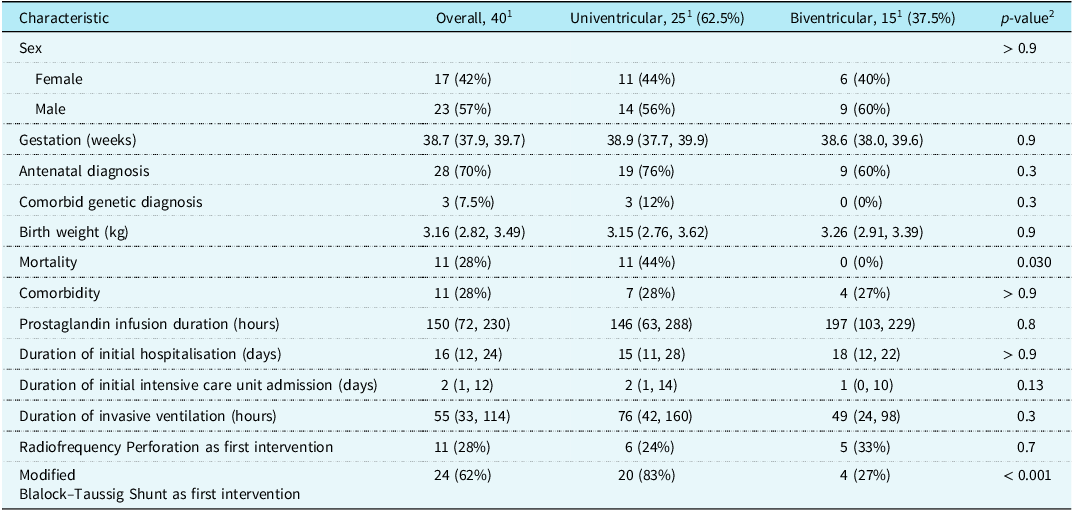
Forty patients with pulmonary atresia with intact ventricular septum were identified and included for analysis; 70% of cases were antenatally diagnosed and 57% of patients were male. Three patients (7.5%) had a genetic diagnosis including 22q11 deletion or Noonan syndrome. Demographic characteristics are defined in Table 1. Significant comorbidities at birth were noted in 11 patients (28%), including significant prematurity (< 32 weeks), twin-to-twin transfusion syndrome, birth trauma and antepartum haemorrhage, hydrops fetalis, polyhydramnios, and chorioamnionitis, with no significant difference in rates of these comorbidities between outcome groups (p > 0.9).
Demographic, mortality, and initial clinical data for patients with univentricular and biventricular circulations

1 n (%); Median (IQR), 2Fisher’s exact test, Pearson’s Chi-squared test or Wilcoxon rank sum test.
The mean follow-up period was 7.9 years (interquartile range 0.7–11.7 years). All patients had complete follow-up at the time of analysis. Twenty-one patients (52.5%) had been designated to undergo a univentricular palliation, four (10%) achieved a one-and-a-half ventricle circulation, and 15 (37.5%) successfully achieved biventricular repair.
Figure 1 demonstrates the progress of patients through initial and interstage procedures to their final surgical outcome. Out of 35 patients undergoing intervention, 16 (46%) underwent an initial modified Blalock–Taussig shunt and six patients (38%) passed away prior to second stage completion. Nineteen patients (54%) initially underwent a percutaneous pulmonary valvuloplasty, with 14 (74%) completed successfully. Of the 15 patients who achieved biventricular repair, three (20%) initially received a modified Blalock–Taussig shunt before progressing to pulmonary valve perforation (surgical or percutaneous). Ten patients (67%) achieved repair through transcatheter pulmonary valve perforation alone. Two patients (13%) had failed initial percutaneous pulmonary valve perforation and progressed to a surgical pulmonary valvotomy.
Flow chart of patient interventions and outcomes.
BT Shunt = Blalock-Taussig shunt; RVOT = right ventricular outflow tract.

Four patients (9%) achieved a one-and-a-half ventricular circulation. Three initially underwent a percutaneous pulmonary valve perforation, two of whom were successful but progressed to a modified Blalock–Taussig shunt, and one failed perforation and proceeded directly to modified Blalock–Taussig shunt. The final one-and-a-half ventricular patient was managed initially with modified Blalock–Taussig shunt insertion.
Of the ten patients (25%) surviving univentricular palliation, five (12.5%) received initial modified Blalock–Taussig shunts and progressed down a standard palliative surgical progression. One patient who received an initial modified Blalock–Taussig shunt had subsequent pulmonary valve perforation but was eventually deemed unsuitable for a biventricular or one-and-a-half ventricular circulation. Four patients (10%) were managed with percutaneous pulmonary valve perforation, with one patient requiring a modified Blalock–Taussig shunt and univentricular palliation.
Early, interstage, and late morbidity and mortality
Overall mortality was 27.5% (11 cases). Five patients who died prior to intervention were included for analysis as all had clear decisions made regarding univentricular management prior to their death based on significantly unfavourable anatomy, with only one being palliated without intention for treatment. All five patients who died prior to cardiac intervention perished due to non-cardiac complications including necrotising enterocolitis, sepsis, and respiratory failure secondary to prematurity. In patients who received cardiac intervention, four deaths (10%) occurred in the early post-procedural period (< 30 days). One patient survived to discharge and represented following an out-of-hospital cardiac arrest of undetermined cause; one developed necrotising enterocolitis and left anterior descending artery stenosis with ischaemia; one patient required a redo modified Blalock–Taussig shunt to improve pulmonary circulation but decompensated post-operatively following a cardiac arrhythmia; and one presented five months post initial surgery with a thrombosed shunt and perished after developing severe sepsis.
Mortality was confined to patients managed on a univentricular pathway (11 vs 0, p = 0.027). No patients had received a cardiac transplant at the time of analysis. Patients who required univentricular palliation were also significantly more likely to have an associated coronary artery abnormality (17 vs 3, p = 0.001). Perioperative complications were observed in 14 patients (35%). These complications included extravasation injury during percutaneous wire perforation, renal failure necessitating filtration, venous thrombosis, intracranial bleeding, shunt infection or occlusion, wound infection, adrenal infarction, necrotising enterocolitis, significant arrhythmia requiring pacing or cardioversion, and sepsis. No significant difference was observed in length of intensive care unit or hospital admission, perioperative complication rates or reintervention rates between cohorts. Clinical characteristics are defined in Table 1.
Echocardiographic parameters
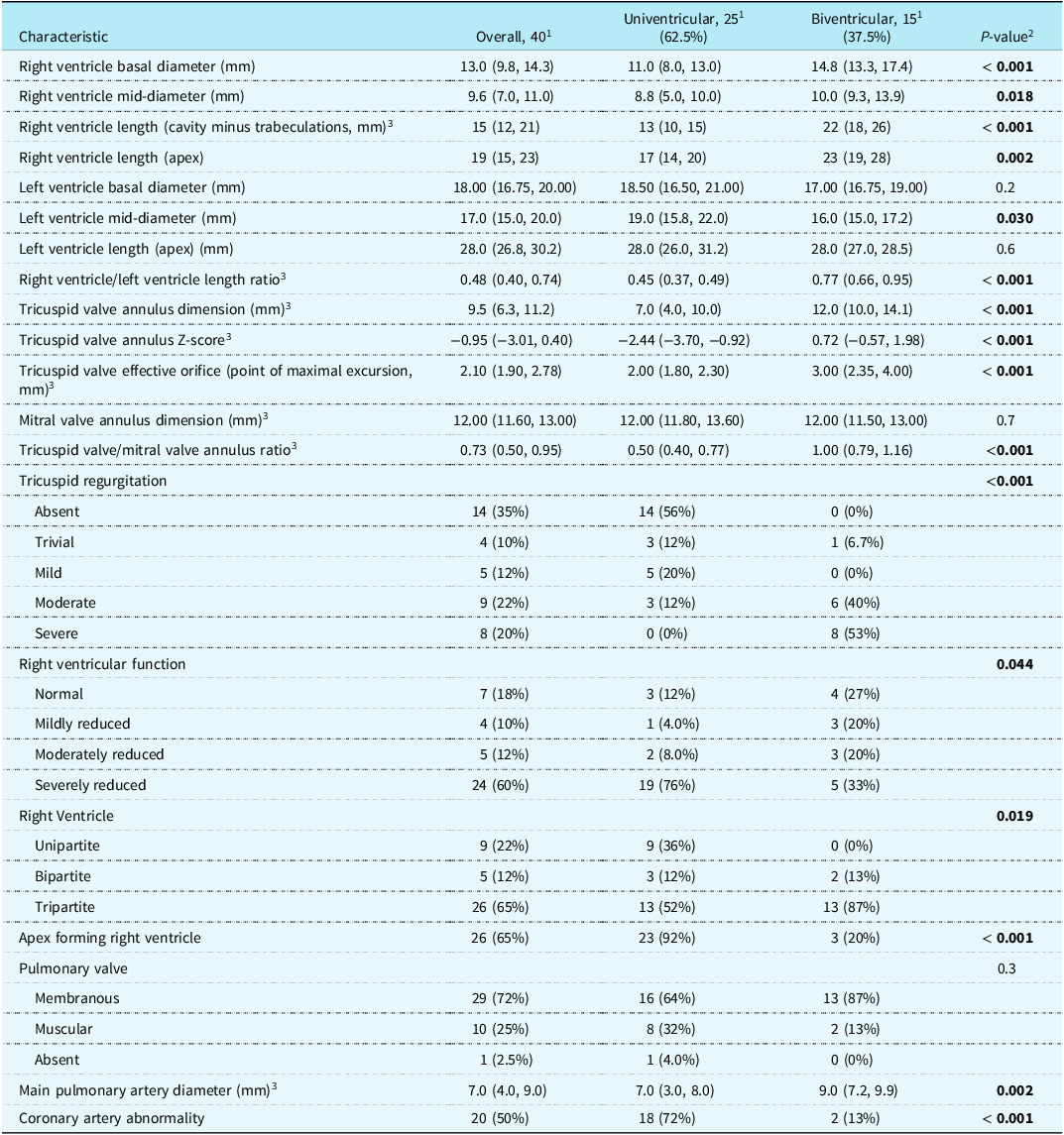
Echocardiographic data at birth between groups showed significant differences in multiple valvular and ventricular parameters (Table 2). The tricuspid valve annulus Z-score and tricuspid valve/mitral valve annulus ratio were significantly smaller in patients undergoing univentricular circulations (−2.62 vs 0.75, p = <0.001) and (0.54 vs 0.96, p = 0.001), respectively. The pulmonary valve and main pulmonary artery diameters were significantly larger in patients who underwent biventricular repair compared to univentricular palliation (9.0 vs 7.0 mm, p = 0.002). All right ventricle length parameters and the right ventricle/left ventricle length ratio were significantly reduced in patients in the univentricular group (0.45 vs 0.77, p < 0.001). The rates of coronary artery anomalies were high (n = 20, 50%), and the majority of patients, including all with right ventricle-dependent coronary circulation, required univentricular palliation (18 vs 2, P < 0.001). Three patients with a non-apex forming right ventricle at their initial echocardiogram achieved biventricular repair. No patients with a unipartite right ventricle achieved a biventricular outcome (p = 0.019). All patients with absent tricuspid regurgitation had progressed to a univentricular circulation.
Echocardiographic parameters in patients with univentricular and biventricular circulations

1 Median (IQR) or n (%). 2Wilcoxon rank sum test or Fisher’s exact test. 3Included as candidate variable in development of discriminatory scoring tool.
Prediction modelling and discriminatory calculator
Development of a classification tool to identify ventricular outcome considered eight baseline continuous echocardiographic measures with complete data available (Table 1). Of these, right ventricle/left ventricle length ratio associated most strongly with surgical outcome in univariable analysis (R2 = 0.50 for predicted probabilities, Supplementary Materials, Table S1). Improved discrimination was seen for nine of the candidate models considered in the bivariable logistic regression modelling, with significant independent contributions to prediction from each in the respective pairs compared to either alone (Table S2). Of these, the best-fit model data were based on right ventricle/left ventricle length ratio and tricuspid valve/mitral valve annulus ratio at initial echocardiography (R Reference Daubeney, Wang and Delany2 = 0.70, area-under-the-curve of 0.95 (95% CI: 0.78–0.99), and the resultant regression equation has been used to derive the discriminatory score: (8.5x right ventricle/left ventricle length ratio) + (6.7x tricuspid valve/mitral valve ratio)-11.3. As logistic regression models probability of outcome on the log-odds scale, a score greater than zero as a predictor of biventricular repair corresponds to a predicted probability of more than a half.
Applied to our patient cohort, the right ventricle/left ventricle length ratio and tricuspid valve/mitral valve annulus ratio using the apical 4 chamber view at initial echocardiography identified patients achieving biventricular repair with a sensitivity of 93% (95% CI:70–99%); and specificity of 96% (80–99%) (Figure 2). Figure S1 in the Supplementary Materials demonstrates the measurements performed in an apical 4-chamber view. Individual patient clinical data, calculated discriminant score, procedures, and outcomes are provided in Supplementary Materials Table S3. Figures S1 and S2 with corresponding movie clips show examples of two cases with calculated discriminatory scores and the final outcome. Figure S4 highlights the relative change to the right ventricle size of a patient achieving a one-and-a-half ventricle outcome, using three-dimensional CT reconstructions.
Discriminant model for pulmonary atresia with intact ventricular septum to evaluate ventricular outcome.
The prediction equation corresponding to the cut-point score of zero is overlaid on a plot of patient measures of right ventricle (RV)/left ventricle (LV) length ratio against tricuspid valve (TV)/mitral valve (MV) annulus ratio. Values above the line anticipate a biventricular outcome, whilst values below the line anticipate a univentricular circulation.

A free-to-use online calculator, labelled as the Perth Pulmonary Atresia Discriminant Score, is made available (Supplementary Materials S4). Information regarding development of the scoring tool is provided (Supplementary Materials S5).
Inter-observer variability
Ten echocardiograms were randomly selected, and a range of left ventricle, right ventricle, and tricuspid valve measurements were repeated by a second sonographer blinded to the prior results. There was good overall agreement with acceptable reproducibility for the assessed parameters. The inter-class correlations ranged between 0.80 and 0.97 for these measurements.
Discussion
Prediction of surgical end outcomes in patients with borderline right heart structures remains challenging, given the wide diversity in anatomical substrate and unpredictable growth of the tricuspid valve and right ventricle over time. Multiple factors have been noted to influence long-term outcomes including age and type of initial intervention, need for reintervention, and ongoing surgical complications. Reference Daubeney, Wang and Delany2 Mortality is highest in patients with univentricular palliation and those with right ventricle-dependent coronary circulation. Reference Iliopoulos and Mastropietro8,Reference Wolter, Markert and Wolter23 Mortality outcomes, rate of univentricular palliation, and complications in our cohort were comparable to published studies, with mortality similarly predominantly occurring within the first two years of life. Reference Petit, Glatz and Qureshi7,Reference Wright, Knight and Thomas9,Reference Liava’a, Brooks and Konstantinov12 Morbidity outcomes did not significantly differ between surgical outcomes, consistent with Grant et al. Reference Grant, Faraoni, DiNardo and Odegard33 There was no significant difference in initial hospitalisation length or complication rates between patients who achieved a biventricular outcome compared to those palliated to a univentricular pathway.
In practice, surgical decision-making is often approached on an individual basis, with multiple echocardiography and clinical parameters considered. However, the difficulty of predicting final outcomes is highlighted by the fact that only 46% of right ventricle decompressions with initial radiofrequency perforation successfully progressed to a biventricular circulation. Other centres have also noted difficulty in successful right ventricle decompression in patients with borderline right ventricle size, who often require further surgical management and may be palliated to a univentricular pathway regardless. Reference Ferencz, Rubin and McCarter6
Echocardiography remains the mainstay for pre-operative decision-making in pulmonary atresia with intact ventricular septum, with other imaging modalities providing important detail. Cardiac catheterisation is used to assess suspected right ventricular dependent coronary connections, with CT offering excellent coronary delineation. Reference Chikkabyrappa, Loomba and Tretter34 Cardiac MRI can provide haemodynamic data in addition to anatomic detail, including the estimation of the pulmonary-to-systemic shunt, differential lung flow, and assessment of right ventricular volume and function. Reference Kawel, Valsangiacomo-Buechel, Hoop and Kellenberger35,Reference Prasad, Romanowicz and Banka36 Prasad et al. Reference Prasad, Romanowicz and Banka36 highlighted that patients with a smaller right compared to left ventricular stroke volume and a lower right ventricular ejection fraction were less likely to achieve biventricular outcome. Reference Prasad, Romanowicz and Banka36 In future, there may be a role in adapting multimodality imaging in refining discriminant models for pulmonary atresia with intact ventricular septum.
When developing a discriminant calculator, a simple target of identifying biventricular anatomy oversimplifies the outcome for patients post procedures Reference Hanley, Sade and Blackstone5,Reference Petit, Glatz and Qureshi7 but this delineation remains a useful metric for management. Cantinotti et al. highlighted the need for contemporary risk prediction models to establish the ideal parameters for use in daily practice. Reference Cantinotti, McMahon and Marchese37 Our findings of right ventricle/left ventricle length ratio Reference Drighil, Aljufan and Slimi38 and tricuspid valve/mitral valve annulus ratio Reference Chen, Chau and Chow10 were congruent with other studies. We additionally demonstrate the strength of using the combination of these parameters in a robust online calculator. Reference Ashburn, Blackstone and Wells1,Reference Dyamenahalli, McCrindle and McDonald3,Reference Ekman-Joelsson4,Reference Shivaram, Van Den Eynde and Barnes25,Reference Cantinotti, McMahon and Marchese37 The joint inclusion of these two informative parameters, which were moderately correlated, yielded superior predictive capacity than either parameter alone. Similar to previous literature, the absence of tricuspid regurgitation predicted a univentricular pathway Reference Ashburn, Blackstone and Wells1,Reference Iliopoulos and Mastropietro8,Reference Wright, Knight and Thomas9,Reference F-f, Du and Chen30 and implies that this finding alone is predictive of outcome. Inclusion of the absence of tricuspid regurgitation or further parameters in a single model increased susceptibility to over-fitting. Therefore, the presence or absence of tricuspid regurgitation was not used in the final model.
The calculator currently works as a successful predictor of our centre’s clinical practice, and it warrants investigation using a broader cohort to examine if it appropriately identifies the practice of other centres. Notably, the demographics, echocardiographic heterogeneity, and outcomes of our cohort reflect those reported elsewhere Reference Dyamenahalli, McCrindle and McDonald3,Reference Ferencz, Rubin and McCarter6,Reference Petit, Glatz and Qureshi7,Reference Wright, Knight and Thomas9,Reference Liava’a, Brooks and Konstantinov12 and therefore the model is likely transferrable across cohorts. We provided a simplified online calculator tool that would be beneficial in borderline cases, to streamline clinical decision-making and to aid the challenges of parental counselling.
The study was limited by the retrospective single-centre nature of the study design. Whilst our study reflects statewide numbers of pulmonary atresia with intact ventricular septum, study numbers remain small given the rare incidence of the condition, with improvements in antenatal diagnosis influencing postnatal numbers and pre-selection of cases that continued to delivery. The discriminatory model was therefore inherently limited by the small dataset, so a pragmatic decision was made to restrict the prediction tool to consideration of univariable or bivariable models. The calculator most effectively predicts active management decisions, rather than the best possible outcomes. However, prospective ratification of a truly predictive model is prohibitive given the heterogeneity, clinical severity, and rarity of this lesion, and therefore a tool which accurately identifies current practice at birth reliably has merit. Our results may inherently reflect the bias of our institutional practice, therefore further studies are necessary to validate the accuracy of these parameters in defining outcomes in a wider cohort. There currently are validation studies underway utilising national and international cohorts. Review of mid-term morbidity was limited to paediatric follow-up, with the oldest patient being under 17 years of age at last review. Longitudinal studies reviewing both fetal and adult congenital patients would provide further insights into incidence, long-term outcomes in adulthood and quality-of-life measures. Reference Liava’a, Brooks and Konstantinov12
Conclusion
The combination of right ventricle/left ventricle length ratio and tricuspid valve/mitral valve annulus ratio at the baseline echocardiogram identified cases that achieved biventricular repair in pulmonary atresia with intact ventricular septum, with a sensitivity of 93% and specificity of 96%. The absence of tricuspid regurgitation predicted a univentricular pathway. A simplified discriminatory scoring calculator has been developed and is attached as supplementary material. The use of a clinically relevant model aims to streamline clinical decision-making, aids difficult counselling in borderline cases, and may limit unnecessary and higher-risk procedures. Further studies examining this model with both prenatal and multi-institutional cohorts are warranted and in progress.
Supplementary material
The supplementary material for this article can be found at https://doi.org/10.1017/S1047951124036205.
Acknowledgements
We thank the Telethon Kids Institute for statistical analysis; and the Child and Adolescent Health Service and Perth Children’s Hospital for approval in digital hosting of the calculator.
Financial support
The authors received no financial support for the research, authorship, and/or publication of this article.
Competing interests
The authors have no conflicts of interest to declare.
Ethical standard
This study was approved by the Child and Adolescent Health Service Human Research and Ethics Committee under RGS3451.