


Introduction
Cognitive Behavioural Therapy (CBT) models explore the role of thoughts and behaviours in the development, maintenance and treatment of depression (Hundt, Mignogna, Underhill and Cully, Reference Hundt, Mignogna, Underhill and Cully2013). Beck's cognitive model argues that depression arises as a response to dysfunctional thoughts, core beliefs, and information processing biases (Beck, Rush, Shaw and Emery, Reference Beck, Rush, Shaw and Emery1979). CBT aims to teach patients skills to help them change these dysfunctional assumptions in order to reduce depressive symptoms (Beck et al., Reference Beck, Rush, Shaw and Emery1979). Studies have shown CBT to be an effective treatment for depression at the time of treatment (Butler, Chapman, Forman and Beck, Reference Butler, Chapman, Forman and Beck2006; DeRubeis et al., Reference DeRubeis, Hollon, Amsterdam, Shelton, Young and Salomon2005; Wiles et al., Reference Wiles, Thomas, Abel, Ridgway, Turner and Campbell2013).
Given the educational basis of CBT, it is assumed that CBT may confer a long-term benefit because clients continue to use the skills they learnt beyond therapy. The CoBalT trial (Figure 1) established that CBT, as an adjunct to usual care, was an effective treatment for primary care patients with treatment resistant depression (Wiles et al., Reference Wiles, Thomas, Abel, Ridgway, Turner and Campbell2013). A recent follow-up of this trial has shown CBT to reduce depressive symptoms and to improve patient's quality of life 46 months after they had been randomized into the trial (Wiles et al., Reference Wiles, Thomas, Turner, Garfield, Kounali and Campbell2016). However, despite evidence for the effectiveness of CBT at both the time of treatment and at follow-up, research that considers the processes and mechanisms by which CBT works is still in its infancy (Adler, Strunk and Fazio, Reference Adler, Strunk and Fazio2015; Strunk, Hollars, Adler, Goldstein and Braun., Reference Strunk, Hollars, Adler, Goldstein and Braun2014; Hundt et al., Reference Hundt, Mignogna, Underhill and Cully2013). Also, it is not evident whether patients continue to use the CBT skills they have been taught in treatment to manage their depression long-term.
CoBalT Trial and long-term follow-up

The only evidence to suggest CBT skill usage might be important for patients managing their depression, posttreatment, comes from a survey of older, formerly depressed patients. This survey showed patients with fewer depressive symptoms reported CBT skills to be useful to them (Powers, Thompson and Gallagher-Thompson, Reference Powers, Thompson and Gallagher-Thompson2008). This is supported by a solitary qualitative study that interviewed nine individuals about their use of CBT skills, 10 months after their treatment had ended. It found that patients still continued to use a range of CBT skills once treatment had finished (Glasman, Finlay and Brock, Reference Glasman, Finlay and Brock2004). However, these small studies may not be representative of all people who receive CBT; both studies used small samples and drew their findings from participants who had received a varying range of psychotherapeutic treatments and not necessarily CBT.
A review paper by Hollon, Stewart and Strunk (Reference Hollon, Stewart and Strunk2006) suggests that patients may struggle to use the skills they have been taught in treatment when they initially start to manage depressive feelings, unless they remind themselves to do so. Hollon et al. (Reference Hollon, Stewart and Strunk2006) conclude that only as these conscious efforts become more automatic will patients be less likely to jump to negative conclusions that may result in a subsequent decline in depressive symptoms. These findings are important as they suggest the prophylactic qualities, efficacy and cost-effectiveness of the CBT model rests, in part, on patients grasping the importance of learning CBT skills in treatment, in order to recall and use them to manage their depression after treatment. To date no research has shown whether patients do recall the CBT skills they have been taught and whether they continue to use them in the longer-term to manage their depression.
The aim of our study was to explore whether people who had attended at least 12 sessions of CBT continued to use and value the CBT skills they had learnt during therapy, about 4 years earlier, to manage their depression.
Method
Recruitment and sampling
An invitation letter, information sheet and consent form were sent to individuals who had completed a CoBalT long-term follow-up study questionnaire. These documents were sent to individuals who had been randomized to receive a full course of CBT (between 12–18 one hour sessions) plus usual care, and to individuals who had been randomized to receive usual care only. The letter asked if they would be prepared to take part in a brief telephone interview about how they had continued to manage their depression since their long-term follow-up, 12 months after having taken part in the trial. Potential participants were also asked to complete a brief measure of depressive symptoms (PHQ-9) (Kroenke, Spitzer and Williams. Reference Kroenke, Spitzer and Williams2001) in order to inform the sampling for these interviews. The PHQ-9 is a multipurpose instrument that uses 9 questions to measure severity of depression. Patients scoring 0–4 are considered not to have depression, 5–9 – minimal depression, 10–14 – moderate depression, 15–19 moderately severe depression, and 20–27 – severe depression. Participants who were willing to be interviewed were required to sign the consent form, complete the PHQ-9 and return the documents, in a stamped addressed envelope, to the research team. Individuals who did not respond to the invitation letter within 2 weeks, were sent a reminder letter. If no response was received, no further contact was made.
From the replies received, we purposefully sampled participants to ensure interviews were held with participants from all three trial sites (Glasgow, Exeter, Bristol), and with participants whose depression had varied in severity as identified by an increase or decrease in their PHQ-9 before starting therapy, in the trial and when approached for interview. Within this sampling strategy, maximum variation was aimed for in relation to socio-economic background, gender and age.
Data collection
Participants were interviewed by LF between November 2014 and January 2015. The interviews were held by telephone for both pragmatic and methodological reasons: conducting face-to-face interviews across all three sites would be costly in terms of time and money, and researchers have shown that well planned telephone interviews can gather the same material as those held face-to-face (Sturges and Hanrahan, Reference Sturges and Hanrahan2004).
A topic guide was used to ensure consistency across the interviews. It was based on our understanding of the literature, the aims of the interview, and comments from formerly depressed patients who had received CBT and were invited to consult on the study design as part of the study's patient and public involvement (PPI). The topic guide asked participants what skills and techniques they had learnt and continued to use, how they continued to manage their mental health, whether they had sought any further CBT or other help for their depression, what if any events of life changes they had encountered since completing treatment, and how they viewed their current physical and mental health. All the interviews were audio-recorded and transcribed verbatim. Data collection continued until data saturation had been reached, i.e. no new themes emerged.
Qualitative analysis
The interviews were analysed thematically using the approach described by Braun and Clarke (Reference Braun and Clarke2006). This approach entailed transcripts being independently read and re-read by LF and KT to familiarize themselves with the data, identify emerging themes and to develop a coding frame. Once the coding frame has been agreed, transcripts were imported into the software package NVivo to allow electronic coding a retrieval of data. Comparisons were then made within and across the interviews in order to identify thematic patterns and deviant cases.
Participants
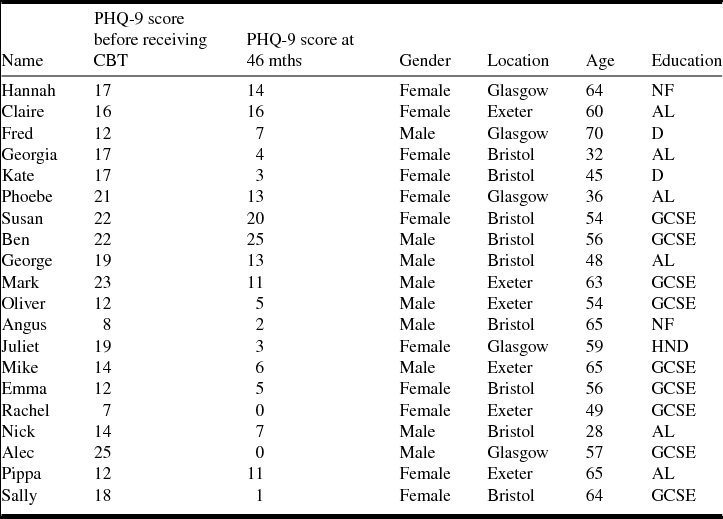
Of the 210 participants eligible to be contacted, 125 (60%) agreed to be contacted for interview (55 CBT; 70 Usual care), 19 declined, and 66 did not respond. Although we interviewed participants from both arms of the trial (20 CBT, 10 Usual care), here we only report data from the 20 participants interviewed who had been in the trial's intervention arm (Table 1), as the aim of this paper is consider how individuals used CBT skills following therapy. On average the interviews lasted around 30 minutes.
Characteristics of participants interviewed

Results
Findings
All 20 participants mentioned that CBT had given them an opportunity to talk about their feelings. However, five participants spoke almost exclusively about the benefit of CBT as an opportunity to talk about their feelings, while the remaining 15 participants also described how CBT had been an opportunity for them to learn about their depression. In this regard, interviewees appeared to fall into one of two groups, which we have termed “talkers” and “learners”. These two groups are described below under the theme “value of CBT”. We then describe the participants’ current use of CBT skills to manage their depression; their beliefs and behaviours following treatment, and how they coped with further challenges to their mental health. Whilst doing so, we highlight differences and similarities in the accounts of individuals in the two groups. All quotes have been anonymized and tagged with a pseudonym for the interviewee's name.
Value of CBT
All of the participants said CBT had helped them feel mentally better around the time they were receiving therapy. Participants described how CBT enabled them to release painful feelings that had been “bottled up” for years. For some individuals this meant revisiting suppressed experiences, such as historical sexual abuse, and for others it meant describing, confronting personal feelings of inadequacy and failure, or accepting feelings of loss, such as physical mobility due to other illnesses. Whilst painful, this was viewed as beneficial.
Sometimes the sessions are a bit upsetting because it's forcing you to think about things that you just put to the back of your mind. But I always found them really helpful. I always felt better when I left. (Rachel)
Learners
While all of the participants described the benefits of being able to talk about their depression, many (n = 15) also described the benefits of being able to “learn” about their depression. This group of participants felt that through CBT they had learnt new ways to cope with their depression. They described being taught new skills and techniques, and spoke of learning and becoming aware of personal resources they could draw upon. This suggested that they had gained some sense of personal control and self-dependency in the management of their depression.
Ok, at the risk of sounding a bit cheesy here, and forgive me, but it [CBT] really has changed a whole lot of how I live my life because of the fact that I found a whole set of tools there that I didn't know I had, that I didn't know I could use, I didn't know I could access. . . it gave me a sense of having a little bit more control over things than I had thought I had and it was a big relief because if there was something I could do about it [the depression] maybe things weren't quite so hopeless. (Kate)
Talkers
In contrast to the “learners”, the “talkers” (n = 5) spoke only about the benefits of talking about their depression. These five individuals did not report learning new skills or discovering personal resources to draw upon. They also described wishing the therapist would “tell” them what to do and reported feeling frustrated that CBT had not given them an “answer” to their problems.
Um. . . I think sometimes I wanted to ask questions where I wanted to get back an answer. Like there was a problem I had in day-to-day life, I wanted to go there and say “look this is the problem, what's the solution” and I never got that. (Hannah)
This group also described the difficulty of treatment ending, with many participants in the group described feeling lost, suggesting that they still continued to rely on their therapist for help in the management of their depression and had not gained the same sense of self-dependency or sense of control that the first group had gained.
The only thing I didn't really like was when it ended, because I was lost. . . I felt very, very lost, I didn't have no one to talk to you know about things then. (Ben)
Use of CBT skills
One of the most notable differences between the two groups related to their use of CBT skills once their therapy had finished.
Talkers
When participants were asked whether or not they thought the CBT skills they had been taught during treatment were useful or helpful, many of the talkers replied “yes” or “all of them”. However, when talkers were asked which ones, or if they still used them, nearly all replied that they could not remember what they had been taught or that they did not use any of them now.
Only one participant from this group described writing worrying thoughts on a piece of paper, and another individual described reading a book to distract herself from negative thoughts. Furthermore, when it came to formally tracking their mental health, only a couple of the talkers mentioned they had done this in the first few months following treatment. One individual had continued to use the written assignments given in therapy as a tool for doing this, and the other participant had simply recollected thinking about his mental health day to day. Thus, there was very little evidence to suggest that individuals in this group were continuing to use the CBT skills they had been taught.
Learners
Conversely, nearly all the learners described how they were still using mood diaries and worksheets to track their mental health. As a consequence, learners appeared able to identify points of progress and change in their mental health over the preceding 46 months. They could also see that they had overcome feelings of low mood and were able to identify how they could better manage their mental health.
When I looked back over the worksheets, I could see when I was getting better and when things were bad. It allowed me to work out the things I needed to change in my life so that I could avoid feeling bad and it showed me that things were getting better. (Oliver)
Learners were also able to recall many of the skills they were taught in therapy. They described regularly using the following skills: Black and white thinking; Breaking down problems; Challenging negative thoughts; Confronting and dealing with problems; Cycles of thought; Distraction; Going out and socializing; Hypothesis testing; Not taking things personally; Setting goals and meeting them; Thought catching; Thought triangle; and Writing things down.
Learners also described the ways in which they continued to remember to use the skills they had been taught. Two described writing brief messages to themselves, such as using sticky notes or writing on the bathroom mirror; others asked close family and friends to tell them to look at their course materials if they noticed they were looking down or seemed depressed.
While the majority of learners were very aware of using CBT skills, three participants from this group reported no longer using any of the skills they had been taught. It was only when these individuals were asked how they managed a “low day” that it was evident that they were unconsciously or automatically using CBT skills. Two learners also felt that they no longer considered that they had depression.
Interviewer: Do you think that you continue to use any of the CBT skills you were taught in treatment?
Interviewee: Um. . . I'm not sure. Yes, I suppose I do, I think it's just become a part of me, of who I am now. It's not something that I consciously apply. I don't know whether I do it anyway but it's not something I think about. I guess it's [depression] not something that bothers me anymore. (Fred)
Changes in beliefs and behaviour
Talkers
Many of the talkers reported being unwilling and unable to change their views. A couple of participants described being very stubborn and acknowledged the challenge their therapist must have felt in trying to get them to see things differently.
The thing with me, I'm very stuck in my ways. It's difficult changing the way I think and do things. Even with the CoBalT, they were saying things I knew but it takes me time to put them into action and even then I'm. . . I'm just nervous to do something or change something. (Susan)
While one participant described taking small steps to change her behaviour after therapy, such as getting up in the morning and walking the dog in order to be more sociable, others described finding themselves back to the way things were before they received CBT, burdened by the same problems, unable to manage their mental health, and over-whelmed by new challenges that arose.
I think it's got the better of me, to be honest with you, I don't know, I just. . .I can't at the moment I just can't see a way out of it, you know. . .Nothing has changed. I'm not good with problems you know, I don't cope very well with problems, if I get a new one, it tends to get on top of me a bit too much. (Ben)
Learners
In contrast, learners reported feeling that CBT had helped them to change their views and behaviour, to try new things, socialize more, and see things differently. Many felt CBT had helped them re-organize their problems, allowed them to see things more clearly and had given them a new perspective on their difficulties. This was particularly apparent for the three participants who appeared to be unaware of using the CBT skills they had been taught. Their accounts suggested that this lack of awareness reflected an important change in their views and beliefs.
I see things very differently now. In fact it's hard to remember seeing them any other way. Perhaps I do still use the CBT techniques, the questions you've asked have made me realize I do, but I think when you are able to see things differently, you do things in a healthy way and all the CBT, CBT techniques just become who you are. (Fred)
Challenges to mental health and seeking further help
For some participants, the period since treatment ended appeared to have brought many challenges, such as the death of a loved one and the diagnosis of a serious medical condition. These significant events appeared to seriously challenge participants’ mental health.
Talkers
When faced with challenges, the talkers tended not to describe using the materials they had been given in therapy and tended not to seek any further help for their depression other than trips to their GP to review their antidepressant medication. None reported using or referring to any online or self-help literature for their depression and almost felt getting any further help for their depression was very difficult. However, despite explaining that CBT had not helped them once treatment had finished, many did say it had been extremely valuable at the time and that they wanted more sessions of CBT.
I'm grateful for the CBT treatment I received, it helped me hugely at the time but I needed more. As soon as the treatment ended I was back to square one with no one to talk too! (Ben)
Learners
In contrast many “learners” did seek further CBT related support for their depression. Many reported continuing to refer to the therapy materials they were given during the trial, two individuals joined online chatrooms for people to talk about their depression, many read self-help books about depression, and, notably, a number sought further CBT, either by joining a support group or by receiving top-up sessions of group CBT.
When asked why they had sought further support and had referred back to materials, many answered that they had learnt their depression could be managed using the CBT skills, so they had wanted to be reminded of them.
I've been a bit wobbly because of what happened with my mum [mother died recently] but I'm doing as well as I can. It's not like it was. It's not a black pit and some days when it's really bad, I do my CBT and kit thing [booklet containing notes and worksheets from the therapy sessions], or my rescue kit or whatever they call it. I can't remember what they called it but it's very helpful. (Kate)
Discussion
The aim of the study was to explore whether people who had received CBT continued to use and value the skills they had learnt during therapy to manage their depression. All of the participants described how they felt CBT had been of help to them at the time of therapy but not all appeared to continue to use and value the CBT skills they had been taught. A minority of interviewees (n = 5) considered that CBT had not given them an answer to their problems and had not helped them once treatment had finished. This group did not recall any of the skills they had been taught and reported using very few CBT skills once therapy had finished. They did not provide any evidence to suggest they had changed their beliefs and behaviours, had not sought further help for their depression following the end of treatment in the trial, and described feeling unable to effectively manage their depression. In contrast, the majority of participants interviewed (n = 15) appeared to view CBT as an opportunity to learn new skills to manage their depression. They described becoming aware of their own personal resources they could draw upon, continuing to track their mental health, and consciously using many of the skills they had been taught, after treatment had ended. A few also reported changing their beliefs to such an extent that their use of CBT skills had become automatic and unconscious. A few of these individuals reported feeling they no longer viewed themselves as having depression.
Strengths and limitations
To our knowledge this is the first qualitative study to explore how participants manage their depression over the long-term after receiving CBT, and it provides useful insights for quantitative studies that show that CBT is an effective treatment for depression over the longer term (Wiles et al., Reference Wiles, Thomas, Turner, Garfield, Kounali and Campbell2016).
Our study used purposive sampling to maximize the diversity of participants interviewed. However, sampling interviewees from those who agreed to be interviewed as part of a trial, and who had completed a long-term follow-up questionnaire and agreed to be interviewed, may limit the generalizability of the findings, as these participants may not be representative of other patients with treatment resistant depression or of individuals who have received CBT. Furthermore, the study included only individuals who had completed at least 12 sessions of CBT. Future research may want to explore how patients who drop out of CBT treatment continue to manage their depression in the long term. Or indeed explore the value of giving patients “booster sessions” of CBT following the termination of treatment in order to understand whether this improves the patient's recall of CBT skills and therein their use of CBT skills to manage their depression.
Comparison with existing literature
The findings support previous research suggesting that improvements in an individual's mental health may be sustained following treatment by continuing to use the CBT skills they have learned in therapy (Glasman et al., Reference Glasman, Finlay and Brock2004). The findings also support previous suggestions that CBT leads to lasting change because patients learn skills that can be implemented after the treatment has ended (Hollon et al., Reference Hollon, Stewart and Strunk2006). They also highlight the importance of patients engaging with treatment as a learning process rather than simply viewing CBT as an opportunity to talk. This reflects the educational basis of the CBT approach (Beck et al., Reference Beck, Rush, Shaw and Emery1979; Williams and Morrison, Reference Williams, Morrison, Bennett-Levy, Richards, Farrand, Christensen, Griffiths and Kavanagh2010). The findings also support previous research by Barnes et al. (Reference Barnes, Sherlock, Thomas, Kessler, Kuyken and Owen-Smith2013) that highlights the importance of emphasizing to patients, prior and during treatment, that CBT is a learning therapy in which the patient needs to actively engage, learn, recall and master CBT skills in order to help themselves independently manage their depression. Furthermore, the study demonstrates the value of what CBT therapists do, and how they use models and specific techniques that help the patient to manage their depression in the longer term, over and above what might be achieved simply by the therapeutic relationship alone.
It was apparent that some of our participants felt the CBT skills they have been taught had become automatic and unconscious once treatment had finished. This finding explains why previous studies, which have attempted to measure patients’ use of CBT skills through self-report measures, may underestimate patients’ CBT usage following treatment and therein the importance of CBT skills for patients’ long term management of their depression.
Finally, the findings also highlight the importance of patients being able to recall the skills they have been taught in therapy in order to be able to practise them. Many of our participants wanted to receive further CBT sessions in order to recall CBT skills they had learnt or to learn new ones in order to cope with adverse events that challenged their mental health. This finding lends support to previous studies that have suggested “booster sessions” may be key to CBT's enduring effects (Glasman et al., Reference Glasman, Finlay and Brock2004; Kovacs, Rush, Beck and Hollon, Reference Kovacs, Rush, Beck and Hollon1981).
Conclusions
Patients who view CBT as both a talking and a learning therapy may actively learn CBT skills, which they can recall and utilize once treatment has ended. These individuals may also change previously held maladaptive beliefs and come to use the CBT skills automatically. These findings suggest for individuals to benefit from receiving CBT, in terms of managing their depression long-term, they must be encouraged to view and engage with this treatment as a learning process.
Acknowledgements
The authors assert that all procedures contributing to this work comply with the ethical standards of the Helsinki Declaration of 1975, and its most recent revision.
We are grateful to all the patients who took part in this research.
Contributors: NW, KT, WK, GL and CW conceived the original idea for this qualitative study. LF conducted all the qualitative interviews, analysed data (under the supervision of KT) and wrote the first draft of the paper. LT was the study co-ordinator. All authors contributed to, and approved, the final manuscript.
Funding: The CoBalT follow-up study was funded by the National Institute for Health Research Health Technology Assessment (NIHR HTA) programme (project number: 06/404/501). The views expressed in this publication are those of the authors and do not necessarily reflect those of the HTA programme, NIHR, NHS, or the Department of Health. The funder of the study had no role in study design or management, data collection, data analysis, interpretation of data, writing of the paper, or decision to submit the manuscript for publication.
Conflicts of interest: CW is the author of a range of CBT-based resources that address anxiety, depression and other disorders. These are available commercially as books, cCBT products and classes. He receives royalty, and is shareholder and director of a company (Five Areas Ltd) that commercializes these resources. WK is the co-author of the 2009 CBT book Collaborative Case Conceptualization, and receives royalties from its sales. The other authors have no conflicts to declare with respect to this publication.




Comments
No Comments have been published for this article.