Introduction
Delirium is a highly prevalent, but poorly recognized illness of the elderly, which is both treatable and preventable (Young et al., Reference Young, Murthy, Westby, Akunne and O'Mahony2010). In the General Hospital, it may affect as many as 30% of all inpatients and until proven otherwise, cognitive impairment in the older person should be assumed to be secondary to delirium (Holmes et al., Reference Holmes, Bentley and Cameron2003). Unfortunately, older patients with delirium have worsening outcomes in terms of length of stay, quality of life, institutionalization and mortality (Witlox et al., Reference Witlox, Eurelings, de Jonghe, Kalisvaart, Eikelenboom and van Gool2010). A training gap, in particular relating to recognition of delirium, has been identified (Inouye et al., Reference Inouye, Foreman, Mion, Katz and Coony2001; Steis and Fick, Reference Steis and Fick2008). It is thought that this may contribute to the suboptimal care received by confused older patients (Steis and Fick, Reference Steis and Fick2008; National Audit Office, 2010).
Studies using a variety of methods show that educational interventions can influence the practice of care for confused older patients. Pre- and post-test studies demonstrate specific educational approaches increase delirium recognition and knowledge, improve prescribing and importantly, prevent and reduce duration and severity of delirium (Rockwood et al., Reference Rockwood1994; Rapp et al., Reference Rapp1998; Milisen et al., Reference Milisen2001). Similarly, prospective cohort case control studies indicate that educational interventions can prevent delirium, reduce length of stay, functional decline and mortality in addition to improving knowledge and recognition (Wanich et al., Reference Wanich, Sullivan-Marx, Gottlieb and Johnson1992; Inouye et al., Reference Inouye, Acampora, Miller, Fulmer, Hurst and Cooney1993; Lundstrom et al., Reference Lundstrom, Edlund, Karlsson, Brannstrom, Bucht and Gustafson2005; Tabet et al., Reference Tabet2005). Taken together, these research findings suggest that educational strategies should be incorporated into routine clinical practice to improve hospital care for the delirious older patient (Tabet and Howard, Reference Tabet and Howard2006).
However, other clinically focused studies suggest that key educational messages are difficult to implement and adherence to non-pharmacological interventions remains a significant challenge outside the research setting (Young and George, Reference Young and George2003; Marcantonio et al., Reference Marcantonio, Bergmann, Kiely, Orav and Jones2010). For example, the highly pragmatic study by Young and George (Reference Young and George2003) shows that guidelines supported by teaching had little effect on practice behaviors. Having failed to show an improvement in either process of care or patient outcomes following the intervention, the authors suggest a need to study factors which limit educational effectiveness. Echoing these difficulties with knowledge transfer and practice change, the recent Delirium guidelines from the National Institute for Clinical Excellence (NICE) in England recommend that the evidence base for effectiveness of educational interventions is poor and educational research should now be a priority area (NICE, 2010).
Recognizing that to date research into educational approaches has focused on evaluating the impact of top–down educational interventions developed by field experts, we have called for a different strategy. In particular, a deeper approach to learning, focused on overcoming barriers to transferring learning into practice and incorporating relevant educational theory is advocated (Teodorczuk et al., Reference Teodorczuk, Welfare, Corbett and Mukaetova-Ladinska2009b). Specifically, we argue that an understanding of the learning needs (gaps between desired and actual practices (Lockyer, Reference Lockyer1998; Grant, Reference Grant2002)) of clinical staff is required as the basis upon which to design interventions. Learning needs have been described as “the cornerstone of the design of effective educational interventions” (Lockyer, Reference Lockyer1998) and it has been shown that those educational interventions that incorporated learning need assessments have greater efficacy than those which did not (Davis et al., Reference Davis, Thomson, Oxman and Haynes1995). Arguably, this is underpinned by the focus on involving learners in the design of educational interventions as supported by the principles of Adult Learning theory (Knowles, Reference Knowles1984).
Our earlier reports have shown that there exists a gap in the literature in terms of understanding the learning needs of hospital staff and few educational approaches are grounded within educational theory (Teodorczuk et al., Reference Teodorczuk, Welfare, Corbett and Mukaetova-Ladinska2010). In this report, we specifically identify the practice gaps of hospital staff and, importantly, map their conceptual relations. The research question is “what are the learning needs of hospital staff in relation to managing the confused older patient?” The intent of the study is to develop effective approaches for delirium education for Liaison Old Age Psychiatry teams.
Method
Theoretical approach
As the purpose of the study was to explore learning needs of staff from different perspectives and develop a deeper understanding to inform educational approaches, Grounded Theory methodology was chosen. Grounded Theory is a robust qualitative approach defined as, “a research methodology designed to develop, through collection and analysis of data that is primarily qualitative, a well-integrated set of concepts” (Kennedy and Lingard, Reference Kennedy and Lingard2006). Originally developed by Glaser and Strauss, the strengths are that it is both inductive and deductive allowing the possibility of testing themes and concepts as they emerge (Glaser, Reference Glaser1965). We adopted a more recent approach developed by Charmaz (Reference Charmaz2006) as it lends itself to exploring new areas and is particularly applicable to researching healthcare settings.
Data gathering and sampling approaches
Data collection, incorporating 15 interviews and 5 focus groups, was undertaken between April 2009 and June 2010. This length of time for data collection was consistent with the in-depth analytic method adopted requiring the researcher to fully immerse himself within the phenomenon under exploration (Charmaz, Reference Charmaz2006). Furthermore, no changes in healthcare delivery or other external factors that we are aware of over this period could have influenced the findings.
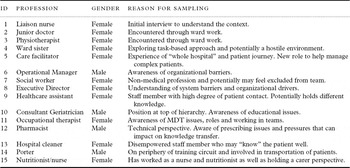
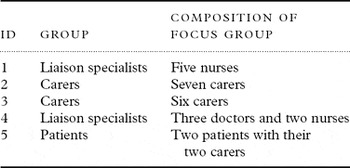
The research setting was a District General Hospital in an NHS Trust in the North East of England. The interviews were with hospital staff from different disciplines who were working in the context of acute general medicine and surgery (Table 1). Initial mapping of hospital staff identified groups of healthcare professionals (from hospital porters to consultant physicians) who were involved in caring for patients with delirium. Sampling decisions were made purposively by the research team (Andrew Teodorczuk, Sally Corbett, Elizabeta Mukaetova-Ladinska, and Mark Welfare) to advance the theoretical concepts developed and test out hypotheses. Andrew Teodorczuk kept a reflective diary where personal assumptions and insights were recorded and these were discussed with the team. In parallel to the interviews, five focus groups were undertaken with carers (2), specialists in Liaison Old Age Psychiatry (2), and patients (1) (Table 2).
Characteristics of the interviewed participants and reasons for sampling

Focus group characteristics

Focus groups and interviews were conducted by at least one member of the research team and followed topic guides developed in conjunction with the rest of the team. The topic guides were semi-structured and included prompts and questions devised by the research team specifically for each interview or focus group. The initial topic guides were developed following a pilot study (Teodorczuk et al., Reference Teodorczuk, Mukaetova-Ladinska, Welfare and Corbett2009a). For the patient focus group, to prompt memories of the hospital experience, pictures were used of older people in hospital following methods described by Bamford and Bruce (Reference Bamford and Bruce2002). The patients were no longer hospitalized and did not have a delirium at time of interview. Furthermore, they were not known to any of the staff interviewed. At the time of interview, field notes were taken by Andrew Teodorczuk. The shortest recording was 27 minutes and the longest 1 hour 46 minutes.
Data analysis
Interviews and focus groups were transcribed having been recorded by means of an Olympus digital voice recorder (DS-50). Data were coded by the method of constant comparison where statements are compared to find similarities or differences both within the same interview or across different interviews (Glaser, Reference Glaser1965). In keeping with the methodology, analysis proceeded in tandem to sampling (Charmaz, Reference Charmaz2006). Codes, which are a unit of data that cannot be broken down to a smaller unit, were grounded within the data rather than preconceived. At first, all the data were coded; however, later codes became more focused. Data were analyzed thematically (Braun and Clarke, Reference Braun and Clarke2006) and NVivo (QSR International, Australia) was used to aid organization.
Initially, the process was descriptive. As analysis proceeded, codes were clustered together into categories leading to greater conceptual density and a coding tree was developed. Categories (or themes) are sets of codes that aggregate together and were derived from the data rather than preconceived. Concepts (overarching themes) were developed by reviewing the categories by means of mapping exercises and memo writing. Memo writing served to advance analysis and both inform the interview schedule and sampling decisions. Memos acted as the key bridge between description and theory, elevating codes to categories and concepts. Once no new theoretical concepts emerged, saturation was achieved. This was a consensus decision following discussion with the research team.
To increase methodological rigour, a research steering group, which compromised three carers and a social worker, was consulted to advance sampling and emerging concepts. A member check, which involves taking findings back to the interviewed participants, was undertaken once no further new concepts emerged. The purpose of the member check was to ensure that we had accurately captured the participant's perspectives and to ensure that data saturation had really been achieved.
Ethics
Ethical approval for the research was granted by the “Newcastle and North Tyneside Research Ethics Committee 1,” on 10 December 2008. All research subjects read the relevant participant information sheet and signed a consent form, stating their agreement to take part in the study. Where participants with memory problems were recruited, capacity was assessed to ensure they were able to understand, retain and weigh up information regarding the study before agreeing to enter the study.
Results
Identified learning needs
Eight categories of learning need emerged: (1) ownership of the confused patient, (2) negative attitudes, (3) a lack of understanding of how frightened the confused patient is in hospital, (4) recognition of cognitive impairment, (5) a failure to work in partnership with the carer, (6) a need to practise in a more person-centered manner, (7) communication and lastly, (8) more specific clinical needs determined to an extent by the role of the member of staff (e.g. prescribing in a patient with delirium by doctors).
1. Ownership of the patient
Taking responsibility for the confused older patients was a key learning need, which was voiced by patients, carers and staff alike. A patient described how, “a doctor has a part to play in making the person feel that they're actually wanted at the hospital” [FG05; Line 717]. Later in the focus group, he clarified that this was because the confused patient is lost in a strange place. From her observations in the workplace, the healthcare assistant interviewed, when asked about the ownership issue, suggested that, “maybe some doctors don't feel it's their area” [Int09; line 801]. An experienced executive director noted that the lack of ownership may partly stem from the complexity of the delirious patient, in a similar manner that an admitting doctor in the Emergency Department may not feel responsibility for the intoxicated patient. Importantly, a carer also explained how, when she had been hospitalized previously, she felt guilty that she also shared the staff's sense that confused patients should not be on an acute ward. This would indicate that potentially the lack of ownership is pervasive not only amongst staff but other patients and carers of the non-delirious patients too.
In the extract below, a senior psychiatrist working into the hospital elaborated on the ownership learning need and linked it to a lack of ownership at an organizational level.
I think there's a fundamental question about responsibility and seeing confusion as something that is the responsibility of the clinician looking after the person. . . . . . there's a tendency not to have done the groundwork to try and assess it, there's a sense that you came into medicine to be a special physician and listen to chests and that we should try and park the confusion in the way that you might park the housing issue. . . . . .I think there is a sense that the DGH (District General Hospital) needs to wake up and recognise that its job will increasingly be about dealing with old people with multiple pathologies including confusional states and specialist wards with particular emphasis on say chest medicine, are not currently well placed to meet these needs.
Consultant Psychiatrist [FG04; line 191]
The psychiatrist appeared to suggest that the hospital system is dated and staff's collective perceptions of their roles are not aligned to the current hospital population. The lack of ownership at an individual level sensed by patients and described by carers and staff may result from this fundamental mismatch.
2. Attitudes
Attitudes, and by assumption behaviors toward the confused older patients emerge as a learning need closely linked to ownership. Carers are able to detect negative attitudes toward the confused older patients as illustrated in the next extract.
They're treating the person as though they're mad and they're not mad at all, they're just having, memory, mental impairment and this is the bit that the staff need to be aware of.
Carer [FG03; line 396]
Furthermore, a carer explained how when staff had difficulties with patients, there is a tendency to blame others; “they implied it was our fault, it was a very sort of hostile attitude towards us” [FG02; line 432]. Certain staff interviewed appeared only able to recognize these negative attitudes when describing staff behavior in relation to members of their family who had been admitted with confusion. The nutritionist describes how her mother, who had severe cognitive impairment, was treated as though she did not exist.
It was as if when you were sitting with her she didn't exist, people would walk by but wouldn't look. . . . . . . . . . . . . . . . .she was like the abnormal person who didn't exist.
Nutritionist [Int 15; line 1002]
This would suggest that once in the hospital setting, staff are less aware of these negative attitudes and may be desensitized to the behavior of others and themselves.
At a corporate level, the operational manager further revealed the underlying negativity toward the confused older patients in the next extract when he explains how the private sector may not wish to manage patients with delirium and “nor should they.”
I think even if they (the private sector) had the skills, it (managing confused patients) wouldn't be good for business, they wouldn't want to move them into a setting where there's lung cancer, palliative care types of patients, nor should they because of corporate manslaughter.
Operational manager [Int07; line 363]
Similar to the previous extract regarding ownership, the manager links individual and organizational practice and suggests that the hospital is not suitable for the cognitively impaired patient.
3. Awareness of how frightening the hospital setting is
A learning need, which emerged through the focus groups, relates to the emotional impact of hospitalization. The ward environment is described as frightening and when the patients interviewed were shown pictures of patients in hospital; they described a sense of how “terrified” [FG05; line 991] the patient is and linked this to a feeling, “like I want to go home” [FG05; line 896]. Those staff that had greatest contact with the patient, such as the healthcare assistants, were aware that patients were scared.
They're (the confused patient) scared, they're not sure what's going on, there's no familiar, familiarity there, they're out of their natural, their surroundings, what they know and they look for faces they know but in hospital there isn't any.
Healthcare assistant [Int09; line 255]
This need to recognize how inhospitable the ward environment is for all patients is eloquently voiced by a patient.
I think it's worth remembering that the word patient comes from the Latin for “I suffer”, the patient is there because they are suffering in some sense or other and that's a given which is putting them in a different situation from one who is not a patient and that sort of calls for compassion as well as technical expertise.
Patient [FG05; line 1079]
4. Recognition of cognitive impairment
Not surprisingly, given the focus of current educational approaches, recognition of cognitive impairment emerges as an important learning need. For example, a physiotherapist interviewed suggested that education should differentiate between the different types of confusion. However, the findings go beyond simple recognition of delirium and others interviewed identified a need to understand what cognitive impairment means within the context of the person. Furthermore, a psychiatrist mentioned how a failure to understand cognitive impairment within the patient can escalate and lead to sedation due to agitation. The importance of recognizing confusion in the context of a patient's normal functioning is further illustrated by another senior psychiatrist who worked both in the community and hospital setting.
Recognition is the primary thing in recognising when people are confused, when people are delirious and I think the other absolute key thing is not assuming that the person in front of you is how they've always been.
Consultant Psychiatrist [FG04; line 129]
5. Person-centered care
Closely linked to recognition within the patients’ context is person-centered care. The central elements of this concerns life stories and being dealt with humanely. However, a tension between person-centered care and task-based care emerged strongly. This is described by a nutritionist who also worked previously as a nurse. The insight may have developed as a result of her time as a carer too.
Individual people are not treated as individuals, they're just treated as a job they've got to do and this is just somebody that needs to be fed. . . . . I think it's getting people to recognise that individual person and what that individual person has to offer.
Nutritionist [Int015; line 234]
She also notes that it may be a challenge to practise in a person-centered fashion as a delirious patient may be unable to express their personhood to the same degree as a patient without confusion. This is further supported by the hospital cleaner who described how in some cases uneaten meals are taken away from patients due to an assumption the patient does not want to eat, whereas no one had engaged with the patient or tried to help with feeding.
6. Carer partnership
A hidden category of learning need relates to the importance of fostering good carer partnerships. Not only are carers excluded from the care processes (e.g. by means of restricted meal times) but also the findings suggest they are being actively marginalized and “shut out” as described in the next extract.
Carer: Dr X (name of Doctor) said she's got to have her hip pinned, not so that she can walk, so that she can be managed and I thought well thank God they're not just leaving her with a broken hip you see but then I said will I have to give my permission for her to have the operation and he said no that's my responsibility with her medical condition such that it is, I make the decision and I tell the Anaesthetist. If her heart stops beating during the operation she'll not be resuscitated, this to my face.
Interviewer: And your wife listening.
Carer: My wife was at the end of her life and I was being shut out completely.
Carer [FG03; line 814]
Healthy engagement with carers emerged as a neglected learning need and it was mentioned that confidentiality was used as a cloak to hide behind for staff who did not want to engage. The consultant physician interviewed recognized confidentiality as a “major block to care” [Int10; line 409] and relatives described how they were perceived as troublesome when in fact they had much to offer.
Stay away, you're a troublesome relative, just one person, just one person. . . . . .Don't bother us, we're busy and actually what that man didn't know was my last husband died of bowel cancer and at the age of 44 and I've been through this before.
Carer [FG05; line 195]
Lastly, further emphasizing the hidden nature of this learning need, a porter when asked whether he felt carers should be more involved in the care process was quite surprised by the suggestion stating that, “we (the porters) don't think they (carers) are part of what we do” [Int14; line 181]. He elaborates further that in relation to the confused patient the focus should be on “making sure the notes are there, get out and get done, move onto the next job” [Int14; line 183]. This highlights the close relationship with the task-based approach, which could undermine good practice.
7. Communication
Communication emerged as a practice gap that was complex, entailing communication between patient and staff member, teams and agencies. Specifically, there is a need to understand that how a healthcare professional communicates with the patient will influence the communication back. A junior doctor interviewed asks for “helpful hints of how your behaviour influences confused older patients” [Int02; line 770].
Communicating amongst team members was a further subcategory of learning need that was raised throughout various interviews. In particular, this related to the need to join up essential information about the patient. Unfortunately, this was compromised because in many cases hierarchies prevented good communication. An example of the hierarchical nature of the ward environment is such that those with greatest contact with the patient may have the weakest voice. The hospital cleaner, porter, and healthcare assistant all voiced that they were at lower end of the hierarchy in the hospital and ultimately felt disempowered.
8. Specific clinical learning needs
The final category of learning need comprised a diverse range of subcategories encompassing many practice gaps, which are related to the role of the staff member. Specific areas included prescribing, feeding, orientation issues, delirium recovery times, capacity and legal issues, and discharge planning. An example of a specific clinical learning need in relation to capacity and legal frameworks is illustrated in the next extract by the operational manager.
Bad practice is just to drop the confusion lock on the door and use it to retain, detain the patient against their will cos that's exactly what it is, and I think basically we just take our mind off the patient because the patient, we know they can't go anywhere, they can bundle around in the ward but they cannot get out.
Operational manager [Int07; line 95]
Conceptual model
A key concept that emerges is that learning needs do not exist in isolation; rather they are hierarchically related. This proposition is grounded within the data and is illustrated by the following extracts.
We almost always screw up the discharge planning because of communication and then part of it is having the expertise and resources and the attitudes in place to provide good care during the stay in hospital. I mean I think that's where the education comes into it.
Consultant Psychiatrist [FG04; line 961]
She wouldn't eat her food normally, it was in front of her, the food was quite good to be honest with you at the (hospital) she would look at it to see stuff and (say) I don't like that, but with a bit of encouragement, a little bit of, you got her to eat the whole thing eventually, but it needed encouragement. You see my experience of staff at mealtimes, both at the (hospital) and the (other hospital), they disappeared, just like that, meals came, staff disappeared.
Carer [FG02; line 1189]
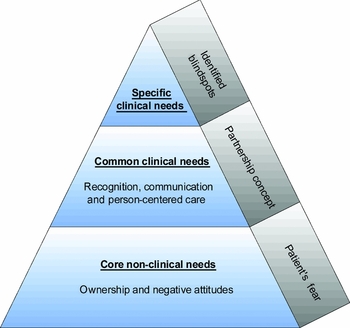
In both extracts, it is apparent that unless the core learning needs of attitudes, ownership, and an understanding of the fear in the hospital setting are addressed, higher level learning (e.g. feeding and discharge planning) needs are unlikely to be addressed. By examining the links between the learning needs, a three-tier hierarchy emerged. This concept is illustrated in the conceptual model shown in Figure 1. At the base layer are the needs relating to ownership, attitudes and fear for which we obtained the richest data. At a common clinical level are the needs of carer partnership, communication, recognition, and person-centered care, which are also related. Lastly, at the top are the specific needs, which form the focus of much teaching. As can be seen by Figure 1, hidden learning needs (those described predominantly by patients and carers) exist and are shown in gray.
Hierarchy of learning needs including hidden elements.

The principle that educational approaches should be targeted at the core learning needs initially is supported by the nutritionist, as described in the next extract.
It's a basic human right that everybody should be treated as like a human being and treated the way you would want to be treated and I think until people can get that right, I think the rest of the training wouldn't have any kind of effect. Maybe that's right or wrong but that's how I feel.
Nutritionist [Int15; line 297]
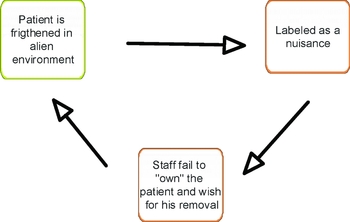
Further analysis revealed a potential vicious circle linking the base level learning needs (Figure 2). An older delirious patient may be frightened in the hospital environment. As a consequence of this, they may communicate in a manner, which is perceived as challenging. They may then be labeled as a “nuisance.” Subsequently, staff may want to remove the patient, which leads to the person being more scared further exacerbating the vicious circle.
Vicious circle of learning needs operating at core level.

Discussion
Main findings
The principal findings of this study are that learning needs (and by implication practice gaps) cluster into eight categories and are hierarchically related. These categories encapsulate the key knowledge, skills and attitudes that are needed to practice effectively and focus on understanding the patient rather than more technical or disease-specific knowledge on delirium. This informs Liaison Teams and other delirium educators with a new framework upon which to develop educational programs. Traditionally, educational interventions have focused on knowledge- or skill-based outcomes such as recognizing delirium as the first step and thereafter educating in terms of how to manage effectively the underlying causes. Our findings would suggest that educational approaches should be targeted at the more basic learning needs identified, emphasizing factors such as promoting ownership, challenging attitudes, improving behavior and communication skills, and increasing recognition of the emotional effect of hospitalization. Only if these basic learning needs are addressed can we expect learners in the work place to successfully learn and apply more technical competencies. Though some interventions, such as the HELP program (Inouye et al., Reference Inouye, Baker, Fugal and Bradley2006), are more successful; the lack of transferability of other delirium education approaches could be due to the failure to recognize this hierarchy.
Relating to the hierarchy, a vicious circle emerges between the core level practice gaps. The findings suggest that uncoupling this vicious circle between ownership, attitudes and fear should form a target for effective educational strategies. Importantly, since all professions are integrally involved and linked in the care processes, education should be extended widely to various professionals involved directly and/or indirectly in the care of patients with delirium.
Strengths and limitations
The strengths of the study are the degree of transferability and the credibility adopted within the research design. Transferability, akin to generalizability in quantitative studies, was increased by presenting and discussing findings at five national and international workshops during the research process. Credibility, similar to internal validity, was strengthened by the member check that involved taking the findings to the research participants and checking accuracy of the perspective obtained. As a result of both processes, it was apparent there was consensus that the findings were accurate and valid.
The limitations of the study were, first that the findings related entirely to the spoken word and therefore may be influenced by power factors, which limit what interviewees divulge. For example, lower status professions may have been unwilling to reveal true sentiments. However, some of the interviewees, for example the operational manager, were remarkably frank. A second limitation relates to the memory difficulties of some of the patients interviewed, which may have constrained recollection of their admissions. However, photos of patients in hospitals were used to prompt further memories. This technique has been used effectively in focus groups with patients who have dementia (Bamford and Bruce, Reference Bamford and Bruce2002).
Fit with literature
To the best of our knowledge, this is the first in-depth study that has explored the learning needs of such a broad spectrum of hospital staff toward managing the confused older patients. However, studies using other methods have reported similar findings. Using survey methodology, Davis and MacLullich examined practice gaps amongst UK doctors in delirium care (Davis and MacLullich, Reference Davis and MacLullich2009) and showed that though doctors are aware of delirium and the associated poor outcomes, they had a limited understanding of the management. Poignantly, they comment that previous attempts to address under recognition have been undermined because, “excellence in delirium care is not recognized as a core skill of a physician.”
Looking more broadly at the education literature, Karen Evans and colleagues studying effective knowledge transfer in non-medical settings (e.g. aircraft engineering) have similarly shown that subject-based knowledge (i.e. academic) is unhelpfully elevated above work-based knowledge (knowledge that is as much attitudinal as factual). Furthermore, they argue that defining what is core work knowledge and contextualizing that should form the first step in developing an effective strategy for work-based learning (Evans et al., Reference Evans, Guile and Harris2009). Our findings complement this proposition and help to define the key elements of practice that are required to care for patients with delirium, starting from the basic learning needs relating to ownership and attitudes.
Educational implications
In terms of developing effective educational approaches for Liaison teams, this study suggests that the core knowledge to develop resides with addressing learner identities as to what is appropriate for their roles. At present, our findings indicate that identities, and thereby ownership and attitudes, are shaped by outdated views of patients within the hospitals. Despite estimates that over a quarter of the patients in the acute setting are likely to have a delirium or dementia illness (Holmes et al., Reference Holmes, Bentley and Cameron2003); at all levels there is a pervasive sense that cognitive impairment is not core business for the hospital.
Importantly, we are not proposing a focus solely on core needs. Rather, we argue that if the technical aspects of delirium care are taught, together with the basic needs, there is potential for greater practice development.
Furthermore, when considering at a deeper level how the learning needs are constructed, it becomes apparent that organizational learning should proceed in tandem to individual or group learning. Educational approaches are unlikely to change practice without organizational support. As alluded to in various extracts, there is much overlap between the organizational and individual learning needs. Reconfiguration of processes in the work place to make it easier to implement the learnt practice is essential. Relaxing the rules in the hospital to allow freedom for carers to visit is an example of how an organization can adapt to support the carer partnership learning need.
Adopting a qualitative methodology, Bradley et al. (Reference Bradley, Schlesinger, Webster, Baker and Inouye2004, Reference Bradley, Webster, Baker, Schlesinger and Inouye2005) have explored implementation barriers to the HELP program at an organizational level, both initially and to sustain knowledge. Seven barriers were found. Challenges included gaining internal support, effective clinical leadership, integration with existing programs, contextual factors, showcasing positive results and maintaining cultural momentum (Bradley et al., Reference Bradley, Schlesinger, Webster, Baker and Inouye2004, Reference Bradley, Webster, Baker, Schlesinger and Inouye2005). Unlike our study, they focused on barriers primarily at an organizational level rather than practice gaps. However, if our findings in relation to new models of delirium education are combined with strategic approaches to overcome the described organizational barriers, potentially more effective staff educational interventions can be developed.
Future research
Future studies could be directed at refining a syllabus for delirium education and developing and evaluating educational approaches underpinned by the learning needs. Such interventions will need to be sensitive to local context and evaluations of such interventions will need to recognize this. It is described within the educational literature that the effects of a program cannot always be measured or foreseen, therefore failure to demonstrate “health outcomes” may not be evidence of failure of the intervention (Kirkpatrick, Reference Kirkpatrick1994; Eva and Lingard, Reference Eva and Lingard2008). For this reason, exploring the factors at play that affect learning is as necessary as testing hypotheses about whether interventions work.
Conflict of interest
None.
Description of authors' roles
Andrew Teodorczuk, Elizabeta Mukaetova-Ladinska, Sally Corbett, and Mark Welfare conceptualized the study. Andrew Teodorczuk collected and analyzed the data and wrote the original draft. All authors have revised it. All authors had full access to all of the data in the study and take responsibility for the integrity of the data and the accuracy of the data analysis.
Acknowledgments
We would like to thank the research steering group, Mrs Barbara Dowd, Mr Harvey Thomson, Mr Garth Miller, and Mr John Dowswell. We are also most grateful to Professor Alasdair MacLullich for his helpful comments with earlier drafts of the manuscript.
This work was funded by Northumbria Healthcare NHS Foundation Trust.