Introduction
The rapid rise in ageing of Western countries has generated much interest in the recent literature with the specific focus on cognitive decline in older people and on factors which might prevent it. The number of older people with cognitive impairments is increasing, thus producing – especially in the most serious cases (i.e. Alzheimer's disease) – high social and economic costs, both for individuals and for societies. The literature has shown that besides genetic factors (Emery et al. Reference Emery, Schein, Hauck and MacIntyre1998), even structural conditions may influence cognitive health in later life, such as individual behavioural or contextual characteristics (Bonsang, Adam and Perelman Reference Bonsang, Adam and Perelman2012; Cagney and Lauderdale Reference Cagney and Lauderdale2002; Engelhardt et al. Reference Engelhardt, Buber, Skirbekk and Prskawetz2010; Mazzonna and Peracchi Reference Mazzonna and Peracchi2012).
In the present study, we aim to investigate the association between cognitive decline and an environmental factor which has until now received little attention in the literature: the older adults' living arrangements.
In recent years, the proportion of individuals living alone in later life has become non-negligible, particularly in European countries (United Nations Department of Economic and Social Affairs, Population Division 2005, 2009), and even if forecasts do not always agree (Keilman and Christiansen Reference Keilman and Christiansen2010), older people living alone are expected to increase further in the coming years, due to increasing marital instability and decreasing fertility (Keilman and Christiansen Reference Keilman and Christiansen2013). In this perspective, it is important to examine whether living alone vis-à-vis living with others may have detrimental effects on maintaining cognitive performance.
Living in a one-person household is not a risk condition in itself for older people, particularly if they are in good health and have satisfactory social interactions. However, in situations of (potential) frailty, living alone may be a risk factor for health in later life (see e.g. Casale-Martínez, Navarrete-Reyes and Avila-Funes Reference Casale-Martínez, Navarrete-Reyes and Avila-Funes2012; van Campen Reference van Campen2011). Conversely, living with others implies, for example, a minimum of social relations which may have a double positive effect on cognitive status: on the one hand, it stimulates social integration and healthy lifestyles for older people; on the other hand, it may be linked to less anxiety and fear of loneliness. Low social integration, poor health behaviours and anxiety are, indeed, found to be positively associated with cognitive decline (Agrigoroaei and Lachman Reference Agrigoroaei and Lachman2011; Arpino and Bordone Reference Arpino and Bordone2012; Merrill and Small Reference Merrill and Small2011).
However, the notion that living with others is beneficial for cognitive health is not clearly supported by the literature. Some empirical studies seem to suggest that living with others could be a protective factor for cognitive functioning. In line with the economic (Casey and Yamada Reference Casey and Yamada2002) and psychological benefits (De Jong Gierveld, Dykstra and Schenk Reference De Jong Gierveld, Dykstra and Schenk2012) of living with a partner in older age, some studies suggest a positive effect on cognitive functioning of being in a partnership vis-à-vis being single (Håkansson et al. Reference Håkansson, Rovio, Helkala, Vilska, Winblad, Soininen, Nissinen, Mohammed and Kivipelto2009; Mousavi-Nasab et al. Reference Mousavi-Nasab, Kormi-Nouri, Sundström and Nilsson2012; Van Gelder et al. Reference Van Gelder, Tijhuis, Kalmijn, Giampaoli, Nissinen and Kromhout2006). The effect of living with adult children is instead more uncertain. To the best of our knowledge, the unique empirical study aiming explicitly to explore the association between cognitive performance and co-residence with children (Bordone and Weber Reference Bordone and Weber2012) shows a negative effect. Other research that could indirectly provide information about this relationship does not seem to be helpful: studies aiming to analyse the effect of co-residence with adult children on older people's psychological health show, for example, mixed results (Buber and Engelhard Reference Buber and Engelhardt2008; De Jong Gierveld, Dykstra and Schenk Reference De Jong Gierveld, Dykstra and Schenk2012). In fact, it is not easy to isolate the role played by living arrangement on the individuals' cognitive status. Apart from the difficulties in taking into account the numerous confounding factors which usually work in this type of study (see e.g. the attrition in the case of panel data, or the direction of causality in the case of co-residence with adult children, and the so-called re-test effect), we even have to consider that the possible positive effect of living with others could vary with respect to different cognitive functions, with the level of baseline cognitive status and with the characteristics of the persons who co-habit with older people. Maybe the impact of living arrangement on the elderly cognitive status has to be investigated, even taking into account the persons who co-habit with the elderly.
In the present paper, we intend to explore this topic in more depth, taking into account as best as possible all the critical issues introduced above: we analyse whether living with others is more beneficial than living alone for different cognitive functions of older people, by distinguishing for different living arrangements. To do this, we used data from the first two waves (in 2004 and 2006/07) of the Survey of Health, Ageing and Retirement in Europe (SHARE), which provides information on five cognitive abilities (orientation, immediate recall, delayed recall, verbal fluency and numeracy) of older men and women living in numerous European countries (we use data from eight of them). Cognitive decline was measured taking into account the differences in several abilities between the first and second waves for individuals aged 65 or over at the first wave. In order to assess the impact of living arrangement on cognitive decline, if any, separate multivariate analyses were carried out, by cognitive domain and country. In performing these analyses, particular attention was paid to the potential selection due to attrition and to another potential source of bias arising from what is generally referred to as the ‘re-test effect’ (Ferrer et al. Reference Ferrer, Salthouse, Stewart and Schwartz2004).
The rest of this paper is organised as follows. The second section reviews the existing literature on the association between family circumstances and the cognitive health of older adults. The third section describes the data and the methodology used to analyse the effect of living arrangement on cognitive decline. The fourth section presents both the methodology and the results of the analyses aiming to examine whether a re-test effect exists in the different data-sets. Then the main findings are described. Finally, we conclude with a synthesis and discussion of the results.
Background and research hypotheses
There is a wide literature debating how living arrangement affects health status in later life stages and the evidence is not clear-cut (Hays Reference Hays2002). If some studies reported that older persons living alone were at greater risks for poor physical and psychological health than those living with others (Buber and Engelhardt Reference Buber and Engelhardt2008; Kharicha et al. Reference Kharicha, Iliffe, Harari, Swift, Gillmann and Stuck2007), other studies found that there were no differences in health according to the living arrangement (Hughes and Waite Reference Hughes and Waite2002) and some reported that living alone could have some health advantages (Michael et al. Reference Michael, Berkman, Colditz and Kawachi2001). This mixed evidence might also depend on the heterogeneity of health outcomes that were used in these studies such as physical diseases, pain, mental health, and self-reported overall health and longevity (for studies focused on older people, see Waite Reference Waite and Uhlenberg2009).
However, even focusing on the literature that have specifically examined the relationship between living arrangement and cognitive functioning, the findings are still mixed. The few studies that explicitly consider the relationship between living arrangement and cognitive status found that living alone is associated with higher cognitive impairments (Van Gelder et al. Reference Van Gelder, Tijhuis, Kalmijn, Giampaoli, Nissinen and Kromhout2006). This is in line with empirical studies analysing the association between cognitive status and older adults' marital status (Håkansson et al. Reference Håkansson, Rovio, Helkala, Vilska, Winblad, Soininen, Nissinen, Mohammed and Kivipelto2009; Mousavi-Nasab et al. Reference Mousavi-Nasab, Kormi-Nouri, Sundström and Nilsson2012). Thus, these findings support the hypothesis that living with others can be directly (through social relations stimulating cerebral activities) or indirectly (practical and emotional support promoting more healthy behaviours and less stress and depression risks connected with loneliness) beneficial for older adults' cognitive health.
However, other studies that analyse the effect of living with adult children on parents' cognitive status show much less conclusive evidence. Even if it is unlikely that adult children living with their parents provide the same benefits provided by the partner (De Jong Gierveld, Dykstra and Schenk Reference De Jong Gierveld, Dykstra and Schenk2012), at least, there should be the opportunity for exchange of social, emotional, practical and financial support. In addition, co-residence with children may, for example, lead to a greater sense of purpose with direct neurohormonal benefits (Fratiglioni, Paillard-Borg and Winblad Reference Fratiglioni, Paillard-Borg and Winblad2004) and/or a reminder to take care of oneself. Thus, one should expect that co-residence with children may be positively associated with cognitive functioning in later life. This is not always the case. The only study looking at the effect of living with children on cognitive impairments (Bordone and Weber Reference Bordone and Weber2012) showed that having at least one child living in the same household was negatively or not at all associated with cognitive abilities of older people in Italy. Given that this is a cross-sectional study, this can be explained by a selection bias: in a country with a familistic welfare like Italy, older adults realising their cognitive abilities are declining might be more likely to move together with or close to a child. However, if we look at the impact of living with children on other health outcomes, the picture is still uncertain. De Jong Gierveld, Dykstra and Schenk (Reference De Jong Gierveld, Dykstra and Schenk2012) reported that older people living alone in some countries of Eastern Europe were on average lonelier than those living with adult children. However, De Jong Gierveld and Van Tilburg (Reference De Jong Gierveld and Van Tilburg1999) reported lower loneliness for older people living with their children compared to those living alone for their Italian sample, but higher loneliness for their Dutch sample. Thus, at least to date, the empirical literature seem to suggest that the role of children can vary with the cultural and institutional context of the country of residence.
In the light of the above findings, this paper aims to examine whether living with others is beneficial for older adults' cognitive health, hypothesising that mixed results from past literature arise because such a beneficial influence varies across several circumstances. Keeping an explorative approach, we want to show whether possible positive association between living with others and the reduced cognitive decline depends on several aspects. Moving from the results of De Jong Gierveld and Van Tilburg (Reference De Jong Gierveld and Van Tilburg1999), we can expect that the role of living with children might be lower in countries with a more familistic welfare (e.g. Southern European countries). This might be expected in the light of the higher share of older adults living with children in these countries (Gaymu et al. Reference Gaymu, Delbès, Springer, Binet, Dèsesquelles, Kalogirou and Ziegler2006), suggesting that in a familistic framework living with children is much more considered as a way to contrast older adults' cognitive impairments. In addition, we want to explore whether the influence of living arrangement varies with other characteristics, which, up to now, are little considered by past research but can partly explain why past literature does not show clear-cut findings. First, we will consider more dimensions of cognitive status, as the effect of living arrangement might depend on this choice. For example, fluid functions (Mousavi-Nasab et al. Reference Mousavi-Nasab, Kormi-Nouri, Sundström and Nilsson2012) might be more sensitive to living arrangement impact than crystallised ones. Second, considering that we will analyse the cognitive decline between two time periods, we might suspect that the role of living arrangement on such a decline depends also on baseline cognitive level. For example, living arrangement might be more influential on those who start from a lower baseline level. It could be indeed that older persons in relatively good cognitive status and living alone can substitute the potential benefits coming from living with others by the interaction with non-resident individuals.
Data and methods
The data
The data used in this paper come from the first two waves (in 2004 and 2006/07) of SHARE. This data-set provides longitudinal information on health and socio-economic status, and social and family networks of non-institutionalisedFootnote 1 adults aged 50 or over representing various European countries (Börsch-Supan et al. Reference Börsch-Supan, Brugiavini, Jürges, Mackenbach, Siegrist and Weber2005). In the current study, eight of the countries participating in the SHARE project are examined:Footnote 2 in particular, Sweden and Denmark are considered as Northern Europe, the Netherlands, Belgium, Germany and France are studied as Central Europe, and Italy and Spain represent Southern Europe. The sample utilised is based on individuals who were 65 or overFootnote 3 in the first wave and were interviewed again in the second wave.Footnote 4 Thus, the paper focuses on 5,502 individuals (46% of the sample aged 65 or over in the first wave) still alive in the second wave (414 individuals corresponding to 4.2% died before the second wave and 2,961 or 30.3% of individuals were not re-interviewed for an undisclosed reason).
Five different measures of cognitive function reflecting the different domains of the multi-dimensional concept of cognitive ability (Aichberger et al. Reference Aichberger, Busch, Reischies, Ströhle, Heinz and Rapp2010; Bernstein et al. Reference Bernstein, Penner, Clarke-Stewart and Roy2006; Dewey and Prince Reference Dewey, Prince, Börsch-Supan, Brugiavini, Jürges, Mackenbach, Siegrist and Weber2005) were available, namely orientation, immediate recall, delayed recall, verbal fluency and numeracy. Orientation is a basic cognitive functioning indicator measuring orientation for time (date, month, year and day of the week).Footnote 5 Recall refers to the ability to recall certain words from a list of ten items immediately after the list was given (immediate recall) and then again after a delay (delayed recall). Verbal fluency is an indicator of executive function, in this case referring to the number of different animals that the interviewee can recall within one minute. Numeracy measures the ability to perform numerical operations.
Each dimension of cognitive ability was measured with different tests each providing different measures: orientation and numeracy are described by five-category variables; immediate and delayed recall range from 0 to 10, and verbal fluency has values ranging from 0 to 60.Footnote 6 For all abilities a higher score implies a higher ability. As argued by Salthouse (Reference Salthouse1985) and suggested by Mazzonna and Peracchi (Reference Mazzonna and Peracchi2012), these dimensions of cognitive functioning are generally based on different combinations of fluid and crystallised intelligence. The first concerns performance in learning, remembering and processing new material, comprising perceptual speed and reasoning abilities. These cognitive abilities tend to decline substantially over an adult lifespan. The second type of cognitive ability is entirely related to accumulated knowledge and skills, such as the meaning of words and size of vocabulary, they tend to increase or remain at a high functional level until late in life (Verhaegen and Salthouse Reference Verhaegen and Salthouse1997). Orientation and (immediate and delayed) recall can be considered fluid abilities indicators, whereas verbal fluency and numeracy can be considered crystallised skills markers (as suggested by Engelhardt et al. Reference Engelhardt, Buber, Skirbekk and Prskawetz2010; Fuscaldo Reference Fuscaldo2012).
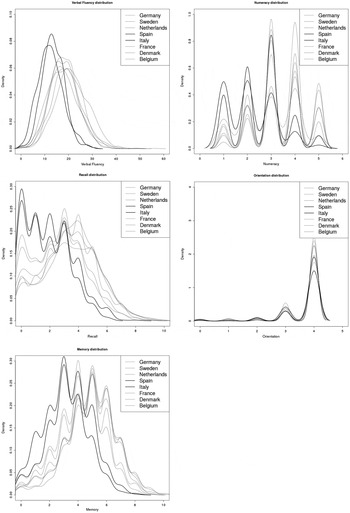
It should be noted that the baseline level of cognitive abilities may vary across countries. Indeed, this is what happens in our sample and is shown in the figure 1 in Appendix. In particular, it appears that the samples from Italy and Spain are characterised by lower performances than countries from Central and Northern Europe for almost all abilities (with the exception of orientation).
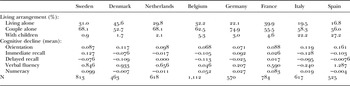
Cognitive decline was measured considering the differences between the scores in the first and second wave,Footnote 7 carried out separately for each of the five indicators of cognitive ability and measured for individuals aged 65 or over. Thus, separate multivariate analyses, in which the differences at ability level are the response variables, were used. Table 1 reports the mean values of these differences: positive values indicate a deterioration of cognitive ability between the first and the second wave, and a negative value implies an increase in cognitive ability. It is interesting to note that for some countries, an improvement in some abilities is observed, and this, as we will discuss in the next section, may be due to the so-called re-test effect.
Living arrangement and cognitive decline between first and second wave, by country

We use two key independent variables: older people's living arrangement along with their baseline cognitive functioning. The living arrangement variable distinguishes whether the individual lives alone or with others. Those living with others were further distinguished between living with the partner (only) and living with (adult) children (with or without a spouse).Footnote 8 The latter is mainly represented by older people living with their children only. However, this living arrangement, as Table 1 shows, is extremely rare in some European countries (such as Sweden and Denmark), leading to the impossibility of distinguishing from living with the partner only. In addition, the baseline cognitive functioning (measured at wave 1, for each of the five abilities) is considered: immediate recall, delayed recall and verbal fluency at wave 1 are considered as continuous covariates, whereas orientation and numeracy are dichotomised.Footnote 9 The baseline cognitive function is of interest not only because it allows one to control for the cognitive health at the start of the period, but also because we are interested in studying whether the association between living arrangements and cognitive decline might be influenced by the health of older people (see the ‘Methodology of analysis’ section).
Other covariates included in the models control for factors which are relevant, according to the literature, for cognitive decline (see the review by Engelhardt et al. Reference Engelhardt, Buber, Skirbekk and Prskawetz2010) and living arrangement. All these controls are measured at the first wave. Health is one of the most significant determinants of living arrangements: individuals living alone are probably those who are healthier. Aside from baseline cognitive functioning, health status also is measured considering the diagnosis of certain chronic diseases (heart disease, stroke and diabetes), the level of difficulty in performing eight Instrumental Activities of Daily Living (IADLs) and mental health (measured by the EURO-D scale; Prince et al. Reference Prince, Reischies, Beekman, Fuhrer, Jonker and Kivela1999). Physical function was categorised as normal (without any difficulty), mild disability (with difficulty in one or two IADLs) and severe disability (with difficulty in more than two IADLs). Respondents with EURO-D scores ranging from 0 to 3 were defined as ‘not depressed’, those with 4 or 5 were defined as ‘mildly depressed’, while those with more than 5 were defined as ‘severely depressed’. Further socio-economic and socio-demographic background factors were taken into account including age, gender and educational level. Education was divided into three categories: low (illiterate or elementary), middle (secondary school) and high (high school or above). Household economic situation was accounted for through household total net worth.Footnote 10 Differences in the number of household members were considered by dividing wealth by the square root of household size (Avendano et al. Reference Avendano, Glymour, Banks and Mackenbach2009), wealth was then collapsed into quartiles. A measure of social involvement was also considered (being connected with better cognitive performance; see e.g. Engelhardt et al. Reference Engelhardt, Buber, Skirbekk and Prskawetz2010), and measured by considering whether the respondent had undertaken at least one social activityFootnote 11 within the previous month prior to the interview.
Furthermore, we added geographical controls: both the region of residenceFootnote 12 and the type of area (a large city, the suburbs or outskirts of a large city, a large town, a small town, a rural area or village).
Lastly, in order to control for the quality of the answers, we took into account the presence of individuals during the cognitive section of the interview both in the first or in the second wave of the survey.
Methodology of analysis
A specific linear regression model was estimated for each country and cognitive ability, paying attention to the potential selection effect due to attrition. Data are of a longitudinal nature, but only two waves are available and the outcome is the difference between cognitive statuses in the first and second waves. Therefore, a panel analysis by means of fixed or random effects models is not possible.
Respondents experiencing a heavier cognitive decline might experience a higher risk of death, institutionalisation or health decline, and so they are less likely to be interviewed in the second wave, leading to a missing outcome for those who are interviewed only once. Therefore, we might expect that the association between living arrangement and cognitive decline (if any) would be biased if this kind of selection is not properly taken into account. This selection effect was addressed by weighting individuals in the regression models. In particular, calibrated longitudinal weights were used (for details on the weights and on the calibration procedure, see SHARE Release Guide 2.5.0 waves 1 and 2, Mannheim Research Institute for the Economics of Aging, 2011).
Baseline cognitive status has been included among covariates together with its interaction with living arrangement. We propose this model specification because we expect that the role of living arrangement might depend on starting cognitive level. Some authors (Glymour et al. Reference Glymour, Weuve, Berkman, Kawachi and Robins2005) suggest that baseline adjustment might introduce spurious associations and bias regression results. This might occur if the cognitive decline preceded the baseline assessment – this well-known phenomenon generally is referred to as the ‘horse-racing effect’. Bias might also occur in the case of unstable or unreliable cognitive health measurement. However, replicating estimates without baseline adjustment does not bring qualitatively different results, so baseline cognitive health and its interaction with living arrangement have been kept in the regression models.
A potential drawback: the re-test effect
Re-test effect and our approach
Measures of cognitive decline in panel surveys are plagued by the fact that at each assessment of cognitive ability, people might learn from tests performed in the previous interview. This is generally referred to as the ‘re-test effect’ (Ferrer et al. Reference Ferrer, Salthouse, Stewart and Schwartz2004) and according to the literature it produces an upward bias in cognitive abilities measurement. In our case, if a re-test effect exists and if it varies across living arrangement, this is an issue in assessing the role of living arrangement on cognitive decline. In addition, the re-test effect may vary across countries, thus it could be the case that it constitutes a problem only for some of them. Therefore, we needed to net out the measurement of cognitive decline from the bias introduced by the re-test effect.
The literature has suggested some methods to tackle this issue (Ferrer et al. Reference Ferrer, Salthouse, Stewart and Schwartz2004) although unfortunately, given our data limitation (we have only two waves), none of these can be applied here.
Thus, we followed an alternative approach. Re-test effects were estimated using data from wave 2, comparing cognitive abilities of individuals who were interviewed also in the first wave with those of individuals who are interviewed for the first time (refresh sample). The differences in terms of observable characteristics were net out via Propensity Score Matching (Rosenbaum and Rubin Reference Rosenbaum and Rubin1983). We assumed that differences between these two groups, once they have been aligned in terms of background characteristics, were only determined by the re-test effect.
Further, we defined as ‘treated’ all the individuals who are observed for the second time in wave 2 (2006/07) and as ‘control’ the refresh sample. Then separately by living arrangement (i.e. living alone, couple alone, living with children) and country, we perform a 1-to-n matching to align the distribution of the ‘treated’ with the ‘control’. In order to ensure a good match between treated and controls, a caliper of 1 per cent is applied. To this end, we also stratify the sample by two dimensions (education and gender), thus generating four cells. We then aligned the cells according to the geographical region, the health status (no problems in IADLs vis-à-vis at least one problem) and cohort (born before or after 1930).
The estimates of re-test effects were computed net of these variables controlling for basic background characteristics and conditioning to household structure. For the sake of clarity, after having dropped the observable differences between the ‘treated’ and the ‘controls’, we regress the cognitive ability on year of birth, years of education, gender, geographical region, health status (defined as above), year dummies (more precisely the interview year 2006 versus 2007) and the probability of being interviewed for the second time in the second wave vis-à-vis belonging to the refresh sample (the afore-defined ‘treated’).
Results
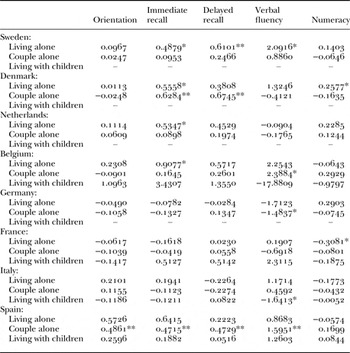
The results (Table 2) show that there is a significant (positive) re-test effect in many countries which varies from one living arrangement to another. For example, in Sweden we find a significant re-test effect in immediate and delayed recall and in verbal fluency for people living alone, while the same effect is not significant for people living in couple. Similarly, the Netherlands and Belgium show a positive re-test effect only for older people living alone in immediate recall (for Belgium a re-test effect is found also in verbal fluency for individuals living in a couple). In Denmark, besides a significant re-test effect for men and women living alone for immediate recall and numeracy, a positive re-test effect is found also among older people living in a couple for immediate and delayed recall. Spain shows a positive re-test effect for individuals in a couple for all cognitive abilities except for numeracy. We also find an odd negative re-test effect (i.e. people interviewed twice have a worse performance with respect to people interviewed once) in Germany (for verbal fluency for older people in a couple), in France (for numeracy for individuals living alone) and in Italy (for verbal fluency for people living with children). This may be explained by noting that in the first two countries the interview approach has changed from the first to the second wave (Blom and Korbmacher Reference Blom and Korbmacher2011).
Re-test effects in different abilities and countries by living arrangements

Notes: Individuals were stratified by country of residence then, via Propensity Score Matching, we aligned the distribution by cohort (born before 1930) and health (with or without problems with Instrumental Activities of Daily Living), gender and educational level (two dummies), and regions of residence (NUTS1). Given the small sample size we were not able to compute the estimation for elderly living with children in Sweden (seven observations), Denmark (eight), the Netherlands (13) and Germany (18).
Significance levels: * p < 0.05, ** p < 0.01.
For our purposes, it is interesting to document that no re-test effect was identified for certain countries in at least some cognitive dimensions (e.g. orientation and numeracy in most countries). This can make us more confident that regression of living arrangements on cognitive decline is not biased by this issue. For example, in the Netherlands it seems that all abilities except immediate recall are not affected by the re-test effect, so the effect of living arrangement, if any, on these outcomes can be interpreted without concerns about re-test effect.
Analysing the influence of living arrangement on cognitive decline
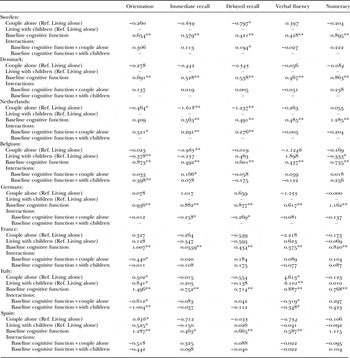
As described above, cognitive decline was measured by the differences between the scores in the first and in the second wave at the cognitive ability level. Results of the multivariate analysis reported in Table 3 refer to the coefficients describing differences, thus, positive values indicate a coefficient associated with an increased deterioration of cognitive ability between the first and the second wave, and a negative value implies a reduced cognitive decline with respect to the reference category. For example, in the Netherlands living only with a partner reduces the orientation decline by 0.464 points compared to what happens for older people living alone. Potential bias introduced by the re-test effect should be considered when referring to Table 3, thus significant coefficients which might be plagued by this problem (i.e. those referring to abilities of countries where a significant re-test effect has been found – see Table 2) are reported in italics. In addition, in order to interpret the data in Table 3, we need to look carefully not only at the main effects but also at the interactions with baseline cognitive score. We find that in almost all cases in which living with others significantly affects cognitive decline, the interaction coefficient is also significant but with the opposite sign. This means that whatever the role of living arrangement, its association with cognitive decline declines (and eventually becomes of the opposite sign) as the baseline level increases.
Estimates of coefficients related to living arrangements and baseline cognitive status in models describing cognitive decline

Notes: All models control also for the covariates: health (through the diagnosis of heart disease, stroke and diabetes, physical functioning and mental health), socio-demographic and economic factors (age, gender, education, social involvement, wealth and residence), and the presence of other individuals during the interview. Coefficients referring to abilities of countries where a significant re-test effect has been found are reported in italics. Ref.: reference category.
Significance levels: * p < 0.05, ** p < 0.01.
According to Table 3, Sweden and some Central European countries, such as the Netherlands and Belgium, all report the evident protective role of living with others. In particular, in Sweden a protective role of living only with a partner is observed for delayed recall. In the Netherlands, similar protective influence of living with a partner is observed for orientation and immediate and delayed recall. Similarly, a protective role of living with children is found for orientation and numeracy in Belgium. In fact, the significant interaction terms suggest that the beneficial role of living with others is stronger for older people with a low baseline cognitive level and can be null or even opposite for those with high baseline abilities. In Sweden and Denmark, a protective role of living only with a partner could be observed also for immediate recall and verbal fluency (for Sweden) and delayed recall (for Denmark), but it could have been obscured by the re-test effect, considering that those living alone show a significant performance improvement between the two waves. In other Central European countries such as Germany and France, the situation is completely different: for both countries there are no effects of living arrangement (even if in Germany a protective role of living with a partner for verbal fluency could have been obscured by a significant re-test effect).
In the Southern European countries, Italy and Spain, living with others implies a greater decline in some abilities in comparison with living alone: in particular, in Italy living in a couple implies a greater decline of orientation and verbal fluency, and in Italy and Spain, living with children leads to a greater decline in orientation. This does not confirm our hypotheses. In fact, in Italy, the significant interaction terms suggest that the detrimental role of living with others is observed among older people with low baseline cognitive level and it decreases or could even be reversed for those with high baseline abilities.
Conclusion and discussion
The aim of this paper was to assess whether living with others (partner and/or adult children) has a protective role from cognitive decline for older adults. The methodological approach we used was aimed at controlling for all potential disturbing factors and selection effects which may arise in this type of analysis. First, we use a longitudinal approach (considering cognitive decline between two waves) rather than a cross-sectional one, taking into account the potential selection due to the attrition between the first and second waves. Second, baseline cognitive health is controlled for and individuals in conditions of very poor health are not considered. Lastly, in the paper we also try to quantify the so-called re-test effect. In addition, we examined whether the relationship between living arrangement and cognitive decline depends on different circumstances: the type of co-residents; the baseline cognitive status; the cognitive domain; and – for the role of co-resident adult children – the type of welfare (more or less familistic) of the country of residence.
Results of regression models provide some evidence that living with others is more beneficial than living alone in Northern European countries and in some Central European countries (the Netherlands and Belgium). This is verified for older people with low starting cognitive conditions (whereas the role of living with others can be null or even opposite for those with high baseline abilities). Probably, older persons in relatively good cognitive status and living alone can substitute the potential benefits of living with others with the interaction with extra-household ties; conversely, older people with low cognitive status have more advantages living with others than living alone. Thus, these results support the hypothesis that co-residence with a partner or with adult children reduces the cognitive decline of older adults in comparison with living alone, especially if their cognitive status is already compromised. In addition, the same results seem to suggest that the ‘protective’ role of living with others is more effective in the case of the fluid dimensions of intelligence (at least in the case of Northern European countries).
However, the scenario is completely different if we look at the Southern European countries: in Italy and Spain living with others implies a greater decline in some abilities in comparison with living alone and this unexpected detrimental role of living with others is observed among older people with low baseline cognitive level, whereas this influence decreases, and eventually becomes of the opposite sign, as baseline increases. Thus, in countries with familistic welfare, co-residence with others is negatively associated with older adults' cognitive health and, contrary to our hypotheses, co-residence with adult children is less protective of parents' cognitive status than in other European countries.
One possible explanation is that, despite the fact that we made several efforts to take into account all the possible confounding factors, there is a selection mechanism, which varies across countries, and we could not control for it in the analyses. It is well known that the level of co-residence of older people with adult children and of institutionalisation are very different across countries (Gaymu et al. Reference Gaymu, Delbès, Springer, Binet, Dèsesquelles, Kalogirou and Ziegler2006): in Southern Europe the institutionalisation rates are lower than in the Central and Northern European countries, while the share of older adults living with children is higher in the former than in the latter. For this reason, even if we do not know the threshold of older persons' frailty that makes them move to a community household, we may assume that, in Southern European countries, older adults living in private households – and especially those living with others – have on average a worse health than those living in private households in Central and Northern European countries. This assumption seems to be confirmed even in our samples, at least with respect to cognitive health: the graphs in the Appendix show that Italy and Spain present lower levels in almost all cognitive dimensions than the other European countries. It might be possible that these older adults' health differences between South and Central/Northern Europe is a disturbing factor that, if not controlled for, does not allow the role of living arrangement on older people's cognitive decline to be isolated correctly. If, for example, older adults living with children (or with a partner) in Southern Europe suffered more serious chronic diseases than those living in Northern Europe, and this interferes with the possible protective role of co-residence with others on cognitive health, we could find different results for the two groups of countries. In this perspective, the paper underlines an additional potential source of selection that is usually ignored by the literature and that should be taken into account in future cross-country studies using a longitudinal approach.
Finally, we have to mention that other aspects could be taken into account in future research on this topic. For example, it might be interesting to look at the frequency of contacts with children not living with the seniors, not considered here because of the small sample size. It might be argued, indeed, that a high frequency of contact with children living elsewhere may be more effective in contrasting cognitive decline than living with children in a negative family climate (see e.g. Belle Reference Belle1982; Fischer Reference Fischer1982; Gerstel and Gallagher Reference Gerstel and Gallagher1993). Another interesting feature that could not have been investigated here is whether living arrangement effect differs between men and women. Unfortunately, with available data splitting the sample by gender was not possible due to the small sample size.
Appendix
Baseline cognitive-level distribution by country.