Introduction
Over a quarter of a million women die globally each year due to complications of pregnancy and childbirth, of which approximately 94% occur in low- and lower-middle-income countries (WHO, 2019). Following the Safe Motherhood Conference in Nairobi in 1987, the Child Survival and Safe Motherhood (CSSM) programme was launched in India in 1992. One of the main recommendations of the CSSM programme was the provision of Emergency Obstetric Care (EmOC) for the prevention of maternal mortality. Since then, there has been an emphasis on tackling maternal deaths through Millennium Development Goal 5 (improved maternal health), Sustainable Development Goal 3 (SDG-3: good health and well-being) and other policy initiatives. Despite this, thousands of preventable maternal deaths occur each year primarily due to complications of pregnancy or childbirth (WHO, 2013).
Low public health expenditure continues to characterize the Indian health system (Bhate-Deosthali et al., Reference Bhate-Deosthali, Khatri and Wagle2011; NHSRC, 2018), and as a result out-of-pocket expenditure on health has been a dominant feature of health care finance in India (Ghosh, Reference Ghosh2011; Bhojani et al., Reference Bhojani, Thriveni, Devadasan, Munegowda, Devadasan, Kolsteren and Criel2012; Leone et al., Reference Leone, James and Padmadas2013; NHSRC, 2018). Expenses incurred through maternal health care are on the rise and are pushing households into extreme poverty (Bonu et al., Reference Bonu, Bhushan, Rani and Anderson2009; Mukherjee et al., Reference Mukherjee, Singh and Chandra2013; Goli et al., Reference Goli, Moradhvaj, Anu, Shruti and Pradhan2016; Mohanty & Kastor, Reference Mohanty and Kastor2017). Catastrophic health expenditure, and the inability to pay for on-time quality emergency obstetric care, increase levels of maternal mortality (George, Reference George2007; Mukherjee et al., Reference Mukherjee, Singh and Chandra2013; Sharma et al., Reference Sharma, Verma, Viramgami, Vala and Lodhiya2018). Adequate maternal health care, including obstetric care, although proved to decrease maternal mortality (Sing et al., Reference Singh, Mavalankar, Bhat, Desai, Patel, Singh and Singh2009; Mohanty, Reference Mohanty2012), is often unavailable in India due to widespread poverty (Mohanty, Reference Mohanty2012). Efforts to improve maternal health, including emergency obstetric care, continue to be the prime focus of Reproductive and Child Health (RCH) programmes in India (Bhatia et al., Reference Bhatia, Yesudian, Gorter and Thankappan2006; Bhattacharya & Halder, Reference Bhattacharya and Haldar2014). However, progress has been slow and inequity in maternal health care service utilization remains a grave concern. Evidence from Maharashtra (Ganatra et al., Reference Ganatra, Coyaji and Rao1998), Rajasthan (Iyengar & Iyengar, Reference Iyengar and Iyengar2000) and Andhra Pradesh (Prakasamma, Reference Prakasamma2009) has shown that nearly half of maternal deaths in India occur at home or in transit to a hospital or health care facility. A recent study estimated that around two-thirds of women in India die while seeking some form of health care, usually a critical medical condition (Khosla et al., Reference Khosla, Dahiya and Sangwan2000; Montgomery et al., Reference Montgomery, Ram, Kumar and Jha2014; Das & Biswas, Reference Das and Biswas2015).
The Maternal Mortality Ratio (MMR) in India was 122 per 100,000 live births in 2015–17 (RGI, 2019). According to the WHO, an annual estimated of 35,000 maternal deaths occurred in India in 2017 (WHO, 2019). Although a marked declining trend in MMR has been observed, some states, such as Assam (229), Uttar Pradesh (216) and Madhya Pradesh (188), have reported very high MMRs (RGI, 2019).
Antenatal care has been demonstrated to have multiple positive effects on women’s health and well-being (Campbell et al., Reference Campbell and Graham2006; Mishra & Retherford, Reference Mishra and Retherford2008; Berhan & Berhan, Reference Berhan and Berhan2014; Origlia, Reference Origlia, Jevitt, Sayn-Wittgenstein and Cignacco2017), including the early detection of pregnancy complications. According to the 1997 UNICEF and UNFPA guidelines there are six basic EOC procedures: the administration of injectable antibiotics, oxytocicis and sedatives/anti-convulsants; the manual removal of the placenta; the removal of retained products of pregnancy; and assisted vaginal delivery. Comprehensive EmOC includes these six basic components plus blood transfusion and Caesarean section. Biswas et al. (Reference Biswas, Das, Misra, Roy, Ghosh and Mitra2005) found that the provision of all these basic emergency obstetric care processes was below the accepted level in four districts of West Bengal, with the exception of the proportion of deliveries made in EmOC facilities. Studies in India have shown that the vast majority of EmOC can be handled effectively by midwifes or nurses after hands-on training at the local level (Ganatra et al., Reference Ganatra, Coyaji and Rao1998; Tibandebage et al., Reference Tibandebage, Kida, Mackintosh and Ikingura2016), but policy enforces stricter rules. For example, the administration of anaesthesia and Caesarean section delivery can only be done by a trained post-graduate anaesthetist and obstetrician, respectively. Such specialists are rarely available in primary health centres, where most women seek services, resulting in referral to tertiary-level facilities (Mavalankar, Reference Mavalankar2001; Gerein et al., Reference Gerein, Green and Pearson2006). The cost of maternal health care services is likely to be higher in such facilities. Transport, food and treatment costs, including medicines, are some of the major expenses in this process. However, there is a dearth of literature investigating the amount spent on EmOC and the ways in which such spending vary among different socioeconomic groups in India, and the published work available is based on information gathered at the micro level. The National Sample Survey Organization (NSSO) conducted a nationally representative cross-sectional household survey on the expenses associated with EmOC, including pregnancies with complications before or during labour (abortion, ectopic pregnancy, hypertension, complications during labour) and complications in the mother after childbirth in its 71st round. This includes data on the expenses incurred when women seek EmOC services at private and public facilities at the all-India level.
This study aimed to assess the average costs incurred in medical, transport and other non-medical expenditure when seeking health care services for complications during pregnancy and after childbirth among women aged 15–49 years in India. It also aimed to examine the variations in expenditure among different socioeconomic groups, as well as the factors contributing to out-of-pocket expenditure and catastrophic spending on EmOC.
Methods
Data
Data were obtained from the 71st round of the National Sample Survey Office (NSSO) survey ‘Key indicators of social consumption in India, Health, conducted by the Government of India in January–June 2014 (NSSO, 2015). A stratified multi-stage design was followed when conducting the survey. Information was collected from 65,932 households (rural: 36,480; urban: 29,452) and 333,104 individuals across various states and union territories in India. The sample sizes for males and females were 168,697 and 164,407 respectively. However, the present study only included 1653 sample women who availed EmOC care in the year before the survey. The 71st data round contained information on the socioeconomic and demographic characteristics of households and also each household’s ‘social consumption of health’ in various categories, including: proportion of ailing persons; spells of ailments and their treatment; rate of hospitalization; and cost of treatment for hospitalization and non-hospitalization. The recall period for institutional (inpatient) expenses was 365 days and for non-institutional (outpatient) care it was 15 days.
Variables
Health care costs were categorized as ‘direct’ and ‘indirect’ costs. Doctor’s fee, cost of medicines, cost of diagnostic tests, bed charges and other medical expenses such as attendant charges, physiotherapy, personal medical appliances, blood and oxygen were categorized as ‘direct costs’. Transport costs, expenditure on food, escort and lodging charges were categorized as ‘indirect costs’.
The study outcome variable was ‘out-of-pocket expenditure (OOPE) for EmOC by the sample women over a period of one year prior to the survey date’. Out-of-pocket expenditure was measured according to World Bank recommendations (Wagstaff et al., Reference Wagstaff, Eozenou and Smitz2019). Here, out-of-pocket expenditure refers to the direct payments made by a patient to a health care provider. There are different forms of out-of-pocket payments (WHO, 2005, Wagstaff et al., Reference Wagstaff, Eozenou and Smitz2019), such as: user fees, paid directly to public health facilities; co-payments, made by members of a health insurance scheme; and payments made to private health care providers by individuals for services that are not covered by any form of health insurance (Xu et al., Reference Xu, Evans, Kawabata, Zeramdini, Klavus and Murray2003). Out-of-pocket health expenditure over a period of one year was estimated in INR (in US$) in three sub-categories of expenditure: medical, transport and other non-medical expenses, for both public and private providers.
The independent variables considered were respondent’s: age (15–24, 25–29, 30–34 and above 34 years), educational status (illiterate, up to primary, up to higher secondary and graduate and above), place of residence (urban and rural), religion (Hindu, Muslim and other [Christian, Sikh, Jain, Buddhist, Zoroastrian and other]), caste (Scheduled Caste, Scheduled Tribe, Other Backward Caste and other), household size (1–3, 4–6 and 7+ members), wealth index (Poorest, Poorer, Middle, Richer and Richest), insurance coverage (covered/not covered) and region (North [Chandigarh, Delhi, Haryana, Himachal Pradesh, Jammu & Kashmir, Punjab, Rajasthan, Uttarakhand]), Northeast [Arunachal Pradesh, Assam, Manipur, Meghalaya, Mizoram, Nagaland, Sikkim, Tripura], East [Bihar, Jharkhand, Odisha, West Bengal], Central [Chhattisgarh, Madhya Pradesh, Uttar Pradesh], West [Dadra & Nagar Haveli, Daman & Diu, Goa, Gujarat, Maharashtra] and South [Andaman & Nicobar Island, Andhra Pradesh, Karnataka, Kerala, Lakshadweep, Puducherry, Tamil Nadu, Telengena]).
Analysis
First, descriptive statistics were done in order to describe the demographic and socioeconomic characteristics of the respondents. Second, socioeconomic differentials in mean OOPE by public/private facility were assessed. Third, Catastrophic Health Expenditure (CHE) was calculated at two threshold levels (5% and 10%). Finally, binary logistic regression was applied to calculate the adjusted effect of various socioeconomic and demographic covariates on the level of catastrophic health expenditure for EmOC in India.
Catastrophic health expenditure refers to a level of expenditure that exceeds a fixed proportion of a household’s income/expenditure. In the present study, household spending of more than 5% and 10% of total household income was considered catastrophic health expenditure. If CHE is considered (at 5%) a dummy variable where 1 indicates a household with catastrophic health expenditure and 0 indicates a household without catastrophic health expenditure, then:
 $${\rm{CHE}} = 1\ {\rm{if}}\ {\rm{OOPE}}\big/{\rm{hhexp}} \ge 0.05$$
 $${\rm{CHE}} = 0\ {\rm{if}}\ {\rm{OOPE}}\big/{\rm{hhexp}} < 0.05$$
where CHE is the catastrophic health expenditure, OOPE is the out-of-pocket expenditure and hhexp is the household’s total expenditure.
All analyses were performed using STATA 12.
Results
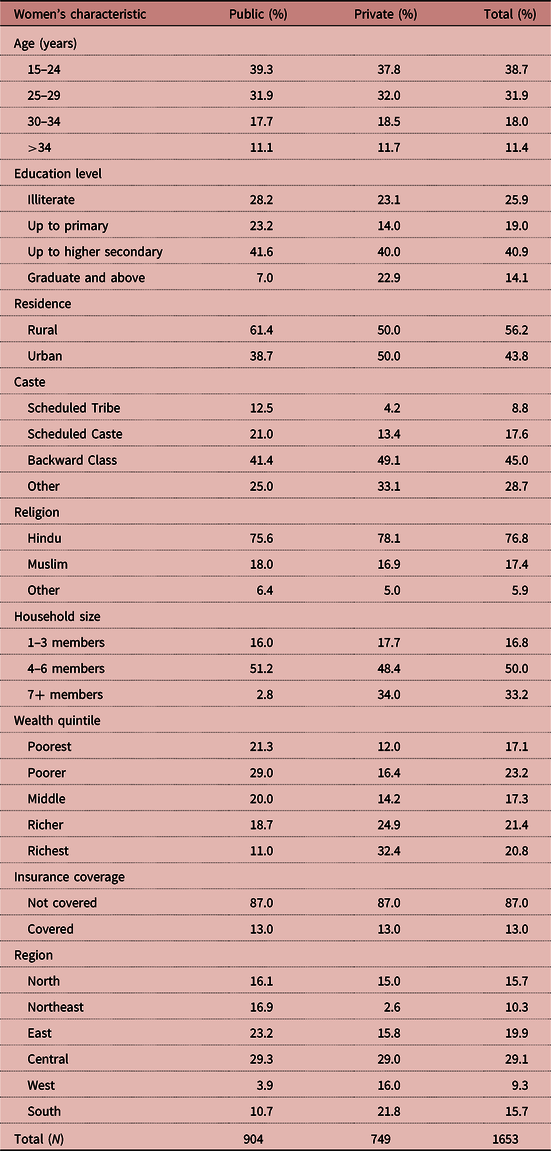
Table 1 shows the socio-demographic and socioeconomic characteristics of the respondents by type of health care facility used. About two-fifths (38.7%) of the women availing public health services for EmOC were in the age group 15–24 years, and only 11% were in the age group 35 years and above. About 61% of women availing public services were from rural areas and 39% were from urban areas. In the case of private services there was no rural–urban differential. More than 70% of the women using EmOC services belonged to the Hindu religion. Almost 50% of women opting for private services belonged to Backward Classes. Of those going to public hospitals, 28% were illiterate, 41% had completed higher secondary education and only 7% had graduate or above education. Half of total (private and public) EmOC use was by women from households with 4–6 members. Almost 50% of public service use was by women in the poorest and poorer wealth quintile, while more than 55% of private facilities were availed by those in the richer and richest quintiles. Insurance coverage was very low among the women who availed EmOC in health care services, both public and private. About 87% of women who were not covered by insurance went to either public or private health care services for EmOC. At the regional level, of women going to a public hospital, the highest rates were in the Central region (29.3%) followed by the Eastern region (23.2%), and the lowest rate was in the West region (3.9%).
Socioeconomic and demographic characteristics of women using EmOC services by type of health care facility, NSSO survey, 2014

Out-of-pocket health expenditure on EmOC
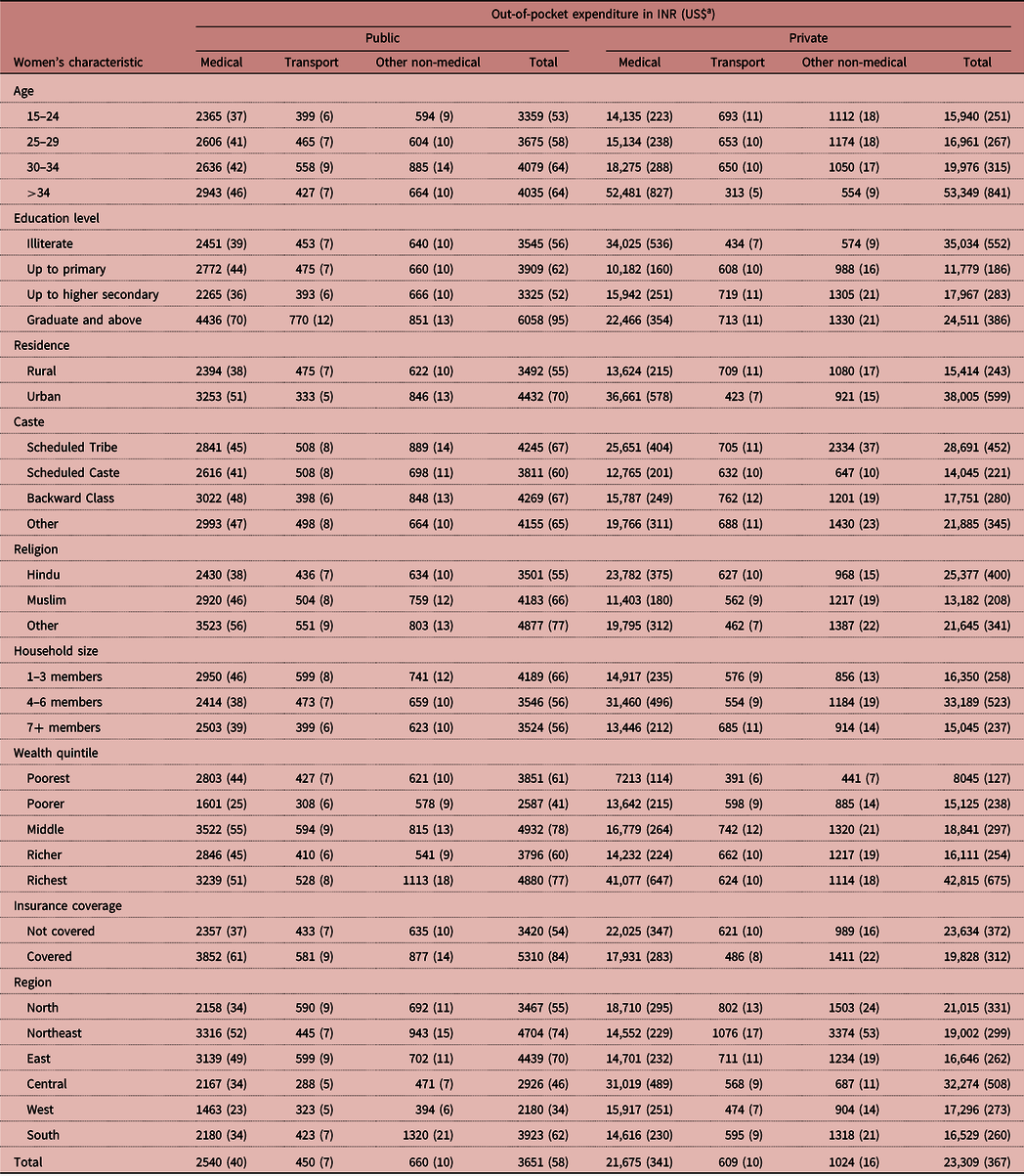
Women’s mean out-of-pocket health expenditure (OOPE) on EmOC (over a period of one year) by sub-category and public/private facility is shown in Table 2. There were large differences in mean OOPE between public and private facilities. The total (all-category) OOPE in private hospitals was INR 23,309, which was about 6 times higher than that in public hospitals (INR 3651). The share of mean OOPE was highest for medical expenditure (INR 21,675), followed by non-medical expenditure (INR 1024) and transport (INR 609) in the overall EmOC expenditure (INR 23,309) in private facilities.
Socioeconomic differentials in mean out-of-pocket expenditure by public and private health care facilities, NSSO survey 2014

a Values calculated in INR then converted to US$ using average exchange rate in 2014 (63.47; www.irs.gov).
Medical expenditure for private care was 3 times higher in the 34 and above age group than in other age groups. However, in the case of public care, there was little difference in medical expenditure among the age groups, while other, non-medical expenditure was higher in the 30–34 age group than in other age groups. Similarly, average total expenditure was higher in women aged 34 years and above (INR 53,349) compared with the 30–34 (INR 19,976) and 25–29 age groups (INR 16,961) in the case of private health care.
The educational status of mothers played a significant role, with illiterate women spending more on private medical care (INR 34,025), and hence having a higher OOPE on EmOC (INR 35,034) than literate mothers. Similarly, overall expenditure on EmOC was higher for women who were living in urban areas compared with their rural counterparts for both public and private facilities. In the case of public health care, the total cost on EmOC was INR 3492 for rural and INR 4432 for urban women, whereas for private health care it was INR 15,414 and INR 38,005 for rural and urban respectively. As expected, non-medical expenses were higher in private than public facilities in both rural and urban areas.
In comparison with Scheduled Caste women, Scheduled Tribe women spent more than twice as much on private services (INR 28,691). But for public services, the caste difference in spending on medical, non-medical and transport was marginal. Women in the Hindu category spent more (INR 25,377) on private health care than Muslim women (13,182) and others (21,645). With an increase in household size from 1–3 to 4–6 members, total public service costs declined. However, in the case of private services, mothers in households with 4–6 members spent more (INR 33,189) on EmOC, followed by those with 1–3 (INR 16,350) and 7 or more members (INR 15,045).
Economic status of mother significantly influenced spending on EmOC, with women in the richest quartile spending more (INR 42,815) on private care compared with those in the poorer (INR 15,125) and middle income (INR 18,841) quintiles. In addition, in private facilities, the poorest quintile women spent the least in all categories (medical, non-medical and transport), followed by others. However, in public facilities the poorest (INR 2803) spent more on medical care than women in the poorer quintile (INR 1601). Similarly, expenditure on EmOC was higher for women who were not covered by public health insurance.
Regional variation in mean OOPE was seen for both public and private facilities. The Central region had a higher mean OOPE, followed by the North, Northeast, West, East and South regions for private facilities. For public facilities, the Northeast region had higher spending than any other region in the overall category.
Catastrophic health expenditure on EmOC
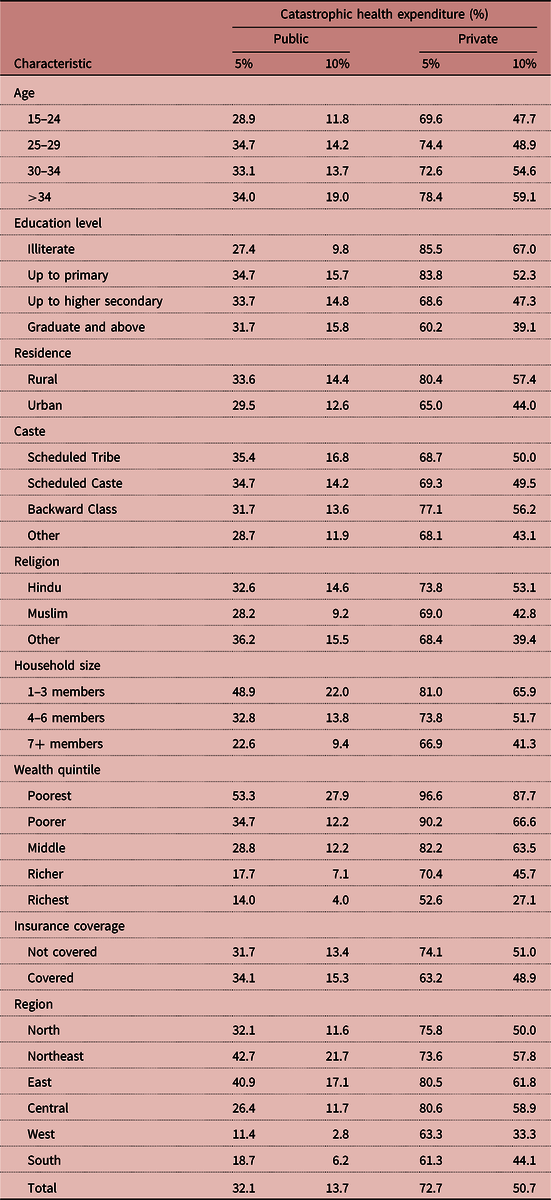
Catastrophic health expenditure by women’s socio-demographic characteristics is presented in Table 3. Expenditure was assessed by public/private facility and at two cut-off thresholds of 5% and 10%. Women in the age group 15–24 years spent less than those in other age groups on both public and private services. A higher incidence of catastrophic expenditure was noted in rural than urban areas across both facility types and cut-off levels.
Catastrophic health expenditure (in %) on EmOC by selected socio-demographic characteristics of women, NSSO survey 2014

Source: authors’ estimates from NSSO survey, 2014.
At a cut-off of 5%, the incidence of catastrophic expenditure was 33.6% in public and 80.4% in private facilities, and at 10% it was 14.4% and 57.4%, respectively for rural households. The poorest quintile had highest catastrophic expenditure and its incidence decreased with increase in wealth. The level of CHE was higher in Scheduled Tribe women at both the 5% and 10% levels for public facilities, whereas it is higher among Backward Class women for private facilities. Among all women using private services, the level of CHE was higher for those who were illiterate or only educated up to primary level compared with others. Similarly, women belonging to the Hindu religion had more catastrophic expenditure on EmOC in private facilities compared with women belonging to other religions. At both cut-off levels, CHE was highest among women with 1–3 family members, and declined with increased family size. Catastrophic health expenditure was higher among women covered by some sort of health insurance compared with those with no insurance. In public health care, CHE was highest in the Northeast and lowest in West region at both cut-offs. However, in private health care, CHE (at 5% level) was highest in the Central region, followed by the East, North, Northeast, West and South region.
Results from the logistic regression analysis
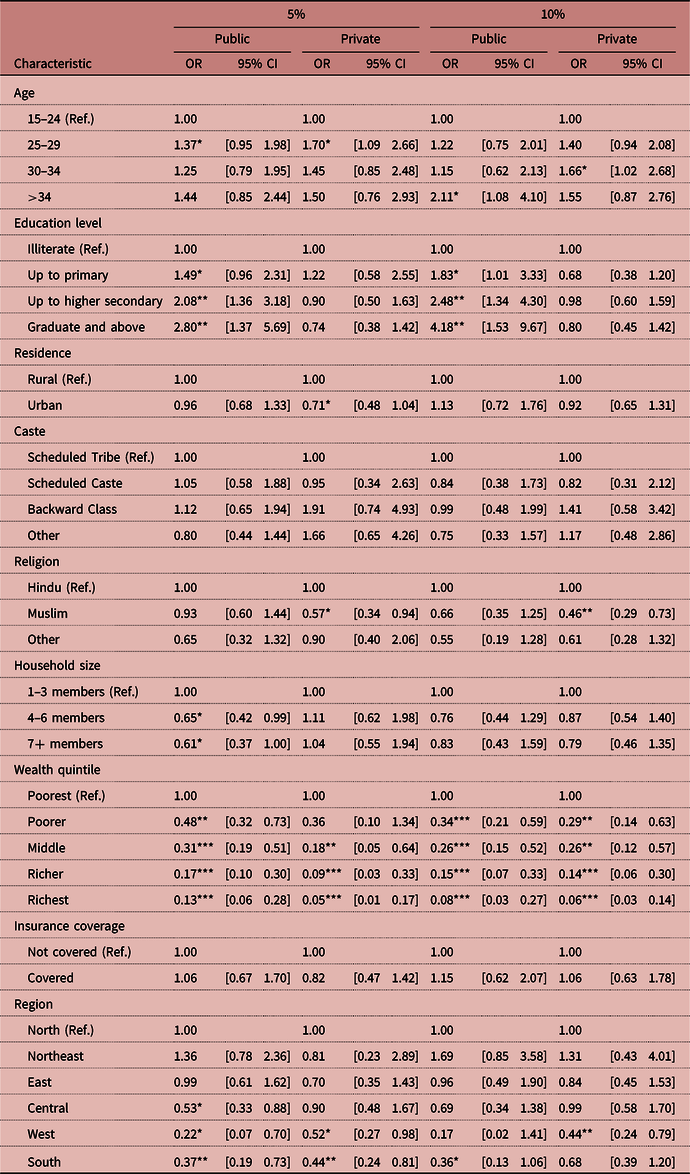
Table 4 shows the results of the logistic regression analysis of the associated of catastrophic health expenditure on EmOC with selected socio-demographic factors. The odds of CHE in the Central, South and West regions were lower than in the North region for public facilities at the 5% level. In the case of private facilities, the odds of CHE were 56% lower (at the 10% level) in the West region than in the North region. Level of education was significantly associated with CHE for public facilities at both the 5% and 10% levels, whereas there was no significant relationship in the case of private facilities. The odds of CHE (at 5% level) among women who had completed secondary education were two times higher than those of illiterate women in public facilities.
Results of multivariate logistic regression analysis of factors associated with catastrophic health expenditure on EmOC, NSSO 2014

Similarly, at the level 5% women in the age group 25–29 years faced higher CHE compare with those in aged 15–24. The richest group had significantly lower CHE in both private and public health facilities. The odds of CHE were 87% and 83% lower in the richest and richer category, respectively, than in the poorest category at the 5% level, while they were 85% and 92% lower at the 10% level for the same categories in public facilities. The occurrence of CHE was 29% lower in women from urban areas compared with their rural counterparts in private facilities at the 5% level. The odds of CHE were lower by 43% and 54% (at 5% and 10% levels respectively) among women belonging to the Muslim religion compared with Hindus in the case of the private category. The results also indicate that, in public facilities, the odds of CHE were 35% and 39% lower among women with 4–6 and 7+ household members, respectively, than among women with 1–3 members at the 5% level. Caste and insurance coverage were not significantly associated with level of catastrophic expenditure on EmOC in either public or private facilities.
Discussion
This study attempted to estimate the average costs incurred by women while seeking EmOC in India, and determine the patterns of expenditure among different socio-economic groups and by private/public health care facility. The findings show that, despite having cashless delivery schemes such as Janani Suraksha Yojana and Janani Shishu Surakhya Karyakram designed to reduce the burden of EmOC costs, households in India still have to make high out-of-pocket expenditures when seeking emergency health care. This analysis of data from the 71st round of the NSSO has shown that expenditure on medical care, transport and other non-medical costs in private and public facilities are the major components of out-of-pocket expenditure. As reported in similar studies from other countries (Arsenault et al., Reference Arsenault, Fournier, Philibert, Sissoko, Coulibaly, Tourigny and Dumont2013; Sikder et al., Reference Sikder, Labrique, Craig, Wakil, Shamim, Ali and Christian2015), out-of-pocket expenditure, which is sometimes catastrophic, is much more prevalent in private facilities than in public facilities. Despite the high cost, poor people are using private services, probably because the benefits outweigh the expense, and also because private services are perceived to be more effective than public ones (Griffiths & Stephenson, Reference Griffiths and Stephenson2001).
The results indicate that out-of-pocket medical expenditure increases with women’s age, both in public and private facilities. Similar findings were made in other studies in India (Kerketta, Reference Kerketta2015; Pradhan & Dwivedi, Reference Pradhan and Dwivedi2017; Paul & Chouhan, Reference Paul and Chouhan2020). Also, illiterate women are spending more on EmOC in private facilities than are literate women. This may be because literate women take more care of their health, or are going to public facilities instead, as indicated by the results of this study. A significant relationship between education and spending on EmOC has been found in many previous studies (Mateen et al., Reference Mateen, Shaikh and Kumar2013; Birmeta et al., Reference Birmeta, Dibaba and Woldeyohannes2013; Belda & Gebremariam, Reference Belda and Gebremariam2016).
Mean OOPE was higher for women in urban areas for both public and private facilities. Urban people were spending more than double the amount on EmOC in private facilities than their rural counterparts. People residing in rural areas have to pay much more for transport. Studies have indicated that this is either because they failed to use free transport services, free transport providers could not be contacted at the time of the emergency or the vehicles fail to reach remote villages due to poor road conditions (Keya et al., Reference Keya, Rob, Rahman, Bajracharya and Bellows2014; Atuoye et al., Reference Atuoye, Dixon, Rishworth, Galaa, Boamah and Luginaah2015). Hence the households had to pay substantial amount from their own pockets to reach the nearest facility (Rahman et al., Reference Rahman, Rob, Noor and Bellows2013; Mohanty & Srivastava, Reference Mohanty and Srivastava2013).
Out-of-pocket expenditure on EmOC in public facilities was lower in Hindu and Muslim women than in those of other religions. Perhaps women from ‘other’ religions had higher economic status, pushing them to be treated in private rather than public facilities. An interesting finding was that OOPE on EmOC was higher in Scheduled Tribe than Scheduled Caste women in both public and private facilities.
Out-of-pocket expenditure on EmOC was also found to be related to women’s economic status. Those of lower economic status spent less in private facilities than women of higher economic status. Also, having insurance cover had a positive relationship with total spending on EmOC (medical, non-medical and transport) in public facilities, meaning that women with insurance spent more than those without insurance. A similar finding of insurance schemes increasing the probability of spending more on EmOC has been made in other studies in Ghana (Browne et al., Reference Browne, Kayode, Arhinful, Fidder, Grobbee and Klipstein-Grobusch2016; Wang et al., Reference Wang, Temsah and Mallick2017).
The study also highlighted regional variation in spending on EmOC. Women from the Northeast and East regions spent more on medical care, whereas lower expenditure was recorded by women from the West region in the case of public facilities. However, for private facilities, higher out-of-pocket expenditure was noted among Central and North region women and lower out-of-pocket expenditure among Northeast and South region women. The variation by region may be due to differences in educational status or availability of public and private health facilities.
The results of the logistic regression analysis showed a similar trend in spending on EmOC, with a significant relationship between catastrophic health expenditure and age, education, household size, religion, wealth quintiles and region, but not caste or insurance coverage. The level of catastrophic health expenditure was highest in women aged 25–29 who were educated, poor and with a family of 1–3 members.
In conclusion, despite the continuous efforts of the India Government to improve maternal health and reduce the burden of EmOC costs in an attempt to achieve SDG-3, it has failed to reduce the high burden of out-of-pocket expenditure on EmOC. A significant proportion of women were still spending money from their own pockets to access services during pregnancy and childbirth at the time of the 71st round of the NSSO in 2014. Women in remote areas still do not seem to be receiving adequate care due the inaccessibility of rural areas and a lack of proper transport links between rural and urban areas. The government needs to strengthen public infrastructure facilities to improve this accessibility. The NFHS-4 found that the percentage of deliveries in public facilities was 52.1% in 2015–16, which was more than twice the rate in private facilities (26.3%). This indicates that, in spite of a good number of women going to public sector for childbirth, a notable proportion go to the private sector in the expectation of better services. As cost of treatment in the private sector is higher, richer women can meet these expenses and poorer women cannot, and are therefore denied these better facilities. The government insurance schemes are not adequate to meet the expenditure related to obstetric care. Those who have insurance cover have to pay more from their own pocket due to low rate of reimbursement by the insurer. Therefore, a public–private partnership (PPP) model of insurance should be introduced in India to allow better care during pregnancy and childbirth. In addition, the private health care system in India should be integrated into a well-regulated, national health care system in order to reduce household catastrophic expenditure on emergency obstetric care.
Study limitations
The study included those households that had incurred out-of-pocket and catastrophic expenses for EmOC but was unable to take into account the effect of price differentials in health care, especially for those household whose women had not gone for any medical treatment. In addition, the concept of affordability and accessibility was not measured directly. Since household expenditure data were self-reported, there could have been issues of over- or under-estimation. Furthermore, the study was limited to women who used any health care facility (whether public or private) but excluded households in which women died at home without going to a health care facility.
Funding
This research received no specific grant from any funding agency, commercial entity or not-for-profit organization.
Conflicts of Interest
The authors have no conflicts of interest to declare.
Ethical Approval
The information collected in the survey was used primarily for research and the name and place of the respondents was not disclosed. The dataset used in this study is also available in the public domain.