





1 Introduction
1.1 Background
In modern analysis, additive combinatorics and geometric measure theory, a central question asks whether sufficiently large sets must necessarily contain copies of prescribed patterns, such as arithmetic progressions, geometric progressions, equilateral triangles, parallelograms or zero sets of specific functions.
Numerous results provide evidence supporting this viewpoint. For example, in the discrete setting, a fundamental and representative result is Szemerédi’s theorem [Reference Szemerédi18], which asserts that any subset of the integers with positive upper density contains arbitrarily long arithmetic progressions. In the continuum setting, it is known that any subset of
 $\mathbb {R}^d$
with a Lebesgue density point contains a nontrivial affine copy of any finite configuration. This result can also be extended to sets with positive Lebesgue measure. However, when considering finite configurations in sets of zero Lebesgue measure, Łaba and Pramanik [Reference Łaba and Pramanik12] demonstrated the existence of three-term arithmetic progressions in special ‘random-like’ subsets of
 $\mathbb {R}$
. These subsets support measures satisfying an appropriate ball condition and a Fourier decay estimate. Higher-dimensional generalisations were explored by Chan et al. [Reference Chan, Łaba and Pramanik4]. More recently, Yavicoli [Reference Yavicoli19] introduced a new definition of thickness and, using variants of Schmidt’s game, proved that a compact set with thickness
 $\tau $
contains a similar copy of any set with at most
 $N(\tau )$
elements. This work extends the estimate of Broderick et al. [Reference Broderick, Fishman and Simmons3] of the maximal length of an arithmetic progression in middle-
 $\varepsilon $
Cantor sets. Numerous related results in the continuum setting guarantee the existence of specific configurations under suitable size assumptions (see, for example, [Reference Bennett, Iosevich and Taylor2, Reference Harangi, Keleti, Kiss, Maga, Máthé, Mattila and Strenner9]).
However, a substantial body of work challenges this perspective through the pattern avoidance problem: for a given pattern, how large can a set
 $X \subset \mathbb {R}^d$
be before it must contain a copy of that pattern? For instance, in the discrete setting, a classical result of Behrend [Reference Behrend1] establishes that for any
 $\varepsilon> 0$
and all sufficiently large integers M, there exists a set
 $X_M \subset [M] := \{0, 1, \ldots , M-1\}$
satisfying
 $ \# X_M \geq M^{1-\varepsilon }$
that contains no nontrivial three-term arithmetic progressions. This contrasts sharply with Roth’s theorem [Reference Roth16], which proves that any integer subset with positive density must contain three-term arithmetic progressions. In the continuous setting, Keleti [Reference Keleti10] constructed a set
 $E \subset \mathbb {R}$
with full Hausdorff dimension yet zero Lebesgue measure that avoids all nontrivial one-dimensional rectangles, which also implies the existence of a full dimensional set E containing no 3-term arithmetic progressions. Shmerkin [Reference Shmerkin17] showed that for any
 $\alpha \in (0,1]$
, there exist Salem sets of dimension
 $\alpha $
avoiding arithmetic progressions. Further avoidance properties are explored in [Reference Denson, Pramanik, Zahl and Rassias5, Reference Fraser and Pramanik8, Reference Keleti11, Reference Maga14].
Fraser et al. [Reference Fraser, Saito and Yu6] studied the dimension bounds for sets avoiding approximate arithmetic progressions, with subsequent improvements by Fraser et al. [Reference Fraser, Shmerkin and Yavicoli7]. Since translation-invariant linear patterns generalise arithmetic progressions, their nontrivial zeros include arithmetic progressions while admitting strictly richer solution sets. For example, a three-term arithmetic progression
 $(x_0, x_1, x_2)$
with nonzero common difference satisfies
 $f(x_0, x_1, x_2) = 2x_1 - (x_0 + x_2) = 0$
, whereas the equation
 $g(x_0, x_1, x_2, x_3, x_4) = 4x_0 - (x_1 + x_2 + x_3 + x_4)$
has solutions including both 5-term arithmetic progressions and nonarithmetic configurations like
 $(5,1,2,8,9)$
.
We focus on translation-invariant linear patterns within the special class
 $$ \begin{align} \mathcal{F} = \bigcup_{v \geq 2} \mathcal{F}_v(\mathbb{N}), \end{align} $$
where
 $\mathcal {F}_v(\mathbb {N})$
is defined by
 $$ \begin{align*} \mathcal{F}_{v}(\mathbb {N})= \bigg\{ f(x_0, \ldots, x_v )=m_0 x_0-\sum_{i=1}^v m_i x_i \,\bigg| \begin{array}{l} m_0=\sum_{i=1}^v m_i, (m_0, \ldots, m_v)\in \mathbb{N}^{v+1} \\ \text{gcd}( m_0, \ldots, m_v)=1 \end{array}\kern-4pt \bigg\}. \end{align*} $$
Liang and Pramanik [Reference Liang and Pramanik13] constructed sets with large Fourier dimension that avoid nontrivial solutions to arbitrary finite systems of such linear equations.
In contrast to the avoidance properties in [Reference Keleti10, Reference Keleti11, Reference Liang and Pramanik13, Reference Máthé15] which only avoid exact solutions to countable equations, we examine the size of sets that avoid not only exact nontrivial solutions to a subcollection
 $\mathcal {G} \subset \mathcal {F}$
, but also approximate nontrivial solutions.
1.2 Statement of main results
Here, we consider a weaker notion of ‘nontrivial zeros’. For convenience, we first present relevant definitions and notation, beginning with the definition of nontrivial zeros for functions
 $f \in \mathcal {F}$
.
Definition 1.1 [Reference Liang and Pramanik13].
For any
 $f \in \mathcal {F}_{v}(\mathbb {N})$
, a vector
 $\vec {x} = (x_{0}, x_{1}, \ldots , x_{v}) \in \mathbb {R}^{v+1}$
satisfying
 $f(x_{0}, x_{1}, \ldots , x_{v}) = 0$
is called a solution to the equation. If the elements of
 $\vec {x}$
are not all identical, it is called a nontrivial solution.
Similar to the definition of a set that
 $\varepsilon $
-avoids arithmetic progressions given in [Reference Fraser, Shmerkin and Yavicoli7], we define what it means for a set to
 $\varepsilon $
-avoid nontrivial solutions to a finite subcollection
 $\mathcal {G} \subset \mathcal {F}$
.
Definition 1.2. Given a finite subcollection
 $\mathcal {G} \subset \mathcal {F}$
and
 $\varepsilon \in (0,1)$
, a set
 $E \subseteq \mathbb {R}$
is said to
 $\varepsilon $
-avoid nontrivial solutions for
 $\mathcal {G}$
if for every nontrivial solution
 $\vec {x} = (x_0, \ldots , x_v)$
of any
 $f \in \mathcal {G}$
,
 $$ \begin{align*} \max_{0 \le i \le v} \inf_{y \in E} |y - x_i| \geq \lambda \varepsilon, \end{align*} $$
where
 $\lambda $
is the diameter of
 $\vec {x}$
, that is,
 $\lambda =\max _{0 \leq i, j \leq v}|x_i-x_j|$
.
Remark 1.3. This definition is equivalent to stating that for a finite subcollection
 $\mathcal {G} \subset \mathcal {F}$
and any nontrivial solution
 $\vec {x}$
of any
 $f \in \mathcal {G}$
with diameter
 $\lambda $
, the
 $\lambda \varepsilon $
-neighbourhood of E cannot contain all components of
 $\vec {x}$
.
Given a finite subcollection
 $\mathcal {G}\subset \mathcal {F}$
, let
 $\alpha $
denote the maximal coefficient of all
 ${f \in \mathcal {G}}$
, namely
 $$ \begin{align} \alpha:=\max\bigg\{m_0 \mid \exists v \geq 2, f \in \mathcal{G} \cap \mathcal{F}_{v}~\text{with}~f(x_0, \ldots, x_v )=m_0 x_0-\sum_{i=1}^{v}m_i x_i \bigg\}. \end{align} $$
Following the framework of [Reference Liang and Pramanik13], we define
 $$ \begin{align} A:=2(\alpha+1). \end{align} $$
In addition, we introduce two key quantities adapted from [Reference Fraser, Shmerkin and Yavicoli7]. First,
 $$ \begin{align*} r_{\mathcal{G}}(N) := \max \{ \#\mathcal{C} \mid \mathcal{C} \subset [N],\ \mathcal{C}\ \text{does not contain nontrivial zeros of any}\ f \in \mathcal{G} \}. \end{align*} $$
In [Reference Liang and Pramanik13], the authors proved that for all sufficiently large N,
 $$ \begin{align} r_{\mathcal{G}}(N) \geq N e^{-(A+4)\sqrt{\ln N}}. \end{align} $$
Based on the lower bound of
 $r_{\mathcal {G}}(N)$
in the discrete setting, we obtain lower and upper bounds for
 $d(\mathcal {G},\varepsilon )$
, where
 $$ \begin{align*} \begin{aligned} d( \mathcal{G},\varepsilon):=\sup\bigg\{{\dim_H} E \,\bigg| \begin{array}{l} E~\text{is a bounded set that }\varepsilon\text{ avoids}\\ \text{the nontrivial zeros of any }f\in\mathcal{G}\end{array}\kern-3pt \bigg\}. \end{aligned} \end{align*} $$
These definitions parallel those for arithmetic progressions in [Reference Fraser, Shmerkin and Yavicoli7]; we generalise them here to arbitrary linear patterns in
 $\mathcal {G}$
.
Building upon these foundations and with minor modifications to the arguments in [Reference Fraser, Shmerkin and Yavicoli7], we now present our main results.
Theorem 1.4. Let
 $\mathcal {G}$
be a finite collection of
 $\mathcal {F}$
as defined in (1.1), with A given by (1.3). Then:
-
(1) for any
 $\varepsilon \in (0,{1}/{2( A+1)}]$
,
$$ \begin{align*} d(\mathcal{G},\varepsilon ) \geq \frac{ \log r_{\mathcal{G}} ( \lfloor {1}/{2(A+1)\varepsilon }\rfloor ) }{\log(A \lfloor {1}/{2(A+1)\varepsilon} \rfloor)}; \end{align*} $$
-
(2) for any
$\varepsilon \leq {1}/{A}$
,
$$ \begin{align*} d(\mathcal{G},\varepsilon) \leq \frac{\log(\lfloor {1}/{\varepsilon }+1\rfloor r_{\mathcal{G}}( \lfloor {1}/{\varepsilon }+1\rfloor)+1)}{2\log\lfloor {1}/{\varepsilon }+1\rfloor }; \end{align*} $$
-
(3) for any
$\varepsilon \leq {1}/{2}$
, if
$ r_{\mathcal {G}}(A)>{A}/{2}$
, then if
$$ \begin{align*} d(\mathcal{G},\varepsilon)\leq \frac{ \log (( A-r_{\mathcal{G}}(A))\cdot \lceil {1}/{2\varepsilon }\rceil +1)}{\log ( ( A-r_{\mathcal{G}}(A) ) \cdot \lceil {1}/{2\varepsilon }\rceil +1)-\log {r_{\mathcal{G}}(A )}/{A} }; \end{align*} $$
$ r_{\mathcal {G}}(A) \leq {A}/{2}$
, then
$$ \begin{align*} d(\mathcal{G},\varepsilon) \leq \frac{\log ( r_{\mathcal {G}} (A) \cdot \lceil {1}/{2\varepsilon } \rceil) }{ \log ( A\cdot\lceil {1}/{2\varepsilon }\rceil)-\log{r_{\mathcal{G}}(A)}/{A}}. \end{align*} $$


Remark 1.5. From the results in the theorem, it is clear that our bounds crucially depend on the magnitude of
 $r_{\mathcal {G}}(N)$
in the discrete setting. According to (1.4), for any fixed
 $\mathcal {G}$
and all sufficiently large N, we have
 $ r_{\mathcal {G}}(N) \geq N e^{-(A+4)\sqrt {\ln N}}$
. Consequently, as
 $\varepsilon \to 0$
, the lower bound in part (1) gives
 $d(\mathcal {G},\varepsilon )\to 1$
. The upper bounds in parts (2) and (3) are obtained through different methods. Specifically, the upper bound in part (2) corresponds to the box dimension, while the upper bound in part (3) corresponds to the Assouad dimension. Moreover, for a fixed family
 $\mathcal {G}$
, the selection of upper bounds depends on the scale parameter
 $\varepsilon $
. We may use the upper bound in part (3) when
 $\varepsilon $
is sufficiently small, whereas the upper bound in part (2) becomes preferable when
 $\varepsilon $
is relatively large. This is because for smaller
 $N \in \mathbb {N}$
, the exact value of
 $r_{\mathcal {G}}(N)$
is easier to compute.
Note that if a set
 $E \subset [0,1]$
avoids nontrivial zeros of a linear equation
 $$ \begin{align*} f(x_0, \ldots, x_v) = m_0 x_0 - \sum_{i=1}^v m_i x_i \in \mathcal{F}_v \quad \text{with} \ v \geq 2, \end{align*} $$
then clearly the set
 $E^{1/k} := \{ x^{1/k} \mid x \in E \}$
for
 $k \in \mathbb {N}_{\geq 2}$
avoids nontrivial zeros of the corresponding nonlinear pattern
 $$ \begin{align*} h_{f}(x_0, \ldots, x_v) = m_0 x_0^k - \sum_{i=1}^v m_i x_i^k. \end{align*} $$
Here, the nontrivial zeros of
 $h_f$
refer to the vectors
 $(x_0^{1/k}, \ldots , x_v^{1/k})$
, where
 $\vec {x}$
is a nontrivial zero of f. Although we do not know the size of
 $r_{\mathcal H}(N)$
for the finite nonlinear equation
 $\mathcal {H}$
, we can still consider similar problems for nonlinear patterns of the form
 $$ \begin{align*} \Gamma =\bigg\{ h_f(x_{0}, \ldots, x_{v} )=m_0 x_0^2-\sum_{i=1}^{v}m_i x_{i}^{2} \mid f(x_{0}, \ldots, x_{v} )=m_0 x_0-\sum_{i=1}^{v}m_i x_i \in \mathcal{F}\bigg\}. \end{align*} $$
We only consider the case
 $k=2$
; the cases
 $k \geq 3$
can be handled analogously.
Definition 1.6. We say a finite subcollection
 $\mathcal {H} \subset \Gamma $
and a finite subcollection
 ${\mathcal {G} \subset \mathcal {F}}$
are equivalent if
 $\mathcal {H} = \{ h_f : f \in \mathcal {G} \}$
, denoted by
 $\mathcal {G} \sim \mathcal {H}$
.
We obtain the following analogous estimation for the lower bound of
 $d(\mathcal {H}, \varepsilon )$
.
Corollary 1.7. Let
 $\mathcal H$
be a finite collection of
 $\Gamma $
and let
 $\varepsilon \in ( 0,{1}/{12( A+1 )} ]$
. Then,
 $$ \begin{align*} d(\mathcal {H}, \varepsilon) \geq \frac{\log r_{\mathcal{G}}(\lfloor {{( {1}/{4(A+1)\varepsilon } )}^{{2}/{3}}} \rfloor-1)}{\log A\lfloor {{({1}/{4(A+1)\varepsilon } )}^{{2}/{3}}}\rfloor }, \end{align*} $$
where
 $\mathcal {G}\sim \mathcal H$
and A is as defined in (1.3).
The translation-invariant linear patterns discussed here are ‘one-to-many’. For ‘many-to-many’ translation-invariant linear patterns, such as
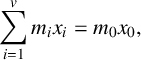
 $$ \begin{align} \sum_{i=1}^{v}m_i x_i =\sum_{j=1}^{u}n_j y_j \quad\text{with}~\sum_{i=1}^{v}m_i=\sum_{j=1}^{u}n_j,~m_i, n_j \in \mathbb{N}~\text{and}~u, v \geq 2, \end{align} $$
we are unable to establish a satisfactory definition of nontrivial zeros or provide bounds for
 $r_{\mathcal {D}}(N)$
in discrete settings, where
 $\mathcal {D}$
is a finite collection of functions taking the form (1.5). These directions will be explored in future work. In fact, the result of Keleti [Reference Keleti10] can be viewed as constructing a full-dimensional set that avoids nontrivial zeros to the equation
 $x_1+x_2=y_1+y_2$
.
This paper is organised as follows. In Section 2, we present some lemmas that will be used later. In Section 3, we present the proof of Theorem 1.4, and in Section 4, we prove Corollary 1.7.
2 Preliminaries
In this section, we introduce some lemmas that will be used later. The first lemma, in the discrete context, allows us to find a nontrivial zero with large gaps.
Lemma 2.1. Fix a finite subcollection
 $\mathcal {G} \subset \mathcal {F}$
, as given in (1.1), and let
 $k, m \in \mathbb {N}$
satisfy
 $A < m$
, where A is defined in (1.3). For every subset
 $\mathcal {A} \subseteq \{1, 2, \ldots , km\}$
with
 ${\#\mathcal {A} \geq k r_{\mathcal {G}}(m)+1}$
,
 $\mathcal {A}$
contains a nontrivial zero
 $\vec {x}$
of some
 $f \in \mathcal {G}$
with
 $\operatorname {diam}(\vec {x}) \geq k$
.
Proof. Partition
 $\{1, 2, \ldots , k m\}$
into k disjoint arithmetic progressions of cardinality m:
 $$ \begin{align*} T_j := \{ j + i k \mid 0 \leq i \leq m - 1 \}, \quad j = 1, \ldots, k. \end{align*} $$
By the pigeonhole principle and the hypothesis
 $\#\mathcal {A} \geq k r_{\mathcal {G}}(m)+1$
, there exists some
 $j \in \{1, \ldots , k\}$
such that
 $$ \begin{align*} \#(\mathcal{A}\cap T_{j})\geq r_{\mathcal{G}}(m)+1. \end{align*} $$
By the definition of
 $r_{\mathcal {G}}(m)$
, the set
 $\mathcal {A} \cap T_j$
contains a nontrivial zero of some
 $f \in \mathcal {G}$
. Since the elements of
 $T_j$
form an arithmetic progression with common difference k, any nontrivial zero
 $\vec {x}$
contained in
 $T_j$
satisfies
 $\operatorname {diam}(\vec {x}) \geq k$
.
Lemma 2.2. Given
 $a_i \in [0,1]$
for
 $1 \le i \le n$
satisfying
 $\sum _{i=1}^n a_i \leq 1-a$
with fixed
 ${a \in (0,1)}$
, let s be the unique solution of
 $\sum _{i=1}^n a_i^s = 1$
. Then
 $s_{\mathrm {\max }}$
, the maximum possible s, is achieved when
 $a_i = {(1-a)}/{n}$
for all i, and is given by
 $$ \begin{align*} s_{\mathrm{\max}} = \frac{\log n}{\log n - \log(1-a)}. \end{align*} $$
Proof. The value of s is defined as the solution to
 $\sum _{i=1}^n a_i^s = 1$
. Consider the compact domain
 $\mathcal {E} = \{ (a_1,\ldots ,a_n) \mid a_i \in [0,1], \, \sum _{i=1}^n a_i \leq 1-a \}$
. Since s depends continuously on the
 $a_i$
in
 $\mathcal {E}$
, the maximum
 $s_{\mathrm {\max }}$
exists by compactness.
First, we show that
 $s_{\max }$
must occur when
 $\sum _{i=1}^n a_i = 1-a$
. Otherwise, we can increase some
 $a_j$
to
 $a_j^{\prime }> a_j$
while maintaining
 $\sum a_i^{\prime } \leq 1-a$
. The new sum satisfies
 $\sum (a_{i}^{\prime })^s> \sum a_i^s = 1$
at the original s. As
 $\sum (a_j^{\prime })^t$
is continuous and strictly decreasing in t, the solution
 $s^{\prime }$
to
 $\sum (a_{i}^{\prime })^{s^{\prime }} = 1$
satisfies
 $s^{\prime }> s$
. Since s increases, the maximum requires
 $\sum a_i = 1-a$
.
Next, we show that for fixed k, s is maximised when all nonzero
 $a_i$
are equal. Suppose
 $a_i < a_j$
. Averaging
 $a_i, a_j$
to two equal values,
 ${(a_i + a_j)}/{2}$
, the strict concavity of
 $x^s$
gives
 $ a_i^s + a_j^s < 2 ( {(a_i + a_j)}/{2} )^s $
and so the new sum satisfies
 $\sum (a_j^{\prime })^{s}> \sum a_i^s = 1$
. Hence, the solution
 $s'$
to
 $\sum (a_j^{\prime })^{s'} = 1$
satisfies
 $s'> s$
.
Thus,
 $s_{\mathrm {\max }}$
occurs when all
 $a_i$
are equal and nonzero with
 $k = n$
. Setting
 ${a_i = {(1-a)}/{n}}$
, we solve
 $s_{\mathrm {\max }} = {\log n}/{(\log n - \log (1-a))}$
.
3 Proof of Theorem 1.4
Proof of the lower bound in part (1).
For any
 $\varepsilon \in (0, {1}/{2(A+1)}]$
, there exists
 $N \in \mathbb {N}$
such that
 $ \varepsilon _N < \varepsilon \leq \varepsilon _{N+1} $
, where
 $ \varepsilon _N := {1}/{2(A+1)N}$
. Define
 $ M := A \cdot N $
.
From the definition of
 $r_{\mathcal {G}}(N)$
, we first take
 $\mathcal {C}_N \subset \{0, \ldots , N-1\}$
, which contains no nontrivial zeros of any
 $ f \in \mathcal {G} $
and satisfies
 $ \#\mathcal {C}_N = r_{\mathcal {G}}(N) $
. Next, we construct a set
 $ E_N $
that
 $\varepsilon _N$
-avoids nontrivial zeros of any
 $ f \in \mathcal {G} $
, with
 $$ \begin{align} \dim_{\mathrm{H}} E_N = \frac{\log r_{\mathcal{G}}( \lfloor {1}/{2(A+1)\varepsilon} \rfloor )}{\log ( A \lfloor {1}/{2(A+1)\varepsilon} \rfloor )}. \end{align} $$
In fact,
 $ E_N $
is defined as the self-similar attractor of the iterated function system (IFS)
 $\{ f_j : j \in \mathcal {C}_N \}$
, where
 $$ \begin{align*} f_j(x) = \frac{1}{M} x + \frac{A j}{M}. \end{align*} $$
Since
 $f_j([0,1]) \subset [0,1]$
for all
 $j \in \mathcal {C}_N $
, the set
 $ E_N $
is given by
 $$ \begin{align*} E_N = \bigcap_{\ell=1}^{\infty} \bigcup_{i_1, \ldots, i_\ell \in \mathcal{C}_N} f_{i_1} \circ f_{i_2} \circ \cdots \circ f_{i_\ell} ([0,1]). \end{align*} $$
We call the intervals
 $ f_{i_1} \circ \cdots \circ f_{i_\ell } ([0,1])$
the level-
 $\ell $
construction intervals. It is obvious that the Hausdorff dimension of
 $E_N$
satisfies (3.1).
It suffices to show that
 $E_N \varepsilon _N$
-avoids nontrivial zeros of any
 $f \in \mathcal {G}$
. We proceed by contradiction. Suppose there exist points
 $\tilde {x}_0, \ldots , \tilde {x}_v$
in
 $E_N$
and a nontrivial zero
 $(x_0, \ldots , x_v)$
of some linear pattern
 $ f(x_0,\ldots ,x_v) = m_0 x_0 - \sum _{i=1}^v m_i x_i \in \mathcal {G} $
such that
 ${|\tilde {x}_i - x_i| < \lambda \varepsilon _N}$
for all
 $i \in \{0,1,\ldots ,v\}$
, where
 $\lambda $
is the diameter of
 $(x_0, \ldots , x_v)$
.
We identify the smallest construction interval I containing all points
 $\tilde {x}_0, \ldots , \tilde {x}_v$
. Let
 $\ell $
denote the level of I and
 $z_I$
its left endpoint. The length of I is
 $|I| = M^{-\ell }$
. For each
 $i \in \{0,1,\ldots ,v\}$
, we write
 $$ \begin{align} \tilde{x}_i = z_I + M^{-\ell} \bigg( \frac{A a_i}{M} + \delta_i \bigg), \end{align} $$
where
 $\delta _i \in [0, M^{-1}]$
and
 $a_i \in \mathcal {C}_N$
for all i. Note that not all
 $a_i$
are equal, since I is chosen to be minimal. Our goal is to show that
 $(a_0, \ldots , a_v)$
forms a nontrivial zero for some
 $f \in \mathcal {G}$
, which contradicts the definition of
 $\mathcal {C}_N$
. To this end, write
 $$ \begin{align} x_i = \tilde{x}_i + \lambda \varepsilon_{x_i}, \end{align} $$
where
 $|\varepsilon _{x_i}| < \varepsilon _N$
for each i. Since
 $$ \begin{align*} \lambda = \max_{i,j} |x_i - x_j| \leq \max_{i,j} |\tilde{x}_i - \tilde{x}_j| + 2\lambda \varepsilon_N \leq |I| + 2\lambda \varepsilon_N = M^{-\ell} + 2\lambda \varepsilon_N, \end{align*} $$
rearranging gives
 $\lambda (1 - 2\varepsilon _N) \leq M^{-\ell }$
, so
 $$ \begin{align} \lambda M^{\ell} \leq \frac{1}{1 - 2\varepsilon_N}. \end{align} $$
However, since
 $$ \begin{align} m_0 x_0=\sum_{i=1}^{v} m_i x_i, \end{align} $$
substituting (3.2), (3.3) and (3.4) into (3.5) gives
 $$ \begin{align*} m_0 \left( \tilde{x}_{0} + \lambda \varepsilon_{x_0} \right)=\sum_{i=1}^{v} m_i (\tilde{x}_{i}+\lambda \varepsilon _{x_i} ) \end{align*} $$
and
 $$ \begin{align*} m_0 \bigg( z_I + M^{-l}\bigg( \frac{A a_{0}} {M} + \delta_{0}\bigg) + \lambda \varepsilon_{x_{0}}\bigg)=\sum_{i=1}^{v} m_{i}\bigg( z_{I}+M^{-l}\bigg( \frac{A a_i}{M}+ \delta_{i}\bigg)+\lambda \varepsilon_{x_i} \bigg). \end{align*} $$
Further,
 $$ \begin{align*} A\bigg(m_0 a_0 - \sum_{i=1}^{v} m_i a_i\bigg) = \lambda M^{l+1}\bigg( \sum_{i=1}^{v} m_{i} \varepsilon_{x_i} - m_0 \varepsilon _{x_0}\bigg)+M\bigg( \sum_{i=1}^{v} m_i \delta_{i} - m_{0} \delta_{0}\bigg) \end{align*} $$
and
 $$ \begin{align*} \frac{A}{M}\bigg(m_0 a_{0}-\sum_{i=1}^{v} m_{i} a_{i}\bigg) = \lambda M^l \bigg( \sum_{i=1}^{v} m_i \varepsilon_{x_i}-m_0 \varepsilon_{x_0} \bigg) + \bigg( \sum_{i=1}^{v} m_i \delta _i- m_0 \delta _{0} \bigg). \end{align*} $$
Note that the left-hand side of the last equality belongs to
 $({A}/{M}) \mathbb {Z}$
, while the right-hand side is less than
 ${A \varepsilon _N}/{(1-2 \varepsilon _N)}+{A}/{2M} <{A}/{M}$
. As a result, the left-hand side must vanish. Since not all the
 $a_{i}$
are equal, we conclude that the
 $a_{i}$
form a nontrivial zero of
 $f \in \mathcal {G}$
, which contradicts the definition of
 $\mathcal {C}_{N}$
. This completes the proof.
Proof of the upper bound in part (2).
For any
 $\varepsilon \le {1}/{A}$
, we can find
 $m \in \mathbb {N}$
such that
 ${1}/{m}<\varepsilon \le {1}{(m-1)}$
. Let
 $E\subseteq [ 0,1 ]$
be a set that
 $\varepsilon $
-avoids nontrivial zeros of any
 $f\in \mathcal {G}$
. We can obtain an upper bound for the Minkowski dimension of E. For this purpose, we split the interval
 $[0,1]$
into
 $m^{2}$
-adic intervals and count the number of subintervals at the next level that intersect E.
According to Lemma 2.1, for every j and each
 $m^{2}$
-adic interval I of length
 $m^{-2j}$
, the number of
 $m^{2}$
-adic intervals of length
 $m^{-2(j+1)}$
that intersect E is less than
 ${mr_{\mathcal {G}}(m)+1}$
. Suppose, for a contradiction, that there exists an interval I where this claim fails. Define Y as the set of left endpoints of the
 $m^{-2(j+1)}$
-subintervals of I that intersect E. Then, Y can be identified with a subset
 $\mathcal {A} \subseteq \{ 1,\ldots ,N\}$
. By Lemma 2.1 with
 $k=m$
, we see that
 $\mathcal {A}$
contains a nontrivial zero of some
 $f \in \mathcal {G}$
with diameter greater than m. Thus, the set Y also contains a nontrivial zero
 $\vec {x}=(x_{0},\ldots ,x_{v})$
of the function
 $f \in \mathcal {G}$
, with
 $\text {diam}(\vec {x})\ge {m}/{N^{j+1}}$
, where
 $v\in \mathbb {N}$
depends on f. Moreover,
 $$ \begin{align*} \max_{0\leq i \leq v}\inf_{y\in E}|y-x_{i}| \leq N^{-(j+1)}=\frac{1}{m}\cdot \frac{m}{N^{(j+1)}}< \varepsilon \cdot \text{diam}(\vec{x}), \end{align*} $$
which contradicts the assumption that
 $E\ \varepsilon $
-avoids nontrivial zeros of any
 $f \in \mathcal {G}$
.
Therefore, we obtain the desired upper bound
 $$ \begin{align*} {\dim_H} E \leq \underline{\dim}_{\mathrm{{B}}}E \leq \overline{\dim}_{\mathrm{{B}}}E \leq \frac{\log (mr_{\mathcal{G}}(m)+1)}{\log m^{2}}\leq \frac{\log(\lfloor {1}/{\varepsilon }+1\rfloor r_{\mathcal{G}}( \lfloor {1}/{\varepsilon }+1\rfloor)+1)}{2\log\lfloor {1}/{\varepsilon }+1\rfloor }. \end{align*} $$
Proof of the upper bound in part (3).
Let
 $\mathcal {G}$
be a finite collection of
 $\mathcal {F}$
and let
 $\varepsilon <{1}/{2}$
. Denote
 $\varepsilon '={1}/{\lceil {1}/{2\varepsilon } \rceil }$
. Assume that E is a bounded set that
 $\varepsilon $
-avoids nontrivial zeros of any
 $ f \in \mathcal {G} $
. We aim to find an upper bound for the Assouad dimension of
 $ E $
. By the definition of Assouad dimension,
 $$ \begin{align*} \dim_{\mathrm{{A}}} E := \inf \bigg\{ \alpha \geq 0 \mid \exists C> 0, \forall 0 < r < R, \sup_{x \in E} N_r(B(x,R) \cap E) \le C \bigg( \frac{R}{r} \bigg)^\alpha \bigg\}. \end{align*} $$
We need to estimate the cardinality of minimal r-covers of
 $B(x,R) \cap E$
for any
 $x \in E$
and scales
 $0 < r < R$
.
Fix
 $x \in E$
and
 $0 < r < R$
. Assuming that
 $r < {\varepsilon ' R}/{A}$
, we consider the interval
 $B_x(R) = [x - R, x + R)$
and express it as the following union:
 $$ \begin{align*} [x - R, x + R) = \bigcup_{0 \le i \le {A}/{\varepsilon'} - 1} I_i \quad \text{where } I_i = \bigg[0, \frac{2R\varepsilon'}{A}\bigg) + i \cdot \frac{2R\varepsilon'}{A} + x - R. \end{align*} $$
We partition the set of indices
 $\mathcal {I} = \{ 0, 1, \ldots , {A}/{\varepsilon '} - 1 \}$
into the subsets
 $$ \begin{align*} \mathcal{I}_j = \bigg\{ i \in \mathcal{I} : i \equiv j \bmod \frac{1}{\varepsilon'} \bigg\} \quad \text{for } j \in \bigg\{ 0, 1, \ldots, \frac{1}{\varepsilon'} - 1 \bigg\}. \end{align*} $$
Each
 $\mathcal {I}_j$
contains A indices and the midpoints of the intervals labelled in the same partition form a scaled and translated copy of
 $\{0,1,\ldots ,A-1\}$
with a gap of
 ${2R}/{A}$
. Thus,
 $$ \begin{align*} \frac{R}{A} \varepsilon' \leq \frac{2R}{A} \cdot \varepsilon < \lambda \varepsilon. \end{align*} $$
Since
 $ E\ \varepsilon $
-avoids nontrivial zeros of all
 $ f \in \mathcal {G} $
, at least
 $ A - r_{\mathcal {G}}(A) $
of the intervals indexed by elements of
 $ \mathcal {I}_{j} $
do not intersect
 $ E $
. Now, consider the original interval
 $ B_x(R) $
. It can be represented as a collection of pairwise disjoint intervals, which correspond to the connected components of
 $ B_x(R) $
after removing the nonintersecting intervals. If the nonintersecting intervals lie adjacent to each other, the number of resulting connected intervals could be as low as one. However, the total number of connected intervals cannot exceed
 $$ \begin{align} \begin{cases} (A-r_{\mathcal{G}}(A))\cdot {1}/{\varepsilon'}+1 & \text{if}~r_{\mathcal{G}}(A)>{A}/{2}, \\ r_{\mathcal{G}}(A)\cdot {1}/{\varepsilon'} & \text{if}~r_{\mathcal{G}}(A)\leq {A}/{2}. \end{cases} \end{align} $$
We proceed iteratively, repeating the process within each disjoint interval (intersecting E) formed at the previous stage. If an interval has length no greater than
 $ r$
, stop the iteration for that interval. Thus, the procedure terminates after finitely many steps. The remaining intervals form an r-cover of
 $B_x(R) \cap E$
. Consequently, bounding their number gives an upper bound for
 $\dim _{\mathrm {A}} E$
. This number depends on the arrangement of the nonintersecting intervals at each stage. Therefore, it is equivalent to the following more general problem.
Suppose we are given an interval J and a finite collection of pairwise disjoint subintervals
 $\{J_i\}$
satisfying
 $$ \begin{align*} \sum_{i} |J_i| \leq |J| \bigg(1 - \frac{A - r_{\mathcal{G}}(A)}{A}\bigg) = |J| \frac{r_{\mathcal{G}}(A)}{A}, \end{align*} $$
where the maximum number of disjoint subintervals
 $J_i$
is bounded by (3.6). Let
 ${s \in [0,1]}$
be the unique solution to
 $$ \begin{align*} \sum_{i} \bigg( \frac{|J_i|}{|J|} \bigg)^s = 1, \end{align*} $$
and define weights
 $p_i = ( {|J_i|}/{|J|} )^s$
. Let
 $s_{\mathrm {\max }}$
denote the maximum possible value of s. According to Lemma 2.2,
 $$ \begin{align*} \begin{cases} s_{\mathrm{\max}}=\dfrac{\log([ A-r_{\mathcal{G}}(A)]\cdot {1}/{\varepsilon'}+1 )} { \log ([ A-r_{\mathcal{G}}(A)]\cdot {1}/{\varepsilon'} +1)-\log {r_{\mathcal{G}}(A)}/{A}} & \text{if} \ r_{\mathcal{G}}(A)>{A}/{2}, \\ s_{\mathrm{\max}}=\dfrac{\log r_{\mathcal G}(A) \cdot {1}/{\varepsilon'}} {\log A \cdot{1}/{\varepsilon'}-\log {r_{\mathcal{G}}(A)}/{A}} & \text{if} \ r_{\mathcal{G}}(A) \leq {A}/{2}. \end{cases} \end{align*} $$
Suppose
 $\mu $
is a probability measure uniformly distributed on
 $J = B_x(R)$
, which is subdivided across the intervals
 $J_i$
formed during the iterative construction according to the weights
 $p_i$
. Define a chain of intervals
 $$ \begin{align*} I = J_{i_n} \subseteq J_{i_{n-1}} \subseteq \cdots \subseteq J_{i_1} \subseteq J = B_x(R), \end{align*} $$
where
 $J_{i_l}$
is the interval containing I at the lth stage of the iterative procedure. Then,
 $$ \begin{align*} \frac{\varepsilon' r}{A} \leq |I| < r. \end{align*} $$
Denote the weight associated with
 $J_{i_l}$
by
 $p_{i_l}$
and let N be the total number of such intervals I. Then,
 $$ \begin{align*} \mu(I) = p_{i_1} p_{i_2} \cdots p_{i_n} &\geq \bigg( \frac{|J_{i_1}|}{|J|} \bigg)^{s_{\mathrm{\max}}} \bigg( \frac{|J_{i_2}|}{|J_{i_1}|} \bigg)^{s_{\mathrm{\max}}} \cdots \bigg( \frac{|J_{i_n}|}{|J_{i_{n-1}}|} \bigg)^{s_{\mathrm{\max}}} = \bigg( \frac{|J_{i_n}|}{|J|} \bigg)^{s_{\mathrm{\max}}} = \bigg( \frac{|I|}{2R} \bigg)^{s_{\mathrm{\max}}} \\ &\geq \bigg( \frac{\varepsilon'}{2A} \bigg)^{s_{\mathrm{\max}}} \bigg( \frac{r}{R} \bigg)^{s_{\mathrm{\max}}}. \end{align*} $$
Since
 $\mu (B_x(R)) = 1$
,
 $$ \begin{align*} 1 = \mu(B_x(R)) \geq \bigg( \frac{\varepsilon'}{2A} \bigg)^{s_{\mathrm{\max}}} \bigg( \frac{r}{R} \bigg)^{s_{\mathrm{\max}}} N, \end{align*} $$
that is,
 $$ \begin{align*} N \leq \bigg( \frac{2A}{\varepsilon'} \bigg)^{s_{\mathrm{\max}}} \bigg( \frac{R}{r} \bigg)^{s_{\mathrm{\max}}}. \end{align*} $$
Thus, we conclude that
 ${\dim _H} E \leq \dim _{\mathrm {A}} E \leq s_{\mathrm {\max }}$
.
4 Proof of Corollary 1.7
In this section, we prove Corollary 1.7 by employing the same approach used in the proof of Theorem 1.4(1).
Proof. For any
 $\varepsilon> 0$
, there exists
 $N \in \mathbb {N}$
such that
 $$ \begin{align*} \frac{1}{4(A+1)(N+1)^{3/2}} < \varepsilon \leq \frac{1}{4(A+1)N^{3/2}}. \end{align*} $$
Denote
 $\varepsilon _N = {1}/{2(A+1)N}$
. Our goal is to construct a set
 $E \subset [0,1]$
that
 $\varepsilon $
-avoids nontrivial zeros of all
 $h \in \mathcal {H}$
.
As proved in Section 3, proof of the lower bound in part (1), we can construct a subset
 $F_N \subset E_N$
that
 $\varepsilon _N$
-avoids nontrivial zeros of all
 $f \in \mathcal {G}$
, where
 $\mathcal {G}\sim \mathcal {H}$
. Here,
 $ F_N $
is defined as the self-similar attractor of the IFS
 $\{ f_j : j \in \mathcal {C}_N \setminus \{0\} \}$
. Then, it is clear that
 $$ \begin{align*} {\dim_H} F_N \geq \frac{\log r_{ \mathcal{G}} (\lfloor ( {1}/{4(A+1)\varepsilon})^{{2}/{3}} \rfloor -1 )}{\log A \lfloor ( {1}/{4(A+1)\varepsilon})^{{2}/{3}}\rfloor }. \end{align*} $$
Define the square root set
 $$ \begin{align*} E = \{ x^{1/2} : x \in F_N \}. \end{align*} $$
Since the map
 $x \mapsto x^{1/2}$
is bi-Lipschitz on
 $[\alpha , 1]$
when
 $\alpha>0$
, we have
 $$ \begin{align*} {\dim_H} E={\dim_H} F_N \geq \frac{\log r_{ \mathcal{G}} (\lfloor ( {1}/{4(A+1)\varepsilon})^{{2}/{3}} \rfloor -1 )}{\log A \lfloor ( {1}/{4(A+1)\varepsilon})^{{2}/{3}}\rfloor }. \end{align*} $$
We now proceed to prove that
 $E\ \varepsilon $
-avoids nontrivial zeros of all
 $h \in \mathcal {H}$
. Suppose there exist
 $\tilde {x}_0, \ldots , \tilde {x}_v$
in E and a nontrivial zero
 $x_0, \ldots , x_v$
of some
 $h_f \in \mathcal {H}$
, where
 $ f \in \mathcal {G} $
, such that
 $$ \begin{align*} |x_i - \tilde{x}_i| < \lambda \varepsilon \quad \mbox{for all } i \in \{0, 1, \ldots, v\}, \end{align*} $$
where
 $\lambda $
is the diameter of
 $\{x_0, \ldots , x_v\}$
. Since
 $\tilde {x}_0, \ldots , \tilde {x}_v$
belong to
 $[0,1]$
and
 $\varepsilon $
is small, we may assume
 $\lambda \leq 2 $
. Note that if
 $x_0, x_1, \ldots , x_v$
is a nontrivial zero of some
 $h_f \in \mathcal {H}$
, then
 $$ \begin{align*} y_0 = x_0^2,\quad y_1 = x_1^2,\quad \ldots,\quad y_v = x_v^2 \end{align*} $$
is a nontrivial zero of
 $f\in \mathcal {G}$
. Since
 $\tilde {x}_0, \tilde {x}_1, \ldots , \tilde {x}_v \in E$
, we have
 $$ \begin{align*} \tilde{y}_0 = \tilde{x}_0^2,\quad \tilde{y}_1 = \tilde{x}_1^2,\quad \ldots,\quad \tilde{y}_v = \tilde{x}_v^2 \in F_N. \end{align*} $$
Further,
 $$ \begin{align} \lambda' = \max_{0 \leq i,j \leq v} |y_i - y_j| = \max_{0 \leq i,j \leq v} \bigl( |x_i - x_j| \cdot |x_i + x_j| \bigr)> \lambda \bigg( \frac{2}{\sqrt{N}} - 2\lambda \varepsilon \bigg), \end{align} $$
and for every
 $i \in \{0, 1, \ldots , v\}$
,
 $$ \begin{align} |\tilde{y}_i - y_i| = |\tilde{x}_i^2 - x_i^2| = |\tilde{x}_i - x_i| \cdot |\tilde{x}_i + x_i| < \lambda \varepsilon (2 + \lambda \varepsilon). \end{align} $$
Combining (4.1), (4.2) and using
 $\varepsilon _N = {1}/{2(A+1)N}$
,
 $\lambda \leq 2$
, we obtain
 $$ \begin{align*} |\tilde{y}_i - y_i| < \lambda \varepsilon (2 + \lambda \varepsilon) \leq \lambda' \varepsilon_N \quad \text{for all } i \in \{0, 1, \ldots, v\}. \end{align*} $$
This implies that there exist
 $\tilde {y}_0, \ldots , \tilde {y}_v \in F_N $
and a nontrivial zero
 $( y_0, \ldots , y_v) $
of
 $f \in \mathcal {G}$
with
 $|y_i - \tilde {y}_i| < \lambda ' \varepsilon _N$
for all i, contradicting the
 $\varepsilon _N$
-avoidance property of
 $F_N$
.
Acknowledgement
The authors are grateful to the anonymous reviewers for their valuable comments and suggestions, which have significantly improved the quality of this manuscript.



