Current data clearly indicate an increase in the number of major disaster declarations for hurricanes and tropical storms in the United States in recent years. 1 This increase signals a need throughout the nation for many communities to be prepared to shelter large hurricane evacuee populations, as profoundly illustrated by the Hurricane Katrina experience in 2005.
Hurricane Katrina displaced a large urban population from the disaster-ravaged areas.Reference North, King and Fowler 2 , Reference Greenough and Kirsch 3 The most economically disadvantaged and vulnerable groups with the fewest resources were among those evacuated by public transportation after they had endured the storm. Such populations are likely to have an overrepresentation of preexisting chronic medical and psychiatric problems,Reference North, King and Fowler 2 , Reference Greenough and Kirsch 3 including serious and persistent mental illness, such as schizophrenia and drug and alcohol dependence.Reference North, King and Fowler 2 The data collected by our group from the Hurricane Katrina shelter experience in DallasReference North, King and Fowler 2 showed that the evacuees had varying levels of trauma exposure from the disaster, depending on whether they had evacuated before or after landfall of the hurricane. The group that evacuated before landfall, that is, people who had the resources to evacuate and did so, was not exposed to physical danger in the storm but experienced disaster-related stressors from displacement, property loss, and bereavement. The group that did not evacuate before the storm, including many without resources to evacuate without assistance, was trauma-exposed in addition to experiencing other disaster-related stressors encountered by both groups of evacuees. Thus, the most disadvantaged and vulnerable part of the population that had disproportionate preexisting medical and psychiatric conditions also had the most prevalent and severe trauma exposure. These findings point to the need to anticipate the amount of resources for crisis counseling as well as for care of chronic psychiatric illness and substance abuse problems according to different needs of the exposure groups.
The Dallas metropolitan area received and sheltered tens of thousands of evacuees altogether from Hurricanes Katrina and Rita in 2005 and Gustav and Ike in 2008. To address the emergent health care needs of these evacuees, volunteers, public health workers, and other personnel from local governmental and nongovernmental organizations were stationed in a large evacuation shelter set up at the Dallas Convention Center by the City’s Office of Emergency Management. A medical clinic was assembled at this shelter for the first time for Hurricane Katrina evacuees. The many patients presenting to the medical clinic with acute psychiatric problems soon made it apparent that a mental health clinic was also needed. This clinic was quickly implemented, and its necessity was confirmed by the large number of patients it served over the next 2 weeks. Additional crisis counseling services were made available throughout the shelter. In the Hurricane Katrina shelter, health care services were provided for more than 10,000 patient visits over 2 weeks, averting potential surges of these patients overburdening the local acute medical care system.Reference Eastman, Rinnert and Nemeth 4 Subsequent Hurricanes Rita, Gustav, and Ike brought new opportunities for the disaster response leadership to apply the lessons learned from prior operations to improve the provision of these services for disaster evacuees. The processes and procedures that were followed in the hurricane evacuee shelters were documented. From this documentation, and with input from key stakeholders, a set of operating guidelines for future provision of mental health services in large disaster shelters in Dallas was developed.
This article summarizes in general terms these guidelines, which describe the processes and procedures as they have evolved throughout their repeated use in Dallas to provide mental health care in large hurricane evacuee shelters. An accompanying online supplement provides additional detail.
ORGANIZATION AND PROVISION OF MENTAL HEALTH SERVICES IN A DISASTER EVACUEE SHELTER
Certain goals for providing shelter mental health services are likely to be consistent across most disasters; however, depending on a given disaster situation in a particular community, the specific objectives may vary. Two general goals for implementing a large emergency shelter mental health response are to
-
1) provide mental health care for disaster evacuees with immediate needs during the shelter operation; and
-
2) protect local emergency care systems from being overburdened by large numbers of evacuees with emergent psychiatric crises presenting for care.
Specific objectives for provision of shelter mental health care are to
-
1) stabilize preexisting or new postdisaster psychiatric conditions;
-
2) manage acute mental health problems in the short term, either until they resolve or until ongoing formal mental health care can be arranged;
-
3) start new psychotropic medications, or continue or restart established psychotropic medications, for preexisting or new postdisaster psychiatric conditions;
-
4) provide symptom relief and emotional comfort for distress related to disaster experience and displacement;
-
5) triage patients with specific psychiatric needs to outside sources of care (e.g., transport patients with critical psychiatric needs to hospital emergency care or patients needing specific psychiatric services to specialized care such as methadone maintenance programs); and
-
6) conduct surveillance of the shelter population, identify mental health needs, and connect individuals with appropriate sources of care.
A well-established disaster mental health response framework exists whose main components are case identification, triage/referral, and provision of care.Reference North and Pfefferbaum 5 Case identification may begin with screening by a crisis counselor or other mental health professional in the shelter and may include diagnostic assessment by a psychiatric care provider. Triage and referral in a shelter setting may be from crisis counselors or other mental health professionals to a shelter psychiatric clinic or from a shelter psychiatric clinic to resources outside the shelter such as hospitals. Provision of care may be limited as in psychological first aid provided by shelter staff or more comprehensive as conducted in a psychiatric clinic. Psychiatric illness requires professional psychiatric care for evaluation and management, whereas psychological distress and psychosocial needs can be managed by other types of mental health interventions such as psychological first aid, crisis counseling, and social services. The main work of crisis counselors and other mental health professionals is to provide symptom relief and emotional comfort for distress related to disaster experience and displacement and to identify individuals with needs for psychiatric evaluation and care and connect them with appropriate care. Psychiatric care providers address emergent psychiatric problems through focused psychiatric assessment, stabilization of psychopathology, and referral to sources of more extensive care. The structure and function of disaster evacuee shelter mental health services presented in this article are aligned with the basic elements of this framework in addition to being modeled on the processes and procedures that have been agreed upon for use in Dallas.
Figure 1 shows a suggested organizational plan for mental health care that fits within broader health care services and an incident command structure in a shelter. The chief of health care services interfaces with the local public health system for surveillance, prevention, and management of disease outbreaks in the shelter in coordination with local disaster management entities for coordination of supplies and personnel and with local, regional, and state disaster response officials. The shelter health care services function is divided into 2 branches: (1) the medical branch and (2) the mental health branch, each with its own director. These 2 directors coordinate care and the 2 branches share resources for general pharmacy services and emergency medical services (EMS).
Incident Command Structure for a Disaster Shelter Mental Health Operation. Abbreviations: ASD, autism spectrum disorder; EMS, emergency medical services; IDD, intellectual developmental disorder; MH, mental health.

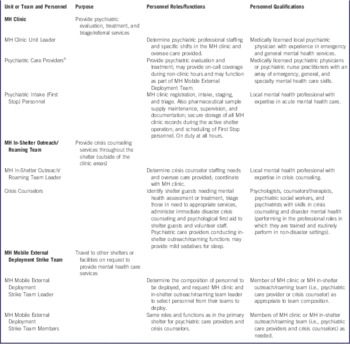
The units or teams of the mental health branch are listed in Table 1 along with their purpose and their key personnel roles, functions, and qualifications. The mental health clinic and the mental health in-shelter outreach/roaming team are units that function within the shelter, whereas the mental health mobile external deployment team is a strike team assembled only as needed for services provided to other locations outside the shelter. The director of the mental health branch is responsible for coordinating all functions of the units and teams, especially regarding the flow of evacuees through various mental health services.
Units and Teams of the Mental Health Branch and Key PersonnelFootnote a

a Abbreviations: MH, mental health.
b The psychiatric care providers in the MH Clinic are organized into two tiers. The first tier consists of public/emergency psychiatric professionals with crisis psychiatry expertise and demonstrated ability to work in crisis and emergency psychiatry settings, as determined by the MH Clinic Unit Leader. The second tier includes other psychiatric professionals, such as those in private or public office-based practices. Second-tier psychiatric professionals are assigned if additional psychiatric professionals are needed (e.g., when the disaster is massive or longstanding and the first tier is overwhelmed, exhausted, or otherwise unavailable for assignment). Second-tier psychiatric professionals are paired with first-tier psychiatric professionals on MH Clinic shifts. Psychiatric providers who are not assigned to work in the MH Clinic might be assigned to work with the MH In-Shelter Outreach/Roaming Team. Additional expertise of child psychiatric professionals may be needed, which could potentially be met with on-call child psychiatric consultants.
The mental health branch also has available to it various ancillary mental health support services: transportation services (e.g., patient transportation to outside services, pharmacy runners), intellectual developmental disorder/autism spectrum disorder mental health and pharmacy services, mental health benefits enrollment, and opiate maintenance services. Any other services deemed necessary can be added to the mental health support services on an ad hoc basis.
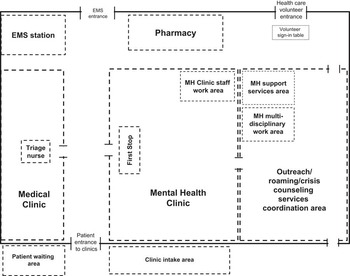
A substantial area is needed for the provision of health care for hurricane evacuee populations. In the Dallas Convention Center shelter, an area of approximately 8200 square feet was designated for shelter health care services. This area was separated from evacuee sleeping, eating, and recreation space, with controlled entry and curtains dividing clinical areas from one another. A medical clinic was assembled within this area and a mental health clinic was situated adjacent to it, with pharmacy and EMS areas placed nearby. Figure 2 depicts a sample layout of the health care services clinical area with specific detail of the mental health service areas. Outside the clinical areas were a general patient intake/registration desk and a waiting area. Evacuees authorized to enter the clinical area proceeded either to the triage nurse for the medical clinic or the intake (“First Stop”) desk for the mental health clinic. Evacuees needing mental health care could also be directed to the mental health clinic by the medical clinic triage nurse or physicians or referred by a crisis counselor in the shelter. The mental health clinic contained examination “rooms” cordoned off by curtains for psychiatric evaluation and treatment and a work station area for psychiatric care providers. The mental health clinic examination rooms contained folding chairs for patients, accompanying family members, and the psychiatric care provider. The mental health clinic work areas were equipped with a long table to accommodate laptops and paperwork, folding chairs, electrical power, internet access, and telephone service. Adjacent to the mental health clinic was a large outreach/roaming/crisis counseling coordination area that served as a home base for coordination of multidisciplinary mental health professional services provided throughout the shelter by the mental health in-shelter outreach/roaming team. Security personnel were readily accessible at the clinic entrances and surrounding areas, providing a safe environment for clientele and staff.
Sample Layout for a Disaster Shelter Mental Health Services Area. Abbreviations: EMS, emergency medical services; MH, mental health.

During the 2 weeks that the Hurricane Katrina shelter in Dallas operated, the mental health clinic had more than 500 separate patient encounters, including nearly 100 on the second day alone, assisted by more than 150 psychiatric care provider volunteers. Consistent with the known types of psychiatric problems encountered in economically disadvantaged populations,Reference Greenough and Kirsch 3 the majority of mental health clinic patient contacts were for care of preexisting severe and persistent mental illness, ongoing substance use disorders, and acute anxiety and insomnia related to disaster and displacement.Reference North, King and Fowler 2 Addressing these specific needs required psychiatric expertise in emergency psychiatry and severe and persistent mental illness including substance use disorders. Opiate-dependent patients already enrolled in opioid maintenance treatment at the time of the storm presented with a need for continuation of these services to prevent withdrawal. Because nearly 10% of the patients were children or adolescents, child psychiatry expertise was needed. Shelter crisis counseling services outside the mental health clinic were provided by a team of other mental health professionals to an estimated 500 evacuees.
In this design for disaster shelter mental health care, patients presenting to the mental health clinic first met with personnel at the intake/registration area (First Stop), who obtained a brief history of the patient’s presenting problem and completed the informed consent and information privacy processes for psychiatric treatment, as appropriate. At this point, patients needing psychiatric evaluation and care were triaged to a psychiatric care provider in the mental health clinic. Patients deemed to need only nonpsychiatric services could alternatively be referred to another service (e.g., mental health support service or crisis counselor).
A psychiatric care provider was continuously available at all hours either in the shelter (during high-volume periods) or on call (outside of high-volume periods). When the mental health clinic was closed, First Stop maintained essential operations at all hours with on-call psychiatric coverage. Federal guidelines for provision of functional needs support services in general population shelters 6 require a minimum ratio of mental health staff to shelter occupants of 1:100 with at least two staff present 24/7 and one psychiatrist on call to the shelter 24/7.
The psychiatric provider’s evaluation consisted of an abbreviated standard psychiatric examination. The elements of this evaluation were as follows: presenting problem/chief concern, current psychiatric problems, disaster-related exposures/stressors, past psychiatric (including relevant substance use) history, medical history, a mental status examination, psychiatric assessment and plan (including medications prescribed and dispensed), and disposition with a plan for discharge or referral to hospital or other facilities.
Most often, patients who had run out of medication for preexisting conditions such as mood, anxiety, or psychotic disorders or who did not bring their medication with them presented for refill of their psychotropic medication or to restart established medication.Reference North, King and Fowler 2 A general principle of disaster psychiatric care is to attempt to resume the medication regimen the patient was prescribed before the disaster, presuming the patient was stable on it and the specific medication is available (otherwise, equivalent substitution is needed). Stabilization of psychiatric disorders may also be needed, particularly in patients with new or recurrent disorders not receiving treatment in recent days or weeks. Other patients may simply need mild sedation or therapeutic support to help them with sleep or anxiety problems over the short term, especially while they are residing in the shelter.
Psychiatric care providers may dispense over-the-counter medications or pharmaceutical samples (if available) or write prescriptions for appropriate medications for the anticipated amount of time needed to allow the patient to establish a source of formal mental health care. Arrangements can be made with local pharmacies to provide on-site pharmacy services. In the mental health clinic, the psychiatric care providers wrote prescriptions for 2 to 3 days of medications to be filled by pharmacy services or for larger supplies (generally no more than 30 days) to be filled by an outside pharmacy. Psychotropic medication samples were secured in a locked cabinet in the mental health clinic for direct psychiatric provider dispensing by use of handwritten labels applied to ziplock baggies. Typical psychotropic medications selected to be dispensed as samples are as follows: quetiapine 100 mg, risperidone 1 mg, trazodone 50 mg, lorazepam 1 mg, and clonazepam 1 mg. A log was maintained of the drugs stored in and dispensed from the sample cabinet. Both the medication log and the cabinet were maintained by First Stop.
Caution is needed for prescription of abusable medications, especially alprazolam. Patients may present for refills of large standing dosage regimens of alprazolam that have been prescribed to them by their local physicians, resulting in urgent need for refills to avoid medically serious withdrawal. It is generally desirable to continue the prescribed medications the patient requests to be refilled (as long as the patient is not deemed to be diverting medications), even if the clinic’s psychiatric care provider does not consider these medications to represent an optimal long-term care plan for the patient. Regardless, in a large disaster evacuee shelter setting, alprazolam and other abusable medications are easily diverted and word of their availability can spread quickly, resulting in surges of patients presenting to the clinic requesting abusable medications. Some of these patients may require referral to a community source of detoxification services. Because of safety and logistical issues related to managing opioid maintenance medications in the disaster shelter, it is advisable to transport the patients to facilities that specialize in opioid maintenance treatment rather than provide this service in the shelter.
Certain psychotropic medications (especially newer agents or formulations) can be prohibitively expensive in this setting. For patients without insurance (typically, patients from outside the geographical area), a payor is needed for provision of long-term regimens of prohibitively expensive medications. If no payor is available, alternative equivalent conversions can be made to other medications for the same psychiatric indication. 7
Referrals to outside services may be needed at any point in the mental health service provision, such as emergency referrals to local acute psychiatric or medical facilities. In the mental health clinic, referrals to local outpatient or inpatient substance detoxification services were made to preselected outside agencies. Patients were transported by ambulance or by transportation service, as appropriate, to these agencies to receive their services.
Appropriate medical records of all patient contacts were kept by each mental health unit or team. During active shelter health care operations, all mental health clinical records were securely maintained in a central shelter storage site under the direction of First Stop. After completing the informed consent and information privacy processes, First Stop staff completed a 1-page rapid mental health assessment form. For patients then triaged to the mental health clinic, the psychiatric care provider documented a 1-page psychiatric assessment on the psychiatric assessment form (on the back side of the rapid mental health assessment form). Crisis counselors interacting with shelter guests outside the mental health clinic carried a shelter mental health contacts log sheet to record basic contact information for each clinical encounter. During the shelter mental health services operation, all records related to clinical encounters of all mental health providers recorded on the specified documentation forms were turned in daily to First Stop for on-site storage by First Stop staff. These records were also used for tabulation of recorded contacts by the mental health branch director to update the numbers served by each unit and the total numbers served by the mental health branch to date. At the time of final closure of shelter operations, all clinical records were transported under the direction of the mental health branch director for long-term storage with the local health authority, where they could be utilized for subsequent analysis to inform planning and future response efforts.
The leaders of the disaster shelter response in Dallas met with community stakeholders and wrote guidelines for the delivery of mental health services in a large disaster evacuee shelter, drawing upon the documentation of their prior experience in sheltering evacuee populations from recent hurricanes. A more generic version was then developed to facilitate the potential use of these guidelines by other communities who might be planning for mental health service provision in large disaster evacuee shelters. This article summarizes the material in this document; the full document is available in an online supplement, “Planning for Mental Health Care in Disaster Shelters.” This supplement contains an appendix with examples of clinical forms, templates, and checklists for mental health service provision, such as mental health volunteer job action sheets, shelter mental health clinic supplies lists, shelter mental health care documentation forms, and volunteer documents (notification templates, volunteer instructions, volunteer liability). Reimbursement documentation forms are not provided, because these must be assembled locally according to requirements for individual state and local jurisdictions. The online supplement also includes guidance for additional important planning elements of disaster preparedness and responses pertaining to setting up a disaster shelter, demobilization at the completion of the operation, reimbursement for services provided, and preparedness and planning for future disaster incidents.
DISCUSSION
Hurricane Katrina was the first case of the need for a community to receive a large evacuee population after a major disaster and provide health care services for them in disaster shelters. 8 , Reference BBC 9 In Dallas, mental health services proved to be an essential component of the health care services provided after hurricanes. Communities across the nation have the potential to receive and shelter large evacuee populations and thus need to be prepared to provide care for emerging mental health needs for these populations in these settings. The Dallas community’s experience in providing mental health care efficiently for large numbers of hurricane evacuees at a large disaster evacuee shelter led to development and refinement of an operational guideline with policies and procedures used in the Dallas operation. A generic version of the processes used in Dallas, provided as an online supplement to this article, may be adapted by other communities in planning for mental health service provision in large disaster evacuee shelters.
This plan for disaster shelter mental health services has several strengths. It is informed by the National Incident Management System developed by the Federal Emergency Management Agency, with specified units, personnel, and functions. It also provides detailed information on how to prepare for and deliver mental health services in a large shelter with a complete collection of lists, forms, and templates used in actual disaster health care operations, and a sample floor plan. A limitation of this plan is that it is based on the experience in one community with hurricane evacuees from the Gulf Coast; thus, further development may be needed for adaptation to different disaster evacuee populations in other communities. The next steps are to put the plan into practice as future disasters present the need for evacuee sheltering, to conduct systematic assessments of the response, to utilize the findings to improve the processes and outcomes, and through repetition of this cycle to develop a model of shelter mental health services based on empirically tested principles.
CONCLUSIONS
The experience of the Dallas community in providing shelter and health care for large populations of evacuees after a series of hurricanes has enabled documentation of the processes and procedures that were developed, used, refined, and accepted by the community as part of its ongoing planning for responding to the needs of evacuees. Based on the Dallas plan, a generic plan was created to share with other communities who may find our approach informative in developing their own local preparedness to receive and provide care for large populations of disaster evacuees, such as those from hurricane disaster areas.
Supplementary material
To view supplementary material for this article, please visit http://dx.doi.org/10.1017/dmp.2015.63