A central question in second language acquisition (SLA) research is whether late language learners, or late bilinguals,Footnote 1 can develop the same type of knowledge in their second language (L2) as they have in their first language (L1), specifically, the type of knowledge that allows native speakers to fluently and accurately comprehend and produce language in spontaneous speech. Regardless of years of formal study, time spent in an immersion environment, or general proficiency level attained, there appear to be some linguistic structures that cause persistent difficulties for late learners during spontaneous language use, no matter the L2 being learned. One area in which these types of difficulties abound is in the domain of L2 inflectional morphology. In two recent studies, Jiang (Reference Jiang2004, Reference Jiang2007) investigated whether late bilinguals had acquired “integrated linguistic knowledge” of the plural morpheme in L2 English; he found that, despite perfect or near-perfect performance on untimed written tests, late bilinguals did not possess the knowledge of the plural morpheme that would allow them to process it as do native speakers when reading sentences in English. Jiang concluded that the development of this type of integrated knowledge, or “automatic competence,” is selective in late L2 acquisition; although some structures are integratable, in that they become automatized in L2 comprehension and production, others (i.e., the plural morpheme in L2 English) appear to be nonintegratable, at least for a significant portion of learners, although it is not yet clear why this is the case.
In contrast to late bilinguals, early bilinguals seem to show an advantage in the acquisition of integrated knowledge, or automatic competence, in their early-learned languages, even when they are less proficient in one of those languages (Cagri, Jackson, & Megerdoomian, Reference Cagri, Jackson and Megerdoomian2007; Guillelmon & Grosjean, Reference Guillelmon and Grosjean2001; Montrul, Reference Montrul2008; Montrul, Foote, & Perpiñán, Reference Montrul, Foote and Perpiñán2008). This apparently fundamental difference in the two types of bilinguals is usually attributed to the existence of a critical period for language learning, after which this type of integrated linguistic knowledge may not be as readily acquired (DeKeyser, Reference De Keyser2000, Reference DeKeyser, Doughty and Long2003; Paradis, Reference Paradis2004, Reference Paradis2009; Ullman, Reference Ullman2001, Reference Ullman and Sanz2005).
Based on these findings, the goals of the current study are (a) to investigate whether early and late bilinguals evidence integrated linguistic knowledge of structures beyond those tested by Jiang (Reference Jiang2004, Reference Jiang2007) and whether age of acquisition plays a role in its existence; (b) to consider whether integration is selective in that some L2 structures become automatized while others do not; and (c) to begin to explore why certain structures may not be integratable, focusing on L1–L2 similarities and differences as one possible explanation. Following Jiang's suggestions for further research as well as his methodology, this study extends both the populations and the linguistic structures examined to determine what is or is not integratable in language acquisition. Specifically, it investigates whether early and late English–Spanish bilinguals display integrated linguistic knowledge of number and gender agreement in Spanish. A pilot and two experiments examine whether early and late bilinguals display sensitivity to agreement errors when reading sentences in Spanish for comprehension. Results suggest that both types of bilinguals do automatically access and deploy knowledge of agreement in Spanish, although, like native speakers, their sensitivity to errors interacts with properties of the experimental stimuli, including the distance between agreement source and target.
AGE AND L2 LINGUISTIC KNOWLEDGE
A considerable body of empirical research exists that suggests age-related effects in language acquisition, both first (e.g., Mayberry, Reference Mayberry1993; Newport, Reference Newport1990) and second (e.g., Birdsong & Molis, Reference Birdsong and Molis2001; DeKeyser, Reference De Keyser2000; Johnson & Newport, Reference Johnson and Newport1989; McDonald, Reference McDonald2000). One hypothesis for these effects is that there is a difference in the type of knowledge late L2 learners have about the L2 in comparison to native speakers. From a generative perspective, Bley-Vroman's fundamental difference hypothesis (Reference Bley-Vroman, Gass and Schachter1989) posits a basic difference in child and adult language acquisition because of a shift from reliance on innate linguistic mechanisms in childhood acquisition to general problem-solving abilities in adult acquisition. Related hypotheses within this framework argue that there is a deficit in the grammatical representation or knowledge of the L2 in late language acquirers because they no longer have (full) access to these innate mechanisms and principles (e.g., representational deficit views: Clahsen, Reference Clahsen1990; Clahsen & Muysken, Reference Clahsen and Muysken1989; Hawkins & Chan, Reference Hawkins and Chan1997; Meisel, Reference Meisel1997; Schachter, Reference Schachter1990; Tsimpli & Dimitrakopulou, Reference Tsimpli and Dimitrakopoulou2007). The opposing view within this paradigm is that variation from nativelikeness in L2 ultimate attainment occurs because of difficulty accessing and assembling grammatical morphology with formal features (a processing or performance problem) rather than a deficit at the level of formal features (e.g., missing surface inflection hypothesis; Haznedar & Schwartz, Reference Haznedar, Schwartz, Hughes, Hughes and Greenhill1997; Prévost & White, Reference Prévost and White2000; fundamental identity hypothesis; Hopp, Reference Hopp2007).
Other hypotheses about the reason behind age effects in L2 acquisition have been formulated in terms of a fundamental distinction between the knowledge that is learned about the language (explicit or metalinguistic knowledge) and the knowledge that allows the learner to put the language into use (implicit or integrated knowledge). Although late bilinguals show few difficulties acquiring the first type of knowledge, they may not so easily acquire the second. According to DeKeyser (Reference De Keyser2000, Reference DeKeyser, Doughty and Long2003), early language acquisition is associated with implicit, or unconscious, learning processes, and later language acquisition with explicit, or conscious, learning processes. In his view, the critical period hypothesis for language acquisition can be understood as applying to implicit learning mechanisms, which diminish with increasing age. Ullman's (Reference Ullman2001, Reference Ullman and Sanz2005) application of the declarative/procedural model to adult L2 acquisition similarly distinguishes between knowledge learned through the declarative memory system and knowledge learned through the procedural memory system. In this model, lexical knowledge in the L1 exists as a part of declarative memory whereas the grammar of the language is based in procedural memory. In L2 acquisition, learners begin with both word and grammar knowledge being dependent upon the declarative system. Although grammar use in the L1 is a matter of the computation of linguistic structures, in the L2 it may be more a matter of the conscious application of learned facts about the language, facts that are available from declarative rather than procedural memory. In a similar vein, Paradis (Reference Paradis and Ellis1994, Reference Paradis2004, Reference Paradis2009) differentiates between implicit linguistic competence and explicit metalinguistic knowledge. According to his definition, implicit linguistic competence is knowledge that is used without conscious effort or control and is completely unavailable to consciousness. Explicit or metalinguistic knowledge is knowledge about the language and consists of facts or rules about the (surface) grammar of a language. According to Paradis, age effects in L2 acquisition are due to a critical period for the type of knowledge that leads to automatic language use, or implicit linguistic competence, so that late bilinguals are forced to rely on consciously learned knowledge about the language as they gradually become unable or less able to acquire language via the procedural memory system.
Based on the hypothesized differences in knowledge types as a function of age of L2 acquisition, one question that arises is whether learners can ever acquire implicit knowledge of the L2 and thus become nativelike in their mechanisms of L2 use. Researchers approaching this question from a cognitive perspective seem to assume that it is possible, although difficult. According to DeKeyser (Reference DeKeyser1997, Reference DeKeyser, Doughty and Long2003), with sufficient practice, knowledge resulting from explicit learning processes may become proceduralized, or automatized. Ullman (Reference Ullman2001, Reference Ullman and Sanz2005) similarly suggests that, as a late bilingual gains experience with the language, knowledge based in the procedural memory system may develop so that the learner can come to rely on this knowledge to comprehend and produce the L2. The extent to which this occurs, however, may depend on factors such as age of L2 acquisition, the type of grammatical knowledge being learned, the type of L2 experience being gained, and individual differences in the ability for procedural learning (Ullman, Reference Ullman2006, p. 100). According to Paradis, the acquisition of implicit linguistic competence by late bilinguals is possible because practice improves procedural learning. However, he states that it is “extremely time-consuming and difficult” (2004, p. 60).
To sum up, it seems that late bilinguals may be dependent primarily on declarative memory or explicit/metalinguistic L2 knowledge due to age effects in the availability of procedural memory or implicit learning and competence. This dependence on explicit rather than implicit knowledge may become evident in their real-time language comprehension, particularly their language production, which is often characterized as nonnativelike because of relatively slower and more effortful speech and what seems to be an increased vulnerability to making errors in speech. In contrast, early bilinguals should have no problem acquiring more than one language via the same mechanisms used by monolingual children. Any early-acquired language, given a sufficient quantity of input, should show evidence of the characteristics of procedural memory or implicit learning and competence. Specifically, processing in the early-acquired language should be nativelike or automatic rather than controlled and should therefore be fast, efficient, unconscious, and stable, unlike what happens in late language acquisition. This is precisely what has been found in direct experimental comparisons of early and late bilinguals.
Guillelmon and Grosjean (Reference Guillelmon and Grosjean2001) examined whether both early and late English–French bilinguals used information about gender in spoken word recognition in the same way as native speakers, and found that although early learners of French showed sensitivity to the marking of gender on French determiners and nouns, late learners of French did not. Montrul et al. (Reference Montrul, Foote and Perpiñán2008) compared proficiency-matched early and late English–Spanish bilinguals’ performance on a series of written and oral tasks testing gender processing and production in Spanish. Results indicated that, although late learners of Spanish showed an advantage in written tasks that allowed for the use of metalinguistic knowledge, early learners were better in oral tasks that necessitated more spontaneous, automatic language use. Cagri et al. (Reference Cagri, Jackson and Megerdoomian2007) tested the perception and production of early and late learners of Persian in a variety of linguistic domains and found that although some of the tasks completed by study participants indicated no significant differences between early and late learners, late learners tended to outperform early learners on tasks that drew on classroom-taught features of the language. However, the early learners were faster than the late learners across all tasks.Footnote 2
In summary, the results of studies directly comparing early and late bilinguals provide support for the idea that age does make a difference in the type of linguistic knowledge used in the processing and production of a language. Although late bilinguals may be as accurate in their language comprehension and production as early bilinguals and may even show an advantage in tasks that are designed such that they allow time for and even encourage explicit knowledge to be taken into account (e.g., Cagri et al., Reference Cagri, Jackson and Megerdoomian2007; Montrul et al., Reference Montrul, Foote and Perpiñán2008), early bilinguals are generally faster and better in tasks that primarily require fast, automatic processing. Note that we are not saying that it is impossible for an individual late bilingual to acquire implicit linguistic competence in a late-learned language; however, as a group, it does not seem to be the case that late bilinguals do so, at least in some linguistic domains.
SELECTIVITY IN THE ACQUISITION OF L2 LINGUISTIC KNOWLEDGE
The idea that late bilinguals are only selectively able to acquire implicit L2 knowledge draws support from several studies, most of which were conducted to investigate the effects of age on the acquisition of an L2. In their study with L1 Korean and Chinese learners of L2 English, Johnson and Newport (Reference Johnson and Newport1989) found that their participants’ performed better with some “rule types” than others. Specifically, grammaticality judgments were least accurate with determiners and plural morphology, and most accurate with word order and present progressive. In a partial replication of Johnson and Newport with L1 Chinese and Spanish learners of L2 English, Bialystok and Miller (Reference Bialystok and Miller1999) found that judgments of the present progressive were most accurate in both participant groups, and that in the L1 Chinese group, typological differences between Chinese and English predicted order of difficulty on the rest of the structures tested. McDonald (Reference McDonald2000) tested early and late learners of L2 English whose L1 was either Spanish or Vietnamese and found that both child L1 Vietnamese and late L1 Spanish learners of English experienced difficulties with most structures tested except for word order, yes–no questions, and particles; they had the most difficulty with third person subject–verb agreement. In Jia, Aaronson, and Wu's (Reference Jia, Aaronson and Wu2002) comparison of learners of English with Asian versus European L1s, grammaticality judgments were most accurate with word order and yes–no questions and least accurate with articles, although the order of difficulty varied according to L1 type. DeKeyser (Reference De Keyser2000) tested L1 Hungarian learners of L2 English and also found differences in grammaticality judgment performance according to the structure tested. Late learners of English experienced more difficulties with the present progressive, determiners, wh-questions, plurals, subcategorization, and adverb placement. Word order in declarative sentences, support of do in yes–no questions, and pronoun gender seemed to be less affected by a later age of acquisition. DeKeyser explained the difference in performance on these grammatical structures in terms of their perceptual saliency. Structures that are more salient to learners, whether because meaning depends on their accuracy, or because of their prominent position in utterances, are those that tend to be acquired regardless of age of L2 acquisition.
In two studies that employed a methodology other than grammaticality judgment, Jiang (Reference Jiang2004, Reference Jiang2007) provided further support for the notion that the acquisition of implicit linguistic competence may not be possible for late bilinguals in select linguistic domains. Pointing to late bilinguals’ difficulties with the consistent, accurate use of inflectional morphology in spontaneous communication, Jiang examined knowledge of the plural -s morpheme in English. In efforts to reduce or eliminate the possibility that participants could use their explicit or metalinguistic knowledge of the plural morpheme, Jiang utilized a word-by-word, self-paced reading task in his experiments. In this task, participants are seated in front of a computer, and are told that they will read sentences one word (or phrase) at a time for comprehension. They are instructed to read each sentence as quickly as possible, pressing a button after each word/phrase in order to make the following word/phrase appear. After some of the sentences, participants are required to answer a comprehension question about the sentence just read, thus ensuring that their focus is on reading for sentence content. Such experiments with native speakers have indicated that when points of ungrammaticality are encountered in the sentence being read, a native reader slows down because of the processing difficulty caused by the ungrammaticality, even though the reader has received no instructions to pay attention to the sentence's form (e.g., Pearlmutter, Garnsey, & Bock, Reference Pearlmutter, Garnsey and Bock1999). Thus, reading times for the word or phrase at or immediately after the point of ungrammaticality, when compared to reading times for the word or phrase in the same positions in a grammatical control sentence, measure sensitivity to the error in the ungrammatical version. According to Jiang (Reference Jiang2004), this methodology is ideal for discovering whether late L2 learners automatically access and use linguistic knowledge in the L2, because there is not time to draw on explicit or metalinguistic knowledge, and no motive to do so, because the given purpose of the experiment is reading comprehension.
In his first study, Jiang (Reference Jiang2004) tested late L1 Chinese–L2 English bilinguals in three experiments. Taken together, the results of these experiments indicated that while native speakers of English were sensitive to the plural -s morpheme while reading sentences with subject–verb number agreement errors, late bilinguals were not. However, both groups were sensitive to errors in person agreement, and even to subcategorization violations in sentences in which the grammatical relationships examined were separated by intervening material. The lack of sensitivity to the plural morpheme in the sentence reading task stood in contrast to results of a written test in which knowledge of plural -s was tested; all but three of the nonnative speakers performed at 100% accuracy in choosing the correct verb form to complete the written test sentences, and those who did make errors only made one each. Jiang concluded that although these learners of English have explicit knowledge of the plural -s morpheme, this knowledge is not the type of knowledge that is automatically activated and used when reading sentences for comprehension. However, their knowledge of both person agreement and verb subcategorization is. Jiang (Reference Jiang2007) expanded on these findings, testing the same population with the same experimental paradigm, and focusing again on the plural -s morpheme. As in his previous work, he included a verb subcategorization condition. Results of the word-by-word sentence reading task indicated that both groups were sensitive to verb subcategorization violations, whereas only the native speakers were sensitive to errors involving the plural morpheme, just as in Jiang (Reference Jiang2004). However, all nonnative speakers performed at 100% accuracy on a written test that examined knowledge of the plural morpheme. Jiang concluded that only certain structures are integratable in late L2 acquisition. That is, although it may be possible to have explicit knowledge about any structure in the L2, late bilinguals are unable to acquire the type of knowledge that is automatically used in spontaneous comprehension and production for all L2 structures.
WHAT STRUCTURES ARE NOT INTEGRATABLE?
The findings from research on age effects in the L2, and the conclusion that Jiang draws in his two studies both raise the question: why would some structures be nonintegratable in late L2 acquisition? As reviewed above, researchers claiming differences in knowledge types as a function of age of language acquisition seem to allow for the acquisition of implicit or “integrated” knowledge beyond the critical period, although they suggest that it is limited by various factors, including the particular structure in question (e.g., Ullman, Reference Ullman2006).
Based on previous research, Jiang (Reference Jiang2007) proposed four distinct hypotheses to address the issue of why some structures may not be integratable, including hypotheses related to L1 transfer, learner developmental readiness (e.g., Ellis, Reference Ellis1997; Pienemann, Reference Pienemann1989), perceptual saliency of the particular structure (e.g., DeKeyser, Reference De Keyser2000), and frequency of the structure's occurrence in the input (e.g., Ellis, Reference Ellis2002). However, he then dismissed each as inadequate explanations for the apparent selectivity in knowledge integration in his studies’ participants, who demonstrated integrated knowledge of verb subcategorization information but not of the plural -s morpheme. In this study, I will focus only on the first of his hypotheses, which is related to L1–L2 transfer. Specifically, because Chinese rarely makes use of the plural morpheme, transfer could explain Jiang's participants’ lack of integrated knowledge of the plural in English. However, Jiang argues that because speakers of other L1s that do make use of the plural morpheme also show difficulties with the plural in English, this explanation does not seem to be adequate. Nevertheless, there are a number of studies that indicate that whether a learner's L1 and L2 share similarities may play a role in L2 acquisition outcomes. For example, Bialystok and Miller (Reference Bialystok and Miller1999) found that late Spanish learners performed better overall than late Chinese learners of L2 English in their partial replication of Johnson and Newport (Reference Johnson and Newport1989); this advantage extended to the plural, though both language groups scored lower on the plural than other constructions. McDonald (Reference McDonald2000) found that although her early L1 Spanish learners were indistinguishable from native speaker controls, her child L1 Vietnamese learners were not; in addition, one of the structures that the child Vietnamese learners had difficulties with was the plural (p. 413), which is not marked on the end of the noun in Vietnamese as it is in both English and Spanish. Birdsong and Molis (Reference Birdsong and Molis2001) found some nativelike performance among their L1 Spanish participants, in contrast to the Johnson and Newport findings with L1 Chinese and Korean learners of L2 English, and Jia et al. (Reference Jia, Aaronson and Wu2002) found that their participants whose L1 was a European language (and thus typologically closer to English) were more accurate on all structures tested, including plurals. The findings of these studies suggest that although Jiang dismissed transfer as an inadequate explanation for his results, L1–L2 similarities may play a role in what is integratable, at least for some structures (even though information about verb subcategorization could not have been transferred from Chinese to English, Jiang's participants had no difficulties detecting violations of subcategorization). From a theoretical standpoint, the role of L1 transfer in L2 acquisition has been discussed in a wide variety of approaches to SLA (for a recent review, see Odlin, Reference Odlin, Doughty and Long2003). From a generative perspective, some researchers hypothesize that the L1 plays a major role in whether formal features or feature strengths can be realized in the L2 (e.g., failed functional features hypothesis; Hawkins & Chan, Reference Hawkins and Chan1997) or whether learners are able to recognize that L2 structures differ from L1 structures (e.g., White, Reference White1991). According to the cognitive literature, the L1 can shape how the L2 is processed (e.g., MacWhinney, Reference MacWhinney, de Groot and Kroll1997), and it can influence how and what learners attend to in the L2 input (e.g., Ellis, Reference Ellis2006). In the present study, I ask whether the ability to acquire integrated knowledge of an L2 structure interacts with the presence or absence of that structure in the L1. Specifically, I investigate whether knowledge of number and gender agreement is integrated in English–Spanish bilinguals.
AGREEMENT IN SPANISH
Spanish is a language with a relatively rich system of inflectional morphology in comparison to English. The Spanish verb is inflected for both person and number, as is the English verb, but unlike English, Spanish has different endings for all person and number combinations. Nouns in both Spanish and English are marked for number (singular or plural). In Spanish, but not in English, nouns are classified according to gender: masculine or feminine. Gender classification in Spanish is complex, with animate nouns often classified as masculine or feminine according to biological gender, and inanimate nouns classified based on morphological and phonological characteristics. The typical pattern to these classifications is that nouns ending in -a are classified as feminine, and nouns ending in -o are classified as masculine, although there are exceptions. Nouns ending in -e and in consonants may be either masculine or feminine (see Harris, Reference Harris1991, for further description of the Spanish gender system). Within the Spanish noun phrase, determiners and adjectives agree with the noun they modify in both gender and number. In English, only the noun is marked for number; definite and indefinite determiners do not agree with the noun in number, and neither do adjectives.
In summary, English and Spanish differ in morphological richness, but in both languages, verbs must agree with their subjects in both person and number. Within the noun phrase, English marks nouns only for number, whereas Spanish nouns are marked for number and are classified according to gender. Elements in the English noun phrase typically do not agree with the noun; in Spanish, the determiner and the adjective must agree with the noun they modify in both gender and number. All of this means that the learner of Spanish whose L1 is English has a somewhat difficult task to accomplish. Although subjects and verbs agree in both person and number in both languages, the verb is much more richly inflected in Spanish than in English, so that learners must learn which verb endings are associated with which person and number combinations. With respect to the noun phrase, the task is even more challenging. All Spanish nouns are classified as either masculine or feminine, and these classifications have no semantic basis, except when the noun is animate. The learner of Spanish must therefore learn the gender for each noun (gender assignment, a lexical process), and although there are patterns that may help the learner, as described above, the exceptions to these patterns make this task difficult. Furthermore, although elements of the noun phrase typically do not agree with the noun in English, in Spanish they must, so that learners have to learn to choose which form the determiner and the adjective must take in order to agree with the noun (gender agreement, a morphosyntactic process). All of this has to occur extremely rapidly in order for the learner to be able to fluently produce the language during real-time communication.
The relative challenge of this task is confirmed in the literature on the adult acquisition of L2 Spanish and other gender-marking languages; whereas subject–verb person and number agreement present few difficulties for the learner beyond the lower and intermediate levels of proficiency, gender agreement within the noun phrase can cause persistent difficulties even at advanced proficiency levels (e.g., Carroll, Reference Carroll1989; Dewaele & Veronique, Reference Dewaele and Véronique2001; Franceschina, Reference Franceschina2001, Reference Franceschina2005; Hawkins & Franceschina, Reference Hawkins, Franceschina, Prévost and Paradis2004), suggesting a lack of implicit or integrated knowledge of gender agreement in L2 learners. However, the learner's L1 may make a difference in the relative difficulty of the acquisition of integrated knowledge of gender agreement. From a generative perspective, proponents of the representational deficit view of L2 acquisition claim that if gender is not instantiated in a learner's L1, then he or she will not be able to acquire it in the L2 (Hawkins & Franceschina, Reference Hawkins, Franceschina, Prévost and Paradis2004). In support of this claim, Franceschina's (Reference Franceschina2001) case study of an L2 learner of Spanish with English as an L1 indicated persistent problems with gender in speech production, even though the learner was assumed to have reached the “end state” of his acquisition of Spanish. Lew-Williams and Fernald (Reference Lew-Williams, Fernald, Caunt-Nulton, Kulatilake and Woo2007) found that L1 English learners of L2 Spanish did not use gender cues on the Spanish determiner to identify the referents of subsequently heard nouns in a “looking-while-listening” task, although native speakers of Spanish did. McCarthy (Reference McCarthy2008) tested the comprehension and production of gender (and number) in L1 English learners of L2 Spanish and found gender difficulties even in advanced learners. In a comparison of highly proficient learners of L2 Spanish with and without gender-marking L1s, Franceschina (Reference Franceschina2005) found significant differences in performance between native speakers of Spanish and learners without gender in the L1; learners with gender-marking L1s performed similarly to native speakers.
In contrast to these studies, others suggest that L2 learners of a gender-marking language perform similarly regardless of whether their L1 is also a gender-marking language. Bruhn de Garavito and White (Reference Bruhn de Garavito, White, Pérez-Leroux and Liceras2003) compared L1 French learners of L2 Spanish with L1 English learners of L2 French and found that both learner groups made approximately the same number of gender errors in oral production. White, Valenzuela, Kuzlowska-Macgregor, and Leung (Reference White, Valenzuela, Kozlowska-Macgregor and Leung2004) compared native speakers of French and English learning L2 Spanish and found that at higher proficiency levels; neither L1 group differed from native speakers. They interpreted these results as evidence against representational deficit views of L2 acquisition. Other studies also suggest that learners with a nongender marking L1 can acquire integrated knowledge of gender in the L2. Alarcón (Reference Alarcón2006) found similar levels of accuracy in native speakers and advanced L1 English learners of L2 Spanish in a task for which participants had to choose the correct form of an adjective to complete a sentence with a complex subject noun phrase. In a self-paced reading study with beginning and intermediate learners of L2 Spanish, Sagarra and Herschensohn (Reference Sagarra, Herschensohn, Chan, Jacob and Kapia2008) found that intermediate (although not beginning) learners were sensitive to gender violations. Keating (Reference Keating2005; see also Keating, Reference Keating2009) used eye-tracking to investigate sensitivity to gender violations and found that advanced learners of L2 Spanish with English as an L1 were sensitive to gender violations; beginning and intermediate learners were not. In a study that employed event-related potentials, Tokowicz and MacWhinney (Reference Tokowicz and MacWhinney2005) found that relatively low-proficiency learners of Spanish with English as an L1 were sensitive to violations of determiner gender agreement (a construction unique to the L2), but not to violations of determiner number agreement (a construction shared by both L1 and L2, but formed differently in the two languages). They explained the differences in sensitivity in terms of L1 transfer, suggesting that because plurality is not marked on the determiner in L1 English, participants ignore this information in L2 Spanish.
THE CURRENT STUDY
Based on these differences between English and Spanish and previous research with L2 learners of Spanish whose native language is English, the present study examines whether early and late English–Spanish bilinguals automatically access and use knowledge of subject–verb number agreement and gender agreement between nouns and adjectives while reading for comprehension. There are three specific research questions that were investigated.
First, can English–Spanish bilinguals automatically access and use knowledge of agreement in Spanish as evidenced by their sensitivity to agreement errors in language comprehension? Based on Jiang's (Reference Jiang2004, Reference Jiang2007) results, late bilinguals can acquire integrated linguistic knowledge of some structures in the L2. Early bilinguals do not appear to have difficulties with the comprehension and production of agreement. An affirmative answer to the first question is thus expected.
Second, does the age of acquisition of Spanish affect whether bilinguals can automatically employ agreement knowledge? According to DeKeyser (Reference DeKeyser1997, Reference DeKeyser, Doughty and Long2003), Ullman (Reference Ullman2001, Reference Ullman and Sanz2005) and Paradis (Reference Paradis and Ellis1994, Reference Paradis2004, Reference Paradis2009), it is not impossible for late bilinguals to develop the same type of L2 knowledge that native speakers have for their L1. However, the acquisition of procedural-based knowledge or implicit linguistic competence may be much more difficult past childhood and is not guaranteed. Early bilinguals, in contrast, should have no difficulties automatically accessing and employing this type of knowledge, given that they acquired the language before any kind of critical period for its acquisition. Age, therefore, may impact the results.
Third, does the ability to automatically employ agreement knowledge vary according to type of agreement (number vs. gender), and does that interact with the presence or absence of that type of agreement in English? If the ability to automatically access and use agreement knowledge depends on L1–L2 similarities, bilinguals may show difficulties with gender agreement, but not subject–verb number agreement; both English and Spanish require subject–verb number agreement, but only Spanish employs gender agreement. However, these similarities and differences may interact with age of acquisition, such that only late bilinguals are affected by them. Early bilinguals should have integrated knowledge of both types of agreement in Spanish, because they acquired Spanish early in life.
Following Jiang's (Reference Jiang2004, Reference Jiang2007) methodology, one pilot study and two word-by-word sentence reading experiments were conducted to address these three research questions. As in his experiments, integrated linguistic knowledge was operationalized as sensitivity to grammatical errors while reading sentences for comprehension.
PILOT STUDY
In a pilot study, 40 English–Spanish bilinguals (20 early, 20 late) of advanced/nativelike proficiency in Spanish and English and 50 native speakers of Spanish participated in a moving window word-by-word sentence reading task in Spanish. Instructions were given on the computer screen in Spanish; they informed participants that they would read a series of sentences in Spanish, which would appear one word at a time, with the participant advancing through each sentence by pressing the space bar for the current word to disappear and the next word to appear. As the participant advanced through the sentence, each word appeared further to the right on the screen, so that it seemed as though a “moving window” allowed the participant to see one word at a time of the full sentence. Two counterbalanced experimental lists were created for the task, each with a total of 72 sentences (plus 10 practice sentences), half of which were grammatical and half ungrammatical because of errors in either subject–verb number agreement (n = 16) or noun–adjective gender agreement (n = 32). The remaining 24 sentences were fillers, half of which were grammatical and half ungrammatical because of errors in subject–verb person agreement. Each sentence only appeared once per list, so that a participant saw a particular sentence either in the grammatical or the ungrammatical condition, but not both; sentences appeared in a pseudorandomized order that was the same for each participant. Comprehension questions appeared after half of the sentences in each list; participants answered by pressing a key to indicate an answer of either yes or no. Half of the questions had a correct affirmative answer, and half had a correct negative answer. None of these comprehension questions drew attention to or focused on any ungrammatical elements in the sentences. During the word-by-word sentence reading task, reading times for the word before (Position 1), at (Position 2), and after (Position 3) the errors in the ungrammatical sentences (illustrated in Examples 1a and 1b) were recorded to be compared with reading times for the same words in the grammatical control sentences. An ungrammaticality effect can show up as a comparative slowdown in reading time in the ungrammatical version of the sentence either right at the point of ungrammaticality (Position 2), right after (Position 3), or both (Pearlmutter et al., Reference Pearlmutter, Garnsey and Bock1999).
1a.

1b.

Answers to comprehension questions were also recorded and scored as correct or incorrect.
All participants scored at least 70% accuracy on the comprehension questions, verifying that sentences were being read for content. In comparisons of the reading times for the word before (Position 1), at (Position 2), and after (Position 3) the point of ungrammaticality in the ungrammatical sentences to the reading times for the same words in the grammatical sentences, paired samples t tests conducted separately within each group indicated that all three groups were sensitive to violations of noun–adjective gender agreement in Spanish. However, only the native speaker group showed sensitivity to number agreement violations.
Based on these pilot results, both early and late English–Spanish bilinguals appear to have integrated knowledge of gender agreement in Spanish, but neither group seems to have integrated knowledge of number agreement, against what was predicted based on L1–L2 similarities, but similar to Jiang's (Reference Jiang2004) findings. In other words, number appears to be a problem for these bilinguals. Nevertheless, number is commonly reported to be a problem for the population of late bilinguals that Jiang tested, whereas this is not so for the late bilinguals tested in the pilot study, and certainly not for the early bilinguals. Although the pilot results seem to indicate that both bilingual groups lack integrated knowledge of subject–verb number agreement, a closer look at the stimuli suggests that the specific sentences used in this experiment (and possibly also in Jiang's) may be the cause of the apparent lack of sensitivity to errors in subject–verb number agreement. In the noun–adjective gender agreement sentences, the agreement source and target were adjacent. That is, the noun that the adjective was to agree with in gender (the agreement source) immediately preceded the adjective (the agreement target), as illustrated in Example 2:
2.
This contrasts with the subject–verb number agreement sentences, in which the agreement source and target were separated by intervening material, as they were also in Jiang (Reference Jiang2004); this is shown in Example 3.
3.
It therefore may be the case that the bilingual participants of the pilot study did not seem to be sensitive to the errors in subject–verb number agreement not because of a lack of integrated knowledge of subject–verb number agreement in Spanish, but because the agreement target was separated from its source by several words (which in this experiment were appearing on the screen one at a time and then disappearing). In addition, the native speaker participants were significantly slower in the ungrammatical subject–verb number sentences only in the by-participants analysis (p < .05), not in the by-items analysis (p = .168), which also supports this possibility. This is true even though there were over twice the number of participants in the native speaker group (n = 50) than in the bilingual groups (n = 20), which means that statistical significance would have been easier to reach in this group. Both bilingual groups did pattern in the right direction, with longer reading times for ungrammatical sentences than for grammatical ones, although these reading time differences did not quite reach significance (early bilinguals: p = .098; late bilinguals: p = .052).
Furthermore, in previous research with both monolinguals and bilinguals, the distance between agreement source and target has been found to affect sensitivity to agreement errors, although the reason for this is not completely clear. Almor, MacDonald, Kempler, Andersen, and Tyler (Reference Almor, MacDonald, Kempler, Andersen and Tyler2001) found that a longer distance between agreement source and target (i.e., subject and verb) led to diminished sensitivity to subject–verb number agreement violations during sentence comprehension in both healthy elderly and Alzheimer participants in their L1. Moreover, there was no correlation between the distance effect and working memory scores in either participant population. Almor et al. (Reference Almor, MacDonald, Kempler, Andersen and Tyler2001) proposed that the distance effect may have been attributable to the participants’ greater expectation for a verb to occur in the short-distance condition (when the agreement source and target were adjacent) in comparison to the long-distance condition. Specifically, they hypothesized that participants responded faster to grammatical verbs and slower to ungrammatical verbs in the shorter condition of the cross-modal naming task because in general verbs appear more frequently after the subject than after a relative clause (Almor et al., Reference Almor, MacDonald, Kempler, Andersen and Tyler2001, p. 50). It is possible that this explanation could account for the reduced sensitivity to number agreement errors in the pilot results of the current study. However, the distance manipulated in Almor et al.'s study was much longer than the distance in the pilot study sentences (10–15 words in Almor et al. vs. 2–3 words in the pilot), and in the pilot study the verb appeared after a prepositional phrase that modified the subject noun rather than a relative clause, making it unclear whether the same explanation would apply.
Studies with bilinguals have found similar distance effects on sensitivity to agreement errors. In L1 English learners of L2 French, Myles (Reference Myles1995) found that percentage accuracy in a gender agreement error correction task generally decreased as structural distance between the noun and modifying adjective increased. She attributed the distance effect to processing limitations in early L2 learning, arguing that in early stages of development, L2 learners’ short-term memory can only deal with low-level processes and therefore learners can only handle agreement when it occurs locally rather than long distance. In Keating's (Reference Keating2005) eye-tracking study with L1 English learners of L2 Spanish, although advanced learners were sensitive to gender agreement errors when the adjective agreement targets were adjacent to the noun agreement sources, that is, within the noun phrase, the learners were not sensitive to gender agreement errors when the errors were outside of the noun phrase. Similar to Myles, Keating suggested that this could be due to limitations in learners’ working memory, stating that information about the noun's gender could be “dumped from working memory” by the time the adjective is encountered when the noun and adjective are not adjacent (p. 114). However, neither Myles nor Keating collected working memory scores from their participants, which could have provided support for their interpretation of their results (i.e., if participants with lower spans were found to be less sensitive to longer distance agreement errors than those with higher spans). It is therefore difficult to determine whether working memory could be the key to explaining distance effects based on these two studies. In addition, Almor et al. (Reference Almor, MacDonald, Kempler, Andersen and Tyler2001) found no correlation between working memory and sensitivity to long-distance agreement errors, which casts doubt on this explanation, although working memory effects may surface in L2 processing even when they do not in L1, because of the overall heavier processing load associated with L2.
Taking all of this into consideration, we sought to answer the research questions more definitively and directly test whether it is the distance between agreement source and target that matters or if early and late English–Spanish bilinguals do actually lack integrated knowledge of subject–verb number agreement. Experiment 1 manipulated type of agreement (subject–verb number vs. noun–adjective gender) and distance, adding a larger number of each type of sentence to increase the experiment's statistical power. In addition, late bilingual participants completed a working memory span task to determine the relationship between working memory and any distance effects found.
EXPERIMENT 1
Method and participants
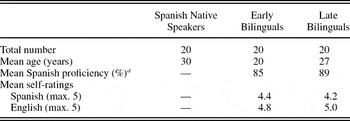
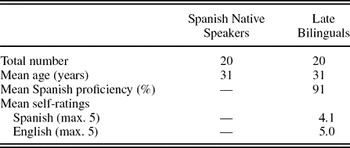
Forty English–Spanish bilinguals (20 early, 20 late) and 20 native speakers of Spanish participated in Experiment 1. Of those, 13 of the bilinguals (5 early, 8 late) had participated in the pilot study approximately 1 year earlier. Participants received monetary compensation for completing the study. Bilinguals were either faculty or students at one of two large midwestern universities in the United States, and were divided into two participant groups based on age of acquisition of Spanish and English. Early bilinguals were “heritage speakers” of Spanish, children of immigrants to the United States who were generally of Mexican descent. Participants in this group learned Spanish at home from birth, and acquired English either during the early preschool years, or soon after starting kindergarten; all began acquiring English by 8 years of age, and had received schooling in English since that time. Late bilinguals were native speakers of English who began learning Spanish as an L2 in a classroom environment at age 10 or later. None had any significant immersion experience in a Spanish-speaking environment before age 18. Native speakers of Spanish were also faculty or students at the same universities, and had all been in the United States only as adults. Both early and late bilinguals completed a standardized proficiency test in Spanish, which included the vocabulary section of a Modern Language Association test (30 items) and the cloze section of the advanced Diplomas de Español como Lengua Extranjera (20 items), a test used by the Spanish Ministry of Education and Culture as an official means of determining and certifying Spanish proficiency. All participants scored 75% or above, indicating advanced/native proficiency in Spanish. Self-ratings in Spanish and English were also given by the participants as an additional measure of bilingual language proficiency; these were based on a scale from 1 (can barely speak/understand/read/write Spanish/English) to 5 (can speak/understand/read/write Spanish/English like a native speaker). These ratings reflected proficiency test results, and indicated that both early and late bilinguals were English-dominant. Participant characteristics are summarized in Table 1.
Participant characteristics for Experiment 1

aTen of the early bilinguals only completed the vocabulary section of the proficiency test.
Materials
Word-by-word sentence reading task. A moving window word-by-word sentence reading task in Spanish was again used in Experiment 1, with two counterbalanced experimental lists, each with a total of 128 sentences (plus 10 practice sentences), half grammatical and half ungrammatical because of errors in subject–verb number or noun–adjective gender agreement. All sentences contained basic vocabulary that typically appears in first- and second-year Spanish textbooks. Participants saw each sentence in either the grammatical or the ungrammatical condition, but not both; sentences were presented in a pseudorandomized order that was the same for all participants. Sixty-four of the 128 sentences were used to test sensitivity to errors in subject–verb number agreement; in half of those, the agreement source and target were adjacent (as shown in Examples 4a and 4b), and in the other half, they were separated by intervening material (as shown in Examples 5a and 5b).
4a.
4b.
5a.
5b.
The other 64 of the 128 sentences tested sensitivity to errors in noun–adjective gender agreement, half with the agreement source and target adjacent (illustrated in Examples 6a and 6b) and half with the source and target separated by intervening material (illustrated in Examples 7a and 7b).
6a.
6b.
7a.
7b.
In the subject–verb number agreement sentences, there were equal numbers of singular and plural subjects (and thus verbs) in each grammaticality condition. In the noun–adjective gender agreement sentences, there were equal numbers of masculine and feminine nouns in each grammaticality condition. All of the nouns were inanimate, and all nouns and adjectives had endings that typically indicate masculine (-o) or feminine (-a) gender. Because each sentence served as its own control (in that the grammatical and ungrammatical versions were directly compared), length, frequency, and verb transitivity were not matched across sentences. Within the sentences with the agreement source and target separated by intervening material (exemplified in Examples 5a and 5b and 7a and 7b), the number (in the subject–verb number agreement sentences) or the gender (in the noun–adjective gender agreement sentences) of the head and local nouns was manipulated such that all combinations of matching and mismatching number and gender appeared equally among the experimental stimuli. However, these combinations of matching and mismatching head and local nouns were not counterbalanced across grammaticality conditions in the experimental lists; whereas there were equal numbers of matching and mismatching sentences in each list, all of the matching items in one experimental list were grammatical and all of the mismatching ungrammatical, and vice versa in the other experimental list. This lack of counterbalancing should therefore be taken into consideration when interpreting the results for these sentences. It is possible that the matching or mismatching of head and local nouns in combination with the grammaticality of the sentences could have influenced participants’ responses to these items. As in the pilot, comprehension questions appeared after half of the sentences in each list. The full sets of experimental sentences from the pilot and both experiments are available upon request from the author.
Written agreement task. In order to verify knowledge of subject–verb number agreement and noun–adjective agreement in Spanish, participants completed a written multiple-choice task, in which they had to select the correct verb or adjective form in order to accurately fill in the blank in a series of 30 sentences.
Working memory span task. The working memory span task administered was adapted from a reading span measure designed by Waters and Caplan (Reference Waters and Caplan1996), and was the same task used in Sunderman and Kroll (Reference Sunderman and Kroll2006). It consisted of 80 sentences in Spanish (taken from Waters and Caplan), half of which were plausible and half implausible. Sentences were grouped into 20 sets of 2 to 6 sentences each (4 sets each). The task had both storage (word recall) and processing (plausibility judgments) components. Participants saw the 20 sets of sentences, 1 sentence at a time on the computer screen, and made plausibility judgments to each of the sentences by pressing a button labeled yes if the sentence was plausible or no if it was implausible. When they reached the end of a set, they were asked to recall the last word of each sentence in the set and write the words in a booklet. The number of words in each sentence did not differ significantly across plausibility conditions or across the different set sizes; and words to be recalled were matched on word length, frequency, familiarity, concreteness, and imageability.
Procedure
Participants were tested individually with only the researcher present; all tasks were completed in one experimental session. The participants first completed a language history questionnaire to provide information about age of language acquisition and experience with both English and Spanish (including formal study and immersion or study abroad experiences). Next, they completed the written Spanish proficiency test described above, along with self-ratings of proficiency in English and Spanish. They then completed the working memory span task. After the working memory span task, participants completed the word-by-word sentence reading task; the procedure was the same as in the pilot. Participants then completed the written agreement task described above.
Scoring
Scoring for the word-by-word sentence reading task was identical to the pilot. For the working memory span task, the total number of words correctly recalled was tallied for each participant in order to obtain a span score. The percentage correct was calculated for the written agreement task.
Results
Written agreement task. Both bilingual groups scored high on the written agreement task. Mean percentage correct for the early bilinguals was 93.2 (SD = 4.6, range = 83.3–100), and for the late bilinguals, it was 98.7 (SD = 2.5, range = 90.0–100). The few errors that were made by the early bilinguals included subject–verb number errors in sentences with mismatching head and local nouns (attraction errors, see, e.g., Bock & Miller, Reference Bock and Miller1991), and some noun–adjective gender errors, primarily with an item testing knowledge of the gender of the word agua (water), which is a feminine noun that takes a masculine determiner in the singular form (el-masc. agua-fem.). Late bilinguals made three number errors attributable to attraction; the rest of their errors were gender agreement errors with agua. The low error rate in both bilingual groups reflects their advanced/native proficiency in Spanish and patterns with previous research, showing a slight advantage on written tests for late over early bilinguals (Montrul et al., Reference Montrul, Foote and Perpiñán2008).
Word-by-word sentence reading task
COMPREHENSION QUESTIONS. All participants scored at least 70% accuracy on the comprehension questions, confirming that they understood the content of the sentences they were reading (native speakers: mean = 95.3, SD = 5.2, range = 75–100; early bilinguals: mean = 93.0, SD = 6.6, range = 70–98; late bilinguals: mean = 94.0, SD = 3.1, range = 86–98).
SENTENCE READING TIMES. As in the pilot, the reading times for the word before (Position 1), at (Position 2), and after (Position 3) the point of ungrammaticality in the ungrammatical sentences were compared to the reading times for the same words in the grammatical sentences. Mixed analyses of variance (ANOVAs) were conducted separately on sets of reading times at each position within each condition (subject–verb number agreement and noun–adjective gender agreement). In the by-participants analyses, grammaticality (grammatical vs. ungrammatical) and distance (adjacent vs. separated agreement source and target) were within-participants factors of two levels each, and group (native speakers vs. early vs. late bilinguals) was a between-participants factor of three levels. In the by-items analyses, grammaticality and group were within-items factors, and distance was a between-items factor. Before analyses were conducted, reading times that were two standard deviations above or below each participant's (in the by-participants analyses) or item's (in the by-items analyses) mean were changed to the corresponding upper or lower limit. In addition, reading times that were below 100 ms or above 2000 ms were changed to the corresponding limit. In the by-participants analyses, 5.2% of the data was affected by these changes; in the by-items analyses, 4.5% was affected.
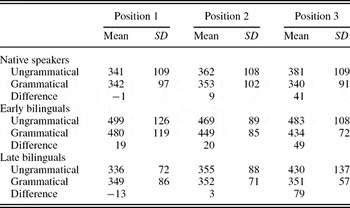
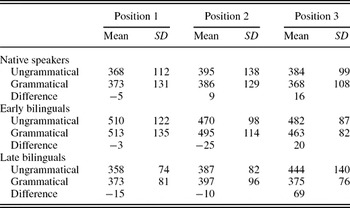
SUBJECT–VERB NUMBER AGREEMENT. In contrast to the results for subject–verb number agreement in the pilot study, in which only the native speaker group showed sensitivity to number agreement violations, all groups demonstrated this sensitivity in Experiment 1, taking longer to read the ungrammatical sentences than the grammatical ones. This sensitivity, however, differed depending on the distance between the agreement source and target. Means for each grammaticality condition in each sentence position along with reading time differences between the ungrammatical and the grammatical sentences are presented in Table 2 (adjacent agreement source and target) and Table 3 (separated agreement source and target).
Mean reading times by group and position, number agreement, adjacent source, and target for Experiment 1

Mean reading times by group and position, number agreement, separated source, and target for Experiment 1

As Tables 2 and 3 illustrate, sensitivity to subject–verb number agreement violations was greater in the adjacent agreement source and target condition in comparison to the condition in which the agreement source and target were separated by intervening material. Statistical analyses confirmed these patterns.Footnote 3 In Positions 1 and 2, there was no main effect of grammaticality, or interactions of group or distance and grammaticality in either by-participants or by-items analyses. In Position 3, there was a main effect of grammaticality, F 1 (1, 57) = 24.21, p < .001; F 2 (1, 62) = 37.43, p < .001, which was qualified by a Grammaticality ×Distance interaction, significant by participants only, F 1 (1, 57) = 6.29, p < .05; F 2 (1, 62) = 3.84, p = .054, and a Grammaticality×Group interaction, significant by items only, F 1 (2, 57) = 2.41, p = .099; F 2 (2, 124) = 5.67, p < .01. There was no three-way interaction among grammaticality, distance, and group.
The interaction between grammaticality and distance in Position 3, which reached significance in the by-participants analysis and approached significance in the by-items analysis, signifies that sensitivity to number agreement errors was greater in the adjacent condition (57-ms slowdown) than in the condition in which agreement source and target were separated (34-ms slowdown). To further explore the interaction between grammaticality and group in Position 3, which reached significance only in the by-items analysis, paired samples t tests were conducted on reading times for grammatical versus ungrammatical sentences at Position 3 within each group; the results showed that all groups read ungrammatical sentences significantly slower than grammatical sentences (native speakers: p < .01; early bilinguals: p < .05; late bilinguals: p < .001), indicating that the interaction reflects the larger effect of grammaticality in the late bilingual group (71-ms slowdown vs. 29 ms in the native speakers and 30 ms in the early bilinguals). The lack of interaction among grammaticality, distance, and group shows that all groups patterned alike in terms of sensitivity to grammaticality as a function of distance.Footnote 4 Overall, this pattern of results suggests that sensitivity to subject–verb number agreement errors diminishes with increased distance between the agreement source and target, as hypothesized based on pilot study results.
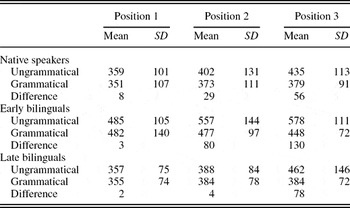
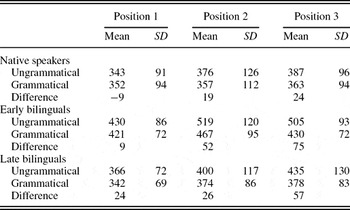
NOUN–ADJECTIVE GENDER AGREEMENT. As in the pilot study, all participant groups showed sensitivity to noun–adjective gender agreement errors, reading ungrammatical sentences more slowly than their grammatical counterparts. Moreover, similar to the Experiment 1 results for subject–verb number agreement sentences, sensitivity to gender agreement violations was greater in the adjacent agreement source and target condition than in the separated source and target condition. Means for each sentence position in ungrammatical and in grammatical conditions along with reading time differences between these conditions are listed in Table 4 (adjacent agreement source and target) and Table 5 (separated agreement source and target).
Mean reading times by group and position, gender agreement, adjacent source, and target for Experiment 1

Mean reading times by group and position, gender agreement, separated source, and target for Experiment 1

These patterns were verified by ANOVA results. In Position 1, there was no significant main effect of grammaticality, but only a Grammaticality×Distance × Group interaction that reached significance in the by-participants analysis, F 1 (2, 57) = 3.26, p < .05; F 2 (2, 124) = 1.86, p = .160. In Position 2, there was a main effect of grammaticality, F 1 (1, 57) = 27.01, p < .001; F 2 (1, 62) = 18.30, p < .001, and a Grammaticality×Group interaction, F 1 (2, 57) = 5.38, p < .01; F 2 (2, 124) = 4.00, p < .05. In Position 3, there was also a main effect of grammaticality, F 1 (1, 57) = 59.56, p < .001; F 2 (1, 62) = 59.90, p < .001, and a Grammaticality×Distance interaction, F 1 (1, 57) = 9.67, p < .01; F 2 (1, 62) = 4.19; p < .05, as well as a Grammaticality×Group interaction, F 1 (2, 57) = 3.98, p < .05; F 2 (2, 124) = 5.96, p < .01.
The interaction between grammaticality and distance in Position 3 reflects the greater sensitivity to gender agreement errors in the adjacent source and target condition (88-ms slowdown) in comparison to the separated source and target condition (52-ms slowdown). Paired samples t tests were again conducted on reading times for grammatical versus ungrammatical sentences within each group, this time at Positions 2 and 3, in order to examine the source of the Grammaticality × Group interactions at both positions. Results indicate that in Position 2, native speaker and early bilingual groups slowed down significantly in ungrammatical sentences (native speakers: p < .05 by participants and by items; early bilinguals: p < .001 by participants and p < .01 by items), but late bilinguals did not (p = .149 by participants and p = .212 by items). In Position 3, however, all three groups slowed down significantly (native speakers: p < .01 by participants and by items; early bilinguals: p < .001 by participants and by items; late bilinguals: p < .01 by participants and p < .001 by items), indicating that the interaction was due to smaller slowdowns in the native speakers (40 ms) and the late bilinguals (68 ms) than in the early bilinguals (102 ms). The interaction among grammaticality, distance, and group that reached significance only in the by-participants analysis in Position 1 was attributable to a significant slowdown in ungrammatical sentences in the separated source and target condition among late bilinguals only (24 ms, p < .001 in paired samples t tests comparing grammatical and ungrammatical reading times).
In summary, for noun–adjective gender agreement sentences, reading times were significantly longer in all participant groups for the ungrammatical than the grammatical condition, whether the agreement source and target were adjacent or separated by intervening material, although whereas native speakers and early bilinguals slowed down at both Positions 2 and 3, late bilinguals only showed a significant slowdown at Position 3. As with subject–verb number agreement results, reading time differences were larger in magnitude when the agreement source and target were adjacent in comparison to when they were separated. One unexpected result was the significant difference in reading times between the grammatical and the ungrammatical conditions in the first position of the gender agreement sentences in the late bilingual group; this difference only occurred with the sentences in which the agreement source and target were separated by intervening material. At the first position, the words in the two versions of the sentences were identical, and thus should not have caused any differences in reading time. It is therefore unclear why this 24-ms difference would occur, but given that the difference in the critical third position (at the word immediately after the point of ungrammaticality in the ungrammatical condition) is over twice as large at 57 ms, it seems reasonable to cautiously conclude that the effect of ungrammaticality is real in these sentences, despite the unexplained 24-ms difference at the first position. Alternatively, as mentioned in the description of the stimuli for Experiment 1, it may have been the case that the lack of counterbalancing of matching and mismatching head and local nouns across grammaticality conditions in the sentences with intervening material between the agreement source and target caused this effect (e.g., participants could have developed expectations about the grammaticality of the sentence based on whether the head and local nouns were matching or mismatching depending on the particular experimental list they saw; these expectations could have caused a speeding up or slowing down before the point of ungrammaticality).
Working memory span task. On the working memory task, late bilinguals recalled a mean of 50.25 words out of 80 possible (SD = 14.57, range = 21–74). To determine whether reduction in sensitivity to grammaticality in longer distance agreement conditions was related to working memory capacity, first an adjacent condition score and a separated condition score were calculated for each late bilingual by subtracting his or her mean grammatical reading time in Position 3 from his or her mean ungrammatical reading time in the same position (because it was only at this position that the grammaticality by distance interactions occurred) in both subject–verb number and gender sentences. Next, a distance score for each sentence type was calculated for each late bilingual by subtracting the separated condition score from the adjacent condition score. The Pearson r value was then calculated for distance scores and working memory span scores. There was no correlation between working memory span scores and either number agreement distance scores (r = 0.21, p = .372) or gender agreement distance scores (r = −0.29, p = .218).
Discussion
To summarize the Experiment 1 results, all three participant groups showed sensitivity to both subject–verb number agreement errors and noun–adjective gender agreement errors in Spanish. However, this sensitivity was greater when the agreement source and target were adjacent than when they were separated by intervening material. Late bilingual working memory span scores did not correlate with this difference in sensitivity as a function of distance in either the subject–verb number agreement or the noun–adjective gender agreement sentences. One potential problem with the design of Experiment 1, however, was that there were no filler sentences included. Out of the 128 sentences read by each participant, 32 sentences were ungrammatical due to subject–verb number errors and 32 due to noun–adjective gender agreement errors. As suggested by an anonymous reviewer, that so many of the sentences were ungrammatical because of only two types of agreement errors could have made the investigated structures obvious to participants, thus biasing the results. Specifically, in the case of the late bilinguals in particular, this may have led to a more conscious processing of the sentences, allowing these bilinguals to make use of their explicit or metalinguistic knowledge of number and gender agreement in Spanish. However, this seems unlikely, given that reading times for late bilinguals and native speakers were very similar (see Tables 2–5). If the late bilinguals had been drawing on explicit knowledge, their reading times should have been noticeably slower because this type of knowledge is less automatized than implicit or integrated knowledge. Furthermore, in Jiang (experiments 1 and 3, Reference Jiang2004; Reference Jiang2007), no fillers were used even when testing only one or two structures, yet his participants were not sensitive to subject–verb number agreement or plural noun errors, indicating that they were not able to or did not draw on explicit knowledge. Nevertheless, to ensure that the pattern of results for the late bilinguals in Experiment 1 was not due to the lack of fillers, a second experiment was conducted that included two types of filler sentences.
EXPERIMENT 2
Method and participants
Twenty English–Spanish late bilinguals and 20 native speakers of Spanish participated in Experiment 2. Both groups were similar to Experiment 1 participants in terms of proficiency and age of acquisition. Participant characteristics are listed in Table 6.
Participant characteristics for Experiment 2

Materials
Word-by-word sentence reading task. The moving window word-by-word sentence reading task in Experiment 2 consisted of two counterbalanced experimental lists, constructed similarly to those in Experiment 1. Each contained a total of 120 sentences (plus 10 practice sentences). Half of the sentences were grammatical and half ungrammatical in each list because of errors in subject–verb number agreement (n = 48), noun–adjective gender agreement (n = 24), subjunctive use in subordinate clauses (n = 24), or the “personal a” (n = 24). This means that, out of 120 sentences, each participant only saw 24 sentences that were ungrammatical because of subject–verb number agreement errors and 12 sentences that were ungrammatical because of noun–adjective gender agreement errors. Subject–verb number agreement and noun–adjective gender agreement sentences were similar to those used in Experiment 1 in terms of numbers of singular and plural subjects and masculine and feminine nouns. In half of the sentences used to test sensitivity to subject–verb number agreement, the agreement source and target were adjacent (as shown in Examples 4a and 4b), and in the other half, they were separated by intervening material (as shown in Examples 5a and 5b). In the sentences in which the source and target were separated by intervening material, the number of the head and local nouns was manipulated so that all combinations of matching and mismatching number appeared equally among the stimuli; these combinations were counterbalanced across grammaticality conditions in the experimental lists. All of the sentences used to test sensitivity to noun–adjective gender agreement had adjacent agreement sources and targets. Distance was not manipulated in both sentence types because they patterned in the same way in Experiment 1 and to keep the total number of experimental sentences to a minimum to avoid tiring the participants. Comprehension questions again appeared after half of the sentences.
Written agreement task. The written agreement task from Experiment 1 was also employed in Experiment 2.
Procedure and scoring
The procedure was identical to that of Experiment 1, without the working memory task. Scoring was the same as in Experiment 1.
Experiment 2: Results
Written agreement task. Written agreement task scores were similar to Experiment 1; mean correct was 98.9% (SD = 2.7, range = 90–100).
Word-by-word sentence reading task
COMPREHENSION QUESTIONS. All participants scored at least 88% accuracy on the comprehension questions, again confirming that they were reading the sentences for content (native speakers: mean = 94.5, SD = 3.8, range = 88.3–98.3; late bilinguals: mean = 94.9, SD = 3.2, range = 90.0–100).
SENTENCE READING TIMES. Comparisons similar to those made in Experiment 1 were made in Experiment 2. Mixed ANOVAs were conducted separately on sets of reading times at each position within each condition. In the by-participants analyses of the subject–verb number agreement sentences, grammaticality (grammatical vs. ungrammatical) and distance (adjacent vs. separated agreement source and target) were within-participants factors of two levels each, and group (native speakers vs. late bilinguals) was a between-participants factor of two levels. In the by-items analyses, grammaticality and group were within-items factors, and distance was a between-items factor. In the by-participants analyses of the noun–adjective gender agreement sentences, grammaticality was a within-participants factor, and group was a between-participants factor. In the by-items analyses, both grammaticality and group were within-items factors in a repeated measures ANOVA. Similar reading time modifications were performed on the data for Experiment 2 as in Experiment 1. Changes affected 5.6% of the data in the by-participants analyses, and 4.9% in the by-items analyses.
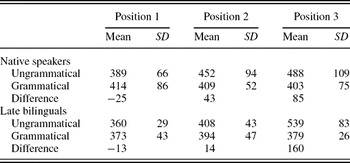
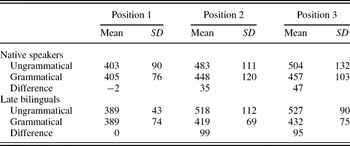
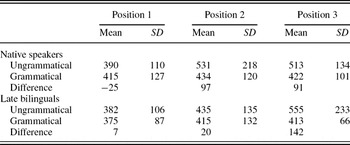
SUBJECT–VERB NUMBER AGREEMENT. As in Experiment 2, both participant groups were sensitive to errors in subject–verb number agreement, and both groups’ sensitivity differed in magnitude as a function of distance. Means and reading time differences for each position are listed in Table 7 (adjacent agreement source and target) and Table 8 (separated source and target).
Mean reading times by group and position, number agreement, adjacent source, and target for Experiment 2

Mean reading times by group and position, number agreement, separated source, and target for Experiment 2

Statistical analyses again verified these patterns. In Position 1, there was no main effect and no interactions. In Position 2, there was a main effect of grammaticality, F 1 (1, 38) = 28.07, p < .001; F 2 (1, 46) = 18.20, p < .001, a Grammaticality ×Distance interaction significant by participants only, F 1 (1, 38) = 5.02; p < .05; F 2 (1, 46) = 2.84, p = .099, and a Grammaticality×Distance×Group interaction also significant by participants only, F 1 (1, 38) = 6.55, p < .05; F 2 (1, 46) = 3.63, p = .063. In Position 3, there was a main effect of grammaticality, F 1 (1, 38) = 29.58; p < .001; F 2 (1, 46) = 83.63, p < .001, which was qualified by a Grammaticality×Distance interaction, F 1 (1, 38) = 5.65, p < .05; F 2 (1, 46) = 5.81, p < .05, and a Grammaticality×Group interaction, which was significant by items only, F 1 (1, 38) = 3.31, p = .077; F 2 (1, 46) = 14.11, p < .001.
As in Experiment 1, the interaction between grammaticality and distance in Position 3 indicates greater sensitivity to number violations in the adjacent condition (122-ms slowdown) than in the condition in which agreement source and target were separated (72-ms slowdown). The interaction between grammaticality and distance and the interaction among grammaticality, distance, and group that both reached significance only in the by-participants analyses in Position 2 were attributable to a slowdown of 99 ms at this position on the part of the late bilinguals, which occurred only in the separated source and target condition; the late bilinguals’ slowdown in the adjacent condition at this position was only 14 ms. The interaction between grammaticality and group that reached significance only in the by-participants analysis in Position 3 was further explored using paired samples t tests, as in Experiment 1. Results showed that ungrammatical sentences were read significantly slower than grammatical sentences in both groups (p < .001), indicating that the interaction was due to a larger slowdown in the late bilingual group (129-ms slowdown) than in the native speaker group (65-ms slowdown).
NOUN–ADJECTIVE GENDER AGREEMENT. Both participant groups were also sensitive to noun–adjective gender agreement errors, as in the pilot and Experiment 1. Means by condition and reading time differences are listed in Table 9.
Mean reading times by group and position and gender agreement for Experiment 2

ANOVA results confirmed both groups’ sensitivity. There was no main effect of grammaticality in Position 1, but there was a Grammaticality×Group interaction, F 1 (1, 38) = 5.85, p < .05; F 2 (1, 23) = 5.94, p < .05. In both Positions 2 and 3, there was a main effect of grammaticality: Position 2, F 1 (1, 38) = 8.81, p < .01; F 2 (1, 23) = 11.98, p < .01; Position 3, F 1 (1, 38) = 18.85, p < .001; F 2 (1, 23) = 61.20, p < .001, but no significant interaction between grammaticality and group.
The main effect of grammaticality in Positions 2 and 3 reflects significant slowdowns in ungrammatical sentences both at and immediately after the points of ungrammaticality, whereas the interaction between grammaticality and group in Position 1 was attributable to a significant slowdown in that position on the grammatical versions of the sentences on the part of the native speakers. As in Experiment 1, the slowdown in this position was only about one-fourth the magnitude of the slowdown that occurred in Positions 2 and 3, suggesting that the slowdowns at Positions 2 and 3 were due to ungrammaticality. Overall, the pattern of results reflects that of both the pilot and Experiment 1, with both groups showing evidence of sensitivity to noun–adjective gender agreement errors.
GENERAL DISCUSSION AND CONCLUSION
The goals of this study were, first, to investigate whether early and late English–Spanish bilinguals evidence integrated linguistic knowledge of agreement in Spanish and, second, to determine whether age of acquisition might play a role in its existence. Third, our final goal was to begin to explore why the integration of knowledge in a late-learned L2 may be selective by focusing on a type of agreement that exists in both English and Spanish (subject–verb number agreement) and comparing it to a type of agreement that exists in Spanish only (noun–adjective gender agreement). It was predicted that English–Spanish bilinguals would be able to automatically access and use knowledge of agreement in Spanish, but that age of acquisition might affect which type of agreement knowledge would be automatized. In combination, the results from the pilot and both Experiments 1 and 2 indicate that, as predicted, English–Spanish bilinguals do possess integrated knowledge of Spanish agreement. Contrary to predictions, however, the age of acquisition did not affect the existence of integrated linguistic knowledge; both early and late bilinguals were sensitive to both subject–verb number and noun–adjective gender agreement errors while reading Spanish sentences for comprehension. However, in all participant groups, intervening material between agreement sources and targets led to diminished sensitivity to both types of errors.
In terms of the possible reasons behind this diminished sensitivity, two different hypotheses were discussed based on previous research with both monolinguals and bilinguals. The first was originally proposed by Almor et al. (Reference Almor, MacDonald, Kempler, Andersen and Tyler2001), who suggested that listeners respond faster to grammatical verbs and slower to ungrammatical verbs when those verbs occur in an expected position in the utterance. The second hypothesis originated from two studies with bilinguals that found distance effects on sensitivity to gender agreement errors (Keating, Reference Keating2005; Myles, Reference Myles1995). These studies suggested that working memory may play a role in distance effects. That is, it may be that late bilinguals in particular may not be able to maintain in memory the gender of the noun with which an adjective is to agree when the adjective does not immediately follow the noun or when it does not occur inside of the noun phrase, because of the overall heavier processing load associated with L2 use. However, all groups in the current study, including native speakers, showed distance effects, suggesting that if these effects are due to working memory limitations, these limitations are not exclusive to late bilinguals processing their L2. Furthermore, in Almor et al.'s study and in the current study, working memory capacity did not correlate with reduced sensitivity to agreement errors, further supporting the idea that this explanation may not be the correct one. Nevertheless, in the current study, working memory span data were only collected from the late bilinguals and only in Experiment 1. A significant correlation may not have been obtained because of the relatively small number of sets of scores (n = 20, the same number used in Almor et al.'s correlational analysis). Further research is needed with larger numbers of participants to determine what the best explanation for distance effects may be, whether they are related to working memory, or simply to listeners’/readers’ expectations about what comes next in a sentence. The use of eye tracking instead of self-paced reading may provide a better way to investigate this question, because it is a methodology that allows researchers to track not only time spent reading a particular sentence region but also regressions made to previously read regions.
To return to the central question in SLA stated at the beginning of the current study, namely, whether late bilinguals can develop the same type of knowledge in the L2 as they have in their L1, based on the results of this study it appears that they can, at least in reading comprehension. Although the prediction was made that the existence of integrated knowledge in Spanish would be selective in the bilinguals tested in this study based on studies investigating age effects in L2 acquisition and on Jiang's research, this was not the case. Regardless of the age of acquisition of Spanish or the existence in the L1 of the particular grammatical structure tested, all participants demonstrated integrated knowledge of agreement in Spanish, or in generative terms, the acquisition of features that do not exist in their L1 (i.e., gender). These results contradict Jiang's (Reference Jiang2004, Reference Jiang2007) findings for Chinese–English bilinguals and findings from studies that show difficulties with gender agreement based on a lack of gender in the L1 (e.g., Franceschina, Reference Franceschina2001, Reference Franceschina2005; Guillelmon & Grosjean, Reference Guillelmon and Grosjean2001; Lew-Williams & Fernald, Reference Lew-Williams, Fernald, Caunt-Nulton, Kulatilake and Woo2007). The current study and other studies with similar results (e.g., Sagarra & Herschensohn, Reference Sagarra, Herschensohn, Chan, Jacob and Kapia2008) raise the question of why these late bilinguals were sensitive to gender agreement errors while others were not.
One possible reason for the disparity in these studies’ results is that the late bilingual participants in the present study may differ from those in some studies in terms of both the quantity and the quality of practice with the L2. For example, although Jiang's (Reference Jiang2004) participants had lived in the L2 context for up to 5 years and were using English as their “working language” (p. 611), they had varying amounts of formal education in the L2 (range = 7–20 years) and a variety of proficiency levels (range = 2–9 on what appears to be a 10-point scale) according to their self-ratings. In Guillelmon and Grosjean's study (Reference Guillelmon and Grosjean2001), all of the participants had been living in a French-speaking environment for a mean of 24 years and rated themselves as highly fluent in French, but it is unclear how much formal training they had had in the language. In the current study, 19 of the 20 late bilingual participants in Experiment 1 and all of the late bilingual participants in Experiment 2 were Spanish instructors, and were either working on or had already obtained advanced degrees in the language. All of them had had extensive formal instruction in Spanish, and were in professional positions that require a strong emphasis on the importance of grammatical accuracy. It may be that this type of participant represents a special type of late L2 learner, in that the constant focus on the details of the language, and the consistent practice with its grammar help to develop a high level of sensitivity to grammatical violations. As teachers, it is their job to identify and correct students' grammatical errors, of which many are related to agreement. In a replication of Guillelmon and Grosjean, Foote (Reference Foote2008) found that the same late bilinguals who served as participants in the current study were sensitive to gender cues during spoken word recognition, in contrast to Guillelmon and Grosjean's participants (although only when these cues were incongruent, i.e., when there was disagreement between the determiner and noun).
In support of the possibility that the nature of these bilinguals’ experience with the L2 may make them more sensitive to grammatical errors, theories related to the acquisition of integrated or implicit L2 knowledge generally imply that late bilinguals are able to acquire such knowledge with sufficient practice, as stated previously. According to some researchers, although explicit and implicit knowledge are inherently different and one cannot become the other, with enough L2 experience the development of implicit knowledge may occur (e.g., Krashen, Reference Krashen1982; Paradis, Reference Paradis and Ellis1994, Reference Paradis2004, Reference Paradis2009; Ullman, Reference Ullman2001, Reference Ullman and Sanz2005). According to others who hold that these two types of knowledge interact (e.g., Ellis, Reference Ellis and Ellis1994, Reference Ellis2005), implicit knowledge can be acquired, but as a more direct result of explicit learning. In this view, explicit L2 learning forms the basis for the eventual development of implicit knowledge, although one does not become the other. A third position on the acquisition of implicit knowledge is that explicit or declarative L2 knowledge can become proceduralized L2 knowledge with sufficient practice (e.g., DeKeyser, Reference DeKeyser1997, Reference DeKeyser, Doughty and Long2003). In two of these three views, a large quantity of explicit training can impact the development of implicit or integrated L2 knowledge, and the late bilinguals of the current study certainly possess years of such training. Future research comparing the type of population tested in the current study to others will serve to shed more light on how the nature of L2 experience and quantity of explicit training can affect the acquisition and use of implicit knowledge. Based on the present study, even in areas in which persistent difficulties are often noted, such as in the realm of L2 inflectional morphology, it may be possible to become nativelike.Footnote 5
ACKNOWLEDGMENTS
Earlier versions of this research were presented at the 32nd annual Boston University Conference on Language Development (Boston University, November 2007), the American Association for Applied Linguistics (Washington, DC, April 2008), and the Georgetown University Roundtable 2009 (Georgetown University, March 2009). The author thanks Soo Kim and Junkyu Lee for assistance in data collection and the following people and organizations for help in participant recruitment and in providing facilities for data collection to occur: Carmen Albaladejo, Luis García, and the Campus Assistance Migrant Program at Michigan State University; Jeanette López-Walle and the Universidad Autónoma de Nuevo León, Mexico; and Silvina Montrul.