INTRODUCTION
Although Blaber (Reference Blaber1970) first reported upon the occurrence of a penis-like outgrowth behind the right cephalic tentacle in females of the North European intertidal dogwhelk Nucella lapillus (Linnaeus, 1758) (Muricidae: Caenogastropoda), the phenomenon of imposex and its cause were not fully described and identified, respectively, for another 16 years (Bryan et al., Reference Bryan, Gibbs, Hummerstone and Burt1986; Gibbs & Bryan, Reference Gibbs and Bryan1986). Imposex was attributed finally to tributyltin (TBT)-based anti-fouling paint poisoning acting upon the endocrine system of N. lapillus resulting in the reproductive failure of local populations of the species (Gibbs & Bryan, Reference Gibbs and Bryan1986; Gibbs et al., Reference Gibbs, Bryan, Pascoe and Burt1987, Reference Gibbs, Pascoe and Burt1988) and the generalized decline of the species along the southern coastline of England (Bryan et al., Reference Bryan, Gibbs, Hummerstone and Burt1986; Gibbs et al., Reference Gibbs, Bryan and Spence1991). Subsequently, dogwhelk imposex was discovered further afield, not just in the United Kingdom, but also throughout the range of the species (Matthiessen & Gibbs, Reference Matthiessen and Gibbs1998). Imposex has subsequently been detected in many other species of, notably, intertidal and subtidal gastropod predators virtually worldwide. The fate and effects of TBT have been reviewed by Champ & Seligman (Reference Champ and Seligman1996).
So serious was the problem of TBT perceived to be in many countries that regulations have been enacted. Beginning in the 1980s legislation was put in place to control its use (Champ & Seligman, Reference Champ and Seligman1996) and some reductions in levels and effects have been reported upon (Waite et al., Reference Waite, Waldock, Thain, Smith and Milton1991; Uhler et al., Reference Uhler, Durell, Steinhauer and Spellacy1993; Evans et al., Reference Evans, Hawkins, Porter and Samosir1994, Reference Evans, Leksono and McKinnell1995). Following laws limiting the use of TBT-based paints on vessels of <25 m length, there is some evidence that N. lapillus populations are increasing. Evans et al. (Reference Evans, Hawkins, Porter and Samosir1994), for example, showed that on the Isle of Cumbrae, in Scotland, relative penis size index (RPSI) scores for N. lapillus and the incidence of penis-bearing individuals decreased and dogwhelk numbers increased between 1988 and 1992.
Although TBT-based antifouling paints were banned from application on small boats, their use was still permitted on larger vessels. After effects upon open waters similar to those identified from inshore ones were identified in 2001 however, the International Maritime Organization (IMO) adopted the Convention on the Control of Harmful Antifouling Systems on Ships. At the same time, the European Union via Regulation (EC) No. 782/2003 banned the application of TBT-based paints on all EU-flagged vessels with effect from 1 January 2003 and, subsequently, with effect from 1 January 2008, made it an offence for any EU-flagged ship visiting any EU port to have TBT present on its hull. The IMO followed the two stages of this ban, similarly with effect from 1 January 2008 (Gipperth, Reference Gipperth2009). All EU-flagged vessels should, therefore, have been TBT-free by this date but, realistically, some reductions in coastal levels should have been seen after 2003 when TBT hull painting halted. As a consequence, effects upon N. lapillus should also have been seen.
With the above scenario in mind, a study was commenced on a small group of N. lapillus individuals inhabiting the Mewsbrook Groyne at Littlehampton, West Sussex, on the south-eastern coast of England. The main aim was to determine if changes in population structure would occur following the TBT ban and, if so, how they would be mediated. The study lasted for 52 months, with additional information being obtained in September 2008. It commenced in May 2004 just over one year since the painting ban came into force and hence, in theory, extended over the period when any effects of TBT upon N. lapillus should have declined. Morton (Reference Morton2009) has reported upon the changes that occurred in this small population of N. lapillus, in terms of population size, structure, growth and reproductive success subsequent to freedom from imposex. This paper reports upon the changes that occurred in the feeding behaviour of N. lapillus over the course of the study.
MATERIALS AND METHODS
Commencing in May 2004, visits were made each month for a total of 52 months to an intertidal outfall draining partly saline (~12‰, Morton (Reference Morton2007)) overflow water from Mewsbrook Lake situated landward of the coastal road between Rustington and Littlehampton in West Sussex. The outfall is locally called the Mewsbrook Groyne and Morton (Reference Morton2007) has described its structure and dimensions, and provided a generalized picture of the colonizing species.
On each visit to the groyne, the shell height of every individual of Nucella lapillus was measured to the nearest 0.1 mm using Vernier calipers and returned to its original location. In addition to the information reported previously, the following other variables were recorded: (i) whether an individual of N. lapillus was feeding on its mussel prey; and (ii) if so, the shell length of the prey item. This prey item and every other empty shell of Mytilus galloprovincialis retained within the fabric of the mussel clusters were collected each month for subsequent analysis. This clearing of the site of all dead mussels was undertaken to not only obtain better estimates of the monthly numbers of M. galloprovincialis mortalities, but also in order to obtain a clearer picture of the causes of such deaths.
Moreover, every attempt was made not to disturb the habitat and thereby allow for the repeated examination of changes occurring in what can be considered (in the 21st Century) a ‘reasonably natural’ intertidal community. Thus large samples of M. galloprovincialis were not collected routinely for analysis, but since the mussel virtually exclusively dominated the lower tidal levels of the groyne, and juveniles were always apparent, it was assumed that the population of this species was relatively stable.
Upon return to the laboratory, the collected predated shells of M. galloprovincialis were measured along their greatest lengths to the nearest 0.1 mm and then examined for signs of predation. This was sometimes identified as Carcinus maenas predation (see Morton & Harper, Reference Morton and Harper2008). Where the valve had been drilled by Nucella lapillus, however, the position of each drill hole was plotted on master outlines of a M. galloprovincialis shell (left and right valves). The collected shells were also separated into those with no obvious predation marks and those that had been both drilled and marginally chipped by C. maenas (this study is ongoing).
The study was halted in August 2008 because, as described by Morton (Reference Morton2009), numbers of N. lapillus had increased by so many that it had become difficult to accurately analyse the population over the course of a single tidal cycle. The importance of doing this is due to the fact that, as described by Burrows & Hughes (Reference Burrows and Hughes1989), dogwhelks can move quite large distances between tidal cycles and so repeat sampling at consecutive low tides may result in the re-counting of earlier identified individuals. A repeat visit was made to the groyne in September 2009, with the main purpose of discovering whether reproduction by N. lapillus had ceased (Morton, Reference Morton2009) but also to determine the population size of the predator and to determine if it was still feeding.
RESULTS
Population size and structure
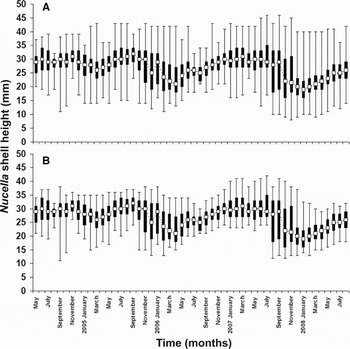
Over the course of the study from May 2004 to August 2008, a total of 52 months, the size of the population of Nucella lapillus on the Mewsbrook Groyne grew from 25 to 510 individuals, a >20-fold increase. This was caused by increasingly successful annual periods of reproduction and recruitment following freedom from imposex (Morton, Reference Morton2009). Similarly, the minimum and maximum shell heights of N. lapillus individuals on the groyne changed considerably (Figure 1). Figure 1A & B is box and whisker plots showing the changes in the median (□) shell heights of N. lapillus individuals over the course of the study period. Figure 1A illustrates the lowest 5th percentile (■) and the highest and lowest extreme shell height values (I). Figure 1B also illustrates the lowest 5th percentile (■) and the highest 95th percentile (I).
Box and whisker plots showing the changes in the median (□) shell heights of Nucella lapillus individuals on the Mewsbrook Groyne over the course of the 52-month study. (A) Illustrates the lowest 5th percentile (■) and the highest and lowest extreme values (I); (B) also illustrates the lowest 5th percentile (■) and the highest 95th percentile (I).

Figure 1A shows that the highest extreme value remained relatively constant over the course of the study at shell heights of between ~40 and 45 mm. Such a value thus represents the approximate tallest shell height that N. lapillus can attain on the groyne and that the population post-January 2005 nearly always contained some of these adults. The lowest extreme values also remained rather constant, although the median and the lowest 5th percentile showed a generally declining trend. Figure 1B shows the same declining trend in median shell height, but further shows that the highest 95th percentile in shell height varied more widely as did the lowest 5th percentile. The former suggests that the population of N. lapillus had a greater number of larger adults in the second half of the study, while the latter suggests periods of increasingly large recruitments by juveniles also in the second portion of the study.
Feeding behaviour of Nucella lapillus
Nucella lapillus was observed feeding on both barnacles, mostly Semibalanus balanoides (Linnaeus, 1767), and Mytilus galloprovincialis on the groyne. In such a habitat, it is difficult to ascertain, during the course of a survey such as this one, if an N. lapillus individual is either feeding on a barnacle (amongst a mat of conspecifics) or is in repose. This is because such attacks are not carried out with the proboscis obviously extended into a drilled hole. Rather, the proboscis may extend but a short distance, if at all, between the forcefully parted capitular plates of the prey. Observations suggested however, as will be described, that only larger individuals of N. lapillus fed on M. galloprovincialis and thus that the switch is made with increasing age from a juvenile diet of barnacles to one of mussels. It seemed logical too that, as has been demonstrated for many predatory gastropods, including N. lapillus (Hughes & Dunkin, Reference Hughes and Dunkin1984a,Reference Hughes and Dunkinb; Hughes & Drewett, Reference Hughes and Drewett1985), smaller predators would feed on smaller prey items and thus that the minimum size of drilled M. galloprovincialis would change if the population structure of the predator changed over time, as will be demonstrated.
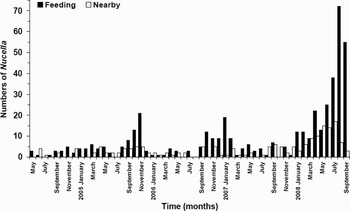
The numbers of N. lapillus observed feeding on M. galloprovincialis by drilling and those observed to be in close proximity (or nearby, within 10 mm) to such drilled (and lacking internal tissues) prey items each month during the study period, are shown in Figure 2. From the start of the study in May 2004 until the early winter of 2005–2006, numbers of drilled M. galloprovincialis were few. However, in October and November 2005 a peak in the numbers of drilled mussels occurred. Thereafter, the numbers of drilled prey declined. Subsequently, a second peak in drilled M. galloprovincialis occurred from October 2006 until January 2007 followed by another summer decline. From January 2008 onwards however, there was a dramatic increase in the preyed upon numbers of M. galloprovincialis, reaching a peak in August 2008. The first two peaks indicate that maximum feeding levels by N. lapillus occur in winter although the dramatic increase in numbers of predators on the groyne in 2007–2008 progressively masked this seasonal effect.
The numbers of Nucella lapillus feeding by drilling (■) Mytilus galloprovincialis and those observed in close proximity (or nearby) (□) to drilled prey items each month on the Mewsbrook Groyne over the course of the 52-month study.

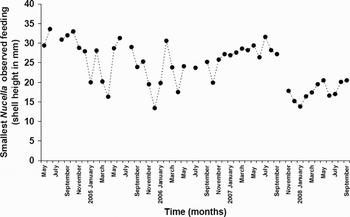
Figure 3 shows the smallest size of an N. lapillus individual recorded drilling a M. galloprovincialis shell on each visit to the groyne. In the early months of the study, the smallest N. lapillus individuals observed feeding had shell heights of between ~30 and 35 mm. With time, however, this figure declined to between ~15 and 20 mm. With an increasing number of juveniles recruited into the resident population of N. lapillus, the size at which they first attacked M. galloprovincialis also declined. The smallest N. lapillus ever observed feeding on a M. galloprovincialis individual had a shell height of 13.4 mm. The mean minimum size for all months was 24.1 mm, that is, juveniles in their first year of life (Morton, Reference Morton2009).
The sizes (shell heights in mm) of the smallest individuals of Nucella lapillus recorded drilling Mytilus galloprovincialis individuals each month on the Mewsbrook Groyne over the course of the 52-month study.

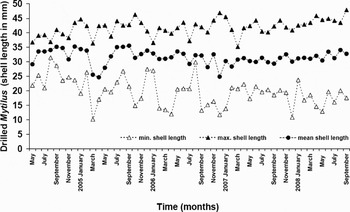
As described earlier, it is generally believed that there is a positive correlation between predator and prey sizes, inferring that smaller N. lapillus should be expected to feed on smaller M. galloprovincialis individuals. This aspect of the relationship between predator and prey on the groyne is illustrated in Figure 4 and shows the sizes (shell length in mm) of the largest and smallest individuals of M. galloprovincialis found to have been drilled by N. lapillus (shell height in mm) each month over the course of the study. Also shown are the mean shell lengths of M. galloprovincialis drilled each month. Firstly, the maximum size (▴) of the M. galloprovincialis attacked remained rather constant, possibly with a slight increase in prey size over time. Secondly, however, in the early months of the study, the minimum prey size (Δ) (between ~20 and 30 mm shell length) was much larger than it was at the end (between ~10 and 15 mm) suggesting that, if the correlation described above is true, the mean size of the predator (N. lapillus) had also declined over time. This shows that the relative numbers of young individuals in the population of N. lapillus on the groyne had increased over time. Figure 3, described above, suggests that this was true.
The maximum (▴), minimum (Δ) and mean (•) shell lengths (mm) of drilled Mytilus galloprovincialis collected each month from the Mewsbrook Groyne over the course of the 52-month study.

Interestingly, the mean shell lengths (•) of drilled M. galloprovincialis prey items (Figure 4) fluctuated quite widely over the first 34 months of the study but thereafter eventually became stabilized, perhaps after a slight intervening downward trend, at a mean shell length of ~30 mm. The smallest drilled M. galloprovincialis recorded (in March 2005) had a shell length of 10.2 mm. The largest M. galloprovincialis ever found preyed upon (in December 2006) had a shell length of 46.9 mm.
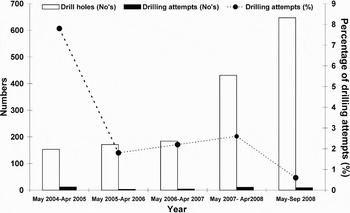
The numbers of M. galloprovincialis individuals drilled by N. lapillus on the groyne are shown as annual histograms in Figure 5. Each open histogram represents the periods from May 2004 to April 2005, May 2005 to April 2006, May 2006 to April 2007, May 2007 to April 2008 and May to September 2008. Also shown, as adjacent closed histograms, are the numbers of unsuccessful (or abandoned) and incomplete, drilling attempts recorded for the same time periods. Although the former increased dramatically over the years, the latter appeared to remain relatively stable. That is, 12 such failed attempts (out of 115 drilling records) were recorded for the year from May 2004 to April 2005, whereas for the period from May to September 2008, nine such attempts (out of 647 drilling records) were identified. When the percentage (•) relationships between the two datasets are compared, the relative numbers of failed drilling attempts declined from 7.8% to 0.6%. This suggests that the drilling abilities of N. lapillus were improving over time, as will be discussed.
The numbers of Mytilus galloprovincialis individuals drilled by Nucella lapillus on the Mewsbrook Groyne at Littlehampton from May 2004 to August 2008. Each open histogram represents the periods from May 2004 to April 2005, May 2005 to April 2006, May 2006 to April 2007, May 2007 to April 2008 and May 2008 to August 2009. Also shown are numbers of (unsuccessful) drilling attempts (closed histograms) recorded for the same time periods and their percentages (•) in terms of the total numbers of successful attacks each month.

Occasionally, more than one drill hole (a maximum of four) was recorded on each M. galloprovincialis shell. Once, two individuals of N. lapillus were observed drilling one M. galloprovincialis shell. Figure 6 shows the numbers of M. galloprovincialis found to have been drilled by either more than one predator or by a single N. lapillus having more than one attempt at drilling the same shell. Between May 2004 and May 2007, half of the predated shells had only one drill hole whereas the other 50% often had many more (~37% in July 2006). From June 2007 onwards, however, >5% of the preyed M. galloprovincialis shells showed signs of being drilled by more than one predator. From this date onwards, individual predators seemed to be more regularly joining conspecifics (as kleptoparasites) in attacks on M. galloprovincialis.
The percentage numbers of Mytilus galloprovincialis with more than one drill hole collected each month from the Mewsbrook Groyne over the course of the 52-month study.

Figure 7 shows the correlations obtained between the shell heights of N. lapillus and its prey items over the course of the study period broken down into years from (A) May 2004 to April 2005; (B) May 2005 to April 2006; (C) May 2006 to April 2007; (D) May 2007 to April 2008; and (E) May 2008 to August 2009. On the left are those N. lapillus observed feeding on M. galloprovincialis and on the right those found in close proximity (see above) to a drilled mussel.
The relationship between predator and prey sizes over the course of the 52-month study for the periods from (A) May 2004 to April 2005; (B) May 2005 to April 2006; (C) May 2006 to April 2007; (D) May 2007 to April 2008; (E) May 2008 to August 2009, with those Nucella lapillus observed feeding (left) and those found nearby a drilled mussel (right).

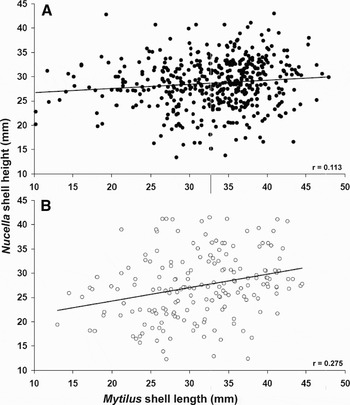
Generally, the correlations were positive (and significant at the P = 0.05 level), except for the observed feeding observations obtained for May 2008 to August 2009 (E), and for the nearby records obtained for May 2004–April 2005 (A), and May 2006–April 2007 (C). The above datasets have been combined in Figure 8 to provide a generalized, overall, picture of the relationship between predator shell height and prey shell length over the total period of the study. For both actual observed encounters (Figure 8A) and for those where a predator was found close to a drilled prey (Figure 8B), the correlations were only slightly positive and significant at the P = 0.05 level. That is, in both cases, the correlations suggest that larger predators feed on larger prey items, but only marginally so.
The combined datasets (Figure 7) for the relationships between the sizes (shell height, mm) of (A) Nucella lapillus observed feeding by drilling on an individual of Mytilus galloprovincialis of known shell length (mm); (B) those observed in close proximity (or nearby) to drilled prey items each month on the Mewsbrook Groyne over the course of the 52-month study.

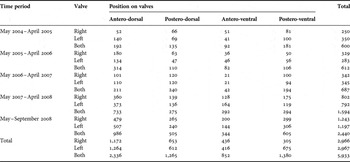
The numbers and positions of drill holes made by N. lapillus in the shells of M. galloprovincialis on the groyne over the study period were counted and identified, respectively, on master outlines of the left and right shell valves (Figures 9 & 10). The dataset was also divided into five time periods as before, from (A) May 2004 to April 2005; (B) May 2005 to April 2006; (C) May 2006 to April 2007; (D) May 2007 to April 2008; and (E) May 2008 to August 2009 (Figure 9). Also identified were the numbers and positions of failed attempts and the sites of multiple drill holes (all described above). There were no significant differences (at the 5% level using a Chi-squared test) between the numbers of attacks on the right and left valves (Table 1), except for the first time period, when significantly more drill holes were recorded from left valves (350) than right ones (250) (χ2: 16.7, P < 0.000).
The positions of the drill holes made by Nucella lapillus in the shells of Mytilus galloprovincialis over the course of the 52-month study on the Mewsbrook Groyne from May 2004 to August 2008. Each pair of valves represents the periods from (A) May 2004 to April 2005; (B) May 2005 to April 2006; (C) May 2006 to April 2007; (D) May 2007 to April 2008; (E) May 2008 to August 2009.

Numbers of drill holes made by Nucella lapillus in the four quadrants of Mytilus galloprovincialis shells (adjusted for quadrant area) on the Mewsbrook Groyne.

Similarly, the positions of drill holes (irrespective of which valve) appeared to be relatively random for the periods from (A) May 2004 to April 2005; (B) May 2005 to April 2006; and (C) from May 2006 to April 2007. For the later periods of (D) May 2007–April 2008 and (E) May 2008–August 2009, however, the drill holes appeared to be more generally focused above the antero-dorsal regions of both valves.
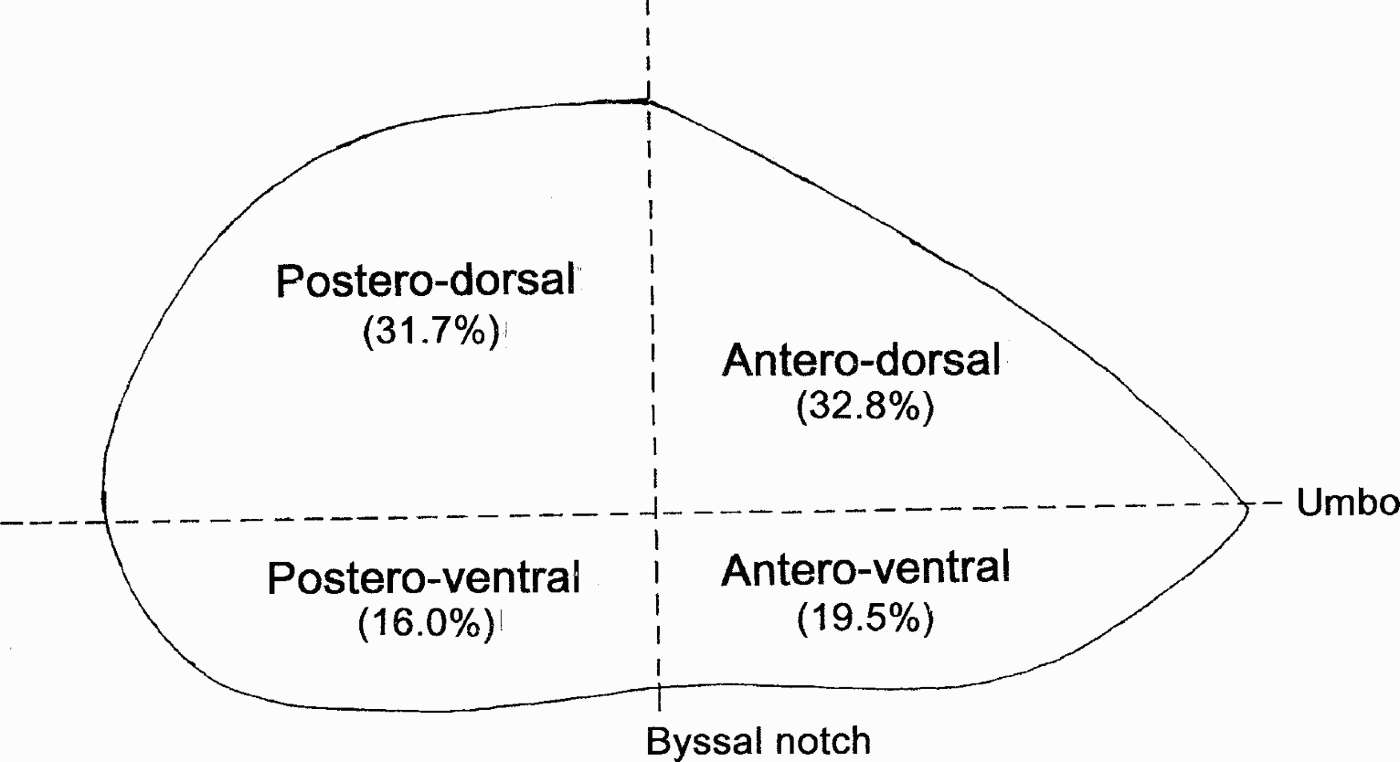
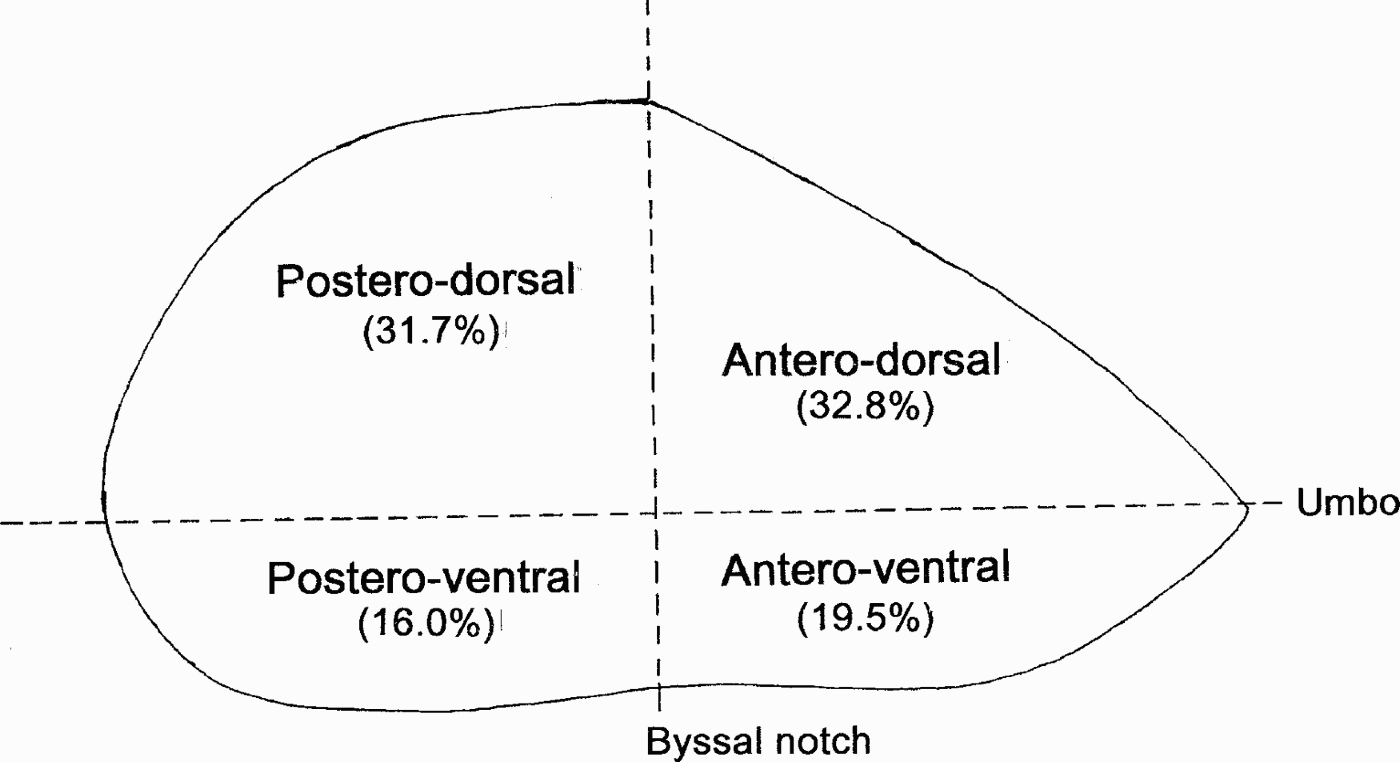
This suggestion was tested for the whole dataset and Figure 10 shows a generalized picture of the numbers of drill holes made by N. lapillus in the shells of M. galloprovincialis over the five years of the study but in relation to the calculated surface areas (in mm2) of the prey's shell valves divided into four regions. These were: (i) antero-dorsal; (ii) postero-dorsal; (iii) antero-ventral; and (iv) postero-ventral, and were defined as (a) above and below the longest shell length from the umbones to the postero-ventral valve margins; and (b) anterior and posterior to the tallest shell height. The four regions were thus of unequal areas in terms of mm2 but the numbers of drill holes in them were adjusted for the differences in such sizes for both left and right valves (Figure 10).
The generalized picture of the numbers of drill holes made by Nucella lapillus in the shells of Mytilus galloprovincialis on the Mewsbrook Groyne over the course of the 52-month study but in relation to the relative areas of the prey's shell divided into antero-dorsal, postero-dorsal, antero-ventral and postero-ventral regions.
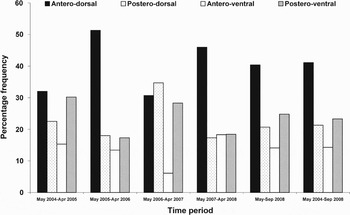
The null hypothesis that the drill holes were distributed randomly between locations on the valves between the different five time periods, that is: (A) May 2004–April 2005; (B) May 2005–April 2006; (C) May 2006–April 2007; (D) May 2007–April 2008; and (E) May 2008–August 2008) was tested using cross tabulation, and rejected (Pearson χ2: 229.5, P < 0.000). The dataset showed that the majority of drill holes were located in the antero-dorsal region of the valves while the fewest were found in the antero-ventral location (Figure 11). Cross tabulation of location on the valves for the different time periods, but layered with respect to occurrence on the right and left valves (Table 1), show similar tendencies of highly significant differences (right valve Pearson χ2: 146.3, P < 0.000; left valve Pearson χ2: 136.6, P < 0.000), and for each time period (χ2 between 42 and 374 (df = 3) at the 0.0% level).
The relative numbers of drill holes made by Nucella lapillus in the four areas (see Figure 10) of the shells (both left and right valves combined) of Mytilus galloprovincialis over the five time periods: (A) May 2004–April 2005; (B) May 2005–April 2006; (C) May 2006–April 2007; (D) May 2007–April 2008; (E) May 2008–August 2009.

In terms of the numbers of attacks recorded over the period of study, they did not differ significantly between the 1st and 2nd time periods, which were (A) May 2004–April 2005 and (B) May 2005–April 2006. Thereafter, however, the numbers of attacks increased significantly between consecutive years (periods B and C (May 2006–April 2007) χ2: 4.3, P < 0.05; periods C and D (May 2007–April 2008) χ2: 360.7, P < 0.000; and periods D and E (May 2008–September 2008) χ2: 177.4, P < 0.000), with >40% of all recorded attacks occurring in the last time period (E), which is in the last five of the 52 months surveyed.
DISCUSSION
The first part of this long-term study (Morton, Reference Morton2009) showed how on the Mewsbrook Groyne on the south-eastern coast of England, progressive freedom from imposex has allowed a population of Nucella lapillus to recover. This was achieved through renewed reproductive success and recruitment resulting eventually in a more ‘natural’ population structure. The second element of this study has revealed that the feeding behaviour of N. lapillus was also affected by imposex. Thus, with renewed recruitment, and hence, as the average age of the individuals making up the population declined, not only did more individuals of N. lapillus start feeding on Mytilus galloprovincialis, but they did so at progressively smaller and smaller sizes and therefore, at progressively younger ages. This study tells us that up to a shell height of ~13 mm, and approximating the first year of life, N. lapillus feeds (apparently exclusively) on barnacles. Thereafter the species shifts to a diet of mainly M. galloprovincialis which it attacks, typically along the antero-and postero-dorsal regions of the shell. Hughes & Dunkin (Reference Hughes and Dunkin1984a) suggested that based on laboratory studies, N. lapillus prefers to feed on barnacles rather than mussels. In the field, it is very difficult to determine if N. lapillus is either attacking a barnacle, which it typically covers, or is in repose. The fact that no N. lapillus individual of <~13 mm shell height was ever seen attacking a mussel however, suggests that under natural circumstances there is a near total dietary change from barnacles to mussels (generally) after the first year of life.
More interestingly is that over time, not only did the numbers of failed drilling attempts on M. galloprovincialis shells by N. lapillus, represented by the incidence of incomplete drill holes, decline but that the attacking dogwhelks progressively focused their attacks on that region of the prey's shell where the most nutritious tissues lie. It is suggested that freed from imposex and presumably the toxic effects of TBT, the feeding behaviour of N. lapillus and its attack success improved to provide it with more nutritious food more expeditiously and efficiently.
The large dataset also suggests that once again over time, as either the density of N. lapillus increased or individual behaviour became more ‘natural’, the incidence of solitary feeding decreased and individuals joined each other at attacked prey. This behaviour can be termed kleptoparasitism and is normally typical of N. lapillus (Hughes, Reference Hughes1986), meaning that the incidence of multiple drill holes in prey shells increased. It is possible that such an increase reflects the higher density of dogwhelks on the shore, but bearing in mind that the overall length of the groyne is 100 m and that the dramatic increase in numbers of individuals was overwhelmingly represented by non-mussel feeding juveniles of N. lapillus, another explanation should be sought.
Aggregative feeding behaviour is characteristic of stable populations of intertidal and subtidal muricids the world over (Morton, Reference Morton and Morton1994; Taylor & Morton, Reference Taylor and Morton1996; Ishida, Reference Ishida2001; Dietl & Herbert, Reference Dietl and Herbert2005). Chemicals released during prey consumption lead to such aggregative feeding, where conspecific neighbours join in after the primary handling of the prey by the initial predator (Taylor & Morton, Reference Taylor and Morton1996; Ishida, Reference Ishida2001; Morton et al., Reference Morton, Blackmore and Kwok2002). Signals can either be the blood leaked from the prey (Ishida, Reference Ishida2001) or chemicals secreted by the predators themselves (Hughes, Reference Hughes1986), but the result is the same—other predators are attracted to either excess or leftover prey. Kleptoparasitism is also energetically advantageous in that less effort is exhausted in accessing a nutritional reward and, as Harper & Morton (Reference Harper, Morton and Morton1997) have pointed out, the energy spent in accessing any prey item is negative until such time as the flesh is reached and ingested.
It is well known that muricids in particular, attack their prey not only in a stereotypical manner but also at a species-specific location on the prey shell, in the case of bivalves. Morton (Reference Morton1999) showed that the predatory whelk Lepsiella flindersi (Adams & Angas, 1863) largely attacked its mussel (Xenostrobus pulex) (Lamarck, 1819) prey along the posterior margin on a south-west Australian shore. However, Kowalewski (Reference Kowalewski2004, figure 7) plotted the distribution of drill holes on an outline of the shell of Mytilus trossulus Gould, 1850 made by Nucella lamellosa (Gmelin, 1791) but could find no evidence of site selectivity. This may have been because, however, the attacks were made on mussels that had been experimentally detached so that all areas of the shell were available for drilling.
Surprisingly, there is limited information available on the locations of attacks made by Nucella lapillus on mussel shells. Hughes & Dunkin (Reference Hughes and Dunkin1984a) suggested, based on a laboratory study, that individuals of N. lapillus maintained on a diet of Semibalanus balanoides preyed upon Mytilus edulis (Linnaeus, 1758) in random positions on the shell initially but subsequently and increasingly selected the ‘thinnest’ part of the shell to drill. The shell of M. edulis however, has a relatively uniform shell thickness (Harper & Skelton, Reference Harper and Skelton1993) and this study suggests that rather the most nutritious tissues, especially under the antero-dorsal regions of the shell, are selected. Of course under natural circumstances the mussel's habit of ventral byssal-attachment exposes the dorsal regions of the shell to attack, as with Lepsiella flindersi attacking Xenostrobus pulex (Morton, Reference Morton1999), but the point is that the attacks made by N. lapillus on M. galloprovincialis in this study were not ‘random’ but stereotypical.
Moreover, with time, the attacks became more and more stereotypical and this is here interpreted as a behavioural response to a release from imposex and thus, TBT poisoning. That is if the assertion by Hughes & Dunkin (Reference Hughes and Dunkin1984a) that inexperienced N. lapillus drill mussel shells in a random manner, then the greatly increased numbers of juvenile dogwhelks identified in this study, as a result of freedom from imposex, should have maintained the ‘randomness’ of recorded attacks. Since they did not, then an alternative explanation of freedom from TBT toxicity might explain why N. lapillus could improve its handling time and hence, profitability, of attacking its mussel prey at the most accessible and, coincidentally, nutritious location.
In conclusion, this study demonstrates that the loss of imposex in a small population of Nucella lapillus, subsequent to the banning of TBT as a component of marine anti-fouling paints, has resulted in: (i) a return to a more ‘normal’ population size and structure, and renewed reproductive vigour, as a result of the regaining of female fertility (Morton, Reference Morton2009); and also (ii) a return to a feeding behaviour more typical of muricids in general, and this species in particular (this study). As a consequence, it is anticipated ultimately, that a more natural intertidal (and subtidal) ecology will be regained on the Mewsbrook Groyne as the dogwhelk population regains its traditional status and role as a keystone predator.
ACKNOWLEDGEMENTS
I am grateful to K.F. Leung, Environmental Protection Department, Hong Kong SAR Government and G. Dinesen, Danish Technological University, Denmark, for statistical advice and assistance with figure production, respectively.