INTRODUCTION
Race is popularly understood as self-evident and easily appraisable by outsiders. Despite the presumption that “we know race when we see it,” a growing literature demonstrates racial identities do not always align with perceptions of race, with individuals who self-report as Latinx or multiracial being especially likely to be interpreted differently (Feliciano Reference Feliciano2016; Porter et al., Reference Porter, Liebler and Noon2016; Roth Reference Roth2010; Saperstein Reference Saperstein2006). Social science information on moments when this occurs usually involves interactions between presumed strangers. For example, 10% of proxy responses given to census takers on their neighbors provided a race that the neighbor did not claim (Porter et al., Reference Porter, Liebler and Noon2016; see also Vargas and Stainback, Reference Vargas and Stainback2016). While this underlines the fact that race is a social construction, built out of perceptions that carry a range of meanings and context-bound information (Roth Reference Roth2016), it also indicates something about the nature of the relationship between the perceiver and perceived. Self-reported race exists as a facet of identity that can be shared with other individuals, and this may be especially the case in the context of a close relationship. But when individuals know each other, do they necessarily know each other’s race?
We argue that intimate unions are a potentially meaningful, though largely untapped, context for assessing the dynamics of perceiving ethnic and racial categories (see Berry et al., Reference Berry, Phinney, Sam and Vedder2012; Boda Reference Boda2018; Vargas and Stainback, Reference Vargas and Stainback2016). However, much of the work on race as observed draws on what are likely brief encounters with the individuals being perceived (Feliciano Reference Feliciano2016; Noymer et al., Reference Noymer, Penner and Saperstein2011; Saperstein Reference Saperstein2006), such as interviewers or health officials. While informative on the ways external information can shape how racial labels are ascribed, knowing a person as a friend or intimate partner presumably sharpens that information towards an understanding aligning with an individual’s identity. Put simply, knowing someone, particularly well, implies knowing his or her race. Left unexamined, however, is the way relationships or traits of individuals within relationships can pattern whether self-reported race and reports from observers align. This raises an important question for the ways racial appraisal operates: are there aspects of relationships, or even traits of partners, that drive the consistency or inconsistency between self-reported race and race as observed?
This study explores this question by leveraging data from the Fragile Families and Child Wellbeing Study (FFCWS). This dataset represents a longitudinal study of a cohort of new mothers and fathers in large U.S. cities in which relationships between child-bearing partners span marriage, cohabitation, friendship, and even having no relationship. Although separate surveys are administered to both mothers and fathers, mothers are also asked some questions about fathers to ensure information about the father is included even if he is unreachable or declines to answer questions. Race and Hispanic origin are among the data gathered in this survey, allowing for a comparison of self-reported race (i.e. from the fathers) to the observed reports provided by the newborns’ mothers. We explore the frequency and the relational predictors of racial matches and mismatches—cases where a mother’s reports of race and Hispanic origin of their newborn’s father differ from the father’s self-report.
Exploring the appraisal of race/ethnicity between intimate partners presents several contributions to the study of race as a socially constructed experience, along with informing the measurement of racial composition of couples. This is the first study to investigate the extent to which self-reported race differs from perceived race within the context of intimate unions, contributing insight to the contexts and interactions that work in concert to produce the social construction of race (Roth Reference Roth2016). This research also offers insight into how endogamous norms manifest not only in mate selection (Rosenfeld Reference Rosenfeld2008; Steinbugler Reference Steinbugler2012) but also within formed romantic relationships, specifically by examining whether racial mismatch between couples tends to produce racial similarity or racial difference between partners. Finally, this study has bearing on the data collection of unions, which are largely drawn from one representative (e.g. householder) on behalf of co-residents. Notably, information provided by a representative of a family unit, even in the case of two parents of the same child, does not always align with self-reports by other family members (Casper et al., Reference Casper, Eby, Bordeaux, Lockwood and Lambert2007; Coley and Morris, Reference Coley and Morris2002; Emerson et al., Reference Emerson, Felce and Stancliffe2013; Hofferth Reference Hofferth2005). Understanding whether these inconsistencies extend to the reports of a partner’s race has implications for estimates of intra- and interracial couples, for example, and informs our theoretical understanding of race construction within the familial context.
BACKGROUND
Intimate Partnerships and Racial Ascription: A Multidimensional Approach
The formation of intimate unions is a primary site where race is socially constructed (Burton et al., Reference Burton, Bonilla-Silva, Ray, Buckelew and Freeman2010; Joyner and Kao, Reference Joyner and Kao2005; Kalmijn Reference Kalmijn1998). The racial composition of couples highlights the ways race persistently represents a key criterion for mate selection (Kalmijn Reference Kalmijn1998; Robnett and Feliciano, Reference Robnett and Feliciano2011; Yancey Reference Yancey2009). Despite increasing interracial union formation over time (Fu Reference Fu2010; Qian and Lichter, Reference Qian and Lichter2011), racial endogamy remains a cultural and behavioral norm (Rosenfeld Reference Rosenfeld2008; Steinbugler Reference Steinbugler2012), signaling the durability of boundaries between racial groups (Qian and Lichter, Reference Qian and Lichter2007; Vasquez Reference Vasquez2015). Although attitudes stigmatizing intermarriage have declined significantly (Herman and Campbell, Reference Herman and Campbell2012; Perry Reference Perry2012), marital partners and, to a lesser extent, cohabiting couples are still more likely to match on racial background than education or religion (Rosenfeld Reference Rosenfeld2008; Sassler Reference Sassler2010). In fact, studies of online dating reveal that race is frequently used to narrow the field of potential matches, revealing clear exclusions that reinforce racialized hierarchies through excluding African American and other non-White partners (Lundquist and Lin, Reference Lundquist and Lin2015; Robnett and Feliciano, Reference Robnett and Feliciano2011; Yancey Reference Yancey2009). Patterns of assortative mating and preference underline how seeing and understanding race is central to union formation.
Beyond patterning who we select, norms around racial sameness may shape how we perceive and interpret the race of partners. Prior work reveals that race can be interpreted as either aligning with or diverging from the identity of the perceived (Feliciano and Robnett, Reference Feliciano and Robnett2014). According to the multiple dimensions framework, race is experienced as a series of interconnected dimensions (López et al., Reference López, Vargas, Juarez, Cacari-Stone and Bettez2017; Roth Reference Roth2016; Saperstein and Penner, Reference Saperstein and Penner2012) which segment race as self-identification from race as observed by outsiders (Roth Reference Roth2010; Saperstein Reference Saperstein2006). This framework draws analytical insight from incidences of racial mismatch, or instances in which race as identified and race as observed differ (Campbell and Troyer, Reference Campbell and Troyer2007; Roth Reference Roth2010; Song and Aspinall, Reference Song and Aspinall2012). The possibility of mismatch varies clearly by race/ethnic group. The large majority of White and Black adults are observed as a race that matches their self-report (Penner and Saperstein, Reference Penner and Saperstein2013; Saperstein and Penner, Reference Saperstein and Penner2012), while 10% to as high as 50% of self-reported Latinx individuals, Asians, Middle Easterners, or American Indians are racially identified by a third party (e.g. an interviewer) in ways that do not line up with their reported identities (Boda Reference Boda2018; Song and Aspinall, Reference Song and Aspinall2012; Vargas and Stainback, Reference Vargas and Stainback2016). Patterns of racial mismatch are variable but demonstrate that observed race operates and is read independently from identity.
Given the possibity of mismatches and a context in which romantic racial sameness is a norm, might romantic partners “see” relationships as racially endogamous even if their partner’s racial identification differs? Exploring this requires more nuance in data gathering on racial perception. Indeed, an unspecified level of racial mismatch can occur in day-to-day interactions, but most of what we know leverages survey or administrative data that taps the racial perceptions of a “generalized other”, or anonymous persons we interact with briefly. These patterns are revealed through creative comparisons of racial self-reports with race reports provided by an interviewer (Campbell and Troyer, Reference Campbell and Troyer2007; Laster Pirtle and Brown, Reference Laster, Whitney and Brown2016; Saperstein Reference Saperstein2006), a proxy respondent (Porter et al., Reference Porter, Liebler and Noon2016), health officials (Frost et al., Reference Frost, Taylor and Fries1992; Kressin et al., Reference Kressin, Chang, Hendricks and Kazis2003; West et al., Reference West, Geiger, Greene, Harris, Liu, Barton, Elmore, Rolnick, Nekhlyudov, Altschuler, Herrinton, Fletcher and Emmons2005), or how a respondent believes they are seen by “other Americans” (Vargas Reference Vargas2015). Additionally, racial ascription is explored through studies gauging the interpretation of racially ambiguous phenotypes in experimental settings (Franco and Franco, Reference Franco and Franco2016; Khanna Reference Khanna2010; Rockquemore and Brunsma, Reference Rockquemore and Brunsma2002; Roth Reference Roth2010). Studying perceptions of unknown persons can expose the role of racial stereotypes that are cued in these moments of appraisal and which guide racial ascriptions (Feliciano Reference Feliciano2016; Freeman et al., Reference Freeman, Penner, Saperstein, Scheutz and Ambady2011; Saperstein and Penner, Reference Saperstein and Penner2010, Reference Saperstein and Penner2012). While these assessments have shown that such information can shape how race is perceived, they explore a narrow range of interactions that individuals encounter.
Encounters where individuals are known to each other, by contrast, are under-explored as sites where processes of racial ascription are operating. Little (if any) systematic information has examined the prevalence of racial mismatch between individuals in established relationships. This is surprising, as qualitative studies of racial and ethnic identity formation commonly reference the varied ways friends or even family members perceive race. Racial identity is often conceptualized as inherently interactional, resulting from negotiations between individuals and those who perceive them (Khanna Reference Khanna2010; see also Rockquemore and Brunsma, Reference Rockquemore and Brunsma2002). Language, culture, and history inform the interpretation of racialized phenotypes (Boda Reference Boda2018; Khanna Reference Khanna2010; Lee and Bean, Reference Lee and Bean2010; López et al., Reference López, Vargas, Juarez, Cacari-Stone and Bettez2017; Ocampo Reference Ocampo2016). Outsiders are often invested in viewing race in a particular way, specifically if it confirms stable notions of how race/ethnic categories are composed. Similarly, those who are perceived respond to or even drive these impressions by adopting performative strategies (e.g., “acting Black”, “acting White”) to guide how they desire to be understood (Khanna Reference Khanna2010; see also Rockquemore and Brunsma, Reference Rockquemore and Brunsma2002). Taken together, these works reveal that race continues to be a dynamic concept among people who know each other well.
Constructing Race “Intimately”: Dynamics of Mismatch when Race is Reported with Public Data
The current work explores two different facets of how intimate partnerships may operate as a potential landscape where racial mismatch can occur. First, a partner’s racial appraisal may generate a racial mismatch if they view the race of their partner differently from how that partner identifies (e.g. a person understandinging their partner as Latinx when the partner identifies as White). The social dynamics that generate mismatches may extend to these established relationships. Exploring whether mismatches occur can reveal the ways that social and situational contexts have bearing on racial appraisals, even among individuals that know each other intimately.
Second, these mismatches can be parsed further to signal whether individauls view their partners as racially/ethnically similar to or different from themselves. Prevailing norms of endogamy and racial sameness may shape how these mismatches intersect with the race of the perceiver, specifically towards certain types of racial consistency or inconsistency. An adult may see their partner as Latinx, even as that person identifies as White, if they themselves are Latinx. Appraising this type of consistency points to circumstances where a partner “sees sameness” between themselves and their partner, even when that partner self-identifies as a different race/ethnicity. This is distinct from a racial appraisal that generates inconsistent readings between one’s self and their partner, or “seeing difference”. Social tendency towards coupling within racial groups suggests that should mismatches happen at all, individuals may interpret their partner’s race as consistent with their own racial identity, rather than perceive difference.
Drawing out these dynamics of racial perception for intimate partners can inform how we conceptualize and measure intra- and interracial coupling. The prevalence of interracial romantic unions is considered a “litmus test” of race relations. Conceptually, they signal circumstances in which individuals are willing to engage mutually understood racial differences (Kalmijn Reference Kalmijn1998; Qian and Lichter Reference Qian and Lichter2007; Vasquez-Tokos Reference Vasquez-Tokos2017). Interracial romantic unions, marital or cohabiting, have persistently been highest between Asians and Whites and Hispanics and Whites, and least common between Blacks and Whites, reflecting group-level social distances occurring in a range of domains (Qian and Lichter Reference Qian and Lichter2007, Reference Qian and Lichter2011). These distances become less clear as racial mismatch informs whether a couple would be defined as an interracial couple and how individuals interpret racial differences. For example, a person who understands themselves as “White”, but is seen as “Latinx” by a partner who identifies herself as “Latinx”, would describe their union as interracial, while their partner would not. Conceptually, this means that while one party sees themselves as crossing a racial line, the other party understands that they are adhering to endogamous norms.
Mediating the ways partners report the race of themselves and their partners, however, is the nature of racial and ethnic data collection itself. This collection of information requires individuals to articulate their race within a specific range of categories that are preset, institutionally generated, and monitored (Mora Reference Mora2014; Perez and Hirschman, Reference Perez and Hirschman2009). Such categories or organizations of categories are often in tension with the labels individuals would apply for themselves (Dowling Reference Dowling2014), producing scenarios where individuals often do not “see themselves” on forms. A key example is the querying of “Hispanic origin” as a question that is separate from a question on “race”. While many perceive Hispanic as a racial category, alongside other categories such as “White” and “Black” (Dowling Reference Dowling2014; Frank et al., Reference Frank, Akresh and Lu2010; Golash-Boza and Darity, Reference Golash-Boza and Darity2008; Roth Reference Roth2010, Reference Roth2016), the U.S. Census (and many other social surveys) places reports of Hispanic origin into its own question. These responses intersect with race responses, thus requiring respondents to declare their identification as composed of race and Hispanic-origin (e.g. White–Hispanic, Black–Hispanic, White–Non-Hispanic). Given the possible options in reporting race/ethnicity for Hispanic persons, we anticipate a heightened level of inconsistency between observed and self-reports (i.e. mismatch) when reporting both race and Hispanic origin for one’s partner.
The meaning behind race declarations for Hispanic individuals is debated. While some presume it conveys information on racialized characteristics such as skin color (Frank et al., Reference Frank, Akresh and Lu2010), it may also inform notions of American identity. Notably, many choose to “opt-out” and declare “some other race” on their forms (Dowling Reference Dowling2014; Roth Reference Roth2010). A small, but growing, body of literature attempts to understand the dynamic nature of racial and ethnic categories through the lens of outsiders (Abascal Reference Abascal2020; Roth Reference Roth2018; Wade Reference Wade2005). For example, Maria Abascal (Reference Abascal2020) finds wide variability in whether an individual is classified as “Hispanic” by outsiders and that this perception is related to different contextual characteristics. This work highlights the possibility of divergence between outsiders’ perceptions of “Hispanic” and self-identification as such, while further suggesting that these perceptions are linked to other social characteristics (Abascal Reference Abascal2020; Wade Reference Wade2005). However, these studies rely on the appraisals of strangers, and it is an open question as to whether the same level of ambiguity in identification and perception exists among individuals within an established relationship. Understanding the likelihood that ethnic-racial designations are perceived and validated externally can further unpack how the public understands these designations and the differences between them.
Factors Driving Racial Mismatch within Intimate Unions: Research Hypotheses
We consider various social processes that shape racial appraisals in relationships. We may anticipate at the outset that members of race/ethnic groups who are most likely to be perceived differently than they identify, such as Latinx adults (Vargas and Kingsbury, Reference Vargas and Kingsbury2016; Vargas and Stainback, Reference Vargas and Stainback2016), would be the most likely to experience racial mismatch in intimate unions, while self-identified Whites or Blacks would be least likely to encounter mismatch. This may be particularly common given the broader debates on the way that the measurement of race and ethnicity conflicts with how the public understands these concepts. In the section below, we consider the various factors that may drive or facilitate racial mismatch between intimate partners. We theorize that the stability of their relationship, social status characteristics of the perceiver and perceived, and the investment in perspectives on race-related matters inform whether racial appraisals generate racial mismatch or consistency within an intimate union.
Beyond race of the perceiver or the perceived, we anticipate that aspects of relationships that shape how racial information is presented and understood will drive whether an individual’s report of their partner’s race/ethnicity aligns with their partner’s identification, as well as whether they view this race/ethnic designation as consistent with their own stated identification. We begin with the presumption that the amount of information one receives about their partner is directly related to the amount of time individuals spend with each other or the strength of ties between the partners. As prior explorations of racial mismatch draw from superficial or brief encounters, information that provides insight into one’s race is likely improved with more time spent.
Therefore, the stability or duration of a relationship is likely to affect how race is appraised, with longer relationships or stronger ties leading to more information. Longer or more established relationships (i.e. marital/co-residential) may lend themselves to explicit discussions of racial identity that can facilitate sharper understandings of the way partners would classify themselves. This suggests a degree of intimacy that may (or may not) include an appraisal of race that is more likely to be closer to the stated identity of their partner when compared to shorter or less stable relationships. Intact relationships or relationships of considerable length likely provide a range of information that would result in more alignment between identification and observation. Therefore, we expect that established intimate unions or those that are longer lasting, regardless of their current standing, are less likely to produce a mismatch.
H1: Racial mismatches are negatively related to relationship duration and are less likely when couples either co-reside or are married.
In addition, the relative social status standings of couples may also impact how race is perceived and understood, particularly given how it is presented on forms. As prior work has shown that social status attributes can inform the likelihood of understanding a person as a member of a privileged or stigmatized group (Penner and Saperstein, Reference Penner and Saperstein2013; Stepanikova Reference Stepanikova2010), navigating racial classification of self and others may be patterned across socioeconomic lines. Status characteristics such as being unemployed and having been incarcerated have been shown to shape how race is perceived by others (Penner and Saperstein, Reference Penner and Saperstein2013). Further, given the range of public responses to the presentation of race and Hispanic origin questions (Dowling Reference Dowling2014), familiarity with social institutions that request racial data may lower the likelihood of providing mismatched reports. Beyond familiarity with data, highly educated individuals may be more invested in conversations around race that may depress the likelihood of mismatch. We anticipate that individuals exposed to environments such as paid work, or a university setting, will be more familiar with dynamics of race reporting.
H2: Racial mismatches are more likely for couples with limited exposure to status-oriented environments, such as paid work or college education.
Finally, ideologies or beliefs that appear to support endogamous norms may also impact how race is understood. Such beliefs may produce racial consistency with the observer—that is, individuals may be especially inclined to “see” their surroundings or their relationships as racially homogenous. Similar to the ways racially stereotyped beliefs can inform racial ascription (Freeman et al., Reference Freeman, Pauker, Apfelbaum and Ambady2010), certain attitudes may guide how couples interpret each other’s race. Norms of homogamy are a powerful context for relationship formation (Van Zantvliet and Kalmijn, Reference Zantvliet, Pascale and Kalmijn2013) and persist as a cultural norm within families (Kalmijn Reference Kalmijn1998; Steinbugler Reference Steinbugler2012). Investment in racial homogamy may reflect built-in preferences to see certain attributes or identities that may not be present when relying on the partner’s self-identification. Additionally, strongly identifying with a racial/ethnic group may influence how race/ethnicity is expressed within a romantic relationship. Holding and encountering perspectives that convey race as salient may shape the likelihood of mismatch in a direction that confirms ideological positions.
H3: Racial mismatch is shaped by attitudinal perspectives that emphasize the importance of norms of racial endogamy or race as salient to day-to-day living. Specifically, perceiving race as meaningful is more likely to generate reports of racial consistency between perceivers and the perceived.
DATA AND METHODS
Data and Sample
Investigating racial mismatch and consistency/inconsistency requires unique sets of data that provide information on one person’s race and Hispanic origin from at least two individuals. As we discuss above, while most surveys and demographic databases provide self-reported race and ethnicity, a share of surveys also gather this information on individuals from sources who observe respondents, usually an interviewer or a proxy for the respondent. However, we draw on one of the only (if not the only) datasets that provides both self-reported and observer reported race and ethnicity information where the observer has an established relational tie to the person they are perceiving. The Fragile Families and Child Wellbeing Study (FFCWS) is a longitudinal dataset of parents of recently born children where both mothers and fathers are surveyed. These data were gathered between 1998 and 2000 within a random selection of hospitals within twenty U.S. cities with populations of 200,000 or more (Reichman et al., Reference Reichman, Teitler, Garfinkel and McLanahan2001). This survey aims to tap experiences of family disadvantage and poverty and, therefore, an oversample of unmarried parents is included, comprising roughly three-quarters of nearly 5000 births (Reichman et al., Reference Reichman, Teitler, Garfinkel and McLanahan2001). In addition, the geographic scope of the sampling frame is unique as sixteen of these cities were selected based on a random sample of U.S. cities with populations over 200,000, and four were included in the study because of distinctive policy and economic environments that cover a range of social and public safety nets.
This dataset is ideally suited for exploring how the multidimensionality of race and Hispanic origin unfolds within intimate unions. These data include couples that are both resident and non-resident, providing a range of relationships where race and Hispanic origin are interpreted. Although the data are approximately twenty years old, the FFCWS is one of the only data sources that queries race, Hispanic origin, and other information of both mothers and fathers and asks mothers questions about her child’s birth father. We acknowledge that this time point precedes important shifts in the collection of race data, such as the inclusion of multiple-race reporting; however, it includes the separation of race and Hispanic origin that is employed currently in federal data collections (Office of Management and Budget 1997). Mothers and fathers are also asked about their race and ethnicity at the time of the baseline wave; they are not asked to re-report at later waves. Although fathers are asked their race and ethnicity at a later wave if they are not reachable at the baseline wave, all of the mother’s reports of the father’s race, the mother’s self-reports, and self-reports from the reachable fathers are asked at baseline. We restrict our analyses to data from the baseline survey.
While 4898 mothers were sampled at the time of the baseline survey, fewer fathers (n=3830) were reachable and agreed to participate in the study (Bendheim-Thoman Center 2008). Inclusion in our analytic sample requires valid information on both mother’s and father’s reports of their own race and Hispanic origin and reports by the mother of the father’s race and Hispanic origin. A total of 167 cases were dropped due to missing information on either of these items. An additional 196 cases were dropped due to missing information on independent variables. We employ listwise deletion to handle missing data, resulting in a final sample size of 3467 pairs of parents.
Variables
Race/Ethnic Identification of Mothers and Fathers
Prior to describing mismatch, we will first outline the collection of race and Hispanic origin data in the FFCWS as well as the related variables. The FFCWS collects race and Hispanic origin from mothers and fathers with two separate questions within the FFCWS baseline survey, collected shortly after the child’s birth. Both mothers and fathers are first offered a list of categories and asked what category “best describes” their race. Possible responses include White, Black, Asian, American Indian, and Other. The second question asks if the respondent is of Hispanic or Latino origin or descent. Mothers, after self-reporting their own race and Hispanic origin, are asked to specify the race and Hispanic origin of the father of their newborn. Our approach to assessing mismatch between the mother’s and father’s reports of race and Hispanic origin is described in more detail below.
Relationship Variables
To test our first hypothesis, we adjust for the relationship status between the mother and father and the length of the relationship, both drawn from the mother’s report. Relationship status is coded as a categorical variable [1=married (reference), 2=cohabitating, 3=dating, 4=friends, 5=no relationship]. Length of the relationship, also provided by the mother, is a categorical variable indicating how long the mother has known the father [1=less than 1 year (reference), 2=1–3 years, 3=more than 3 years].
Sociodemographic Characteristics
We include theoretically relevant variables to capture demographic and status-orientated traits of the father that may influence how he is racially perceived by others (see Penner and Saperstein, Reference Penner and Saperstein2008). These come both from self-reports of the mother and self-reports of the father. The father’s employment status, provided by the father, is coded from a variable in the baseline data indicating whether he did regular work for pay in the past week or not (1=employed and 0=not employed). Parents’ college attainment indicates the exposure of both parents to college education. It is drawn from mother’s and father’s reports on their education and is coded as 1=neither parent attended college (reference), 2=only mother attended college, 3=only father attended college, 4=both parents attended college. Finally, we include a dichotomous indicator representing whether the father has ever been incarcerated (1= been incarcerated and 0=has not).Footnote 1
Racial Attitudes
FFCWS includes several attitudinal measures capturing perspectives on racial issues, including racial difference within families and orientation towards racial identity. Both parents are asked whether being of the same race/ethnic group is important to a successful marriage, with responses ranging among very important, somewhat important, and not important. The responses are collapsed into a dichotomous variable (1= is very/somewhat important for a marriage and 0=is not important). This measure is included for both the mother and father. We also include a measure of the centrality of the father’s racial identity with a response to a question about whether he feels an attachment toward his racial/ethnic group; this measure is collapsed into categories of “feels attachment” (including responses of strongly agree and agree) and “does not feel attachment” (including disagree and strongly disagree) for this study.
Control Variables
Several characteristics may shape the mother’s perception of the father’s race outside of the dimensions outlined above and are therefore accounted for in all analyses. These control variables include self-reports of the mother’s race/ethnicity, mother’s age, mother’s and father’s foreign-born status, and the region of residence. Mother’s race is a categorical variable coded as 1=non-Hispanic White (reference), 2=non-Hispanic Black, 3=Hispanic (all racial groups), 4=all other races.Footnote 2 Mother’s age is coded as a continuous variable, indicating her age at the time of the baseline survey (range=15–43). Foreign-born status of both the mother and father is coded as a dichotomous variable (1=foreign-born and 0=born in the U.S.). Region of residence is constructed from information on the city in which the mother lives, drawn from restricted-use FFCWS data [1=Northeast (reference), 2=South, 3=Midwest, 4=West].
Classifying Mismatch: Considering Race and Hispanic Origin
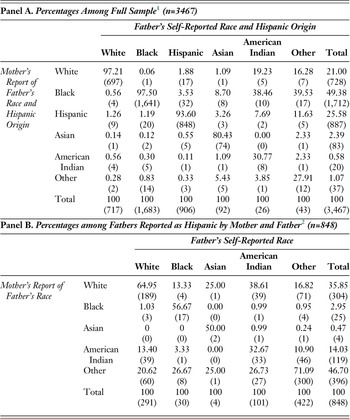
To capture mismatch, we begin with cross-classifications of father’s self-reported race/ethnicity and mother’s report of his race/ethnicity. To account for the various ways in which race and Hispanic origin are rendered in surveys (as well as public discourse), we show two ways this mismatch can occur in Table 1 across two panels. First, we show the prevalence of mismatch where Hispanic ethnicity is situated as a “race” alongside other groups; thus, all reports of fathers as Hispanic, regardless of race reports, are aggregated into one category (see Panel A). Therefore, matches and mismatches in Panel A refer to discordance across a conventional set of race/ethnic categories (e.g. non-Hispanic White, non-Hispanic Black, Hispanic, non-Hispanic Asian, etc.), with a collapsed Hispanic category.
Mother’s Report and Father’s Report of Father’s Race and Hispanic Origin

1 Percentages reflect the number of fathers by mothers’ report of their race and Hispanic origin (numerator) among all fathers who self-report this race and Hispanic origin category (denominator). Frequencies in parentheses.
2 Percentages reflect the number of Hispanic fathers by mothers’ report of their race (numerator) among Hispanic fathers who self-report this race category (denominator). Frequencies in parentheses.
Source: Fragile Families and Child Wellbeing Study, Baseline Wave
In Panel B, we utilize the full range of detail in race and Hispanic origin to identify matches and mismatches in reports of father’s race/ethnicity. This panel captures differences in reports of the father’s race among fathers who were reported as Hispanic by both mothers and fathers. (If one parent reported the father as Hispanic and the other did not, this mismatch would be captured in Panel A.) Experiences of Latinx groups often differ based on reported race, and these distinctions within the Hispanic category are particularly important to capture, as ideas on what constitutes racial difference among this group are in flux (Dowling Reference Dowling2014; Roth Reference Roth2010). We, therefore, account for the potential that how individuals see race is layered in how partners combine their responses to Hispanic origin and race reports. For example, if a mother reports the father’s race and Hispanic origin as “Hispanic White” and he reports himself as “Hispanic Other”, this is classified as a mismatch. A match occurs when the mother describes her newborn’s father with the same combination of race and Hispanic origin categories.
Turning first to Panel A, we find a great degree of concordance between mothers’ reports of fathers and the father’s self-reported background. Percentages in this table represent the number of fathers within each corresponding racial category of the father’s self-report and the mother’s report, over the column total. Numbers along the diagonal represent concordant reports. For example, 97.21% of fathers of newborns who self-report as White (non-Hispanic) are reported as White (non-Hispanic) by the mothers of those newborns, with similar levels of concordance among Black fathers (97.5%) and Hispanic fathers (93.6%). Discordance is relatively rare. In total, 187 fathers, or 5.4% of sampled fathers, report race/ethnic categories that do not match the mother’s report of their background. A little more than one percent of self-reported Black fathers are perceived as Hispanic by their newborn’s mother. Nearly two percent of self-reported Hispanic fathers are reported as White, while 3.53% are reported as Black. Less than 3% of all self-identified White fathers are reported as non-White by their newborn’s mother. Meanwhile, nearly 20% of Asian-identified fathers are reported using a non-Asian label by their child’s mother, and the majority of self-reported American Indian and Other Race fathers had discordant reports. The majority of mothers report these men as either White, Black, or Hispanic.
We next provide a more detailed exploration of the concordance of race and Hispanic origin reports (see Panel B), where we gauge race mismatch among fathers who are both self-reported and observed as Hispanic. Although there is still a substantial amount of concordance between the mother’s and father’s report of the father’s race, we see a relatively greater degree of racial mismatch among this group, with 307 Hispanic fathers perceived as a different racial category than they report. Around 64.95% of self-reported Hispanic-White fathers are reported as Hispanic-White by the mothers. We find even less concordance among Hispanic-Black fathers (56.67%). The highest degree of concordance occurs among self-identified Hispanic-Other Race fathers, as 71.09% are also reported as such by their newborn’s mother.
The forthcoming analyses define mismatch as any incidence of conflict between race and Hispanic origin responses. The prevalence of mismatch includes 187 cases from Panel A and 307 cases in Panel B, resulting in a total of 494 cases experienced by 14.25% of the sample. Our analyses capture this mismatch with a dichotomous measure indicating either discordance or matching between mothers’ and fathers’ reports of fathers’ race (1=mismatch and 0=matching reports).
Types of Mismatch: Seeing Racial Consistency Versus Difference
We further gauge a relational dimension of mismatch by measuring how these reports coincide with the mother’s report of her own race and Hispanic origin. We subdivide the incidence of mismatch between two types: (1) those where the mother sees racial similarity (i.e. mother’s mismatched report of the father’s race and ethnicity aligns with her own self-reported race and Hispanic origin) and (2) those who perceive difference (i.e. mother’s mismatched report of the father’s race and Hispanic origin conflicts with her own race and Hispanic origin). Mothers must report the father as the same race and Hispanic origin as herself to be classified as perceiving similarity and report a difference on either to be categorized as perceiving difference.
Analytic Strategy
We begin examining the relationship between the independent variables and both types of racial mismatch by exploring the distributions of mismatch within each category of our independent variables. These patterns are then placed in a multivariate context, where we test the influence of each set of factors in shaping the likelihood of mismatch with logistic regression models, net of controls. The final model includes all independent measures. Firth logistic regression models are used to assess relationships. This modeling technique is ideal as our outcome is relatively unlikely among our respondents. Of the more than 3500 mothers, only close to 500 report any racial mismatch, with even smaller counts when divided by type (i.e. mismatches in which the mother perceives similarity or difference). Firth regression reduces issues of small-sample bias when conducting maximum likelihood estimation (Allison Reference Allison2012; Firth Reference Firth1993). Unfortunately, Firth regression is not possible with a trichotomous outcome, so the analysis is conducted with two logistic regressions that mirror a multinomial approach. Therefore, we predict all outcomes in separate analyses, restricting the analytic sample to matched reports and any mismatched reports (n=3467), matched reports and mismatched reports in which the mother perceives similarity (n=3316), and matched reports and perceptions of racial difference (n=3124), respectively. We have estimated comparable models with multinomial logistic analyses which produce highly similar results (analyses available upon request). All analyses were conducted with Stata 15.0.
RESULTS
Bivariate Analyses
Sample Characteristics
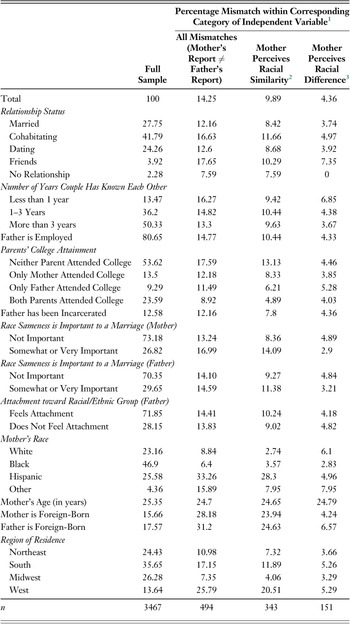
The first column of Table 2 (to the left of the vertical line) shows the composition of the sample of FFCWS mothers at baseline. Most mothers in the FFCWS have co-residential ties, as 27.75% of mothers are married to their child’s father and 41.79% are cohabiting, with the remaining listing the father as “dating”, “friends”, or “no relationship”. Half of the mothers have known the father for more than three years, while 13.47% have known him less than a year. College education is not commonly shared among parental pairs. Over half of parental pairs include mothers and fathers who have never attended college, and both parents attended college in 23.59% of the sample. Around half of the mothers self-identify as non-Hispanic Black and approximately one quarter self-identify as non-Hispanic White or Hispanic. Mothers are, on average, 25.35 years old and are largely U.S. born, with only 15.66% of mothers in the sample born outside of the United States. Similarly, close to 18% of fathers are foreign-born. The sample is geographically dispersed, as around a quarter live in the Midwest or the Northeast, almost 36% live in the South, and roughly 14% live in the West.
Distribution of Racial Mismatch between Mother’s and Father’s Report of Father’s Race across Independent Variables (Fragile Families and Child Wellbeing Study, n=3467)

1 Percentages reflect the number of mismatches (numerator) over the number of respondents within the corresponding category of the independent variable (denominator). Percentages of mothers that perceive racial similarity and perceive racial difference sum to all mismatches.
2 Racial similarity refers to cases in which mother’s report of the father’s race matches her race.
3 Racial difference refers to cases in which mother’s report of the father’s race does not match her race.
Distribution of Race Mismatches
The remaining columns of Table 2 show three indicators of mismatch: percent of any mismatch, mismatches where the mother perceives racial similarity (i.e. her report of the father’s race matches her race self-identification) and mismatches where the mother perceives racial difference (i.e. her report of the father’s race conflicts with her self-identification). The percentages in these columns represent the number of mismatches (numerator) over the number of responsents within the corresponding category of the independent variable (denominator). Within each row, the percentages of mothers who perceive racial similarity and who perceive racial difference sum to the percentage within the “all mismatches” category. We present the percent of race mismatches overall (in the top row) and the percent for each category of the independent variables. Overall, 14.25% of the mothers report their newborn’s father’s race differently than the father himself, 9.89% perceive racial similarity between themselves and their newborn’s father, and 4.36% perceive racial difference. In other words, among instances in which the mother reports the father as a different race or ethnicity than he self-identifies, the majority represent cases in which the mother perceives racial sameness between herself and the father.
In the remaining columns, we explore the association between independent variables and racial mismatch. We find that relationship stability generally corresponds to lower levels of mismatch. Around 17% of cohabiting mothers and 18% of mothers who list their newborn’s father as a friend provide mismatched reports, compared to roughly 12% of married mothers. Interestingly, the lowest level of mismatch (7.59%) occurs among mothers who report no relationship with the child’s father. While this is counter to expectations, it is also a small and heterogeneous category, including parents who may previously have been a couple but are currently not together. Mismatches are more frequent among short lived relationships, as 16.27% of mothers who have known the father less than a year report a mismatch, compared to only 13.3% of those who have known the father for more than three years.
Relative education and racial perspectives also shape mismatch. Only 8.92% of mothers in more educated couples (i.e. where both mothers and fathers have some exposure to college) report a mismatch, compared to 17.59% of mothers in couples where neither party attended college. Perspectives about race also shape mismatch, as nearly 17% of mothers that feel that being of the same race/ethnic group is at least somewhat important to a marriage report a mismatch, compared to around 13% who feel racial sameness is unimportant. This perspective shapes the type of mismatch mothers report. Fourteen percent of mothers who see racial sameness as important to a marriage report a mismatch where they see racial similarity, while less than three percent report a mismatch where they see racial difference. Percent mismatch along categories of father’s perspectives hovers consistently around 14%, suggesting that the likelihood that a mother’s race report of her child’s father is mismatched is tied to her perspectives on racial matters but not as clearly tied to perspectives of her child’s father.
Self-identified race of the mother also clearly shapes the level of mismatch. Roughly 33% of Hispanic mothers provide a mismatched report, most of which are incidences where mothers perceive race consistency as opposed to difference (28.3% vs. 4.96%). Referring back to Table 1: Panel A, 93% of Hispanic identified fathers are also viewed as Hispanic by their child’s mother. Table 1: Panel B shows that divergence in reports emerges once the accompanying race reports are considered (e.g. self-identified Hispanic-White fathers who are reported as Hispanic-Some Other Race). Table 2 also shows that relatively few (less than 10%) non-Hispanic White or non-Hispanic Black mothers report a mismatch. This is a function of both how non-Hispanic White and Black adults are highly likely to partner within their same race/ethnic group and how these groups are the most likely to experience consistency in their self-identification and observed identification. Most mismatches for non-Hispanic White mothers reflect perceptions of racial difference, rather than racial consistency (6.1% vs. 2.74%), while slightly more mismatches for non-Hispanic Black mothers reflect perceived racial consistency (i.e. reporting father’s race as non-Hispanic Black) than racial difference (3.57% vs. 2.83%).
Finally, mismatches are also sensitive to a variety of demographic characteristics, particularly nativity. Close to 30% of mothers who are foreign-born and over 30% of mothers whose newborns’ fathers are foreign-born report a mismatch, the majority of which reflect mothers perceiving racial consistency with themselves. Mismatches are also uneven across region, reflecting the geography of race and nativity, as 17.15% of mothers from the South and a quarter of mothers from the Western region provide mismatched reports, compared to less than 8% in the Midwest and 10.98% in the Northeast.
Multivariate Analyses
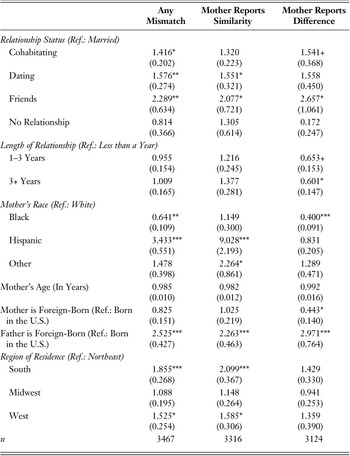
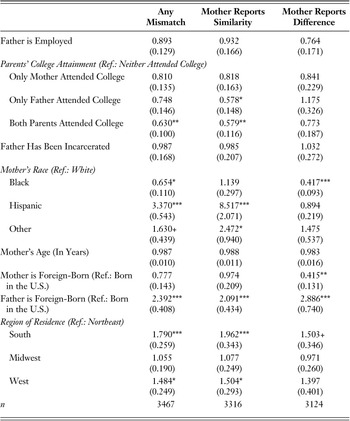
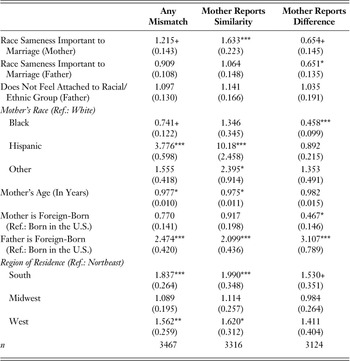
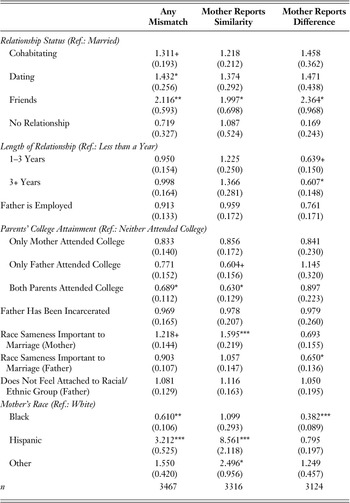
Tables 3–6 show the results of the multivariate analyses predicting either the likelihood of any racial mismatch, the likelihood of mismatch in which the mothers perceive racial consistency, and the likelihood of mismatch in which the mothers perceive racial difference. Analyses of the type of mismatch only include pertinent cases (i.e. matching cases and either all mismatched cases, cases of perceived similarity, and cases of perceived difference, respectively). The presentation is divided across the specific bodies of covariates: the role of relationship characteristics (see Table 3), socioeconomic characteristics (see Table 4), and racial perspectives and attitudes (see Table 5). We present a final model where all variables are included (see Table 6). All models are adjusted for the mother’s race, nativity of the father and mother, mother’s age, and region of residence.
Odds Ratios of the Role of Relationship Characteristics in Predicting Racial Mismatch (Ref.=No Mismatch, n of Full Analytic Sample=3467)

+ p<0.10; * p<0.05; ** p<0.01; *** p<0.001. Ref.=Reference. Standard errors in parentheses.
Source: Fragile Families and Child Wellbeing Study, Baseline Wave
Odds Ratios of the Role of Socioeconomic Status in Predicting Racial Mismatch (Ref.=No Mismatch, n of Full Analytic Sample=3467)

+ p<0.10; * p<0.05; ** p<0.01; *** p<0.001. Ref.=Reference. Standard errors in parentheses.
Source: Fragile Families and Child Wellbeing Study, Baseline Wave
Odds Ratios of the Role of Racial Perspectives in Predicting Racial Mismatch (Ref.=No Mismatch, n of Full Analytic Sample=3467)

+ p<0.10; * p<0.05; ** p<0.01; *** p<0.001. Ref.=Reference. Standard errors in parentheses.
Source: Fragile Families and Child Wellbeing Study, Baseline Wave
Odds Ratios of Relationship Status, Socioeconomic Status, and Racial Perspectives in Predicting Racial Mismatch (Ref.=No Mismatch, n of Full Analytic Sample=3467)

+ p<0.10; * p<0.05; ** p<0.01; *** p<0.001. Ref.=Reference. Note: Standard errors in parentheses.
Source: Fragile Families and Child Wellbeing Study, Baseline Wave
Note: Results on mother’s age, foreign birth of mother and father, and region of residence are suppressed (available from authors by request).
Racial Mismatch and Relationship Characteristics
We explore whether racial mismatch is facilitated by weaker ties between parental couples. Confirming this expectation, we find that mismatches are more common in non-marital relationships. Independent of controls, mothers who are cohabitating (OR=1.416), dating (OR=1.576), or friends (OR=2.289) with their newborn’s father have significantly higher odds of reporting any type of mismatch, relative to mothers who are married to the father. Mothers who report being in no relationship with the child’s father at the time of birth do not significantly differ from married mothers; however, this may be attributable to the small sample size of mothers who report no relationship with the father at the baseline wave (see Table 2), as well as the possibility that mothers in the “no relationship” category have a diversity of previous relationship statuses with the father. These associations persist across types of mismatch. Those who are dating or friends are more likely than married mothers to contribute to a mismatched report in which the mother perceives the father’s race as consistent with her own, while those who cohabit or are friends have higher odds of providing a mismatched report in which the mother perceives difference. The role of relationship duration emerges only for mismatches where mothers perceive racial difference, although the relationship is consistent with expectations for this outcome. Mothers who have known the father for more than a year, either between one to three years (OR=0.653), or more than three years (OR=0.601) have significantly lower odds of reporting a mismatch, although the former pattern only meets statistical significance at a weaker threshold (p<0.10).
The pattern of associations with controls largely reflects the descriptive patterns of Table 2. Relative to non-Hispanic White women, non-Hispanic Black women are less likely to provide a mismatched report of the father’s race (OR=0.641), particularly when the mother reports him as racially different than herself (OR=0.400). Hispanic women are far more likely than non-Hispanic White mothers to provide mismatched reports of the father’s race (OR=3.433), specifically when the mother perceives her child’s father as racially similar (OR=9.028). Parental pairs with a foreign-born father are highly likely to provide mismatched reports (OR=2.525), but foreign-born mothers are less likely than native-born peers to report a mismatch in which she perceives the father as racially different. Finally, we see that mismatch has a geographic pattern, with mothers living in the Southern and Western United States more likely to provide mismatched reports, relative to mothers who live in the Northeast.
Racial Mismatch and Socioeconomic Status
We anticipate that exposure to status-oriented environments will dampen the likelihood of race mismatches, reflecting a familiarity with institutionalized approaches of racial classification. Indeed, parental pairs where the mother and the newborn’s father have both attended college are less likely (OR=0.630) than their non-college attending peers to report a mismatch. This pattern occurs among mismatches where mothers perceive racial consistency but has no significant relationship when mothers perceive racial difference. Exposure to college for either the father (OR=0.578) or both parents (OR=0.579) lowers the likelihood of mothers perceiving racial consistency. Other SES factors (employment and incarceration) have no significant association to mismatch.
Racial Mismatch and Racial Attitudes
Table 5 assesses the role of racial attitudes, specifically parents’ perspectives on the role of race in marriages and feelings of attachment to racial groups, on the likelihood of mismatch. We hypothesize that mismatches are facilitated by perspectives in which racial sameness is understood as salient to family life or dampened if racial identity is deemed personally relevant. The mother viewing race/ethnic sameness as important to a marriage is positively, though weakly statistically speaking, associated with any mismatch overall—but this effect masks associations in two different directions. Holding these views increases the likelihood of perceiving racial consistency (OR=1.633, p<0.001) and decreases the likelihood of perceiving racial difference (OR=0.654), though this latter pattern is weaker statistically. Put another way, mothers who view race as important to a marriage are more likely to report their newborn’s fathers as matching their own race, even if that conflicts with his self-identification, and less likely to report him as racially different. Interestingly, we find a parallel pattern for fathers’ perspectives, as fathers who deem race sameness as important are less likely to be interpreted by their child’s mother as racially different (OR=0.651) if they are read as a member of a group they do not claim. Alternatively, we do not identify evidence that fathers’ reported attachment to race/ethnic groups influences the likelihood of mismatches.
Full Model
In the final analysis, we include all predictors and controls into the same model to gauge the independent effects. Overall, many of the key associations sustain, indicating that these facets of relationships have distinctive ties to the likelihood of reporting racial mismatch. Beginning with relationship characteristics, we find that mismatch is driven by the established nature of a relationship, with any mismatch more likely when mothers are cohabitating, dating, or friends with the child’s father, relative to marital unions. Being friends with the child’s father, relative to being married, is the most strongly related to predicted mismatch and is positively related to both perceiving similarity and difference. As in the previous analysis, duration of relationship is negatively associated with mismatch, but only for mismatches where the mother reports the father’s race as racially different than herself. Similarly, we find that the education of couples at the college level is still negatively related to a mismatch (OR=0.689), only reflecting cases where the mother is reporting the father as a similar race as herself (OR=0.630). Finally, perspectives on the role of race in relationships continues to predict mismatches, specifically those in which the mother reports her child’s father as racially consistent to herself, independent of other attributes.
DISCUSSION
Racial classification of an individual is a dynamic and multidimensional process, producing, at times, variance between self-reports and reports provided by others (Campbell and Troyer, Reference Campbell and Troyer2007; Feliciano Reference Feliciano2016; Roth Reference Roth2016; Vargas and Stainback, Reference Vargas and Stainback2016). Studies on the differences in reports provided by individuals and outside observers shed light on how an individual’s race is interpreted in public (Boehmer et al., Reference Boehmer, Kressin, Berlowitz, Christiansen, Kazis and Jones2002; Kressin et al., Reference Kressin, Chang, Hendricks and Kazis2003; Noymer et al., Reference Noymer, Penner and Saperstein2011), but this is not the only context where variance in race reports can emerge. This study provides one of the few explorations of interaction-based observed race (see Roth Reference Roth2016, Reference Roth2010). Drawing on a unique collection of race reports within a family survey, we interrogate intimate partnerships as a site where perceptions of race and Hispanic origin may diverge from or align with the information gathered in self-reports. Using data collected from childbearing couples with newborns, we are able to compare reports on the father’s race and Hispanic origin collected from both the father and the mother. To explore how norms of racial endogamy may be intertwined with processes of racial ascription, we further distinguish between mismatches where mothers perceive racial consistency between themselves and their newborn’s father and mismatches in which mothers perceive racial difference.
Defining matches as self- and observed reports that align along both race and Hispanic origin, we find that 14% of mothers provide a report of the father that does not match their newborn’s father’s self-reported race, while the rest of the reports of the father’s race were concordant with one another. Our results strongly suggest that norms of endogamy that privilege race/ethnic sameness (see Kalmijn Reference Kalmijn1998) shape the process of racial ascription. Among these mismatched reports, we find that the majority of mothers are more likely to report the father as matching her own race/ethnicity, rather than perceive racial difference between herself and the father of her child. This pattern of racial consistency indicates that, in the midst of ambiguity, racial appraisals are guided by endogamous norms.
Our findings further demonstrate that the relational processes that drive this appraisal are complex. The multivariate analyses reveal that the likelihood of predicting mismatches between observed and self-reported race is patterned by length and status of relationships, socioeconomic standing, and perspectives around race, but their relevance often varies by whether the perceiver understands the target as racially similar or different. Confirming our first hypothesis, the fully adjusted models reveal that racial mismatch, regardless of type, is facilitated by weak relational ties between new parents. Further, the length of relationships depresses the likelihood of mismatch in which fathers are understood as racially different, indicating that racial ascription of difference may be more sensitive to length of time than racial ascription of sameness. In support of our second hypothesis, mothers in couples who are exposed to college are also less likely to provide a mismatched race report, but this occurs primarily in mismatched cases in which the mother reports the father as racial similar to herself. Finally, confirming Hypothesis 3, holding racial beliefs that emphasize racial sameness is also associated with consistency between mother’s and father’s reports of the child’s father race, regardless of his identification. Meanwhile, fathers who hold these beliefs as important are less likely to be understood as racially different.
We also find that the nature of racial data classification is critical to the appearance of racial mismatches. Many mismatches are driven considerably by particularities of classifying race separately from Hispanic origin. Overall, mothers have more alignment with the father around his status as “Hispanic” than how his Hispanic origin intersects with race (see also Porter et al., Reference Porter, Liebler and Noon2016); this finding underscores the need for understanding what race reports actually reflect for Latinx groups (Roth Reference Roth2010). This has further implications for studies that explore patterns of racial inequality among the Hispanic category (see Abascal Reference Abascal2020; Frank et al., Reference Frank, Akresh and Lu2010; Golash-Boza and Darity, Reference Golash-Boza and Darity2008), highlighting the fluidity of observed and reported race among Hispanics even within established relationships. While beyond the reach of this study, the racial classification of Latino fathers may be shaped in part by skin color (Garcia et al., Reference Garcia, Sanchez, Sanchez-Youngman, Vargas and Ybarra2015), which may play a role in the extent of mismatch among these fathers (Golash-Boza and Darity, Reference Golash-Boza and Darity2008). Moreover, the meaning of race and Hispanic origin reports remains hotly debated (López et al., Reference López, Vargas, Juarez, Cacari-Stone and Bettez2017); our findings point to the additional need for understanding the source of reports, as well.
Ancillary analyses (available from authors by request) reveal many of our reported associations are driven by the processes of racial ascription among families with fathers labeled as Hispanic by both mothers and father (i.e. the fathers represented in Table 1: Panel B). Comparisons to subsamples of fathers labeled as non-Hispanic by one or both parties, as well as to only mismatches of the type depicted in Table 1: Panel A, revealed less significance, with these samples representing a smaller portion (roughly one third) of the total mismatched observations. This suggests that the specific relational, social, and attitudinal forces that drive mismatch may be shaped by the race/ethnicity of the perceiver and the perceived. While the current work represents a first step toward understanding the extent and drivers of couple-level racial mismatch, future research is needed to examine how this is more fully contextualized by race/ethnicity.
Overall, this study reveals that processes of racial ascription operate even between individuals who are intimately tied to one another, complicating the role race plays in mate selection. Determining one’s race is a key part of establishing relationship eligibility (see Curington et al., Reference Curington, Lin and Lundquist2015) either through being employed to maintain norms of racial and ethnic endogamy (Kalmijn Reference Kalmijn1998; Rosenfeld Reference Rosenfeld2005) or to enact racialized preferences (Feliciano and Robnett, Reference Feliciano and Robnett2014). However, racial self-identification is not always shared explicitly, even in a context where race/ethnicity is rapidly diversifying. Attitudes that privilege racial sameness also drive assumptions about identification, according to our findings. This is driven in part by adults socializing within largely segregated and racially homogenous spaces. It also reflects perceived consequences to crossing race/ethnic lines such as social isolation (Steinbugler Reference Steinbugler2012), policing by peers and parents (Tillman and Miller, Reference Tillman and Miller2017), enhanced mental distress among interracial partners (Kroeger and Williams, Reference Kroeger and Williams2011), or the perception of inordinate challenges faced by interracial offspring (Campbell and Eggerling-Boeck, Reference Campbell and Eggerling-Boeck2006). Such experiences demonstrate the way race is “lived” can have consequences for how race is “seen”.
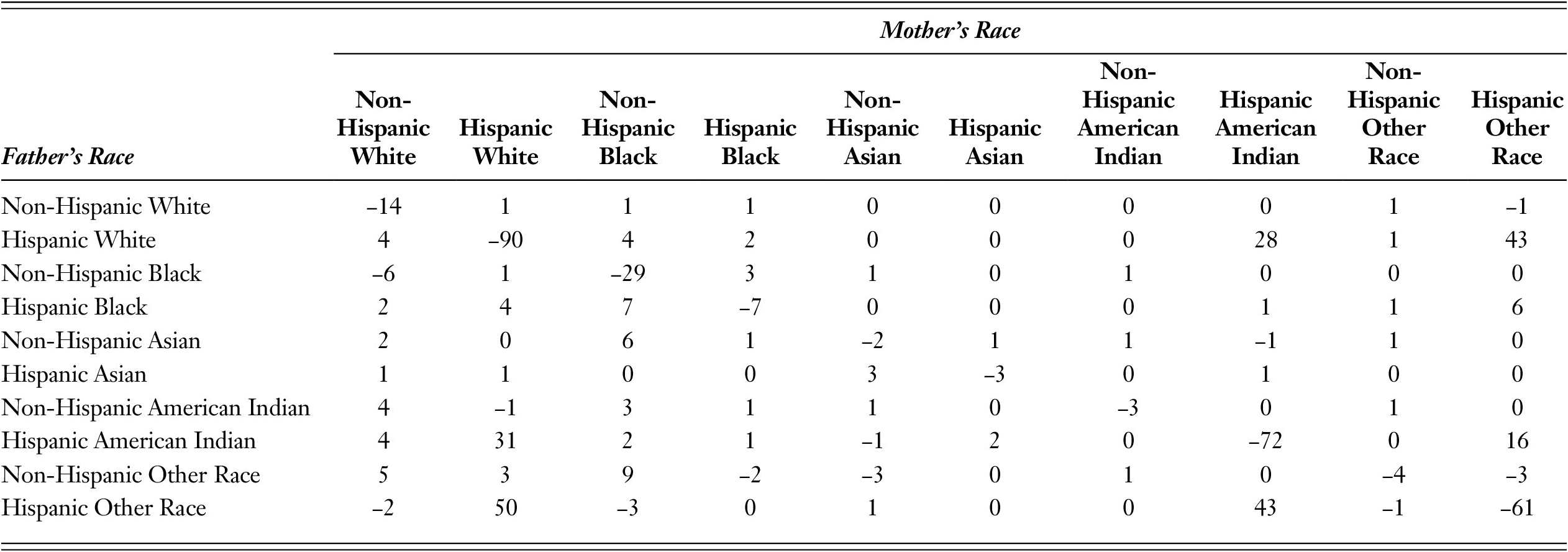
Finally, this work has clear bearing on the ongoing conversation about the collection of racial and ethnic data within surveys and beyond (Hofferth Reference Hofferth2005; Howell and Emerson, Reference Howell and Emerson2016; Roth Reference Roth2016). First and foremost, this work adds to other studies that point to the potential inconsistencies between reports within family surveys (Coley and Morris, Reference Coley and Morris2002; Hofferth Reference Hofferth2005; Mikelson Reference Mikelson2008; Waller and Jones, Reference Waller and Jones2014). These patterns of mismatch documented here are likely a conservative estimate, as they reflect only the cases where both mother’s and father’s data are available. Fathers who are unable to be reached for an interview have likely the weakest ties with the child’s mother. Reporting information by proxy on a range of individuals at minimum requires conceptual clarity in reporting racial patterns, and analysts should be conscious that what is collected is a perception or an observation as opposed to a self-identification. Additionally, the results reveal that gathering both race and Hispanic origin data by proxy may be most affected by this “perceptual layer”. Only five percent of mothers provided a mismatched report across categories when all Hispanics are subsumed under one category. Finally, patterns of mismatch may shape estimates of racial phenomenon, most notably interracial relationships—in these data, we have more mixed-race coupling using father’s self-reports than mother’s reports of father’s race, as mothers are more likely to report fathers as racially similar to themselves (see Appendix Table A1). We may be missing important nuances about how racial difference between couples operates when relying on race reports from only one parent.
Although representing a step forward in studying the dynamics of racial appraisal within intimate relationships, this study is not without limitations. First, instances of perceived and reported racial mismatch are numerically rare, becoming even more so when distinguishing between whether the mother perceives similarity or not. While using Firth regression techniques reduces the impact of small-sample bias on our estimates, the relative size of this outcome limits our ability to tease out further complexity, such as the likelihood of misclassifying a father as a specific racial group. Second, as the FFCWS data only ask the mothers to report on the father’s race and not vice versa, we are unable to provide symmetrical estimates of mismatch; this limitation restricts us from exploring potential differences by gender. Finally, physical characteristics like skin color have a strong bearing on racial classification (Feliciano Reference Feliciano2016; Golash-Boza and Darity, Reference Golash-Boza and Darity2008) but are unfortunately beyond the reach of our data. These limitations notwithstanding, the current study contributes by engaging dynamics of familial ties and interaction to a discussion of observed race (Roth Reference Roth2010, Reference Roth2016). While it is well known that race is not an “objective” or easily appraised fact, the current study advances our understanding of the specific forms of relationships that generate racial meaning.
ACKNOWLEDGEMENTS
We wish to acknowledge the anonymous reviewers for their helpful comments. We would also like to extend a special thanks to Aliya Saperstein for her valuable feedback on a prior iteration of this paper. A previous version of this paper was presented at the 2017 Annual Meeting of the American Sociological Association.
APPENDIX
Difference in Number of Fathers between Using Father’s Self-Report and Mother’s Report of Father’s Race, by Mother’s Race and Hispanic Origin

Note: Numbers are generated by subtracting the number of fathers in each racial category as reported by the mother from the number of fathers in each racial category as reported by the father. Positive numbers show that there are more fathers in the racial group, and negative numbers show that there are fewer fathers in the racial group, when using reports from the father.
Source: Fragile Families and Child Wellbeing Study, Baseline Wave