Introduction
The poultry red mite (PRM) Dermanyssus gallinae (De Geer 1778) is considered to be the most harmful ectoparasite in poultry farms in Europe (Höglund et al., Reference Höglund, Nordenfors and Uggla1995; Sparagano et al., Reference Sparagano, George, Harrington and Giangaspero2014). Individuals mainly feed on the blood of laying hens and wild birds at night (Kirkwood, Reference Kirkwood1968), and remain hidden the rest of its time in dark places (e.g. crevices and cracks around hen nests), where they can survive for up to 9 months without feeding (Chauve, Reference Chauve1998; Nordenfors et al., Reference Nordenfors, Höglund and Uggla1999). PRM can also accidentally infest mammals, including horses, dogs and even humans (Ramsay et al., Reference Ramsay, Mason and Hunter1975; Mignon and Losson, Reference Mignon and Losson2008; George et al., Reference George, Finn, Graham, Mul, Maurer, Moro and Sparagano2015). The occurrence of D. gallinae negatively impacts the general health of hens and the quality of their eggs (i.e. blood marks on the shells of eggs), which leads to significant economic losses in the hen egg laying industry (Chauve, Reference Chauve1998; Kilpinen et al., Reference Kilpinen, Roepstorff, Permin, Nørgaard-Nielsen, Lawson and Simonsen2005). In particular, PRM parasitism causes skin irritation, anaemia, vascular problems and, even, the death of the host (Chauve, Reference Chauve1998; Cosoroaba, Reference Cosoroaba2001; Kilpinen et al., Reference Kilpinen, Roepstorff, Permin, Nørgaard-Nielsen, Lawson and Simonsen2005).
At present, PRM in egg laying hen units is mainly controlled by using different chemical acaricides. However, the repeated use of chemical acaricides is responsible for the presence of residues in eggs and meat (with a potential impact on Public Health), and is associated with the emergence of PRM resistance to different acaricides, as reported in several European countries (Zeman and Zelezny, Reference Zeman and Zelezny1985; Beugnet et al., Reference Beugnet, Chauve, Gauthey and Beert1997; Marangi et al., Reference Marangi, Cafiero, Capelli, Camarda, Sparagano and Giangaspero2009; Sparagano et al., Reference Sparagano, Pavlićević, Murano, Camarda, Sahibi, Kilpinen, Mul, Van Emous, Le Bouquin, Hoel and Cafiero2009, Reference Sparagano, George, Harrington and Giangaspero2014). This issue is exacerbated when chemical acaricides are used illegally (off-label), as recently demonstrated in Europe (Flochlay et al., Reference Flochlay, Thomas and Sparagano2017).
In addition, resistance to certain acaricides (such as carbaryl, amitraz and permethrin) has emerged in PRM populations over the last 40 years (Zeman and Zelezny, Reference Zeman and Zelezny1985; Beugnet et al., Reference Beugnet, Chauve, Gauthey and Beert1997; Marangi et al., Reference Marangi, Cafiero, Capelli, Camarda, Sparagano and Giangaspero2009; Sparagano et al., Reference Sparagano, Pavlićević, Murano, Camarda, Sahibi, Kilpinen, Mul, Van Emous, Le Bouquin, Hoel and Cafiero2009, Reference Sparagano, George, Harrington and Giangaspero2014). Therefore, increasing awareness of the general public and changes to legislation have promoted the search for new and eco-friendly ways to control D. gallinae, including vaccines, entomopathogenic fungi and essential oils. Simultaneously, the chemical ecology of PRM is being increasingly studied to develop control strategies based on pheromonal communication.
Here, an overview of current information is provided, along with potential future directions, in controlling PRM. The different volatile organic compounds (VOCs) currently identified from D. gallinae and other mite species are presented, along with those already used to control them. Specifically, information is presented on (1) pheromones affecting mite behaviour with an attracting effect and (2) the repellent properties of VOCs on PRM. Finally, several devices using VOCs to control D. gallinae in field assays are described, as well as designs tested on other Acari species that could potentially be used on PRM.
Attractive substances
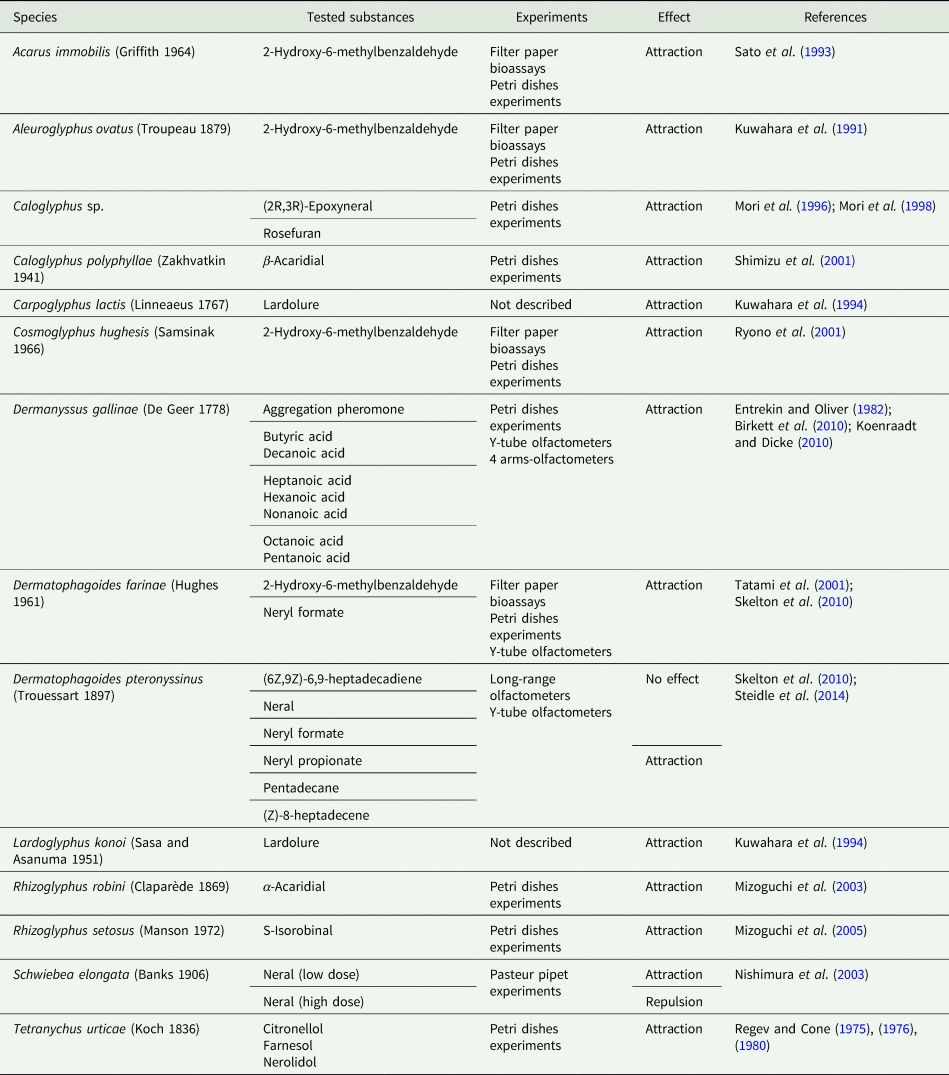
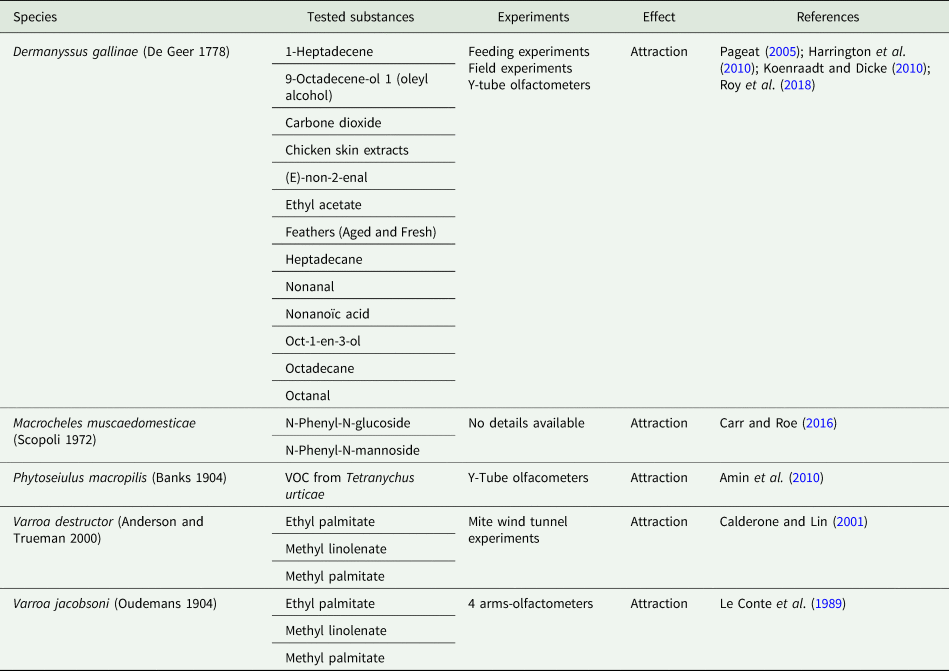
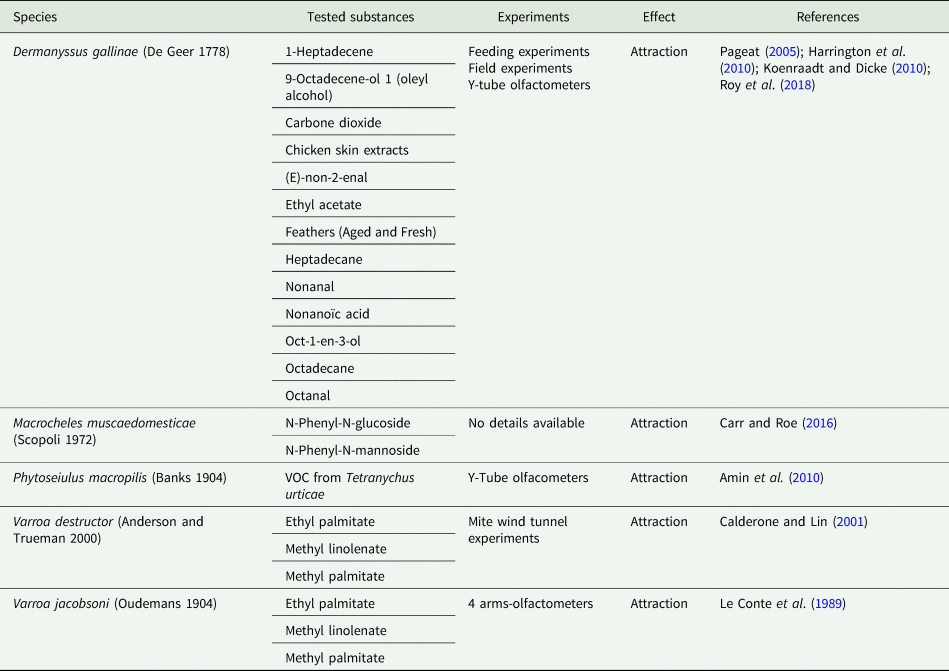
VOCs present an interesting alternative to classical acaricides for controlling acarian populations. Several types of VOCs could be used to manipulate the behaviour of Acari, potentially being integrated in « attract and kill » devices. Here, the potential of several pheromones (Table 1) and kairomones (Table 2) that have already been identified is focused on.
Chemical compounds of pheromones tested for their attractive and repulsive effect on mites

Chemical compounds of host kairomones with an attractive effect on mites
Pheromones
Pheromones are molecules that are emitted by an individual of a species to influence the behaviour of another individual of the same species (Pageat, Reference Pageat2005). Several pheromones are considered to attract mites, including aggregation pheromones, immature female pheromones, female sex pheromones and, at low doses, alarm pheromones (Sonenshine, Reference Sonenshine1985; Carr and Roe, Reference Carr and Roe2016). To identify the molecules present in the pheromonal mix released by a species, static headspace analyses (e.g. solid phase micro extraction or SPME) (Birkett et al., Reference Birkett, Pickett, Dewhirst, Jespersen and Kilpinen2010; Steidle et al., Reference Steidle, Barcari, Hradecky, Trefz, Tolasch, Gantert, Schulz, Steidle, Barcari, Hradecky, Trefz, Tolasch, Gantert and Schulz2014) and dynamic headspace analyses (e.g. thermodesorption) (Chen et al., Reference Chen, Martin, Fingu Mabola, Verheggen, Wang, He and Francis2019; Makarow et al., Reference Makarow, Schäfer, Albrecht, Robert, Schütz and Kaul2019) are performed. While dynamic headspace analysis has not yet been performed on mites, to our knowledge, it could prove useful, because it allows small amounts of volatile molecules to be detected and quantified (Pfannkoch and Whitecavage, Reference Pfannkoch and Whitecavage2000; Zhang and Li, Reference Zhang and Li2010). The sampling technique must be coupled to gas chromatography-mass spectrometry (GC-MS) analysis to identify the different compounds (Zhang and Li, Reference Zhang and Li2010). Following the identification and quantification of molecules within the pheromonal mix, behavioural tests could be performed, including Y-tube olfactometers bioassays or filter paper contact bioassays, to characterize the behaviour of mites when they are confronted with all or a part of the identified molecules (Entrekin and Oliver, Reference Entrekin and Oliver1982; Steidle et al., Reference Steidle, Barcari, Hradecky, Trefz, Tolasch, Gantert, Schulz, Steidle, Barcari, Hradecky, Trefz, Tolasch, Gantert and Schulz2014).
Aggregation pheromones
The aggregation pheromones of mites cause non-feeding conspecific mites (male and female) of different developmental stages to aggregate in a safe environment (Carr and Roe, Reference Carr and Roe2016). The aggregation behaviour in PRM was well studied before the aggregation pheromone was identified. Entrekin and Oliver (Reference Entrekin and Oliver1982) studied two possible causes for this behaviour: thigmokinesis (i.e. increased locomotion in response to changes in contact with the immediate physical environment) and the release of an aggregation pheromone. Both stimuli impact the clustering of mites; however, the chemical ones form aggregates more efficiently. The aggregation phenomenon due to the perception of potential aggregation pheromones by PRM was evaluated by Koenraadt and Dicke (Reference Koenraadt and Dicke2010). The authors tested the attraction of two groups of conspecific mites (fed and unfed) by performing behavioural experiments. The authors showed that fed and unfed mites were attracted by volatiles emitted by fed conspecifics. This finding was consistent with a previous study showing that the aggregation of mites increases after feeding (Entrekin and Oliver, Reference Entrekin and Oliver1982). Koenraadt and Dicke (Reference Koenraadt and Dicke2010) proposed that unfed mites are motivated to find a host to feed, while fed ones were searching for a place to hide and reproduce after their blood meal.
Subsequently, Birkett et al. (Reference Birkett, Pickett, Dewhirst, Jespersen and Kilpinen2010) conducted SPME-GC analysis on fed adult PRM, and identified eight molecules, including seven carboxylic acids (including hexanoic acid and dodecanoic acid) and one aldehyde (an octanal) that could be components of the pheromonal mix driving aggregation-forming behaviour in PRM. Behavioural experiments confirmed the attractive effect of each compound, as well as a synergic effect when compounds are associated. It was concluded that the eight compounds attract PRM and could be applied simultaneously, separately or sequentially to each other (Birkett et al., Reference Birkett, Pickett, Dewhirst, Jespersen and Kilpinen2010). It is possible that the aggregation pheromone of PRM is composed of only one or several molecules, as observed in other mite species. For example, Lardolure is the only aggregation pheromone that has been identified in Caloglyphus polyphyllae Footnote 1 and Lardoglyphus konoi mites (Kuwahara et al., Reference Kuwahara, Asami, Morr, Matsuyama and Suzuki1994; Carr and Roe, Reference Carr and Roe2016). In comparison, the aggregation pheromone of the European House Dust Mite (EHDM) Dermatophagoides pteronyssinus is mostly composed of neryl propionate, pentadecane and neryl formate (Skelton et al., Reference Skelton, Cameron, Pickett and Birkett2010; Steidle et al., Reference Steidle, Barcari, Hradecky, Trefz, Tolasch, Gantert, Schulz, Steidle, Barcari, Hradecky, Trefz, Tolasch, Gantert and Schulz2014). Finally, neryl formate might be a component of the pheromonal mix of several different species, as it was identified as a major compound of the aggregation pheromone in the American House Dust Mite, Dermatophagoides farinae and EHDM (Skelton et al., Reference Skelton, Cameron, Pickett and Birkett2010).
Alarm pheromones
Alarm pheromones are emitted by an individual that has been stressed by an unsafe environment or that has been injured through direct contact (Carr and Roe, Reference Carr and Roe2016). Detection of low concentrations of alarm pheromones causes attraction and clustering behaviour in mites, as part of group survival strategies (i.e. formation of a ‘safety net’). Above a given concentration, the pheromone becomes repulsive, which causes the strategies of individuals changing (i.e. scattering and hiding) (Carr and Roe, Reference Carr and Roe2016). To date, the alarm behaviour or the possible emission of this pheromone has not been studied in PRM; however, several compounds of this pheromone have been identified in other species of Astigmatid mites, including neryl formate and neral (Kuwahara, Reference Kuwahara2010, Reference Kuwahara2011; Carr and Roe, Reference Carr and Roe2016). When neral is applied in low doses (1 and 3 ng) on filter paper, mites (Schwiebea elongata) are attracted to this compound; however, at higher doses (30 ng), they exhibited repulsive behaviour (Nishimura et al., Reference Nishimura, Shimizu, Mori and Kuwahara2003; Carr and Roe, Reference Carr and Roe2016). Neryl formate was identified as an alarm pheromone for several species, including Tyrophagus putrescentiae (Schrank 1781), leading to alarm behaviour (Kuwahara, Reference Kuwahara2010); however, it attracts also other species, such as D. farinae and D. pteronyssinus at high doses (10 and 100 ng), and is considered to be an aggregation pheromone (Skelton et al., Reference Skelton, Cameron, Pickett and Birkett2010). Therefore, it is essential to clearly differentiate alarm pheromones that attract mites at low doses from aggregation pheromone that attract mites at all doses. Studies on the PRM alarm behaviour or the potential alarm pheromone emission have yet to be conducted, which could represent an interesting future direction for research.
Sex pheromones
Two types of sex pheromones have been detected in mites: (1) immature female pheromones, also known as arrestant sex pheromones and (2) female sex pheromones (Sonenshine, Reference Sonenshine1985; Carr and Roe, Reference Carr and Roe2016). There is a competition between male mites to reproduce with conspecific females. Consequently, males might detect differences between a deutonymph (i.e. second nymphal stage) from a protonymph (i.e first nymphal stage) by using the immature pheromone signature emitted by deutonymph females, which is composed of citronellol, farnesol and nerolidol in Tetranychus urticae females (Regev and Cone, Reference Regev and Cone1975, Reference Regev and Cone1976, Reference Regev and Cone1980). Following the discovery of a deutonymph female, males exhibit guarding behaviour (i.e. association of a male with a deutonymph female) in some acarian species [e.g. Hericia sp. (Canestrini 1888) or Tetranychus kanzawai (Kishida 1927)], until the deutonymph becomes an adult female (Sonenshine, Reference Sonenshine1985; Witaliński et al., Reference Witaliński, Dabert and Walzl1992; Yasui, Reference Yasui1992; Fashing, Reference Fashing2003; Oku, Reference Oku2009; Carr and Roe, Reference Carr and Roe2016). Colloff (Reference Collof2009), cited by Carr and Roe (Reference Carr and Roe2016), highlighted that only deutonymphs are able to emit the immature female pheromone. Nevertheless, this pheromone has not been identified in D. gallinae so far.
The female sex pheromone is normally released by fed mature females to attract preferably fed males, as the two sexes have a high reproductive success status (Sonenshine, Reference Sonenshine1985; Carr and Roe, Reference Carr and Roe2016). The female sex pheromone might also be released by males, explaining the mounting behaviour between males that is sometimes observed (Mori and Kuwahara, Reference Mori and Kuwahara2000; Mizoguchi et al., Reference Mizoguchi, Murakami, Shimizu, Mori, Nishida and Kuwahara2005; Carr and Roe, Reference Carr and Roe2016). Again, the female sex pheromone was not studied in D. gallinae, but different compounds have been identified as female sex pheromones in mites (Table 1).
PRM is part of the Acari. The molecules identified in closely related species could be potential candidates for characterizing the sex pheromones of PRM, especially as some compounds are already shared by different species, including 2-hydroxy-6-methylbenzaldehyde in Acarus immobilis, Aleuroglyphus ovatus, Cosmoglyphus hughesi and D. farinae (Kuwahara et al., Reference Kuwahara, Sato, Koshii and Suzuki1991; Sato et al., Reference Sato, Kuwahara, Matsuyama and Suzuki1993; Ryono et al., Reference Ryono, Mori, Okabe and Kuwahara2001; Tatami et al., Reference Tatami, Mori, Nishida and Kuwahara2001).
Sexual chemical communication between mites has been extensively investigated in several species, but not in PRM. Thus, it would be interesting to fill this knowledge gap on chemical communication in PRM. The potential synergic effects between the sex pheromone and aggregation pheromone could potentially be identified, which could be used to control PRM.
Host kairomones
Kairomones are molecules emitted by individuals mediating interspecific interactions that are generally harmful to the emitters (Pageat, Reference Pageat2005). This section addresses kairomones that are attractive to some mites, including D. gallinae (Table 2). PRM aim to localize potential hosts to feed. The uropygial gland products of chicken might have potential kairomones in the host location process (Pageat, Reference Pageat2005; Koenraadt and Dicke, Reference Koenraadt and Dicke2010). The identification of some of the compounds released by these products revealed the presence of alcools, alcanes and alcenes (described in Table 2). However, these compounds were directly identified from the chicken gland, and it was not confirmed that these compounds are volatiles that could be detected over a distance, as in olfactometer experiments (Roy et al., Reference Roy, Arriaga and El Adouzi2018). Following behavioural experiments in olfactometers, Koenraadt and Dicke (Reference Koenraadt and Dicke2010) observed that aged feathers of chicken (found on the floor of poultry houses and with potential microbial activity) were more attractive to PRM than fresh feathers (feathers cut from live hens). Mites responded to small numbers of feathers (10 feathers in a 2.5 L glass jar), indicating that they can detect very low amounts of these kairomones; however, no precise measurement was made (Koenraadt and Dicke, Reference Koenraadt and Dicke2010). Carbon dioxide (CO2) can also be considered as a kairomone for PRM. A gradual increase to CO2 levels induces host-seeking behaviour in mites, whereas a quick increase induces mites to freeze. This attitude is probably linked to the potential presence of predators (Kilpinen, Reference Kilpinen2005). Finally, temperature is a powerful stimulus that activates mites and, coupled with vibrations, might contribute to host detection and localization (Kilpinen, Reference Kilpinen2001, Reference Kilpinen2005).
Following host localization, PRM are attracted by several kairomones produced by the host (Roy et al., Reference Roy, Arriaga and El Adouzi2018). Several compounds were identified from living hens by SPME, followed by GC/MS analyses. Their attracting effect to PRM was confirmed with tube olfactometer experiments. A synergic effect of four molecules characterizing gallinaceous bird scent [(E)-non-2-enal, nonanoic acid, octanal and oct-1-en-3-ol] was highlighted by olfactometry (Roy et al., Reference Roy, Arriaga and El Adouzi2018). More generally, the attracting capacity of VOCs from the skin and feather extracts of hens (composition not available in the paper) was identified in a study where it was necessary to attract PRM to feed on synthetic membranes (Harrington et al., Reference Harrington, Guy, Robinson and Sparagano2010). However, it is not clear whether these molecules are involved in attracting D. gallinae to the host (i.e. detection of skin VOCs) or whether they serve as are contact cues for skin recognition. Several studies have investigated kairomones produced by hens; however, knowledge remains limited about the potential attracting role of VOCs in the environment of hens, with future studies being required on this subject.
Few studies have investigated the kairomones of other mite species. The methodology exploited with other species is similar to that used with PRM. After analysing the body extracts of male and female adult houseflies Musca domestica and after feeding experiments, N-phenyl-N-glucoside and N-phenyl-N-mannoside were identified as two kairomones that attracted the phoretic mite, Macrocheles muscaedomesticae (Wicht et al., Reference Wicht, Rodriguez, Smith and Jalil1971; Achiano and Giliomee, Reference Achiano and Giliomee2006 cited in ref of the review of Carr and Roe, 2015). In addition, female predator mites Phytoseiulus macropilis were attracted by unidentified kairomones from T. urticae in Y-tube olfactometer experiments (Amin et al., Reference Amin, Mizell and Flowers2010). However, three kairomones (methyl palmitate, ethyl palmitate and methyl linolenate) were identified in Varroa jacobsoni and Varroa destructor, which are two species of honey bees parasites, following behavioural experiments with four-armed olfactometers and mite wind tunnels (Le Conte et al., Reference Le Conte, Arnold, Trouiller, Masson, Chappe and Ourisson1989; Calderone and Lin, Reference Calderone and Lin2001). The use of a wind tunnel allows the long-range effect of different compounds to be tested. The use of this methodology on PRM could extend current knowledge on the potential attracting properties of pheromones and kairomones.
Repulsive substances
Olfactive repellents can be divided into two categories: (1) true repellents (also called expellents) or spatial repellents, and (2) odour masking compounds (or attraction inhibitors) (Deletre et al., Reference Deletre, Schatz, Bourguet, Chandre, Williams, Ratnadass and Martin2016). A true repellent induces a shift in orientation from an odour source without direct contact. In comparison, odour masking compounds induce the attractiveness of the host to decline, or difficulties to localize the host using odour cues (Deletre et al., Reference Deletre, Schatz, Bourguet, Chandre, Williams, Ratnadass and Martin2016).
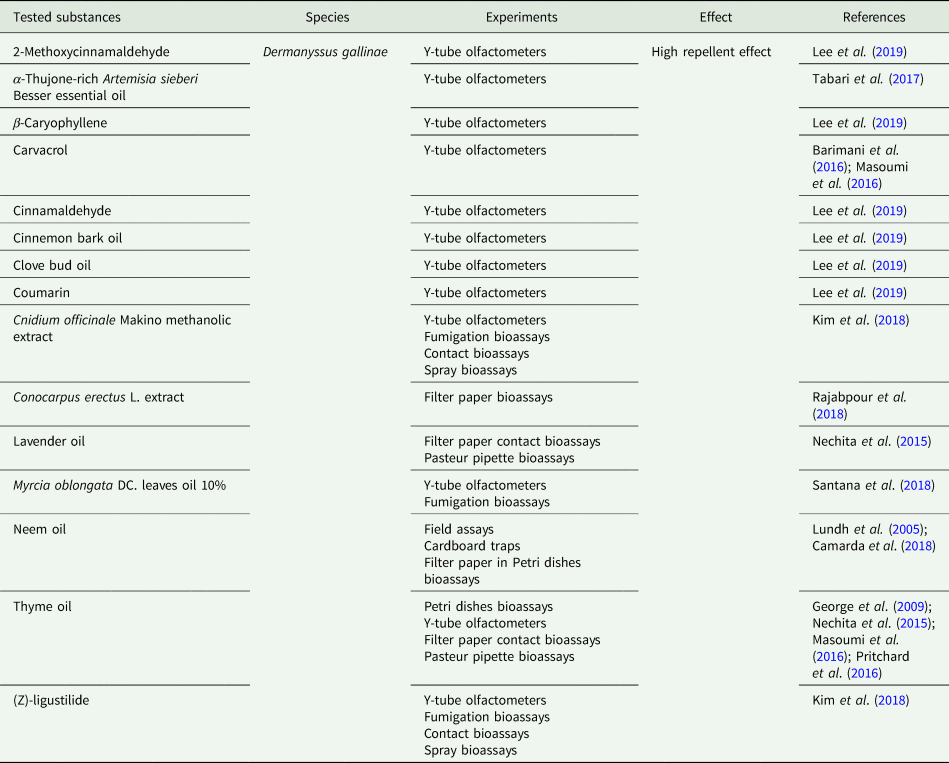
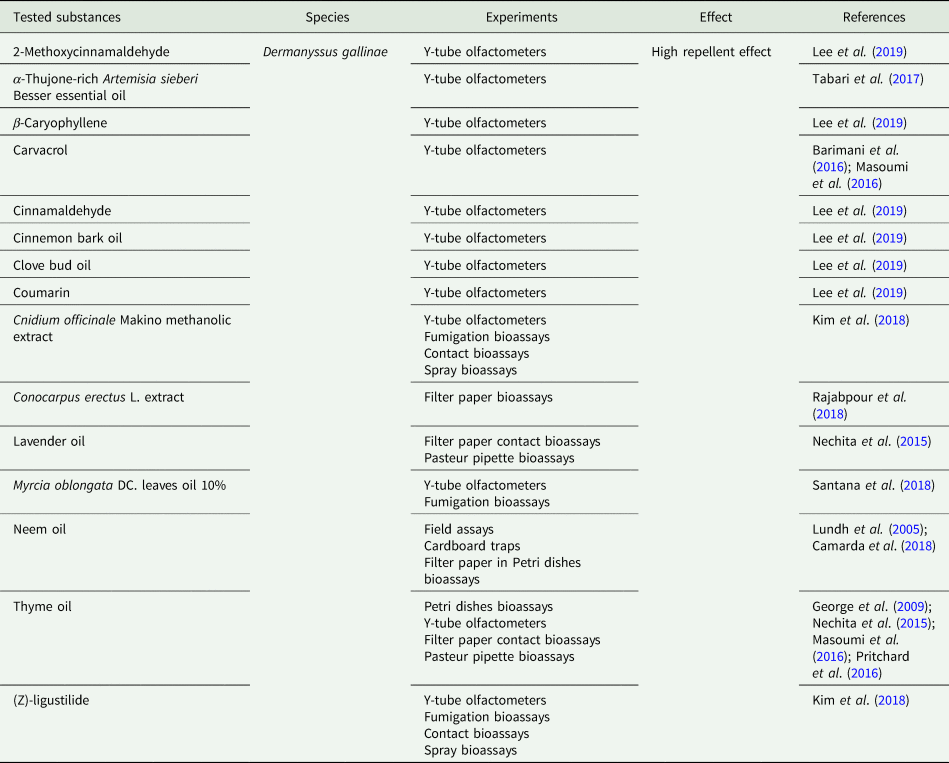
Several experiments were conducted to test the repellent properties of substances studied on PRM, including contact experiments (i.e. Petri dishes with filter paper saturated with the compound) and olfactive experiments using olfactometers (Nechita et al., Reference Nechita, Poirel, Cozma and Zenner2015; Masoumi et al., Reference Masoumi, Youssefi and Tabari2016). Globally, it is interesting to evaluate the repellent effect of a substance to: (1) test a potential negative repellent effect of a toxic substance (e.g. acaricide) (Lundh et al., Reference Lundh, Wiktelius and Chirico2005) and (2) confirm the repulsive effect of a substance that could be used as a pure repellent (Nechita et al., Reference Nechita, Poirel, Cozma and Zenner2015). The different compounds tested on PRM are summarized in Table 3, showing the level of repulsive effect.
Chemical compounds with a high repellent effect on D. gallinae
Essential oils
The repulsive and/or acaricidal efficiency of essential oils has been extensively studied. For instance, Lundh et al. (Reference Lundh, Wiktelius and Chirico2005) showed that neem oil, Azadirachta indica (Jussieu) (concentrations of 15 to 20%), has a good acaricide effect associated with a low repellent effect under laboratory conditions. In another study, Camarda et al. (Reference Camarda, Pugliese, Bevilacqua, Circella, Gradoni, George, Sparagano and Giangaspero2018) tested the effectiveness of this oil under field conditions. The authors showed that a 20% neem oil formulation (RP03TM) caused the mite population in poultry farms to decline by 94.65 to 99.80% after three nebulizations of the product over one week (Camarda et al., Reference Camarda, Pugliese, Bevilacqua, Circella, Gradoni, George, Sparagano and Giangaspero2018). Other essential oils are also effective, particularly essential oils from the family of Lamiaceae (Martinov) such as Origanum (L.), Satureja (L.), Thymbra (L.) and Thymus (L.) species. These species are characterized by a major compound, carvacrol, which is a good acaricide candidate with a toxic effect on D. gallinae. It has no repellent effect at 1% concentration; however, above this concentration, repellence occurs (Kirimer et al., Reference Kirimer, Başer and Tümen1995; Barimani et al., Reference Barimani, Youssefi and Tabari2016).
Out of several essential oils tested for their pure repellent properties during in vitro contact bioassays, thyme and lavender oils had the highest repellent activity with, respectively, 80 and 40% of the oil-treated surface area being avoided by PRM (Nechita et al., Reference Nechita, Poirel, Cozma and Zenner2015; Pritchard et al., Reference Pritchard, Küster, George, Sparagano and Tomley2016). Nevertheless, in this type of experiment, it is not possible to distinguish whether mites are repelled by olfactory or contact cues, with complementary studies in olfactometers being required (Deletre et al., Reference Deletre, Schatz, Bourguet, Chandre, Williams, Ratnadass and Martin2016). The association of thymol (i.e. the major compound of thyme essential oil) and carvacrol was evaluated in olfactometer bioassays for potential synergic repellent effects (Masoumi et al., Reference Masoumi, Youssefi and Tabari2016). The study, unfortunately, revealed that the addition of thymol to carvacrol decreased the repellent effect of carvacrol. Other studies analysed the different compounds present in a given essential oil by GC-MS experiments, and tested the repellent effect of the oil on PRM by Y-tube olfactometer experiments (Tabari et al., Reference Tabari, Youssefi and Benelli2017; Santana et al., Reference Santana, de L. Souza, Coracini, Walerius, Soares, da Costa and da S. Pinto2018). The essential oil of Artemisia sieberi (Besser) [rich in α-thujone (31.5%), β-thujone (11.92%), camphor (12.3%) and 1,8-cineole (10.09%)] and the essential oil of Myrcia oblongata (DC) [rich in caryophyllene oxide (22.03%) and trans-verbenol (11.94%)] showed a significative repellent effect to D. gallinae. Nevertheless, the effect of each of their constituent compounds was not evaluated (Tabari et al., Reference Tabari, Youssefi and Benelli2017; Santana et al., Reference Santana, de L. Souza, Coracini, Walerius, Soares, da Costa and da S. Pinto2018). Finally, a study by Lee et al. (Reference Lee, Kim and Kim2019) obtained interesting results, in which two essential oils (cinnamon bark and clove bud oils) and some of their constitutive compounds were tested for their repellent abilities. The two oils and their compounds were repellent to PRM, except for cinnamyl acetate from cinnamon bark oil, and for two compounds from clove bud oil (eugenol and eugenol acetate), which even showed an attractant effect, following 120 min of application. The concentration of the active compound over time might be an issue, as many essential oils exhibit high repellent activity against D. gallinae over the short-term due to their high volatility (George et al., Reference George, Callaghan, Guy and Sparagano2008, Reference George, Shiel, Sparagano, Port, Guy and Okello2009). A dose effect exists for several molecules, including thyme oil, which could be used as a repellent or as an acaricide, depending on the concentration. When used as an acaricide, essential oils have a short-term effect; however, it is possible to couple them with other biological control methods, such as entomopathogenic fungus. When these two methods are coupled, the short-term acaricide effect of essential oils is complemented with the delayed, but long-term effect, of the fungus. For example, an entomopathogenic fungus [Beauveria bassiana (Balsamo-Crivelli) Vuillemin] in combination with essential oils [Eucalyptus globulus (La Billardière), Eucalyptus citriodora (Hook), Thymus vulgaris (Linné), and Eugenia caryophyllata (Thunb.)] was tested to create a new way to control D. gallinae (Immediato et al., Reference Immediato, Figueredo, Iatta, Camarda, de Luna, Giangaspero, Brandão-Filho, Otranto and Cafarchia2016). Following toxicity tests, it was found that the combination of B. bassiana and E. globulus at 0.2% might be the best combination for an acaricide effect against D. gallinae.
Plant extracts
Most studies on plant extracts have focused on the acaricide properties of the extracts, and are not evaluated in this review, because repellent properties are not discussed. Only two studies evaluated the repellent properties of two plant extracts. Rajabpour et al. (Reference Rajabpour, Mashhadi and Ghorbani2018) showed that aquatic and ethanolic extracts of Conocarpus erectus are repellent for PRM using contact experiments. Nevertheless, the repellent effect described here was unclear, as it was not possible to distinguish the contact and olfactive repellent effects. In another study, the acaricidal and repellent activities of a methanolic extract and fractions from the rhizome of Cnidium officinale were tested to control D. gallinae (Kim et al., Reference Kim, Lee, Hwang, Yoon and Kim2018). Kim et al. (Reference Kim, Lee, Hwang, Yoon and Kim2018) showed that the methanolic extract of C. officinale has a 91.3% repellent activity on PRM, while (Z)-ligustilide, which is an isolated compound from C. officinale roots, showed a repellent response rate equal to 100% using a T-tube olfactometer.
Application of VOCs in field assays
Here, current applications of VOCs to control PRM are described along with potential other strategies from other Acari species relevant for PRM control. The introduction of repulsive substances to hen feed could make the emission of repellent VOCs against the PRM possible (El Adouzi et al., Reference El Adouzi, Arriaga, Dormont, Nicolas, Labalette, Lapeyre, Bonato and and Roy2019). For instance, Nor-Mite® (mostly composed of >2% eugenol) was added to hen feed, and the VOCs emitted by hens were analysed. GC-MS analysis showed that Nor-Mite® fed hens released several VOCs, including eugenol. Following olfactometer experiments, the repellent effect of eugenol and other VOCs from Nor-Mite® fed hens was confirmed. In addition, the authors suggested that other molecules present in Nor-Mite®, such as trans-caryophyllene and geraniol, might contribute to this repellent effect, with possible additive/synergic effects (not tested in this paper) (El Adouzi et al., Reference El Adouzi, Arriaga, Dormont, Nicolas, Labalette, Lapeyre, Bonato and and Roy2019).
Several devices have been tested to control other Acari species. For example, one design using attracting VOCs is an ‘attract and kill’ trap has been applied to others species of Acari. A system based on the encapsulation of an attracting pheromone coupled to an acaricide was developed for the brown dog tick Rhipicephalus sanguineus (Latreille 1806) by Dhivya et al. (Reference Dhivya, Latha, Raja, Sreekumar and Leela2014). The capsule was made of a natural polymer (i.e. chitosan). The species assembly pheromone was chosen as an attractant, and was coupled with deltamethrin as acaricide. Laboratory and field tests showed a reduction of infestation, as the ticks were discovered dead around the traps. Another study using aggregation-attachment pheromone together with deltamethrin to attract and kill Amblyomma variegatum (Fabricius 1794) (the tropical bont tick) demonstrated an overall tick control efficiency of 92% (Kelly et al., Reference Kelly, Lucas, Randolph, Ackerson, Blackburn and Dark2014). Similar studies could be conducted for D. gallinae by coupling the aggregation pheromone with a natural acaricide (e.g. an essential oil) or entomopathogenic fungi.
Conclusions
PRM is a world economic problem for the poultry industry, and the development of solutions with low risk on human health should be promoted to control their populations, especially in hen egg laying farms. The development of sustainable pest control based on an understanding of chemical ecology is being increasingly implemented, and should be applied to PRM. New insights on pheromonal communication of PRM are fundamental to create efficient control strategies.
Knowledge remains more limited about chemical communication in mites including PRM compared to ticks, mainly due to their smaller size and, consequently, the lower emission of VOCs. In the last decade, the identification of attractants in mites has increased, along with more information on their associated effects on mite behaviour. Nevertheless, a large knowledge gap exists on VOCs that attract PRM that should be addressed in the future.
The lack of knowledge, especially on PRM pheromones, could be explained by the difficulties encountered to maintain an artificial breeding of PRM (Kirkwood, Reference Kirkwood1971; Zeman, Reference Zeman1988; Bruneau et al., Reference Bruneau, Dernburg, Chauve and Zenner2001; Harrington et al., Reference Harrington, Guy, Robinson and Sparagano2010). This hurdle prevents the availability of fed mites reducing the implementation of pheromones studies. For the development of further PRM pheromone studies, an efficient artificial or semi-artificial breeding system must be developed to facilitate the supply of fed individual as well as to allow a control of several parameters (e.g. time since the last meal, female fertilization or not etc…). Among the current possible alternative, the use of a semi-artificial laboratory breeding on alive chicken (i.e. a plastic bag filled with PRM in contact with the chicken) seems to be a promising solution as it provides a high number of individuals in a short period of time (Nunn et al., Reference Nunn, Bartley, Palarea-Albaladejo, Innocent, Turnbull, Wright and Nisbet2019).
Concerning PRM's kairomones, several studies are currently available with no assays of these molecules in field conditions (Pageat, Reference Pageat2005; Koenraadt and Dicke, Reference Koenraadt and Dicke2010; Roy et al., Reference Roy, Arriaga and El Adouzi2018). Different implementations are still to be needed to consider these molecules as an efficient field attractant such as the emission source apposition or the concentration of the synthetic molecule. Moreover, the interference of kairomones from hosts when synthesized kairomones are applied in layer farms would be difficult to avoid and should decrease the efficacy of the product.
In contrast to the limited number of studies on attracting VOCs, many studies exist on repulsive VOCs to PRM. This phenomenon might be explained by the fact that repelling PRM outside poultry farms is the first solution that comes to mind in terms of control strategies. Essential oils and plant extracts seem to represent promising repellents, despite their short-term efficiency. Several designs using VOCs on PRM have been elaborated and tested under field conditions. Further studies are needed to optimize these strategies, or to create new ones based on ‘attract and kill’ or ‘push-pull’ principles.
Finally, although mites and ticks are two separated groups in the Acari taxon, similarities exist in how they communicate. Therefore, researchers investigating the chemical communication of mites should refer to studies on chemical communication in ticks, for which there is extensive published literature.
Financial support
This work was supported by the Federal Public Service, Health, Food chain safety and Environment (grant number RF18/6325)
Conflict of interest
None.
Ethical standards
Not applicable.