Allies trade more with one another than non-allies, owing to positive security externalities (Gowa and Mansfield Reference Gowa and Mansfield1993; Mansfield and Bronson Reference Mansfield and Bronson1997), credible promises not to expropriate (Gowa and Mansfield Reference Gowa and Mansfield2004), or explicit issue linkages (Long and Leeds Reference Long and Leeds2006). However, if economic interests can create similar security interests (e.g., Gartzke Reference Gartzke2007; Fordham Reference Fordham2010), then the formation of alliances may follow trade, and not vice versa. Nonetheless, the prevailing evidence linking alliances to higher levels of commerce cannot tell us whether trade follows the flag, as often argued, or the flag follows trade.Footnote 1 We develop a potential solution to this problem by examining the conditions under which trade policy follows the flag when free trade itself may not. If membership in alliances can affect trade policy in ways that are costly to at least one member, i.e. if alliances are valuable militarily but not Pareto improving with respect to trade aspects of the relationship, then we can be more confident that countries do structure commercial relations around underlying security interests.
To that end, we analyze a model of tariff-setting and security cooperation in which allies may differ in their valuations of the commercial and military dimensions of their relationship. By relaxing the common assumption of symmetric market power and security interests (see Gowa and Mansfield Reference Gowa and Mansfield1993), we are able to show that, for sufficient disparities in market power, the ally with a larger market will tolerate and refuse to retaliate against the imposition of new protection by a partner with a smaller market. Unretaliated protection emerges as the stable, “cooperative” outcome when the security elements of the alliance for a powerful ally outweigh the damage to its terms of trade caused by a weak ally’s protectionism. This is most likely to occur in asymmetric alliances, where powerful states take on weak partners in order to receive some specific security benefit—basing or staging rights, etc.—and tolerate undesirable trade policies in order to maintain cooperation in the security sphere. Thus, trade policy enters alliance politics not because it produces positive externalities, but because the weak ally can safely boost its terms of trade by exploiting the stronger ally’s need for its contribution to the alliance.
We test our hypothesis over unretaliated protection using a data set of antidumping (AD) measures in the period 1980–2013 (Bown Reference Bown2014). Focusing on the interaction between relative market power and the presence of alliance ties, we find that, among dyads where the states belong to a common alliance, a state becomes more likely to deny domestic petitions for AD measures as its relative market power over its partner increases. In contrast, among dyads where the states do not belong to a common alliance, no systematic relationship exists between relative market power and states’ likelihood of imposing AD measures.
This article makes several contributions. First, by showing that joining an alliance is not Pareto improving in the trade sphere—i.e., the stronger ally would have better terms of trade outside the alliance—we avoid the endogeneity problems plaguing previous work and show that, when it comes to military alliances, trade policy does seem to follow the flag. Second, we show that security cooperation often involves trade-offs over linked issues, particularly trade, and that all good things need not go together in commerce and security. In fact, these results imply that previous analyses examining samples of great powers and those that use total trade as a proxy for low trade barriers can produce misleading inferences about the relationship between security and economic cooperation. Third, by discovering an explicit link between the “high” politics of international security and “low” politics and trade, we show that the traditional distinction between the two is a false dichotomy; when powerful, wealthy states need allies, they may secure such relationships by foregoing the use of their own considerable economic power and tolerating unilateral protectionism even against the wishes of their own domestic producers.
We first review the literature on alliances and trade, particularly the restrictive assumption that allies share significant market power below. Next, we analyze a game-theoretic model of tariff setting both inside and outside alliances. After deriving hypotheses over the interaction between alliances and relative market power, we conduct empirical tests that provide broad support for the theory. We conclude by considering the implications for our understanding of security and trade, as well as other areas of political science.
LITERATURE
Alliances and trade are typically linked through the former’s ability to control the latter’s externalities. As states pay close attention to the social costs and benefits of trade, they are concerned with the resultant efficiencies, which free up wealth for investment in military power. When states trade freely with their adversaries, they effectively arm them and create a negative security externality. Trade with allies, though, creates a positive externality in which states with similar interests can direct more resources toward mutual adversaries. As a result, trade barriers should be lower, and aggregate trade higher, between allies than non-allies (Gowa and Mansfield Reference Gowa and Mansfield1993; Gowa and Mansfield Reference Gowa and Mansfield2004).Footnote 2
However, the prevailing evidence linking trade and alliances faces an inferential problem. Total trade, a common proxy for low trade barriers, may be higher among allies than non-allies if either (1) states increase trade with their allies or (2) similar economic interests lead them to share security interests, which they then formalize in alliances (Fordham Reference Fordham2010).Footnote 3 The challenge for discriminating between these processes lies in the fact that free trade is Pareto improving, as both sides are better off trading in an alliance that they also share a security interest in forming. However, if one side could be shown to make a sacrifice, to be less well-off in the alliance than it would be outside it in terms of trade policy, then we can say with more confidence that trade does, indeed, follow the flag.
We approach this problem by relaxing a key assumption. The proposed link between alliances and free trade requires that both allies have sufficient market power to generate substantial efficiencies through free trade. For Gowa and Mansfield (Reference Gowa and Mansfield1993), this means alliances between great powers, who tend to be economically as well as militarily powerful. Morrow (Reference Morrow2003) argues, however, that defense budgets in peacetime are unlikely to be large enough to make positive security externalities very attractive, even if both the countries involved are wealthy.Footnote 4 Further, most alliances are not made up of symmetrically wealthy partners. Rather, they are asymmetric in that they involve partnerships between the large and small (Bennett Reference Bennett1997), where allies engage in a mutually beneficial trade across issues of security and autonomy (Morrow Reference Morrow1991; Fordham Reference Fordham2010).
In these more representative alliances, assuming symmetric market power may be problematic. If one state is a price setter and the other a price taker, then it is not clear that the price setter will gain economically from lowering barriers or that an economically smaller ally can make overall increases in defense spending that are meaningful to the alliance. The trade-off model of alliances holds that smaller states may surrender some autonomy over their foreign policy in return for the provision of security by a more powerful partner (Morrow Reference Morrow1991), but the price that powerful states pay for this autonomy may implicate both security and trade policy. If a smaller ally has some specific, private good of military value, then it can drive a hard bargain, leading the more powerful state to sacrifice some economic autonomy in order to preserve the alliance. A militarily weak and economically small state may straddle strategic geography, control valuable staging areas close to other zones of interest, or possess resource endowments critical to the generation of military power; in each case, the security benefits it offers may be specific to the provider. Turkey, e.g., controls the only straits by which to keep Russian naval power confined to the Black Sea, a specific contribution of particular interest to her North Atlantic Treaty Organization (NATO) allies in the Cold War. Furthermore, if the smaller ally is at risk of joining a rival alliance bloc or if its otherwise friendly government is unstable domestically, it may safely impose on the autonomy of a more powerful ally in return for providing a security good rather than vice versa. Thus, alliance formation is the outcome of a strategic process in which the required concessions—whether economic, political, or military—are acceptable for both parties, and we suspect that how economic policy concessions emerge in practice depends on allies’ relative market power.Footnote 5
In the model presented below, we show that asymmetric alliances may lead to inefficient, yet tolerated, one-sided protectionist behavior in some pairs of states. That the weak might manipulate the strong in alliances is certainly not a new idea (e.g., Olson and Zeckhauser Reference Olson and Zeckhauser1966; Sandler Reference Sandler1992; Snyder Reference Snyder1997; Sandler and Hartley Reference Sandler and Hartley2001), yet in most applications the problem is one of collective action.Footnote 6 Small allies contribute little to the public or, sometimes, club good of security while larger states shoulder a disproportionate share of the burden. Our model, however, leads us to a different conclusion: rather than a suboptimal contribution to the common interest, a small state’s implementation of protection may be an expected and tolerated element of a stable, “cooperative” relationship.
THE MODEL
We turn now to a simple game of economic and security cooperation that explicitly models asymmetries of market power and security interests, both inside and outside alliances. First, we show that in a single play of a tariff-setting game with non-allied states, low tariffs by either side are unsustainable. Then, we compare this tragic outcome with a single play of the game with allied states, who care about one another’s welfare through security externalities. When allies value trade and security equally, i.e. when both have significant market power, the maintenance of free trade is again possible in the long-run only through the threat of retaliation, albeit more easily than it is among non-allies (cf. Gowa and Mansfield Reference Gowa and Mansfield1993). However, when states value the benefits of the alliance differently, one ally manipulates the other’s security dependence and dominant strategy of complicity in order to make unilateral economic gains at its ally’s expense. Importantly, this outcome is a stable equilibrium in a one-shot play of the game and will therefore also exist as an equilibrium of iterated games as well without the need for threats of retaliation.
MOVES AND PAYOFFS
Suppose that two allied states i={1,2} make simultaneous choices over cooperation c i , the maintenance of low trade barriers, and defection d i , the implementation of some barrier to trade, which we can think of as a simple ad valorem tariff or, as in the empirical analysis below, the imposition of AD duties. The simultaneous-choice framework for tariff setting games is a common choice in both political science (Gowa and Mansfield Reference Gowa and Mansfield1993) and economics (Bagwell and Staiger Reference Bagwell and Staiger2002). Although the intuitive logic behind tariff games is often a sequential one of action and reaction, decisions are, nonetheless, taken under some uncertainty about the other side’s choice, and a simple game in the normal form captures this well. Furthermore, as the research question involves the presence of dominant strategy for at least one side, the distinction between simultaneous and sequential choice specifications is unimportant.
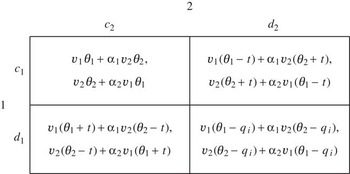
Payoffs, presented in Figure 1, reflect both domestic-political and international-security dimensions of the alliance. Domestically, distributive concerns lead governments to maximize not aggregate national income but their own terms of trade, which are linked to their ability to satisfy important domestic constituencies that keep them in office (Bagwell and Staiger Reference Bagwell and Staiger2002). This enables the adoption of the Prisoner’s Dilemma framework common in tariff-setting games (Gowa and Mansfield Reference Gowa and Mansfield1993). As the game is symmetric, we present only state 1’s payoffs, but simple substitution of subscripts will give state 2’s payoffs.
The game in normal form

Let θ
1 represent state 1’s value for the terms of trade with state 2, equated with its own domestic support. State 1 weighs its terms of trade by its market vulnerability,
 $$v_{1} \in (0,1)$$
, or the extent to which state 2 exercises market power over it. A high value of v
1 indicates that state 1’s terms of trade are quite vulnerable to state 2’s trade policy decisions, whereas a low v
1 indicates that state 1 is less vulnerable. Market power in this sense can be exercised in several ways, from tariff and non-tariff barriers that alter external prices to the pursuit of policies that empower rival groups in a foreign state at the expense of the sector in power. States with more market power can thus affect the welfare of domestic support groups in other states through different channels.
In the international-security aspect of the relationship, state 1 also values its ally’s ability to maximize its own domestic support through an affinity term
 $$\alpha _{1} \in [0,1]$$
. Therefore, the security aspects of the relationship are reflected in state 1’s valuation of state 2’s terms of trade, and vice versa, because improved terms of trade translate into potentially larger investments in the alliance. As the affinity term increases, state 1 considers its ally more politically important, and it derives an increasing amount of indirect benefits from state 2’s improvement of its own terms of trade. We set an upper limit of α=1, however, because we assume that states never care more about others’ terms of trade than they do their own.Footnote
7
The international-security dimension is also weighted by state 2’s market vulnerability v
2, which captures the extent to which state 1’s own market power can help or harm its ally’s terms of trade.
Decisions over cooperation and defection alter the terms of trade in the following ways. First, when a state unilaterally defects, (d i , c −i ), by implementing protection, it adds t>0 to its own terms of trade, whereas the other state loses the same amount. Second, when both states impose protection, (d i , d −i ), each suffers a loss of q i in its utility for the terms of trade, where q i >0. We can think of q i as the cooperative failure that occurs when both states impose tariffs, such as a mutual trade war, the dissolution of the alliance, or the collapse of a friendly government otherwise willing to provide specific security benefits. We can also take an increase in q i to represent the extent to which the security goods that state i receives from its ally are specific to that ally. In other words, the costs of cooperative failure increase as state i has fewer alternative partners to turn to to receive the specific contribution it receives from its ally. Finally, when both cooperate, (c i , c −i ), they receive unaffected terms of trade θ i .Footnote 8
Recall that we list only state 1’s payoffs given the symmetry of the game. When both states cooperate by not imposing protection, state 1 gets
 $$u_{1} \,(c_{1} ,c_{2} )\,=\,v_{1} \theta _{1} \,{\plus}\,\alpha _{1} v_{2} \theta _{2} ,$$
and should state 1 defect while state 2 cooperates, state 1 gets
 $$u_{1} \,(d_{1} ,c_{2} )\,=\,v_{1} \,(\theta _{1} {\plus}t)\,{\plus}\,\alpha _{1} v_{2} \,(\theta _{2} {\minus}t).$$
Likewise, if state 1 cooperates while state 2 defects, state 1 gets
 $$u_{1} \,(c_{1} ,d_{2} )\,=\,v_{1} \,(\theta _{1} {\minus}t)\,{\plus}\,\alpha _{1} v_{2} \,(\theta _{2} {\plus}t),$$
and when both states defect by imposing protection, state 1 gets
 $$u_{1} \,(d_{1} ,d_{2} )\,=\,v_{1} \,(\theta _{1} \,{\minus}\,q_{1} )\,{\plus}\,\alpha _{1} v_{2} \,(\theta _{2} \,{\minus}\,q_{2} ).$$
This is a straightforward generalization of Gowa and Mansfield’s (Reference Gowa and Mansfield1993) model. When q i <t and when v i =1, the payoff structure is analogous to their security-externality model. Cooperation over the maintenance of low trade barriers requires repeated play and punishment strategies, as the basic structure of the game is a modified Prisoner’s Dilemma in which defection remains a single-period dominant strategy.Footnote 9 However, as the market power v i and cooperative failure q i terms vary across alliance members, they alter the structure of payoffs and incentives, leading to quite different predictions over the patterns of trade that accompany military alliances. In fact, the model’s key result—that one ally cooperates in the other’s defection—emerges under a range of plausible conditions in a single iteration of the game without the need for repetition.Footnote 10 We explore these equilibria in more detail in the following section.
EQUILIBRIA
We focus on Nash equilibria, which appear below in both pure and mixed strategies. We characterize equilibrium behavior in terms of allies’ affinities for their partner’s terms of trade, α i ; market vulnerabilities, v i ; and losses from cooperative failure, q i . We begin the discussion by establishing two claims. First, in a version of the game played by non-allied states, mutual protection is the unique equilibrium; absent repeated play and punishment strategies, non-allied states refuse to maintain low trade barriers. Second, we also confirm that, in a single play of the game, allies cannot achieve mutually free trade either. However, we show that under other conditions, a stable outcome emerges in which one ally imposes protection that the other nonetheless accepts, allowing an ally to boost its terms of trade at the cooperating state’s expense. We also discuss a mixed strategy equilibrium that refines our understanding of the dynamics of tolerated, unretaliated protection. We save the proofs of all propositions for the Appendix.
The first claim to establish is that free trade is most difficult to achieve between non-allied states, which we model here by setting each player’s affinity term to 0, or α 1=0. In other words, states care only about their own welfare; there are no positive externalities associated with each other’s rising wealth:
PROPOSITION 1: (No Non-Allied Free Trade) When α i =0 for all i, pure strategies (d i , d −i ) constitute the unique Nash equilibrium.
The intuition behind Proposition 1 is straightforward. When states have an incentive to improve their terms of trade at each other’s expense, then in a single play of the game, neither state can afford to risk cooperation owing to the threat of the other’s tariff, nor can it afford not to impose protection on a trade partner that allows is to do so. As such, we see neither free trade nor unretaliated protection where trade may not be symmetrically free but, nonetheless, occurs. To the extent that equilibria not involving mutual protection occur in the move to the model of allied states, we can say that alliances make specific patterns of trade easier to establish, even in the absence of threats of retaliation:
PROPOSITION 2: (No Allied Free Trade) Pure strategies (c i , c −i ) cannot be a Nash equilibrium.
Moving to our main case of allied states, Proposition 2 states that mutual cooperation in free trade cannot be a Nash equilibrium. As each state seeks to maximize its terms of trade, even as it experiences some affinity for its partner’s payoffs, neither can credibly promise to cooperate while the other does so. This result is isomorphic to the single-period results in Gowa and Mansfield’s (Reference Gowa and Mansfield1993) security-externality model, which requires repeated play and punishment strategies in order to achieve mutual cooperation over free trade. However, as stated in Proposition 3, stable outcomes in alliances need not exhibit mutually low tariffs; in fact, equilibria exist in which allies engage in a particular kind of exchange across economic and security issues in which one gains specific security goods in return for allowing an ostensibly non-cooperative implementation of trade protection:
PROPOSITION 3: (Unretaliated Protection) Pure strategies (c i , d −i ) are a Nash equilibrium if and only if α i ≥v i /v −i and either
 $${\rm (a)}\,{{v_{{{\minus}i}} \,(t\,{\minus}\,q_{{{\minus}i}} )} \over {v_{i} \,(t\,{\plus}\,q_{i} )}}\,\lt \,\alpha _{{{\minus}i}} \,\lt \,{{v_{{{\minus}i}} } \over {v_{i} }}\quad {\rm or}\quad {\rm (b)}\,\alpha _{{{\minus}i}} \,\lt \,{{v_{{{\minus}i}} \,(t\,{\minus}\,q_{{{\minus}i}} )} \over {v_{i} \,(t\,{\plus}\,q_{i} )}}$$
are satisfied.
When will one ally impose protection, safe in the expectation that its counterpart will not retaliate? Proposition 3 states that this occurs when allies have asymmetric interests with respect to the economic dimensions of the alliance.Footnote 11 For example, when state 1’s affinity for state 2’s terms of trade is sufficiently high, or when α 1≥v 1 /v 2, it has a dominant strategy of cooperation. In other words, when state 1 cares enough about keeping state 2’s government satisfied, its optimal strategy is to cooperate with state 2’s behavior no matter what state 2 does. Thus, state 1’s threat to retaliate against tariffs from its ally is incredible, because it is unwilling to risk losing whatever specific security goods—whether basing rights, geography, etc.—are provided in the alliance. Next, when state 2 will respond to cooperation with defection (condition (a) above) or simply has a dominant strategy of defection (condition (b)) it happily takes advantage of state 1’s reluctance to retaliate by imposing trade protection, thereby improving its own terms of trade and maximizing domestic support.
What kinds of alliances are most likely to exhibit this behavior? First, keeping the discussion framed on the equilibrium (c 1, d 2), state 1 will accept state 2’s tariffs when it values state 2’s terms of trade highly enough, or when α 1≥v 1 /v 2. Furthermore, as 0≤α 1≤1, state 1 can care this much—i.e., have an incredible threat of retaliation—only when v 1≤v 2, or when its terms of trade are less vulnerable than state 2’s terms of trade. Therefore, the more state 1 can hurt state 2’s terms of trade, and the less state 2 can hurt state 1’s, the lower is v 1/v 2, and the more state 1 is willing to accept inefficient tariffs by state 2 in order to secure its security contribution. In other words, the threat of losing the security gains of the alliance by damaging the allied government’s domestic support leads the more economically powerful state to weigh its ally’s ability to gain from manipulating the terms of trade more heavily than preserving its own terms of trade.
Second, it is also worth noting that condition (a), which ensures that state 2 will defect only if state 1 is sure to cooperate, becomes easier to meet as state 1’s losses from mutual protection, q 1, increase. Although this does not alter the observed outcome of (c 1, d 2), which requires only that α 2<v 2/v 1, it does show that state 1’s desire to avoid mutual protection increases the range of equilibria in which state 2 takes advantage of state 1’s incredible threat of retaliation, rather than simply engaging in a dominant strategy of protection, which does not depend on state 1’s choice.
Therefore, we should expect to see patterns of one-sided trade protection most often in economically asymmetric alliances in which one state is able to affect its ally’s terms of trade, the other’s terms of trade are relatively more vulnerable to its bigger ally’s trade policy, and the big state has a strong interest in keeping the small state’s government happy through the improvement of the latter’s terms of trade. As discussed above, we argue that the big state’s losses from cooperation, q 1, will increase as it gains ever more specific security goods from its ally, which is likely to be the case when militarily weak countries are brought into the alliance.
To this point in the discussion, asymmetric interests in the alliance have guaranteed that at least one ally has a dominant strategy of cooperation, which its partner can take advantage of in order to increase its own terms of trade. However, when allied interests in the security aspects of the alliance are more similar, it is possible that neither has a dominant strategy, as characterized by Proposition 4.
PROPOSITION 4: (Probabilistic Protection) Mixed strategies (k 1 d 1, k 2 d 2) are a Nash equilibrium if and only if v i (t–q i )/v −i (t+q −i )≤α i <v i /v −i for all i={1,2}.
When neither ally values the other’s ability to maximize its terms of trade too highly, yet one still receives specific security gains from the alliance, each plays a mixed strategy of imposing protection probabilistically. As the game is symmetric, we discuss only state 1’s probabilities of defection and cooperation, which it chooses in order to render its ally indifferent over its own choice such that EU 2(c 2)=EU 2(d 2). The probability with which state 1 imposes protection against its ally is
 $$k_{1} \,=\,{{t\,\left( {v_{2} \,{\minus}\,v_{1} \alpha _{2} } \right)} \over {q_{2} v_{2} \,{\plus}\,q_{1} v_{1} \alpha _{2} }}.$$
Comparative statics over state 1’s mixing probability gives further intuition over the effects of the potential losses from mutual protection. First, note that k 1 is a true probability, 0<k 1<1, only when v 2>v 1 α 2, or when state 1 exercises sufficient market power over its ally.Footnote 12 Therefore, consistent with the conditions supporting condition (a) above, state 1’s probability of implementing protection unambiguously decreases in the costs of cooperative failure, q 1, or the extent to which state 1 gains a specific security good from state 2.
PROPOSITION 5: (Mutual Protection) Pure strategies (d i , d −i ) constitute the unique Nash equilibrium if and only if α i <v i (t−q i )/v −i (t+q −i ) for all i.
Finally, it is worth examining the effect of relative market power on non-allied trade. If non-allied pairs gain nothing from the improvement of the other side’s terms of trade, or α i =0, then non-allied trade can be thought of as the limiting case of the conditions given in Proposition 5, where each side’s affinity term is too low to support any tolerance of protection. When affinity terms are sufficiently low and the losses from mutual defection are not too high (q i <t), the game reduces to a simple Prisoner’s Dilemma, where in a single-shot play mutual protection is the unique Nash equilibrium. Further, in the non-allied case where α i =0, relative market power has no effect on either side’s choice. In fact, if the game were to be repeated and punishment strategies used to induce cooperation between non-allies, relative market power would likewise have no effect on equilibrium behavior, because all payoffs, whether in a cooperative or punishment phase of the equilibrium, remain weighted by the same factor, v i . In other words, whereas price setters may find punishment relatively less painful, they also find exploiting the other side less tempting. Therefore, we expect relative market power to have no effect on protection decisions outside alliances.
To sum up the model’s implications, asymmetries of market power and security interests in an alliance can lead to surprising patterns of tolerated, unretaliated trade protection. When an economically powerful state forges an alliance with a weaker state from which it receives a specific security good, the desire to maintain friendly relations with the allied government leads it to allow the ally to impose protection without fear of retaliation. To be sure, the powerful state suffers marginally in its terms of trade, but these costs are outweighed by the benefits of maintaining security cooperation with a friendly government supplying some specific good like basing or transit rights that it can get from nowhere else. Given the frequency with which asymmetric alliances appear in the empirical record (Morrow Reference Morrow1991; Bennett Reference Bennett1997), as well as the likelihood that their formation involves linked issues in diverse areas (Long and Leeds Reference Long and Leeds2006), tolerated protection within alliances may be far more common than previously expected.
EMPIRICAL ANALYSIS
To assess the model’s empirical implications, we examine states’ imposition of protectionist measures on their trade partners. We focus on the larger implication of states’ propensity to impose trade protections on others as a function of their relative market power and alliance status rather than on the domestic political process underlying that implication in our model. In particular, we test the implication that the larger allies will be less likely to impose retaliatory protectionism on smaller allies.
Research Design
We use anti-dumping duties (AD) and the process of imposing them as the measure of trade protectionism. AD duties can serve two different purposes. First, AD legislation originated in the United States in 1921 to address domestic industries’ concerns about unfair foreign competition (Goldstein Reference Goldstein1986). Thus, AD duties can offset the advantage that foreign competition gains by “dumping” goods into the domestic market and selling them at prices below the costs of production. This purpose accounts for the name of the instrument. Second, scholars argue that the policy instrument has evolved over time to become a tool for protecting domestic industries that demand it. Hoekman and Kostecki maintain that “[a]ntidumping constitutes straightforward protectionism that is packaged to make it look like something different. Its goal is to tilt the rules of the game in favour of import-competing industries” (Reference Hoekman and Kostecki2009, 439).
In this context, AD measures constitute an ideal realm to test the argument for three reasons. First, the purposes that AD duties serve are consistent with how we conceptualize retaliatory protectionism in our model. The process of imposing AD duties begins with an allegation by a domestic industry of foreign protectionism—i.e., dumping by foreign exporters. Imposition of AD duties then involves states’ choice to retaliate against the alleged protectionism. Second, AD duties are policies, whose imposition can be traced to explicit decisions by political leaders. This is in contrast to analyzing changes in aggregate trade flows among countries, which is how the existing literature on trade and alliances has carried out empirical analysis. Although policy decisions certainly affect trade flows, they are only one of many factors—e.g., economic cycles, changes in consumer tastes—that affect them. Lastly, AD duties involve barriers on specific trade partners. This is in contrast to other trade-restrictive measures that are difficult to identify (e.g., implementation of new regulatory standards) or imposed generally against all trade partners (e.g., tariff hikes with most favored nation treatments).
Although AD measures are attractive as indicators of protectionist policies between countries, they do not solely reflect international political concerns. Although government agencies make the decisions to impose AD measures on other countries, their decisions are contingent on receiving petitions from domestic actors requesting the measures. Given this process, scholars have widely presumed the preeminent determinants of AD measures to be domestic. In addition to the micro- and macro-economic variables, Hansen and Prusa (Reference Hansen and Prusa1997) find evidence that support the role of political contributions and AD-requesting industries’ representation on the House Ways and Means Committee in getting AD petitions granted.
By contrast, Hansen and Park (Reference Hansen and Park1995) explicitly pit such pluralistic explanations of trade remedies against national-interest-based ones and find that the latter—including security and alliance concerns—improves the explanatory power of the former. They find that countries impose smaller AD duties on their allies than non-allies. More generally, Hansen and Prusa (Reference Hansen and Prusa1997, 237) explicitly recognize that the identity of the target country can influence government agencies’ decisions about AD measures: “petitioners filing against countries with which the US has security alliances might find that policymakers are subject to pressure from the State Department and Executive branch to deny protection” (Reference Hansen and Prusa1997, 231). In short, high politics enters into states’ decisionmaking over AD duties. By accounting for the domestic political process underlying petitions for AD measures and examining the variation in states’ granting or denial of the petitions, we can capture states’ calculations about their alliance status.
Countries that have domestic AD legislation and use AD measures (AD users) are a small subset of all countries in the world. However, a wide variety of states impose AD measures on a wide variety of partner states, including a large group of developing ones (Allee Reference Allee2005, 7–8). AD measures are general enough to target wide-ranging economic sectors and enable states to impose trade barriers as they deem most appropriate (Miranda, Torres and Ruiz Reference Miranda, Torres and Ruiz1998). Countries with domestic AD legislation range from the United States and the European Union (EU) to Ecuador and Trinidad and Tobago.
Furthermore, focusing on AD users biases the empirical tests against our argument about alliances and trade protectionism. AD user countries are, by definition, more capable of protectionism than non-AD user countries. If our analysis shows that such protectionism-prone countries moderate their trade-restricting measures under conditions of shared alliances with asymmetric market power, then the results will likely hold even more strongly among less protectionism-prone countries. AD user countries are also on average larger economies than non-AD user countries. Contrary to our argument, a simple capacity argument would expect these larger countries to exploit their market power, especially against smaller economies, by imposing protectionist measures with impunity. This in fact is the anticipated scenario for non-allied trade partners. In this manner, an analysis using data on AD measures provides a hard test of the argument, the results from which have implications beyond AD user countries.
Data
The unit of analysis is the directed dyad-year in which states capable of administering and implementing AD measures (AD user states) are paired with all of their trade partners, against whom domestic actors potentially file petitions for AD measures. The AD data are derived from the Global Antidumping Database, which closely tracks the details of AD activities by 31 states and more irregularly 18 additional states around the world (Bown Reference Bown2014). The coverage of years varies for each AD user state; the earliest entrant in the database is the EU in 1978, and the latest entrant is Pakistan in 2002.Footnote 13
Two measures are derived from the Global Antidumping Database. The first is the count of total petitions that domestic actors in an AD user state file in a year against a particular trade partner. States receiving these petitions can grant or deny them. If they accept a petition, then they proceed to implement a policy that adjusts the price of relevant imports.Footnote 14
However, states do not necessarily grant all the AD petitions they receive. Government agencies administering AD measures can reject some petitions based on the weakness of the case, owing to lack of evidence for dumping or any injury caused by dumping. Thus, the determinants of a petition’s acceptance or denial are non-random at the level of petitions (Hansen and Prusa Reference Hansen and Prusa1997). By contrast, we focus on the implicit intervention by the state in influencing decisions about AD petitions and assume that petition-level characteristics do not systematically influence the aggregated count of petitions denied by a state against a trade partner in a particular year.
Accordingly, the second variable derived from the Global Antidumping Database is the number of petitions against a trade partner an AD user state denies in a particular year. Petitions that are given a “negative” ruling, “terminated” by the government agency or granted only a “partially” favorable ruling for petitioners are coded as denied.Footnote 15 This count of denied petitions enables the calculation of the main dependent variable in the analysis, the percentage of AD petitions filed against specific states in a year that is denied.
In compiling this data, the EU is treated as a single entity that imposes AD measures on its trade partners and can be a target of AD measures by those states with the capacity to impose them.Footnote 16 This analytical decision reflects the empirical reality that the EU acts as a single entity on all external trade issues during the period under analysis. In particular, the AD legislation in the EU goes back to 1968 (Vermulst Reference Vermulst2005). An alternative is to disaggregate the EU members and create dyads that are strictly state to state. However, this would create an artificial inflation of AD measures for the EU member states, as every member state would be coded as imposing and confronting the measures that the EU imposed or confronted.
The main explanatory variables in our analysis are (1) an indicator capturing whether the states in each dyad are in a common alliance or not and (2) a measure of the relative market power between the states in each dyad. The alliance data are derived from the Correlates of War Project’s Formal Alliances data set (version 4.1) (Gibler Reference Gibler2009). The principal measure of alliances we use from the data set is the dichotomous measure of defense pacts, which is the highest level of military commitment. For additional checks, we use other measures of alliances from the data set. These include agreements involving decreasing amount of obligation from neutrality, to non-aggression treaties, and to entente agreements. Although it reduces the number of years under analysis by ten years, we also use a measure of alliances from the Alliance Treaty Obligations and Provisions Project (ATOP) (Leeds et al. Reference Leeds, Ritter, Mitchell and Long2002). For the EU, we aggregate the bilateral alliance data to the level of the institution by coding the EU as an ally of a state when at least one EU member has an alliance with the state.Footnote 17
To capture the asymmetry between two states, we employ a measure based on the size of the economy. We use the logged ratio of the constant GDP of state 1 to that of state 2. Larger values of this ratio imply that state 1 has greater market power than state 2, which serves as a direct analog to the equilibrium conditions over relative market power derived in Proposition 3. As discussed above, this does not entail an assumption that a state with a larger market necessarily has market power in the particular industry that supports the political leader in the smaller-market state. The larger economy can exert economic influence through other, indirect economic channels. For a robustness check, because the population size can serve as a proxy measure of market size across countries, we use a corresponding logged population ratio between states. This and other economic data in the analysis are from the World Bank’s World Development Indicators (World Bank 2015).
The demand for protectionism can depend more broadly on states’ relative factor endowment or development. As states become more abundantly endowed in capital, then domestic economic actors in labor-intensive industries will demand more protection against imports from labor-abundant states. Similarly, as partner states become more abundantly endowed in capital, then domestic economic actors in labor-intensive industries will demand less protection against imports from such partner states. We use GDP-per capita of each state as the proxy for the capital–labor ratio.Footnote 18
The extent of democracy is a crucial political variable. More democratic states will provide more access points for domestic actors to demand protection. At the same time, more rent seeking may take place in less democratic states, leading to greater demand for protection than in fully democratic states. Correspondingly, as Reinhardt (Reference Reinhardt2000) argues, democracies may be more prone to be targeted in trade disputes. Therefore, we control for the levels of democracy of both states in each dyad. We use the polity2 variable from the Polity IV Project (Marshall and Jaggers Reference Marshall and Jaggers2009) to capture the level of democracy in states.
The target states’ ability to retaliate against AD duties by AD users can affect the calculations of domestic petitioners and states. Accordingly, we include a dichotomous indicator for States 2 who have AD capacity. This is the same list of states that occupy the position of States 1, with data from the Global Antidumping Database.
The GATT/WTO has long disciplined member states’ usage of AD duties. If both states in dyads are members of the GATT/WTO, the domestic industries may curb their AD petitions, owing to the greater likelihood of them being denied. AD user states may also deny a higher percentage of the AD petitions when the targeted trade partners and themselves belong to the multilateral institution together. Co-membership can increase states’ propensity to reject petitions for AD measures, owing to the possibility that a protectionist policy can become subject to the dispute settlement procedures at the institution. The membership data is from Goldstein, Rivers and Tomz (Reference Goldstein, Rivers and Tomz2007) and extended for more recent years.
The amount of import competition is one of the key factors that drives demand for protection. Import penetration is calculated as the proportion of imports into state 1 coming from state 2 as a share of state 1’s total imports. A state’s export dependence—the proportion of state 1’s total exports going to state 2—in contrast, may dampen demand for protection. Actors that rely on market access abroad can pressure to maintain trade openness at home. Both measures are logged. Although the national trade data are from the World Development Indicators, the dyadic trade data are derived from the United Nations’ Comtrade database (United Nations Statistical Division 2015).
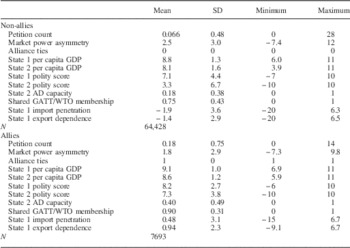
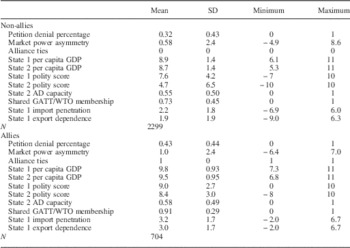
We provide summary statistics for two sets of models, one of petition counts and the other of petition denials. Table 1 provides the summary statistics of the variables for the count model, by alliance status. Table 2 provides the summary statistics of the variables for the petition denial models.
Summary Statistics for Model of Antidumping (AD) Petition Counts

Summary Statistics for Models of Antidumping (AD) Petition Denial

Methods and Models
We seek to verify the following pattern. The number of petitions for AD against state 2 that state 1 receives from domestic industries, but denies, should be increasing in the ratio between the states’ GDP if the states are allies. When state 1 is economically larger than state 2 and is allied with state 2, it will deny greater percentages of domestic petitions for AD measures. If two states are not allies, then we do not expect any systematic relationship between relative market size and the number of petitions against state 2 that state 1 denies. In short, we anticipate a multiplicative term between the measure of alliance ties and the measure of market power asymmetry to be positive and significant.
There are some notable anecdotal examples of this pattern. First, during the period under analysis below, the United States received a positive count of AD petitions against Belgium (NATO partner) and Sweden (no alliance ties) in nine separate years. In 2012, the two countries were roughly equal in economic size. Belgium’s GDP was $498.9 billion, whereas Sweden’s GDP was $543.9 billion. Across the nine years, the United States denied 62 percent of petitions against Belgium, whereas it denied only 30 percent of petitions against Sweden. Second, the pattern can exist over time for a given partner as well. The United States denied 0 percent of AD petitions against Argentina, when the latter had no alliance ties with the United States, but when the two did have an alliance, the United States denied 50 percent of the petitions it received. Before Hungary becoming a member, the EU rejected only 10 percent of AD petitions against Hungary when it was not an alliance partner, yet the EU rejected 100 percent of petitions filed against Hungary when it was an alliance partner.
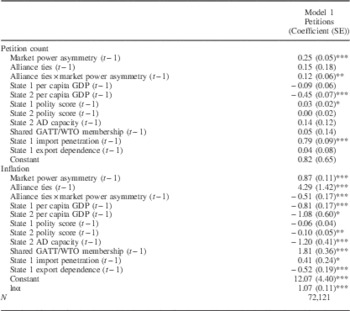
Before proceeding to estimate the main model on the proportion of petitions denied, we first model the determinants of AD petitions. We examine the determinants of the varying counts of petitions that AD user states receive against trade partners, given that most trade partners do not face any AD petitions. Given the overdispersion of the petition count, we use a zero-inflated negative binomial model to analyze this dynamic. We do not have a specific argument that separates the inflation and the count stages of the model. Accordingly, we include the same set of covariates for the two stages. The following equation characterizes both stages, and Table 3 summarizes the results:
 $$\eqalignno{ {\rm Petitions}\;{\rm received}_{{ijt}} \!= \,& \alpha \,{\plus}\,\beta _{1} \:{\rm Market}\;{\rm power}\;{\rm asymmetry}_{{ijt{\minus}1}} \,{\plus}\,\beta _{2} \:{\rm Alliance}_{{ijt{\minus}1}} \cr & {\plus}\beta _{3} \:{\rm Market}\;{\rm power}\;{\rm asymmetry}_{{ijt{\minus}1}} \,{\times}\,{\rm Alliance}_{{ijt{\minus}1}} \cr & {\plus}\beta _{4} \:{\rm Development}_{{it{\minus}1}} \,{\plus}\,\beta _{5} \:{\rm Development}_{{jt{\minus}1}} \cr & {\plus}\beta _{6} \:{\rm Democracy}_{{it{\minus}1}} \,{\plus}\,\beta _{7} \:{\rm Democracy}_{{jt{\minus}1}} \cr & {\plus}\beta _{8} \:{\rm State}\;{\rm 2}\;{\rm AD}\;{\rm user}_{{jt{\minus}1}} \,{\plus}\,\beta _{9} \:{\rm Shared}\;{\rm GATT/WTO}\;{\rm membership}_{{ijt{\minus}1}} \cr & {\plus}\beta _{10} \:{\rm Import}\;{\rm penetration}_{{ijt{\minus}1}} \,{\plus}\,\beta _{11} \:{\rm Export}\;{\rm dependence}_{{ijt{\minus}1}} \cr & {\plus}{\varepsilon}_{{ijt}} . $$
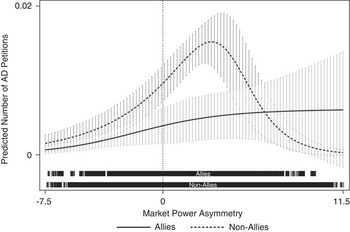
In the inflation stage, AD user states are less likely to confront non-zero counts of AD petitions against their allies as their market power asymmetry increases. When the market power is symmetric within dyads (Market power asymmetry=0), AD user states are more likely to receive petitions against allied trade partners. All the control variables have a negative effect on inflation, except shared membership in GATT/WTO and AD user states’ degree of import penetration. In the count stage, however, the multiplicative term has the opposite effect. Given that AD states receive some positive count of AD petitions, they receive higher numbers of petitions against their allies as their market power asymmetry increases, indicating that allied states are uniquely likely to be accused of protection under the conditions anticipated by the theoretical model.
Zero-Inflated Negative Binomial Model of Antidumping (AD) Petition Counts

Note: standard errors in parentheses are clustered on directed dyads.
*p<0.1, **p<0.05, ***p<0.01.
Figure 2 plots the predicted count of AD petitions for allied and non-allied dyads as a function of market power asymmetry with 90 percent confidence intervals. For the central part of the data distribution, AD user states receive more petitions against non-allied trade partners than against allied trade partners, as market power asymmetry increases. The predicted number of petitions is statistically different. Given this difference, we generate an inverse Mills ratio (IMR) calculated from a probit model of AD petitions, using the same specification as above. Inclusion of this measure in the main analysis controls for the different likelihood of AD user states receiving petitions against their allied versus non-allied trade partners.
Predicted count of antidumping (AD) petitions, allies versus non-allies

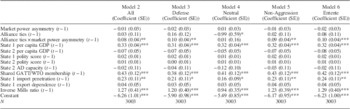
For the main analysis, the dependent variable is the percentage of petitions denied. As the proportions are bounded between 0 and 1, we use a generalized linear model with a logit link function and a binomial distribution of the dependent variable. Other than the inclusion of the IMR variable obtained from the analysis of AD petition determinants, the list of covariates remains the same as in the previous model. We run the model using the various measures of alliance ties beyond the main defense pacts coding. In Model 2, the alliance is a binary indicator of all types of alliances in the COW data set. Model 3 is the main defense pacts measure. Models 4 and 5 use neutrality and non-aggression pacts, respectively, and Model 6 uses ententes, or consultation agreements. Table 4 summarizes the results.
GLM Models of Percentage of AD Petition Denial

Note: GLM models with logit link and binomial family. Standard errors in parentheses are clustered on directed dyads.
GLM=generalized linear model; AD=antidumping.
*p<0.1, **p<0.05, ***p<0.01.
The multiplicative term between alliance ties and market power asymmetry is positive and statistically significant across the models except in Model 4, which uses neutrality pacts as the measure of alliance ties. The size of the coefficient remains relatively the same across the significant results. In Model 4, the alliance ties coefficient is negative, indicating that when the power asymmetry within dyads is 0, AD user states deny fewer AD petitions against trade partners with whom they have neutrality pacts. The divergent effect of neutrality pacts may result from the type of commitment entailed—where states hope that their partners will not use military power under certain conditions—or from the small number of such agreements in the data. Whereas all the other types of alliances range between 660 and 815 dyad-years under analysis, neutrality pacts only have 61 observations. Accordingly, the estimates of the variable likely reflect idiosyncratic dynamics of these observations.
The rest of the covariates generate fairly consistent results across the models as well. Shared GATT/WTO membership increases AD user states’ percentage of denying AD petitions from domestic industries. The inverse Mills ratio from the model of petition determinants is positive, indicating that the selection of trade partners targeted by AD petitions in the first place affects the percentage of petitions denied.
AD user states with higher import penetration from their dyadic trade partner deny higher percentages of petitions. This result has two substantive interpretations. First, as Model 1 demonstrates, AD user states with higher import penetration are more likely to receive AD petitions and receive more AD petitions against trade partners with whom they experience penetration. If AD user states confront constraints in administering and imposing AD duties, then they likely grant a fixed number of the received petitions. This would lead to higher percentages of denied petitions when they receive higher numbers of petitions. Second, AD user states with higher import penetration may also consider the political economic implications of granting a high percentage of petitions. Higher acceptance may provide incentives to other import-competing domestic industries to seek AD protection and increase the likelihood of trade conflicts between the states.
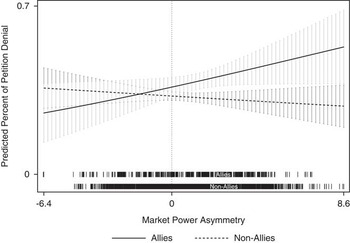
To present the substantive interpretation of the main result more clearly, we plot the predicted percentages of denied petitions for allied and non-allied dyads as a function of market power asymmetry, holding all the other variables at their means. Figure 3 contains the plot, with the 90 percent confidence intervals for the two series. The rug plots on the bottom show the distribution of observations for the two groups.
Predicted percentage of antidumping petitions denied, allies versus non-allies

As the positive slope of the solid line shows, AD user states deny increasing percentages of AD petitions against their allied trade partners as their relative market power increases. By contrast, AD user states deny decreasing percentages of AD petitions against their non-allied trade partners as their relative market power increases. The predictions separate over much of the range of power asymmetry where the AD user states are more powerful (market power asymmetry>0). These results provide strong support for the hypothesis emerging from our model. Among allied states, as the extent of power asymmetry grows within dyads, more powerful AD user states become more likely to deny domestic petitions for protectionism—refusing to retaliate against the likely protectionism by the trade partner. The same relationship does not exist, though, for non-allied states. In fact, stronger non-allied states become slightly more likely to grant AD petitions as power asymmetry increases in their favor.
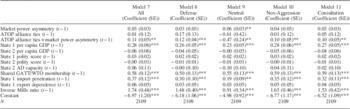
We carry out various robustness checks to examine how stable the results are, in addition to the set of COW alliance measures used above. First, ATOP provides alternate measures of alliances. The correlation between the dichotomous measure of all ATOP alliances and the dichotomous measure of all COW alliances is 0.83. Table 5 provides the results of the corresponding models using ATOP’s variables of all alliances, defense pacts, neutrality, non-aggression, and consultation agreements. Although the size of the sample decreases by about one-third, the pattern of the results remain the same. AD user states deny higher percentages of AD petitions from their domestic industries against trade partner allies as their relative market power increases. The same relationship does not exist for non-allied dyads. Neutrality agreements have a reversed effect. Non-allied states deny greater percentages of AD petitions, whereas non-allied states deny fewer percentages as their relative market power grows. As with the COW neutrality pact measure, the relative scarcity of this type of alliances (34 instead of between 585 and 819) may account for this result.
GLM Models of Percentage of AD Petition Denial (ATOP Measures of Alliances)

Note: GLM models with logit link and binomial family. Standard errors in parentheses are clustered on directed dyads.
GLM=generalized linear model; AD=antidumping; ATOP=Alliance Treaty Obligations and Provisions Project.
*p<0.1, **p<0.05, ***p<0.01.
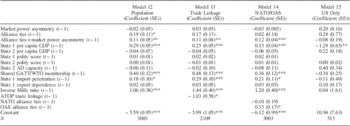
Second, we estimate the main models with an alternate measure of relative market power, based on population size of states. Population size represents market power in terms of the number of consumers and the potential for a state to influence the terms of trade through that channel. The correlation between the power asymmetry measures coded by GDP and by population is 0.76. Model 12 in Table 6 summarizes the results, which closely mirror the ones from Model 3. A plot of the predicted percentage of petition denial, available online, shows an even more distinct separation between the allied dyads and the non-allied dyads than Figure 3.
GLM Models of Percentage of AD Petition Denial (Robustness Checks)

Note: GLM models with logit link and binomial family. Standard errors in parentheses are clustered on directed dyads.
GLM=generalized linear model; AD=antidumping; NATO=North Atlatic Treaty Organization; OAS=Organization of American States.
*p<0.1, **p<0.05, ***p<0.01.
Third, some treaties of alliance explicitly link military and economic—or more specifically trade—benefits (Long and Leeds Reference Long and Leeds2006). If such alliances were prevalent, then the explicit linkage rather than the dynamic we posit might account for the empirical relationship. In Model 13 in Table 6, we include a dichotomous measure the explicit linkage from the ATOP data set.Footnote 19 The trade linkage measure is negative and significant, indicating that AD user states reject fewer percentages of AD petitions against their trade partners, with whom they have a trade-linked alliance. More importantly, the interaction effect maintains the magnitude and significance.
Lastly, the United States and US-centered alliances may dominate and dictate the observed relationship between alliance ties and denial of AD petitions. We check for this possibility in two ways. In Model 14, we control for the two main US-centered alliances—NATO and the Organization of American States (OAS). In Model 15, we restrict the sample to only contain the United States as the AD user state. In Model 14, the multiplicative term maintains its magnitude and significance. Among the added controls, NATO does not have a significant effect, whereas OAS increases the percentage of denied AD petitions. In Model 15, the hypothesized relationship does not exist, indicating that the relationship established in the previous models is not driven by the United States and its alliances and trade partners.
In short, the main results are robust to various specifications, alternate measures, and additional control variables. The empirical evidence consistently supports our hypothesis that alliance partners with greater market power tolerate more protectionism from smaller partners by denying domestic petitions for AD duties.
CONCLUSION
We have shown that divergent interests across trade and security can lead to unexpected patterns of tolerated, unretaliated protection in military alliances. In particular, economically smaller allies are uniquely likely to implement new protection in the form of AD measures against their larger partners, who are uniquely unlikely to retaliate. In fact, rather than a failure of collective action, such unretaliated protection characterizes a stable cooperative outcome that is crucial to the maintenance of the alliance. By showing that trade policies, as opposed to changes in trade flows, differ across samples of allied and non-allied dyads, we can avoid problems of endogeneity and say with greater confidence that trade can, indeed, follow the flag. This conclusion poses a challenge for the conventional wisdom in the extant literature, in that all good things need not go together in trade and security politics, and it may also provide indirect support for arguments that trade follows peaceful relations between states as opposed to vice versa (see Russett and Oneal Reference Russett and Oneal2001; Keshk, Pollins and Reuveny Reference Keshk, Pollins and Reuveny2004).
Although much of the recent literature on trade protectionism has focused on domestic preferences and institutions as the determinants, our findings can serve to revive the interest in the high politics of international trade. As our analysis demonstrates, domestic determinants and national security determinants are not mutually exclusive. Domestic industries and institutions provide the impetus for protectionist policies, but state-level interests can intervene in the process, allowing economically small but valuable allies to shape the trade policies of their economically powerful allies that would otherwise have strong incentives to punish unilateral protectionism.
Broadly, this article highlights the role that issue linkages play in international politics; whether states explicitly assert the linkage or not,Footnote 20 international bargains likely reflect the heterogeneous preferences of states over a wide-ranging set of policies and the varying trade-offs that states are willing to make across those policies. The flexibility of establishing such issue linkages is precisely what enables states to maintain cooperative outcomes in many issue areas in international politics. Given these interactions between both the “low” politics of international trade and commerce and the “high” politics of alliances and security, the distinction between high and low politics in international relations may be quite unproductive.
The argument and the findings in this article also have implications beyond the study of international relations. In political relationships where strong ties and heterogeneous interests simultaneously exist, a party in that relationship can exploit the relationship to its benefit. For example, in the context of Africa, Kasara (Reference Kasara2007) demonstrates that cash crop farmers, who ethnically identify with the head of state, confront higher taxes on their production because they have few electoral alternatives. More generally, ostensibly “cooperative” relationships need not always be the tide that raises all ships, especially when issue linkages are involved—whether between trade and security, representation and taxation, etc. Parties will make sacrifices in some areas, foregoing gains in one in exchange for more desired benefits in another.
Lastly, this article generates many potential avenues for future research. We highlight two, one in the area of trade disputes and the other in intra-alliance politics more generally. First, consider how findings in this article lead to implications for how allied and non-allied states would behave in trade disputes. Larger states in an asymmetric alliance may be more prone to concede in trade disputes to smaller allies. Correspondingly, smaller states in an asymmetric alliance may be more likely to initiate and escalate disputes against their larger allies than either symmetric allies or non-allied states. Second, if ostensibly weak states can, by virtue of the contributions they make to the alliance, gain the freedom to engage in tolerated trade protection, then alliance scholarship may fruitfully consider the leverage they exercise over a broader number of intra-alliance decisions. Far from free riders, weak allies may exercise a surprising amount of policy autonomy, affecting decisions over military interventions, military coordination, and, perhaps more importantly, alliance membership. As such, research on this topic can contribute to the literatures on alliances and trade, trade disputes, and intra-alliance politics more broadly.
Appendix
Proof of Proposition 1
To establish the uniqueness of (d
i
, d
−i
), it is sufficient to show that d
i
is each player’s dominant strategy, or that
 $$u_{i} (d_{i} )\,\gt \,u_{i} (c_{i} )\forall s_{{{\minus}i}} $$
. In the proposed equilibrium, d
i
is a best reply when
 $$u (d_{i} \!\mid\!d_{{{\minus}i}} )\,\gt \,u_{i} \,(c_{i} \!\mid\!d_{{{\minus}i}} )$$
, or v
i
(θ
i
–q
i
)>v
i
(θ
i
–t), which is true by construction as q
i
<t. Thus, neither player has a profitable deviation, and the equilibrium is sure to exist; uniqueness is assured by
 $$u (d_{i} \!\mid\!c_{{{\minus}i}} )\,\gt \,u_{i} \,(c_{i} \!\mid\!c_{{{\minus}i}} )$$
, or v
i
(θ
i
+t)>v
i
θ
i
, which is sure to be true as t>0. Therefore, (d
i
, d
−i
) is the unique Nash equilibrium.□
Proof of Proposition 2
We establish the claim via contradiction. Suppose the opposite is true and that (c i , c −i ) is a Nash equilibrium. If c i is a best reply for s −i =c −i , then it must be the case that u i (c i )≥u i (d i ), or that
 $$v_{i} \theta _{i} \,{\plus}\,\alpha _{i} v_{{{\minus}i}} \theta _{{{\minus}i}} \,\geq \,v_{i} (\theta _{i} \,{\plus}\,t)\,{\plus}\,\alpha _{i} v_{{{\minus}i}} (\theta _{{{\minus}i}} \,{\minus}\,t).$$
However, u i (c i )≥u i (d i ) is true iff α i ≥v i /v −i , which cannot be simultaneously true for both i and −i: when v i <v −i , i can meet the constraint but −i cannot, as α i ≤1. Therefore, (c i , c −i ) cannot be a Nash equilibrium.□
Proof of Proposition 3
To establish existence, it is sufficient to show that (c
i
, d
−i
) are both best replies when α
i
≥v
i
/v
−i
and α
−i
<v
−i
/v
i
. The Proof of Proposition 1 establishes that
 $$u_{i} (c_{i} )\,\geq \,u_{i} (d_{i} )\,\forall s_{{{\minus}i}} $$
when α
i
≥v
i
/v
−i
. Given i’s weakly dominant strategy, d
−i
is a best reply for −i when
 $$u_{{\minus}i} (d_{{\minus}i} \!\mid\!c_{{i}} )\,\gt\, u_{{\minus}i} \,(c_{{\minus}i} \!\mid\!c_{{i}} )$$
, which is true when
 $$v_{{{\minus}i}} (\theta _{{{\minus}i}} \,{\plus}\,t)\,{\plus}\,\alpha _{{{\minus}i}} v_{i} (\theta _{i} {\minus}t)\,\gt \,v_{{{\minus}i}} \theta _{{{\minus}i}} \,{\plus}\,\alpha _{{{\minus}i}} v_{i} \theta _{i} ,$$
or when α
−i
<v
−i
/v
i
. Uniqueness is ensured by
 $$u_{i} (c_{i} )\geq \,u_{i} \,(d_{i} )\,\forall s_{{{\minus}i}} $$
and
 $$u_{{\minus}i} (d_{{\minus}i} \!\mid\!c_{{i}} )\,\gt\, u_{{\minus}i} \,(c_{{\minus}i} \!\mid\!c_{{i}} )$$
within the defined constraints.□
Proof of Proposition 4
To show that there exists no equilibrium in pure strategies when v
i
(t–q
i
)/v
−i
(t+q
−i
)≤α
i
<v
i
|v
–i
, it is sufficient to show that
 $$u_{i} (d_{i} \!\mid\!c_{{{\minus}i}} )\,\gt \,u_{i} \,(c_{i} \!\mid\!c_{{{\minus}i}} )$$
and
 $$u_{i} (c_{i} \!\mid\!d_{{{\minus}i}} )\,\geq \,u_{i} (d_{i} \!\mid\!d_{{{\minus}i}} )\,\forall i$$
. The Proof of Proposition 1 shows that
 $$u_{i} (d_{i} \!\mid\!c_{{{\minus}i}} )\,\gt \,u_{i} \,(c_{i} \!\mid\!c_{{{\minus}i}} )$$
when α
i
<v
i
/v
−i
. Furthermore,
 $$u_{i} (c_{i} \!\mid\!d_{{{\minus}i}} )\geq u_{i} \,(d_{i} \!\mid\!d_{{{\minus}i}} )$$
when
 $$v_{i} (\theta _{i} \,{\minus}\,t)\,{\plus}\,\alpha _{i} v_{{{\minus}i}} (\theta \,{\plus}\,t)\,\geq \,v_{i} (\theta _{i} \,{\minus}\,q_{i} )\,{\plus}\,\alpha _{i} v_{{{\minus}i}} (\theta _{{{\minus}i}} \,{\minus}\,q_{{{\minus}i}} ),$$
or when α i ≥v i (t–q i )/v −i (t+q −i ). This guarantees that there are no mutual best replies for the proposed conditions.
As every finite game with a finite action space has a Nash equilibrium in mixed strategies, let each ally play d i with probability k i such that EU −i (c −i )=EU −i (d −i ), where
 $$EU_{{{\minus}i}} (c_{{{\minus}i}} )\,=\,k_{i} \,[v_{{{\minus}i}} \,(\theta _{{{\minus}i}} \,{\minus}\,t)\,{\plus}\,\alpha _{{{\minus}i}} v_{i} (\theta _{i} \,{\plus}\,t)]\,{\plus}\,(1\,{\minus}\,k_{i} )\,(v_{{{\minus}i}} \theta _{{{\minus}i}} \,{\plus}\,\alpha _{{{\minus}i}} v_{i} \theta _{i} ),$$
and
 $$EU_{{{\minus}i}} (d_{{{\minus}i}} )\,=\,k_{i} \,[v_{{{\minus}i}} \,(\theta _{{{\minus}i}} \,{\minus}\,q_{{{\minus}i}} )\,{\plus}\,\alpha _{{{\minus}i}} v_{i} (\theta _{i} \,{\minus}\,q_{i} )]\,{\plus}\,(1\,{\minus}\,k_{i} )\,[v_{{{\minus}i}} \,(\theta _{{{\minus}i}} \,{\plus}\,t)\,{\plus}\,\alpha _{{{\minus}i}} v_{i} \,(\theta _{i} \,{\minus}\,t)].$$
Thus i’s probability of defection is the unique value
 $$k_{i} \,=\,{{t\,(v_{{{\minus}i}} \,{\minus}\,v_{i} \alpha _{i} )} \over {q_{{{\minus}i}} v_{{{\minus}i}} \,{\plus}\,q_{i} v_{i} \alpha _{{{\minus}i}} }},$$
that solves
 $$EU_{{{\minus}i}} (c_{{{\minus}i}} )=\,EU_{{{\minus}i}} \,(d_{{{\minus}i}} )\,\forall i$$
.□
Proof of Proposition 5
To establish existence and uniqueness, it is sufficient to show that d
i
is a dominant strategy for all i, or
 $$u_{i} (d_{i} )\,\gt \,u_{i} (c_{i} )\,\forall s_{{{\minus}i}} $$
, when α
i
<v
i
(t–q
i
)/v
−i
(t+q
−i
). First, the Proof of Proposition 1 shows that u
i
(d
i
)>u
i
(c
i
) for s
−i
=c
−i
when α
i
<v
i
/v
−i
, and the Proof of Proposition 3 shows that u
i
(d
i
)>u
i
(c
i
) for s
−i
=d
−i
when α
i
<v
i
(t–q
i
)/v
−i
(t+q
−i
). As v
i
(t–q
i
)/v
−i
(t+q
−i
)<v
i
/v
−i
, the binding constraint is α
i
<v
i
(t–q
i
)/v
−i
(t+q
−i
), which guarantees that
 $$u_{i} (d_{i} )\,\gt \,u_{i} (c_{i} )\,\forall s_{{{\minus}i}} $$
.□