Systemic hypertension is increasingly being recognised in infants: current prevalence estimates range between 0.7 and 2%, and is higher in premature infants.Reference Seliem, Falk, Shadbolt and Kent 1 , Reference Alagappan and Malloy 2 Although the leading cause for hypertension in adults is recognised to be essential hypertension, studies have identified a number of aetiologies for hypertension in infants.Reference Seliem, Falk, Shadbolt and Kent 1 Use of umbilical arterial catheters, certain drugs, and various renal, cardiac, pulmonary, and autonomic problems can interact to cause hypertension in infants.Reference Seliem, Falk, Shadbolt and Kent 1 Hypertension may resolve over time, but there are no observational or follow-up studies that describe the morbidities or mortalities associated with this diagnosis in the vulnerable premature neonatal population.Reference Dionne, Abitbol and Flynn 3 This lack of data makes it difficult to determine whether either observation or treatment is the correct clinical course.
Although drugs are commonly used to treat hypertension in older children and adults, use in infants is less common. This lower use may be due to lack of evidence-based guidance. Most published recommendations are based solely on expert opinions.Reference Dionne, Abitbol and Flynn 3 There are no published studies or actively enrolling randomised trials to evaluate the safety and efficacy of antihypertensive drugs in infants. To date, only two studies have attempted to describe the use of antihypertensive drugs in the neonatal ICU.Reference Blowey, Duda, Stokes and Hall 4 , Reference Sahu, Pannu, Yu, Shete, Bricker and Gupta-Malhotra 5 Both studies included both term and preterm infants. Further data are needed to describe current antihypertensive prescription practices, particularly in premature infants.
Given the unknown long-term risks of unmanaged hypertension and the limited data regarding drug management, this study aimed to define the profile of antihypertensive drugs used and variations in their use in a large cohort of premature infants. Data from this study will support the design, choice of drug, and implementation of future trials.
Materials and methods
Study design and setting
We used a database derived from the electronic health record populated by clinicians of all infants cared for by the Pediatrix Medical Group in 348 neonatal ICU in North America from 1997 to 2013. Data on multiple aspects of care were entered into a shared electronic health record to generate admission and daily progress notes and discharge summaries. Information regarding maternal history, demographics, drugs, laboratory results, diagnoses, and procedures were then transferred to the Pediatrix Clinical Data Warehouse for quality improvement and research purposes.Reference Hsieh, Hornik and Clark 6
We identified all infants born ⩽32 weeks gestation and ⩽1500 g birth weight discharged between 1997 and 2013. We excluded infants with major congenital anomalies. We collected antihypertensive drug exposure, demographic data, laboratory values, diagnoses, presence and duration of umbilical arterial lines, and postnatal systemic steroid exposure.
Definitions
We defined antihypertensive drug exposure as any exposure of any duration to an antihypertensive drug. Antihypertensive drugs were categorised by mechanisms of action and included the following: adrenergic receptor blockers such as atenolol, esmolol, labetalol, and propranolol, angiotensin-converting enzyme inhibitors such as captopril and enalapril, calcium channel blockers such as amlodipine, isradipine, and nifedipine, and vasodilators such as hydralazine and nitroprusside. Diuretics were excluded because of their frequent use for other indications such as prevention and treatment of bronchopulmonary dysplasia. We defined first-line antihypertensive therapy as the first antihypertensive drug received during hospitalisation. Combination therapy was defined as use of two antihypertensive drugs on the same day. We defined discharge antihypertensive drug as any antihypertensive drug exposure on the day of discharge or the day before discharge. We defined hypertension as a clinical diagnosis of hypertension documented in the medical record by the treating neonatologist. Antenatal steroid exposure was defined as any maternal exposure to steroids before delivery, and postnatal steroid exposure was defined as any infant exposure to systemic dexamethasone or hydrocortisone after birth. Umbilical arterial catheter exposure was defined as at least 1 day with an umbilical arterial catheter in place. An infant was classified as having renal dysfunction if serum creatinine levels were >1.7 mg/dl or renal failure if serum creatinine levels were >3.0 mg/dl at least once at any time point during hospitalisation. To account for the contamination of infant measurements by maternal creatinine, we conducted a sensitivity analysis defining renal dysfunction and renal failure-based serum creatinine values obtained at any time after day of life 14.
Statistical analysis
Standard summary statistics were used to describe demographic characteristics; continuous variables are presented as medians (25th and 75th percentiles), and categorical variables are presented as counts (percentages). We used a Wilcoxon’s ranked sum test or Pearson’s χ2-test to compare distributions of continuous and categorical variables across groups.
We used univariable logistic regression to evaluate the association between infant factors and discharge on any antihypertensive drug. All covariates that were significantly associated with the outcome in univariable analysis were included in a full, multivariable model. We used backward-stepwise selection of variables with a p value for removal of 0.2 and a p value for entry of 0.15. Our final model included the following covariates: gestational age, diagnosis of renal dysfunction, birth by caesarean section, and prenatal steroid exposure. All statistical analyses were performed in STATA 13.1 (StataCorp LP, College Station, Texas, United States of America).
Results
Antihypertensive drug exposure
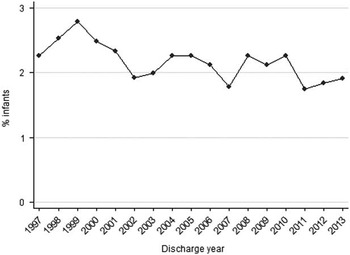
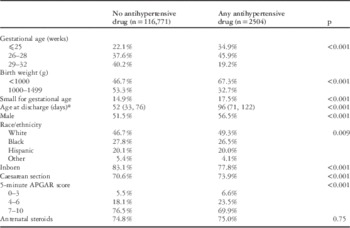
A total of 119,360 infants from 348 neonatal ICUs were included, and 2504 (2.1%) received at least one dose of any antihypertensive drug during their hospitalisation. The median postnatal and postmenstrual age at first exposure to any antihypertensive drug was 48 days (15, 86) and 34 weeks (29, 39), respectively. The total number of infant days of exposure to any antihypertensive drug was 30,679 days. The median duration of exposure among infants exposed to antihypertensive drugs during their hospitalisation was 6 days (1, 16). Antihypertensive drug exposure decreased slightly over the duration of our study from 2.3% in 1997–2004 to 2.0% in 2005–2013, p=0.009 (Fig 1). Infants who received antihypertensive drugs were of lower gestational age and birth weight compared with infants not prescribed antihypertensive drugs, 26 weeks (25, 28) versus 28 weeks (26, 30), p<0.001 and 850 g (685, 1080) versus 1030 g (783, 1260), p<0.001, respectively (Table 1).
Percentage of infants exposed to antihypertensive drugs by discharge year.

Characteristics of the study population.

* Median (25th, 75th percentile)
Diagnoses and interventions
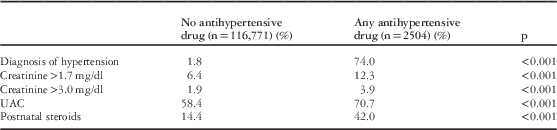
Hypertension was diagnosed in 3961/119,360 (3.3%) infants, and was more common among infants exposed to antihypertensive drugs (Table 2). Of infants diagnosed with hypertension, only 1853/3961 (46.8%) received antihypertensive drugs. Renal dysfunction and renal failure occurred in 7807/119,360 (6.5%) and 2326/119,360 (2.0%) infants, and both were more common among those exposed to antihypertensive drugs (Table 2). When defined based on serum creatinine values obtained after the first 14 days of life only, renal dysfunction and renal failure were less common, occurring in 3569/119,360 (3.0%) and 1242/119,360 (1.0%), respectively, but both remained more common among infants exposed to antihypertensive drugs: 8.7 versus 3.5%, p<0.001 for renal dysfunction and 3.0 versus 1.2%, p<0.001 for renal failure. Of infants diagnosed with renal dysfunction and renal failure, 308/7807 (4.0%) and 97/2326 (4.2%) received antihypertensive drugs. This distribution was similar when renal dysfunction or failure was defined on the basis of creatinine values obtained after 14 days of life only: 188/3569 (5.3%) for renal dysfunction and 65/1242 (5.2%) for renal insufficiency.
Diagnoses and interventions associated with antihypertensive drug use.

UAC=umbilical arterial catheter
Postnatal steroids and umbilical arterial catheters were used in 17,891/119,360 (15.0%) and 70,045/119,360 (58.7%) infants. Use of postnatal steroids and umbilical arterial catheters was more common among infants exposed to antihypertensive drugs (Table 2). Umbilical arterial catheters also remained in place longer among infants exposed to antihypertensive drugs compared with those not exposed, 11 days (8, 17) versus 1 day (1, 1), p<0.001.
Drugs
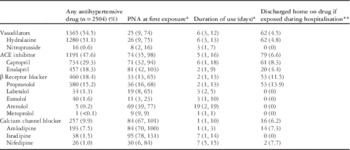
Hydralazine was the most commonly prescribed antihypertensive drug (1280/2504, 51%), followed by the angiotensin-converting enzyme inhibitors captopril (734/2504, 29%) and enalapril (457/2504, 18%) (Table 3). Propranolol was the most commonly used adrenergic receptor blocker (380/2504, 15%), whereas amlodipine was the most commonly used calcium channel blocker (193/2504, 8%). Postnatal age at the start of therapy and duration of exposure varied based on the type of antihypertensive drug. Vasodilators and adrenergic receptor blockers were started at an earlier age compared with calcium channel blockers and angiotensin-converting enzyme inhibitors, and the median duration of therapy with atenolol was longer than that of all other drugs, 19 days (2, 19).
Frequency and duration of antihypertensive drug use.

ACE=angiotensin-converting enzyme; PNA=postnatal age
* Median (25th, 75th percentile)
** Denominator is number of infants ever exposed to each drug during their hospitalisation
We administered two or more antihypertensive drugs to 582/2504 (23.2%) infants, and 11,820/30,679 (38.5%) of infant days of exposure to any antihypertensive drugs. Infants were more likely to be prescribed at least two drugs if they were outborn (27 versus 21%, p=0.003) or had a diagnosis of hypertension (87 versus 68%, p<0.0001). Gestational age, birth weight, gender, race, postnatal steroid exposure, presence of an umbilical arterial catheter, and renal dysfunction or failure were not associated with use of multiple antihypertensive drugs.
Among infants who received two or more antihypertensive drugs, the most common combinations were angiotensin-converting enzyme inhibitors and calcium channel blockers, 98/582 (16.8%) and adrenergic receptor blockers and vasodilators, 94/582 (16.2%). The median duration of exposure to two or more antihypertensive drugs was 1 day (1, 5).
Antihypertensive drugs at discharge
Survival among infants exposed to antihypertensive drugs was 92%. Only 199/2097 (9.5%) of infants ever exposed to any antihypertensive drug who survived were discharged on antihypertensive drugs. The most commonly used antihypertensive drugs at discharge among survivors were angiotensin-converting enzyme inhibitors, 79/2097 (3.8%) and vasodilators, 62/2097 (3.0%). On multivariable analysis, prematurity was associated with an increased odds of being discharged on an antihypertensive drug, odds ratio=3.14 (95% confidence interval 1.82, 5.44) for gestational age of ⩽25 weeks versus gestational age of 29–32 weeks, and odds ratio=2.90 (1.84, 4.58) for gestational age of 26–28 weeks versus gestational age of 29–32 weeks.
Discussion
The current practice for treating hypertension in premature infants is primarily based on expert opinion, with limited evidence-based data for drug use. Our study is the largest to describe current antihypertensive drug exposure in a cohort of hospitalised premature infants ⩽32 weeks gestational age. We found that 2% of hospitalised premature infants were exposed to antihypertensive drugs, with hydralazine, captopril, and enalapril being most commonly used. The majority of infants were exposed to only one type of antihypertensive drug during their neonatal ICU hospitalisation. The duration of treatment was often <1 week, and infants were rarely discharged on antihypertensive drugs.
The results of our study are consistent with previous studies that have shown an incidence of 1–3% for neonatal hypertension.Reference Seliem, Falk, Shadbolt and Kent 1 , Reference Alagappan and Malloy 2 , Reference Singh, Hurley and Myers 7 – Reference Skalina, Kliegman and Fanaroff 9 The lack of a clear definition for neonatal hypertension makes clinical diagnosis challenging. The American Academy of Pediatrics does not recommend routine blood pressure screening in healthy term infants, and there are no recommendations for screening preterm infants. 10 A systematic review of previous studies defined percentiles of systolic, diastolic, and mean blood pressures in premature infants from 26 weeks onwards and recommended pharmacotherapy when the infant’s blood pressure was consistent at the 99th precentile.Reference Dionne, Abitbol and Flynn 3 , Reference de Swiet, Fayers and Shinebourne 11 – Reference Zubrow, Hulman, Kushner and Falkner 15 Other expert opinions include correction of iatrogenic and reversible causes of hypertension, such as fluid overload, pain, and use of drugs such as steroids, before initiation of drug therapy.Reference Dionne, Abitbol and Flynn 3 Data from a few published case series reveal a wide variety of agents used by physicians.Reference Seliem, Falk, Shadbolt and Kent 1 , Reference Skalina, Kliegman and Fanaroff 9 , Reference Friedman and Hustead 16
Our results are also consistent with previous observations that only approximately half of infants diagnosed with hypertension are treated with antihypertensive drugs;Reference Blowey, Duda, Stokes and Hall 4 , Reference Sahu, Pannu, Yu, Shete, Bricker and Gupta-Malhotra 5 however, a key difference between previous studies and ours is the patient population – we focussed only on infants born ⩽32 weeks of gestation. Although the aetiology of hypertension is likely different in premature infant populations compared with term infants, this does not change the prevalence of antihypertensive drug therapy. This finding could be a result of the transient duration of hypertension, lack of clear guidelines for diagnosis and management, or concerns about drug adverse events in premature infants.
We identified several characteristics of premature infants exposed to antihypertensive drugs, including lower gestational age at birth, lower birth weight, male gender, a diagnosis of hypertension, laboratory values consistent with renal dysfunction or failure, use of an umbilical arterial catheter, and administration of postnatal steroids. Several of these factors are known risk factors for hypertension.Reference Seliem, Falk, Shadbolt and Kent 1 , Reference Singh, Hurley and Myers 7 In our study, it was difficult to know whether physicians incorporated awareness of these potential risk factors in their decision of whether or not to treat with antihypertensive drugs.
Hydralazine was the most commonly prescribed antihypertensive drug. Hydralazine is an arterial vasodilator that causes direct smooth muscle relaxation, and thereby decreases systemic vascular resistance and improves cardiac output. It is available in oral and intravenous forms. Although the intravenous form has better bioavailability, the oral form can be compounded into a stable suspension for 7 days. Onset of action starts at 5–15 minutes after administration, and the duration lasts for 4–6 hours. Although there is no clear evidence for its use as the first-line agent, experience in using hydralazine in infants with cardiac diseases, its stable oral form, and its rapid onset of action may be the reasons for its preferred use.
Overall, infants were prescribed vasodilators or β blockers earlier than angiotensin-converting enzyme inhibitors or calcium channel blockers. The later use of angiotensin-converting enzyme inhibitors may be because of concerns about their impairment of the final stages of renal maturation in premature infants.Reference Dionne, Abitbol and Flynn 3 , Reference O’Dea, Mirkin, Alward and Sinaiko 17 , Reference Guron and Friberg 18 Specifically, there are concerns about prolonged hypotension and oliguric renal failure with enalapril, even at low doses.Reference Dionne, Abitbol and Flynn 3 , Reference Wells, Bunchman and Kearns 19 , Reference Mason, Polak, Pyles, Mullett and Swanke 20 The similar timing of vasodilators and β blockers may be because of the recommendation that β blockers should be used in combination with hydralazine when a single agent has been suboptimal.Reference Dionne, Abitbol and Flynn 3 , Reference Flynn 21
We also report combinations of antihypertensive drugs used in premature infants. In our population, <25% of premature infants receiving antihypertensive therapy receive more than one drug. Regardless of whether infants received single or combination therapy, the duration of treatment was often <1 week, and infants were rarely discharged home on drugs. Long-term follow-up studies of infants discharged home on antihypertensive drug therapy typically show resolution of idiopathic forms of hypertension, except for infants with underlying renal or cardiac disease or a history of extracorporeal membrane oxygenation.Reference Singh, Hurley and Myers 7 – Reference Skalina, Kliegman and Fanaroff 9 , Reference Friedman and Hustead 16 , Reference Sheftel, Hustead and Friedman 22 , Reference Arar, Hogg, Arant and Seikaly 23 These studies, however, are typically limited by small sample sizes. This limited evidence clearly makes it challenging to define appropriate guidelines for duration of therapy and drug choice. The selection of antihypertensive drugs is further complicated by the fact that data on long-term implications of neonatal hypertension and adverse events associated with prolonged pharmacotherapy are lacking.
The key strengths of our study include its large sample size, long study period, and representation of a diverse group of neonatal ICUs ranging from academic centres to community hospitals, accounting for nearly 25% of all neonatal ICU admissions in the United States of America. Our study was primarily limited by the data source, which is derived from an electronic health record and has not undergone the scrutiny of clinical trial data collection. Antihypertensive drug exposure was extracted from provider documentation and orders, and confirmation of administration and infant tolerance of the drug by the bedside nurse were not available. This limitation extends to the description of combination antihypertensive drug therapy, which may be biased by infants transitioning from one drug class to another, rather than truly requiring two or more drugs to control their hypertension. Data on why individual drugs were chosen were not available, and we did not have access to blood pressure measurements to confirm indication and efficacy. To address this deficiency, we report on the number of infants diagnosed with hypertension, but acknowledge the limitation of such a diagnosis being made by treating providers without standardised diagnostic criteria. We were also unable to comment on the long-term use or impacts of antihypertensive drugs. This limitation may be of particular relevance, given that a single-centre, retrospective study of 36 hypertensive preterm infants found that postnatal age at hypertension diagnosis follows a bimodal distribution, with 13/36 infant diagnosed after discharge from the neonatal ICU.Reference Shah, Hashmi, Sahulee, Pannu and Gupta-Malhotra 24 Further, our definition of discharge medication was based on drugs recorded for an infant on the day of discharge or the day before, and not based on pharmacy instructions recorded in the discharge summaries or outpatient prescriptions, as neither were available from our data source. Finally, our study conclusions apply to a select population of premature infants born ⩽32 weeks gestational age and ⩽1500 g birth weight without major congenital anomalies. This population was chosen given that the highest prevalence of hypertension in premature infants was previously reported in the very low birth weight population,Reference Shah, Hashmi, Sahulee, Pannu and Gupta-Malhotra 24 and because of the potential confounding effect of major congenital anomalies on drug therapy – for example, infants with CHD may be exposed to adrenergic receptor blockers or angiotensin-converting enzyme inhibitors for the treatment of arrhythmias or for afterload reduction after cardiac surgery, and not primarily to treat systemic hypertension.Reference Chu, Hill, Clark, Smith and Hornik 25 , Reference Hsu, Zak and Mahony 26
In summary, we found that, in practice, premature infants born ⩽32 weeks gestational age are exposed to wide variations in drug use for hypertension. The findings of our study should inform the design and implementation of future randomised trials of antihypertensive drugs in premature infants.
Acknowledgement
None.
Financial Support
P.B.S. receives salary support for research from the National Institutes of Health and the National Center for Advancing Translational Sciences of the National Institutes of Health (1R21HD080606-01A1 and UL1TR001117), the National Institute of Child Health and Human Development (HHSN275201000003I and 1R01-HD081044-01), and the Food and Drug Administration (1R18-FD005292-01); he also receives research support from Cempra Pharmaceuticals (subaward to HHS0100201300009C) and industry for neonatal and paediatric drug development (www.dcri.duke.edu/research/coi.jsp). C.P.H. receives salary support for research from the National Center for Advancing Translational Sciences of the National Institutes of Health (UL1TR001117). R.G.G. receives salary support for research from the National Institutes of Health training grants (5T32HD043728-10 and 5T32HD043029-13).
Conflicts of Interest
None.
Ethical Standards
This study was approved by the Duke University Institutional Review Board with a waiver of informed consent.