I. INTRODUCTION
The economics literature abounds with definitions of externalities; yet, at the same time, it contains a similarly high number of complaints about the lack of any such definition.Footnote 1 In general terms, we may say that ‘externality’ refers to the unpriced effects of economic activities.Footnote 2 Externality, in its usual meaning, is thus a “residual concept” (Lagueux Reference Lagueux2010), defined by its exteriority to the market, and this has two consequences. First, the definition of externality depends on the specific definition of the market that has been adopted. Second, since externalities can also be internalized ‘by the market,’Footnote 3 the specific nature of such a solution again depends on the definition of the market in question.
Economic theory traditionally distinguishes two different models of exchange: the perfect competition model where the agents involved are an auctioneer and price-takers (Walras Reference Walras1874), and the bargaining model where the agents are price-makers (Edgeworth Reference Edgeworth1881). Not surprisingly, therefore, in the literature on externalities we find two modes of internalization by the market: that which takes place within a perfect competition framework (Arrow Reference Arrow1969), and that within a bargaining framework (Coase Reference Coase1960). Kenneth J. Arrow’s (Reference Arrow1969) conception of externality in terms of missing markets and its internalization by what is now called ‘Arrovian markets’ became seminal in general equilibrium theory: this is used, for example, by David Starrett (Reference Starrett1972), Jean-Jacques Laffont (Reference Laffont1977, Reference Laffont, Bonin and Bonin1988), Leonid Hurwicz (Reference Hurwicz1995), and John Boyd and John Conley (1997). Ronald Coase’s “The Problem of Social Cost,” published in 1960, gave renewed vigor to the economic analysis of externalities: criticizing the Pigovian approach and leading to the “Coase theorem,” this paper became seminal within property-rights theory and new institutional economics.
Our paper compares Arrow’s (Reference Arrow1969) and Coase’s (Reference Coase1960) analyses of externalities, with a twofold aim. First, we stress the differences between their theoretical solutions to externalities; that is, in their modes of internalization by the market (perfect competition and bilateral bargaining) in a world of zero transaction costs. Although Arrow and Coase both consider that externalities are the source of Pareto suboptimalities, which are solved by internalization—in this sense, we describe externalities as ‘absolute’Footnote 4—these different modes of internalization through the means of exchange implicitly invoke different assumptions and institutions, and, therefore, entail different implicit definitions of externality. In view of this, we also emphasize that defining an externality as an effect that has either no market or no price is insufficiently determinate, given that ‘market’ may refer here to different institutions and theories of exchange.
Second, we bring to light an overlap between their respective ideas on economic policy that has thus far been overlooked. As we shall see, Arrow (Reference Arrow1969), following Coase, introduces transaction costs and, therefore, breaks with the prevailing view in general equilibrium theory, according to which missing markets are inefficient. Both stress the likely causes of externalities: markets are costly to create. Whenever transaction costs exceed the potential gains of internalization, market solutions are no longer desirable. Since the inefficiency of externality per se is no longer straightforward, it is now relative. Both authors then indicate that other institutional solutions may be more efficient than the market: Arrow joins Coase (Reference Coase1960) regarding the necessity of comparing different solutions to externalities, and, hence, of taking into account the costs of these various institutions.
It is well known that the idea of the “Coase theorem,” although present in Coase’s Reference Coase1960 paper, was not the main insight presented therein, but was just a first step in the development of the analysis, which then goes on to introduce transaction costs; but economists have focused their attention on the “Coase theorem,” “like augurs divining the future by the minute inspection of the entrails of a goose” (Coase Reference Coase1981, p. 187). It is less well known that, in the same manner, Arrow’s solution by perfectly competitive markets can also be seen as only a first step in his analysis: he himself points out why his theoretical solution is impracticable, and he also introduces transaction costs. Therefore, he partly steps outside the general equilibrium theory framework in explaining the source of missing markets. Since Arrovian competitive markets remain a standard solution in general equilibrium theory, the solution via ‘Arrovian markets’ seems to have met with the same destiny as the “Coase theorem.”
Our aim, therefore, is to compare the accounts provided by Arrow (Reference Arrow1969) and Coase (Reference Coase1960), which paved the way to the two main market solutions for externalities.Footnote 5 This leads us to show that, even though they derive from significantly different analytic frameworks, they finally coincide in their policy propositions once Arrow introduces transaction costs in his analysis. In what follows, we dissociate them in areas where they are often associated (Arrovian markets versus bilateral bargaining, with zero transaction costs), and thus stress how their specific implicit definitions of externalities depend on their respective theoretical frameworks. Conversely, however, we also bring to light their convergence in areas where they are usually presented as conflicting (i.e., when transaction costs are positive).
This convergence, which has not previously been analyzed, may be explained by the fact that each author is not entirely aligned with the tradition to which he is associated. This is why comparing the two authors’ approaches on externalities is not equivalent to comparing general equilibrium theory and new institutional economics. The main differences between these traditions on externalities are well understood (see Dahlman Reference Dahlman1979 and Papandreou Reference Papandreou1994), but the comparison of Arrow (Reference Arrow1969) and Coase (Reference Coase1960) on this issue has not been the subject of enough attention. In the literature related to the meaning and validity of the “Coase theorem,” some authors associate Arrow (Reference Arrow1969) with Coase (Reference Coase1960) (with zero transaction costs) and assert that Arrovian markets formalize Coasian negotiation (e.g., Zerbe Reference Zerbe1980, Starrett Reference Starrett1972, Boyd and Conley Reference Boyd and Conley1997, Fox Reference Fox2007); others set them in opposition, as we do (e.g., Cooter Reference Cooter1982, Schweizer Reference Schweizer1988). However, this literature is not concerned with Arrow’s paper in and by itself, and even less so with his introduction of transaction costs. Above all, it does not discuss the implicit definitions of externalities that thereby arise.Footnote 6
Section II will show that Arrow’s and Coase’s different conceptions of exchange imply different implicit definitions of externalities and different institutions required for market internalization, when transaction costs are nil. Section III studies how the necessity of internalization is called into question by Coase’s and Arrow’s introduction of transaction costs. Our comparison brings to light that taking transaction costs into account does not avoid consistency problems: it breaks the straightforward link between externality and efficiency that previously prevailed in the world of zero transaction costs, and, therefore, it calls into question the relevance of the concept of externality. Since both authors try to retain the reference to their own ideal world, as we will see, they manage these difficulties in different manners.
II. ABSOLUTE EXTERNALITIES IN A WORLD WITHOUT TRANSACTION COSTS
In a world of zero transaction costs, externalities are ‘outside the market’ and must be internalized: absolute externalities are absolutely inefficient. Beyond this broad statement, however, there is little specific agreement. In particular, the two main theoretical frameworks typically associated with the study of externalities rely upon different conceptions of the market institution, and thus entail different definitions of externalities: these frameworks are Arrow’s (Reference Arrow1969) competitive equilibrium account and Coase’s (Reference Coase1960) bilateral bargaining account.Footnote 7
Externality as a Missing Market in a Perfectly Competitive Framework (Arrow 1969)
The pioneering work of James E. Meade and his concept of “unpaid factors” (1952, p. 57) was seminal in promoting the definition of externality as direct interaction—i.e., unpriced interaction—within a perfect competition framework. Following Meade (Reference Meade1952), there were several attempts in the 1950s and 1960s to define and specify the notion of externality and its relationship with the broader notion of market failure—see Tibor Scitovsky (Reference Scitovsky1954), Francis Bator (Reference Bator1958), James Buchanan and Craig Stubblebine (Reference Buchanan and Craig Stubblebine1962) and, later, Walter Heller and David Starrett (1976).Footnote 8 Arrow pursues the same goal, saying, “surprisingly enough, nowhere in the literature does there appear to be a clear general definition of [the public good] concept or the more general one of ‘externality.’ The accounts given are usually either very general and discursive, difficult to interpret in specific contexts, or else they are rigorous accounts of very special situations” (1969, p. 133).
Along the same line as Meade’s unpriced factors, Arrow (Reference Arrow1969) refers to externalities as interactions that escape the parametric price system induced by the assumption of perfect competition, and puts forward a new definition of externality as a kind of missing market—a definition that is now firmly established in general equilibrium theory.
Externality as a special case of missing markets
As is well known, Arrow’s early works contributed to the most solid and important results of general equilibrium theory: the existence proof (Arrow and Debreu Reference Arrow and Debreu1954, with McKenzie Reference McKenzie1954 and Gale Reference Gale1955) and welfare theorems (Arrow Reference Arrow and Neyman1951, with Debreu Reference Debreu1951). His deductive approach is part of this framework: “The corpus of neoclassical theory is rich enough to spin off a significant number of research problems endogenously. Improved formulations of general equilibrium theory and of welfare economics were obvious intellectual needs when I started my work” (Arrow Reference Arrow1985, p. iv). The problem of externalities can be seen as one of these endogenous research programs that required such improvements: within a competitive framework, where every choice is based on a given price signal, an externality is necessarily not taken into account by agents and, hence, automatically produces a Pareto suboptimality that has to be corrected. As such, an externality is a “market failure.”
The two concepts of externality and market failure are, nevertheless, not simply synonymous, and Arrow (Reference Arrow1969), therefore, tries to clarify their meanings: “[M]arket failure is a more general category than externality; and both differ from increasing returns in a basic sense, since market failures in general and externalities in particular are relative to the mode of economic organization, while increasing returns are essentially a technological phenomenon” (1969, p. 134). Thus, the distinction between market failure and increasing returns is an essential one, and not formal: the problems with returns are technological, while failure problems are institutional.Footnote 9 Although Arrow does not provide a precise definition of the notion of failure, he does give an implicit outline: the main violations of the two theorems of welfare economics are, according to him, (1) the absence of “universality of markets”—since equilibrium exists but is not Pareto optimal; and (2) the non-convexity of indifference maps and production sets—since the existence of an equilibrium is then no longer guaranteed. Only the first type of violation, that of missing markets, is considered as a “failure of markets to exist” (ibid., p. 148).Footnote 10 Externalities are, hence, missing markets, but missing markets also encompass other phenomena, including the absence of future markets or risk-hedging markets. This is why “[t]he problem of externalities is thus a special case of a more general phenomenon, the failure of markets to exist” (ibid., p. 148).Footnote 11
Externalities, therefore, invalidate the first theorem of welfare economics—since they are incompatible with the assumption of “universality of markets”—and, as they produce suboptimalities, they should be internalized. This is why we call them ‘absolute.’
The role of parametric prices in the definition of externality
Arrow establishes the conditions for Pareto optimality of a general competitive equilibrium with externalities. Formally, the consumption of a commodity by an individual i influences the utility of all others: agent i’s consumption is an argument of their utility function and produces numerous distinct externalities, as many as there are impacted agents. The solution is to show that “by suitable and indeed not unnatural reinterpretation of the commodity space, externalities can be regarded as ordinary commodities, and all the formal theory of competitive equilibrium is valid, including its optimality” (ibid., p. 146). Because externalities are now personalized—two different impacted persons correspond to two different externalities—we must create new commodities x ij characterized by both agent i, who produces it, and agent j, who is impacted by it, and associate a price p ij to them. Arrow undertakes to prove that such a system of personalized equilibrium prices exists and remains Pareto optimal.Footnote 12
As stressed, for example, by Laffont, the perfect competition solution, therefore, requires an “economic policy [that] consists of establishing a complete system of competitive markets that incorporate externalities” (1988, p. 14). In other words, internalization requires broadening the assumption of the complete system of markets to externalities; i.e., creating the missing competitive market. In the general competitive equilibrium framework, such creation calls for a special institutional organization. Creating a missing competitive market means first creating and allocating property rights; but while such an initial allocation is necessary, it does not in and by itself ensure competitive exchange. A parametric price for the externality must then be set—i.e., a single price set by an auctioneer and taken as given by the agents—as required by the perfect competition assumption.Footnote 13
This competitive solution, therefore, implicitly suggests a definition of externality that is closely related to the competitive equilibrium framework from which it originates. Externality here designates an effect that is external to the parametric price system, an effect outside a competitive market; i.e., externality is conceived of as a missing competitive market. The advantage of this perfect competition definition of externality is that it specifies the otherwise rather allusive reference to an ‘unpriced’ effect or missing market, since it explicitly refers to the institutional framework of perfect competition and to the associated price-taking assumption. Thus, it makes the exchange mode clearer, since it highlights the implicit theoretical framework. Underlining the institutional framework of competitive markets is important because it is not the only way of exchanging externality. As we shall see, Coase (Reference Coase1960) stresses the possibility of internalization through bilateral bargaining among agents, which does not require a price-taking assumption or the intervention of any auctioneer. It assumes a radically different mode of exchange and price setting from that of perfect competition.
Externality and the Bilateral Bargaining Solution (Coase 1960)
Another traditional means for internalizing externalities ‘by the market’ assigns a key role to decentralized negotiation between the emitter and the receiver of the externality. This solution is associated with the version of the “Coase theorem” originating in Coase (Reference Coase1960), which assumes bilateral bargaining between price-maker agents. This bilateral bargaining solution eliminates the Pareto suboptimality of the absolute externality, but in a different manner from the competitive solution.
Coase was not trained as an economist, but studied commerce at the London School of Economics; influenced by his professor and then colleague Arnold Plant, he acquired a special interest in the application of economic theory to practical matters. In the mid-1930s, he became interested in monopolies and did empirical research on public utilities, specifically on radio broadcasting (Medema Reference Medema1994). His article on the Federal Communications Commission (Coase Reference Coase1959) contained his first criticisms of the Pigovian analysis of externalities (Pigou 1932).Footnote 14 His 1960 development of that argument was based on legal cases and simple examples and was very different from Arrow’s deductive and formalized approach.
The “Coase theorem” solution through bargaining
Asserting that, in the absence of transaction costs, the emitter and the receiver of an externality can negotiate to reach an optimal allocation of resources, “The Problem of Social Cost” (Coase Reference Coase1960) puts forward the possibility of internalizing externalities through a decentralized price system. This criticism of the then-standard Pigovian analysis was later to be formulated as the “Coase theorem” by George J. Stigler (1966, p. 113).Footnote 15 Coase’s statement is this: if property rights are defined and allocated, then “the ultimate result (which maximises the value of production) is independent of the legal position if the pricing system is assumed to work without cost” (1960, p. 8). The final allocation is obtained through negotiations between parties on a level of nuisance and a compensation payment, which are considered as sales of all or part of a property right, or the right to use a resource, initially defined and distributed. Considering externalities as a conflict of use over a property right (and thus reciprocal by nature) was among the new insights of Coase’s analysis.Footnote 16
Coase’s (Reference Coase1960) argument rests on fictitious examples, such as the rancher whose cattle destroy neighboring crops, describing a bilateral bargaining over the level of the externality and its price. Although Coase sets this bargaining process within a global framework of perfect competition (since the agents take the prices of other commodities as given), they act as price-makers regarding the externality, as noted early on by Stanislaw Wellisz (Reference Wellisz1964). For example, if the farmer’s net gain from cultivating the land is $2 and the rancher has to pay him $3 for all damage caused by his herd, then both would gain if the farmer abandoned his culture in exchange for a payment from the rancher of between $2 and $3 (Coase Reference Coase1960, p. 4). As Coase himself recognized, his framework is implicitly Edgeworthian:
Edgeworth had argued in Mathematical Psychics (1881) that two individuals engaged in exchanging goods would end on the ‘contract curve’ because, if they did not, there would remain positions to which they could move by exchange which would make both of them better off. Edgeworth implicitly assumed that there was costless ‘contracting’ and ‘recontracting’; and I have often thought that a subconscious memory of the argument in Mathematical Psychics, which I studied more than fifty years ago, may have played a part in leading me to formulate the proposition which has come to be termed the ‘Coase theorem.’ (Coase Reference Coase1988b, p. 160)
As in Edgeworthian bargaining, the final result of the Coasean negotiations over externalities is Pareto optimal because it is assumed that mutually satisfactory bargains are struck: “[O]f course, if such market transactions are costless, such a rearrangement of rights will always take place if it would lead to an increase in the value of production” (Coase Reference Coase1960, p. 15). The result is on the contract curve, and specifically in the core (see, e.g., Hurwicz Reference Hurwicz1995).Footnote 17
Despite its ambiguous formulation—“under perfect competition private and social costs will be equal” (Stigler Reference Stigler1966, p. 113)—Stigler’s interpretation of Coase’s assumptions follows the one we present here, since it is derived from the same example of cattle and crops as in Coase, and the rancher and farmer are price-makers. As in “The Problem of Social Cost” (Coase Reference Coase1960, pp. 5 and 6), Stigler’s perfect competition assumption applies to the markets for cattle and corn: the rancher and farmer take the prices of cattle and corn as given, but make the price of the externality. Stigler’s interpretation of the “Coase theorem” is, therefore, also to be understood in a bilateral bargaining framework, as are the vast majority of statements of the “theorem” (e.g., Calabresi Reference Calabresi1968, p. 68; Dahlman Reference Dahlman1979, p. 142; Stigler Reference Stigler1992; Hurwicz Reference Hurwicz1995).Footnote 18
Our characterization of the “Coase theorem” in the tradition of bargaining raises the question of the relationship between Walrasian perfect competition and Edgeworthian bargaining in the large number case. Do our two solutions prove to be equivalent in this case? Edgeworth’s conjecture, proved later as the limit-theorem (Debreu and Scarf Reference Debreu and Scarf1963), asserts that if the number of agents of each type tends towards infinity, then the core of the economy is reduced to Walrasian equilibria. However, this identity of equilibria should not hide the differences in the two concepts of equilibrium or in the process of exchange that is assumed to lead to it: Walrasian price-taking in one case, Edgeworthian recontracting in the other.Footnote 19
The assumption of exhaustion of gains from trade
The bilateral bargaining solution to externalities requires the creation and allocation of property rightsFootnote 20 and the exhaustion of gains from trade to ensure the Pareto optimality of the agreement. From a theoretical perspective, the bargaining solution, like the competitive one, requires something more than the definition of property rights alone. In addition to property rights, the competitive solution requires the assumption of perfect competition; i.e., parametric prices. The bargaining solution requires instead that all mutually beneficial exchanges are contracted out. As Joseph Farrell writes: “The Coase theorem dispenses with the heavy assumptions of perfect competition, but replaces them with the strong assumption that no mutually beneficial agreement is missed. So while it economizes on formal institutions, it demands a lot of coordination and negotiation” (1987, p. 114). The assumption of exhaustion of gains from trade is necessary, since, if all agents individually maximize their own part of the exchange surplus, they may not agree about the distribution of this surplus, in which case some mutually satisfactory bargains are not struck and the result can be non-optimal:
Let us be clear, though, that the rational self-interest of each of two free wills does not necessitate that there will emerge, even in the most idealized game-theoretic situation, a Pareto-optimal solution that maximizes the sum of the two opponents’ profits, in advance of and without regard to how that maximized profit is to be divided up among them. Except by fiat of the economic analyst or by his tautologically redefining what constitutes ‘nonrational’ behavior, we cannot rule out a non-Pareto-optimal outcome. (Samuelson Reference Samuelson and Kuenne1967, p. 35, his emphasis)
This theoretical problem is one of the main challenges posed to the “Coase theorem” (Arrow Reference Arrow and Boskin1979,Footnote 21 Regan Reference Regan1972, Polinski 1979, Cooter Reference Cooter1982, Veljanovski Reference Veljanovski1982, Coleman Reference Coleman1984, Samuelson Reference Samuelson and Roth1985), as Coase himself later recognized.Footnote 22 Hurwicz provides a concise summary of the problem: “It is, of course, not beyond the bounds of imagination that in this situation, in effect one of bilateral monopoly, a non-optimal solution might be viewed as realistic. But the spirit of Coase’s approach is that the parties will somehow arrive at a Pareto-optimal solution” (1995, p. 63). In the statements of the “Coase theorem,” the assumption of exhaustion of gains from trade is either included in (e.g., Calabresi Reference Calabresi1991, p. 1222), or added to (e.g., Hoffman and Spitzer Reference Hoffman and Spitzer1982, p. 75), the zero-transaction-costs assumption.Footnote 23
Arrow vs. Coase: What Is Missing?
This leads us to compare Arrow’s and Coase’s analyses of internalization, and their respective definitions of externality.
We note, first, that although they both assert that internalization comes through exchange, they differ as to which institutions are required for this. From Arrow’s perspective, allocation of property rights alone cannot ensure internalization by exchange: to institute a competitive market for externalities in a general equilibrium framework, a parametric price must be set by an auctioneer. In contrast, as Arrow writes, Coase “argue[d] that in principle clear definition of property rights is sufficient to ensure efficiency. This position goes well beyond the standard neoclassical position that competitive markets suffice for efficiency. As is well known, defined property rights are only one of the necessary conditions for competitive markets” (1979, p. 24). From Coase’s perspective, bargaining is supposed to take place spontaneously and efficiently, which means that he implicitly assumes the exhaustion of gains from trade as soon as property rights are allocated and as long as transaction costs are nil. In fact, this link that Coase makes between the assumptions of exhaustion of gains from trade and of zero transaction costs is ambiguous. In a later commentary, he first asserted that the critique in terms of bargaining problems was theoretically correct even in the world of zero transaction costs (Coase Reference Coase1988b, p. 161). But, immediately afterwards, he denied its empirical relevance: “[T]here is good reason to suppose that the proportion of cases in which no agreement is reached will be small” (ibid., p. 161); or, again: “I would regard such [not Pareto optimal] outcomes as being . . . most unlikely, particularly in a regime of zero transaction costs” (ibid., p. 163). This means that, in Coase’s view, the exhaustion of gains from trade is not logically included in the zero-transaction-costs assumption even if the latter actually makes the former far more likely. Finally, again in Coase’s mind, only their costs can prevent mutually beneficial negotiations from occurring in practice: “[T]he only reason individuals and private organizations do not eliminate [externalities] is that the gain from doing so would be offset by what would be lost (including the costs of making the arrangements necessary to bring about this result)” (ibid., p. 27). In his view, bargaining problems do not have much empirical relevance: the situation of zero transaction costs entails that no mutually advantageous bargain will be missed.Footnote 24 To sum up, the definition and allocation of property rights are, therefore, necessary, and are believed to be sufficient, even if this belief in the operation of the real world is, as stressed above, not theoretically grounded. Meanwhile, in Arrow’s framework, property rights are necessary but not sufficient to ensure the efficiency of (competitive) internalization.
Turning, second, to the definition of externality, we note that since both solutions assert that internalization comes through exchange, both refer to externality as a non-exchanged effect; i.e., an effect not taken into account by the agents. However, again, as each requires a different exchange mode, once the latter is specified, the definition of externality is specified, too. The Coasean definition differs from the Arrovian one in that no reference to parametric prices and perfect competition is necessary. In addition, the role of property rights is also different in the two definitions. In the bilateral bargaining framework, absence of exchange necessarily means lack of property rights, since the creation of property rights is believed to ensure internalization by exchange. Here, an externality could be defined more precisely as an effect without property rights rather than an effect without exchange, and the insistence of some authors on the role of property rights in the analysis of externalities (e.g., Buchanan and Tullock Reference Buchanan and Tullock1962, p. 44; Demsetz Reference Demsetz1966, p. 62) must be understood along these lines. On the contrary, in the perfect competition framework, absence of exchange does not always imply a lack of property rights: property rights could well be allocated and yet not exchanged, if no competitive market over these rights is created. An externality cannot, therefore, be defined by the lack of property rights; it can be more precisely defined, as we did earlier, as an effect without parametric prices. In other words, saying that the two traditions refer to externalities as non-exchanged effects is correct but only in an allusive sense, since it does not set out the assumptions underpinning the exchange. When the kind of exchange is made clear, we see that the roles of perfect competition and of property rights differ between the two definitions.
Finally, in both analyses, externalities are necessarily inefficient, and therefore absolute, since they are not exchanged—no matter what is the exchange mode. What happens when the competitive or the bargaining solution restores optimality? Strictly speaking, the externality as a non-exchanged effect disappears, since it is now exchanged, either through competitive behavior or bargaining behavior. In the competitive case, for example, “since we are now assuming a market for pollution, (formally) there are no externalities present in this economy” (Hurwicz Reference Hurwicz1995, p. 55). But, of course, the interaction ‘phenomenon’ or the side effect remains; in common language, pollution is not zero at the optimum, it only becomes Pareto optimal.Footnote 25
In both traditions, the connection between externality and inefficiency is called into question once transaction costs are introduced.
III. WHAT HAPPENS TO EXTERNALITIES IN A WORLD WITH POSITIVE TRANSACTION COSTS
In the previous analyses without transaction costs, externalities are absolute: their suboptimality can always be eliminated through exchange. The introduction of transaction costs will modify the essential characteristic of externalities, since now they do not necessarily call for such an internalization. If bilateral bargaining (Coase) or competitive exchange (Arrow) is costly, transaction costs can exceed the gains from trade, and internalization through exchange is no longer appropriate. Finally, and rather strikingly, since they are coming from different theoretical frameworks, the authors seem to converge in their policy proposals: that different institutional solutions have to be compared in terms of their gains and costs. We shall explain this convergence by reference to their concern to apply economics to the real world.
The Introduction of Transaction Costs in the Bargaining World: The Irrelevance of the Concept of Externality
Coase’s call for realism explains his criticisms of standard microeconomics and the great majority of his insights. His work evinces an enduring search for realistic assumptions: this was already present in his 1937 article on the firm, was further developed in his response to Milton Friedman (Reference Friedman1953) delivered at a conference in 1981 (Coase Reference Coase1982), and has been reasserted in his latest book (Coase and Wang Reference Coase and Wang2012). His theory manifests a continuous back-and-forth between theory and facts (see Mäki Reference Mäki1998, Wang Reference Wang2003, Pratten Reference Pratten, Davis, Marciano and Runde2004, Bertrand Reference Bertrand2013). “The Problem of Social Cost” is no exception, and it is in the name of realism that transaction costs are introduced in the analysis. Coase considers the assumption of zero transaction costs as “very unrealistic” (1960, p. 15). This assumption was aimed at “mak[ing] clear the fundamental role which transaction costs do, and should, play in the fashioning of the institutions which make up the economic system” (Coase Reference Coase1988b, p. 13), a role neglected by later economists who thus narrowed the scope of his analysis (see, e.g., Medema Reference Medema1999, Coase Reference Coase1992).Footnote 26
Transaction costs arise from the fact that “[i]n order to carry out a market transaction it is necessary to discover who it is that one wishes to deal with, to inform people that one wishes to deal and on what terms, to conduct negotiations leading up to a bargain, to draw up the contract, to undertake the inspection needed to make sure that the terms of the contract are being observed, and so on” (Coase Reference Coase1960, p. 15).
A second-best comparison: Keeping the reference to an optimal state without transaction costs
Introducing transaction costs implies that reaching a Pareto-optimal allocation by internalization is no longer straightforward. If a mutually beneficial exchange costs more than its expected benefits, this exchange of rights does not occur and the suboptimal initial allocation remains. If different allocations of rights are compared, “[o]ne arrangement of rights may bring about a greater value of production than any other. But unless this is the arrangement of rights established by the legal system, the costs of reaching the same result by altering and combining rights through the market may be so great that this optimal arrangement of rights, and the greater value of production which it would bring, may never be achieved” (Coase Reference Coase1960, p. 16, our emphasis).Footnote 27 In other words, one allocation of rights maximizes the value of production and is Pareto optimal: either it is the initial situation, thanks to an appropriate allocation of rights, or it has to be reached by exchanges. If these exchanges are too costly, this optimal allocation of rights will not be reached: the situation in which a mutually beneficial transaction does not take place, since it is too costly, remains suboptimal. In other words, Coase retains the reference to an ideal world and to its Pareto optimality.
The fact that optimality cannot be obtained through exchange does not, however, mean that the initial situation is desirable a priori, since “[i]t is clear that an alternative form of economic organisation which could achieve the same result at less cost than would be incurred by using the market would enable the value of production to be raised” (ibid., p. 16). There is a role, therefore, for policy. Using an opportunity-cost approach, the policymaker has to compare the values of the production yielded by different institutional arrangements (net of their operation costs) and choose the one that yields the greater net value.Footnote 28 These different arrangements do, of course, include the market, but also encompass the firm (ibid., p. 16), public regulation (ibid., p. 17), and the status quo (ibid., p. 18). This becomes a pragmatic problem: “Satisfactory views on policy can only come from a patient study of how, in practice, the market, firms and governments handle the problem of harmful effects” (ibid., p. 18). Since “[a]ll solutions have costs” (ibid., p. 18), none of them will be optimal. We have here a kind of second-best comparison between the values of the production yielded by different institutional arrangements; this is very different from the standard theory criticized by Coase, which designs policy through comparison between the real world and the ideal world of perfect competition.Footnote 29
Once we take into account the costs of the different solutions, externality should not necessarily be eliminated even where it is suboptimal: if market transactions and firm solutions are too costly, and “[i]f with governmental intervention the losses also exceed the gains from eliminating the ‘externality,’ it is obviously desirable that it should remain” (Coase Reference Coase1988b, p. 27). The desirability of externality here is relative to the net gains of all the solutions. It is precisely to indicate that externalities should not automatically be suppressed that Coase does not use the standard established term:
To prevent it being thought that I shared the common view, I never used the word ‘externality’ in ‘The Problem of Social Cost’ but spoke of ‘harmful effects’ without specifying whether decision-makers took them into account or not. Indeed, one of my aims in that article was to show that such ‘harmful effects’ could be treated like any other factor of production, that it was sometimes desirable to eliminate them and sometimes not, and that it was unnecessary to use a concept such as ‘externality’ in the analysis in order to obtain the correct result. (ibid., p. 27)
More on the irrelevance of externality: The Coasean tradition
A certain Coasean tradition draws out the consequences of positive transaction costs as regards the inefficiency of externalities in a radical manner. In this tradition, the introduction of transaction costs is known for causing the erosion of the concept of externality itself. Since, in the world of the “Coase theorem,” the existence of an externality does not preclude reaching a Pareto-optimal allocation, it is positive transaction costs and not externalities in and by themselves that stand in the way of reaching this optimum. The concept of transaction costs eventually replaces the concept of externality, as Carl J. Dahlman makes particularly clear:
Ultimately, the relevance of externalities must lie in the fact that they indicate the presence of some transaction costs. For if there were no costs of transacting, then the potential Pareto improvement could be realized by costless bargaining between self-interested economic agents. . . . The conclusion is thus unambiguous: in the theory of externalities, transaction costs are the root of all evil. But for transaction costs, such perversions of the invisible hand could not even occur much less persist. (1979, p. 142)Footnote 30
Moreover, in this framework, a mutually beneficial exchange that would not be realized because it was too costly is, in fact, not Pareto-improving given transaction costs. If we approach transaction costs like any other production cost, as Guido Calabresi does, then “no less than existing technology, [they] define what is currently achievable in any society—the Pareto frontier. It follows that any given society is always or will immediately arrive at a Pareto optimal point given transaction costs” (1991, p. 1212, his emphasis). Therefore, “what is is efficient” (ibid., p. 1216), even if transaction costs are positive and even high.Footnote 31 Thus, here, the concept of externality loses its relevance entirely, since it can never be suboptimal.Footnote 32
This interpretation of Pareto optimality given transaction costs encounters two problems. The first one is well known: it legitimates any existing situation as optimal. In this line of argument, the notions of efficiency and transaction costs are being interpreted in a circular way.Footnote 33 The second problem is that such an interpretation of efficiency finally contradicts the “Coase theorem,” since the assumption of zero transaction costs is no longer required to assert that the result is efficient. As Calabresi comments: “[A]ny starting point will be, or will immediately lead to, an efficient end point, even with transaction costs” (ibid., p. 1215, his emphasis).Footnote 34 The argument with which we are faced is somewhat tortuous: since externalities can be solved by negotiation in the world of zero transaction costs, this notion (linked with suboptimality) is meaningful only in the positive-transaction-costs world. However, in this latter world, transaction costs are taken into account to specify the Pareto optimum, and externalities are not suboptimal, either.
Nevertheless, as seen above, Coase’s own analysis of externalities cannot be blamed for these difficulties of circularity and inconsistency. Since his conception of optimality is different from these, he does not add the transaction-costs proviso to the Pareto criterion, which makes him distinctive within the Coasean tradition he initiated: the externality inefficiency is relative to the net gains of alternative solutions, including bargaining. We will now see that the consequences Arrow draws from the introduction of transaction costs are rather similar.
The Introduction of Transaction Costs in a Perfect Competition Framework: From “Failure of Markets to Exist” to “Failure of the Market to Achieve Efficiency”
Although Arrow is one of the main architects of the axiomatization of general equilibrium theory, he is cautious about the interpretation of its results. He thinks that one of its great benefits is that it can enlighten us regarding the assumptions required for existence and optimality. Furthermore, while he believes in the importance of these theoretical results, he also accepts that the conditions (perfect competition, universality of markets, convexity, and so on) required for existence and optimality are unrealistic (see Duffie and Sonnenschein Reference Duffie and Sonnenschein1989, p. 581). For example, regarding his existence proof of general equilibrium, he commented: “My own view of the matter is that the world is imperfectly competitive. I do not believe in the perfectly competitive view of the world, I think the general equilibrium theory is an imaginatively manipulative theory; one can get results out of it. It serves for many purposes as good approximation for reasons that one does not fully understand. Therefore, it is a useful tool” (1987, pp. 197–198, his emphasis). Because of this dissatisfaction and his concern for realism, he has always been interested in market failures—including externalities —imperfect competition models, and applied economics.Footnote 35 His interest both in the idealized general equilibrium theory and in the functioning of real economy explains his particular view of markets (and, consequently, of externalities). As has been stressed by Christopher Bliss:
To some theorists a market is an abstraction, no more; an idealized representation of the process of exchange. Arrow’s vision concerning the market is different: it is realistic and institutional. This is not to say, of course, that Arrow is uninterested in frank idealizations of markets. Such could hardly be supposed of the great co-architect of what has come to be known as ‘The Arrow–Debreu model’. Yet there is no doubt that pure general equilibrium is not for Arrow an end in itself. Its interest for him springs from its role as a point of reference for the evaluation of the performance and potential of real world markets. (1987, p. 303)
In the same vein, the solution via competitive markets elaborated in the 1969 article is to be treated cautiously.
The limits of Arrovian markets and the introduction of transaction costs
Arrow himself emphasizes that the abstract, theoretical solution of creating the competitive missing market has limitations.
First, the price-taking assumption is especially ill-suited to the kind of personalized externalities that he introduces in his demonstration, since it applies to only one buyer and one seller (Arrow Reference Arrow1969, p. 146).Footnote 36 Second, Arrow, in fact, wants to stress the causes of missing markets and tries to explain precisely what impedes this mode of internalization. Externalities are usually not appropriable.Footnote 37 This is why Arrow, when studying the reasons why markets for externalities are missing, underlines that “[i]t is not the mere fact that one man’s consumption enters into another man’s utility that causes the failure of the market to achieve efficiency. . . . Pricing demands the possibility of excluding nonbuyers from the use of the product, and this exclusion may be technically impossible or may require the use of considerable resources” (ibid., p. 146).
In fact, as soon as he goes beyond the simple observation of the presence of externalities and attempts to explain their causes, Arrow needs to introduce transaction costs. In so doing, he partly steps outside the general equilibrium approach. He posits two sources of transaction costs, or causes of the “failure of markets to exist”: not only the exclusion costs, but also “the costs of information and communication” (ibid., p. 149).Footnote 38 The absence of the market is, hence, due to the costs of its creation, and the very notion of market failure becomes relative: “Market failure has been presented as absolute, but in fact the situation is more complex than this. A more general formulation is that of transaction costs, which are attached to any market and indeed to any mode of resource allocation” (ibid., p. 149). Consequently, “[m]arket failure is the particular case where transaction costs are so high that the existence of the market is no longer worthwhile” (ibid., p. 149). Market failure now refers to a situation in which creating a market is no longer a solution, since transaction costs are too high. This is why Arrow concludes that “it is better to consider a broader category, that of transaction costs, which in general impede and in particular cases completely block the formation of markets” (ibid., p. 134). This means that the absence of a market per se is not the problem, for its creation may be too costly; the root of the problem is transaction costs. A few years later, Arrow confirmed this interpretation: “[T]he optimal resource allocation will not be achieved by a competitive market system if there are technological externalities. These are goods (or bads) for which no market can be formed. The usual reason given is that the good is not property in law or in practice, the latter covering the cases in which the act of enforcing property rights is itself costly and may therefore not be worthwhile” (1979, pp. 23–24).
A second-best comparison: The relativity of market failures
Transaction costs, therefore, lead to “welfare losses,” and different solutions have to be compared, all of them costly: “Removal of these welfare losses by changing to another system (for example, governmental allocation on benefit-cost criteria) must be weighed against any possible increase in transaction costs (for example, the need for elaborate and perhaps impossible studies to determine demand functions without the benefit of observing a market)” (Arrow Reference Arrow1969, p. 149). As he explains, this analysis “involves the recognition that the instruments available to the government or other nonmarket forces are scarce resources for one reason or another, so that all that can be achieved is a ‘second best’” (ibid., p. 134).
The concepts of externality and of market failure are now relative to the level of transaction costs of the market. When a market is too costly—i.e., not worthwhile—alternative modes of resource allocation must be envisaged and compared according to their respective costs. This introduction of transaction costs and relative market failures leads us to make several observations.
First, while introducing transaction costs, Arrow could be seen as having one foot in each theoretical world. The concept of externality—which is derived from the ideal framework of perfect competition—is exported to a world of positive transaction costs. But it is difficult to extract a concept defined in a specific analytical framework—here, a world of perfect competition without transaction costs, where markets and institutions are exogenous and never explained—and to export it to another analytical framework where transaction costs are used to explain missing markets and institutions more generally.Footnote 39 Externality as absolute market failure and externality as relative market failure belong to different analytical worlds.
Second, and perhaps as a consequence, Arrow’s argument appears almost paradoxical. He starts with a characterization of missing markets in terms of absolute market failure, systematically producing suboptimalities that can be corrected by creating competitive markets. Then, when introducing transaction costs, he undermines his previous characterization of externality and market failure. The definition of externality—as direct interaction without parametric price, or as a missing market—is not challenged. However, its close relationship with the previous account of the inefficiency of such missing markets is called into question, as is his definition of market failures. As we said, in the high-transaction-costs case, if missing markets remain suboptimal—because we are trying to reach only a second best and nothing can be optimal—they are no longer creating inefficiency per se. On the contrary, and as we have already seen, they reveal the inefficiency of creating markets: “[m]arket failure is the particular case where transaction costs are so high that the existence of the market is no longer worthwhile” (ibid., p. 149). Therefore, the introduction of transaction costs entails moving from a world in which missing markets are necessarily inefficient to a world in which, on the contrary, missing markets can prove to be worthwhile. If market failure simply referred to missing markets, with or without transaction costs—i.e., only to the fact that a market was missing and without any normative judgment—it would not be a specific concept. But if it refers to failure proper, a “failure of markets to exist,” as suggested by Arrow, it appears peculiar to define a market that does not, and should not, exist as a ‘good’ or efficient missing market. For, one could ask: where is the failure if the absence of market is a good thing?Footnote 40 We suggest that Arrow moves implicitly from “failure of markets to exist” (ibid., p. 148) to “failure of the market to achieve efficiency” (ibid., p. 146): previously, a market was considered to fail to exist, since it should exist; now a market succeeds in not existing in the sense that it would fail to be efficient, since it would be too costly to be worthwhile.
To retain the same relationship between inefficiency and missing markets (i.e., the same normative meaning) before and after introducing transaction costs, Arrow could have defined market failure as the situation in which the creation of markets would be worthwhile; i.e., as the situation in which transaction costs are low rather than high (or, more precisely, inferior to the gains of the creation of a perfectly competitive market). In this case, market failures would refer to situations where missing markets are inefficient and externalities require internalization, in the world of zero transaction costs just as in the world of positive transaction costs.Footnote 41 More radically, though, another way to avoid the ambiguity of such a concept of “failure” could have been not to have used it, following Coase, who avoids using the term “externality” precisely because of its lack of straightforward normative content.
The Difficult Switch from One World to Another
The authors draw on different analytical frameworks and have different methodological approaches—a more deductive one for Arrow, a more inductive one for Coase—which cannot be reconciled. Nevertheless, both share a concern for realism, or for real-world markets, which may explain the degree of convergence we note with respect to their policy designs. Obviously, though, this does not mean that Arrow practices a Coasean institutional comparative method.
Because of this concern for realism, Arrow partly steps outside the general equilibrium framework, where every institution is taken as either given or missing, with no explanation in either case. He does, indeed, investigate the possible causes of externality, trying to explain why markets are actually missing. He then introduces transaction costs in the manner of Coase, and, like him, suggests a second-best comparison between different institutional solutions. Therefore, they arrive at quite similar policy recommendations. Of course, the pragmatic comparison of the costs and benefits of the various institutional arrangements studied by Coase—and which is one of the main insights of his thought—is not something that is carefully analyzed by Arrow. As Andreas A. Papandreou emphasizes, “once transaction costs are incorporated and one moves to a new sense of market failure . . . , [o]ne would expect that a ‘relative’ notion of market failure would involve comparison of the market with alternative modes of organization. . . . The problem is that Arrow never discusses a comparison set of modes of organization and we are left with non-existence as an explanation of failure” (1994, p. 95). Papandreou is probably a bit harsh here: Arrow does identify alternative organization modes and asserts that “[t]he identification of transaction costs in different contexts . . . should be a major item . . . of the theory of resource allocation in general” (1969, p. 134). Even though he himself recognizes that “[o]nly the most rudimentary suggestions are made here” (ibid., p. 134), he comments that various kinds of “collective action” are alternatives to the market: public intervention, firms with their “authoritative and hierarchical controls” (an implicit reference to Coase Reference Coase1937), and “norms of social behavior, including ethical and moral codes” (Arrow Reference Arrow1969, p. 151).
However, Papandreou is correct: Arrow stresses the importance of transaction costs, but does not draw the full consequences of introducing such a notion. Even in his later research programs, he does not direct his inquiries in that direction. And, similar to the way in which Arrow does not adopt a world of positive transaction costs, Coase does not really let go of the zero-transaction-costs world. In his analysis of the positive-transaction-costs world, and despite his pragmatism, Coase retains a reference to the zero-transaction-costs world and its Pareto optimality.
In this twilight zone between the worlds of zero transaction costs and of positive transaction costs, both authors face certain difficulties. Their introductions of transaction costs call into question the relevance of the concepts of externality and failure, since they modify the previously accepted link between these concepts and suboptimality. The efficiency of market internalization, by competitive markets or bilateral bargaining, becomes relative to transaction costs, and the concept of externality loses its clear normative content. The authors do not manage this issue in the same way. Coase avoids using the term “externality” and prefers to refer to “harmful effects,” which evokes the phenomenon itself rather than its normative consequences. For his part, Arrow implicitly changes his definition of failure, switching from a “failure of markets to exist” to a “failure of the market to achieve efficiency,” and from the notion of an inefficient missing market to a “worthwhile” missing market. This is an implicit challenge to the notion of a missing market, which is thus called into question, since it cannot be said to be ‘missing’ anymore.
IV. CONCLUDING REMARKS
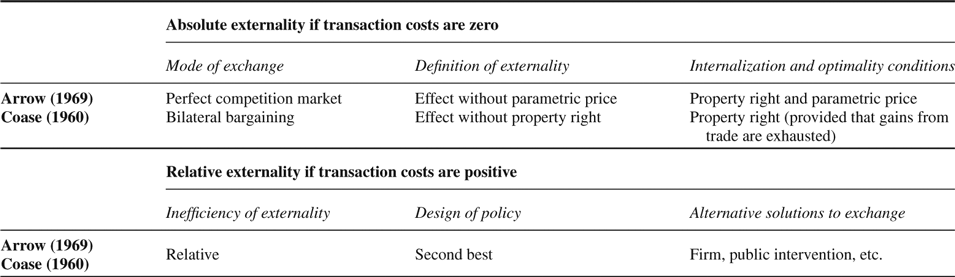
The general-equilibrium-theory account of externality and the criticisms leveled at it from the perspective of property-rights theory are well understood. However, this paper’s focus on Arrow’s and Coase’s analyses of externality has highlighted a theoretical difference (namely, that they are based on different definitions and assumptions) as well as an empirical convergence (that their suggestions for policy design are quite similar), which have not previously been underlined (see Table 1).
Arrow (Reference Arrow1969) and Coase (Reference Coase1960) on externalities: definition, efficiency, solutions

First, from a theoretical point of view, both authors assert that absolute externality produces a suboptimality that internalization through exchange can always correct. However, as long as the mode of exchange and its institutional framework are not specified, a definition of externality as a non-exchanged or unpriced effect remains underspecific. As Arrow and Coase do, indeed, refer to two different modes of exchange—perfect competition and bilateral bargaining, respectively—the institutions needed for exchange are different: property rights and parametric prices for Arrow, property rights alone for Coase (under the assumption of exhaustion of gains from trade, which is theoretically required for efficiency). The specific definition of externality, or the answer to the question of what is missing in a case of externality, is, therefore, also different: parametric prices in the former case, property rights in the latter.
Second, even if they are generally associated with different theoretical traditions, Arrow and Coase coincide in their introduction of transaction costs. And, in doing so, both call into question not only the systematic need for their ‘market’ internalization, since this can be too costly, but also more generally the inefficiency of externality, which now becomes relative. Moreover, introducing transaction costs leads both authors to envisage institutional arrangements other than the market for internalization, none of them optimal, and to compare their respective costs.
This is not as paradoxical as it might seem: although Arrow and Coase have different methods—primarily deductive for the former, primarily inductive for the latter—they share a common concern for realism. Arrow starts from a theory-based analysis, but is always concerned by its possible applications and the functioning of real markets. This is why he finally joins Coase in introducing transaction costs. Conversely, Coase is closer to Arrow than a focus on the Coasean tradition would have us believe, since he, like Arrow, retains a reference to an ideal and optimal world. Each author is, consequently, more complex than the traditions associated with them would suggest, and certain aspects of their articles have been forgotten or misinterpreted: Arrow’s original introduction of transaction costs in the general equilibrium theory of externalities; Coase’s reference to an exterior Pareto-optimal state, which some of his followers (e.g., Demsetz and Dahlman) would later abandon.
This discussion implicitly raises another methodological question, which has not been mentioned so far in our comparison. Arrow assumes rational maximizing agents, while Coase vehemently criticized this assumption as unrealistic (Coase Reference Coase1988b, for example). Their respective views of the agent and the market are tightly intertwined: the perfect competition model of the market needs rational maximizers with specific beliefs; while Coase’s bilateral bargaining needs only agents that exhaust gains from trade. Although Arrow’s—and, more largely, general equilibrium theory—assumptions about agents and their rationality have a definite meaning, already examined in the literature, the decision theory or the view of human nature underlying Coase’s economics is still to be investigated.
Finally, looking at the meanings of our comparison between two kinds of ‘market’ internalization for applied economics, a common misunderstanding appears. Coase (Reference Coase1960) is usually seen, in environmental economics, as the father of permits markets, since he was one of the first to stress the need for property rights and, more precisely, for tradable property rights—later followed by John H. Dales (Reference Dales1968). Actually, however, the efficiency of permits markets is usually justified by the assumption that, at equilibrium, firms will equalize their marginal abatement costs to permit price, thus adopting a price-taking behavior in a competitive framework. Henceforth, these markets—the SO2 American market or the European carbon market, for instance—are built with reference to centralized competitive and Arrovian markets rather than to decentralized Coasean bargaining.