The work of the British archaeological illustrator Alan Sorrell (1904–74) spanned nearly five decades, from the 1930s to the mid-1970s. Sorrell was an important artist in his own right: what he called his ‘imaginative’ pieces can be classified in artistic terms as neo-Romantic, and they stand alongside the achievements of the more acclaimed Paul Nash, Henry Moore, John Piper and others. Indeed, Sorrell trained, taught and, to some extent, exhibited within the same circles as these artists, yet he is best known today for his practice as an archaeological illustrator. In this capacity, he was employed by the then Ministry of Works, the London and Guildhall Museums, the National Museum of Wales, the Illustrated London News and other museums, bodies and individuals to produce reconstructions of ancient monuments and re-creations of ancient life. Such displays subsequently had – and, arguably, today continue to have – a profound impact on the archaeological and wider communities, with some crediting Sorrell for raising the profile of specific sites and their academic interpretations,Footnote 1 and many acknowledging – even idolising – Sorrell for his pioneering style and approach.Footnote 2
This paper evaluates a selection of Sorrell's reconstruction work, and begins to situate it in the context of the history of archaeological thought. Our research is centred on a collection of Sorrell's archived materials temporarily loaned to the Society of Antiquaries of London by the Sorrell family and studied by the authors in 2010–11. Further documentation relating to Sorrell's practice exists in other locations, including private holdings of personal correspondence and original illustrations as well as institutional collections, such as the Museum of London and the National Museum of Wales. Alongside cataloguing the Sorrell archive, we have conducted a preliminary survey of these outside sources and supplemented our analysis with a series of interviews with family members and colleagues. Such research aims to flesh out what is otherwise a limited body of scholarship on Sorrell's life and outputs, published primarily as short articles or editorials in exhibition volumes.Footnote 3
The conviction that animates this paper is that visual images are important, both epistemologically and ontologically. In other words, images have a productive quality that adds to and meaningfully transforms our archaeological practice. Indeed, upwards of fifty years of critical scholarly study of visual representation in archaeology testifies to the capacity of images to encourage us to rethink and reformulate interpretative approaches, add capital and methodological rigour to the field, inspire specialist and non-specialist audiences alike and alter our perceptions of material culture itself.Footnote 4 This research represents one small part of a wider enquiry across the sciences, social sciences and humanities into the role of imagery and different forms of display in the standardisation, spread and validation of scientific knowledge around the globe.Footnote 5 Indeed, it is a component of a half-millennium-old antiquarian appreciation of the intimate relationship between picture-making and the creation of the archaeological record. That relationship is teased out in an increasing number of edited publicationsFootnote 6 and symposia,Footnote 7 often characterised by case studies either of influential artists or of pictorial productions from the seventeenth to the nineteenth centuries. Piggott was one of the first to analyse antiquarian practices so as to codify the technique of archaeological representation.Footnote 8 His arguments, elaborated or extended by others,Footnote 9 have exposed visual traditions as key components in the solidification of scientific and archaeological intellectual frameworks. To look critically at the production of images, then, is to look critically at the very fabric of the discipline itself.
The aims of this project are thus much more than a particular enquiry into a series of interesting episodes or anecdotes in the history of archaeology: we aim to show that Sorrell played a role in defining what archaeology was in his own time and what it is today. Our paper presents a preliminary framework for understanding Sorrell's practice and its significance in the development of British archaeology. Along the way, we will provide examples from the Sorrell archive to showcase the potential and import of the material remains of his practice.
Genealogies of archaeological interpretation
Alan Sorrell's history is multifaceted, complex and, to date, subject only to limited assessment, primarily through his family's own biographical research.Footnote 10 It is beyond the scope of this paper to present a full account of Sorrell's life, although it is significant that his career began with formal training at the Southend School of Arts and Crafts (1918–22), and continued with study at the Royal College of Art (1924–7), where he ultimately took up a teaching post that bridged the war years. His time there as both a student and an instructor was tumultuous, not least because, unlike several of his peers and colleagues, circumstances demanded that he seek out routine commercial work to support his own education and, subsequently, his family. As such, and by his own admission, Sorrell's outputs varied in quality, with some commissions (such as the large-sized teaching charts he produced for Macmillan Publishers) causing him personal embarrassment due to their banal nature.Footnote 11 Sorrell's financial obligations arguably came to define his oeuvre, for they led to his first reconstruction-oriented artistic commissions and took him away from a full-time focus on fine art composition. His first major public project – four mural paintings for the Southend-on-Sea Central LibraryFootnote 12 – testifies precisely to this tension in his practice, as Sorrell was purportedly obliged by his employers to shift his original vision for the panels from contemporary subject matter to an instructional historic theme.Footnote 13
Sorrell was introduced to aspects of the archaeological profession from at least 1928 when he took up a scholarship at the British School at Rome and there came to know, among others, Aileen Henderson (later Lady Aileen Fox). The start of his career as an archaeological illustrator, however, tends to be dated to 1936, when he made a chance visit to Kathleen Kenyon's excavations at Leicester. There he produced a drawing, later modified into a reconstruction of Leicester's Roman forum and basilica, that was published in the Illustrated London News (ILN).Footnote 14 According to his family, such exposure through the ILN led directly to Sorrell's pre-war collaborations with Mortimer Wheeler at Maiden Castle and with Cyril Fox and V E Nash-Williams at the National Museum of Wales.Footnote 15 It seemingly also impacted his wartime experience when, serving with the Air Ministry and Royal Air Force (RAF) as both a Camouflage Officer and a model-maker, he promoted himself as being able to translate his ‘panoramic drawings of architectural subjects’ into aerial views of action areas.Footnote 16 As Sorrell put it in what appears to be a draft letter to the RAF:
I am not trying to interest you in pictures or ‘works of art’ but … a type of drawing which I think must have an application to bombes [sic] targets. I believe such drawings could amplify and partly take the place of the models which I understand are sometimes made. The saving in time and cost will be obvious.Footnote 17
Sorrell's practical and parsimonious argument here is one that resurfaces throughout his career, helping to drive forward his commissions and contributing to the curbing of experimentalism in his work.Footnote 18 Indeed, it was apparently the economy of his illustrations that led to a long-term collaboration with the Ministry of Works, beginning in the mid-1950s, as his imagery was seen to offer a more affordable alternative to the models typically produced as interpretative aids for British archaeological sites.Footnote 19
It is arguable that through links to the Ministry of Works and the ILN, and through archaeology-oriented contributions to major events such as the 1951 Festival of Britain, Sorrell amassed a kind of gravity in the discipline that positioned him around many of the leading archaeologists and archaeological digs of the time. His archive testifies to such gravity, containing preparatory and completed visual products for sites from Stonehenge to Jericho to Hadrian's Wall, and communications with practitioners both inside and outside academia across more than forty years. What is critical is that the comprehensiveness and detail of these materials bear witness to the evolution of Sorrell's imagery from start to finish, helping to situate him within larger processes of archaeological knowledge-making. This is important because Sorrell sits among a long line of reconstruction artists whose outputs have been subject to scattered, but generally unsustained, scrutiny. These artists include Sir Amédée Forestier (1854–1930), the Anglo-French artist and illustrator who specialised in historical and prehistoric scenes, and Charles Robert Knight (1874–1953), the American artist best known for his paintings of dinosaurs. All of them produced work whose impact is evident not just in terms of public engagement, but in repositioning scientific interpretations of the past and reconfiguring educational agendas and perceptions of physical experience.Footnote 20 The means by which such transformations and relationships evolve tend to go unremarked, and the role of the artist him/herself is often obfuscated behind the scientist and scientific aims at objectivity. The debate over whether visualisers might, indeed, be scientists (based on their close observational practices, their regular visits to the field and their independent research) is long-standing.Footnote 21 To borrow from Pamela H Smith,Footnote 22 this ‘artisanal epistemology’ sees creative practitioners caught up in the work of science, helping to constitute the very arguments and authority that underpin disciplinary knowledge sets.
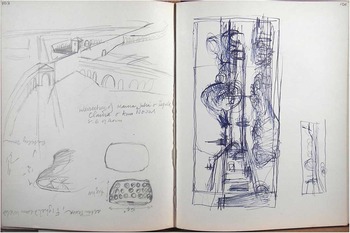
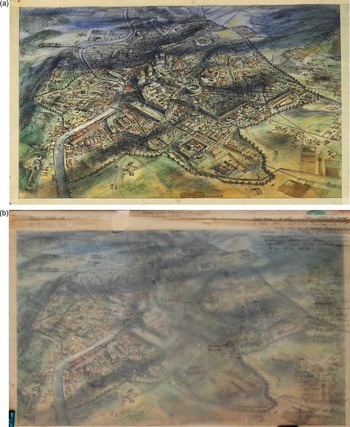
Significantly, Sorrell's archive begins to expose the intellectual brokering that is manifested when a non-archaeologist is enlisted into the craft of archaeology and comes to work closely with professionals in the discipline. This brokering is evident in the way in which Sorrell's working process is represented here as a conglomeration of notes and materials created and often repeatedly manipulated by multiple hands. Such materials include Sorrell's initial concept sketches (fig 1) and the evidentiary sources underpinning them (typically, newspaper clippings, photocopies of academic papers, copies of different prints or images, photographs and maps, collected by Sorrell himself or sent to him by his commissioners). Sorrell's conceptual sketches tended to be transformed into full draft images that were subsequently overlaid with tracing paper. That paper was annotated in Sorrell's hand directly over areas of the drawing that he was uncertain about or that he wanted to see amplified via further input from colleagues. From there, it was circulated to those colleagues, and hence began an elaborate process of negotiation (fig 2), with more and more annotations added to the image as it was passed back and forth between parties – either by hand or by post.
Preparatory sketches from one of Sorrell's sketchbooks (date unknown), including a Roman aqueduct (probably for Birley Reference Birley1970) on the left, and an unknown landscape scene on right. Photograph: Ian Sanders (SORRELL / SKETCHBOOK / G)

(a) Sorrell's Rome AD 330; (b) overlying notes (undated) on tracing paper recording communication between Sorrell and (probably) Antony Birley. Along the right-hand side of the image Sorrell wrote: ‘A difficulty in this drawing is how much difference of contour I should show – not much on this scale?’, to which Birley replied, ‘VERY LITTLE INDEED, TO JUDGE FROM THE EFFECT IN AIR PHOTOGRAPHS’. Photograph: Ian Sanders (SORRELL / IMPERIAL ROME / 6)

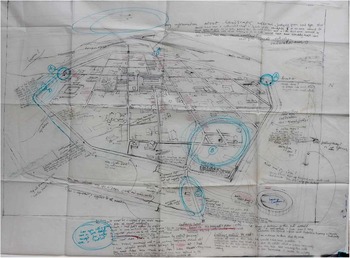
A classic case comes from Sorrell's commissioned work for the Reading Museum and Art Gallery in the early 1970s (fig 3). He was asked to produce multiple views of Roman Silchester, and so began an extensive line of correspondence with the archaeologist Jill Greenaway about the archaeological features to be depicted in the drawings. Sorrell supplied Greenaway with heavily annotated tracings, upon which Greenaway responded with her own detailed notes. In addition, Greenaway elaborated her replies to Sorrell with extensive typewritten correspondence. In a multi-page letter from 2 October 1972 she writes:
Draft image of Roman Silchester (early 1970s) with notes by Sorrell and Jill Greenaway. Photograph: Ian Sanders (SORRELL / SILCHESTER / 2)

I now return your drawing. I have, as requested, written my comments on the drawing so that you can keep them together. I am afraid there seem to be a lot of comments and on occasions they run into each other, so I repeat and expand them below to clarify matters.Footnote 23
Sorrell, in fact, prompted Greenaway for archaeological detail, and, in various instances, suggested specific details himself based on his understanding of the archaeological record. On 9 February 1973, Greenaway wrote to Sorrell acknowledging the relevance of some such suggestions:
I have, as before, answered your questions on the drawing itself. The only question which needs a more detailed answer is that of whether there was a wall or fence around the atrium. I am inclined to agree with you that it must have been enclosed in some way.Footnote 24
The fruitfulness of this back-and-forth deliberation of the evidence was, indeed, specifically remarked upon by Greenaway in one letter: ‘It is exciting to see a reconstruction drawing grow like this and I very much look forward to seeing the final version.’Footnote 25 What was at play here was not the creation of imaginative outputs by a fanciful artist, but the methodical production of a view of the archaeological record, which was derived from real cross-disciplinary collaboration. Whilst reconstruction work is often relegated to the back end of the archaeological process, the possibilities it bears for reframing this process from the outset are hinted at via Sorrell's engagements with Greenaway.Footnote 26
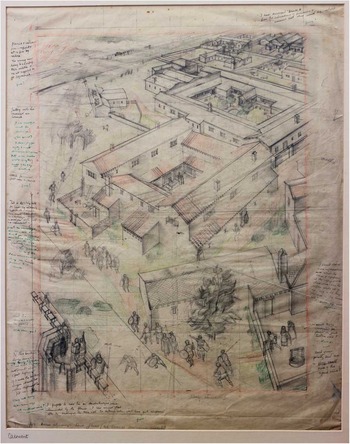
Other examples of such exchanges of knowledge between artist and archaeologist are obvious in the archive from at least as far back as the late 1930s, when Sorrell was commissioned by the National Museum of Wales to create multiple reconstructions of Welsh sites. In one instance, Sorrell communicated with V E Nash-Williams about a view of Caerwent (fig 4). Sorrell made recommendations and raised questions about his depiction of the site, and Nash-Williams responded in his characteristically neat green-inked handwriting. As Sorrell wrote along the bottom left-hand border of figure 4:
Working drawing of Caerwent (late 1930s) with notes by Sorrell in pencil or black pen, and by V E Nash-Williams in his distinctive green pen. Photograph: Ian Sanders (SORRELL / CAERWENT / 7)

I propose to make this an almost-twilight scene illuminated by the flames. I have assumed that after the building of the town wall the Antonine-calm would have quite disappeared.
To which Nash-Williams succinctly replied, ‘good!’.Footnote 27
Or, in a more elaborate exchange about a reconstruction of Caerwent's basilica and forum (not illustrated here), Sorrell proposed key additions to the scene, writing ‘a shop – this is possible I suppose even at this period’. And Nash-Williams readily accepted the proposition and added even further detail to its composition: ‘Yes, with rough wooden [vessels?] instead of pottery & façade scarred and patched.’Footnote 28 Here Nash-Williams is implicated in the aesthetic design of the imagery, such that his role in its production, as with many of Sorrell's archaeological collaborators, was not detached but active and decisive.
This process of back-and-forth communication – whether between Sorrell and Greenaway, or Sorrell and Nash-Williams or others – could go through several such iterations before a final image was produced. It is important to note that, even after an image had been published, this iterative process of revision often continued. An image might be published, for example, in the ILN, but then subsequently appear elsewhere in a slightly revised form (as in the case of Sorrell's images of the London Mithraeum, discussed below). In such cases, Sorrell was sometimes responding to yet further feedback on the published image, and sometimes revising the image because of a seeming need to circumvent copyright issues (see below for commentary on Sorrell's practical need to earn a livelihood from the sale of multiple images to different clients).
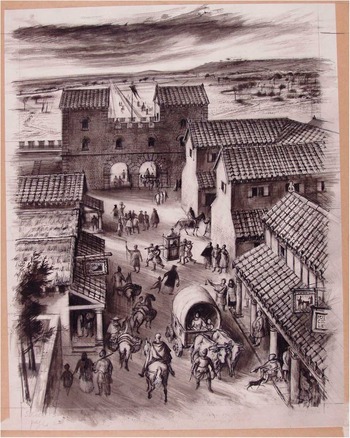
A third example of this collaborative process in action is Sorrell's illustration of a street scene in London looking towards Newgate. This image was originally intended for a Puffin children's book conceived in the late 1940s, but not published at the time (the scene eventually emerged in printed form in Aileen Fox's Roman Britain (fig 5).Footnote 29 Here, Fox gave a lengthy list of instructions for Sorrell to follow, and further references for him to consult, over many pieces of correspondence. Several of the instructions and references seem to have been concerned with decorative detail – for instance, Fox's insistence on the inclusion of a shop:
Final illustration of a Roman London street scene at Newgate, published in Fox Reference Fox1961. Photograph: Ian Sanders (SORRELL / ROMAN BRITAIN / 15)

Could you do one in the foreground? I send a German publication of Loeschke's – see page 7 it is a vintner … but you could alter it to pottery or cutlery. There are some other nice pictures of shops … on the reliefs from Neumagen … in the Rom. Soc. Library.
Fox went so far as to ask for ‘Fruit in baskets (at a stall)’ and ‘People’:
What about children going to school carrying satchels? Again Neumagen … or Germ. Rom. 38 … and … A child with a toy … as in Tullie House Museum catalogue – p.33.
In a subsequent (also undated) letter, Fox returned to the same topic:
it looks, on the R [right], as if it had a glass window – it should be quite open and things hanging up outside, don't you think, like the reliefs in the Mostra catalogue – What about rolls of cloth being unwound?Footnote 30
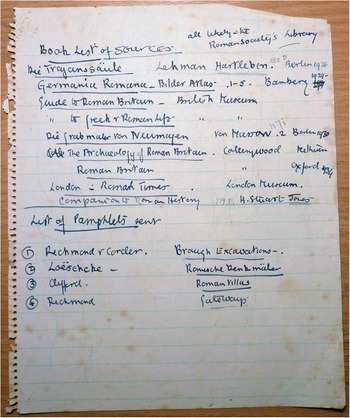
Fox, indeed, provided a full bibliographic list to Sorrell to allow him to construct rigorous and resilient reconstructions (fig 6). In turn, Sorrell himself often included an ‘Artist's Bibliography’ in the books he illustrated. This citational approach is embedded in Sorrell's overall philosophical and methodological outlook, which he candidly outlined in an article for Current Archaeology.Footnote 31 Here he placed key emphasis on accuracy and careful research, and more specifically on the processes by which reconstruction artists could or should practise their craft. For our purposes, what is significant is that such an approach allows us to follow Sorrell's process through source material to the final product and, in so doing, complement and intellectually deepen related lines of scholarship on the epistemologies of archaeological imagery. For example, researchers such as MoserFootnote 32 and PerryFootnote 33 have critically examined the iconography, composition and style of a range of archaeological visualisations. In the process, they have highlighted genealogies of specific images – and of genres or tropes of images – which affirm the enduring effects that such imagery can have on our academic outlook and conceptions of the past. This work has tended to be wide-ranging in its scope, often looking across long spans of time and between examples widely separated in space. In contrast, the Sorrell archive gives us a very fine-grained and small-scale picture of how particular icons or motifs arrive in a given illustration through the everyday work of a practising artist and his interactions with archaeologists. Moreover, it bears witness to the means by which a rigorous method of scholarly referencing and verification is foundational to the production of Sorrell's pictures.
List of reference materials from Aileen Fox to Sorrell for an unpublished Puffin picture book on Roman Britain (late 1940s). Photograph: Sara Perry (SORRELL / ROMAN BRITAIN / 31/1)

Secondary circulation and the impact of archaeological imagery
Importantly, the evolution of the image did not end with the production of a published drawing. If the Sorrell archive gives us an opportunity to trace the processes by which an individual image came into being and was worked up into a final product, it also enables us to trace the many ways in which that final product was then reused, recycled, adapted and transmitted across contexts. Tracing this continued redeployment of the image is significant because it lends insight into the processes by which archaeological thinking is engaged with by different academic and public institutions and audiences. Sorrell's images, once produced, went on to have a life of their own, appearing and reappearing in a diversity of settings.
Such continued reuse and recycling of archaeological pictures suggests that they play a role in the intellectual capital of the discipline. It can be argued that these images are among the range of cultural and economic assets that archaeology draws upon for professional gain, and the Sorrell archive testifies to the fact that the mobilisation of his imagery could have far-reaching consequences. Sometimes those consequences were deliberate, but at other times quite unintended; sometimes they had their most pointed impact on Sorrell's institutional clients, sometimes on Sorrell himself. The end result in any one case was a complex patchwork of uses, repetitions, modifications and changes of meaning according to context, with widespread and concrete on-the-ground ramifications for the discipline.
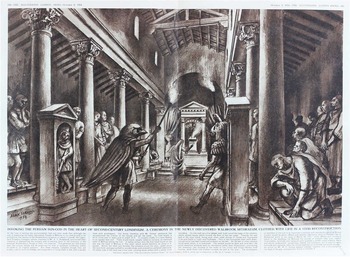
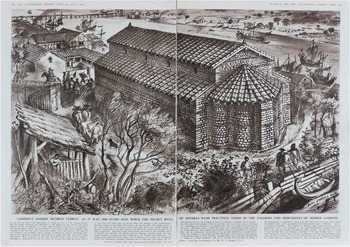
An example of this process presents itself in Sorrell's illustrations of the London Mithraeum (figs 7 and 8). These, it seems, were originally commissioned by the ILN and overseen by W F Grimes, then of the London Museum. They came about in the context of Grimes's famous excavations of the Walbrook area of the City of London on a site that was to be redeveloped for a major office complex. For non-specialists, these excavations represented an important episode in both the development of post-war urban archaeology and the popularisation of the discipline, as thousands of City workers spent their lunch breaks peering over the sides of the excavations.
Interior view of the London Mithraeum, published in the Illustrated London News, 9 October 1954. Photograph: Ian Sanders

Exterior view of the London Mithraeum, published in the Illustrated London News, 2 October 1954. Photograph: Ian Sanders

Whilst Sorrell and Grimes collaborated with each other on image production as early as 1950, it was Sorrell who, two years later, began to pressure Grimes for commissions on the subject of Roman London.Footnote 34 Grimes eventually took Sorrell up, working with him on numerous images related to the Roman London excavations, including an interior and exterior view of the Mithraeum, both reproduced in the ILN. Indeed, the ILN made a major feature of the Mithraeum – publishing Sorrell's images across many issues in 1954.
Such reconstructions, particularly the interior view of the Mithras temple with its shadowy ceremonial figures, have a presence that extends far beyond their original commission alone. Indeed, figure 7 is derived in part from an illustration of a Mithraic temple at Carrawburgh, based on input from Sir Ian Richmond, and published in the ILN on 24 March 1951. Elements of that image contributed to Sorrell's London Mithraeum reconstruction of 1954, which itself then went on to populate the collections of the London Museum and also the Guildhall Museum in various forms and to be sold as a Museum postcard. In such a capacity, it fed back into the economy of the institution, intentionally deployed by the London and Guildhall Museums for money-making and organisation-building purposes.
Indeed, in a communication from the 1970s about a separate commission, Guildhall Museum staff were explicit about the capital that hiring Sorrell offered to them. As the Assistant Director, Ralph Merrifield, wrote about a proposed new series of reconstructions by Sorrell:
This would include the copyright, which would be vested in the Museum … If we can afford it, there will be considerable advantages in employing Sorrell for this job. We have already 6 or 7 of his reconstructions … and it would be desirable to have uniformity of style. He is conscientious in seeking accuracy, and his pictures are readily comprehensible. At the same time, he is an artist with his own distinctive style. His pictures are best-sellers as postcards, and are always in demand for book and T.V. illustrations, so that a considerable part of their cost would be recoverable in due course as copyright charges, etc.Footnote 35
This matter of copyright was not insignificant, given that it was clearly construed as a means to offset the initial cost of hiring Sorrell and to ensure supplementary income for the museum in the future. For Sorrell, however, it seemed also to represent an obstacle to his own income in terms of publication. Bereft of the power to replicate his reconstructions for sale in other venues, he was often prompted to make minor modifications to the imagery both to take into account changing archaeological interpretations and to avoid copyright infringement – and hence continue to enjoy the right to earn a living from his own productions.Footnote 36 In 1971, for example, he produced a revised version of his Mithraeum reconstruction for the Guildhall Museum. Here the temple has acquired planked flooring, and both figures and architecture are somewhat more stylised. Prior to this, another version was published in Fox's Roman Britain (Reference Fox1961) and yet another in Sorrell's Roman London (Reference Sorrell1969). A not dissimilar version was also transformed into a reconstruction for Anthony Birley's Imperial Rome (Reference Birley1970). We will return to this topic below but, again, it can be seen how the reconstructions took on meaning far beyond their visual content alone, being directly linked to streams of income and public support for institutions, publishers and Sorrell himself over time.
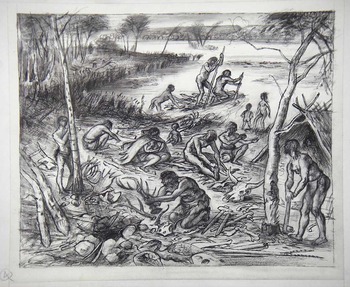
In another example, that of Star Carr (fig 9), Sorrell's imagery was closely related to the long-term interpretation of the archaeological record. The Sorrell family recollects that Sorrell originally wished to include a house in his iconic reconstruction of the site, based on his sense that the material record was sufficiently substantial to have supported such a permanent structure.Footnote 37 As can be seen in figure 9, however, he was overruled by the archaeologists and compelled to depict Star Carr as a temporary camp, and the first published version of the image, printed in the 3 February 1951 issue of ILN, included no evidence of shelter whatsoever. In 2010, in a series of highly publicised media reports (often illustrated with Sorrell's original reconstruction), evidence of a post-built house was indeed uncovered at the site,Footnote 38 leading some to suggest that Sorrell's archaeological eye had thus been vindicated.Footnote 39 Fifty years after its initial conception, then, Sorrell's imagery continued to circulate, hinting not only at the resilience of the reconstruction but also at Sorrell's expertise with the evidentiary basis of archaeology.
Final illustration of Star Carr, published in Green Reference Green1968. Photograph: Ian Sanders (SORRELL / PREHISTORIC BRITAIN / 7)

Archaeologists and others
The Sorrell archive is significant also for the history of British archaeology in the decades after the Second World War, in particular the professionalisation and institutional configuration of the discipline. It casts light on a specific trajectory of professional development and the ways in which institutions emerged and came to relate to one another, as well as framing the practice of certain individuals. Sorrell had intimate working relations with a cast of key people who pioneered archaeology in these decades. He collaborated with Mortimer Wheeler, Leonard Woolley, Kathleen Kenyon, W F Grimes, V E Nash-Williams, Ian Richmond, James Mellaart, Cyril and Aileen Fox, Shepherd Frere, Philip Rahtz and many others connected with the Ministry of Works.
Sorrell's outputs, in fact, became critical tools for the Ministry as it pushed forward its emerging public agenda of heritage preservation and conservation. The Ministry turned to Sorrell for regular work in 1956, partly in what appears to be a money-saving manoeuvre.Footnote 40 With the cost of interpretative models (specifically at the site of Stonehenge) proving prohibitively expensive (around £2,300 for a model and the means to house it on-site), Sorrell's fee of £200, and the promise of converting his imagery into guidebooks, signage and postcards, was seized upon. By 23 July 1957, the House of Commons announced a formal relationship between Sorrell and the Ministry of Works, and by August of the same year, the ILN printed a full-page feature on Sorrell's governmental commissions, announcing:
And we have the testimony of many readers that such reconstructions do indeed make ‘dry bones live’ and help in the attainment of that knowledge and understanding of what the past was really like, which are the true objects of archaeology. This belief has now been attested in no uncertain way by the Ministry of Works [which has] specially commissioned from Mr. Sorrell a series of reconstruction drawings of eight famous monuments which are administered by the Ministry … these drawings would be displayed at the sites concerned so that visitors might have some idea of what the places looked like in their splendour.Footnote 41
Sorrell's practice then followed the model described earlier: he corresponded in depth with Ministry employees in the construction of such images, often challenging the archaeologists over their interpretations of the evidence. For example, writing to R Gilyard-Beer in 1967 about an illustration of the Chapel of the Nine Altars at Fountains Abbey, Sorrell attempted to point out, via a sketch on tracing paper (fig 10), inconsistencies in the reported material remains that made the reconstruction impossible. Gilyard-Beer responded to Sorrell on 25 October 1967, saying:
Sketch on tracing paper by Sorrell (c 1967) wherein Sorrell questioned the accuracy of the archaeological record for Fountains Abbey supplied by R Gilyard-Beer of the Ministry of Public Building and Works. Photograph: Ian Sanders (SORRELL / SKETCHBOOK / J)

Thank you for your letter, and for your very ingenious suggestion about the putlog holes in the Chapel … On balance, I think that these holes are ordinary putlogs and not the seating for the corbels carrying the wallposts of the late timber roof (although I cannot offer any worthwhile suggestion about where the latter should be found) … So I think it would be best to stick to our original solution.Footnote 42
Others – for instance John Hamilton, working with Sorrell in 1961 on a reconstruction of Clickimin Broch – addressed Sorrell in a manner that suggests his status was that of an equal partner in the interpretative process:
The lecture in Edinburgh went off much better than I expected and I am glad to say that the somewhat revolutionary views about the blockhouse & wall ranges were fully accepted by the pundits! So all is well and we can feel much more confident about reconstruction.Footnote 43
Outside the Ministry, some archaeologists actually called upon Sorrell to apply his keen eye to the solving of analytical quandaries. As Aileen Fox wrote to Sorrell, probably in the late 1940s, about the reconstruction of a villa for her Roman Britain book:
The real problem of villas is whether they had an upper storey – that is why I fought shy of them, without a good deal of work I can't find out – in general they are thought to be single-storeyed, really on very little evidence – Do see if you can spot any holes for wooden stair [sic] going up in some corner!Footnote 44
Sorrell has here become entangled in the interpretative work of archaeology. At the same time, his images went on to create the public face of heritage practice in Britain, foregrounding its sites and pulling in revenue both for Sorrell himself and his employers.
In other words, as we see it, Sorrell was part of a larger professional and intellectual programme of the time. Adam Stout has characterised this programme as the particular agenda of Wheeler, Grahame Clark, Gordon Childe, O G S Crawford and a relatively narrow group of other men.Footnote 45 The argument here is that this was, in part, a self-conscious project: these men took it upon themselves to push forward the professional organisation and scientific rigour of the discipline from the 1920s onwards. We would argue, however, in line with the work of several other scholars,Footnote 46 that this agenda actually animated the work of a much wider group of archaeologists and other professionals.
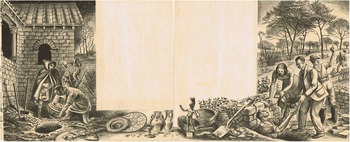
Figures 11 and 12, for example, are examples of other Sorrell outputs whose production was initiated by Aileen Fox (for whom Sorrell also painted a family portrait). These were originally commissioned for the Puffin picture book for junior readers referred to above. The unpublished imagery is laid out in a ‘before and after’ format: on the left of figure 11 we see a Romano-British group hastily burying their ‘treasure’ under a darkening sky, and on the right the treasure is being excavated by a group of archaeologists. It is archived as one of a series of preliminary proofs for the book. The woman in figure 12 is explicitly intended as a portrait of Fox, while the suited man, clearly the senior archaeologist in the picture, appears to be Gordon Childe. Accompanying these drawings are Fox's extensive notes and sketches for Sorrell on their construction. These hint at the painstaking effort that is invested in projecting scientific diligence on archaeological practice. One of Fox's notes says:
Printer's proof of Sorrell's ‘Past and Present’ illustration (referred to by Fox as ‘Digging it up’) for Fox's unpublished Puffin book (late 1940s). Photograph: Ian Sanders (SORRELL / SKETCHBOOK / 31/8)

A detail of fig 11 wherein Sorrell has explicitly depicted Aileen Fox and (probably) Gordon Childe as modern archaeologists ‘digging up’ the past. Photograph: Ian Sanders (SORRELL / SKETCHBOOK / 31/8)

Digging it up wants to look more scientific! Put a pick with the shovel (not spade) – Let the excavators have trowels – Mason's pointed ones, a camera, a ranging pole with stripes. Let there be a surveyor's level in the distance. Let trenches be cut or the area clear – The wall should be more ruined which has just been uncovered. You can see a nice bit of excavation in the Brough offprints. Pl II and III or IV to give you the idea of tidy work, not looting!
In a separate letter concerning an apparently revised version of the image, Fox wrote:
I still feel the Excavation is a ‘hole and corner affair’ and not very scientific! – Never mind – I expect you will put it right – The wall that has been uncovered is rather unconvincing – it should be a bit more ‘ruined’ on the top courses anyhow – The man who is digging hasn't got room to work. I think you must move some of the whole pots by the spade, and extend the trench in that area – and can't I hold my Mason's trowel even in this picture? The loose sherds should be put into a biscuit or sweet tin, with a label, and somebody should have a tape measure.
Another idea – take the man out of the hole, and let him be crouching down digging with a trowel to get out the treasure – like the man who is putting it in, only different? The details of the treasure are right, of course – Except I think the coins would go in a bag or wrapping.
In yet another piece of correspondence on the image, Fox stated:
I agree with Carrington that the archaeologists are not your best picture – (The man couldn't get himself let alone the treasure in that hole!) But the idea, which is in my text is right, and I shall be cross if he [the publisher] tries to cut it out.Footnote 47
This ‘idea’ to which Fox referred was that of solidifying the intellectual validity of the discipline and sanctifying the methodological rigour of archaeological practice. Speaking of her relationship with Sorrell and, in particular, the development of figure 12, Fox wrote that ‘Sorrell demanded precise answers to many questions of detail … I never wholly approved of his version of the excavation of a late Roman buried treasure, but in most of his pictures accuracy of detail was successfully combined with imaginative scenes and with a wonderful feeling for landscape.’Footnote 48 Arguably, Sorrell's inconsistent work on figure 12 is a consequence of negotiating the production of a more experimental and conceptual image, based not necessarily on specific archaeological data but on Fox's ‘idea’ of good practice. Such tension in his artistry dates back at least to the time of Sorrell's residency at the British School at Rome where, in reporting on his desire to push beyond simple technical mastery of composition, the Director, A Hamilton Smith, wrote of Sorrell that: ‘he seemed inclined also to attempt allegorical subjects, but his knowledge seemed unequal to the task’.Footnote 49
Nevertheless, more than a decade after its initial preparation, figure 12 was published in modified form in Fox's (1961) Roman Britain (not illustrated here). It was accompanied by a discrete passage of text stressing the scientific nature of the excavation, which was implicitly contrasted with the darkness and seeming panic of the end-of-Roman Britain tableau. As we see it, this represents one example of Sorrell's close involvement with an active agenda of professional and scientific rectitude.
Archaeology and neo-Romanticism
Sorrell was a ‘neo-Romantic’ artist in that his work was bound into that of such artistic producers as Nash, Piper, Moore and others, who were themselves part of a distinctively English or British tradition stretching back to the eighteenth century. Romanticism, in its origins, represented an engagement with nature, foregrounding personal and emotional reactions to the world and often evidencing a self-conscious populism. Neo-Romantic art had a particular relationship with national consciousness, especially in the inter- and post-war years.Footnote 50 Sorrell's work bridged this naturalism and nationalism, and his form of Romanticism was important precisely because it provided the key to the appeal and resonance of his images. The lighting and application of shadow to create awe and mystery, the sweeping backdrops, the use of indistinct figures often huddled in groups – all these reference the Romantic tradition. Sorrell's stature as an artist in his own right leant heavily on this referencing. Over and over again, in our conversations with senior figures in the discipline and in related critical discussion of his work, it is this distinctive Romantic style that has been alluded to as the crux of Sorrell's allure.Footnote 51
While, in some of its more problematic forms, Romanticism could be executed in an undisciplined and fanciful fashion – based on the whims of one's imagination – in its original conception it was anything but. A proper apprehension of nature was, in the view of Romantic philosophers, writers and artists, possible only with correct and rigorous training. It is important, therefore, not to draw a simple or binary distinction between Sorrell as an ‘imaginative’ and as a ‘reconstruction’ artist: his significance lies in the convergence of both. By the same token, in his work there was clearly a sometimes anxious link between these genres. His first commission included a series of four murals – part reconstruction, part imagination, part civic – for the Southend-on-Sea Public Library, including a seventeenth-century dockyard scene, the Refitting of Admiral Blake's Fleet at Leigh, 1653.Footnote 52 These murals were originally intended to be contemporary in their approach, but Sorrell's commissioners appear to have requested otherwise, and, as Willsdon describes:
Instead, the murals became the foundation for his subsequent distinguished career as an artist of archaeological reconstructions. Asked to portray historical events in what was his home region, he saw his task as ‘to pierce the skin of building which had spread over the hillsides, plant them again with trees, mentally demolish that ugly gasometer and the railway … and then rebuild’.Footnote 53
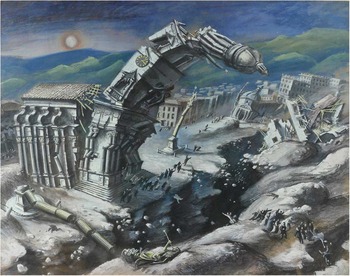
Across much of his career, Sorrell's imaginative pieces characteristically employed motifs and images from archaeology, often drawn from his time at the British School at Rome in the late 1920s. Indeed, Sorrell seems to have been forthright about the School's influence, as suggested in a letter written by his son to the School in the mid-1970s where it is said that Sorrell ‘regarded his two years there as having a marvellous formative influence on all his later work’.Footnote 54 A classic case of such work is Falling Tower (fig 13).Footnote 55 Its date is uncertain, and it does not appear to depict a specific city, but there are elements of both Rome and London in its apocalyptic vision.
Sorrell's Falling Tower (date unknown). Photograph: Sorrell family private collection

Sorrell himself felt that he was deploying different kinds of artistic sensibility in different contexts. He expressed his thoughts in a slightly cryptic way on the reverse side of a draft illustration of Wroxeter:
Some kinds of drawing
1. Drawing, based on observation, does not anchor the artist to the representation of things seen – cf. Richard Dadd, John Martin, Samuel Palmer (& my own too!)
2. English art has roots in literature & poetry as well as the more visual side, Blake, Dante drawings, Millais, Bible illustrations etc.
3. The same artist can combine in himself various attitudes to drawing, cf. my own work, Nubia, Hinckley P., Istanbul, and drawings of the imagination, adaptation of [?] drawing to a more imaginative use & drawings for archaeology.Footnote 56
Neo-Romantic art as a whole drew freely on archaeology in this period. Jacquetta Hawkes’ A Land combined archaeological fact with mystical meditation and was illustrated by Henry Moore.Footnote 57 The artists Nash and Piper, in particular, became fascinated by the aerial photograph and the way it reveals patterns in the landscape from the air; Nash kept a scrapbook of clippings of air photographs from Antiquity.Footnote 58 Nash's most famous picture, Battle of Britain, juxtaposes the vapour trails of fighter planes with the markings of archaeological and other features on the land. No matter how severely professionals of the time talked of scientific rigour, the archaeologist was viewed in contemporary cultural productions as a mystical figure, as, for example, in Powell and Pressburger's 1944 film, A Canterbury Tale.
It is important to recognise that Sorrell stood a little apart from this generation, to some extent because of his different socio-economic circumstances. Such differences are hinted at by Smiles's discussion of Nash's approach in comparison to that of Sorrell, wherein it is said that Nash ‘would never have accepted the terms on which Sorrell worked’ because his perspective was one that saw art as an escape from archaeology itself, a ‘vital engagement with the past as opposed to the sterility Nash associated with empirical method’.Footnote 59
Sorrell, however, desperately needed to earn a living to support his young family. There is copious evidence of his economic difficulties, both in the archives and in letters in the possession of the family and the Museum of London. It has previously been assumed, for example, that the ILN approached Sorrell when it was seeking to commission an illustration but in fact the reverse was frequently the case. For example, the draft of a letter in the possession of the family, undated but written during the Second World War, reads as follows:
Just before the outbreak of war I submitted for yr. consideration the working drawings [for a] series of 3 drawings of the Roman legionary fortress at Caerleon as it appeared at about 280AD. You may remember that you were interested in these drawings and wrote me saying you wd. like to publish them … I am bringing up the matter again because of the curiously ‘topical’ nature of these reconstructions – an even cursory examination will show that the Roman legionary fortress & the present day militia camp are practically identical in layout, detail & appearance. Thus publication now wd. therefore show the extraordinary link between past & present. Sir Cyril Fox, the Director of the National Museum of Wales who has kindly given permission for the publication, is so interested in the project that he is prepared to write a descriptive note …
I hope you will be able to take up the matter again & I feel that the topicality of the drawings would [strike?] a note unusual in such matters.Footnote 60
Correspondence between Sorrell and W F Grimes from 1952 onwards, now held at the Museum of London, similarly provides a vivid picture of Sorrell's position and the lengths to which he had to go to secure commissions. In January 1952 he wrote to Grimes asking for work; Grimes wrote back in February saying he was away and had not had a chance to look into things. Sorrell then wrote again in March: ‘As I have not heard from you I assume you are not very keen on the idea of a drawing in the ILN of your recent discovery in Roman London – the fort I mean of course … I do hope I may be allowed to go ahead with one drawing at least of our project scheme.’Footnote 61 Grimes responded a few days later, again in negative terms. Undeterred, or possibly in urgency, Sorrell wrote back on 27 July. Grimes replied on 8 August in terms that hint that his earlier reservations on the grounds of lack of knowledge were secondary to the basic financial difficulty. Sorrell replied on 13 August. The conversation resumed in June 1953 when Sorrell wrote again. Grimes responded on 7 July, and so it went on, until in 1956 the Museum did eventually commission further work from Sorrell.
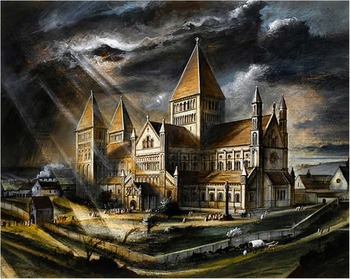
Financial hardship, as discussed above in the context of copyright, had a direct impact on Sorrell's artistic style. Moreover, in his Current Archaeology piece, he discussed at some length how the demands of institutions and individual archaeologists led him to draw and paint in a certain way. Perhaps the most famous aspect of his pictures, the scudding clouds, glowering skies, deep contrasts of light and shade and a general threat of stormy weather, seen here at Old Sarum (fig 14), was at least partly imposed on him through the to-and-fro of the working process with archaeologists. He commented in somewhat cantankerous fashion about this process:
Sorrell's Old Sarum c 1130 (probably completed in 1967). Photograph: Liss Fine Art

No one likes to commit himself, and I remember on more than one occasion I have been strenuously urged to put some smoke to ‘cover up’. Temperamentally I find this a very difficult proposition – and anyway, how nice it is to be able to adopt a holier-than-thou attitude!Footnote 62
The balance, then, between Sorrell's neo-Romantic spirit, his technical aptitude and his financial circumstances seemed always under negotiation. This is evident even in his earliest days at the British School at Rome, where he ‘devoted most of [his] time at the School to the solving of purely technical problems, studying to that end, colour, both scientifically and practically, anatomy, etc.’ but wanted to push further with large-scale work of ‘a deliberately experimental nature’.Footnote 63 And it is evident throughout his career as Sorrell struggled to assert his artistic identity, support his family and live up to the expectations of a Prix de Rome scholar.Footnote 64 His livelihood was thus variously poised between his supposedly ‘little known’ imaginative artFootnote 65 and his status as someone who ‘dominated the field of reconstruction illustration during the post-war decades’.Footnote 66
Visualisation and archaeological rigour
Ultimately, the value of the Sorrell archive relates to the past as well as the present. In it we see embedded some of the fundamental epistemological difficulties of archaeology itself: the mediation between objective documentation and narrative, between precision and imagination. Whilst there is general acceptance within the discipline that all views of the past are not equal, that different interpretations of the past are – or should be – constrained by the evidence and, further, that archaeologists should work to make the links between evidence and interpretation stronger,Footnote 67 this consensus is uneasy, because it leaves critical questions unanswered. How, exactly, should we evaluate arguments? What cultural factors are being imposed upon the process? By what criteria is this argument deemed wild or fanciful, but that argument cautious or rigorous? If more data do not necessarily lead to better arguments in and of themselves, how can archaeologists better marshal their data and bring their evidence into a more critical dialogue with interpretation?
The study of Sorrell's work offers a fruitful way into these issues: we see interpretation in action. Instead of asking ‘how should we do this?’ in the abstract, we can examine empirically and in depth how arguments are in fact evaluated. We have seen how intensely collaborative – and at once inventive – the process can be. Sorrell developed visual imagery from multiple source materials, which was then elaborated via input from archaeologists. It should be remembered that much of Sorrell's work actually took place during the excavation itself – many of those we interviewed had their first meetings with Sorrell when they were students working on particular digs. And these different actors brought different agendas to the development of the imagery. Sorrell and his contemporaries were not independent of their cultural context; they were serious scholars attempting to get to grips with the past in the best way they could.
To put it another way, what we are seeing in Sorrell's work is archaeology in negotiation. For us, the metaphor that comes closest to understanding archaeology as a discipline in this context is that of craft.Footnote 68 The craft of archaeology is a collaborative exercise, most obviously in the field,Footnote 69 but we have seen here how interpretations are shaped through collaboration long before and after the trenches have been backfilled. It is also a craft that is at times intuitive, but which rests on a thorough knowledge of and respect for the material. This is what comes through most clearly in Sorrell's work – a deep level of care and commitment to research combined with a vivid imagination, both elements being necessary to the final achievement.
This paper represents the first phase of a longer-term enquiry. The Sorrell archive provides not simply a source that sheds light on the history of archaeology but also an opening for exploring critical questions about contemporary forms of interpretation. As such, it offers much more than an antiquarian miscellany – the material held within the archive touches on the very essence of the discipline of archaeology both as it developed in the twentieth century and as it exists today.
Acknowledgements
We thank the British Academy for a Small Award for this project, and Sara Perry extends her appreciation to the Department of Archaeology at the University of York for a Departmental Research Fund grant, which facilitated supplementary archival research at the British School at Rome. We thank also the Sorrell family, participants in the Sorrell Workshop held on 16 February 2011 in London, staff at the Society of Antiquaries of London (in particular, Heather Rowland and Stephen Papworth) and many former colleagues of Sorrell with whom we have corresponded. We invite all those who have been influenced by Sorrell – from professional and academic archaeologists to enthusiasts – to contribute to our blog.Footnote 70 Every effort has been made to secure permission for the images printed in this article; we would be grateful for notification of any errors.
Bibliography
- Primary sources
- BSR Archives
British School at Rome Archives, Box 178: Rome Scholars in Mural Painting (1928 A E Sorrell)
- London Museum Archives
76.16 and 57.8/1–4 (four drawings of Roman London, Alan Sorrell)
- SORRELL
Alan Sorrell Archive in the possession of the Sorrell family