Introduction
A desire to recover Indigenous scientific knowledge has become a major feature of archaeology in post-colonial contexts. Within many African states post independence, the ‘usable past’ became a shorthand for how Indigenous historical knowledge specifically could be mobilized for wider social purposes, including the destabilization of western colonial epistemologies (Ranger Reference Ranger and Fyfe1976). Usable pasts treated the past as a total knowledge system, with Indigenous scientific skills like craft production and performance seen as essential to both the content and practice of history writing. Not every past or skill was deemed usable, though: communities who found themselves under- or un-represented in post-independence political life were not major constituencies in these projects. For nomadic or hunter-gatherer populations who lacked national representation and/or were actively persecuted, their pasts were often treated as less than usable for promoting visions of global progress.
Now, usable pasts refer to archaeological research addressing current socio-economic challenges (often as part of co-creative work with local stakeholders) (Lane Reference Lane2011), and changes to the term's use showcase the trajectories that debates over accessing Indigenous knowledge systems have taken in the past half-century. The earlier iteration of usable pasts bears revisiting, though. It illustrates one way in which Indigenous scientific knowledge was cast as essential to transforming the entire enterprise of history writing, and directs us to the challenges of recovering this knowledge from primary sources whose authors questioned its use and value.
Here, we explore the potential for revising our understanding of how Indigenous forms of knowledge—especially scientific or skills-based knowledge—were transformed into or excluded from archaeological evidence, and how we can access the practical and epistemological processes that produced these transformations through archives documenting the full life-span of a historical research project: field notes, correspondence, manuscripts and publications. We illustrate this through one particular encounter: a 1930 meeting between a man called Mapote and Marion Walsham How (an amateur archaeologist and historian) in colonial Basutoland, which resulted in Mapote producing an exemplar of extant ‘Bushman’ rock-art practices. Mapote's Stone, as the product of this meeting was known, subsequently became a reference specimen for regional painting and pigment-making.
We employ an ‘along the grain’ historical ethnography—reading archives to understand the habits of reasoning at work within them (Stoler Reference Stoler2009)—drawing on new archival material and pigment analyses to elaborate the life-span of How and Mapote's project from its execution in 1930 to publication in 1962, and its eventual incorporation into rock-art canon. This allows us to illustrate the transformation of Mapote from a field assistant to an ethnographic informant, of How from an amateur to an expert, and of their experiment into a major piece of rock-art scholarship. We further suggest that despite rock-art studies’ decades-long reflection on the use of ethnographic data, the field has paid insufficient attention to how ethnographic records were given their evidentiary status—the epistemological processes accessible through critical historiographic work.
This discussion sits at the intersection of imperatives to seek new archaeological perspectives on Indigenous innovation and to utilize historical ethnographic data in archaeological interpretation. Both strands of thought emphasize the resilience of Indigenous knowledge over time and its empirical challenge to Western epistemologies and their networks (cf. Fredriksen & Bandama Reference Fredriksen and Bandama2016; Roddick & Stahl Reference Roddick and Stahl2016). These latter knowledge systems, however, have never been stable but are produced and affirmed through practice—especially fieldwork where ‘personal and affective forces’ (Jacobs Reference Jacobs2006, 566) among researchers creates a crucial arena for knowledge making. We demonstrate how a historical ethnographic approach to field research, its archive and their ‘epistemic cultures’ (Dubow Reference Dubow2006) can surface the intimate micropolitics of knowledge production in a colonial context with global resonance, particularly regarding archaeology’s use of salvage ethnographies like How's.
How (some) African pasts became usable
The 1970s and 1980s saw the usability of indigenous knowledge at the centre of movements to revise both the stakes and the practice of history writing in Africa during a period of nation building in a new developmentalist, Cold War era order (Jewsiewicki Reference Jewsiewicki1982). Scholars like Valentin Mudimbe (Reference Mudimbe1988) argued that the qualification or minimization of African knowledge was deeply embedded in the discourses of social science (especially anthropology) through a division between scientific and naïve epistemologies. Usable pasts in this sense involved revising not only the raw materials of the past, but also how the very notion of what constituted science implicated longer experiences of field practices and methodologies that disenfranchised African ways of knowing (Masolo Reference Masolo1991, 1006; Mavhunga Reference Mavhunga and Mavhunga2017, 5–7). This resonated globally: Gayatri Spivak (Reference Spivak1999) specifically took aim at how the transfer or hybridization of knowledge in colonial contexts unavoidably cast ‘native informants’ as ‘junior collaborators’ (Masolo Reference Masolo2003, 25; cf. Hountondji Reference Hountondji1995) who mediated the transfer of information between the core and the periphery but whose agency and expertise was minimized or negated.
We see this at work over the course of the nineteenth and twentieth centuries as sciences like ornithology, botany and geology developed via conduits and in field sites established through expanding imperialisms (e.g. Schumaker Reference Schumaker2001). In Anglophone African colonies like those we consider here, archaeology was often entangled with these disciplines both through its practice (occurring within or alongside other scientific expeditions) and through the network of practitioners involved.
In South Africa and Basutoland, archaeological and ethnological work in the mid to late nineteenth century was carried out by naturalists (including interested amateurs) and professional surveyors and bureaucrats, part of a growing middle-class intelligentsia that sought to fashion a local scientific culture premised on evolutionist ideas of African antiquity (Dubow Reference Dubow2004; Reference Dubow2006). Archaeology was co-opted into political agendas during the first part of the twentieth century, and following South Africa's 1910 union the erasure of non-white identity from archaeological interpretation became central to the discipline's nation-building role (Schlanger Reference Schlanger2002). From the 1940s to 1950s, archaeologists like the Abbé Henri Breuil (under patronage of two-time Prime Minister Jan Smuts) bolstered white South Africans’ sense of custodianship over the past while putting South African rock art on the global map (Dubow Reference Dubow2019, 31, 34). The denial of African pasts and African voices was National Party policy (which produced the apartheid system) from 1948 to 1994, and the ability to write history (albeit not always of deep pasts) from non-white perspectives became a focus of the liberation struggle (e.g. Biko Reference Biko1987).
Despite the post-independence historical revisionism described above and the eventual impact of global movements like the Subaltern Studies Collective, Clapperton Mavhunga (Reference Mavhunga and Mavhunga2017) argues that ingenuity and innovation in Africa's long-term history remain under-theorized and under-explored. African communities practising hunter-gatherer lifeways, for one, are consistently neglected in this regard: much ethnographic and archaeological scholarship continues to wrestle with treating forager knowledge systems as dynamic and adaptable while also representing a continuity with a deep, autochthonous past, this latter being a key component of arguments for political visibility and cultural rights among peoples who are often marginalized.
Archaeologists engaged in conversation and activism prioritizing Indigenous knowledge systems will be familiar with many of these themes. We might also recognize the challenges that present themselves when seeking appropriate archaeological and anthropological approaches to ‘learn from, reapply, or protect aspects of local technologies’ (Stump Reference Stump2013, 269): the need to historicize this knowledge; the assumption that Western and non-Western knowledge systems simply are disparate without interrogating how disparateness has been produced socially; and the degree to which hybrid or co-creative endeavours between different forms of knowledge meaningfully shift underlying epistemologies and their power centres. Relatedly, in critical ethnoarchaeological interventions, sustained engagements with Indigenous communities placing ‘contemporary human-material relationships’ at the forefront of analyses can challenge the creation and use of archaeological theory, and also the elitist features of the knowledge communities in which archaeologists operate (Cunningham & MacEachern Reference Cunningham and MacEachern2016, 633; Lyons & Casey Reference Lyons and Casey2016, 612; cf. Gosselain Reference Gosselain2016).
These problematics often concern themselves with knowledge production at the interface of encounter, but of equal importance are the long-term processes that work on this ethnographic knowledge once it enters into a scientific network. This issue is germane to studies of archaeological and ethnographic collections, whose long lives enable layers of meaning to accrete over time, with each layer requiring detailed attention to the historical circumstances in which collections were enmeshed. We are reminded that an artefact or a specimen is not ‘what it is simply because it was found in a fieldwork setting’, but because of what happens to it once it is detached from that setting (Stevenson et al. Reference Stevenson, Libonati and Baines2017, 114).
These perspectives help us to understand the mechanisms of reasoning and archiving whereby objects, information, and, in this case, Mapote himself could be transformed from an assistant into an ethnographic curiosity, and his Stone into archaeological specimen. This relates partly to what Christina Riggs (Reference Riggs2017, 157) calls archaeology's ‘archival apparatus’: the documentation, organization, publication, measurements and other treatments of objects that codify them as worthy of regularized, scientific knowing. In this case, as we will see, the archival apparatus worked on a person as well as his art—a dehumanization that should not be lost on us. For rock art, illustration especially represented a technology necessary to make images and objects more objective (cf. Daston & Galison Reference Daston and Galison1992), as the sub-field developed its own (often regionally specific) conventions and standards over the course of the twentieth century. At the time How met Mapote, the visual literacy of rock-art copyists and analysts was a key element of asserting authoritative knowledge over the art and its interpretations (Dubow Reference Dubow2019)—a literacy related to one's experience viewing rock art (i.e. number and variety of sites seen). In How and Mapote's encounter, we will see this authority being acquired through the ability to designate Mapote's paintings as less than representative of Bushman art, while his technique was transformed into a body of evidence via an archival apparatus including scientific intervention.
Achieving objectivity also entailed work on ethnographic testimony and oral history, especially in the context of rock art and pigment production that were linked closely with the ideas of hunter-gatherers as relic communities under threat by nineteenth- and twentieth-century modernity. For How, Mapote represented one such community, and their experiment was an exercise in salvage ethnography—recovering remains of an ‘authentic’ culture before it was extinguished (Gruber Reference Gruber1970). But within this paradigm existed a tension: for objects and testimony to be authentic and useful they must be free of Western influence, while the pervasiveness of colonialist forces rendered this impossible and created the very conditions whereby the cultures in question were deemed in need of salvaging (Rosaldo Reference Rosaldo1993, 69–70).
In this, we see the formation of knowledge networks that include participants who are often not credited with authority (Latour Reference Latour1987, 180–205), but Mapote and How's encounter offers the opportunity to pinpoint precisely where and how Mapote's authority was qualified. We are in a position to examine where the distinctions emerging between Indigenous and scientific knowledge can be ‘problematised as social phenomena’ rather than being taken for granted as simply being different from one another (Jacobs Reference Jacobs2006, 567). We can thus begin to nuance both the knowledge that Mapote shared and the trajectories that this knowledge has taken as it became selectively codified into data.
‘The next best thing to a real Bushman painting’
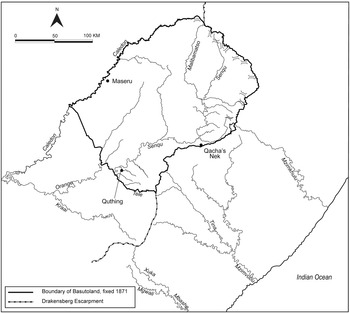
Mapote and How met in November 1930 in what was then Basutoland (modern-day Lesotho, Fig. 1), a British protectorate established in 1871 (under Imperial rule from 1886) from the polity forged by the first Sotho monarch Moshoeshoe I in the early nineteenth century. While separate from South Africa, Basutoland's politico-economic trajectories were closely related to its neighbour and the lives of its bureaucrats, scholars and scientists were trans-national. During the mid nineteenth century, Anglophone administrators and naturalists based at the Cape conducted field research in and around the Maloti-Drakensberg Mountains (straddling Basutoland and South Africa) (King Reference King2015), while a growing network of Francophone missionary-intellectuals pursued studies of ethnology, history, architecture and natural science (King Reference King2019, 79–80). In the late nineteenth and early twentieth centuries, scholarship by black historians and ethnologists (many of whom were mission-educated) remained confined to missionary publications or to the handful of prominent outlets that emerged at a remove from the Cape (King Reference King2019, 84–6).
Map showing the location of places mentioned in the text.

As archaeological scholarship in southern Africa became systematized (Gertrude Caton-Thompson's 1929 excavations at Great Zimbabwe are typically treated as Year Zero for this) and professionalized, the split between Anglophone and Francophone intellectual communities increasingly reflected a split in disciplinary professionalization. Rock art splintered from ‘dirt’ archaeology in its methodologies and field practices as well as the geopolitical affiliations of its actors: globally, the most prominent rock-art scholars of the early twentieth century included French intellectuals like Breuil, whose work in southern Africa dovetailed with fieldwork by archaeologists like Clarence van Riet Lowe and A.J.H. Goodwin, but was also facilitated through more amateur work by missionaries like Frederick Christol (Dubow Reference Dubow2019; Schlanger Reference Schlanger2019). How's bilingual family and her personal connections to missionary-scholars such as Christol helped her navigate across these knowledge networks. Black field practitioners were essential to fieldwork during this time, but were rarely acknowledged and appear fleetingly in associated accounts (Shepherd Reference Shepherd2003).
Rock-art field recording and interpretation in the first half of the twentieth century hinged on the visual literacy of its fieldworkers. Copyists (including women like Joyce and Mollie van der Riet and Helen Tongue) were valued for their abilities to make accurate replicas of paintings as observed in the field, which in turn entailed the skill to discern, trace and colour nuances of complex scenes (Weintroub Reference Weintroub2009; Wintjes Reference Wintjes2017; Witelson Reference Witelson2018). Breuil's interpretations were lauded as authoritative based on his eye for detail, derived in part from the breadth and diversity of paintings he had seen (Dubow Reference Dubow2019). For scholars like Christol and Dorothea Bleek, authoritative interpretation entailed both visual literacy and ethnological knowledge of the people believed to have painted the art, a perspective resonant with the region's earliest rock-art interpretations from the 1860s and 1870s. Thus, while much rock art was held to be the product of Bushman communities (past or present), the key to unlocking understandings of the art's meaning lay with oral testimonies from people who could claim a link with or first-person experience of Bushman painters. This was not analogical reasoning but the result of persistent racial-evolutionist perspectives that held hunter-gatherer communities as living relics of a primitive society, in which belief systems and art practices were hereditary (cf. Bank Reference Bank2000).
Mapote's encounter with How occurred in this intellectual setting. Before proceeding, a note on our use of the term ‘Bushman’. From the seventeenth to the twentieth centuries, this was used pejoratively, denoting excessive mobility, criminality, savagery and possibly slave-like status. However, Indigenous communities often self-identified as Bushmen, incorporating a range of languages historically known as Khoisan and hunter-gatherer-pastoral traits, while occasionally signifying resistance against settler colonists. The term is not interchangeable with ‘San’. We retain Bushman because 1) it is the word used in the original documents we discuss; and 2) as the word Bushman became freighted with additional meanings during the last two centuries, substituting another word would obscure these details. While we omit inverted commas around Bushman/Bushmen for aesthetic reasons, we view this as a complex construct throughout.
‘I asked him if he would do some painting for me’
Mapote and How's meeting was set in motion years earlier through the relationship between How's grandfather David-Frédéric Ellenberger and Mapote's father Moorosi. Moorosi led a group known as BaPhuthi, subordinate to the Basotho royal house founded by Moshoeshoe but with authority in Basutoland's mountains south of the Senqu River. As Moorosi's missionary, Ellenberger occupied a station in the midst of Moorosi's territories and consequently was well positioned not only to become familiar with Moorosi but to witness the events that unfolded when Moorosi led an 1879 revolt against British and Basotho forces (King Reference King2019, 79, 209). After an eight-month campaign, Moorosi's rebels were overpowered, sent into indentured labour at the Cape or dispersed through the southern Maloti-Drakensberg (Moorosi himself was killed); Mapote was one of the dispersed, having fought alongside his father. How later credited Ellenberger's close relationship with Moorosi as the reason Mapote was willing to travel from his home in South Africa to visit her in highland Basutoland in 1930Footnote 1 (see endnotes for primary archival sources).
As Mapote's first and perhaps most significant interlocutor, How's perspectives on this encounter must be understood both in terms of her intellectual agenda and the overlap of her familial and scientific knowledge networks. The two major sources of information about this meeting represent different moments in time: How's field notes taken at the time of the 1930 meeting, and the draft manuscript of what would become her published Mountain Bushmen of Basutoland (1962), which she wrote 27 years later.Footnote 2 As such the manuscript is shaded by How's memories, reflections and an agenda influenced by her later awareness of campaigns of Bushman extermination. The manuscript offers the clearest account of How's motivations for initiating the encounter with Mapote, which is supported by her scholarly work in other areas (e.g. editing Ellenberger's archive). Thus, while this post-facto, remembered quality of the manuscript is worth bearing in mind and inflects the nature of her narrative, we can proceed with some degree of confidence as to her accounting of her project's rationale.
In the manuscript, How locates the origins of her work with Mapote in the ethnological projects of her father J.C. MacGregor and Ellenberger, and the scholarship of amateur archaeologists like Christol, who published his major work L'art dans l'Afrique australe in Reference Christol1911. Ellenberger and MacGregor jointly researched and (in some versions) co-authored History of the Basutos (Reference Ellenberger and MacGregor1912), and the sprawling archive of their work amounted to an heirloom. Notably, they collected the oral and genealogical material that formed the basis of their publication during the course of their respective professional and pastoral duties (the latter as a District Commissioner) (King Reference King2018). How carried this habit forward as she conducted her own research into rock art, ethnology, history and veterinary science while her husband, Lt.-Col. Douglas Walsham How, was employed as a Basutoland administrator.
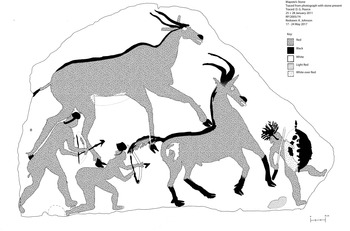
Christol's publications provided How's entry point into rock-art research, specifically his suggestion that art production was an inherited cultural feature of African communities. On reading Christol's book in the late 1920s, How set out to test this hypothesis by asking her ‘servants in the kitchen’Footnote 3 whether they recognized the carvings on a walking stick given to her husband by a Sotho policeman. The response—‘perhaps [the carver] may have got his ideas from seeing his father painting in the caves with the Bushmen’Footnote 4—included a recommendation to find Mapote, a relative of Moorosi who could provide more information. Invoking their family connections, How persuaded Mapote to travel to her home in Qacha's Nek, where he stayed for several days as she interviewed him and observed as he executed a sample painting for her on a stone taken from her garden (Fig. 2). Mapote's compensation for this was a new pair of boots.Footnote 5
Mapote's Stone. (Re-drawing: Kiah Johnson.)

In this project, How joined the ranks of the rock-art field researchers and women copyists described above, with some significant differences. While her interests were perhaps most closely aligned with Ellenberger's oral history collection, Christol's focus on art production and Dorothea Bleek's interweaving of ethnographic evidence and art interpretation, the experimental nature of Mapote's commission stands out, as do the sorts of information How collected from Mapote.
How's interviews with Mapote ranged widely and covered his painting techniques, interpretations of the scene he produced, biography and remembered elements of regional history.Footnote 6 Mapote demonstrated how he created paintbrushes of different lengths and sizes from bird feathers and provided the Sesotho names (some of which may have been informed by Khoe-Kwadi loanwords: cf. Bleek Reference Bleek1956, 507–10) for the pigments and binders that he used. While the manuscript and book contain lengthy quotes from Mapote, these are absent from How's field notes, and qualifications of How's own account that she initially included in the manuscript (e.g. ‘If I remember rightly […]’) were deleted from the published version.Footnote 7 Such quotes therefore may be remembered, manufactured, or exist in undiscovered notebooks.
While How and Mapote discussed at length what qualified as an authentic or best red pigment, and How was even able to produce a sample of this (obtained from an acquaintance), Mapote was compelled to paint with ochre sold in the local general store due to the small amount of the genuine material available (e.g. ‘I [How] should send to the local shop for a little red ochre and he would show me the difference between it and Qhang Qhang’).Footnote 8 He explained how this needed to be mixed with blood (preferably eland, but How ordered ox blood from a nearby butcher) to achieve the proper consistency and binding properties necessary to create a vivid, lasting image.Footnote 9
How took this as an example of the inauthenticity of Mapote's practice, which was augmented for her by his biography (see below). Mapote explained how Moorosi had children with a number of ‘wives’ who included Bushmen, and that Mapote was not descended from these. Consequently, while he learned to paint from his extended Bushman family, How explains that ‘he and his half Bushman step-brothers […] used to paint together at one end of the cave and the real Bushmen together at the other’.Footnote 10 She also notes that Mapote's explanations of his craft included identifying where he was deviating from more Bushman-like ways of operating. Thus, when the manuscript includes statements such as, ‘my husband and I […] went quickly onto the verandah to see the next best thing to a real Bushman painting being done’, both the painting and Mapote himself were treated as less than original.Footnote 11
These conversations left How with the impression that Mapote's paintings represented a moribund practice, attenuated or adulterated through a combination of historical forces (resulting in the annihilation and acculturation of Bushman communities) and the attrition of a relic culture in the face of modernity (cf. McGranaghan Reference McGranaghan2016). While her initial interest in Mapote was spurred by a belief in the doomed nature of painting knowledge, in the process of her research How became increasingly convinced that he represented one glimpse of a widespread phenomenon:
mountains and the deserts in the West of South Africa were the last strongholds of the clever and tragic little Bushmen, who being congealed in their ancient customs found it so difficult to understand the changing times, and got very little sympathy to help them to do so.Footnote 12
How's lifelong movement through social circles containing government administrators, law enforcement officials and military officers, along with her own research, revealed to her the campaigns of genocide and forced assimilation of San communities that unfolded during the previous two centuries. Her personal and public writing lamented this loss, while also disclosing her fondness for the officers charged with violence against these same communities.Footnote 13
Nevertheless, as early as 1930 she was aware of the scientific value that vanishing Bushman knowledge represented, and this knowledge underpinned her decisions to record and, ultimately, disseminate Mapote's information.Footnote 14 This did not simply include reproducing Mapote's paintings in a scholarly format, but also transcribing his testimony in detail and augmenting it with chemical analyses of the pigments used. Her reproductions of Mapote's recipes for pigments and binders, brush manufacture and preparing rock surface are faithfully rendered across field notes, manuscript drafts and the final publication. She sent samples of the ‘authentic’ red pigment to an unnamed laboratory for chemical analysis (of what sort is unclear).
How elaborated upon this record by conducting a second experiment with another descendant of Moorosi's constituents called Masitise in 1932.Footnote 15 While her goal was to produce another exemplar of Bushman painting, it was a different experience to her meeting with Mapote. How did not document Masitise's process in the same amount of detail (‘I do not remember what pigments he used, they must have been the same as Mapote used or I would have noted the difference’Footnote 16) and she described herself as less attentive to Masitise throughout. Her comments from this meeting (documented in the manuscript) largely related to his interpretation of the painting he produced (he described this as a battle of the ‘last Bushman’ of the Drakensberg; see Mitchell Reference Mitchell2010) and some information on traditional plant use, which she compared with Mapote's information in the final publication.Footnote 17
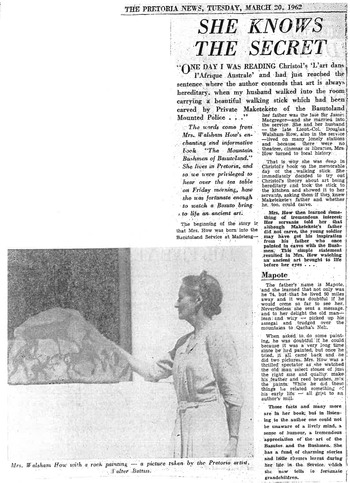
Mountain Bushmen presents How's primary data from these experiments, interwoven with a narrative that includes historical research, reminiscence of her family's presence in Basutoland and illustrations of a range of ethnographic objects including walking sticks and snuff boxes. In terms of genre, the book owes much to precursors in travel writing and early ethnological literature, drawing inspiration from Ellenberger, Christol and George Stow, as well as missionary chroniclers like Thomas Arbousset and François Daumas (Reference Arbousset and Daumas1846). This was a self-aware choice: the transition from manuscript to book shows How edited out lengthier digressions on her experiences of travelling through the Maloti-Drakensberg and incorporated a larger number of references to published scholarship. When the book was released, How was praised within South Africa both for her ability to identify Mapote and Masitise as rare anthropological specimens, and for her success in documenting a significant part of the region's heritage in such compelling and useful detail (Fig. 3).
Newspaper clipping announcing the publication of Mountain Bushmen with a photograph of How alongside Mapote's Stone. (The Pretoria News, 20 March 1962.)

Expertise and qualification
In How and Mapote's encounter, we can observe several sorts of knowledge-making at work. Based on the archive documenting the life-span of How's research, we can consider Mapote initially acting as more of a field assistant than an ethnographic informant, although by the time How published her book he had been transformed into the latter. In How's field notes, she described Mapote asserting that he knew the difference between authentic and substitute practices and utilizing his own skill to innovate when he felt that the latter were unavoidable. Aware of an ideal way of working and the impossibility of accomplishing this, Mapote made modifications suited to the materials available to him, drawing on his scientific expertise to make judgements as to the most effective changes possible.
In this fieldwork stage, the interactions between How and Mapote appear at their most collaborative within the confines of the power imbalance that existed, with the two discussing the painting process and negotiating compromises according to Mapote's preferences. At this point, Mapote most resembled a field assistant: he offered his expertise and knowledge to advance a data-collecting enterprise with an awareness of that enterprise's goal, both with respect to producing the painting and to providing information necessary to collect samples of raw materials for pigments. Mapote was also put in the position of acting as a self-aware analyst of a cultural community—to reflect on what separated Bushmen from people like himself in BaPhuthi society. One way to view this is that Mapote communicated a theory of ‘Bushman-ness’ to How, consisting of the manner in which Bushmen painted and alluding to a difference between this and another category of person, a category that Mapote himself represented. In transcribing and reporting this, How mapped the concepts Mapote communicated onto Western ideas about racial purity, although there is good reason to consider (based on scholarship examining meanings for ‘Bushman’ across English and African languages) that Mapote may have been using Bushman to refer to a subjugated form of personhood (Morelli Reference Morelli2019).
Yet How's writing did not credit Mapote with innovating; rather, these modifications were seen as ersatz traditions, making do in less than perfect conditions and as such rendering the entire performance of painting less than authentic. His execution and technique retained some intellectual value, enhanced by his real-time explanation of what he was adapting and why, but the use of inauthentic raw materials dimmed (for How) the significance of the project.
As How wrote up her field notes and, later, prepared the manuscript for publication, she cast Mapote more definitively as an ethnographic informant, positioning herself as the greater authority on Mapote's knowledge (see below) and treating this knowledge not as rooted in his individuality, but rather in a cultural community that she defined. The book achieves this through its narrative form, by interspersing Mapote's testimony with vignettes of other field encounters (e.g. a Mosotho man called Samuel Masao reacting to burning pigment), using it to explicate examples of Bushman art from elsewhere, or qualifying it with other scientific data. For instance, she follows Mapote's account of the white pigment's production with a statement by the laboratory analyst Uranovsky that Mapote must have been mistaken about the quality of this paint (How Reference How1962, 36). Despite her scepticism over the reliability of Masitise's information, How published this alongside data from Mapote, presenting these as corroborating one another (e.g. How Reference How1962, 34).
This use of Masitise's testimony in the book as valid in combination with Mapote's is very different to the way How described Masitise in the manuscript. While the book presents ‘the Artist Masitise’ with the caveat that ‘Masitise's evidence was far less [convincing] than of Mapote’, the manuscript is more dismissive. There, she suggested that Masitise's knowledge was too geographically narrow to be of much use,Footnote 18 adding: ‘I was not as impressed by Masitisi as I was by old Mapote. Some of Masitisi's statements are I think exaggerations. They not only do not “ring true” like Mapote's, but they do not seem possible.’Footnote 19 That the manuscript presented Masitise's and Mapote's stories in two separate sections makes the perceived weakness of Masitise's story stand out even more, whereas in the book information extracted from each account is distributed across the book's chapters, including under the heading ‘Lore and Culture of the Mountain Bushmen’. In the process of assembling the book and evaluating the evidence before her, How concluded that Mapote was the more authoritative of the two artists, at least by the standards that she had set. Yet much of this authority is lost in the final analysis, as Mapote's information—including the Stone, the paints he produced and the stories that he relayed to How—was carved up and threaded through the book to be presented as individual pieces of data, which How could then validate and use to produce a more totalizing picture of Bushman culture.
This strategy is perhaps not wholly uncommon in ethnographic work, but that is the point: it represents a decision to treat Mapote's information as part of a comparative ethnographic project. In the manuscript, Mapote's in-the-moment decisions were clearer and his skill and innovation were evidenced more fully. In the journey from notes to manuscript to book, How transformed him more decisively into an ethnographic informant through her presentation and qualification of his evidence. This is the archival apparatus at work: extracting data from Mapote and his Stone, treating these as usable, verifiable aspects of his story, and transforming them into evidence through analysis that included chemical composition, ethnographic comparison and historical contextualization—all based on what How saw as the standards for authority and acceptance in contemporary ethnological scholarship.
Amateurism and authority
How's own transformation into an authoritative voice on rock-art production was based on her ability to gather, record and present data in a manner that accorded with contemporary ethnographic and archaeological standards; to distinguish between real and attenuated painting styles; and to rank Mapote's and Masitise's work relative to one another and to her wider research. She drew comparisons between Mapote's and Masitise's paintings and those she had seen in rock-shelters in the Maloti-Drakensberg, highlighting divergences in style and execution and suggesting an imitation or degradation of more ancient art (although rock art was produced in the region well into the nineteenth and twentieth centuries: e.g. Challis Reference Challis2012; Mallen Reference Mallen2008):
It seemed to me when looking at the paintings of Mapote and Masitisi that I could see two differences between real Bushmen paintings and theirs. Even when Mapote was painting on a piece of rock that was too small, his figures and animals were large—so were those of Masitisi. But even if the little yellow men had a whole cave wall to paint on, the figures and cattle they painted were unusually small. Their pictures were much more full of life and movement, as if they enjoyed depicting energetic lively happenings.Footnote 20
Recalling the importance of visual literacy in establishing authority in rock-art studies, How's ability to relate Mapote's art to in situ examples from elsewhere was a means of asserting familiarity and expertise, which became an expression of authority when the full project was published in Mountain Bushmen. How also bolstered her claims for recognition by drawing on assistance from established experts like Ronald Stretton Webb (a historian and ethnologist who advised her on regional historyFootnote 21) and James Walton (the architect and colonial administrator who illustrated Mountain Bushmen), even as she was tepid in questioning established researchers like Christol and Stow.
Additionally, the fidelity between the painting itself, the field notes and the book (something How comments on in the manuscriptFootnote 22) further validated the evidentiary value of Mapote's experiment at the time of publication. Our own analyses confirm that How's reproduction of Mapote's work was accurate. As sampling the Stone's pigments was not allowed, we carried out Raman spectroscopy on Mapote's Stone with both green (514 nm) and near-IR (785 nm) lasers at the University of the Witwatersrand, in order to confirm the pigments employed for each colour and to start a reference database for further in situ and laboratory characterization of rock paintings. Results show that the red is composed mainly of haematite and clay, consistent with red ochre, and the black of amorphous carbon, consistent with charcoal. The white pigment is a mixture of quartz, gypsum, haematite, clay and calcite, which is identical to the results of analysis reported by How (Reference How1962, 36).
Transforming Mapote's Stone into a piece of evidence relied not only on her chemical analysis, but also on maintaining the position that Mapote's knowledge was a scarce resource:
He said that it was a very long time since he had done any painting. He thought of asking some old friends to come and do it with him. ‘I will ask … I will ask …’. He put his hand over his eyes and said again ‘I will ask …’. Then he took his hand from his eyes, looked at me and said, ‘They are all dead that I could ask’.Footnote 23
Towards the end of the manuscript, How drew attention to the disappearance of Bushmen from southern Africa, linking this both to campaigns of genocide and enslavement in the early nineteenth century and to a suggestion that such violence may also have been understandable in light of how ‘cruel and vindictive they could be in a cattle raid’.Footnote 24 It is clear that she saw some distinction between deliberate annihilation and something more tragic and unavoidable, and that she arrived at this in part through her relationships with people involved. For instance, How described a Frontier Armed and Mounted Policeman as ‘one of the kindest men that ever lived’ and charged with killing Bushmen on sight.Footnote 25 The ‘disappearance’ of Bushmen was, in her eyes, a tragedy for science. That part of How's achievement in eliciting Mapote's artwork and publishing this in Mountain Bushmen was due to her capturing a relic culture is further evidenced by the newspaper coverage of the book's publication. Regional papers heralded Mountain Bushmen as describing ‘an ancient art brought to life’, with Mapote described as ‘a Basuto’.Footnote 26 Mapote's knowledge was seen as useful here precisely because of his marginalization.
The processes described above illustrate how archaeology's archival apparatus worked to transform Mapote and How's encounter—with all its complex micropolitics of knowledge-making—into usable evidence. How extracted elements from Mapote's experiment (biographical details, pigment recipes, technical pointers), subjected these to visual, chemical and historical analysis that served to validate them independently from Mapote, documented and ranked examples of painting production, and justified the publication value of the project in terms of ethnographic salvage. However, this apparatus did not stop working when Mountain Bushmen was published: our own Raman analyses are the latest of a decades-long series of interventions implicating Mapote's Stone in building knowledge about rock art in southern Africa and beyond.
What sort of science is rock-art interpretation?
As rock-art research became more formalized over the twentieth century, concerns over the use of ethnography became defining features of this sub-field. Ultimately, these concerns were not just about producing robust analogical comparisons between ethnography and art, but with the extent to which ethnographic sources could constitute reliable or appropriate sources of data. Despite decades of debate on this topic, though, insufficient attention has been paid to the conditions under which ethnographic accounts have become constituted as useful evidence in the first place, leaving testimonies like Mapote's in something of an intellectual cul-de-sac: open to re-interpretation but often not going so far as to critique the terms on which this testimony was generated in the first place.
While rock-art studies in the first half of the century often turned to ethnographic testimony to describe or interpret some facet of art imagery (particularly in discerning evidence of ‘hunting magic’: McGranaghan & Challis Reference McGranaghan and Challis2017), approaches grounded in field archaeology and stratigraphy turned to image style as the outcome of painters’ own evolution, and thus necessary to establishing chronology to produce suitable interpretations (Conkey Reference Conkey, David and McNiven2018). The use of ethnography became more rigorous following the structuralist turn of the late 1950s–1980s, especially in southern Africa, where ethnographic analogy and a direct historical approach utilizing ethnographic data became the dominant global paradigm for rock art (Conkey Reference Conkey and Whitley2001).
In this vein, a major inflection point in southern African rock-art interpretation was the argument that the production and consumption of art by San painters must be considered as a holistic experience encompassing the use and manufacture of pigments and painting implements, the interface with the rock face (as a ‘veil’ between worlds: Lewis-Williams & Dowson Reference Lewis-Williams and Dowson1990), and the later viewing of the art (often including touching it). Mapote's Stone and testimony became significant in this context, as they constituted a rare and exhaustive account of pigment production and painting practice. Indeed, despite How's incomplete satisfaction with Mapote's authenticity, later scholarly interventions were able to identify facets of Mapote's testimony that were sufficiently consonant with a broader San ethnographic corpus as to render his information more useful than How had perhaps credited (e.g. Lewis-Williams Reference Lewis-Williams1995; Reference Lewis-Williams and Price2001; Reference Lewis-Williams2002; Lewis-Williams & Pearce Reference Lewis-Williams and Pearce2004, 101–2).
However, the less-than-Bushman parts of Mapote's biography (his association with Moorosi's Phuthi, for instance) were not relevant in this context and continued to fade from view. In this and subsequent scholarship, Mapote's position as an ethnographic informant was affirmed where his experiment was held up as an example of Bushman ideas—where his account of painting separately from ‘more Bushman’ relatives was treated as a wider tendency or traditional practice (Blundell Reference Blundell2004). Masitise's information is barely discussed in later scholarship.
Intersecting with the elaboration of the shamanistic paradigm, the late 1980s–2000s also saw heavier critiques of ethnographic analogy, especially concerning hunter-gatherers in southern Africa. Analogical reasoning in African contexts was in need of revision (not least for its invocation of sources freighted with racist epistemologies), and emergent details of the long-term interactions among diverse linguistic and cultural groups across the continent raised the question of whether modern hunter-gatherer communities were appropriate analogues for ancient ones, given the socio-economic transformations that the former had undergone (Hammond-Tooke Reference Hammond-Tooke1998; Jolly Reference Jolly1993; Wilmsen & Denbow Reference Wilmsen and Denbow1999). Mapote's testimony became a case study in this debate, as his account of socio-cultural mixing between San and Phuthi was taken as evidence not only of San acculturation, but of the difficulty of characterizing creolized cultures (e.g. Jolly Reference Jolly1996).
Late twentieth-century revisionist calls concerning ethnographic analogies (especially those built from historical sources) focused more on the reliability and authenticity of the ‘source’ side of the analogy and the accuracy with which researchers were able to interpret ethnographic sources. We submit that relatively less focus has fallen on the epistemologies underpinning the production of the ethnographic record. That is, ethnographic accounts were accepted as de facto anthropological evidence rather than interrogated as to how they became evidence in the first place—which entails attention to the dynamics of knowledge production within historiographic analysis of scientific cultures.
This trend applies to rock-art research globally. Despite decades of self-critique and revisionism there are still no universally agreed methodologies for working with ethnography in rock-art studies (Monney & Barrachini Reference Monney, Baracchini, David and McNiven2018). In the early 1990s, scholars distinguished between informed (utilizing ‘insider’ perspectives on art meaning and production) and formal (studying the form of the art) interpretive approaches (Chippindale & Taçon Reference Chippindale, Taçon, Chippindale and Taçon1998). The first of these, however, does not include a well-defined set of methods, nor does it encourage reflection on the epistemologies involved in interpreting ethnographic and visual sources together. Also sorely needed are efforts by archaeologists to re-trace primary evidence of field encounters and problematize the nature of field and subject in them (but see McGranaghan et al. Reference McGranaghan, Challis and Lewis-Williams2013; Monney Reference Monney2015). Such an approach demands more critical, thorough and innovative use of archival and museum sources; greater attention to the dynamics of knowledge production between collectors and interlocutors; and how those dynamics transform interlocutors from, for instance, skilled craftspeople into ethnographic subjects.
In Mapote's case, the ambiguous distinction between field assistant and informant, technician and subject, is a reminder that the evidentiary usefulness of his contributions were contingent not just on How's intellectual orientation, but on subsequent engagements with her publication—how the products of archaeology's archival apparatus circulate among and give form to a knowledge community. This is not meant as an indictment of ethnographic analogy, nor as an exercise in fault-finding with shamanism. Instead, we draw attention to the intellectual imperative to re-trace histories and habits of knowledge production, especially when historical and ethnographic sources have a long afterlife. Such an approach would constitute the sort of intervention in rock-art studies called for by Meg Conkey (Reference Conkey, David and McNiven2018): taking seriously a wider context of image production that includes experimental or commissioned work by craftspeople like Mapote.
Conclusion
The encounter between Mapote and How, including the paintings it produced, is good to think with. We rarely have access to a window on the intimate dynamics of meetings like this, and where such accounts exist they are not always so persistent in archaeological literature. Nancy Jacobs (Reference Jacobs2006, 567) has argued that ‘sustained attention to knowledge systems can inappropriately reify difference and detract attention from practices’; rather than assuming that How initiated her project with fixed ideas about race and culture, it is fruitful to focus on how these ideas were shaped through the micropolitics of encounter with Mapote and others involved in producing Mountain Bushmen. In this case, How's awareness of what was necessary to demonstrate expertise and produce valid science fed into her choices to treat Mapote less like an assistant and more like an ethnographic informant—useful less for his expertise than for his ability to refract some sense of Bushman-ness. While she certainly was inclined to the latter view from the outset, her decisions on how to present Mapote's information, how to contextualize it within other examples of rock art, how to evaluate it relative to Masitise's art and how to analyse it as a specimen represent her understanding of how to transform Mapote's knowledge into ethnographic and archaeological evidence. This understanding developed over the course of her reflection on the meetings with Mapote and Masitise, and was as much to do with her embeddedness within a network of amateur and professional scholars as with her personal interests and experiences (recalling her attachment to Mapote as an extension of her grandfather's work).
This process of making knowledge also entailed discarding information not deemed usable in ethnological science, and underscores the dehumanization that accompanies such epistemic choices. Masitise's contributions were dismissed almost in their entirety and we are left with virtually no information about him beyond what How thought was relevant to her project: the narrative of the scene that he painted and some stray pieces of information about plant use. How accorded Mapote's information more value and went to greater lengths to document it faithfully, attempting to preserve it in detail befitting a vanishing resource. If we attempt to work backwards through the lens of How's epistemic biases to recover Mapote's agency and backstory, we might read his contribution as attempting to relay his own theory of what it meant to live and work like a Bushman—a designation that could refer to a kind of personhood bounded by social status, subjugation and language. We might also focus on Mapote's experiences as a member of a different marginalized community—Moorosi's Phuthi—seeking security and recognition in the wake of Moorosi's rebellion and his descendants’ subsequent dispersal. We might consider that his return to Basutoland 50 years after his kin were subject to state-led violence and coerced labour to meet How entailed a significant risk for him (see King Reference King2019).
Beyond attempting to find an ‘un-filtered’ version of Mapote's account, it is worth returning to Mavhunga's argument that innovation in Africa's long past is under-explored. Mapote and the encounter with How illustrate the need to recover scientific skill within sources and archives already embedded within the archaeological canon but obscured by our archival apparatus and the epistemologies it enables. Indeed, we submit that this apparatus can work to modify or obscure the micropolitics of encounter—we see this in action as How's field notes were shaped into a research publication—and that this erasure can easily be perpetuated in subsequent scholarship. In this sense, usability of Indigenous knowledge is a determination made at multiple points in the process of producing archaeological evidence: the field, the archive, the publication and its audience. Each of these is a major arena for interrogating how Indigenous expertise is acknowledged or marginalized, and each requires a specific suite of methodological interventions to understand these processes. In describing one example in detail, we offer an example of such an intervention that has wide resonance with field encounters—historical and contemporary—world-wide.
Acknowledgements
We thank the Van der Byl family for making Mapote's Stone available for display and research. Mark McGranaghan provided helpful comments on earlier drafts of this paper. Thanks to Peter Mitchell for assistance in accessing reference materials amidst the constraints of the COVID-19 lockdown.