Introduction
Microorganisms demonstrate remarkable metabolic diversity, including the ability to dehalogenate a wide variety of halogenated compounds (Smidt & de Vos Reference Smidt and de Vos2004). Substantial research on microbial dehalogenation has been conducted in pursuit of pollution abatement technologies, but since natural sources of halocarbons exist (Gribble Reference Gribble2003), degradation of non-xenobiotic compounds also occurs in nature. In anoxic environments such as sediments, microbial dehalogenation can allow for the subsequent oxidation of the hydrocarbon structure for carbon and energy sources, or reductive dehalogenation can serve as an electron sink for oxidative metabolism. Some bacteria can conserve energy released from reductive dehalogenation reactions for growth through a process termed (de)halorespiration or halidogenesis (Löffler et al. Reference Löffler, Cole, Ritalahti, Tiedje, Haggblom and Bossert2003). Due to the exergonic nature of reductive dehalogenation, it is a competitive respiratory process capable of out-competing sulphidogenesis, methanogenesis, and acetogenesis in anaerobic environments (Fennell & Gossett Reference Fennell and Gossett1998, Löffler et al. Reference Löffler, Tiedje and Sanford1999).
Antarctica is an interesting location for the study of the natural production and consumption of halogenated compounds, since it is far removed from anthropogenic sources of such material. Biogenic production of brominated and iodated C1 and C2 alkanes has been reported in Antarctic melt pond ecosystems (Schall et al. Reference Schall, Heumann, DeMora and Lee1996). These ponds are located on the McMurdo Ice Shelf in the Ross Sea, are dominated by thick photosynthetic microbial mats, and have been studied extensively for photosynthetic processes. Cyanobacteria, such as Nostoc are known to have halocarbon producing populations (Gribble Reference Gribble2003) and are present in these ponds, although their role in halocarbon production at these sites has not been confirmed (Schall et al. Reference Schall, Heumann, DeMora and Lee1996). Recent studies of the anaerobic sediments below the photosynthetic mats in McMurdo Ice Shelf ponds examined processes controlling terminal carbon flow (Mountfort et al. Reference Mountfort, Kaspar, Downes and Asher1999, Reference Mountfort, Kaspar, Asher and Sutherland2003).
We hypothesized that biogenic halocarbons produced in the microbial mats in melt ponds could serve as competitive microbial electron acceptors for respiration in the underlying anaerobic sediment and, hence, support dehalogenating microbial populations. This study examines the dehalogenation potential of model halocarbons by anoxic sediments of eight Antarctic melt ponds.
Materials and methods
Samples were collected in the summer (January 2001). “Orange Pond”, “Foam Pond”, “Russel Pond”, and “Skua Pond” are located near Bratina Island, and “Rock Pond”, “Boulder Pond”, and “Boulder Dry Pond” (unofficial names) are located at Cape Evans on Ross Island. Pond geochemistry was not determined but physicochemical characterization of McMurdo Ice Shelf ponds is well documented (Mountfort et al. Reference Mountfort, Kaspar, Asher and Sutherland2003). Sediment was sampled within 0.5 m of the pond shore into 50 ml Corning tubes (plastic) and stored at 5°C while in Antarctica. The samples were shipped to Michigan State University from Christchurch, New Zealand on ice. Sediments were stored at 5°C and microcosms were prepared within one month.
Viability of the anaerobic community was ascertained by testing the potential for methanogensis. Methane production was assayed in 60 ml serum bottles using 30 ml of a modified complex medium (Cote & Gherna Reference Cote, Gherna, Gerhardt, Murray, Wood and Krieg1994). No mercaptoethanesulfonic acid was added, and 5 mM sodium acetate was included as electron donor. Duplicate cultures were measured every two to four days for methane formation (Löffler et al. Reference Löffler, Champine, Ritalahti, Sprague and Tiedje1997).
Dehalogenation activity was assayed in microcosms prepared with 100 ml of anaerobic bicarbonate buffered mineral medium (pH 7.3) in 160 ml serum bottles (Löffler et al. Reference Löffler, Champine, Ritalahti, Sprague and Tiedje1997). The medium was reduced with 0.4 mM sodium sulfide. Lactate (1 mmol, 10 mM), acetate (1 mmol, 10 mM), or hydrogen (400 µmol) plus acetate (200 µmol, 2 mM), were added as electron donors and carbon sources. PCE (15 µmol), TCE (15 µmol), 2-bromophenol plus 2-chlorophenol (25 µmol, 250 µM, each), or 3-bromobenzoate + 3-chlorobenzoate (50 µmol, 500 µM each) were added as potential electron acceptors. The analogous chlorinated and brominated compounds were included in the same treatments to reduce the number of treatments. Microcosms without halogenated compounds and uninoculated cultures served as controls. Cultures were incubated statically in the dark at 20–22°C and were measured by UV-Vis HPLC or GC-FID periodically for 16 months for halocarbon transformation (Sun et al. Reference Sun, Cole, Sanford and Tiedje2000). To confirm activity of primary enrichments, which were performed singly, a 1% inoculum was transferred in duplicate from selected cultures to fresh medium and assayed as before.
“Foam Pond” sediments were chosen to estimate the 2-bromophenol debrominator population size by Most Probable Number (MPN). Five replicates at five serial dilutions were used. The medium was bicarbonate buffered mineral medium with lactate (5 mM) and acetate (2 mM) as carbon and electron donors and supplemented with 100 mg L-1 yeast extract and 0.4 mM sodium sulphide. 2-bromophenol (125 µM) was added as electron acceptor. Foam Pond sediment (1 g wet weight) was added to medium for the lowest dilution. Phenol, 2-bromophenol, and methane were measured after 2 and 16 months. The 95% confidence intervals of the debrominating and methanogenic population sizes were estimated using in Microsoft Excel worksheet designed for MPN calculations (Briones & Reichardt Reference Briones and Reichardt1999).
Results
To study the potential for reductive dehalogenation in Antarctic melt-pond sediments, model halocarbon compounds were chosen that represent known biogenic or geogenic compounds and whose degradation is well studied in mesophilic, anaerobic systems. Although low temperature incubations would have more closely reflected in situ conditions, incubations were conducted at 20–22°C to favour more rapid activity of these generally slow metabolic processes. Negative results, therefore, do not rule out potential activity by psychrophiles at lower temperatures.
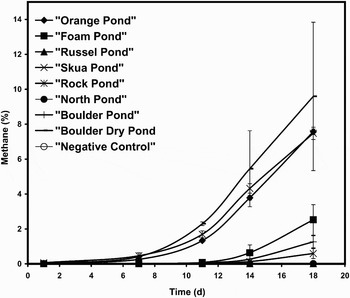
To confirm the viability of the anaerobic communities after sampling and transport, methane production was assayed in complex enrichment medium (Fig. 1). Methane production was rapid in “Boulder Dry Pond”, “Skua Pond”, and “Orange Pond”, with methane exceeding 7% headspace gas in 18 days. Methane production in “Foam Pond”, “Boulder Pond”, “Rock Pond”, and “Russel Pond” began after a 12-day lag period. No methane was detected in “North Pond” sediments in complex medium, although methane was detected in the dehalogenation enrichments from this site.
Headspace methane production from anaerobic complex medium inoculated with Antarctic melt pond sediments. Error bars represent standard deviation.

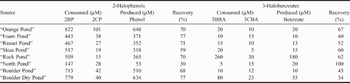
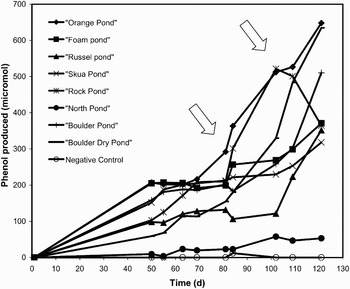
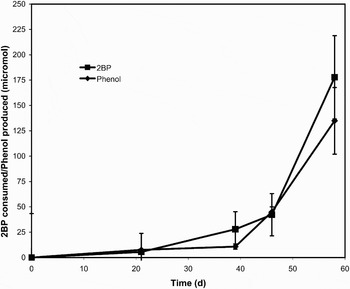
The potential for dehalogenation of halophenols was tested in lactate amended minimal medium with 2-bromophenol (2BP) and 2-chlorophenol (2CP). The initial feeding of 2BP (250 µM) was debrominated by seven of the eight sediments tested and continued upon multiple feedings (Table I). No enrichment consumed the initial feeding of 2CP (250 µM). “Orange Pond” showed the most 2CP loss (101 µM). This activity commenced after 102 days and was minor compared to 2BP debromination (Table I). Phenol accumulated in all cultures (Fig. 2), and in the most active cultures accounted for up to 77% of halophenol loss (Table I). Net phenol consumption was apparent after 102 days in the “Rock Pond” enrichment (Fig. 2). Debromination occurred in all transfers of the active microcosms. “Orange Pond” had the most active populations, and phenol production accounted for 76% of 2BP loss (Fig. 3). 2-Bromoethane sulphonate (2 mM), an inhibitor of methanogensis, did not inhibit debromination in secondary transfers from “Foam Pond” and “Orange Pond” enrichments.
Halophenol and halobenzoate dehalogenation in Antarctic melt pond sediments amended with lactate (10 mM) and either 2-bromophenol (2BP, 250 µM) plus 2-chlorophenol (2CP, 250 µM) or 3-bromobenzoate (3BBA, 500 µM) plus 3-chlorobenzoate (3CBA, 500 µM). 3-Halobenzoate cultures were not fed during the eight month incubation. All 2-halophenol cultures, except “North Pond”, were re-fed 2BP (250 µM) at day 81. “Orange Pond,” “Boulder Dry Pond,” and “Boulder Pond” were fed 2BP (250 µM) again at day 101. Data for 2-halophenols is presented for a three month incubation.

Phenol production from 2-bromophenol (2BP) and 2-chlorophenol fed primary enrichment cultures from Antarctic melt pond sediments amended with lactate (10 mM) as an electron donor. The first arrow indicates when all cultures, except “North Pond,” were re-fed 250 µM 2BP. The second arrow indicates when “Orange Pond,” “Boulder Dry Pond,” and “Boulder Pond” were given a third feeding of 250 µM 2BP.

2-Bromophenol debromination in 1% transfers from the halophenol enrichment culture from “Orange Pond” amended with 10 mM lactate as an electron donor. Error bars represent standard deviation.

The potential for halobenzoate dehalogenation was tested with 3-bromobenzoate (3BBA) and 3-chlorobenzoate (3CBA). Substantial debromination of 3BBA only occurred in one enrichment, “Rock Pond” (Table I). Benzoate accounting for 62% of 3BBA loss accumulated in this culture, and debromination occurred in the absence of significant methanogensis. Limited 3BBA debromination also occurred in “Boulder Dry Pond” cultures but only upon extended incubation. 3BBA debromination was not as rapid or as widely distributed among the sediments as 2BP debromination. No substantial dechlorination of 3CBA was observed (Table I).
To estimate the dehalogenator population size in an Antarctic melt pond sediment, a Most Probable Number (MPN) enrichment experiment was performed with “Foam Pond” sediment. The first sampling of the “Foam Pond” MPN tubes after two months only showed debromination in the lowest dilution corresponding to a population size of 7.2–79 debrominating cells g-1 wet weight (95% C.I.). After 16 months, however, activity was detected in higher dilutions, and the population size was estimated at 103–104 cells g-1 wet weight. At both time points all replicates at all dilutions showed methane production, suggesting the methanogen population size was greater than the upper detection limit of the dilution series, i.e. 1.39 × 10⁵ cells g-1 wet weight.
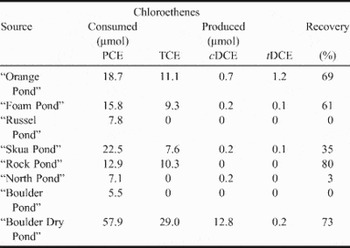
Five sediments dechlorinated PCE to TCE with acetate, or hydrogen plus acetate as electron donors (Table II, Fig. 4). Dechlorination was slow, occurring over 2–4 months, and initially did not proceed past TCE in these cultures or in primary enrichments with TCE plus lactate. Dechlorination products, TCE and DCEs, accounted for up to 80% of PCE loss in active enrichment cultures (Table II). After prolonged incubation (> 10 months), cis-DCE and a mixture of trans-DCE and cis-DCE accumulated in certain enrichments. PCE dechlorinating cultures first converted PCE to TCE, before further reduction to DCEs (data not shown). Only “Orange Pond” dechlorinated TCE when it was added as the starting substrate and produced trans-DCE and cis-DCE in a ratio of approximately 2-3:1.
Tetrachloroethene (PCE) conversion to trichloroethene (TCE) and dichloroethenes (DCE) in Antarctic melt pond sediment microcosms amended with lactate (10 mM) and PCE (20 µmol). “Boulder Dry Pond” was fed additional PCE (20 µmol) twice, and “Skua Pond” was re-fed once.

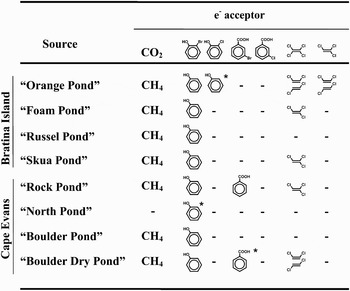
Overview of dehalogenation activity in melt pond sediment microcosms derived from Cape Evans and Bratina Island. The asterisks indicate the initial feedings were only partially transformed even after 16 months of incubation. The “-” indicates there was no product formation for that treatment.

Discussion
Antarctica is a promising location to study natural halogen cycles due to its geographic isolation and relatively limited human impact. We hypothesized that melt ponds like those on the McMurdo Ice Shelf would harbour dehalogenating microbial populations since these ponds are known to produce biogenic halocarbons (Schall et al. Reference Schall, Heumann, DeMora and Lee1996). In theory, the abundant phototrophs in the mats could both produce biogenic halocarbons and, through primary production, create conditions for an active anaerobic community in the underlying sediment (Mountfort et al. Reference Mountfort, Kaspar, Downes and Asher1999, Reference Mountfort, Kaspar, Asher and Sutherland2003). Since reductive dehalogenation is a competitive electron accepting process (Fennell & Gossett Reference Fennell and Gossett1998, Löffler et al. Reference Löffler, Tiedje and Sanford1999), halocarbons in the anaerobic sediments could support halorespiring populations.
Although the microbiology of the melt ponds scattered on the McMurdo Ice Shelf has been examined for several decades, the small ponds sampled on Cape Evans are not well documented. Three of the Cape Evans ponds, “Rock Pond”, “Boulder Pond”, and “Boulder Dry Pond”, were small - about 2 m in diameter - and formed in the shadows of large boulders. “Boulder Dry Pond”, in fact, did not contain standing water at the time of sampling and was noticeable only by a darker colour against the otherwise light, dry soil in that area. The “Boulder Dry Pond” sample was dense with organic matter and when rehydrated upon inoculation of the microcosms, turned a deep green colour suggesting the site contained substantial photosynthetic mat material. This dry pond, presumable aerobic at the time of sampling, was the most rapid to produce methane and was active in several of the dehalogenating enrichments suggesting even less obvious Antarctic environments may support active anaerobic communities capable of reductive dehalogenation.
We tested six model compounds to screen for dehalogenation (Fig. 4). Although dechlorination of chlorinated aromatic compounds was limited, 2BP was debrominated in seven of the eight sediments and one site showed clear debromination of 3BBA. 3BBA debromination occurred in the absence of methanogenesis in “Rock Pond”, and the two 2BP secondary enrichments tested were not inhibited by BES, a common inhibitor of methanogenesis and often used to test for cometabolic activity of methanogens in dehalogenating cultures. These results are consistent with the traditional view that aromatic halocarbons are typically not subject to cometabolic dehalogenation (Holliger et al. Reference Holliger, Regeard, Diekert, Haggblom and Bossert2003). These finding are further consistent with numerous reports of 2BP and bromobenzoate dehalogenation and a common preference for dehalogenation of brominated over chlorinated compounds (Linkfield et al. Reference Linkfield, Sulfita and Tiedje1989, Sanford et al. Reference Sanford, Cole and Tiedje2002, Ahn et al. Reference Ahn, Rhee, Fennell, Kerkhof, Hentschel and Haggblom2003, Rhee et al. Reference Rhee, Fennell, Haggblom and Kerkhof2003, Fennell et al. Reference Fennell, Rhee, Ahn, Haggblom and Kerkhof2004).
Our MPN study showed a 2BP debrominating population of 103–104 cells g-1 wet wt. All replicates in all MPN dilutions, even those that did not debrominate, showed methane production after two months, further suggesting no obligatory link between methanogenesis and debromination in these sediments.
Chloroethene dechlorination was slow and primarily produced TCE from PCE. Although halorespiring organisms are known to perform this single-step dechlorination of PCE (Löffler et al. Reference Löffler, Cole, Ritalahti, Tiedje, Haggblom and Bossert2003), it is also reported as a common co-metabolic reaction catalysed by reduced co-factors of acetogens and methanogens (Holliger et al. Reference Holliger, Regeard, Diekert, Haggblom and Bossert2003). In addition, Desulfomonile tiedjei strain DCB1 is a 3CBA dechlorinating strain that is also known to cometabolically dechlorinate PCE to TCE when its 3CBA dehalogenase is induced (Cole et al. Reference Cole, Fathepure and Tiedje1995). Certainly methanogensis was active in chloroethene amended cultures. Therefore, it is currently unclear if the dechlorination of PCE to TCE observed in our microcosms was due to metabolic or cometabolic processes. The further conversion of TCE to a mixture of trans- and cis-DCE in a 3:1 ratio is a recently described microbial transformation (Griffin et al. Reference Griffin, Tiedje and Löffler2004, Miller et al. Reference Miller, Milliken, Sowers and May2005). Further studies with the actual brominated or iodated aliphatic C1-C2 compounds identified in these ponds may prove better substrates than the chlorinated model compounds tested here.
These results demonstrate the presence of reductive dehalogenating activity in Antarctic melt-pond sediments. Dehalogenating populations have apparently survived dispersal to the Antarctic. Whether the dispersal events were ancient or more recent, once there, some populations grew locally to a population of 103–104 debrominators g-1 sediment as estimated by our MPN results. However, the metabolic diversity of dehalogenating populations appears much less than in many US and European sediments, as judged by the limited range of substrates transformed and the very slow enrichment. This is consistent with the more depauperate state of most species in Antarctica and reflects both limitations in dispersal and in colonization. Of course, pond specific biogenic halocarbons, medium composition, and incubation conditions would likely increase the number of successful enrichment substrates. Nonetheless, finding dehalogenating populations in a remote, pristine environment is significant to understanding their biogeography and historical ecological role. Furthermore, this work demonstrates Antarctic melt ponds as suitable systems in which to study the novel metabolism fuelling natural halogen cycles.
Acknowledgements
This work was supported the NSF Training Course in Antarctic Biology and the NASA Astrobiology Institute's Center for the Genomic and Evolutionary Adaptation to Cold. B.M.G was partially supported by an EPA STAR Graduate Fellowship.